




Abstract
ASEAN's response to the 2025 Myanmar earthquake (M7.7, over 5400 deaths) produced a compliance-harm paradox: rapid political coordination, record DELSA deployment, and procedural compliance coexisted with 74 per cent of the worst-affected townships lacking shelter assistance seven weeks later, continuing airstrikes, and politically directed aid. This article develops an embedded normative tension framework, bridging constructivist and practice-attentive institutional analysis, to explain why institutional success and humanitarian failure were structurally co-produced. AADMER incorporates sovereignty-procedural and humanitarian-needs-based norms that coexist compatibly under stable conditions but become irreconcilable under compound emergencies—when the affected state is itself a source of humanitarian harm. Three practice-mediated mechanisms locked in sovereignty-procedural dominance: institutional channelling via the National Focal Point, the post-Nargis depoliticisation constraint, and the consensus veto compounded by intra-ASEAN fragmentation. The ASEAN Chair's resort to bilateral improvisation outside AADMER confirms the architecture's structural inadequacy, revealing this paradox as an enduring feature of sovereignty-centric disaster governance.
Introduction
On 28 March 2025, a magnitude 7.7 earthquake struck central Myanmar—the most powerful seismic event to affect the country since 1912. The earthquake killed over 5400 people, injured more than 11,400, destroyed approximately 224,000 homes, and caused economic losses estimated at USD 11 billion, equivalent to 14 per cent of Myanmar's GDP (AHA Centre, 2025d; UN OCHA, 2025b). Yet the earthquake was not merely a natural disaster. It struck a country in the midst of civil war following the February 2021 military coup, where the State Administration Council (SAC) controlled approximately 17 per cent of the territory, the remainder being contested by the National Unity Government (NUG) and numerous ethnic armed organisations (Special Advisory Council for Myanmar, 2024). The worst-affected Sagaing Region was a core stronghold of armed resistance, already subject to military airstrikes and deliberate internet shutdowns. Approximately 2.6 million internally displaced persons existed before the earthquake, and the health system was near collapse (Institute of Development Studies, 2025).
This convergence of natural disaster and political-military crisis constituted what the international humanitarian community defines as a compound emergency (Duffield, 1994; UN Inter-agency Standing Committee, 1994)—and it presented ASEAN's disaster governance architecture with its most consequential test. The ASEAN Agreement on Disaster Management and Emergency Response (AADMER), signed in 2005 and operationalised through the AHA Centre, ASEAN-ERAT, and DELSA, represents two decades of institutional development born from the Indian Ocean tsunami and Cyclone Nargis. The earthquake activated this architecture under conditions that fundamentally violated its design assumptions: no stable unified government, contested territorial control, an obstructive host state, and a disaster inextricable from ongoing armed conflict.
The response produced a striking divergence. ASEAN's official reporting documented substantial achievements: political coordination within 48 h, a record DELSA deployment of USD 633,044, activation of the Humanitarian Assistance Coordinator role for the first time, and comprehensive procedural compliance (AHA Centre, 2025d, 2025c). Simultaneously, UN agencies and international human rights organisations reported that 74 per cent of the worst-affected townships lacked shelter assistance seven weeks after the disaster, over 120 airstrikes continued during the declared ceasefire, and the military systematically blocked humanitarian access to resistance-held territories while directing aid based on political loyalty rather than need (Amnesty International, 2025b; Human Rights Watch, 2025; UN OCHA, 2025c).
This article argues that the divergence between institutional outputs and humanitarian outcomes is neither paradoxical nor accidental but the predictable manifestation of an embedded normative tension within AADMER. The agreement simultaneously incorporates two legitimate but potentially contradictory normative orders: a sovereignty-procedural order (state sovereignty, non-interference, state-led coordination, consensus) and a humanitarian-needs-based order (humanity, impartiality, needs-based access, community participation). Under stable conditions—when the affected government is cooperative and controls its territory—these norm sets produce compatible outcomes. Under compound emergency conditions, faithful implementation of the sovereignty-procedural order structurally undermines humanitarian outcomes, as the institutional mechanisms designed to facilitate assistance become instruments through which an obstructive state constrains it.
The research question guiding this analysis is: How did the latent tension between sovereignty-procedural norms and humanitarian norms embedded in AADMER manifest in the 2025 Myanmar earthquake compound emergency, and what structural limitations of ASEAN disaster governance does this reveal?
The 2025 earthquake constitutes what Yin (2018) terms a ‘revelatory case’—the first observation of AADMER's disaster governance mechanisms operating under full compound emergency conditions. While Cyclone Nargis (2008) occurred under an authoritarian government that obstructed international aid, it did not involve active civil war with fragmented territorial control. The 2025 case thus enables analytical observation of institutional dynamics that previous disasters had only partially exposed. The reliance on secondary sources reflects the access constraints inherent in the case—a limitation the article acknowledges while arguing that the available evidence is sufficient to demonstrate the structural pattern at stake.
The article employs a single revelatory case study (Yin, 2018) with a structured comparative dimension, analysing AADMER's performance across two normative lenses applied to the same empirical events. The analysis draws on primary documents from the AHA Centre, UN OCHA situation reports, and monitoring by international human rights organisations, triangulated against ASEAN official statements and AADMER's legal text. These three source categories embody systematically different normative perspectives: AHA Centre reporting reflects the sovereignty-procedural framework within which it operates UN and NGO monitoring applies humanitarian-needs-based criteria, and ASEAN political statements reveal the diplomatic negotiation between the two. This triangulation strategy treats the divergence between source categories not as a methodological problem but as empirical evidence of the embedded normative tension itself. The analytical procedure proceeds in three steps: mapping AADMER's institutional design against its two embedded normative orders (Section III), tracing the 2025 earthquake response through both normative lenses to document the divergence between institutional outputs and humanitarian outcomes (Section IV), and identifying the structural mechanisms through which sovereignty-procedural norms dominated using process tracing (Section V).
The data consist of three source categories with systematically different normative orientations: AHA Centre situation reports and ASEAN official statements constitute the sovereignty-procedural record; UN OCHA, OHCHR, and monitoring reports from Amnesty International, Human Rights Watch, Fortify Rights, CARE, and UN Women provide the humanitarian-needs-based record; and AADMER's legal text and SASOP protocols serve as the institutional baseline. The analysis identifies embedded normative tension through four observable indicators applicable beyond this case: (1) coexisting textual provisions invoking competing normative logics within the same agreement (ASEAN, 2009, Articles 3 and 20); (2) the absence of hierarchical ordering between them; (3) implicit scope conditions whose simultaneous violation renders the normative orders incompatible; and (4) documentary evidence of operational friction in cases partially approaching these conditions, such as Cyclone Mocha (2023).
Two methodological clarifications are warranted. First, as Neumann (2002) and the practice theory tradition emphasise, practitioners embedded within institutional communities may experience norms as coherent even where external analysts identify structural contradictions; ASEAN practitioners may navigate normative tensions pragmatically without recognising them as structural features (Martel and Glas, 2023). This article does not claim that all practitioners perceive the tension in the terms articulated here; the embedded normative tension is an analytical construct derived from the institutional architecture and its documented effects, not a phenomenological claim about practitioner consciousness. Second, the article does not incorporate interview data. Three constraints rendered systematic interviewing impracticable: the active civil war made engagement with Myanmar-based officials logistically infeasible and ethically problematic; ASEAN institutional culture constrains officials’ willingness to discuss normative contradictions during ongoing crises (Serey et al., 2024); and the article's central argument concerns structural properties of AADMER's normative architecture observable in institutional outcomes without requiring subjective accounts. Future research incorporating elite interviews and ethnographic methods could enrich this structural account.
The article proceeds as follows. Section II develops the theoretical framework, synthesising constructivist accounts of ASEAN's sovereignty-procedural norms, international humanitarian scholarship on needs-based principles, and institutional analyses of AADMER to conceptualise the embedded normative tension. Section III examines AADMER's institutional design as the embodiment of the sovereignty-procedural normative order and identifies its implicit assumptions. Section IV analyses the 2025 earthquake response, demonstrating the systematic divergence between institutional outputs and humanitarian outcomes. Section V explains why sovereignty-procedural norms prevailed through three structural mechanisms—institutional channelling, depoliticisation constraint, and consensus veto—examines the intra-ASEAN dynamics that shaped the response, and draws broader theoretical implications for sovereignty-centric regional organisations. Section VI concludes.
Theoretical Background: Normative Tensions in Regional Disaster Governance
This section develops the analytical framework that guides the subsequent empirical analysis of ASEAN's response to the 2025 Myanmar earthquake. The framework draws on three bodies of scholarship: constructivist accounts of ASEAN's sovereignty-procedural normative order, international humanitarian studies on needs-based principles, and recent institutional analyses of ASEAN's disaster governance mechanisms. By synthesising these literatures, this article identifies an embedded normative tension within AADMER—a structural contradiction between sovereignty-procedural norms and humanitarian norms that remains latent under stable state conditions but becomes acutely manifest when disaster strikes in the context of a compound emergency.
The ASEAN Way and the Sovereignty-Procedural Normative Order
The normative foundations of ASEAN regionalism have generated one of the most productive debates in Asian international relations scholarship. Acharya's (2001) constructivist account posits that ASEAN member states developed a distinctive set of shared norms—non-interference, non-use of force, quiet diplomacy, mutual respect for sovereignty, and consensus-based decision-making—that collectively constitute the ‘ASEAN Way’. For Acharya, these norms are not merely constraints on state behaviour but constitutive elements of a nascent security community, providing the ideational infrastructure for peaceful conflict management among states with vastly different political systems. His subsequent work on ‘norm localisation’ (Acharya, 2004) further argues that ASEAN does not passively receive global norms but actively reconstructs them to fit pre-existing regional normative orders, a process that simultaneously legitimises international principles and preserves local ownership. Acharya's (2011) concept of ‘norm subsidiarity’ extends this argument further, proposing that regional actors do not merely localise external norms but actively create new norms to protect their autonomy from perceived overreach by global governance frameworks—a dynamic particularly relevant to ASEAN's engagement with international humanitarian principles.
This constructivist reading, however, has faced sustained critique. Narine (2002, 2009) offers a sceptical assessment, contending that the ASEAN Way functions less as a genuine normative community than as a diplomatic convenience that shields authoritarian regimes from external scrutiny. Jones (2010, 2012) pushes this critique further, arguing that non-interference has never been the inviolable principle its proponents claim; rather, ASEAN states have consistently intervened in one another's affairs when their material interests demanded it, while invoking non-interference selectively to deflect unwanted international pressure. In Jones's reading, sovereignty norms in ASEAN are not fixed but strategically deployed, creating what he terms an ‘unchanged melody’ that masks considerable variation in actual practice.
The 2021 Myanmar coup and its aftermath have brought these theoretical tensions into sharp empirical focus. Plunkett and Tansey (2024) introduce the concept of ‘norm waverers’ to capture ASEAN's inconsistent and vacillating response, characterised by initial assertiveness—the unprecedented Five-Point Consensus—followed by systematic backtracking driven by reputation management rather than genuine norm enforcement. Serey et al. (2024) similarly demonstrate that post-coup ASEAN dynamics reveal a contest between the norm of ‘ASEAN centrality’ and the norm of non-interference, with different member states prioritising different norms depending on their strategic calculations. Morada (2023) goes furthest, proposing that ASEAN adopt a ‘non-indifference’ principle and consider membership suspension—a direct challenge to the sovereignty-procedural order. Haacke (2025) offers a more nuanced reassessment, arguing that the Five-Point Consensus, despite its widely acknowledged implementation failures, has nonetheless shifted the boundaries of ASEAN's legitimate diplomatic involvement in a member state's internal affairs—an incremental but significant normative evolution.
What emerges from this literature is a normative order that can be characterised as sovereignty-procedural: a set of interlinked norms governing who decides and how decisions are made within ASEAN frameworks. The core principles—sovereignty, non-interference, consensus, and state-led coordination—collectively establish that the affected state government serves as the exclusive legitimate interlocutor, that external actors operate only upon invitation and within parameters set by the host state, and that ASEAN institutions facilitate rather than direct member state actions. This normative order has proven remarkably durable precisely because, as Acharya (2001) notes, it provides ontological security to regimes of diverse political character.
Humanitarian Principles and the Needs-Based Normative Order
Running parallel to the sovereignty-procedural tradition is an equally well-established normative order rooted in international humanitarian principles. The foundational principles of humanity, impartiality, neutrality, and independence—codified by Pictet (1979) and subsequently adopted across the international humanitarian system—establish a fundamentally different logic of action. Where sovereignty-procedural norms ask ‘who has authority?’ humanitarian norms ask ‘who has need?’ The principle of humanity demands that human suffering be addressed wherever it is found; impartiality requires that assistance be provided solely on the basis of need without discrimination; neutrality prohibits taking sides in hostilities; and independence mandates that humanitarian action remain autonomous from political, military, or economic objectives (Barnett and Weiss, 2008, 2011).
The relationship between these humanitarian principles and state sovereignty has long been a central problematic in international relations. Peters (2009) argues that sovereignty is increasingly ‘humanised’, deriving its normative legitimacy from the state's capacity to serve its population. The responsibility to protect (R2P) doctrine, articulated by ICISS (2001) and subsequently refined by Bellamy (2010, 2015), represents the most ambitious attempt to reconcile sovereignty with humanitarian imperatives by reframing sovereignty as conditional upon a state's fulfilment of its protective obligations. Yet as Welsh (2013) demonstrates R2P remains deeply contested both procedurally and substantively, and its scope was deliberately narrowed after the Nargis debate to exclude natural disasters (Junk, 2016).
Recent scholarship has further developed this relationship. Mine et al. (2019) demonstrate that East Asian actors have accepted comprehensive human security norms yet consistently frame them as complementary to state security, while Caballero-Anthony et al. (2023) show that Asian human security practice emphasises bottom-up resilience over top-down intervention, domesticating humanitarian norms within state-centric parameters. R2P's trajectory in Southeast Asia reveals a similar pattern: Bellamy and Drummond (2011) identify an accommodation between R2P and non-interference that limits coercive implications, while Maulana and Newman (2022) find that regional elites consciously contest R2P through ‘normative resistance’, invoking existing ASEAN principles to justify limited responses to mass atrocities. This pattern of selective engagement—accepting humanitarian principles rhetorically while constraining their operational implications through sovereignty-procedural mechanisms—is precisely the dynamic that the embedded normative tension framework seeks to capture at the institutional level within AADMER.
The concept of ‘complex emergencies’—the intersection of armed conflict, state fragility, and humanitarian crisis (Duffield, 1994; Macrae and Zwi, 1994)—is directly relevant here. In such settings, Biersteker et al. (2021) demonstrate that faithful adherence to state sovereignty channels may render humanitarian actors complicit in the exclusion and violence that generate need, while bypassing state authority risks undermining frameworks upon which sustained access depends. Lie (2020) shows that this tension generates persistent operational contradictions that no single framework has resolved.
This body of scholarship establishes what can be termed a humanitarian-needs-based normative order, which governs who should be reached and on what basis. Its core principles—needs-based allocation, non-discriminatory access, community participation, and operational independence from political actors—stand in logical tension with the sovereignty-procedural order, not because they are inherently incompatible, but because they establish different priority hierarchies when conflicts arise between state authority and human welfare (Barnett and Weiss, 2008; Biersteker et al., 2021).
AADMER as a Site of Embedded Normative Tension
The ASEAN Agreement on Disaster Management and Emergency Response (AADMER), signed in 2005 and entering into force in 2009, represents ASEAN's most institutionally ambitious attempt to codify regional disaster governance. Born directly from the institutional lessons of the 2004 Indian Ocean tsunami and catalysed by the political crisis surrounding Cyclone Nargis in 2008 (Amador, 2009; Passeri, 2022), AADMER established a comprehensive legal framework encompassing disaster risk reduction, emergency response coordination, and post-disaster recovery. The AHA Centre, operationalised in 2011, serves as the agreement's implementing body, coordinating regional disaster response through standardised operating procedures, pre-positioned relief supplies, and real-time information sharing.
What has received insufficient analytical attention, however, is that AADMER simultaneously incorporates both normative orders described above, and does so without establishing a clear hierarchy between them. On the sovereignty-procedural side, AADMER affirms the ‘sovereignty and territorial integrity of the Parties’ and designates each member state's National Focal Point (NFP) as the exclusive channel through which all assistance requests, offers, and coordination must flow. The agreement's operational architecture is fundamentally state-led: the affected government initiates requests, determines the scope of acceptable assistance, and retains authority over the distribution of relief. As Coe and Spandler (2022) argue in their landmark analysis, the AHA Centre's core political function is to empower ASEAN states vis-à-vis extraregional humanitarian actors, effectively enabling member states to gatekeep intrusive external aid while maintaining the appearance of regional cooperation.
Simultaneously, however, AADMER incorporates explicitly humanitarian language. The agreement references ‘humanitarian principles’, ‘the right of affected communities to participate in the planning, management, and implementation of disaster management activities’, and the imperative of ‘equitable access’ to disaster assistance (ASEAN, 2009, Articles 3 and 20). These provisions align with the needs-based normative order, implying that the ultimate measure of the agreement's success is not procedural compliance but humanitarian outcome—whether affected populations receive adequate, timely, and non-discriminatory assistance.
Suzuki (2021) provides a crucial insight in this regard, demonstrating that ASEAN's disaster management framework was deliberately designed as a mechanism for navigating the non-interference principle—what she terms ‘interfering via ASEAN’. Disaster response, unlike security cooperation or human rights monitoring, provides a politically acceptable entry point for regional engagement precisely because it can be framed as technical and humanitarian rather than political. The Nargis experience exemplified this logic: the Tripartite Core Group (TCG) mechanism enabled ASEAN to facilitate humanitarian access to Myanmar while formally preserving the military government's sovereign authority (Amador, 2009; Howe and Bang, 2017). Triyana et al. (2023) further identify persistent procedural gaps in AADMER's coordination and simplification mechanisms that impede effective implementation even under favourable political conditions.
This article's central analytical proposition builds upon these observations. The coexistence of sovereignty-procedural and humanitarian norms within AADMER constitutes what this article terms an embedded normative tension—a structural condition in which two legitimate but potentially contradictory sets of principles coexist within a single institutional framework. Under normal circumstances—when the affected government is stable, cooperative, and committed to its population's welfare—this tension remains latent. Faithful adherence to Norm Set A (sovereignty-procedural norms: working through the NFP, respecting state-led coordination, operating by consensus) naturally produces outcomes consistent with Norm Set B (humanitarian norms: needs-based assistance reaching affected populations without discrimination). The institutional architecture functions as designed because both normative orders point in the same operational direction. This compatibility is empirically evident in cases such as Typhoon Haiyan in the Philippines (2013) and the Sulawesi earthquake in Indonesia (2018), where cooperative host governments channelled international assistance through AADMER's NFP system, and the procedural outcomes of Norm Set A directly served the humanitarian objectives of Norm Set B without significant friction (Cook et al., 2025; Ferris and Petz, 2013).
The critical analytical question, however, is what happens when these conditions do not obtain—when the affected government is itself a party to conflict, when state channels are instruments of discrimination rather than conduits for impartial assistance, and when the NFP serves military-strategic rather than humanitarian-protective functions. In such compound emergencies, faithful implementation of Norm Set A structurally undermines the achievement of Norm Set B. Working exclusively through state channels strengthens a government that restricts humanitarian access; respecting state-led coordination defers to an authority that directs aid based on political loyalty rather than need; and operating by consensus grants veto power to the very actor whose conduct generates the humanitarian crisis.
This framework differs from Jones's (2010, 2012) strategic norm deployment thesis: the embedded normative tension is not about how actors use norms but about how the normative architecture itself generates contradictory imperatives regardless of actor intent. It extends Coe and Spandler's (2022) insight that the AHA Centre's political gatekeeping function is an emergent property of embedding two normative orders without establishing a hierarchy between them. Unlike Wiener's (2004) ‘contested compliance’ or Finnemore and Sikkink's (1998) norm life cycle—both of which address how actors dispute or diffuse norms—the AADMER case involves structurally contradictory norms that coexist uncontested until crisis conditions reveal their incompatibility. The framework focuses analytical attention on the conditions under which latent norm conflicts become manifest and the institutional mechanisms that determine which normative order prevails.
Tensions within ASEAN's normative order are not new. Haacke (2003, 2025) documents that sovereignty-protective and diplomatically progressive principles have coexisted since ASEAN's inception, with boundaries incrementally shifting across successive crises. Serey et al. (2024) identify competing normative impulses—centrality versus non-interference—in the post-coup Myanmar response. The embedded normative tension framework extends this insight by showing that AADMER codifies contradictory commitments within a single operational agreement where compound emergency conditions render the usual mechanisms of pragmatic management structurally inadequate. If such normative management is routine, however, a question arises about the status of the framework's second normative order: ASEAN may ‘pay lip service’ to humanitarian norms without genuine commitment.
Glas and Balogun (2020) demonstrate precisely this pattern in ASEAN's people-centric governance norm, which was institutionalised in a ‘limited and defensive way’ that preserved elite-driven governance. This article acknowledges the asymmetry: Norm Set B's analytical significance lies not in equivalent internalisation but in creating legitimate evaluative criteria that external actors—UN agencies, human rights organisations, affected communities—invoke to assess ASEAN's performance, yielding systematically different assessments under compound emergency conditions. Indeed, this asymmetry helps explain why Norm Set A dominates: it is backed by deeper practitioner commitment, while Norm Set B lacks equivalent practical constituency.
Moreover, the embedded normative tension operates not only between the institutional framework and the affected state but also among member states, which prioritise the two norm sets differently depending on their strategic calculations, historical relationships with Myanmar, and domestic political pressures. This intra-ASEAN differentiation means that the consensus mechanism does not merely transmit the affected state's preferences but actively produces outcomes shaped by the political configuration among members—a dimension explored in Section V.
Normative Tension in Institutional Practice
The framework's final theoretical dimension concerns how norms relate to the practices through which they are enacted. Recent scholarship cautions against treating norms as static entities detached from the practices through which they are enacted (Bernstein et al., 2025; Pratt, 2020). Practice-oriented ASEAN scholarship reinforces this point: Martel and Glas (2023) show that ASEAN diplomats invoke the ‘ASEAN Way’ as a flexible rhetorical resource rather than a fixed normative code, and Glas and Laurence (2022) demonstrate that the non-interference norm has changed through practice. This article takes these insights seriously. The embedded normative tension manifests not as an abstract textual contradiction but through the operational practices—NFP routines, SASOP protocols, consensus procedures—that enact AADMER's provisions. Under normal conditions, these practices fulfil both normative orders simultaneously, rendering the tension practically invisible; under compound emergency conditions, they produce systematic humanitarian failures, exposing the latent incompatibility. This practice-attentive reading distinguishes the framework from purely structural accounts that treat norms as automatically determining outcomes and purely strategic accounts that reduce them to post hoc rationalisations (Jones, 2010, 2012). The normative architecture shapes the field of possible action not by dictating choices but by structuring the institutional pathways through which those choices must be enacted.
The 2025 Myanmar earthquake provides what Yin (2018) terms a ‘revelatory case’ for examining this theoretical proposition. For the first time, AADMER's disaster governance mechanisms confronted the full compound emergency scenario: a magnitude 7.7 earthquake striking a member state in the midst of civil war, where the internationally recognised government was itself a military junta actively restricting humanitarian access to opposition-held territories. This unprecedented convergence of natural disaster and political crisis activated the embedded normative tension in its most acute form, revealing structural limitations that prior disasters—including Nargis in 2008, which occurred under authoritarianism but not active civil war—had only partially, exposed. Kelman's (2012) disaster diplomacy framework further suggests that such events can either catalyse diplomatic breakthroughs or deepen existing conflicts, making the 2025 earthquake a critical test of both ASEAN's institutional capacity and its normative coherence.
The following sections apply this framework to the empirical record of ASEAN's 2025 earthquake response, examining how the embedded normative tension manifested in institutional outputs (Section III) and humanitarian outcomes (Section IV), before analysing why the sovereignty-procedural normative order systematically dominated the humanitarian normative order and what this reveals about the structural limitations of ASEAN's disaster governance architecture (Section V).
AADMER's Institutional Design: The Sovereignty-Procedural Architecture
The Nargis Legacy and the Depoliticisation Strategy
AADMER's operational architecture cannot be understood apart from the political crisis that shaped its implementation. While the agreement was signed in 2005 following the Indian Ocean tsunami, its institutional development was decisively shaped by Cyclone Nargis, which struck Myanmar in May 2008, killing approximately 140,000 people and displacing 2.4 million (Tripartite Core Group, 2008). The military government's obstruction of international relief—refusing entry to foreign aid workers, delaying the importation of supplies, and rejecting offers of naval assistance from Western governments—provoked an international crisis in which France's Foreign Minister invoked the Responsibility to Protect doctrine (Howe and Bang, 2017; Junk, 2016).
ASEAN's response proved formative. The Tripartite Core Group (TCG)—comprising ASEAN, Myanmar, and the United Nations—brokered a compromise preserving the military government's formal sovereignty while enabling humanitarian access (Amador, 2009). The Post-Nargis Joint Assessment demonstrated that needs-based assistance could reach populations through state channels when the state cooperated, and the TCG was celebrated as an innovative model (ASEAN Secretariat, 2010).
Yet the Nargis experience embedded a specific lesson into ASEAN's institutional DNA: that disaster response must be rigorously depoliticised to secure member state cooperation. As Suzuki (2021) demonstrates, disaster management was deliberately positioned as a technical and humanitarian domain rather than a political one—a strategy of ‘interfering via ASEAN’ that provided a politically acceptable entry point for regional engagement precisely because it avoided challenging sovereignty. Coe and Spandler (2022) go further, arguing that the AHA Centre's core political function is to empower ASEAN member states to gatekeep intrusive extraregional humanitarian actors. Taken together, these accounts suggest that the post-Nargis institutional development entrenched a specific normative hierarchy within AADMER: Norm Set A (sovereignty-procedural norms) was consolidated as the default operational logic—what Coe and Spandler (2022: 362–364) describe as the AHA Centre's function of ‘empowering’ member states vis-à-vis external humanitarian actors—while Norm Set B (humanitarian norms) was relegated to an aspirational status, expected to be achieved as a natural consequence of procedural compliance rather than as an independent institutional imperative.
The Operational Architecture as Norm Set A Embodied
AADMER's operational mechanisms translate sovereignty-procedural norms into concrete institutional practices. Three elements are particularly significant. First, the National Focal Point (NFP) system designates each member state's government-appointed contact as the exclusive channel through which all assistance requests, offers, and coordination must flow (ASEAN, 2009, Article 3). Every external actor—including the AHA Centre itself—operates only through and with the approval of the NFP. This institutional design ensures that the affected state retains comprehensive authority over the direction, control, coordination, and supervision of all assistance activities within its territory.
Second, the standard operating procedure (SASOP) establishes time-bound protocols—initial reporting within 3 h, assistance approval within 6 to 12 h, search-and-rescue deployment within 10 h (ASEAN Secretariat, 2022)—but operates entirely within the state-consent framework. Third, the AHA Centre, ASEAN-ERAT, and DELSA constitute the operational infrastructure: the AHA Centre coordinates across 10 national disaster management organisations (Centre for Excellence in Disaster Management and Humanitarian Assistance, 2022), ASEAN-ERAT provides rapid deployment capacity (AHA Centre, 2018a), and DELSA maintains pre-positioned relief supplies (AHA Centre, 2018b). Collectively, these mechanisms enable operationally competent responses—provided the affected state functions as a cooperative partner.
Implicit Design Assumptions: When Norm Set A Achieves Norm Set B
The institutional architecture described above operates on four implicit assumptions. First, a stable, unified government exists in the affected state. Second, the government exercises effective control over the entirety of its territory. Third, the government is cooperatively disposed towards humanitarian assistance. Fourth, the disaster is primarily natural in origin, without significant political complications (Triyana et al., 2023). When these conditions obtain—as they did during Typhoon Haiyan in the Philippines (2013) and the Sulawesi earthquake in Indonesia (2018)—faithful implementation of the sovereignty-procedural architecture (Norm Set A) naturally produces humanitarian outcomes consistent with needs-based principles (Norm Set B). Working through a cooperative NFP channels assistance to populations in need; respecting state-led coordination ensures locally appropriate responses; and consensus-based decision-making builds trust that sustains long-term engagement.
The critical implication, identified in the theoretical framework above, is that AADMER contains no institutional mechanism for situations in which these assumptions do not hold. There is no protocol for engaging multiple authority structures in a fragmented governance environment, no provision for bypassing or supplementing a non-cooperative NFP, and no procedure for adjudicating between sovereignty-procedural and humanitarian norms when they conflict (Triyana et al., 2023). Passeri (2022) documents how Myanmar's military has systematically weaponised natural disasters across multiple crises from Nargis to COVID-19, yet AADMER's institutional design has not adapted to address this documented pattern. The absence of compound emergency protocols is not an oversight but a structural consequence of the depoliticisation strategy: acknowledging the possibility that a member state's government might obstruct humanitarian access would politicise the very domain that ASEAN sought to insulate from political contestation.
The 2025 Myanmar Earthquake: A Compound Emergency
The earthquake that struck central Myanmar on 28 March 2025 created precisely the conditions under which AADMER's implicit design assumptions collapsed. With a magnitude of 7.7, the earthquake was the most powerful to strike Myanmar since 1912, killing over 5400 people, injuring more than 11,400, and causing economic losses estimated at USD 11 billion—14 per cent of Myanmar's GDP (AHA Centre, 2025d; UN OCHA, 2025c). Approximately 224,000 homes were destroyed or severely damaged, and 6730 telecommunications facilities were incapacitated (UN OCHA, 2025a).
Crucially, the earthquake struck a country already in the throes of civil war. Since the February 2021 military coup, Myanmar has descended into armed conflict between the State Administration Council (SAC), the National Unity Government (NUG), and numerous ethnic armed organisations. By May 2024, the military's stable territorial control had diminished to approximately 17 per cent of the country (Special Advisory Council for Myanmar, 2024). The worst-affected Sagaing Region was a core stronghold of the resistance movement, where active combat operations continued. Prior to the earthquake, approximately 2.6 million internally displaced persons already existed, the health system was near collapse, and Sagaing had been subjected to deliberate internet shutdowns by the military (Institute of Development Studies, 2025).
This constituted what the IASC (1994) defines as a complex emergency. All four of AADMER's implicit design assumptions were simultaneously violated: no stable unified government, fractional territorial control, military obstruction of humanitarian access, and a disaster inextricable from ongoing armed conflict. While Cyclone Mocha (2023) also struck post-coup Myanmar, it affected a geographically limited front in Rakhine; the SG-AHAC role was not activated, and the SAC retained substantially greater national control. The 2025 earthquake thus represents a qualitative escalation—compound emergency conditions that Mocha had only partially foreshadowed.
The 2025 Earthquake Response: Norm Conflict Manifested
This section analyses the 2025 Myanmar earthquake response through the embedded normative tension framework developed above. It demonstrates that ASEAN's disaster governance mechanisms produced two fundamentally different outcomes depending on which normative lens is applied: substantial institutional outputs when measured against Norm Set A (sovereignty-procedural norms), and severely constrained humanitarian outcomes when measured against Norm Set B (humanitarian-needs-based norms). This divergence is not a paradox but the predictable manifestation of the latent norm conflict under compound emergency conditions.
Institutional Outputs: Norm Set A Functioning as Designed
Measured against its own sovereignty-procedural standards, ASEAN's response to the 2025 earthquake demonstrated that the institutional architecture built since Nargis functions effectively when activated through established channels. Three dimensions of institutional output merit examination. First, political coordination achieved unprecedented speed. Within 24 h, the ASEAN Chair (Malaysia) issued a formal statement of solidarity. Within 48 h, a special ASEAN Foreign Ministers’ Meeting was convened by video conference, approving collective assistance measures (ASEAN, 2025a). Most notably, the ASEAN Secretary-General activated the role of ASEAN Humanitarian Assistance Coordinator under AADMER Article 20 for the first time in the agreement's history (ASEAN, 2025b). Compared to the three weeks required to establish the TCG mechanism during Nargis, this represented a significant acceleration—evidence of 15 years of institutional development embedding procedural routines into organisational practice.
Second, resource mobilisation reached record levels. ASEAN-ERAT completed assessments across 40 townships (AHA Centre, 2025d). DELSA dispatched USD 633,044 in relief supplies—the largest single DELSA deployment—within prescribed SASOP timelines (AHA Centre, 2025c). A multinational search-and-rescue contingent of 462 personnel was deployed (AHA Centre, 2025a), and the Joint Operations and Coordination Centre for ASEAN (JOCCA) was established in Yangon (AHA Centre, 2025b).
Third, procedural compliance was maintained throughout. The NFP communication channel operated on a 24-h basis, the AHA Centre published ten situation reports between the day of the earthquake and 23 April, and standard operating procedures were observed in logistics, customs facilitation, and cross-border movement (AHA Centre, 2025d; ASEAN Secretariat, 2022). In sum, every element of AADMER's sovereignty-procedural architecture operated as designed: state consent was obtained, institutional channels were respected, consensus was maintained, and resources were mobilised through legitimate procedures.
Humanitarian Outcomes: Norm Set B Systematically Undermined
Evaluated against humanitarian-needs-based criteria, however, the same response reveals a fundamentally different picture. Four dimensions of humanitarian outcome demonstrate how faithful implementation of Norm Set A structurally constrained the achievement of Norm Set B. The most fundamental constraint was restricted humanitarian access—the severe limitation on physical access to affected populations. UN OCHA reported that days after the earthquake, substantial areas remained inaccessible even to UN agencies (UN OCHA, 2025a). Seven weeks after the disaster, 74 per cent of the most severely affected townships had not received shelter assistance due to access restrictions, limited operational capacity, and funding shortfalls (UN OCHA, 2025c). In the worst-affected Sagaing Region—a resistance stronghold—the military imposed strict controls on external access, requiring prior authorisation that was complex and time-consuming to obtain. Areas under resistance influence were structurally excluded from the official assistance framework, as the NFP channel could not reach territories beyond the military's control (Human Rights Watch and Physicians for Human Rights, 2025; Institute of Development Studies, 2025).
The 72-h ‘golden time’ for search and rescue (International Search and Rescue Advisory Group, 2020) elapsed before many affected areas could be reached. Despite ASEAN's political coordination within 48 h, access authorisation delays meant rescue teams could not enter substantial portions of the disaster zone within the critical window, with operations still ongoing 10 days later (UN OCHA, 2025a). The security environment compounded these delays: even during the declared ceasefire intended to facilitate earthquake relief, the military continued airstrikes in earthquake-affected areas of Sagaing Region, including an attack on a monastery sheltering a mobile medical team treating earthquake victims (Fortify Rights, 2025).
Discriminatory Aid Distribution
Where access was possible, the distribution of relief was distorted by the military's political objectives. Human Rights Watch and Amnesty International documented that the SAC controlled the distribution of humanitarian supplies and used them as instruments of political leverage (Amnesty International, 2025b; Human Rights Watch, 2025). Amnesty International characterised this as the ‘weaponisation of humanitarian aid’, reporting that the military systematically denied assistance to populations in resistance-held territories while directing supplies to areas under its control (Amnesty International, 2025a). Aid workers were stopped, interrogated, and extorted at military checkpoints, while local aid providers faced criminalisation for operating in opposition-held areas (Human Rights Watch and Physicians for Human Rights, 2025; OHCHR, 2025). This discriminatory distribution directly violated the humanitarian principle of impartiality—the core of Norm Set B—yet the sovereignty-procedural architecture provided no mechanism for ASEAN to challenge or circumvent these practices.
Continued Military Operations
The SAC declared a temporary ceasefire from 2 to 22 April, but this was not effectively observed. Amnesty International's monitoring documented over 120 airstrikes continuing after the earthquake, with military operations persisting in Sagaing and Magwe regions even as relief operations were underway (Amnesty International, 2025b). The UN High Commissioner for Human Rights reported that humanitarian workers faced obstruction at military checkpoints, including being stopped, interrogated, and extorted (UN OHCHR, 2025). Unexploded ordnance displaced by the earthquake created additional hazards for affected communities (UN OCHA, 2025b). This security environment rendered the humanitarian operating space fundamentally unsafe, yet AADMER's depoliticised framework contained no provisions for addressing security threats generated by a member state's own military.
Disproportionate Impact on Vulnerable Populations
The humanitarian consequences fell disproportionately on those already marginalised. Over 10.4 million women and girls required emergency assistance before the earthquake (UN Women, 2025); gender-based violence risks escalated in overcrowded shelters, with one site reporting 14 latrines for 1200 displaced persons (UN Women and UNFPA, 2025). Sixty-five per cent of children separated from families were girls, with early marriage and child labour among the most reported risks (CARE, 2025). Ethnic minority communities received systematically less assistance than populations in military-controlled areas—the antithesis of needs-based, non-discriminatory humanitarian assistance.
The Divergence: Two Valid but Incompatible Assessments
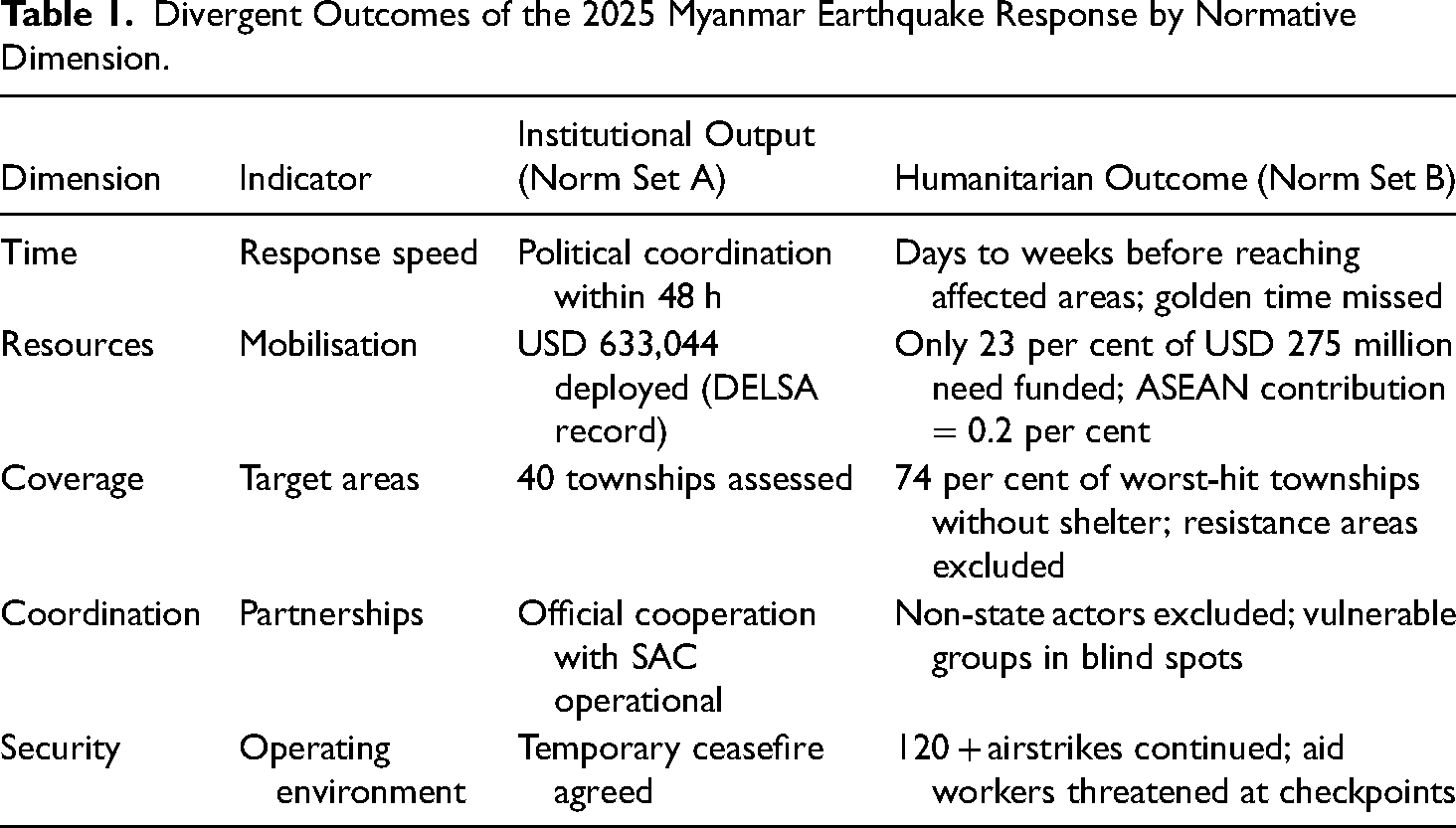
The analysis above reveals that two entirely valid yet irreconcilable assessments can be made of the same response. AHA Centre's official reporting emphasises the former set of outcomes; UN OCHA, Human Rights Watch, and Amnesty International emphasise the latter. The question is not which assessment is ‘correct’—both accurately describe different dimensions of the same reality—but what the divergence reveals about the institutional architecture that produced it.
The pattern that emerges from Table 1 is systematic rather than incidental. In every dimension, ASEAN succeeded in the domain it directly controlled—political coordination, procedural compliance, logistics within the state-consent framework—while failing in the domain that depended on the affected state's cooperation with humanitarian principles: actual access, equitable distribution, population protection. This pattern is precisely what the embedded normative tension framework predicts: under compound emergency conditions, faithful implementation of Norm Set A does not merely fail to achieve Norm Set B but actively works against it.
Divergent Outcomes of the 2025 Myanmar Earthquake Response by Normative Dimension.
Analysis: Why Sovereignty-Procedural Norms Prevailed
Structural Mechanisms of Norm Set A Dominance
This section explains why the sovereignty-procedural normative order (Norm Set A) prevailed over the humanitarian-needs-based normative order (Norm Set B), identifying three structural mechanisms that locked in this outcome. The first and most consequential mechanism was the institutional channelling effect of the NFP system. By design, AADMER routes all assistance through a single government-appointed contact, concentrating decisional authority in the affected state. In compound emergencies, this architectural feature transforms the institutional channel itself into an instrument of control. The SAC exploited its position as the sole legitimate interlocutor to selectively authorise access, direct supplies to politically favourable areas, and exclude populations in resistance-held territories from the official assistance framework. ASEAN's faithful adherence to the NFP channel—precisely the behaviour that Norm Set A demands—thereby amplified the military's capacity to weaponise humanitarian aid (Amnesty International, 2025a; Passeri, 2022). This created what can be termed a compliance-harm paradox: the more rigorously ASEAN complied with its own procedural norms, the greater the humanitarian harm it enabled.
The second mechanism was the depoliticisation constraint. As Section III demonstrated, AADMER's operational framework was deliberately designed to insulate disaster response from political contestation—a legacy of the Nargis experience that Suzuki (2021) identifies as ‘interfering via ASEAN’. This depoliticisation strategy foreclosed the institutional vocabulary and procedural mechanisms that would be needed to address the inherently political dimensions of a compound emergency. ASEAN possessed no mandate to challenge the SAC's obstruction of humanitarian access because acknowledging such obstruction would require acknowledging that the disaster was inseparable from the political-military conflict—the very entanglement that the depoliticisation strategy was designed to avoid. The absence of compound emergency protocols in AADMER is thus not a technical oversight but a structural consequence of the normative architecture: the system was designed to function as if disasters and politics occupy separate domains, and it has no capacity to respond when they demonstrably do not.
This characterisation rests on three convergent lines of evidence rather than an argument from silence. First, Coe and Spandler (2022: 362–364) document that the AHA Centre's institutional design presupposes the affected state as a cooperative partner, providing no procedural mechanism for the reverse scenario. Second, the discursive record of the 2025 response confirms this logic in practice: all ASEAN official statements and AHA Centre situation reports employed exclusively technical language—‘coordination’, ‘logistics’, ‘relief delivery’—while systematically avoiding reference to military obstruction or discriminatory distribution (AHA Centre, 2025d; ASEAN, 2025a, 2025b), even as UN OCHA (2025a, 2025c) and Amnesty International (2025b) documented these dimensions simultaneously. Third, the ASEAN Chair's resort to bilateral engagement with the NUG—declaring aid must reach populations ‘irrespective of who is in control of the territory’ (Wongcha-um, 2025)—required operating outside AADMER precisely because the institutional vocabulary contained no terms for such political acknowledgement.
The third mechanism was the consensus veto. ASEAN's consensus-based decision-making grants each member state an effective veto over collective action. In the disaster governance context, this means the affected state—whose conduct is the source of the humanitarian constraint—can block any institutional response that would challenge its authority. As Plunkett and Tansey (2024) demonstrate in the context of the Five-Point Consensus, ASEAN's norm enforcement is characterised by ‘wavering’ rather than sustained pressure, because the consensus requirement systematically favours inaction over confrontation. Applied to disaster governance, this mechanism ensures that Norm Set A's procedural requirements (state consent, consensus) operate as structural barriers to the implementation of Norm Set B's substantive imperatives (needs-based access, non-discrimination).
It should be acknowledged that ASEAN has occasionally exerted collective pressure on Myanmar: the Nargis TCG brokered humanitarian access (Amador, 2009; Howe and Bang, 2017), and the Five-Point Consensus represented an assertive response to the 2021 coup. However, these episodes reinforce the structural argument. The Nargis precedent operated within the state-consent architecture; the Five-Point Consensus was followed by systematic implementation failure because the consensus mechanism provided Myanmar with structural leverage to resist enforcement (Haacke, 2025; Plunkett and Tansey, 2024).
The 2025 response further revealed that the consensus mechanism operates through a politically differentiated field: Malaysia and Indonesia emphasised humanitarian access (Tang, 2025; Wongcha-um, 2025), while Cambodia, Laos, and Viet Nam maintained sovereignty-protective positions shaped by their single-party governance structures and strategic interest in preserving non-interference (Serey et al., 2024; Velikaya, 2025). Thailand and Singapore occupied a mediating position (Tang, 2025; Velikaya, 2025). This fragmentation rendered institutional adaptation structurally unattainable: member states sympathetic to Norm Set B lacked coalition strength to override the sovereignty-procedural default, while the consensus requirement ensured that sovereignty-protective members could maintain the status quo through simple inaction. A purely strategic account cannot explain why even Malaysia—the most assertive member—was compelled to operate outside AADMER's channels; the constraint lies in the normative architecture itself.
This empirical pattern enables adjudication between competing theoretical accounts. Jones's (2010, 2012) thesis that sovereignty norms are strategically deployed partially fits: Cambodia, Laos, and Viet Nam's sovereignty-protective stance aligns with their strategic interests. However, Jones's framework cannot explain two features. First, Malaysia's inability to pursue humanitarian objectives through AADMER despite holding the Chair demonstrates that the constraint is architectural, not coalitional—if norms were purely strategic instruments, a motivated Chair should have been able to deploy humanitarian norms within the framework. Second, the AHA Centre's consistent procedural compliance—routing assistance through the NFP, producing situation reports reflecting only the state-sanctioned operational picture—was not any actor's strategic choice but an institutional routine reproducing the sovereignty-procedural order without conscious norm deployment.
Drawing on Pratt's (2020) concept of normative configurations, this article argues that AADMER's sovereignty-procedural norms shape outcomes neither through automatic causal force independent of agency nor through deliberate strategic manipulation, but through the routinised institutional mechanisms documented in the preceding sections—the NFP communication channel, SASOP deployment sequences, and consensus decision-making procedures—that channel action along sovereignty-procedural pathways as embedded organisational routine, generating the compliance-harm paradox without requiring any actor to consciously choose sovereignty over humanitarianism. The normative architecture operates as a practice-mediated structural constraint rather than either norm-as-automatic-cause or norm-as-strategic-tool.
The ASEAN Chair's Dilemma: Bilateral Improvisation and Institutional Limits
The most analytically revealing development was Malaysia's resort to bilateral diplomacy outside AADMER's channels. On 17 April, Prime Minister Anwar met SAC leader Min Aung Hlaing in Bangkok—the first such meeting since the 2021 coup—and the following day held a video conference with NUG Prime Minister Mahn Win Khaing Than, marking ASEAN's first public engagement with Myanmar's parallel civilian government (Security Council Report, 2025). As George Yeo observed, the humanitarian exercise provided a politically acceptable entry point for broader peace engagement (Wongcha-um et al., 2025). Yet this initiative operated entirely outside AADMER: the meetings were bilateral, Malaysia's field hospital in Sagaing was a national contribution, and as a former AHA Centre Executive Director noted, ASEAN's frameworks were ‘not designed for deeply unstable political environments’ (Ya, 2025).
This pattern—the Chair improvising bilaterally because multilateral mechanisms proved inadequate—reinforces the embedded normative tension thesis. The response to AADMER's inadequacy was not institutional adaptation but institutional bypass—implicitly acknowledging what the depoliticised framework could not: that reaching affected populations required engaging authority structures beyond the state. Yet this improvisation remained ad hoc, personality-dependent, and without institutional anchorage. The ceasefire lacked ‘enforceable mechanisms’ (APHR, 2025), and the military resumed airstrikes within days. Tang's (2025) assessment that the Five-Point Consensus has ‘outlived its usefulness’ reflects broader recognition that ASEAN's frameworks were designed for an institutional landscape that Myanmar's compound emergency has fundamentally altered.
Two additional factors compounded these structural mechanisms. First, resource asymmetry further constrained ASEAN's leverage: ASEAN's DELSA contribution of USD 633,044 constituted merely 0.2 per cent of the estimated USD 275 million need (UN OCHA, 2025c), dwarfed by bilateral contributions from Japan (∼USD 15 million) and the Republic of Korea (∼USD 5 million). An institution designed to gatekeep extraregional actors rather than exert internal pressure (Coe and Spandler, 2022) is structurally incapable of conditioning assistance on humanitarian compliance. Second, the military's deliberate information control—internet shutdowns and 6730 destroyed telecommunications facilities (UN OCHA, 2025a)—meant that ASEAN's situation reports reflected only accessible, military-controlled areas while conditions in resistance-held territories remained invisible to the official reporting system.
Theoretical Implications: Beyond the ASEAN Case
This analysis yields three broader theoretical contributions. First, the embedded normative tension framework extends the existing literature on ASEAN's normative order. Where Acharya (2001, 2004) emphasises norm construction and localisation, Jones (2010, 2012) highlights strategic deployment, and Plunkett and Tansey (2024) identify norm wavering, this article demonstrates that ASEAN's institutional frameworks can embed structurally contradictory norms that coexist unproblematically under stable conditions but generate predictable institutional failure under compound emergency conditions. This is distinct from norm contestation (Wiener, 2004), in which actors dispute the meaning or applicability of norms; the AADMER case involves two sets of norms that are simultaneously accepted but architecturally irreconcilable when crisis conditions violate their shared design assumptions.
Second, the case offers a corrective to evaluations of ASEAN disaster governance that focus exclusively on institutional capacity-building. Cook et al. (2025) rightly identify persistent reform gaps in Southeast Asian disaster policy, but the 2025 earthquake reveals that the problem is not merely one of institutional capacity—it is a problem of normative architecture. AADMER's mechanisms functioned competently within their designed parameters; what failed was the normative framework's capacity to address situations in which procedural compliance produces humanitarian harm. This distinction has significant implications for reform: capacity-building alone cannot resolve a structural normative contradiction.
Third, the findings carry implications for sovereignty-centric regional organisations beyond ASEAN. Any regional disaster governance framework that simultaneously commits to (a) state sovereignty and state-led coordination and (b) humanitarian principles of needs-based, non-discriminatory assistance faces the same embedded normative tension. As Matczak (2015) and Ferris and Petz (2013) document, regional organisations globally are assuming greater disaster management roles; the ASEAN case demonstrates the structural limitations such organisations encounter when member states in compound emergencies become obstacles rather than partners in humanitarian response.
The embedded normative tension is not unique to disaster governance but reflects a broader structural pattern across ASEAN's organisational footprint. The ASEAN Charter (2007) simultaneously affirms state sovereignty (Article 2) and human rights protection (Article 1)—yet the ASEAN Intergovernmental Commission on Human Rights has no enforcement mechanism that could override member state consent. Similar tensions surfaced during the COVID-19 pandemic, when collective commitments to equitable access proved subordinate to national sovereignty over vaccine distribution (Cook et al., 2025). As Haacke (2003) documents, ASEAN's normative order has always contained progressive commitments alongside sovereignty-protective principles, with the former consistently subordinated when they threaten the latter. The AADMER case thus offers a microcosm of this macro-level condition, and the wider contribution lies in providing a theoretical framework and empirical methodology applicable across ASEAN's governance architecture and to other sovereignty-centric regional organisations.
A question of transposability arises: would the same dynamics occur in compound emergencies involving member states other than Myanmar? The framework predicts that the key variable is not Myanmar's pariah status but the compound emergency condition itself—the simultaneous violation of AADMER's four design assumptions. Myanmar's post-coup situation intensified the tension by maximising the gap between state authority and humanitarian need, but the structural contradiction inheres in the normative architecture rather than any single member state's political character. A compound emergency in another member state would activate the same institutional channelling, depoliticisation, and consensus veto mechanisms, albeit with different coalition dynamics. Cyclone Mocha (2023) provides preliminary evidence that the pattern extends beyond the specific 2025 political context, although as itself a Myanmar case, it constitutes only a limited test of transposability across member states. Systematic comparative analysis across ASEAN member states—and, more broadly, across sovereignty-centric regional organisations globally—is identified as a priority for future research, to which the four observable indicators developed here offer an analytical toolkit.
Conclusion
This article has analysed ASEAN's response to the 2025 Myanmar earthquake through the lens of embedded normative tension—the structural coexistence of sovereignty-procedural and humanitarian-needs-based norms within AADMER that generates predictable institutional contradictions under compound emergency conditions. The analysis demonstrates that ASEAN's disaster governance mechanisms achieved substantial institutional outputs—rapid political coordination, record resource mobilisation, procedural compliance—while simultaneously producing severely constrained humanitarian outcomes—restricted access, discriminatory distribution, continued military operations against affected populations.
This divergence was not a failure of implementation but a structural consequence of normative architecture. Three mechanisms locked in the dominance of sovereignty-procedural norms: institutional channelling through the NFP, the depoliticisation constraint, and the consensus veto—compounded by intra-ASEAN fragmentation, resource marginality, and deliberate information control. Malaysia's resort to bilateral improvisation outside AADMER confirmed the architecture's inadequacy.
AADMER's embedded normative tension constitutes a structural feature, not a remediable design flaw. The compliance-harm paradox identified in this analysis—whereby rigorous adherence to procedural norms amplifies humanitarian harm—will recur whenever AADMER's four design assumptions are simultaneously violated. The framework predicts that this dynamic is not specific to Myanmar's pariah status but inheres in the normative architecture itself; a compound emergency in any member state would activate the same institutional channelling, depoliticisation, and consensus veto mechanisms. Resolving this tension would require either subordinating sovereignty-procedural norms to humanitarian imperatives (fundamentally altering ASEAN's normative order) or developing parallel mechanisms outside the state-consent framework (challenging ASEAN's institutional logic). Neither path is politically feasible, suggesting the tension will remain an enduring limitation. The October 2025 ASEAN Leaders’ Review, endorsing humanitarian delivery ‘through cross-border efforts where necessary’ (ASEAN, 2025c), may signal incremental normative evolution—though whether this language translates into practice remains a question for subsequent research.
This study is subject to limitations. Data on humanitarian outcomes in resistance-held territories remain incomplete, relying on external monitoring. As a single-case study, the findings require comparative validation—Cyclone Mocha (2023) and future compound emergencies offer potential comparisons. Future research should examine non-state humanitarian actors that operated outside AADMER's framework: preliminary reporting suggests that NUG-affiliated organisations and cross-border civil society channels facilitated relief to populations beyond the SAC's reach, representing a de facto alternative humanitarian architecture whose relationship to AADMER's formal mechanisms warrants systematic investigation. The applicability of disaster diplomacy frameworks (Kelman, 2012) to the Myanmar context also merits examination.
The 2025 Myanmar earthquake constitutes the most consequential test of ASEAN's disaster governance architecture since its creation. That the mechanisms performed precisely as designed—and that this performance produced humanitarian outcomes fundamentally at odds with the agreement's own stated principles—reveals a contradiction that lies not in the implementation but in the normative foundations of regional disaster governance itself.
Footnotes
Declaration of Conflicting Interests
The author declared no potential conflicts of interest with respect to the research, authorship, and/or publication of this article.
Funding
The author received no financial support for the research, authorship, and/or publication of this article.
