



Abstract
Around the world there are over 300 transboundary watercourses and around 500 transboundary groundwater bodies shared by two or more States. The Association of Southeast Asian Nations (ASEAN) region contains forty-one transboundary surface and groundwater bodies shared between ten ASEAN States and the five non-ASEAN States at its periphery. As transboundary water resources they are governed under international law found in a series of layers across a spectrum of bindingness (customary international law, global–regional–multilateral–bilateral agreements and non-binding instruments). Through an analysis of the international law relevant to the governance of transboundary water resources in the region, this study seeks to explore the ASEAN approach to transboundary water governance under international law. While this analysis finds that there is no uniform practice across the region, the paper concludes with possible paths forward for the legalization of transboundary water cooperation.
Introduction
Established in 1967, the Association of Southeast Asian Nations (ASEAN) is comprised of ten member States (Brunei, Cambodia, Indonesia, Laos, Malaysia, Myanmar, Philippines, Singapore, Thailand, and Vietnam) who work together to advance regional interests. While ASEAN cooperation has largely focused on establishing an economic community (ASEAN, 2023a), it is multifaceted, encompassing a human rights institution, the ASEAN Intergovernmental Commission on Human Rights (ASEAN, 2023b), and a regional forum. There is also increasing cooperation regarding regional environmental issues, guided by the ASEAN Social-Cultural Community Blueprints which provide a pathway for ASEAN States to manage a series of environmental challenges to achieve sustainable development (ASEAN, 2015). These Blueprints have been further developed into the more specific ASEAN Strategic Plan on Environment, providing action plans across seven strategic areas, including water resources management (ASEAN, 2017). ASEAN expects a significant increase in water use across the region, increased health and environmental risks due to contaminated water, and increased intensity of flood and drought events due to climate change (ASEAN, 2017).
ASEAN has long sought to implement IWRM at the national, subregional, and regional levels (ASEAN, 2005). If this is to align with Sustainable Development Goal (SDG) 6, particularly SDG 6.5, this must include the transboundary level. ASEAN States share nineteen transboundary surface and groundwaters between them, and share twenty-two more with States at ASEAN's periphery, including Bangladesh, China, India, Papua New Guinea, and Timor-Leste. Their utilization is subject to relevant international law, found across many different instruments which exhibit a spectrum of bindingness. This plethora of legal instruments includes two global water conventions, the 1992 Convention on the Protection and Use of Transboundary Watercourses and International Lakes (Water Convention) and the 1997 Convention on the Law of the Non-navigational Uses of International Watercourses (Watercourses Convention), as well as a series of regional–multilateral–bilateral agreements. In some ways, these instruments codify customary international law, particularly the rules of equitable and reasonable utilization, the due diligence obligation not to cause significant harm, prior notification, and the obligation to conduct an environmental impact assessment (McCaffrey, 2019; McIntyre, 2011). There are also a series of non-binding instruments, also referred to as soft law, which can offer guidance for States. These layers of international water law contain provisions that have been categorized into five key elements, including provisions on scope, substantive rules, procedural rules, institutional mechanisms, and dispute settlement. It is recognized that these key elements provide a suite of norms for the successful governance of transboundary water resources, representing components of best practice (Wouters et al., 2005).
Some scholars have identified the “ASEAN Way” of interstate cooperation, an approach taken by States in the ASEAN region that is based upon consultation, consensus building, refraining from criticizing the internal affairs of others, and a preference for non-legal forms of cooperation (Davidson, 2004; Koh, 2007; Nurhidayah et al., 2015; Zou, 2009). This approach has been reflected in ASEAN as an institution. However, as the region developed, legalistic forms of cooperation and dispute settlement have emerged, evident in economic cooperation and the attraction of foreign investment (Davidson, 2004), in the resort to international dispute settlement mechanisms (ICJ, 1962, 2002, 2008), through the adoption of the 2007 ASEAN Charter (ASEAN, 2007), and increasingly so regarding environmental issues with the adoption of the 2002 ASEAN Agreement on Transboundary Haze Pollution. In regard to transboundary water resources, we also see a process of legalization occurring. At the international level, there is a push towards increased coverage of transboundary watercourses by agreements through, for example, SDG 6.5.2 reporting exercises, where States self-report on existing mechanisms of cooperation on their transboundary watercourses (Rieu-Clarke, 2021). In the ASEAN region, while only Vietnam is party to the Watercourses Convention, there are a series of agreements, most notably the 1995 Agreement on the Cooperation for the Sustainable Development of the Mekong Basin (Mekong Agreement) between Cambodia, Laos, Thailand, and Vietnam, but also a series of other regional, multilateral or bilateral agreements, and non-binding instruments. While the Mekong Agreement has been the topic of significant study (eg. Gao, 2013; Ibrahim, 2019; Kinna and Rieu-Clarke, 2017; Spijkers and Devlaeminck, 2021), the role of international water law in the ASEAN region has largely been ignored. In the context of this ongoing process of legalization internationally and regionally, this doctrinal study seeks to explore the legal frameworks of regional transboundary water resources, divided here into agreements and instruments that govern watercourses and transboundary aquifers shared solely by ASEAN–ASEAN States, and those shared between ASEAN and non-ASEAN States. In doing so, this article asks: Is there a regional approach to transboundary water governance under international law? How does regional practice reflect the ASEAN Way and the five key elements of best practice for transboundary water agreements?
In answering these questions, this article first explores the components of the ASEAN Way and its expression in regional instruments. The article then conducts an analysis of ASEAN State practice, first exploring ASEAN perspectives on international water law, discussed here through the comments of select ASEAN States during the drafting and adoption of the Watercourses Convention. These perspectives provide insight on regional approaches for transboundary water governance, shaped by shared histories, experiences, and values. This analysis of State practice continues, utilizing the five key elements to elaborate on the current status of transboundary water agreements and instruments in the ASEAN region. This framework, developed by Wouters et al. (2005), will be utilized here to provide a systematic analysis of relevant transboundary water agreements. While Wouters later utilized this framework to analyze treaties around the world (Wouters, 2013), other scholars have utilized these elements to analyze treaties in different regions (e.g., Baranyai, 2020; Kinna and Rieu-Clarke, 2017; Neal, 2023; Su, 2014), specific issues (e.g., Petersen-Perlman and Feitelson, 2022; Zheng, 2023), and even policy reports have utilized similar framings (UNECE, 2021b). This analysis is limited to agreements and instruments that specifically manage the water resources for uses other than navigation.
The ASEAN Way and Increasing Legalism in the ASEAN Region
The ASEAN region is incredibly diverse, with different cultures, religions, economies, environments, and governments. In spite of its diversity, these States share common experiences of colonialism, and Cold War interactions with hegemonic powers (Lin, 2010). These shared experiences helped to establish a common normative approach to international law, based on a core set of values first found in the Five Principles of Peaceful Coexistence, including mutual respect for sovereignty and territorial integrity, mutual non-aggression, non-interference, equality and mutual benefit, and peaceful coexistence (China-India, 1954). While first codified in the 1954 Agreement on Trade and Intercourse between the Tibet Region of China and India, they were expanded upon in the Ten Principles of Bandung, adopted in the 1955 Final Communiqué of the Asian-African Conference of Bandung, to include equality between all nations, a respect for human rights and the principles of the United Nations Charter, settlement of disputes by peaceful means, and the neutrality of the participating States (MFA-Indonesia, 1955). This laid the normative foundation for the later establishment of ASEAN as these principles “lent to ASEAN countries a workable, normative system of international relations” (Chen, 2017, 194).
This system of international relations developed into what has been referred to as the “ASEAN Way,” an informal and personal method of State-State cooperation and consensus building (Davidson, 2004; Masilamani and Peterson, 2014) that emphasizes (1) consultation, (2) harmony through a respect for sovereignty, non-interference and non-intervention, and (3) cooperation, preferably guided by non-binding instruments and loose institutional arrangements (Zou, 2009). This approach permitted the slow consensus building that led to the establishment of ASEAN. Its founding document, the non-binding 1967 ASEAN Declaration signed by Indonesia, Malaysia, Philippines, Singapore, and Thailand, largely reflected this approach. With the goal of economic growth, regional peace, and greater collaboration, Article 2 of the Declaration incorporated these principles including “equality and partnership,” respect for the norms and principles of the UN Charter, which includes sovereignty, non-interference, and the prohibition on the use force, as well as mutual assistance in areas of common interest (ASEAN, 1967). The Declaration also sets forth a loose institutional structure, including annual foreign ministers’ meetings, a Standing Committee, ad hoc and permanent committees, and a national secretariat in each member State (ASEAN, 1967: Art. 3). These institutions are based upon consensus, as ASEAN is to “represent the collective will of the nations of South East Asia” (ASEAN, 1967: Art. 5). The principles of the ASEAN Way were explicitly incorporated into Article 2 of the 1976 Treaty of Amity and Cooperation in Southeast Asia, which includes mutual respect for sovereignty and territorial integrity, non-interference, and the settlement of disputes by peaceful means, among others (ASEAN, 1976). In regard to the settlement of disputes, the Treaty provides for a tiered approach, with first resort to friendly negotiations, and then to the ASEAN regional institutions, the High Council, through mediation, conciliation or good offices or even the International Court of Justice. The State's right to choose is protected as this is based upon consent (ASEAN, 1976: Art. 13, 15–17). After the signing of the ASEAN Declaration and the Treaty of Amity, ASEAN grew from five to ten States—Brunei Darussalam (1984), Vietnam (1995), Laos and Myanmar (1997), and Cambodia (1999) (Natalegawa, 2017).
The ASEAN Way, however, has undergone a process of change as ASEAN States required more legalistic forms of cooperation (Koh, 2007). To further solidify a regional identity around a core set of norms and institutions (Koh, 2007; Lin, 2010), ASEAN States signed the 2007 ASEAN Charter. The Charter codifies and expands upon the principles of the ASEAN Way in Article 2, including “respect for independence, sovereignty, equality, territorial integrity,” commitment to regional peace, prohibition on the use of force, the use of peaceful means of dispute settlement, non-interference, respect for human rights, respect for the UN Charter and other international laws applicable to ASEAN States, respect for the diversity of ASEAN, and the unity of ASEAN States and the central role of the institution (ASEAN, 2007: Art. 2(2)). It also strengthens and updates the institutional structure of ASEAN, granting ASEAN legal personality (ASEAN, 2007: Art. 3). The ASEAN Charter also establishes the ASEAN Summit, the Coordinating Council, Community Councils, Sectoral Ministerial Bodies, Secretariat and a Secretary General, a Committee of Permanent Representatives, National Secretariats, a human rights body, and the ASEAN Foundation (ASEAN, 2007: Arts. 3, 8–11, 13, and 15). These institutions continue to exhibit features of the ASEAN Way, as decision-making is based upon consultation and consensus (ASEAN, 2007: Art. 20). Dispute settlement also maintains many of the features of the Treaty of Amity, with States first settling disputes through diplomatic means including dialogue, consultation, or negotiation (Art. 22), then good offices, conciliation, and mediation, and through mechanisms established in specific instruments, including the Treaty of Amity (ASEAN, 2007: Arts. 22–24). If disputes remain unresolved via the application of the aforementioned provisions, then the dispute “shall be referred to the ASEAN Summit, for its decision” (ASEAN, 2007: Art. 26).
In regard to transboundary environmental issues, some scholars have referred to the ASEAN Way as a “further complication,” challenging their cooperative resolution (Nurhidayah et al., 2015). The ASEAN Way ultimately legitimizes a State's perception of sovereignty as a right to do what they wish within their own territory and minimizes space for discussion of a State's domestic environmental affair as it would be viewed as interference (Koh, 2007). This, however, began to change with the adoption of the 2002 ASEAN Agreement on Transboundary Haze Pollution. While the ASEAN Way is still reflected in its lack of provisions on liability, compensation, or reparation due to transboundary damage (Rusli et al., 2022), it recognizes limitations on State sovereignty by codifying a due diligence obligation not to cause significant harm (ASEAN, 2002: Art. 3(1)). Article 9(a), however, protects freedom of choice by merely encouraging States to promote “zero burning” policies, instead of outright banning such activities (Nurhidayah et al., 2015). Furthermore, in the case of a dispute, the Agreement maintains consultation or negotiation as the only mechanism of dispute settlement (ASEAN, 2002: Art. 27).
Perspectives of ASEAN States on the Watercourses Convention
The law of international watercourses is codified in two global water conventions, the Water Convention and Watercourses Convention. These two complementary agreements contain provisions which reflect the five key elements of transboundary watercourse agreements, including scope, substantive rules, procedural rules, institutional mechanisms, and dispute settlement (Wouters et al., 2005). While the global water conventions are available for ASEAN States to become party, only Vietnam is party to the Watercourses Convention. In spite of this, some ASEAN States participated in the drafting process of these instruments, giving us insight into the perspectives of States in the region. As the Water Convention was originally designed as a regional agreement between members of the UN Economic Commission for Europe, it was not possible for ASEAN States to participate in the drafting process. Some ASEAN States have since engaged with the Convention Secretariat through attendance at the Meeting of the Parties. In 2021, for example, Cambodia, Myanmar, Philippines, Thailand, and Vietnam sent representatives, signaling a willingness to observe and perhaps learn from the practice of the States parties (UNECE, 2021a). ASEAN States, including Cambodia, Malaysia, Thailand, and Vietnam, however, participated directly in the Drafting of the Watercourses Convention at the UN Sixth Committee, illustrating their early views on the norms of international water law. Although only the latter three commented during the drafting process, these three States had largely positive attitudes toward the draft Convention.
In regard to its scope, the Watercourses Convention applies to the “uses of international watercourses” excluding navigation (UNWC, 1997b: Art. 2(a)). A “watercourse” is defined as a “system of surface waters and groundwaters constituting by virtue of their physical relationship a unitary whole and normally flowing into a common terminus” (UNWC, 1997b: Art. 2(a)). While ASEAN States did not comment on the scope of the Convention, they did comment on the other elements. Regarding the substantive rules, the Watercourses Convention provides that all States have the right to utilize the watercourse, but must do so in an equitable and reasonable manner (UNWC, 1997b: Art. 5). Determining what is equitable and reasonable requires consideration of a variety of different factors, to be taken into consideration as a whole (UNWC, 1997b: Art. 6). This is accompanied by the obligation to conduct due diligence to prevent “significant” harm (UNWC, 1997b: Art. 7). Vietnam perceived equitable and reasonable utilization to be the “keystone of the draft convention and should be strengthened” (UNGA, 1996a), recognizing that “no use enjoyed inherent priority over others” (UNGA, 1996c). In line with scholarly opinions (McCaffrey, 2019), Vietnam accepted the proposal that the due diligence obligation is subordinate to equitable and reasonable use (UNGA, 1996c). Vietnam, however, desired that the wording around both substantive rules be strengthened (UNGA, 1996a). Regarding the due diligence obligation not to cause significant harm, for example, Vietnam desired stronger wording “as damage that appeared to a rich country to be insignificant might seem tremendous to a poor country” (UNGA, 1996b). While it placed strong emphasis on this obligation, Vietnam recognized that the principle of equitable and reasonable utilization took priority, accepting the wording “taking into account the provisions of articles 5 and 6,” thus subordinating the due diligence obligation not to cause significant harm (UNGA, 1997d). The Watercourses Convention also provides for the protection of ecosystems (UNWC, 1997b: Art. 20). Regarding this issue, Malaysia and Thailand both agreed with a Chinese proposal to replace “preserve the ecosystems” with “maintain ecological balance” (UNGA, 1997b). Later on, however, both States agreed to set this aside (UNGA, 1997c).
The substantive rules are bridged to the procedural rules, including prior notification of planned measures, exchange of information, and consultation, by the general duty to cooperate, which incorporates a recommendation to “consider” establishing an institutional mechanism (UNWC, 1997b: Art. 8, 9 and 12–17). While these States were silent on some of these procedural aspects, this could indicate that they were not controversial. Vietnam referred to consultation, a prominent component of the ASEAN Way, as a “routine measure” that should be mandatory (UNGA, 1996d). Like ASEAN instruments, the Watercourses Convention provides for a series of dispute settlement options, ranging from diplomatic to judicial (UNWC, 1997b: Art. 33). In spite of a regional preference for consultation and diplomatic methods, there was strong support for robust dispute settlement mechanisms. Malaysia desired a binding mechanism that could settle disputes quickly, as it believed that “small States would be unprotected against large States” without it (UNGA, 1997c). The Watercourses Convention also provides for a unique mechanism of dispute settlement, mandatory fact-finding. If after six months a dispute cannot be settled, then the States shall, “at the request of any of the parties to the dispute,” establish a fact-finding commission and submit the dispute to impartial fact-finding (UNWC, 1997b: Art. 33(33)). This has proven controversial, with China, for example, opposing mandatory fact-finding in explanation of its vote against the adoption of the Draft Convention (UNGA, 1997a). Vietnam, however, pointed out that such a commission is a “minimum obligation” as some countries held a “negative opinion” of the due diligence obligation not to cause significant harm (UNGA, 1997c).
In sum, there appeared to be largely positive responses to the norms of the Watercourses Convention, particularly the substantive rules. Multiple ASEAN States expressed a desire for stronger substantive rules and even dispute settlement mechanisms. While some of these concerns were to protect smaller, developing States, it is surprising that ASEAN States would express a desire for binding dispute settlement mechanisms given strong emphasis on diplomatic methods in the ASEAN region. Vietnam, for example, supported strong dispute settlement mechanisms, but later at its accession submitted a reservation stating that it “reserves the right to choose the appropriate means of dispute settlement notwithstanding the decision of the other party to the concerned dispute” (UNWC, 1997a). This could reflect a preference for choice in dispute settlement mechanisms, which increasingly includes binding third-party mechanisms. This would reflect the approach of ASEAN agreements such as the Treaty of Amity and ASEAN Charter, as well as the practice of ASEAN States which have increasingly utilized binding dispute settlement mechanisms including those under the UN Convention on the Law of the Sea. At the adoption of the Watercourses Convention, nine of ten ASEAN States were present, 1 all voting in favor. Why then have ASEAN States not signed onto the Convention? While such discrepancies might raise concerns about the accuracy of such statements, the few State parties in the region paired with comments that these rules should be drafted so as to protect other States may hint at the dual-role of States in the drafting of conventions. While further research is needed, Malaysia, for example, might view its role at the UNGA as the drafting and adoption of a convention that works for all States, even if it has no intention of becoming a party to the convention itself.
Transboundary Water Governance in the ASEAN Region
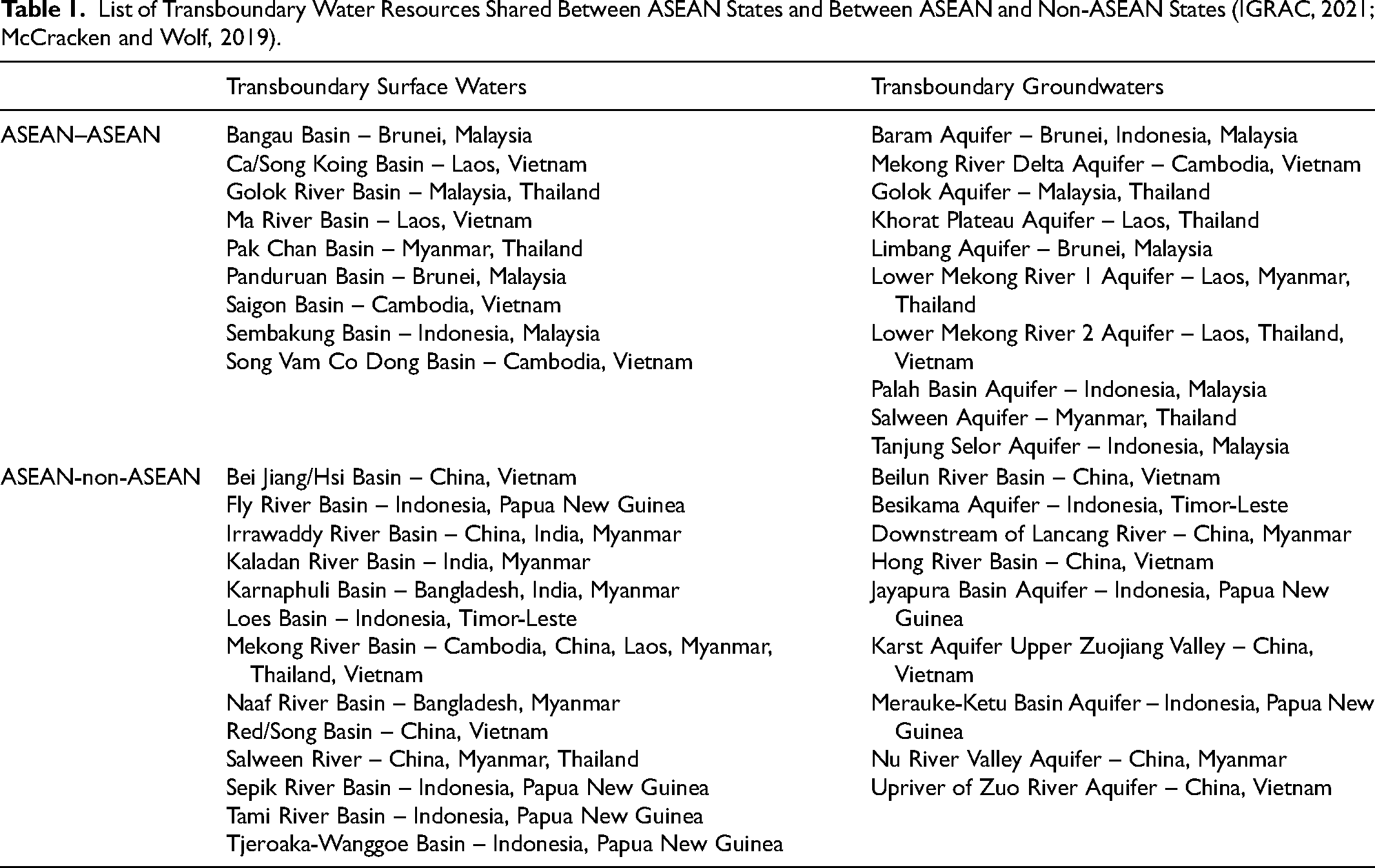
Across the region there are forty-one transboundary water bodies. ASEAN States share nineteen transboundary water resources with other ASEAN States, including nine transboundary surface waters and ten transboundary groundwaters. ASEAN States share a further twenty-two transboundary water resources with non-ASEAN States, including thirteen transboundary surface waters and nine transboundary groundwaters—see Table 1. While the large majority of these transboundary water resources are shared bilaterally, there are three groundwaters shared between ASEAN States and five surface waters shared between ASEAN and non-ASEAN States that are multilateral. Apart from the nature of these transboundary water resources, also of note is China's importance as a riparian State, sharing ten of the forty-one transboundary water resources in the region with five ASEAN States (Cambodia, Laos, Myanmar, Thailand, and Vietnam). Given the history of China–ASEAN relations, this deserves special attention. Utilizing the five key elements of transboundary watercourse agreements, this section looks at the practice of States in the region across the layers of international water law, including regional, multilateral, and bilateral agreements, as well as non-binding instruments. Not all of these instruments can be referred to as “ASEAN” instruments, but as they involve ASEAN States they capture the status of State practice in the region and can assist in determining whether or not there is a regional approach to transboundary water governance. This analysis will be conducted across two regional units—watercourses shared solely by ASEAN States and watercourses shared by ASEAN and non-ASEAN States—permitting an analysis of instruments across the region, while also drawing out distinctions that may appear between these two groups.
List of Transboundary Water Resources Shared Between ASEAN States and Between ASEAN and Non-ASEAN States (IGRAC, 2021; McCracken and Wolf, 2019).
Transboundary Water Governance of ASEAN–ASEAN Transboundary Waters
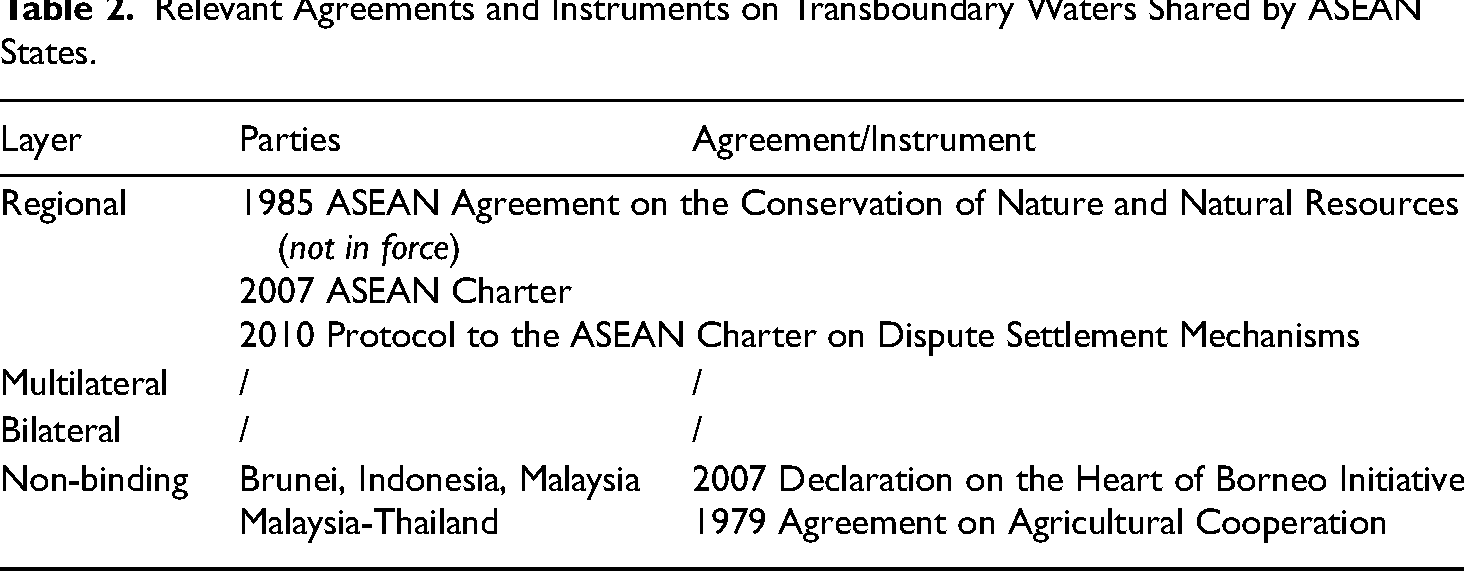
No overarching instrument that solely relates to transboundary water resources is available at the regional level. There are, however, relevant agreements that ASEAN States have established that could assist in governing transboundary water resources, including the 1985 ASEAN Agreement on the Conservation of Nature and Natural Resources, the ASEAN Charter, and the 2010 Protocol to the ASEAN Charter on Dispute Settlement Mechanisms. The 1985 Nature and Natural Resources Agreement has a broad scope, dealing with transboundary water resources among a series of other environmental issues. Provisions that relate to transboundary water resources, however, take an approach similar to the Watercourses Convention. While the Agreement has not yet entered into force, 2 all ASEAN States have signed onto the Agreement and are therefore obligated, at a minimum, “to refrain from acts which would defeat the object and purpose” of the Agreement (VCLT, 1969: Art. 18). With the goal of ensuring “the sustainable utilization of harvested natural resources under their jurisdiction in accordance with scientific principles and with a view to attaining the goal of sustainable development” (ASEAN, 1985: Art. 1(1)), it sets out rules for the sustainable use of natural resources, including water. While there is no dedicated provision on the utilization of transboundary water resources, recognition of “sustainable utilization” could reflect the substantive rules, particularly equitable and reasonable use which aims at “attaining optimal and sustainable utilization” of a shared water resource (UNWC, 1997b: Art. 5). In this context, Chapter VI of the 1985 Agreement, entitled “international cooperation,” provides that States sharing a natural resource “shall cooperate concerning their conservation and harmonious utilization, taking into account the sovereignty, rights and interest of the Contracting Parties.” This requires States to consider the interests of other riparians when utilizing a transboundary water resource (ASEAN, 1985: Art. 19(1)). “To that end” States are to take a variety of measures, including due diligence to prevent harm by “controlling, preventing, reducing or eliminating adverse environmental effects which may result […] from the utilization” of the resource in the other State (ASEAN, 1985: Art. 19(2a)). This is further reinforced in Article 20 on Transfrontier Environmental Affects, which provides that States are responsible to ensure that “activities under their jurisdiction or control do not cause damage to the environment or the natural resources” of other Parties (ASEAN, 1985). Furthermore, States are to “avoid to the maximum extent possible and reduce to the minimum extent possible adverse environmental effects” of their activities, including effects beyond their jurisdiction (ASEAN, 1985: Art. 20(22)). In support of these substantive rules, Articles 19 and 20 of the 1985 Agreement also set out a series of procedural rules including environmental assessment, prior notification of planned measures that may cause significant impact, consultation, and emergency notification and to establish bilateral or multilateral agreements in this regard (ASEAN, 1985). Directly in support of the due diligence obligation not to cause significant harm, Article 20 echoes these procedural requirements, including requirements of environmental impact assessments, prior notification, consultation for planned measures that may cause harm, and emergency notification (ASEAN, 1985). To assist with implementation, the Agreement sets out institutional mechanisms, including a meeting of the parties held every three years, a Secretariat, and national focal points, each of which could assist in actualizing cooperation. Disputes are to be settled “amicably by consultation or negotiation” (ASEAN, 1985: Arts. 21–23 and 30).
The 1985 Agreement, however, has not yet entered into force, possibly due to its broad scope and questions regarding its necessity given the establishment of later environmental agreements such as the 1992 Convention on Biodiversity (Koh, 2007). As such, we might look to other regional agreements including the 2007 ASEAN Charter and 2010 Protocol to the ASEAN Charter on Dispute Settlement Mechanisms. The Charter provides that as part of its scope, ASEAN aims to “promote sustainable development so as to ensure the protection of the region's environment, the sustainability of its natural resources, the preservation of its cultural heritage and the high quality of life of its people” (ASEAN, 2007: Art. 1(9)). While it does not include procedural rules, it sets out institutions through which ASEAN States could discuss the implementation of their customary obligations. This includes head of State meetings through the ASEAN Summit, the Coordinating Council where ASEAN foreign ministers meet twice per year, and the ASEAN Community Councils including Sectorial Ministerial Bodies such as the ASEAN Mekong Basin Development Cooperation and the ASEAN Ministerial Meeting on the Environment (ASEAN, 2007: Arts. 7–10). Disputes between ASEAN States are to be settled through dialogue, consultation and negotiation, good offices, conciliation, and mediation (ASEAN, 2007: Arts. 22–23). For disputes that do not involve an ASEAN instrument then ASEAN States are to follow the provisions of the 1976 Treaty of Amity, discussed above.
On transboundary watercourses shared solely by ASEAN States we see limited use of binding agreements. There is, however, one joint institution, the Malaysia-Thailand Joint Committee on the Golok River, established in 1979 by a ministerial agreement between Thailand and Malaysia (Malaysia-Thailand, 2023). Comprised of the Joint Steering Committee, Technical Working Group, and Joint Evaluation Team, the Committee discusses joint development of the Golok River Basin. While there is no reference to the substantive rules, the Committee acts as a focal point for procedural rules, particularly information sharing through an online platform (Malaysia-Thailand, 2023). This is facilitated by joint projects, such as the construction of Cableway Stations across the Golok River, one in each State, to facilitate data collection (Malaysia-Thailand, 2023). Cooperative management of the Golok River appears to be moving incrementally, with recent Joint Steering Committee meetings discussing plans to establish an Integrated River Basin Management Plan, facilitated by a new Memorandum of Understanding (Malaysia-Thailand, 2019). There is also a non-binding instrument through which Brunei, Indonesia, and Malaysia have governed the Island of Borneo, the 2007 Declaration on the Heart of Borneo Initiative. Supported by the World Wildlife Fund, the Initiative describes itself as a “voluntary trans-boundary cooperation” mechanism, with the States declaring they will cooperate to manage the environment of the Island of Borneo “based on sustainable development principles through research and development, sustainable use, protection, education and training, fundraising as well as other activities that are relevant to trans-boundary management conservation and development,” while “taking into consideration relevant multilateral environmental agreements, as well as existing regional and bilateral agreements/arrangements” (Brunei-Indonesia-Malaysia, 2007). The three States were to prepare a series of projects and plans in this regard. 3 While cooperation primarily relates to forest management, these forests serve as the catchment area of many of the Island's rivers (WWF, 2011) (Table 2).
Relevant Agreements and Instruments on Transboundary Waters Shared by ASEAN States.
Transboundary Water Governance Between ASEAN and Non-ASEAN States
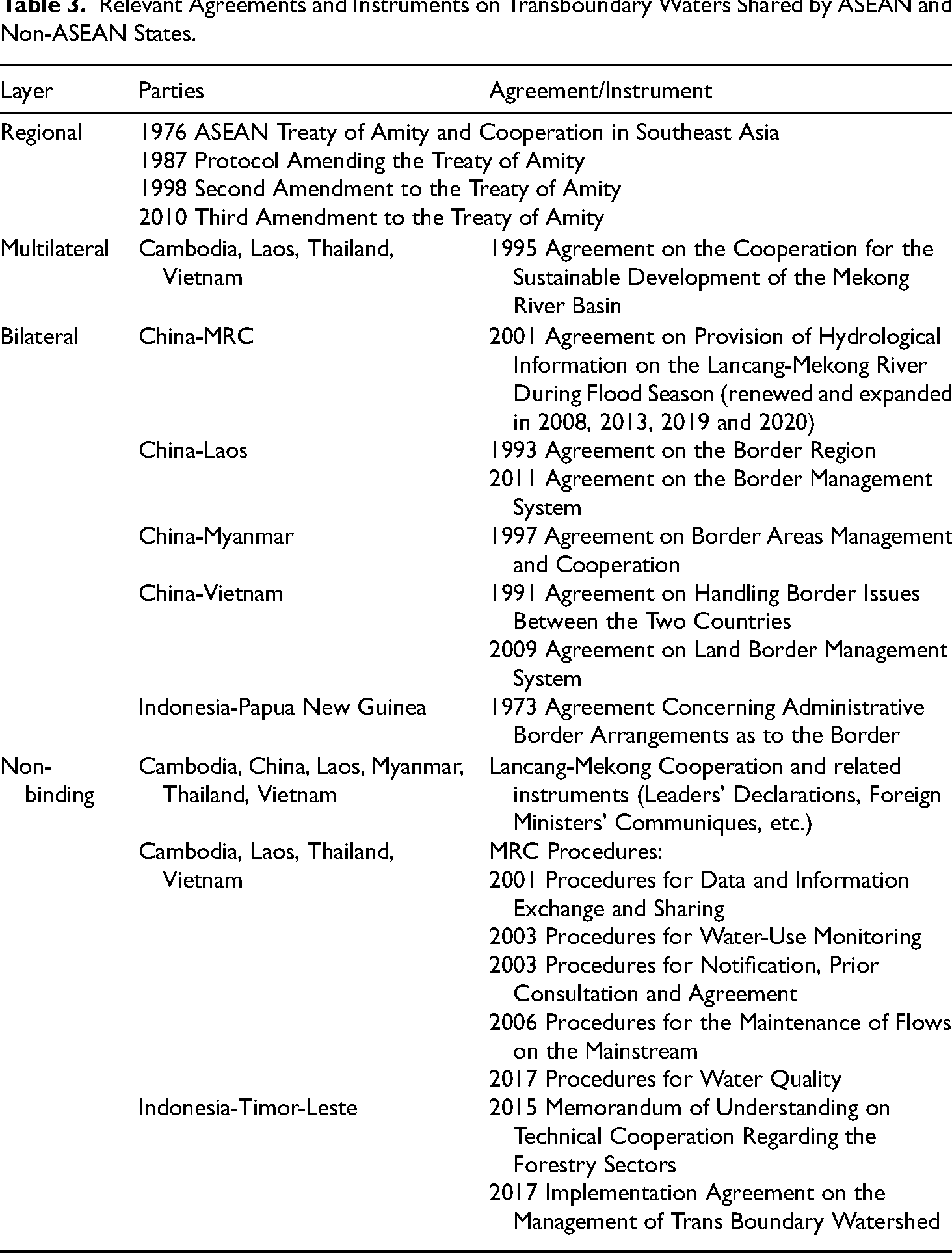
While non-ASEAN States are not party to regional agreements related to transboundary water resources, some have signed onto regional agreements that may assist in resolving disputes between ASEAN and non-ASEAN States. All five States at ASEAN's periphery, including Bangladesh, China, India, Papua New Guinea, and Timor-Leste, are party to the 1976 Treaty of Amity. With the purpose to “promote perpetual peace, everlasting amity and cooperation among their peoples,” the Treaty establishes a general duty to cooperate under a framework based on the Five Principles of Peaceful Coexistence (ASEAN, 1976: Art. 2), and various dispute settlement mechanisms based upon consent.
At the basin level, there are no agreements between ASEAN States and Bangladesh or India, but there are agreements between Indonesia and Papua New Guinea, Indonesia, and Timor-Leste, as well as agreements and non-binding instruments between China and States on the Mekong. Indonesia and Papua New Guinea share three transboundary basins and two transboundary groundwaters. While there are no watercourse agreements between them, the 1973 Agreement Concerning Administrative Border Arrangements as to the Border between Papua New Guinea and Indonesia provides some guidance on shared water resources. This Agreement, signed by Australia on behalf of Papua New Guinea, provides limited obligations in regard to shared water resources, instead providing that both States are to take “necessary precautionary measures […] to prevent serious pollution of rivers flowing across the border,” reflecting the due diligence obligation not to cause significant harm. It also provides for consultations regarding such activities (Indonesia-Papua New Guinea, 1973: Art. 12). Indonesia also has two non-binding instruments with Timor-Leste, 4 the 2015 Memorandum of Understanding on Technical Cooperation Regarding the Forestry Sector and the 2017 Implementation Agreement on the Management of Trans Boundary Watershed. Although it aims to promote cooperation in the forestry sector, the 2015 MoU provides that technical cooperation will consist of the “management of trans boundary watershed[s],” particularly through the creation of a transboundary watershed management plan (Indonesia-Timor-Leste, 2015: Arts. II(d) and III(d)). This is supported by the establishment of an institution, the Joint Forestry Working Group which meets “at least once every two years” (Indonesia-Timor-Leste, 2015: Art. V(4)). To enhance cooperation under the 2015 MoU with a focus on transboundary watercourses, Indonesia and Timor-Leste established the 2017 Agreement. Applying to a list of shared surface water resources found in annex, the Agreement lists multiple areas of cooperation with an emphasis on procedural rules including joint monitoring, exchange of information, as well as the formulation and implementation of management plans (Indoesia-Timor-Leste, 2017: Arts. II and III). Both agreements provide that disputes will be settled via consultation or negotiation (Indonesia-Timor-Leste, 2015: Art. IX; 2017: Art. VI).
One of the most prominent river basins in the region is the Mekong River, which has been jointly governed by the four lower riparians (Cambodia, Laos, Thailand, and Vietnam) under the 1995 Mekong Agreement. Recognized as being compatible with the Watercourses Convention (Kinna and Rieu-Clarke, 2017), the Mekong Agreement contains all five key elements. In regard to the substantive rules, Article 5 provides that States are to “utilize the waters of the Mekong River system in a reasonable and equitable manner,” setting out a regime of notification, prior consultation, and agreement for utilization. Utilization of a tributary requires only notification, whereas the mainstream has higher requirements—requiring wet-season notification for intra-basin use, but prior consultation for inter-basin diversions, whereas the dry season requires prior consultation for intra-basin use, but prior agreement for inter-basin diversions (Mekong Agreement, 1995: Art. 5). It also contains the due diligence obligation not to cause significant harm, entailing that States must “make every effort to avoid, minimize and mitigate harmful effects that might occur to the environment,” particularly the water quantity, quality, ecosystem, and ecological balance (Mekong Agreement, 1995: Art. 7). Cooperation among these four States is facilitated by the establishment of an institutional mechanism, the Mekong River Commission (MRC), comprised of a Council, Joint Committee and Secretariat (Mekong Agreement, 1995: Arts. 11 and 12). These institutions play a strong role in dispute settlement, with disputes first settled at the Council or Joint Committee, and then through negotiation or mediation (Mekong Agreement, 1995: Arts. 18, 24, and 35). The Mekong Agreement does not contain procedural rules; instead requiring that the Council adopt rules of procedure (Mekong Agreement, 1995: Art. 19). These procedures, established via non-binding instrument, provide guidance on data and information exchange (2001), water-use monitoring (2003), notification, prior consultation and agreement (2003), maintenance of mainstream flows (2006), and water quality (2017).
While the Mekong River has largely been governed by the downstream ASEAN States (excluding Myanmar), 21% of the basin is in upstream China (Browder and Ortolano, 2000). China shares many transboundary waters with half of all ASEAN States. Scholars have indicated that even though China is not party to the global water conventions, it has largely adopted an approach that embodies the key substantive and procedural rules of international water law. Its treaties, however, often utilize broad, vague language (Su, 2014; Wouters and Chen, 2013). These agreements, however, are primarily found in China's Northeast and West, with few agreements with States on China's Southern border. Here, transboundary water cooperation is largely pushed forward by non-binding instruments. Even though China is not party to the Mekong Agreement, China shares information from two monitoring stations (Yunjinghong and Manan) on the lower reaches of the river in China's territory. This began in 2002 with information shared once per day during the flood season (June 15th to October 15th) and has been incrementally expanded upon, most recently in 2020 when China agreed to share information year-round (MRC, 2002; 2020). There is even discussion of real-time information sharing concerning hydropower dams (Reuters, 2023). China also participates as a dialogue partner of the MRC permitting it to participate in the functions of the Commission but without rights or obligations under the Agreement. The rules of customary law, such as equitable and reasonable utilization and the due diligence obligation not to cause significant harm, however, do apply. As China has sought greater cooperation and collaboration with its Mekong neighbors, it established the Lancang-Mekong Cooperation (LMC) in 2015, one of the few institutional mechanisms that includes all Lancang-Mekong States as member (Zawacki, 2019). The LMC has a broad scope, utilizing a 3 + 5 approach across three “cooperation pillars” (social, cultural and people–people exchange, political and security issues, and economic and sustainable development) and five “key priority areas” (agriculture and poverty reduction, water resources, production capacity, cross-border economic cooperation, and connectivity) (MFA-China, 2016). Unlike the MRC, the LMC is developed by non-binding instruments adopted at various meetings including Leaders’ Meetings, Foreign Ministers’ Meetings and occasional Water Ministers’ Meetings. In spite of their non-binding nature, they recognize relevant international law. The most recent Leaders' Meeting Declaration, the Nay Pyi Taw Declaration, indicates that LMC cooperation is based upon “the principles of extensive consultation, joint contribution and shared benefits, respect for and compliance with the United Nations Charter and international laws as well as ASEAN Charter, domestic laws and regulations of member countries” (LMC, 2023). LMC instruments also generally reflect the substantive and procedural rules. In regard to the substantive rules, LMC instruments generally strive for “sustainable water resources management and utilization,” loosely reflecting equitable and reasonable utilization (Devlaeminck, 2022). In the context of upstream–downstream tensions concerning the impacts of hydropower, more recent LMC instruments have reflected the due diligence obligation not to cause significant harm, incorporating “minimizing negative impact” (Devlaeminck, 2022). The LMC places a strong emphasis on procedural rules, particularly information sharing, evident through the establishment of an online data sharing platform. While there is no specific mention of consultation, prior notification or dispute settlement mechanisms, this could take place through the series of meetings at the Leaders’ and Foreign Ministers’ level.
While the LMC is the multilateral component of China's cooperation with Mekong River States, there are also a series of bilateral agreements related to the demarcation and management of their borders, each with provisions related to water resources that mark or cross the border. The 1991 China-Vietnam Agreement on Handling Border Issues between the Two Countries and the 1993 China-Laos Agreement on the Border Region take similar approaches. Using the word “boundary rivers,” referring to any river that runs along or crosses the border (China-Vietnam, 1991: Art. 13(11); China-Laos, 1993: Art. 6(1)), they contains basic provisions that reflect the substantive rules, requiring utilization of these boundary waters to be conducted through negotiation under the principles of mutual benefit and equality, and the avoidance of “causing loss” (China-Vietnam, 1991: Art. 2; China-Laos, 1993: Art. 6(2)). The 1992 China-Vietnam Agreement even requires agreement for any “engineering works conducted in boundary waters that may affect the boundary waters” (China-Vietnam, 1991: Art. 2(1)). A similar approach is found in the 1997 China-Myanmar Agreement on Border Areas Management and Cooperation. Also applying to “boundary rivers,” it requires States to “consult separately on the basis of equality, mutual benefit and respect for the interests of the parties regarding the use” of waters from a boundary river, and to “take measures” to keep them “clean and free from pollution” (China-Myanmar, 1997: Art. 10). More recent agreements have used the term “boundary water” while also updating these provisions. The 2011 China-Laos Agreement on the Border Management System, for example, maintains requirements for negotiation regarding protection and use of the boundary water (China-Laos, 2011: Art. 9). It also adds a provision regarding negotiation in instances where “the construction or removal of dams, sluices and other hydropower projects on the boundary waters, as well as water use, change in water flow, impacts on river regimes, amongst others” causes significant impact (China-Laos, 2011: Art. 10). The 2009 China-Vietnam Agreement on the Land Border Management System, however, has fewer provisions regarding boundary waters, simply requiring cooperation “to resolve issues related to the use and protection of boundary waters […] so as to avoid causing significant harm,” removing requirements for negotiation (China-Vietnam, 2009: Art. 9(i)). It does, however, require that projects on the boundary waters, including bank protection works, dredging, as well as the construction, renovation, or removal of river related installations, requires the approval of an institution, the China-Vietnam Land Border Joint Committee (China-Vietnam, 2009: Art. 11) (Table 3).
Relevant Agreements and Instruments on Transboundary Waters Shared by ASEAN and Non-ASEAN States.
Summary and Discussion
In sum, there is an applicable body of rules across the region, including regional, multilateral, and bilateral agreements, as well as a series of non-binding instruments. These rules appear across the broad spectrum of international water law, with regional, multilateral, bilateral, and non-binding instruments prevalent here. These instruments reflect the five key elements of transboundary water agreements, illustrating broad acceptance of the customary rules, particularly equitable and reasonable use and the due diligence obligation not to cause significant harm. The 1985 Nature and Natural Resources Agreement, for example, contains provisions that largely reflect the Watercourses Convention, but it remains not in force. While its entry into force could provide an overarching framework for transboundary water governance between all ASEAN States, this seems unlikely in the near future. At the multilateral and bilateral levels, there are surprisingly few instruments on transboundary watercourses shared by ASEAN States. Those that exist emphasize procedural cooperation and consultation, offering opportunities for consensus building through the ASEAN Way. This is evident on the Golok River Basin between Malaysia and Thailand and on the Island of Borneo, where cooperation has increased incrementally. With limited agreements in the ASEAN region, there remains a large reliance on customary international law. Without institutional support, however, implementation may prove challenging. There is a greater number of instruments on transboundary watercourses shared by ASEAN and non-ASEAN States, a mix of both binding agreements and non-binding instruments. The most prominent is the 1995 Mekong Agreement, which provides a comprehensive framework for the governance of the Mekong. Fundamental components, however, are found in non-binding procedures. As it only includes the four lower riparian States as parties, it struggles to manage the basin as a whole. China and its practice also loom large, evident across bilateral and non-binding instruments it has with five ASEAN States. Many of these relate not only to the sharing of the border but also regarding information sharing with MRC States. The LMC, however, takes a comprehensive approach, linking transboundary water resources to a wider development agenda. Indonesia also has active cooperation with its two non-ASEAN neighbors, Papua New Guinea and Timor-Leste, through border arrangements and non-binding instruments. Notably absent, however, are any agreements between Bangladesh, India, and neighboring Myanmar. Across nearly all instruments, we see a preference for consultation and negotiation as the primary methods of dispute settlement, with others resorting to various institutions, such as the MRC.
Observations and Concluding Remarks: From the ASEAN Way to Legalism?
The ASEAN region is home to forty-one transboundary surface and groundwater bodies, shared between ASEAN States and five States at ASEAN's periphery. ASEAN States have established a common method of State relations, known as the ASEAN Way, featuring consultation, respect for sovereignty, and a preference for non-binding instruments. This method has served ASEAN States well, leading to a more peaceful and cooperative region. In regard to environmental issues, however, it faces limitations as it restricts a State's ability to discuss the environmental issues of another State. As the region has experienced increasing (albeit slowly) tendencies toward legalistic forms of cooperation, evidenced by the establishment of the ASEAN Charter and 2002 Transboundary Haze Agreement, this paper sought to explore the current status of transboundary water cooperation in the region and to determine whether or not there is a regional approach prevalent in transboundary water agreements and instruments and to what extent it reflects the ASEAN Way and international best practice. During the drafting and adoption of the Watercourses Convention select ASEAN States made comments on various provisions. Through their comments they appeared to shift from the ASEAN Way, even supporting binding dispute settlement mechanisms. A closer look at regional practice, however, illustrates that characteristics of the ASEAN Way permeates agreements and instruments across the region. The Watercourses Convention offers a framework of rules to jointly govern a transboundary watercourse, entailing a discussion of the States internal uses of a water resource. While this appears to go against the ASEAN Way and principles of non-interference, this was codified in the earlier 1985 Nature and Natural Resources Agreement which took a similar approach. The Agreement, however, is not in force and is unlikely to enter into force in the near future. Looking across the other layers of international water law on transboundary watercourses shared by ASEAN States, there are only two other instruments, both non-binding, which primarily emphasize procedural rules and voluntary cooperation. As such, they strongly emphasize the ASEAN Way. On transboundary watercourses shared between ASEAN and non-ASEAN States, however, there is a rich body of agreements and instruments that exemplify nearly all of the five key elements, but practice is mixed. Here, we see strong support for the substantive rules, found in binding agreements such as the Mekong Agreement and China's border agreements, but also reflected in the non-binding instruments of the LMC. Whereas cooperation between Indonesia and Timor-Leste incorporates the due diligence obligation not to cause significant harm and related consultations, offering an opportunity for discussions on the other State's utilization of the watercourse, cooperation between Indonesia and Papua New Guinea does not, instead emphasizing procedural obligations. Across all instruments studied here, however, the ASEAN Way is prevalent in dispute settlement as agreements place a strong emphasis on consultation and negotiation. There are exceptions, however, such as the Mekong Agreement which resorts to the MRC's Joint Commission.
This survey of regional State practice illustrates that there is no unified regional approach, with ASEAN States taking different approaches on different watercourses—on those shared between ASEAN States, the ASEAN Way seems to prevail; on those between ASEAN States and their non-ASEAN neighbors, there is a stronger emphasis on the suite of international water law rules. While there does not appear to be uniform State practice in the region, the customary rules of international water law apply. This survey of State practice, however, illustrates the vast diversity in application across the ASEAN region and beyond, posing legal problems of fragmentation and even normative incoherence. As such, how might the region move forward? Given looming challenges for water resources, a push for greater consensus is needed. One such avenue for this is greater collaboration between ASEAN and other regional water-related institutions, such as the MRC and even LMC. The MRC has already sought a closer working relationship with ASEAN, holding the first ASEAN-MRC Water Security Dialogue in 2021 (Hatda and Kittikhoun, 2021). This dialogue resulted in a series of recommendations for water scarcity, water pollution, climate risks, and methods for youth engagement (MRC, 2022). What is missing, however, is meaningful dialogue on transboundary water resources. The ASEAN Way is one approach that might permit such dialogue, moving transboundary water cooperation forward. The number of transboundary water resources across the region clearly illustrates that this is not solely a mainland issue, impacting almost all ASEAN States. Once consensus has begun to take shape, then perhaps more robust legal instruments that reflect the five key elements will follow. Accession to either of the global water conventions would certainly provide an overarching framework for transboundary water governance, and multiple ASEAN States expressed positive views about the Watercourses Convention. This, however, has not led to accession by States in the region. Although not in force, the 1985 Nature and Natural Resources Agreement provides a solid foundation for water cooperation, containing key elements of international water law while maintaining core components of the ASEAN Way such as consultation, appearing to take a middle ground. However, its broad scope appears to have hindered its entry into force. Given that the majority of States have already ratified or acceded to the Agreement, further attempts to push it toward entry into force might be a fruitful path forward. More practically, it could be recognized as guidance for ASEAN States to establish multilateral or bilateral agreements. Given that most of the transboundary water resources in the region are shared bilaterally, this seems logical. China's cooperation with ASEAN States, particularly on the Mekong, highlights another alternative to transboundary water cooperation, non-binding instruments, as it established the LMC in 2015. Non-binding instruments are a key component of the ASEAN Way, have been utilized by Indonesia and Timor-Leste, as well as on the Island of Borneo, highlighting the fact that, regardless of the form of agreement, it can help push cooperation forward in an incremental way. Furthermore, the LMC illustrates that even non-binding instruments can insert norms into cooperation. Regardless of the form of cooperation, there are no shortcuts and transboundary water cooperation is a long and hard process. Through the ASEAN Way, perhaps the region can build needed consensus on the legalization of transboundary water cooperation for a more water secure future.
Footnotes
Declaration of Conflicting Interests
The author declared no potential conflicts of interest with respect to the research, authorship, and/or publication of this article.
Funding
The author received no financial support for the research, authorship, and/or publication of this article.