



Abstract
How do we explain ASEAN – a non-western, traditionally ‘weak’ actor – and the degree to which it has successfully co-opted the EU into accepting its approach to human rights? This article considers the question of human rights in the ASEAN–EU relationship. It does so by reappraising the literature on constructivism and comparative regionalism, embracing the move beyond norm diffusion and Europe to norm contestation and local actors, namely ASEAN. Building on the literature of contestation, it operationalises Mattern's model of Representational Force to analyse the case study of the ASEAN–EU relationship from the 1990s to the establishment of AICHR in 2009 and beyond where we can see contestation in action. Interestingly, through the contestation over the ‘promotion’ and ‘protection’ of human rights, there is significant scope to see how it is ASEAN that has largely co-opted the EU into supporting a uniquely ‘ASEAN’ approach to human rights in Southeast Asia.
Introduction: ASEAN, the EU, and the Puzzle of Human Rights
The Association of Southeast Asian Nations (ASEAN) and the European Union (EU) have shared a long history: from ‘dialogue partners’ in the late 70s and 80s, through to a more turbulent period in the 90s and early 2000s, to ‘enhanced’ and ‘strategic’ partnership thereafter. What is perhaps most striking about the ASEAN–EU relationship is the catalyst of human rights. ASEAN has long been criticised, both as a regional organisation and for its approach to human rights; especially regarding the ASEAN Intergovernmental Commission of Human Rights (AICHR) and its ‘protection’ of human rights, ASEAN ‘fails’ when compared to its EU counterpart. There are concerns that ASEAN's implementation of human rights has been wanting, where AICHR remains a powerless body and the overall emphasis of ‘promotion’ at the expense of ‘protection’ ensures that both achieve little for human rights (Olivia, 2014). Across the ASEAN region, there are fears of a ‘human rights crisis’ (Collins, 2018): from the Rohingya persecution to the disappearance of human rights activists, many lament ASEAN's approach to human rights, undermined by its normative culture and norm violation (Davies, 2013), as well as AICHR's institutional design limiting its ability to act (Langlois, 2013). In response, most turn to norms and the need to abandon the fabled ‘ASEAN Way’ (Hara, 2018), paving the way for an independent Court to act (Gunawan and Elven, 2017), inspired by examples such as the EU. Indeed, the EU has often been analysed as a potential ‘model’ for ASEAN (Jetschke, 2017). However, there are those who raise concerns over an ‘EU’ or ‘western-centric’ approach to comparative regionalism (Acharya, 2016) and human rights (Grovogui, 2021), and some scholars instead view AICHR on ‘realistic’ terms and remain ‘cautiously optimistic’ (Duxbury and Hsien-Li, 2019; Hsien-Li, 2011).
How then should we understand the ASEAN–EU relationship, and what does it reveal about ASEAN's approach to human rights? Turning to comparative regionalism and the constructivism that informs it, significant is the earlier focus on norms as fixed to norms as contested. Explaining change within constructivism is now under the spotlight more than ever (Collins, 2019; Hofferberth and Weber, 2015; Peltonen, 2017), causing many to re-evaluate the value of norm analysis beyond mere diffusion and compliance. Between these two – constructivism on the one hand, and criticisms of ASEAN's mere ‘promotion’ of human rights on the other – there are striking similarities in the potential for both to be seen differently. Heeding Acharya's (2016) bemoaning of ‘moral cosmopolitanism’ and rejecting an ‘EU model’ and seeing the so-called ‘positive’ international norms as unfair, constructivists tied both to Europe and to norms as first and foremost fixed remain unable to fully account for how AICHR engages with human rights beyond the usual aforementioned criticisms. This is a shame, for the ASEAN–EU relationship illustrates a hidden insight: the evolution of ASEAN's ‘appropriate regional mechanism’ has been a source of contestation and change within the relationship. This keyword, ‘appropriate’, has acted as a catalyst for contestation. Interestingly too, it has been ASEAN's approach to human rights, a small yet significant lynchpin in the relationship, that has led to that change.
This article is structured as follows: ‘Literature Review: Constructing ASEAN and the EU’ section reappraises the literature on earlier conventional constructivism's explaining norms and change through norm diffusion (with its focus on the EU) but distinguishes this from critical constructivism that emphasises language, local actors, and change through contestation. In so doing, it contributes to the shift away from EU-/western-centric approaches and models (Börzel and Risse, 2016) and recent attempts to illustrate ASEAN's agency and commitment to human rights (Davies, 2021; Langlois, 2021). ‘Representational Force: Contesting ASEAN, the EU, and Human Rights’ section then situates Mattern's (2005) model of Representational Force within these debates, illustrating how contestation works in practice. ‘Operationalising Representational Force: Contesting ‘Promotion’ and ‘Protection’ in the ASEAN–EU relationship’ section, through operationalising Representational Force, will demonstrate that ASEAN's 1993 ‘appropriate regional mechanism’ through to the 2009 launch of AICHR and beyond, rather than simply constrained by an ASEAN ‘inability’ to adopt international norms or ‘institutionalise’ like the EU, has instead been a source of language power for ASEAN in playing a creative role in narrating community and human rights in the region. Through an exploration of the ASEAN–EU relationship from the 90s through to the 2015 launch of the ASEAN Community that draws on key texts and supplemented by semi-structured interviews, it will be shown how – through language power detailed in Representational Force – ASEAN has been able to employ language to force the EU to acquiesce on ASEAN's approach to human rights. From EU criticism, to acceptance, and finally its active support of AICHR, the most surprising insight to conclude is how ASEAN has successfully co-opted the EU into recognising its approach to human rights. ‘Conclusion: ASEAN, the EU, and the (Surprising) Use of Language Power’ section will conclude that to see ASEAN's ‘appropriate regional mechanism’ on the grounds that AICHR today is primarily supposed to be a body that oversees the implementation of human rights is to miss a crucial point. AICHR, as well as the whole narrative of ‘promotion’, has played an important role for ASEAN to ‘narrate’ regional human rights. It is in this sense that, in the ASEAN–EU relationship, ASEAN has demonstrated real language ‘power’.
Literature Review: Constructing ASEAN and the EU
How are we to understand the ASEAN–EU relationship, and what does it reveal about ASEAN's ability to narrate human rights? Two important literatures collide here: constructivism in IR theory and comparative regionalism, and both are central to understanding the ASEAN–EU relationship. Critics and others who some term ‘apologists’ for ASEAN, moreover, remain insufficient in accounting for the surprising degree to which ASEAN has successfully co-opted the EU in supporting its approach to human rights in Southeast Asia. Since its inauguration in 2009 (and its history as a mere ‘appropriate regional mechanism’ on paper since 1993), much of these literatures assume AICHR to be in a position of weakness. By extension, ASEAN's implementation of human rights seems woefully inadequate to the extent that many fear a ‘human rights crisis’ across Southeast Asia (Collins, 2018). This seems rather paradoxical, as Collins points out, for it is, ‘a period of time in which ASEAN has never been so interested in human rights’ (2018: 1). Yet, critics of ASEAN have argued quite reasonably that this failure has its origins in ASEAN, specifically its normative culture (namely non-intervention, respect for national sovereignty, consensus and informality) and institutional design (or lack of). Of particular relevance to human rights, the focus is for ASEAN to assume a greater sense of institutionalism. Much of this criticism stems from our understanding of constructivism as an attachment to (international/ Western) norms, and it is ASEAN's and AICHR's attachment to certain norms that undermine its capacity to uphold human rights.
Meanwhile, some constructivists have suggested that to expect AICHR to adhere to international expectations is unfair. Acharya (2004, 2016) suggests that constructivism – and how we view ASEAN – needs to do more than simply measure the acceptance rate of international norms by local actors, conveniently limiting or foregoing local resistance in the name of methodological parsimony (reducing the stakes to norm compliance or norm rejection). To merely assess the uptake of such ‘positive’ norms was tantamount to what Acharya bemoaned as ‘moral cosmopolitanism’ (2012). It is precisely this commitment to analysing ‘international positive norms’ which has coincided with the thorny issue of the ‘EU model’. Concerning norms and regionalism, these authors argue that the literature has yet to free itself from a western or ‘EU-centrism’ (Acharya, 2016), in which the EU continues to be held as an example of regionalism for others to follow – especially regarding international or western/European human rights (Grovogui, 2021; Ramina, 2018). Most prominently in 2007, the then British Foreign Secretary David Miliband argued that the EU was a ‘model power’. This idea was reflected in Manners’ (2002, 2008) conception of ‘normative power Europe’, later culminating in the idea of exporting the ‘EU model’ to ASEAN (Jetschke, 2010, 2017). Even where local resistance is acknowledged, the attraction of the EU as primarily a norm exporter and the rest of the world as potential norm importers persists (Björkdahl et al., 2015). Acharya (2016) dismisses these works as unhelpful, only perpetuating the idea that there may be a ‘universal regionalism’ and its origin European: ‘Regionalism is not a European or Western idea or approach, but has world-wide heritage and multiple manifestations… [yet] Attempts to offer a broader intellectual history of regionalism and develop approaches to capture this diversity and complexity of regionalism around the world have been scarce’ (Acharya, 2016: 109).
Answering the call to look beyond EU-centrism is increasingly prominent within constructivism. Allison-Reumann (2017) suggests that rather than just a norm recipient, ASEAN may be a norm entrepreneur. Meanwhile, Manea's (2008: 369) study of ASEAN–EU relations regarding ASEM argued that: ‘ASEAN's rather confrontational mode of interaction with the European Union in relation to human rights has served as a catalyst for the dynamic growth of a collective definition of self in ASEAN.’ However, Manea limits herself to seeing contestation only with regards to ASEAN's change, without reflecting on changes to both actors and the contesting of a new relationship. Both of these attempts – whilst important in rescuing ASEAN from the dominance of an EU-centric study of regionalism – fail to truly embrace the interesting missing link of local resistance, that of contestation, exerted through language power. The problem when viewing the ASEAN–EU relationship, and also AICHR, remains – international ‘positive’ norms surrounding regionalism and human rights have already been ‘decided’, and it is decidedly un-ASEAN.
Constructivism in many ways ‘explains’ ASEAN, as well as the EU and human rights. Yet constructivism, like comparative regionalism, has struggled to explain how ASEAN – the non-western, traditionally ‘weaker’ actor – can realistically challenge the EU on human rights. The focus on the fixity of norms, in particular, is problematic. Whether referring to the ‘splitting of constructivism’ (Hofferberth and Weber, 2015), the ‘geneology’ of constructivism (Peltonen, 2017), or simply the challenge against ‘fixed’ norms presented by contestation (Collins, 2019), it is clear that the story of norms is incomplete. With this in mind, it may be possible to talk of constructivisms; and yet while it is necessary to not only acknowledge this opening up of constructivism, more work needs to be done to spell out the differences within whilst appraising these distinctive values. This division acknowledged, it is precisely these divisions within contructivism that we can now see how different portrayals of ASEAN emerge. In this guise, we may provisionally say that one constructivism (emphasising fixed norms) sets up ASEAN as fundamentally weak and failing to ‘protect’ human rights; another (critical constructivism emphasising norms as contested) understands it as fundamentally with power through the ability to contest and construct a regional approach to human rights.
If earlier conventional constructivism emphasises norms, structure, and Europe, then critical constructivism emphasises language, agency, and everyone else. For Dixon, conventional constructivists have long been stuck on the view that: ‘states’ responses to international norms has focused on commitment, compliance, and non-compliance… simply complying with or violating a norm’ (2017: 83). ASEAN, of course, has been a trophy child of conventional constructivism where it has been held up as a successful ‘security community’ à la Deutsch et al. (Acharya, 2009), an association bound by certain norms that have put an end to regional conflict and heralded an era of cooperation never before seen in Southeast Asia. Moreover, a deeper understanding of ASEAN's normative culture demonstrates its ‘Exceptionalism’ – that is, its unique approach to regionalism based on its history and its politics, most notably the need to satisfy the individual state's sovereignty, a particularly thorny issue that has its origins in the European colonialism experience (Acharya, 2016). Yet it seems that norms – defined, or rather operationalised in the narrow sense – have done the association a disservice. As ASEAN has gone from one crisis (the 1997/8 financial crisis) to another (the ongoing ‘human rights crisis’ of today), some constructivists continue to criticise such ‘Exceptionalism’, calling for a change to its constitutive norms, normally with the view towards ‘correct’ institutionalisation to ensure it protects human rights in the region (amongst other things). Overall, perhaps what is at stake in the constructivism story of norms really is how it is operationalised – and it is here that it meets the move beyond the European focus in regionalism. Indeed, from Davies’ (2021) focus on ASEAN's ‘ritualism’ of human rights to Wahyuningrum's (2021) account of AICHR, there is a stronger recent appreciation of ASEAN. Yet even here, the focus remains on ‘concrete suggestions for institutional development within the ASEAN regime’ (Langlois, 2021: 5) instead of the more critical focus on how ASEAN contests human rights.
From constructivism to comparative regionalism, there is a need to consider local actors and how exactly they define what is possible and what is permissible: i.e. contest Many are quick to undermine ASEAN as mere ‘talk’, ‘promoting’ as opposed to ‘protecting’ human rights. Yet interestingly, by tracing the evolution of language we can see creativity and contestation (Mattern, 2005, 2015; Wiener, 2014, 2018). Language, furthermore, is accessible to all and can be a clear means to signal an intention to act or legitimise a political position (something that ‘fixed’ norms have struggled to take seriously). Contestation is the necessary analytical focus for understanding ‘whose practice counts’ and the reality of the ‘co-constitution of normative change in global society’ (Wiener, 2018: 76). Applying this to the ASEAN–EU relationship, we see that ASEAN, too, has played a role in the ‘promotion’ and ‘protection’ of human rights. Following on from the potential of critical constructivism revealing ASEAN's agency, it seems that language power – through contestation – may be the answer to Acharya's call. It first reflects Acharya's earlier criticism of the dominance of international ‘positive norms’ and ‘EU-centrism’ on the one hand, and moreover provides an answer to criticisms of AICHR, that it does demonstrate a certain language power (local agency) and it does engage with human rights (creatively, from an ASEAN perspective). It is here that we turn to Representational Force.
Representational Force: Contesting ASEAN, the EU, and Human Rights
So how precisely do we see language power in play? Without offering a full account of the breadth and depth of Representational Force (see Mattern, 2005; Stacey, 2020), it is suffice to say that the model seeks to ‘show’ contestation in play. First, it takes a macro view of the actors under study, taking their identities seriously. Contestation then focuses on taking a crisis of these identities as its starting point – in this case, the breakdown of relations between the EU and ASEAN over human rights in the early 90s. Language, importantly, is only powerful when it draws on and interprets (‘narrates’) real events and crises: against a background of human rights concerns in Southeast Asia on the one hand, most notably in Myanmar and East Timor, and the EU's enshrining human rights into its foreign policy on the other, both actors would narrate two contrasting ‘identities’ (Stacey, 2020). The EU would see itself as a ‘Guardian’ of human rights, a sense of ‘duty’ in defending human rights worldwide, and ASEAN, challenging the international standard of human rights that it deemed unfair, posed a threat to that identity. ASEAN, meanwhile, saw itself expressing its regional ‘Exceptionalism’ 1 that even merely talking about human rights was an evolutionary step and it would take it at its own pace and in its own way. This was a consequence of ASEAN's history of colonised states and the desire to maintain national sovereignty for all members states, a key constitutive norm for ASEAN, as well as debates surrounding the western bias of human rights (from ‘Asian values’ to socio-economic rights and development). Through Representational Force we, therefore, see how these two identities did not emerge in a vacuum but were forged through narrative and language – actors interpreting events and how they position themselves in this world. Ultimately, human rights has played its ‘small yet significant’ role in contestation and change in the relationship. These two narrative identities of ASEAN and the EU, in the midst of a relationship crisis, became vulnerable to attack from the other who could use language to threaten and coerce their worldview.
Second, in order to see this language power (how language and narrative are specifically used to force change in identities), it shifts analysis towards the micro view of actors’ words and phrases and how these contest and evolve. Mattern (2005: 107–122) identifies three ‘phases’ in contestation; the first phase, breaking from tolerance, entails the words and phrases that both actors use to make sense of the other as a threat to their identity; the second phase, articulating dissent, explores the links actors make between certain words and phrases that destabilise the other's narrative identity; the third phase, fastening identity, refers to how each actor responds to the other's narrative threat, using tactics of ‘Terror’ and ‘Exile’, that is the manoeuvring of words and narrative to coerce the other to adapt their narrative and by extension a precious trace of their identity. Understanding tactics is important – essentially actors, socially constructed through narrative, exhibit multiple contradictions that can be exploited in times of vulnerability (i.e. crisis). How to distinguish between different tactics? Simply put with regards to the ASEAN–EU relationship, Exile allows a return to the status quo whilst Terror forces a new shared understanding and/or identity 2 . In the case study of ‘protection’ v ‘promotion’, the tactic of Terror will be explored here. In particular, ‘Terror constructs a trap in which the victim must not only abandon his dissent, but also narrate himself as a supporter of the “reality” preferred by the force-wielder. In this way, Terror turns a phrase-in-dispute into a phrase-in-support of the narrative that is under attack’. Ultimately, the coercive actor seeks to, ‘[point] the linguistic “gun”’ (Mattern, 2005: 113). This tactic has been used by ASEAN in its engagement with the EU to the extent that it has successfully co-opted the EU into accepting its version of ‘promotion’ of human rights through AICHR.
Third, contestation leads to two possible outcomes: a return to the status quo relations and ‘reality’ (exemplified by fixed norms), or a renewed re-written relationship in which language power helps fasten a (temporary) new shared understanding of ‘reality’. Both actors nevertheless employ language deliberately to contest – from mere ‘dialogue partners’ (pre-early 2000s), to ‘enhanced partnership’ (from the 2007 Nuremburg Declaration), to ‘strategic partnership’ and ‘partners in integration’ (especially from 2014 onwards), both sides forced change. Here, we observe one key source of contestation, that is ASEAN's narrative of ‘promotion’ of human rights and the EU's narrative of ‘protection’ of human rights, a key narrative dispute when recognising its language power in the ASEAN–EU relationship.
One further note on Representational Force is to consider and address three concerns (Stacey, 2020: 62–66). First, who is this ASEAN (and, to a lesser extent, the EU) that represents anything? Given the degree to which individual member states (and even political actors within those states) may disagree on human rights, it is important to consider how genuine, unified, and ‘powerful’ these collective statements are. However, insofar as there are collective meetings, statements, etc., and insofar as an ASEAN engages with an EU through meetings, statements, etc., the language that does emerge to define their relationship is powerful insofar as it shapes the realm of what is possible (à la Mattern, 2005). Second, and related, through operationalising Representational Force there are issues over how one chooses ‘representatives’ of ASEAN or the EU, and what constitutes both ‘accurate’ and ‘enough’ empirical material: arguably, there is a more or less clear ‘elite’ in any organisation, and to ensure accuracy is to regard only material that reflects repetition in the actors’ speech (e.g. through statements, documents and leaders’ speeches), and ‘enough’ being an aggregate of what is available and ensuring coverage of the main events that most would agree on. For the purposes of this study, primary data consists of semi-structured interviews with 19 representatives from the EU and ASEAN 3 which serve to provide insight into how the secondary data (documents, joint statements, etc.) demonstrate actual contestation between ASEAN and the EU. For example, the 1993 Vienna World Conference on Human Rights, the 1997/8 financial crisis, the 2004 Vientiane Program, 2007 ASEAN Charter, the 2009 launch of AICHR, and the 2012 ASEAN Human Rights Declaration are all important in understanding ASEAN and human rights. ASEAN and EU positions on Indonesia (from the EU's critical stance on Indonesia's involvement in East Timor, through to Suharto's fall in 1998 and both the EU and ASEAN's increased role in the Aceh province in the 2000s), and Myanmar (1980s to present day, including the history of sanctions), also provide clues as to what contestation over human rights may look like in the broader sense. 4 Third, why the ASEAN–EU relationship? Both are seen to be successful regional organisations in their own right. Both have in one way or another pursued human rights, and both have shared a long history (economical and political), mostly passive and amicable, but also disputed and at times deeply so, and it has been human rights at the centre of this contestation. Furthermore, taking the EU as the ‘other’ forms the basis of a critical case study for the model: ASEAN is seen as the ‘weaker’ actor, and yet with Representational Force – perhaps surprisingly to some – ASEAN to an important extent has directed human rights within the relationship.
Operationalising Representational Force: Contesting ‘Promotion’ and ‘Protection’ in the ASEAN–EU Relationship
Pre-1990s, the story of the ASEAN–EU relationship had been largely economic, largely passive. On the initiative of ASEAN, relations were formally established in 1972 through the Special Coordinating Committee of ASEAN, followed by the ASEAN Brussels Committee set up to discuss the General System of Preferences over trade with the then European Economic Community. The relationship was upgraded with the first EEC-ASEAN ministerial meeting held in 1978, followed by the 1980 ASEAN-EC Co-operation Agreement on trade that would define the relationship for the next decade. ‘Tolerance’ was the prevailing narrative. So how did contestation between ASEAN and the EU emerge? What emerged in the early 90s was a narrative division over human rights; two emerging identities, the EU as a ‘Guardian’ of human rights, and ASEAN committed to ‘Exceptionalism’, would threaten the other and lead to the breakdown of that relationship. The 1993 Vienna conference, and the ASEAN Foreign Ministers communiqué that committed ASEAN to an ‘appropriate regional mechanism’ – a riposte to the perceived bias in ‘universal’ standards – would provide enough narrative force to dislodge the previously passive and primarily amicable ASEAN–EU relationship of previous years. It is here that we may understand this split as a shift towards phase one of Representational Force.
Phase 1
How did dissent emerge? The EU's understanding, expressed in the emerging narrative identity of ‘Guardian’ of human rights, was made possible by the shift towards ever stronger institutionalism on the one hand (the birth of the Union), and increasingly enshrined human rights into its identity as a regional community. Much attests to these foundations and evolution, with the 1952 Treaty of European Coal and Steel setting a precedent for states to confer powers and power to a supranational authority. Human rights have also had a far-reaching history in Europe with the signing of the European Convention on Human Rights (1950-effective 1953). A European Court followed in 1959, and decades of steps to further define the European ‘reality’ of regionalism and human rights. However, it would be the end of the cold war and the onset of the 1992 Maastricht Treaty, which enshrined human rights into EU foreign policy, which would come to cement this new ‘Guardian’ identity. Against the background of Indonesia's invasion of East Timor and years of human rights abuse, the strain on the EU-ASEAN relationship would provide ample material for language and contestation. Despite some individual states’ strong desires to increase trade with ASEAN (notably the UK and Germany), Portugal's veto of the renewal of a 1980 Cooperation Agreement would signal an EU's willingness to criticise ASEAN on the grounds of human rights.
ASEAN would embrace human rights – a move associated with placating international pressure – but would do so through an ASEAN interpretation. For ASEAN, its unique constitutive norms would give rise to a very different kind of nascent community and interpretation of human rights. Tellingly, the 26th Joint Communiqué of the ASEAN Foreign Minister's Meeting stated that: ‘The Foreign Ministers agreed that ASEAN should coordinate a common approach on human rights and actively participate and contribute to the application, promotion and protection of human rights’ (1993: Article 17). ASEAN's understanding of a regional mechanism was filtered by regional concerns, and specific language, most notably the ‘appropriate regional mechanism’ (Article 18, emphasis added), amongst others, were deployed to express these very ASEAN concerns. For the EU: ‘However, disagreement on the implementation of human rights in ASEAN member countries has hindered progress in negotiations with the Community thus far…The universalist approach to human rights by the Community as expressed in ‘conditionality’ clause in its agreement with third countries, is challenged by ASEAN states. They feel that these principles should be interpreted and applied in the light of regional and cultural characteristics specific to each country and region. The Community rejects this point of view’ [(1993: 5) emphasis added].
The 1993 conference would reflect a growing dissatisfaction with ASEAN, now a perceived threat to an EU defined by its ‘Guardian’ identity, which in turn would threaten ASEAN's ‘Exceptionalism’.
Phase 2
How did each side articulate different realities of human rights, with specific reference to an ‘appropriate regional mechanism’? Once these contrasting narrative identities and divergences were established, ASEAN–EU relations during the 90s and early 2000s were marked by both sides articulating their dissent over human rights. Political and economic events would embolden the EU, contrasting with an ASEAN undermined by the Asian financial crisis and the deligitimisation of ‘Asian values’ culminating in criticisms of the ‘ASEAN Way’. In phase two, we see the emergence of contestation under the struggles of a ‘Protection’ narrative, as voiced by the EU's strong commitment to institutions and later civil society, and a ‘Promotion’ narrative, which ASEAN first articulated in the 2004 Vientiane Program. The Vientiane Action Plan, which followed the Tenth ASEAN Summit in late 2004 was unprecedented in that human rights, was mentioned in official ASEAN documentation. Owing much to the Working Group on an ASEAN Regional Mechanism (WG) and ‘elite’ civil society, the document set out the ASEAN narrative of ‘promotion’ of human rights (2004: 29–30) entailing ‘stocktaking’, ‘establish network[s]’, ‘promote education and public awareness’, and perhaps most significantly, ‘Elaboration of an ASEAN instrument on the protection and promotion of the rights of migrant workers’ and ‘Establishment of an ASEAN Commission on the promotion and protection of the rights of women and children’. Protection, however, was not elaborated in any meaningful way. From the ASEAN perspective, that is not to say that protection was unimportant, but promotion provided a means for ASEAN and any regional mechanism to engage with human rights (Chalermpalanupap, 2014; Severino, 2014).
The narrative of ‘Promotion’ would in turn add a certain language power to ASEAN's identity of regional ‘Exceptionalism’, and rested on what Termsak Chalermpalanupap (2014) described as the twin links of ‘regional solutions to regional problems’ and ‘Three-track approach to civil society’. ‘Regional solutions to regional problems’ referred to ASEAN's particularities as a region, in particular state sovereignty and non-intervention, and it was argued that any regional mechanism had to be sensitive to these realities and be ‘realistic’ (2014). ‘Three track approach to civil society’ took on a further nuance to this, whereby a selective process of interaction with civil society ensured that ASEAN balanced its own elites’ needs with the needs of consultation with the wider public – the evolution of the WG, established in 1995 as an outsider, to become an official stakeholder in the 2007 ASEAN Charter, represented a key point of reference in which ASEAN's identity would evolve. The WG, formed by elites who summarily downplayed their calls for human rights within ASEAN over subsequent meetings in the late 90s, was able to articulate human rights for ASEAN. From the late 90s to the emergence of AICHR in 2009, ASEAN thus narrated ‘promotion’ as a phrase-in-support of what it increasingly saw as EU intervention and idealism, and a phrase-in-dispute of the ‘reality’ of the EU as a ‘Guardian’ of human rights. Former ASEAN Secretary-General Severino (2014) captured this sentiment in his words: ‘We don’t listen to the EU’.
The EU's language, in contrast, would coalesce around the narrative of ‘Protection’, one that it distinguished sharply from promotion. The importance of ‘institutions’ as well as ‘civil society’ as links in the narrative chain would both add a certain language power to its ‘Guardian’ identity. Strong institutionalism has always featured in the EU's identity, something it considered a pre-requisite for successful regionalism. Shaped by nationalism and authoritarian states during WW2, the evolution of the EU has seen a strong tendency towards institutionalising human rights, including the European Court of Human Rights, the European Ombudsman, and the European External Action Service. Based on this distinctly European experience, the EU saw ASEAN's indifference towards strong and independent institutions as an affront to regionalism and human rights protection. Steven Everts, former EU advisor on ASEAN, stated that, for the EU, ASEAN has always been, ‘very similar to us… yet institutionally weak.’ This is a shame for, ‘all [regional organisations] do need enforcement’ (2014). In particular, ASEAN's lack of intervention on Myanmar and Indonesia lay in stark contrast to the EU's response – Myanmar was subject to restrictive measures throughout the 90s and 2000s (ending temporarily in 2013) and statements of condemnation, and moreover human rights abuses both during Suharto's regime in Indonesia and post-1998 provoked a similar EU response. Several joint ASEAN–EU meetings were cancelled in the late 90s due to the EU refusing to host Myanmar. The EU's response to the relationship crisis was both of disappointment yet also unyielding – in 1998, a declassified document illustrated the Council of the European Union's stance: ‘The Presidency attaches a high priority to resolving the EC-ASEAN JCC deadlock,’ but meetings could only continue, ‘on terms acceptable to both sides’ (1998: 2), a nod to the EU's criticism of ASEAN's approach to human rights and its failure to intervene in either Indonesia or Myanmar.
Adding a further nuance to this has been the EU's experience of democracy and civil society, integral to the checks and balances of state power. Following the 1992 Maastricht Treaty a policy paper by the European Commission (1992), referring to ‘interest groups’, sought out new ways in which to engage with citizens of the EU. The paper offered: ‘An open and structured dialogue between the Commission and special interest groups,’ representing the EU's first official statement on the role of civil society (1992: 8). However, it would not be until the early 2000s and criticisms regarding a ‘democratic deficit’ that would provoke EU introspection; a 2001 white paper on European governance, under Proposals for Change, highlighted five ‘Principals of good governance’, including, ‘…openness, participation, accountability, effectiveness and coherence’ (2001: 7). ‘Interest groups’, the EU's engagement with civil society, took on new importance in the European consultation process. In an EU communication on Asia (with a further specific reference to ASEAN), the EU saw its ‘focus on the need to strengthen and broaden intellectual contacts and partnerships (…local authorities, NGOs…), but asks whether this emphasis on civil society is showed by all’ (2002: 10). Against this background, the EU's understanding of ASEAN ‘Exceptionalism’ became one of disagreement, and the phrase-in-dispute ‘Promotion’ would further undermine ASEAN–EU relations during the late 1990s and early 2000s.
Phase 3
How did ASEAN (and the EU) fasten a new relationship? The 2000s, leading up to the inauguration of AICHR in 2009 and beyond, represented opportunities for both sides to narrate their differences under a new partnership. Again, political and economic events were interpreted and narrated: the 2007/8 financial crisis undermined the reputation of the EU, while there was a growing sense that power (at least economic) was shifting to Asia. Given that human rights represented a source of contestation in an otherwise mutually beneficial relationship, and that both sides saw their regional identity implicated in these divisions, it made logical sense for both to contest its meaning. For the EU, the ‘reality’ of human rights within Southeast Asia undermined its identity as an effective ‘Guardian’ of human rights abroad. It therefore would resort to language power to force a new representation of the relationship. Despite criticisms of an ‘EU model’, there is some evidence of EU influence, but more akin to a ‘reference point’ than a ‘model’. Through Representational Force, the EU has narrated its regional approach to human rights, specifically through contesting the role of institutions and civil society. This ‘fastening’ represents phase three.
The EU's most successful use of language power relates to its articulation of institutions as integral to regionalism. Shaping the 90s and early 2000s, the EU critically and unhelpfully viewed ASEAN as a toothless tiger: ‘That's just a state of fact’ (Igor Driesman, formerly of the European External Action Service, 2014). From the 2000s, however, the EU phrased ‘Protection’ not as institutions diametrically opposed to the ASEAN Way, but rather as a continuation of it. Indonesia's Aceh province represented a useful case study for the EU to showcase such positive ASEAN intervention. In 2000, an EU communication outlined that, ‘The EU's relationship with Indonesia has been framed by the EU-ASEAN partnership’ (2000: 4), that prior EU engagement with Indonesia had been ‘limited’, yet, ‘Indonesia is one of the ASEAN members contributing to the current evolution towards democracy and concern for human rights. The EU should support the impetus… to creating a more open dialogue with ASEAN’ (2000: 5). On preserving Indonesia's ‘cohesion’, ‘[T]he European experience is a good example… ASEAN may wish to develop a stronger regional dimension, as the Union has done’ (2000: 9). What followed was an EU drive in Indonesia, encouraging ASEAN to play a role, starting with an initiative with the UNDP and ASEAN on a ‘good governance programme.’ Yet it would be in 2005 that would define a new partnership and understanding of regionalism whereupon the EU agreed with the EU Monitoring Mission in Aceh, in collaboration with 5 ASEAN member states. From the outset an EU Council message stated that the EU, ‘commits to reinforcing the EU/ASEAN partnership through this concrete undertaking on the ground…’ (2005: 2), with a mandate that included a commitment to, ‘report[ing] on human rights violations observed by them and communicate to international actors in the field of human rights’ (2005: 4). Importantly, as officials knew, human rights was treated as secondary to respecting and preserving Indonesian territorial integrity. In a now declassified document, EU and ASEAN monitors concluded their experience in Aceh, with a nod to both sides’ strengths (‘For the greater part, the ASEAN monitors were military whilst the EU deployed a greater range of civilian skills such as human rights and reintegration expertise’ – 2016[2007]: 9), and that despite difficulties in cooperation (‘[T]here is room for improvement and much of this can be achieved by more understanding of respective modus operandi and better training, both at a national level and between the EU and ASEAN’ – 2016[2007]: 10), in the end, ‘Without doubt the joint EU-ASEAN nature of AMM has contributed to the overall success of the peace process and the mission itself’ (2016[2007]: 10). Ultimately, Aceh helped the EU showcase a ‘new’ ASEAN in Indonesia.
‘Enhanced partnership’ would emerge as the EU's linking phrase to replace contestation and subtly force a new, distinctive relationship. Already ASEAN–EU relations were, in important ways, reflecting a shifting ASEAN whereby Javier Solana argued that: ‘[F]rom the outside, it looks like a loose ‘European model’ exists… Others around the world are paying close attention. The African Union, Mercosur, ASEAN – these are all examples of strengthening regional regimes’ (2005). Seizing the opportunity, ‘enhanced partnership’ culminated in the 2007 Nuremburg Declaration on an EU-ASEAN Enhanced Interaction, resulting in a joint commitment to, ‘Cooperate to strengthen ASEAN capacity and institution building processes,’ and, linking this to a key ASEAN pledge, ‘that will contribute to the goal of achieving an ASEAN community…’ The Declaration also saw the EU's reaffirming of its commitment to, ‘share its relevant experience in regional integration’ (2007: 3). The same year, the ASEAN Charter reflected an affinity towards institutionalism that at least in part reflected the EU. The High-level Task Force, along with the ASEAN secretariat, noted how the EU served as an ‘inspiration’. Walter Woon, the Singaporean representative, believed that the ASEAN dispute settlement mechanism in the ASEAN Charter could, ‘[t]ake heart from the European example’ (2009: 76–77), yet others, such as the Malaysian representative, warned that ASEAN is not ‘simply copying’ the EU (Razak, 2009: 25–6). ASEAN Secretariat Ong Keng Yong, in a 2007 visit to Berlin, offered what emerged as the common ASEAN view, that it was, ‘Looking to the EU for ideas, not as a model.’ With the launch of AICHR in 2009, the EU offered its ‘congratulations’ whilst ‘encourage[ing ASEAN to] align the future operations of AICHR in general adherence to the Paris principles’ (2009: 1). Further cementing this new ‘reality’ of institutions and partnership, the Bandar Seri Begawan Plan of Action to Strengthen The EU-ASEAN Partnership (2013–2017) aimed to, ‘…serve as a vehicle to strengthen the ASEAN-EU partnership, while at the same time supporting ASEAN's goals of regional integration and community building’ (2012: 4). In Article 4, ‘institutional support for ASEAN’, both actors endeavoured to, ‘implement measures aimed to build the capacities in the ASEAN Secretariat, as well as other ASEAN institutions,’ whilst furthermore, ‘Promote exchange programmes between ASEAN and EU institutions’ (2012: 40–41). Whilst the endeavour to build capacities highlights ASEAN's increasing recognition of the importance of institutions, the following commitment to promote ‘exchange programmes’ reiterated a key link to ASEAN's narrative of ‘Exceptionalism’; ‘Institutions’ were articulated as an integral part of ASEAN's community aspirations, not a threat to ASEAN ‘Exceptionalism’, but a continuation of it.
All this was framed in the new language of ‘enhanced’ partnership (later ‘strategic partnership’). How this can be operationalised under Representational Force is shown in Figure 1 below. Importantly, the ‘gun’/trap demonstrates tactics in action: the logical sequences made towards a new, fastened identity. Here, the EU was able to articulate institutions as a continuation of ASEAN, as evidenced (amongst others) in the Aceh mission, the Nuremburg Declaration and fastened under ‘strategic partnership’.
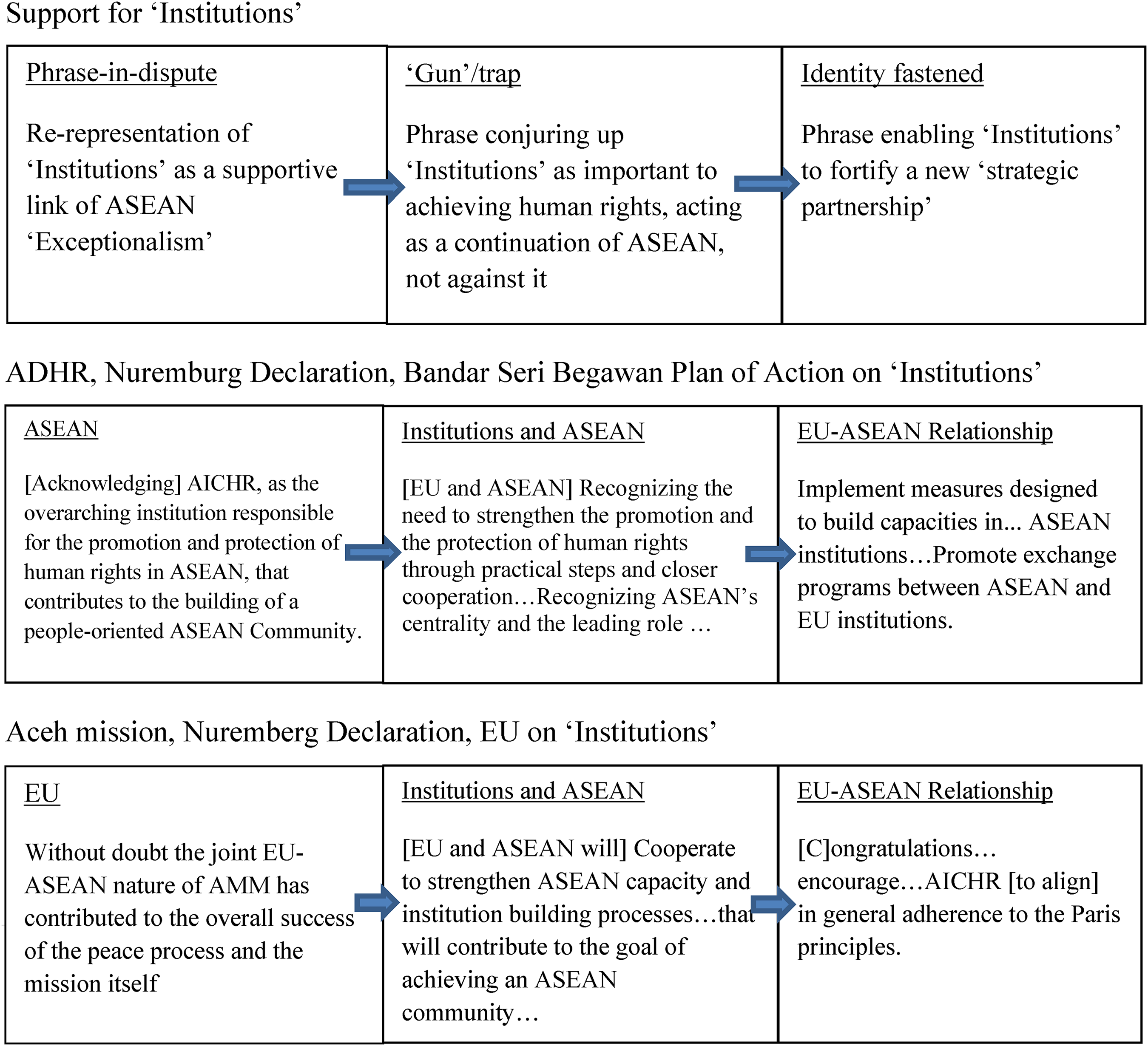
EU's Operationalising Phase 3.
Perhaps most surprisingly for some and most significant for others, however, has been how ASEAN, too, has demonstrated language power. For ASEAN's part, the phrase-in-dispute ‘Protection’, as narrated by the EU meaning strong institutionalism and consultation with civil society, disputed ASEAN's ‘Exceptionalism’. The ‘appropriate regional mechanism’ became a source of contestation whereby ASEAN has deployed tactics to either silence or coerce the EU's criticisms over ‘Promotion’. This has been achieved in two ways; in the first instance, it is clear that the EU could not simply accept the ASEAN view that promotion was sufficient. As such, ASEAN has demonstrated a commitment to protection through promotion, framing human rights implementation, and subsequently AICHR, as an ‘evolutionary process’. Already in the Nuremburg declaration (2007), there was a notable shift towards ASEAN's ‘promotion’ narrative – ‘protection’ of human rights is mentioned a mere 2 times, ‘promotion’ of human rights 11 times. The launch of AICHR in 2009 further demonstrated the EU's shift towards acceptance, where minor reservations were hidden in between lines of praise. Alongside this, the key ‘trap’ demonstrating language power in action has been ASEAN's insistence on promotion as a stepping stone to protection. We see this in several ASEAN official's comments; Swajaya, Indonesia's former Permanent Representative to ASEAN (2013), argued during ASEAN Day's Discussion Panel that the ‘promotion and protection’ of human rights lay at the centre of AICHR, and was an ‘evolutionary process’ recognising ‘AICHR… [needs to] foster greater awareness on human rights protection.’ Whilst respecting ASEAN's need to control the direction of human rights, on the one hand, it also forced the EU's hand to accept by appealing to its concerns, that promotion is useless without later developing the means to implement and protect human rights (Swajaya, 2013: 4). There has been an increasing sense, Djamin (2014, 2015) argues, that in some form ASEAN needs stronger institutions, that this could be the means to protect – but it has to be implemented with ASEAN in mind. Perhaps most forcefully has been the view that, ‘promotion is a kind of protection’ (Indonesian AICHR staff, 2014). Reiterating the EU's concerns over ASEAN, Driesman's final comments are telling; ‘[We] need to listen to them [ASEAN], try to be factual and have some humility’ (emphasis added). In being ‘factual’ the EU can preserve its status as a ‘Guardian’ preserving international standards of human rights on the one hand, but in showing ‘humility’ it accepts ASEAN's alternative model for human rights implementation.
Moreover, there has been the tactical use of language over the issue of civil society and AICHR's elitism. The criticism of AICHR's inability to engage with civil society meaningfully has seemingly been overturned to the extent that the EU no longer sees this as a threat to its human rights image, but rather the EU can now instead support AICHR. What has emerged as the crucial ‘trap’ is the notion of ‘duality’ – the careful balancing of both regional interests (people-oriented) and national interests (elite-oriented). This compromise leads to a mode of operating whereby human rights can be effectuated on a regional level on the one hand, and a national level on the next: ‘The regional level encourages change at the national level, and the national level in turn helps to direct the regional level’ (Chalempalanupap, 2014). Of particular importance has been the WG, which has been an arena for contestation. Established in 1995, the group straddled between civil society on the one hand and ASEAN elites on the other. As has been noted, the group initially proposed an appeal to human rights to ASEAN on terms it could not accept; through internal contestation within elites – and irrespective of the EU – the working group successfully put human rights on the ASEAN agenda, on ASEAN's terms. Furthermore, Elaine Tan, former President of the ASEAN Foundation, has argued both engagement and caution when working with the EU and its approach: ‘There are positive initiatives by the EU that ASEAN has taken… Education, Erasmus…We want to do more.’ However, Tan emphasised that, ‘ASEAN is clear it wants its own approach,’ and the Foundation, people-centred, prioritises the view that the various peoples of ASEAN should be allowed, ‘To think ASEAN’ (2015). Ultimately, Rafendi Djamin states that ASEAN has made the ‘small but conscious step’ from a community with a people-oriented approach to people-centred one today: ‘People-centred is, well, about the people’ (2015).
Through Representational Force, this language can be seen in the elevation of the EU's support for AICHR. Considering the Bandar-Seri Begawan 2013–2017 Action Plan, both actors acknowledged both the key role of promotion and the importance of supporting AICHR. In ‘Co-operation on Human Rights’ (2013: Article 2.3), the aim became to, ‘Support the work of AICHR, as the overarching body…’ (2013: 3). Furthermore, a press statement issued by the EU following the EU Special Representative Mr Lambrinidis’ visit to AICHR offered much praise of the institution: ‘EUSR [European Union Special Representative] Lambrinidis emphasized ASEAN's centrality in the area of Human Rights in the region and beyond, with AICHR having an overarching role. He also expressed EU willingness to further support AICHR.’ Moreover, this shift to actively supporting AICHR demonstrates an EU shift towards ASEAN's approach. Whilst the joint statement of the 1st ASEAN–EU Policy Dialogue on Human Rights (2015) discussed cooperation and commitment to human rights, including, ‘an interaction with civil society’ (appealing to the EU's concerns), and ‘the right to development’ (appealing to ASEAN's concerns), the 2nd dialogue (2017) saw how: ‘The two sides expressed their commitment to the promotion and protection of human rights and fundamental freedoms contained in the Universal Declaration of Human Rights and the international human rights instruments to which ASEAN Member States are parties, as well as the ASEAN Human Rights Declaration and other human rights related regional instruments.’ (emphasis added.)
The language appears to reflect a balance between both actors’ concerns, suggesting something akin to a new phase of ‘tolerance’ – not a ‘fixed’ reality, but rather contestation can be expressed within the friendly space of ‘strategic partnership’. Moreover, ASEAN has directed this relationship, as evidenced in the operationalising of Representational Force found in Figure 2 below. ASEAN's successful use of the linguistic ‘gun’ has forced the EU's path into accepting ASEAN's representation of AICHR: that is, articulating the narrative of promotion (‘AICHR is a work in progress’), the EU has embraced ASEAN's answer to human rights protection (‘[AICHR] is the best avenue that we have’).
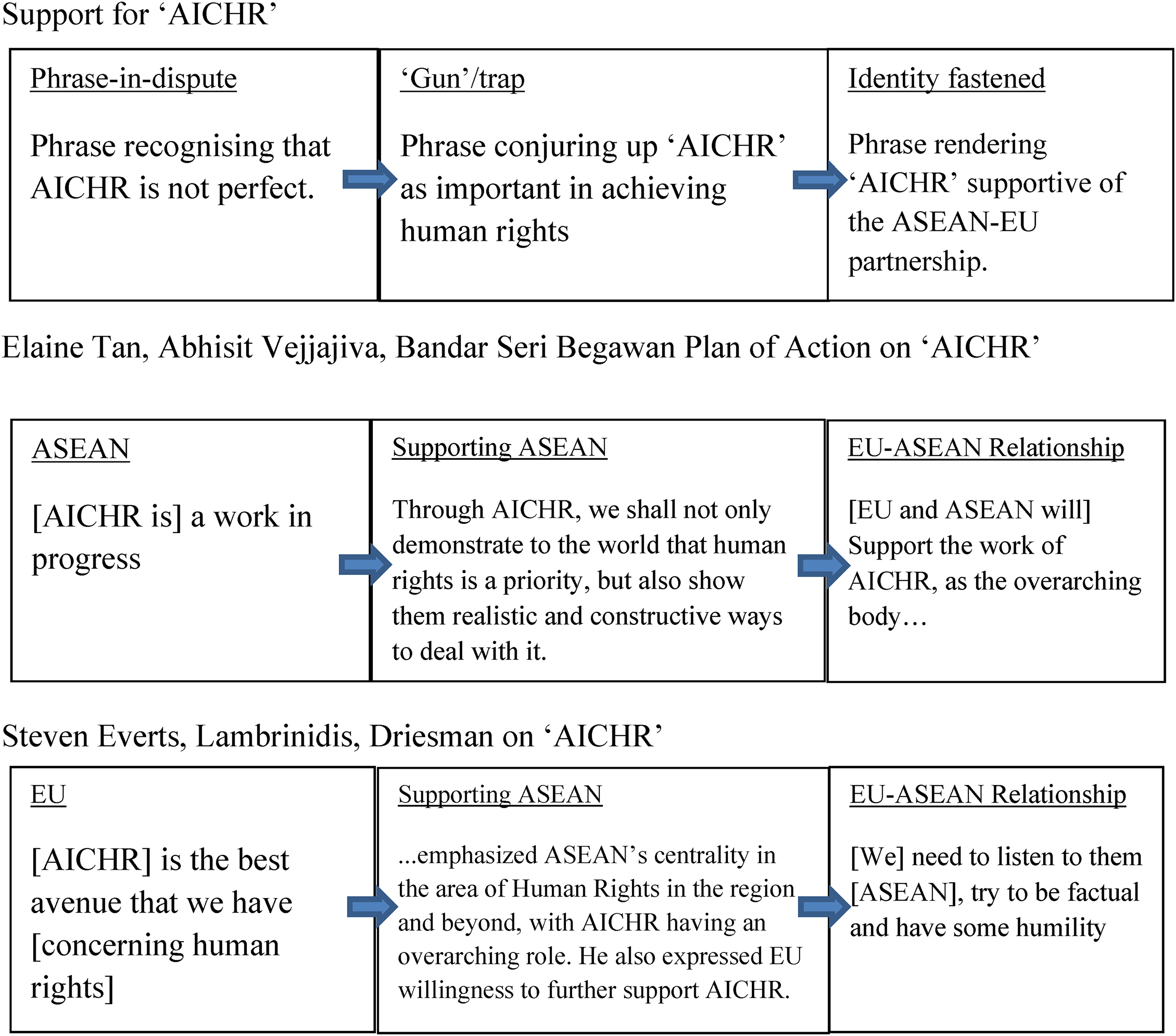
ASEAN's Operationalising Phase 3.
Conclusion: ASEAN, the EU, and the (Surprising) use of Language Power
Human rights represents a small yet significant catalyst in understanding the ASEAN–EU relationship – not least because, perhaps surprising to some and significant to others, it demonstrates how ASEAN has co-opted the EU into accepting ASEAN's representation of human rights in Southeast Asia. One clear example of this has been through the contestation over ‘promotion’ and ‘protection’ of human rights. 5 Despite criticisms, ASEAN's answer to an ‘appropriate regional mechanism’, AICHR, has celebrated more than a decade of life. It remains, in part, because it has served as a means for ASEAN to contest the regional narrative of human rights, most notably with its dialogue partners in the EU. It is this key – language power – that explains how a local actor resists, adapts, and most importantly contests so-called international ‘positive’ norms. Attesting to this has been the case study of the ASEAN–EU relationship, and how the EU's narrative identity of ‘Guardian’ of human rights clashed with ASEAN's identity of ‘Exceptionalism’. It has been said that ASEAN has never intended to listen to the EU, but this remark hides an interesting history of contestation and change in the language between the two. This narrative clash of identities and the empirical evidence to support it suggest, interestingly, that whilst the EU demonstrated its capacity to influence ASEAN it did so merely as a ‘reference point’, not a ‘model’: ‘We don’t listen to the EU’ (former ASEAN Secretariat Severino, 2014) may be closer to Wong's (2012) understanding of the EU as a ‘passive’ actor, yet the plethora of joint meetings, declarations, and even deliberate action by the EU in many areas in Southeast Asia in the name of human rights does at least suggest some scope for influence, and the language between the two regional communities has changed. Language, with the aim to coerce the other's narrative identity to change, was deployed by both sides. In the case of ‘promotion’, the EU at first criticised, then later accepted, and finally supports ASEAN's approach, most interestingly AICHR's ‘evolutionary process’. AICHR, in a critical sense, represents a long lineage of ‘an appropriate regional mechanism’ that demonstrates itself as a source of (language) power. Overall, it showcases ASEAN's real influence in the relationship and narrative of human rights in Southeast Asia and perhaps beyond. Driesman's (2014) comments are particularly revealing: ‘[We] need to listen to [ASEAN], try to be factual and show humility.’
A few final notes: this is not to say that ASEAN's narrating of human rights protection is without problems. From a moral point of view concerning human rights, there is the criticism that AICHR fails to engage or uphold human rights – contesting meaning cannot replace implementation. Moreover, there still remains the powerful influence of international norms, regardless of the contestation of local actors. So how to recognise the right portrait of ASEAN? Our answer lies in the fact that ASEAN has many faces, and it is with keen attention to the nuances of constructivism that we may ‘see’ its various forms. Whilst critical constructivism offers the exciting revelation of how actors contest, this is not to say that some concepts of norms as ‘fixed’ (especially ‘positive’ or western norms) do not play some role in structuring these actors. We may say that norms and their fixity serve as the arena, while language serves as the array of weapons and tactics used by the combatants to contest. Weapons – language power – are an extension of the agent's metaphorical body, their agency, much like the sword is an extension of the warrior, and the arena, that is the terrain, the contours, and the physics of space, all shape, structure, what agents and their weapons can do.
Amongst these reflections lie Representational Force: able to see contestation in action, yet only by suspending any attachment to prior moral or ethical beliefs and frameworks. If contestation is, as the theory goes, possible on any level, then that may be a rather disconcerting thought. The liberal inside us may wish to appeal to international ‘positive’ norms of human rights as ‘fixed’ moral foundations. Nevertheless, the application of Representational Force helps us understand the ASEAN–EU relationship, building on the work of Acharya, Weiner, and others – that local actors do resist, and more interestingly they contest, and this is one way that they go about it. AICHR may well represent a unique space for ASEAN to contest the very meaning of our approach to human rights for years to come, and the EU may well continue (or not) to follow ASEAN's lead. It is, after all, an ‘evolutionary process’. And just how powerful is this language? As political and economic events increasingly favour the non-western world, language becomes one of the first tools for previously ‘weak’ actors to signal their intentions, legitimise their positions, and narrate their destiny. The EU for now may well have acquiesced, rather than accepted, ASEAN's ‘evolutionary process’ in the ‘promotion’ and ‘protection’ of human rights. Nevertheless, that ASEAN – a non-western, traditionally weak actor – demonstrates (language) power is now clear.
Footnotes
Acknowledgements
The author would like to extend his thanks to those he interviewed over the many years in pursuit of understanding ASEAN, the EU, and human rights. Moreover, special thanks to Swansea University, as well as all the reviewers, both familiar and anonymous, who have shaped the many drafts of this article.
Author's Note
Jamie D. Stacey, independent researcher.
Declaration of Conflicting Interests
The author declared no potential conflicts of interest with respect to the research, authorship, and/or publication of this article.
Funding
The author received no financial support for the research, authorship, and/or publication of this article.