




Abstract
This article contributes to the scholarship on Latin American campaigning by presenting data on the use of social media by presidential candidates in Guatemala’s 2019 election, including a content analysis of more than 2,000 Facebook posts along fifteen variables. The data show that Facebook use by presidential campaigns is ubiquitous and allows campaigns to disseminate messages in non-traditional formats. Candidates use their Facebook accounts to mention issues of concern to voters and to make promises to fix the country’s problems, but offer far more slogans and vague promises than detailed policy proposals. They also rarely attack other candidates or tout their own qualifications for the presidency. The data also reveal systematic differences in campaign messaging between frontrunner and long-shot candidates.
The use of social media by candidates for public office is reshaping electoral politics around the world. Since they allow campaigns to communicate with the public for free, social media platforms like Facebook, Twitter, and Instagram appeal to candidates who do not have the resources to spend on more traditional campaigning methods. They can allow outsider candidates to overcome hostility from party elites and traditional media.
Studies from the US and European contexts have examined how candidates use social media to discuss issues, attack their opponents, and appeal to emotions (Auter and Fine, 2016, Borah, 2016; Evans et al., 2014, 2017). This literature has found that social media posts are less likely to attack an election opponent and less likely to include policy content than are traditional television ads (Bode et al., 2016). This is consistent with the hypothesis that social media posts are likely to be targeted at supporters rather than persuadable voters, and therefore should be less negative and less policy focused (Borah et al., 2018).
Yet systematic content analyses of Latin American campaigns’ social media communications are sparse, despite the fact that a majority of Latin Americans use at least some social media platforms (Sonneland, 2017). This research note contributes to the study of how campaigns in Latin America use social media for messaging to voters. It does so through a content analysis of over 2,000 Facebook posts along fifteen variables by presidential candidates in Guatemala’s 2019 campaign. The results shed light on how candidates in the country use social media for campaigning and how relatively new technological tools are combining with more traditional methods to reshape electioneering in the region.
This article seeks to make two contributions to the literature. First, it offers the first systematic analysis of campaign messaging on social media in Guatemala. By doing so, this article contributes to broader research on election campaigning in Latin America. Second, the article employs a novel coding scheme for content analysis that captures elements of programmatic and image-centred appeals to voters. The coding scheme includes variables such as “personal touch” and “ethnic image” (described below) that have not be used in prior research and that are particularly relevant in the Latin American context.
The Campaign and Social Media
As Guatemala’s 2019 presidential campaign began in March, over twenty candidates were registered. Early frontrunners were former first lady Sandra Torres of the left-leaning Unidad Nacional de la Esperanza (National Unity of Hope, UNE), former attorney general Thelma Aldana, Zury Ríos, and Alejandro Giammattei (Contreras, 2019). Giammattei, who ultimately won the presidency in the second round against Torres, ran under the banner of the conservative Vamos party. Candidates ranged from far left to far right, with relatively few candidates staking out the centre of the political spectrum.
The campaign unfolded with new institutional rules in place. Most importantly, reforms to the electoral law in 2016 prohibited campaigns from purchasing ad space directly from media companies. Instead, campaigns were required to purchase media time through the Tribunal Supremo Electoral (Supreme Electoral Tribunal, TSE), which divided media time equally across the campaigns. Maximum campaign spending limits were also reduced, with a maximum for each campaign of approximately $3.8 million (IFES, 2019: 10).
While reforms to the electoral law prohibited candidates and political parties from directly buying publicity on social media, candidates made extensive use of their own accounts to promote their candidacies. The importance of social media was amplified by the new rules for contracting media airtime, whereby the TSE paid broadcasters only 20 per cent of the market rate to run campaign ads. As a result, most major national broadcasters declined to sell airtime to the TSE. While campaigns did acquire television and radio airtime, the most widely watched television stations were unavailable to the campaigns (Mirador Electoral, 2019a: 42, 44, 49). Thus, campaign advertisements were much scarcer on the airwaves than in previous elections. With only limited ability to buy airtime in the national media, campaigns relied on social media and on-the-ground campaign methods to reach the electorate. Thus, the most modern and most traditional methods of campaigning had to compensate for the paucity of television advertising.
The relevance of social media for Guatemalan campaigns is highlighted by surveys showing prevalence of social media use in the country. In a 2018 survey, Latinobarómetro found that half of Guatemalans use Facebook, while 18 per cent use YouTube, 14 per cent use Instagram, and nearly 9 per cent use Twitter. Half of respondents reported that they use Facebook to stay informed about politics (Latinobarómetro, 2018: 13, 46). A CID-Gallup national poll asking Guatemalans which means of communication they use to become informed about candidates found that while broadcast television was by far the most popular (64 per cent of respondents), 14 per cent reported using Facebook to learn about candidates. This doubled the number of Guatemalans reporting that they learnt about candidates from print media, and far surpassed reliance on other social media and messaging platforms (Fundación Libertad y Desarrollo, 2019).
The social media co-ordinator for one of the presidential campaigns reported that Facebook was particularly important for their campaign because their candidate was strongest in urban areas where most people use Facebook, and that Facebook was even more important in 2019 because of the scarcity of campaign advertising on the major television stations (interview with author, Guatemala City, June 2019). Data from the Latin American Public Opinion Project’s AmericasBarometer (www.LapopSurveys.org) for 2018 show that younger and more educated Guatemalans are much more likely to have a Facebook account than older and less educated individuals, and indigenous persons are less likely to use Facebook than non-indigenous (36 per cent compared to 52 per cent). Thus, campaigns are reaching a disproportionately young, educated, and mestizo audience through Facebook.
Candidates’ social media presence was ubiquitous. Of twenty-two presumptive presidential candidates at the outset of the campaign, all of them had a Facebook account used for campaigning. Twenty had a Twitter account, sixteen had an Instagram account, and seven had a YouTube account. Only seven campaigns had a website. The pattern is similar for the twenty-two political parties fielding a presidential candidate: twenty-one had a party Facebook account, eighteen had a Twitter account, eleven had an Instagram account, and eleven had a YouTube account. Only fourteen political parties had a working website.
While some candidates’ campaigns posted more frequently on Facebook than on other platforms, a few candidates (Thelma Aldana, Thelma Cabrera, Edwin Escobar) were more active on Twitter than Facebook. About half of the campaigns posted almost identical content to their Facebook and Twitter accounts.
Altogether, presidential candidates posted 6,627 messages to Facebook during the campaign period preceding the first round of the election, with an average of 301 posts per candidate. The volume of Facebook posts ranged from a low of thirty Movimiento para la Liberación de los Pueblos (Movement for the Liberation of Peoples, MLP) (Thelma Cabrera from the MLP party) to a high of 854 Unidad Revolucionaria Nacional Guatemalteca (Guatemalan National Revolutionary Unity, URNG) (Pablo Ceto of the URNG). The range of followers on candidate Facebook pages is dramatic, from just 746 followers to over 250,000, with a mean of over 44,000. Candidate posts averaged 609 likes and 159 shares, while videos posted by campaigns averaged 12,800 views. 1
Given Guatemala’s large number of political parties and presidential candidates, below I distinguish between frontrunner candidates who have a realistic shot at winning the presidency and long-shot candidates. As Boas (2016: 26–27) notes, minor candidates “are usually playing a different game than major candidates – acting as spoilers, positioning themselves to trade a second-round endorsement for political deals with a new government, or simply pursuing media exposure to improve their future electoral prospects.” We should therefore expect some differences in how frontrunner and long-shot candidates use social media for campaigning.
Campaign Messaging on Facebook Dataset
To explore the content of social media messaging used by campaigns, I coded the content of 2,126 Facebook posts by presidential candidates prior to the first round of the election on 16 June 2019. Given the weakness and personalisation of political parties in Guatemala (Sánchez, 2008) and the larger audiences for candidate social media accounts than political party accounts, I focus on the Facebook accounts used by candidates rather than by political parties.
The dataset includes all Facebook posts by three leading frontrunner candidates (Alejandro Giammattei, Sandra Torres, and Zury Ríos; n = 1,072) 2 and a stratified random sample of all other (long-shot) presidential candidates (n = 1,054). To construct the sample, the campaign was divided into four time periods of roughly equal length, and a random sample of fifteen posts was taken for each candidate during each campaign period.
Basic descriptive information was coded for each post: its format (text, photos, video), number of likes and shares, whether the post included a link to an external site (including other Facebook pages), and whether the post made an announcement about an upcoming campaign event or media appearance. When a post contained a video, the type of video content was recorded as being a traditional television-style campaign spot, a campaign event such as a rally or press conference, a candidate’s media appearance, a candidate’s direct message to the audience, or other. 3
Most substantively, I coded the content of the post along a range of variables, all of which are coded dichotomously:
Whether the post included a campaign
Whether the post included a message offering a
Whether the post included photos or video showing the candidate meeting with or speaking face-to-face with ordinary citizens (
Whether the post includes a
Whether the post mentions indigenous peoples or if an indigenous language is used (
Whether the post includes any clearly visible symbols of indigenous culture, such as persons in traditional indigenous clothing (
Whether the post mentions the personal
Whether the post mentions at least one policy area (
Whether the post proposes a specific policy action (
My coding scheme follows previous research in coding the content of social media posts dichotomously (e.g. Evans and Clark, 2016). However, I depart from some work that places each social media post in only one category, such as “issue tweet” or “attack tweet” (Evans et al., 2014; Heras Gómez and Díaz Jiménez, 2017). Such a coding decision loses much information about social media messaging by campaigns, as each post is forced into only one category. Thus, a social media post that includes an attack on an opposing candidate and a policy proposal might be coded as simply an attack message. By contrast, my coding criteria allow for recording multiple elements of an individual social media post, without the coder making judgements about the primary element of the post.
The coding scheme captures many of the important elements of campaign messaging on Facebook. It is not exhaustive, however, and does not capture all of the idiosyncratic and sometimes colourful uses to which candidates put their social media profiles. Various candidates used their accounts to wish their audiences a happy Mother’s Day, Secretary Day, and World Water Day – examples of what others have labelled courtesy messages (López-Meri et al., 2017). Some campaigns interacted with Facebook users – such as Zury Ríos posting a poll for users to vote on which photo of the candidate to use on the ballot – but this type of interaction with other Facebook users was rare.
Findings
In terms of Facebook post format, posts including text and images were most common, making up a majority of posts (65 per cent of frontrunner posts and 58 per cent for long-shot candidates). Posts including text and a video were also common, making up 31 per cent to 32 per cent of posts from both long-shot and frontrunner candidates. Posts containing only a video, only text, or only an image made up a small proportion of all posts and were more common from long-shot candidates.
Candidates posted a variety of image content. Photos of candidates meeting with voters were common, as were photos of campaign rallies. Some photos showed the candidate with his or her family, part of a personalisation strategy that has been documented in social media use by candidates in Europe (Graham et al., 2018).
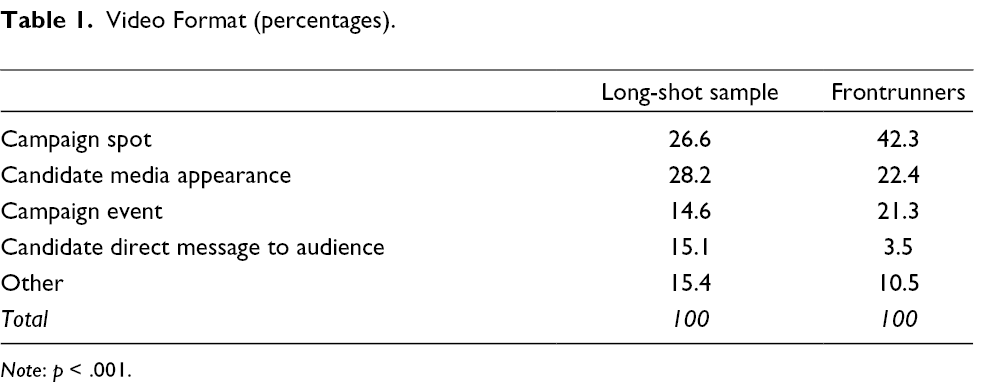
As Table 1 shows, videos posted by campaigns are a mix of campaign spots, campaign events, candidate interviews on television or radio programmes, and candidates speaking directly to viewers. Campaign spots varied widely in production quality. Campaign event videos usually showed campaign rallies or canvassing events. Many of these videos were recorded with smartphones, and some were unedited and ran thirty or sixty minutes long. Videos of candidates’ television or radio interviews were often long and unedited; an exception was Alejandro Giammattei’s campaign, which edited the candidate’s interviews into multiple one-minute videos, each one framed around a different issue. In the category of candidates speaking directly to viewers, candidates sometimes recorded themselves with a smartphone. Alternately, Roberto Arzú held Facebook Live sessions in which he responded to user questions in real time.
Video Format (percentages).
Note: p < .001.
Frontrunner candidates more frequently posted campaign spots and campaign events. They were much less likely to post direct messages from candidate to audience. One plausible explanation for the difference is that frontrunner campaigns enjoyed the resources to produce slick campaign spots and organise large rallies, while smaller campaigns made more use of inexpensive methods such as recording messages directly to supporters.
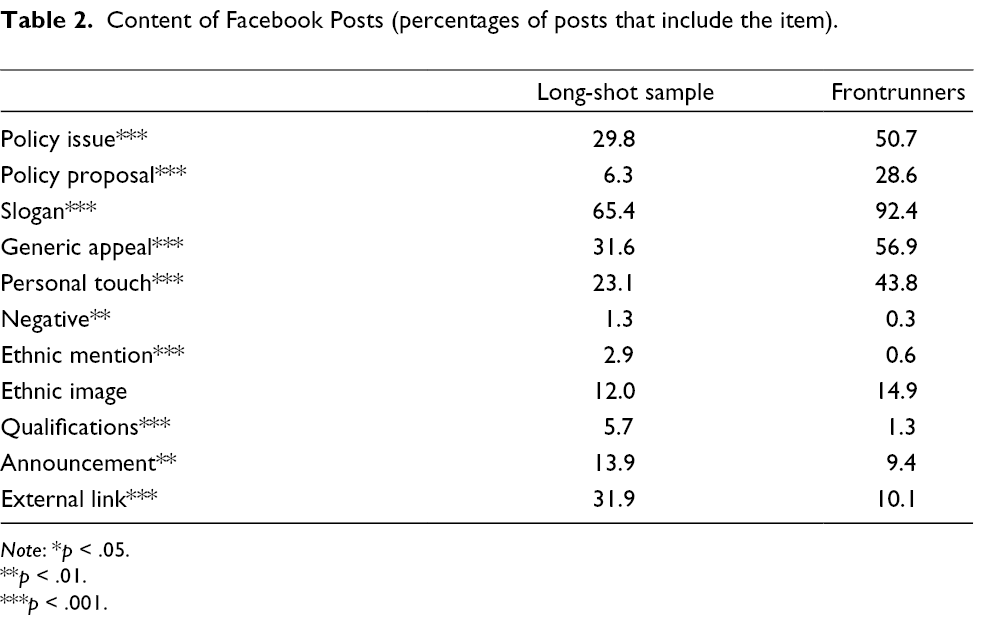
The substantive content of campaign Facebook posts is presented in Table 2. A majority of posts included a campaign slogan, and many also included a generic appeal to voters. Mentions of policy issues were also common, while specific policy proposals were less so. (This is to be expected, as any policy proposal is also coded as a mention of a policy issue, while many posts mention an issue without offering a policy proposal.) Posts showing the candidate’s personal touch – photos or video of the candidate meeting with ordinary people – were also common.
Content of Facebook Posts (percentages of posts that include the item).
Note: *p < .05.
**p < .01.
***p < .001.
There are large and statistically significant differences between the content of posts from frontrunner and long-shot candidates. Overall, frontrunners tended to do more with each post, often including slogans, generic appeals, policy issues, and personal touch in the same post. Frontrunners mentioned policy issues and offered policy proposals much more often than did long shots. In large part, this difference is driven by Sandra Torres’ campaign, which included in most of its posts a list of policy proposals specific to a particular municipality that the candidate had visited for a campaign event. Frontrunners also more often employed campaign slogans (included in over 92 per cent of posts), generic appeals, and personal touch images.
For comparison, Guatemalan presidential candidates used Facebook to post more issue-oriented messages than did the Mexican congressional candidates studied by Heras Gómez and Díaz Jiménez (2017), who found that only 12 per cent to 13 per cent of Twitter and Facebook posts were policy-oriented or programmatic. This is much lower than the rate at which Guatemalan presidential candidates mentioned policy issues, and at which frontrunners offered policy proposals.
A noteworthy finding is the paucity of certain content in campaign messaging. Perhaps surprisingly, there is almost no negative messaging: attacks against rival candidates were rare throughout the first round of the campaign. This parallels some research on American campaigns that finds congressional candidates rarely use negative messaging against their opponents via Twitter (Evans et al., 2014), but differs from US presidential races where candidate attacks on social media have been fairly common (Borah, 2016; Evans et al., 2017). When a candidate did use a negative message, Sandra Torres was most frequently the target – reflecting Torres’ frontrunner status and intense unpopularity among a large segment of the electorate, especially in urban areas.
There are several possible reasons for the scarcity of attack ads. First, attacking lesser-known candidates might only draw more attention to the targeted candidate, increasing their name recognition and support. A preferable alternative might be to let one’s rivals campaign in obscurity. 8 Relatedly, in a multi-party context, even attacks that hurt the electoral prospects of another candidate may not rebound to the benefit of the attacking candidate (Nai, 2020: 6).
Second, given the two-round election system, candidates might seek to avoid alienating frontrunner candidates in the hopes of striking political deals with them after the first round of voting, throwing their support behind one of the candidates that passes to the second round. This is consistent with research on negative campaigning, which suggests that in systems with a large number of parties competing, negative campaigning should be minimised because candidates have a strategic incentive to avoid alienating potential post-election coalition partners (Nai, 2020: 5–6).
Finally, the campaigns may simply outsource their attacks against other candidates. Outside groups wielding fake social media accounts – known in Guatemala as “net centres” – have been hired to support political figures and attack political opponents, including during elections (Currier and Mackey, 2018). The extent to which such trolls for hire are employed in Guatemalan elections and their effects on voters are unknown. But the availability of such surrogates may help account for why candidates refrain from directly attacking their opponents through their own social media accounts, given the risk of a backlash effect that negative messaging carries (Lau and Rovner, 2009; Nai, 2020).
While candidates rarely attacked their rivals, they also rarely touted their own qualifications for the presidency. Among frontrunners, only a paltry 1.3 per cent of posts included a reference to the candidate’s qualifications. Among long-shot candidates, less than 6 per cent of posts referenced candidate qualifications. Former diplomat Edmond Mulet led all candidates, mentioning his qualifications for the presidency in thirteen of the sixty Facebook posts sampled.
Campaign posts also rarely mentioned indigenous peoples, who are mentioned in less than 3 per cent of posts among long-shot candidates and less than 1 per cent among frontrunners. The campaigns of Pablo Ceto, Benito Morales, and Manuel Villacorta mentioned indigenous people most frequently; the first two candidates are themselves of indigenous descent, and Villacorta was the candidate for the Winaq party, which has a strong Mayan identity. Images of indigenous cultures were much more frequent, but less than 15 per cent of posts included imagery of indigenous identity.
A small proportion of posts announced campaign events. Most campaign announcements related to candidates’ upcoming media appearances rather than campaign rallies. This suggests that face-to-face grassroots connections, including clientelist networks, are still primary in mobilising people to campaign events in Guatemala. A fair number of posts also included external links, which most commonly linked to another Facebook account (such as a media outlet that had interviewed the candidate). Frontrunner candidates included external links much less often than did other candidates.
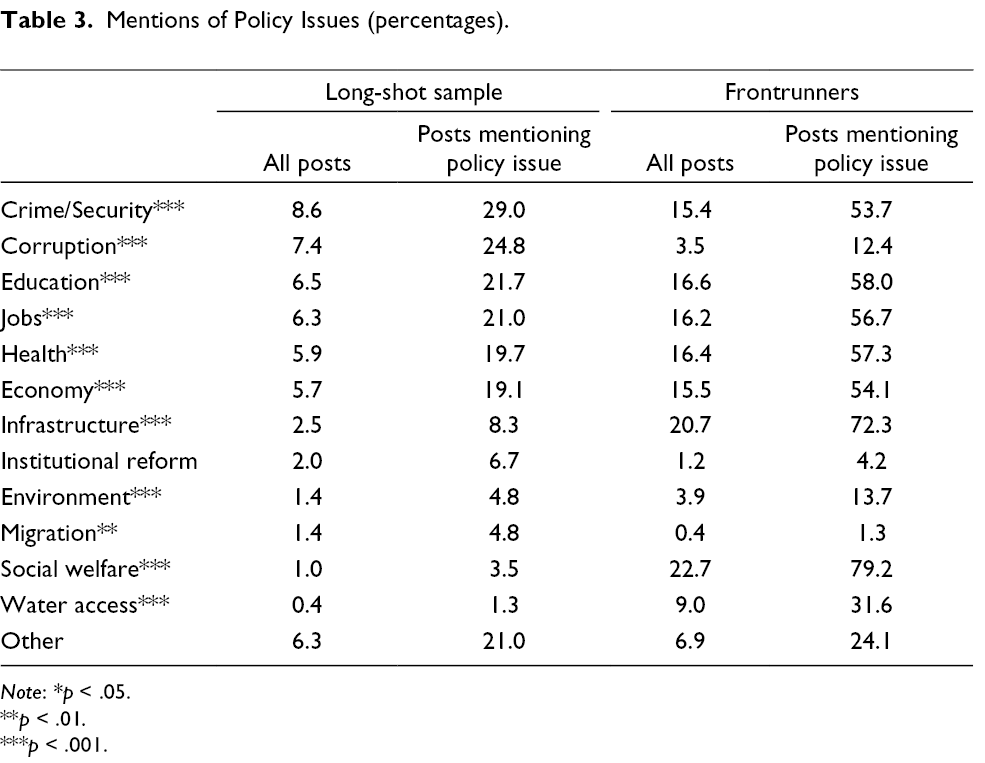
The issues that candidates mentioned in their posts are summarised in Table 3. While a majority of posts did not mention any issue, many posts mentioned multiple issues. Valence issues predominated: candidates promised to improve citizen security and reduce crime, to provide jobs, to improve education and health services, and to invest in infrastructure. Most candidates promised that they would deliver solutions on a wide range of difficult issues. A recurring theme along these lines was the promise to bring maquilas, or export-oriented assembly plants, to local communities to create jobs. Likewise, candidates across the political spectrum supported militarising security policy, such as having the military patrol streets to combat crime. However, issues of poverty, social inequality, civil service reform, and the environment were mentioned only rarely (see also Martínez, 2019).
Mentions of Policy Issues (percentages).
Note: *p < .05.
**p < .01.
***p < .001.
Some candidates did invoke value-based wedge issues. In particular, many conservative candidates posted their opposition to abortion and same-sex marriage and their support for reinstating the death penalty. The conservative candidate Amílcar Rivera even made “no more human rights for criminals” a campaign slogan.
Frontrunners were significantly more likely than long-shot candidates to mention crime and security, jobs, education, health, the economy (other than employment), infrastructure, social welfare, the environment, and access to water. The large differences on infrastructure and social welfare largely reflect Sandra Torres’ campaign: Torres frequently promised infrastructure projects and promised to bring back the Mi Familia Progresa (“My Family Progresses”) welfare programme, which she oversaw as first lady during the Álvaro Colom administration (2008–2012). Frontrunners were significantly less likely to mention corruption and migration. The issue of corruption in particular is noteworthy: given its recent prominence in Guatemalan political life, it was mentioned relatively rarely by most candidates, but especially by frontrunners. The avoidance of the issue reflects the fact that some candidates, like Torres, were themselves under investigation for corruption and were widely perceived by voters to be corrupt. Some people speculated that candidates appealed to voters on value issues like same-sex marriage to divert attention from the issue of corruption (Martínez, 2019).
There was a loose correspondence between issues emphasised by candidates and those most important to voters. One poll found that by far the most important issues for voters were unemployment (24.9 per cent), insecurity (23.5 per cent), corruption (16.5 per cent), and the high cost of living (10.5 per cent). Infrastructure, education, health, and access to water also registered as problems of concern (Fundación Libertad y Desarrollo, 2019). The one notable disconnect between voters and candidates was the paucity of mentions of corruption by frontrunner candidates.
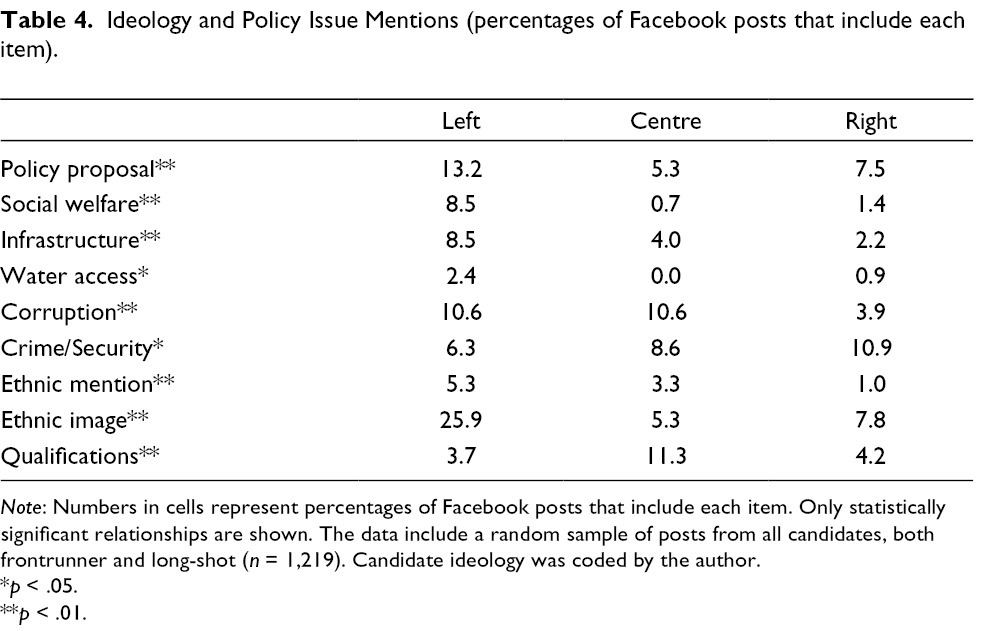
Table 4 compares the content of Facebook posts by candidate ideology. There is no statistically significant difference across the ideological spectrum in the likelihood that a candidate mentions a policy issue, or in mentioning jobs, the economy, health care, the environment, institutional reform, or migration. However, left-of-centre candidates were more likely to offer a policy proposal, a result driven by Sandra Torres’ overwhelming offering of policy proposals. Left-of-centre candidates were also more likely to mention social welfare, infrastructure, and water access. Right-of-centre candidates were more likely to mention crime or security (as existing theory would predict; see Uang, 2013), and were less likely than centrist and leftist candidates to mention corruption. Left-of-centre candidates were more likely to mention ethnic identity, and much more likely to include ethnic images in their Facebook content. Centrist candidates were significantly more likely to mention their qualifications. With only three candidates coded as centrist, this result is driven by Edmond Mulet’s frequent references to his qualifications.
Ideology and Policy Issue Mentions (percentages of Facebook posts that include each item).
Note: Numbers in cells represent percentages of Facebook posts that include each item. Only statistically significant relationships are shown. The data include a random sample of posts from all candidates, both frontrunner and long-shot (n = 1,219). Candidate ideology was coded by the author.
*p < .05.
**p < .01.
The Digital Landscape of Guatemalan Campaigning
The analysis above shows that social media has become an important part of presidential campaigning in Guatemala. Presidential campaigns use social media to share messages in a variety of formats, including videos that depart from traditional television spots. Candidates use their social media posts to try to shape their public image, and this often includes photos and videos of the candidate meeting with ordinary people – showing that they keep in touch with ordinary Guatemalans and their concerns. And most candidates use their Facebook accounts to mention issues of concern to voters and to make promises to fix the country’s problems.
The data also paint a pessimistic picture of the quality of Guatemalan campaigns in terms of offering voters programmatic alternatives. Candidates’ social media posts generally lack depth. Slogans and vague generic appeals are common, and though policy issues are often mentioned, concrete policy proposals are much less common. Those proposals that are offered typically lack detail. In short, much of the campaign messaging found on social media reproduces traditional characteristics of Guatemalan campaigning: a focus on candidate image, trafficking in hollow rhetoric, and offering vague and unrealistic promises to fix all sorts of problems.
The data also reveal a relative absence of issues pertaining to indigenous identity and ethnic discrimination. Indigenous groups are rarely mentioned by candidates, although symbolic imagery of indigenous culture figured prominently in some campaigns. The paucity of references to indigenous peoples in campaigns’ Facebook posts is matched by mass media coverage of the electoral process, in which mentions of indigenous peoples are rare (Mirador Electoral, 2019b: 20).
Finally, the data reveal some interesting and unanticipated patterns. Surprisingly, candidates avoid touting their own qualifications in their campaign messaging on social media. They also avoid attacking other candidates. There are also systematic differences in campaign messaging that vary not only by ideology but also by candidate competitiveness. Frontrunner candidates with a realistic chance at winning election use social media differently than do long-shot candidates. Frontrunners mention corruption less often, but mention most other policy issues more often; they offer policy proposals more often; they use slogans and generic appeals more frequently; they post more spot-style videos; and they seem to be more conscious in crafting an image of connectedness to ordinary people by using “personal touch” images.
Conclusion
The descriptive data on Guatemalan presidential campaigns presented in this article could serve as a benchmark for future research on electioneering throughout Latin America. Scholarship in this area might shed light on whether patterns found in Guatemala – the relative absence of negative campaigning and touting candidate qualifications, and the differences between frontrunner and long-shot candidates – extend to other countries in the region. Content analysis of campaign messages on social media in more countries will open up greater space for causal theorising, allowing scholars not only to document patterns in campaign messaging but also to explain variation across candidates and electoral contexts.
A first step in this direction might examine whether the use of social media differs in countries with more institutionalised party systems. Suggestive in this regard is a separate study examining tweets from presidential candidates in Argentina, a country with fewer candidates, more institutionalised party loyalties, and more ideologically structured political competition. Argentina’s campaign tweets include more attacks and fewer slogans, generic appeals, and personal touch images than Guatemalan campaign Facebook posts. However, Argentina’s candidates were similar to Guatemalan frontrunner candidates in the frequency with which they mentioned policy issues while offering policy proposals less frequently than their Guatemalan counterparts (Pallister and Fitzpatrik, 2021).
The use of social media and new messaging apps also raises new issues in election campaigns for scholars to study. One such issue is how social media use affects campaigns’ ability to engage in micro-targeting or narrowcasting – targeting specific groups of voters with specific messages. Some features of social media, such as purchasing ads on Facebook, might facilitate such segmentation of electoral appeals. Other features, however, such as the broad public audience for any candidate’s tweets, work against such segmentation or micro-targeting (Evans and Clark, 2016). An area for further research is whether contexts of moderate social media penetration such as that found in Guatemala facilitate what Luna (2017) calls segmented linkages to voters, with campaigns offering more programmatic or symbolic appeals to social media audiences (typically younger, urban, affluent) and clientelistic linkages to offline constituencies (more rural, older, less affluent). A greater understanding of message targeting will be key to mapping the digital landscape of campaigning in the region.
Supplemental Material
Online supplementary file 1 - Supplemental material for Digital Caudillos: The Use of Social Media in Guatemalan Presidential Campaigns
Supplemental material, Online supplementary file 1, for Digital Caudillos: The Use of Social Media in Guatemalan Presidential Campaigns by and Kevin Pallister in Journal of Politics in Latin America
Footnotes
Declaration of Conflicting Interests
The author(s) declared no potential conflicts of interest with respect to the research, authorship, and/or publication of this article.
Funding
The author(s) received no financial support for the research, authorship, and/or publication of this article.
Supplemental Material
Supplemental material for this article is available online.
Notes
Author Biography
Email:
References
Supplementary Material
Please find the following supplemental material available below.
For Open Access articles published under a Creative Commons License, all supplemental material carries the same license as the article it is associated with.
For non-Open Access articles published, all supplemental material carries a non-exclusive license, and permission requests for re-use of supplemental material or any part of supplemental material shall be sent directly to the copyright owner as specified in the copyright notice associated with the article.
