



Abstract
From 2014 to 2023, Ricardo Mendez Ruiz published thousands of Facebook posts where he explained that he and the far-right Foundation against Terrorism, of which he is president, will defend Guatemala's military and sovereignty from “terrorists” who threaten Guatemala. Mendez Ruiz engages in propaganda campaigns and lawfare to discursively discredit targets–human rights defenders and anti-impunity actors–and their work. These two work together and force targets into exile, contributing to democratic backsliding. This article analyses these posts to better understand who Mendez Ruiz targets and what he says about them, underscoring the role of a non-state actor in weakening democratic institutions and deepening authoritarianism.
In ten years of Facebook posts (2014–2023), the far-right Foundation against Terrorism (FCT) and its founding president, Ricardo Méndez Ruiz, have left little to the imagination regarding how they view particular public figures. 1 Méndez Ruiz has called a former Attorney General scum, a former prosecutor swine, a former Constitutional Court magistrate immoral, a former high ranking judge a sociopath, a journalist mentally ill, and a former US ambassador to Guatemala trash. Posts targeting individuals are mixed in with, for example, posts calling for police action against those who “threaten decent Guatemalans’ security and the economy” (@MendezRuizV, 25 April 2022). These exclusionary and anti-democratic discursive campaigns exist at the intersection of propaganda and hate speech, broadly understood. 2 They are characteristic of far-right populists like Méndez Ruiz, included on the United States Department of State's (2021) so-called Engle list of “corrupt and undemocratic actors,” and have had a devastating impact on the strength of Guatemala's democratic institutions.
The FCT is a pro-military civil society organization initially founded in response to trials against veterans for crimes committed during Guatemala's internal armed conflict (1960–1996). It has close ties to AVEMILGUA, the Guatemalan Military Veterans’ Association (Gamazo, 2013a). The son of a coronel and former Ministry of the Interior, Méndez Ruiz has never been in government or held public office, though he once ran for mayor of Guatemala City (Ochoa, 2012) and announced his intention to run for the presidency in the 2019 elections, but did not do so (Soy502, 2018). Yet the FCT is far from a “typical” civil society organization, as will be seen further below. Méndez Ruiz and the FCT fit well into what a 2019 American Bar Association (ABA) report terms “state-aligned actors.” This refers to those “who have contributed to or benefited from high-level government corruption and the culture of impunity that permeates Guatemala” (ABA, 2019: 5; see also Wilson, 2022).
From 2014 to 2023, the period under study, Méndez Ruiz weaponized both words and the law (known as lawfare 3 ) to promote his and his allies’ interests. Online campaigns paved the way for legal action, and each reinforced the other. These propaganda campaigns were largely carried out on social media, but were also conducted through Méndez Ruiz's weekly opinion column in mainstream newspapers (the entire text or a picture of which he often then shared on Facebook). 4 These campaigns sought to convince followers of the targets’ guilt and the threat posed to Guatemala even before a suit is filed, while the suits represent concrete and lawful action taken, which could then be juxtaposed with targets’ allegedly unlawful and criminal behaviour. Targets increasingly fled Guatemala after a suit had been filed against them to avoid prosecution for generally baseless accusations in front of corrupt judges. The target's departure was framed as proof of guilt, proof that what Méndez Ruiz and the FCT published was correct, and proof that Méndez Ruiz and the FCT were protecting Guatemala. In reality, the exile of human rights defenders and anti-impunity/anti-corruption actors works to narrow democratic space and promote authoritarian tendencies by delegitimizing and silencing critical voices. It works to weaken democratic institutions by, for example, stacking the judiciary with state-aligned actors (see, for example, HRW, 2024; Schwartz and Isaacs, 2023).
It is worth noting that Méndez Ruiz and the FCT are not single-handedly undermining democracy in Guatemala. The Liga ProPatria, the Immortal Guatemala Foundation, and others engage in similar tactics for similar ends, as do anonymous social media accounts, which are key players in the discursive landscape. Clandestine structures, discussed further below, are also surely involved. I focus on Méndez Ruiz because he is a very public, very present actor, far more so than the Immortal Guatemala Foundation's Giovanni Fratti, for example. As well, as Dudley et al. (2024) write, by mid-2023, “Méndez Ruiz had gone from a figure of ridicule to one of the most influential actors in the judicial system.” This status was years in the making and was only possible because of continuous and ultimately successful efforts to mainstream the criminalization and delegitimization of human rights defenders and anti-impunity actors, thereby shifting the needle on what was (un)sayable, and efforts to weaken democratic institutions meant to eliminate impunity and corruption, notably the Attorney General's office and judiciary.
The below longitudinal analysis of a decade of Méndez Ruiz's Facebook posts seeks to better understand Méndez Ruiz and, by extension, the FCT's online campaigns. This research seeks to identify who Méndez Ruiz targets and what he says about them. With this, I explore the variety of tactics used to sideline human rights and anti-impunity actors and the role non-state actors can play in weakening democratic institutions and promoting authoritarian tendencies.
This article has two main lines of argument. The first relates to who is targeted. I demonstrate that Méndez Ruiz's targets have changed over the years in response to Guatemala's changing political context. My analysis of Méndez Ruiz's targets further reveals a clear mutually reinforcing link between propaganda campaigns and lawfare. These campaigns work together to push the targets into exile to avoid biased trials. After the threat is eliminated, Méndez Ruiz moves on to another target. The impact of the departure of human rights and anti-impunity actors is undeniable, as democratic institutions are weakened and democratic backsliding deepens. In this case, it is a non-state actor who is working to weaken these institutions, succeeding with state actors’ complicity. This is important and helps us better understand the kind of role non-state actors can play in these processes.
The second line of argument concerns Méndez Ruiz's understanding of Guatemala's present and future. In Méndez Ruiz's posts, those involved in human rights and anti-impunity work are threats to Guatemala and/or “bad Guatemalans,” responsible for all of Guatemala's ills. They must be stopped. Two of the tactics used to do this are propaganda campaigns and lawfare, as seen above. However, I argue that Méndez Ruiz's profound celebration of the military suggests a possible third, and generally overlooked, tactic in what he frames as a decades-old and ongoing war against “terrorists”: military force.
This article begins with a short discussion of some of the key studies on discursive anti-democratic campaigns in the Guatemalan context and distinguishes my own research from them. I then turn to explore Méndez Ruiz's far-right ideology and the far-right's use of social media. The next section explains data collection. A quantitative analysis of over 2200 posts follows. The article ends with a deep dive into the words Méndez Ruiz uses in over 4900 posts to delegitimise his targets and then shifts to look more specifically at how Méndez Ruiz talks about the threat these individuals and groups pose. I then turn to Mendez Ruiz's portrayal of the military and end with a short postscript.
Key Literature
A growing body of literature exists on lawfare, hate speech, and related topics in Guatemala. The Myrna Mack Foundation and the Washington Office on Latin America (WOLA) have studied this issue, as have the ABA, the now defunct International Commission against Impunity in Guatemala (CICIG), and various online media. The ABA (2019: 5) identifies “state-aligned actors” as orchestrating “coordinated online attacks [that] erode [human rights] defenders’ credibility, undermine their efforts to challenge corruption and impunity, and make them more vulnerable to offline attacks.” In terms of language used, actors use “Euphemisms and ‘coded’ words such as comunista (communist) and terrorista (terrorist)” that recall the armed conflict (ABA, 2019: 5). Individual posts from both Méndez Ruiz and the FCT are analysed in the report. The Myrna Mack Foundation and WOLA (2020) also include Méndez Ruiz and close allies in their study of networks called Illicit Economic-Political Networks, or REPIs (see also, ABA, 2019; Fundación Myrna Mack, CICIG, and Heinrich Boll Stiftung, 2019; Schwartz, 2023). These networks have resurrected the concept of the internal enemy to ‘neutralise’ those who “represent a risk to the REPI's illegal activities.” Those identified as risks are “attacked or have their fundamental rights violated with the aim of delegitimizing or discouraging the defence of human rights” (Fundación Myrna Mack/WOLA, 2020: 8–9). 5
Wilson (2022) also explores online speech and harassment campaigns in Guatemala, and cites the FCT. He examines campaigns that use “anti-human rights speech” within the framework of digital authoritarianism. Wilson writes, “Government online propaganda operations have been termed ‘digital authoritarianism,’ and are characterised by an array of anti-democratic techniques that include internet shutdowns, surveillance, censorship of online speech, disinformation, state-sponsored trolling, and incitement to violence” (Wilson, 2022: 706). The aim of digital authoritarianism, he writes, is to silence those who are critical of the government, and to increase popular support against them. He identified 12 categories of anti-human rights speech, examples of many of which are included below, and the impact on the targets, from reputational damage to negative effects on health.
My research stands apart from these other studies. For example, whereas Wilson (2022) includes the FCT and Mendez Ruiz's X/Twitter posts in a “convenience sample” of 200 posts published between December 2018 and December 2020, my research is longitudinal and explores Méndez Ruiz's entire corpus of publicly available posts over a ten-year period, allowing me to identify shifts over time. These shifts are directly related to political events and cannot be understood out of context. As well, I was able to identify aspects of Méndez Ruiz's discourse that are not “anti-human rights speech.” For example, while Wilson identifies “accusations of anti-patriotic behaviour” as one category of anti-human rights speech, reading the corpus of posts allowed me to identify what “patriotic behaviour” is. 6 Since Méndez Ruiz's posts are targeted at a specific audience of followers, “positive” 7 messages are also important, whether they are about patriotic behaviour, electoral candidates, or the Kaibiles’ performance in an international Special Forces competition. These positive posts are also part of Méndez Ruiz's propaganda campaigns. They remind people who “we” are and what “we” are fighting for.
My research is also distinct from other research because when other studies touch on physical, “offline” violence, it is in the context of threats and attacks against human rights defenders. My own study of a decade of posts highlights a larger willingness and even threat to seek recourse in state-sponsored violence, that is, via military intervention.
Méndez Ruiz's Politics and the Online/Offline Context
Méndez Ruiz describes himself as far right. 8 His X/Twitter biography reads: “Included in the Engle list for defending our veterans [military medal emoji]. Businessman. 9 Far right activist. President of the Foundation against Terrorism (FCT) [two Guatemalan flag emojis]” (@RMendezRuiz). On 21 August 2020, he posted: “My ideological position? To the right of the right!” (@MendezRuizV). He describes former de facto head of state Efraín Ríos Montt, who stood trial for genocide in the 2010s, as “the most brilliant statesman ever” (@MendezRuizV, 18 October 2020) and has only praise for Donald Trump and Vladimir Putin. Indeed, on 21 February 2018 (@MendezRuizV), he declared that it is “truly an honour” to be included on a list of fascists originally created as a criticism.
Méndez Ruiz's posts reveal that, beyond being on the far right of the political spectrum, he is a far-right populist. Wodak's work on this topic is instructive and I refer to her work throughout the final sections of this article as I analyse the contents of Méndez Ruiz's online publications. I do this to anchor my analysis in the literature and locate Méndez Ruiz within larger trends, rather than to “prove” that Méndez Ruiz is a far-right populist. Wodak (2020: 21) recognises that defining far-right populism is a complicated task, but nevertheless offers some basic contours. To begin, far-right populism “attempts to reduce social and economic structures in their complexity and proposes simple explanations for complex and often global developments.” She then identifies four “crucial” dimensions. 10 First, “Nationalism/Nativism/Anti-pluralism,” which involves both a “Volk” and a home or heartland. These two elements allow “threat scenarios” to be built, where “the homeland or ‘we’ is/are threatened by ‘others’: Strangers within society and/or from outside” (Wodak, 2020: 26). Wodak (2020: 29) includes a list of keywords that help divide and describe the world, as populists see it. “We” are “decent, honest, good, industrious, dutiful, charismatic, honourable, noble, brave, trustworthy, incorruptible,” while “the others” are amoral, deceitful, lazy, without conscience, evil, bad, cowardly, criminal.” Second, anti-elitism, which leads to a strong belief in the “the rule of the (arbitrarily defined) ‘people.’ “Third, authoritarianism, where a kind of saviour figure is glorified as guaranteeing “‘law and order’ and ‘security.’ “Finally, “Conservatism/Historical Revisionism,” which privileges conservative social/family values and “preserving the status quo or a return to former, supposedly better times” (Wodak, 2020: 26). 11 As will be seen below, Méndez Ruiz's social media publications fit well with these descriptions of far-right populist discourse.
Méndez Ruiz's placement on the “right of the right” of the political spectrum locates his views within the range of ideologies that have long identified the internet—that “ungoverned expanse where spectacular lies compete for space with more mundane truths and excess begets excess” (Kenny, 2022: 137)—and then social media as creating space for their ideologies to spread. Previous research (e.g., Daniels, 2018; KhosraviNik, 2017; Maly, 2023; Marwick et al., 2022; Muis et al., 2021) on the symbiotic relationship between the far right and social media provides essential context for understanding how Méndez Ruiz operates online and why it is so important to analyse his social media posts. This is particularly true of Facebook since, unlike on X/Twitter, on Facebook, Méndez Ruiz can publish long posts that dig into his thinking. Social media is how Méndez Ruiz and the FCT are heard, convince others of their far-right populist views, extend their reach, and gain influence and power.
Méndez Ruiz's words and phrases, and the feelings they inspire, are amplified as they are liked, commented on, and re-posted, sometimes by real people, sometimes by anonymous accounts (and most likely also by bots. See Blommaert, 2020). This is easier to do on X/Twitter than on Facebook, and most analyses focus on that platform to describe how ideas and hashtags spread. Netcenters, or “anonymous groups who create fake accounts” (CICIG, 2019a: 3), are key in this. A master account 12 is created and then a series of fake accounts will begin an organised campaign to shape the narrative about a particular topic. Real people with real accounts will then begin to re-post these publications and add their own commentary. The effect is that the original post goes viral, spreading disinformation or “coded” hate speech (Redacción Ocote, 2022. See also, Fundación Myrna Mack/WOLA, 2020; Waxenecker, 2017). The aim is to “modify or mould” opinion and create trending topics with a particular narrative, and make it seem like these views are representative (CICIG, 2019a: 5).
Yet part of Mendez Ruiz's aim in posting online (via social media) is also to influence what happens offline. 13 The Myrna Mack Foundation and WOLA underscore this point. They state that social media is used to “influence public opinion and, in the end, justice, with the aim of ensuring that their illegal activities go unpunished” (Fundación Myrna Mack/WOLA, 2020: 34). As well, often dehumanizing online discourse convinces people to act, whether in the form of surveillance, physical attacks, false denunciations, or the spurious use of the judicial system (Fundación Myrna Mack/WOLA, 2020: 11). Indeed, as Leitch and Pickering (2022: 1) point out, social media was involved in all elements of the 2019 Christchurch mosque shooting, from “its inspiration, planning, preparation, execution and ongoing mythical status” (see also, Burnham and Arbeit, 2023; Gounari, 2022; Kenny, 2022; Maly, 2023, Marwick et al., 2022).
In Guatemala, the ease with which the online takes shape offline can be seen in requests for precautionary measures. In its 24 August 2023 decision regarding then-President and Vice President-elect César Bernardo Arévalo de León and Karin Herrera Aguilar, the Inter-American Commission on Human Rights (CIDH) (2023: para. 3) concluded that “the information presented shows prima facie that [they] are in a serious and urgent situation, given that their rights to life and personal integrity are at risk of irreparable harm.” The information presented, described by those who submitted the request as a “smear campaign,” featured social media posts, including one Méndez Ruiz had interacted with. Another post was from Méndez Ruiz himself (CIDH, 2023: para. 10). In addition to considering the other evidence presented, the CIDH understood that comments made on social media may have a real-world impact. Thus, the importance of analyzing what happens online.
Data
I consulted two Facebook accounts in Méndez Ruiz's name: his personal account (@mendezruizricardo), though at least some posts are public, and his account as a “public figure” (@MendezRuizV). As of November 2024, the latter account had over 13,000 followers. I used this public figure account to fill in the gaps in data from the personal account.
Posts from the two accounts are similar; most posts from the public account are shared from his personal account. For example, from September to December 2022, Méndez Ruiz posted 86 times on his personal account. During this same time, he posted 65 times on his public account. Only a few of the posts published only on his personal page seem “personal” (e.g., his wedding anniversary; a view of Guatemala City). The rest (e.g., links to interviews with Méndez Ruiz, videos of FCT lawyer Raúl Falla's trial interventions, and an announcement about a new denunciation) are clearly aligned with the work of the FCT and Méndez Ruiz's public persona.
I read 4905 posts from 2014 to 2023. Only 2281 are included in the quantitative analysis. All 4905 posts are included in the discursive analysis. Since one goal of the quantitative analysis was to explore how online campaigns and lawfare work together, I included posts that named one or several non-allies or included a photo of them. Thus, posts that only mention allies (e.g., FCT lawyers Falla or Moïses Galindo, both also on the Department of State's [2021] Engle List), organizations (e.g., the Myrna Mack Foundation, CICIG, the Peasant Development Committee [CODECA]), news outlets (e.g., Canal Antigua, Plaza Pública), groups (e.g., the Dutch, “those who say they defend human rights,” “self-proclaimed civil society”), and trials (e.g., Sepur “Circo”) were excluded. Other excluded posts feature Méndez Ruiz and his family, celebrate the military, or offer thoughts on international events.
Quantitative Analysis
Méndez Ruiz named over 260 non-allies in the posts analyzed. Thirty were named more than 20 times between 2014 and 2023 (Figure 1). Former head of the CICIG Iván Velásquez and former Attorney General Thelma Aldana were named 400 and 399 times, respectively, in these ten years, while Sandoval was named 282 times in seven years (2016–2022). Human rights defender and anti-corruption actor Helen Mack, former magistrate Gloria Porras (2014–2022), former US Ambassador to Guatemala Todd Robinson, former Attorney General Claudia Paz y Paz, former “high risk” court judge Erika Aifán (2017–2023), journalist José Reuben Zamora (2016–2023), and former “high risk” court judge Miguel Ángel Gálvez round out the list of the ten most-named individuals (see Figure 2).
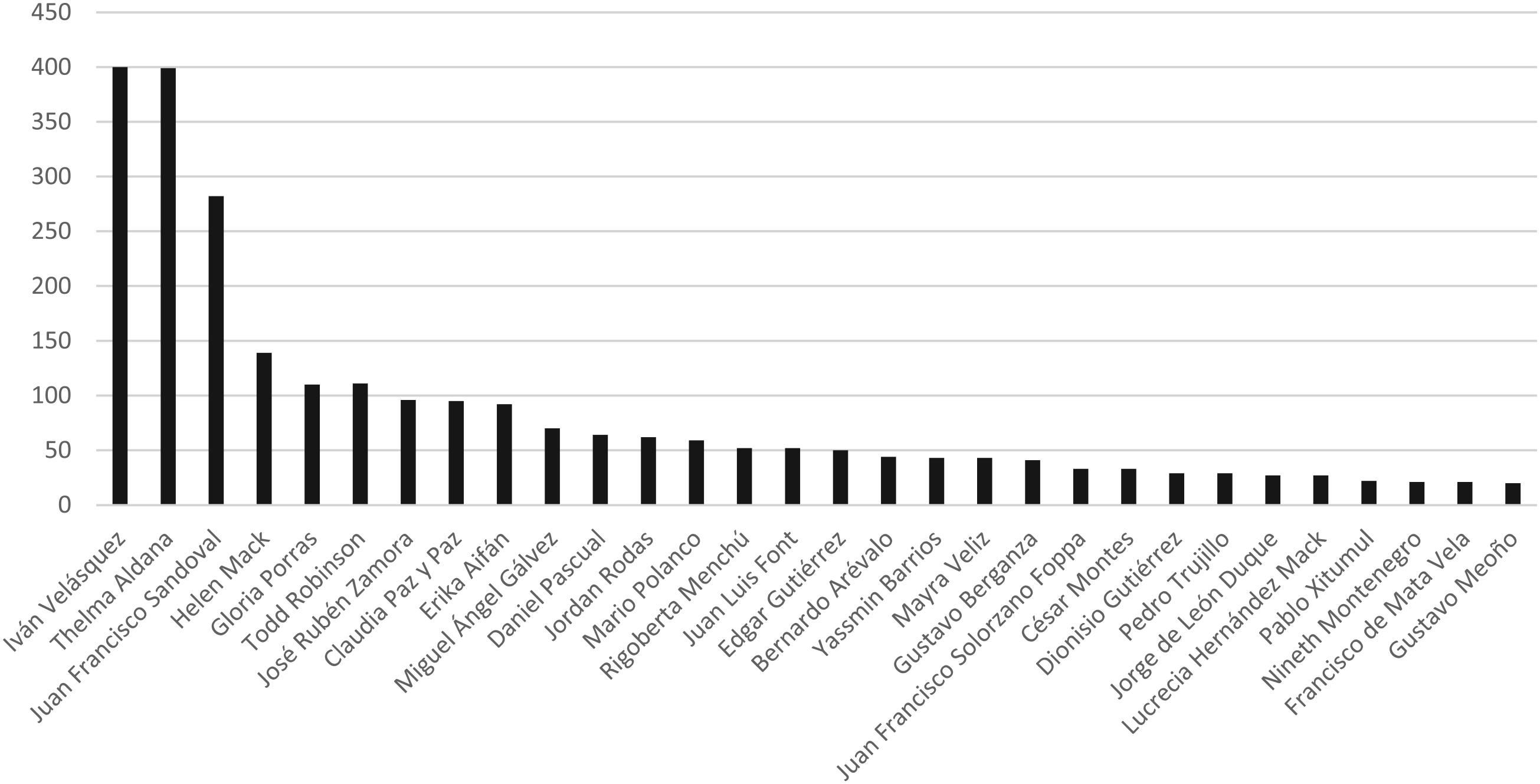
Named More Than Ten Times, 2014–2023.
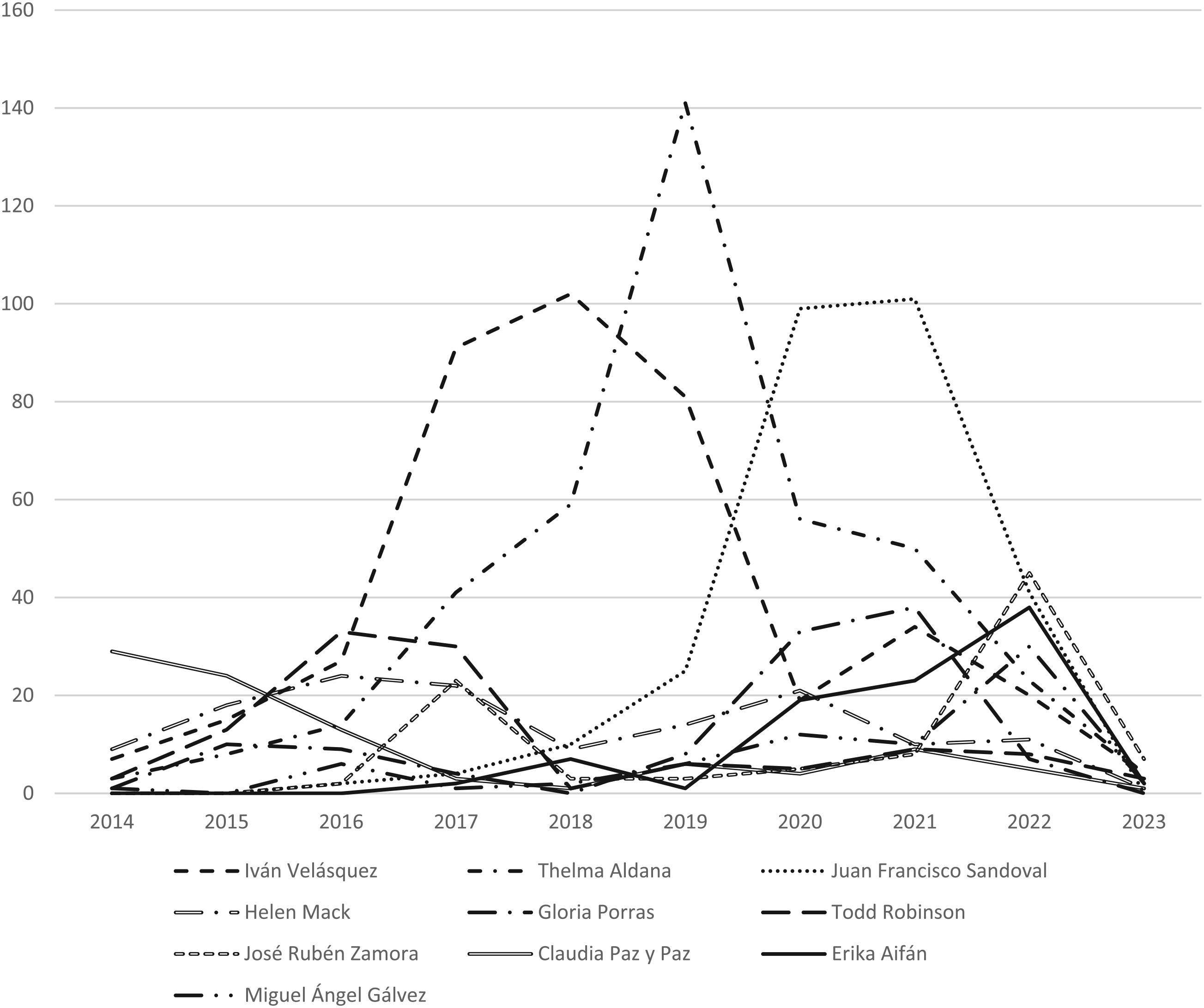
Top Ten Most-Named, 2014–2023.
A short, preliminary comment about what “being named” means is necessary. At a basic level, it means the person's name was written in a post or their photo published. Beyond this, these individuals are criminalised, delegitimised, othered, and/or dehumanised in a manner closely resembling Wodak's (2020) dimensions of far-right populism. This is explored in depth in the next section.
What stands out in Figure 2 is that, of the eight Guatemalans in this top ten, only Zamora is still in the country at the time of writing (November 2024). He had just been released to house detention after more than two years in jail awaiting and then re-trial for money laundering and other charges (García and Rodríguez Mega, 2024). All the others listed are in exile, pushed there by a non-state actor with an express pass to the Public Ministry (MP) (Silva Ávalos, 2022). Paz y Paz has been in exile since 2014. Aldana went into exile in 2019, and Sandoval and Porras in 2021. Mack, Aifán, and Gálvez left in 2022. Figure 2 shows steep declines in the number of times each was mentioned after those dates. This is no accident. Each fled Guatemala after Méndez Ruiz and allies increasingly targeted them online, campaigns that culminated in legal attempts to strip them of immunity and/or the filing of criminal complaints. Rather than be tried on trumped-up charges in an increasingly hostile judicial system—because judges and prosecutors who are not corrupt have fled and been replaced by “state-aligned” ones—and with FCT lawyer Falla acting as additional prosecutor in the Special Prosecutor's Office against Impunity's (FECI) cases after Rafael Curruchiche took over in 2021, targets fled. And this despite the years of threats of direct physical violence most of them suffered that did not convince them to flee. Méndez Ruiz has celebrated these targets’ departures from the country by publishing photos of them with red Xs over their faces. After the targets’ forced departure, mentions of them decreased significantly as Méndez Ruiz shifted his focus to a new target, further demonstrating how the weaponization of words complements and reinforces lawfare, with lawfare converting words into action. It also shows how they work together to push human rights and anti-impunity actors out of the country. With these threats eliminated, corrupt actors can take over, contributing to the weakening of democratic institutions.
These most-targeted individuals have different roles in the struggle to end impunity and corruption in Guatemala. 14 I sorted them into the following groups: non-Guatemalan actors; public functionaries (e.g., judges, magistrates, and prosecutors); members of civil society; and journalists, researchers, and analysts. I also sorted the other non-allies Méndez Ruiz names into these same groups. Figure 3 includes all the individuals named in the 2281 posts included in this quantitative analysis, now classified into categories. A clear trend emerges. Members of civil society are named most frequently from 2014 to 2016 and less so after that. The years 2016 to 2018 are marked by an increase in mentions of non-Guatemalans, mostly Velásquez and Robinson, a key Velásquez ally. 15 Naming public functionaries also rose from 2016 to 2017 and then skyrocketed after 2018. Naming public functionaries peaked in 2020, declining thereafter. Journalists, researchers, and analysts, on the other hand, were more frequently named from 2020 to 2022. The naming of politicians increased significantly in 2023.
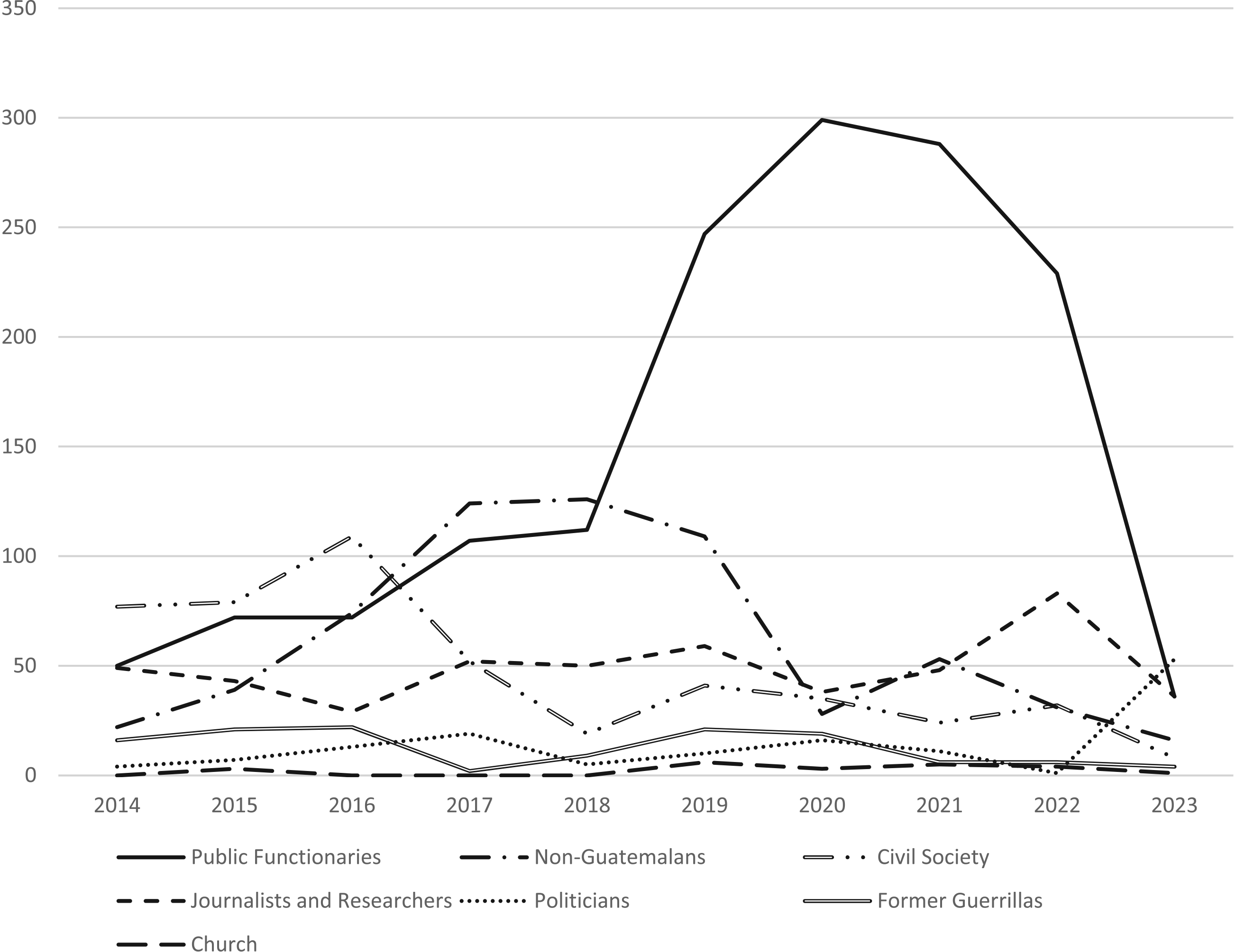
Groups Named, 2014–2023.
These shifts can best be understood in conjunction with developments in the Guatemalan political landscape. IN the late 2010s, shifts clearly corresponded to key events in increased democratic backsliding. Méndez Ruiz's initial concerns in the mid-2010s related to suits filed against veterans by civil society organizations that Méndez Ruiz and the FCT declared were heirs to the guerrilla (FCT, 2013). Thus, his posts targeted members of these and similar organizations. His efforts—both online and via lawfare—to halt the trials that eventually began did not bear fruit, though he did support ultimately successful (non-state) efforts to “oust” Paz y Paz in May 2014 (Lakhani, 2014). At this time, and with incoming Attorney General Aldana's support, the work of the Velásquez-led CICIG was gaining momentum, and in fact shifting focus from “pursuing discrete cases” to “target[ing] the fluid ‘illicit politico-economic networks’ that sustained impunity” (Schwartz and Isaacs, 2023: 26–27). This culminated in the 2015 ousting of Vice President Roxanna Baldetti and then President Otto Perez Molina for their roles in the La Línea customs corruption scandal.
It is easy to imagine that Mendez Ruiz and his allies, who did not defend Pérez Molina, came to see that civil society organizations did not pose the biggest threat to their interests. Though these groups may have posed a threat to veterans’ continued freedom, the real threat, this time to systemic corruption and those who benefitted from it, described by Schwartz and Isaacs (2023) as the criminal oligarchy, was the CICIG and its allies in state institutions, notably the Public Ministry.
Mentions of non-Guatemalans (i.e., Velásquez and Robinson) peaked in 2017–2019, the latter year coinciding with a sharp increase in mentions of public functionaries. Robinson's term as ambassador ended in 2017, while Velásquez was refused re-entry into Guatemala in 2018. The CICIG itself was forced out of Guatemala in 2019, the first step in what Schwartz and Isaacs (2023: 27) describe as the authoritarian counteroffensive (see also, USAID, 2024:19) that accelerated democratic backsliding.
With the (in-country) threat non-Guatemalan CICIG supporters posed eliminated, Méndez Ruiz turned his attention to public functionaries engaged in anti-impunity and corruption efforts. Many, including Sandoval, Aifán, and Gálvez, occupied positions in state institutions that had been created in collaboration with the CICIG (CJA, n.d.; Schwartz, 2024). As independent public functionaries fled in 2021 and 2022, intensifying democratic backsliding and furthering authoritarianism by turning the judicial system into a political weapon used to target actors whose work posed a threat to the status quo, mention of them declined. Tied up with functionaries’ departures is Curruchiche's naming as FECI head in 2021, and Consuelo Porras’ re-appointment as Attorney General in 2022. Both these events are highlighted in accounts of Guatemala's slide toward authoritarianism (e.g., HRW, 2022, 2023; Schwartz and Isaacs, 2023; USAID, 2024. The Department of State [2022a, 2022b] has classified both Porras and Curruchiche as corrupt and undemocratic actors).
The shift in targets at the end of the period of study might be seen as Méndez Ruiz believing the problem of institutional anti-impunity efforts had largely been solved. He could then turn his attention to other sectors that continued to pose a threat, and mentions of journalists/researchers (i.e., Zamora) and then politicians (i.e., Arévalo) increased in 2022 and 2023.
Words as Weapons
Counting the number of times Méndez Ruiz named Gloria Porras, for example, on Facebook before she went into exile is insufficient if we hope to understand Méndez Ruiz's vision of Guatemala, or his impact. For this, we must read every word in every post.
Individual Targets
Méndez Ruiz's Facebook page is full of posts that discredit the targets and their work in strengthening Guatemala's institutions. Many of these accuse the targets of various things, including the crimes they were formally accused of. Yet, Méndez Ruiz goes far beyond this to attack the target's values, motivations, and character. Some of what Méndez Ruiz has said about each of his ten most-named targets, divided into the same groups as above, is listed below. Before beginning, it is useful to recall Wodak’s (2020: 29) map of “the far-right mindset,” where “we” are “decent, honest, good, industrious, dutiful, charismatic, honourable, noble, brave, trustworthy, incorruptible,” while “the others” are “amoral, deceitful, lazy, without conscience, evil, bad, cowardly, criminal.” 16 These and similar words appear over and over again in Méndez Ruiz's posts.
Aldana has no dignity; she has been bought; she is a tool of “dark forces,” dirty, a terrorist, a criminal, a murderer, a thief, corrupt, a fugitive, a Marxist puppet, scum; she is Velásquez's thug; she lies. Sandoval is swine, scum, a murderer, immature, a coward, corrupt, a thief, a scoundrel, a common criminal, a rich kid, a State Department thug, Velásquez's thug, “la China comunista's” (Communist China, that is, Helen Mack) disposable pawn, the head of a criminal structure; he tramples on other peoples’ rights. Paz y Paz is like Hitler; she is a puppet, a member of the extreme left, immoral, out for ideological vengeance, a front for terrorists, Marxist, a vividora 17 ; she is from a family of terrorists. Gloria Porras is corrupt, immoral, Mack's pawn, a puppet, a member of the extreme left, a communist, “la China comunista's” thug, deadly; she can go to hell; she sold out to the Marxist agenda. Aifán is a sociopath, Velásquez's puppet, a member of the shadowy left, a judicial hitman, corrupt, a coward, shameless, a danger to society, a leftist activist, scum, a disposable pawn of the US. Gálvez is a member of the extreme left, corrupt, an activist disguised as a judge, a cowardly murderer, immoral.
As for la China comunista, Helen Mack is a vividora, a member of the extreme left, a Marxist, a thief; she is only interested in power, not Guatemalans’ wellbeing; she is the reason violence is out of control; she used her sister's death to get rich; she lives off hate and confrontation. Zamora is Velásquez's puppet, a member of the shadowy left, corrupt, a coward, mentally ill, a gangster, a criminal, immoral, a coward, pernicious, a racketeer, a money launderer, a liar, a blackmailer, the sicario de la pluma (hitman of the quill). 18
Velásquez is the devil; he is a criminal, a murderer, a coward, a manipulator, a terrorist, an agent of the far left, demented, dirty, a loser, a vividor, a kidnapper, a moral dwarf, a puppet, a scoundrel, a fraud, corrupt, a communist, a Taliban; he has been bought; he can go to hell. Robinson is an imbecile, clumsy, a coward, trash, a manipulator, a son of a bitch, a socialist; he is twisted; he is bitter; he supports terrorists and criminals; he has no scruples.
The way these ten targets are described raises fundamental questions about their aptness for public service and their values. Aifán is a particular target of these kinds of attacks. In addition to the above comments, Méndez Ruiz declared that her “irrational attitude” had pushed him to formally request to the Supreme Court that she undergo a psychiatric exam (@MendezRuizV, 1 February 2022). Méndez Ruiz later posted an article that reported that, in 2020, the FCT had requested that a psychologist attend audiences Aifán presided over. According to Méndez Ruiz, the psychologist concluded that Aifán “suffers from serious emotional disorders” (@mendezruizricardo, 11 March 12022).
Méndez Ruiz further discredits his targets by questioning their motivations. For example, “high risk” judge Yassmin Barrios and Paz y Paz received the Civil Courage Award and $50,000 from the Train Foundation in 2015 (Prensa Libre, 2015). Méndez Ruiz wrote, “It makes me very uneasy. It could be the prelude to new arrest warrants against soldiers” (@mendezruizricardo, 12 October 2015). His point was clear: rather than being motivated by a commitment to justice, individuals like Paz y Paz and Barrios are motivated by prizes and money. The FCT filed suit against Barrios based on the logic that the award was a payment for a guilty verdict in the Ríos Montt trial. She was accused of “passive bribery,” illegally receiving a gift, and money laundering, among other things (@MendezRuizV, 12 August 2020). As for Paz y Paz, “It is not a crime…since she was no longer Attorney General. Despite this, it's morally reproachable” (@MendezRuizV, 11 August 2020). These statements are in contrast to repeated statements that Méndez Ruiz and the FCT are motivated by love of country and anti-communist sentiments.
The Myrna Mack Foundation and WOLA (2020) describe delegitimizing attacks against individuals as character assassination. This is certainly true, just as it is true that attacking the character of well-known figures in anti-corruption struggles also attacks those struggles themselves, calling them into question and chipping away at public support for them. In turn, support grows for actors such as Méndez Ruiz who themselves are working to chip away at democratic institutions. These attacks are also an essential part of a discourse that sets the targets apart from “good” Guatemalans (akin to the ‘true people’ in Wodak’s [2020: 21] explanation of far-right populism). The words Méndez Ruiz uses to denounce each of the top targets make it clear that the targets are “bad,” and that they are “bad for Guatemala.” Can someone like Gloria Porras, who is corrupt, immoral, a puppet, “la China comunista's” thug, lethal, and who sold out to the Marxist agenda, be “good?” Can she be working for the benefit of the nation? The answer can only be no. In Porras’ case, and in that of Aldana and Sandoval, Méndez Ruiz is more explicit about whether they are good or bad. On 21 September 2021, Méndez Ruiz shared a press statement from the Liga ProPatria. In it, the Liga ProPatria described the Department of State (represented in Guatemala by Todd Robinson from 2014 to 2017) as the “intellectual author behind the crimes committed by bad Guatemalans who agreed to become [the Department of State's] front men in the judicial system.” He continued, “This is why” the Department of State protects Aldana, Porras, and Sandoval, who are wanted for “countless criminal acts” (@MendezRuizV).
“Bad Guatemalans” who commit crimes are positioned in opposition to “good Guatemalans,” including Méndez Ruiz, who respect the rule of law. A clear example of this dates to late 2018. Predicting that Sandoval and Aldana would soon be on trial, Méndez Ruiz wrote that “We respectable Guatemalans” will make sure Sandoval and Aldana's “right to due process is respected, a right they trampled on so many times…thinking that power was eternal” (@mendezruizricardo, 13 December 2018). Yet power is not eternal, and Méndez Ruiz promises that the FCT and its “legal snipers” (@mendezruizricardo, 1 November 2022) “will take care of it” (e.g., @mendezruizricardo, 9 November 2022; @mendezruizricardo, 24 October 2022).
Groups
Méndez Ruiz also targets groups of people in his posts, often by calling them terrorists. For example, Méndez Ruiz linked the left to “Islamic” terrorists. In September 2014, after a US journalist was executed in Iraq, Méndez Ruiz wrote “In Guatemala, the radical left keeps a complicit silence in relation to the genocide against Christians in Iraq and Hamas’ terrorist acts…. Guatemalan ‘civil society’ includes in its ranks … various organizations that are vital” to the contraband trade. “For an Islamic terrorist who hopes to cross into the US, this is a piece of cake thanks to the radical left” (@mendezruizricardo, 2 September 2014). Eleven days later, Méndez Ruiz posted about the execution of a British humanitarian worker. He wrote that no “‘civil society’ organizations have made any statements” about these executions; “surely” civil society “applauds them in secret” (@mendezruizricardo, 13 September 2014). Four months later, in the aftermath of the attack on Charlie Hebdo, Méndez Ruiz posted a link to a video from the FCT's YouTube page featuring Daniel Pascual, other CUC (Peasant Unity Committee) members, and former EGP (Guerrilla Army of the Poor) member Silvia Solórzano at a protest in support of Palestine. Méndez Ruiz wrote that “members of the extreme and terrorist left in Guatemala support the Islamic cause”; “those who appear in this video are applauding the terrorist attack against France” (@mendezruizricardo, 7 January 2105). 19 Méndez Ruiz also wrote that this “act of savage violence is applauded by those who the US Department of State support in Guatemala, people who carried out similar terrorist attacks here during the internal armed conflict” (@mendezruizricardo, 7 January 2015).
These posts link the contemporary left to fomenting conflict more broadly, just as the guerrillas are described as having done in previous decades. In Méndez Ruiz's discourse, this conflict creates economic and social ills. A 28 December 2015, post spells this out in greater detail. Méndez Ruiz posted a newspaper report that the Honduran and Salvadoran economy showed great potential for growth in the next decade. Guatemala ranked much lower. Méndez Ruiz wondered why. The “answer is clear and simple: social conflict. They do not have a Daniel Pascual, a Claudia Samayoa, a Helen Mack, or other vividores who scare away foreign investment… The human rights mafia lives off conflict, a conflict that plunges the majority of Guatemalans into poverty” (@mendezruizricardo). He repeated a similar scapegoating (Wodak, 2020: 28) in a long post on 25 August 2019, that began by asking “When will we have a BWM factory in Guatemala?” Méndez Ruiz concluded that what Guatemala needed to do was to guarantee “legal certainty” to attract investment. For this, he said, Congress had to approve the NGO law to monitor the “flow of capital” destined for “NGOs that dedicate themselves to generating social conflict” (@mendezruizricardo).
In Méndez Ruiz's overly simplistic logic (Wodak, 2020: 21), there is a straight, causal link between the social conflict the left foments and Guatemala's weak economy and underdevelopment. In turn, these lead directly to (undocumented) Guatemalan immigration north. On 27 November 2018, Méndez Ruiz posted that a Guatemalan migrant and his son were kidnapped and tortured in Mexico. “Who is responsible? The left, which doesn’t allow the economy to grow or for there to be jobs” (@mendezruizricardo). Four years later, when a truck carrying migrants crashed in Mexico, killing over 50, Méndez Ruiz wrote that “The reason behind migration is the lack of judicial certainty, caused by the left, which prevents investment, the only way to create jobs. If we stop the Marxists, we will stop migration” (@mendezruizricardo, 10 December 2021). A few months before, in the context of US Vice President Kamala Harris’ visit to Guatemala, Méndez Ruiz posted that “the main reason behind illegal migration is the lack of jobs, which is a result of the lack of judicial certainly [Harris’] friends on the left promoted” (@mendezruizricardo, 14 April 2021).
Méndez Ruiz heightened his attacks even further to describe the left not only as causing conflict and creating socio-economic challenges, but as thriving on and benefiting from them at the expense of “Guatemalans.” For example, on 26 July 2015, in the context of discussions about Ríos Montt's fitness to stand trial, the Fundación issued a public statement. Toward the end, the FCT declared that the “lackeys of the international conflict industry…feed themselves—literally—from the confrontation between Guatemalans” (@mendezruizricardo). Later in the year, he wrote that “every cent paid” as reparations means “one less opportunity for Guatemalans” (@mendezruizricardo, 11 December 2015). These reparations, which Méndez Ruiz insists are unconstitutional, are paid from “our taxes” (@mendezruizricardo, 27 March 2016). Had reparations not been paid to Helen Mack, for example, tax money could have been spent to save Guatemalans dying in hospitals for lack of medicine (@mendezruizricardo, 1 March 2017).
All this convinced Méndez Ruiz that Guatemala is contaminated. Contamination of government institutions was particular concern to Méndez Ruiz. For example, the Human Rights Ombudsperson's office, then led by Jorge de León Duque, was contaminated by Marxism (@MendezRuizV, 17 June 2017). Yet Méndez Ruiz is far more concerned with the MP than with other government institutions, perhaps because, as he said in 2013, “everything is because of her,” meaning then-Attorney General Paz y Paz. The FCT would not exist, he said, if she had not come to lead the MP (Gamazo, 2013a). The Paz y Paz administration then passed on their “ideological contamination” to Aldana (@mendezruizricardo, 5 January 2015). He explained all this to newly named Attorney General Consuelo Porras when he met her for the first time on 17 July 2018. The “crisis of ideological contamination” at the MP, he informed her, originated in “illegal criminal proceedings against our war veterans” (@mendezruizricardo), which Paz y Paz is celebrated for having helped move along the MP pipeline.
More recently, on 19 May 2020, several months into the COVID-19 pandemic and its daily tallies of infections, Méndez Ruiz posted an open letter in connection to the FCT's denunciation against Sandoval for allegedly revealing privileged information. The FCT was concerned that the MP's Justice Operators Unit would be tasked with investigating. This unit, the FCT said, was “infected” and “controlled by the same mafia” Sandoval and his brother, also under investigation, belonged to (@MendezRuizV, 19 May 2020). Two weeks later, the FCT repeated, “It is imperative that the MP be decontaminated of the corrupt prosecutors who had been inherited” from the Aldana and Velásquez era (@MendezRuizV, 1 June 2020). Two months later, on 18 August 2020, he posted a collage of 12 faces, including Gloria Porras, Aldana (who had already gone into exile), Sandoval, Barrios, Aifán, Gálvez, “high risk” court judge Pablo Xitumul, and then Human Rights Ombudsperson Jordán Rodás. The following text accompanied the image: “the administration of justice should be cleansed of the ideological operators who contaminate it” (@MendezRuizV). On 2 November 2021, after Sandoval had fled and the FCT-friendly Curruchiche replaced him as head of the FECI, Méndez Ruiz denounced leaks in the MP. The MP, he wrote, “and especially the FECI, should be disinfected from the plague of moles that infest it” (@mendezruizricardo, 2 November 2021).
The Missing Piece—Military Force
Interspersed with discursive attacks that label anti-impunity actors and human rights defenders as terrorists who “contaminate” Guatemala and criminal complaints filed in the judicial system, is a profound and unquestioning glorification of the military. This can be seen as a continuation of the pro-military propaganda used during the conflict (for example, see Zur, 1998). For Méndez Ruiz, the military's role in Guatemala is expansive. This was clear during the pandemic, as he said on 21 November 2021, “The Army. Always our Army,” responsible for “free[ing] us from communism, rescu[ing] the country from an earthquake's rubble, [and] … carrying out an efficient vaccination campaign” (@MendezRuizV; see also, @mendezruizricardo, 30 November 2021). In this and other posts about the response to the pandemic, Méndez Ruiz praises the military for protecting Guatemala from a deadly virus. He describes Aldana, on the other hand, as having bought an overpriced building. With the Q35 million of Guatemalans’ money Méndez Ruiz says was lost in the purchase of said building, “about half a million vaccines could have been purchased” (@MendezRuizV, 17 July 2021). With this post, Mendez Ruiz is saying that Aldana's alleged corruption quite literally cost many Guatemalans their lives.
In a context where the military is celebrated for a successful vaccination campaign, Méndez Ruiz's comments about disinfecting or decontaminating the MP take on additional meaning. This is even truer given how he described Helen Mack and many others who had signed a letter in September 2020 requesting international assistance to resolve the crisis in the Constitutional Court. He called them traitors, and said they were “the most virulent left [la izquierda más virulenta]” (@mendezruizricardo, 2 September 2020). He followed this on 13 March 2021, by comparing Gloria Porras to COVID and described Porras’ “mortality rate” as “enormous.” What Guatemala “deserves,” he wrote, is a “vaccine against her and against those who think and act like her” (@mendezruizricardo). It is easy to imagine who would deliver the vaccine to Guatemalans—the military.
The terrorist-vaccine-army link was reinforced in a series of posts published in 2021 as the Taliban neared Kabul. Méndez Ruiz posted (@MendezRuizV) a video about the Taliban and the situation in Afghanistan on 13 August and then published another post calling on Guatemalans to “GET VACCINATED!” On 14 August, he once again posted a video of the Taliban and then re-posted a publication from the Army featuring cadets “voluntarily” helping at vaccination clinics. “In this emergency,” the Army had written, “we all get involved” (@MendezRuizV). As mentioned above, in the weeks that followed, Méndez Ruiz labelled Iván Velásquez the Taliban and re-posted an article where Falla called NGOs and public functionaries the Guatemalan Taliban.
In thousands of Facebook publications, Méndez Ruiz declares that the MP is contaminated by virulent terrorists and that the military is well-practiced in administering life-saving vaccines. As a meme Méndez Ruiz reposted with text and the image of a soldier says, “ONLY ONE ORDER AND WE WILL GO BACK” (@mendezruizricardo, 10 September 2019).
Postscript
In their campaign to protect Guatemala and “good Guatemalans” from the danger anti-impunity actors and human rights defenders represent, Méndez Ruiz and the FCT have turned to mutually reinforcing discursive campaigns and lawfare, backed up with threats of military force. The impact of his and allies’ efforts has been to weaken democratic institutions and deepen authoritarian tendencies.
In many ways, what Méndez Ruiz and his allies are doing in Guatemala is like what is happening in neighboring El Salvador under President Nayib Bukele. Bukele also uses social media to great effect, for example by ordering various state institutions to do various things via tweet. This ranges from re-naming barracks (Hatcher, forthcoming) to ordering security forces to patrol a particular area to uphold emergency public health measures decreed during the Covid-19 pandemic (Martínez, 2020). In the latter case, the Minister of Defense replied, also via tweet, that they would do just as the president ordered (Martínez, 2020). Indeed, Bukele has made social media—and its hashtags, troll farms, and influencers—work to his advantage (Flores, 2018; Esberg, 2020; Rauda Zablah, 2023). Critics are blocked on social media (HRW, 2021) and independent media are targeted with financial audits and spyware (Martin et al., 2023). Lawsuits are filed against those who might get in Bukele's way, thereby criminalizing, for example, environmental activism (Ferrucci and Cabezas, 2024). Human rights organizations report state surveillance and harassment (WOLA, 2024). “Corrupt” judges were removed from the courts and replaced with Bukele loyalists (BBC News Mundo, 2021). The International Commission against Impunity in El Salvador was shuttered (after it began investigating the Bukele government) (Papadovassilakis and Robbins, 2021). Throughout all this, the military is celebrated as protecting the country against both external and internal enemies (see, for example, DW, 2021).
Notably, however, Bukele controls all branches of government, while Méndez Ruiz is outside formal governmental structures. Unlike Bukele, who can declare a state of emergency that limits basic human rights and use it as an excuse to silence opposition and address the country's most pressing problem (gangs, in the case of El Salvador) (WOLA, 2022), Méndez Ruiz and like-minded allies must chip away at democratic institutions, using the tools available to them as non-state actors.
Yet, though Méndez Ruiz has been working from outside of formal state structures, despite having much weight within them, compared to El Salvador's state-sponsored democratic backsliding, the results are quite similar. As well, in 2023, V-Dem classified El Salvador as newly in the Electoral Autocracy category and “in an episode of autocratization.” The same year, Guatemala was classified as an Electoral Democracy. The country, however, is “in an episode of autocratization” and could also be classified as an Electoral Autocracy (V-Dem, 2024: 17). It seems there is more than one way for a country to slide back from democracy into autocracy or authoritarianism, and the evidence from Guatemala underscores the essential role non-state actors can play.
Footnotes
Acknowledgments
The author wishes to thank Rachel Schwartz for her comments on an earlier version of this article, as well as Enrique Naveda, Jo-Marie Burt, and Juan Francisco Sandoval, her co-panelists at the 2023 Latin American Studies Association Conference. All errors are the author's own.
Declaration of Conflicting Interests
The author declared no potential conflicts of interest with respect to the research, authorship, and/or publication of this article.
Funding
The author received no financial support for the research, authorship, and/or publication of this article.
