



Abstract
This article focuses on electoral victories by wives of regional heads in West Sumatra province during Indonesia’s 2019 elections. We argue that these victories can be explained by the emergence of a phenomenon we label “neo-ibuism.” We draw on the concept of “state ibuism,” previously used to describe the gender ideology of the authoritarian Suharto regime, which emphasised women’s roles as mothers (ibu) and aimed to domesticate them politically. Neo-ibuism, by contrast, allows women to play an active role in the public sphere, including in elections, but in ways that still emphasise women’s roles within the family. The wives of regional government heads who won legislative victories in West Sumatra not only relied on their husbands’ political resources to achieve victories, they also used a range of political networks to reach out to voters, in ways that stressed both traditional gender roles and their own political agency.
Keywords
Introduction
The 2019 legislative election in the province of West Sumatra was marked by a remarkable phenomenon. No less than eight women who were the wives of incumbent regional heads and deputy regional heads from the province stood for seats in local and national parliaments. They included Nevi Zuairina, the wife of the West Sumatra governor, as well as wives of four bupati (heads of rural districts, or kabupaten) and of one walikota (mayor, the head of an urban district, or kota). They ran under the banner of four different parties, but two parties were dominant: the Prosperous Justice Party (Partai Keadilan Sejahtera, PKS) and National Democrat Party (Partai Nasional Demokrat, Nasdem); each nominated three of these candidates. Of the eight, three were elected: two, including Nevi Zuairina, in the national legislature, the People’s Representative Council (Dewan Perwakilan Rakyat, DPR), and one in the provincial legislature, or the People’s Regional Representative Council (Dewan Perwakilan Rakyat Daerah DPRD).
These eight women used varied electoral strategies. Several of them emphasised their connections with their husbands by adding the names of their husbands to the ends of their own. Several of them modified their personal identities in ways that aimed to increase their vote, for example emphasising their femininity and beauty by using heavily edited campaign photographs. Some campaigned strongly on issues relevant to women. Some emphasised adat (“custom”).
Given this variation, how should we understand the emergence of these candidates? In recent times, a dominant framework for understanding local politics in Indonesia has been patronage politics, with patronage distribution often depicted as a critical component of electoral mobilisation (Aspinall and Sukmajati, 2016; Aspinall and Berenschot, 2019; Isra, 2017). In this article, we argue that the patronage politics approach does not provide a complete picture of the electoral strategies used by the wives of regional heads in the 2019 election in West Sumatra. The relations these candidates built with voters did not always rely on the patronage of their husband, or their capacity to mobilise the local bureaucracy and clientelistic networks; while these were often important, these candidates frequently also drew on other forms of social relations and influence. Importantly for our purposes, these candidates were also able to mobilise powerful ideas about gender roles and relations, and the networks and organisations formed around – and to uphold – those ideas.
We draw upon the concept of “ibuism” in explaining the electoral strategies of these candidates. As we explain in more detail below, “state ibuism” (where ibu is the Indonesian word for mother) is a widely used term for the gender ideology practiced in the authoritarian “New Order” period (1966–1998). This ideology stressed women’s roles as wives and mothers in the private sphere. We argue that the campaigns we studied in 2019 express a new form of this ideology – neo-ibuism – in which the female candidates we studied still stress their positions as wives and mothers, and draw upon the political authority and networks provided by their husbands, yet also practise a new form of political agency. As we shall see, these women were not merely the passive actors envisaged by New Order ideology; they played an active and creative role in the pursuit of votes.
Our analysis is presented in six sections. After this introduction, the second section lays out our core concept of neo-ibuism and explains how we use it in the context of the 2019 elections in West Sumatra. In the third section, we provide context on the backgrounds of women candidates in West Sumatran elections from the beginning of the post-Soeharto reformasi (“reform”) period to now, and introduce the women who are our focus in this article. The fourth section zeroes in on the recruitment of the candidates who are our focus. A fifth section analyses the strategies pursued by these candidates, focusing on the networks, resources, and discourses that two of them relied upon. Our final section concludes by reiterating the main arguments presented in the article.
Most of the research for this article was carried out in the city of Padang, the capital of the province, but we also made visits to South Solok district and the city of Solok during April–June 2019. Among our chief informants were four of the wives of regional heads running for office in 2019, though we also interviewed numerous other politicians, campaign workers, and observers. We observed campaign events, accompanied candidates as they interacted with voters, and compiled their campaign material.
Defining Neo-Ibuism
The concept of ibuism was first popularised in a piece by Julia Suryakusuma (2011) on “state ibuism” that was published in 1996, and later developed in a bilingual book. 1 Both works focused on the role of women and gender ideology in the authoritarian “New Order” regime (1966–1998). Suryakusuma (2011: 10) defined ibuism as “a gender ideology which generates fixed stereotypes and greatly constrains because its goal is indeed to control and to create a hierarchical structure.” This ideology herded women toward “domestication” that involved the taming, segregation, and depoliticisation of women: “State Ibuism defines women as appendages and companions to their husbands, as procreators of the nation, as mothers and educators of children, as housekeepers, and as members of Indonesian society – in that order” (Suryakusuma, 1996: 101). Ibuism was a social construction of womanhood propagated by the state, which aimed to reinforce state power, male dominance, and existing social hierarchies by confining women to the domestic sphere and limiting their role in social and political affairs (Rhoads, 2012: 50).
To promote its vision of ibuism, and to inculcate in women that it was their duty to serve the family and the state, the New Order established various state-affiliated women’s organisations, notably Guidance for Family Welfare (Pembinaan Kesejahteraan Keluarga, PKK) and Women’s Duty (Dharma Wanita). These organisations were run by the wives of government officials and bureaucrats and organised programmes designed to promote the state and its development goals (Suryakusuma, 2011). Both organisations emphasised the primacy of the domestic and family sphere for women, stressing their roles as wives and mothers. Suryakusuma viewed both organisations as effective mechanisms for mobilising women to support the New Order state. The state-sponsored women’s organisations ran on a highly hierarchical, virtually feudal, model: leadership positions in organisations such as PKK and Dharma Wanita were determined not by a woman’s particular skills or achievements, but by her husband’s position (thus the provincial leadership position went to the wife of the governor, in a town they went to the mayor’s wife, etc.). In this way, women’s participation in organisational life was determined by the idea of ikut suami (literally: “follow the husband”) and a woman’s role as pendamping suami (literally: “a husband’s companion or spouse,” but also with the connotation of helpmate). The ideology of ibuism, embodied in many organisations, became deeply rooted in Indonesian society, motivating many women to support New Order power structures, and reinforcing traditional ideas about gender roles.
Early in the post-New Order reformasi period, various actors – including some women’s movement activists – suggested dissolving PKK and Dharma Wanita. These activists accused these organisations of being tools the regime had used to limit the role of women in social and political life. As Suryakusuma (2011: 41) put it, their mission had been domestication: PKK and Dharma Wanita had given the impression of lifting the status of women, but in reality they had reinforced the limitation of women’s role to the private sphere.
In fact, successive governments maintained these organisations, arguing that they helped the government to pursue its new agenda of “women’s empowerment” (pemberdayaan perempuan) – a goal broadly supported (though with varying levels of commitment) by post-New Order governments (Noerdin and Aripurnami, 2007; Suryakusuma, 2011). Government leaders suggested that PKK and Dharma Wanita had been reconfigured, becoming more independent and allowing women to play a more autonomous role in designing and running their programmes (Noerdin and Aripurnami, 2007). However, some analyses have suggested that government leaders, especially at the local level, use these organisations to mobilise women voters in elections (Adzmy and Disyacitta, 2018).
It is in this context that we set out to examine election campaigns by wives of regional heads in West Sumatra in 2019. In describing what we find, we propose the term “neo-ibuism.” The pattern of electoral mobilisation pursued by these female candidates still deserves to be understood through a frame of “ibuism” because these women are, at least in part, positioned – and advantaged – in relation to their husbands and their husbands’ political resources. In reaching out to voters, they also partly relied on networks of women that could trace their origins to New Order corporatist organisations, and used a discourse that stressed women’s roles as wives and mothers. But it is neo-ibuism because – unlike the New Order version that tried to depoliticise women and ensure their political passivity – this version allows women to be active subjects directly engaged in the struggle for political power. These women were not entirely reliant upon their husbands and families’ connections, and in their campaigns they repeatedly said that women could and should be independent in carrying out political activities. They frequently targeted women in ways that implied if not emphasised an expansion of women’s roles beyond traditional roles of wives and mothers.
In short, neo-ibuism is an ambiguous political discourse and strategy that reflects the changing tenor of Indonesia’s social and political life. As with many political candidates throughout Indonesia, the women who are our focus in this article ran complex campaigns that involved multiple elements, including making use of their husbands’ influence in the regional bureaucracy, building large “success teams,” engaging in clientelistic politics at the grassroots, as well as making use of appeals for gender solidarity when meeting with women voters. Unlike in the old version of ibuism, the state is no longer all-powerful, with these women seeking multiple avenues to reach out to voters on a personal basis. These were elections, in short, that foregrounded that all political action is “embedded in ongoing networks of personal relationships rather than carried out by atomised actors” (Granovetter, 1992: 25).
At the same time, the personal stories of the women who are our focus suggest that they did not become candidates primarily because of their own personal political ambition, or even that of their husbands. To be sure, when campaigning these candidates did make use of the reputations and power resources possessed by their husbands – as we explore below. However, party considerations were also important in determining their emergence as candidates. Political parties nominated these women because they were seeking highly electable candidates who, by attracting a large number of personal votes, would boost their party’s overall vote total and thus, potentially at least, increase the total number of party candidates elected from the province. 2 This finding is particularly clear when we note that two parties – PKS and Nasdem party – were most active in nominating such women, with each of these parties nominating three such candidates (Gerindra and PKPI nominated one each).
Women Candidates in West Sumatran Elections
The province of West Sumatra, in which the largest ethnic group is the Minangkabau, is a region with a strong history of Islamic politics, especially associated with Islamic modernism (Kahin, 1999). In the post-reformasi period, however, as with many Indonesian regions, the political map in West Sumatra has been quite dynamic. No single party has been able to dominate the province, with a range of nationalist and Islamic parties sharing the province’s allocation of fourteen DPR seats. In the 2019 election, for example, the Gerindra Party and National Mandate Party (Partai Amanat Nasional, PAN) were the two top-placed parties, each taking three seats. These parties were also strong supporters of presidential candidate Prabowo Subianto, who swept the province with 85.95 per cent of the vote, making the province one of his bastions.
Though West Sumatra is the largest matrilineal society in the world where women exercise power in both the domestic and public spheres through their position in kinship relations and traditional practices (adat) (Blackwood, 1995), the province does not have a strong record of women’s representation in parliament. Between the 1999 and 2014 elections, it elected only three female candidates to the DPR: Aisyah Aminy, a prominent leader of the Islamic party, the Unity Development Party (Partai Persatuan Pembangunan, PPP), in 1999; Zalmiar Yanri, a medical doctor from the Democrat Party (Partai Demokrat), in 2009; and Betti Shadiq Pasadigoe of the Golkar Party (Party of Functional Groups), in 2014. The election in 2019 represented something of a breakthrough, with three women elected to the DPR: Nevi Zuairina of the Islamist party PKS, Lisda Hendrajoni of the Nasdem party, and Athari Gauthi Ardi of PAN, the party associated with the Islamic modernist organisation Muhammadiyah, which has deep roots in West Sumatra.
This dramatic increase in the number of women DPR members elected from West Sumatra was accompanied by an equally dramatic change in the nature of the backgrounds of these women representatives. Aisyah Aminy and Zalmiar Yanri were elected on the basis of their personal political achievements, including their records in advocating on women’s issues. In particular, voters knew Aisyah Aminy for her consistent and vocal advocacy in favour of improving the quality of women’s lives, including in terms of social welfare, marriage law, and education (Rifai, 1993). Since 2014, in contrast, the women elected to the DPR have had personal family connections with power-holders. Betti Shadiq Pasadigoe, elected in 2014, was wife of the bupati (district head) of Tanah Datar, Shadiq Pasadigoe. Though Betti was at number six position on her party’s candidate list in her constituency, she attained a phenomenal result, winning almost 78,000 personal votes – the highest of all candidates elected from West Sumatra, and more than enough to win her a seat.
This pattern repeated five years later. Nevi Zuairina (PKS) and Lisda Hendrajoni (Nasdem party) are both wives of West Sumatra local government heads: Nevi Zuairina is the wife of the governor of the province, Irwan Prayitno; Lisda Hendrajoni is married to the bupati of South Pesisir district, Hendrajoni. Nevi Zuairina, who was at position number two on the PKS candidate list, won over 52,000 votes – more than the total won by the (male) candidate number one, Refrizal, a DPR member since 2004. Lisda Hendrajoni was at third position on the Nasdem party candidate list and got more than 37,000 votes. Both Nevi and Lisda were able to attain enough personal votes to defeat incumbent DPR members from their parties. Athari Gauthi Ardi (from PAN), the third female DPR candidate elected in 2019, is not the wife of a regional government head but is the daughter of a former DPR member from West Sumatra, Epiyardi Asda from PPP. In addition, one other female candidate who was not elected also had dynastic connections: this was Suriati Muzni, the wife of the bupati of South Solok who ran for the Nasdem party (Table 1). Overall, although the 2019 election was a historic one for West Sumatra in terms of the number of women DPR members elected, it also marked a step forward in the growing influence of political dynasties in the province.
Female Candidates with Family Connections to Power Holders in the 2019 Election in West Sumatra.
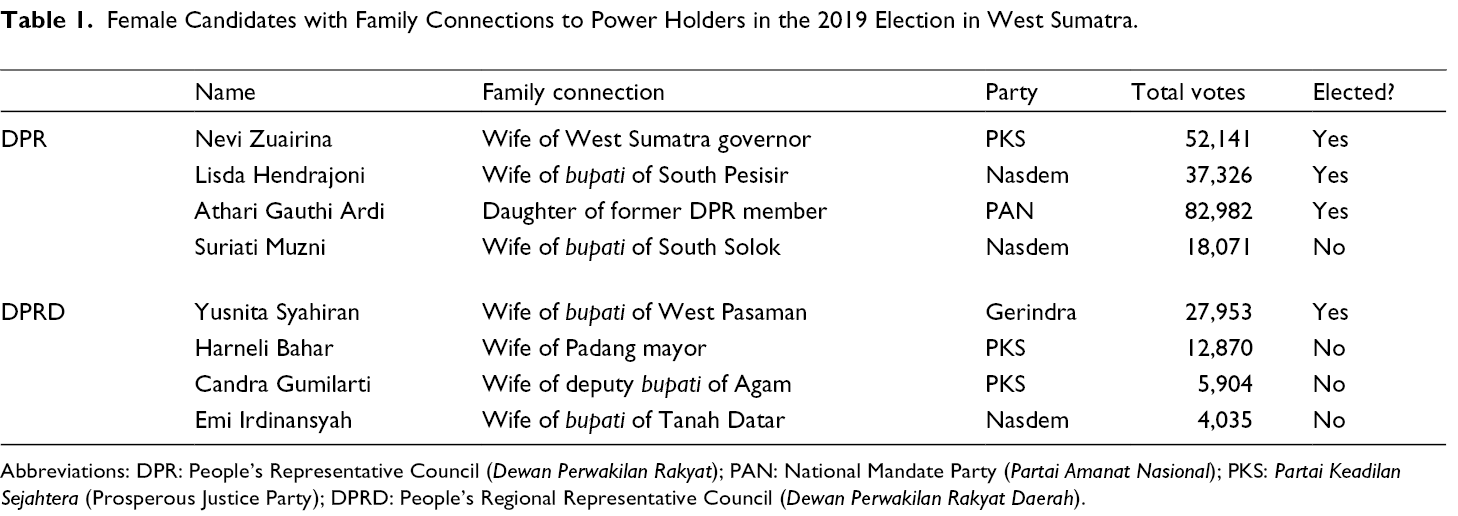
Abbreviations: DPR: People’s Representative Council (Dewan Perwakilan Rakyat); PAN: National Mandate Party (Partai Amanat Nasional); PKS: Partai Keadilan Sejahtera (Prosperous Justice Party); DPRD: People’s Regional Representative Council (Dewan Perwakilan Rakyat Daerah).
In contrast with the DPR at the national level, there was actually a decline in women’s representation in the provincial DPRD in 2019. In 2014, eight women were elected to the sixty-five-seat DPRD. This dropped to four in 2019. Of these four, only one was the wife of a regional government head: Yunisra Syahiran is the wife of Syahiran, the bupati of West Pasaman. She stood as a Gerindra candidate and was at the top of her party’s candidate list in her electoral district. She was the only one of the four wives of regional heads or deputy regional heads who stood for election to the DPRD in 2019 to be elected. The others were two other PKS candidates, Harneli Bahar (wife of the mayor of Padang) and Candra Gumilarti (wife of the deputy bupati of Agam), and Emi Irdinansyah (wife of the bupati of Tanah Datar), running for the Nasdem party. In 2014, no such women had stood for election to the West Sumatra DPRD. 3 Even so, the failure of three of them shows that having a powerful husband is not a guarantee of political success.
These developments point to a certain contradiction, or ambiguity in women’s representation in West Sumatra, as in many parts of Indonesia. On the one hand, the rise of female dynastic candidates has helped women’s descriptive representation in the province (at least in the national DPR, if not in the provincial DPRD). It is widely believed that greater female representation in legislative bodies will, over time, produce greater policy attention to issues relevant to women and thus advance the cause of gender equality (International IDEA, 2005: 46). On the other hand, the trend in the province – as in much of Indonesia – suggests that legislative elections are increasingly generating victories for candidates, including female candidates, who are deeply entrenched in existing local power structures. In particular, female candidates married to male local government heads make use of the political resources – access to finances, control of the bureaucracy, dominance over local patronage structures, and so forth – possessed by their husbands to get elected. Thus, it is possible that women are becoming a growing feature of Indonesian electoral politics, without necessarily committing themselves to promoting women’s equality (Hillman, 2018: 330), as is ideally assumed.
Recruitment of Female Candidates
If prior to 2014 it was very unusual for the wives of local government heads to stand for legislative seats in West Sumatra, the practice now is approaching the status of a new norm. What factors lie behind this shift? What processes lay behind the recruitment of these women as candidates? As already alluded to, with at least some of these candidates it was not their own personal ambitions, nor even those of their husbands, but party strategies which were key. We explore this by focusing on the two parties – PKS and Nasdem party – which each nominated three such candidates.
In the case of the PKS, the move to nominate wives of local government heads was the result of a decision taken by the party’s national leaders. West Sumatra PKS leaders we interviewed frankly acknowledged that the party was nominating wives of its local government heads not merely to help the party meet the 30 per cent quota on female candidates, but also to help it boost its overall vote by making use of the personal popularity and influence of these candidates’ husbands. PKS was keen to pursue this strategy because it was concerned that it might not meet the parliamentary threshold (i.e. the proportion of the national vote required for any party to gain seats in the DPR) of 4 per cent that was set in 2019. In the lead-up to the election, public opinion surveys suggested that the party might fall short. A PKS provincial official explained the logic as follows:
There has been a policy change in the PKS. In previous elections, starting from 2004, and then through 2009 and 2014, it was something of a taboo to put forward the wives of regional government heads or deputy heads. A taboo; in fact, no such women gained seats prior to 2014. Really, what we prioritised at that time was the community’s attitude. We worried that people would think we were greedy for positions. But [that stance] did not increase our vote. But really, elections are all about targeting votes. So we decided this year, in 2019 – in fact, there was a policy from the centre, from the party president – that all wives of [our] regional government heads and deputy heads, so long as they were not public servants [and thus prohibited from standing] would be required to step forward for the 2019 election. (Confidential interview, 31 May 2019, Padang)
This PKS leader, along with others, saw this approach as a pragmatic response to the challenge of ensuring the party’s vote did not slip below the parliamentary threshold. After the Central Leadership Board (Dewan Pimpinan Pusat, DPP) of the party issued an instruction for its cadres who were serving as local government heads or deputies to nominate their wives, 4 three of the four such PKS cadres in the province did so (the exception was the mayor of Payakumbuh whose wife was ineligible to stand because she was a lecturer at the Bandung Institute of Technology, with the status of a civil servant).
Importantly, PKS cadres also tended to see these women as qualified to stand for election in their own right. Although they mainly did not have much in the way of formal political experience, they had mostly long been involved in a practical way in party activities and political affairs. The PKS is known for being formed out of a campus-based Islamic social movement, modelled on the Muslim Brotherhood, and for having a highly integrated programme of cadre training and social, religious, charitable, educational and political activities (Octavia, 2012; see also Rofhani and Fuad, 2021). Party cadres tend to marry within the movement, and both spouses are typically encouraged to take part in the PKS’s highly selective and intensive cadreisation and educational programmes. The result was that the wives of the party’s regional government officials in West Sumatra were themselves all party cadres and, when ordered by the party to stand for election, adopted a position summed up in the Arabic phrase commonly used in the party – samiqna waataqna (to hear and obey) – a phrase that underlines party cadres’ expected attitude of utter loyalty to the party.
Similar to what happened in PKS, in the Nasdem party, too, the critical factor was the over-riding goal of increasing the party’s vote total. However, rather than being a cadre-based party, the Nasdem party is typical of the personalist or presidentialist parties (Mietzner, 2013, 2015; Ufen, 2006) that have arisen in post-Suharto Indonesia. It represents a loose coalition of local officials, politicians, businesspeople, and activists not differentiated by policy or ideology from other parties. In one respect, therefore, the Nasdem party recruitment pattern differed from that of PKS: while PKS approached the wives of its own regional government heads to become candidates – remembering that these women were themselves long-standing PKS cadres – the Nasdem party adopted a more laissez faire approach. It approached local government heads who were not themselves affiliated to the party, seeking to persuade them to allow their wives to stand for Nasdem. None of the local government heads whose wives ran for Nasdem were affiliated to the party. Lisda Hendrajoni’s husband was not only a bupati; he had also been the head of PAN in his district before deciding to step down from that position in 2018 as a result of his backing for President Joko Widodo (PAN officially supported Widodo’s rival, Prabowo Subianto). Meanwhile, Suriati Muzni Zakaria’s husband was not only bupati of South Solok, he also headed Gerindra in that district. Emi Irdinansyah Tarmidzi’s husband, the bupati of Tanah Datar, was a well-known Golkar party cadre. For these men and their wives, Surya Paloh’s offer was an opportunity for them to expand the political power of their families at the local level – and was all the more attractive given that he allowed them to nominate without charging the nomination fee that is an expected part of electoral processes in Indonesia.
The process by which Nasdem recruited these women was straightforward. One bupati explained to us how he was personally telephoned by Surya Paloh, the party’s national chairperson, who asked him to arrange for his wife to stand for the party, despite the bupati’s reluctance:
I received the request from the Nasdem Party twelve days before the registration of candidates closed. Surya Paloh telephoned me personally. Then, because I respect Surya Paloh, I went to Jakarta to meet him and continue our discussion. There I tried to convince him again that my wife is somebody who has never been involved in politics. She’s just an ordinary housewife. But he said that when they did a survey, she was one of the most popular figures [in the district]. “If you refuse, it’s not certain we will be able to nominate her in the future.” So in the end, she registered to run with Nasdem. The party handled everything, she only needed to get the papers ready. (Confidential interview, 7 April 2019)
In this particular case, the woman concerned did not want to become a candidate, recognising that she lacked the experience, skills, and desire to engage in practical politics. In the end, however, she acceded to her husband’s desires. Such interactions show that the pattern of recruitment of these women tended to follow the old logic of ibuism, insofar that these women were primarily assessed and approached as candidates through their relationships with their husbands. In this case, the woman’s reluctance to stand was not only brushed aside but was considered inappropriate in a wife who was expected to serve her husband. The connection to the old construction of women’s roles as selfless servants of husbands, children, the family, and the state without expectation of personal reward (Suryakusuma, 2011: 3) is obvious. The parties and their leaders were themselves directly implicated in this patriarchal approach: rather than contacting directly the women concerned – and acting as if they were themselves independent agents able to determine their own fates – both the Nasdem party and PKS parties first got in touch with their husbands, expecting them to be in a position to determine whether their wives would stand for election, or at least to be able to act as intermediaries. By doing so, they acted to reinforce these women’s subordination to their husbands and their confinement to the domestic space, even while putting them forward as candidates.
Of course, the electoral calculation behind these candidacies was also clear. The parties recruiting these women viewed them as potential vote getters, able to boost their parties’ vote totals in the context of anxiety about whether they would meet the new parliamentary threshold, and in a context when all parties were seeking popular female candidates to help them meet the 30 per cent gender quota. These women were not nominated, in other words, out of any desire on the part of these parties to pursue a wider affirmative action agenda or to promote the interests of women. These parties demonstrated no clear strategic plan about what these women would do once elected. Instead, they tended to step forward as candidates as a product of the parties’ desires to boost their vote totals, and the candidates’ – and their husbands’ – desires to build up their local power bases.
Campaign Strategies: Networks, Resources, Discourse
The strategies that these women used suggest the ambiguity of neo-ibuism: each drew on a combination of patronage politics, the political influence of their husbands, and an approach that targeted women and emphasised their own independence, while stressing that women’s political agency could be combined with women’s traditional roles as wives and mothers. In order to analyse how these women candidates campaigned, including the resources and networks they drew upon, and the discourse they mobilised, we focused our field research on two DPR candidates: Nevi Zuairina (the PKS candidate who was the wife of the governor) and Lisda Hendrajoni (Nasdem party candidate and wife of the bupati of South Pesisir). Both of these women were elected, but they had different emphases in their campaign strategies.
The Story of Nevi Zuairina (PKS)
In reflecting on her election campaign, Nevi Zuairina (Interview, 1 June 2019), explained her success by referring to “the great deal we had already planted [tanam] over five years.” By this, she was referring to the work that she and her husband had been engaged in since her husband, Irwan Prayitno, was elected as governor of the province in 2010. It was as if she was saying that 2019 was a moment to harvest the results of her work over preceding years. Nevi Zuairina, mother of ten children, had been politically active since 1999, when she joined the Justice Party, the forerunner of the PKS. Initially, however, she had no desire to be a DPR candidate but she relented in the face of the party’s instruction to her to stand. She knew that her background as wife of the governor, in which capacity she had become the chairperson of fifteen social organisations in the province, would be a strong basis for her election campaign (Interview, 1 June 2019, Padang).
As noted above, Nevi won her election convincingly, with over 53,000 votes, far exceeding those of her closest intra-party rival, Refrizal, a three-term incumbent who won only a little more than 27,000 votes. Nevi’s victory was all the more impressive given that her electoral constituency did not include Padang, which was not only the provincial capital, but also her hometown. (She decided not to run in this district because a relative, Hermanto, a two-term incumbent in the DPR was running there.)
In organising her campaign, Nevi relied on several main sources of strength, quite similar to those used by powerful local politicians throughout Indonesia (Aspinall and Sukmajati, 2016). The first was her personal campaign team or, as such organisations are known in Indonesia, her success team (tim sukses). This team was highly diverse and consisted of numerous community leaders who had supported her husband when he had won a seat in the DPR in three consecutive elections, and as governor in two elections. In forming her success team, Nevi thus simply had to reactivate the network that her husband had built up over the preceding four years (since her husband was re-elected as governor in 2015). As Nevi put it, her husband was her main “political mentor”:
What’s certain is that I am experienced. For one thing, my husband has been everywhere in the world of politics, three terms in the parliament and twice as governor. That’s my main source of supplies [bekal] for me to learn from him, that’s why I call him my private mentor. (Interview with Nevi, 1 June 2019)
These supplies, however, included not just experience, but also the concrete benefit that came from a network of political campaigners and brokers that had been tested through multiple successful election campaigns. Over the years, Irwan had cultivated the support of this network by providing its members with access to various government programmes, projects, and similar benefits, and now he reactivated it to get his wife elected. In short, Nevi was able to access the sort of patronage-based political network that is often available to family members of local ruling political elites (Putri, 2017).
The second resource Nevi could draw upon consisted of the PKS organisational machine, along with the party’s cadres and sympathisers. The PKS has an unusually solid party organisation for the Indonesian context, and in West Sumatra the party provided a large part of the political machine that fell in behind Nevi’s campaign. Many of the party’s cadres were enthusiastic in their support of her, viewing her as a longstanding and loyal party cadre, and having over years built close relations with her through the party’s ideological training programmes. Party members looked to Nevi as a key female leader of the party. This was not only because she was a long standing party cadre in her own right but also because she was prominent as the wife of one of the party’s very few governors nationally. The support of the PKS machine, based as it was on the party cadres’ ideological commitment, was not costly financially.
If these two networks – a patronage-based success team and a party network – were typical of the sorts of electoral infrastructure relied upon by male candidates, the third network Nevi turned to consisted primarily of women, and was uniquely available to her as a result of being the wife of the governor. As the province’s “first lady,” Nevi had frequently interacted with a large number of women’s organisations, many of them direct descendants of the corporatist organisations established during the New Order period. Nevi described herself as somebody who enjoyed getting involved in organisations, and, by virtue of being wife of the governor, became the chairperson of fifteen women’s organisations in the province, which included PKK.
PKK, established during the New Order, has remained an important organisation, mobilising networks of women volunteers down to the neighbourhood level. It is frequently an important partner of government in running various health and welfare programmes. In the New Order, women organised through groups like PKK were positioned as passive recipients of state guidance, and PKK’s main function was as an instrument of control of women and families (Suryakusuma, 2011). During the reformasi period, PKK has changed, with some wives of regional government heads often actively using their positions in PKK for wider political purpose (Noerdin and Aripurnami, 2007: 197).
Nevi had been the head of the Tim Penggerak (Mobilising Team) of PKK in the province for eight years, since her husband became governor. She was certainly able to leverage the reputation she had generated among PKK leaders and members to build her campaign; she had built that reputation by treating her role in PKK not merely as a ceremonial position, but as a means to build relations with a wide range of actors and to build a public image as a capable leader. Certainly her Instagram account demonstrates her active participation in various activities of the group, from family planning events, to celebrations of national foodstuff day, and local leadership training activities. There has thus been a shift in how PKK is used – it was previously a tool for building state legitimacy and pursuing a developmentalist mission; the shift to electoral politics means the women who now lead it can use PKK for their own political purposes.
At the same time, Nevi’s involvement in PKK also meant she was able to reduce expenditure of personal or party finances on her campaign. Government regulations (notably Presidential Regulation No. 99 of 2017) allow the government to provide funds to ten basic programmes run by PKK, including programmes on foodstuffs, clothing, housing and running a household, education and skills training, and health. As we have explained at greater length elsewhere (Fajri and Kabullah, 2019: 89), this regulation clearly advantaged Nevi, who was able to transform PKK into a major political resource for her campaign, offering both access to her constituents and financial support from the state budget. She could make use of government funding to support PKK activities and thus build her own profile and her network. Thus, far from merely “following her husband” in politics, Nevi acted consciously, strategically, and pragmatically to build her own political career using the tools she had available to her through PKK.
Nevi’s emphasis on these women’s networks ensured that her campaign adopted, at least in part, a female-centred approach. In reaching out to these women’s networks, Nevi explained that she typically campaigned on issues relevant to women including by using the slogan keluarga sakinah, mawadah, warahmah untuk ketahanan keluarga (which translates roughly as “peaceful, hopeful and loving families are resilient families”) (Interview, 1 June 2019, Padang), an expression that draws on a Quranic verse and is meant to encapsulate the PKS vision of an ideal family. In her campaign materials, Nevi frequently used the tagline “women vote for women” to encourage women voters to remember her. She also promoted ideas about family welfare and women’s economic independence, stressing that when women earned an income they would be able to help their families economically.
Nevi was clearly a very strong candidate. Relying on these three pillars – her husband’s connections through her success team, her party, and the connections she had herself built up through women’s organisations – she was able to organise a very effective and systematic campaign. She would attend as many as ten community meetings per day, far in excess of other candidates who mostly managed only three to five such meetings (Interview, Nevi, 1 June 2019). Moreover, she was able to visit locations throughout her electoral constituency – a privilege not extended to other PKS candidates, who had to confine their campaigning to particular locations in accordance with the zonifikasi (zoning) system by which the party typically divided up electoral districts (Aspinall and Berenschot, 2019: 88). A combination of personal experience and skills, along with her access to strong party and organisational networks, made her a formidable candidate.
The Story of Lisda Hendrajoni (Nasdem Party)
In contrast with the story of Nevi above, who achieved success by cultivating a network of support groups, the victory of Lisda Hendrajoni, a Nasdem party candidate, was very much focused on her personal role, and that of her husband, in building social relations with voters, especially via social media and her Instagram account – which she kept very active through the campaign period. Lisda, the wife of the bupati of South Pesisir, Hendrajoni, in office only since February 2016, was known for her friendly and outgoing personality, and her ability to adapt to all sorts of social situations. Her personal approach was very much founded in her prior professional experience as a flight attendant; she was also famously stylish in her personal presentation, being known as something of a local Islamic fashion icon.
Lisda was able to win in her electoral constituency, with over 37,000 personal votes, despite being placed only at position number three on the Nasdem party list and facing tough competition from other Nasdem candidates, including incumbent DPR member Endre Saifoel, the wife of the bupati of South Solok, Suriati Muzni Zakaria, a former mayor of Padang, Fauzi Bahar, and a former bupati of Solok, Syamsu Rahim. Her victory relied on several factors.
The first was the mobilisation of the bureaucracy by her husband on her behalf. Lisda’s husband apparently supported her very seriously, giving officials in the local government structure vote targets in the ballot booths where they were themselves scheduled to vote (confidential interviews with government officials, 4 April 2019; 8 April 2019). The more senior the official, the higher the vote target. People close to the bupati frequently threatened the officials concerned that they would be transferred or “non-jobbed” (i.e. removed from official duty, hence losing formal subsidies and informal money-making opportunities) if they did not achieve these targets (according to Indonesian law, civil servants are not supposed to be involved in election campaigns in this way, but these provisions are frequently violated in practice: Aspinall and Berenschot, 2019). The support of the South Pesisir bureaucracy came not only in the form of such voter mobilisation by bureaucrats but also in the form of utilisation of government facilities and programmes: for example, local government billboards advertising local government achievements or programmes on healthcare, family planning, and the like frequently prominently featured Lisda’s face. Her appearance in these government advertisements – wearing a pink headscarf, or jilbab – was consistent with that in her official photo in her election material promoting her as a Nasdem candidate. Hendrajoni, a retired police officer, also made use of his connections among police families to support his wife’s campaign, especially in areas outside the district of South Pesisir. In these ways, the campaign was in fact typical of many election campaigns organised by incumbent local government heads in Indonesia, who are often able to ensure that bureaucrats and retired government officials act as vote brokers (Aspinall and Berenschot, 2019: 182). Bureaucrats frequently feel bound by ties of reciprocity to support their patrons in this way (Kabullah et al., 2020; Tidey, 2012).
Second, Lisda – and her campaign team – engaged in a campaign of massive distribution of patronage. In the months leading to the election, in her capacity as wife of the bupati, Lisda attended on a routine basis – indeed, virtually a daily basis – numerous official functions in which she distributed “assistance” to deserving community members. This assistance came in various forms, ranging from small gifts of cash, to goods (such as books, household equipment, wheelchairs), as well as formal packets of government programmes – typically in the form of bantuan sosial (social assistance), a discretionary grant many regional heads use for patronage purposes. Such patronage-based strategies are likewise very common among election candidates in Indonesia, especially those who are able to mobilise government resources to boost their campaigns (Adzmy and Disyacitta, 2018; Aspinall and Berenschot, 2019; Aspinall and Sukmajati, 2016; Kabullah et al., 2020). Importantly, the recipients of Lisda’s largesse at such events tended to be women’s groups, children, persons with disabilities, victims of natural disasters, and impoverished individuals. In other words, her role in this patronage campaign was highly gendered – often emphasising Lisda’s caring and maternal role, itself an important aspect of contemporary neo-ibuism.
Somewhat different to Nevi, whose campaign was largely focused on organisational networks – especially state-focused women’s networks – Lisda’s approach was much more personalised when she reached out to obtain support from women’s groups. Lisda co-operated with other female Nasdem candidates who were running for seats in the provincial and district DPRDs in electoral constituencies that fell within her own national constituency. These candidates included Emi Irdinansyah, the wife of the bupati of Tanah Datar and Mailinda Rose, a member of the Padang City DPRD. This arrangement, often known in West Sumatra as a “packet” system, was a way to make campaigning more efficient – co-operating candidates could share team members and campaign costs, especially in a context in which the Nasdem party was unlikely to provide much support, with party workers instead providing support to local party elites.
Lisda had a personal style and appeal that was of great assistance to her campaign, and which many candidates lacked. She had an engaging speaking style that she used effectively in convincing voters to support her. In particular, she won much support speaking to audiences made up of women and had a winningly personal approach, willing to talk in a direct and friendly manner to all sorts of people, to physically embrace women and children she met, take “selfies” with supporters, and the like. Many of the people she visited called her bunda or “mother” – a much less formal and more affectionate term of address than Ibu Bupati (“Madam/Wife of the Bupati”). She was also able to present herself as multi-talented: actively participating in prayer meetings, singing at wedding receptions, playing golf, among other things, and always promoting such activities on her Instagram account. At the same time, Lisda managed to overcome potential obstacles that might derive from the fact that she was not a native of South Pesisir or even ethnically Minangkabau (she was from the southern Sumatran province of Lampung) by integrating into the local clan structure through a process of traditional adoption. She also drew heavily on Islamic themes, routinely – and with much publicity – attending religious functions, wearing Islamic fashion, and ensuring that she used the title Hajjah in all her publicity material.
Finally, Lisda also pursued a female-focused election strategy, targeting women voters in her outreach and campaign activities, emphasising women’s issues such as women’s independence and family welfare, and, as with Nevi, using her official role in the PKK to raise her profile. As wife of the bupati of South Pesisir, Lisda also automatically became the leader of PKK in the region concerned, and she played a very active role in PKK activities.
All in all, although Lisda presented herself as a candidate who was capable and effective in her own right, in part she significantly depended on her husband’s political machinery and influence, and stressed her connections with him. (She added her husband’s name to her own in her campaign material, unlike Nevi Zuairina.) Stressing her feminine and maternal properties, she built a public image that both highlighted but also went beyond her connections with her husband.
Comparing the Campaigns
Nevi’s and Lisda’s campaigns shared an overwhelming focus on women. Both of them devoted much of their campaign’s energy on reaching out to women voters, and they used similar mechanisms and promoted similar themes in doing so: stressing women’s economic independence, the role of women in building prosperous families, women’s and children’s health, and the like. They both avoided polemical and sensitive topics – such as the position of women according to Islam, polygamy, or domestic violence. For both, this was a winning combination.
Even so, there were differences between their campaigns. Nevi built a campaign that was more institutionalised. She could rely on the machine of her party, PKS, which is the strongest cadre-based party in Indonesia. Her long involvement in various women’s organisations, especially PKK, also helped her to build a solid campaign organisation. Lisda relied much more on her personal connections and abilities. She realised that the Nasdem party lacked a strong party machine like PKS, so she was more innovative in her approach – for instance forging co-operation with other women running for the party. Her campaign was also less organisationally focused, with a strong public-relations component focused on building a positive image in the media.
Conclusion
During Indonesia’s recent authoritarian past, the state promoted an all-encompassing vision of women’s role in society that has been labelled “state ibuism.” Emphasising the primacy of women’s roles as wives and mothers, the state celebrated women’s position in the family and private sphere. A network of state-affiliated corporatist organisations, including groups like PKK and Dharma Wanita, helped to promote this vision. These organisations also allocated leadership positions to women on the basis of the official positions occupied by their husbands, further emphasising that women’s role in the public sphere was secondary to that of men.
The election campaigns by wives of government officials in West Sumatra we have analysed in this article suggest that elements of this vision live on, but in a new form that incorporates greater space for active agency by women, and a more prominent role for women in the public sphere. On the one hand, the women we have focused on clearly owed much of their political prominence – and their political success – to their husbands. In running their election campaigns, they not only traded on their husbands’ names (Lisda, who ran for Nasdem party, did this more openly than Nevi, who ran for PKS), they also depended on their husbands’ networks in the bureaucracy and social organisations, and on the resources they provided. To the extent that these female candidates reached out to women, they largely did so through women’s organisations – notably PKK – that are themselves remnants of the corporatist bodies established to promote state ibuism under the New Order. The fact that, as wives of regional government heads, these women automatically assumed leadership roles in PKK, helps underline the continuity with the New Order vision of ibuism. The old idea of “follow the husband” thus lives on in contemporary political life, with its implication that women’s political participation is at least in part involuntary, rather than being a matter of personal choice. 5 At the same time, the patterns by which some of them were recruited – with party leaders such as Surya Paloh first contacting their husbands rather than these women themselves – further emphasise how party elites, at least, saw these women as accessories of their husbands.
On the other hand, these wives of government officials who won elections did so in part because they drew on their own particular skills and talents, not simply by relying on sources of authority and influence derivative of their husbands. Women can now use PKK and similar organisations to further their own political ambitions. Both Nevi Zuairina and Lisda Hendrajoni, though in many ways very different, were active agents of their own success, promoting themselves to their constituents – sometimes with considerable creativity – and reaching out through a variety of political networks to voters at the grassroots. They both demonstrated considerable talent at campaigning. While both used the advantages that their husbands’ entrenchment in the local state afforded them, they did much more than simply promote themselves as wives of their powerful husbands. They also used a combination of state-based and societal strategies. In terms of the vision of women’s place in society they promoted, both Lisda and Nevi told their supporters at campaign events that women could have multiple functions, without criticising those who believed that the primary role of a woman should be to remain in the home and raise children. They stressed that women could play a positive political role in part precisely because of women’s “natural” proclivity for love and emotion, and they stressed that women could and should be active in both political and economic life – and that being active would help rather than undermine the family.
Neo-ibuism is thus a form of gender politics that builds on what the authoritarian period bequeathed to reformasi-era Indonesia, but incorporates the political dynamism and competitiveness associated with the democratic era, including its stress on citizens’ independence and agency. The story is thus not a simple one: while the success of these female candidates does not necessarily represent a major step forward in the struggle for gender equality, it also suggests that even women who practice the new form of “ibuism” do so with a greater degree of autonomy than was possible during the authoritarian era. Yet by combining this new emphasis on autonomy and agency with continued stress on women’s traditional roles as wives and mothers, neo-ibuism implies that women can make progress only by taking on additional burdens, rather than by seriously renegotiating gender roles, let alone challenging patriarchal power structures. In short, this is an ambiguous picture, in which it is possible to discern both signs of progress and the heavy drag of the past.
Footnotes
Acknowledgements
The study was initiated by the Research Centre for Politics and Government (PolGov), Gadjah Mada University, Indonesia, and the Department of Political and Social Change, Australian National University. The authors would like to thank all the participants who gave many suggestions for improvements of the article during a workshop in Yogyakarta, Indonesia. We also specifically thank all the informants in our research locations. Many thanks to Dr. Edwin de Jong and Prof. Gerry van Klinken. Our gratitude also goes to Andalas University, Indonesia especially the Department of Public Administration, and the Center of Constitutional Studies (PUSaKO). Last but not least, we also express our gratitude to Prof. Yuliandri, Prof. Saldi Isra, Prof. Zainul Daulay, Ilhamdi Taufik, Dr. Uyung Gatot S Dinata, Feri Amsari, Dr. Charles Simabura, Dr. Khairul Fahmi, and Dr. Azwar.
Declaration of Conflicting Interests
The author(s) declared no potential conflicts of interest with respect to the research, authorship, and/or publication of this article.
Funding
The author(s) disclosed receipt of the following financial support for the research, authorship, and/or publication of this article: The research for this special issue was funded by the "Supporting Rules-Based Order in Southeast Asia" (SEARBO) project, administered by the Department of Political and Social Change at the Australian National University and funded by the Australian Department of Foreign Affairs and Trade. The opinions expressed here are the authors' own and are not meant to represent those of the ANU or DFAT.

Notes
Author Biographies
Email:
Email: