




Abstract
This article analyses barriers to women’s political representation in Indonesia and the ways that women candidates overcome them. Surveying the literature and drawing on three data sources – findings of thirteen teams of researchers studying women candidates running in the 2019 election, a survey of 127 such candidates, and a nationally representative survey of Indonesian citizens – the article identifies widespread patriarchal attitudes as one significant barrier, alongside structural disadvantages. It highlights two distinctive methods by which women candidates aim to overcome these barriers: one group of candidates target women voters and draw on women’s networks to mobilise what has been called “homosocial capital”; another group of dynastic candidates rely on the political and financial resources of (often male) relatives. The article briefly surveys the place of political Islam in both impeding and facilitating women’s representation. By surveying these issues, the article introduces this special issue on women’s political representation and the 2019 election.
Keywords
Introduction
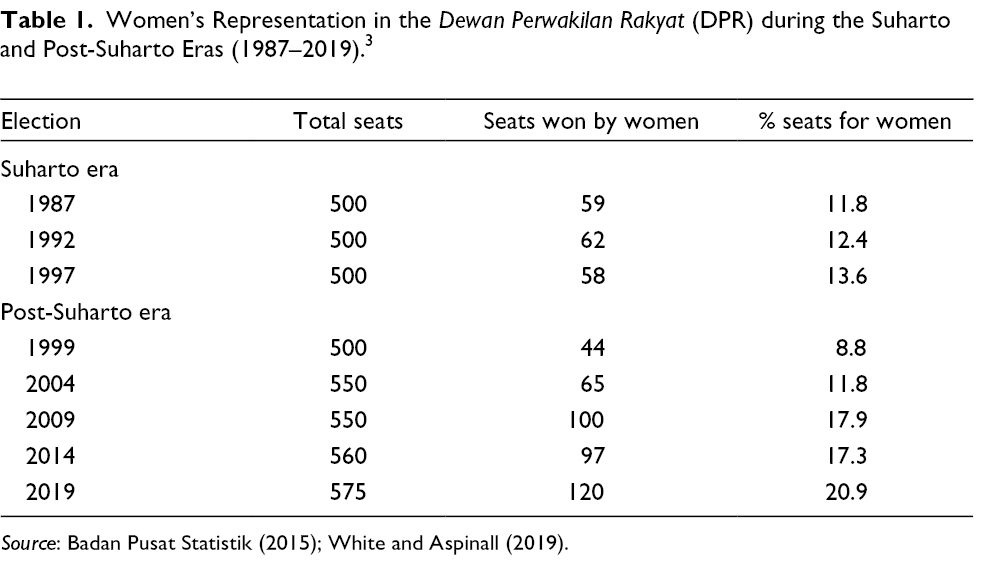
The year 2019 was a significant milestone in the history of Indonesian democracy. It was twenty years since the first democratic elections of the contemporary era. The legislative elections of April 2019 were the fifth of the post-authoritarian period. Less celebrated, but also important, was another achievement: the 2019 elections were the first to see the number of women elected to Indonesia’s national parliament, the People’s Representative Council (Dewan Perwakilan Rakyat, DPR), break through the barrier of 20 per cent, with 120 of the DPR’s 575 seats (20.9 per cent) taken by women. In Indonesia’s first post-authoritarian election in 1999, the proportion of women elected to the DPR was only 8.8 per cent. It has been a long struggle to increase women’s representation since that time, and one that is still reaping only a modest harvest. At the provincial level, women’s parliamentary representation remains well below the national level, at around 18 per cent, a small rise from 2014 when it was only 16 per cent; at the district level, the figure increased from below 14 per cent to just over 15 per cent. 1
Indonesia is often celebrated as one of the most successful examples of democratic transition of recent decades. Replacing the military-based authoritarian regime of President Suharto (1966–1998) with a multi-party system was a major achievement (despite recent signs of backsliding; Power and Warburton, 2020). Nonetheless, scholarship on Indonesian politics has repeatedly demonstrated that Indonesia’s new democracy has been marred by significant weaknesses, notably the pervasiveness of corruption and “money politics” as well as the dominance of wealthy elites (Aspinall and Berenschot, 2019). Though often not touched upon in mainstream analyses of the health of Indonesian democracy, the country’s inability to come close to achieving the promise of equal representation for its female citizens must surely rank as one of its major democratic defects. Alongside the still low level of women’s representation in legislatures, the proportion of women elected to executive government posts – notably, as governors and district heads in the regions – is even lower; according to data compiled by Perludem (Perkumpulan Indonesia untuk Pemilu dan Demokrasi, Association for Elections and Democracy), in 2018 only 8 per cent of district heads were women, alongside only one of thirty-four governors (Perludem, 2018). Of course, the democratic gender gap revealed in such figures hardly makes Indonesia unique. According to data from the Inter-Parliamentary Union, in late 2019 the global average of women’s representation in lower houses of parliaments was 24.6 per cent; in Asia it was 20.1 per cent (with Indonesia coming in just above this figure, at 20.9 per cent). Indonesia was ranked 120th out of 187 countries. 2
How and why has the representation of women in Indonesia’s legislatures remained low? What obstacles do women encounter when becoming candidates and campaigning, and how do they overcome them? How do they organise their campaigns and reach out to voters? What does studying women’s representation tell us about elections and representation in Indonesia more broadly? What lessons can be drawn from the Indonesian case for analysis of women’s representation elsewhere? To answer these questions, in 2019 we initiated a research project on women candidates in Indonesia’s legislative elections. Jointly organised by researchers from the Australian National University and the Universitas Gadjah Mada, we worked with teams of Indonesian researchers who conducted research in thirteen locations around the country, from Aceh in the far west, to Ambon in the east. These researchers interviewed women candidates, their supporters, election officials, and other relevant persons, and shadowed election campaigns. We supplemented this qualitative research with a nationally representative survey of 1,220 Indonesian citizens, conducted by the Indonesian Survey Institute (Lembaga Survei Indonesia, LSI), asking respondents about their attitudes to women’s political involvement and related issues. Finally, we asked members of our thirteen qualitative teams to ask a set of standardised questions of the women candidates they were interviewing. We collected responses from 127 candidates and, though we must be careful in reading the results (this was not a randomised or representative survey, nor was it large), they also provide tentative insights into campaign approaches adopted by women candidates.
Though the findings of this multi-pronged research effort are diverse, two overarching themes concern the material resources that women candidates draw upon when running for office, and the networks through which they organise their campaigns. As we explain, Indonesia has adopted an electoral system that emphasises personal campaigning by individual candidates, and in which parties generally provide only limited support to nominees. The result is an electoral landscape dominated by personalised campaigns, in which candidates build their own campaign teams (or “success teams,” tim sukses, as they are generally known) and rely upon their links with established social networks to reach voters. Such efforts are costly, as are the gifts of money, goods, community infrastructure, and the like, which have become an important part of campaigning in the highly clientelistic electoral landscape that has evolved in Indonesia (Aspinall and Berenschot, 2019; Aspinall and Sukmajati, 2016; Muhtadi, 2019). Due to entrenched patriarchal structures in Indonesian society, women candidates often face disadvantages when it comes to mobilising the material resources and networks required to win elections: they often have fewer material resources at their disposal than men, and they are less deeply embedded in dominant informal political networks at the local level.
In identifying these disadvantages, we have been guided by, and build upon, existing research on women’s representation in Indonesia (Bessell, 2004, 2010; Dewi, 2015; Hillman, 2018, 2017; Prihatini, 2019a, 2019; Prihatini, 2019b, 2019c, 2019d; Satriyo (2010, 2014); Shair-Rosenfield, 2012), most of which focus on institutional barriers, including male dominance within political parties, while also acknowledging the ideological barriers that limit women’s participation. We also make use of the massive body of research that has investigated the issue internationally. In particular, we were influenced by the “supply and demand” model of women’s political representation, first developed by political scientists Pippa Norris and Lovenduski (1995) in their classic study of the British parliament. Norris and Lovenduski proposed that low representation of women often occurs as a result of obstacles that arise even before women become candidates. Such problems, they argued, can be conceived in terms of the supply of qualified candidates (do such candidates want to run and are they able to do so?) and demand (are party leaders willing to nominate such candidates?). Once women do run for election, outcomes of electoral contests might also be affected by how such candidates are received by voters. As we shall see, while this model remains useful for analysing women’s representation in Indonesia, supply and demand obstacles have partly been ameliorated by a gender quota that requires political parties to ensure that 30 per cent of the candidates they nominate are women. Therefore, there has been institutional support as an enabling factor supporting women candidates on the supply side, at the nomination phase only. Nonetheless, women candidates still face structural disadvantages when it comes to competing. In part, these disadvantages arise from prejudicial social attitudes, but they are also a product of the centrality of individual networks and financial resources mentioned above.
In the remainder of this introductory article, we highlight main findings of our joint research effort, while also briefly introducing each of the articles in the special issue. In the first section, we introduce the institutional setting, highlighting features of Indonesia’s electoral system that impact on women candidates, and summarising the history of efforts to increase women’s representation by way of a gender quota. The second section discusses obstacles to women’s representation that arise from social attitudes, drawing on our national survey. The next two sections identify different methods women candidates use when campaigning, and when trying to overcome the structural obstacles they confront. Some candidates draw on what Bjarnegård (2013: 21–23) has described as “homosocial capital”: the relationships, trust, and mutual understandings that arise from social connections among people sharing the same gender. These candidates thus target women voters and campaign through social networks largely comprising women. Another group uses resources provided by powerful male backers – especially relatives, usually husbands or fathers – accounting for the rise of dynastic candidates over successive elections. These two groups of candidates represent distinct modal patterns of campaigning, even if they overlap in practice. A fifth section considers the influence of Islam in voting patterns for women candidates, noting how, contrary to some accounts, Islam per se is not a barrier to women’s representation. Women candidates running for Islamic parties can use Islamic networks and symbols to mobilise voters, while often negotiating to balance party ideology, patriarchal party attitudes, and voter expectations. Finally, we conclude by returning to the lessons of our study for comparative research on women’s representation, and for the nature of Indonesian politics.
Women’s Representation in Indonesia
During the authoritarian “New Order” regime (1966–1998), women were represented in Indonesia’s national legislature in small numbers, and had little impact (Bessell, 2004). Women’s representation in national parliament averaged 9 per cent, and at its highest in 1992 reached only 12.4 per cent (Badan Pusat Statistik, 2015). Women’s involvement in the public sphere mostly occurred through religious organisations (such as Nahdlatul Ulama, NU, and Muhammadiyah, the largest Muslim organisations in Indonesia), or through state-corporatist organisations such as Dharma Wanita (for the wives of civil servants), or Family Welfare Empowerment (Pemberdayaan Kesejahteraan Keluarga, PKK). Such bodies stressed that women’s primary responsibilities lay in the domestic sphere. Patriarchal views concerning men’s leadership of the family were enshrined in law through the 1974 marriage law as the state promoted men’s social and political role while downplaying women’s role in the public sphere (Blackburn, 2004). The domestication of women during this period has had major influence on public perception of the role of women in politics in the subsequent so-called reformasi era.
Many studies of why women have found it difficult to play a political role, especially by winning seats in legislatures, in post-Suharto Indonesia zero in on institutional barriers, including lack of support for women in the rules that govern Indonesia’s system of political representation (e.g. Hillman, 2017, 2018; Parawansa, 2002). To elect members of legislatures at all levels, Indonesia uses a system of proportional representation (PR), by which legislators are elected in multi-member districts. In Indonesia’s first post-Suharto election, the country inherited a “closed-list” version of PR, in which voters simply marked their preference for a party on the ballot paper. The order of candidates on that party’s list then determined which candidate(s) would take the seat(s) the party won in that electoral district: if a party won one seat, it would go to the candidate at the top of the list; if it won two, the top two candidates would be awarded the seats, and so on. This system turned out to be disadvantageous to women because the major parties were heavily male-dominated and placed men at the top of their candidate lists. As a result, the number of seats held by women in parliament declined in the first election in the post-authoritarian era in 1999, from 11.6 per cent in 1997 to 8.8 per cent in 1999 (Table 1).
Women’s Representation in the Dewan Perwakilan Rakyat (DPR) during the Suharto and Post-Suharto Eras (1987–2019). 3
In successive elections, Indonesia moved to a system of open-list PR (the system was first fully implemented in 2009), in which voters can choose between marking a preference for a party on the ballot paper (as before) or indicating a preference for one of the candidates on the party list. To allocate seats in an electoral district, the votes for each party and all its candidates are added up; the seat(s) go to the candidate(s) with the largest individual vote totals. The introduction of the open-list system had the effect of enhancing the importance of personal campaigning by candidates, because it effectively meant that candidates from the same party list were competing against each other (Aspinall, 2014). The open-list PR system has thus enhanced the role of vote-buying, informal campaign teams, and efforts to promote the personal profile of individual candidates (Aspinall and Sukmajati, 2016). The results have further undermined Indonesia’s already relatively weak parties (Ufen, 2009).
Shifting the weight of campaigning away from parties to individual candidates has the potential to pose major obstacles to women candidates, given that Indonesian society is marked by significant gender inequality. For example, workforce participation rates are relatively low and women’s earnings average around half that of men’s, with the result that women often are less well endowed with financial resources than men (World Economic Forum, 2020). 4 Women candidates, with the exception of dynastic and celebrity candidates, also tend to be less well known, reflecting that, in relative terms, women lack positions of authority and influence within important political networks; to cite one example, women are underrepresented in the senior levels of the civil service, an important pool of recruitment for political candidates (Pierskalla et al., 2020). Though parties largely remain male dominated, should they wish to promote women candidates they now have less leverage to do so, because under open-list PR voters determine which of a party’s individual candidates win seats.
The low number of women elected to the DPR in 1999 shocked many women’s movement activists. After much lobbying, in 2003 a new law on elections was introduced that included a voluntary quota system. Beginning with the 2004 election, it required each political party “to consider” nominating women candidates of at least 30 per cent (Siregar, 2005). Because it was ambiguous and lacked non-compliance provisions (Hillman, 2017: 39), the measure contributed to only a slight increase of women’s representation in the DPR in 2004 (Table 1).
In 2008, the candidate quota was strengthened in three main aspects: (1) it required political parties to implement a “zipper system” where one of every three candidates on their lists had to be a woman; (2) local election commissions were asked to verify that party lists complied in each electoral district; and (3) parties were asked to include 30 per cent of women in their executive boards (Hillman, 2017: 40). Although sanctions remained weak, women’s representation in 2009 increased significantly to 17.86 per cent, bringing Indonesia close to the then world average of 19 per cent (Bessell, 2010: 219). These results were greeted with optimism; institutional intervention had proven effective. Before the 2014 election, the quota provisions were again strengthened: parties would now not be allowed to compete in electoral districts where they were non-compliant (Puskapol, 2015: 29). However, hopes for another rise in women’s representation were dashed; instead, there was a slight decline (Table 1).
This takes us to the 2019 election, the focus of the current special issue. While women’s representation did increase in 2019 at both national and provincial levels, enthusiasm from women’s advocates has been muted. In particular, the rise in numbers of women elected has been overshadowed by concerns about the characteristics of many of the women elected (see White and Aspinall, 2019; Wardani and Subekti, this issue). While women are taking their seats in legislatures in larger numbers than ever before, reflecting a rise in what is known as descriptive representation, the rise in women connected to political elites has raised questions about the extent to which these women will advance the interests of the women they represent, known as substantive representation (Wängnerud, 2009). Political networks and financial resources remain central to women’s electability and the key barriers to their success.
Reception of Women Candidates
As noted above, the supply and demand model proposed by Norris and Lovenduski (1995) suggests that obstacles to women’s representation begin long before candidates face voters. Supply impediments occur when qualified women are reluctant to put themselves forward as candidates, or lack the opportunity to do so. There may be a variety of reasons: notably, qualified women may lack the material resources, the time, networks, or other opportunities to stand. Demand problems occur when party selectors are reluctant to endorse women candidates, either because they hold discriminatory attitudes or because they believe voters do. The emphasis on supply and demand in the literature partly derives from a widely shared finding in many developed democracies that once a woman candidate who is as qualified as a male rival stands for election, she will not suffer a significant penalty on the basis of her gender (Brooks, 2013; Krook, 2010). Party and incumbency are found to be more predictive of voting patterns than considerations of gender in most circumstances (Dolan et al., 2018).
What about in Indonesia? While some of the women candidates interviewed and observed through our research project insisted that gender discrimination was not an obstacle to their electoral chances, others pointed to a range of practical and attitudinal obstacles. The survey we conducted after the election also suggests that widely held patriarchal values in Indonesian society represent a significant impediment. 5 These attitudes start in the private sphere. For example, when asked whether they agreed with the statement “Men should be the head of the household and women should support them,” fully 97 per cent of respondents either agreed or strongly agreed. Similarly, 93.6 per cent agreed that a woman had to ask for her husband’s permission to work, and 74.4 per cent said that it was better that the husband provide for the family, compared to 23.3 per cent who said both husband and wife should be responsible.
These patriarchal attitudes carry over into the political sphere. For example, 62 per cent of respondents agreed or strongly agreed with the statement “In general, men are more capable of being political leaders,” while only 19.3 per cent disagreed or strongly disagreed (the remainder were neutral). Similarly, 78.2 per cent of respondents agreed or strongly agreed that “Men not women must be the heads or leaders of the community, and women must support them” versus only 17.6 per cent who disagreed or strongly disagreed. On these and similar questions, women respondents were more likely to provide favourable views of female leadership and autonomy, but not by dramatically higher margins. The largest gap in responses between men and women came in response to the question on who should provide for the family, with a difference of seven percentage points between men and women; gaps were much smaller on the necessity of a woman having her husband’s permission to work (one point), whether men make better political leaders than women (four points), and on men’s leadership of the household and society (two points). In short, the view that politics is a male rather than female domain seems to be broadly supported by a large majority of Indonesians.
There was also evidence that women are disadvantaged in politics by other views about gender roles. For example, when we asked whether it would be appropriate for a married woman with small children to hold political office, 34 per cent said it would be inappropriate, versus only 8 per cent saying it would be inappropriate for a man in the same situation. Interestingly, women were slightly more critical of women with small children holding office than men, with a difference of three percentage points. We also asked about what is referred to in the comparative literature as “issue competency”: whether men or women are seen as being better suited at handling particular social or political issues. It was only on three topics – women’s issues, financing and budgeting, and health – that more respondents said women were more capable than men. In the nine other areas we asked about – the environment, education, development and the economy, foreign affairs, human rights and democracy, religious affairs, prevention and elimination of corruption, law and order, and security and defence – men had the advantage (though many respondents also felt gender made no difference). Men even enjoyed a slight edge in education, an area where women are seen as more competent in many countries. We found similar results for candidate attributes, with large majorities of respondents associating character dispositions associated with political leadership – such as being authoritative and being firm – with men more than with women (for details, see White and Aspinall, 2019: 7).
On the other hand, in some respects, respondents did seem to be open to women’s political leadership. When we asked whether the country would be better or worse with more female political leaders, more responded that it would be better or much better (31.1 per cent) than said it would be worse or much worse (22.9 per cent) (the largest group, 44.6 per cent, said it would make no difference). These results did reveal a gender gap between men and women. Women were seven percentage points more likely than men to say that the country would be better with more women in public office (34 per cent vs 27 per cent), and men were ten percentage points more likely than women to say the country would be worse off (28 per cent vs 18 per cent). Our survey also revealed generally high support for the 30 per cent quota for women candidates: 67 per cent of respondents agreed or strongly agreed that the quota helped women candidates overcome discrimination, and 65 per cent agreed or strongly agreed that it helped women achieve equal representation. This high level of support was spread almost evenly across both male and female respondents to the survey.
Importantly, although large proportions of respondents held discriminatory views about women in politics, when it comes to whether these views influence voting behaviour, the evidence is less clear cut. We asked respondents whether they had voted for a woman at any of the three levels of legislative elections (38.5 per cent said they had) and then followed up with those who said they had not done so, asking why they had not chosen a woman. By far, the most common explanation was that they did not know any of the women candidates (56.7 per cent) while only 6.5 per cent agreed that “in general, it’s not appropriate for women to become leaders” and 3.7 per cent cited “religious reasons.”
This finding is important: because many voters are risk averse (Shair-Rosenfield, 2012), they tend to choose candidates they already know; because well-known candidates (who might be party leaders, influential businesspeople, or former bureaucrats) are more likely to be men, this logic helps male candidates. The finding thus highlights structural weaknesses disadvantaging women, given that candidates who are not already well known to voters frequently try to overcome this disadvantage by promoting themselves using publicity material (banners and stickers being the most ubiquitous in Indonesia) and by establishing large grassroots teams of brokers – political intermediaries whose job it is to recruit voters and distribute cash or other gifts to them on the candidate’s behalf. Both options require financial resources and networks, which women candidates often lack.
The answer to the question as to whether a respondent had voted for a woman candidate at the 2019 elections at any level was significant for a second reason: it revealed a gender gap in men and women’s voting patterns. Forty-two per cent of women said they had voted for a woman candidate, compared to 35 per cent of men. This gender gap is significant because, as a number of the contributions to this special issue make clear, many women candidates direct their campaigns to women voters and mobilise around women’s issues.
Women Targeting Women
Much of the literature on women’s representation in Indonesia in the past has highlighted demand problems, analysing in particular the nature of male-dominated party leaderships and their preference for nominating and supporting well-connected male candidates (e.g. Bessell, 2010). To be sure, there are also plenty of supply problems, derived partly from normative and cultural expectations, the expense of campaigns, and the relative dearth of positive female role models. To some extent, the gender quota was a way to short-circuit both these problems. By requiring parties to nominate women, it created “artificial” demand for women candidates in the parties; by assuring women they had a place, it generated greater confidence on the part of potential women candidates that they stood a chance.
However, while requiring parties to nominate more women, the quota does not resolve the structural disadvantages that women candidates face. Even if more women stand for election than in the past, with women making up just over 40 per cent of all DPR candidates in 2019 (Prihatini, 2019a), and even if many of them have the skills that would make them capable legislators, these are not necessarily attributes that help them get elected. In particular, as already noted, women are likely – on average – to be less financially resourced than their male counterparts, and they are also less deeply entrenched in the local networks that candidates use to build their success teams and influence voters.
How do women candidates get around these problems? In particular, do women candidates adapt to the realities of male dominance and seek to draw upon material resources and other advantages provided by male relatives or sponsors, and make use of male-dominated networks? Or do they mobilise women-centred networks and direct their appeals at women voters? Another survey finding is instructive in this regard. As well as commissioning the voter survey cited above, we asked members of our thirteen research teams to ask the women candidates they were interviewing a number of standardised questions. We did not randomly select respondents, but instead encouraged researchers to focus on candidates in their regions whom they considered to have a serious chance of being elected, so we must treat our findings with caution – they are not representative of the entire population of women candidates in Indonesia. Nevertheless, the findings are suggestive. Of the 127 women candidates surveyed, 39 per cent said the voters they were targeting were about 40–60 per cent women (in other words, their campaign strategy did not involve significant gender targeting). Another 40 per cent said that over 60 per cent of their targeted voters were women, while only about 13 per cent said they were targeting mostly male voters (the remainder did not provide a response). In other words, a very significant group of women candidates use highly gender-targeted campaigns, a feasible strategy when we remember that under Indonesia’s open-list PR system, a candidate need win only a small proportion of the votes in each electoral district to win a seat.
The gender gap was less dramatic when it came to candidates’ campaign teams. While 24 per cent of respondents said they relied on success teams that were over 60 per cent women, the largest group, 41 per cent, said their teams were at least 60 per cent male (29 per cent fell in the intermediate group with teams that were 41 per cent–60 per cent women). One explanation for the discrepancy between the extent to which women candidates target women voters and the degree to which they rely on women brokers concerns the male-dominated nature of social networks at the community level. Candidates in Indonesia typically target influential community leaders to join their success teams, hoping that such individuals will be able to sway their own followers to support their favoured candidate (Aspinall and Berenschot, 2019; Muhtadi, 2019). However, social influence is itself frequently highly gendered and the local notables that candidates view as ideal team members – village heads, neighbourhood heads, religious leaders, or small-scale entrepreneurs – are disproportionately male.
There is a connection between the gendering of campaign teams and of targeting strategies. In the same candidate survey, of the fifty-two respondents who said that the primary target of their campaign efforts were women voters (i.e. women were 60 per cent or more of the candidate’s target voter pool), almost half (twenty-three) said their success teams were also made up of at least 61 per cent women. By contrast, only ten of these candidates said that women made up 40 per cent or less of their campaign teams. In short: women-focused campaign teams tend to go together with women-focused campaign strategies.
Overall, while the survey results point towards a diversity of strategies, they also suggest that a significant group of women candidates draw upon homosocial capital. These women make use of the relationships of mutual trust and understanding that arise in women-focused networks, by relying on such networks to build their campaign teams and by concentrating their campaigning efforts on women voters. In her analysis of clientelistic politics in Thailand, in which she coined the term “homosocial capital,” Bjarnegård (2013) argued that homosocial capital tends to benefit men more than women in male-dominated societies because women “are dependent on male networks for access to relevant resources and because of difficulties in building and maintaining their own networks.” Women politicians are thus likely to be disadvantaged in highly clientelistic settings that place a premium on informal connections and trust between political actors (see also Daby, 2021). However, our findings demonstrate that homosocial capital can be a powerful tool in the hands of women candidates, even in a highly clientelistic environment such as Indonesia. Assisted by open-list PR, which allows candidates to win by targeting a relatively small group of voters, many women candidates in Indonesia target women voters, sometimes virtually exclusively. During our fieldwork we encountered many such candidates, almost all of whom worked through the many formal and informal female-dominated networks that engage large numbers of women at the community level in Indonesia.
Such networks include large women’s religious organisations, such as the women’s wings of the major mass-based Islamic organisations Muhammadiyah and NU, as well as a multiplicity of devotional groups from all religions. There are also state-sponsored community organisations such as the PKK, an organisation that was established during the New Order and lives on as a community health and development organisation focused on maternal and childhood health and other welfare initiatives. Women’s co-operatives and micro-enterprises, at least some of which receive state support and are therefore especially likely to court political candidates, also abound, alongside countless foundations, clubs, non-governmental organisations, and other groups organised by women. Like other social networks in Indonesia, these groups and their leaders are potential targets for candidates hungry for networks through which they can reach voters.
Importantly, our survey of 127 women candidates suggests that female-focused campaigns tend to be more successful than the alternative: women candidates in our survey who targeted women voters and worked mostly with women in their success teams had a greater chance of being elected than respondents who mostly targeted, and were supported by, men. One-third of the candidates we surveyed who claimed that their success teams were predominantly (i.e. 80 per cent or more) women were elected; against only 17 per cent of candidates whose success teams were overwhelmingly male (i.e. 20 per cent or fewer women). The same pattern was visible when it came to voter targeting: of candidates who said 80 percent or more of their targeted voters were women, 30 per cent were elected; the equivalent figure for respondents who mostly targeted men (i.e. women were under 40 per cent of their targeted voters) was 12.5 per cent. In contrast, candidates’ levels of expenditure on campaigning had relatively little correlation with the rates at which they were elected. These results need to be treated with great caution given that our candidate survey was neither large nor randomised, but they are suggestive of a pattern of female-focused campaigning yielding relatively high rates of electoral success for women candidates. They are also consistent with the findings of our voter survey, which showed that female respondents were, by a seven-point margin, more likely than men to report voting for a woman candidate. At the least, our findings point to the need for further research on this topic.
Some of the articles in our special issue focus on candidates who mobilise women through female-focused networks. The article by Muhammad Mahsun, Misbah Zulfa Elizabeth, and Solkhah Mufrikhah examines successful campaigns of several women candidates in Central Java who were leaders of Muslimat or Fatayat, the women’s and young women’s organisations associated with Indonesia’s largest mass Islamic organisation, NU. The authors argue that these candidates derived significant political and social capital from their organisations, and were able to use this capital to mobilise support down to the village level, meaning that they did not have to rely on paid campaign workers or spend large amounts of cash to shore up voter support. These women found it advantageous to target women voters and play to their strengths as women candidates by directly addressing so-called women’s issues, including reproductive health, maternal and infant mortality, violence against women and children, and women’s economic empowerment. Using these strategies, women candidates were able to politicise NU women’s networks, convincing their members that only a woman from the same network could represent their interests in the legislature.
The candidates identified in Mahsun and co-authors’ study were not members of dynastic families who already dominated local government. Most were, however, connected by family ties to local religious elites, being the daughters of well-respected religious leaders (kiai). Their leadership potential came partly from their family authority but also from their ability to rise through the ranks of NU women’s networks, acquiring large amounts of political and social capital by advocating for the rights of NU women, including by winning access to government programmes for local Fatayat and Muslimat branches. Experience in women’s networks thus has a two-fold advantage to women candidates. First, those networks can be mobilised directly for electoral support. Second, women who have experience in them can develop the organisational and strategic skills to allow them to develop successful campaigns and build successful careers in the legislature.
Women’s experience in grassroots networks and political campaigns is also the focus of the article by Longgina Novadona Bayo. More women were elected to the provincial parliament of East Nusa Tenggara (Nusa Tenggara Timur, NTT) in 2019 than ever before. Bayo shows that most of the successful candidates were not linked to local elites through family ties, and had stood as candidates on multiple occasions before finally achieving success. Building on the framework by Choi (2019) for analysing women’s pathways to power, Bayo illustrates how women activists at the grassroots joined political parties as cadres and then rose through the ranks to join the party elite. In seeking to explain their success, she develops the notion of persistence: women candidates may not succeed in their first, second, or even third attempts to be elected, but, over time, they build campaigning skills and capacities that they use in activating their grassroots networks. She also focuses on the role of women’s networking, role models, and capacity-building through NGOs.
But there were also candidates who targeted women voters without relying on grassroots networks, such as those provided by religious organisations or advocacy groups. The article by Amalinda Savirani, Nuruddin Al Akbar, Ulya Niami Efrina Jamson, and Listiana Asworo discusses a striking experiment in liberal politics that was tried in 2019: the Indonesian Solidarity Party (Partai Solidaritas Indonesia, PSI). More than any party in the post-Suharto period, the PSI advanced a programme that included a strong women’s rights agenda, emphasising issues such as domestic violence and polygamy, and condemning religious conservatism. Many of its prominent leaders and candidates were women. The PSI consisted, however, of people whom Savirani and co-authors call “floating liberals”: they mostly had urban elite backgrounds and lacked organic connections to the social networks that infuse Indonesian communities. Accordingly, the party organised a campaign that largely bypassed the grassroots networks used by most candidates in Indonesian elections, instead relying heavily on television exposure and social media. The results were mixed: while the party, including many of its leading women, performed strongly in several urban electorates, it failed to achieve enough votes nationally to pass the parliamentary threshold of 4 per cent, and thus failed to seat candidates in the DPR.
Most women candidates we studied targeted women voters and focused their campaigns on gender issues. However, while the PSI used strategic gender issues (Molyneux, 1985), attacking male privilege and female disadvantage, the overwhelming majority of other women candidates did not, preferring to focus on practical topics they felt had concrete bearing on the lives of women and children. Featuring most were traditional “women’s issues” such as maternal and infant health, and women’s economic empowerment through co-operatives, microenterprises, and other government-funded programmes. Using their identity as women and mothers, candidates highlighting such issues hoped to prime women voters to vote in accord with their gender interests (Holman et al., 2015).
Dynastic Candidates and the Rise of Women’s Representation
Though a considerable number of women candidates in Indonesian elections pursue female-focused electoral strategies, our candidate survey indicates that there is also a group of women candidates who do not rely on female-centred networks; some even rely mostly on male brokers and target male voters. Who are these women, and what is their electoral impact?
One answer is provided by the article by Sri Budi Eko Wardani and Valina Singka Subekti in this issue. They argue that the increased number of women elected to the DPR in 2019 masks a less positive trend: an increase in the number of such women with dynastic connections. According to their calculations, the number of women with dynastic backgrounds – someone who is a wife, daughter, or otherwise closely related to an incumbent politician – increased from 34 per cent to 40 per cent of the women elected to the DPR. While both men and women connected to political families feature in Indonesian elections, the percentage of male dynastic candidates as a proportion of total candidates elected is much lower, at only 8.5 per cent in 2019 (Wardani and Subekti, this issue), reflecting that men have multiple pathways into power. Women dynastic candidates, or at least many of them, short-circuit the resource and network challenges experienced by other women candidates largely by relying on their powerful, usually male, relatives. Dynastic candidates benefit from the fame that these relatives confer on them, and they can use the financial resources and political networks they have at their disposal. Party elites for their part, Wardani and Subekti argue, care only about recruiting candidates who can attract votes, so that many parties chose to run newcomer dynastic candidates in the same electorates as many of their most experienced and qualified female cadres, with many of the latter losing their seats to the former.
A close view of what the campaigns of dynastic candidates look like is provided by Muhammad Ichsan Kabullah and M Nurul Fajri in their article on election campaigns in West Sumatra, where eight wives of local government heads and deputy heads competed for legislative seats. They suggest that the emergence of these spousal candidates points to a phenomenon they describe as “neo-ibuism.” During the authoritarian era, the regime promoted a vision that stressed women’s role in the domestic sphere and distanced them from public affairs, especially politics, while controlling women through a series of state-sanctioned women’s organisations. Within these women’s organisations, leadership positions were given to women according to the status and position of their husbands. This vision was dubbed “state ibuism” (ibu being the Indonesian word for “mother”) by Suryakusuma (1987, 2011). Kabullah and Fajri argue that neo-ibuism entails greater female political agency than was possible in the authoritarian era, but still stresses women’s roles as mothers and positions them politically in relation to their husbands. Tellingly, the authors provide evidence that at least some of these women were recruited as candidates when national party elites contacted their husbands, arranging with them to have their wives run for office.
Though we are here contrasting the male-focused campaigns of dynastic candidates with the women-focused campaigns of candidates who work through women’s networks, there can be overlap in practice between the two types. As Kabullah and Fajri explain, female dynastic candidates often have privileged access to particular types of female networks – especially state-supported organisations such as PKK (the wives of regional government heads are automatically appointed to lead these organisations, in one clear example of continuity with New Order practice). Dynastic candidates, too, perhaps because they are partly defined by their relationship to powerful men, often reach out to women voters by stressing their shared roles as mothers and in the family (a revised version of ibuism). Even so, there is still an identifiable disjuncture between the two types: in our candidate survey, of the fifty-six candidates with dynastic connections, twenty-six (or 46 per cent) had teams that were 61 per cent or more male (the figure for non-dynastic candidates was appreciably lower, at 36 per cent); likewise, less than a third (30 per cent) of the candidates with dynastic connections targeted primarily women voters compared to almost half (49 per cent) of the non-dynastic candidates. Again, we need to treat these numbers with caution (ours was not a randomised survey), but they are suggestive that dynastic candidates’ connections to male sources of power carry through to their organisational and targeting efforts.
Of course, Indonesia is hardly the only country in Asia, or more broadly, where many women politicians come from established political families. Several Asian countries have been led by women heads of government or state who were wives or children of (often deceased) prominent male politicians (Choi, 2019; Derichs et al., 2006; Richter, 1990), while Choi (2019) argues that dynastic connections are one important pathway to power for women at all levels in numerous Southeast Asian countries. More generally, Folke et al. (2021) have drawn on European examples to argue that women with dynastic connections tend to make up a large share of elected women representatives at early stages of expanded women’s political engagement because party selectors, lacking knowledge of potential women candidates as individuals, tend to fall back on what they know about candidates’ male relatives. Dynastic connections become less important over time, as party leaders become more familiar with women candidates. In this perspective, the advantage of belonging to a political family is primarily informational. By the same token, in the Philippines, analysts of political dynasties have sometimes argued that voters support dynastic candidates when they are familiar with, and hold favourable views of, earlier politicians bearing the same family name: “elite families … are often thought to transmit their character and characteristics to younger generations” (McCoy, 1994: 8).
While this informational dynamic may be important in Indonesia, the fact that dynastic connections are not declining over time, but becoming more important, suggests that other factors must also be at play. If what counts in Indonesian elections is – as argued above – financial and network resources, it may be that the advantages possessed by dynastic candidates are so strong that they outweigh the ability of other women candidates to, over time, overcome the informational disadvantages they face among voters. To be sure, the situation is complex, and the article by Bayo makes clear that some independent women can build up the capital and capacity over time to successfully compete. But the preponderance of evidence at the national level suggests that dynastic connections are becoming more, not less, important.
It should be noted, however, that the dynastic argument is not the only one that may be advanced to explain the rise in women’s representation. As noted above, scholars have long argued that electoral system design can have a major impact on the extent of women’s representation – witness how Indonesia’s shift to open-list proportional representation has made it harder for women lacking financial and network resources. Another article in this special issue, authored by Luky Sandra Amalia, Aisah Putri Budiatri, Mouliza KD Sweinstani, Atika Nur Kusumaningtyas, and Esty Ekawati, argues that Indonesia’s shift to simultaneous legislative and presidential elections in 2019 may have had an impact. These authors argue against what they explain was the widespread view in Indonesia that simultaneous elections would disadvantage women candidates, including by diverting media attention away from legislative candidates to the presidential contest, and by burdening candidates with the obligation to campaign for the presidential candidate their party supported. Against this, the authors point out that women candidates were disproportionately elected in provinces where the presidential candidate-pair supported by their parties also did well. They suggest that linking the presidential and legislative elections advantaged women candidates, allowing them to campaign in areas where a presidential candidate had strong support, but where they, as candidates, lacked personal connections.
Women, Islam, and Representation
There is much debate in the literature concerning the relationship between Islam and women’s political participation. On the one hand, the much-cited work of Inglehart and Norris (2003), a comparative analysis drawing on the World Values Survey, concludes that Muslim-majority nations are less supportive of gender equality, that this lack of support leads to real-world gender inequality, and thus that Islam represents a significant barrier to women’s political participation. The latest Inter-Parliamentary Union (IPU) data appears to back this argument: women are only 17.7 per cent of members of lower houses of parliaments in Middle Eastern and North African countries, significantly lower than the world average (but just above the Pacific, the worst faring region). On the other hand, other authors (e.g. Rizzo et al., 2007; Ross, 2008) have pointed to major differences in the strength of patriarchal culture across the Muslim world, particularly between Arab and non-Arab Muslims societies, and highlighted how socio-economic and institutional factors contribute to these differences.
In Indonesia, findings have been mixed. Research by Fattore et al. (2010) drew on survey data to find that there was no support for the proposition that Muslims were opposed to women in political office, with no significant difference in the attitudes of Muslim men and non-Muslim men, and only minor differences between Muslim and non-Muslim women (both of whom were more favourable of women in office than men). Our own national survey, conducted by LSI after the 2019 election, found much variation, but indicated that Muslims were more likely than non-Muslims (64 per cent versus 44 per cent) to agree or strongly agree with the statement “In general, men are more capable of being political leaders.” 6 Meanwhile, Prihatini (2019b) found that Islamist political parties in Indonesia were no better or worse than pluralist or secular parties at recruiting and nominating women.
One way to approach this question is by focusing on women’s representation across regions of Indonesia with varying population compositions. There are areas of Indonesia where women’s representation is particularly low, and some of these regions have a high Muslim population, such as Aceh. However, if we look at province-level voting patterns in 2019 and compare them with the percentage of the population that is Muslim, we can see that there is no correlation between how Muslim a province is and how well women candidates fared (Figure 1). Two provinces that elected no women to the DPR have among the lowest proportion of Muslims in the population: predominantly Hindu Bali and majority Christian Papua. The province with the highest representation of women in the DPR, Bengkulu, is among the most Islamic. Even if we take a slightly different measure and look at provinces that have a history of Islamist activism, we see great variation. Both West Java and South Sulawesi have a strong history of involvement in Islamist movements, but women candidates do comparatively well in elections to the DPR and provincial level Regional People’s Representative Council (Dewan Perwakilan Rakyat Daerah, DPRD) in both provinces.
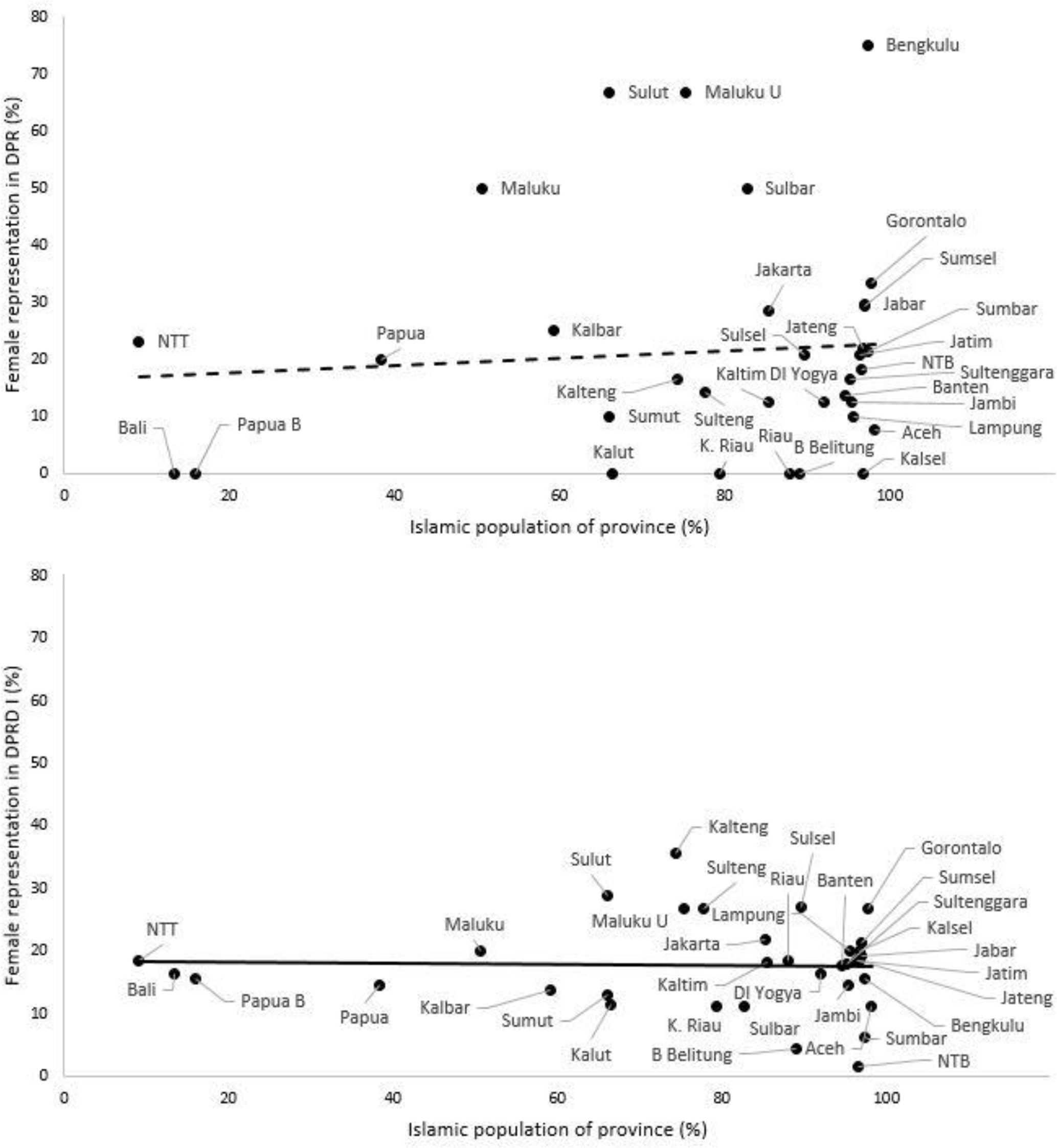
Women’s Representation in the Dewan Perwakilan Rakyat (DPR) and Dewan Perwakilan Rakyat Daerah (DPRD) Relative to Muslim Population.
Islamic parties and networks in Indonesia have often provided supportive contexts for women candidates to emerge. In this special issue, the study by Mahsun and co-authors shows that women candidates from the elite of NU-affiliated women’s organisations who ran for Islamic parties were able to leverage their networks to enhance their political capital (see also Dewi, 2015). By contrast, one Islamist party with an historically low proportion of women DPR members is the Prosperous Justice Party (Partai Keadilan Sejahtera, PKS). From a high of just 6.7 per cent of the party’s DPR members in 2004 being women, the proportion fell to 2.5 per cent in 2014, when only one PKS woman candidate was elected to the DPR (Prihatini, 2019b: 7). As Prihatini (2019b) has shown, this drop was linked to a reduction in the number of women being placed number one on the party’s candidate lists. In 2019, the party nominated a record number of women to first position on its lists (Prihatini, 2019b), and eight PKS women candidates were elected to the DPR, making up 15 per cent of the party’s seats.
Did this shift represent a change of heart by PKS, a recognition of the importance to the party of running strong women candidates, or was it simply tactical? The article by Rofhani Rofhani and Ahmad Nur Fuad discusses the PKS attitude to women’s candidacy and the motivation of women candidates running for the party. Focusing on East Java, the authors argue that the party’s ideological stance towards gender issues has changed; over time, participating in elections has pushed PKS to moderate its politics to appeal to a broader constituency and, by the same process, the party has moderated its anti-feminism. While PKS women candidates continue to give primacy to their domestic roles, they also believe strongly that women should be represented in legislatures. In their election campaigns, they do not focus on ideological and moral issues, instead targeting women voters through practical measures and policies. While they are constrained by gender roles ascribed to them by party ideology, they are able to exercise a degree of agency and push at the boundaries of what is considered permissible for women politicians in the party.
The relationship between Islam and women’s political participation is complex. On the one hand, ideology may limit women’s agency within Islamist organisations; on the other, access to Islamic networks and parties may boost the chances of women being elected. But being Muslim in a Muslim-majority nation can also have other benefits for women candidates. They can leverage religious and ideological issues in the same manner as men, but they have a distinctive weapon in their arsenal when doing so: their appearance. As Zulfatun Ni’mah shows in the final article in this special issue, some women candidates consciously use Islamic symbols of femininity and piety, especially the Islamic headscarf or hijab, to boost their electoral chances. In Cilacap, Central Java, Ni’mah finds that 93 per cent of women candidates wore the hijab in their official campaign photographs. This high percentage reflects community attitudes: the LSI survey conducted as part of this project found that 83 per cent of respondents agreed or agreed strongly with the statement that Muslim women should wear the hijab in parliament. However, while wearing the hijab was almost universal, Ni’mah found that both the motivations for doing so, and the hijab styles used, differed among candidates. Some women chose a particular style to reflect their party’s Islamic ideology. Others were more instrumental, wearing a style that signalled their Muslim identity while distancing themselves from puritanical strains of Islamic thought; some chose a style they believed enhanced their appeal to voters because it made them more physically attractive.
Overall, such articles show that the relationship between Islam and women’s political participation is multi-faceted: the articles in this special issue point towards the potential for a much expanded and highly nuanced literature on this subject in the Indonesian context.
Conclusion
The articles in our special issue have broad implications, and to consider these we return to two of the questions with which we began this essay. What does the study of Indonesian women candidates in this collection add to the literature on women’s political representation globally? What new light do our analyses of women candidates and the strategies they mobilise throw on Indonesian politics writ large?
Research into the gender gap in political representation across the world has taught us that there is no single reason for women’s underrepresentation. Women’s willingness and capacity to compete, the attitude of political parties to women candidates, and the sentiment of the electorate all typically play a role. These factors all have a gendered dimension (Krook, 2010), and the role played by each will vary from country to country and from election to election, depending on socio-economic, institutional, and structural features. Nonetheless, we also know from comparative research that it is harder in some countries than others for women to be elected. Despite a small increase in the number of women elected to the national legislature in 2019, Indonesia continues to underperform in women’s political representation, particularly relative to its achievements in terms of women’s education and overall economic performance, and despite the provision of a 30 per cent candidate quota for women in legislative elections. There is large gender gap in all forms of resources that candidates need for political success, including financial resources, access to elite networks, and experience of political leadership. Women face prejudice from political parties and from society about their capacity to represent their communities, a fact we see confirmed in our survey of voter attitudes. To be sure, the articles in this special issue also point to the resilience and creativity of women candidates and campaigners in trying to improve this situation – a point we return to below – but they also indicate that the obstacles remain significant.
It is both in understanding these obstacles and in identifying pathways around them that our special issue contributes to the comparative study of women’s political representation. On the obstacles, the Indonesia experience demonstrates that patriarchal attitudes continue to matter a great deal. Most of the literature examining the impact of gender on voter choice discusses the USA or other Western countries, and here the conclusion is generally that the sex of a candidate does not impact voter choice in a negative way (Dolan et al., 2018). Although women candidates may face stereotypes concerning women in leadership positions, when it comes to casting a vote, the importance of partisanship and incumbency outweigh candidate sex (Dolan, 2014). In Indonesia, although the link between gender stereotypes and voting behaviour has not been empirically tested, the indications are that candidate sex does impact on voter decisions. The prevalence of patriarchal attitudes combined with a weak party system where party affiliation is low (in our post-election survey, only 12 per cent of respondents reported feeling close to any political party) suggests that party as a heuristic is likely to have little impact (and in any case, in Indonesia’s open-list PR system, voters supporting a particular party always have the option to choose among multiple candidates running for that party).
A second contribution to comparative study, however, is more positive, and concerns the relative frequency of female-focused campaigning in Indonesian elections, and its viability as a pathway to victory for women candidates. As we know, electoral design can also create incentives for voters to choose women candidates. On the whole, list PR systems where multiple candidates are elected per electorate have proven to be more advantageous for women’s representation than electoral systems where parties are represented by only one candidate (Reyes, 2019: 81). Indonesia’s electoral system, with open-list PR and a candidate quota of 30 per cent combined with a mandated placement quota of one in every three candidates being a woman, should work well for women’s representation. But the structural features of an electoral system also interact with ideological and cultural factors, including values and norms concerning women’s political participation, but also clientelism, and other structural features such as the party system. And on the whole, in Indonesia as many of the articles in this special issue show, these factors tend to work against women’s representation.
However, the open-list PR system in Indonesia also presents women with opportunities. As we have seen, one approach taken by women candidates is to work through women’s networks and target their campaigns at women voters. There is much debate in the literature concerning gender-based voting or whether women vote for women. Again, most of the literature examining the so-called gender affinity effect concerns the USA and is thus in the context of strong partisanship and majoritarian voting (Holli and Wass, 2010). Although the findings are mixed, a consensus appears to be emerging that on the whole (and in line with the above discussion on harmful gender stereotypes) party is more important for both men and women in casting their votes (Badas and Stauffer, 2019). While some studies show a “baseline gender preference” (Sanbonmatsu, 2002) for the sexes to choose candidates of the same sex, this is activated only under particular conditions, such as an election campaign where gender issues have particular salience (Dolan et al., 2018).
Our candidate survey and our nationally representative survey suggest that a different dynamic is operating in Indonesia. We noted that there was a gender gap in voting, with women more likely to vote for a woman candidate than men, and that the women candidates who targeted women voters and used women in their campaign teams had a higher rate of being elected than those who did not. These results, combined with a number of the case studies in this special issue, suggest that there is a gender affinity effect in Indonesia. In a society such as Indonesia, where stereotypes and discourse on women’s issues and roles are highly gendered, women who run “as women” (Herrnson et al., 2003) are able to tap into women’s practical gender interests, priming women voters to identify their collective interests with those of the candidates (Holman et al., 2015). Indonesia’s open-list PR system where candidates often win with a relatively small proportion of the total votes cast in a district means that this strategy can be very effective. Thus, both institutional features and the cultural context need to be given greater emphasis in discussions of whether a gender affinity effect exists and under what circumstances it arises (Goodyear-Grant and Croskill, 2011; Schwindt-Bayer et al., 2010).
A third contribution a focus on women candidates in Indonesia brings to studies of women’s representation concerns the literature on clientelism (i.e. that mode of electoral politics based on the personalised exchange of material benefits for political support). Overall, this literature suggests that clientelistic politics tends to disadvantage women given the dominance of men in the informal social networks that perform brokerage roles in clientelistic politics (see Bjarnegård, 2013; Daby, 2021). The Indonesian experience points to the presence of female-centred networks and homosocial capital as a possible route to power even in a clientelistic context (see also Darwin, 2017). Though these networks may in many circumstances be infused with clientelism – especially when the women candidates mobilising through them are themselves wealthy and powerful figures connected to local incumbents – some of our case studies also suggest that such networks may foster a form of social solidarity that makes them an alternative to clientelism, reducing the need of the candidates who work through them to cement the loyalty of their supporters with material inducements.
Turning to lessons for the analysis of Indonesian politics in general, our studies of women candidates and their campaigns reiterate established findings in the country literature about how access to material wealth and established networks shape political success in the country’s personalised and clientelistic electoral landscape. From the rise of dynastic women candidates to the leveraging of quasi-state institutions such as PKK by some of them, studies in this special issue demonstrate that Indonesian elections remain heavily tilted in favour of wealthy and politically connected candidates. Even so, these studies also point to continuing space for pluralism and competitiveness that is often missed in the wider literature. These studies highlight examples of relatively materially under-resourced women candidates who campaign by mobilising through women’s networks, targeting women voters and raising women’s issues. Most analyses of formal and informal networks in Indonesian politics (e.g. studies in Aspinall and Sukmajati, 2016) have tended to view the informal networks that permeate electioneering in a top-down manner, as mechanisms by which candidates forge personalised connections with voters and deliver clientelistic benefits to them. At least some of our studies, however, show that we need to look more carefully at the interactions between candidates and constituents through such networks and to focus also on their roles as mechanisms for forging shared understandings of collective interests and advancing common agendas. The experiences of many women candidates, in short, point to the potential for a more programmatic forms of politics that lies half-buried in the morass of clientelistic politics that otherwise dominates the electoral landscape.
It is also through this focus on women’s agency that we may also find sources for optimism in the search for potential solutions for closing the gender gap in political representation in Indonesia. There are certainly institutional changes that could be made to the country’s electoral system to increase women’s election rates, such as returning to a closed-list system with a stronger quota (see White and Aspinall, 2019, for elaboration). Reforms that give women greater access to financial resources for campaigning would also support positive change. But what our studies show above all is that women candidates can themselves do a great deal to win office. A number of articles in this special issue point to women’s agency in overcoming the obstacles they face. After all, 120 women currently sit in the national legislature, and if 40 per cent of them have elite family connections, that means 60 per cent do not. As we hope the articles in this special issue show, many Indonesian women already demonstrate enormous determination and creativity in seeking to overcome the obstacles that stand between them and political success.
Footnotes
Acknowledgements
As editors of this special issue, the authors thank the "Supporting the Rules-Based Order in Southeast Asia" (SEARBO) project based at the Australian National University, for providing the funding which made the research possible. The Department of Politics and Government at University of Gadjah Mada hosted two excellent workshops at which participants benefited from feedback from the late Professor Cornelis Lay, Associate Professors Greg Fealy and Marcus Mietzner, and Dr. Eve Warburton, as well as from other project participants. We thank other participants in the project whose fascinating papers on women's engagement in electoral politics in other parts of Indonesia could not be accommodated in this special issue. We are grateful to the editors of the Journal of Current Southeast Asian Affairs, especially Andreas Ufen, for their support, and the two anonymous reviewers for their very helpful feedback. All the following articles in the special issue were translated from Indonesian by Edward Aspinall and Sally White. Maxine McArthur provided crucial copy-editing support. Cornelis Lay was a dear friend and inspiring academic mentor to many who participated in this research. We dedicate this special issue to his memory.
Declaration of Conflicting Interests
The author(s) declared no potential conflicts of interest with respect to the research, authorship, and/or publication of this article.
Funding
The author(s) disclosed receipt of the following financial support for the research, authorship, and/or publication of this article: The research for this special issue was funded by the “Supporting the Rules-Based Order in Southeast Asia” (SEARBO) project, administered by the Department of Political and Social Change at the Australian National University and funded by the Australian Department of Foreign Affairs and Trade. The opinions expressed here are the authors' own and are not meant to represent those of the ANU or DFAT.
Notes
Author Biographies
Email:
Email:
Email: