




Abstract
This article analyses an experiment in liberal-progressive politics that occurred in Indonesia in 2019. A new party, the Partai Solidaritas Indonesia (PSI, Indonesian Solidarity Party), supported gender equality as part of a broad liberal programme. PSI foregrounded female candidates and focused on gender issues, including controversial topics such as opposition to polygamy. Reflecting party campaign strategies that focused on media exposure, rather than grassroot mobilisation, the party garnered support mostly from educated urban voters. Support for women’s equality – especially on issues such as sexual harassment and gender-based violence – is concentrated in this group and partly reflects recent cultural shifts linked to globalisation and changes in the media landscape. PSI failed to gain representation in the national legislature, limiting its potential to play a major political role in the near future. Even so, this experiment provided opportunities for young women to step forward politically and has popularised discourse on women’s equality.
Keywords
Introduction
In 2019, Indonesia arguably experienced its most successful experiment yet in political liberalism, when a new party, the Partai Solidaritas Indonesia (PSI, Indonesian Solidarity Party), participated in the country’s national election. PSI branded itself as a party of urban young people; only those under forty years old could be members (there are a few exceptions). In addition, PSI is a party with a “female face”: 48 per cent of the party’s legislative candidates were women, and the party promotes discourse on women’s equality (including rejecting polygamy, opposition to domestic violence, support for interfaith marriage, etc.). Many of its most prominent leaders and spokespeople were women, including the party general chairperson Grace Natalie, as well as Tsamara Amany, Dara Nasution, Isyana Bagoes Oka, and Danik Eka Rahmaningtyas. This orientation to gender equality is in line with PSI’s liberal ideology, which stresses personal freedom, protection of minorities, individual rights, and equality (Hughes, 2011). This is in contrast with the dominant conservative Indonesian cultural values, which place religion (especially Islam) as their core foundation (Assyaukanie, 2009; Kersten, 2015).
PSI’s ideological stance makes it an outlier in the Indonesian party system (Eliraz, 2019). One attempt to map Indonesian party ideology, carried out by the Lembaga Survei Indonesia (LSI, Indonesian Survey Institute) with the Australian National University, found that legislators in provincial legislatures mostly locate their parties in the centre-right of the left-right ideological spectrum (Aspinall et al., 2018). Mainstream parties do not identify as being either “liberal progressive” (left-wing) or “conservative” (right-wing). In this context, we can say PSI wants to start a new tradition in Indonesian politics, one that stands in contrast with the growing trends of Islamic populism and conservatism (Hadiz, 2018; Savitri et al., 2018).
However, in the election, PSI did not get enough votes to meet the national parliamentary threshold of 4 per cent (a relatively high figure), gaining only 1.89 per cent nationally. As a result, the party failed to obtain seats in the national parliament, the Dewan Perwakilan Rakyat (DPR, People’s Representative Council). However, the party won a considerable number of seats, taking into account that it was a first-time competitor, in district parliaments (where the parliamentary threshold does not apply), especially in major urban centres such as Jakarta, Bandung, Surabaya, and Malang (Setiawan, 2019). The PSI vote among Indonesians overseas was also considerable, with the party coming third after Golkar and PDI Perjuangan (Partai Demokrasi Indonesia Perjuangan, or Indonesian Democratic Party of Struggle) among expatriates (KPU, 2019).
Though the party’s election campaign was in some respects a failure, given that it did not win national representation, in other ways it was a success, with the party gaining a significant number of votes, especially in comparison to most other new parties in Indonesia’s post-Suharto history (Prihatini, 2019). Moreover, these results point towards an emerging constituency of young, educated, middle-class voters, sympathetic to calls for political reform and to liberal ideas, and open to women candidates and campaigns emphasising gender issues (Ristianto, 2019). Does this mean that Indonesia is witnessing a new trend of ideological variation among educated urban voters – the group that has in recent times been the basis of the Islamist party, the Partai Keadilan Sejahtera (PKS, Prosperous Justice Party)? Does the rise of the party point to the emergence of new attitudes concerning women’s equality? What strategies did its women candidates use to mobilise voters and why? What can we learn from the PSI experiment in understanding the future of Indonesian electoral politics?
With regard to why the party focused on women’s equality and made women candidates so prominent, this article suggests that this stance was in part an outgrowth of the party’s liberalism, specifically its concern for protecting vulnerable groups, and in part a product of strategic calculation, given that gender issues are potentially attractive to a large number of voters. In this regard, PSI also seemed to be identifying a shift in the social and cultural landscape in Indonesia – at least in the major urban centres – marked by a growing awareness of the need for women’s equality and greater support for the goals of feminism, including sexual rights, sexual choice, and opposition to sexual harassment. Throughout the course of modern Indonesian history, Indonesians who are urban, young, educated, and middle class have tended to exercise the most important agency on these issues (Blackburn, 2004: 221), but this group has grown markedly in recent decades. There has been the rise of a new feminist sensibility among many young urbanites, partly linked to the influence of globalisation and new forms of online communication. Yet in this foundation were planted the seeds of the party’s limited success, because the issues and concerns that appeal to this constituency do not resonate so well among poor and rural voters.
This article advances these arguments through several sections. First, the article presents a brief historical overview of progressive liberal politics in post-Suharto Indonesia, arguing that the emergence of PSI cannot be separated from the historical development of a wider progressive social movement milieu, especially the liberal Islamic movement, but one that lacks significant grassroots connections. In the ensuing section, we elaborate on the political strategies adopted by PSI, focusing on their use of conventional and social media strategies that are similar to American-style political marketing. We then proceed by analysing how PSI candidates made gender issues central in all their campaigns, including by using creative campaign methods. Next, we compare strategies used by PSI candidates in urban areas, and in more rural areas, where the party’s female candidates often used classical strategies to mobilise voters, such as distribution of club goods. Our findings point both to the social and political changes that enabled PSI to focus on gender issues, but also the limits of this form of liberal politics, limited as it is to a primarily urban and middle class setting.
This article draws on field research we conducted in the lead-up to, and after, the 2019 election in Jakarta and Malang (East Java). We chose Jakarta as our main focus because, as the country’s capital and largest metropolitan centre, this was also the region where the best-known PSI candidates stood for election. Jakarta is a very competitive political arena, frequently attracting strong candidates with high public name recognition and support. We added data from Malang for comparative purposes, given that the PSI candidates competing here were not as well known as those in Jakarta, and noting that Malang – although a significant urban centre – retains strong traces of traditional local culture and is more typical of most Indonesian electoral constituencies.
From Discourse to Elections: Urban Liberal Politics in the Post-Suharto Period
To understand the emergence of PSI in a larger context, we must understand the history of the liberal-progressive movement in Indonesia, especially since the collapse of the New Order. Though liberal ideas and liberal political movements have historically been weak in Indonesia (Hadiz and Robison, 2013: 46), strains of liberal thinking and activism have of course long been present, especially among many of the intellectuals, students, and civil society activists who formed non-governmental organisations (NGOs) and otherwise mobilised for democratic reform in the late Suharto period (Aspinall, 2005). Though these highly varied groups failed to coalesce into a powerful electoral vehicle immediately after Suharto fell, they have continued to be an important part of the Indonesian political scene (Beittinger-Lee, 2010; Van Wichelen, 2010). One key component of this broader liberal or progressive milieu is groups concerned with promoting women’s equality, though as Blackburn (2004: 224) points out, the liberal-secular women’s movement has always been a minority in Indonesian society, and women’s movements have generally been fragmented.
One manifestation of progressive liberalism that has a strong connection with the birth of PSI is the movement known as Jaringan Islam Liberal (JIL, Liberal Islamic Network). This group was founded in the early 2000s by several young Muslim intellectuals including Luthfi Assyaukanie, Ulil Abshar Abdalla, and Hamid Basyaib (Agustina, 2015), backed by the prominent author and journalist Goenawan Muhammad and the well-known pollster Saiful Mujani (Surahman, 2013). JIL became popular among liberal Islamic activists by questioning well-established positions on social issues and promoting critical thinking. JIL activists called for a renewal of Islamic thought, with an explicit orientation to liberal ideas emphasising freedom of expression, freedom of thought, individual rights, and protection of minorities (Kloos and Berenschot, 2017). For example, they suggested that the Qur’an should be open to a contextual interpretation rather than being followed literally. They also advocated and supported the minority Islamic group Ahmadiyah. JIL drew on earlier traditions of reformist Islamic thinking, especially those associated with the modernist intellectual Nurcholish Madjid (Rachman, 2010; Rahardjo, 2010). The Utan Kayu Community, named for the place where JIL was formed in 2001, went much further than Madjid, however, promoting public discussion of all sorts of contemporary issues, including democracy and gender equality (Mujani, 2007; Surahman, 2013; Rahardjo, 2010).
As their strategy for social change, the activists associated with JIL consciously strove to change intellectual and public discourse (Kloos and Berenschot, 2017), including by using the latest information technology to promote their ideas. JIL promoted its discourse through a mailing list and an official website at www.islamlib.com (Rachman, 2010). In this regard, they were forerunners of the later generation who became active in PSI, who also relied heavily on traditional and social media to promote their ideas. JIL (like the later PSI) in part emphasised the media because it lacked a strong grassroots base, which made the group vulnerable when its views came into conflict with those promoted by large Islamic organisations such as Nahdlatul Ulama (Fealy, 2019).
Among other ideas, JIL placed a strong emphasis on gender equality and freedom for women, breaking taboos on issues such as female sexuality, polygamy, and interfaith marriage (Kahar, 2004). The group’s website included a range of articles criticising polygamy as a form of discrimination against women (Affiah, 2006). Members of the group were involved in drafting a counter legal draft on Islamic law for the Pengarusutamaan Gender (PUG, Ministry of Religious Affairs Gender Mainstreaming) team in 2004, an attempt that expressed a vision of gender equality and arguably represented a high-water mark of the liberal Islamic movement in post-Suharto Indonesia. This effort, however, eventually failed when it encountered resistance from conservative groups (Nurjihad, 2004; Nurlaelawati, 2010). Below, we will see connections with the PSI’s discourse on social inclusion and women’s equality.
The “golden era” of the liberal Islamic movement, such as it was, did not last long. As stated by Fealy (2019), this movement experienced many obstacles when their main charismatic patron, Abdurrahman Wahid, died. JIL also lost the support of donors, such as The Asia Foundation, which wanted to avoid the controversy generated by JIL (Fealy, 2019; Suratno, 2011). The large Islamic organisations such as Muhammadiyah and Nahdlatul Ulama increasingly distanced themselves from liberal Islamic thought, marginalising JIL further from the Islamic mainstream (Van Bruinessen, 2011). In the end, it turned out that the core of JIL was a relatively socially isolated group of big-city intellectuals, who were unable to resist the pressure when they began to face opposition from better established groups with mass followings in both urban and rural areas. This outcome is in line with historical trends, including Blackburn’s study that shows how liberal Islamic thinking, including on women, is not deeply rooted in Indonesian society in general (Blackburn, 2004: 229).
However, many of the activists associated with JIL continued to promote efforts for social and political reform, including in electoral initiatives. In particular, some supported various volunteer groups that backed Joko Widodo (Jokowi) when he ran for the governorship of Jakarta in 2012, along with his deputy Basuki Tjahaja Purnama, or Ahok, an ethnic Chinese and Christian (Suaedy, 2014). Jokowi later ran for the presidency in 2014, and the JIL network supported him as he promoted a minority protection political agenda. A particularly important event for many of them was the 2017 gubernatorial election in Jakarta, when JIL activists supported Ahok, who became the target of a hostile Islamist campaign when he was accused of insulting Islam (Burhani, 2018). For these liberal Islamic intellectuals, the campaign to support and defend Ahok was a test case for Indonesian pluralism.
When PSI was founded, many of these same individuals supported the new party. For example, the consultancy firm owned by JIL founder Saiful Mujani (Saiful Mujani Research Consulting, SMRC) helped to establish the party by helping to design a publicity campaign (Mudhoffir, 2018). JIL leaders frequently spoke out in defence of PSI. For example, Luthfi Assyaukanie defended the party when its leader Grace Natalie declared PSI’s opposition to religiously inspired local government regulations (Sharia Bylaws), prompting criticism by conservative Islamic groups (Muhyiddin, 2018). Ade Armando, another leading figure in JIL, worked as a consultant in SMRC and had the task of designing PSI’s media strategy. Armando publicly defended the party and contrasted it with Jokowi’s party, PDI Perjuangan, which he said “gave no more reason for hope” (Armando, 2019).
To be sure, liberal Islamic intellectuals were not the only group who founded and supported PSI. The party was funded by the businessman Jeffrie Geovanie, who also acted as chairperson of the party’s advisory board. Geovanie himself is not a new figure in Indonesian politics, but had previously been involved in several parties (Kumparan, 2018) and been both a gubernatorial candidate (in West Sumatra) and a member of the Dewan Perwakilan Daerah (DPD, House of Regional Representation). He is also a prominent businessman, with interests in hotels and property, has connections with various tycoons, and is a director of Trego Holding in Singapore (Kumparan, 2018). The role of politicians like Geovanie, along with his business networks, as financiers of PSI meant that some people accused the party of being too closely associated with oligarchic networks (Mudhoffir, 2018). The PSI secretariat was located in a building in Kebon Kacang, Central Jakarta, that was owned by Geovanie (Interview, Raja Juli Antoni, Jakarta, 3 July 2019). More generally, the media strategy of the party meant it required substantial financial support, leading it to build connections with wealthy donors. Raja Juli Antoni, the Secretary General of PSI, acknowledged that PSI received funds from big companies, although he did not mention the names or amounts.
At the same time, the party selected leaders in ways that reflected the party’s progressive values, including by promoting minority groups and women (we return to the question of why gender issues featured so prominently in the party below). For example, Grace Natalie, former journalist and news anchor for a national private television station, with an accountancy and management background (and also a former CEO of SMRC), became the general chairperson of the party in part as a result of this factor: being of Chinese descent, and a non-Muslim, she was a “double minority” woman (Afrianty and Winarnita, 2019). Given the fact that in Indonesia women have tended to be politically marginal compared to men (Firdaus, 2019), Grace personified the PSI vision of siding with minorities and rejecting political conservatism (Chen, 2019).
Another leading PSI member and female icon of the party was Tsamara Amany. Tsamara graduated from the communication department of Paramadina University in Jakarta and became an admirer of Ahok after she did an internship in the Jakarta provincial government when he was governor (Yasmine, 2017). She was active in Teman Ahok (Friends of Ahok), a volunteer group set up to support the governor.
Of course, not all the new PSI leaders were women. For example, Raja Juli Antoni, the general secretary of PSI, completed his master’s degree in the UK and his PhD in Australia, and was associated with the liberal current among Muhammadiyah youth. Surya Tjandra, a labour activist (appointed deputy minister of agrarian and spatial planning after the election in 2019), ran as a DPR candidate in the East Java V electorate.
The party thus took some measures to try to broaden the base of its appeal through selecting candidates with connections to various activist groups and social movements, including Danik Eka Rahmaningtyas, a Muhammadiyah cadre in Jember, East Java. However, the JIL connection demonstrates that the party was heir to a particular type of liberal activism in Indonesia, one that was rooted in the urban intelligentsia and focused not primarily on grassroots activism but on promoting social and political change through discourse, especially by using the media and new technologies to promote public debate, critical thinking, and new ideas. As we shall see, PSI very much adopted this strategy and used it to shape its campaign.
“Americanisation” and the Political Marketing of PSI Candidates
PSI chose a campaign strategy that in many respects resembled those used by parties in the USA and other established democracies, being based on a political-marketing approach (Maeshima, 2018). In this approach, promoting a candidate or party is no different from selling a product: both need to become known by potential “consumers.” While other parties in Indonesia also use consultants, what distinguished PSI from other parties was the image (“construction”) it was selling, and its target “market.” PSI sought to portray itself as a “new hope” for clean and progressive politics and paid much attention to women and young people as its core group of potential voters. Other candidates from other parties did this too, but candidates often combined this approach with the use of clientelistic methods and “success teams” to mobilise voters, including through vote buying (Aspinall and Berenschot, 2019).
The adoption of this strategy was partly a product of the role played by the political consultancy firm SMRC in supporting the party from its birth. The founder of SMRC, Saiful Mujani, is a PhD graduate from Ohio State University. When he returned to Indonesia in 2004 on completing his studies, he became one of the first Indonesians to establish a political consulting organisation designed to help parties and candidates conduct opinion polls and design their campaigns (Mietzner, 2009; Qodari, 2010). As mentioned above, Saiful Mujani was also a key person in the liberal Islamic movement (Nurdin, 2005). SMRC’s support of PSI was largely informal, but it was intimate, demonstrated in personal connections, such as those of party general chairperson Grace Natalie, who had worked for SMRC, or of SMRC researcher Dara Nasution, who became a PSI candidate in North Sumatra.
To support PSI, SMRC made use of the large stock of electoral and survey data it could access. It conducted surveys to help the party design its campaign strategy, including by identifying regions where voters were receptive to new candidates. The party then ran its leading candidates in these regions. In the early stages of this research, SMRC identified fifty national electoral districts where the party had a high chance of winning seats. These areas tended to be those that had been open to electing new candidates in the last three elections and that were not badly affected by polarisation between Islamic and “nationalist” forces; most of the areas identified were urban (Informal communication with SMRC researcher, Singapore, 11 July 2019). By early 2019, a couple of months before the election, when it seemed that the party had limited potential to break through the parliamentary threshold and thus seat its candidates in the DPR (Indonesia’s national legislature), PSI leaders decided under advice from SMRC to concentrate those efforts on just a dozen or so electoral districts and high-profile national figures. The candidates chosen included Grace Natalie (in Jakarta III electoral district), Tsamara Amany (Jakarta II), Surya Tjandra (East Java V), Isyana Bagoes Oka (Banten III), Giring Nidji (West Java I), Fajar Riza Ulhaq (West Java V), Andi Budiman (East Java I), Danik Eka Rahmaningtyas (East Java IV), and Dara Nasution (North Sumatra III). Some of these districts are urban areas; all of the candidates were running for DPR seats; none was running for a seat in the provincial or district DPRDs – such candidates financed themselves. This focus was a last-ditch effort to reach the national parliamentary threshold, though party leaders were aware that this would be hard to achieve.
SMRC helped the party by designing campaigns in each of the target districts, identifying and mapping the key social features of those districts, training candidates in public speaking, helping the party identify issues it could use in its promotional material on social media, and so on (Interview, Dara Nasution, Jakarta, 3 July 2019). The party’s emphasis on gender issues was partly a result of SMRC inputs. For example, some of the controversial ideas that Grace Natalie raised, including opposition to polygamy and to sharia regulations (i.e. regulations passed by local governments which purported to implement aspects of Islamic law but that were often discriminatory against women and minorities), were actually inputs from SMRC. This focus was chosen because support for women’s equality, and opposition to sexual harassment and violations of sexual rights, are very popular among young, educated urbanites. To be sure, the party did not only focus on gender issues. Tsamara Amany, for example, bravely and directly challenged PKS legislator Fahri Hamzah on his views on corruption and reducing the authority of the Corruption Eradication Commission. This eventually resulted in the two being invited to debate on TV. But Tsamara was also at the forefront of an anti-marital rape campaign, typically a taboo issue in Indonesia.
There were also practical reasons why PSI candidates emphasised gender issues. As members of a new party, PSI candidates needed a way to make people become aware of them. Highlighting controversial issues that provoked public debate was one way to achieve this goal. The party’s leaders succeeded in doing so: whenever there was public debate concerning women, leading party figures such as Grace Natalie and Tsamara Amany were almost invariably at the centre. They became media darlings, who were frequently invited to newsrooms to share their opinions on these and other controversial issues. This was a relatively cheap and cost-effective strategy to popularise the party and to promote themselves as candidates. Moreover, it made sense to focus on media and social media given the party was targeting urban young voters who are active social media users. In sum, party leaders believed that gender issues were an effective campaign instrument to popularise the new party, and there was a pragmatic reason for doing so.
The party also designed a media campaign that focused heavily on young voters – for example, Grace Natalie appeared in advertisements using a typically youthful form of slang – and that relied heavily on social media. 1 In essence, SMRC promoted a marketing approach that aimed to get key PSI candidates on television as much as possible and to heavily promote them through social media. The goal was to get candidates in the media spotlight: getting them interviewed by raising controversial issues, and having active social media accounts. The philosophy was simple: as long as the party was in the media often enough, it would stick in the heads of voters, prompting enough of them to support it at the ballot box.
Recruiting Women Candidates
Part of the background to PSI’s focus on women’s equality and feminism is a shift in thinking on gender issues that had begun in urban and youthful circles in the years leading to the formation of the party. As Blackburn (2004) has shown, groups favouring women’s equality have long been part of the political landscape in Indonesia. But over the years since reformasi (the post-Suharto period of reform), liberal thinking on women’s equality has become increasingly influential among young people, particularly women. It has reached a wider – albeit primarily urban and middle-class – public, rather than being mostly confined to NGO activists as in the past.
This shift is exemplified by the burgeoning of online media focusing on women’s rights and feminism; one example is Magdalene.co, founded in 2013, which has a substantial number of readers. Other online media, such as Tirto.id, have started to have special sections on feminism too. Globalisation has played a role here, via the influence of global trends such as the #MeToo anti-sexual harassment movement in social media. The cumulative effect of such developments is the beginning of a cultural shift: unlike in the past, the media and online activists have begun to pay attention to cases of gender-based violence experienced in the workplace or on campuses. Victims have bravely spoken out on their own experiences of sexual harassment and abuse.
At the same time, the old traditions of feminist activism also continue, and various networks of women’s groups – for example Jaringan Kerja Prolegnas Pro Perempuan (Working Network on Pro-Women National Legislation) – now advance the goals of equality into arenas such as domestic violence and sexual harassment (Affiah, 2017). The government has also started to respond through legislation, such as a draft bill on Elimination of Sexual Violence (Rancangan Undang-Undang Penghapusan Kekerasan Seksual, RUU PKS), which reached the national legislature thanks to lobbying by the NGO activists (following earlier laws on domestic violence [2004] and human trafficking [2007]).
When PSI was founded, its leaders wanted their party to resonate with this changing political environment around gender issues (Interview, Raja Juli Antoni Jakarta, 3 July 2019). In particular, as a party that claims to be a young people’s party (partainya anak muda), they believed it was important for PSI to be in line with young people’s views. Accordingly, from the start, party leaders agreed they needed to focus on gender issues and promote women candidates capable of addressing those issues.
In its campaign to promote gender issues, PSI built networks with some of the foremost women’s movement activists in Jakarta, with a goal of generating a focus on gender equality and to identify core campaign issues. PSI invited activists from groups such as LBH APIK (Lembaga Bantuan Hukum, Asosiasi Perempuan Indonesia untuk Keadilan, or Indonesian Women's Association for Justice Legal Aid Institute) – a legal aid institution providing support for women who suffer from injustices, violence, and various forms of discrimination. They provided information about trends in violence against women, and made suggestions about how the party could integrate these issues in its campaign material. Tunggal Pawestri, Programme Development Manager of Women’s Empowerment and Sexual Rights and Diversity in HiVos (a Dutch donor), also the co-founder of Women’s March Indonesia, was also invited to meet with party leaders in 2017, ahead of the election year of 2019. She shared her knowledge on gender issues with them (Interview with Raja Juli Antoni, Jakarta, 3 July 2019, and personal communication, Tunggal Pawestri, 31 July 2019). In short, PSI was eager to learn from feminist activists. To be sure, it did not make much use of women’s movement organisations as a means to mobilise voters at the grassroots, despite the potential availability of such networks. As already explained, the party preferred an American-style political marketing campaign, rather than one based on grassroots networks.
PSI had features that made it attractive to candidates who wanted to promote women’s equality. The party had an affirmative action policy for women candidates, but it still recruited candidates on merit: individuals had to go through a series of tests before being nominated. This procedure helped the party to head off attempts to denigrate its women candidates as being there merely to “fill the quota” (an accusation frequently directed at female candidates running for other parties).
In interviews, several women candidates in Jakarta explained why they decided to join PSI. Permaswari Wardhani (also known as Imas), an architect who was new to politics, explained that she joined after seeing the party’s advertisements calling for candidates to put themselves forward: “… it was free, they had a very good jury [that is, to select the candidates] and the selection process was broadcast live” (Interview, Permaswari Wardani, Jakarta, 5 May 2019). As a political newcomer, she had never previously thought that joining a party would be that easy. Imas, a Muslim herself, was very concerned about the rise of intolerance and conservative identity politics in the wake of the 2017 gubernatorial Jakarta election. Another candidate, Imelda Berwanty Purba, a professional in the property sector, was a survivor of domestic violence and had been active in the movement against violence against women. She was also a volunteer in a women’s advocacy institute focused on domestic violence. For her, PSI was attractive precisely because of its focus on women’s equality: “No other parties provide this opportunity” (Interview, Imelda Purba, Jakarta, 4 April 2019).
The selection process itself was tough. According to Imas, each would-be candidate had to go through five stages: (1) writing an essay on the themes of anti-corruption and intolerance, as well as preparing a portfolio; (2) presenting their “vision and mission” statement before a jury; (3) undergoing a public examination that was broadcast live; (4) collecting at least 200 photocopies of citizen ID cards to demonstrate support; (5) formally registering with the Electoral Commission (Interview, Permaswari Wardani, Jakarta, 5 May 2019). The party also tried to be sensitive to the needs of its women candidates, including when it came to allocation of electoral districts: in the case of Imas, for example, the party allowed her to stand in the most conveniently located district, taking account of her child-raising responsibilities.
Overall, we can see that PSI took seriously its mission of recruiting female candidates (and candidates from minority groups). The party wanted to show the public that it was inclusive, and that it operated on the basis of meritocracy. Accordingly, PSI provided chances for ordinary, non-elite individuals to join the party, something that was difficult in other parties. This openness was in turn attractive to young women candidates in the big cities, many of whom also felt they could relate to PSI’s political agenda.
Campaigning for PSI on Gender Equality
As noted above, the core of PSI’s strategy was reliance on the media, including when it came to promoting its focus on gender equality. The reason for adopting this strategy, according to Raja Juli Antoni, was that PSI had learnt that parties that succeeded in previous elections were those that won high media exposure, especially through television. The party thus did everything it could to get its cadres to appear on TV. They did this not by buying advertising slots and paying for them, but by triggering public debate on sensitive issues such as polygamy, sharia bylaws, and corruption. Through such means, PSI strove to get the media to cover its candidates for free. The party encouraged its candidates to use creative means to attract media attention, and provided incentives, in the form of additional campaign materials, to candidates who succeeded in getting on national television.
One example was Permaswari Wardani’s campaign for a seat in the Jakarta provincial parliament. She used comics that she drew herself to promote her campaign and posted them on Twitter. The comics included short messages, including on PSI’s campaign against domestic violence. In one of her comics, she focused on sexual harassment by describing a monster, which she nicknamed Genderuwo kekerasan (Genderuwo of violence), after a Javanese monster with superhuman strength (Figure 1). Imas presented PSI’s campaign content in the form of a formidable female knight who could face the monster, and end sexual violence, together with another female candidate from PSI, Imelda Berwanty Purba. Her strategy attracted media attention. Imas was interviewed by national TV, boosting the party’s image. In return, the party rewarded her by supplying her with campaign material such as stickers, and banners, as well as funds to print more comics (Interview, Permaswari Wardani, Jakarta, 5 May 2019). 2
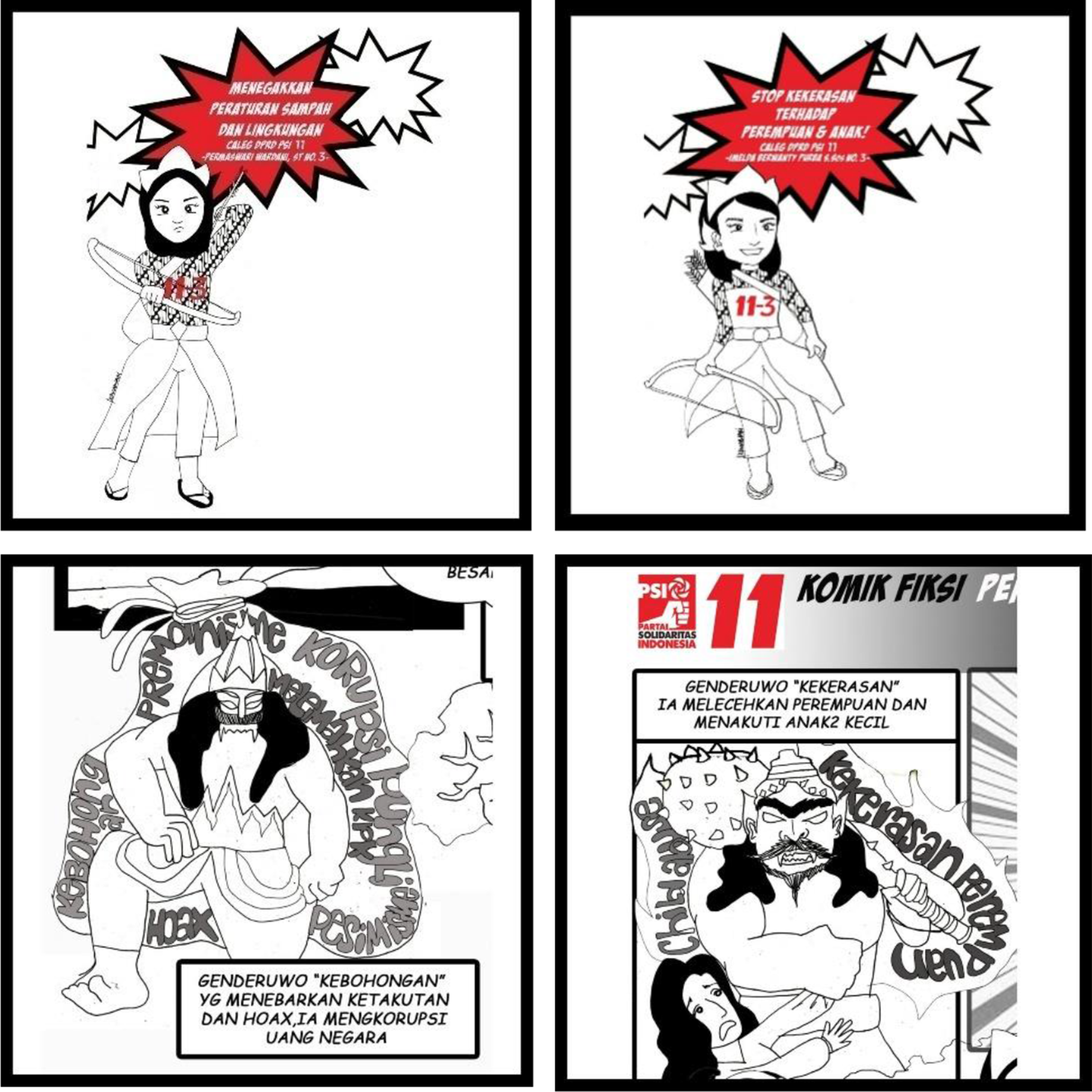
Example of Creative Campaign Material Produced by Permaswari Wardani, a Candidate for PSI (Partai Solidaritas Indonesia) in Jakarta source from personal documentation Permaswari Wardhani.
Another example was Tsamara Amany, one of the best known of the party’s candidates. In her postings in her social media accounts, especially on Instagram (@tsamaradki) and her YouTube channel, Tsamara Amany, she frequently responded to gender issues such as those connected to sexual violence. She strongly supported the bill on the elimination of sexual violence, which was in 2019 stalling in the DPR after meeting opposition from several Islamic groups and politicians from PKS. She campaigned on the case of “Agni,” a victim of sexual violence at Gadjah Mada University in Yogyakarta, and generally opposed victim-blaming in cases of violence against women (Movanita, 2019). She also focused on issues affecting Indonesian migrant workers (she was running in a Jakarta electorate in which overseas Indonesians’ votes were counted). In interviews with us, it was very obvious that Tsamara had an excellent grasp of the problems faced by migrant workers (Interview, Tsamara Amany, Jakarta, 8 April 2019, 4 May 2019).
Although PSI women campaigned on a broad gender equality platform, they also experienced various ambiguous expectations about their identity as women, along with gender stereotypes. From our interviews and observations, young female PSI candidates worked hard to convince people that their capacity was their most important electoral attribute, but whether they admitted it or not, for some of these candidates their public image as beautiful, feminine, and fashionable women (according to normative standards of beauty and femininity constructed by the media and commercial world) also helped. (One of the participants in a public discussion with Tsamara Amany that we attended said that he would vote for PSI because Tsamara was beautiful). The party made use of this imaging too – alongside these women’s reputation for being smart and open-minded. Indeed, it was a huge advantage when it came to getting votes from constituents. PSI thus had some ambiguity in addressing gender issues: on the one hand being very critical of conservative interpretations of women’s position in society; on the other hand also tending to “essentialise” women-ness.
PSI beyond the Major Cities
There was considerable variation in how PSI campaigning played out across Indonesia. In Jakarta and other major urban centres, it made sense to challenge taboos and rely on social media. But this was not the case in all parts of the country. The party did not provide the same marketing support for its regional candidates, with the consequence that they were largely on their own when it came to designing and running their campaigns. In addition, outside the big cities, and in regions where religious conservatism is strong, women’s equality has less popular support and can even be rather controversial. For example, many non-urbanites believe polygamy is acceptable according to Islamic law. 3 To challenge such practices is to contest dominant values – a risky strategy for a new party that needs voters.
The party’s leaders acknowledged that rural and regional voters were less receptive to the party’s messages, including on women’s equality, than better-educated voters in major urban centres. While candidates running for national races in big cities campaigned on issues like domestic violence and polygamy, candidates in regional seats, especially in rural areas, tended to “repackage” those issues in ways that were more palatable for the voters they encountered there. To reach such voters, regional PSI candidates also tended to use classical methods of voter mobilisation that often resembled those used by mainstream parties.
For example, Dara Nasution was a PSI candidate running in North Sumatra III, a predominantly rural electoral district inhabited by many “traditional voters.” She acknowledged that issues related to women’s equality, including anti-polygamy, were not popular in her electorate. She explained:
I met many religious leaders who have more than one wife. It will be too controversial if I campaign against polygamy in my electorate. People will think I don’t follow Islamic values. Because of that, I tend to focus on issues that are understood among the voters there, such as health care and education. (Interview, Dara Nasution, Jakarta, 3 July 2019)
Criticising polygamy, in particular, would make her vulnerable to attack by local conservative groups and make her less popular. This is why she needed to “repackage” the party’s presentation of campaign themes related to women to make them comprehensible. As a female candidate, she was also vulnerable to harassment. Her Instagram account was often filled with insulting remarks – including remarks of a crude sexual nature – usually after she posted a new photo of herself campaigning.
The women candidates we encountered in Malang, East Java, had similar experiences. When campaigning, they did not raise PSI’s most progressive policies on women’s equality, such as those emphasising elimination of sexual violence and polygamy. Instead, they focused on classical issues associated with campaigns among women voters in Indonesia – healthcare and education, childhood stunting and the role of mothers in preventing it, women’s economic empowerment, and the like. For example, Sofia Ambarini, a DPR candidate in the greater Malang area, emphasised community empowerment programmes, including for the elderly. She provided periodic social assistance to a number of elderly people (as well as scavengers or pemulung) through organisations she built, Simbah Asuh (Foster Parents) and Yayasan Lintas Solidaritas Bersama (Foundation for Inter-Group Joint Solidarity) (Interview, Sofia Ambarini, Malang, 11 April 2019). Susiati, another female candidate for the party in Malang city, said that she highlighted women’s equality practically, promoting women’s economic empowerment by providing approximately twenty women with training in developing micro, small, and medium enterprises – salons, sewing businesses, and the like (Interview, Susiati Malang, 4 May 2019). Such strategies were similar to those pursued by candidates, both male and female, from other parties (see Rofhani and Fuad, 2021).
As with candidates from other parties, PSI candidates also used private funds or self-help to pay for their campaigns. Only a few DPR candidates received financial assistance from the party. Although Sofia Ambarini was actually a strong DPR candidate, she did not get financial assistance because she was not on the list of highly potential candidates. Sofia herself was a businesswoman who was also a social activist, funding her various charitable works as part of her company’s corporate social responsibility (CSR) activities. She spent 350 million rupiah (US$24,000) on her campaign, getting just over 4,000 votes. Susiati, who was running for a seat in the Malang City DPRD, was an activist in the co-operatives and small enterprises sector; she spent 10 million rupiah (US$670) on her campaign and received only 267 votes. Neither candidate qualified for parliament.
In sum, most PSI candidates we encountered in regional centres conducted a style of politics that differed little from that of candidates running for other parties and did not much demonstrate the progressive politics associated with the party at the national level. When it came to building campaign teams and mobilising voters, for example, they used family, kinship, and friendship networks in much the same way as other candidates (Aspinall and Sukmajati, 2016). Though some candidates, like Sofia Ambarini, used social media such as Facebook to introduce themselves to constituents, they did not rely on it, instead using traditional methods such as visiting residents in their neighbourhoods to introduce themselves. They believed this was more effective in part because, according to Malang PSI head, Mardiroto, SMRC research had informed them that social media usage in Malang was only about 5 per cent of the population (Interview, Mardiroto, 22 March 2019).
In this context, it is worth noting that similar electoral experiments by progressive activists in Indonesia have encountered similar obstacles. For example, during the 2000s and 2010s, a network of NGOs and intellectuals embarked on an experiment they labelled building “democratic blocs” in elections in several districts across Indonesia (see Mundayat and Priyono, 2009; Törnquist and Webster, 2009). These efforts involved building alliances of local civil society organisations and popular organisations – such as those representing farmers or workers – that would nominate a local activist to elected office or build an alliance with local elites they viewed as progressive. While these attempts had some successes, they largely failed at “seizing the state” through electoral methods, with most activists failing electorally in the face of rampant vote buying, the high costs of campaigning, and the compromises that came with building coalitions with local elites (e.g. Mahsun, 2017; Subono et al., 2012). Candidates from labour unions have often confronted similar problems, garnering support from their fellow workers but then facing demands for patronage when seeking to attract broader support (Savirani, 2016: 201).
In sum, PSI female candidates found it challenging to bring their campaign on gender equality beyond their party’s core urban context. One of the reasons relates to gender attitudes themselves: voters in regional and rural areas are much less familiar with the evolving discourse of gender equality emerging in Jakarta and other big cities; they tend to be less liberal on these issues and tend to understand topics such as polygamy from a religious (i.e. Islamic) perspective. Violence against women remains a taboo topic. Another reason relates to the dynamics of electoral politics themselves beyond the urban setting, particularly the prevalence of clientelism in which voting is a transaction in exchange for money. Facing these conditions, at least some PSI female candidates in such regions adjusted and repackaged their campaigns, which eventually were little different from those run by candidates from other parties.
Conclusion
This article has explored a new political experiment in Indonesia that occurred during the 2019 election, an experiment that combined liberal politics with a strong emphasis on women’s equality. PSI and its female candidates placed gender issues at the centre of their platform and campaigns in a way that was unprecedented in Indonesian politics. They did not just promote a mild notion of “women’s empowerment” or “women’s leadership,” as other parties commonly do, but went straight to sensitive and taboo issues concerning women, such as polygamy and domestic violence. It was a positive development for gender issues to be promoted to the public in this way, which is why many women’s movement activists aligned themselves with PSI. Moreover, at the national level, PSI cadres acted boldly on these issues, challenging others, including religious leaders, to discuss and debate with them. Their stand made it clear how far one strand of liberal opinion in Indonesia has integrated support for gender equality into a wider programme of support for respecting individual rights and protecting minority groups.
In fact, it is possible to see PSI’s campaign as marking a social shift in Indonesian politics, particularly in the urban setting. The idea of women’s rights has become more popular in the educated urban middle class over recent decades, partly thanks to the influence of global campaigns and trends, partly due to efforts by women activists, and partly due to new forms of online and social media. Issues that were once considered taboo and shameful – such as rape and sexual harassment – have slowly emerged into the public sphere. The #MeToo global movement, for instance, has given confidence to victims of sexual harassment to speak up and demand the authorities treat the issue as a public rather than private matter. This increased awareness is finding political form, too. The draft bill on the eradication of sexual violence, which remains before Indonesia’s parliament and is still the subject of ongoing controversy, shows that women’s equality has begun to move into the mainstream of the country’s national legislative programme. PSI’s campaign was another reflection of this wider political and cultural shift.
Viewed from the perspective of the struggle for women’s equality, PSI had adopted a strategy that can be seen as both “practical” and “strategic” at the same time (Blackburn, 2004: 14). It is practical, even pragmatic, in the sense that the party used gender issues as part of its strategy to attract voters. Yet it was also strategic in that the party did not merely focus on issues of women’s day-to-day economic empowerment, education, access to healthcare, and the like (the focus of many mainstream parties and women’s groups) but also drew public attention to some of the most sensitive aspects of gender inequality. For the first time, for example, the issue of violence against women was a central concern of a significant party. As a result of the party’s efforts, liberal values, including on women’s rights, are now more widely known, especially among younger, urban, and educated voters (although this does not mean they are always accepted). Bringing these values into the open is a way to begin transforming Indonesian politics. This experiment in liberal politics and gender equality thus has substantial implications for Indonesian politics into the future.
For all this, our assessment must also acknowledge the limitations of the PSI experience. As a strategy of social change, the party’s discursive approach targeted mostly urban areas and educated and open-minded citizens. In this respect, the PSI experience continued a long-standing pattern of liberal women’s activism in Indonesia, which has tended to lack connections with lower-class citizens. This limitation becomes very evident during elections, when liberal progressive politicians find it hard to break through existing power structures and patterns of social behaviour. When they venture outside their urban middle-class base, liberal politicians who promote women’s equality face deeply entrenched local beliefs and power structures that support male domination of the public sphere. Ittakes bravery for ordinary citizens to oppose such power structures, and history suggests that they most commonly do so when organised through grassroots movements (one example was the left-wing Indonesian Women’s Movement, Gerwani, which claimed 1.5 million members in 1963: , 1964, cited in Blackburn, 2004: 178).
Over the long run, a strategy of marketing at the level of discourse is no substitute for organising citizens. This is a longstanding weakness of both liberal politics and feminism in Indonesia: their proponents often do little to root liberal values in the everyday lives of ordinary Indonesians, especially poor citizens. This, we argue, was one cause of the limited nature of PSI’s achievement in the election: the party and its discourse were “floating,” disconnected from the mass of ordinary citizens, even as they were rooted in an urban middle-class environment. This disconnect was not solely a result of the party’s decisions, nor even of its choices of policies and campaign issues. More fundamentally, it reflected the deep social gulf that separates sophisticated urbanites from the bulk of poorer Indonesians.
Footnotes
Declaration of Conflicting Interests
The author(s) declared no potential conflicts of interest with respect to the research, authorship, and/or publication of this article.
Funding
The author(s) disclosed receipt of the following financial support for the research, authorship, and/or publication of this article: The research for this special issue was funded by the “Supporting the Rules-Based Order in Southeast Asia” (SEARBO) project, administered by the Department of Political and Social Change at the Australian National University and funded by the Australian Department of Foreign Affairs and Trade. The opinions expressed here are the authors' own and are not meant to represent those of the ANU or DFAT.
Notes
Author Biographies
Email:
Email:
Email:
Email: