




Abstract
Some theorists and practitioners argue that the stability of the global trade system is endangered by trade distorting effects of regional Free Trade Agreements. Does this also hold true for interregional FTAs? Based on criteria, such as scope, rules of origin and WTO notification, it is argued here that interregional FTAs between East Asia and Latin America do not fully confirm the distortion thesis, as the positive effects of WTO-plus elements in the examined FTAs and their positive notification record to the WTO signify. Yet, overlaps between different rules of origin may lessen the multilateral effectiveness of interregional FTAs.
Introduction
Latin American and East Asian economies have grown substantially over the last decades based on the growth of Foreign Direct Investment (FDI) and trade. Since the end of the 1990s the governments in both regions have decided to put up a number of bilateral Free Trade Agreements (FTAs). This trend is another manifestation of a worldwide process of economic integration which currently encompasses 300 bilateral and regional Free Trade Agreements. Seven years ago only 130 bilateral FTAs existed (The Wall Street Journal 2007). Bilateral FTAs co-exist with regional integration schemes such as ASEAN (Association of Southeast Asian Nations), ASEAN+3 (ASEAN, China, South Korea, and Japan), AFTA (ASEAN Free Trade Area), and EAS (East Asia Summit) on the Asian side and the MERCOSUR (Southern Common Market), Andean Community and LAIA (Latin American Integration Association). As the intraregional welfare gains in both regions increased, new interregional inter-linkages in the form of FTAs emerged as a means to securing access to new export markets. Currently there are around nine FTAs in force linking the two regions.
One common argument put forth against FTAs is that they endanger the multilateral World Trade Organisation (WTO) system. Their diversity enhances the so-called noodle-bowl (see figure 1) of overlapping agreements in specific and trade-distorting effects on trade relations in general. Does this interpretation also hold true for interregional FTAs? In order to answer this question we will take a look at the scope, rules of origin and WTO notification of the most important interregional FTAs between Latin America and East Asia. In this study I will focus on FTAs linking the economies of China and Chile, Japan and Mexico, Japan and Chile, Singapore and Panama, and South Korea and Chile. It is argued here that the observed cases do not support the thesis that FTA interplay with the WTO is always of disruptive nature. Yet, in contrast to the positive contribution to criteria of WTO-plus elements and notification to the WTO, the mixture of different rules of origin may lessen the multilateral effectiveness of interregional FTAs.
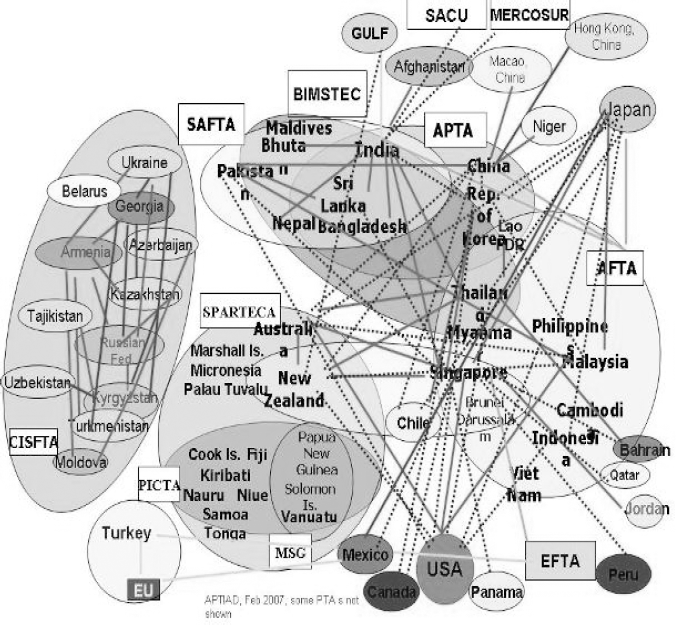
The Noodle-Bowl of FTAs in the World
The expansion of bilateral Free Trade Agreements raises the question of how to conceptualize this phenomenon. Bilateralism in general may be conceived of as political and/ or economic interactions between two states. Trade Bilateralism refers to trade policy or trade liberalization options two states utilize by signing an agreement in order to optimise trade flows between their economies. The trade policy folio consists of unilateral, bilateral, minilateral, and multilateral liberalization measures.
Unilateral trade liberalization occurs very rarely in the Asia-Pacific region. So far, only Singapore and Hong Kong decided to reduce trade barriers unilaterally. At present, all other states prefer to engage in bilateral trade agreements, which can be geographically concentrated (i.e. Singapore–Japan) or geographically dispersed (i.e. China–Chile). Minilateral trade agreements such as the North American Free Trade Agreement (NAFTA) and the ASEAN may thus also be concentrated in one region or dispersed as in the case of the Free Trade Agreement of the Americas and the Trans Pacific Strategic Economic Partnership (Aggarwal 2006: 4). Multilateral liberalization can be located at the global level of trade policy and is governed by the World Trade Organisation (WTO). Finally FTAs can be conceived of as international institutions. Their rules and regulations qualify them as “persistent and connected set of formal and informal rules that prescribe and behavioural roles, constrain activity, and shape expectations” (Keohane 1989). They are therefore formal institutions negotiated by states in order to manage trade cooperation issues and problems.
Explaining Trade Bilateralism
Causes of Trade Bilateralism
In order to explain the emergence and the effects of bilateral Free Trade Agreements we will take a look at some explanations from the emergent literature on FTAs. Why do states decide to set up Free Trade Agreements? A first distinction may be made between economic and political variables: Economic explanations concentrate on the perceived economic benefits of FTAs (Lloyd 2002: 1284; Aggarwal 2006: 8-9).
Fit between two countries industrial structures, that will have an effect on the potential benefits of a bilateral agreement.
Binding of market access for goods.
FTAs trigger foreign direct investments.
Gains from trade and factor flows and greater competition in regional markets
Welfare gains from harmonisation of national economic policies and regulation.
Political reasons for the initiation of bilateral FTAs are:
Trade policy choices are determined by the preferences of interest groups, especially industries or companies with exposure to trade developments.
Countries policy responses will vary with their regime types. It may be hypothesized that democratic governments pursue a more liberal foreign economic policy than authoritarian ones.
Foreign economic policies vary with traditions of active or less active government intervention. These determine the openness or restrictiveness of trade policies.
I.e. industries or companies with exposure to trade developments.
The significant difficulties to build multilateral trade rules in the institutional context of the WTO as well as in regional arrangements like ASEAN, APEC and Mercosur trigger the demand for bilateral trade institutions.
Economic size and development status.
Security concerns.
Multilateralism is currently preferred by states since it is the most effective way to reduce transaction costs and provide the highest level of information. Absolute gains/ Management of Interdependence (Liberal Insitutionalism).
States engaged in bilateral relations may be better off than in multilateral contexts if it comes to maximising relative gains (Realism).
FTAs are what states make of it. At the moment FTAs are in fashion. Existing FTAs serve as institutional models for others to come (Social Constructivism).
More or less all WTO members take part in at least one of the 300 regional and bilateral Free Trade Agreements. Sceptical arguments against FTAs generally start from this observation. It is argued that FTAs could “threaten to fragment the multilateral trading system and to undermine its core principle of the most-favoured-nation (MFN) treatment” (Schott 2004: 7). Under this WTO agreement member countries are not allowed to discriminate between their trading partners. In short:
MFN means that every time a country lowers a trade barrier or opens up a market, it has to do so for the same goods or services from all its trading partners – whether rich or poor, weak or strong (WTO 2007).
The most-favoured-nation treatment is laid down in the first article of the General Agreement on Tariffs and Trade (GATT), in the Article 2 of the Agreement on Trade in Services (GATS), and in the Agreement on Trade-Related Aspects of Intellectual Property Rights (TRIPS). If countries set up a Free Trade Agreement, a few exceptions may be granted. Under very strict conditions states may set up bilateral or regional rules that apply only to goods traded within the nations involved. These rules are defined in paragraphs 4 to 10 of Article XXIV of GATT, the Enabling Clause, and Article V of GATS.
The effects of bilateral FTAs correlate with their institutional design and their interaction with other trade institutions a) on the global multilateral level (WTO) and on the regional level (other FTAs and minilateral institutions like ASEAN or APEC). These horizontal and vertical interactions are conse-quences of the increasing density of international institutions on the bilateral state-to-state level, the regional, the interregional and the global level of the global economic governance system (Young 2002).
If interregional FTAs are stepping stones or obstacles to the global trading system shall be answered by applying the criteria of WTO notification, WTO-plus elements (scope), and the Rules of Origin in the cases of China– Chile, Japan–Mexico, Japan–Chile, Singapore–Panama, and South Korea–Chile.
Trade Bilateralism between Latin America and East Asia
For a long time trade relations between Latin America and East Asia were the weakest link in the interactions between the world economic regions. In the late 1980s, however, many Latin American economies decided to unilaterally liberalize their trade policies. This had a significant effect on the interregional trade balance between Latin American and East Asian economies. The successfully concluded Uruguay Round of the General Agreement on Tariffs and Trade added a momentum to this development as it eased the liberalization of developing countries’ economies and their respective foreign economic policies.
In the last years, increasing imports of commodities by East Asian states, especially China, increased the dynamics of current trade relations between the two regions. Table 1 clearly shows that industrialized markets like the European Union und the United States of America have lost weight as Latin America's export destinations in the period between 1995 and 2006, while Asia has gained importance.
Latin America's Export Destinations (in %)
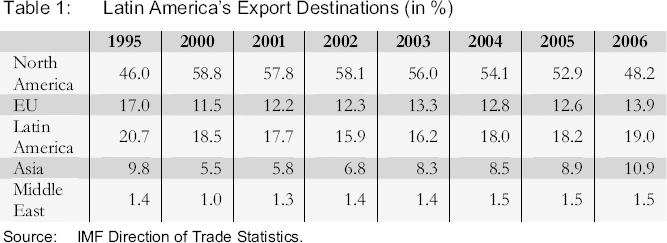
Latin America's Export Destinations (in %)
Source: IMF Direction of Trade Statistics.
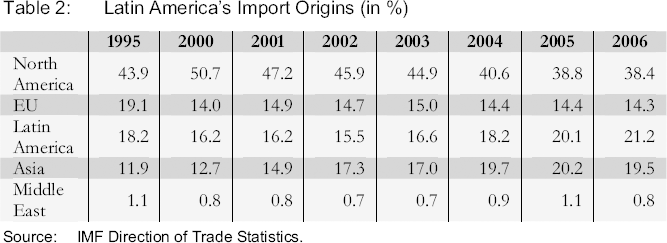
Moreover Table 2 shows that Latin America's imports from Asia considerably increased from 11.9 per cent to 19.5 per cent in the same period. This development can be explained primarily by the rising imports of Chinese products (from 1.2 per cent up to 6.8 per cent in 2005).
Latin America's Import Origins (in %)
Source: IMF Direction of Trade Statistics.
In order to manage the growing economic interdependencies between the two regions a number of interregional FTAs were set up:
Bilateral FTAs between Latin America and East Asia
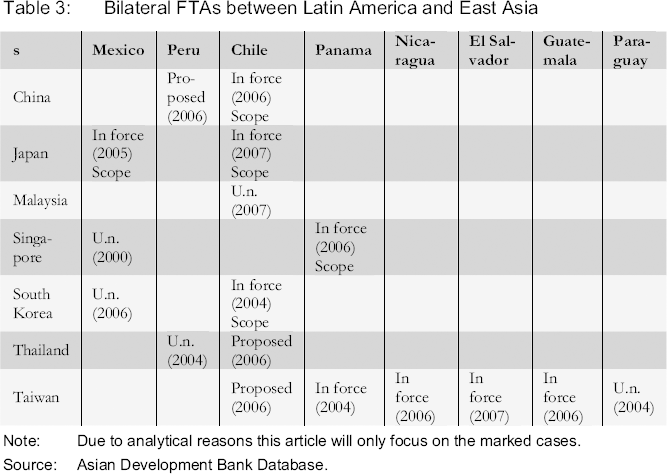
Note: Due to analytical reasons this article will only focus on the marked cases.
Source: Asian Development Bank Database.
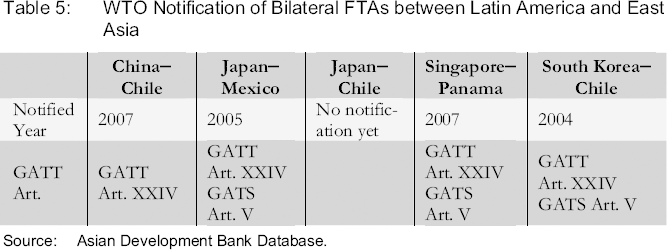
The WTO notification status of the six interregional FTAs in question is laid out in Table 4 below. There are basically two types of notification, the Ena bling Clause and the GATT/ GATS provisions. Since the first criterion mainly provides for the mutual reduction in tariffs on trade in goods among developing countries as well as for developed countries to give reduction to developing countries, we will only consider the GATT/ GATS provisions as relevant, since the six interregional FTA-cases presented here include Industrialized and take-off countries, but no developing countries.
FTA-Growth in East Asia
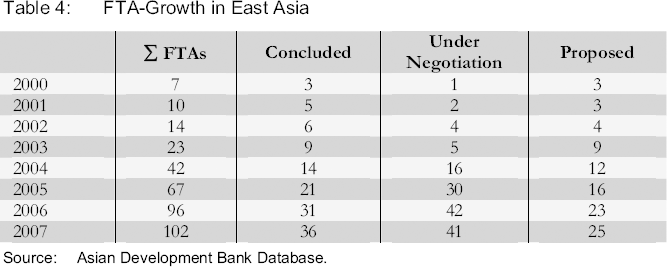
FTA-Growth in East Asia
Source: Asian Development Bank Database.
WTO legislation obliges its members to notify regional trade agreements, may they of bilateral or plurilateral nature. Since the year 2000 we can observe a significant trend towards notification under the General Agreement of Trade Art. XXIV (GATT Art. XXIV) and under the General Agreement of Trade and Services (GATS Art. V). In the case of East Asia, current studies imply that more than 53 per cent of concluded FTAs as of June 2007 were notified to the WTO. This rate is bound to rise since many agreements were just concluded and the process of WTO notification has not been initiated yet (see table 2).
WTO Notification of Bilateral FTAs between Latin America and East Asia
Source: Asian Development Bank Database.
A short analysis of the WTO notification status of bilateral FTAs between Latin America and East Asia yields almost the same results as the one above on East Asian Free Trade accords. Of the five concluded interregional bilateral FTAs, three out of four notified under GATT Art. XXIV are also notified under GATS Art. V (Japan–Mexico; Singapore–Panama; South Korea– Chile). Only China–Chile has excluded GATS Art. V and Japan–Chile has not notified yet. Since Japan and Chile have notified all their bilateral FTAs so far, it can be expected that the rate of notified interregional FTAs might rise to 100 per cent in the observed cases. It seems as if interregional FTAs are as comprehensive and extending beyond preferences for some goods into services and regulatory issues as their regional counterparts.
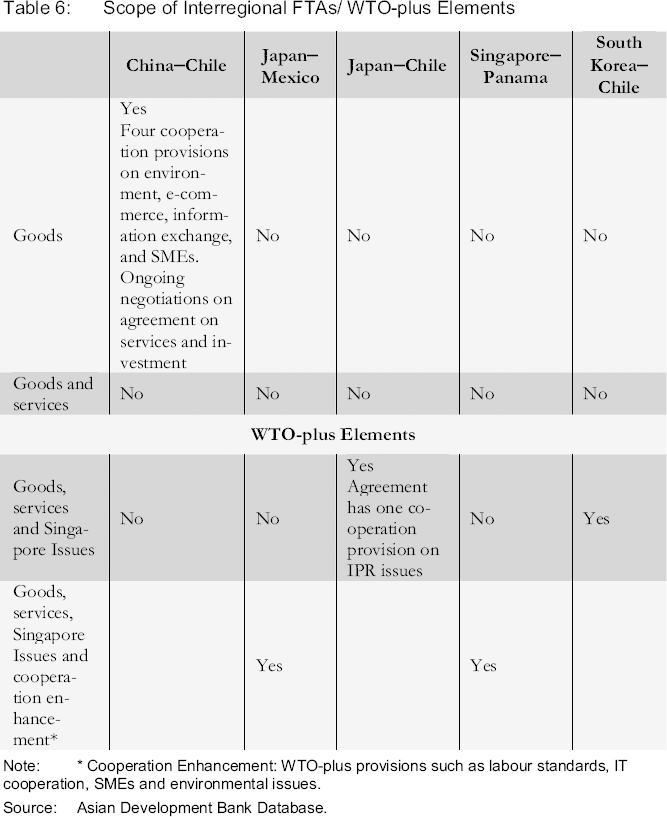
Recent analyses of bilateral Free Trade Agreements in East Asia state that a large number of recent agreements go beyond the WTO framework (goods + services) by including issues like intellectual property, labour etc. In order to identify “WTO-plus elements” one can a) identify the so-called “Singapore-Issues” (trade facilitation, investment, government procurement, and competition policy). These issues were one part of the WTO-Agenda prior to the WTO-Ministerial Conference in Cancun in 2004, where they were taken from the agenda due to a lack of consensus. The highest possible WTO-plus contribution incorporates b) goods, services, Singapore Issues and cooperation enhancement. The latter includes WTO-plus provisions such as labour standards, IT cooperation, SMEs and environmental issues (Kawai and Wignaraja 2007: 11).
Table 6 clearly shows that four out of five observed cases include WTO-plus elements, out of which two (Japan–Chile and South Korea–Chile) cover only Singapore Issues and the other two cover Singapore Issues and cooperation enhancement issues (Japan–Mexico and South Korea–Chile). The only FTA that stands out in this respect is China–Chile that is currently stuck on the level of goods. Since negotiations on agreement and services are ongoing, a final conclusion can not be drawn on this bilateral process. Yet, it is quite obvious that WTO-plus provisions are dominant in interregional trade bilateralism between East Asia and Latin America.
Scope of Interregional FTAs/ WTO-plus Elements
Scope of Interregional FTAs/ WTO-plus Elements
Note:
Cooperation Enhancement: WTO-plus provisions such as labour standards, IT cooperation, SMEs and environmental issues.
Source: Asian Development Bank Database.
Rules of Origin (ROO) are criteria that define where a product was made and which goods will have preferential bilateral tariffs. Thereby they preclude trade deflection among member countries to an FTA. Foreign economic policies may discriminate between exporting countries by applying anti-dumping actions, countervailing duty, quotas and so on. Globalization and the emergence of international value and product chains increase the complexity of product processing in general. WTO member states have to ensure the transparency of their rules of origin, that they do not have distorting, restricting or disruptive consequences for international trade relations, that they are managed in a homogeneous and reliable way, and that they should give information what exactly gives origin (WTO 2007).
The rules of origin in East Asia show different characteristics and thus appear in different forms: 1) a change in tariff classification (CTC) rule defined at a detailed Harmonized System (HS) level; b) a regional or local value content (VC) rule which means that a product must satisfy a minimum regional (or local) value in the exporting country or region of an FTA; and c) a specific process (SP) rule which requires a specific production process for an item (Kawai and Wignaraja 2007: 12).
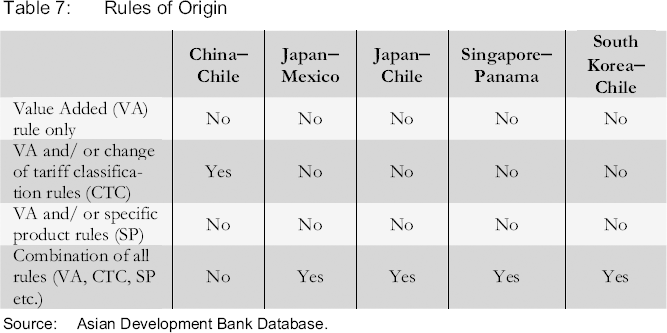
Table 7 shows that four out of five interregional FTAs between East Asia and Latin America have implemented a mixture of the three ROOs rather than utilize a single regulation. Whereas only China and Chile use the VA/change of tariff classification rules (CTC), the remaining FTAs (Japan–Mexico, Japan–Chile, Singapore–Panama, South Korea–Chile) use a combination of all rules. This observation correlates with a trend in East Asia where 20 out of 30 FTAs use mixed ROOs.
Rules of Origin
Rules of Origin
Source: Asian Development Bank Database.
Based on company surveys Kawai and Wignaraja argue that the combination of ROOs increases the overlap density and thus complexity of the FTA network in the region (noodle-bowl) by increasing the transaction costs (complex procedures to prove the country of origin; changes to production processes) of private business actors. About 64 per cent of the companies in question state that rules of origins should be harmonized in order to ensure stable business operations (Kawai and Wignaraja 2007: 12).
This short analysis has revealed that interregional trade cooperation between Latin America is to a large extent consistent with WTO norms. By applying the criteria of WTO notification, WTO-plus elements (scope), the Rules of Origin to the cases of interregional FTAs linking China and Chile, Japan and Mexico, Japan and Chile, Singapore and Panama, South Korea and Chile the following specific results were attained: Almost all states in question have notified their bilateral agreements to the WTO. This trend correlates with the one East Asia. Regarding the existence of WTO-plus elements we observed that four out of five interregional FTAs included such provisions. If these interregional FTAs are building blocks for the global trade regime governed by the WTO remains yet to be seen. The obstructive nature of mixed rules of origin might harm trade flows and elevate the noodle-bowl effect. Yet, the growing trend of plurilateral FTAs in regional (ASEAN+x) and in interregional terms (i.e. Trans-Pacific Economic Partnership) might be in an indication of a trend, in which states see some utility to streamline their different FTAs into more comprehensive, regional, interregional, and even multilateral trade agreements.