



Abstract
China's state-led model of corporate social responsibility (CSR) does not seem to present a promising environment for the participation of non-governmental organizations (NGOs). Nevertheless, we observe recent examples of NGO involvement in CSR initiatives. Chinese NGOs are using the CSR platform to challenge the environmental practices of firms operating in China. We take a field-theoretical approach that focuses on the agency of actors. We show how an international NGO proposes a new standard and how Chinese NGOs use local environmental information disclosure laws to engage with firms in the textile supply chain. We find that NGOs leverage the power of brands to influence the practices of Chinese suppliers. However, we find differences in the framing and tactics employed by international NGOs versus their Chinese counterparts. Field analysis helps better understand the actors in the field of CSR, along with their motivations and their resources, and it offers a useful perspective on civil society development in China.
Introduction
Non-governmental organizations (NGOs) are playing an increasingly important role in formulating the environmental and social responsibilities of companies and have been considered one of the main drivers of corporate social responsibility (CSR) initiatives. As CSR gains increasing social acceptance, NGOs appear to be exerting substantial influence on firms’ decisions (Teegen, Doh, and Vachani 2004; Yaziji and Doh 2009; Doh and Guay 2004). However, the responsibilities of firms may be defined quite differently in different places, reflecting the institutional context (Doh and Guay 2006). While the role of NGOs in CSR is well established in many industrialized countries – in particular in countries with a liberal democratic form of governance – one might expect a different role for such actors in an emerging market context such as China's (Yaziji and Doh 2009). In particular, a combination of a strong state and weak relations between business and civil society suggests that CSR in China may be shaped more by top-down regulatory processes than by bottom-up citizen involvement (Matten and Moon 2008; Moon and Shen 2010).
However, despite limitations on NGO activity in China, NGOs are influencing company practice. Citing the example of the Institute of Public and Environmental Affairs (IPE), Lee, Plambeck, and Yatsko (2012) suggest that even a small Chinese NGO may have unexpected clout. A widely reported but not necessarily typical ex-ample involves Apple, which appears to have directly responded to the concerns about pollution in its supply chain raised by a coalition of Chinese environmental NGOs led by the IPE. Apple engaged in dialogue with representatives from the NGOs and enhanced the environmental auditing of its Chinese suppliers by involving NGOs (Apple 2013; Friends of Nature et al. 2013). The fact that NGOs in China are changing corporate practice is puzzling: How are NGOs in China participating in CSR activity in a context that does not seem to favour their involvement? In what follows 1 , we explore this phenomenon: First, we consider the conceptual problem of NGO–firm engagement in China, noting how local conditions influence both implementation of CSR and the work of NGOs. We then consider theoretical approaches to Chinese NGOs’ role in CSR and argue that a field approach is useful for conceptualizing the institutional context of NGO action as well as the agency of actors, as such an approach allows us to explore how NGOs are shaping the institutions of CSR in China. Adopting a field-theoretical perspective, we analyse two recent cases of attempts by NGOs to influence CSR practices in the Chinese textile industry. In the first case, the international NGO Greenpeace advocated the elimination of toxic chemicals from the textile supply chain, while in the second, a coalition of Chinese environmental NGOs called on brands to ensure that their suppliers were adhering to Chinese environmental law. To develop the two cases, we draw on a variety of sources of data, including NGO and media reports of the campaigns, text analysis of NGO reports totalling 43,592 words and interviews with informants involved with the campaigns. Our goal is to better understand how NGOs participate in CSR activity in China. We find that international and Chinese NGOs define corporate environmental responsibilities somewhat differently and that companies may respond differently as well. We conclude by suggesting further directions for research as well as discussing the practical implications for firms and NGOs operating in China.
The authors gratefully acknowledge the valuable comments of the editors and two anonymous reviewers. We further gratefully acknowledge the financial support for our research provided by the Ningbo Science & Technology Bureau's Ningbo Soft Science Programme (Grant No. 201201A1007003) and as a Ningbo–CASS Strategic Collaborative Project by the Ningbo Education Bureau and the Chinese Academy of Social Sciences (Grant No. NZKT201204). However, the views expressed in this paper are those of the authors alone.
The Role of NGOs in Promoting CSR in China
CSR and Its Application in China
CSR in China has recently become a more popular object of research (Moon and Shen 2010), and the possibility that a distinct understanding of good business practice is emerging in China has been explored (see, for example, Weikert 2011). Three developments seem of particular relevance: First, Chinese CSR has developed with official support, from the top down (Moon and Shen 2010; Lin 2010). For instance, Levine (2008) notes the encouragement of CSR in state-owned enterprises by the State Assets Supervision and Administration Commission and by various initiatives of the China Banking Regulatory Commission as well as the Shanghai and Shenzhen Stock Exchanges. A second and related finding is that CSR in China places less emphasis on the engagement of external stakeholders (Cooke and He 2010). In a study of Chinese executives’ perspectives on CSR, Yin and Zhang (2012) found that businesspeople considered local government and employees to be key stakeholders and only rarely pursued dialogue with local communities, consumers and the media. However, Moon and Shen (2010) indicate that this may be changing as stakeholder theories are being incorporated more into Chinese business and as civil society gains a greater voice via the Internet and media. Moreover, in a study of company websites, Tang and Li (2009) find evidence of convergence in understandings of CSR between Western and Chinese firms and suggest that differences may be related to the industrial sector of the company as well as its direct contact with consumers, rather than nationality. Third, it has been found that thematic emphases of CSR initiatives by Chinese firms may differ from those of Western firms and that Chinese firms may highlight the philanthropic and welfare aspects of CSR (see, for example, Xu and Yang 2010; Yin and Zhang 2012; Kolk, Hong and van Dolen 2010). Some authors have stressed the impact of cultural traditions, such as Confucian philosophy, on local CSR conceptions (Wang and Juslin 2009) and discourses (Zhao 2012), or, alternatively, how such traditions conflict with CSR (Ip 2009). Another line of research has investigated popular perceptions and media representations of CSR. Tian, Wang, and Yang (2011) suggest that Chinese consumers may be relatively unaware of CSR and are concerned more with the results of a firm's CSR activities than with the motivations that guide them. Nevertheless, CSR has been growing in visibility in recent years as a theme of media reports that have increasingly emphasized ethical rather than instrumental reasons for adopting such strategies (Liu, Jia, and Li 2011).
China's style of CSR appears to provide less space and legitimacy for NGO involvement than does a more society-led CSR model. In particular, the relatively low salience of stakeholder relationships in Chinese conceptions of CSR may make it difficult for NGOs to influence firms, and the absence of widespread consumer support for CSR initiatives may make the “business case” for environmental and social responsibility untenable. This can be observed in the language and rhetoric of Chinese firms’ CSR reports. In a study of 21 such reports published from 2007 to 2008, Strafella (2011) found that these companies tended to define CSR on their own terms:
Even if their concept of CSR is probably based on a range of sources, including the SZSE [Shenzhen Stock Exchange] guidelines, reports of other companies, the media, and even NGOs, these Chinese companies appear very much in control of the discourse resources of responsibility (Strafella 2011: 221).
This notwithstanding, the prominence of CSR and CSR reporting in China has developed substantially since 2006 (Strafella 2011), and the institutionalization of measures such as CSR reporting practices (see, for example, Marquis and Qian 2014) and voluntary industry standards may provide an opening for greater NGO involvement in the future. However, to date there is little evidence about how NGOs engage in CSR initiatives. With the exception of reports on specific NGOs’ CSR activity (see, for instance, Lee, Plambeck and Yatsko 2012), the role of NGOs in Chinese CSR seems to have received scant scholarly attention (with notable exceptions: for instance, Zhang and Barr 2013; Johnson 2011). We aim to address this gap by applying a field-theoretical perspective to analyse NGO campaigns for environmental responsibility in the textile industry.
The Nature of NGOs
Growing out of a Western, specifically American, liberal democratic tradition (DeMars 2005), NGOs are often conceptualized as occupying social space that is beyond the reach of the state and of economic organizations. NGOs can be broadly understood as organizations that are private and not for profit but pursue specific societal interests (Teegen, Doh, and Vachani 2004). They direct “advocacy and/or operational efforts on social, political and economic goals, including equity, education, health, environmental protection and human rights” (Teegen, Doh, and Vachani 2004: 466). NGOs can be further classified according to the dimensions of “service” versus “advocacy”: Whereas service groups help those with unmet needs via the provision of goods and services, advocacy groups represent a social interest or ideology and aim to change behaviours and practices (Yaziji and Doh 2009). This distinction is somewhat artificial as many groups engage in both types of activity, but it suggests a basic difference in orientation that is analytically useful. In the discussion below, we will focus particularly on advocacy groups that are actively engaged in shaping CSR norms and rules in China. Advocacy NGOs are further subdivided into “watchdog” and “social movement” types, with “watchdogs” largely concerned with monitoring the actions of government and business and “social movement” groups aiming to change the current system in some way (Yaziji and Doh 2009: 9).
NGOs in China
It is clear that NGOs in China are not currently drivers of CSR as they are in Western models (Lin 2010). For instance, NGO influence on CSR in the Chinese textile industry has been “very marginal” (Chi 2011: 846). However, NGOs are active in China. Both Chinese branches of international NGOs and domestic Chinese NGOs operate in China and engage with companies, as described below.
International NGOs
International NGOs (INGOs) have operated in China since the country's opening up in the late 1970s, and the World Wildlife Fund (WWF) introduced panda protection programmes in 1979 (Xie 2011). INGOs typically have substantially greater access to funds and a higher degree of professionalism than their Chinese counterparts, which, according to Mol (2009), helps them achieve a greater impact. Moreover, INGOs may have high-level, influential contacts with Chinese policymakers. For instance, the Natural Resources Defense Council (NRDC), a US-based NGO, has provided technical assistance to the Chinese government, participating in the development of national energy efficiency standards for buildings (Adams and Adams 2011). However, even highly professional, well-resourced INGOs face an institutional environment that may be different from those in their respective “home” countries, such as restrictions on fundraising (China Radio International 2012), which may affect their Chinese operations. INGOs, even quite centralized ones such as Greenpeace (Timmer 2009), can generally adapt to new circumstances. For instance, Bloodgood (2009) has documented how Greenpeace has modified its tactics according to institutional differences in various Western democracies. Greenpeace also modifies the way it speaks about the environment depending on the local setting. A study of Greenpeace's Chinese, Japanese and German websites carried out in 2003 revealed that the organization tends to vary their discursive and linguistic framings substantially depending on location. In China, this appears to involve downplaying the role of protest in Greenpeace tactics (Heinz, Cheng, and Inzuka 2007).
Chinese NGOs
Chinese environmentalists have adopted and adapted the NGO form, creating a hybrid which is “suited to – but also constrained by – the local context and resources of the actors” (Yang 2010: 120). The precise form varies, and Yang (2005) identifies a continuum of seven organizational types that range from government-organized NGOs to the fully independent NGOs of the Western type. These groups have received the support of INGOs, particularly in the areas of funding, capacity-building and knowledge dissemination (Xie 2011; Morton 2008). However, even with international assistance, local NGOs are constrained by their ambiguous legal status (Bai 2007), cumbersome registration procedures and regulation of fundraising (Ho 2008; Johnson 2011). As a result, Chinese NGOs tend to be highly responsive to the overall political situation in the country (Yaziji and Doh 2009; Chi 2011) and often limit their activities to, for instance, policy suggestions, education and research.
Although domestic Chinese NGOs may have a more limited scope of action and fewer material resources than their international counterparts, they possess local knowledge and networks (including online networks: see Sullivan and Xie 2009). This allows them to exercise a type of influence via informal channels that Ho and Edmonds (2008) describe as “embedded activism”. An example of this is the journalistic background of many NGO workers, whose contacts and experience have resulted in a “greening” of the Chinese media (Yang and Calhoun 2007). Indeed, environmental NGOs (ENGOs) have been able to grow in recent years, and Mertha (2008) suggests that space exists within the Chinese system for environmental groups to operate as policy entrepreneurs and issue framers. However, this space exists only if ENGOs’ activities are not perceived as threatening political stability (Edmonds 2011).
There are three important indications that NGOs could play a larger role in Chinese CSR, one being the incremental relaxation of the regulation of NGOs. In jurisdictions such as Beijing and Shenzhen, for example, registration rules have been altered to allow NGOs to register directly with the local municipal Bureau of Civil Affairs without being sponsored by a supervisory administrative body, as had been the case in the past (Beijing Today 2011; China Daily 2012). A second indication is the development and implementation of new laws and regulations that create a larger role for the public in some aspects of governance. Johnson (2011) describes how Chinese environmental information disclosure laws have created a new and legitimate role for local NGOs to both hold local authorities accountable for the release of such information and use public records to bring to light company violations of environmental law. This signifies an increasing role being played by NGOs in helping bridge the enforcement gap between relatively strong environmental regulations at the central level and weak enforcement at the local level (Schwartz 2008). A third indication that NGOs are growing in salience in terms of CSR is that public support for them is improving. Whereas trust in NGOs was substantially lower in China than in other countries as recently as 2004, by 2012 trust in NGOs had risen to a record 79 per cent in China – higher than in the UK, France, Germany and the US (Edelman Trust 2012). Taken together, these three developments suggest that NGOs may be positioned to play a greater role in CSR initiatives in the future, at least regarding the environmental responsibilities of firms.
While conditions for Chinese NGO involvement in CSR are somewhat constraining, the discussion above points to the substantial opportunity that CSR initiatives provide for such groups. The fact that many multinational companies (MNCs) accept that NGOs play a stakeholder role offers these organizations a unique route to influence. In a social and political context in which NGOs are unlikely to engage in contentious activities such as demonstrations, boycotts and lawsuits, the door to dialogue with companies – and especially with MNCs – appears to be opening. For this reason, it is likely that at least some NGOs in China will attempt to expand their role in CSR. We consider this possibility below.
A Field-Theoretical Approach to CSR
This paper began with a puzzle: How do NGOs participate in CSR activity when conditions may not favour their involvement? We suggest that field theory can shed light on this question and provide a useful perspective on understanding how CSR practices are developing in the Chinese context. Field-theoretical perspectives (Martin 2003) – in particular those with a focus on the social skills of actors (Fligstein 2001; Fligstein and McAdam 2011, 2012) – reconceptualize the relationships between actors and institutions, providing a useful framework to investigate the role of NGOs in Chinese CSR.
According to Fligstein, “fields refer to situations where organized groups of actors gather and frame their actions vis-à-vis one another” (Fligstein 2001: 108). Thus, fields can be identified when sets of individuals share a similar goal and act towards it. The organizations within a field are themselves made up of fields, and within bureaucratic organizations, fields can be conceived of as hierarchically nested (Fligstein and McAdam 2012). Position within a field is linked with a theory of action:
Field theory makes the exciting, nontrivial, and generative claim that action can be explained by [paying] close attention to field position as every position in the field induces a set of motivations that are subjectively experienced as “what should be done” (Martin 2003: 42).
Moreover, these motivations are field-specific, suggesting a differentiated social world in which motivations are linked with position rather than with identity. Importantly, this suggests that motivations are not fixed but can shift as an actor shifts position in a field. A corollary of this is that location in the field, rather than a categorical identity, is consequential for explaining action. The key elements of fields include actors and the rules guiding their behaviours, the projects that these actors undertake in order to maintain or change these rules, their framing of their projects and of the field itself, and their social skills used to gain influence in the field.
Field approaches define relationships between actors as fundamentally agonistic and involving struggle, as in a game in which actors contest not only each other but also the rules of the game (Martin 2003) and in which new institutions are built out of conflict when stability breaks down and old rules cease to function (Fligstein 2001). While fields are inhabited by organizations (such as an “ENGO field” in China (Yang 2005)), there are also inter-organizational and inter-institutional fields. Hence, CSR engagements in which groups of actors define their activities in relation to each other could be conceived of as a field. Particularly useful in this view is the focus on those actors – located within their fields – who, by dint of their social skills and ability to induce cooperation in others, promote institutional changes (Fligstein 2001). Even within a context of conflict and agonistic relations, the skilled social actor can bring people together to create new fields and new cultural frames for fields, transforming identities and interests and creating new institutions. The field approach described above thus suggests that the development of local understandings and practices of CSR in China could follow different patterns than those in other contexts, reflecting different field dynamics. This suggests directions for empirical research on NGO participation in CSR initiatives in China. Research should aim to reveal how actors build coalitions and introduce new cultural frames to shape identities and interests. We consider this possibility below.
Method
Context and Approach: NGO Influence on CSR in the Chinese Textile Industry
China exports approximately 107.3 billion USD worth of clothing and apparel annually (The Economist 2011), making it the world leader in this industry, which accounts for approximately 20 per cent of Chinese manufacturing employment and 7 per cent of GDP (Chi 2011). CSR policies have been adopted in this sector (Zhao and Gu 2009), but Chinese firms may be less likely than similar companies in other national contexts to implement CSR (for a comparison with Brazil, see Abreu et al. 2012). Although local Chinese CSR standards have been developed for the industry via the establishment of China Social Compliance 9000 for the Textile and Apparel Industry, a CSR management system (Levine 2008), local NGOs have not participated substantially in this process (Cooke and He 2010).
We adopt a field-theoretical perspective to analyse two recent cases of NGO attempts to influence CSR practices in the Chinese textile industry. We aim to better understand the participation of NGOs in CSR activity in China. We therefore focus our analysis on the following areas: First, who are the main actors, and what resources do they command? Second, what kinds of projects are different groups advocating, and what rules are the object of these projects? Third, how do different actors frame their actions, and what resources and social skills do they use for support?
Data
Our knowledge of the NGO campaigns is based on several types of qualitative evidence from English- and Chinese-language sources. First, we studied reports written by NGOs themselves (Greenpeace 2011; Friends of Nature et al. 2012a, 2012b) as well as information about the organizations available on their websites. Second, we examined publicly available texts such as company CSR reports and statements and public correspondence between companies and the NGOs. Third, we gathered media and academic reports about the campaigns from Chinese- and English-language sources, focusing on the period from July 2011 to June 2013. Finally, to triangulate our textual evidence, we interviewed staff from NGOs that were directly involved in these campaigns, including Greenpeace and the IPE.
Analyses
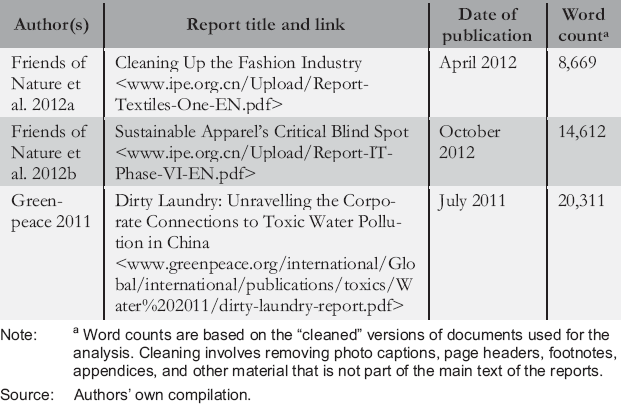
We used electronic text analyses of NGO reports including word frequency and keyword analysis to support our discussion of report content and framing (see Appendix). Using corpus analysis software (WordSmith 5 Tools), we obtained lists of keywords by comparing the reports with a reference corpus of comparable texts. Keyword analysis indicates which words are over- or underrepresented in a text relative to a reference corpus and thus indicates what a text is “about” (Mahlberg 2007). For our reference corpus, we used the Freiburg-Brown Corpus of American English (FROWN) which contains informative texts totalling approximately one million words (McEnery, Xiao, and Tono 2006). Prior to analysis, the reports were “cleaned”, which entailed removing photo captions, page headers, footnotes, appendices and other material not part of the main text of the reports.
To further investigate the background, we conducted additional interviews with representatives of civil society groups involved in CSR in China and with journalists from organizations such as China Dialogue who report on Chinese environmental affairs. A total of 17 interviews were conducted between July and December 2012 in English, Chinese and German. These interviews were then transcribed, and the transcripts of interviews conducted in languages other than English were translated. Analyses were based on English translations. For all other materials studied, analysis was based on English versions.
NGO Campaigns for Environmental Responsibility in the Chinese Textile Industry
In the section below, we describe two separate industry-wide initiatives undertaken since 2011 by advocacy NGOs operating within China to promote environmental responsibility in the textile supply chain. Our analysis relies on a synthesis of the multiple sources of evidence described above. First, we examine the efforts of Greenpeace to persuade companies to eliminate the use of toxic chemicals in textile-processing. In attempting to impose a new standard – the elimination of toxic chemical use in textiles – Greenpeace's campaign appears to be an example of a “proxy war” campaign as described by Yaziji and Doh (2009). While the NGO's goal was to create new rules for chemical use, it also challenged the practices of specific firms. We next consider the attempts of a coalition of Chinese ENGOs to expose pollution violations in the supply chains of several international clothing brands in two investigative reports published in April and October 2012. The ENGOs’ action appears to be a “watchdog” campaign (Yaziji and Doh 2009) aimed at better enforcement of existing standards. Although formally independent of each other, the international and Chinese NGO campaigns targeted several of the same firms.
We argue that although the INGO and Chinese ENGOs are motivated by a common goal of protecting the environment, particularly water quality, they developed somewhat different supply chain responsibility projects, which reflect their different field locations. Both campaigns promoted a norm of supply chain responsibility that defines apparel brands as key players, attributing moral responsibilities to them for activity throughout their supply chains due to their position of power vis-à-vis suppliers. Further, both the INGO and the Chinese NGOs employed stakeholder-framing to legitimate their own roles in CSR processes. Here, the NGOs appear to draw on discourses of stakeholder engagement. Despite these similarities, their resources – in particular the discursive and linguistic resources employed to support this framing – differ. In its report, the international group appeals to global standards and global citizens, emphasizing the worldwide scale of the environmental problem and characterizing Chinese laws as inadequate. Greenpeace's stakeholder position is thus achieved via its representation of a global voice. Scientific evidence is used as a resource that endows the NGO with authority to speak. By contrast, in their reports, the Chinese NGOs locate authority in the standards of Chinese environmental law and highlight the harm that pollution causes to the environment and Chinese communities. This local orientation, supported by “eyewitness” reports from local communities, suggests that the NGOs are authentic and legitimate representatives of Chinese interests. This interpretation is supported by the results of our textual analysis, shown below in Tables 1 and 2.
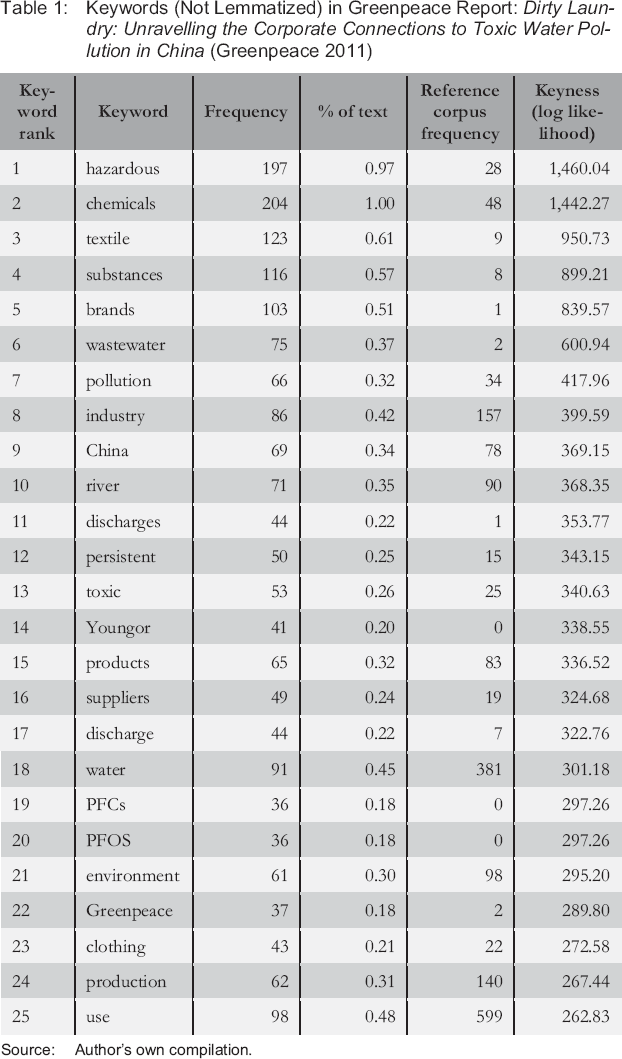
Keywords (Not Lemmatized) in Greenpeace Report: Dirty Laundry: Unravelling the Corporate Connections to Toxic Water Pollution in China (Greenpeace 2011)
Source: Author's own compilation.
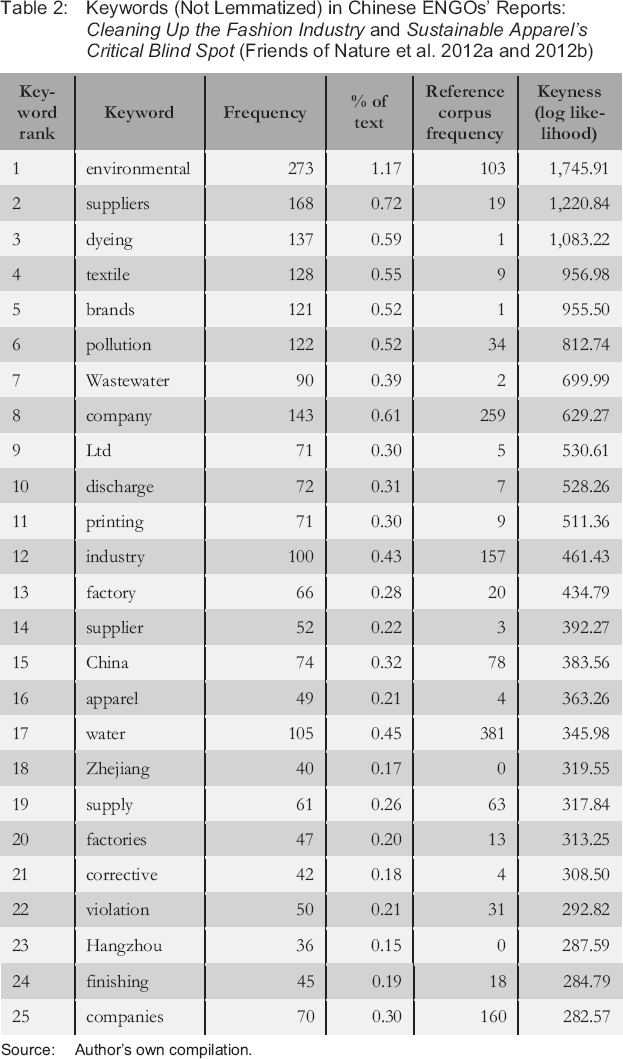
Keywords (Not Lemmatized) in Chinese ENGOs’ Reports: Cleaning Up the Fashion Industry and Sustainable Apparel's Critical Blind Spot (Friends of Nature et al. 2012a and 2012b)
Source: Author's own compilation.
While Table 1 displays the 25 most highly ranked keywords of the Greenpeace report, Table 2 shows the keywords of two reports published by the Chinese ENGOs, which were combined for the analysis. The keyword analyses indicate both basic similarities and interesting differences in the different NGOs’ language, suggesting points of convergence and divergence in their environmental projects. The words “textile”, “brands”, “pollution” and “wastewater” are highly ranked keywords in the reports of both the INGO and the Chinese groups. “Industry”, “China”, “water”, “supplier(s)” and “discharge(s)” are also mentioned by both groups. However, there are differences that suggest important contrasts in the groups’ goals and projects.
As Table 1 suggests, the focus of the Greenpeace report is on the materials that pollute, underscoring the INGO's project of creating a new standard for chemical use. Words such as “hazardous”, “chemicals”, “substances”, “toxic”, “persistent”, “PFCs” (perfluorinated chemicals) and “PFOS” (perfluorooctane sulphonate) suggest a focus on chemical sources of pollution. By contrast, keywords from the two reports by the Chinese NGOs include terms relating to polluting activities and the sites of pollution, such as “factory”, “factories”, “dyeing”, “printing” and “finishing”. “Violation” is also prominent, as is “corrective” – as in the phrase “corrective action”. These keywords relate to the Chinese NGOs’ project of environmental law enforcement and pollution reduction.
Greenpeace
For many years, Greenpeace has been drawing both local and international attention to pollution concerns within China. In 2011 Greenpeace International published Dirty Laundry, a report suggesting that toxic substances had been released by two Chinese textile producers, one in the Pearl River Delta (Well Dyeing) and the other located in the Yangzi River Delta (Youngor). Based on on-site research carried out by Greenpeace staff, the report was published in both English and Chinese.
The Dirty Laundry report appeared as part of Greenpeace's global “detox” campaign, which aims to eliminate the discharge of all toxic chemicals, replacing these with non-hazardous alternatives (Greenpeace 2011). To promote this new standard, Greenpeace crafted a strategy that involved publicizing the links between well-known clothing brands and the chemicals used by their suppliers. Appealing to an ethic of “responsibility by social connectedness” (Young 2008), the NGO addressed brands associated with suppliers who used these chemicals whether or not the chemicals were actually used in the brands’ products. The NGOs thus addressed brands as “critical players” (Yaziji and Doh 2009) with power over suppliers and responsibility for suppliers’ actions – even for activity that may be only indirectly related to the brands themselves. Greenpeace suggested that the corporate codes of conduct adhered to by many companies are inadequate as they simply stipulate that suppliers must abide by local laws. By contrast, Greenpeace ascribes a much greater responsibility to both brands and suppliers:
Every brand and every supplier has the responsibility to know where and when hazardous chemicals are being used and released up and down their supply chain and to strive to eliminate them (Greenpeace 2011: 74).
Prior to the publication of Dirty Laundry, Greenpeace contacted the firms mentioned in the report to inform them of its findings. Companies reacted differently to the campaign, in ways that reflect their different locations in the field. For instance, several international clothing brands addressed by Greenpeace, including Adidas, Puma and Nike, responded swiftly to the NGO and pledged to eliminate the use of hazardous chemicals in their products (Dubsky 2011; for analysis of the press releases related to the campaign that were published by Greenpeace and the sportswear brands, see Brennan, Merkl-Davies and Beelitz 2013 and Brennan and Merkl-Davies 2013). The Chinese brand Li Ning soon followed suit and made a similar pledge to eliminate toxic chemicals (Tan 2011). However, several companies banded together in a collective effort to create their own rules of the game. Brands including Adidas, Puma, Nike and Li Ning established an industry platform, the “Roadmap to Zero”, which allowed them to control the process of chemical elimination, though they did receive input from civil society groups such as Greenpeace (Roadmap to Zero 2011).
While Greenpeace appears to have caused certain apparel brands to change their practices with regard to chemical use, the reactions of Well Dyeing and Youngor, the two suppliers targeted by the NGO, were different. As producers, these Chinese firms occupy a different position in the field vis-à-vis brands, consumers and the NGOs. While they do not exercise the market power of brands, suppliers may be less vulnerable to the threat of reputational loss and public pressure. In the case of Youngor – a supplier named by Greenpeace that is also a major Chinese domestic brand – the picture is somewhat complicated. Although the NGO did have contact with both Well Dyeing and Youngor, this does not appear to have resulted in extensive dialogue. For example, immediately after Dirty Laundry was released, Youngor publicly rejected the NGO's findings and emphasized its adherence to local laws, supporting this claim with the results of government and private tests of its wastewater discharge ( Hexun.com 2011). Quoted several weeks later in the English-language Chinese newspaper Global Times (2011), the deputy general manager of the Youngor Textile Complex denied any violation of environmental standards but appeared to agree with the NGO's goals:
We support Greenpeace's ideal, which is zero discharge of toxic materials, and we agree enterprises should take their responsibility, but we are doing what we can and we can't make promises that [are] beyond our ability to keep (Global Times 2011).
Not only did brands and suppliers respond to Greenpeace differently, but an interviewee observed that these differences were reflected to some extent in the media coverage of the campaign. Many international media reports concentrated on Greenpeace's challenge to the brands and the brands’ response. By contrast, Chinese media reports tended to focus on Greenpeace's claims and the statements of the suppliers, perhaps reflecting a more local orientation.
Chinese ENGOs
In April 2012, less than a year after Greenpeace published Dirty Laundry, a group of Chinese ENGOs launched their own textile supply chain campaign, which was not formally coordinated with the earlier INGO campaign. In this case, the Chinese NGOs appear to make use of changes in other fields (namely, the introduction of environmental information disclosure (EID) laws in China as well as new CSR institutions) to support a project for pollution control in China. By using publicly available information on suppliers’ environmental violations, Chinese NGOs attempted to obtain the cooperation of brands in the NGOs’ project to pressure Chinese suppliers to adhere to Chinese environmental law and remediate environmental harms. Thus, using a strategy that combined the authority of Chinese environmental law with the market pressure of brands, Chinese NGOs attempted to influence the environmental practices of Chinese suppliers.
Environmental information disclosure laws were adopted in China in 2008, mandating that both government environmental agencies and certain firms disclose information to the public, such as records of pollution violations and of enforcement, along with details about the discharge of hazardous materials (Mol, He, and Zhang 2011). Johnson (2011) describes how Chinese NGOs, led by the IPE, responded quickly to the new law and created a publicly accessible online database of environmental violation information that allows polluting firms to be easily identified. In another example of skilful organizing, the IPE brought together several ENGOs to form the Green Choice Alliance (GCA), which promotes supply chain responsibility by encouraging companies to screen their suppliers in China using the pollution database described above (IPE n.d.). The GCA now boasts over 40 NGO member organizations, and some of these organizations have co-authored several investigative reports about pollution in various industries, including electronics and textiles (for example, Friends of Nature et al. 2011a, 2011b, 2012a, 2012b; for further analysis of the work of the Green Choice Alliance, see also Zhang and Barr 2013).
Research done by the Chinese ENGOs for their textile industry reports uncovered 6,000 records of violations at Chinese textile factories as of February 2012. The NGOs identified 48 brands supplied by polluting facilities and in March 2012 sent them letters asking whether they knew about their suppliers’ environmental problems (Friends of Nature et al. 2012a). Among the brands contacted were several of the companies targeted by Greenpeace, including Adidas, Li Ning and Youngor. Adidas was one of the brands that responded immediately to the Chinese NGOs’ letter with an explanation of the violations discovered and promises of corrective action. Adidas not only accepted the Chinese NGOs’ role in the process of environmental monitoring, but praised the organization:
We welcome the efforts that the Green Choice Alliance has made in China in the past few years and we support the leadership of [the] IPE in pushing [for] public disclosure of environmental information (Friends of Nature et al. 2012a: 23).
The company cooperated with the NGOs’ attempts to leverage the power of the brand to convince Chinese suppliers to improve their practices. The effects of Adidas’ pressure on Well Dyeing are documented in the second of the ENGOs’ two reports on the textile industry:
During this process, the driving force from Adidas could not be ignored. Adidas continuously used their brand name and purchasing power to push Well Dyeing Factory Ltd. to carry out corrective measures. During communications, Well Dyeing clearly stated that if they could not remove the violation record it would have a direct impact on their 2012 third-quarter orders, thereby showing Adidas's determination to push this company to make improvements (Friends of Nature et al. 2012b: 41–42).
Although Greenpeace's (2011) campaign does not appear to have resulted in extensive dialogue between Well Dyeing and the NGO, the company changed its environmental practices in response to pressure from Adidas. It seems that when both external buyer pressure and evidence of violations of local laws were present, the company found it necessary to acknowledge and work with the NGOs.
Like Adidas, Li Ning, the Chinese sporting goods brand, also responded to the NGOs, and the environmental groups rated the firm's communication as “responsive-positive” (Friends of Nature et al. 2012b: 50). However, in contrast to Adidas and Li Ning, Youngor was among 19 international and Chinese brands that did not respond to the Chinese NGO coalition's initial letter. On 25 September 2012 the NGOs sent a follow-up letter to these brands. In their second report, published in October 2012, the NGOs characterized Youngor as “unresponsive” and “negative” due to its lack of response to this second round of requests for information. While the company did not respond to the NGOs themselves, in the Chinese media it denied the existence of pollution problems ( Winshang.com 2012). Thus, despite the different basis for claims made by the Chinese NGOs and Greenpeace (local law versus new international standards) and different styles of interaction (addressed as a brand rather than as a supplier), Youngor did not immediately seek engagement with the Chinese NGOs.
However, an important recent development must be noted: After the Chinese NGOs published a third report on the textile industry in December 2013 (Lüse Jiangnan Public Environmental Concerned Center et al. 2013), Youngor did respond (IPE 2013). The IPE wrote:
We would like to recognize the fact that Youngor quickly and actively followed up and we look forward to Youngor pushing those suppliers with pollution problems to carry out rectifications (IPE 2013).
Discussion
Applying a Field Approach
By focusing attention on relationships between actors in a field, a field approach is useful for understanding how apparently weak organizations may gain strength by positioning themselves in particular ways vis-à-vis other actors. This type of approach can also help in the analysis of changing motivations of actors as a field is reorganized. Moreover, a consideration of the resources and social skills suggest that an actor may modify its position in the field through strategic action. In the section below, we discuss the key features of an emerging field of CSR in the Chinese textile industry.
Actors
A field approach supports a socialized conception of actors which is quite useful for analysing the dynamics of inter-organizational interaction in the CSR field. Specifically, this approach helps to explain how NGOs are, rather unexpectedly, beginning to influence Chinese CSR. Although not independently powerful, these groups can exercise power when they act in concert with, for instance, major MNCs, and they are particularly influential when they can appeal to the authority of Chinese law. The conditions for this type of NGO action seem to be created in part by another important actor: the state. The crucial role of the state in shaping the CSR field and in creating conditions for disclosure of environmental information has been described above. Moreover, NGOs also share a goal with certain state agencies in terms of environmental protection.
Importantly, there appear to be some points of agreement between the NGOs and certain MNCs, the latter of which accept these groups playing the role of stakeholder and appear to support environmental protection goals. Certainly, it is quite possible for MNCs to work with NGOs for strategic reasons, and it has been suggested that companies adapt their strategies for NGO engagement in response to the institutional contexts in which they operate (Kourula 2010). By contrast, the distance between Chinese firms and NGOs may seem greater than that between MNCs and NGOs, as Chinese firms may be less likely to accept these organizations as stakeholders. However, a field approach suggests that this difference may result from the field position held by many Chinese firms (for example, the brand-versus-supplier distinction). The fact that Chinese brands Li Ning and Youngor have responded to NGOs indicates that some Chinese firms do appear to accept the stakeholder role of NGOs. This could suggest the importance of field position in influencing behaviour. As relationships between different groups evolve, configurations may change, and Youngor's decision to engage with NGOs after a period of non-response may perhaps be an example of change occurring in the field.
Change might occur as new actors enter the field or as actors’ perceptions change. For instance, consumers are an audience for the NGO–firm interaction, as such providing a potential source of power that could further shape the field. However, Chinese consumers do not appear to have played a major role in the NGO campaigns described above and, in fact, may be initially sceptical of efforts to pressure brands to take responsibility for pollution reduction. This was the conclusion of Zhang and Barr (2013) in their analysis of a recent campaign to raise awareness of environmental issues in Apple's Chinese supply chain, organized by the coalition of Chinese ENGOs described above. Nevertheless, consumer education is certainly a key component of NGO informational campaigns, and the effect of such campaigns may change opinions (as Zhang and Barr note). Indeed, the need to reach out to consumers and explain why NGOs are addressing firms about pollution concerns was raised in a number of our interviews. Thus, an important question is whether the NGOs’ efforts will be successful and to what extent consumers – and specifically, Chinese consumers – will actually be willing to consider CSR in their purchases. If consumers do consider CSR, then relationships within this field could shift, and consumer response could become an increasingly important consideration for Chinese brands.
One point that emerged in our interviews was the NGOs’ desire to avoid releasing contradictory information that might confuse consumers. In an earlier IT industry campaign, Greenpeace and the Chinese NGOs made somewhat different assessments of Apple's environmental performance, an inconsistency which raised questions and some concerns (Ellis 2011). Although the campaigns by the international and local NGOs were not formally coordinated, the organizations appear to have been trying to avoid this kind of confusing message in the context of the textile industry campaign. The theme of consistency also appeared in another context. Interviewees mentioned their goal of maintaining a consistent message when addressing the Chinese public as well as international readers of their reports. One interviewee specifically commented on the challenge of finding a message that would appeal to these two different audiences.
Projects and Rules
The NGO project to shape the CSR field involves leveraging brand pressure to change supplier behaviour. Typically, but not always, this involves an MNC pressuring a Chinese supplier. This is not unlike the “boomerang” model of NGO pressure described by Keck and Sikkink (1998: 12–13). In this model, NGOs exercise indirect pressure on a target (for instance, an unresponsive state) by activating external allies to put direct pressure on the target. However, the case of CSR in the textile industry in China shows that local laws can also be used as a resource for approaching strong external actors – in this case, MNCs – to pressure local firms. While both INGOs and Chinese NGOs make use of CSR norms such as corporate codes of conduct when seeking dialogue with firms, Chinese NGOs use local law as an additional resource. In the textile industry campaigns described above, this strategy distinguishes Chinese NGOs from the international group (which suggested Chinese law regulating certain chemicals was inadequate), and it may be a source of local legitimacy and a strategy for gaining state support.
Greenpeace's rule-changing project can be understood from a field perspective as a response to a rather different field position from which the international organization can appeal to international norms and attempt to change standards regarding the use of specific chemicals. This international group is not as embedded in the local context as are the local NGOs and can seek other sources of legitimation for its demands. On the other hand, an alternative corporate project within this field is the brands’ “Roadmap to Zero” initiative through which companies accept the NGOs’ goal but attempt to control the process of eliminating toxic chemicals themselves. By contrast, the local Chinese ENGOs’ project appears to be a more general one focused on pollution reduction in China. A further project can be observed in the resistance of some companies to NGO pressure. This seems to be a “status quo” project in which the companies aim to maintain their control of environmental management and do not seek engagement with NGOs. This does not mean that an unresponsive firm does not have an environmental programme. For example, firms that did not initially seek contact with NGOs, such as Youngor, may report on their adherence to external environmental standards such as ISO 14001 (Youngor Group Co., Ltd. 2013). Indeed, the fact that Youngor did not engage immediately with the NGOs but responded to the Chinese NGO coalition's third report might suggest that an initially unresponsive firm may potentially amend its environmental project in response to NGO pressure.
Thus, both formal laws and informal (“soft”) regulation provide rules for this field and a focus for specific projects. The limitations of voluntary rules are apparent, though, in the differing levels of response that brands give in the face of NGO claims and demands. While firms such as Adidas responded positively and swiftly to the NGOs, accepting their stakeholder role and actively cooperating with them, some firms did not. When firms do not share a commitment to CSR that involves a role for external stakeholders, then NGOs that seek influence must find other sources of pressure (as in their critical-player strategy) to gain influence.
It is important to note that although we have contrasted the Chinese ENGO project with that of the international NGO, the divergence of the local from the international should not be overstated as there are many examples of cooperation between domestic and foreign environmental groups. A theme that was mentioned in many of the interviews was the importance of this kind of international cooperation. International groups may employ different resources, including different discursive resources and framing, but may share some goals with domestic (Chinese) ENGOs. In the case of the textile campaigns, it appears that the presence of both types of actors in the field creates an important dynamic that shapes the field and influences the resulting engagement with companies.
Framing and Social Skills
The frames that actors employ indicate their understanding of the field and their perception of what stories will gain support for their projects and which will fail: “Skilled actors understand the ambiguities and certainties of the field and work off them. They have a sense of what is possible and impossible” (Fligstein 2001: 114). The adoption of a stakeholder frame justifies the NGOs’ engagement with brands, and the critical-player approach shifts the focus of environmental enforcement activity from the state to powerful companies, who use their market power to persuade suppliers to stop using certain inputs (Greenpeace) and to abide by environmental laws (Chinese ENGOs). While Greenpeace speaks for global citizens and the global environment, appeals to external, global standards and is critical of Chinese environmental law, Chinese ENGOs frame their activities with reference to Chinese environmental law and thus as supportive of the state. By focusing on brands as critical players, both Greenpeace and the Chinese ENGOs can identify external sources of China's pollution problems as well as allocate responsibility to these actors for remediation. The CSR platform thus provides NGOs with frames for action that fit local constraints. By mobilizing information rather than people, and by focusing on companies rather than the state, NGOs can exercise power in the CSR field without threatening social stability. Such frames and forms of action are much more acceptable than confrontational strategies, but still enable NGOs to shift power relationships between the state, companies and civil society.
The Value of a Field Approach
We started with a puzzling question: How are NGOs in China finding ways to take part in CSR activity in China, where conditions may not be particularly favourable for their involvement? We then developed a theoretical perspective to address these questions and explored two empirical cases. The cases suggest a possible explanation: In spite of an unfavourable context, NGOs in China actively use new laws and CSR platforms to create roles for themselves. Moreover, they develop specific social skills that allow them to connect with different actors in order to receive support for their projects. Connecting to MNCs seems to be an inherent part of this Chinese implementation of a civil society strategy. The theoretically developed field approach can help us to understand this in more detail.
To pressure Chinese suppliers, Greenpeace used the power of brands that had already shown a commitment to stakeholder engagement. Local NGOs followed a similar strategy of using the market power of these buyers as a resource. However, their approach was two-pronged: On the one hand, Chinese NGOs appealed to the authority of Chinese law to support their relatively simple demand that suppliers operate according to local rules. This strategy was used to speak to brands. On the other hand, the NGOs leveraged the market power of brands when interacting with suppliers, forcing compliance with local law via pressure from the buyer. Thus, while operating within the context of a strong state, law could become a resource for the NGOs. While this strategy is not political in the traditional sense, it clearly has a political outcome of changing relationships between the state, the firm and the NGO.
Of particular interest is the relationship between the different NGOs in the field. Their simultaneous engagement in the field clearly helped shape it in ways that cannot be understood by looking at each group's campaign independently. A field approach acknowledges this complexity and, moreover, focuses attention on the role of specific actors in these organizations who had the social skills required to use new opportunities and to obtain cooperation regarding, and support for, new projects.
Implications and Conclusion
In closing, we have argued that field-theoretical approaches help explain the developing role of ENGOs in Chinese CSR. We suggest that field approaches can structure further research into the activities of both civil society actors and firms. This suggests the utility of research that produces case studies exploring the choices and strategies of particular firms and other organizations. This could further be supported by research that takes a sense-making approach (see, for example, Basu and Palazzo 2008; Lucea 2010; Areanas, Lozano and Albareda 2009) to understand the cognitive frames that actors apply to comprehend the emerging field and to act within it. Another methodological approach is provided by discourse and rhetorical studies, which can support investigation of the discursive frames in which actors situate their action and legitimate it (see, for instance, Brennan and Merkl-Davies 2013; Burchell and Cook 2006; Joutsenvirta 2011; Joutsenvirta and Uusitalo 2010; Joutsenvirta and Vaara 2008; Suddaby and Greenwood 2005; Vaara and Tienari 2008).
Our analysis raises questions about the limits of NGO strategy. While skilful actors have been able to take advantage of the opportunities provided by CSR initiatives, it is not clear whether they will be able to substantially modify Chinese business practice this way. It seems that the critical-player strategy can be used to pressure individual Chinese suppliers to change their practices. Nevertheless, our study also triggers questions for further research: Will NGOs be able to discover or create additional resources to directly pressure local firms without the brands’ influence? One question is whether they can build on the legitimacy they have gained through recognition from brands. Have NGOs changed their own position in the field sufficiently to command a stronger role vis-à-vis supplier firms? Will they be able to gain acceptance for their stakeholder status in their interactions with domestic firms? The recent response of Youngor to the domestic Chinese NGOs’ third report may perhaps be an indication that this is possible. Another question is whether consumers will provide a source of support, and whether the growing market power of Chinese consumers could become a resource for NGOs. Finally, will other groups with different agendas be able to gain a foothold in the CSR field, or will the impact of NGOs in Chinese CSR be limited to environmental concerns? These will be some of the key questions deserving further examination as NGOs continue to attempt to shape the CSR field in China.
Our analysis has practical implications as well: Companies doing business in China should be prepared to engage and interact with civil society groups, as the potential for NGO involvement in CSR issues – especially environmental issues – may grow. NGOs will have to consider how to address the limits of the critical-player strategy. If Chinese firms are unwilling to acknowledge a stakeholder role for NGOs, the influence of these groups on CSR practice will remain quite limited. Clearly, many ENGOs are already addressing this issue via their environmental and consumer education work to promote green consumption habits. However, further innovations may be needed. Policymakers may want to consider how to support the further development of NGO participation in CSR initiatives in China. The case of the NGOs described above demonstrates that their involvement in CSR can be supportive of the state rather than adversarial towards it. This suggests that it may be to the benefit of the state to take further measures to enable NGO work, such as by expanding and deepening environmental disclosure laws, as well as by explicitly supporting NGO–firm interaction and collaboration to bolster joint efforts to green the field.
Footnotes
Reports of the Chinese NGO and Greenpeace Campaigns
| Author(s) | Report title and link | Date of publication | Word count a |
|---|---|---|---|
| Friends of Nature et al. 2012a | Cleaning Up the Fashion Industry www.ipe.org.cn/Upload/Report-Textiles-One-EN.pdf | April 2012 | 8,669 |
| Friends of Nature et al. 2012b | Sustainable Apparel's Critical Blind Spot www.ipe.org.cn/Upload/Report-IT-Phase-VI-EN.pdf | October 2012 | 14,612 |
| Greenpeace 2011 | Dirty Laundry: Unravelling the Corporate Connections to Toxic Water Pollution in China www.greenpeace.org/international/Global/international/publications/toxics/Water%202011/dirty-laundry-report.pdf | July 2011 | 20,311 |
Note:
Word counts are based on the “cleaned” versions of documents used for the analysis. Cleaning involves removing photo captions, page headers, footnotes, appendices, and other material that is not part of the main text of the reports.
Source: Authors’ own compilation.