



Abstract
During the initial outbreak of COVID-19 in China, Chinese netizens engaged in protracted entanglements with the state across major platforms. They called on the Wuhan (武汉, wuhan) government to be accountable for the rapid spread of the pandemic. Interestingly, this same group of netizens had sung praises to the Chinese Communist Party's tune and lauded the extraordinary achievements of the regime before the outbreak of COVID-19, during the seventieth anniversary of the country. In fewer than six months, the national binge spiralled into poignant criticisms. Against this backdrop, this paper investigates two questions: First, why was there a marked shift in opinions towards the state? Second, what discourse did netizens adopt when expressing their discontent? We argue that the shift is indicative of two-way socialisation in the party-state's legitimacy-building process. While netizens have bought into the official narratives of a celebratory event, they hold the state to the same standard when a crisis occurs.
The outbreak of COVID-19 in early 2020 caused severe economic disruption in the People's Republic of China (PRC). As health officials worked to contain the virus, online patrols also tried to smother potential contentions. Two major events galvanised netizens to call out the Wuhan (武汉) municipal and Hubei (湖北) provincial governments for the virus’ rapid transmission: their failure to inform residents of the severity of the pandemic, and the death of Dr. Li Wenliang (李文亮), a whistle-blower and hero who was silenced by the regime. While online collective action is not unprecedented, as social media platforms have long been deemed as a place on which political contention takes place (Cui and Wu, 2016; Harwit and Clark, 2001; Yang, 2014a; Zhang, 2013), the same group of people who had hailed the Chinese Communist Party (CCP) in October 2019 shifted to vocally criticise it in early 2020. Though the two events may seem incomparable, the same underlying belief concerning the party-state's behaviour applies. Calls for truth, transparency, and punishment of officials are linked with the legitimacy and moral authority of the regime, just as success in wealth, national power, economic performance, and social governance do likewise. During the pandemic, controlling community transmission was as salient as economic performance, as both are integral measuring sticks against which CCP's governance is evaluated.
Against this backdrop, this paper asks the following analytical questions: first, why was there a marked shift in opinions towards the state? Second, how did netizens express their discontent? Specifically, did they adopt official discourses to advance their cause, or did they advocate a different set of values and norms? From our observation, netizens called on the party-state to be accountable to its core messaging and to remain true to its promises. Despite the situational character of netizens’ responses to public events, we suggest the marked shift in opinion between October 2019 and February 2020 could be conceptualised by two-way socialisation in the party-state's cultural governance – netizens have bought into the official narratives and thus hold the Chinese government of the same standard. They expect the same action as propagated by the state, especially on moral claims including benevolence, truth, improvement, and sincerity.
We adopt Perry's understanding of cultural governance, which is “the deployment of symbolic resources as an instrument of political authority” (Perry, 2017: 29). We see such governance as an important tool to overcome legitimacy deficiency. However, cultural governance is not a unidirectional process through which Chinese netizens are socialised into the official narrative. Behaviours exhibited by netizens, instead, show a degree of two-way socialisation. Two-way socialisation comes down to the congruence of state behaviour and its narratives, and netizens play an important role in holding the state accountable or reshaping state behaviour. Congruence was made possible because netizens, on the one hand, had internalised official narratives and norms, and at the same time, imparted these narratives as a preferred style of governance, which the party-state should meet. This phenomenon could lead to mutual accommodation between the state and society, which Yang (2014b) highlighted as an outcome of internet control and online contention. We do not disagree that the state could further strengthen its censorship capacities to suppress netizens’ online activities. Yet, increases in censorship also reveal different strategies that the state takes to respond to citizens’ demands for improvement in governance. Therefore, two-way socialisation does not need to always yield positive, or governance-changing results, despite the possibility of forming a mutually accommodating relationship between the state and society.
The contribution of our paper is twofold. Theoretically, this paper conceptualises a group of netizens’ attitudes and behaviours towards the party-state's legitimacy-building efforts. While these netizens do challenge the actions of the party-state, they merely try to hold the party-state accountable to the narratives it has created. This is not the same as forming a counter-hegemonic bloc aimed at achieving democratic freedom and civil liberties. Empirically, this paper tracks the behaviours of netizens between September 2019 and February 2020 and presents a snapshot of online discussions over that period of time. This snapshot helps us understand the ecology of Chinese social media platforms and some of the specific discussions that netizens have had.
This paper is divided into five sections. The next section introduces our methods. The third section surveys the literature on cultural governance and highlights our contribution to the literature. The fourth section examines the PRC's seventieth-anniversary celebrations, showing that cultural governance has succeeded in cultivating legitimacy. In the fourth section, we will show that legitimacy-building has established certain standards to which Chinese netizens hold the party-state accountable. This paper concludes with a discussion on the portability of the concept.
Methods and Data Collection
This study employs discourse analysis and online ethnography, which adopts ethnographic techniques to learn about cultures and social media interactions in virtual spaces (Kozinets, 2002). Our online ethnography has been guided by process tracing, which “gives greater attention to description as a key contribution, and emphasizes the causal sequence” (Collier, 2011: 823). The sequence that we are analysing is the changes in attitudes towards two important events in China. Looking at how netizens, referring to internet users, communicate values, ideas, and beliefs about governance via social media can provide a nuanced understanding of how citizens view their role in relations with the party-state. These methods help identify the evolution of opinions and the factors behind shifts of opinions.
Data were collected from two major social media platforms that Chinese netizens use regularly: Weibo and Zhihu. Both platforms allow users to see all publicly available posts. We excluded WeChat, another widely used platform, to avoid selection bias, because we could only see posts of our WeChat friends. On Weibo, we first searched hashtags including the phrases “national celebrations of the 70th anniversary” (国庆七十周年, guoqing qishi zhounian)/“the 70th anniversary of China” (中国七十周年, zhongguo qishi zhounian), and “Li Wenliang,” resulting in twenty-four and 463 hashtags for each event, respectively. The search was further narrowed to the five most popular hashtags for each. For the former, the five selected hashtags were (1) “the 70th anniversary of the founding of new China” (新中国成立七十周年, xinzhongguo chengli qishi zhounian), (2) “the 70th anniversary of China” (中国七十周年, zhongguo qishi zhounian), (3) “celebrating the 70th anniversary of the founding of new China” (庆祝新中国成立七十周年, qingzhu xinzhongguo chengli qishi zhounian), (4) “a sign of celebrating the 70th anniversary of the founding of new China” (庆祝新中国成立七十周年的标志, qingzhu xinzhongguo chengli qishi zhounian de biaozhi), and (5) “grand parade for the national celebrations of the 70th anniversary” (国庆七十周年大阅兵, guoqing qishi zhounian dayuebing). The most prevalent hashtags containing “Li Wenliang” included (1) “Dr. Li Wenliang” (李文亮医生, Li Wenliang yisheng), (2) “Dr. Li Wenliang passed away” (李文亮医生去世, Li Wenliang yisheng qushi), (3) “Li Wenliang in emergency room” (李文亮在抢救中, Li Wenliang zai qiangjiuzhong), (4) “Li Wenliang,” and (5) “Zhong Nanshan called Li Wenliang a hero” (钟南山称李文亮为英雄, Zhong Nanshan cheng Li Wenliang wei yingxiong). The profiles of netizens who contributed at least one post under at least one of these hashtags were selected and screened.
Since Zhihu is a Q&A platform where users express their opinions in the form of responses to a given question, we searched for questions containing key phrases. Two discussion topics were therefore screened: “the 70th anniversary of the founding of new China” (新中国成立七十周年, xinzhongguo chengli qishi zhounian) and “parade for the national celebrations of the PRC's 70th anniversary and mass march” (中华人民共和国国庆七十周年大阅兵和群众游行, zhonghuarenmin gongheguo guoqing qishi zhounian dayuebing he qunzhong youxing). We chose the five questions that received the most answers under these two topics. Those users who responded to any of these five questions were marked as the target audience of our ethnographic research. Similarly, we also started with the topic of “Li Wenliang” and found eleven questions under which users had posted comments. As such, Zhihu users who posted an original article or comments under any of these eleven questions were recruited.
We studied 1,062 Weibo profiles and 1,431 Zhihu users. Our analysis of the publicly available posts showed a 10:1 ratio between posts supporting the state during the seventieth anniversary and those criticising it during the early stages of the pandemic (see Appendices 1–3). This ratio is not insignificant considering about 10 per cent of active netizens turned against the state during moments of crises, and the actual ratio could be lower due to online censorship. One could raise the issue that the two populations are non-overlapping, which renders our analyses ineffective in understanding the broader picture. Admittedly, without access to real data in light of privacy restrictions and censorship, the actual situation is difficult to paint. We still argue our findings support the hypothesis of two-way socialisation, suggesting at least a particular netizen group demands the government's unlimited liability in healthcare provisions during the pandemic.
Data screening was guided by two theoretical assumptions. First, netizens who have already bought into the narratives of the party-state tend to agree with the main narratives of the party-state's legitimacy building. They would frequently repost and “like” news from official government social media outlets. Second, these netizens would adopt the same discourses to praise and criticize various levels of government. Consequently, we adopted two principles when selecting netizens for the final analysis. First, we selected netizens who regularly “like” and “repost” official narratives transmitted through the party-state (official social media accounts from central and local governments and administrative organs). One could argue that these “likes” and “reposts” are acts of genuflecting to the state and are not netizens’ true views. However, the overall frequency and intensity of the messaging from selected netizens suggest otherwise. Specifically, “likes” and “reposts” do not only appear during national celebrations and are frequent behaviours outside of state festivities. Moreover, longer personal reflections usually follow those “likes” and “reposts.” One netizen, one month after the national celebrations, posted her travel experience in Beijing Daxing Airport and wrote “I am lucky to be at Daxing [airport]. It is really really big but I could only explore a little #China##Seventy Years Anniversary of the New China#.” She connected her personal experience with China and the CCP's accomplishments, exemplified by this large-scale infrastructure project. Second, we selected netizens who had commented on both events – the seventieth-anniversary celebrations and COVID-19/Dr. Li Wenliang.
We collected postings made between September 2019 and February 2020 and identified a total of 437 netizens. We stopped expanding the sample for two reasons. First, privacy settings did not allow us to track all netizens’ online behaviours beyond a certain time. Our data-gathering process began on 28 March 2020. By late May, when we tried to track postings that had been made during the seventieth anniversary and Dr. Li's death by those netizens, only 437 profiles allowed us to track their comments beyond the six-month limit. Second, we stopped at the 437 threshold because the core messaging became repetitive.
Netizens’ posts about the two events showed nuanced differences. All 437 profiles had posted at least two reflections for each event and the lengths of posts varied significantly. Shorter posts contained a few and not exceeding twenty characters, but longer ones had more than 100 characters. Longer and personal reflections, especially on the state's success in modernising the country, indicate that netizens are not simply fulfilling their roles as obedient citizens. For example, a netizen exclaimed about the enormous changes to his hometown as a result of China's reform and opening as well as the varieties of food available compared to his childhood. This indicates to us that such praises were sincere. Despite these nuances, the central themes remained the same. This group of netizens praised the party-state's efforts in modernising China and were elated to see phalanxes of the People's Liberation Army (PLA) marching across Tiananmen Square (天安门广场, tiananmen guangchang). However, with the passing of Dr. Li, they directed their attacks on the provincial and municipal authorities and harangued Beijing to bring justice to Dr. Li.
In Appendix 2, we show their demographical information. We are also cognizant of the demographical limitations. First, among 900 million netizens in China (Xinhua Net, 2020), we took a snapshot of fewer than 500. Second, we do not have complete access to demographical information via online ethnography as netizens do not always disclose their age, gender, occupation, and/or location on social media. For example, netizens can decide to disclose their full birthday (year, month, and day), the month and day of their birth, and their horoscope or simply hide such information altogether. Difficulty in terms of accessing biographical information also applies to occupation and location. Almost all netizens do not disclose their occupation outright, and a minority of netizens disguise their physical location. On the latter, for example, we identified one netizen to be physically located in China, but she had set her location to Kenya. Second, the user population on Weibo and Zhihu is heavily skewed towards netizens in their twenties and thirties. To get a general picture of the age and gender distribution, 48 per cent and 30 per cent of Weibo users were born in the 1990s and first decade of the twenty-first century, and 54.6 per cent of Weibo users were female (Weibo, 2020). As for Zhihu, netizens between the ages of twenty and thirty-five account for 83.12 per cent of all users, 48.85 per cent of Zhihu users are female, and 51.15 per cent are male (China Internet Watch, 2020). Our profiles represent this age bias and gender balance.
We are also cognizant of the limitations of the research and data availability. The purpose of the research is to take a snapshot of Chinese social media and netizen attitudes between September 2019 and February 2020. Though not representative of all Chinese netizens, this snapshot does serve as an important lens through which to understand the interaction between netizens and the state. The two events provide an outlet for people to express their feelings otherwise concealed in their daily lives, and these feelings are indicative of their underlying sentiments towards the state. Therefore, we emphasise that the findings here are suggestive and serve as the building block to understanding broader Chinese netizens’ response to state socialisation for two reasons.
First, there is a group of netizens who are always critical of the state, despite shifts in political events. They are politically active on social media and expressive of their dissatisfactions. The presence of this group of netizens indicates that not all netizens have been socialised into the party-state's grand narrative about its governance and legitimacy. Second, though online behaviours may not always correspond to real-life propensities, we argue that actions on the internet and in the real world are not independent of each other, as “the real-world Chinese society and economy of today are fused inseparably with the internet and social media” (Lynch, 2022: 237). Though the internet is not free from censorship, investigating behaviours in the virtual space is still of value as netizens astutely make political points through codes, euphemisms, metaphors, and satires – such as replacing “harmony” (和谐, hexie), which means censorship, with “river crabs” (河蟹, hexie), an internet slang (Cao et al., 2022).
Cultural Governance as Two-Way Socialisation
Socialisation is the “learning of social patterns corresponding to [an individual's] societal positions as mediated through various agencies of society” (Hyman, 1959: 25). Concerning political socialisation, scholars agree that national governments, both democratic and authoritarian, play a key role in incorporating citizens, especially youth, into the state's governing structure (Li, 2009; Meyer and Richard, 1975). According to Easton and Dennis (1965), successful socialisation relies on a steady flow of information aimed at inculcating senses of loyalty and obedience towards the state. The media of communication that facilitate the dissemination of ideas evolved from traditional family settings, education institutes, peer networks, communities, and media to social media platforms.
Scholars working on China agree that the CCP espouses performance legitimacy – stability, development, and national unity through trustworthy actions (Chu, 2013; Laliberté and Lanteigne, 2008; Schubert, 2008; Shambaugh, 2008; Zhang et al., 2018; Zhu, 2011). Holbig and Gilley (2010) argue there has been an emphasis on party ideology, as party adaptation and innovation became important means of re-legitimising the CCP's rule. New legitimacy-building techniques are adopted to address the loss of the CCP's traditional proletarian base. Consequently, cultural governance has been used to address that ideological gap. While Perry (2017) restricts her analysis on CCP's efforts to commingle traditional Chinese culture and communist rule, we see cultural governance as an important tool with which the party socialises the Chinese people. By invoking symbolic authority from traditional and revolutionary cultures, the party-state tries to mould a national identity orienting around ideas such as the China Dream, rejuvenation, patriotism, and freedom from foreign oppression (Wang, 2014; Weatherley and Rosen, 2013). Traditional values such as morality, benevolence, and glorious rule are adapted to contemporary contexts, and moral truth has been constructed by reimaging the party as one that cares for the common interests (Bondes and Heep, 2013). The party therefore shows a considerable degree of paternalistic benevolence, self-improvement, philanthropy, filial piety, sincerity, and faith (Hwang and Schneider, 2011; Xu, 2018).
Cultural governance takes multiple forms in an individual's everyday life and has been exercised in different realms of Chinese polity, including education, emotional work and public sentiment mobilisation, information and communication technologies such as television and film, and historical memories and relics (Brady, 2009; Liu and Ma, 2018; Repnikoa, 2017). Among these means, cultural governance through the internet became an important way to strengthen the CCP's online discourse and regulate expressions through censorship (Cui and Wu, 2016; Meng et al., 2016; Schlarge and Jiang, 2014; Yang, 2013). In the process, both central and local authorities have used social media platforms to transmit official narratives and regulate, patrol, and influence online discussions (Noesselt, 2014).
However, the literature has overlooked the effects of those initiatives on Chinese netizens. Specifically, did recipients buy into those narratives? If they did, could those narratives hold governments accountable? Against this backdrop, we argue that two-way socialisation is a suitable concept to understand the interaction between the state and the society. First raised by international relations scholars, the concept emphasises “people are not only the targets of socialization but also active agents that influence the content and outcomes of the process” (Pu, 2012: 347). In this study, while netizens were socialised into the CCP's legitimacy-building efforts, they held higher expectations of good governance. In turn, their call for justice was to hold the state true to its presentation and adopt the same discourse by recycling core messages that the state has used for cultural governance. Through this process, netizens could bring change in policy implementation or have their concerns addressed by the party-state, if they garner enough social attention and translate such attention into political pressure for change. In turn, netizens are not passive receivers of cultural governance.
Our empirical work ostensibly suggests a form of rightful resistance. Episodic and within-system instances of rightful resistance also adopt “recognized principles to apply pressure on those in power who have failed to live up to some professed ideal or who have not implemented some beneficial measure” (O’Brien, 1996: 3). Different from what O’Brien and Li (2006) have observed, our cases show that there has been a sense of conformity to the state's narrative, which rightful resistance has overlooked.
We see two-way socialisation as an interactive process between the party-state and the Chinese people through which the former adapts its governing capacity to meet challenges from the latter. Those challenges are firmly grounded in the narrative that the party-state has used to establish its legitimate rule. Therefore, there exists a sense of heavy scrutiny over the state's performance and, at times, forces the state to intervene in situations otherwise left unattended. As a result, we see this process further enhances the party-state's leadership instead of being a legitimacy crisis. Our findings therefore contrast with Cao et al. (2022: 163), as they see netizens’ political discourse on social media means the latter has become “a platform for the war of position against authority.” Indeed, our empirical studies suggest that hegemonic ideas have not been the subject of conflict.
If two-way socialisation cannot be considered a form of an anti-hegemonic movement, can it be a strategic move through which netizens perform their “loyalty” and extract benefits in return? While more research needs to be conducted to provide a confirmed answer, our empirical findings suggest that this is not the case – though the situation could be complex. The starting assumption of two-way socialisation is that netizens have been socialised into the narratives of the state. Therefore, when the party-state acts contrary to its messaging, these netizens suffer from cognitive dissonance – the state's behaviour is conflicting with its narrative. With that said, we do not dismiss the presence of strategic performances of loyalty. For example, netizens who are always critical of the state could certainly praise it during important occasions but only to extract benefits from it. For example, those who are always critical of the state could first praise its overall pandemic control policies and then call to lift them as they no longer reflected certain professed values.
Moreover, though the empirical work in the study confirms the idea of “hierarchical trust” in China, two-way socialisation is not limited to criticism of local governments (Meng and Li, 2022). The empirical work was drawn based on one incident in Wuhan. Therefore, netizens expressed deep concerns and called on both central and local governments to correct the damages that had been done to Dr. Li Wenliang. In other cases, for example during the White Paper Protest, netizens and the Chinese people targeted both central and local authorities to address their grievances concerning stringent pandemic control measures. Online, by looking at these select netizens, they call on the central government, without targeting specific local governments, to quickly solve the issue and abide by its commitment to “people first, life first” (人民至上,生命至上, renmin zhishang, shengming zhishang) and one of the ways were to ease pandemic control measures that had affected the lives of ordinary people, especially small businesses.
The PRC's Seventieth Anniversary Celebrations
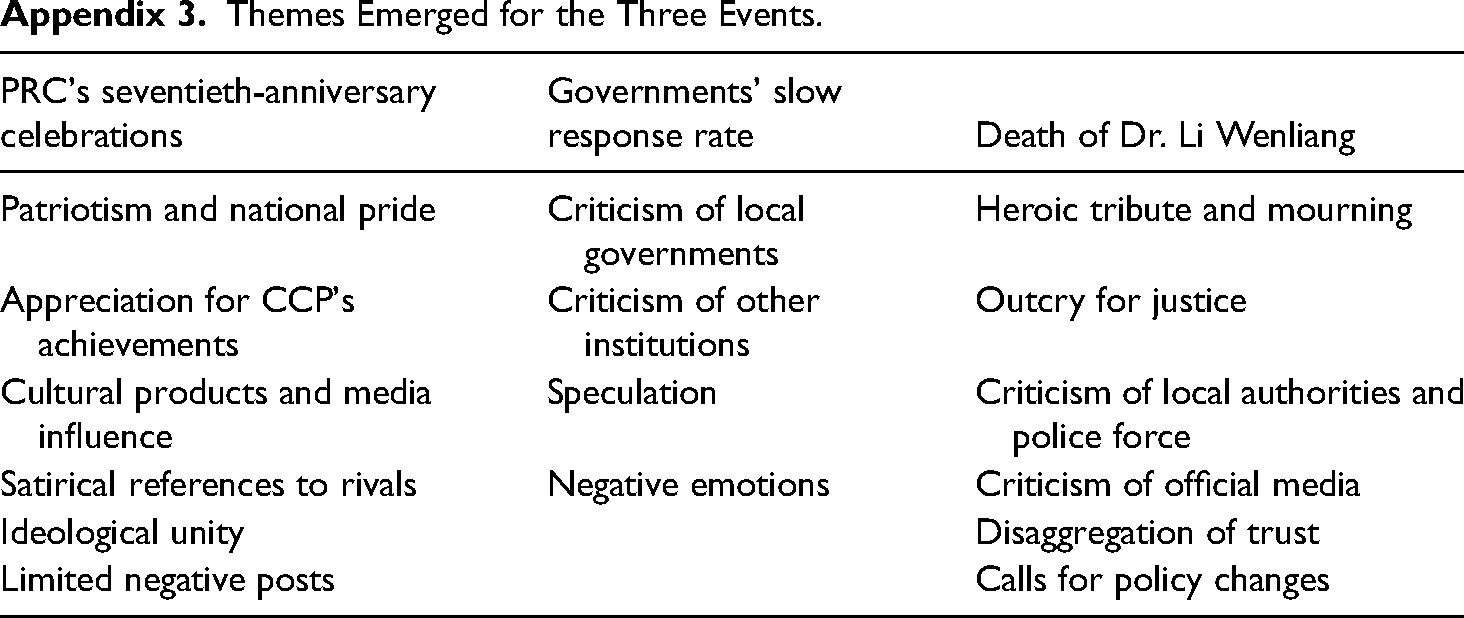
The PRC's seventieth anniversary took place on 1 October 2019. To celebrate, a variety of ceremonial events were held across the country. Among those, the most notable ones were the military and civilian parades on 1 October. In addition to those who physically went to Tiananmen Square for the celebration, a large number of Chinese people watched the event live on China Central Television (CCTV). And the latter group's descriptions of the event dominated social media (see the themes of these social media posts in Appendix 3). Chinese netizens expressed their strong excitement, impressiveness, and pride. Showcasing the CCP's achievements, the parade reminded the Chinese people of the party-state's efforts in nation-building and development since 1949. For instance, about 75 per cent of our ethnographic targets, 325 Weibo users quoted Deng Xiaoping (邓小平)'s famous saying “Development is the [only] hard truth” (发展是硬道理, fazhan shi yingdaoli).
Such an expression was emblematic of this group of netizen's appreciation and gratitude towards the CCP. If the party-state's legitimacy exercise was underpinned by its performance, they certainly responded positively. The military parade was the hallmark of the celebrations and received many praises. Two hundred thirty-seven netizens compared present-day China and the backwardness of the earlier periods. Among them, 156 netizens also expressed that “The prosperity that you had wished for finally came true” (这盛世,如你所愿, zhe shengshi, runisuoyuan) – paying tribute to the founders of the PRC. Moreover, seventeen netizens posted pictures of Zhou Enlai (周恩来), who, at the Founding Ceremony of the PRC, ordered China's nascent air force to fly twice over Tiananmen Square to show face. While exalting the party-state's modernisation efforts, they commemorated Zhou with the hashtag featuring the sentence “Premier Zhou, we have enough fighter jets, they no longer need to fly twice” (周总理,我们现在有足够的飞机,飞机不用飞两遍了, Zhou zongli, women xianzai you zugou de feiji, feiji buyong fei liangbian le).
Interestingly, fifty-six netizens also mentioned Donald Trump in a satirical manner. In implicit expressions of national pride, Trump, a symbol of the United States, an enemy of China, was trolled by Chinese netizens. For example, one netizen speculated that Trump watched the parade and felt envious of China. This line of thought implied a uniform social identity as Chinese citizens. Such a nationality-based in-group identity had been developed through ideology works for years and was particularly reinforced by the parade on 1 October 2019. In this sense, such reactions can be understood as the culminating results of the CCP's successful cultural governance.
Another type of posting behaviour that showed the success of the CCP's cultural governance was reposting or retweeting official narratives. Both central and local authorities frequently disseminated information about the PRC's seventieth anniversary through their social media accounts during the celebration season. For example, CCTV and People's Daily reported how soldiers had been trained for the military parade. This information was viewed by thousands of netizens, as official accounts inherently attract substantial followers. Those who viewed and bought into the official narratives voluntarily retweeted the original posts, as all of our observed netizens have, sometimes with comments expressing their appreciation for the party-state and the PLA. Such a posting behaviour demonstrated that the party-state's narratives on mainstream ideology had penetrated and transmitted among Chinese netizens.
The celebrations also involved multitudinous cultural products: movies, TV series, and theatre performances. The party-state sponsored them to profess national development, stability, and unity. With sufficient funds, these cultural products reached a broad audience as netizens could easily access these cultural products. The influence of these products was also indicated on social media around 1 October 2019. In our sample, eighty-four Weibo users discussed the movies they watched during the celebration season, such as The Climbers, The Captain, and My People, My Country. In these posts, they shared the same feelings and thoughts as those who discussed the military and civilian parade, for example, national pride and gratitude towards the motherland. One netizen posted: “The stage play National Emblem showed deep devotion to our country. The country always came before the family. I love my country” (舞台剧国徽展现了对国家的忠诚。国总是先于家的。我爱我的国家, Wutaiju Guohui zhanxian le duiguojia de zhongcheng. Guo zongshi xianyujia de. Wo ai wodeguojia).
In addition to discussions of the play, movies such as My People, My Country, and patriotic songs were also popular among netizens’ discussions. Among netizens, there was a visible exclamation and call back of the CCP's core message concerning not forgetting one's original intentions (不忘初心,牢记使命, buwang chuxin laoji shiming). Despite these congruences in expressions, some subtleties were observed. First, twenty-three netizens, in addition to congratulating the successes of the party-state and its modernisation efforts, also commented on China's military equipment and the overall appearance of the PLA in great detail. Among them, three argued that the military parade was a telling example of China's prosperity, and this example cannot be repudiated (防杠庆典, fanggang qingdian). The rest, however, restricted their expressions of pride around the country's prosperity and strengths shown through the parade. Seemingly, the stamp of the party-state's cultural governance can be more visibly seen in the former group.
Taken together, all our profiles demonstrated a sense of patriotism, if not nationalism, during the PRC's seventieth anniversary. Due to this uniformity, we quoted posts that appeared quite frequently among the 437 profiles we had studied, meaning that these posts have been directly drawn from our data pool. It should be noted that “frequent” here refers to a repetition of the same messaging across at least 10 per cent of our total sample size. Some of the less frequent posts include “guarding the motherland” (我为祖国站岗, wo wei zuguo zhangang) and “this is what China should be like” (中国该有的样子, zhongguo gai you de yangzi) – seventeen profiles expressed feelings similar to these two statements.
Our observation of netizens’ discussion of National Day yielded few negative posts. This may be due to censorship and the sheer mass of praise. Additionally, China observers may argue that loyalty and appreciation could be staged due to the intense party-building activities that require individuals, especially those in the work-unit systems, to conform to the works of Xi Jinping (习近平). However, we have two apologies, as mentioned previously. First, the frequency of consenting to official narratives, both before and after the national celebration cannot be ignored. For example, one could certainly be asked or feel obliged to show loyalty to the state on certain occasions. Yet, frequent showcasing of loyalty suggests voluntary action. Second, the contents and sentiments of those posts made during national celebrations were intense. For instance, someone simply fulfilling their acts of loyalty would usually not spend more than 100 characters to reflect upon their personal experiences and tie their personal happiness and livelihood with the development of the state. Behind these texts are senses of conviction that the party-state has achieved miraculous results. We identified thirteen netizens who connected the national day celebration with China's women's national volleyball team. In their long posts, they claimed that the team's successes were based on characteristics such as “perseverance” (坚韧不拔, jianren buba), “teamwork” (团结协作, tuanjie xiezuo), and “fighting for the country” (为国争光, wei guo zhengguang). In the same posts, they attributed these same characteristics to the party-state and argued that “the spirits of the women's [national] team are of the country and the Chinese civilization” (女排精神就是国家精神, nüpai jingshen jiushi guojia jingshen).
Another salient question is whether netizens believe the national propaganda. While we could not directly interview these netizens, there are pieces of evidence that suggest they have bought into the national narrative. For example, mocking Trump and claiming that China's modernisation paths are signs of Chinese nationalism – as the underlying sentiments are pride and gratitude. Moreover, netizens were not only proud to be Chinese, but proud of China's achievements in lifting people out of poverty and chartering their own path of national revitalisation. Therefore, they are grateful to the CCP for their efforts in serving the people, bringing happiness to the Chinese people, and making the Chinese nation great again, which are core themes of the party-state's propaganda campaign. Therefore, as we shall see in the next section, when the CCP acted in contradiction to its public image of a benevolent leader of the country, these netizens expressed their deep concern and asked the party to correct its wrong.
The Breakout of COVID-19
The Initial Slow Response Rate From Local Governments
Fewer than three months after the PRC's seventieth anniversary, the first case of COVID-19 was found in Wuhan, China. From late December 2019 to early January 2020, the local health authorities identified several more cases of this novel disease. At the time, relatively few people knew about the disease and how severe it was. Even though the World Health Organization (WHO) stated that a wider outbreak of the virus was possible, local governments reported no evidence of community transmission. Not until late January did the local authorities inform residents that the 2019 novel coronavirus could be transmitted from human to human.
Chinese netizens heavily criticised the response of local governments to COVID-19 on social media (see Appendix 3 for the themes of these social media posts). Specifically, in late January, netizens called on the Wuhan municipal and Hubei provincial governments, claiming that they should be held accountable for the slow response and rapid spread of the virus. Over 70 per cent of our sample, 310 netizens alleged local corruption and fifty-eight asserted that such slow response “apparently caused a delay in pandemic prevention” (显然造成了防疫的延迟,xianran zaochengle fangyi de yanchi). Additionally, local hospitals, health care commissions, the Red Cross, and government-sponsored non-profit foundations were also criticised for their inadequate response. Posts fell into two categories: speculation and emotions. One group speculated that hospitals were prioritising financial gain over people's safety and health and that the Red Cross impeded hospitals in fighting the virus.
The other group expressed strong anger over delinquent officials. Despite their harsh tone, these criticism posts reflected the success of the CCP's legitimacy-building and cultural governance prior to the outbreak of COVID-19. Their emotional expressions and complaints against the governments showed that they had trust and high expectations of governance (e.g. stability, benevolence, truth, and sincerity). The trust and expectations, in essence, resulted from the CCP's political socialisation by producing and disseminating narratives of the regime's positive images. And Wuhan local authorities’ response to COVID-19 in early 2020 was inconsistent with what this group of netizens had expected from a trusted government.
Compared with the celebrating posts surrounding the CCP's seventieth anniversary, these criticisms of Wuhan local governments corroborated the fact that the CCP's political socialisation had been a two-way process. The discourses that netizens adopted to hold the local governments responsible could be traced back to previous official narratives as part of the CCP's cultural governance. For example, it has been disseminated and expected that the CCP-led governments care for people's interests. Once this expectation was violated in early January 2020, audience members moved from passive receivers of official narratives to active agents calling for action.
While online criticisms at the early stages of the pandemic could be argued as an exceptional case, when the central and local governments were also trying to figure out a coherent response, we see these criticisms are nonetheless emblematic of two-way socialisation. First, despite being an exceptional case at the time, netizens’ expectations of the state are not exceptional. For example, demanding the state to prevent community transmission and expressing dissatisfaction with slow responses do not defeat the core idea that netizens expect the state to care for their interests. Second, as documented below, dissatisfaction and anger on social media lead to calls for action directly targeted at local authorities.
Death of Dr. Li Wenliang
When few people knew about COVID-19, doctors began discussing its severity and transmission in WeChat groups. Dr. Li Wenliang, an ophthalmologist at Central Hospital of Wuhan, warned his colleagues in the group about an illness akin to the severe acute respiratory syndrome (SARS) that had swept across China in 2003. Days later, the Public Security Bureau in Wuhan admonished Dr. Li for making a false statement, which threatened social order and stability. Dr. Li was asked to sign a letter promising that he would never talk about COVID-19 again, and then, he returned to his work. On 8 January, Dr. Li contracted the virus and was then quarantined and treated. The official diagnosis came on 1 February, when people knew more about the virus. Unfortunately, COVID-19 took away Dr. Li's life on 6 February. This night marked the beginning of poignant criticisms of governments on social media (see Appendix 3 for these social media posts), which continued for months (Cao et al., 2022).
On social media, netizens called Dr. Li a hero, tweeted about him and retweeted pertinent posts from official accounts to mourn him. Among our 437 netizens, they all thanked and honoured the doctor for his honesty and early warnings about COVID-19. They empathised with Dr. Li and treated him as one of their own – people who cared about and loved their country deeply and purely. Among them, 283 expressed that “Li Wenliang will live forever in our hearts” (李文亮永远活在我们心中, Li Wenliang yongyuan huo zai women xinzhong).
Dr. Li's death directly led to netizens’ outcry for justice. The hashtag sentence featuring “the passing of Dr. Li Wenliang” (李文亮医生去世, Li Wenliang yisheng qushi) went viral on social media. Netizens questioned why the local state had silenced Dr. Li and discussions related to SARS, while WHO had officially announced the disease as “severe acute respiratory syndrome coronavirus 2 (SARS-CoV-2).” Dr. Li was perceived as a whistle-blower. They lamented that those who admonished him were the thieves who took away his whistle. Dr. Li's saying, “There should be more than one voice in a healthy society” (一个健康的社会应该不止有一种声音, yige jiankang de shehui yinggai buzhi youyizhong shengyin), was cited repeatedly by netizens when they criticised Wuhan local authorities and police force. As people learned about COVID-19, it was obvious that Dr. Li did not spread rumours or anything untrue, and thus, he should not have taken any responsibility for what he said. Therefore, netizens believed that the Wuhan Public Security Bureau owed an apology to Li Wenliang, and argued that “Police, apologize. We have been waiting for justice” (警察,请道歉。我们在等待正义, Jingcha, qing daoqian. Women zai dengdai zhengyi).
In our online ethnography, the degree to which netizens criticised the local government differed. One dominant group, consisting of 237 netizens, only grieved the loss of a whistle-blower and hoped for a better world. Though these netizens also called for justice and questioned the silencing of words such as SARS, they hoped that the country could be unified in the fight against COVID-19 and echoed unity, trust, and hope.
On the other hand, another dominant group, consisting of 162 netizens, proposed on their social media that irresponsible officials and media ought to be punished. They claimed that the admonition made by the Public Security Bureau towards Dr. Li should be abolished: “Abolish the admonition. Exonerate Li Wenliang” (撤掉训诫,昭雪李文亮, Chediao xunjie, zhaoxue Li Wenliang). Indeed, in addition to mourning the loss of a doctor, they called for a full investigation of both the pandemic and the mistreatment of the late whistle-blower. These netizens specifically targeted local officials and called on the central government to address the situation. Strong words such as “exonerate” (昭雪, zhaoxue), “hold someone responsible” (问责, wenze), and “inquire” (约谈, yuetan) were used to question local authorities. They also criticised official media such as People's Online Daily and CCTV – the mouthpiece of the state. The media once declared that Li Wenliang and several other doctors were rumour mongers. Such reporting delayed people's awareness and prevention of COVID-19. In this sense, netizens argued that the mouthpiece of governments should also be accountable for the rapid spread and cover-up of COVID-19.
In contrast, seventy-six netizens still sang praises of governments, mentioning that the admonition was a mistake of the Public Security Bureau only and that the National Supervisory Commission did a good job in holding those executives concerned to account. Furthermore, the Wuhan Municipal Bureau of Human Resources and Social Security were praised for efficiently ascertaining work-related injuries for Li Wenliang's death. Among them, one post mentioned that “ascertainment of work-related injuries is a recognition of health care workers during the pandemic” (调查工伤是对疫情期间医护人员的认可, diaocha gongshang shi dui yiqing qijian yihu renyuan de renke).
We observed that netizens tended to disaggregate the local and central governments, trusting the latter while attacking the former due to violations of netizens’ expectations of a responsible government. It is hard to decipher whether these netizens were aware of the central leaders’ role in the early stages of pandemic control, especially without actual interviews. However, our empirical work is suggestive that these netizens did not know the role of the central leaders. We make this claim based on two observations. First, we identified five netizens who, soon after the passing of Dr. Li, echoed the WHO's comments on China's efforts to shut down major cities. Second, we failed to track traces of anti-central postings. We acknowledge that there could be individual dissatisfaction targeted at the central government. However, these criticisms were not widely circulated as we have not seen many reposting of deleted posts – the Chinese censorship system only censors original posts, not simple reposting of sensitive materials.
Our data revealed that the CCP's legitimacy was not affected by the mistakes of local governments, as local leaders, considered scapegoats, can be plucked out to appease public outcry and indicate an admission of wrongdoing. Moreover, netizens’ social media posts indicated that they mainly blamed the local police force for Li Wenliang's death. In their view, a combination of mistreatment and silencing his whistles ultimately brought the demise of a national hero. Distrust in the police department, however, did not lead to a crumbling of faith in the party-state. A majority of those who took collective action on social media cried for the central government to intervene and called for good governance, moral truth, improvement, and sincerity. For example, seven netizens called that: “Let justice shine upon our hearts” (让正义的光芒照进我们心里, rang zhengyi de guangmang zhaojin women xinli), “Waiting for belated justice” (等待迟到的正义, dengdai chidao de zhengyi), “There will be light, [the government] must pay attention to people's livelihood, and there will be a re-genesis of justice” (会有光明的,政府必须关注人民的生命,正义必将重现, huiyou guangming de, zhengfu bixu guanzhu renmin de shengming, zhengyi bijiang chongxian).
Viewed in this light, netizens’ actions exhibit forms of two-way socialisation. First, they seek justice from higher authorities they see as legitimate. Second, such calls originated from senses of stability, truth, and performance that the party-state had inculcated in the Chinese people. This situation shows that netizens have internalised the narratives and norms of CCP's governance and impart their preferences to the party-state. Against the backdrop of heavy censorship, the Chinese state allowed criticisms during the early period of the pandemic because they were issue-specific and mainly concerned with the welfare of the populace. In a recent analysis by Iza Ding (2020), the Chinese state engages in “performative governance” to assuage complaints and persuade citizens of its virtue. Social media permits venting, collects information on local governance, and then decides whether to engage in problem-solving actions.
Two-Way Socialisation
Online protests altered how the state managed Dr. Li's case. During the initial period of the pandemic, when the state itself was trying to find a measured response to the looming situation, Dr. Li's action on WeChat caught the attention of local policy authorities. On 3 January 2020, they summoned Dr. Li, together with seven additional persons, and admonished them for “making false comments” about the emerging pandemic situation. At the police station, Dr. Li agreed to discontinue his actions and signed the Letter of Admonition. News about their punishment was aired on CCTV 13 Live News and CCTV 2 Time No. 1. The approval of the programme by the party's propaganda machine shows their attitude towards the situation – suppressing those fear mongers who may cause social instability.
Dr. Li's treatment went largely unnoticed on social media until he was admitted to an intensive care unit as a result of contracting the virus. As he was receiving treatment, his experience went viral and quickly caught netizen's attention. When Dr. Li exhaled his last dying breath, the cry to bring justice to the venerable doctor reached its peak. Waves of online protests caught the attention of central authorities, as an inspection team from the Central Discipline Committee was dispatched on the day of Dr. Li's death to Wuhan and investigate the situation. The team arrived in Wuhan on 8 February, the second day after Dr. Li's death.
It is true that online censors worked diligently to suppress postings that questioned the state's pandemic prevention measures and its earlier responses. According to a news report from the BBC, the CCTV issued 119 internal orders to regulate seven types of postings, including ones that ought not to be posted, such as those that had exposed loopholes in pandemic prevention work (Luo, 2022). In Dr. Li's case, netizen's outcry became insuperable for online censors to control, as the entire country was mourning the death of an “ordinary hero” (平民英雄, pingmin yingxiong) and questioning the central and local states’ responses. Therefore, we argue the central government's quick reactions were a direct corollary of two-way socialisation and online contention.
Indeed, the March 19 broadcasting of CCTV's Xinwen Lianbo (新闻联播), the most important daily news program in China, included a three minutes forty seconds segment announcing the inspection team's findings. In the segment, the news formally acknowledged the wrongdoings of the local government and provided a detailed account of Dr. Li's death. Interestingly, the title of the report was “Bulletin on the Investigation into Issues Related to Dr. Li Wenliang Raised by the Masses” (关于群众反映的涉及李文亮医生有关情况调查的通报, guanyu qunzhong fanying de sheji Li Wenliang yisheng youguanqingkuang diaocha de tongbao). This indicates that the online protests caught the attention of the central government, which in turn dispatched a work team to appease the masses. Moreover, the posthumous honouring of Dr. Li, awarding him a China Youth May Fourth Medal, the highest recognition granted to a Chinese Youth by the Youth League of the CCP and all China Youth Federation, was meant to further cement Dr. Li's status as a role model. Indeed, the award itself has been regarded by the state to create moral exemplars who are politically progressive and virtuous. We suggest that without two-way socialisation, the state would not have intervened at the rate that they had done.
Actions from the central government show that the state continues to portray itself as a moral leader and a righteous paternal figure looking out for the best of the Chinese people. And rectifying Dr. Li's name and extolling his actions were CCP's targeted responses to netizens for two reasons. First, rectification is within the purview of the party-state and bringing justice shows the party-state continue to concern for the masses. Second, such a concern establishes the party-state as a benevolent father and ruler capable of correcting itself and staying true to its origins of serving the people.
Conclusion
Opinion shifts among Chinese netizens between the PRC's seventieth anniversary and its early COVID-19 experience revealed that legitimacy building through cultural governance led to two-way socialisation. While the party-state succeeded in moulding a shared belief in the regime among netizens, performance became a major criterion of legitimate governance among Chinese netizens. Indeed, when the party-state ostensibly failed to show benevolence, truth, improvement, and sincerity, netizens protested and sought solutions to address their grievances. When doing so, they adopt the same narrative and discourse that have been used by the CCP and attack the local state for failing to achieve certain goals.
To careful observers of Chinese politics, these could be vocal netizens and their responses to public events are situational. These vocal netizens naturally respond differently to celebratory and crisis events, and their responses are shaped by their moral values, perceptions of central–local relations, and state–society relations. However, we nonetheless see two-way socialisation as a useful concept. First, the discourse that they had adopted to challenge the local authorities suggested that they had internalised the official narratives of the state. In turn, such narratives shaped their moral values and state–society relations. Second, netizens could potentially play an important role in holding the state accountable for the messages that it had professed, as in the case of Dr. Li's death.
There are also two implicit understandings concerning netizens’ actions during the early stages of the pandemic. First, netizens saw that the local government had not provided good governance promised by the central government, leading to a marked shift in terms of their attitudes. Second, the idea that the central government can still serve as the ultimate bearer of justice suggests that online contentions do not seek to overthrow the party-state's rule. Consequently, Chinese netizens sought to draw attention to neglected issues rather than becoming newly conscious of their rights as citizens or challenging state hegemony.
Two-way socialisation could be portable outside of the period of investigation. In 2021, in light of the CCP's centenary, a new wave of celebrative activities was planned. And on the day of the celebration, Chinese netizens again went on social media, congratulating the CCP's nation-building and modernisation efforts. Evidently, the CCP's cultural governance has effectively won the Chinese people's hearts. Compounded with the state's ability to ensure zero-COVID transmission, the slogan of “people first, life first” (人民至上,生命至上, renmin zhishang, shengming zhishang) resonated with the masses. However, in early and especially late 2022, Chinese people marched on the street and used the same slogan to fight for a loosening of pandemic control measures. Responding to waves of protest, the state quickly dissipated those measures. From this quick turn of events, the strength, resilience, and durability of the party-state rest not only upon its ability to create buy-in for its rule, but more so on its performance and responsiveness to the Chinese people's concerns over their livelihood. Therefore, the process of two-socialisation can be the burgeoning of mutual accommodation between the state and societal forces.
Indeed, authoritarian regimes do respond to people's needs, and this snapshot of two events provides a lens through which to understand why they do so. There are of course malign responses that need to be further unpicked. During the March 2022 Shanghai lockdown, Chinese authorities tightened their online control as people in Shanghai suffered from food shortages and limited access to proper healthcare. A tightening of censorship, however, does not defeat the idea of two-way socialisation as governments’ responses can be with good or bad intentions. Indeed, strengthening control measures is a good indicator that perhaps the party-state has failed to achieve its intended results and therefore needs to update cultural governance. A new series on Xi Jinping, Navigator (领航, linghang), is indicative of this change – implicitly telling the Chinese people to simply follow his leadership.
Footnotes
Declaration of Conflicting Interests
The authors declared no potential conflicts of interest with respect to the research, authorship, and/or publication of this article.
Funding
The authors received no financial support for the research, authorship, and/or publication of this article.

Author Biographies
Themes Emerged for the Three Events.
| PRC's seventieth-anniversary celebrations | Governments’ slow response rate | Death of Dr. Li Wenliang |
|---|---|---|
| Patriotism and national pride | Criticism of local governments | Heroic tribute and mourning |
| Appreciation for CCP's achievements | Criticism of other institutions | Outcry for justice |
| Cultural products and media influence | Speculation | Criticism of local authorities and police force |
| Satirical references to rivals | Negative emotions | Criticism of official media |
| Ideological unity | Disaggregation of trust | |
| Limited negative posts | Calls for policy changes |