




Abstract
The COVID-19 pandemic started in Chile as the country was experiencing massive protests and a deep political crisis. Sanitary measures restricting movement and gatherings were implemented while the process of constitutional change responding to this crisis developed. In this context of conflict, we study why people continued participating in street protests despite the restrictions and the health risks involved. Using two surveys, we test key factors addressed in extant scholarship: biographical availability, perceived risks, and grievances. We find that grievances related to the pandemic were the most important factor, while biographical availability was much less relevant in the pandemic context. There is no evidence that perceived health risks mattered when deciding whether to join a street protest or not. These results suggest that under conditions of political crisis, grievances related to the administration of the pandemic can motivate political participation even when the latter put people's health at risk.
Introduction
Since the early 2000–2004, Chile has experienced increasingly frequent and large protest waves. Growing discontent paved the way for a social uprising in October 2019 with violent demonstrations and strong police repression. The SARS-CoV-2 1 pandemic in 2020 hit the country in the midst of this political crisis. While street protests decreased because of restrictions to free movement and health-related risks, the pandemic also produced new sources of disgruntlement that deepened extant discontent. In this article, we examine the factors that predict participation in demonstrations in this particular context.
To address this issue, it is necessary to understand both the underlying causes and the dynamics of recent protests in Chile. During the 1990s, after 17 years of dictatorship, governments succeeded in stabilizing both the economy and the democratic regime. Yet, few structural changes were arguably made to the neoliberal model introduced during military rule (1973–1989). As a consequence, inequality and the privatization of the provision of social services fueled social discontent and distrust with the political authorities.
Growing protests since the 2000–2004 reached its tipping point in the 2019 social uprising. As in other cases of massive protests, demonstrations were initially triggered by a contingent event, namely, a subway fare hike introduced in October that year. Protests eventually gained momentum and escalated into a massive revolt, in which several metro stations across Chile's capital were occupied and an unprecedented number of protest events ensued. The president at the time, right-wing businessman Sebastián Piñera, responded by declaring an emergency state and imposing curfews in all major cities. Protesters soon clashed with a police force that sought to disperse the crowds by firing rubber bullets, tear gas, and water cannons. In October 25, over a million people gathered in the capital and hundreds of thousands joined demonstrations in the country's main cities against the state of emergency, and the country's deeply rooted inequalities (Ruiz, 2020). From October 2019 onwards, both pacific and violent street protests took place on a weekly basis until the SARS-CoV-2 pandemic reached Chile in March 2020.
This protest wave not only paralyzed the country, but also paved the way for a debate on the need for a new political constitution that addresses extant disenchantment with Chile's socio-economic policy, the capacity to deliver welfare, and existing social inequalities. In November 2019, representatives from most political parties announced an agreement to hold a referendum for a new constitution. This was held in October 2020, and an overwhelming majority of Chileans voted in favour of rewriting the constitution and electing an assembly with gender parity and quotas for indigenous people to pursue this task.
While the November 2019 agreement slowed its pace and intensity, the protest wave ensued. On March 8, only five days before the sanitary lockdowns began, over two million women demonstrated across the country to commemorate International Women's Day (El Mostrador, 2020).
Undoubtedly, the SARS-CoV-2 pandemic hit Chile in the midst of its deepest political crisis since the end of the military regime in 1990. This particular context opens many questions about the relationship between street protests and the pandemic in Chile and around the world. On the one hand, the pandemic reduced the opportunities to participate in demonstrations. Quarantines and curfews were implemented during a large part of 2020, directly increasing the risks and costs of demonstrating. Lockdowns also had severe economic consequences such as unemployment, decreased income, and higher domestic work burdens. The latter rearranged people's priorities and possibilities to engage in protest activity. Furthermore, health risks related to the pandemic may have deterred individuals from participating in on-site events as physical contact was discouraged due to contagion risks (see Cobbina et al., 2021). On the other hand, however, grievances related to the authorities’ handling of the pandemic and its outcomes may have fostered the participation in demonstrations. For example, the pandemic widened the already large inequalities in the health system, highlighting a gap between people from different socio-economic backgrounds (Mena et al., 2021). Arguably, the pandemic context has had the potential to elicit factors that could either exacerbate or reduce participation in demonstrations. It thus remains an open question in which direction — if so — the pandemic affected people's decision to partake in street protests.
We focus on street protests instead of other types of repertoires of action because it involves physical contact, which in the context of the pandemic constitutes a health risk. It also provides a fruitful venue to examine the analytical leverage of extant social movement scholarship to understand the drivers of street protest participation in the particular scenario of a pandemic and the risks associated with it. We draw on data from two surveys (MOVID-19, an online panel survey conducted during the year 2020 and MOVID-Impact, a nationally representative telephone survey conducted in December 2020) to test three models that are key to extant literature investigating participation in street demonstrations: biographical availability, perception of risk, and grievances. We show that grievances related to the pandemic — such as the perception that large health access inequalities exist and the belief that the government prioritized the economy over the well-being of individuals — constitute the most relevant predictors of participation in street protest We find no evidence of perceived health risks related to the SARS-CoV-2 pandemic affecting the odds of participation.
Our analysis of participation in demonstrations in times of a pandemic matter for manifold reasons. First, it contributes to our understanding of the social and political effects of the SARS-COV-2 pandemic. The latter is relevant for possible future events where public health crises strain the relation between citizens and authorities. Our case study is of special interest to understand the ways in which the pandemic has reshaped the political opportunity structure to address pending political and social reforms in Chile.
Second, so far, there is conflicting evidence on the role of the pandemic in shaping protest participation. Some authors have pointed out a short-term decrease in street protest participation due to sanitary restrictions and health risks (e.g. Bloem and Salemi, 2021; Pinckney and Rivers, 2021). Others highlight a strong resurgence of protest as the SARS-CoV-2 pandemic advances (Kishi, 2021; Pleyers, 2020). We contribute to this debate by disentangling the role of factors related to the sanitary crisis which might push towards simultaneously increasing and decreasing participation in demonstrations.
From a theoretical perspective, our study also contributes to ongoing debates on the role of risks and grievances for protest participation. One of the key premises of this research field is that participation in protest involves risks related to legal, social, physical, and financial dangers (McAdam, 1986). Because these risks stem from the political action of adversaries (e.g. authorities, police), they can elicit strong emotions (e.g. anger, fear, sadness, and outrage) leading individuals either to participate or to refrain from protest (Adra et al., 2019; Zeineddine and Leach, 2021). Analyzing the perception of health risks related to SARS-COV-2, instead, we assess a perception of risk that is disentangled from these conflict-related emotional factors.
We start the article by describing previous protest waves, as well as the development of demonstrations during the pandemic in Chile. We then examine research findings on the effect of biographical availability, health risk perceptions, and what we refer to as pandemic grievances, on protest participation. Next, we present our research hypotheses. This is followed by a description of the two studies of our article and their methodologies. We finish by showing our results, and conclude by discussing the important role that the pandemic has played in deepening grievances that were only momentarily silenced during the beginning of the health emergency.
Protest Waves and the Reshaping of the Political Agenda in Chile
During the last two decades, protests in Chile have often shaped the policy agenda. While the 1990s were characterized by a process of demobilization of civil society, social movements became increasingly massive from the 2000–2004 onwards (Donoso and von Bülow, 2017). High school students mobilized in 2001 and 2006, forcing a debate on the education model and its unequal opportunities and outcomes. In 2011, university students joined and mobilized for months to push for public and tuition-free education. The student demands were part of the electoral program that allowed the centre-left coalition, spearheaded by President Bachelet, to win the 2013 elections. Once in power, the Bachelet government addressed these demands by presenting a series of bills — albeit through the same subsidy systems which previously had prompted the student protests. The Bachelet administration also faced important labor mobilizations and a national discussion on the unequal working conditions of permanent staff and subcontracted workers (Donoso, 2017). In 2016, the No + AFP movement called for the end of the country's current pension system based on individualized savings managed by private for-profit organizations (Rozas and Maillet, 2019). Both in the case of the workers’ protest and the No + AFP movement, the Bachelet government responded by creating a presidential advisory commission charged with the task of elaborating a reform proposal (Donoso, 2013). Environmentalist movements also increasingly mobilized after the 2000–2004 (Scherman et al., 2021), actively opposing numerous extractive projects and demanding new regulations. Since 2018, women's protests against violence, abortion restrictions, and gender inequalities have arguably become the country's most salient and massive expression of discontent, increasingly challenging the development model and its inequalities as a whole (Palacios-Valladares, 2022).
Latinobarómetro data on Chile shows that between 10 and 20 percent declared to have participated at least in one protest between 2000 and 2015. Puga and Moya (2022) report a 36 percent participation in urban areas by 2018. Figure 1 shows the evolution of both violent and non-violent protest events during the 2010s.
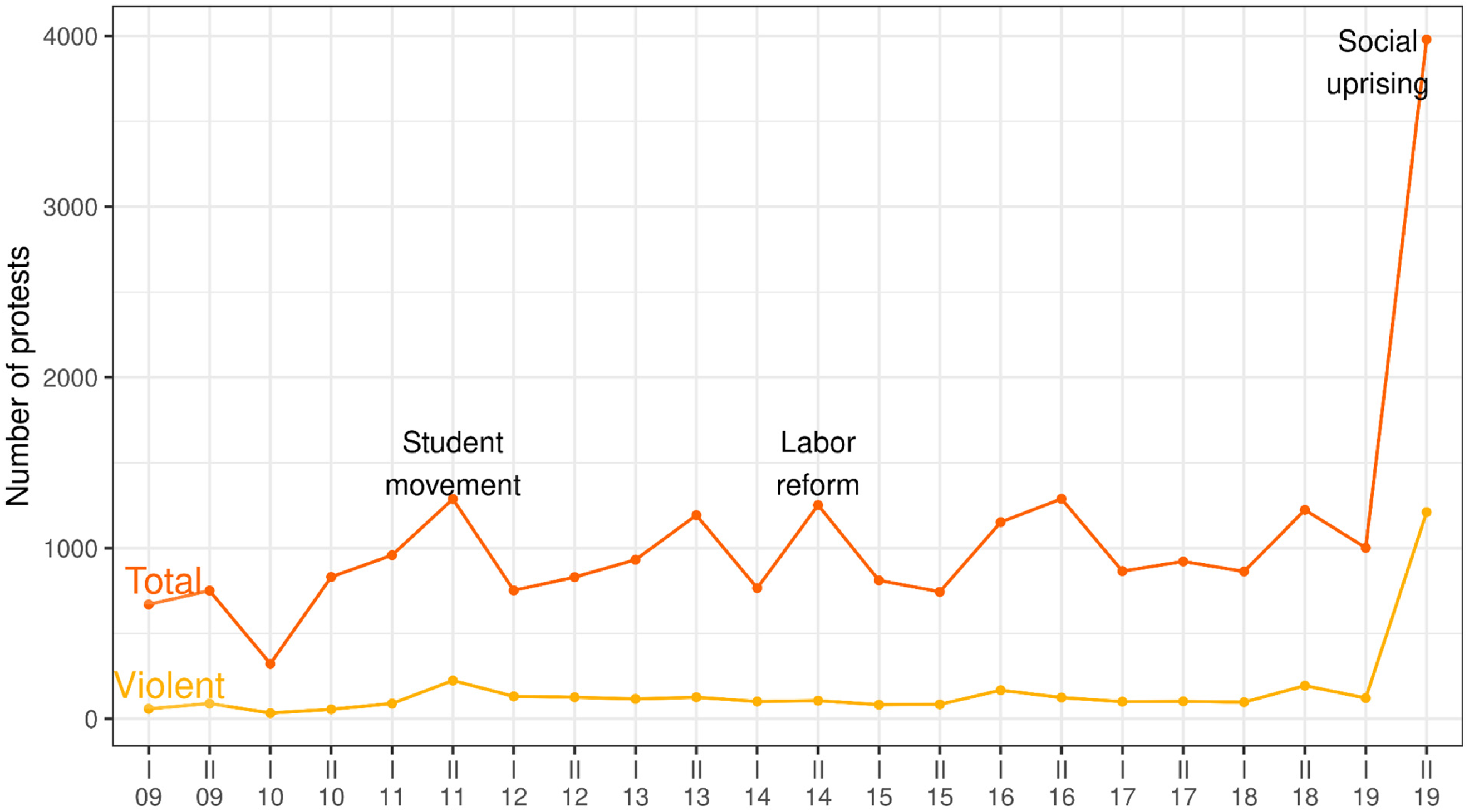
Semiannual Protest Events in Chile (2009–2019). Total Considers Violent and non-Violent Events. Source: Joignant et al., 2020.
Common to all these protests was a shared understanding of how the neoliberal logic underpinning most policy fields has deepened historically rooted inequalities and impacted on people's everyday life (Donoso and von Bülow, 2017). The neoliberal model was introduced during the military regime in the 1970s in Chile, which partly explains its rapid and encompassing implementation. General Pinochet's unambiguous objective was to dismantle the previous state-led development model. The neoliberal transformation of the Chilean economy pursued by the military involved subordinating the state to a subsidiary role, and giving a central role to market mechanisms and efficiency criteria in allocating and supporting certain economic activities (Motta and Bailey, 2007; Ruiz and Boccardo, 2014).
The failure to address large social inequalities since the end of the dictatorship became increasingly evident, and discontent with extant political parties that had been unwilling or unable to introduce changes grew steadily over the 2000–2004. Moseley (2015) referred to Chile during 2008–2012 as having a strong institutional context where community engagement did not predict contentious behaviour as in other Latin American countries. However, later studies showed a steep decline in political satisfaction. Already in 2012 — probably as a consequence of the 2011 demonstrations — support for political institutions was quite low (Luna and Toro, 2013). Both the centre-left administration of President Bachelet (2014–2018) and the centre-right government of Sebastián Piñera (2018–2022) reached record low levels of approval: 15 percent in 2016 for Bachelet and only 5 percent for Piñera in 2019, with even lower figures for Congress and political parties (CEP, 2019). Likewise, the share of people that believed democracy worked badly or very badly increased from 26 percent in 2008 to 47 percent in 2019 (CEP, 2019). Clearly, the signs of discontent were evident long before the 2019 social uprising. It is difficult to explain the extent of the country's political crisis without making reference to the limitations of the political system in processing social conflict. This is why the political response to this massive revolt was to propose a path for a new constitution.
SARS-COV-2: Threats and Enablers of Participation in Street Protest
Protesting has become a common activity and broadly accepted by society (Meyer and Tarrow, 1998). In light of its importance in contemporary politics, some of the key questions that both sociology and political science have sought to address are when, why, and how people participate in protests.
The social movement literature has emphasized different dimensions to answer these questions. One of the central concepts of what has become known as the political process model is that of the political opportunity structure (McAdam et al., 2001). It stresses the importance of changes in the institutional structure and the informal power relations of the political system. Through signals to social and political actors, the political opportunity structure shapes the broader set of constraints and opportunities for social movements to emerge (Tarrow, 1994).
The SARS-CoV-2 pandemic affected two key dimensions of the structure of political opportunities: access to participation and the state's capacity to repress. Evidence across the globe points at a sharp short-term decrease in protest activity (Bloem and Salemi, 2021; Kishi, 2021; Metternich, 2020; Pinckney and Rivers, 2021; Pleyers, 2020), mostly explained by sanitary restrictions on collective gatherings, health risks associated with participation (Pinckney and Rivers, 2021), and also the instrumentalization of the pandemic by governments aiming at repressing political dissent (Kishi, 2021; Censolo and Morelli, 2020). With varying success, activists attempt circumventing this closure of opportunities by adjusting their protest repertoires (Ferrero and Natalucci, 2020; Pinckney and Rivers, 2021; Pleyers, 2020; Pressman and Choi-Fitzpatrick, 2020; Zajak et al., 2021), and thus online activism has become more relevant. Other internationally documented examples of tactical adjustments are distancing during demonstrations, caravans, and coordinated but spread protests from balconies and homes using noise and music (Kowalewski, 2021).
Chile serves as a clear example of the closure of political opportunities provoked by the SARS-CoV-2 pandemic. After months of protests, from March 2020 onwards, the government introduced restrictions of free movement, mandatory quarantines, the ban of public gatherings, and physical distancing in response to the pandemic. These measures were arguably aimed at curbing the spread of SARS-COV-2, however, they also helped the Chilean government to control a protest wave that, until then, showed few signs of appeasing (Bloem and Salemi, 2021: 8; Pleyers, 2020: 298).
At the same time, however, the evolution of the pandemic and the sanitary and economic measures implemented by the Piñera government created a fertile soil for grievance formation. Health worker unions (Colegio Médico, 2020; DiarioUChile, 2021), scientific associations (El Mostrador, 2021a), local governments (Emol, 2020), and political opponents (El Mostrador, 2021b), all criticized the government measures on various grounds. First, due to their insufficiency in curbing contagions: quarantines were dynamic and did not include cities like Santiago as an interconnected entity, many firms were allowed to continue working, employees were not sufficiently protected to skip work for sanitary reasons when needed, government communications often downplayed the sanitary crisis, and official contagion statistics were denounced as opaque. Second, the government was criticized due to prolonged and heavily restrictive measures with debatable sanitary gains: an absolute curfew by night, as well as a ban on public gatherings in open spaces, both remained in effect continuously between March 2020 and September 2021. Finally, the economic measures aimed at helping families endure the economic hardships triggered by the pandemic (and to allow them to comply with the sanitary restrictions) were widely criticized as insufficient or too late, even by the government allies. In time, the refusal of the government to provide stronger economic aid led to its isolation from its parties and their congress representatives.
As a consequence, social discontent kept growing since the start of the pandemic and the political support for authorities visibly decreased. This is shown in recent opinion polls. According to the Centro de Estudios Públicos (CEP, 2021a), by August 2021, 57.3 percent of the people had a negative evaluation of President Piñera. The confidence in the health authorities remained low as well: in April 2021, 56.6 percent of Chileans stated that they had little or no confidence in the information provided by the Ministry of Health (CEP, 2021b).
In sum, while sanitary restrictions and health risks might narrow political opportunities in the short term, the pandemic creates a context where the salience of previous grievances seems to have increased (Andrews, 2020; Iacoella et al., 2021; Mendes, 2020). As sanitary restrictions affect jobs, commerce, political rights, and public social services — while forcing governments to make decisions with heavy costs for families, firms, and/or the state — they bring to the front social and economic inequalities making latent conflicts more salient. Recent research has found stronger resurgence of protest and social conflict as the SARS-CoV-2 pandemic advances (Kishi, 2021; Pleyers, 2020).
In the case of Chile, disgruntlement with the measures implemented to address the pandemic has not implied returning to the heightened protest levels of 2019. Yet, considering the level of conflict prior to the pandemic, it is not farfetched to suggest that accumulated grievances might lead to protests later. Research has shown that pandemics have worked as powerful incubators of social grievances and unrest (Censolo and Morelli, 2020), while forced social isolation is also linked to emotions enabling social uprisings (Grant and Smith, 2021). In fact, uprisings and revolts of great historical significance erupted across Europe after the Black Death, spurred by aggravated social inequalities and the response of rulers in defense of elites’ interests (Censolo and Morelli, 2020; Hays, 2005; Snowden, 2020; Wade, 2020). Similarly, cholera outbursts during the 19th century were closely followed by waves of revolts across Europe and Asia (Evans, 1988). Censolo and Morelli (2020) selected 57 pandemics between the bubonic plague and the Spanish flu, finding uprisings and revolts directly linked to them in all but four cases. In Chile, the Spanish flu immediately predated the “marches of hunger” and a period of intense class conflict which ultimately led to the coup of 1924 and the end of the parliamentary republic.
While we know that discontent might accumulate during pandemics, it remains an empirical question of the extent to which the models proposed for examining protest participation can explain this phenomenon in times of a pandemic. On the one hand, the pandemic might foster grievances. On the other hand, health risks and mobility restrictions might discourage people from protesting. In this article, we both draw on and seek to complement existing literature when explaining protest participation in the particular context of the SARS-CoV-2 pandemic. We consider three groups of factors that might explain individual protest participation: biographical availability, perception of health risks and health status, and grievances related to the pandemic. In the following, we describe available research on these three factors and present our research hypotheses related to each.
Biographical Availability
Participating in protests requires time and effort (Klandermans, 2004). The first explanatory model to consider is therefore related to life course factors mediating people's availability to engage in protests. Biographic and sociodemographic dimensions, in particular, affect entrance into activism. The literature has long established that partaking in protests is strongly conditioned by the responsibilities that people have in their life. The more responsibilities, the less likely it is that people are willing to take those risks involved in participating in protests. Family responsibilities are a clear example in this direction (Schussman and Soule, 2005). Marital status, especially if only one spouse is engaged in a social movement, decreases the probability of partaking in protest because it is correlated with geographical moves, employment changes, and the birth of a child (Wiltfang and McAdam, 1991). In the same vein, age affects participation negatively as being younger often means less responsibilities and more willingness to take the risks that protesting often involves (Wiltfang and McAdam, 1991). In the case of Chile, LAPOP data (see Luna and Toro 2013) shows that participation in street protests is higher for people between 18 and 24 years.
Furthermore, the literature has shown that being employed reduces the likelihood of partaking in protest because it implies less free time and the risk of losing one's job (McAdam, 1986). It has also been shown that having a full and protected employment might entail access to a reliable source of resources, which has been proven to foster participation in protest (Schussman and Soule, 2005). In Chile, however, as in Latin America in general, employment is often informal and even formal employment enjoys little protection. Puga (2021) reports that lower-status occupations have lower odds for protest participation in Chile, while Puga and Moya (2022) show strongly increased participation among those not working for pay. Thus, we expect employed people to be less likely to protest in Chile.
Another crucial element is education. Since the classic study of Verba et al. (1995) education has been probed to strongly foster both conventional and non-conventional forms of political participation. This is because education is associated with both higher income and higher civic skills, both of which are central resources to enable political participation. Consistently, Luna and Toro (2013) showed stronger levels of participation in Chile among highly educated people and those interested in politics. This has been confirmed by more recent studies that show that the most disadvantaged social groups are those who are less likely to use protest as a means to voice their concerns (e.g. Norris, 2002).
In light of the above, our departing hypotheses are that:
Perception of Health Risks and Health Status
Scholarship has shown that one of the determinants of participation in protests is individual perceptions (e.g. Klandermans, 1984). Two perceptions seem to be relevant: the perception of the efficacy of one's action for producing social change, and the perception of the risks that one incurs when engaging in collective action (Passy and Giugni, 2001). Few would take exception with the claim that the SARS-COV-2 pandemic has increased the risks associated with participating in protests, especially those repertoires of action that involve physical contact such as manifestations. On the one hand, as described above, the Piñera government set strict restrictions on free movement from March 2020 onwards. On the other hand, people's fear of contagion could be playing a direct role in the sharp decline of protest events from this date onwards. Extant research on SARS-COV-2 has shown that individuals worry about the extent to which SARS-COV-2 might threaten their own and their family's well-being (Cooperativa, 2021).
The assessment of risks has been a central variable when explaining why people partake in protests. Risk has been defined as “the anticipated dangers — whether legal, social, physical, financial, etc. — of engaging in a particular type of movement activity” (McAdam, 1986: 67). McAdam (1986) conceptualizes what he refers to as high-risk activism in his research on the 1964 Freedom Summer project in the United States. Some of these risks refer to the possibility of being arrested, paying a fine, being beaten, tortured, or killed (Wiltfang and McAdam, 1991: 989). The risks of political confrontation might elicit strong emotional responses such as fear or outrage (Adra et al., 2019; Zeineddine and Leach, 2021), which, in turn, might either inhibit or motivate protest participation. However, these types of risks are different from the ones people face in the context of a pandemic. Given the contagious nature of the virus, having chronic diseases associated with severe outcomes of the SARS-COV-2 disease, having a worse health status in general, and perceiving higher health risks, become relevant risk-related indicators. Yet, health risks might not carry the same emotional responses as political risks. Consistently, Cobbina et al. (2021) argued that protestors — particularly those with underlying health issues — incurred in calculated risks to protest during the SARS-COV-2 crisis. If motivations to protest were strong enough, they would engage in practices of risk mitigation to be able to partake in demonstrations. In this sense, the pandemic context enables a stricter test on instrumental risk calculations as a factor explaining protest participation. By exploring this relation, we thus aim at contributing to the scholarly debate on the role of risks in deciding to engage in protests. We therefore propose the following hypotheses:
Pandemic Grievances
The work of Verba et al. (1995) not only established that those who can (i.e. have resources) take part in the protest The authors also stressed that political interest and concern about political issues spur political participation, in general. How concerns, sense of injustice — or, in the language of social movement literature, grievances — affect protest participation has long intrigued social movement scholars. The existence of grievances is a key antecedent to foster collective action.
Grievances refer both to “suddenly imposed grievances” that threaten a specific social group's existence (Buechler, 2004: 59), and to those grievances that are constructed over longer periods of time. Grievances can be defined as a “sense of indignation about the way authorities are treating a social or political problem” (Klandermans et al., 2008: 993). This conviction of wrong or injustice, in turn, motivates protest participation. Gerber et al. (2021) show that in Chile whether people evaluate authorities as unjust matter especially for the justification of transgressive collective actions, such as unauthorized protests. In the context of articulated social movements, grievances form part of collective action frames that work as a “schema of interpretation” allowing individuals to “locate, perceive, identify, and label reality” (Benford and Snow, 2000: 614). Social movements then actively seek to shape their collective action frames to integrate those grievances that resonate with mainstream beliefs and values. But grievances abound in society and can also exist without a social movement organization that spearheads mobilization processes to address them. In the case of more fragmented collective action, grievances serve the same function: they create frames of injustice that spark collective action, and motivate the risk-taking involved in engaging in protests.
The sources of grievances are multifold. Early scholarship brought to the fore material conditions and claimed that the emergence of social movements could partly be explained by rapidly changing societies and the increasing expectations and relative deprivation that this involved (e.g. Smelser, 1962). Studying social movements such as the labor, indigenous, and student movements, Latin American scholarship has centred on material grievances to explain the rise of protests. Later studies criticized this perspective arguing that material hardship was a constant, and would not spur protest without an active effort to frame it as an injustice by social movement organizations (Buechler, 2004). Latin American literature also questioned an excessive focus on material demands bringing to the fore political variables as the root cause of protest movements. Focusing on indigenous movements, Rice (2012) stresses the importance of an institutionalized party system to channel protests. In a similar vein, Arce (2008) shows that a higher number of political parties tend to be associated with more protests. This is because a high number of parties is a sign of poorly institutionalized parties with weak capacity to represent social movement demands. Disi (2018), in turn, shows that the rise of student protests in Chile can partly be explained by the weak organizational linkages with ruling political parties. Inspired by new social movement theory — hugely influential in Latin America — authors such as Slater (1986) and Jelin (1985) have also stressed the importance of social movements as pioneers of new values and meanings, and the redefinition of identities.
Nonetheless, as Simmons (2014) states, rather than thinking about the material and ideational dimensions of grievances as opposed to each other, we gain analytical leverage by conceptualizing them as both materially and ideationally constituted. Differentiating between the material and ideational roots of grievances also allow us to analyze how grievances that might be materially different are imbued with similar meaning across distinct settings (Simmons, 2014: 515). For example, struggles around natural resources might have different material backgrounds, and even different levels of severity, and yet, play a similarly important role as a mobilizing force because there is also an idea of community that is threatened in each case.
Grievances are also grounded in context. Grasso and Giugni’s (2016) recent research on protest participation in the context of the economic recession since 2008 shows that while individuals who feel that they have been the most deprived tend to protest more, certain economic and political contexts strengthen this effect. Specifically, the authors find that the effect of individual deprivation on protest is conditional upon state policies and the general economic environment, which enhance the protest potential of grievances and broaden out perceived political opportunities. In the case of the analysis of protest in Chile in times of SARS-COV-2, this is of particular relevance given how the pandemic hit the country in the midst of social and political turmoil. Grievances related to the pandemic, hence, must be understood in light of the accumulation of discontent that it entails. This is of particular importance since prior research on Chile has shown that distributive beliefs are associated with participation in protests (Castillo et al., 2015). In light of the above, we propose:
This Research
Our analytical strategy follows a two-step design with the goal of providing more robust evidence regarding the determinants of participation in protests during the SARS-COV-2 pandemic. We first draw from a large panel study to test the role of the three major groups of predictors identified above. Building on these first findings, we replicate and expand our research using the second survey with a broader set of predictors. Both studies are presented sequentially focusing on the role of the three groups of factors: biographical availability, health and risk, and grievances related to the pandemic. A repository with all study materials and data is available. 2
Study 1
Data
MOVID-19 consists of an online panel survey conducted on a weekly basis between April and December 2020 and on a monthly basis between January and December 2021. It was a collective project coordinated by researchers from different Chilean universities and different disciplines (e.g. public health, psychology, sociology, and medicine), aimed at tracking symptoms and social practices related to SARS-COV-2 among people 18 years and older in Chile. The survey was implemented in computer-assisted self-interviewing mode. MOVID-19 recruited participants through social media, massive mailings, and press. Data used for this analysis include 22,418 individuals who participated between 24 September 24 and 24 December 2020. 69.8 percent of them are women, 29.5 percent are between 18 and 39 years old, 54.2 percent are between 40 and 64 years old, and 16.3 percent are 65 years or older. We only use data from September onwards as the items on participation in street protests were introduced at that moment. The research team decided to introduce these items as protests were expected to (and actually did) increase in October after the first anniversary of the social uprising in 2019.
Measures
Participation in demonstrations: During the observation period, participants were weekly asked to report how many days they had left their homes to protest or demonstrate (among other activities). Responses were coded so that 0 signals Never participated and 1 Participated once or more. Overall, 12.7 percent reported participating in protests during the considered period of time.
Biographical availability: Respondents reported their age (in years), gender (woman; man; and other), and educational level (high school or less, technical qualification, and university degree).
Health risks: Health factors were captured by asking respondents whether they had been diagnosed with one of seven illnesses and health conditions: arterial hypertension, diabetes, chronic respiratory diseases (asthma, emphysema, or other), and cardiovascular diseases, among others. Respondents with one or more of these conditions were considered as presenting a health risk factor, especially regarding SARS-CoV-2. MOVID-19 also asked respondents to report whether they had been diagnosed with SARS-COV-2 by means of a PCR test
Pandemic grievances: We considered three attitudinal items to capture people's grievances related to the pandemic's social and political context. Respondents were asked to state the extent to which they agreed or disagreed with three statements (using a 5-point scale from Strongly disagree to Strongly agree): “In Chile there are huge inequalities in the face of the pandemic: some people are much more protected and have much more health access than others” (Mean = 4.52, SD = 0.97), “Government authorities have prioritized people's wellness over other political and economic interests” (Mean = 2.46, SD = 1.30) and “It is our duty to strictly obey the instructions of health authorities, even if we sometimes do not agree” (Mean = 3.97, SD = 1.06).
Analysis
Given our focus on individual-level predictors, we use a cross-sectional approach for understanding the determinants of street protest participation. We use logistic regression models to predict the likelihood of having participated in demonstrations during the observation period. We use a progressive modeling framework, considering first the biographical availability predictors (Model 1), then adding health factors (Model 2), and finally considering pandemic grievances (Model 3). All models were estimated using R version 4.1.0.
Results
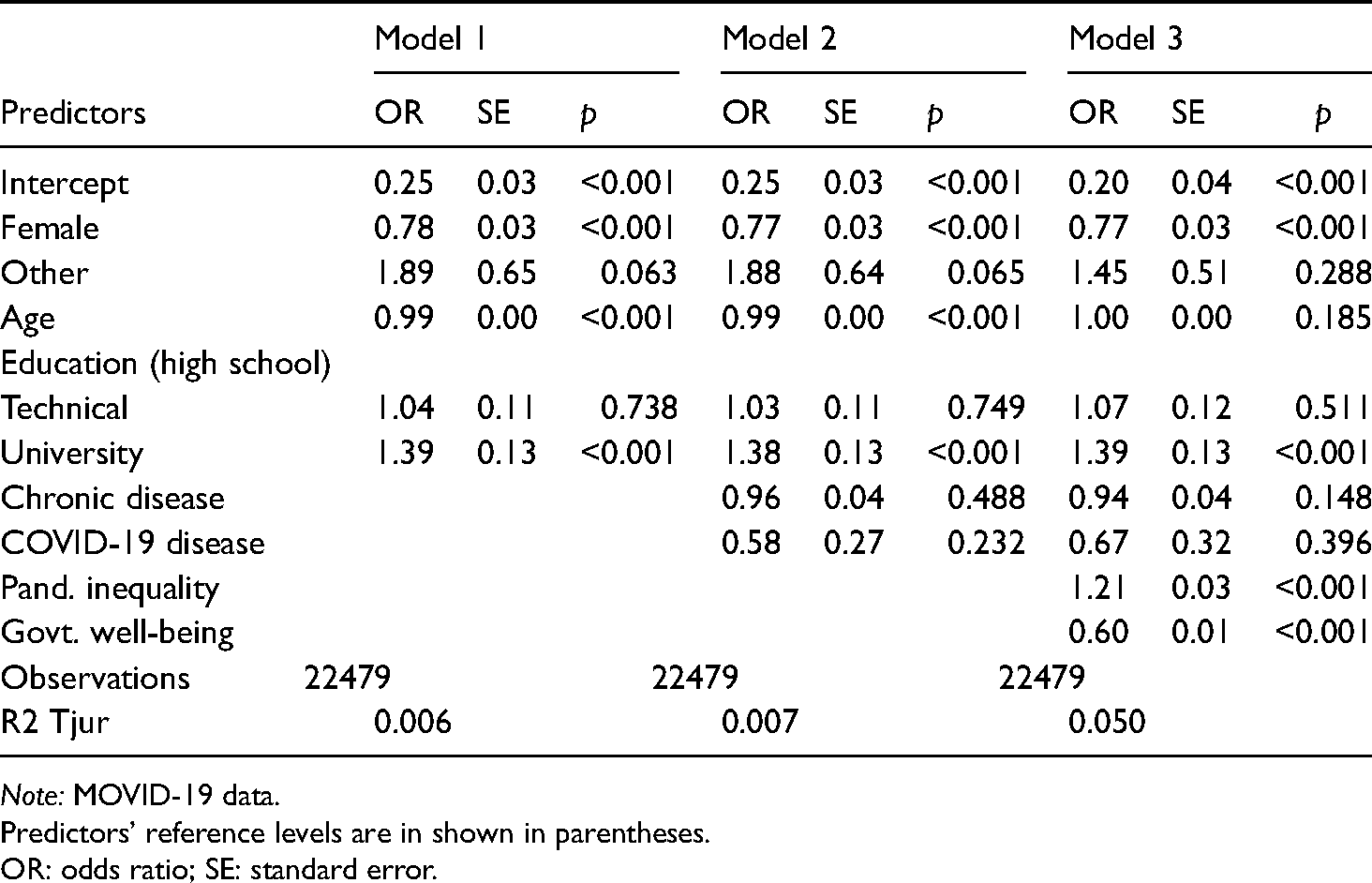
Table 1 presents the results of our first study. We find evidence that older respondents engage less in demonstrations, although the effect is rather small and practically irrelevant when controlling for pandemic grievances (Model 3). As in previous studies, we observe that having a university degree is associated with more engagement in street protests. Specifically, individuals holding a university degree have odds 41 percent higher of participating in protests than those with secondary studies (Model 3). Furthermore, females are less engaged in protests compared to men: the odds of participating in protests during the observation period are 22 percent lower for women compared to men. The health factors covered in this study do not exhibit a considerable impact on participation in protests, as neither having a chronic disease or having been diagnosed with SARS-COV-2 display a considerable difference in protest participation.
Binary Logistic Models Predicting Protest Participation.
Note: MOVID-19 data.
Predictors’ reference levels are in shown in parentheses.
OR: odds ratio; SE: standard error.
Overall, we find support for the relevance of pandemic grievances, signaling that injustice perceptions related to the pandemic motivate individuals to protest (Model 3). In line with the critical political conditions exhibited by the social uprising of 2019, these grievances appear connected with the sociopolitical conflicts and display a strong connection to protest participation. In particular, a stronger perception that the pandemic entails large inequalities for individuals is associated with higher odds of protest participation. Likewise, those who have a stronger evaluation that the government is not prioritizing the well-being of individuals also have higher odds of engaging in street protests. Finally, a strong disagreement with the duty to comply with health authorities predicts higher odds of participating in protests.
Study 2
The second study was conducted with two contributions. First, it includes more measurements to assess the determinants of protest participation in terms of biographical availability and health risks, including a direct assessment of perceived risks related to the pandemic. Second, while using a smaller sample, it considers a representative sampling design contributing to higher external validity of the results.
Data
MOVID-Impact consists of a nationally representative telephone survey conducted between 4 December 2020 and 22 December 2020. The fieldwork took place after the referendum for a new constitution, which implied a relatively calmer period of protest participation in comparison to the previous survey. The questionnaire was designed by a group of researchers from different Chilean universities and different disciplines (e.g. public health, sociology, psychology, and medicine). This survey captured a range of social, health, and economic outcomes related to SARS-COV-2. A sampling frame was constructed considering a multi-stage geographically stratified sampling procedure. 1261 complete responses were obtained through a random sample of this sampling frame. 61.9 percent of the sample were women, 36 were between 18 and 39 years old, 40.8 were between 40 and 64 years old and 23.2 were 65 years or older. The survey was implemented in computer-assisted telephone interviewing.
Measures
Participation in demonstrations: Respondents were asked whether during the last month they had participated in a public demonstration (2.9 percent reported having participated). 3
Biographical availability: Respondents reported their age (in years), gender (woman; man), and educational level (Less than high school, Completed high school or less, Technical qualification, and University degree). Employment status was measured considering last week as the reference period (employed, unemployed or inactive). The natural logarithm of household income (plus one) was used to account for background resources. 4 We also controlled for whether people lived in areas under mandatory lockdown during the previous month of answering the survey.
Health status and health risk factors: Apart from measuring if respondents had a chronic disease or had been diagnosed with SARS-COV-2 as in Study 1, we consider a health status indicator (very bad to very good in a 7-point scale). Additionally, we included two measures of compliance with physical distancing as indicators of health risks avoidance. Respondents provided information about the frequency with which they kept at least two meters away from people during the last week and avoided meeting more than 10 people in a closed place (a 5-point scale from Almost never to Always). 65 percent reported always avoiding being with more than 10 people in closed places, and 55 percent reported always keeping at least two meters away from other people. Finally, a measure of perceived risks of the Coronavirus was included (a 5-point scale from Not at all dangerous to Extremely dangerous).
Pandemic grievances: The same measurements as in Study 1 are considered. Additionally, we consider changes in household income due to the pandemic: respondents compared household incomes from November 2020 to November 2019 (decreased income; stable income; and increased income).
Analysis
We used the same analytical strategy as Study 1.
Results
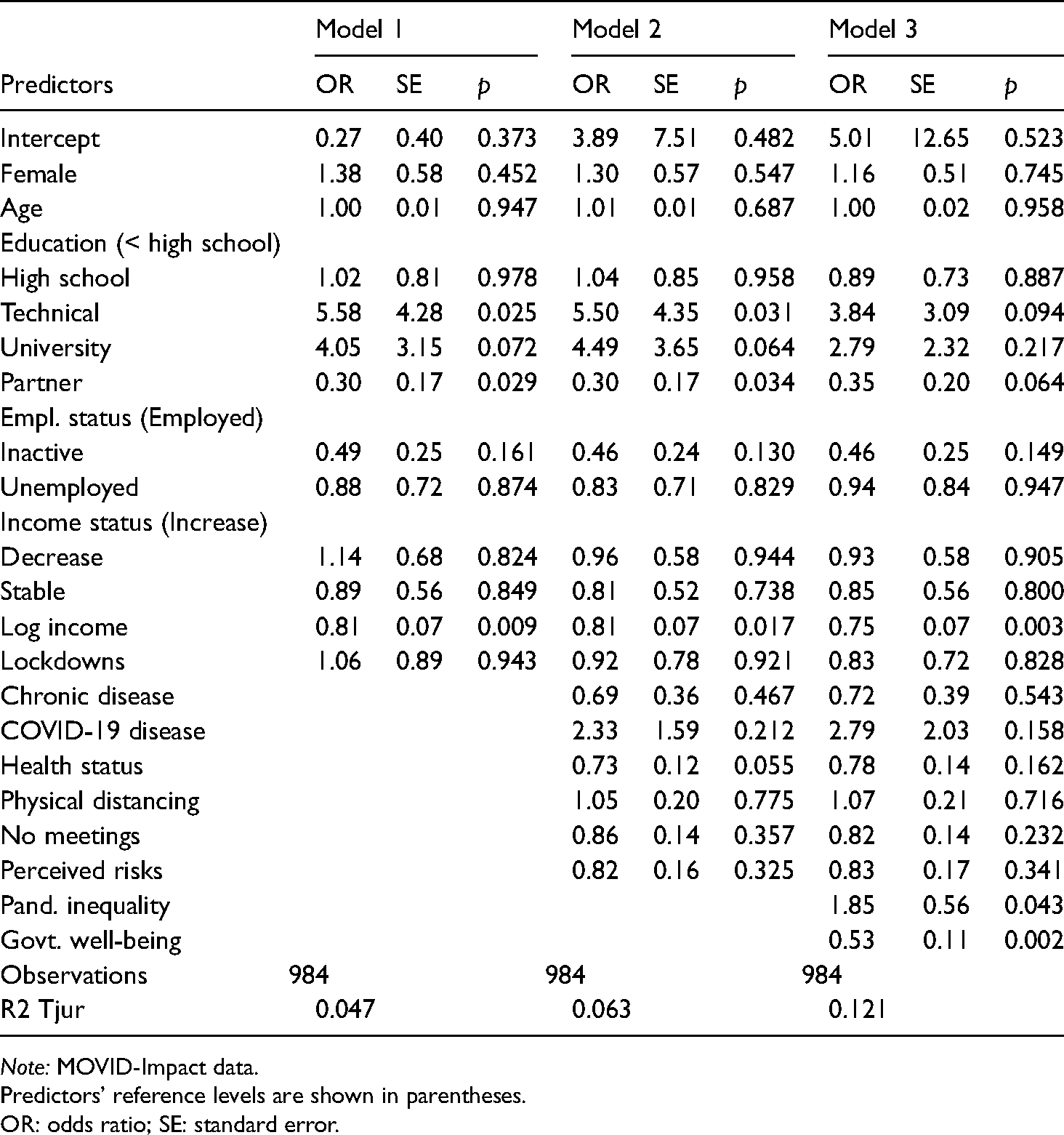
Study 2 results (Table 2) are generally aligned with the findings from Study 1. A higher educational level predicts higher chances of participating in demonstrations, although it is especially marked for those with higher education technical qualifications. As in the previous study, age does not exhibit a considerable effect on street protest participation. In contrast to Study 1, the effect of women being less prone to participate in protests is not replicated. Regarding the added biographical predictors of political participation, having a partner decreases the odds of engaging in demonstrations by 68 percent (Model 3), while a higher household income predicts less participation in street protests (contrary to the resources model). This might signal that the economic hardships derived from the pandemic (and the grievances about the government’s economic response to them) are strongly pressing lower income groups into the protest, thus reversing the expected effect of incomes.
Binary Logistic Models Predicting Protest Participation.
Note: MOVID-Impact data.
Predictors’ reference levels are shown in parentheses.
OR: odds ratio; SE: standard error.
Similar to Study 1, neither having a chronic disease nor having been diagnosed with SARS-COV-2 display considerable effects on protest participation. In the same vein, although having a better health status is associated with less participation in protests, this association is not considered in terms of magnitude. Furthermore, the risk factors considered in this study (practicing physical distancing, avoiding large meetings, and perceiving high risks of SARS-COV-2) do not display a considerable effect on street protest participation.
Finally, pandemic grievances appear in the same direction and roughly the same magnitudes as in Study 1, while there is no evidence that changes in household income compared to pre-pandemic levels enhance protest participation. This underscores the role of the political conditions that precede the pandemic, showing that previous conflicts stemming from inequality and political disaffection persist and motivate protest participation. Specifically, perceptions that the pandemic entails large inequalities for individuals are associated with higher odds of protest participation. Likewise, those who have a stronger perception that the government is not prioritizing the well-being of individuals have higher chances of participating in protests. Finally, a strong disagreement with the duty to comply with health authorities is related to higher odds of engaging in protests. 5
Discussion
Protests matter in Chile. Since the early 2000–2004, different social movements have shaped the policy agenda in significant ways (Bellei et al., 2014; Donoso and von Bülow, 2017; Puga, 2021). Therefore, it is key to understand the features of protesters and what drives individuals to engage in collective action in spite of the risks associated with the SARS-COV-2 pandemic.
Our results suggest that grievance factors played a much stronger role during the pandemic — at the expense of structural and risk factors. Our studies showed the strongest support for the role of pandemic grievances on participation in demonstrations. Individuals were more likely to have taken part in protests if they perceived large inequalities in protection and access to health during the pandemic (H3a), if they believed that the government was prioritizing the economy over individuals’ well-being (H3b) and if they disagreed with the duty to comply with health authorities (H3d). Only household income decrease (H3c) failed to affect participation. The accumulation of grievances resulting from the various protest waves that preceded the 2019 social uprising might have led to a situation similar to that described by Cobbina et al. (2021) in which protesting is considered a risk worth taking. Protesting in times of a pandemic can be conceptualized as a new type of high-risk activism, but very different from the one usually theorized in the literature.
In addition, our findings show limited support for the biographical availability model. We did find that people with a higher educational level (H1b), and people with no partner (H1c) were more likely to participate, but there were no differences in participation due to employment (H1e). Age had only a mild effect in one of the two studies, which disappeared after controlling for grievances (H1d). In contrast to the resource model, those with higher levels of income tended to participate less (H1a).
These results suggest that in the context of the pandemic in Chile several common predictors of participation in street protest have become less relevant. The negative effect of income might reflect a stronger effect of economic-related grievances in the context of this crisis. The weakening of the effect of employment might be explained by movement and workplace restrictions, which displaced a share of the labor force into telecommuting or temporarily leave and thus leveled the field of autonomy between those with and without a job. This could also explain to some extent the weakness of the age effect, which has been a central predictor of protest participation not only in Chile but also in comparative literature. Furthermore, the socialization spaces that usually foster younger people's engagement in protests have been severely reduced, as educational institutions have been functioning mostly online.
The political context in which the pandemic reached the country, however, likely plays a role here, too. As the protests of 2019 gained momentum, groups that usually protest less (such as older and lower-income people) have become more frequently involved in collective action, and thus possibly acquired relevant repertoires and dispositions to protest during the pandemic.
Second, we did not find support for the role of perceptions of health risks. Having a chronic disease (H2a), having had SARS-COV-2 during the pandemic (H2b), having a worse health situation (H2c), perceiving higher risks due to SARS-COV-2 (H2d), and taking physical distancing precautions during the pandemic (H2e) did not predict partaking in street protests.
While surprising, these results can be related to recent research on the Black Lives Matter protests during the pandemic in the United States. On the one hand, Cobbina et al. (2021) describe how for black protesters the risks associated with SARS-COV-2 are perceived as real, but also as negligible in comparison to the risks of police violence. Therefore, the latter is a much stronger deterrent for protest activity. Police violence is a much stricter test for how much risk black protesters are ready to incur into when protesting than contagion risks, and thus contagion risks retain little effect among those who would protest despite the risks of police violence. The violence of police repression in Chile during the last years (e.g. United Nations, 2019) puts Chilean activists in a similar situation. On the other hand, Cobbina et al. (2021) also describe how protesters, many of them with underlying health issues and other risk factors, generally incur into calculated risks to protest during the SARS-COV-2 crisis. Consciousness of health risks thus does not necessarily deter protesters, but rather drives them to engage in practices of risk mitigation insofar as protest motivations are strong enough. Thus, it makes sense that perceived health risks do not predict participation as strongly, but that a general context of higher health risks makes grievance predictors stronger.
The stronger role of grievances should be also pondered in the light of two literatures that are not usually at the centre of collective action debates. On the one hand, there is the role of emotional processes in triggering events of protest (Jasper, 2011). Several authors have stressed that the social isolation and the uncertainty associated with this pandemic intensifies the emotional response to experiences of injustice, thus potentially fostering social conflict and unrest (cf. Andrews, 2020; Grant and Smith, 2021). Grievances, then, become emotionally significant in the current context. On the other hand, there is the historical experience of pandemics as silent social incubators of unrest (Censolo and Morelli, 2020; Hays, 2005; Snowden, 2020). Here, emotions combine with economic hardships and with authorities’ sanitary responses — which often prioritize elites’ interests — while opportunities for expressing dissent reach extreme lows. It thus makes sense that opportunity costs and risk assessments play smaller roles during pandemics, while simmering grievances become key factors for the stalwart activists which remain active. As the sanitary crises wear off and political opportunities return to previous levels, however, we can expect these accumulated grievances to burst out. Considering the previous context of social unrest in Chile, it seems likely then that social conflict and massive protests will return in the near future. These future protests would be driven by strong grievances, which are being nurtured and silenced by the pandemic context. However, the open process of constitutional change in Chile and its potential to effectively channel these silenced grievances might become crucial in avoiding the second Chilean revolt.
Conclusions
In this article, we examined the predictors of protest participation during the SARS-CoV-2 pandemic in Chile. In a world where SARS-COV-2 will most likely be — to a greater or lesser degree — a reality in our lives, it becomes more and more relevant to understand the factors that may motivate or discourage people from participating in protests in said context. Health risk factors, lockdowns, and pandemic grievances are all new factors that can change the ways in which people demonstrate. In this article, we have analyzed participation in the context of this pandemic reality. We have done so by analyzing a particularly interesting case: Chile in the aftermath of a social uprising that by the end of 2019 evidenced low trust in political institutions among Chileans. We analyzed two surveys measuring protest participation and comparing three predictive models (biographical availability, perceptions of health risk, and grievances). Our findings showed the strongest support for grievance-related factors in predicting participation in demonstrations: protest participation was strongest among those who perceived large inequalities in health access during the pandemic, and those who perceived the government to disregard individuals’ well-being.
The contributions of this analysis to the mobilization literature are several. On the one hand, we disentangle the effects of different explanatory factors for street protest participation in the context of the SARS-COV-2 pandemic. Our findings show that in this critical juncture the structure of protest determinants changed importantly: classical factors related to biographical availability severely weaken, while grievances derived or highlighted by the pandemic and the government response become the most salient predictors. Health risks, on the other hand, which are arguably life-threatening yet do not bring the same emotional response as risks related to political repression, do not seem to affect the likeness of participation. All considered, our research points to the strengthening of grievances and thus of the political framing of social conflict as a factor explaining social mobilization in this context.
Besides the general consideration of the SARS-COV-2 pandemic as a context, our findings regarding the role of health risks are a relevant contribution as well. While this context serves to propel these risks to the fore, they exist to different degrees in any historical context. The lack of evidence for these risks affecting participation in protests, even when they are expected to be most visible and to affect larger social groups, calls for revisiting the problem of risk avoidance as a determinant of protesters’ behaviour.
Some limitations to this study should be considered. First, most variables correspond to single-item measures and this may affect construct validity. Future research should seek to replicate these findings using measures that capture the whole complexity of the constructs considered in this article. Second, self-selection bias might occur in Study 1, in which people concerned with SARS-COV-2 are probably more likely to participate in our panel survey. Third, adjusting the design in line with the causal inference literature would contribute to providing stronger evidence of the causal direction proposed in our article. One might wonder whether participating in protests could indeed increase perceived grievances or affect people's likelihood of getting SARS-COV-2. Hence, future research should replicate these findings with more robust designs.
Footnotes
Declaration of Conflicting Interests
The author(s) declared no potential conflicts of interest with respect to the research, authorship, and/or publication of this article.
Funding
The author(s) received no financial support for the research, authorship, and/or publication of this article.
