




Abstract
We know a great deal about how individual and institutional factors combine to explain economic voting in well-established democracies, but much less is known about these dynamics in younger democracies and even less so in subnational contexts. Using survey and fiscal data from four federal Latin American countries and adopting a multilevel estimation strategy, we examine voters’ ability to blame and reward governors for the state of the economy (state and national levels) while simultaneously accounting for the states’ level of fiscal centralization and partisan dynamics between the two levels. We find that support for governors is weakly associated with the economy but more strongly so with presidential approval. More importantly, we find that fiscal centralization and partisan dynamics moderate the association between the economy, presidential approval, and support for governors. Little support is found, however, for the clarity of responsibility argument in multilevel governance in these Latin American countries.
Keywords
Introduction
Recent efforts in Latin America to decentralize governance were primarily focused on enhancing democratic quality. This involved promoting greater participation and better representation (Diamond, 1999; West, 2015). While many scholars have explored this trend, the crucial aspect of accountability – a key component of democratic quality outlined by Diamond and Morlino (2005) – has often been overlooked. Democratic values prescribe that politicians must be held accountable for their decisions through punitive or rewarding measures by the electorate (Diamond and Morlino, 2004). Kramer (1971) explains this concept through a reward-punishment model, where voters reelect incumbents for satisfactory performance or oust them for poor performance. This model is particularly relevant to economic issues (Lewis-Beck and Paldam, 2000), including in Latin America mostly at the macrolevel (e.g., Benton, 2005; Carlin et al., 2015a; Johnson and Ryu, 2010; Love and Windsor, 2018; Singer, 2013; Singer and Carlin, 2013), but also at the microlevel (e.g., Gélineau and Singer 2015; Nadeau et al., 2017, Chap.5). Yet, effective accountability rests on the assumption that citizens can discern between representative and unrepresentative governments to appropriately sanction them (Przeworski et al., 1999). Consequently, the essence of accountability is conditional upon citizens’ capacity to accurately identify which government is truly accountable for the state of the economy. Thus, we ask: How do varying degrees of multilevel governance affect the ability of voters to hold their incumbents accountable for the current state of the economy?
In past decades, scholars have been particularly interested in understanding how well the reward-punishment model travels to other contexts, with a particular interest in the role of the economy. Analyses both at the aggregate and individual levels show some heterogeneity, with the economy exerting strong effects in some countries and much weaker ones in others (e.g., Blais et al., 2004; Lewis-Beck, 1988). The most notable contribution in that field is that of Powell Jr and Whitten (1993), who argued and showed that the economy has its strongest effect on the vote when institutional arrangements make it clear who is to be held responsible. This “clarity of responsibility” argument has spurred an entire research agenda and motivated scholars to propose several critiques and refinements (e.g., Anderson, 2000; Dassonneville and Lewis-Beck, 2017; Duch and Stevenson, 2013; Valdini and Lewis-Beck, 2018).
The vast literature that grew out of Powell Jr and Whitten (1993) work identifies horizontal (e.g., strong committees and bicameralism) and vertical (e.g., multilevel governance) factors that may increase or blur responsibility assignment. Other scholars also argue that it is crucial to separate institutional from government clarity (Hobolt et al., 2013). Institutional clarity deals with the “rules of the game” and concerns the institutional concentration of power. These rules are country-specific and do not vary much over time. On the other hand, government clarity is about the “cohesiveness” of the incumbent government (e.g., single-party government, ideologically cohesive coalition) and can vary greatly over time within a given country. In addition to institutional and government clarity, other research shows the importance of individual-level factors like partisanship and political sophistication. These individual-level characteristics can promote or hinder the application of the reward-punishment model by voters (Cutler, 2008; Rudolph, 2003a, 2003b).
Much has been learned about the way individual, institutional, and government factors combine to condition economic voting. The vast majority of these findings, however, rests on studies of economically developed and well-established democracies (mostly Europe, Canada, and the U.S.). In fact, not much is known about the dynamics of economic voting in recent democracies, except for the notable contributions by Echegaray (2005), and more recently Gélineau (2013), Carlin et al. (2015a) and Valdini and Lewis-Beck (2018) on Latin America. Similarly, multilevel governance—one very important and contentious factor affecting the “clarity of responsibility”—is also often overlooked. Yet, when powers and responsibilities are divided among different levels of government, voters may find it harder to identify who is responsible for the national and regional states of the economy. Most work on multilevel governance merely separates federations from unitary countries without considering the degrees of centralization or decentralization of powers and responsibilities that characterize country-specific institutional arrangements.
To explore how multilevel governance affects the ability of voters to hold their incumbents accountable for the state of the economy, we examine four large Latin American federations, namely, Argentina, Brazil, Mexico, and Venezuela. All four countries were recently (re)democratized and have multilevel governance structures. Most importantly for present purposes, these four federations afford for varying degrees of decentralization, both between and within them. This variation allows us to better identify how decentralization affects voters’ ability to reward or punish incumbents for good or bad economic conditions. By combining fiscal country-level and public opinion data, as well as adopting a multilevel estimation strategy, we find that support toward incumbent governors is affected by the president's performance, especially when the governor is from the same party as the president. State-level economy also appears to matter more than national-level economy. Yet, this state-level retrospective voting dynamic is moderate and does not appear to be affected by the states’ level of centralization.
In what follows, we present an extended discussion of the literature about how individual and institutional factors condition economic voting, with a particular interest on multilevel governance. Next, we discuss subnational-level elections and elaborate a series of hypotheses. We then give details about the data and methods before presenting the results of our analysis. We conclude with a brief discussion of our findings and their implications.
Clarity of Responsibility, Accountability, and Multilevel Governance
A significant dimension that characterizes nearly all democracies is that of multilevel governance. 1 There has been an important push toward decentralization in recent decades, and newly democratized countries did not escape this trend. One of the reasons explaining this pattern is the fact that decentralization is believed to bring about increased efficiency and responsiveness (Weingast, 1995). In short, it is widely thought that by decentralizing powers and responsibilities, local governments can provide public policies that are better tailored for local problems and needs. Moreover, local governments are believed to respond and adopt best practices more quickly and more effectively than a central government. It is also believed that voters, by being closer to their local public officials, can keep them more accountable and responsive to local demands. Benefits related to efficiency have been studied extensively, but only very recently have scholars looked at questions of responsiveness and political representation. The findings have been more contentious (Brzinski et al., 1999).
In fact, the extent to which decentralization helps or hurts voters in holding their elected officials accountable is questionable (Downs, 1999). From a normative standpoint, local and regional governments, by being closer to their electorates, should be more accountable. Yet, direct evidence of this claim is slight. The greatest concern about accountability and economic voting is that citizens are bad at assessing the real control politicians hold over economic conditions and other external events (Achen and Bartels, 2017). Achen and Bartels (2017) suggest that voters make “systematic attribution errors” by misattributing economic fluctuations to the actions of incumbents. Additionally, multilevel governance can obscure responsibility by making it harder for voters to identify “who is in charge” and, consequently, punish or reward the responsible government. In the case of decentralized countries in Latin America, findings by Remmer and Gélineau (2003) and Gélineau and Remmer (2006) suggest that voters are unable to clearly differentiate the economic responsibilities that lie with national versus subnational government officials. The public's apparent difficulty in distinguishing between local and national economies, or in holding local leaders accountable, highlights the challenges of achieving accountability in decentralized systems.
Several scholars, using individual-level data, have examined more directly voters’ ability to assign responsibility and hold governments accountable under multilevel governance systems. The bulk of the work has examined Canada and the U.S.− as well established democratic federations − but also the European Union as a particular case of multilevel governance (e.g., Arceneaux, 2005, 2006; Atkeson and Partin, 1995; Cutler, 2004, 2008; De Vries et al., 2011; Hobolt and Tilley, 2014; Orth, 2001; Stein, 1990). The findings are mixed. Some studies show that multilevel governance blurs responsibility (Cutler, 2008) and decreases accountability (Anderson, 2006; Cutler, 2004). Other findings, however, show that voters are generally able to identify which level of government is responsible for what (Arceneaux, 2005, 2006; Johns, 2011), even if they do not necessarily use that knowledge in their voting decisions (Johns, 2011). The relationship between accountability and multilevel governance might even be more complex. For instance, Arceneaux (2006) finds that voters use knowledge about the responsibilities of distinct levels of governance, but only for those issues that are highly accessible.
The European model of clarity of responsibility, however, does not fully translate to the Latin American context, where different electoral systems and institutional arrangements significantly alter its applicability (Valdini and Lewis-Beck, 2018). Yet, limited scholarship has tackled this question in Latin America. Notable exceptions include Escobar-Lemmon and Ross (2014), who estimate the effect of administrative, fiscal, and political decentralization on voters’ perceptions of government accountability. The authors find that decentralization, especially in its administrative and fiscal forms, can improve perceptions of subnational government accountability. Moreover, in a study of 18 Latin American countries, Singer and Carlin (2013) suggest that the capacity of voters to effectively hold incumbents accountable is enhanced when the political, economic, and institutional contexts clarify who is responsible for economic performance. This principle implies that within decentralized governance structures, where authority is more directly aligned with local constituencies, voters are more inclined to hold incumbents accountable for poor economic performance. These pieces of evidence provide a useful theoretical basis for our inquiry. Finally, in a related topic, Zechmeister and Zizumbo-Colunga (2013) show that the state of the economy significantly influences how much citizens hold the incumbent executive accountable for corruption in Latin America. When the economy is perceived as strong, the impact of perceived corruption on presidential approval diminishes. Yet, it remains unclear whether voters’ hold incumbents accountable at the national or subnational levels.
Most of the work in the area treats multilevel governance as the presence (or not) of two or more levels of government. Such a binary categorization, though, hides the nuance in the levels of centralization that exists among different institutional arrangements. In fact, some countries devolve way more powers and responsibilities than others. Even within each country, the level of decentralization can vary substantively. One notable exception is the work by Anderson (2006) that examines 16 countries and accounts for degrees of decentralization. Anderson, however, only considers economically developed countries and does not account for within-country variation. Yet, not considering within-country variation in decentralization is an important shortcoming as it varies greatly within one country, which can result in heterogeneous institutional effects among voters of the same country.
This shortcoming is well tackled by León (2011) and León and Orriols (2016) in her work on Spain. León indeed accounts for within-country variation, but her measure of decentralization, contrary to Anderson, is less precise. Specifically, León classifies Spain's autonomous communities into three groups: slow, mixed, and fast track regions. This classification refers to low, moderate, and high levels of decentralization in terms of expenditure and revenue powers. León uses this classification to differentiate layer and marble cake models of federalism, an analogy borrowed from Grodzins (1966). Layer cake model of federalism refers to a situation where powers are centralized at one level of government, either central or regional, while the marble cake model is characterized by shared authority between levels of government. As expected, economic voting is strongest when federalism follows the layer cake model because under such arrangement voters can more easily attribute responsibility to the appropriate level of government. When the power is shared between different levels of government, as in the marble cake model, responsibility assignment is more obscured.
Acknowledging that countries exhibit varying degrees of decentralization between and within them, we propose to evaluate the extent to which decentralization conditions the effect of the economy on vote choice. We do so by considering vote intention at the regional (governor) level of government in four large federations of Latin America (Argentina, Brazil, Mexico, and Venezuela). We also account for both the state of the national and regional economy and afford a precise measure of decentralization à la Anderson.
Governors and the Economy
There is an extensive literature, especially from the U.S., about the nexus between economic performance and incumbent support at the subnational level of government. One view posits that governors are evaluated based on the president's performance as well as on the state of the national economy (Carsey and Wright, 1998; Simon, 1989; Simon et al., 1991). The expectation is that voters use subnational elections to signal their displeasure with the president and the national economy. If voters are satisfied with the president's performance and evaluate the national economy positively, subnational politicians will be rewarded. Conversely, if voters are unhappy about the president and the state of the national economy, subnational office holders will be punished. This referendum voting model assumes that individual voters do not acknowledge the governors’ independent economic policy inputs. According to this model, presidents are central political figures around which both national and subnational politics revolve. As such, the fundamental logic of the referendum model implies that individual voters send messages to the central government when voting for governors. Moreover, a slightly modified version of the referendum voting model posits that in-party governors are blamed and rewarded more strongly for national economic performance and president's performance than out-party ones (Stein, 1990).
Another view builds on the premise that “the responsibility of managing the state economy is laid at the feet of the governor” (Atkeson and Partin, 1995, 100), and suggests that governors are evaluated based on state-level rather than national-level economic performances (Leyden and Borrelli, 1995; Niemi et al., 1995; Partin, 1995). Drawing on theories of retrospective voting (Downs, 1957), this view implies that individuals punish incumbent governors for deteriorating state economic conditions and reward them for improving state conditions. This second view assumes that voters recognize the independent policy-making role played by governors. In the U.S. context, subnational governments adopt administrative behaviors that are believed to affect the states’ economic conditions like recruiting businesses through tax incentives and providing them with cheap land, for example (Atkeson and Partin, 1995). This gubernatorial retrospective voting model also assumes that governors are central figures in state politics. The approach recognizes that, just like presidents, governors are visible “targets of discontent” (Kirschten, 1990). In fact, evidence from the U.S. has shown that the governor is the second most recognized elected official, behind the president (Squire and Fastnow, 1994).
The role of governors in the region's economic and political landscape is unquestionable. In many ways, Latin American governors are no different than U.S. governors in that they also enjoy significant economic policy-making powers and responsibilities. The (re)democratization processes that started in the 1980s in the region have transferred increased decision-making powers to subnational governments (governors and even mayors, in some cases), making them central actors in the provision of public policies but also in the management of economic affairs (Bossyut, 2013). Latin American governors, just like their U.S. counterparts, also enjoy a high degree of public visibility. Indeed, it is not rare to see governors in Latin America use their office to propel their career to higher grounds. Governors often become presidential candidates, and even presidents, as in the case of Néstor Krichner of Argentina, Fernando Collor de Mello of Brazil, Henrique Salas Romer of Venezuela, and Enrique Peña Nieto of Mexico.
At the same time, and despite recent trends of decentralization, economic policymaking in Latin America remains highly centralized in the hands of the national executive (Mainwaring, 1997). Precisely, the role played by presidents in implementing stabilization and adjustment efforts, especially in times of economic crisis, may overshadow the independent role played by governors in economic policymaking. Governors may be seen as mere local managers working for the central government and may be evaluated on the basis of the president's performance, as suggested by the referendum voting model.
Thus, on the one hand, the role governors play in state economic management combined with their reasonably high public visibility suggest that governors should be held accountable for state/provincial economic performance. On the other hand, the central role played by presidents in economic policymaking and their much higher public visibility suggest that governors will take a back seat and will rather be evaluated on the basis of the president's performance as well as on the state of the national economy.
Yet, as discussed earlier, the extent to which incumbent governors are blamed or rewarded for the economy is shaped, in part, by citizens’ ability to attribute them responsibility. Where the attribution of responsibility is easy to establish, economic voting should be high. Conversely, where the attribution of responsibility is difficult to establish, the relationship between economic performance and vote choice should be weaker. Our interest here is with multilevel governance and how such institutional arrangement can promote or blur responsibility assignment. Like León (2011), we expect that economic voting is strongest when institutions concentrate powers at one level of government or another (the layer cake model of federalism) because such arrangement makes it clearer “who is in charge.” Specifically, in states that are more fiscally independent from the central government (i.e., that are decentralized), governors should be blamed/rewarded for their own economic regional performance. In these cases, given governors greater role in policymaking, voters perceive that governors are in large part responsible for the state economy and should, therefore, be held accountable for it. Little should the national politics dynamic affect support for governors when states are more fiscally independent.
The logic in states that are more highly fiscally dependent from the central government (i.e., that are centralized), however, is quite different. Voters should be less inclined to hold governors responsible for the state of the regional economy because little do they have to do with it. Instead, their support should be more heavily associated with the president's performance, as defined by the state of the national economy and presidential popularity. Moreover, the role of national politics on gubernatorial support in fiscally dependent states should be particularly strong when the governor and the president are both from the same party because they are viewed as being from the same “team.”
Thus, three hypotheses emerge from the previous discussion:
H1: Referendum voting model: In fiscally dependent states, governor's support follows national politics. Specifically, governor's support increases (decreases) with positive (negative) evaluations of the national economy and presidential popularity;
H2: Gubernatorial retrospective voting model: In fiscally independent states, governor's support is more strongly associated with the state of the regional economy. Specifically, governor's support increases (decreases) with positive (negative) evaluations of the state of the regional economy;
H3: In-party effect: In fiscally dependent states, governor's support follows even more strongly national political forces when both the governor and the president are from the same party.
Data and Methods
To evaluate the three hypotheses presented above, we rely on a hierarchical approach that nests individual voters (level 1) in states (level 2). We consider four large Latin American federations for our analyses: Argentina, Brazil, Mexico, and Venezuela. There are 23, 26, 31, and 23 states in Argentina, Brazil, Mexico and Venezuela, respectively, and a Federal District in each of the four countries. The individual level data are from the 2010 wave of the AmericasBarometer survey. 2 The AmericasBarometer is not an election study but gathers nevertheless a handful of information about political attitudes, preferences, and behaviors. In particular, it asks respondents’ vote intention toward the incumbent governor or an opposition candidate if a gubernatorial election were to be held. We use this question to create our dependent variable where a vote intention for the incumbent governor is coded 1 and other vote choices are coded 0. This has been standard practice in recent work on vote choice in Latin America (e.g., Carlin et al., 2015b; Nadeau et al., 2017). The AmericasBarometer also asked respondents about their evaluation of both the state-level and the national economies and their approval of the president's job. 3 These three variables constitute our individual-level independent variables. Our dataset contains a total of 6834 respondents in the four countries under study. The analyses presented below, however, rely on only 3556 observations because many respondents from the AmericasBarometer were reluctant to report their vote preference. 4 Further analyses revealed that data was predominantly missing in Brazil. Details about the exact question wording and coding are provided in Appendix A.
At the state level, we identify states in which the governor is from the same party as the president (1) or from a different party (0). This variable allows us to evaluate the hypothesis about the in-party effect. Finally, and more importantly for our purposes, we create an additional state-level variable that measures fiscal centralization, i.e., the extent to which the state is dependent from the central/federal government. The variable fiscal centralization represents the per capita amount transferred from the federal government to the state in purchasing power parity (PPP). The variable was then standardized by subtracting the overall country-specific mean and dividing it by its respective standard deviation. Note that higher values indicate greater centralization. We acknowledge that it would have been preferable to use a more standard measure of fiscal autonomy like total transfers over states expenditures, but comparable data were not available in all four countries. In Brazil, where fiscally data is more easily available, we find our measure of centralization to be highly correlated with such measure (Pearson's r of 0.67). This is an indication that our measure is close to our concept of interest of centralization. Figure 1 shows the distribution of our centralization variable. This variable presents some variation both between and within countries. In particular, we find greater variation in centralization/decentralization in Argentina, Mexico, and Venezuela, as compared to Brazil. Fiscal data were obtained from each country's national statistical office.
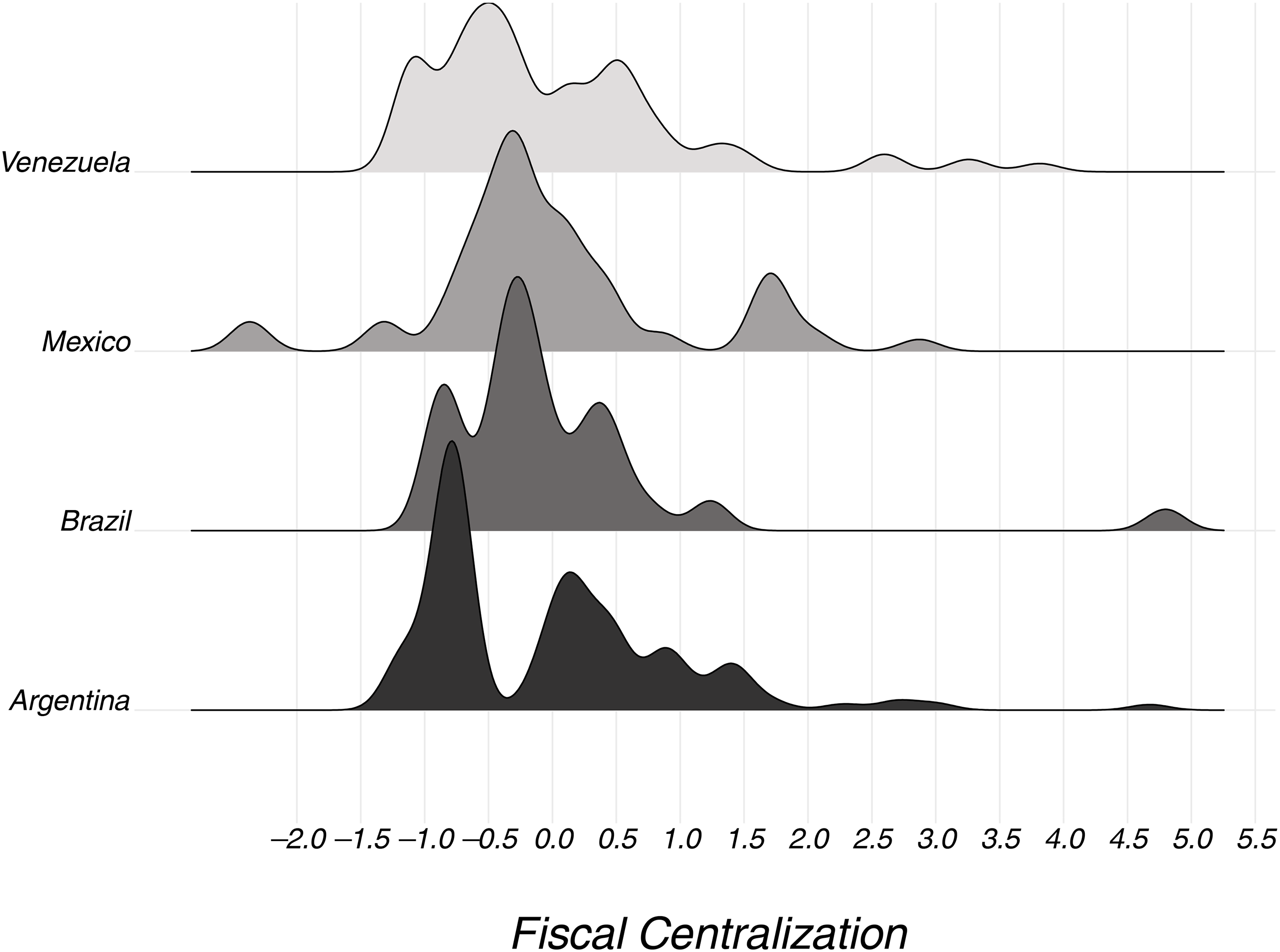
Distribution of the Centralization variable.
Finally, the individual-level and state-level data were merged to allow estimation of a multilevel logistic regression model with random intercepts. Details about the data, including the number of subnational units included in the analysis and the number of respondents embedded in these subnational units are provided in Table B1 in Appendix B.
Results
The results of the multilevel logistic regressions are presented below. To ease the interpretation, predicted probabilities are visually represented, but the full regression model results are presented in Table B2 in Appendix B. 5
Figure 2 shows the results testing the first hypothesis related to the referendum voting model. We want to determine whether governors’ support is affected by national dynamics like the economy and the president's overall performance. The left panel of Figure 2 suggests that the evaluation of the national economy is not related with governors’ vote intentions, independently of the level of fiscal centralization/decentralization. 6 This finding is contrary to the referendum voting model (H1) where we expect governor's support to increase (decrease) with positive (negative) evaluations of the national economy in states that are fiscally dependent from the national government (i.e., the centralized states). The relationship between presidential approval and gubernatorial support (presented in the right panel of Figure 2) indicates that, in centralized states, a well-rated president is positively correlated with the probability of support for governors. This finding is in line with the referendum voting model (H1). In contrast, in decentralized states this relationship is reversed, although the relationship is weaker than in centralized states. We will return to this last finding later as we explore partisan dynamics. In sum, the findings from Figure 2 are partially supportive of the referendum voting model (H1) that stipulates that in fiscally dependent states, governor's support follows national politics. Specifically, governor's support increases (decreases) with positive (negative) evaluations of the president in centralized states.
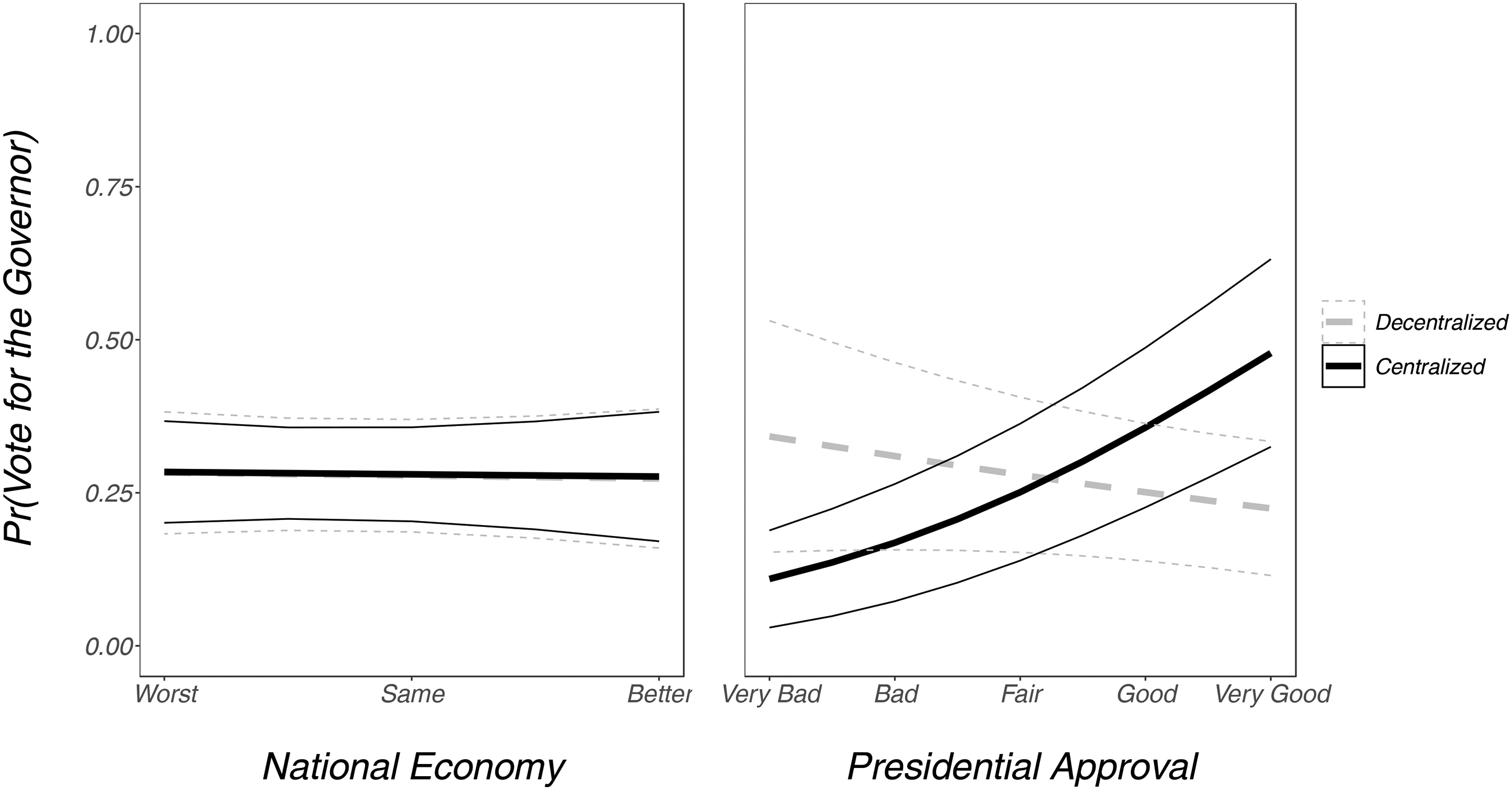
Referendum Voting Model (H1).
Figure 3 shows that voters reward (punish) their governors when they perceive the state-level economy to be better (worst). The steepness of the slopes suggests, however, that this effect is only moderate, independently of the level of fiscal centralization/decentralization. Contrary to H2, governor's support is not more strongly related to the state-level economy in decentralized states, as compared to states that are more fiscally dependent from the national government. Recall that the gubernatorial retrospective voting model hypothesis (H2) expects governors from more fiscally decentralized states to have more leverage on their state's economy, and thus should be more rewarded (punished) by the voters for their economic success (failure) than governors who do not have as much leverage. To be sure, the results from Figure 3 do not provide support for the “clarity of responsibility” argument, according to which fiscally decentralized institutional arrangements clarify the governor's responsibility over the state's economy. These results clearly show that in Latin America, traditional models of economic accountability at the subnational level do not hold (Remmer and Gélineau 2003; Gélineau and Remmer 2006).
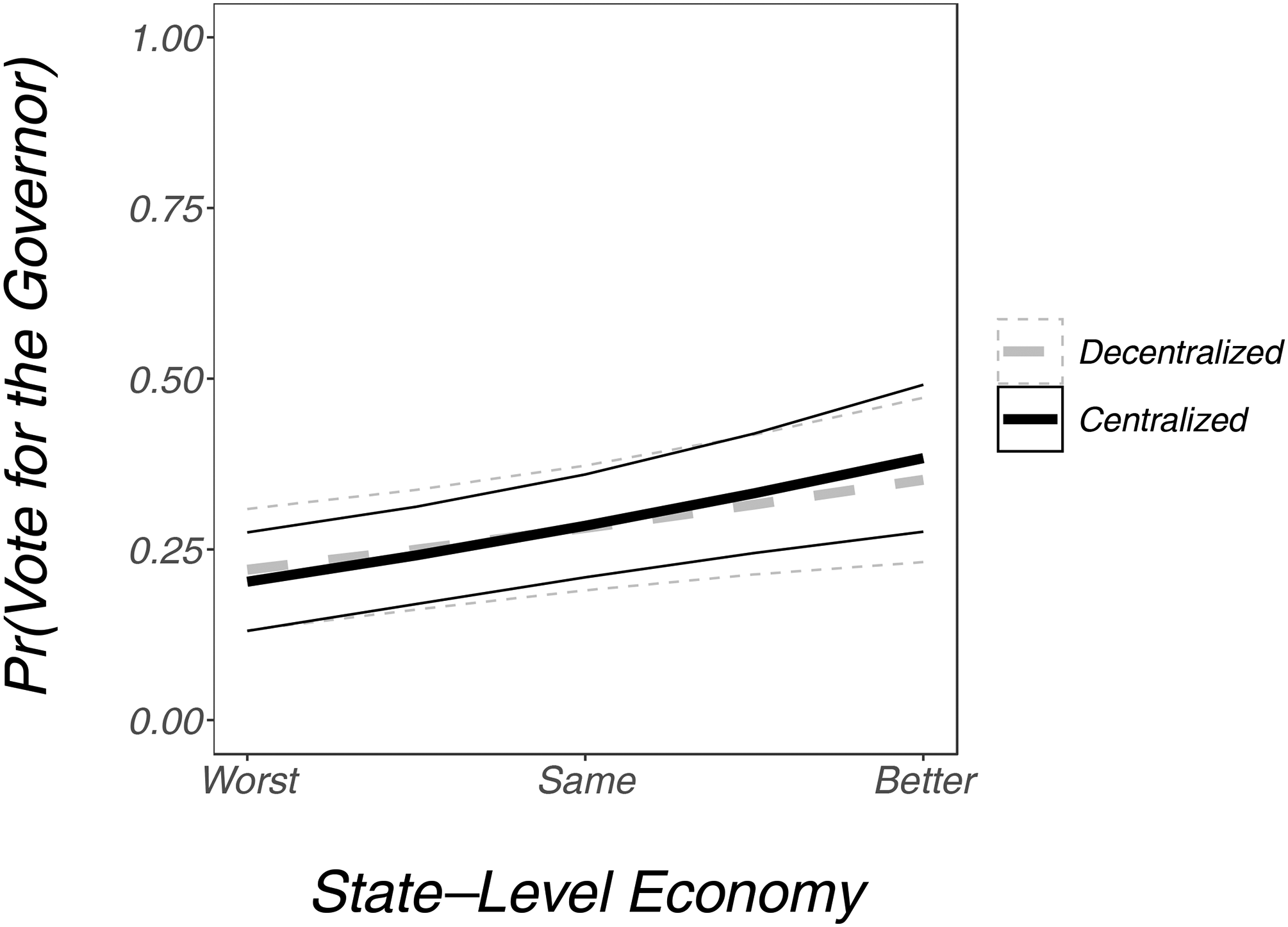
Gubernatorial Retrospective Voting Model (H2).
Finally, the last series of graphs presented in Figure 4 show how the level of centralization/decentralization of states interacts with the partisan affiliation of presidents and governors. Figure 4 presents four panels with the top two showing findings for centralized states and the bottom two those for decentralized states. The dynamics in both types of states present similarities but also notable differences. Let's first look at the effect of the national economy on the probability to vote for the governor. The results indicate that, in centralized states (upper left panel), in-party governors do not benefit from better evaluations of the national economy. To the contrary, in-party governors in centralized states see their vote probability decrease as the state of the national economy improves. Out-party governors in centralized states, for their part, benefit from more positive evaluations of the national economy. The lower left panel of Figure 4 shows the opposite dynamic in decentralized states. Precisely, as the evaluation of the national economy improves, the higher (lower) the probability to vote for in- (out-) party governors. Together, these findings do not support the idea that the electoral success of in-party governors in centralized states is more closely tied to the national economy than that of governors in decentralized states, as stipulated in H3.
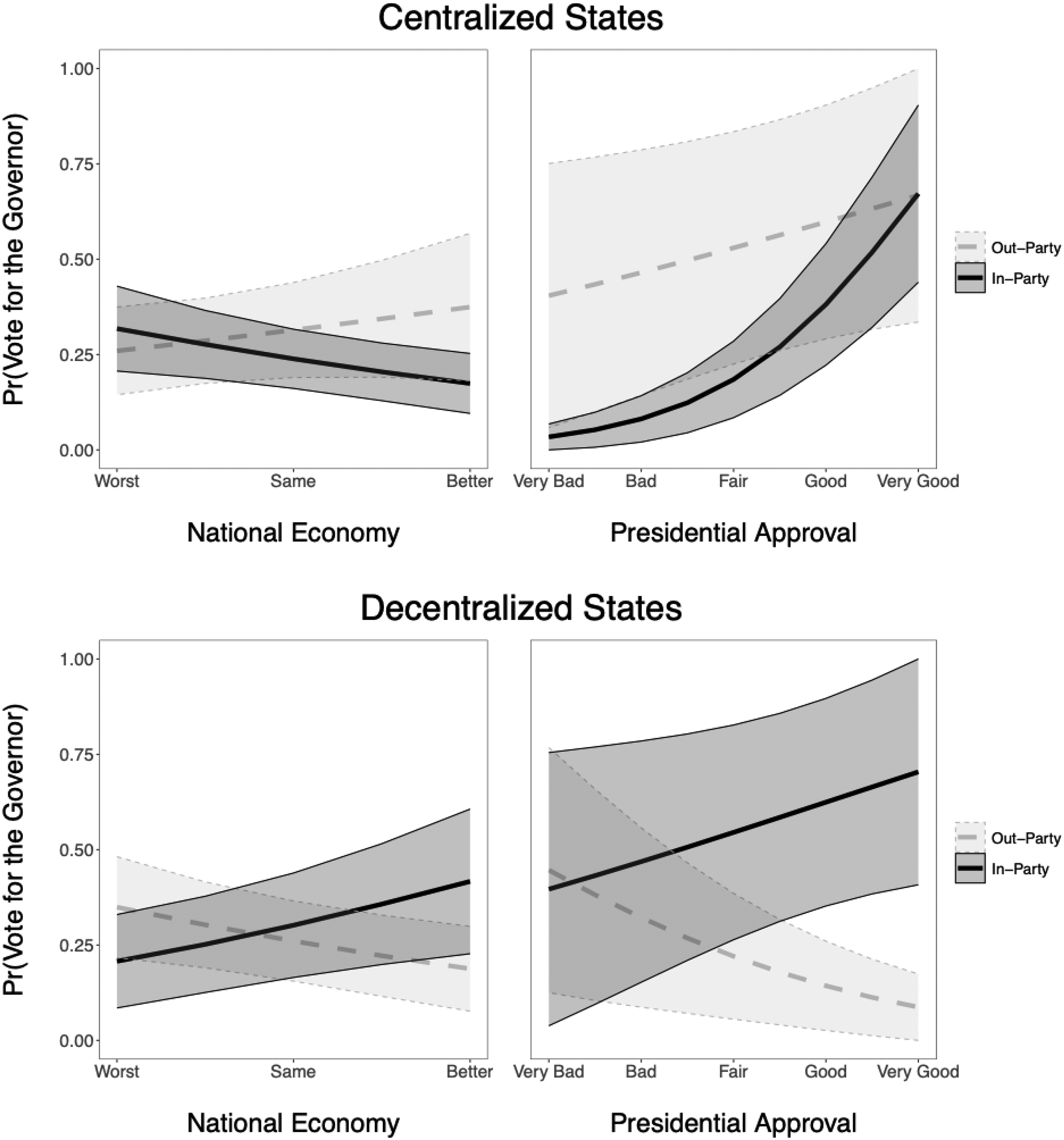
In-Party Effect of the National Dynamics (H3).
We move next to how presidential approval relates to support for governors. In centralized states (upper right panel of Figure 4), we see that support for in-party governors is closely tied to presidential approval, as expected by H3. The relationship is very strong, as shown by the steepness of the curve, suggesting that support for in-party governors follows very closely presidential approval. That same panel shows that presidential approval is also positively related to support for out-party governors although the strength of the relationship is weak. Interestingly, the lower right panel of Figure 4 shows that support for out-party governors is negatively related with presidential approval in decentralized states. This finding makes sense as the fate of governors in more fiscally independent states should be less tied to national political forces like presidential approval. In decentralized states, support for in-party governors is positively related with presidential approval, although not nearly as strongly as in centralized states, as expected by H3.
In sum, the findings from Figure 4 show mixed support for our third hypothesis that stipulates that, in fiscally dependent states (i.e., centralized states), governor's support should follow even more strongly national political forces when both the governor and the president are from the same party. What we find is that although in-party governor's support is closely associated with the president's popularity in both centralized and decentralized states, it is slightly more so in centralized states as expected by H3. The findings for the state of the national economy, however, run counter to H3. Again, this last finding suggests that voters have a hard time to clearly differentiate the economic responsibilities that lie with national and subnational government officials, as found by Remmer and Gélineau (2003) and Gélineau and Remmer (2006).
Figure 4 reinforces the idea that partisan factors play an important role. Precisely, we find that presidential approval significantly affects support for the governor, but differently depending on whether the governor is from the same party as the president or not and in a centralized state or a decentralized one. Recall the finding between presidential approval and support for governors shown in the right panel of Figure 2 above. It showed that presidential approval was strongly and positively (negatively) associated with governors’ support in centralized (decentralized) states. The upper and lower right panels of Figure 4 shed light on this result by indicating important partisan dynamics. These two panels show that presidential approval and in-party governors’ support are strongly and positively related in centralized states, but presidential approval is negatively associated with out-party governors in decentralized states (although the effect is more moderate).
Together the findings indicate some support for the referendum model. On the one hand, we find, as expected that presidential approval and governor's support are positively related in centralized states, as shown in Figures 2 and 4, and that results even hold among out-party governors (as shown in the upper right panel of Figure 4). On the other hand, the relationship between the state of the national economy and support for governors is murkier. In Figure 2, we do not find support for the referendum model. The upper left panel of Figure 4, for its part, shows unexpected dynamics. Precisely, it indicates that in centralized states, the national economy and support for governors are positively associated among out-party governors but negatively associated among in-party governors. This finding is not inconsistent with the referendum model of voting but inconsistent with H3 about in-party dynamics and casts doubts about voter competence.
Finally, the results presented above provide somewhat weak evidence for the prevalence of economic voting (see Figures 2 and 3, in particular). One might argue that the inclusion of presidential approval in the model reduces the influence of the economy (national and state-level) on the probability of voting for the governor because it is conceptually similar to vote preferences. To ensure the robustness of our findings, we evaluated a restricted model that excludes presidential approval. The results are presented in Figures C1-3 in the Appendix and show that our conclusions remain mostly unchanged after excluding presidential approval. The association between the economy and support for governors is, in fact, attenuated when excluding presidential approval.
Discussion and Conclusion
This paper tests various hypotheses derived from the literature on economic voting in four Latin American countries: Argentina, Brazil, Mexico, and Venezuela. The objective was to determine whether institutional arrangements affect voters from these countries the same way as past research shows they do in economically developed and well-established democracies. The results present a mixed picture.
We find that the national economy appears to have very limited impact on support for governors in these Latin American countries, although weak (but unexpected) relationships emerge when we account for partisan dynamics. The state-level economy seems to matter a little bit more for governors, equally in both centralized and decentralized states. As such, voters seem—for good or bad reasons—to make a distinction between national economy and state-level politics. This finding, however, does not necessarily mean that voters draw a clear and solid distinction between national and state-level politics. National dynamics, especially those related to the president, show a strong association with governors’ vote intentions. Precisely, we find a substantial effect of the president's job approval on support for governors. As expected, this effect is much larger when governors are from the same party as the president and, in particular, within more centralized states. This result is consistent with the referendum voting model: voters can use their support for the president to punish or reward the governor. But, as suggested by Arceneaux (2006), other issues than the economy might determine these attitudes.
We also find that the state-level economy matters for support toward governors. Interestingly, the extent to which governors are blamed and rewarded for perceived economic performance is not contingent on the fiscal character of the state. And, contrary to expectations, governors are not less systematically blamed or rewarded for perceived economic performance in more fiscally centralized states. This fact may indicate that in these countries, electoral accountability is being replaced by other forms of accountability.
Together, our findings suggest that the fiscal arrangement between the central government and their subnational units does little to affect how voters attribute blame or credit for the state of the economy—both at the national or state levels—in their support for subnational elected officials. Voters punish (reward) governors when they perceive the state-level economy to be worst (better), but, contrary to the “clarity of responsibility” argument, voters are not more likely to do so in fiscally decentralized institutional arrangements, as compared to more fiscally centralized ones. This finding is in line with the recent contribution by Valdini and Lewis-Beck (2018) who find that the usual Eurocentric conceptualization of the clarity of responsibility is not always adequate to understanding economic voting in Latin America.
Our interpretation of these findings is that, as documented by Achen and Bartels (2017), voters indeed misattribute economic conditions to the actions of governors. Our findings suggest that voters struggle to accurately assess the true responsibility of different levels of government for economic outcomes. Many have already argued that voters are unable to assign responsibility and hold governments accountable for economic conditions in Latin America, but scholars have not yet identified whether voters’ hold incumbents accountable at the national and/or subnational levels. The findings presented in this article suggest that voters in Latin America misattribute economic conditions regardless of whether states are fiscally centralized or decentralized, implying that voters do not differentiate the economic responsibilities between national and subnational governments. This assessment challenges traditional models of economic accountability and raises questions about the implications of multilevel governance for democratic responsibility.
Lastly, the effect of presidential approval on support for governors is stronger in more fiscally centralized states, suggesting that voters perceive the increased role of presidents in more centralized fiscal arrangements, especially when the governor and the president are from the same party. Here, government and institutional clarity, as proposed by Hobolt, Tilley and Banducci (2013), combine to understand support for governors in Latin America.
Our research is not without limitations. First, we recognize that our measure of fiscal centralization/decentralization, although adequate for present purposes, is not optimal. A better measure would be one where we could calculate the share of the total state-level expenditures financed by federal transfers. In more centralized states, that share would be high, indicating that state's expenditures are greatly dependent from the central government resources. Unfortunately, we were not able to find comparable data for our four country cases that match the 2010 AmericasBarometer survey data. Second, we recognize that our findings may not travel beyond Argentina, Brazil, Mexico, and Venezuela, or Latin America, more generally. These countries are large federations that have only recently held open and fair elections. These characteristics are in great contrast with many of the countries considered so far in similar analyses. In future extensions of this work, it would be desirable to incorporate better measures of fiscal centralization/decentralization and a greater variety of cases. Third, we recognize that the measurement of retrospective economic voting is an imperfect indicator of economic evaluations. Yet, our inquiry is constrained by data availability. We encourage future research to replicate the findings presented in this article with new data sources and different measures of retrospective economic voting. Future inquiries on the subject should also consider the reasons why voters hold, or do not hold, governors accountable for the state of the economy.
Footnotes
Declaration of Conflicting Interests
The authors declared no potential conflicts of interest with respect to the research, authorship, and/or publication of this article.
Funding
The authors received no financial support for the research, authorship, and/or publication of this article.
