



Abstract
Latin American democracies have been characterised as the product of personalistic leaders relying on their unique qualities to achieve and maintain political power. However, this characterisation has lacked conceptual and empirical development since the term “personalism” has been used to account simultaneously for a particular type of electoral appeal seeking to mobilise and persuade voters and for the concentration of power in a single political leader. This article advances in conceptualising electoral personalism as a strategy followed by political elites appealing to voters based on the personal characteristics of leaders and candidates, distinguishing it from personalisation as the concentration of power in a single leader. Based on statistical analysis, we propose two novel indicators of electoral personalism and assess its prevalence among Latin American countries. The article also advances in exploring its political, economic, and social determinants at the aggregate and individual levels.
Introduction
Personal politics precedes party politics. To some extent, the latter can be viewed as an evolution of the former. As Duverger (1959) noted, the first political parties emerged in a context of personal politics, in which the individual qualities of locally notable leaders were the main political asset for electoral mobilisation in a context of restricted enfranchisement. Nevertheless, the advent of universal suffrage led to mass parties that evolved over time, giving birth to diverse parties based on their organisational characteristics (Gunther and Diamond, 2003). Despite this well-known trend, personal politics has shown remarkable resilience, and in fact, personalism has been postulated as being on a global rise (Frantz et al., 2021a; Garzia, 2014; Garzia et al., 2021; Kendall-Taylor et al., 2017; Musella and Webb, 2015; Rahat and Kenig, 2018).
Latin American democracies are not the exception in this context. Scholars have characterised Latin American politics as plagued by personalism. In his classic book Parties and Party Systems, Sartori wrote: “If there is one word that recurs over and over again in the description of South American politics, it is personalismo” (Sartori, [1976] 2005: 64, emphasis in original). Recently, Carlin et al. (2015) wrote about Latin American politics: “In the absence of parties that present meaningful choices to voters, clientelism and candidate traits may be all that is left for voters to consider” (p. 10).
Despite its importance in the political history of Latin American countries, the literature devoted to political personalism has been scarce. Even when some notable contributions have addressed the causes and the political consequences of charisma (Andrews-Lee, 2019, 2020, 2021; Madsen and Snow, 1991), political personalism as a separate phenomenon still lacks a generally accepted definition. Personalism can be broadly defined as the process by which political leaders individually considered predominate over other albeit relevant actors and institutions. 1 The tendency towards the increasing importance of political leaders is supported by evidence (McAllister, 2007). However, broad definitions do not allow for differentiating among specific forms of personalism since they only refer to a general predominance of leaders over collective actors and institutions. Nevertheless, this predominance can occur in different arenas, as we aim to show in the theoretical argument advanced in this study.
Another shortcoming prevents the systematic study of personalism among Latin American countries. Most extant research on personalism focuses on parliamentary systems (Garzia, 2014; Garzia et al., 2021; Musella, 2018; Rahat and Kenig, 2018). Likewise, an important body of literature is devoted to studying the personal vote as opposed to party reputation in legislative elections (Carey and Shugart, 1995; Cheibub and Nalepa, 2020; Mustillo and Polga-Hecimovich, 2020). Since personalism relates to the relevance of individual political leaders and candidates, presidential elections should be the perfect stage to develop and test theoretical expectations about personalism. We aim to fill this gap by focusing on how personalism works in presidential systems, particularly in presidential elections, where the pre-eminence of presidential candidates does not need to be highlighted.
Based on that, this article intends to make two contributions to the literature. First, we define electoral personalism as a deliberate strategy that political elites can use in competitive environments to mobilise and persuade voters based on individual rather than collective appeals. With that goal, we distinguish between electoral and governmental arenas to account for different types of political personalism. We argue that this distinction is important to adequately identify the electoral incentives candidates might have to mobilise and persuade voters based on their personal traits from how presidents exercise their political power. A personalist candidate does not necessarily have to be a personalist president in the event of winning the election. Second, we provide an overview of electoral personalism in Latin America. We rely on Google Trends (GT) data to build a novel indicator of electoral personalism in Latin America. We also use expert survey data (V-Party) to assess the reliability of our measures based on GT and to expand the period under study. Finally, we use this data to explore the determinants of electoral personalism at the aggregate and individual levels, testing institutional, social, and economic factors associated with the prevalence of personalistic linkages.
The rest of the article proceeds as follows. It first discusses the literature on personalism and proposes a two-dimensional conceptualisation to circumscribe electoral personalism. Then, it describes the temporal and geographic scope of electoral personalism based on our two data sources. The following section presents our exploration of the determinants of electoral personalism based on statistical models at the aggregate and individual levels. Finally, we conclude with the discussion and some implications of our results for the study of personalism.
Conceptualising Electoral Personalism
Personalism is an elusive phenomenon, which helps to explain why it remains in a conceptual lacuna. Political science has addressed it in different and, to some extent, contradictory ways (Kostadinova and Levitt, 2014). For example, as Duverger has noted, personal qualities served as an informational cue for voters to choose among candidates in elections before the advent of mass parties. Those parties were created to gather notable people who could attract voters based on their personal traits, such as social prestige, technical skills, or wealth. The critical factor behind this type of political party was the quality of its leaders. Duverger (1959) noted that “Adherence to it has, therefore, quite a different meaning: it is a completely personal act, based upon the aptitudes or the peculiar circumstances of a man; it is determined strictly by individual qualities” (p. 64).
However, with the advent of mass politics, political parties underwent a process of institutionalisation, giving birth to the iconic mass party. It does not imply that the leaders’ role has vanished. On the contrary, the evolution of parties gave rise to an important variation in terms of internal structure and organisation (Dalton and Wattenberg, 2002), which made the role of the leaders within the party more complex. With the decline of parties as a background, the literature assumes that a process of personalisation of politics is on the rise in modern democracies (Frantz et al., 2021a; Garzia, 2014; Kendall-Taylor et al., 2017; Musella, 2018; Pedersen and Rahat, 2021; Poguntke and Webb, 2005; Rahat and Kenig, 2018). Still, conceptualising personalism is not easy since the same term has been used to describe different political phenomena.
Some studies have associated the term with the ability of some leaders to rule on their own will. They have pointed out the concentration of power around leaders in modern democracies (Poguntke and Webb, 2005) and dictatorships (Frantz et al., 2020) or the dominance of a weakly organised ruling party by a single leader (Rhodes-Purdy and Madrid, 2020). In this line, some authors argue that personalism “refers to the domination of the political realm by a single individual” (Frantz et al., 2021a: 94).
This idea also resembles O’Donnell's “delegation democracy,” in which presidents tend to ignore the role of agencies involved in horizontal accountability. 2 Additionally, this concept is close to others pointing to the same phenomena, like “hyper-presidentialism” (Rose-Ackerman et al., 2011) or “caudillismo” (Di Tella, 1990), neo-caudillismo (Corrales, 2008), or “caciquismo” that describes a variety of ways in which political power is exercised with few horizontal controls. These approaches have in common that they understand personalism as related to the exercise of political power, focusing on how this may affect democratic institutions.
Another related body of scholarship has understood the concept of personalism as a form of linkage that certain kinds of leaders forge with their followers (Andrews-Lee, 2019, 2021; Kitschelt et al., 2010). Personalistic-charismatic ties are based on leaders’ exceptional political and personal qualities (Madsen and Snow, 1991; Merolla and Zechmeister, 2009; Weber, 1947). Recent works have interpreted charisma not as an absolute characteristic that a leader has or does not have but as a subjective quality that voters confer on the leader (Eberhardt and Merolla, 2017; Haslam et al., 2011). As Andrews-Lee (2020: 299) points out, citing Kostadinova and Levitt (2014), not all personalistic leaders are charismatic, but all charismatic leaders are personalistic. We agree that these are distinctive phenomena; in this sense, charismatic leaders can be seen as a subset of personalistic leaders.
Relative to this conceptualisation, Andrews-Lee (2021:15) has identified three ways leaders exert their charisma: by acknowledging their followers’ suffering, promising to address it through decisive actions personally, and employing emotional and symbolic language to inspire a mission of profound social change aimed at overcoming malevolent forces and securing a prosperous future for their followers. Given her conceptualisation, the author argues that, even though followers individually feel a profound personal connection to the leader, these bonds’ collective identities constitute “charismatic movements.” Charismatic movements can exceed the electoral arena and be formed in totalitarian regimes or outside politics (Andrews-Lee, 2021: 19).
Following Kostadinova and Levitt (2014), we believe that detaching the term “personalism” from closely related, albeit different, concepts, such as charisma or those related to the personalisation of power, could be analytically helpful. We propose conceptualising personalism along two dimensions, according to Table 1: the type of appeals that politicians use and the arena in which they occur. We define electoral personalism as a deliberate strategy that political elites can use in (at least to some extent) electorally competitive environments to mobilise and persuade voters based on individual (such as the characteristics of leaders and candidates) rather than collective appeals. Previous studies have advanced typologies of political personalism. For example, Rahat and Sheafer (2007) and Rahat and Kenig (2018) distinguish between institutional, media, and behavioural personalisation. While our conceptualisation shares some aspects with “behavioral personalism,” our concept distinguishes between the behaviour of politicians and voters in the electoral and governmental arenas, giving place to conceptually differentiate two different political phenomena, as we aim to show in this article.
Two Dimensions for the Studying of Political Personalism.
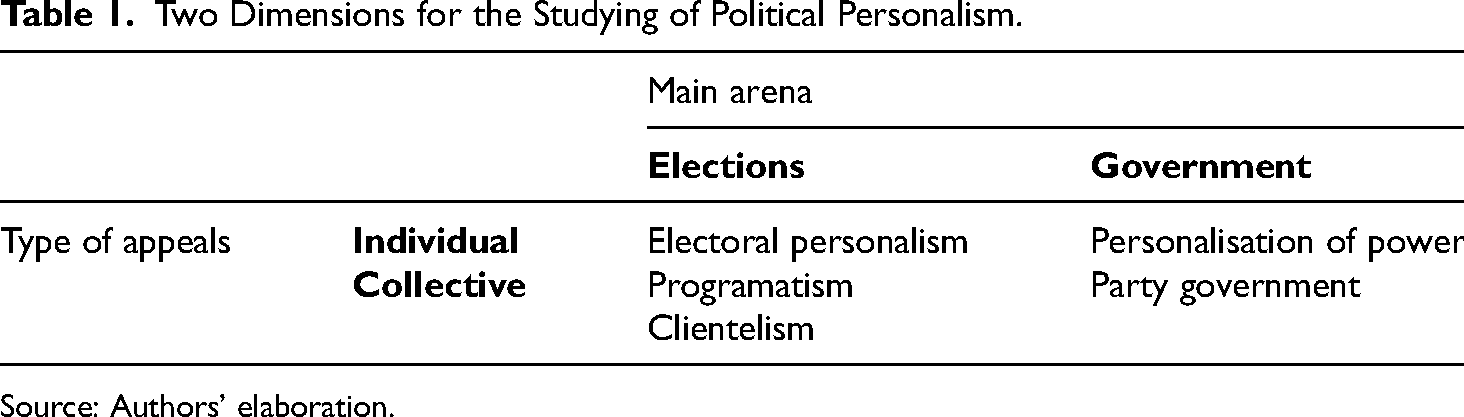
Source: Authors’ elaboration.
First, distinguishing between electoral and governmental arenas helps to tell apart electoral personalism from concepts related to the personalisation of power, like the “presidentialisation” of politics (Poguntke and Webb, 2005), which focuses on the governmental arena, that is, in the way political power is exercised and, more specifically, in the concentration of power in a single leader or the executive power. In the governmental arena, the distinction between individual and collective appeals is related to who is held accountable for government performance vis-à-vis citizens. If a single leader is perceived as accountable to the citizens, that leader could claim the credit and take advantage of successful government actions. On the contrary, if the government is viewed as a collective endeavour, the party or coalition of parties is rewarded for the success or blamed for the government's failure. The former scenario resembles an instance of personalisation of power, in which a single leader concentrates political power. At the same time, the latter is close to the concept of party government (Katz, 1986, 1987), in which government policies are decided within political parties, and public officials are held accountable through political parties (Strøm and Müller, 1999).
The distinction between arenas represents an analytical advantage since elections serve as a precise limit when defining which actors should be incorporated into the analysis. First, it limits the concept's scope to those systems with at least some degree of electoral competitiveness, keeping outside authoritarian systems where elections do not occur or are just symbolic. Second, it limits the analysis to those actors who participate in the election and only to the electoral period, a substantive difference from concepts like charisma, which can involve a greater diversity of actors and more extensive periods. Third, contrary to concepts related to the personalisation of power, it allows the incorporation into the analysis of non-governmental political actors, giving a broader view of the whole political system.
Second, the distinction between collective and individual appeals allows for separating electoral personalism from other linkages between politicians and citizens. According to the literature on linkage mechanisms, there are three ideal types on which politicians and voters could be linked (Kitschelt, 2000): programmatic, clientelist, and charismatic. The latter is conceived as “purely symbolic or personalistic, based on citizens’ likes and dislikes of grand gestures and personal styles” (Kitschelt, 2000: 845). Being ideal types means they appear in a mixed manner in real-world scenarios. According to Luna (2014), parties and candidates can efficiently segment the electorate, targeting specific groups of voters with a particular mixture of linkages.
We keep the term “electoral personalism” strictly referring to how politicians pursue political power by persuading and mobilising voters based on individual appeals. We depart from the idea that electoral competition requires differentiation. On the one side of this linkage, competing parties, or candidates, need to differentiate among themselves when appealing to voters. To do this, parties and candidates can opt for different strategies. It can be achieved based on a collective appeal (i.e. referred to a party label) or an individual one (i.e. referred to a candidate's attribute). When politicians appeal to voters, they can do so by stressing the importance of the party label or by emphasising a personal attribute. On the other side of the linkage, the effectiveness of the personalistic electoral strategy is reflected in how citizens perceive them. Given the bidirectional nature of the politician–citizen linkage, the systemic level of personalism depends not only on the strategies that politicians follow but also on how much the electorate validates their strategies.
As Table 1 states, ideological or programmatic differentiation is based on collective appeals. That a system is programmatically structured implies that politicians coordinate within each party to differentiate their party from others effectively. The existence of programmatic linkages between voters and politicians also implies that voters make choices based on the programmatic record and proposal of competing parties (Kitschelt et al., 2010: 16). Since programmatic linkages require a collective organisation that aggregates and channels the demands and the credibility of a candidate position depends on the party label's ability to bear that position effectively, they are naturally collective.
Clientelist linkages are also usually based on collective appeals. When a candidate offers a good or service to a voter, that proposition must be backed up by a credible organisation that attaches credibility to the politician's offer. Parties are often seen as crucial for the existence and maintenance of clientelist networks by institutionalising this practice by providing a structured framework for the clientelist exchange (Kitschelt and Wilkinson, 2007) and facilitating this exchange by organising the distribution of resources and ensuring the loyalty of voters (Stokes, Dunning and Nazareno, 2013).
Nevertheless, some studies have sophisticated the conceptualisation of clientelism. First, Nichter (2018) distinguishes between electoral and relational clientelism. According to the author, clientelist relationships sometimes exceed what classic literature has considered as clientelism, that is, practices such as vote buying or turnout buying, and become a long-term relationship characterised by the persistence of the distribution of benefits to clients in the period between elections (Nichter, 2018). Second, in the context of weak parties, some exceptions have been reported to clientelism as a party strategy. For example, Aspinall et al. (2022) stated that clientelism in Indonesia is organised by individual politicians who rely on private funding and use vote-buying pork barrelling strategies for brand building. Having made these reservations, even though clientelism has traditionally been considered an electoral practice based on collective appeals, as depicted in Table 1, some clientelist practices could be better placed on other cells.
In sum, if electoral personalism has to do with what politicians do to differentiate from each other to compete in elections, it should be reflected in their efforts when appealing to the electorate. Once the analytical focus is on the electoral period, the fundamental distinction becomes between individual and collective appeals. Whereas the former points to those appeals that highlight individual characteristics like sympathy, experience, or some other specific ability, the latter focuses on collective aspects such as party membership or programmatic appeals. Electoral personalism constitutes the deliberate strategic linkage politicians forge with citizens based on individual appeals during electoral periods.
Incentives to Follow a Personalistic Electoral Strategy
What leads a politician to campaign based on collective or individual appeals? We contend that it depends on each strategy's relative costs and benefits. When collective appeals are not available, or they are cost-prohibitive, then individual-based appeals are more likely to occur. For example, if particularistic deals are not credible (either because the politician lacks the endorsement of a valuable party label or because the party has no access to state resources), then particularistic strategies are probably suboptimal. In the same way, when a programmatic stance lacks credibility (because the party supporting a candidate experienced a sudden policy shift or because the candidate does not fit the party's programmatic or ideological profile), then the ideological or programmatic strategy is also suboptimal. In these cases, a candidate will be left only with personalistic appeals, increasing the likelihood of relying upon personal attributes to mobilise and persuade voters.
There seems to be a scholarly consensus about the dichotomic nature of a dyad with two polar values reflecting party and personal-leader attachments, respectively (Kostadinova and Levitt, 2014; Pedersen, 2023). According to this distinction, voters can be attached to a party label or a personal leader. In some way, these are opposite heuristics that can guide voters’ electoral behaviour. Some scholars argue that the party label matters for the salience of personal appeals. While a high party valence should encourage candidates to run party-based campaigns, a low party valence induces candidates to run campaigns centred on personal traits (Däubler and Muineacháin, 2022).
Accordingly, we should expect candidate-based campaigns in those countries with low-valence party brands on average. In contrast, in countries with high-valence party brands, we should expect candidates to run for office through party-based campaigns, appealing to the electorate on a programmatic or ideological basis. When parties lose credibility due to poor governing performance or because they incur sudden policy shifts (Lupu, 2016; Roberts, 2014; Stokes, 2001), they affect the utility of ideology as an informational shortcut. Since credibility is an essential attachment of an ideological or programmatic signal, the latter cannot work properly without the former. According to some previous studies, the rise of personalised politics is closely related to the decline of political parties (Rahat and Kenig, 2018).
As with the linkages theory (Kitschelt, 2000), collective and individual appeals appear to be combined differently in the real world. However, it is important to note that the efforts made by politicians when competing in elections are finite, and the resources they employ are always scarce, which encourages them to employ them as efficiently as possible. When a candidate devotes some effort to building his own image in front of the electorate, he is failing to dedicate that effort to signalling programmatic or ideological positions or to promising targeted benefits to individual voters or small groups of them. 3 Thus, electoral personalism as a strategy to mobilise and persuade voters can be seen as a candidate's overall effort to connect with voters based on personal characteristics, stressing attributes like kindness, competence, honesty, or wealth.
How much effort a candidate will devote to this strategy will depend on the availability of alternative strategies and relative cost. Thus, we expect that when collective appeals based on party labels are unavailable or too costly, politicians will rely mainly on personalistic strategies, leaving little room for programmatic and particularistic appeals. In contrast, when the heuristics based on party labels are available and function like informational shortcuts for voters, politicians will rely on collective rather than individual appeals.
What factors encourage or hinder the availability of collective appeals? We argue that at least two main factors are essential in the process. First, the degree to which voters perceive political parties as important for deciding their vote. It could be due to its ideological positions, programmatic profile, or credible promise to deliver a constant flux of material benefits. Second, the degree of stability in the supply side of the electoral market is reflected in the continuity of the main party labels over time. The literature tends to agree that the decline of political parties is a global trend. Even if there are some notable exceptions, Latin American politics is part of the general tendency towards the decline of political parties. Bad performance by governing parties sustained in the long run undermines their ability to accomplish both requirements. On the one hand, they cannot sustain their programmatic profiles because of sudden policy shifts and the unexpected coalitions they form to gain or retain electoral support. On the other hand, they are in a poor position to ensure the continuity of the party label over time since the systematic creation of new parties or ad hoc electoral alliances contributes to blurring party labels. Therefore, the efficacy of collective appeals is reduced, fostering the rise of individual appeals.
Additionally, an important body of literature is devoted to the importance of candidates vis-a-vis political parties (Wattenberg, 1990, 2011). Therefore, voters evaluate personal qualities among candidates and leaders and use these assessments as input for their voting decision. In this line, personalistic electoral strategies only need a party label as an instrument for electoral purposes, an empty vessel that only exists as a vehicle for official purposes, that can be filled with nothing but the leader's or candidate's appeal. Furthermore, parties are not necessary under a personalist strategy in countries where independent candidates are allowed to run for the presidency. With the advent of social media-based campaigns, even the essential functions assumed by parties’ territorial networks and personal brokers are in significant change. As some authors have argued, one of the critical functions of punteros is to deliver people to the rallies during electoral campaigns and to mediate between the poor and the state (Auyero, 2001; Szwarcberg, 2015; Zarazaga, 2014). However, as long as the campaigns occur in the social media realm, brokers must intensify their role as social mediators rather than political mobilisers in electoral times.
The other factor fostering individual appeals is the shift in the centre of gravity of electoral campaigns. The rising importance of mass media, particularly social media, has changed how politicians appeal to voters (Enli and Skogerbø, 2013; Garzia et al., 2021; Larsson, 2016; Metz et al., 2020; Wattenberg, 1990). Since the utility of parties as an informational tool is declining, media-centred campaigns encourage candidates to campaign on the basis of individual appeals, stressing their attributes, such as fame, reputation, or other personal attributes that a candidate can communicate directly through mass and social media, giving rise to instances of electoral personalism (Figure 1).
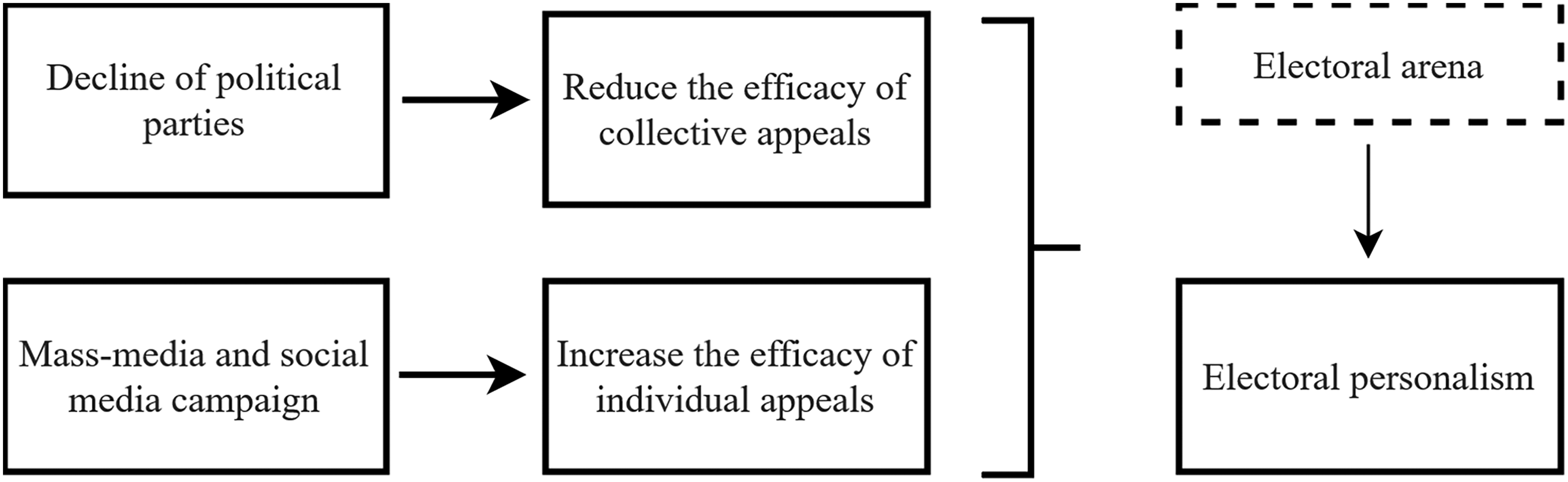
The Decline of Parties, Media-Centered Campaigns, and the Fostering of Individual Appeals. Source: Authors’ Elaboration.
Accounting for Electoral Personalism in Latin America
Scholars have employed various empirical strategies to measure personalism. Depending on the conceptual background, extant research has focused on aggregate or macro-level indicators (Frantz et al., 2021b; Rahat and Kenig, 2018), the personal characteristics of political leaders (Musella, 2018), or psychological traits that connect leaders with voters (Andrews-Lee, 2019, 2020; Garzia, 2014). If, according to our conceptualisation, electoral personalism is related to the differentiation strategies followed by politicians seeking to mobilise and persuade voters, a direct measurement approach should look at politicians’ efforts to attract voters by appealing to their characteristics. Since it is difficult to measure the effort made by politicians to mobilise based on their personal appeals directly, an indirect approach to measuring electoral personalism is observing voters’ reactions to the strategies followed by candidates and parties. When voters focus more on the candidate than the party, this could indicate that they are validating a personalistic strategy. To account for the variation in the scope of electoral personalism in Latin America, we rely on GT data, which is available from 2004. 4 Moreover, to overcome some limitations of GT data and assess our estimations’ reliability, we rely on experts’ judgments from the Varieties of Party Identity and Organization data (V-Party, 2022).
GT, provided by Google Inc., is a web-based tool that allows users to compare and analyze the relative popularity of topics and search terms over time and across regions. This tool does not give the total number of searches of a word, but it uses the vast amount of data collected from Google's search engine to provide a normalised indicator of the popularity of one or more terms, which can be customised based on time, geographic location, or category. Because of its versatility, GT has gotten the attention of many researchers on, for example, medicine, economics, or politics (Chykina and Crabtree, 2018; Cebrián and Domenech, 2023; Jun, Yoo and Choi, 2018; Lorenz et al., 2022; Mellon, 2013; Reilly et al., 2012).
To explore the variation in the scope of electoral personalism in Latin America, we built two indicators: a candidate-level index of electoral personalism and a weighted systemic indicator of personalism. We extracted GT data for each candidate-party pair of the 663 in our dataset, covering all Latin American presidential elections between 2004 and 2022. The extraction was restricted to 1 month before the election day and to the country where the election occurred.
5
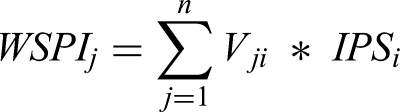
This indicator seeks to capture the impact on voters’ interest of the personalistic effort that presidential candidates and parties made to mobilise and persuade voters. We first estimated the Individual Personalism Score (IPS) indexed by an ith candidate-party dyad in a presidential election. This score is defined as the proportion of the GT score for the candidate over 30 days before the election, related to the sum of the GT scores for the candidate and his party.
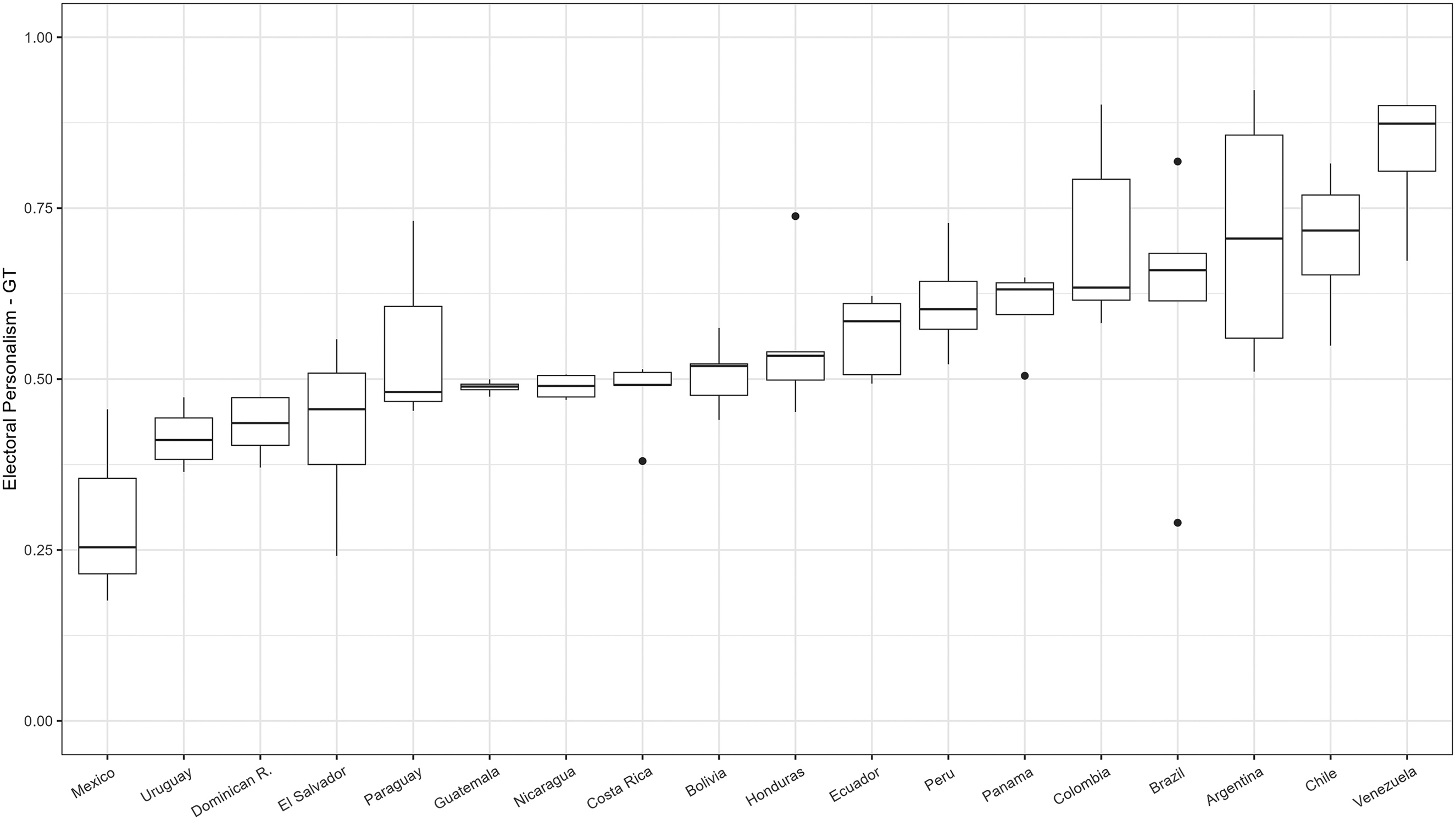
Electoral Personalism in Latin America, 2004–2022. Source: Authors’ Elaboration.
Some examples help to illustrate how our indicators work, focusing on personalism in the electoral arena separately from the governmental arena. Some personalistic candidates are not personalistic rulers, and vice versa. Empirically, electoral personalism does not necessarily go hand in hand with the personalisation of power, as we claim in our conceptualisation (see Table 1). Even though the literature has traditionally considered some Latin American presidents as highly personalistic leaders, usually relating it to a populist leadership style, this does not necessarily hold for how they appeal to voters before becoming presidents. President Cristina Fernández in Argentina is frequently reputed as a personalist and even populist politician (Schamis, 2013; Weyland, 2018). However, Fernández has an IPS score of 0.51, suggesting that she did not base her electoral strategy entirely on individual appeals as a presidential candidate. Once in power, Fernández may have acted as a personalist president, giving rise to a process of personalisation of power, 6 but that does not mean that, as a candidate, she followed a personalistic strategy.
Similarly, Evo Morales in Bolivia has also been considered a personalist and populist leader (Madrid, 2008, 2016). Even if there is some controversy about what factors ultimately explain the electoral rise of Morales and the MAS (Crabtree, 2011; Luján, 2020), most of the literature tends to stress the personalistic style of Morales. 7 Still, when we look at how he appealed to the electorate, we observe that he cannot be classified as a case of electoral personalism. Indeed, like Fernández, Morales has an intermediate level on IPS: 0.48, suggesting that, as a candidate, he did not rely mainly on personalistic appeals. Not surprisingly, both leaders are well known for having vigorous parties supporting their candidacies (PJ and MAS).
Conversely, some presidents, not usually depicted as highly personalistic in their governing style, have had a personalistic electoral strategy. For example, Mauricio Macri in Argentina faced many political and institutional restrictions in the governmental arena that limited his ability to rule alone. Thus, he was not a personalistic president. 8 However, his IPS was 0.93, showing that he relied heavily on personal and individual appeals as a candidate. Finally, electoral and governmental arenas sometimes do accord. Jair Bolsonaro, the former Brazilian president, is an example of a politician with a personalistic governing style 9 and an electoral strategy centred on his figure. In our IPS, Bolsonaro achieved 0.98 points. These comparisons enhance the benefits of conceptually distinguishing between personalism in the electoral arena and the personalisation of power in the governmental arena. They also help provide empirical support to our conceptualisation and its related empirical measurement.
Exploring Systemic Determinants of Electoral Personalism in Latin America
This section advances in an exploratory analysis of what factors (at the system level) are associated with the variation in the level of electoral personalism. To that end, we use our estimations based on GT as the dependent variable and explore a set of independent variables that, according to our conceptualisation, are expected to influence the aggregate level of electoral personalism. We also rely on some expectations that have been identified by existing research.
We first examine institutional factors that might induce political leaders to rest on individual rather than collective appeals. The first factor is the existence of primaries to nominate a presidential candidate. If primaries exist, we expect higher levels of electoral personalism since candidates should be more likely to stress their own attributes to differentiate from other candidates running under the same party label. Some previous studies claim that introducing primaries as a candidate selection process might foster electoral personalism as open nomination procedures allow individual candidates to compete for party endorsements without depending on party leaders and internal organisation (Dalton et al., 2002; Musella, 2018; Rahat and Hazan, 2013; Wattenberg, 1990).
In the same vein, independent presidential candidates might foster individual appeals since they allow individual candidates to get rid of party endorsements. Independent presidential candidates can increase the scope of personalistic strategies since they do not need the endorsement of an established political party. In that case, if a party label exists, it is a mere façade since it is the personal leader who controls the party rather than the other way around.
Finally, a president running for re-election (incumbent) can affect electoral personalism since it can downplay party labels and reduce the election to a contest between the president and their opponents.
The administrative organisation of a country can also play a role regarding electoral personalism, particularly the presence of federalism (Kitschelt, 2000: 861). According to Kitschelt et al. (2010) “Localized politics tends to be more personalistic and clientelistic” (p. 40). Thus, we expect federal countries to be positively associated with electoral personalism.
Finally, we incorporate additional controls to account for relevant political factors. First, we include the average level of trust in political parties to measure the effect of the decline of political parties in each election. Additionally, the level of political conflict can affect how much politicians opt out of party labels. We include the lagged number of anti-government demonstrations (based on data from Martínez, 2021) as a measure of political conflict confronting the government and social and political opposition. We also include a measure of ideological polarisation (Mainwaring and Su, 2021) to complement the effect of political conflict on the level of electoral personalism. In the same vein, we control for the level of electoral volatility since we expect more unstable political markets to exhibit higher levels of electoral personalism. Lastly, we add the level of inflation (ln) to account for the economic drivers of electoral personalism. 10
We ran several linear regression models with the WSPI as the dependent variable. We include country fixed-effects with clustered standard errors to account for possible unobserved components of the estimations within-country correlation. All models incorporate, as a control variable, the percentage of the population with Internet access according to World Bank data. By controlling for internet access, we aim to account for variations in online behaviour and ensure that our findings more accurately reflect the impact of personalistic strategies on voter perceptions rather than being skewed by disparities in internet availability.
Table 2 presents the main results. As can be seen, two variables acquire statistical significance across models. First, primaries are positively associated with the level of electoral personalism. The presence of primaries is associated with an average increase of approximately 0.2 points in the level of electoral personalism. Second, federal democracies exhibit higher levels of personalism. On average, they show an increase of 0.3 points in the WSPI compared with unitary countries. This result could be due to the fact that in federal democracies, presidents do not control some key policy areas, like public health or education. Thus, the programmatic space shrinks, leaving smaller room for programmatic differentiation and boosting personalistic electoral strategies.
Systemic-Level Determinants of Electoral Personalism in Latin America.
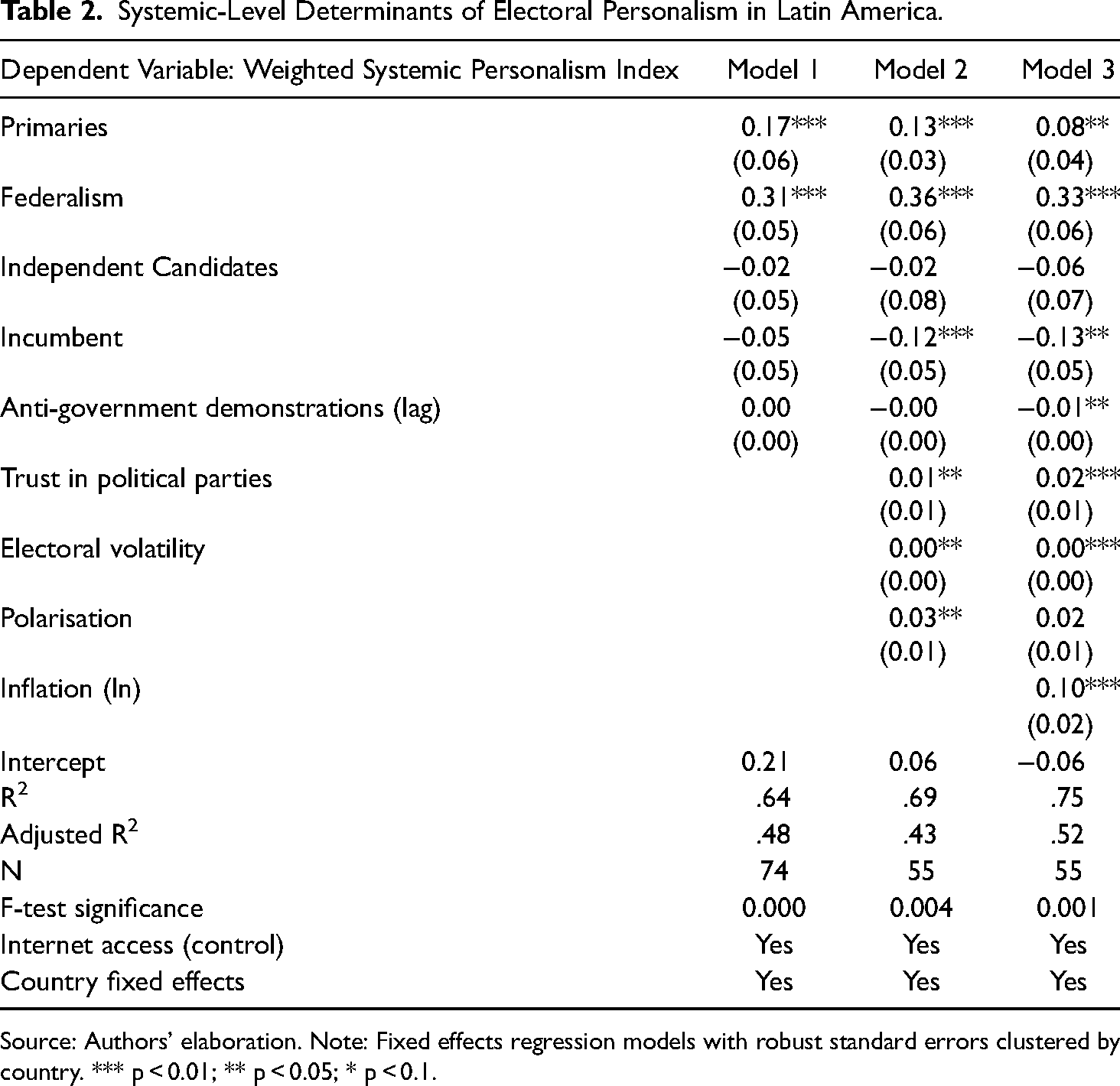
Source: Authors’ elaboration. Note: Fixed effects regression models with robust standard errors clustered by country. *** p < 0.01; ** p < 0.05; * p < 0.1.
Contrary to our expectations, trust in political parties is positively associated with electoral personalism. An increase of one percentage point in the level of trust in political parties is associated with an average increase of 0.01 points in the WSPI. When we measure the WSPI using V-Party data (Table A-3 on the Supplemental Appendix), the effect of primaries and federalism remains the same, but the effect of trust in political parties disappears. This result could suggest that in those countries with higher levels of trust in political parties, the GT data might report more searches on individual candidates than party labels since parties are already well-known among citizens.
While the presence of independent candidates does not achieve statistical significance in any of the three estimated models, the presence of an incumbent does reach statistical significance in models 2 and 3, with a negative sign. The presence of a president running for re-election is associated with an average decrease of about 0.1 points in the WSPI based on GT data, which may be because a president is a well-known public figure, and thus, it reduces the number of internet searches on their name.
Other independent variables also exhibit mixed results. For example, electoral volatility shows a positive and statistically significant effect. An increase of one percentage point in electoral volatility is associated with an average increase of about 0.002 points in the WSPI. The same can be said of political polarisation (in model 2) and inflation (in model 3). Both variables are positively associated with the level of electoral personalism.
Figure 3 shows the point estimates of the regressions in Table 2 and the confidence intervals (90% confidence). As can be seen, federalism and the presence of primaries for the presidential contest show the most prominent positive association with the level of electoral personalism, followed by the level of inflation. Political polarisation and trust in political parties show a modest but still significant positive effect on electoral personalism. Additionally, the presence of an incumbent running for re-election reports the larger negative effect on electoral personalism.
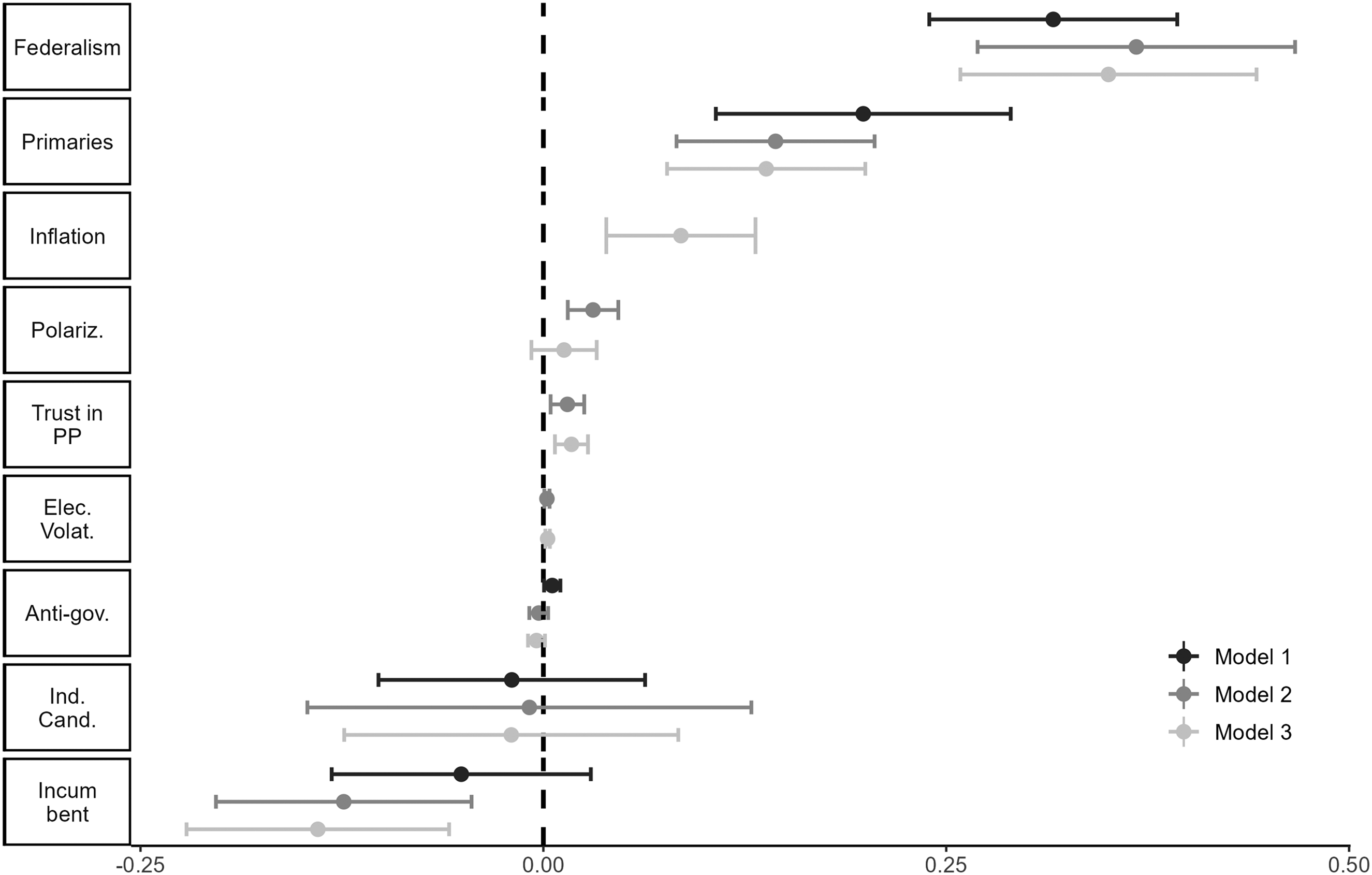
Systemic Determinants of Electoral Personalism in Latin America. Source: Authors’ Elaboration.
Exploring Individual Determinants of Electoral Personalism
While our conceptualisation of electoral personalism focuses on the supply side of the electoral market, it is worth noting that for an electoral strategy to succeed, voters must validate it, at least partially. To explore which factors might be associated with the prevalence of electoral personalism at the individual level in this section, we rely on survey data from LAPOP. Unfortunately, the available data only cover the period 2006–2010, so we cannot conduct any statistical exploration for recent years. Nevertheless, we believe it is worth estimating individual-level models to shed light on some micro-foundations that may (or may not) lead voters to validate supply-side personalistic strategies. We are interested in testing how political variables at the individual level, such as partisanship and ideological self-identification, and other typical socioeconomic factors are associated with the electoral behaviour of Latin American voters. We use the LAPOP question about the main reason for voting for a candidate/party to build the dependent variable 11 . We take responses for the candidate's qualities as the main reason for voting as a personalistic vote, in contrast with the other options (candidate's party and programme) as the opposite. While those voters who mention the candidate's quality validate the efforts made by politicians to mobilise voters based on the candidate's (individual) appeals, those voters based on the candidate's party label or programme are mobilised and persuaded basically on (collective) partisan grounds. We ran logistic regression models to estimate the effect of individual-level factors, such as the main political independent variables and the most usual socioeconomic controls. 12 Based on a binary outcome, our dependent variable vote for candidate's qualities equals 1 when the candidate was the main reason for voting and 0 otherwise. 13
As shown in Table 3, partisanship is, as expected, negatively associated with the probability of voting for the candidate's qualities as the most important reason. Accordingly, voters identified with a political party are less prone to vote based on the character of the party's candidate. Regarding the ideology of voters, our results show that rightists are more likely to vote for the candidate's qualities. The more to the right voters place themselves, the higher the probability of voting based on the candidate's traits.
Individual-Level Determinants for Electoral Personalism in Latin America, 2006–2010. Logistic Regression Coefficients.
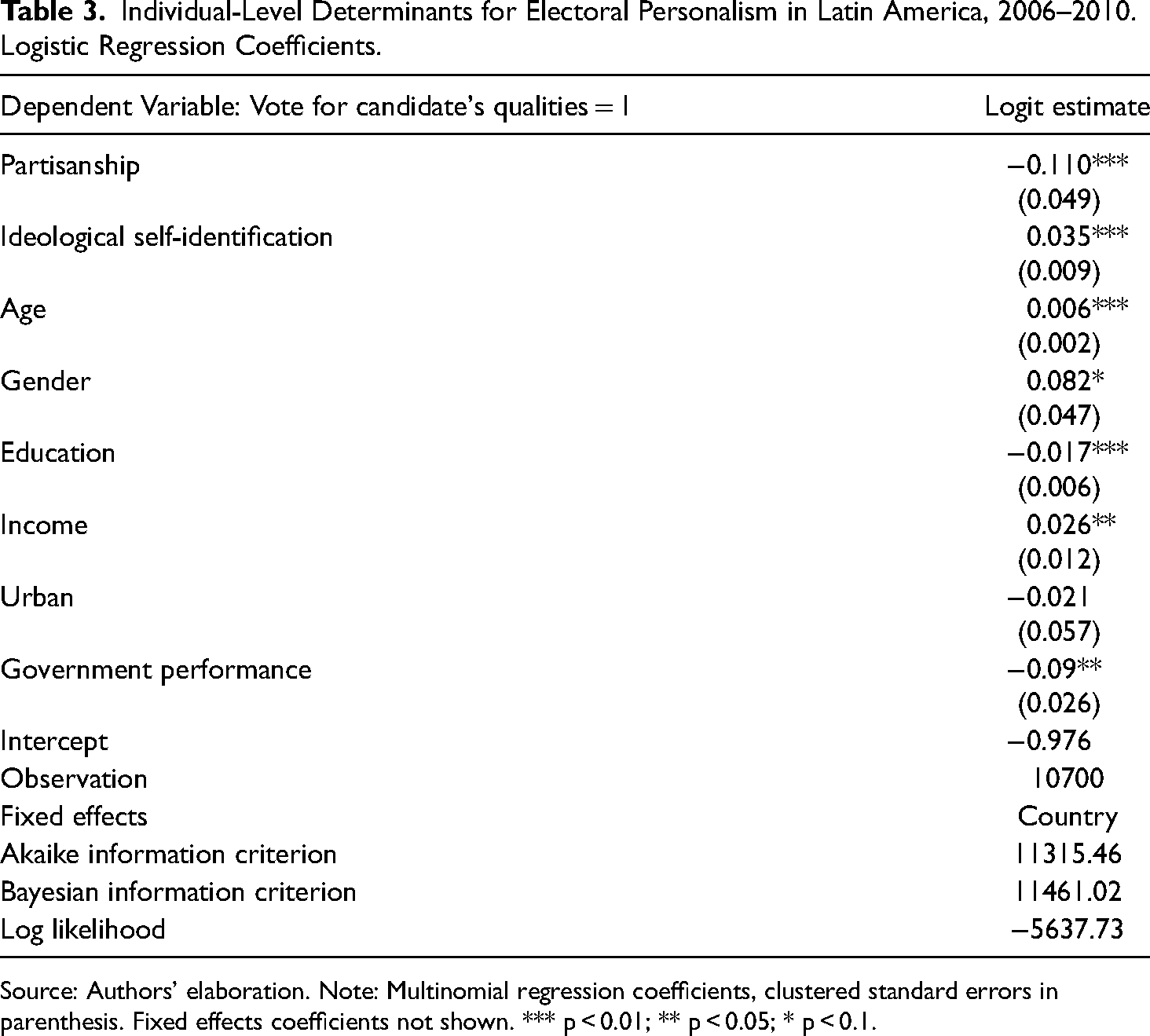
Source: Authors’ elaboration. Note: Multinomial regression coefficients, clustered standard errors in parenthesis. Fixed effects coefficients not shown. *** p < 0.01; ** p < 0.05; * p < 0.1.
Perhaps the most intriguing result is the voters’ government performance evaluation. According to previous studies on the rise of personalistic leaders (Andrews-Lee, 2020; Navia and Rivera, 2019), we would have expected that the worse voters’ evaluation of the government's performance, the greater their propensity to vote on the basis of the candidate's personal qualities. However, our results cast some doubts on these expectations. As can be seen, worse evaluations (higher values on the variable) are negatively associated with the probability of casting a vote based on the candidate's personal qualities. This finding suggests that social discontent with government performance should not necessarily be seen as a driver of electoral personalism. Given the exploratory character of this study, this finding raises important questions for future research.
Among control variables, older voters are more likely to vote for the candidate's qualities than the programme or party label. Additionally, gender shows a statistically significant effect, showing that women are more likely to vote based on the candidate's qualities. Education is negatively associated with the likelihood of voting for the candidate's qualities. These results suggest that voters with lower education levels should be more prone to rely on personalistic appeals to cast their votes. The opposite can be said about the effect of income: more affluent voters are more prone to vote based on the candidate's personal qualities rather than party labels or programmes. Finally, voters’ urban or rural residence do not achieve statistical significance.
According to Figure 4, partisanship shows the larger (negative) effect among individual-level determinants of electoral personalism, reducing approximately 10 per cent the probability of casting a vote based on a candidate's qualities. Regarding voters’ evaluations of government performance, the probability of casting a personal vote decreases roughly 10 per cent for each marginal movement across the scale. Among variables with a positive effect, gender shows the larger effect, with women being 9 per cent more prone to vote based on the candidate's qualities than on the party label or its programme. The effect of ideological self-identification, level of education, and income are approximately the same.
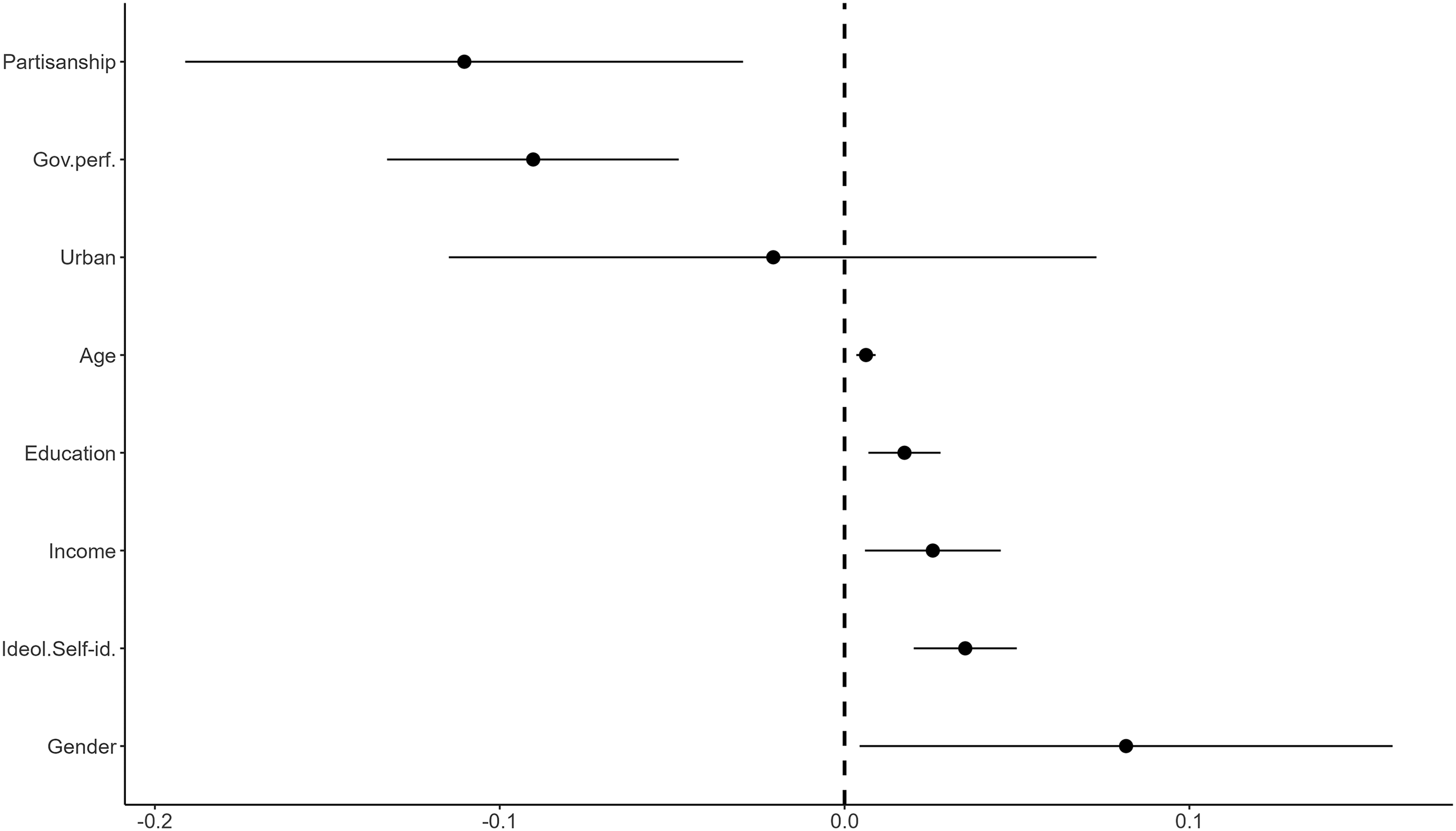
Individual-Level Determinants of Voting Based on the Candidate's Qualities. Source: Authors’ Elaboration.
Concluding Remarks
Conventional wisdom holds that personalism is widespread in Latin American politics. While good reasons exist for that generalisation, it has suffered some conceptual glitches. Using the same term to account simultaneously for a modality of electoral mobilisation and persuasion and a particular form of exercising political power has condemned it to a form of conceptual stretching. We propose a conceptualisation of electoral personalism based on two dimensions: the nature of the appeals carried out by politicians pursuing their goals and the arena in which they act.
We argue that distinguishing between electoral and governmental arenas is important because it allows us to account for situations in which the same individual can follow a personalistic strategy when competing in elections but not necessarily when in office. Additionally, it recognises that the incentives politicians face when competing in elections may differ from those they face once in office. Cases like President Nayib Bukele in El Salvador meet both criteria, but other cases illustrate that the distinction is useful. For example, according to some scholars, former Uruguayan President José “Pepe” Mujica is a charismatic leader and thus deserves the label “personalistic.” However, Mujica was backed by an institutionalised party, like the Frente Amplio, that limited his ability to follow a purely personalistic strategy.
Our indicators show that electoral personalism varies greatly among parties, candidates, and countries. It also varies across time, suggesting that short-term determinants can affect the level of electoral personalism. We assessed the reliability of our calculations based on GT data using expert surveys. Given the exploratory character of our empirical analysis at the aggregate level, we cannot be conclusive on the determinants of electoral personalism. Nevertheless, we did find some empirical regularities that help to identify some crucial drivers of personalism in the electoral arena.
At the system level, federalism and the mechanism of primaries to select presidential candidates seem to encourage electoral personalism. Additionally, the level of trust in political parties, electoral volatility, and political polarisation are positively associated with electoral personalism.
At the individual level, our findings indicate that voters tend to validate personalistic electoral strategies according to some political and socio-demographic factors. Right-oriented, less educated, and affluent voters tend to vote more based on candidates’ qualities than their party labels and programmes.
These results confirm our priors about the difficulties of measuring personalism. Even if our indicators help to capture some systematic components of the phenomenon, we need to develop more refined and nuanced indicators that directly measure the efforts made by politicians to mobilise and persuade on the basis of individual appeals. The scores based on GT data are promising but have some shortcomings. The same holds for the experts’ survey data we used as a robustness check. They may be reflecting some conventional wisdom among academics, so it is not easy to reach counter-intuitive findings that would help us improve our understanding of the phenomenon. Improving our data and measures is fundamental to refining our knowledge about personalism.
Supplemental Material
sj-docx-1-pla-10.1177_1866802X241250034 - Supplemental material for Assessing Electoral Personalism in Latin American Presidential Elections
Supplemental material, sj-docx-1-pla-10.1177_1866802X241250034 for Assessing Electoral Personalism in Latin American Presidential Elections by Diego Luján and Federico Acosta y Lara in Journal of Politics in Latin America
Footnotes
Acknowledgments
An earlier version of this article was presented at IPSA's Congress held in Buenos Aires. Thanks to Timothy Power, Lucas González, and Juan Andrés Moraes for their comments and suggestions.
Declaration of Conflicting Interests
The authors declared no potential conflicts of interest with respect to the research, authorship, and/or publication of this article.
Funding
The authors disclosed receipt of the following financial support for the research, authorship, and/or publication of this article: The authors received financial support from the Agencia Nacional de Investigación e Innovación of Uruguay under the Fondo Clemente Estable (FCE_3_2022_1_172600).

Supplemental Material
Supplemental material for this article is available online.
Notes
Author Biographies
References
Supplementary Material
Please find the following supplemental material available below.
For Open Access articles published under a Creative Commons License, all supplemental material carries the same license as the article it is associated with.
For non-Open Access articles published, all supplemental material carries a non-exclusive license, and permission requests for re-use of supplemental material or any part of supplemental material shall be sent directly to the copyright owner as specified in the copyright notice associated with the article.
