




Abstract
This article examines four potential strategies of the Brazilian welfare system in the face of increasing liberalization and globalization since the 1970s. We test whether liberalization and economic globalization hurt the expansion of social expenditure (the efficiency hypothesis or race to the bottom hypothesis) or whether the welfare system expands as a response to the volatility caused by liberalization and globalization (compensation hypothesis). We employ time-series regression analysis to panel data from 1970 to 2015. We controlled for economic (wealth and GDP growth) and political factors (strength of the left and effective competition of parties in the lower house). We identify different strategies followed by the welfare system through the period analyzed. However, two strategies are dominant in the long run: A neoliberal strategy when the impact of globalization is considered (efficiency hypothesis) and an embedded neoliberal strategy when the effect of liberalization is pondered (compensation hypothesis).
Introduction
The relationship between globalization, liberalization, and welfare effort—understood as the investment made by the political system in health, education, social security, and housing—has been thoroughly examined in the literature (Cruz-Martínez, 2021; Hicks and Zorn, 2005; Jensen, 2011; Rudra, 2002). However, there is no consensus on the impact of globalization and liberalization on the scope of welfare effort. On one side, researchers who follow the efficiency hypothesis or the so-called “race to the bottom” argue that as the political system liberalizes and globalizes, there is more pressure to make it competitive to attract foreign capital and, therefore, social spending and taxes are reduced (Rudra, 2002; Kurtz and Brooks, 2008).
On the other side, researchers following the compensation hypothesis argue that greater liberalization and globalization will be accompanied by greater job and economic insecurity for the population, who will demand greater investment from the state to cope with the external risks associated with economic integration and neoliberalism (Kaufman and Segura-Ubiergo, 2001; Rodrik, 1998). Welfare programs and institutions are developed as a response to the volatility caused by liberalization and globalization (Bergh, 2021). The positive relationship between liberalization and welfare expansion would follow the path of European welfare states in the period of embedded liberalism (Ruggie, 1982).
This article examines the Brazilian case to identify patterns of continuity and change in the welfare effort since the 1970s. The primary purpose is to confirm the strategies of the Brazilian welfare system in times of increasing liberalization and globalization. Second, we test the efficiency and compensation hypothesis dilemma.
Liberalization is operationalized with two indicators: The structural reforms indices of Lora (2012) and Morley et al. (1999), updated by Escaith and Paunovic (2004). Globalization is operationalized with the KOF Globalization Index. We used a composite index of three social expenditure indicators for the welfare effort variable. The evolution of the welfare effort, liberalization, and globalization is illustrated through a temporal analysis (1970–2015) with normalized data (max =1, min = −1), which allows us to place the welfare system strategy in one of four quadrants (embedded neoliberalism, state-centric, austere-closed and neoliberal approach). To confirm the strategy of the Brazilian welfare system and test the efficiency and compensation hypotheses, we employed time-series regression analysis to panel data from 1970 to 2015. We controlled for economic and political factors.
Brazil offers a thought-provoking case to study the compensation and efficiency hypothesis since it has combined elements of both in its recent history. Brazil represents an example of how compensation and efficiency can be complementary in the welfare system's strategy and how the state can play an essential role in both the economic and social spheres without sacrificing accumulation and human development. Studying the case of Brazil can provide valuable lessons for other countries facing the challenges and opportunities of economic liberalization. Brazil is a singular case, or in the words of Seawright and Gerring (2008), an extreme case regarding how closed their economy is and has been. Therefore, it would be relevant to know how the welfare system in one of the most closed economies has reacted to the process of liberalization and globalization. Brazil is also the largest economy in the region and the eleventh in the world. The efficiency and compensation hypotheses were developed by analyzing large economies. Therefore, it would be relevant to understand how a large economy in the Global South with an emerging welfare state (Huber and Stephens, 2012) has reacted to the structural reforms and globalizing pressures.
The results show Brazil moved through the four macroeconomic strategies examined in the paper. However, we find two dominant strategies in the long run: A neoliberal strategy when the impact of globalization is considered and an embedded neoliberal strategy when the effect of liberalization is pondered. Therefore, the compensation and efficiency hypotheses are relevant to understanding historical social policy expansion and retrenchment. The article is structured as follows: an analytical framework, research design, results, discussion, and conclusion.
Analytical Framework
The transformations that emerged during the intense process of globalization have produced a convergence around macroeconomic policies focused on economic liberalization (Robinson, 2004, 2009). Eriksen (2017) considers that in the process of promoting economic competitiveness, globalized economies are called upon to deregulate (i.e., trade and financial markets liberalization, foreign investment, privatization, and reduction of tax levels).
Kurtz and Brooks (2008) conducted one of the most relevant pieces of research on this issue, identifying the political system's strategies followed by Latin American countries as economies liberalized. They understand the political systems’ primary strategy was to maintain an active role on the supply side (i.e., interventions promoting economic production, exports, and public employment) but without abandoning the globalizing movement towards trade and financial openness. They refer to this strategy as embedded neoliberalism. Gonçalves (2012: 637) examines the Brazilian case and confirms that the neo-developmentalism experienced in recent years is a version of embedded neoliberalism, where the central policies of liberalism are combined with state intervention focused on macroeconomic stabilization. Quin (1997) has also shown that liberalization is associated with increasing government expenditure, although the results were not fully robust.
In this article, we use Kurtz and Brooks’ theoretical and empirical research as a basis for examining emerging Latin American welfare states amid economic globalization and liberalization (1970–2015). In contrast to Kurtz and Brooks or Quin, we are not investigating the role of the state as a whole, but specifically the role of welfare systems. Hence, instead of operationalizing government expenditure (as a percentage of GDP), we focus on the welfare component of public spending.
The political systems have two options to respond to the increasing liberalization. They might respond to liberalization with less intervention, aiming to promote the accumulation of economic elites following trickle-down economics. In this case, the liberalization strategy restraints the political system to reduce direct state intervention in the economy and facilitate the development of a market economy. On the contrary, more state (intervention) might accompany the process of liberalization aiming to maintain or gain the legitimacy of society, becoming especially relevant as liberalization and the development of the market economy have chained a process of “social disintegration” (Loaeza, 1999: 112).
Polanyi (1944) highlighted the incompatibilities between free-market economics and democracy due to the inexistence of the self-regulating market neoliberal dogma (see also Dale, 2010). However, Polanyi speaks of a double movement that occurs to safeguard society and the free market economy, requiring state intervention. Decommodification results from this double movement (Goodwin, 2018, 2024). Social spending on education, health, social security, and housing is seen as a decommodification intervention, promoting society's collective welfare and legitimizing the state's role in a market society.
However, Lopes da Silva (2015) would argue that social policy is, in any case, contradictory in nature because it serves the interests of both capital and workers. On the one hand, the social policy protects workers against cyclical social risks and natural disasters—such as COVID-19 or earthquakes—but they also stimulate the economy, expanding consumption, credit, and other measures favoring capital (Ginsburg, 1979; Vartianen, 2002).
Eriksen (2017) interweaves the issue of liberalization and welfare effort with Polanyi's double movement, arguing that as societies liberalize, they become more exposed to new social risks due to external shocks creating segments of society with a greater tendency to reject neoliberal policies that may bring instability. In Latin American, the lost decade caused partly by neoliberal structural adjustment policies is a vivid example of this argument (Gascó and Cúneo, 2013). Eriksen then intuits that if the segments of society affected by economic liberalization are sufficiently important—power in numbers, mobilization, and resources—then the state is more likely to adjust its policies in search of legitimacy and social order either from above—as a preventive strategy—or from below—as a result of popular mobilization—in order to maintain social stability and preserve political legitimacy in the context of economic liberalization" (Eriksen, 2017).
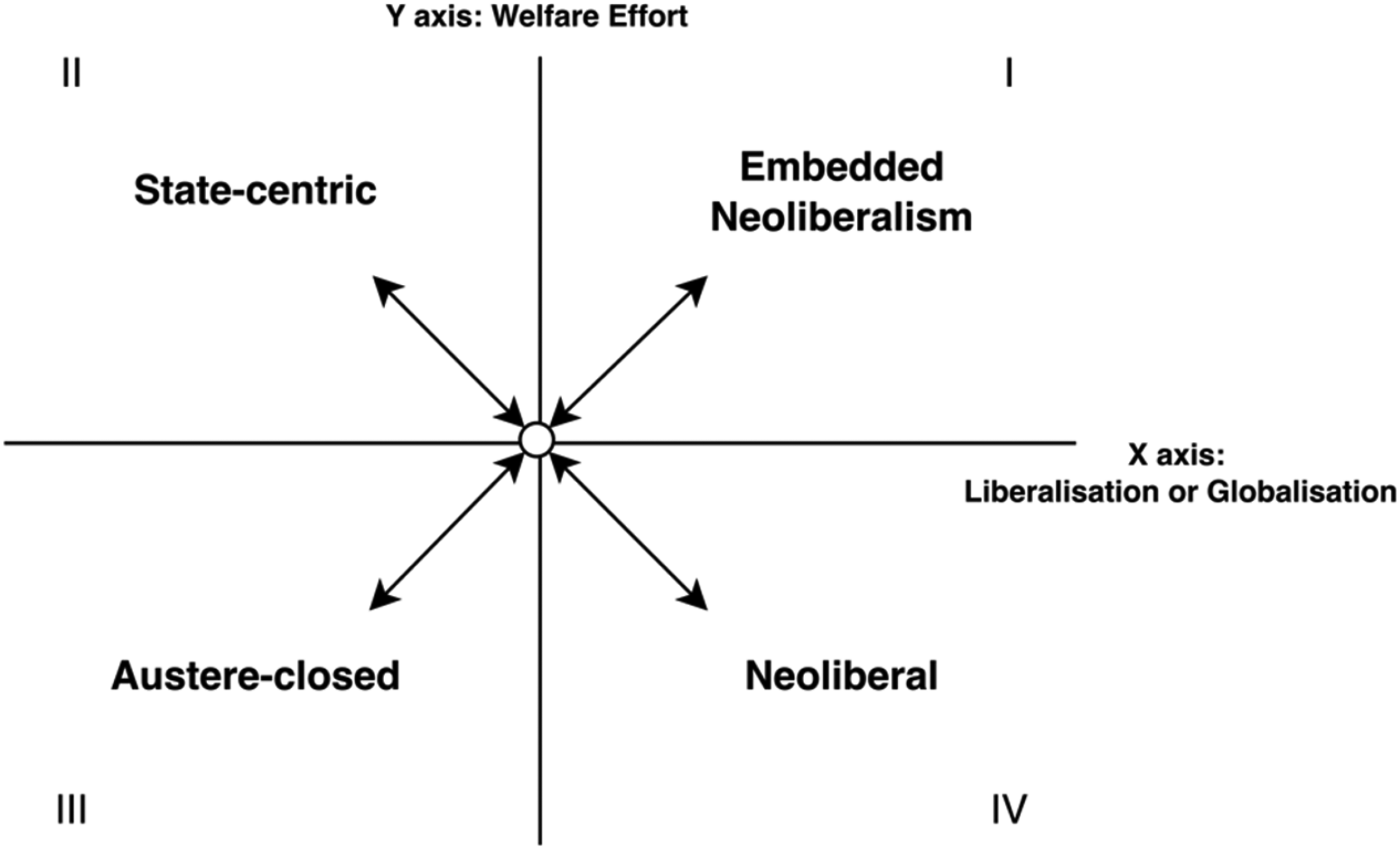
We propose a four-fold typology to portray the complex relationship in the social policy—globalization/liberalization nexus. The typology allows us to examine the evolution of the Brazilian macro-economic strategy in the last five decades in light of the well-known debate between the relationship between social policy expansion/retrenchment and economic liberalization/globalization. Figure 1 shows the four possible strategies, each located in a quadrant: The embedded neoliberal (I), the state-centric (II), the austere-closed (III), and the neoliberal (IV).
Strategies of the Welfare System in the Face of Liberalization and Globalization. Prepared by the Author.
Embedded neoliberalism combines a high degree of welfare effort and liberalization/globalization (i.e., an increasing double movement). In this strategy, the expansion of welfare effort occurs simultaneously with increased liberalization and globalization. Political systems promote both accumulation and legitimation under this strategy. Following this strategy would confirm the compensation hypothesis mentioned above.
The state-centric quadrant presents a high degree of welfare effort and a low degree of liberalization/globalization. This strategy combines social policy expansion with decreasing liberalization and globalization. This strategy exemplifies the state-led industrialization period of Latin American political systems in the mid-twentieth century (Bertola and Ocampo, 2012). Political systems promote closed economies to prevent underdevelopment, combined with a social policy expansion to promote welfare.
The austere-closed approach combines a low level of liberalization/globalization and welfare effort (e.g., a decreasing double movement). This strategy combines the retrenchment of welfare effort with a decreasing liberalization and globalization. Finally, the neoliberal approach shows a low level of welfare effort together with a high level of liberalization/globalization. This strategy combines welfare retrenchment with increased liberalization and globalization. Accumulation is given thus relative importance over legitimation. Following this strategy, hegemonic during the so-called Washington consensus era, would confirm the efficiency hypothesis.
Research Design
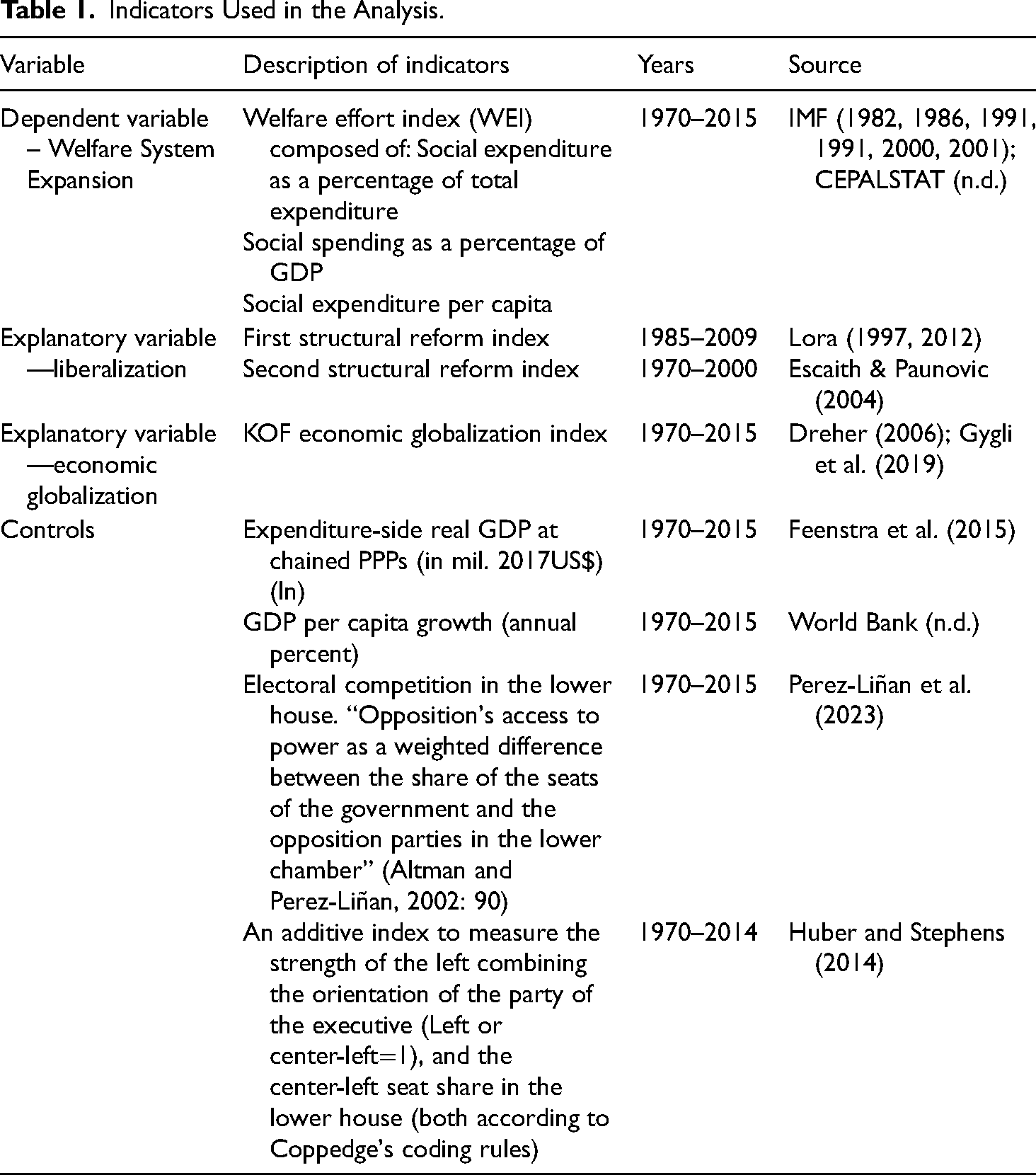
The main research question in this article is: What has been the strategy of the Brazilian welfare system regarding the increasing economic liberalization/globalization? A historical and quantitative analysis of the available statistical data is undertaken to answer this question. This will allow us to test the compensation and efficiency hypotheses described above. See Table 1 for a description of the indicators used to operationalize the dependent, explanatory, and control variables.
Indicators Used in the Analysis.
Dependent variable
Social policy expansion is generally operationalized with social expenditure indicators (Cruz-Martínez, 2015; Esping-Andersen, 1990; Huber and Stephens, 2012). Simply put, welfare effort is the proportion of economic resources a political system invests in public social provision (Amenta, 1993: 751). Olaskoaga-Larrauri et al. (2011: 1,264) consider it “measure the relative consumption of economic resources in providing protection.”
Segura-Ubiergo (2007) constructed a welfare effort index using three indicators of social expenditure: Social expenditure as a share of total expenditure, social expenditure as a share of GDP, and social expenditure per capita. This composite index could be considered synthetic because it “sums up all the actions taken by welfare institutions in a single figure” (Olaskoaga-Larrauri et al., 2011: 12,364). We use those in this article to operationalize the welfare effort variable. They suggest three alternative strategies to address globalization and liberalization, respectively: (i) rearrange total spending to increase social spending; (ii) raise more revenue to increase social spending (increase the size of the state); and (iii) increase the generosity of social spending.
Social spending is only one of the multiple dimensions of the welfare state (Cruz-Martínez, 2014, 2017a, 2017b, 2021). However, the limited data availability before 1990 impedes the inclusion of additional dimensions of the welfare state in the analysis (e.g., coverage, quality of the coverage and outcomes of welfare institutions). Therefore, while we recognize the limitation of only including one of the multiple dimensions of the welfare state, the literature acknowledges the usefulness of social spending to operationalize welfare effort in time series and cross-national analyses (Jensen, 2011).
We construct a composite welfare effort index to operationalize the dependent variable. First, a simple arithmetic mean was performed, with each indicator having the same weight (33.33 percent). Secondly, a principal component analysis was performed to reduce the multidimensionality of the data and construct a “summary index” of the three social expenditure indicators. 1 The social expenditure data comprises social spending on social protection, education, health, and housing and comes from the International Monetary Fund's Government Finance Statistics Yearbooks. GDP and the national expenditure deflator come from the World Bank indicators (World Bank, n.d.), and the population data comes from CEPALSTAT (n.d.).
Using composite indices when studying the welfare effort offers several benefits. It condenses multifaceted data into a single metric, which allows a comprehensive overview of the welfare effort without delving into multiple indicators. Therefore, when studying the relationship between globalization/liberalization and welfare efforts, a multiplicity of relevant aspects and the three alternative strategies mentioned above are considered. However, it is crucial to recognize that while composite indices offer valuable insights, they also come with challenges, such as potential oversimplification and subjective weighting of components. We address the former by assessing the three social expenditure indicators individually as dependent variables in the model and the latter by constructing the composite index using principal component analysis along with the simple-arithmetic mean.
Explanatory Variables
Textbook definitions refer to liberalization as the removal of existing restrictions on an economic, social, or political system, aiming for changes towards a free-market economy. We mainly focus on analyzing how favorable liberalizing reforms have been to promote the free functioning of the market. We consider trade, financial, capital account liberalization, privatization, and labor policies. In contrast, globalization refers to the development of an integrated and interdependent global economy that promotes free trade, movement of capital—though not of people—and the outsourcing of services and production to markets where labor is cheaper and less regulated. Keohane and Nye (2000) argue that globalization is a multidimensional process that involves economic (facilitation of flows of goods, capital, and services), political (diffusion of government policies,) and social (diffusion of ideas, information, and people) domains.
Liberalization is operationalized with two indices of structural reforms, one developed by Lora (1997, 2012) and the second one proposed by Morley et al. (1999) and updated by Escaith and Paunovic (2004). Globalization is operationalized with the KOF economic globalization index (Dreher, 2006).
Measurements of economic liberalization are controversial, mainly when using data from early years. There are different ways to measure the same issue, as can be attested by comparing measures from the World Bank, BID, and ECLAC for Latin American countries. Even trade liberalization, defined as the summation of imports and exports over the GDP, can produce different measures, as shown by Avelino et al. (2005) for Latin America. This problem is more acute when measuring the liberalization of capital accounts. In this case, the standard measure was suggested by Quin (1997), who used the IMF Annual Report on Exchange Arrangements and Exchange Restrictions. Quin's measurement called Openness offered a valuable tool to study capital and current account transactions and legal agreements to restrict exchange and capital flows. We decided to use Lora and Morley's structural reform indices because they operationalize liberalization with policy indicators measuring the magnitude of the liberalization structural reforms. These policy indicators in the structural reform indices of liberalization allow “distinguishing between the effects of the structural reforms per se and those resulting from macroeconomic stabilization” (Lora, 2012: 19). Simply put, Escaith and Paunovic (2004) argue that these structural reform indices allow us to measure the magnitude of the institutional changes that occurred in the Latin American region, irrespective of the economic events or effects. In addition, Morley's structural reform index also uses the IMF Annual Report on Exchange Arrangements and Exchange Restrictions to operationalize the balance of payments of capital account liberalization (one of the five components of this index).
The first structural reform index—which refers to liberalization - is a composite index that allows measuring the extent of reforms over time and how favorable they have been to the proper functioning of the market. The policy areas considered are trade, financial, fiscal privatization, and labor policies. 2 Employing an arithmetic mean of the normalized data (max = 1, min = 0), the five areas were reduced to the structural reform index, which shows the evolution of structural reforms and aims to measure “the degree of neutrality of economic policies” (Lora, 2012: 26). Data is available from 1985 to 2009.
Morley et al. (1999) developed the second structural reform index to correct what they consider a limitation in the Lora index. They extended the data retrospectively to 1970, allowing for comparative analysis, and replaced the labor reform indicator with one measuring changes in the liberalization of the capital account of the balance of payments. The updated second structural reform index (Escaith-Paunovic) includes trade openness, domestic financial liberalization, the balance of payments of capital account liberalization, tax reform, and privatization. 3 The data was normalized (max = 1, min =0), and the composite index was constructed using an arithmetic mean. We decided not to merge the two structural reform indices to avoid mixing data from different data sources, as this can bring at least extra noise to the analysis.
The third indicator is the KOF economic globalization index. Keohane and Nye (2000: 4) and Dreher (2006: 1,092) characterize economic globalization “as long-distance flows of goods, capital, and services as well as information and perceptions that accompany market exchanges". The economic globalization index takes into account eight indicators of de facto economic globalization (e.g., trade in goods, trade in services, trade partner diversity, foreign direct investment, international debt) and seven indicators of de jure economic globalization (e.g., trade regulations, trade taxes, tariffs, trade agreements, investment restrictions). The final results of the KOF index range from 0 (not globalized) to 100 (fully globalized). The KOF index is a widely used indicator in the literature to operationalize globalization, especially when conducting longitudinal and cross-national analyses (Gräbner et al., 2021; Heimberger, 2022). Being a composite index, the same limitations mentioned above are extended here.
Controls
Economic and political factors were incorporated as controls in the regression analyses. By including control variables in the regression analyses, we want to hold these variables constant to isolate the effect of the primary explanatory variable (liberalization or globalization) on the welfare effort. This helps to control for potential confounding factors and improves the precision of the estimates. We chose the control variables based on theoretical justifications and empirical evidence. Changes in social spending can be caused by numerous factors, such as:
an increase in a country's wealth and individual income and consumption may increase the political system's resources to finance social welfare (Lamartina and Zaghini, 2011; Myles and Quadagno, 2002; Wilensky, 1975) an increasing electoral competition which may cause opposition and government to back social policy expansion to expand their electoral pool of support to win elections (Altman and Castiglioni, 2020; Ewig, 2016; Garay, 2016; Niedzwiecki and Pribble, 2023) the ideological orientation of the party in the executive, precisely thanks to left-of-center parties (Sirén, 2021). Huber and Stephens (2012) found that left political strength is a determinant of the region's social security and health expenditure.
We incorporate four controls
4
in the linear regression analyses to take into account the explanatory effects of the four items mentioned above: Country's wealth (GDP per capita), individual income and consumption (GDP per capita growth), electoral competition (index of effective competition proposed by Altman and Perez-Liñan (2002)
5
, and an additive index to measure the strength of the left combining the orientation of the party of the executive, and the center-left seat share in the lower house (both according to Coppedge's coding rules) (Huber and Stephens, 2014).
Dorlach (2021), Martin-Mayoral and Sastre (2017), Cruz-Martinez (2021), and other researchers have examined the determinants of social spending in Latin America and the Caribbean and other middle-income countries and had proposed various controls to include in econometric and regression analyses. One would argue that the main limitation, due to small N, is the possibility of omitted variable bias. However, the limited amount of historical data before 1990 limits the possibility of including additional controls (e.g., labor strength, fiscal capacity). Future cross-country time-series regression analysis with BRICS or Latin American countries might solve the small-N problem and could facilitate the inclusion of other relevant control variables.
Results
First, we conducted a descriptive analysis of Brazil's social policy expansion, liberalization, and globalization with secondary sources. Second, we conduct a descriptive analysis plotting the trajectories of the dependent variable (i.e., welfare effort) and the explanatory variables (i.e., liberalization and globalization). Thirdly, we normalize the time-series data (max= 1, min = −1) to plot the evolution of the Brazilian welfare system's strategies as the economy liberalized and globalized. Fourth, we perform 12 simple ordinary least squares regressions on a time series (1970–2015) between the indicators operationalizing the dependent variable (i.e., welfare effort index, social expenditure as a percentage of total expenditure, social expenditure as a percentage of GDP and social expenditure per capita) and the explanatory variables of economic liberalization (i.e., Lora and Escaith-Paunovic structural reform index) and globalization (KOF index). As a result of the third analysis, a matrix of scatter plots (4×3) is constructed, showing the regression line and formula in each of the 12 individual plots.
Finally, we execute 12 linear least-squares regressions on a time series panel (1970–2015) between liberalization, globalization, and welfare effort, controlling for the two economic and two political factors mentioned above. Following Huber et al. (2008), annual observations are taken to be random draws from nature. We do not include a lagged dependent variable because it inappropriately suppresses the explanatory power of independent variables (see Achen, 2000). By introducing panel-corrected standard errors, Beck and Katz (2004) showed that a lagged dependent variable is included in the right-hand side of the equation but without suppressing the explanatory power of other independent variables. Therefore, future analysis should include data from other Latin American countries to be able to include panel-corrected standard errors in the time-series cross-section regression analysis data following Beck and Katz.
We also do not include country dummies in the analysis. Beck and Katz (1996) argue that this deals with the omitted variable bias, but Plümper et al. (2005: 334) show that if “a theory predicts level effects, one should not include unit dummies. In these cases, allowing for a mild bias resulting from omitted variables is less harmful than running a fixed effects specification.’’ In our case, we aim to test the effects of the level of liberalization and globalization on the level of welfare effort. Therefore, following Plümper et al. (2005), we do not include country dummies or fixed effects estimations in our models.
A Descriptive Analysis of Social Policy Expansion and Increasing Liberalization and Globalization in Brazil
Evolution of Welfare Effort
Pioneering countries in Latin America began to develop their welfare systems in the early twentieth century, including Brazil, Cuba, Uruguay, Chile, and Puerto Rico. The consolidation and expansion of welfare programs took place during the import-substitution industrialization era, emphasizing social security programs reserved for formal workers. However, those programs have started to coexist with residual social assistance programs since the debt crises of the 1980s and the so-called Washington Consensus (Cruz-Martinez et al., 2024).
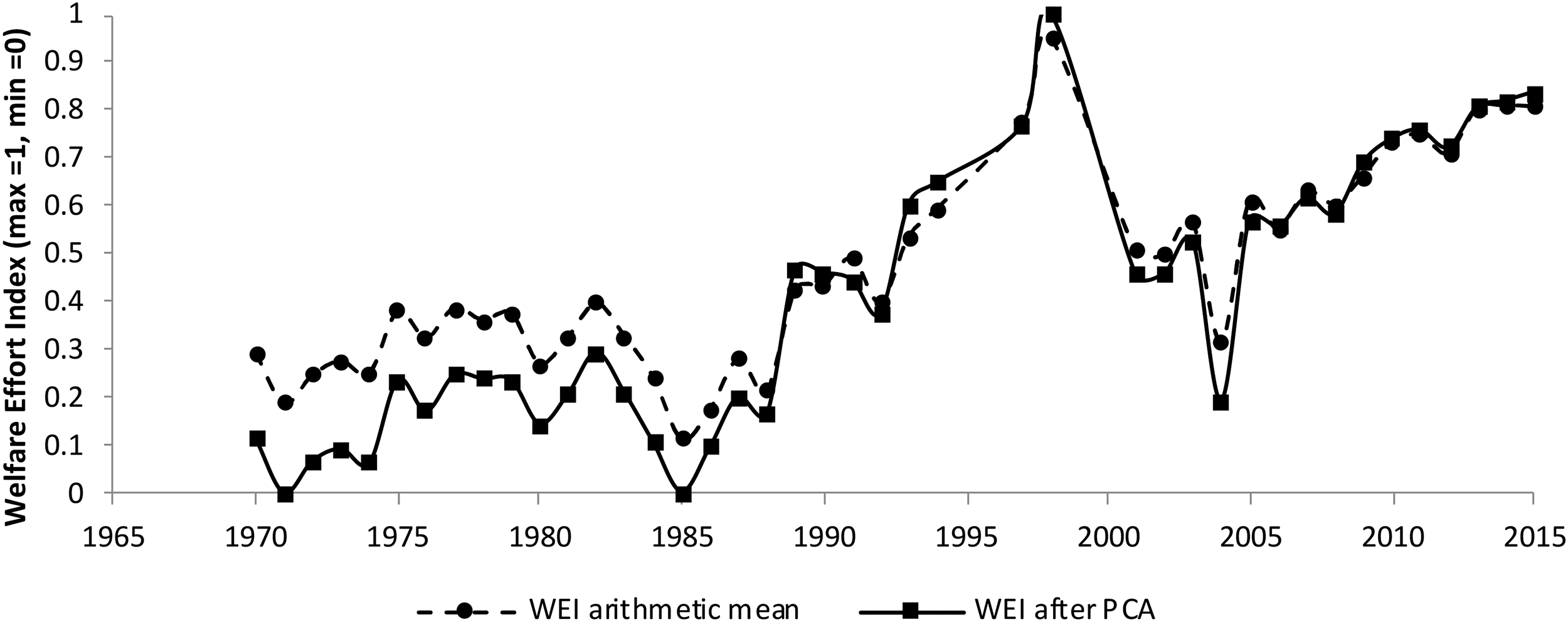
Figure 2 shows Brazil's welfare effort evolution from 1970 to 2015. Brazil lived under a military dictatorship in the early years of this period, specifically from 1970 to 1985. Mota (2005) notes that the gradual expansion of some basic social services maintained their selective, productivist character—i.e., focused on the formalization of work—and with an important presence of the private sector. However, as shown in Figure 2, the welfare effort in 1985 at the end of the military dictatorship was lower than in 1970. Therefore, we can affirm that in these early years, there was a setback in terms of social investment. Fausto and Fausto (2014) confirm the abandonment of welfare programs during the dictatorship and the country's worldwide reputation for low health, education, and housing standards.
Tracking of the welfare effort in Brazil (1970–2015). Source: IMF (1982, 1986, 1991, 1991, 2000, 2001); CEPALSTAT (n.d.).
It is worth highlighting that the debate about expanding education, health, and social security in Brazil took place before the arrival of the neoliberal era and the consequent liberalization. Civil society organizations and social movements consolidated their proposals in the 1988 Constitution (do Amaral, 2009). The 1988 Constitution and the consequent Lei Orgânica da Assistência Social transformed social policy in Brazil by decentralizing the governance of the welfare and tax system, creating new actors and arenas where social policy could be formulated (i.e., municipalities) and creating public social protection system with universal pretensions (Vatisman, Borges de Andrade and Farais, 2009). Thanks to the First National Conference on Social Assistance and the intersectoral collaboration of Brazilian society organizations, social assistance policies began to be seen as a right, not as charity. The Constitution laid the “institutional groundwork for social protection” (Hunter, 2014: 34). However, it was not until the arrival of President Lula that the provision of services and cash transfers became institutionalized in the Brazilian welfare system (Vatisman et al., 2009). This institutionalization and expansion help us to understand the growing movement of social spending in Brazil from 1970 to 2015, but the quality of this coverage has not been sufficient to guarantee the satisfaction of human needs, especially in times of temporary and precarious employment (Mota, 2009; Pereira, 2002).
One of the main achievements of the 1988 Constitution in the expansion of social policy was the incorporation of citizens who were traditionally excluded—outsiders—and who contributed to the national economy in the informal and agricultural sectors (Costa, 2002; Garay, 2016), providing for health rights, contributory social security and noncontributory social assistance under the principles of social citizenship (see Finkelman, 2002 and Piola et al., 2013 for more on health, Marques et al., 2010 for more on social security, and Stocco et al., 2018 for social assistance).
Boschetti (2003) eloquently summarizes Brazil's welfare system as follows: it has a corporatist logic in social security, a universalist logic in health—although with a strong presence of the private sector—and a logic of conditionality and selectivity in social assistance to include outsiders. Specifically, we should highlight the Bolsa Familia transfer program, the Previdencia Rural noncontributory pension, and other social assistance programs that expanded greatly during the first decades of the twenty-first century. While this expansion can certainly be reflected in terms of coverage, it is important to highlight that the Brazilian system is a dual one, where a large part of Brazil's welfare effort is dedicated to contributory social security programs and what we could consider “the crumbs” is reserved for social assistance programs (Barrientos, 2019). Nonetheless, Brazilian social policy has become a model for international organizations and has spread globally (Porto de Oliveira, 2019).
Increasing Liberalization and Globalization
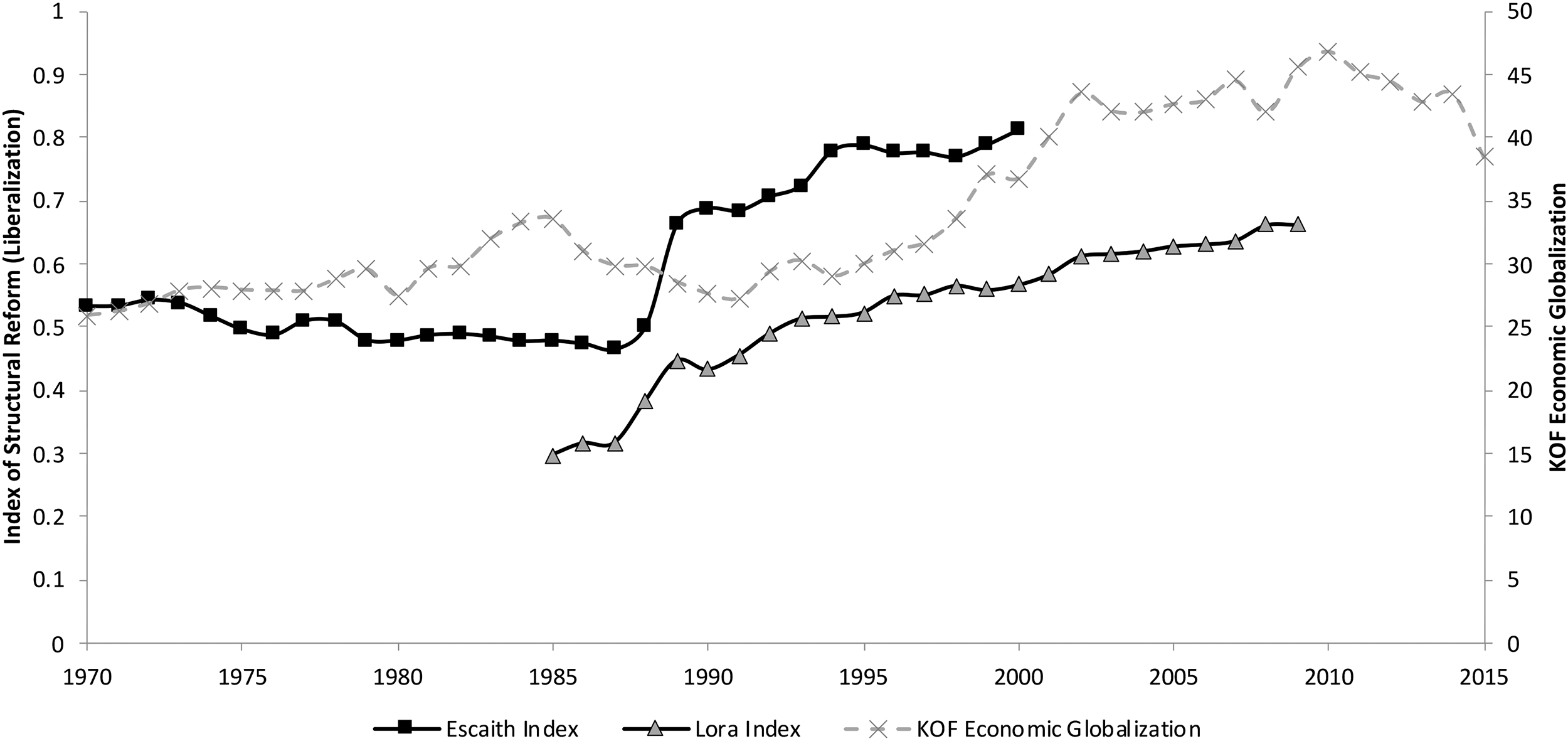
From 1970 to 1987, Brazil showed almost constant rates of liberalization and globalization as military dictatorship sought to transform and modernize Brazilian capitalism to contain what they saw as a communist threat and the masses of organized urban and rural workers (see Figure 3).
Tracking economic liberalization and globalization in Brazil (1970–2015). Source: Lora (2012); Escaith & Paunovic (2004); Dreher (2006); Gygli et al. (2019).
The turning point in the process of liberalization and globalization in Latin America was the period following the debt crisis of the mid-1980s and the advent of the neoliberal period. From 1988 onwards, we see a growing liberalization and globalization that has lasted until the present day and has not diminished with the arrival of the center-left PT to power. At the beginning of the 1980s, Brazil had one of the most closed economies in the world, driven by the legacy of the state-centric development model and import controls implemented by the military dictatorship in an attempt to deal with the debt crisis of the 1980s. Brazil started a process of financial liberalization at the end of the 1980s (Lavinas, 2017).
Economic liberalization was largely “incentivized” by international financial institutions (IFIs). Loans were conditioned on implementing structural reforms that would liberalize the economy (Bertola and Ocampo, 2012). Similarly, IFIs had a relevant role in the production and diffusion of the neoliberal social policy model based on social policy expansion with targeted social assistance programs such as conditional cash transfer programs (Heimo and Syväterä, 2022). As Palma (2003) eloquently describes, “Nowhere else in the world did neoliberalism spread so rapidly, in a one-dimensional version, and with such uniformity and standardization.”
With the arrival of Collor de Mello in 1990, state enterprises in the industrial sector began to be privatized, and trade openness increased by abolishing a significant part of import and export controls and reducing tariffs from 50 percent in 1990 to 15 percent in 1994. The inflationary crisis would mark the governments of Itamar Franco and Fernando Henrique Cardoso. The latter, together with Fausto Serra—also of the PSDB party—outlined his thesis of shock capitalism, stating that to develop Brazil, economic liberalization, the end of state monopolies, and the participation of the private sector would be necessary (Fausto and Fausto, 2014).3
Cardoso “believed that economic modernization and the rectification of Brazil's great social debt were not incompatible” but necessary conditions for ending inflationism (Fausto and Fausto, 2014: 336). Therefore, Cardoso could be seen as the actor who consolidated the strategy of neoliberalism rooted in the welfare system in the face of increasing liberalization and globalization. Lula incorporated and expanded Cardoso's anti-poverty social policy programs (Tomazini, 2019) without abandoning the neodevelopmental strategy (Singer, 2017). Cerny (2014) would argue that both Lula and Rousseff kept most of the neoliberal reforms of Cardoso, although with a consolidation of the social welfare system. He called this “social neoliberalism,” a concept similar to embedded neoliberalism, which we use here.
In sum, the increasing liberalization and globalization that began with the military dictatorship was consolidated with the Washington Consensus and materialized numerically in the above graphs in 1988. As we see in the statistical analysis below, this deep-rooted neoliberalism became the Brazilian dogma during the subsequent governments of Presidents Lula, Rousseff, Temer, and former President Bolsonaro. Although Brazil has experienced increasing liberalization, in comparative terms, it is still a relatively closed economy, only surpassed by Argentina within Latin America (CEPALSTAT, n.d.).
Temporal Analysis of the Socio-Economic Strategies Followed by Brazil
The second analysis plots the evolution of the Brazilian political system's socio-economic strategies regarding welfare efforts as the economy liberalized and globalized. Figure 4 shows this evolution by operationalizing economic liberalization with the Escaith & Paunovic index for 1970–2000 (solid line) and the Lora index for 1985–2009 (dashed line). The data are divided into the four quadrants mentioned above, and we label the strategy as embedded neoliberalism (I), state-centric (II), austere-closed (III), and neoliberal (IV).
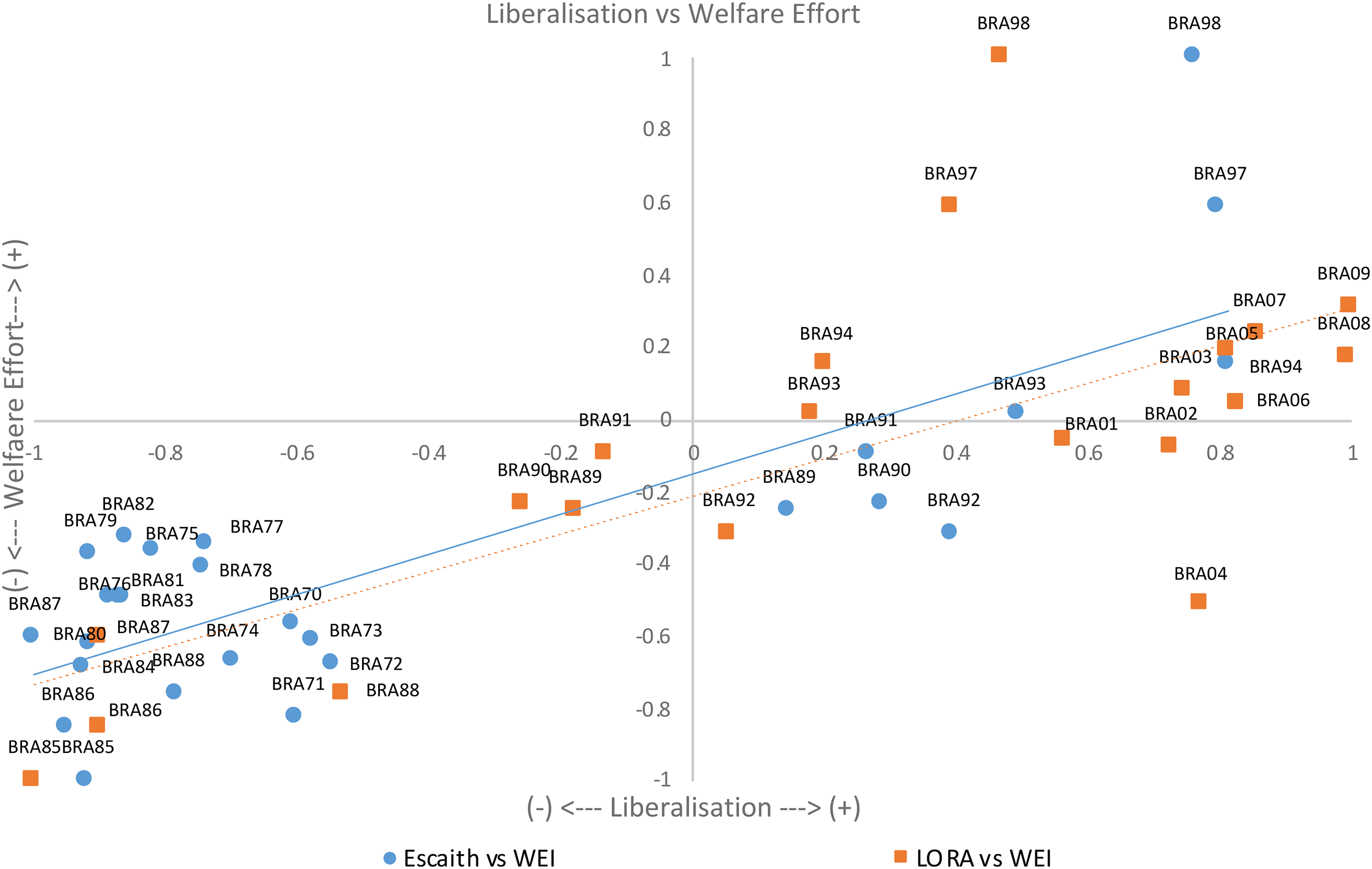
Strategies of the Brazilian welfare system in the face of economic liberalization. Source: IMF (1982, 1986, 1991, 1991, 2000, 2001); CEPALSTAT (n.d.); Lora (2012); Escaith & Paunovic (2004).
Brazil went from an austere-closed socio-economic strategy (1970–1989) to a brief period of neoliberalism during the early 1990s, to finally settle in the lower part of the first quadrant (i.e., embedded neoliberal strategy) with a medium level of welfare effort and a high level of liberalization under the PT governments. As shown in Figure 2, social spending (% GDP) grew considerably from 1988—the birth of the current Constitution. Social spending (% GDP) grew annually by 0.26 percent (CARG) from 1970 to 1989 to 4.15 percent annually from 1988 to 1998. In the PT government, from 2003 to 2015, social spending grew at 0.8 percent annually (CAGR)—lower than in the decade following the 1988 Constitution.
There is a positive relationship between the variables of liberalization and welfare effort. While the Lora and Escaith-Paunovic measures of liberalization show a similar trend, the Lora index shows a lower level of liberalization in most years where there is data for both indices.
Figure 5 presents the Brazilian welfare system strategy in times of globalization. As with Figure 4, the X-axis shows the welfare effort, and the Y-axis substitutes liberalization with globalization operationalized with the KOF economic globalization index (1970–2015). In contrast to Figure 4, Figure 5 presents a trend line of a 2-year moving average. The advantage of this calculation is that it allows visualization of the movement over the period.
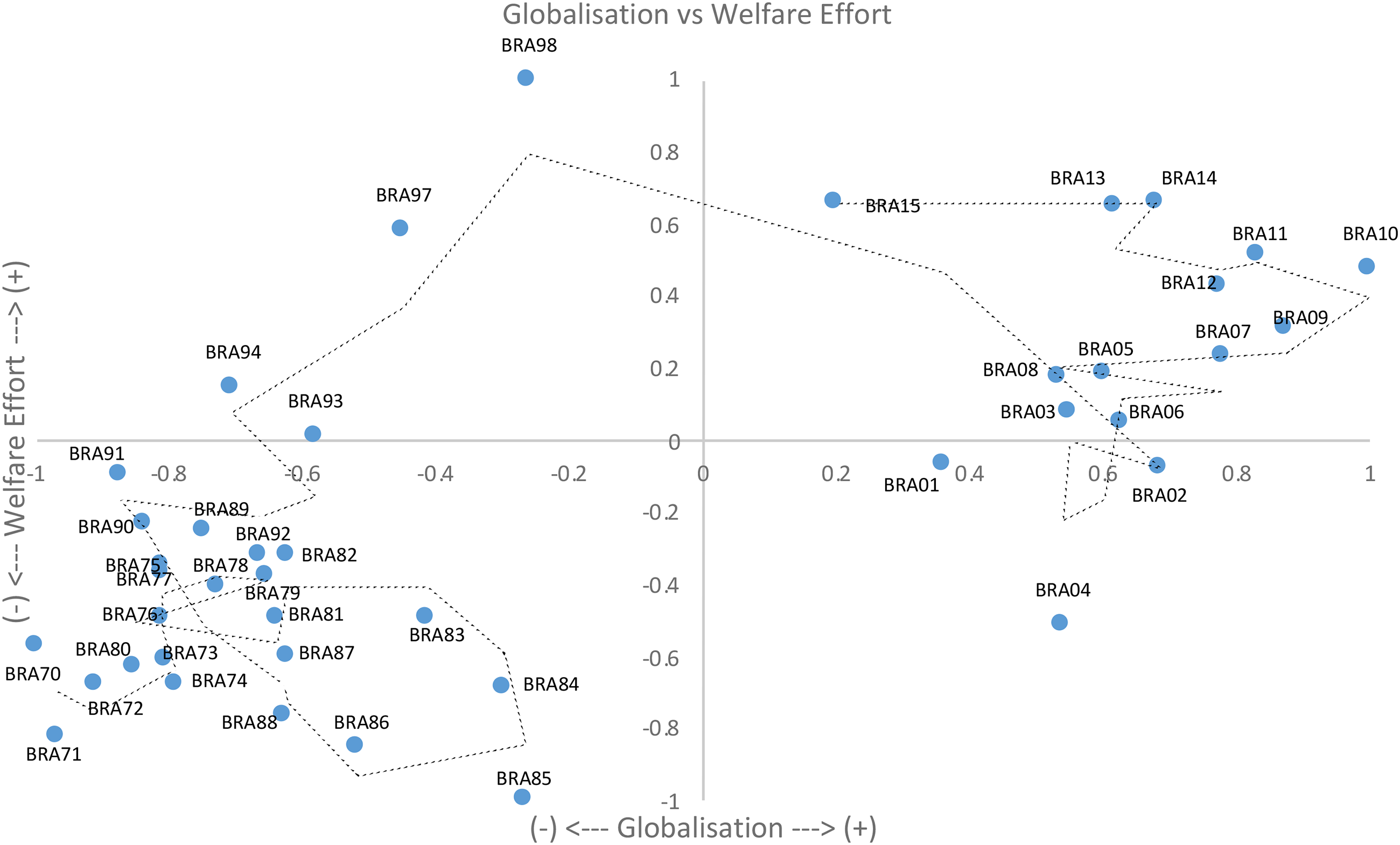
Strategies of the Brazilian welfare system in the face of globalization. Source: IMF (1982, 1986, 1991, 1991, 2000, 2001); CEPALSTAT (n.d.); Dreher (2006); Gygli et al. (2019).
The analysis is carried out using the same names for the four quadrants. The shifts are more dramatic in this figure. Brazil remained in an austere-closed strategy during the 1970s and 1980s, like with the liberalization above. However, if we look closely, we can see that even though the welfare effort was relatively stagnant during this period, economic globalization increased from the 1970s until 1985 and then went to one of the lowest scores recorded in 1991. However, since the creation of the current constitution, the country began a process of increased social investment, and since 1991, there has been a nonstop increase in globalization. In 1993, during inflation control, Brazil established itself in the second quadrant with a clear state-centric strategy. The inflation controls and the expansion of social spending contributed to reducing monetary poverty (Vatisman et al., 2009). Austerity measures imposed within days of Cardoso's electoral victory (1998) saw social investment decline drastically—as seen in Figure 2—due to the International Monetary Fund's loan impositions. From Cardoso's second term until Lula's victory, Brazil was established in the fourth quadrant with a clear neoliberal strategy. Lula's government moved Brazil into the first quadrant into embedded neoliberalism with a high welfare effort and globalization.
Considering the whole period, we can identify a positive relationship between the variables: the greater the globalization, the greater the welfare effort. However, the truth is that the picture is more complex than that. As happened with the previous figure, we can see Brazil moving from one strategy to the other through the periods. The statistical analysis we perform below aims to confirm the dominant strategy of the Brazilian welfare system in times of increasing globalization and liberalization.
Simple Linear Regressions to a Time Series (1970–2015): Scatterplot Matrix
Having observed the historical strategies followed by Brazil, we proceed to statistically test whether the dominant strategy during this long period was embedded neoliberalism. We will be able to confirm this if we observe a positive and significant relationship between liberalization (Lora and Escaith) and the welfare effort index (IWE), as well as between globalization (KOF) and the welfare index. We also tested the embedded neoliberal strategy by individually considering each of the three components of the welfare effort index on its own on the left-hand side of the formula.
Figure 6 shows a matrix of scatter plots with three columns (explanatory variables) and four rows (dependent variable and the three social expenditure indicators). The slope of the regression line in the 12 scatter plots shows a positive relationship between the welfare effort variables with liberalization and globalization (characteristic of an embedded neoliberal strategy). The coefficient of determination (R2)—the quality of the fit obtained in the regression analysis—was between 0.41 and 0.65 in the 6 regressions where the welfare effort index and social expenditure per capita were the dependent variables. The results denote that between 41 percent and 65 percent of the variance of welfare effort can be explained by liberalization and globalization.
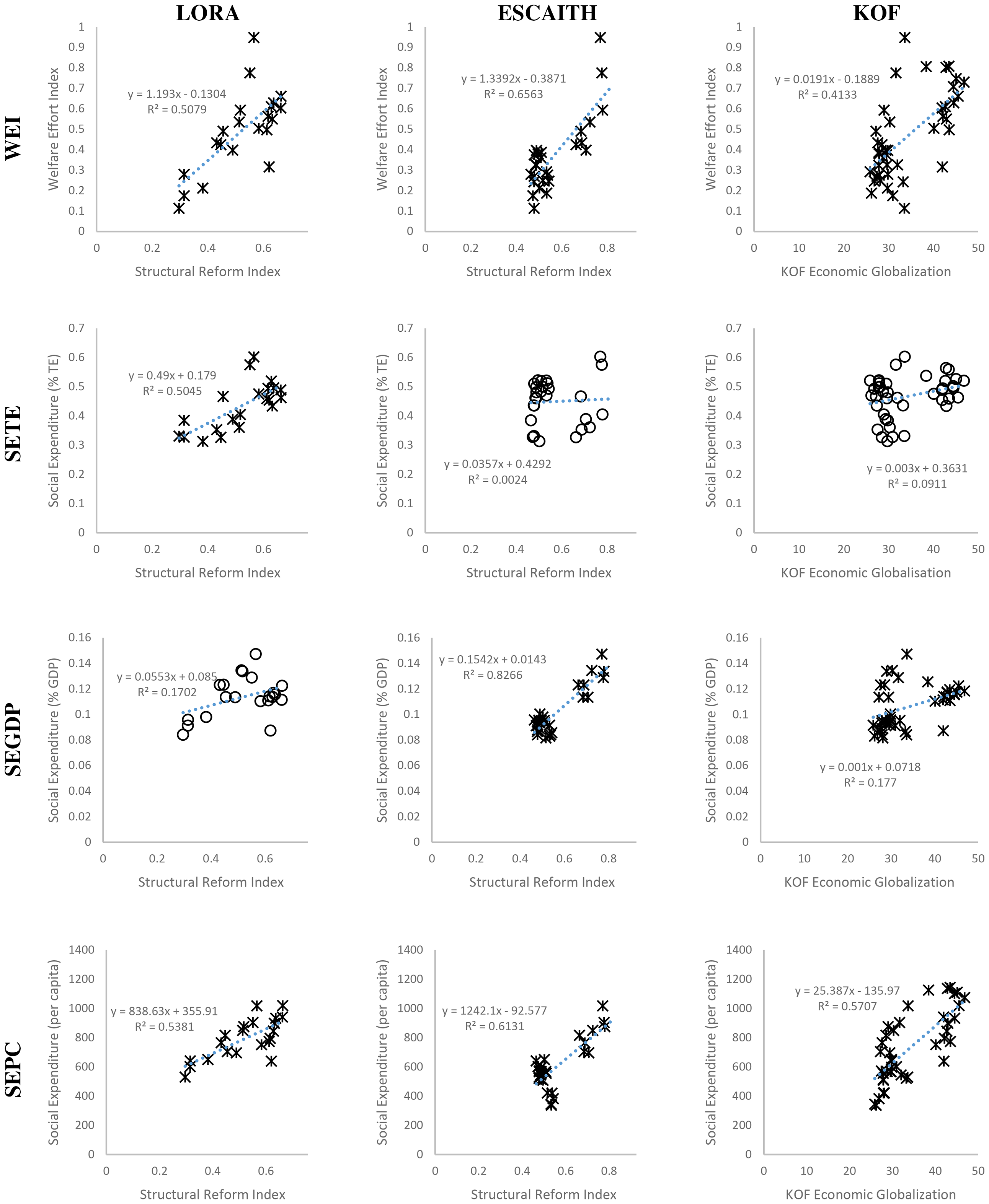
Scatterplot Matrix: Welfare Effort Versus Liberalization and Economic Globalization (1970–2015).
Nine of the 12 models show a statistically significant relationship at 0.01. The only nonsignificant models were SETE-Escaith, SETE-KOF, and SEGDP-Lora (models with circles in the markers in Figure 6).
The results show a positive, strong correlation between economic liberalization and globalization and the welfare effort. This is in line with the compensation theory and the embedded neoliberal strategy. However, it is important to incorporate controls in the model to reject spurious correlations and confirm the dominance of the embedded neoliberal strategy.
Multiple Linear Regressions: Controlling for Economic and Political Factors
Table 2 presents 12 regressions with four dependent variables and three explanatory variables. Model 1 examines the relationship between welfare effort and Lora's structural reform index (liberalization). Model 2 uses the Escaith and Paunovic liberalization index as an explanatory variable, and model 3 uses the KOF globalization index.
Multiple Linear Regression Analysis Between Welfare Effort and Liberalization/Globalization Controlling for Economic and Political Factors.
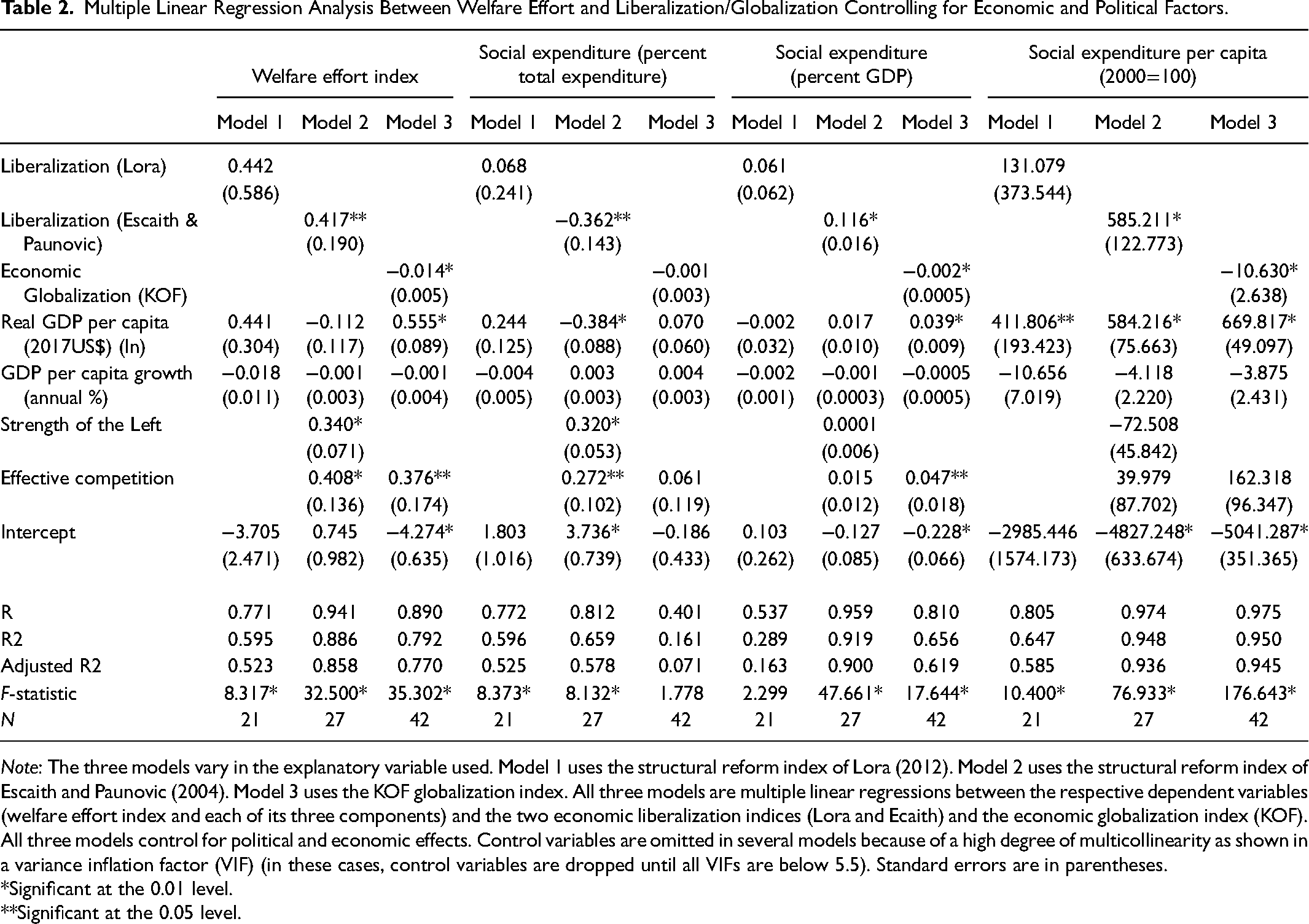
Note: The three models vary in the explanatory variable used. Model 1 uses the structural reform index of Lora (2012). Model 2 uses the structural reform index of Escaith and Paunovic (2004). Model 3 uses the KOF globalization index. All three models are multiple linear regressions between the respective dependent variables (welfare effort index and each of its three components) and the two economic liberalization indices (Lora and Ecaith) and the economic globalization index (KOF). All three models control for political and economic effects. Control variables are omitted in several models because of a high degree of multicollinearity as shown in a variance inflation factor (VIF) (in these cases, control variables are dropped until all VIFs are below 5.5). Standard errors are in parentheses.
*Significant at the 0.01 level.
**Significant at the 0.05 level.
The formula for the linear regression models is
This research technique makes it possible to test if we can confirm the existence of a long-term embedded neo-liberal strategy even after controlling for differences in economic and political conditions. Table 2 shows that when controls are included, the coefficients of liberalization and globalization remained positive in seven out of eight models with liberalization as the explanatory variable and none of the four models with globalization as the explanatory variable. These findings exemplify the complexity and multiplicity of strategies the Brazilian welfare system has followed in the last five decades.
The coefficient of determination results show that liberalization and globalization's explanatory power varies considerably across models. After the hypothesis testing, we cannot find a simple strategy followed by the Brazilian welfare system. After controlling for political and economic factors, liberalization and economic globalization kept their significant explanatory variable in seven out of nine models. The compensation hypothesis appears to be confirmed when we consider liberalization, particularly the period of 1970–2000 with the Escaith-Paunovic index (the only exception is model 2 with social expenditure as a percentage of total expenditure as a dependent variable). Liberalization and social welfare effort jointly increased during the period, confirming the strategy of embedded neoliberalism. The significance of the relationship disappears when using the Lora index to measure liberalization (model 1). 6
However, the picture is distorted when we consider the relationship between globalization and welfare effort. The four models with globalization as the explanatory variable show a negative relationship with welfare effort, and all but one are significant at 0.01. Therefore, when considering the whole analysis period, the efficiency hypothesis best describes the Brazilian welfare system strategy with the increasing globalization. Cautiously, due to the small N, we could argue that globalization negatively affected welfare effort after controlling for economic and political factors.
GDP per capita appears to be the most relevant control variable. The higher the country's wealth, the strength of the left, and the electoral competition for the lower house, the higher the probability for a higher welfare effort. It is relevant to note that economic growth was insignificant in every model.
Discussion: Findings and the Literature
Our historical and simple regression analysis confirms the compensation hypothesis for the case of Brazil. After introducing political and economic controls, the compensation hypothesis appears relevant to explain liberalization's and globalization's impact on the welfare effort. However, once controls are considered, the relationship between globalization welfare effort turns negative, thus supporting the efficiency hypothesis.
Our findings on the role of liberalization support previous research (see Bergh, 2021). Particularly in the case of Brazil, we contributed to support the positive association between liberalization and welfare effort within a country and over time. Our findings also support Nooruddin and Simmons’s (2009) findings showing that democracies respond to liberalization by increasing welfare effort while dictatorships respond inversely. The varieties of capitalism literature (Hall and Soskice 2001, Iversen 2005) outlines that depending on the type of welfare, increased pressure for competitiveness may result in pressure for social policy expansion (coordinated market economies) while in other, it may well fuel retrenchment (liberal economies). Our research in Brazil supports the argument that a market economy, in this case hierarchical, sees an expansion of welfare effort in the face of liberalization.
However, we provide empirical evidence to support the efficiency hypothesis with regard to the impact of globalization on the welfare effort. According to Busemeyer (2009), while time-series analysis provides evidence for the compensation hypothesis, time-series analysis supports the idea that globalization negatively impacts spending over time. We adopt a long-term perspective and confirm the long-term negative effect of globalization on the Brazilian welfare effort. However, it is important to note that if this is assessed via simple linear regression analysis, Busemeyer's argument will not be confirmed for the case of Brazil. We find evidence to support the efficiency hypothesis in the social policy globalization nexus only after controlling for economic and political factors.
One surprising fact is that economic per capita growth does not explain welfare effort in the 12 models. This calls into question the literature arguing that economic prosperity like the one experienced in Brazil and a large part of the Latin American region during the commodity boom, is an important factor for social policy expansion. On the other hand, our work confirms some of the relevant political determinants behind social policy expansion. First, it supports Altman and Castiglioni's (2020) finding that social policy expansion benefits from political competition. A close electoral race pushes political parties to increase their electoral pool of supporters by means of supporting social policy expansion (Ewig, 2016; Garay, 2016). Second, it supports the relevance of the ideological leaning of governments in the left-turn or pink tide in expanding welfare effort. The well-known power resources theory argues the relevance of left-of-center parties in expanding social policy in Latin America and beyond (Huber and Stephens, 2012). Third, it supports the other well-known hypothesis of welfare state development in high-income economies: The relevance of wealth (GDP per capita) or overall level of economic development (Wilensky, 1975).
It would be relevant to end the discussion with the interpretation of the models when using each of the three social expenditure indicators as dependent variables. The structural reforms of liberalization during 1970–2000 appear to have rearranged the total spending of the Brazilian political system to increase the social spending, to have help raise more revenue to increase social spending (increase the size of the state) and to have increase the generosity of social spending. This is confirmed in model 2 with each of the three indicators used to construct the index of welfare effort. Similarly, the process of economic globalization during 1970–2015 appears to have help with the latter two (increase the size of the sate and the generosity of social spending).
Conclusion
The historical and simple regression analyses results show a positive, strong correlation between economic liberalization and globalization and the welfare effort. This is in line with the compensation theory and the embedded neoliberal strategy. However, the picture distorts after including political and economic controls in the analyses.
In the long run, the increasing liberalization is positively related to the welfare effort of the Brazilian welfare system. On the contrary, the rising globalization is negatively related to the welfare effort in South American country. Therefore, even though we can identify different strategies followed by the Brazilian welfare system in the five decades examined here, we find two dominant strategies in the long run: A neoliberal strategy when the impact of globalization is considered (positive relationship between welfare effort and globalization) and an embedded neoliberal strategy when the effect of liberalization is pondered (negative relationship between welfare effort and liberalization). These results should be taken cautiously because even though we incorporated controls and performed several robustness checks with different dependent variables, we have a small N due to the nature of the longitudinal one-case study.
Future research can investigate what kind of pressures are at the root of the Brazilian welfare system's embedded neoliberal strategy and neoliberal strategy. They could be bottom-up pressures, top-down forces, or extrasocietal pressures. Future research could also test how globalization and liberalization impact social investment versus social consumption policies to expand the literature we have on consolidated welfare states (see Beramendi et al., 2015). It will also be necessary to verify whether there is convergence or divergence in the Latin American and Caribbean regions concerning the strategies of welfare systems in the face of economic liberalization and globalization.
Footnotes
Acknowledgments
The author would like to thank blind reviewers, professors and students of the “Pós-Graduação em Serviço Social” Program at the Universidade Federal de Pernambuci (UFPE), José Manuel Vázquez Ayala, Stein Sundstøl Eriksen, Mayrin García, Angus McNelly, Aníbal Pérez-Liñan as well as the participants of the 56th International Congress of Americanists for their valuable comments on previous versions of the manuscript, references, data and/or methodological and conceptual indications on the analyses performed. The shortcomings, of course, remain my responsibility. The first part of the research was conducted while the author was a postdoctoral researcher in the State of the South project at the University of Agder.
Declaration of Conflicting Interests
The authors declared no potential conflicts of interest with respect to the research, authorship, and/or publication of this article.
Funding
The author disclosed receipt of the following financial support for the research, authorship, and/or publication of this article: This work was supported by the CAPES/PRInt (Programa de Pós-Graduação em Serviço Social UFPE) and from the Spanish Ministry of Economy, Industry and Competitiveness (grant numbers: FJCI-2016-29871 and GOWPER-CSO2017-85598).
