




Abstract
Recently, many political scientists have argued that democracy may be threatened more by the erosion of its principles, embodied in the democratic institutions, than by traditional breakdowns. This debate led to a series of initiatives that sought to identify and evaluate this process of institutional erosion. This research note contributes to these efforts by assessing the importance and current performance of a set of formal and informal democratic institutions. We present results from a survey, conducted in 2020 with 419 Brazilian political scientists, which sought their opinions on the importance of a series of democratic principles and the status of Brazilian democracy. This survey is part of the Bright Line Watch project that brings together a group of political scientists to monitor democratic practices, their resilience, and potential threats.
Introduction
Recently, many political scientists have argued that democracy may be threatened more by the erosion of its principles, embodied in the democratic institutions, than by traditional breakdowns (Levitsky & Ziblatt, 2018; Runciman, 2018). This debate led to a series of initiatives that sought to identify and evaluate this process of institutional erosion, also described as the “epidemic of norm breaking” by Levitsky and Ziblatt. This research note contributes to these efforts by assessing the importance and current performance of a set of formal and informal democratic institutions. We present results from a survey with Brazilian political scientists, part of the Bright Line Watch project (Carey et al., 2019), on the importance of a series of democratic principles and the status of Brazilian democracy.
Experts view political rights and free elections as the most important democratic institutions, followed by separation of powers and government limitations. In turn, equality, participation, and restrained elite behavior are the least important. We also show this ordering is similar to views from an analogous sample of American political scientists. In terms of performance, Brazilian political scientists consider national electoral procedures as high-performing but view the branches’ and government agencies’ independence negatively, which contrasts with Americans’ more favorable views toward their democracy.
Finally, we explore differences in views on importance and performance according to respondents’ self-placement in the left–right scale. While results show considerable agreement across scholars, those who identify with the left attribute more importance to equality and participation and view the status of democracy in a more negative light than their centrist counterparts.
The Survey
We invited a total of 2,179 members of the Brazilian Political Science Association (ABCP) to answer our survey, which was self-administered via Qualtrics and fielded on October 21, 2020, amid the association's biannual conference.
1
We received 419 responses, of which 112 were from professors, 22 from postdocs, 138 from graduate students, and the rest were from researchers, members of nonacademic institutions, and a handful of undergraduate students.
2
The questionnaire reproduced surveys conducted by the Bright Line Watch project in the United States (Carey et al. 2019) and that had also been applied in Turkey, Peru, South Korea, and Poland. Specifically, it listed thirty-one characteristics associated with democratic government—twenty-six items translated from the U.S. surveys and five introduced by us—and asked respondents to what extent these characteristics were important for democratic government. We measured responses on a 4-point scale:
1- Not relevant. This has no impact on democracy. 2- Beneficial. This enhances but is not required for democracy. 3- Important. If this is absent, democracy is compromised. 4- Essential. A country cannot be considered democratic without this. 1- Brazil does not meet this standard. 2- Brazil partly meets this standard. 3- Brazil mostly meets this standard. 4- Brazil fully meets this standard.
Next, respondents were shown the same list and asked about the extent to which Brazil's democracy meets the standards associated with these characteristics:
At the end of the survey, we asked about self-placement on the left–right scale, a general assessment of the Brazilian democracy, and sociodemographic information.
List of Principles
The democratic principles are presented in the online Supplemental material, in the same order as they appeared in the survey. For instance, the first principle was “Elections are conducted, ballots counted, and winners determined without pervasive fraud or manipulation” and is denoted by a brief description, in this case, Fraud-free elections.
Importance for Democracy
Which principles of democratic government do Brazilian experts most value? Figure 1 shows the distributions of responses per item, in descending order of the percentage that considered the principle “Essential.”
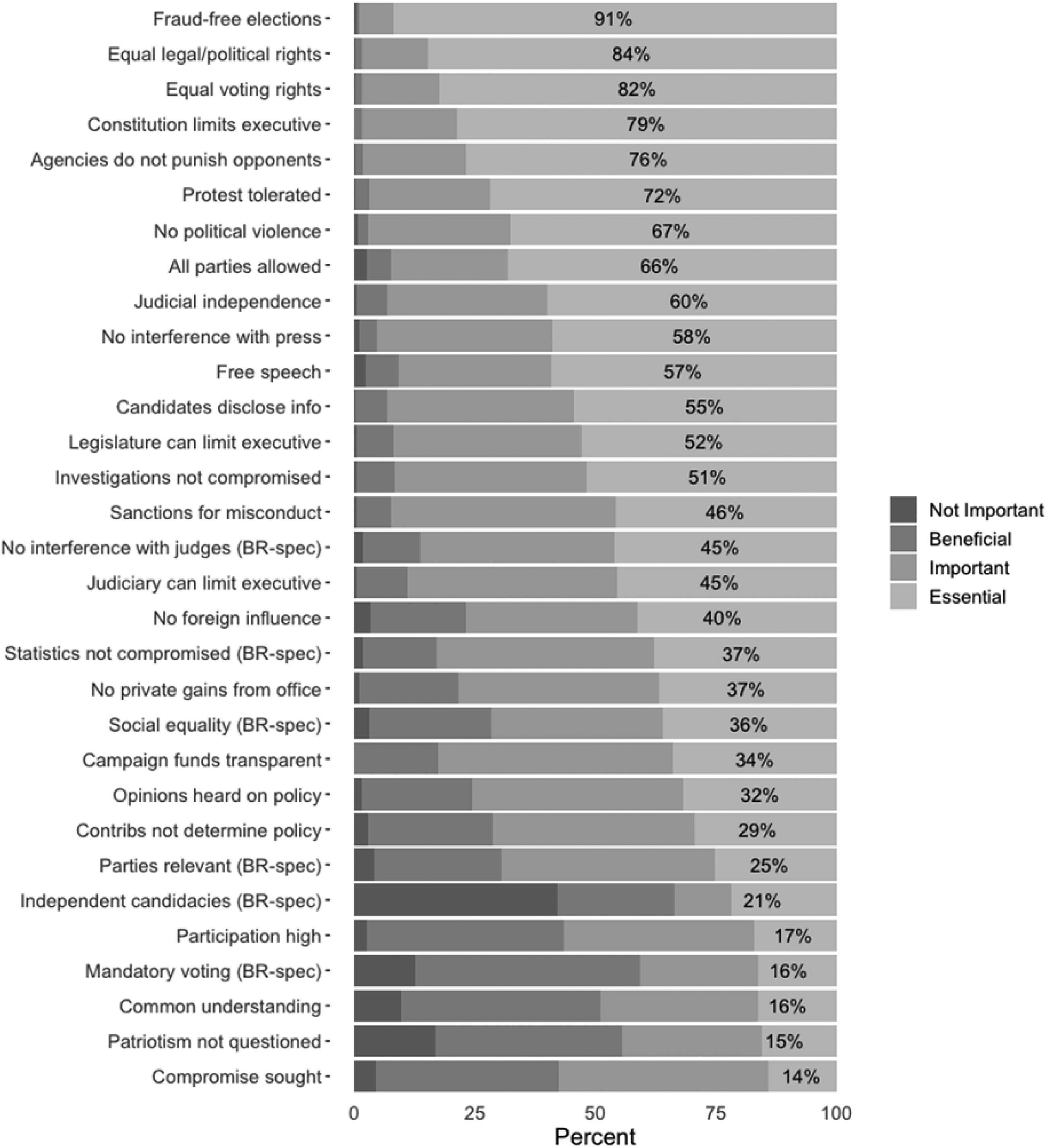
Responses to “how important are these characteristics for democratic government?”.
Respondents consider fraud-free elections, equal legal and political rights, and non-persecution of political opponents as essential. Next, institutional checks, no political interferences with judges, and government statistics are perceived as more relevant than officials not using public office for private gains or the idea that individuals should share a level of social equality. Toward the bottom, we find informal norms of political behavior, high voter turnout, mandatory voting, and independent candidacies as mainly beneficial for democracy. 3 These results are similar to responses from the third wave of the Bright Line surveys with political scientists in the United States (September 9–18, 2017). Figure 2 presents the comparison by showing Brazilian experts’ percentages with a black dot and American ones with a gray triangle. A gray arrow indicates that Brazilians evaluate the item as less critical, while a black arrow indicates that Americans considered it more critical. 4
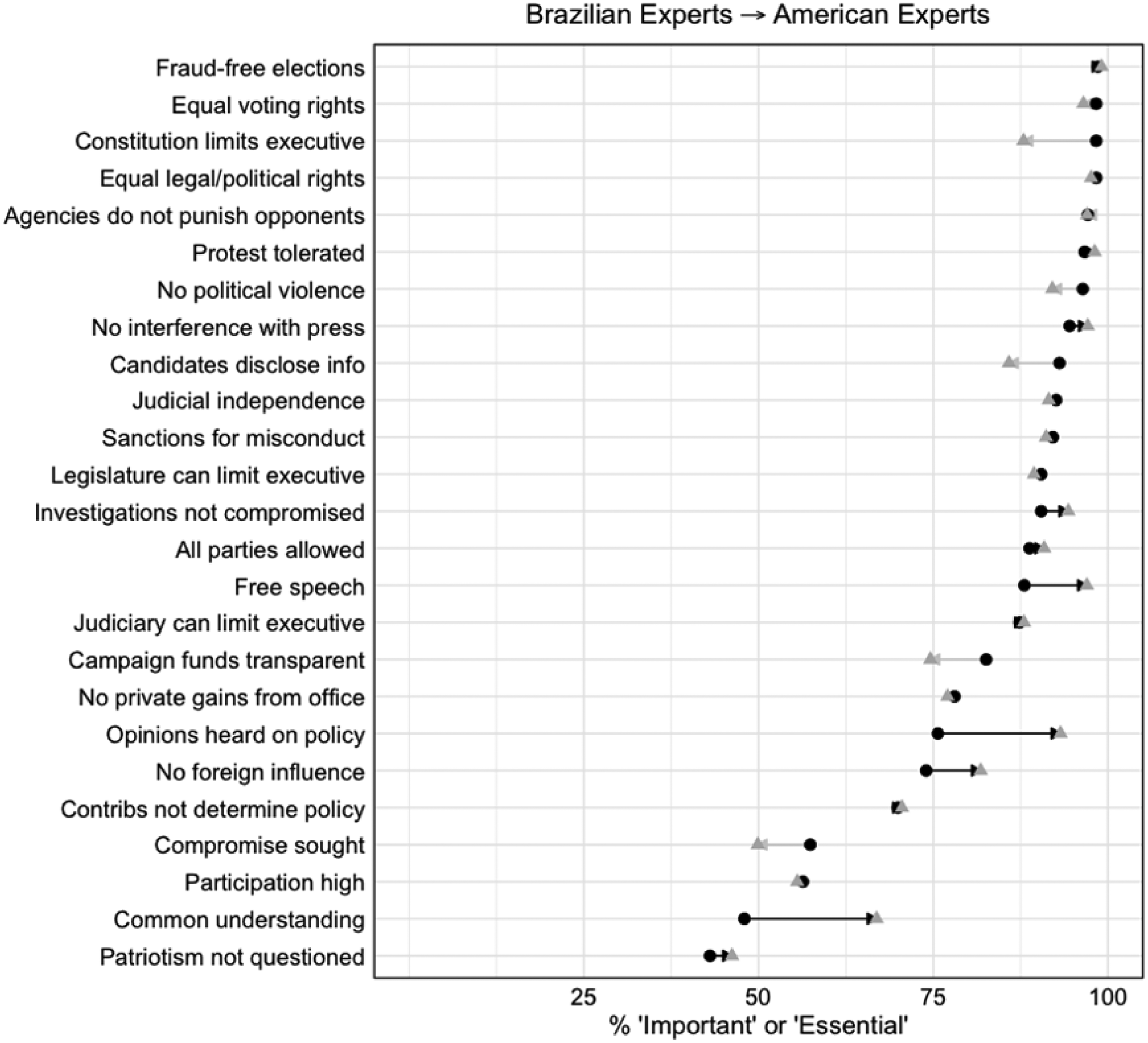
Brazilian and American expert responses to “how important are these characteristics for democratic government?”.
Overall, there is slight variation across the two samples, except for three principles. American experts view Citizens’ opinions on public policy and Common understanding as more important than Brazilians. In contrast, Brazilians see Constitutional limits to executive power as more important.
Performance of Democracy
When asked about the extent to which Brazil meets the principles’ standards, responses were generally negative. Figure 3 presents the distribution of responses per item.
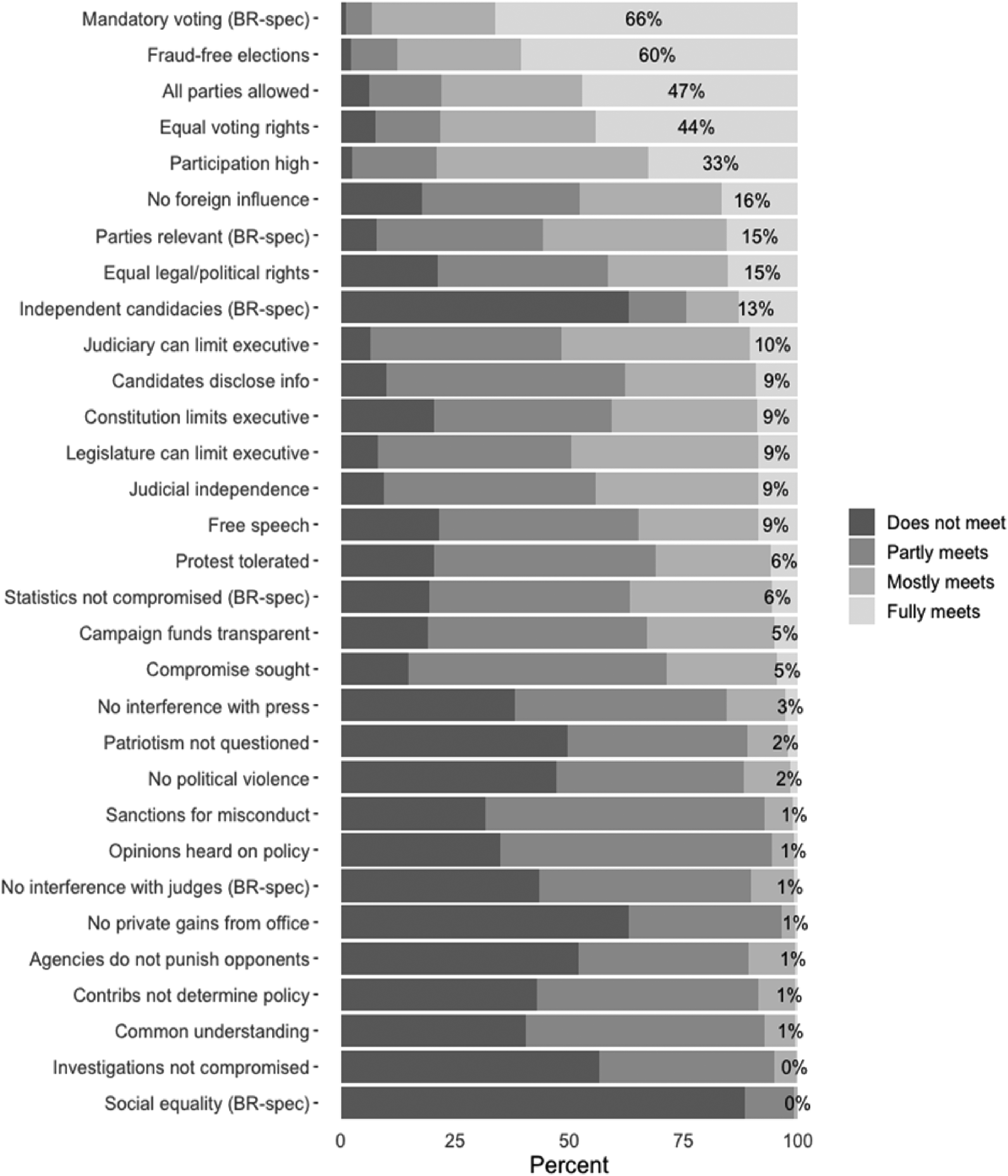
Experts’ responses to “how well does the statement describe Brazil today?”.
According to Brazilian political scientists, the country's electoral politics is in good shape: the majority sees elections as, at least mostly, fraud-free, voting rights as equal, participation as high, and does not encounter ideological restrictions on parties either.
In contrast, experts perceive other features of Brazilian democracy more negatively. For instance, most of them view Brazilian democracy as not meeting or partly meeting principles related to government restrictions. A majority believes Brazil only “partly meets” the principle of restraining governments from interfering with the press, judges, and official statistics, as well as not punishing political opponents, using political violence, and attaining private gains from office.
Crucially, experts consider that essential features of democratic government are performing poorly. Figure 4 compares the results obtained in the question on the principles considered as essential or important for democracy in general with the share of answers that rated Brazil as “fully” or “mostly meeting” these standards.
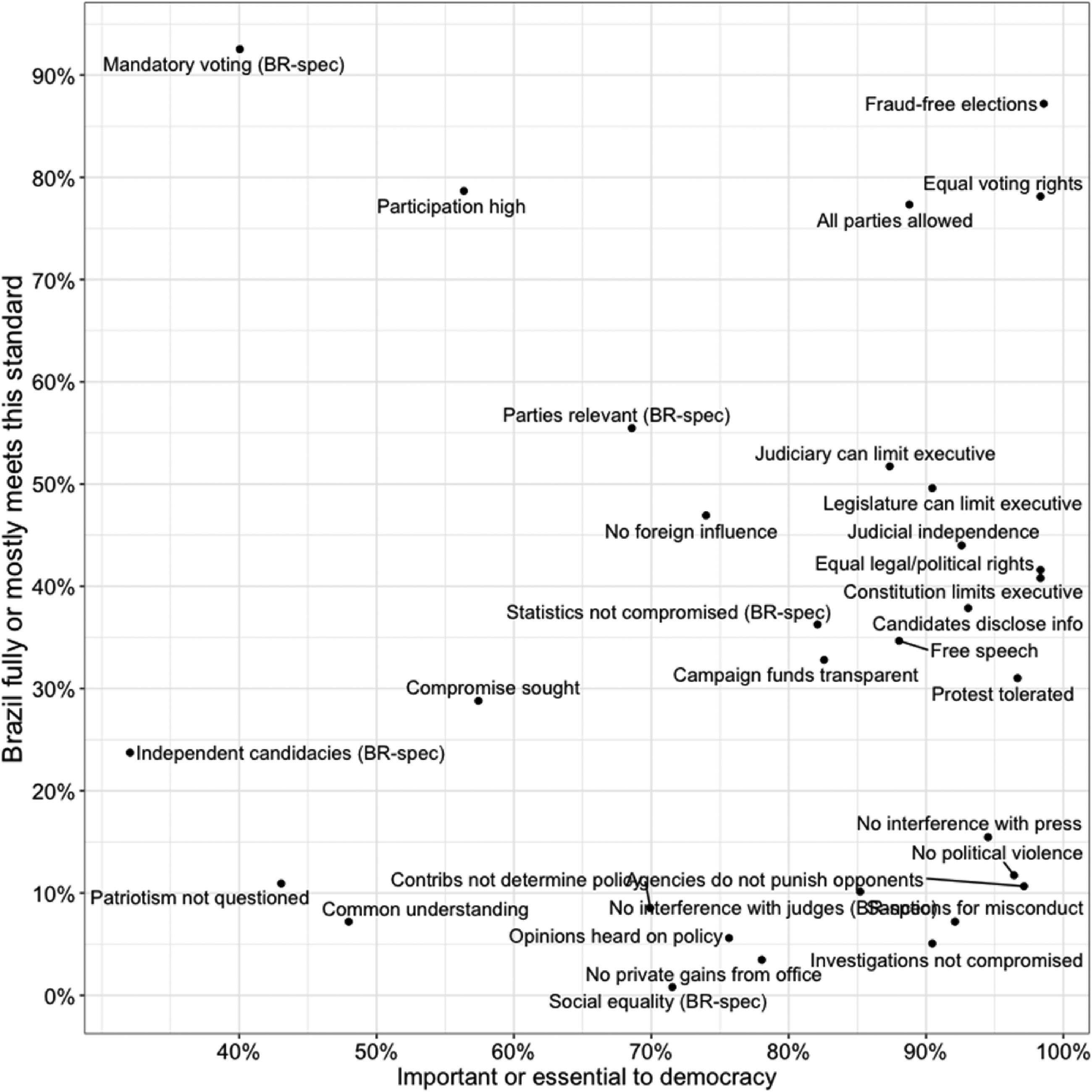
Experts’ responses to importance of principles and performance of Brazilian democracy.
The essential but problematic characteristics of Brazilian democracy, according to the sample of experts, are on the bottom right of the graph. Perhaps most worrisome is the perception that law enforcement investigations and the press are not free from political interference, with government agencies being used to monitor, attack, or punish political opponents.
Possible explanations for this perception were instances of government agencies monitoring individuals who criticized the government, and episodes in which the president chose to interfere with Federal Police investigations. Moreover, the controversial case against former President Lula da Silva, who was not able to run for office in the 2018 elections after courts found him guilty of corruption and money laundering may have contributed to this outcome. In fact, recent evidence led the Supreme Court to deem that decision as biased. And as for political violence, at least eighty-four candidates were assassinated during the 2020 municipal races, and in 2018 (Nunes, 2020), a prominent Black female councilwoman, Marielle Franco, was murdered in Rio de Janeiro.
Brazilians’ concern with these principles becomes even more apparent when we compare with how the sample of American political scientists perceived their country's performance. Figure 5 compares the percentage of Brazilian and American political scientists who perceived their respective democratic governments fully or mostly meeting each principle's standards.
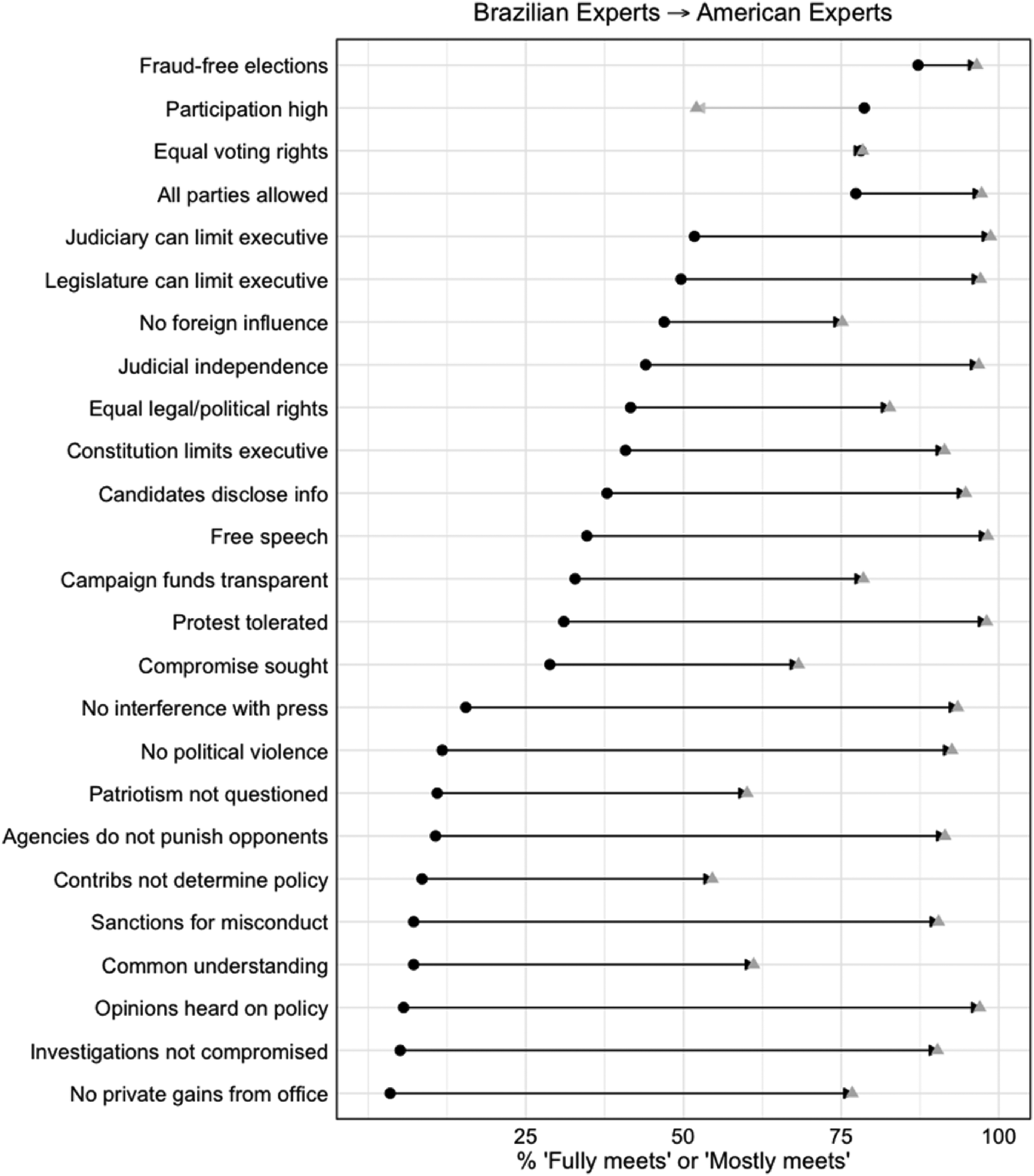
Brazilian and American experts’ responses to “how well does the statement describe the Brazil/u.s. today?”.
Except for high voter participation—a feature of Brazilian elections since democratization that is rare in the United States, equal voting rights and fraud-free elections that are perceived similarly across samples, Brazilian experts are more pessimistic than their American counterparts. The share of American experts who believe that their country's democracy fully or mostly meets these principles’ standards is at least 20 percentage points larger than Brazilians across all other items.
Differences Across Brazilian Scholars
Scholars have long debated which principles are essential for democracy. In this section, we assess whether differences are related to experts’ ideological positions, as it appears to be the case among the U.S. public (Carey et al., 2019). We explore this issue across Brazilian scholars by looking at the association between self-placement on the left–right 10-point scale and views on the importance of principles and assessment of the Brazilian democracy. 5
To that end, we employ a series of multivariate regressions in which the dependent variables are whether the respondent considered the principle “Essential” or “Important,” and our main predictor of interest is the position on the left–right scale. We include gender and a set of dummies that indicate if the respondent primarily works on research, teaching, or administrative work as controls. Figure 6 shows the beta coefficient associated with the left–right predictor in each regression. Negative values indicate that scholars who position themselves more to the right view principles as less important than those who identify with the left. Statistically significant coefficients are depicted as black and those that do not reach significance as gray.
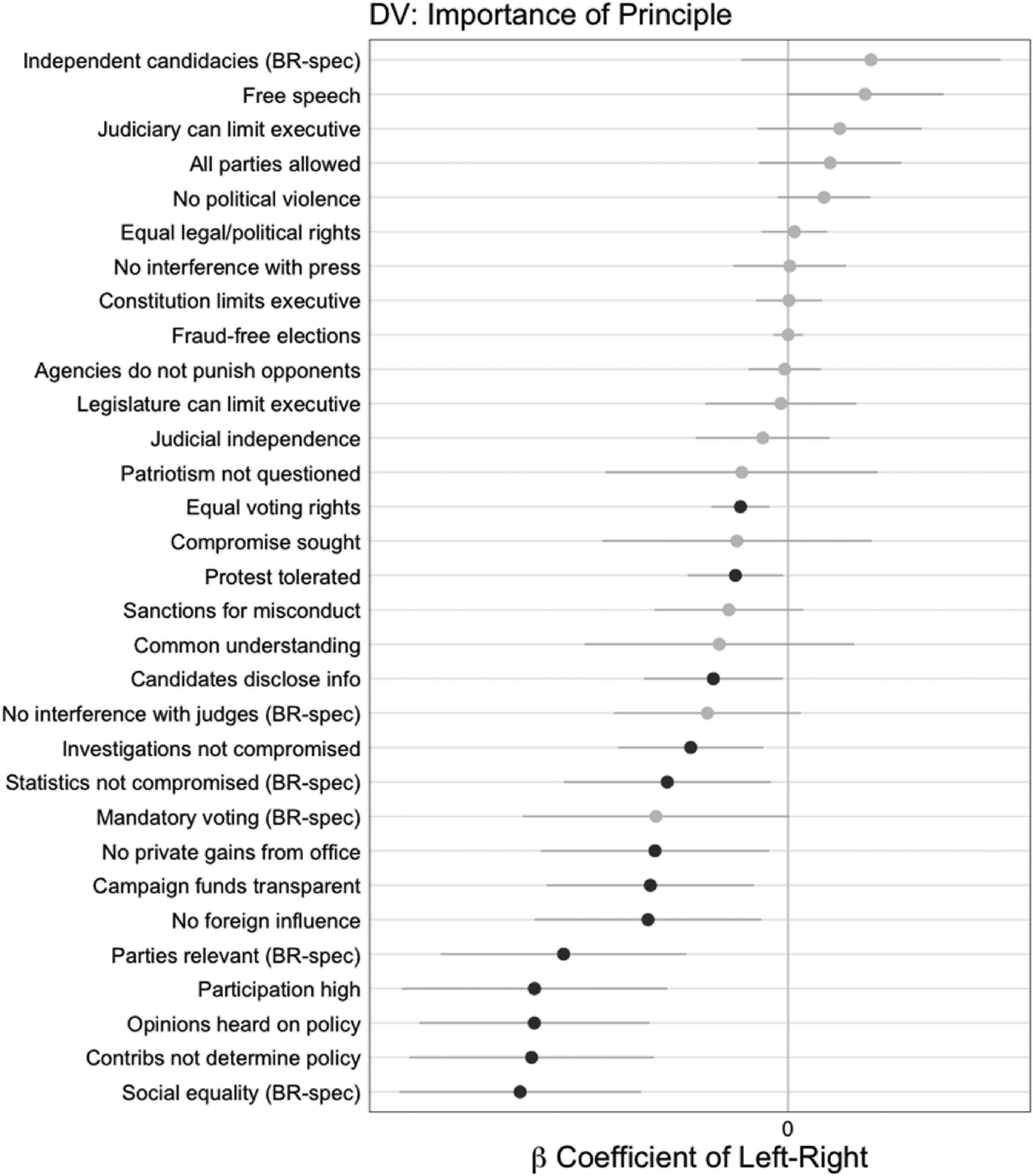
Association between position on the left–right scale and views on importance of principles.
Results show the absence of clear difference across experts on roughly half of the principles. Yet, we find that respondents who position themselves more to the right tend to view some principles as less important, particularly those regarding equality and participation.
When we look at differences in evaluations of Brazilian democracy's performance, however, we find opposite results. Respondents who place themselves more to the right tend to evaluate Brazil's democracy as “mostly” or “fully meets” the standards more often, as shown in Figure 7.
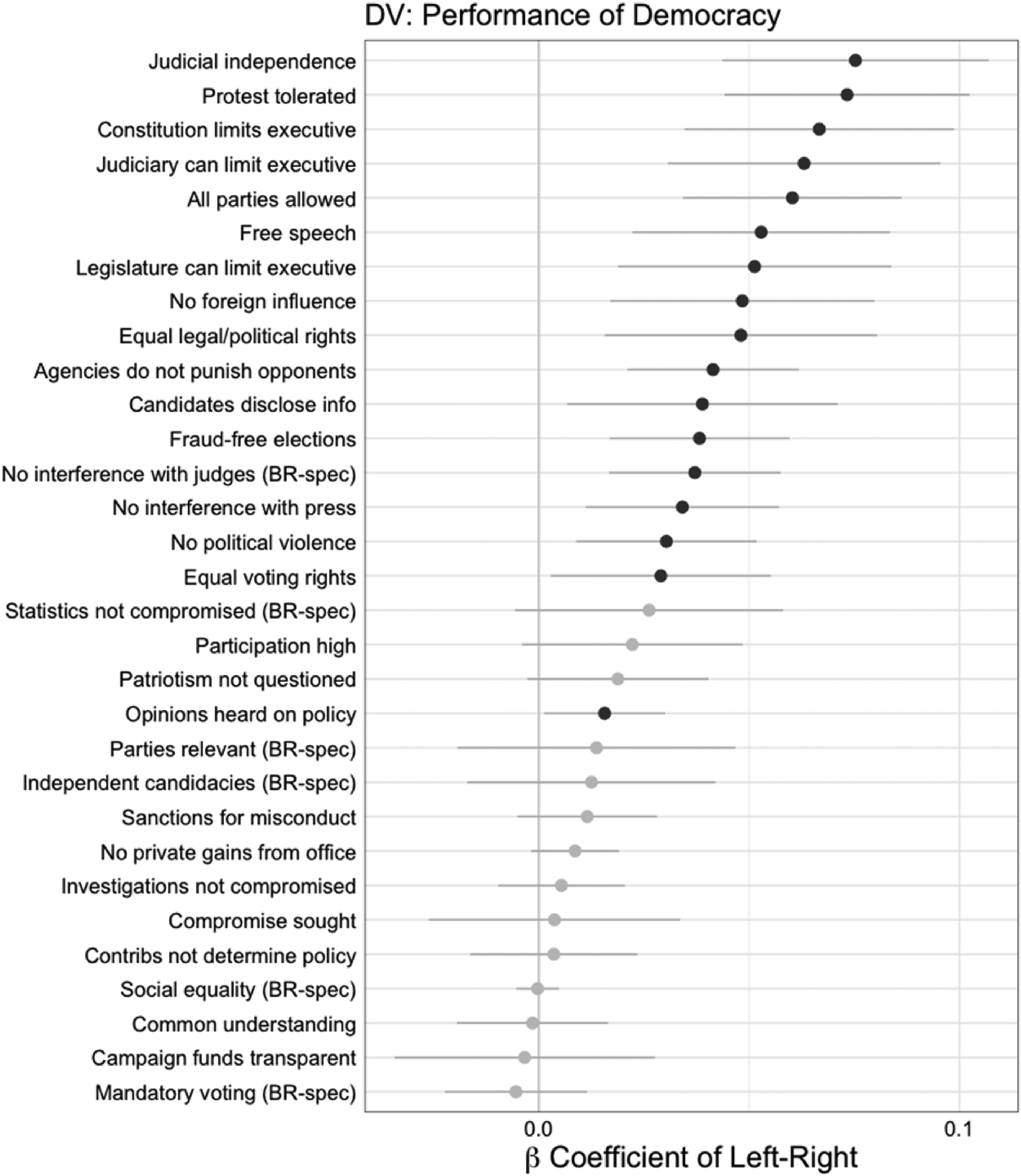
Association between position on left–right scale and views on Brazil's performance regarding democratic principles.
In this analysis, differences are more pronounced regarding judicial independence, tolerance to peaceful protests, limits on the executive, and interference on agencies and other branches. Conversely, there are no differences regarding electoral participation—one item in which Brazil meets the standard values—and social equality—one in which Brazil does not.
Conclusion
Political scientists have debated whether the world or specific countries are going through a process of democratic deconsolidation. For instance, while Foa and Mounk (2016, 2017) are more pessimistic about the state of democracy, Alexander and Welzel (2017), Norris (2017) and Voeten (2017) do not perceive recent trends to be as alarming. Regardless of the crisis magnitude, concerns about a progressive erosion of democracy have prompted research on democracies’ weakest institutional links in a comparative perspective. This research note contributes to these efforts by presenting results from a survey of Brazilian political scientists.
We find that Brazilian experts share views when ranking the importance of democratic institutions, such as electoral competition, equal political rights, and diverse forms of constitutional limits on the executive. This institutional ordering is similar to how American political scientists assess the importance of democratic principles. However, when asked to evaluate institutions’ current performance, Brazilians are largely more pessimistic. Additionally, recent events within each country may condition these views, as shown by the variation in the rating of the U.S. democracy across time in the online Supplemental material.
Using a left–right self-placement measure, we also explored differences in views on the importance and performance of democratic institutions among Brazilian experts. Results show that more leftist scholars attribute more importance to social equality and political participation, yet these experts are generally more critical of institutions’ performance.
Supplemental Material
sj-docx-1-pla-10.1177_1866802X221107032 - Supplemental material for Democratic Principles and Performance: What do the Experts Think?
Supplemental material, sj-docx-1-pla-10.1177_1866802X221107032 for Democratic Principles and Performance: What do the Experts Think? by Guilherme A. Russo, George Avelino and Fernando H. E. Guarnieri in Journal of Politics in Latin America
Supplemental Material
sj-R-2-pla-10.1177_1866802X221107032 - Supplemental material for Democratic Principles and Performance: What do the Experts Think?
Supplemental material, sj-R-2-pla-10.1177_1866802X221107032 for Democratic Principles and Performance: What do the Experts Think? by Guilherme A. Russo, George Avelino and Fernando H. E. Guarnieri in Journal of Politics in Latin America
Footnotes
Declaration of Conflicting Interests
The author(s) declared no potential conflicts of interest with respect to the research, authorship, and/or publication of this article.
Funding
The author(s) disclosed receipt of the following financial support for the research, authorship, and/or publication of this article: This work was supported by the Chicago Center on Democracy.

Supplemental Material
Supplemental material for this article is available online.
Notes
Author Biographies
References
Supplementary Material
Please find the following supplemental material available below.
For Open Access articles published under a Creative Commons License, all supplemental material carries the same license as the article it is associated with.
For non-Open Access articles published, all supplemental material carries a non-exclusive license, and permission requests for re-use of supplemental material or any part of supplemental material shall be sent directly to the copyright owner as specified in the copyright notice associated with the article.
