




Abstract
Are voters’ attitudes towards corrupt candidates affected by the details they learn about candidates’ wrongdoing? This study examines the effect of including different pieces of information emphasising the public costs or private gain of a similar corruption incident on the probability of support for the incumbent mayor’s re-election. I use three surveys experiments with online convenience samples of Brazilian subjects. The survey experiments use various vignettes presenting a fictitious Brazilian incumbent mayor with antecedents of misuse of public funds, running for re-election. I manipulate the details that subjects learn on those antecedents to assess whether information on the public costs of the corruption incident or on the candidate’s illicit enrichment stimulates a stronger rejection. Additional manipulations are used to test rival hypotheses. Results consistently show that information showing the candidate’s illicit enrichment drives a stronger negative response than every alternative treatment.
Introduction
In recent years, a growing number of studies have investigated the conditions that affect voters’ reactions towards corrupt candidates. This has been the focus of many experimental and observational studies, including an initiative to support field experiments across various developing countries. 1 These studies have emphasised the importance of a host of mediators, such as subjects’ identification with the accused candidate’s party (Anduiza et al., 2013), subject’s identification with the candidate’s position on specific issues (Rundquist et al., 1977), the degree of party system polarisation (Eggers, 2014), and the role of information provided by the media and oversight agencies (Banerjee et al., 2014; Botero et al., 2015; Chang et al., 2010; Costas-Pérez et al., 2012; Ferraz and Finan, 2008; Palau and Davesa, 2013; Weitz-Shapiro and Winters, 2013, 2017). The role of information has been tackled by various experimental papers, which found that voters differentiate between credible versus non credible information (Botero et al., 2015; Weitz-Shapiro and Winters, 2017).
Several of these studies (Fernández-Vázquez and Rivero, 2016; Klašnja et al., 2017; Pereira and Melo, 2015; Weschle, 2016) assess whether voters are willing to condone corrupt incumbents if the politician provides other material benefits. The underlying assumption is that voters hold politicians accountable with a self (material) interest approach; that is, when they assume that their well-being suffers from corruption they are more likely to punish corrupt candidates, but when they benefit from corruption or from a corrupt politician, they are less likely to punish the candidate.
For instance, two recent studies find that voters care about the distribute consequences of corruption. Weschle (2016) uses a survey experiment to assess the effect of informing subjects that a corrupt incumbent distributed the spoils of corruption – through clientelism – versus informing them that corruption was used for his private benefit and finds that electoral punishment is stronger when subjects learn that corruption was used for the candidate’s private benefit. Fernández-Vázquez and Rivero (2016) find in an observational study that only mayors who engage in corruption with negative distributive consequences are punished by voters. Similarly, other studies find that accountability is mitigated when the candidate brought other side benefits to their constituents, such as jobs (Klašnja et al., 2017), public goods (Pereira and Melo, 2015), or when the economy is growing (Klašnja and Tucker, 2013). In contrast, Winters and Weitz-Shapiro (2013) find no evidence that a good record of public good provision reduces punishment towards corrupt incumbents.
This line of research is grounded on an underlying conception of a utilitarian voter who is willing to condone corruption should he obtain other material benefits. In terms of the type of moral reasoning which would motivate a behaviour-promoting accountability, it assumes that voters primarily rely on consequential type of evaluation; that is, they weigh the candidate’s malfeasance records specially focusing on the presumed negative consequences of that act. 2 Accordingly, voters are more willing to condone corruption if the consequences of such malfeasance are not negative, or other candidate’s records contribute to the public well-being.
In this study, I propose an alternative foundation for the motivation behind voters’ attitudes towards corrupt candidates: that voters reject the candidate’s greed more than the negative consequences of corruption. According to this hypothesis, voters consider corruption more as a (negative) candidate trait than as an illicit act bearing negative consequences for their well-being.
This hypothesis is consistent with various studies that show that candidates’ traits, such as integrity and trustworthiness, have an important impact on voters’ evaluation (Fridkin and Kenney, 2011; Funk, 1996). If this theory is correct, then information about how the candidate sought for himself some particular advantage out of the corruption act would spur a stronger reaction than any other type of information about the negative consequences of such act.
This theory implies that voters’ motivation stands closer to a deontological type of moral reasoning; that is, voters reject more the corruption in itself than the negative consequences of it. According to the deontological tradition, moral evaluations rely on an assessment of the morality of the act in itself and by the intent of the actor, more than on the consequences of such act. 3
While the distinction between corruption that benefits the public versus corruption for self-benefit is relevant to understand public’s motivation, real-world corruption incidents are rarely schemed to benefit the public, which stands from the very essence of corruption as an activity that politicians want to hide. Most times, corruption is associated with negative outcomes – that is, involving public costs – rather than with positive distributive consequences, as a large number of empirical studies has shown (see Bardhan, 1997; Olken and Pande, 2012, for a review of findings). The distinction I propose assumes two alternative – but not exclusive – pieces of information on a similar corruption crime trying to reflect the type of information that typically reaches the public. This alternative distinction, I argue, can help us better understand how information accessible to the public in typical corruption cases affects their behaviour.
Moreover, I argue that information on the public costs and on the private gain is ubiquitous in corruption news stories. The media will typically emphasise the side of the story where the burden of the evidence more heavily relies on. If the accusation is grounded on proofs of illicit enrichment, then the story will focus more on the private benefit of corruption. Alternatively, when the evidence relies on proofs of misuse of public funds, such as over-invoicing, no-bid contracts or evidence that money was diverted from its original purpose, the story will focus more on the public costs of corruption.
It is true that virtually every episode of corruption involves money misappropriated from one source – involving a cost for the public welfare – and diverted to a destination not legally sanctioned, such as an illegal campaign fund or used for illicit enrichment. However, the study’s underlying assumption is that providing additional information on only one of these sides will prompt subjects to focus mainly on one of these stimuli. As a rich body of literature on priming effects shows (Ansolabehere et al., 1993; Iyengar et al., 1982), by providing additional information on issue, we can assess the effect of that information on a subject’s response. Hence, the purpose of this research is to assess whether knowing more about the public costs versus the private gain of a corruption act spurs a stronger reaction.
To assess the public costs versus private gain hypotheses I use three online survey experiments – including one pilot study – administered to a convenience sample of Brazilian subjects. The pre-analysis plan for the two experiments was preregistered (Avenburg, 2015, 2016). In all studies I use vignettes presenting a hypothetical incumbent mayor running for re-election with antecedents of misuse of public funds. Two main treatments are used to test the two main hypotheses of this study. In one, the vignette provides additional information on the source of misappropriated funds – that is, from which programmes funds were misappropriated – to emphasise the public costs of corruption. These costs are made explicit in the second study. An alternative treatment provides additional information on the destination of those funds; that is, on the mayor’s illicit enrichment. Additional treatments are used to test rival hypotheses.
Results consistently show that additional information showing the private spoils of corruption generates a stronger negative response. These findings suggest that corruption is not an undifferentiated treatment. What citizens think about a politician’s behaviour is largely a function of what sort of details are revealed (generally through the media) about that behaviour. More specifically, when they learn details about how a corruption scheme is used for the politician’s personal benefit their rejection of that candidate will be stronger.
The findings have important implications both for the scholarly literature and for assessments of the effect of corruption on public opinion at large. Regarding the former, the findings provide suggestive evidence that corrupt candidates receive a stronger punishment when corruption is perceived as a candidate’s trait – that is, as a result of his greed – than when perceived as a crime bearing negative consequences for the public. In terms of the implications for assessments of the impact of corruption scandals on public opinion, these results imply that corruption news articles focusing on such aspects as illicit enrichment by politicians will generate a stronger public reaction than articles covering other aspects of corruption.
In the next section, I discuss the public costs versus private gain distinction, discuss its relevance for our understanding on the motivation behind electoral accountability and for our assessment of information on corruption scandals on public opinion. I also present the two main hypotheses. The following sections present the pilot study and each of the two experiments, describe their design, the rival hypothesis tested, and analyse their results. In the conclusions, I discuss the findings and their implications.
Public Costs and Private Gain in Corruption News
Typical corruption schemes can be seen as a sequence involving private benefits (from which voters are excluded) and public costs (which voters suffer). 4 Both aspects can presumably trigger voters’ negative response: public costs (as it assumes costs on voters’ welfare) and private gain. Emphasis on private gain doesn’t necessarily involve public costs but might invoke other moral reactions of unfairness (i.e. illicit enrichment) and lack of trust on the candidate.
A full corruption story often contains information both on the source where the money was misappropriated from and on where those funds were diverted. When these types of stories are available, the public reaction will respond to a combination of all the details contained in the story. However, not always the news coverage of corruption schemes shows both aspects of the story. The focus of media reports will depend on where the burden of the evidence is grounded. While a very solid investigation could serve the press to portray a complete scheme from end to end – that is, from where the funds misappropriated were obtained to where they were diverted – often information disproportionately focuses on one of these sides. Different cases of corruption generate different types of news, covering different details of the story, which, I argue, will affect differently public opinion.
I propose a twofold categorisation on the type of information available in press reports based on its hypothesised impact on public opinion: (1) information focusing on the private benefit – for the official – of corruption, which reflects a piece with more information on the destination of diverted funds and (2) information focusing on the public costs – for the community – of a corruption incident, which is often present when the story focuses on the origin of those funds. 5 There are three main reasons why this distinction, I argue, contributes to the extant literature.
The first reason is that the public costs versus private gain distinction offers a categorisation on the type of information in real-world news that typically reaches the public and, hence, contributes to our assessment on the impact of corruption scandals on public opinion. While the categorisation wasn’t built from a systematic coding of the type of information available in a sample of real-world corruption scandals, I use two sources to defend its relevance.
First, it is partially based on a sample of news articles on corruption scandals in Brazilian municipal politics that were used to build the experimental vignettes in a realistic fashion, following the typical format of news in Brazilian journals. In Appendix 11, I present this sample of news articles covering municipal corruption in Brazil. A total of 21 news articles were selected with that end using a Google search specifically geared towards identifying municipal corruption incidents that did not necessarily reached a national audience. 6 The search attempted to identify typical lower level corruption incidents which subjects could find similar to those they could potentially encounter in their own municipalities. In that appendix, the articles are classified depending on whether the information emphasises the public costs or private gain of corruption.
Second, I present a number of examples of recent major corruption scandals in Latin America to show how different scandals can be thought as providing more information on the public costs, private gain, or a combination of both. 7 In November 2014, a Mexican news outlet revealed that President Enrique Peña Nieto was living in a luxurious house built by a subsidiary linked to a major construction conglomerate involved with government contracts. The scandal was known as the “White House” scandal because of the property the president was enjoying. As can be seen, the focus of the story was on the house that the president was taking benefit from. While we can assume that the incident might involve costs for the public welfare, the details of the story, based on the burden of the evidence, emphasise the private gain side of the story.
In 2005–2006, two major scandals hit Brazilian politics: the Mensalão (“Monthly Payments”) case and the Sanguessugas (“Bloodsuckers”) case. The first was a scheme in which various members of the PT government offered monthly bribes to allied legislators in exchange for political support. Evidence showing that legislators were receiving PT (Partido dos Trabalhadores) monthly bribes is an example of information on the private benefits of corruption; subsequently, the press reported that the diverted funds might have originated from state-owned companies’ advertisement budget. This is an example of the public costs of corruption. The Sanguessugas case involved a scheme of overpayments and money diversion in public purchases of ambulances; hence, news stories focusing on overpayments and payments without acquisition of those ambulances show the public costs of such fraud. More recently, the Petrobras corruption scandal revealed systematic overpayments in contracts awarded by the main state-controlled oil company, which seriously affected the company’s value. 8 The details revealed in this scandal show the public costs of the scheme. Another recent major corruption scandal, the Lava Jato, revealed that many first-ranked politicians in Brazil received illegal funds, which reflects the private spoils of corruption.
Other corruption scandals reveal both aspects of the story. For instance, in 2014, a financial crisis at the Honduran Social Security Institute (IHSS), a government-run social security office, led to various investigations revealing that the crisis was triggered by systematic misuse of public funds and money diversion. The public costs side was clear from the fact that several patients who required assistance from the institute died as a result of lack of adequate medical supplies and staff. Subsequently, other press investigations revealed the private gain of the scheme, showing that IHSS officials were living in luxurious houses and enjoyed an extravagant lifestyle and that part of the diverted funds were used for illicit campaign funding for the ruling National Party. A similar corruption scandal with deadly results took place in Guatemala in May 2015, when an investigation found that the Guatemalan Social Security top managers had received bribes to purchase faulty medical supplies, which ultimately led to several deaths.
Various other scandals involved the use of illegal campaign donations, which conveys a personal benefit for the candidates receiving such donations, although not necessarily used for illicit enrichment. This was the case of various scandals that took place in Chile in 2014–2015 involving tax evasion and illicit campaign funding. 9
The second reason why the public costs versus private gain is relevant is that it contributes to our understanding on the type of motivation that prompts a stronger accountability by assessing whether voters rely on a consequential assessment of the consequences of corruption or, alternatively, focus on the benefit that the corrupt politician sought for himself. As previously explained, an important line of inquiry in this research agenda is based on the assumption of a utilitarian voter willing to condone corruption if the costs of corruption are not perceived. This article shows an alternative foundation that can stimulate a stronger reaction.
The last reason is that this distinction is also relevant for other experimental studies on corruption and accountability. When scholars use vignettes to describe a corrupt candidate’s records, they often need to convey additional information on the public costs or on the private benefits of corruption. For instance, Chong et al. (2015) in a field experiment distribute leaflets informing on the amount of funds that mayors spent in a corrupt manner and their responsibility in terms of public goods provision – which suggests the costs of a corrupt administration. Similarly, in their experimental study Banerjee et al. (2010: 20) prime subjects on the costs of corruption by telling them: “Corrupt politicians steal money set aside for development funds and do nothing for you.” In contrast, other experimental treatments include information on the politician’s illicit enrichment (Botero et al., 2015) or information on bribe taking, which also emphasises the private benefit of corruption (Banerjee et al., 2014; Klašnja and Tucker, 2013; Weitz-Shapiro and Winters, 2017; Winters and Weitz-Shapiro, 2013, 2016). Results presented in this study suggest that this additional information could moderate the treatment effect.
The proposed classification doesn’t imply that private costs and private gain are mutually exclusive in corruption schemes. As can be seen in Appendix 11, often the two aspects are shown in typical corruption news stories. However, it is analytically relevant to distinguish the effect of each of these aspects for a number of reasons. First, as previously stated, it is not uncommon that only one of these sides is reflected in a scandal. Hence, an estimate of the average effect of each of these pieces of information on subjects’ opinion can be used to estimate which type of scandal will convey a stronger public reaction. Second, even if both aspects are reflected, often one of these sides is more pre-eminent in the story and will be the focus of the headline and more attention will be devoted to it. Therefore, the side of the story that is most salient in the news will affect subjects’ judgement on this issue. Third, oversight agencies have often more institutional resources and expertise in gathering information that would make the evidence of a prospective incident rely on one of these aspects. Audit Courts will often collect more evidence that exposes the public costs of corruption, in particular when they focus on such crimes as over-invoicing, no-bid contracts and other types of non-efficient uses of public funds. In contrast, inquires that focus on inconsistencies on elected officials’ statements of assets, or major global investigations of non-declared assets – such as the Panama Papers scandal – will focus on the private gain side of the story.
The two main hypotheses of this study can be summarised as follows:
Pilot Study
The design of the two studies described in this article came out from the results of a pilot study, where a somehow related hypothesis was tested with null results. In this pilot study, I tested the hypotheses that accountability is moderated by information on the type of budget from where funds were misappropriated from and by information on where those funds were diverted. In particular, I hypothesised that when subjects learn that funds misappropriated were taken from expenditures that do not directly benefit the public – funds that were originally destined to repair computers in a municipal offices – they will be more willing to accept the corrupt candidate than when they learn that those funds were misappropriated from public health expenditures that directly benefit the public. A second hypothesis inquired whether different types of information on the destination of misappropriated funds – illicit enrichment versus illicit campaign expenditures – affect voters’ likelihood to accept the corrupt candidate. Vignettes presented a fictitious incumbent mayor running for re-election with antecedents of misuse of public funds. The alternative vignettes varied the information on the source of misappropriated funds and on the destination of those funds. The two alternative sources and two alternative destinations of misappropriated funds were combined in a 2 × 2 factorial design. I introduced a control condition (where subjects were informed that the candidate had no antecedents of irregularities) and a baseline condition (where subjects were informed that the candidate had antecedents of irregularities, but no further details on the source and destination of misappropriated funds were presented). In total, six vignettes were presented; the complete wording is presented in Appendix 1.
The pilot study’s design was similar to the two subsequent studies, using Facebook ads to recruit subjects. Instead of the two screeners used in the two other studies, only one was used in the pilot study. It was run between August and September 2015. In total 1,598 subjects completed the survey, and a total of 774 subjects passed the single screener used for the pilot study (48.4% of the total sample). Results showed no support for either of the two hypotheses. In Appendix 10, results are displayed using ordinary least squares (OLS) regression analysis. None of the conditions shows a statistically significant difference, except for the difference between the baseline condition – where subjects learn that the candidate has corrupt antecedents, but no other information on the source or destination of misappropriated funds is provided – and all other vignettes that display any type of information on the source of these funds and on the destination of these funds.
The difference between the baseline condition and all other vignettes with further information on the source and destination of the misappropriated funds provided the basis for the two studies presented in this article. In particular, the first study inquires whether the stronger effect is explained by the information on the source of the misappropriated funds or on the destination of those funds. When information about the source of the misappropriated funds is provided, subjects have some insight on the type of budget that is being defunded and, hence, are primed on the public costs of the corruption incident. When information about the destination of those funds is provided, subjects have an idea of how corruption is used for the benefit of the candidate, hence conveying an idea of the private gain of the incident. Consequently, the two studies presented here are used to test the public costs versus private gain hypotheses.
First Study
Following Samuels and Zucco (2012), I recruited subjects online with Facebook advertisements that avoided any reference to politics, to attract a wider sample of subjects. The ads targeted Brazilian users over the age of 18, offering the chance to win an iPad after completing a survey. Participants clicking on the ad were redirected to an external website that presented the consent form and hosted the survey.
All vignettes presented a hypothetical incumbent mayor with antecedents of corruption who is running for re-election. Following Weitz-Shapiro and Winters (2017), I asked subjects to imagine they live in a different municipality where this mayor is running for re-election and informed them that since he has been in office, the overall conditions in the municipality improved, with new public works completed and improved street cleaning and public transport. The vignette stated that the candidate is still very popular and has good chances of being re-elected (the exact vignette wording is available in Appendix 1). Because I was interested in comparing evaluation across different candidates who have corruption records, I used positive information on prior records, aside from the corruption records themselves. The purpose of providing a positive reference point was to allow a relatively high benchmark from which the negative evaluation point of the corruption record would presumably drop, hence allowing enough variation in the dependent variable.
The corruption treatment was provided by informing subjects that the State Audit Court examined how the candidate used public funds and detected irregularities such as over-invoicing and no-bid public purchases and rejected the candidate’s accounts (which is the regular procedure of Brazilian Audit Courts detecting severe irregularities). In Brazil, State Audit Courts have an extensive role in auditing accounts of officials at the municipal level (Ferraz and Finan, 2008; Melo et al., 2009; Pereira and Melo, 2015), and prior research has found that they are viewed as a credible source of accusation (Weitz-Shapiro and Winters, 2017). The vignettes added that despite the Audit Court’s decision, the candidate was allowed to run for re-election (in Brazil candidates with accounts rejected are not allowed to run, but they often circumvent this restriction by appealing in the judiciary).
To test the two main hypotheses I provided subjects with additional details emphasising either the public costs or the private benefits of the corruption incident. To test the public costs hypothesis, I used a vignette that included additional details on the source of the misappropriated funds. The vignette informed subjects that those funds were originally destined to improve the quality of public hospitals. The treatment emphasised the costs of the corruption incident in a key area, as public health is one of the main concerns for Brazilians, according to opinion polls. 10 To test the private benefit hypothesis I used a vignette that informed subjects that diverted funds were destined to a mayor’s bank account. Each treatment included specific details of the accusation to test rival hypotheses (described below).
The outcome variable (probability of voting for the mayor) was measured with a seven-point Likert-type scale. An alternative outcome measure, satisfaction with the mayor, was also measured using a second seven-point Likert-type scale. I included a pretreatment questionnaire with several demographic and socio-economic questions, along with questions measuring subject’s sources of political information, whether he or she regularly follows political news and discusses politics, whether he or she can properly identify the role of Audit Courts, and whether he or she attends public or private hospitals, 11 as subjects who regularly use public hospitals could be more sensitive to information stating that corruption affected public health.
In addition, I included two screener questions. The two screeners were presented as standard questions with instructions that attempted to measure attentiveness in the last part of the introductory paragraph (see Appendix 12 for the exact screener wording). As the vignettes introduced the additional information (on the public costs or private gain of the incident) in the fourth line of the paragraph, the screener was used to capture subject treatment compliance assuming equal attentiveness in the screener question and in the vignette. 12 In addition, I measured the time subjects spent reading the treatment vignettes to test whether those who passed the screeners also spent more time reading the vignette. Results are presented and discussed both for the entire sample and for the sample that passed at least one screener. I particularly focus on the results for the sample of most attentive subjects: those who passed at least one screener. Because the experimental design sought to capture the effect of various types of additional information introduced in the middle of the vignettes, results for the sample of most attentive subjects is of particular importance.
Rival Hypotheses
I tested a set of three alternative hypotheses assessing the role of additional information on the corruption incident. The first one states that any more extensive information, regardless of what kind of information it is, reinforces the treatment effect. Consequently, any vignette that provides additional information will provide a stronger reaction, even if this information doesn’t include details on the source or destination of misappropriated funds. According to this hypothesis, more information means a stronger treatment (by providing a stronger treatment dosage). If so, the fact that in the previous pilot experiment additional information generated a stronger response could be interpreted as a result of a reinforced treatment.
The second hypothesis states that information providing specific details about the accusation generates a stronger effect. Here I rely on prior research, grounded in dual-coding theory (Paivio, 1986), which has shown that concrete news has a stronger effect than abstract news (Prabu, 1998). Plausibly, the additional information that subjects received on the source and destination of misappropriated funds was making the news more concrete, creating a “story” out of information that otherwise can be perceived as abstract. To test this hypothesis I included an additional vignette with more abstract procedural information (the procedural information condition). When subjects were provided with more information either on the source of misappropriated funds or where those funds were diverted they got a real, concrete story, as opposed to those confronted with the abstract procedural treatment. Consequently, the treatment effect in those cases would be stronger.
Finally, I included a third hypothesis that focuses on the often insuficient background information that subjects have on the role of Audit Courts. I posit here that subjects in the exploratory experiment used the additional information on the source and destination of misappropriated funds to interpret what a negative audit means, which not all subjects might completely understand. To test this hypothesis, the procedural information condition provided additional information on the role of the Audit Court. Only abstract information was provided to accommodate hypothesis # 2. In particular, this hypothesis was tested with the sample of subjects who were less knowledgeable of the role of Audit Courts.
Vignette Design
The baseline treatment informed subjects that the Audit Court found irregularities and consequently decided to reject the mayor’s accounts. The procedural details treatment added information on the role of the Audit Court as well as information on the session and chamber of the Audit Court that decided to reject accounts (all information that is frequent in news articles). The public costs version was similar to the baseline, with additional information that the irregularities included over-invoicing and no-bid contracts in expenditures intended to build a primary healthcare centre. The private benefits treatment was similar to the baseline condition, with additional information that the Audit Court found that the mayor created a civil association to divert public funds to his own bank account. I used the Audit Court as the agency that investigates diversion of funds, though in Brazil this crime is more often investigated by the regular court system, to avoid varying the institution making the accusation. Presumably, subjects are more familiar with the procedures of the regular court system than with those of the Audit Court system. If so, introducing two different institutions might bias comparisons across groups.
Summarising the four treatment conditions: Tr1 Baseline: Information that the candidate has accounts rejected by the Audit Court. Tr2 Procedural: Baseline plus information on the Audit Courts procedures and mechanisms leading to that decision. Tr3 Healthcare: Baseline plus information that misappropriated funds came from a programme to build a primary care health centre. Tr4 Bank Account: Baseline plus information that funds misappropriated were diverted to the mayor’s bank account.
Hypotheses and Expected Results
Results
The experiment was run between November and December 2015. In total, 4,894 subjects responded to the survey. A total of 1,506 subjects passed at least one screener question (31 per cent of respondents) and a total of 701 subjects passed both screeners (14 per cent of respondents). The experimental sample is largely representative, although individuals with lower levels of education are under-represented. The sample also shows a larger share of women. Both patterns are consistent across the two studies (sample descriptive statistics are presented in Appendix 2).
The under-representation of the least educated subjects is consistent with prior studies using recruitment with Facebook advertisements in Brazil (Boas, 2014; Samuels and Zucco, 2012) and can be arguably attributed to the fact that this population has a lower rate of Internet usage. According to a 2016 study carried out by the Brazilian Institute of Geography and Statistics (IBGE), only 29.5 per cent of the least educated segment of the population – those with primary school incomplete or less –regularly use Internet. In contrast, 91.2 per cent of Brazilians with high school completed or more have a regular access to Internet (IBGE, 2016). To assess whether results for the entire sample are consistent with those of the subsample of the least educated subjects in Appendix 8 I run a similar analysis for those who have incomplete high school education or less. Results are discussed below in this section.
In terms of time spent on the vignette’s screen, subjects who passed at least one screener spent an average of 88.6 seconds, while subjects who did not pass any screener spent an average of 79.1 seconds. Subjects who passed the two screeners spent an average of 89 seconds. This suggests that subjects who passed screeners did spend more time reading the vignettes.
In Table 1, I present results from the OLS models. Results are displayed using baseline as the reference category. As can be seen across the six columns, results fully support the private gain hypothesis. In all columns, the bank account condition shows the strongest negative effect. As we can see in Appendix 7, several covariates (age, education, income, ideology, and frequency of political conversation) significantly predict probability to pass screener. Therefore, in columns 2-6 additional covariates are included to control for imbalances (see results of a multinomial logistic model testing sample balance in Appendix 3). In columns 2 and 3, I control for education, income, and gender, and in column 4, I include a knowledge of Audit Courts role dummy as control. All results fully support the private gain hypothesis. The effect size ranges from a decline in 9 percentage points in columns 1, 3, and 4 (with respect to the baseline condition) to a decline in 7 percentage points in column 2. The fact that the interaction with the Audit Court dummy is not significant (in column 5) suggests no support for the procedural information hypothesis. The interaction with the public hospital dummy (in column 6) is not significant, suggesting no support for the public costs hypothesis.
OLS Regression on Vote Intention (Study 1).
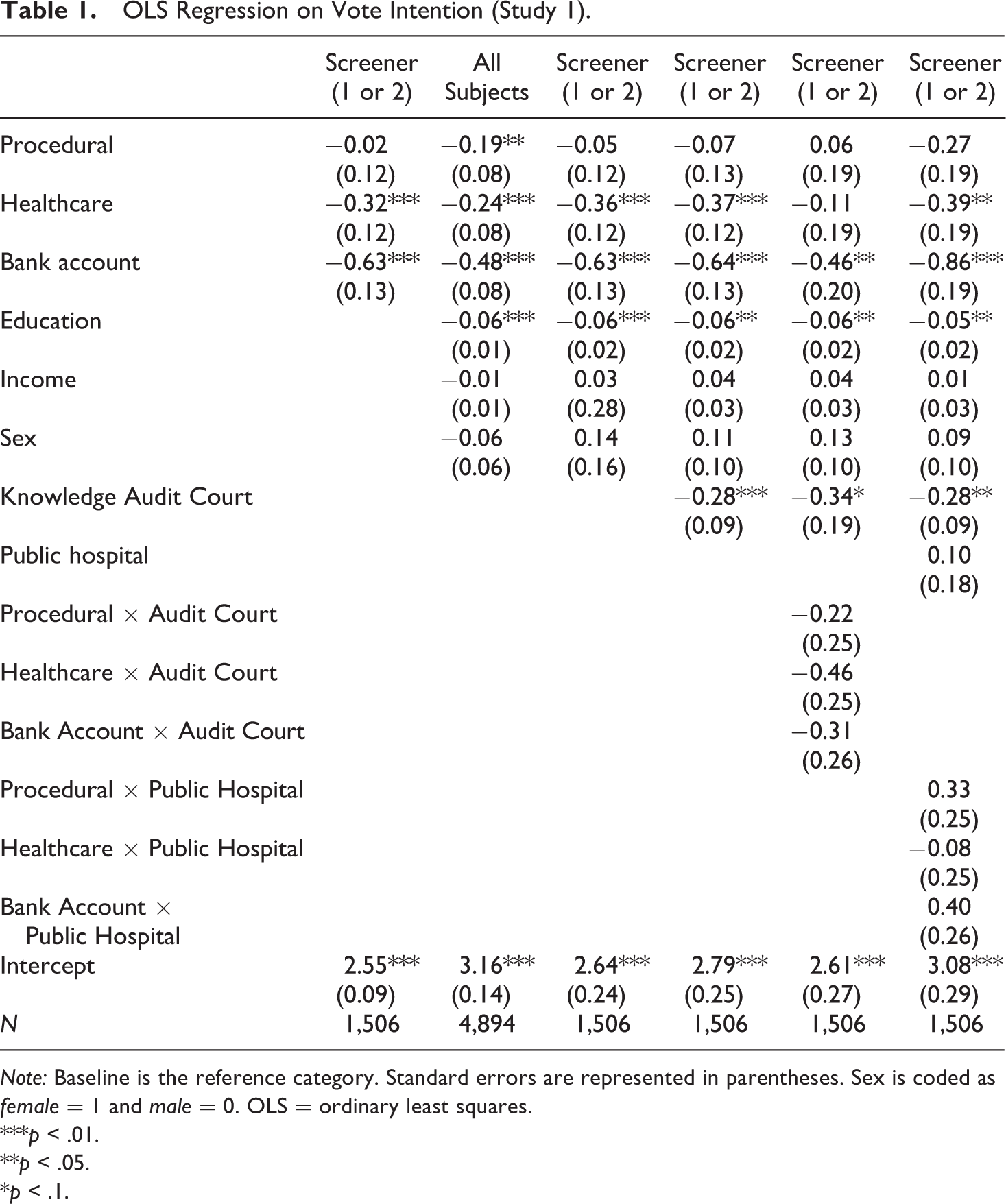
Note: Baseline is the reference category. Standard errors are represented in parentheses. Sex is coded as female = 1 and male = 0. OLS = ordinary least squares.
***p < .01.
**p < .05.
*p < .1.
In Appendix 4, I report mean vote intention for each treatment condition for subjects who passed at least one screener. Table 5A in Appendix 5 shows results of difference-in-means tests with vote intention as dependent variable for subjects who passed at least one screener. Results using both Holm adjusted p values (for multiple hypotheses tests) and non-adjusted p values show that subjects in the bank account condition are significantly less likely to support the candidate as compared to all other conditions. In addition, these results also show that subjects in the healthcare condition are significantly less likely to support the candidate than subjects in the baseline and procedural conditions. When shifting the dependent variable to satisfaction with mayor (Table 5B) only the bank account condition shows significant differences with the other conditions. Results using the entire sample (displayed in Appendix 6) also provide strong support for the private gain hypothesis.
In Table 9A in Appendix 9, I use various interactions to assess whether the effect varies across subjects with different background conditions. In particular, I interact the various treatments with an ideology variable that measures in a 0–10 point scale whether the individual self-identifies from far-left (0) to far-right (10); a 1–5 point scale variable capturing whether the individual regularly follows the news, which goes from never (1) to always (5); a 1–5 point scale variable capturing whether the individual regularly talks about politics, which goes from never (1) to always (5); and two dummies indicating if subject self-identifies with one of the two main parties: the PT or the Partido da Social Democracia Brasileira (PSDB). There is an interesting interaction between ideology and bank account: as we go to the far-right in the ideology spectrum, individuals seem to be more information sensitive to the bank account information. However, the same interaction shows no significant results in the second study. Therefore, it is unclear to what extent this result is generalisable.
In Appendix 8, I assess whether these results are consistent when considering only the under-represented population of the least educated subjects. Results are consistent with the larger population. Subjects in the bank account condition – as well as subjects in all other conditions – are less likely to support the candidate than those in the baseline condition.
In sum, overall results in study 1 fully support the private gain hypothesis.
Second Study
Results of the first study showed that more information on the candidate’s illicit enrichment drives a stronger punishment effect. The purpose of the second study is twofold. First, the bank account and healthcare vignettes were modified to make them more homogeneous. In the first study, those vignettes included specific stories on the corruption episodes found out by the Audit Court to accommodate its format to the one of typical real news and as a test for the specific details versus abstract news hypothesis. The trade-off is that as different forms of specific stories are developed, other details of the story besides the treatment itself might have an impact on the outcome of interest. In this new experiment, those conditions are displayed in more homogeneous vignettes, without developing concrete stories, so that other background conditions are kept similar.
Second, a new vignette is included to assess whether the finding that voters care more about the private benefits of corruption than about the consequences of it can be used to generalise a theory about how subjects weigh corruption antecedents. As previously explained, the fact that subjects reject more strongly the personal use of public funds supports the idea that corruption is weighed more as a candidate trait than as an act bearing negative public consequences and is consistent with a deontological idea of morality, in which the judgement focus more on the act in itself than on the consequences of it. To assess whether this finding can be used to generalise a theory about accountability, I use a new treatment that primes subjects on the lack of candidates’ trustworthiness: this is the lying treatment. In this new treatment, subjects are informed that the candidate lied to the Audit Court to cover-up the irregularities in his use of public funds. This new treatment is also consistent with the idea of corruption as a candidate trait, as subjects receive more information on the candidate’s faulty behaviour but not on the consequences of such behaviour. Consequently, if the theory that subjects consider corruption as a candidate trait is valid, then we should be able to generalise the theory finding a similar treatment effect in both the private gain and in the lying vignettes, as in both cases the candidate attempted to deceive voters and oversight institutions, either by using a scheme to divert money or by lying to the Audit Court to conceal the irregular use of public funds. In contrast, if subjects are particularly concerned with the elected officials’ illicit enrichment, we should still detect a stronger effect in the bank account vignette.
In addition, I increased the negative stimulus of the public costs vignette as a harder test for the private gain hypothesis. The new stimulus made explicit the costs associated with the misuse of funds by informing subjects that as a consequence, the primary care health centre couldn’t be finished. 13
Experimental Design
The experiment was run in January 2016. The recruitment method was similar to the one used in the first study, with one modification. To avoid repeated survey takers, I used a Facebook pixel that identified and prevented showing the ad to users who completed the pilot and first surveys. In addition, I set the survey in the same Qualtrics platform that was used in study 1; the survey was set to prevent retaking the survey (as consequence subjects who completed study 1 who attempted to complete for the first time study 2 would be considered retakers). Finally, I included a question asking subjects whether they took a similar survey during the months that the two previous experiments (including the pilot study) were being run.
The baseline vignette was identical to the one used in study 1, with only one modification, that is, it included the information that irregularities included over-invoicing and no-bid contracts and that misappropriated funds came from a healthcare programme. That means that the new baseline condition had more information than the baseline condition in study 1. A second vignette included the information that the candidate lied to the Audit Court when justifying expenses (lying condition). A third vignette included the information that because of the misuse of funds, the primary care centre was not built (public costs condition). A fourth vignette included the information that the candidate diverted the misappropriated funds to his own bank account (bank account condition). I included the same screeners used in study 1. The four treatment conditions can be summarised as follows: Tr1 Baseline: Information that misappropriated funds come from a healthcare programme. Tr2 Lying: Baseline plus information stating that the mayor lied when justifying expenses. Tr3 Public Costs: Baseline plus information that as a result of the misuse of funds, the primary care centre was not built. Tr4 Bank Account: Baseline plus information that the misappropriated funds were diverted to the mayor’s bank account.
Hypotheses and Expected Results
Results
A total of 4,918 subjects completed the survey. After dropping 563 subjects who had taken one of the previous surveys, the final number of respondents is 4,355. Subjects who passed at least one screener spent on average 100 seconds reading the treatment vignette, while subjects who failed to pass any screener spent an average of 90 seconds. Subjects who passed both screeners spent an average of 103 seconds reading the vignette. This suggests, again, that screener passage is a good indicator of treatment compliance.
In Table 2, I present results of the OLS analyses. The baseline condition is the reference category. Results, again, fully support the private gain hypothesis. In the first column I present results using the sample that passed at least one screener without controls. Subjects in the bank account condition are significantly less likely to support the candidate than subjects in the baseline condition. The bank account is the only condition that shows a statistically significant negative effect. Results from the sample of all candidates (column 2) present similar results. Results displayed in columns 4 and 5 (with the subsample that passed the screener using additional controls) also fully support the private gain hypothesis. The magnitude of the effect ranges from an almost 5 percentage point decline in the probability of voting for the mayor (in columns 1, 3, and 4) to an almost 3 percentage point decline (in column 2). The relative decline in the magnitude of the effect with respect to study 1 is probably a result of the additional information provided in the baseline condition. In the last column I include the interactions with the public hospital dummy. In this analysis, the difference between the bank account condition and the baseline condition is not significant (at the .05 level) and the interaction is not significant. This is the only model, though, where the difference is not significant at the .05 level.
OLS Regression on Vote Intention (Study 2).
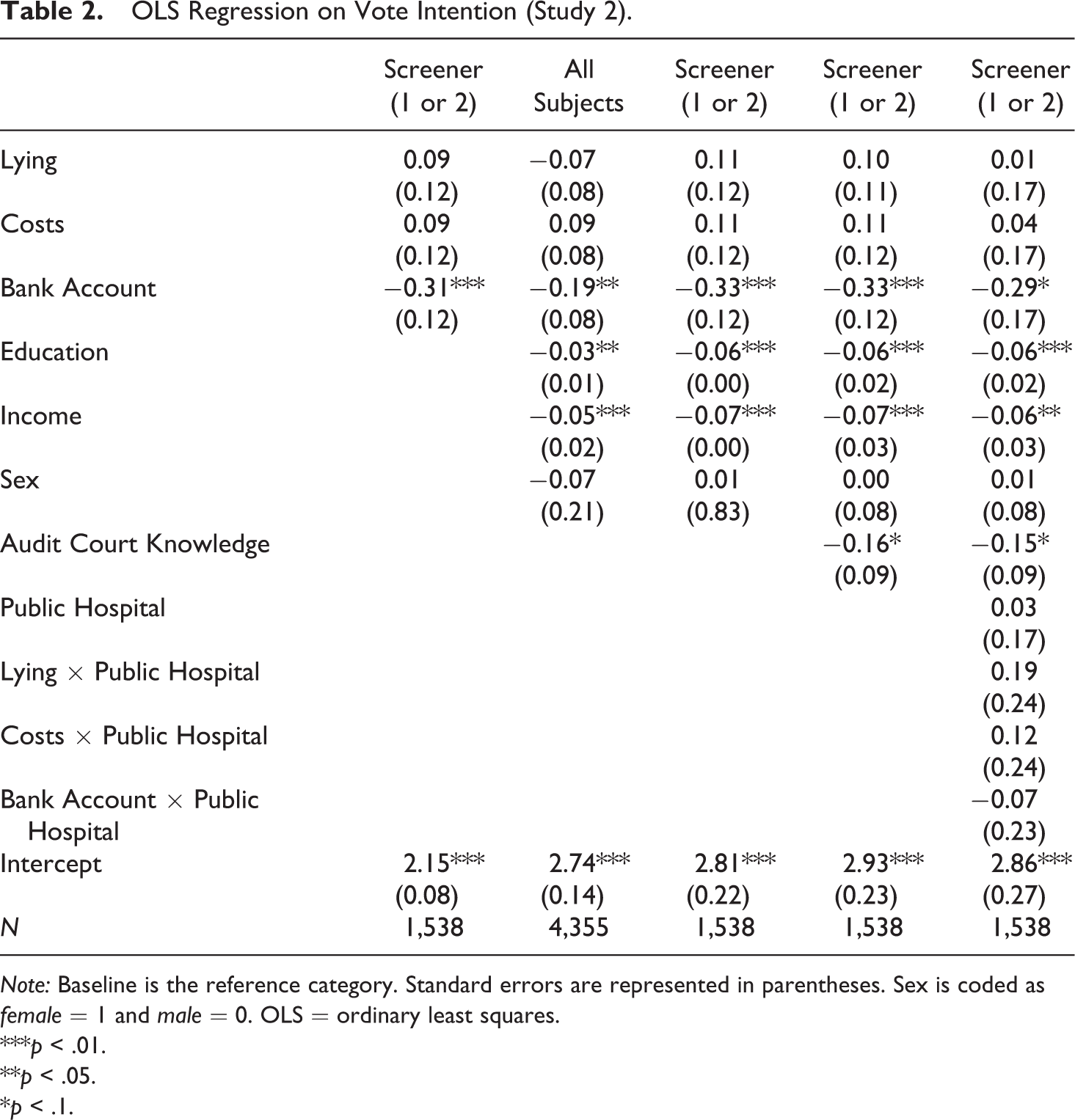
Note: Baseline is the reference category. Standard errors are represented in parentheses. Sex is coded as female = 1 and male = 0. OLS = ordinary least squares.
***p < .01.
**p < .05.
*p < .1.
Table 5C in Appendix 5 presents results for the difference-in-means test for subjects who passed at least one screener. Results also fully support the private gain hypothesis as the difference between this condition and all other conditions is significant (with both Holm-adjusted p values and with non-adjusted p values). No other significant differences are observed. Table 5D presents results of similar analyses using satisfaction with the mayor as dependent variable (for the subsample that passed the screener). These results also provide full support for the private gain hypothesis (although the difference with the baseline and with the lying conditions are not significant when using the Holm-adjusted p values).
Table 9B in Appendix 9 shows the results for various interactions. None of these terms is statistically significant. Table 8B in Appendix 8 displays results for the subsample of least educated subjects. Here, the difference between the bank account condition and the baseline condition is not statistically significant at conventional levels. However, the coefficient sign is in the expected direction, and the pool of the least educated subjects in this study (n = 982) is relatively smaller than the one in the first study (n = 1,393).
Conclusions
This study provides consistent evidence that subjects respond differently to similar corruption incidents depending on the type of information they receive. That is, they are particularly sensitive to information involving illicit enrichment. Results are robust even when increasing the stimulus of the main rival hypothesis (public costs) with more salient information on the public costs of the corruption incident (in study 2).
These results suggest that holding politicians to account is not grounded on a self-interested estimation of the costs of corruption, as much of the previous literature suggests. They show that a rejection of the candidate’s greed is a stronger stimulus to punish corrupt politicians. However, the theory cannot be extended to affirm that any type of behaviour that shows that the candidate is not trustworthy prompts a similar effect. As suggested by the results of the second study, greed is a stronger prompt than knowing that the candidate lied to the Audit Court. This means that in subjects’ evaluation of corrupt candidates, their judgement is grounded on a conception that considers that the public office should never be used for illicit enrichment. Corruption is viewed more as a candidate’s trait than as a malfeasance bearing negative consequences, and the candidate’s greed is perceived as the worst offence.
This study also points out to new possible avenues for studies on accountability by linking the type of information that is typically present in corruption news articles with the subjects’ reactions towards corrupt candidates. This avenue has obvious implications for our assessment of how corruption scandals affect voting behaviour, as subjects typically learn about these scandals through the press. While a more systematic content analysis of a pool of corruption news articles is warranted to assess how real news on corruption affect public opinion, results presented in this study show a possible classification which has proved to affect differently subjects’ responses.
We should note, however, that all vignettes presented incumbent mayors who had positive backgrounds records in a number of areas. A limited interpretation of this study, therefore, is that the findings are only valid for the cases of candidates with good records (outside of the corruption incident). That is, voters might be more information sensitive to public costs when incumbents show worse background records. Whether information sensitivity varies across this or other dimensions of candidacy could be tested in future research.
These findings have important repercussions as we interpret the political consequences of corruption scandals. They suggest that when the evidence of corruption is grounded on proofs of illicit enrichment, the effect of such a scandal on public opinion will be stronger. In contrast, when the information is grounded on proofs that show the public costs of corruption, such as unfinished public works, the impact on public opinion will be weaker.
Footnotes
Acknowledgements
This material is based upon work supported by the National Sciene Foundation through a Doctoral Improvement Grant (#1323890). I am also grateful for valuable comments to John Gerring, Taylor Boas, Daniel Hidalgo, Dino Christenson, Rebecca Weitz Shapiro, Romulo Leitao, and two anonymous reviewers. All comments and errors are my own responsibility. The online surveys were approved by the Boston University IRB (Protocol # 3221X) The survey data is available via the Harvard Dataverse Network ( ).
).
Declaration of Conflicting Interests
The author(s) declared no potential conflicts of interest with respect to the research, authorship, and/or publication of this article.
Funding
The author(s) disclosed receipt of the following financial support for the research, authorship and/or publication of this article: This research was supported with a National Science Foundation Dissertation Improvement Grant (SES-1223890).