




Abstract
Transforming armed groups into legitimate political actors is often considered an ideal way to settle armed internal conflicts. In democracies, the efficacy of such approaches depends on the public legitimacy that the citizenry grants them. How does the prospect of Revolutionary Armed Forces of Colombia’s (FARC’s) political participation influence citizens’ support for the peace process? This study addresses this question by triangulating evidence from three separate studies: (1) regression analysis using face-to-face nationally representative survey data, as well as (2) a vignette experiment and (3) a conjoint analysis, both conducted online with national samples of Colombians. Though methodologically distinct, each analysis converges on a singular conclusion: mass support for the integration of ex-FARC guerrillas into democratic politics damaged support for negotiated peace, often to similar or greater degrees than mass support for transitional justice mechanisms. We suspect this reflects citizens’ fear of undermining democratic representation, the legitimacy of democratic institutions, and electoral integrity.
Political participation. Always a conflictive issue. From the beginning it was clear to us that one of the objectives[…] was to get [the FARC guerrilla organisation] to put down their arms and enter the exercise of politics. We said it various times. Nevertheless, there were obstacles from the outset. In the first place, the approval of the Juridical Framework for Peace excluded the authors of crimes against humanity and genocide from [political] participation for life. But beyond that, a solid majority of surveyed citizens[…] were opposed to this possibility. This was perhaps the most durable of the positions in the public opinion studies, even more durable than the possibility of alternative sentences, opposition that never declined even in those moments when optimism and support were on the rise. (Humberto de la Calle, chief negotiator for the Government of Colombia in Havana, Revelaciones al final de una Guerra, 2019: 137 [author translation].)
The prospect of transforming rebels into political actors who channel political conflict through democratic institutions rather than open conflict is an alluring approach to resolving conflict. But how does the political integration of ex-combatants influence overall mass support for negotiated peace? Most of what we know about political integration processes comes from contexts where democracy lacks deep roots, such as Nepal, El Salvador, and Mozambique. We analyse this question in Colombia – a long-established democracy with a functioning judicial system, well-organised civil society, and competitive multi-party elections. Our guiding assumption is that citizens in democratic contexts may baulk at the political integration of ex-combatants because it potentially threatens institutional legitimacy and stability. Specifically, and building on related research (e.g. Arnould, 2016; Mazurana et al., 2017; Patel et al., 2009), our central premise is that support for the integration of ex-combatants into democratic politics is a crucial, yet unappreciated, driver of citizen support for negotiated peace. Furthermore, attitudes towards political integration have an impact independent of attitudes towards transitional justice (TJ) mechanisms often adopted concomitantly.
We test our propositions in the case of the 2016 peace agreement between the Government of Colombia and the Revolutionary Armed Forces of Colombia (FARC) guerrillas. The integration of ex-guerrilla combatants into the democratic processes was hotly debated in the media, among elites, and in public opinion (see introductory essay by García Sánchez and Carlin; also Carlin et al., 2016; Daly, 2018; Kaplan and Nussio, 2018; Taylor, 2015). Positions on this issue, as the introductory epigraph from Humberto de la Calle suggests, became firmly entrenched. When President Juan Manuel Santos made good on his pledge to seek to ratify the final accords through a plebiscite in 2016, Colombian citizens rejected it. We argue that support for the FARC’s right to compete in democratic politics was a critical determinant of Colombians’ support for the negotiated peace accord. The theoretical upshot is that public opinion towards political integration may play a stronger role in peace agreements than the current literature assumes. Normatively, the implication is that leaders who seek to integrate ex-combatants into democratic politics would do well to address the public’s reticence and adopt reforms that help insulate democratic institutions from negative externalities.
In support of this proposition, we marshal evidence from three complementary approaches – traditional survey analysis, a vignette experiment, and a conjoint analysis. Our results suggest that preferences for the political reintegration of FARC guerrillas are among the strongest predictors of support for – or rejection of – the peace process and its outcomes. Moreover, mass preferences vis-à-vis political integration of ex-combatants are empirically distinguishable from attitudes towards TJ mechanisms, both as a latent construct and in their relative influence on support for negotiated peace. As such, this case study generates new hypotheses for testing in other cases.
Rebel Political Integration and Support for Brokered Peace
Our expectations about the importance of public attitudes towards ex-combatant political integration derive from three sources. First, we draw on studies of public opinion towards conflict resolution in general. Second, we consider the relative importance of these factors in the context of a consolidated democracy. Let us review them in turn. Third, we review the small but growing literature surrounding Colombian public opinion towards the State–FARC conflict and peace process. In so doing, we note how little attention support for political integration has received. We argue and demonstrate that Colombians hold distinct attitudes towards political integration and TJ, a point that justifies our study’s analytic focus.
States transitioning from conflict to peace are increasingly compelled to follow the emerging international norm of implementing TJ mechanisms to address past atrocities (Olsen et al., 2010; Sikkink, 2011; Subotić, 2009; Teitel, 2014). Many states, simultaneously, introduce processes of DDR – demobilisation, disarmament, and (social and economic) resocialisation – and the political integration of former combatants (de Vries and Wiegink, 2011; Sriram et al., 2013; Theidon, 2007; Ubink and Rea, 2017; Willems and van Leeuwen, 2015). Public opinion research on these processes has, thus far, chiefly focused on TJ mechanisms and sought to explain individual attitudes towards them (see reviews in David, 2017; Nussio et al., 2015). In contrast, we know very little about the causes or consequences of mass support for political integration of ex-combatants.
If achieving broad public legitimacy for these processes is crucial, though tricky, in non-democratic and transitional contexts (see review in Nussio et al., 2015), it is even trickier in consolidated democracies, which rely more on legitimacy than repression to enforce policies and where public officials depend on electoral support (Carlin et al., 2019; Matanock and García-Sánchez, 2017). Democratic contexts, we hypothesise, raise the stakes of DDR’s political dimension. Whereas, in autocratic contexts, this may entail integrating guerrilla and national security forces or crafting power-sharing agreements between warring parties, in democracies political reintegration may entail granting ex-combatants the right to contest elections, serve in the legislature and ministerial posts, or act in the executive via power-sharing structures. Citizens may, rightfully, wonder whether such measures will corrode the legitimacy of democratic institutions, dilute representation, and make elections less free and fair. Thus, a tension between resolving conflict and maintaining democratic norms could reduce citizen support for negotiated peace. If so, the latter should depend, at least in part, on attitudes towards political integration. This theoretical expectation guides our case study.
Recent research on Colombia has, however, largely converged on the factors of exposure to conflict and political affiliation to explain public support for brokered peace and the candidates who champion it (Branton et al., 2019; Dávalos et al., 2018, Gallego, 2018; Hazlett and Parente, 2020; Liendo and Braithwaite, 2018; Matanock and García-Sánchez, 2017, Matanock and Garbiras-Díaz, 2018; Pechenkina and Gamboa, 2019; Tellez, 2019). Far less attention has been paid to mass attitudes towards specific TJ and DDR provisions or, especially, the political integration of ex-combatants. One might object that polling on such topics would merely produce “non-attitudes”, that is, respondents do not recognise the attitude object but nevertheless select a response choice. If so, scholars are wise to ignore them. But there are at least three reasons to suspect that Colombians may, in fact, hold real attitudes on these issues.
First, the TJ, DDR, and political integration provisions debated and ultimately agreed upon were not merely symbolic. If fully implemented, they could profoundly alter Colombian society and politics. Second, questions surrounding such provisions have occupied a place on the political agenda for more than three decades. The FARC’s attempted political integration via the Unión Patriótico in the 1980s and 1990s failed spectacularly amid assassinations; M-19 rebels successfully disarmed and entered democratic politics in the early 1990s; the Autodefensas Unidas de Colombia (AUC) undertook DDR and TJ in the wake of the Justice and Peace Law in the mid-2000s. In the most recent talks with the FARC, many Colombians may have simply updated existing attitudes towards ex-combatant political integration and TJ.
Second, we find speculative evidence that Colombian citizens invested in learning about specific political integration and TJ provisions and the peace process in general. Google trends of a five-year window show that searches for “participación política de las FARC” (political participation of the FARC) spiked more than seventy-fold. 1 According to Google Correlate, searches for “el proceso de paz” (the peace process) correlate extremely highly with “participación política de las FARC” (r = .8457). 2 Such big-data evidence is only suggestive. But, together with the historical importance of the accords and Colombians’ priors from previous attempts at political integration, TJ, and DDR, it gives us more confidence that many Colombians do, in fact, hold real attitudes – as opposed to “non-attitudes” – towards these matters and thus they may prove analytically useful for our purposes.
Third and finally, data from a 2016 survey conducted by the Observatorio de la Democracia at the Universidad de los Andes as part of the AmericasBarometer (more details below) suggest that attitudes towards the political integration of FARC guerrillas constitute a latent construct distinct from, but related to, attitudes towards TJ. A principal component analysis of TJ and political integration indicators described below reveal that a single component only explains 40 per cent of the variation in these nine items, but two components explain 57 per cent. A scree plot also supports a two-component solution (see Figure S1 in Supplemental Material). We take this descriptive inference as additional proof that the public holds real attitudes towards, and discriminates between, political integration and TJ. Beyond these three reasons, the distinct effects of political integration and TJ attitudes on support for the peace process we highlight below further illustrate that the Colombian mass public holds distinct, if related, attitudes on these approaches to conflict resolution.
Getting to “Sí”: Transitional Justice and Political Integration
As described in García Sánchez and Carlin’s introduction to this special issue, FARC’s TJ and political integration formed the spine of the 2016 peace accord. They were also its most contested aspects. It was a foregone conclusion that demobilised FARC troops would have to undergo some form of TJ. In addition to which specific forms of TJ should be applied, negotiators in Havana and the Colombian public debated whether, even after participating in TJ measures, ex-FARC should participate in the democratic process. FARC negotiators lobbied hard for broad participation rights and privileges, while the Colombian public and political class were sharply divided. Political elites, led by President Juan Manuel Santos and ex-president and senator Álvaro Uribe, lobbied for or against FARC’s political participation vocally and publicly during Santos’s 2014 re-election bid, the campaign surrounding the October 2016 referendum, and more or less constantly throughout the peace talks.
TJ provisions in the signed 2016 peace accord 3 included an eleven-member truth commission (Comisión para el Esclarecimiento de la Verdad, la Convivencia y la No Repetición, or Commission for the Clarification of Truth, Coexistence and Non-Repetition) and a special jurisdiction court (Justicia Especial de Paz, JEP) to hear cases of crimes against humanity and war crimes committed by all parties to the conflict. The government also created an Armed Conflict Victims Unit through which collective and individual reparations are distributed.
Political integration largely centred on the conversion of the FARC into a political party. Maintaining the FARC acronym, this new party was named Fuerza Alternativa Revolucionaria Común (Alternative Common Revolutionary Force). Besides legal recognition, the accords granted the new FARC party at least two electoral advantages over the two election cycles from 2018 to 2026. First, the FARC (the party) is guaranteed legal recognition, regardless of the number of votes it obtains in these two elections. Second, the FARC is guaranteed legislative seats – five in the 102-seat senate (~5 per cent) and five in the 166-seat House of Representatives (~3 per cent) – independent of its actual electoral returns.
Whether and how strongly public rejection of TJ and, particularly, political integration impeded the legitimacy of negotiated peace remain open questions. Answering them has wide-ranging theoretical and practical implications, not just for the long-term success of peace in Colombia but for ending civil conflicts in general. We suspect political integration is particularly critical in a robust electoral democracy like Colombia, where TJ is necessary given the magnitude of the conflict but cannot address the basic political problems undergirding the conflict. Likewise, power-sharing arrangements require the adaptation and manipulation of democratic institutions that raise scepticism among the citizenry. Does mass support for political integration provisions influence overall support for negotiated peace in the democratic context of Colombia? Below we describe our empirical strategy to examine this question.
Empirical Strategy
Our empirical strategy seeks to triangulate evidence for our propositions across three separate studies. Study 1 employs survey data from 2016 to estimate the correlates of voting intentions in the referendum, which occurred shortly after the survey was fielded. Study 2 examines the treatment effects of experimental vignettes conducted in a 2015 online panel survey depicting two types of FARC members and their legal fates on support for the peace process. Study 3 is a conjoint analysis of items tapping FARC’s political integration provisions and TJ mechanisms, among other items, specified in Joint Communiqué 60 on the Accord for the Creation for a Special Judicial Process for Peace (23 September 2015) which outlined the key points of agreement between the FARC and the government.
Triangulating evidence across multiple data sources, measures, time periods, and methodologies allows for an unusually robust analysis of the importance of attitudes towards political integration and TJ in the popular legitimacy of the Colombian peace process. As should be clear, the results of all three studies complement and extend each other.
Study 1 – Support for FARC’s Political Integration, Transitional Justice, and Negotiated Peace: Cross-Sectional Survey Analysis
Does support for the mechanisms of political integration and TJ among Colombians correlate with support for the peace process or voting intentions for the plebiscite on the peace agreement? From August to October 2016, the Observatorio de la Democracia at the Universidad de los Andes conducted face-to-face interviews with 1,563 respondents selected into a multi-stage probabilistic sample of Colombia’s voting-age population that is representative at the national level; urban and rural levels; small, medium, and large cities; and the six major census regions (margin of error ±2.5 per cent) as part of the AmericasBarometer. 4 Incidentally, 1,356 of the respondents were interviewed prior to the 2 October vote. 5
This survey is unmatched in its quality, degree of representation, and the breadth of attitudes towards various aspects of the Colombian peace process. We use it to examine how attitudes towards political integration and TJ predict self-reported vote intentions in the peace accord referendum and support for the signed peace accord. Specifically, we employ two batteries of items representative of the range of outcomes and trade-offs an eventual peace agreement might include (see introduction to this symposium by García Sánchez and Carlin for a detailed description of the data).
Our first battery focuses on the public’s willingness to support the FARC as a democratic political entity. We fashion an index – “support for political integration” – based on five questions. The first asks whether the respondent approves of the FARC forming a political party. The second gauges support for granting the FARC the same rights as other parties. The third captures approval of the FARC running candidates in the next election. The fourth asks whether the government should ensure demobilised FARC members can participate in democratic politics. And the final question asks whether the respondent would vote for a FARC candidate. All five questions load on a single dimension in a principal component analysis and scale reliably (Cronbach’s α = .83). The final additive scale ranges from 0 to 100.
The second battery centres on TJ. Beginning with the difficult question of criminal sentencing, one question asks whether it would contribute to reconciliation if FARC members who are responsible for atrocities but confess their crimes and make reparations were to spend five to eight years in jail. This time span is significant, and discussed in the negotiations and the media, because it corresponds to the number of years paramilitaries accused of similar crimes spent in jail; most paramilitary members were never formally convicted, but the 2005 Colombian Ley de Paz y Justicia (Peace and Justice Law) (975) negotiated between President Uribe and the AUC set a maximum of eight years of jail time for those who complied with the Law for Justice and Peace framework. A second question asks whether FARC human rights violators who fail to admit guilt should spend longer than eight years in jail. The battery’s third question gauges respondents’ agreement with a policy that members of the military or police who committed atrocious crimes be punished as severely as FARC members. A final question asks respondents whether they think rank-and-file demobilised FARC soldiers should not go to jail. All four questions tap into key TJ aspects of the agreement, where pure punishment is traded for peace, truth, and the hope of reconciliation. We rescale the variables to range from 0 to 100 and generate an additive index called “transitional justice” (Cronbach’s α = .6). While reliability is not particularly high, the principal component analysis of the four items shows unidimensionality and each item loads at ≥.4 on that dimension.
We analyse two dependent variables in Study 1. First is vote intention in the 2016 referendum. Of the 1,356 respondents interviewed prior to the plebiscite and who answered the vote intention question, 4 per cent said they did not know or gave no answer, 38 per cent admitted they would not vote, 38 per cent said they would vote in favour of a peace accord, and 20 per cent said they would vote against it. Because of the referendum’s eventual low turnout (37 per cent) and close results that eventually led to congress directly approving the peace agreement, we model vote intention as a three-category choice. The second dependent variable is support for the signed peace accord, 6 on a 1–7 scale.
Because of the nature of the vote intention variable, we employ a multi-nomial logit 7 estimator with controls for interpersonal trust, whether or not the respondent or a close family member had been a victim of the country’s armed conflict, skin colour, wealth, education, gender, age, urban/rural, self-reported proximity to Uribe’s Centro Democrático party, and region, along with corrections to account for survey design. Since this approach, unlike the following two, does not permit us to rule out endogeneity, we must content ourselves with speaking in terms of associations rather than causal links between our independent variables of interest and referendum voting intentions. In order to curtail systematic error stemming from the question wording of the dependent variable itself, we exclude all respondents who said they did not support the use of a referendum to ratify a peace accord because they “do not know what a referendum is” or did not respond to the vote intention question. 8 Our base category is the intention to vote against the peace accord. Thus, our model results represent the probabilities of intending to turn out and to vote for a peace agreement, as opposed to voting against it, at different levels of our indexes of support for political integration and support for TJ.
Figure 1(a) displays model-predicted vote intention across the range of these two indexes (with 95 per cent CI); grey bars represent their sample-based distribution. As the top panel of Figure 1 highlights, the political integration index is strongly associated with the probability of electorally supporting the peace agreement. The more supportive Colombians are of the FARC becoming a formal political actor, the more likely they are to turn out and to vote for the peace agreement. And the less supportive they are, the more likely they are either not to vote or to vote against the accord. In contrast to the political integration results, the bottom half of Figure 1 illustrates that support for TJ has modest effects on expected vote intention. Colombians most supportive of TJ are, indeed, more likely to vote “yes” than those opposed to it. Yet the relatively flat slope indicates a weak effect and, moreover, it is the only significant one (i.e. comparisons vis-à-vis intentions to “vote no” and to “abstain” are insignificant). Furthermore, overall model fit (via akaike information criterion [AIC] or bayesian information criterion [BIC]) barely increases by adding the TJ index to a model including only the control variables. With the addition of the political integration index, by comparison, the model fit doubles (pseudo R 2 increases from .08 to .16). Overall, results from this high-quality survey just ahead of the referendum strongly support our contention that attitudes towards FARC’s political integration are as important, if not more so, than support for TJ when it comes to understanding public support for the Colombian peace agreement.
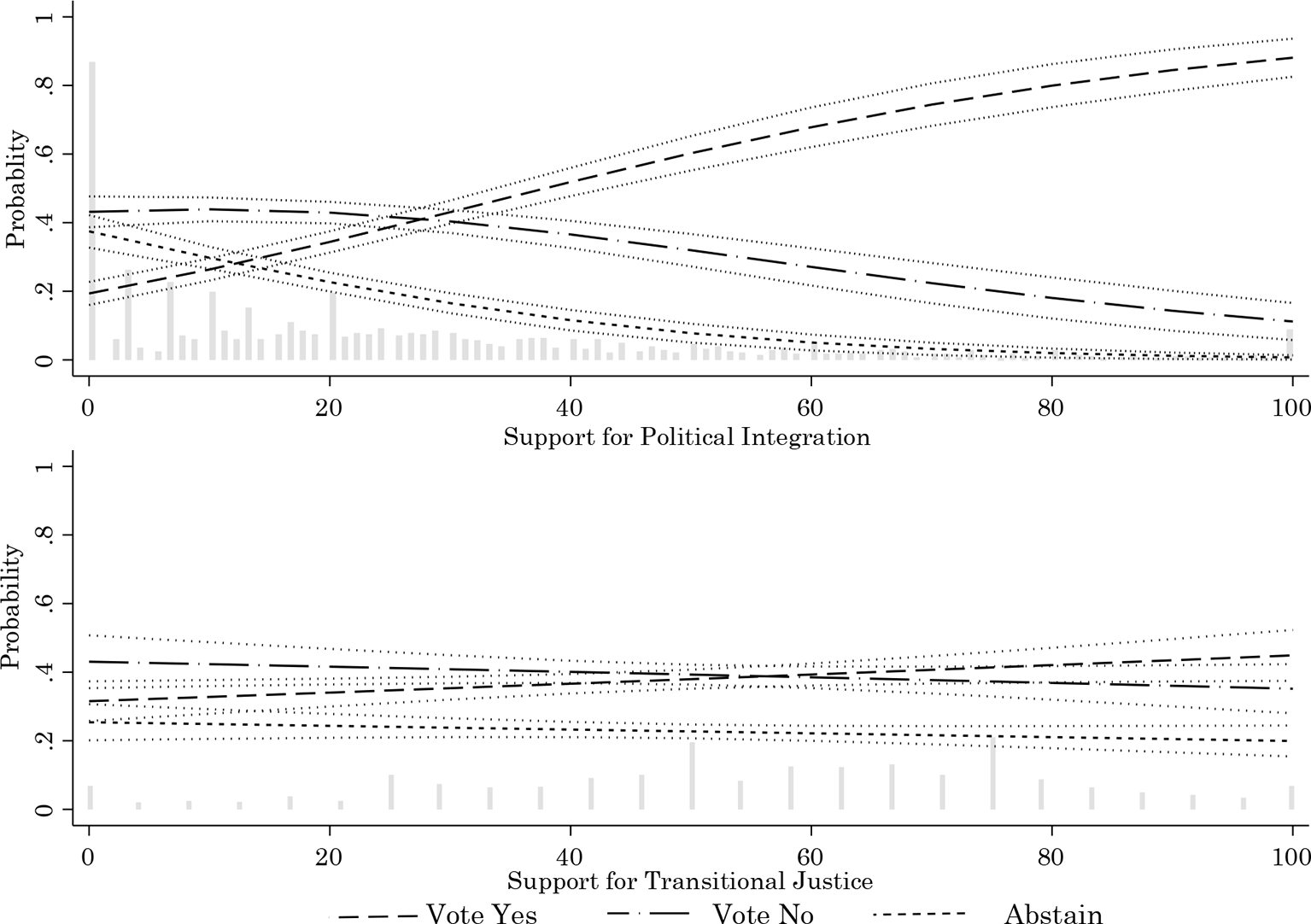
Probabilities of Referendum Vote Choice in the 2016 Peace Accord Referendum by Support for Political Integration and Support for Transitional Justice, 95 Per Cent Confidence Interval.
Turning to our second dependent variable, we use an ordered logit estimator (OLS) 9 to regress overall support for the peace accord penned by the Government of Colombia and the FARC on support for political integration and support for TJ, controlling for the same variables as before. The results, highlighted in Figure 2, tell a similar story (see Table S2 in Supplemental Material for model estimates). Support for political integration is a strong and quite consistent predictor of expressed support for the peace agreement (standardised β = .46, p <.001). Estimates for support for TJ, however, are more modest (standardised β = .07, p =.04). In sum, both analyses align with our proposition that, while support for TJ should not be ignored, mass attitudes towards political integration matter a great deal to the legitimacy of negotiated peace in this democratic context.
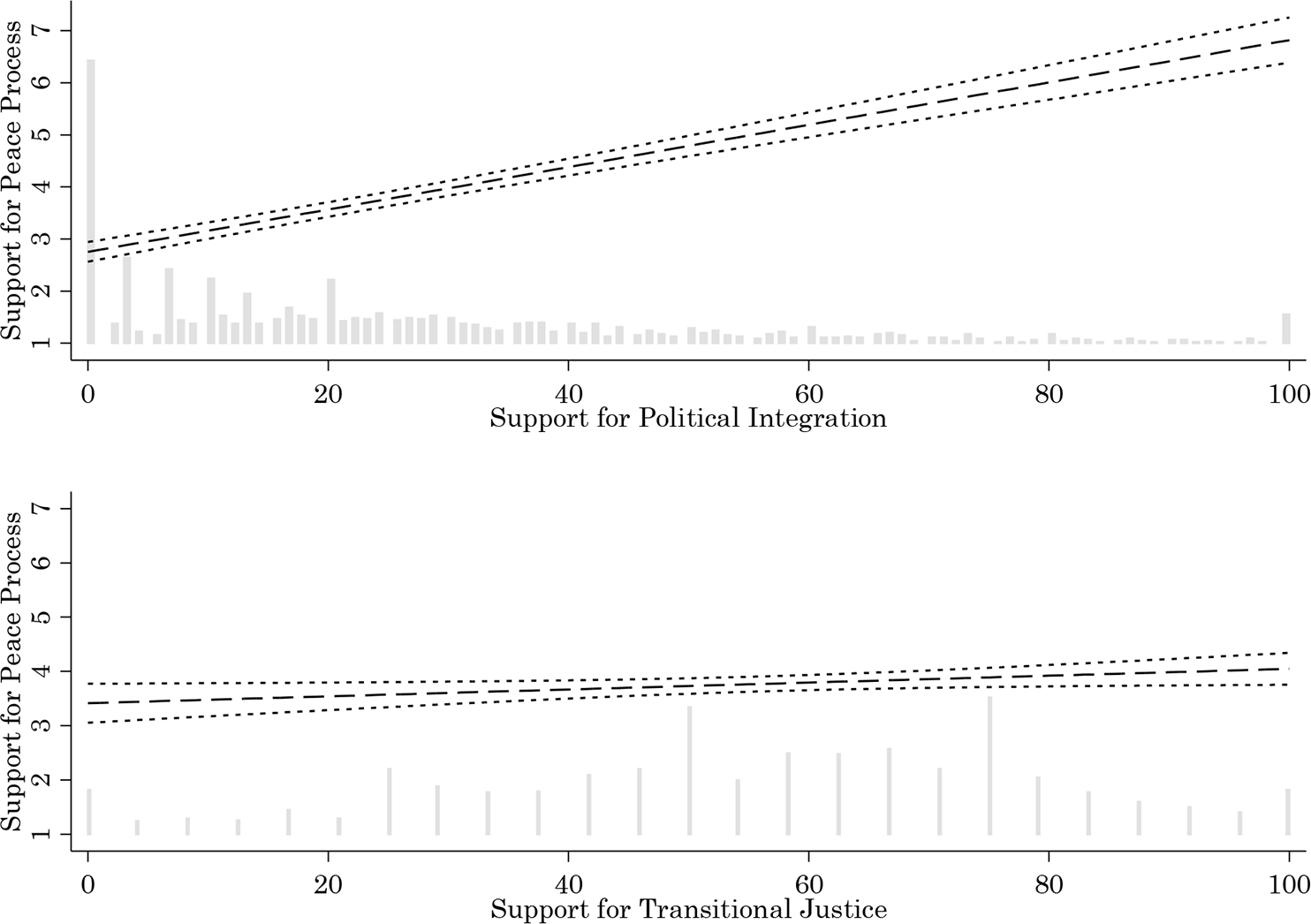
Predicted Levels of Support for the Peace Process by Support for Political Integration and Support for Transitional Justice.
Study 2 – FARC’s Political Participation and Support for Negotiated Peace: An Experimental Vignette Analysis
Evidence from Study 1 suggests that support for FARC’s political participation reliably, and strongly, predicts intentions to vote in favour of the peace deal in the 2016 referendum and support for the peace process more generally. Its effects appear to rival or even outstrip those of support for TJ. Can we isolate and thus better identify the distinct effects of political integration? Study 2 attempts this with an experimental vignette. 10 Its goal is to analyse how the participation of former rank-and-file FARC guerrillas in politics, after undergoing TJ and disarming, alters public support for negotiated peace.
Our approach is inspired by Gibson and Gouws’s (1999) study of blame attribution after the South African Truth and Reconciliation Commission’s highly controversial report on violence in Apartheid. Our vignette borrows heavily from theirs, in both language and the four dimensions of blame attribution. That is, we hold constant the FARC member’s “obedience/leadership,” “goals,” “intentionality,” “motivations” as well as public acknowledgement of the crime (a TJ mechanism) and disarmament (a DDR mechanism). What varies experimentally across treatments are “consequences” vis-à-vis political participation (a form of political integration).
The result is a “molar” treatment (Shadish et al., 2002). That is, the vignette provides realistic contextual information based in the public debate at the time of the study. For example, interviews with actors on all sides of the talks suggested that any peace accord would very likely allow former FARC troops to run for office after undergoing TJ and DDR measures. A provision guaranteeing the FARC congressional seats was less assured. Since guaranteed seats were eventually included, our results should be interpreted as a lower bound on the effects of political integration on support for the peace processAdditionally, our vignette attributes actions to this FARC troop that, while heinous, would not typically qualify as an international crime under International Criminal Court (ICC) jurisdiction. Interviews with domestic and international actors close to the negotiations shared our interpretation.
To probe our expectations, we embedded a vignette experiment within a survey (n = 3,400) the week before the June 2014 elections and replicated it with a subset of these same subjects (n = 1,000) in January 2015. We recruited subjects from Netquest’s online panel using quotas to achieve representation with respect to gender, age cohorts, and geographic zones as categorised by the National Administrative Department of Statistics (DANE). According to DANE (2019), over 60 per cent of Colombians regularly used the internet by 2018, so quotas bolstered our sample’s representativeness. 11 Subjects were randomly assigned to the two treatments below, allowing us to identity the effect of political integration. Table S3 in Supplemental Material shows the distribution of subjects across the treatments and balance on their key attributes for both waves of the experiment. Our expectation is that allowing former FARC combatants to compete in democratic elections has pernicious effects on the legitimacy of the peace process.
Vignette
Felipe was a member of the FARC. He was not a commander in the FARC and therefore had to take orders from others higher up in the organisation. As a result of his actions, a person was kidnapped and held hostage for several days. Felipe says that his actions were motivated by the belief that what he was doing was necessary and justified by the struggle. Felipe has publicly acknowledged these actions and given up his weapons. He will not go to jail for his actions […]
Unable to Compete in Elections Treatment
[…] but he will not be able to compete for elected office in the future.
Able to Compete in Elections Treatment
[…] and he will be able to compete for elected office in the future.
After reading the vignette and treatment, subjects were asked three questions regarding their opinions of the outcome’s fairness and whether it would contribute to peace and to reconciliation. Although fairness, peace, and reconciliation are potentially distinct, these three survey items tapped a single latent dimension and formed a highly reliable scale, which ranges from 1 to 7 with means of 3.4 (wave 1) and 3.3 (wave 2). 12
Figure 3 displays the experimental results. Figure 3(a) and (b) report mean legitimacy scores across both treatments in wave 1 and 2, respectively. Results show systematic and substantial negative treatment effects of FARC-troop political participation on the legitimacy of a peace agreement in both waves of the survey. Adding political competition to Felipe’s TJ and DDR outcomes – publicly acknowledging his actions and giving up his arms, but not serving jail time – decreases the legitimacy scores by 0.67 and 0.62 points on the 1–7 scale in the initial study and the replication, respectively. Put another way, introducing Felipe’s political integration on top of his TJ and disarmament outcomes lowers perceptions of the peace process’s legitimacy by roughly 19 per cent. The stability of this treatment effect over time within subjects lends credence to Humberto de la Calle’s conclusion that public attitudes on political integration were, indeed, stubborn.
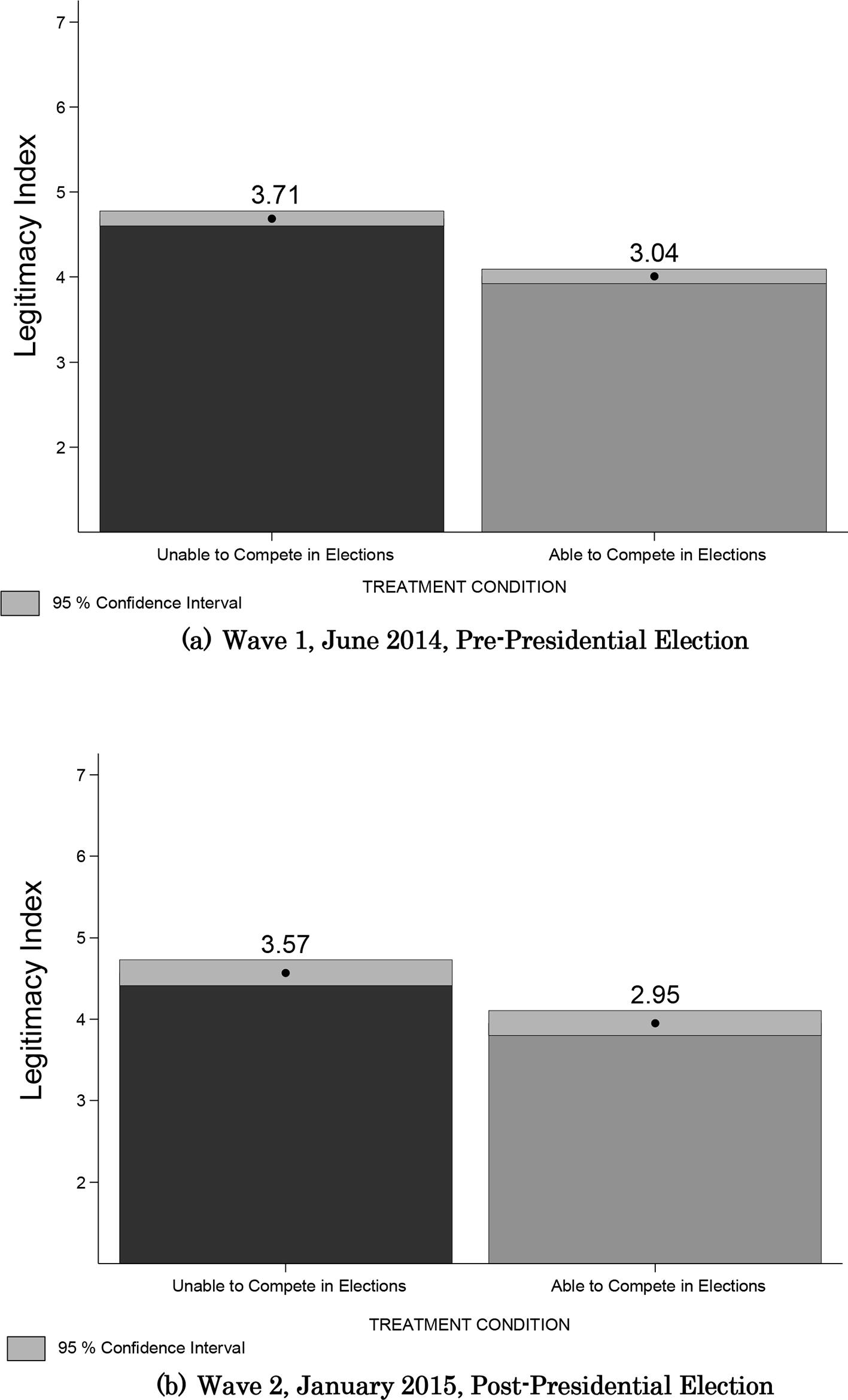
Treatment Effect of FARC Political Participation on Legitimacy of Negotiated Peace in a) 2014 and (b) 2015. FARC, Revolutionary Armed Forces of Colombia.
Like Study 1, Study 2’s experimental results clearly demonstrate that integrating the FARC into Colombian democratic politics is detrimental to the popular legitimacy of the peace accords. The protocol helps us rule out potential omitted-variable bias due to unmeasured positive or negative affect towards the FARC. Additionally, since the FARC is likely to remain a highly visible political actor in Colombia’s democratic institutions, with their eight-year guaranteed seats in Congress, these effects may matter in the short and long run. Comparing effect sizes across Studies 1 and 2 is unwarranted given the number of factors that vary between them. But Study 2 complements Study 1’s basic conclusions, underscoring the reliably negative effects of political integration on support for negotiated peace.
Study 3 – Support for FARC’s Political Integration and Transitional Justice: A Conjoint Analysis
In our third effort to compare the effects of TJ and political integration on the popular legitimacy of the Colombian peace agreement, we test the robustness of the results from the first two approaches using a conjoint experimental design. The experiment was deployed in a national online survey conducted in July 2016, just a few months before final agreement and plebiscite (details below). With it, we seek to leverage both our study’s timing and experimental method to triangulate our inferences.
Since our survey was fielded after the release of the key points of agreement between the FARC and the government, a traditional conjoint instrument, using differing levels of a set of attributes, was not feasible. Such an approach would have involved asking subjects to assess the importance of differing lengths of jail time or degrees of political integration, for example. By summer 2016, the government and FARC negotiators had settled the main questions regarding these issues and they would not be reopened, even after the failed plebiscite. Hence offering subjects alternatives dramatically different from the publicly announced agreement would not have been credible. Thus, we modified the traditional conjoint approach to only employ attributes (holding constant the level) of the peace process that the two sides had publicly agreed to and published in Joint Communiqué 60. 13 Furthermore, this approach adds a degree of realism to the experiment that is often missing in conjoint studies whose listed outcomes may be possible but unlikely.
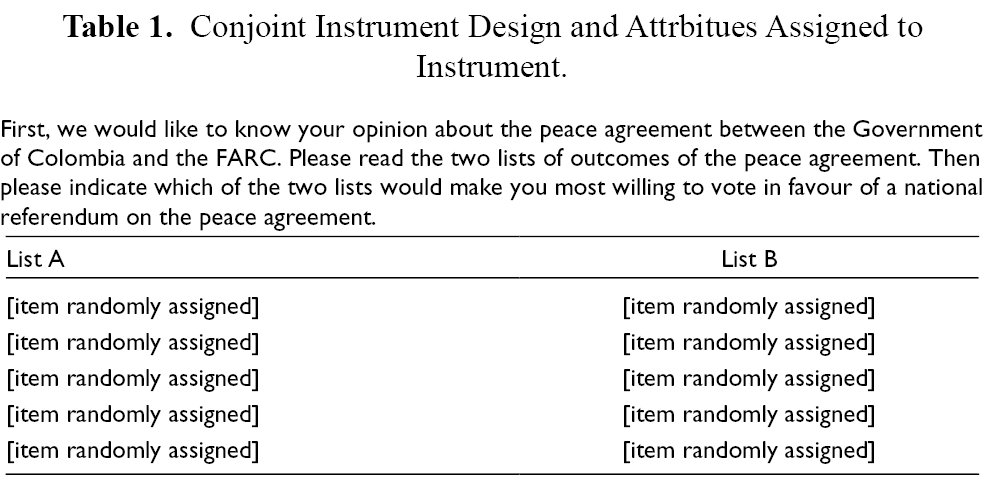
Conjoint Instrument Design and Attrbitues Assigned to Instrument.
First, we would like to know your opinion about the peace agreement between the Government of Colombia and the FARC. Please read the two lists of outcomes of the peace agreement. Then please indicate which of the two lists would make you most willing to vote in favour of a national referendum on the peace agreement.
Item bank from which the 8 randomly assigned items are drawn:
Truth Commission
No amnesty for grave human rights violations
FARC form a legal political party
Amnesty for political crimes of rebellion
Five to eight years of restricted movement for grave human rights violations if they provide truth, reparations, and guarantees of non-repetition
Twenty years jail for human rights violations if they do not provide truth, reparations, and guarantees of non-repetition
Two to five years jail for minor roles in grave human rights violations
Special Courts for FARC
Special Courts for Security Forces
Special Courts for grave human rights violations if they provide truth, reparations, and guarantees of non-repetition
Which list, A or B, would you be most willing to vote for in a national referendum?
A
B
We distilled the agreement’s ten main attributes vis-à-vis political integration and TJ from this document and showed subjects two hypothetical agreements composed of a random set of five of these ten attributes. This allows us to assess which aspects of the peace agreement engendered more (or less) popular legitimacy. Table 1 shows an English translation of the conjoint instrument and the ten items used to randomly populate the hypothetical agreements (original Spanish instrument is reported in the Supplementa Material).
To conduct the study, we recruited 2,807 Colombian subjects using Netquest’s online panel. Each subject was asked to select their preferred peace agreement – A or B – in each of two pairs of randomly generated agreements (i.e. four potential agreements). Following Hainmueller et al. (2014), we keep the number of conjoint treatments low and the instrument short to avoid satisficing and roll-off. We further follow their approach by estimating the effects of each item with a linear probability estimator and standard errors clustered by subject. As with Study 2, the Netquest online sample in Study 3 is nationally representative for gender, age cohorts, geographic zones, and social class thanks to quotas, and matches the 2016 AmericasBarometer’s values for FARC victimhood, gender, and age.
Figure 4 displays the sample average treatment effect (SATE) of each attribute in increasing/decreasing the likelihood of a subject selecting the hypothetical peace agreement. In other words, since the attributes are actual key planks of the agreement, the figure shows whether the presence of an attribute increases or decreases public support for the peace agreement.
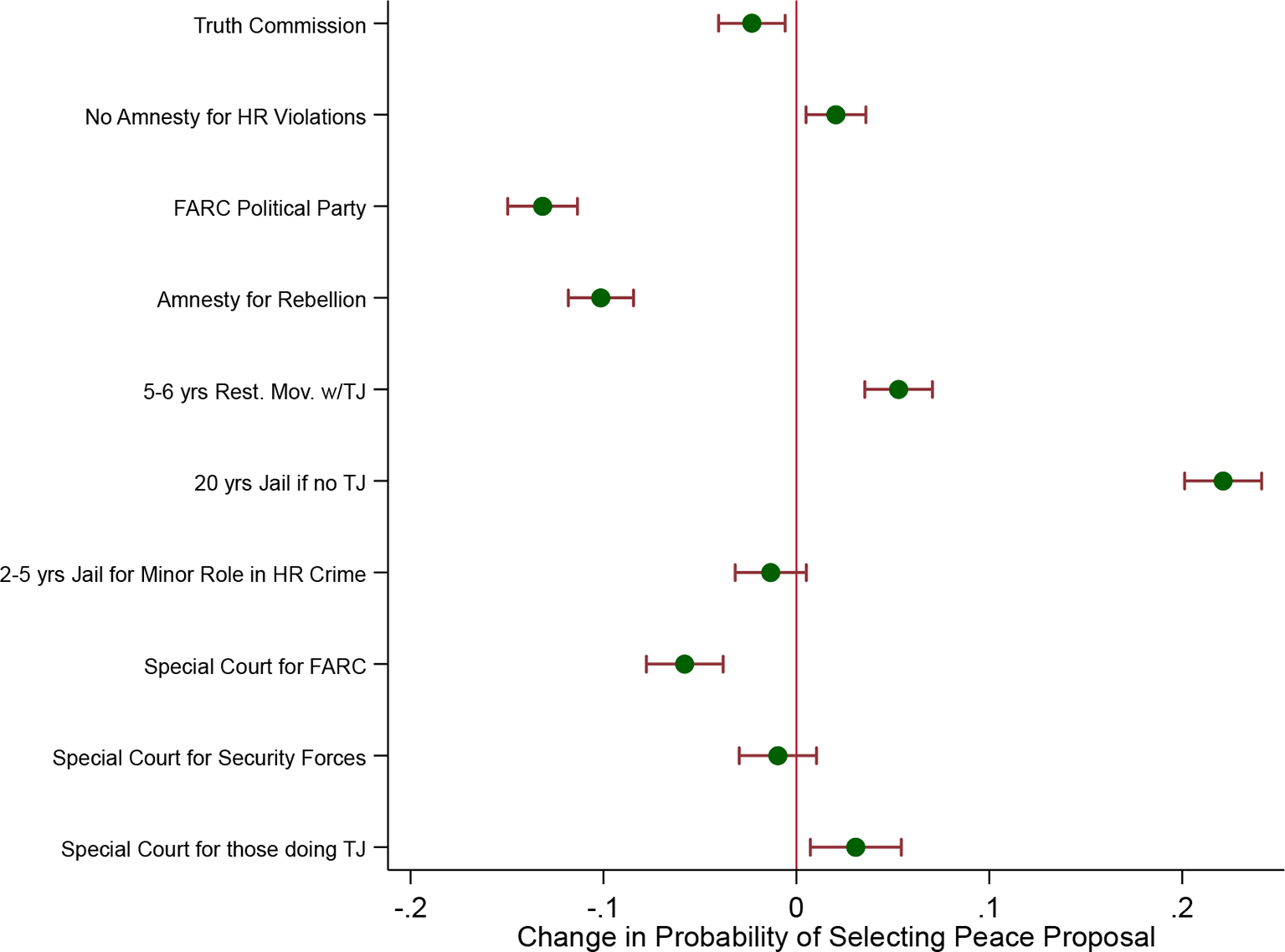
Effects of Political Integration and Transitional Justice Provisions on Support for Peace Agreements: Conjoint Analysis. FARC, Revolutionary Armed Forces of Colombia; HR, human rights; TJ, transitional justice.
The results displayed in Figure 4 again highlight that support for the Colombian peace agreement is significantly diminished by the inclusion of political integration for the FARC. When the possibility of the FARC forming a legal political party (attribute “FARC Political Party” in Figure 4) is included within a proposed peace agreement, respondents were thirteen percentage points less likely to prefer the agreement. This attribute has the largest negative effect on support for the agreement and the second largest effect overall. As such, these findings supplement evidence from Studies 1 and 2 and suggest that the FARC’s political integration substantially reduces the public legitimacy of the peace process.
The results of the conjoint study also mirror Study 2 when it comes to TJ. In general, the Colombian public is more supportive of a peace agreement when its most punitive aspects are highlighted. Those attributes that focus on TJ and lack a clear punitive component have minor effects on support for the agreement. For example, the establishment of a truth commission or special TJ courts has no or only small effects, while the creation of special courts for the FARC has substantive negative effects. The attribute that garners the most support is twenty-year jail terms for FARC human rights abusers who fail to admit guilt and pay restitution. Of course, such sentences fall far beyond the final TJ framework and were not politically realistic. But it is crucial to note that sentences that fall within the TJ framework do spur support for peace negotiations. Indeed, our Colombian respondents are significantly more likely to support an agreement when FARC members who have committed human rights abuses admit guilt and pay restitution serve five–eight years of restricted movement. Yet this positivity is offset by the negativity surrounding another critical aspect of Colombia’s peace accord: the political integration of the FARC. The FARC forming a political party lowered support for a peace deal more than any other included potential outcome. Overall, political integration of the FARC and punitive components of the agreement most strongly shape public support for the peace agreement.
By the nature of the conjoint experiment, subjects often judged lists that did not include a provision of political integration among the five factors. One might reasonably wonder whether the effects of the other provisions are stable in its absence. Null results from interacting “FARC Political Party” with all other items suggest that its presence (or absence) does not alter any of the other provisions’ effects. Like the results of Studies 1 and 2, and the initial principal components analysis (PCA) analysis of TJ and political integration attitudes, these results point to a Colombian public that holds distinct attitudes regarding TJ and FARC’s political participation. Study 3 also squares with Colombians’ reactions to how these processes have played out in practice. A key distinction between the peace deal rejected in the referendum and the one that Congress ultimately passed was the removal of sixteen seats from “special districts” in heavy conflict zones, which were meant to favour the FARC. Although we do not know the counterfactual, that is, how the FARC would have fared in these special districts, we do know that competing in “regular” districts, the FARC failed to win a single seat in the 2018 legislative elections. Moreover, waning public support for the peace process is potentially linked to the interplay of TJ and political participation for FARC leaders. FARC members were named – not elected – to occupy five temporary seats in the Senate and five in the House of Deputies – for two electoral periods. Yet these FARC congressmen use their legislative immunity to eschew the special justice courts enshrined in the TJ framework. From their perspective, the logic is simple: acknowledging crimes against humanity would strip them of their legislative seat and enter the processes of TJ. From the public’s perspective, not only does this go against the spirit of the peace accord, but even if they were to undergo these TJ mechanisms, another FARC member could be named to fill the seat. In short, falling public support for the peace deal in light of these loopholes is consistent with the findings of our analysis.
Conclusion
A central goal of this special issue is to understand how the public views the FARC and to link this to the long-run prospects for peace and democracy in Colombia. By viewing the Colombian case in this manner, this special issue speaks to the pressures democracies face vis-à-vis resolving internal conflict. As should be clear, respecting international legal obligations is only one type of pressure governments must deal with. An equally significant issue is how to craft TJ proposals in a way that reflects the electorate’s understanding of what is just and fair while also securing a viable political solution that leads to durable peace. The international TJ space has obviously become heavily internationally regulated, a process well documented by scholars. What is less well understood is how domestic demand for justice and tolerance of political integration influences support for negotiated peace within consolidated democracies. Our case study makes a clear contribution in this regard.
From the din of multiple methods and analyses, a single empirical message comes through loud and clear: public support for negotiated peace hinges as much, if not more so, on preferences for the political integration of ex-guerrillas into Colombia’s democratic institutions as on preferences for TJ. Whereas a growing literature has made the case that getting TJ right in the eyes of the citizenry is crucial, this study makes an equally strong case for getting political integration right. This is not to diminish the role of TJ but to elevate the role of political integration. Furthermore, the evidence reported here suggests that the public does not view TJ and political integration as one and the same. Rather, attitudes towards them are empirically distinguishable and have distinct predictive capacities vis-à-vis support for negotiated peace.
This conclusion holds implications for how scholars should measure and model mass support for conflict resolution. We are also aware that a scope condition for this argument may be institutionalised democracy. In such contexts, elites may be held accountable – either directly or indirectly – for negotiating peace deals that reflect citizens’ trade-offs between democratic norms and the uncertain prospect of peace. Future research should examine, though, whether our findings hold in cases where a guerrilla insurgency enjoys greater public support during the conflict and the peace negotiation stages than the Colombian FARC.
Beyond these theoretical contributions, our research findings have a powerful policy implication. Domestic civil society, international democracy promoters, human rights activists, and peace negotiators on both sides should work together. That is, these actors would do well to widen their communications focus on traditional TJ and DDR mechanisms to include various provisions that facilitate political integration. Articulating the available options for and benefits (and potential costs) of political integration would appear critical to garnering public support for any peace deal that asks guerrillas to trade bullets for ballots.
To better address the trade-offs of political integration in communications about peace agreements, future research could examine the underlying concerns of citizens. Are they concerned about provisions such as guaranteed legislative seats without competition serving as a “reward” to ex-guerrillas perceived as criminals, similar to those who favour retributive over restorative justice? Are they concerned that incorporation of ex-guerrillas will damage the legitimacy or even the stability of hard-won democratic institutions? Having a political avenue to pursue their goals was important to the FARC as they negotiated giving up arms. If such an exchange is at odds with mass opinion, as it was in Colombia, peace may be fleeting. An integrated communications strategy could work to convince the public of the viability of ex-combatant political participation.
If our conclusions are valid, then the long-term prospects of the peace accord in Colombia depend, in no small part, on how well political institutions absorb FARC participation in the democratic process and how mass tolerance of their participation evolves. Thus far, Colombia’s political system has endured multiple stress tests, not the least of which involves Seuxis Pausías Hernández, alias “Jesús Santrich,” a key FARC delegate and signatory of the 2016 peace accord. Originally slotted to fill one of the FARC’s ten congressional seats, drug-smuggling charges from the US Department of Justice prevented him from taking his seat. Santrich was arrested in April 2018 but the JEP could not determine whether Santrich had broken the terms of the peace agreement, which shielded FARC members from extradition for crimes committed before 1 December 2016. Hence, the JEP blocked a US extradition request in May 2019 and released Santrich. Colombian prosecutors immediately re-arrested him, claiming they had uncovered new evidence. Ultimately, the Supreme Court ruled that Santrich, as congressman, enjoyed immunity and released him to a Territorial Space for Training and Reincorporation (Espacio Territorial de Capacitación y Reincorporación). In July 2019, he fled through his housing unit’s window to rejoin his comrades, including Iván Márquez, in a new dissident armed force.
As the Santrich case illustrates, the political reintegration of ex-combatants is likely to be an uneven process in Colombia and in other cases of domestic conflict in democratic contexts. Moreover, it shows how TJ and political reintegration can interact and, potentially, validate citizen concerns about ex-guerrilla political participation, calling into question the value and efficacy of negotiated peace. Future empirical work could fruitfully proceed in this vein.
Supplemental Material
Supplementary Material 1 - Supplemental material for Pitfall to Peace: FARC’s Political Participation and Mass Support for Peace Talks in Colombia
Supplemental material, Supplementary Material 1, for Pitfall to Peace: FARC’s Political Participation and Mass Support for Peace Talks in Colombia by Ryan E. Carlin, Gregory J. Love, Jennifer L. McCoy and Jelena Subotić in Journal of Politics in Latin America
Footnotes
Acknowledgements
The authors would like to acknowledge the generous feedback on earlier drafts of this paper on the part of Sandra Botero, Juan Camilo Cárdenas, Miguel García-Sánchez, Ana Montoya, Juan Camilo Plata, Angelika Rettberg, Juan Carlos Rodríguez-Raga, Juan Tellez, and Juan E. Ugarriza. We also thank Carlos Lemos, Ana Martin, and Ana Caridad Sánchez for research assistance and/or logistical support.
Authors’ Note
Presented at Observatorio de la Democracia at the Universidad de los Andes, the Woodrow Wilson Center, the University of Connecticut's Human Rights Institute and Center for Latin American and Caribbean Studies, the UNC-Duke Consortium in Latin American and Caribbean Studies, and Florida International University's Latin American and Caribbean Center.
Declaration of Conflicting Interests
The author(s) declared no potential conflicts of interest with respect to the research, authorship, and/or publication of this article.
Funding
The author(s) disclosed receipt of the following financial support for the research,authorship, and/or publication of this article: United States Agency for International Development Center of Excellence on Democracy, Human Rights, and Governance/Institute for International Education Democracy Fellows and Grants Program, National Science Foundation (SES-#1526089), and the Center for Human Rights and Democracy at Georgia State University.
Supplemental Material
Supplemental material for this article is available online.

Notes
Author Biographies
E-mail:
E-mail:
E-mail:
E-mail: