




Abstract
Efforts to end civil wars via negotiations often generate sharp divisions in public opinion. A large, quantitative literature has found evidence for numerous variables serving as potential drivers of public support of and opposition to conflict negotiations. Yet the formation of policy preferences is a complex process, and while many factors might make small contributions to an individual’s conflict termination preferences, we lack a sense of which factors matter most or how to adjudicate among competing explanations. In this article, we leverage a large amount of nationally representative survey data from Colombia (2004–2015) and use machine learning tools to systematically explore which variables are the strongest predictors of public support for negotiations with Fuerzas Armadas Revolucionarias de Colombia (FARC). We find that certain aspects of conflict exposure, individual values bearing on justice and punishment, and belief in the efficacy of the state are among the strongest predictors of negotiation preferences, while many conventionally important variables in the literature have little predictive power. The results have implications for scholars seeking to understand broad drivers of (dis)satisfaction with negotiations and shed light on the polarising Colombian peace process.
Introduction
Societies at war often become deeply polarised in response to calls by warring actors or third-party mediators to negotiate an end to conflict. Peace processes in Northern Ireland, Guatemala, and Israel–Palestine produced virulent debate in the public sphere on the legitimacy of negotiation (Irwin, 2006; Jonas, 2000). The negative consequences of public polarisation are particularly troubling in democratic states. Bargaining actors may find themselves constrained by domestic constituencies who will punish them for making concessions (Mattes and Savun, 2010), rendering a brokered agreement less likely in the process. Further, signed agreements that fail to garner public buy-in are sensitive to derailment by warring actors and face other difficulties in implementation (McKeon, 2005; Nilsson, 2012). These pitfalls are perhaps most evident in Colombia, where negotiations between the Colombian government and the Fuerzas Armadas Revolucionarias de Colombia (FARC) generated a robust opposition movement that conspired to derail a popular referendum on the agreement (Carlin et al., 2016; Matanock and García-Sánchez, 2017).
Understanding why publics become polarised in the face of conflict negotiations is thus critical for both scholars and practitioners invested in successful post-conflict transitions. Motivated by this need, conflict scholars have produced a sizeable body of quantitative research seeking to understand the causes of wartime opposition and support for peace. Unsurprisingly, much of this literature has focused on how victimisation and exposure to violence shape public approval for brokered transitions (Berrebi and Klor, 2006, Berrebi and Klor, 2008; Blattman, 2009; Hirsch-Hoefler et al., 2014; Tellez, 2018; Weintraub et al., 2015). Other work not directly bearing on conflict termination preferences has pointed to identitarian attachments (Balcells, 2012), the interplay of identity and conflict-exposure (Beber et al., 2014), and the role of values and beliefs in how citizens think about war and peace (Kertzer and Brutger, 2016).
While providing a foundation for understanding how contextual and individual characteristics shape public-termination preferences, the existing literature still faces a number of shortcomings. First, the heavy focus on victimisation as a key explanatory variable is problematic if a broad array of factors ultimately plays a role in attitude formation, such as the geography of the war (Bakke et al., 2009), sociodemographic characteristics, political and moral beliefs (Halperin and Bar-Tal, 2011), and the influence of political parties and elites (Berinsky, 2007; Matanock and García-Sánchez, 2017). This is particularly true in low-intensity conflicts, where large segments of the population have direct exposure to victimisation. Finally, victimisation itself is not monolithic; it can vary in both intensity and directness and produce varying effects on civilians, as the often-contradictory nature of the victimisation literature attests (Bauer et al., 2016). Studies that consider a broader range of variables in shaping wartime public opinion are thus needed.
Second, given the constraints associated with studying public opinion in societies at war, the bulk of research in this area is observational and reliant on null hypothesis significance testing to determine whether a given variable is a valid determinant of conflict termination preferences. While this approach has value, it also faces methodological challenges. Variables that are statistically significant often do not increase the ability of a model to predict the outcome of interest (Ward et al., 2010), casting doubts on the generalisability of the findings. Part of this problem arises from scholars using all of their data to estimate coefficients, increasing the likelihood of overfitting models and producing noisy estimates (Hill and Jones, 2014). As a result, there is a need for research that uses predictive methods to evaluate which factors matter in determining wartime preferences.
We address these gaps in the literature in two steps. First, we leverage a large, nationally representative set of survey data from the Colombian civil war (2004–2015), in which respondents were consistently asked about their conflict termination preferences. The sample represents a uniquely long period of time for the study of wartime attitudes; further, the Colombian case is an interesting one in its own right given the contentiousness of the peace process (Arjona, 2016). Second, we undertake an exploratory and inductive analysis where we systematically evaluate the predictive power of a large set of potential predictors of negotiation preferences. Inductive analysis is a basic building block of many research agendas, which is useful in generating theory and hypotheses that can be tested with confirmatory designs 1 (Gelman, 2004; Tukey, 1977). We use the random forest algorithm to determine which factors are the strongest predictors of citizens’ willingness to support negotiations with the FARC. The approach avoids many of the pitfalls associated with conventional hypothesis testing methods (Beck et al., 2000; Hill and Jones, 2014).
The results have implications for theories of public preferences for peace and negotiated settlements. First, variables bearing on vengeance and negative social reciprocity emerge as surprisingly important in shaping opposition to negotiations (Carlin and Love, 2018). Citizens with strong preferences for punitive responses to crime oppose negotiations at much higher rates than their counterparts, supporting conclusions from growing research on the importance of vengeance and negative reciprocity in shaping policy preferences (Stein, 2015). Second, citizens’ trust in the implementing actors matters: civilians with low trust in state institutions are less supportive of negotiation as a solution to conflict – regardless of who is currently in office – suggesting that citizens may consider how likely it is that the state is going to succeed at implementation in its evaluations. The results reflect theoretical accounts of conflict termination as a risky prospect, where individuals who are more trusting are more willing to endorse negotiated peace (Carlin and Love, 2018). Finally, the analysis provides a nuanced account of the effects of conflict exposure on negotiation preferences: citizens in municipalities plagued by ongoing conflict are among the strongest supporters of negotiation, while direct victimisation itself has little predictive power.
These results speak, in part, to previous findings in the literature on attitude formation while also offering surprising insights into civilian attitudes in wartime contexts. First, while much of the conflict bargaining literature focuses on the distributive consequences of negotiated settlements – that is, what domestic audiences stand to gain or lose in the bargaining process – our study emphasises the importance of considering normative responses to peace processes. Civilians may see some issues (e.g. those bearing on punishment and justice) as indivisible, creating barriers for peace (Atran and Axelrod, 2008). Second, states with low institutional capacity may find themselves doubly obstructed in attempting to negotiate peace – both in their own inability to negotiate and implement as well as in their citizens’ low opinion of their prospects for ending the war. Finally, the findings help adjudicate between contradictory findings in the literature surrounding the effects of conflict exposure and victimisation. We point to a distinction between victimisation and proximity; proximity – the potential for experiencing future harm should the conflict fail to reach settlement – may be the key driver of attitudinal differences between those with low and high conflict exposure, rather than victimisation itself.
Explaining Support for Peace
Public support looms large in theoretical accounts of international and subnational conflict termination (Fearon, 1994, 1995). Recently, accounts have highlighted how public opposition to settlement or other conflict termination strategies can lock leaders into conflict. Debs and Goemans (2010) present a model in which leaders’ wartime choices are constrained by the effect those decisions have on their probability of retaining office, where the likelihood of losing office is determined by the type of audience they face at home. Similarly, Croco (2011) finds that the threat of punishment induces culpable leaders to continue conflict at differentially higher rates, while Beardsley and Lo (2013) suggest audience types may help account for why some countries intervene as third-party actors in ongoing conflicts.
While indicating that public opinion and especially public cohesion on matters of war are important to actors at the negotiating table, many of these theoretical accounts largely assume that publics have some level of unified support of or opposition to conflict termination. Yet empirical accounts make clear that the public is rarely unified in its preferences for negotiation; more often than not, publics become highly polarised on these issues, both across and within the groups that are party to the conflict (Irwin, 2006; Kertzer and Brutger, 2016). Thus, understanding how civilians form wartime preferences holds valuable implications for theoretical models of war.
Here, we undertake an inductive analysis to determine which factors, among the many explanatory variables discussed in the wartime public opinion literature, are the strongest predictors of individual preferences. One prominent variable in this literature is conflict exposure, which has (at times) produced competing expectations for individual preferences bearing on war. 2 One set of findings indicates that exposure to violence is often associated with increased pro-social behaviour, including increased community participation, trust, and cooperation (Blattman, 2009; Gilligan et al., 2014). A second set of findings conversely link exposure to violence with a hardening against the (perceived) perpetrator and a desire on the victim’s part for more punitive responses (Balcells, 2012; Berrebi and Klor, 2006, Berrebi and Klor, 2008; Sanín and Wood, 2014).
With respect to conflict termination preferences in particular, the effects of conflict exposure in the literature are similarly inconclusive. Beber et al. (2014) and Grossman et al. (2015), for example, find a “hardening” response to conflict exposure among northerners in The Sudan and Israelis, respectively. On the other hand, Tellez (2018) finds increased support for peace among civilians in conflict zones in Colombia, while Weintraub et al. (2015) find a non-linear relationship between exposure to violence and support for the pro-negotiations candidate in the 2014 Colombian presidential elections. With respect to attitudes towards transitional justice in particular, Nussio et al. (2015) finds no difference between victims and non-victims.
The contradictory nature of these findings may be the result of unspecified mechanisms linking exposure and attitudinal shifts (Bauer et al., 2016). More specifically, “conflict exposure” in the literature tends to encompass both victimisation and proximity to conflict. These experiences are distinct and can produce different effects if, for example, victimisation leads to anger and hardening, while proximity to conflict increases demand for risk reduction and thus negotiated peace (Bakke et al., 2009). In order to explore these possibilities, we consider predictors bearing on different victimisation experiences as well as proximity to conflict.
Beyond conflict exposure, other prominent accounts of wartime public preferences emphasise the role of elites in shaping public opinion. Such models suggest civilians are largely uninformed, and look to elites for cues on how they should feel about wartime policy (Baum and Groeling, 2009; Berinsky, 2007). Research in this vein suggests that variables such as partisan attachments and media consumption (Baum and Potter, 2008; Gadarian, 2010; Matanock and García-Sánchez, 2017) are strong predictors of support for negotiations. As with most models of public opinion, individual knowledge and education are also thought to be strong predictors of attitude formation (Zaller et al., 1994). We thus consider variables bearing on partisan attachments, media diets, and socio-demographic characteristics bearing on education.
Finally, a growing body of work emphasises “pre-political” attributes as key predictors of wartime preferences. These attributes include psychological dispositions, values, or orientations that shape individual responses to threat and risk (Hetherington and Suhay, 2011; Huddy et al., 2005). They also include social preferences for negative reciprocity: the desire to punish individuals who violate social norms (Bowles and Gintis, 2004; Carlin and Love, 2018; Kertzer and Rathbun, 2015). Such research suggests that values or preferences bearing on the management of risk or the punishment of norm violations – for example, attitudes towards vengeance (Stein, 2015) or the value of democracy – should predict attitudes towards the negotiated settlement of wars.
Still other factors might shape wartime attitudes that aren’t directly posited in the literature. These might include ideological affinities with the warring parties (Irwin, 2006), or whether an individual faces potential losses in a negotiated settlement. A wealthy landowner, for example, might be particularly threatened and opposed to negotiation with a rural, Marxist insurgency like the FARC (Kalyvas and Balcells, 2010). For our purposes, we do not review all potentially meaningful variables here, but rather employ an empirical strategy that allows us to explore a wide range of potential predictors, including those not discussed in the literature but with hypothetically plausible effects on civilian attitudes. In the next section, we discuss the methods and data used to accomplish this goal.
Empirical Strategy
As previously mentioned, evaluating the explanatory power of a large set of predictors presents challenges for conventional modelling approaches. Testing null hypothesis for a large set of variables raises concerns about multiple comparisons, while variables that are statistically significant may not meaningfully improve a model’s ability to predict the outcome of interest (Ward et al., 2010, 2013). Here, we instead rely on a predictive framework to explore which accounts of wartime public opinion have strong empirical backing. More specifically, we measure the predictive power of explanatory variables based on how much they improve out-of-sample predictions when included in the model. Variables that produce substantial improvements in out-of-sample predictive accuracy have better empirical support than those which do not meaningfully improve prediction (Ward et al., 2013). 3
To do so, we make use of the random forest algorithm introduced in Breiman (2001), an ensemble machine learning methodology that combines the output of many less complicated models to make predictions about an outcome of interest. The random forest is becoming more common in political science, both for building predictive models as well as for assessing which variables are the most important predictors of an outcome (Hill and Jones, 2014; Muchlinski et al., 2016). Random forests benefit from flexibility, being able to estimate complex, non-linear relationships between variables, and enjoying a generally high level of predictive accuracy (Fernández-Delgado et al., 2014). Moreover, the random forest allows us to evaluate the predictive power of all covariates within the same model, rather than comparing models with varying subsets of predictors (as with other approaches). 4
Data
Our data come from The AmericasBarometer survey published annually by the Latin American Public Opinion Project (LAPOP). 5 LAPOP produces nationally representative samples of voting-age adults from almost every country in Latin America, with the goal of exploring citizens’ attitudes about democratic governance. For Colombia, the relevant data ranges from the years 2004 to 2015, with each year surveying approximately 1500 respondents. The surveys are carried out using face-to-face interviews in Spanish and use a sample design that takes into account stratification and clustering in the country’s six major geographic regions as well as its urban–rural divide. We also take advantage of additional surveys that LAPOP carried out in Colombia in 2013 and 2015 in areas deemed “high-conflict zones” that were previously inaccessible to survey firms. Each of these surveys adds an additional 1,500 respondents to our sample and gives us valuable information on the experiences of civilians living in conflict zones. 6
Our outcome of interest is whether citizens support or oppose negotiation as a conflict termination policy. For this purpose, we rely on a survey item included consistently between 2004 and 2015. This time period corresponds to the middle of the first term of Alvaro Uribe’s presidency, his second term, and the first four years of Juan Manuel Santos’ administration. With respect to the war, this period represents the lead up to the peace process between the FARC and the Colombian government, which while becoming public at the end of the sample, did not produce a signed agreement until 2016.
Respondents were asked to choose between two options 7 : “Which of the following two options do you think is better in terms of ending the conflict – negotiations or use of military force?”
Figure 1 depicts the proportion of respondents preferring negotiations over military force through the years in our sample. As is clear, respondents appear to prefer negotiated settlement over military force throughout the sample period, with generally 60 per cent–70 per cent of respondents favouring negotiations. This reflects that while a bulk of Colombian citizens have been consistently in favour of negotiating an end to the war, the details concerning how to bring about its end have been highly contentious.
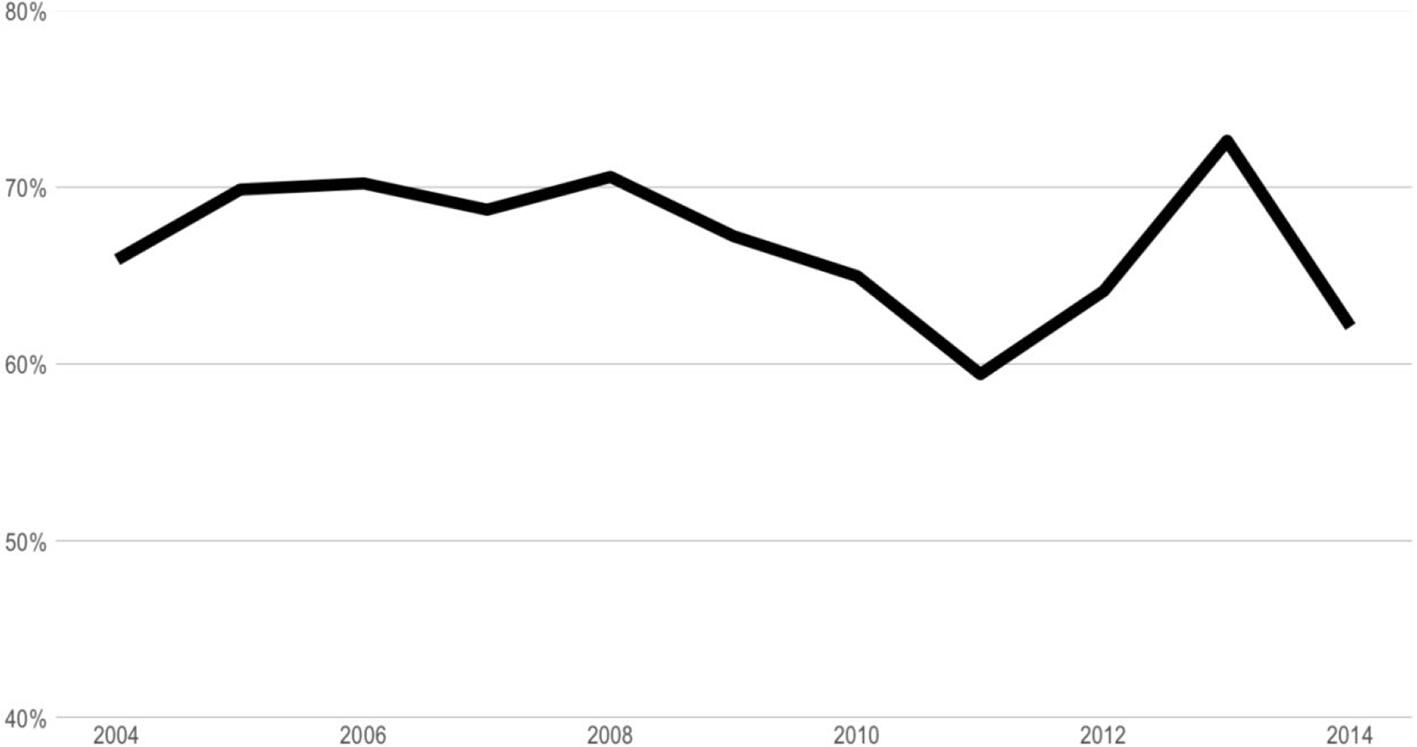
Average number of respondents preferring negotiation over military solution to conflict. Source: LAPOP (2004–2014).
Predictors
In order to predict civilian preferences over negotiation, we include a large number of predictors in our analysis available with the LAPOP surveys. 8 We restrict the variables under consideration to those with a rate of non-response under 15 per cent and impute missing values for the variables we do include using AMELIA (R package for multiple imputation of missing data)(Honaker et al., 2011). In total, we retain survey data on about 16,000 responses across ten years of the Colombian conflict.
First, we include a set of socio-demographic variables, including age, gender, education levels, ethnic identity, size of the municipality in which the respondent lives, and rurality of the municipality according to the National Statistical Agency. Given the agrarian nature of the conflict, rurality and size of the municipality may play an important role in shaping civilian perceptions of the war. Additionally, we use response rates on asset ownership to construct a relative wealth index using the methodology outlined in Córdova (2009). Wealth, in particular, may be relevant to the conflict if the left–right schism is conceived of by some civilians as class-based conflict.
Second, we include a set of variables related to political and social preferences, construed broadly. These include beliefs about the value and efficacy of democracy in principle and in practice, as well as measures of tolerance for opposing voices, relevant if support for democratic principles promotes conciliation and compromise in negotiations. In order to evaluate support for “pre-political” social preferences surrounding vengeance and negative reciprocity (Carlin and Love, 2018; Stein, 2015), we also include items that measure preferences for extra-judicial violence against criminals. We then construct a measure of ideological self-placement out of LAPOP’s original ten-point ideology scale. 9
Third, we make use of a set of variables bearing on civilian attitudes towards the state and its institutions. These survey items measure trust levels in various institutions as well as how often civilians interact with them and their perceptions and experiences with corruption more generally. With respect to negotiations, weak trust in institutions or poor experiences with them may make civilians less likely to believe the government can successfully negotiate an end to war. For ease of interpretation, we collapse these variables into a latent variable using a principal component plot (scree plot available in Appendix 1), though the results are substantively similar if including these measures individually. 10
Finally, we leverage various sources of data related to victimisation, conflict proximity, and attitudes towards the warring actors. We construct an indicator for whether the respondent lives in a municipality designated as a “conflict zone” by the federal government’s “National Plan for Territorial Consolidation” (Decreto Presidencial 2332 de 2013, 2009). 11 We also include variables on whether respondents personally or indirectly experienced conflict-related violence in various forms, through death of family members, forced expulsion, or emigration for fear of violence.
Together, these variables provide a comprehensive set of possible factors that can shape negotiation preferences. In the next section, we discuss the random forest algorithm and our strategies for interpreting the model.
Analysis
We fit a random forest comprised of 500 component models (“decision trees”) using the previously discussed predictors. 12 The outcome of interest is whether a person chose “negotiated settlement” or “military solution” as their preferred conclusion to the civil war. In order to evaluate the predictive power of our random forest model, we train our trees on a subset of the data (about 80 per cent) and make predictions on the remaining data. 13
In order to determine how predictive explanatory variables are of negotiation preferences, we rely on permutation importance, a metric that captures the increase in classification error resulting from permuting, or omitting, a given variable from the decision trees in a random forest. Intuitively, if a predictor has a strong relationship with the outcome of interest, then permuting the variable should produce a substantial decrease in the ability of the model to produce accurate predictions. If, on the other hand, permuting a predictor does little to change the model’s predictive accuracy, then we can say that the variable has a weak relationship with the outcome of interest and is a poor predictor of that outcome. Importantly, permutation importance is calculated using data that were randomly excluded from the model-fitting dataset (“out-of-bag” data; Jones and Linder, 2015), which allows us to evaluate the predictive power of each variable on data that were not used to fit the model. 14
Beyond determining the predictive importance of a given variable, we would also like to get a sense of its relationship to a person’s willingness to support negotiations. For this purpose, we rely on partial dependence plots to visualise the relationship between the two variables (Friedman et al., 2001). Partial dependence is determined by obtaining an average prediction from the random forest for each unique value of a predictor, accounting for the effects of the other variables. This process produces a predicted probability of endorsing negotiations at each value of a predictor, and is akin to finding marginal expected probabilities in linear regression, where the change in outcome is estimated while other variables are held constant.
Results
Figure 2 shows the top fifteen variables in terms of permutation importance. Given that the random forest algorithm is a random process, we fit the forest 200 times and average the resulting variable importance measures. We depict the top ten predictors across repeated iterations. Table 1A in the Appendix provides a description of each variable.
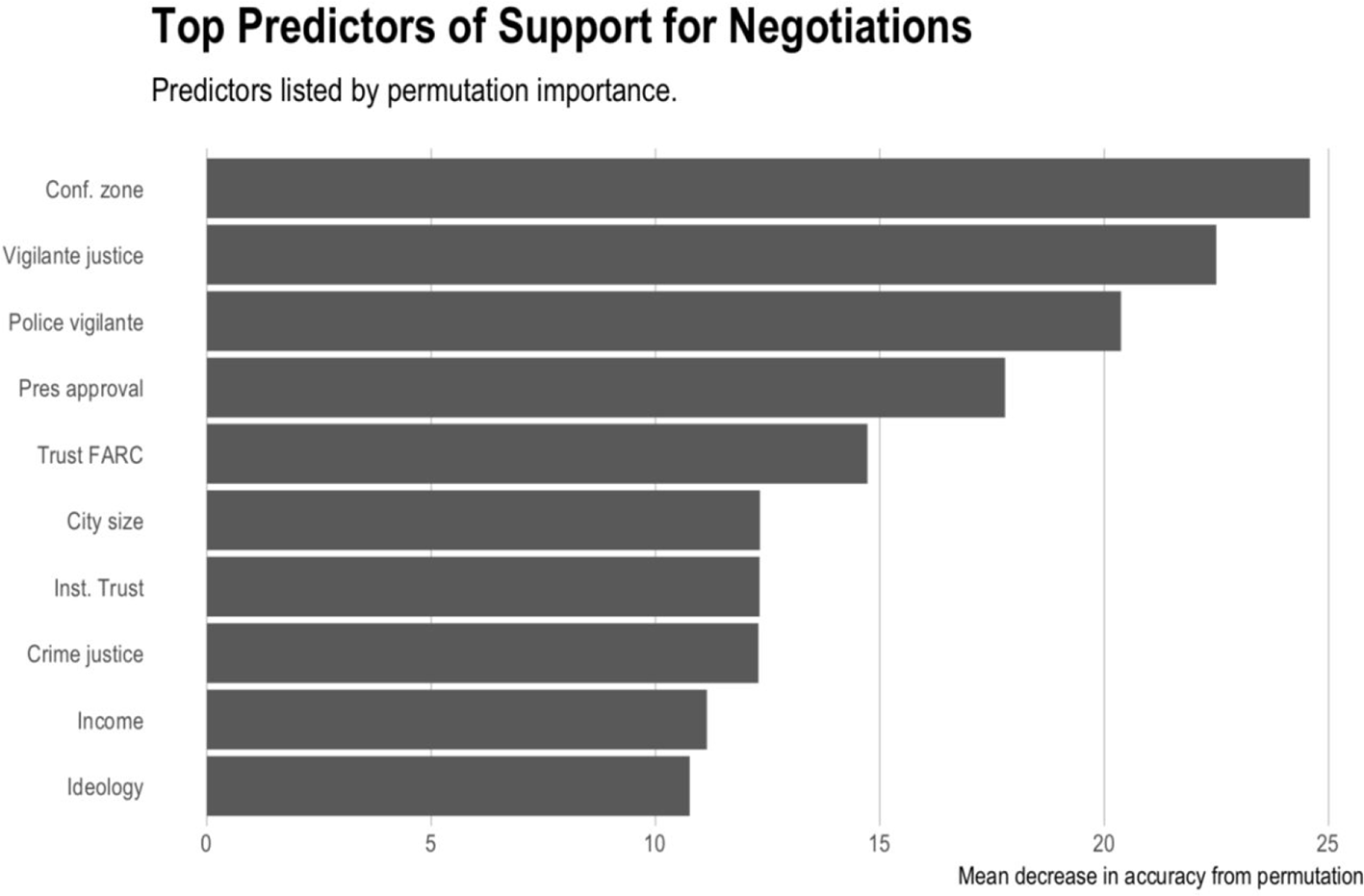
Top ten predictors by permutation importance of supporting negotiations with the FARC. FARC: Revolutionary Armed Forces of Colombia.
The x-axis depicts the mean decrease in accuracy resulting from permuting the variable in question. Excluding the top variable, which measures whether or not the respondent lives in a high-conflict area (“conf. zone”) for example, leads to a roughly 25 per cent decrease in classification accuracy in the overall model. This suggests that knowing whether or not someone lives in an area plagued by conflict provides important information in predicting whether that person will support negotiations or not. Conversely, excluding the variable capturing how often the respondent attends religious services (not depicted) leads to a relatively paltry decrease in classification accuracy of 1.5 per cent. This suggests that religiosity is playing a minor role in how civilians think about the negotiations.
A few patterns emerge among the top predictors of individual support for negotiations. First, two variables measuring respondents’ social preferences on punishment of criminality emerge as strong predictors of negotiation preferences. Second, variables capturing citizens’ trust in varied state institutions also appear as strong predictors of negotiation preferences. Finally, while proximity to conflict appears as a critical predictor of preferences, variables measuring victimisation have little predictive power. We discuss each of these findings in turn.
Social Preferences and Vengeance
Model results suggest that two survey items capturing civilian attitudes towards justice and the punishment of social transgressions are important predictors of negotiation preferences. These items measure, respectively, the extent to which a respondent supports the police taking extra-legal measures to capture criminals, as well as the extent to which the respondent supports individuals “taking the law into their own hands” to deal with crime. Each survey item ranges between 15 per cent and 20 per cent reductions in classification rates when permuted from the model, suggesting large decreases in valuable information when these variables are excluded.
Figure 3 visualises the relationship between these variables and support for negotiations. As is clear, respondents who exhibit more punitive attitudes surrounding crime are consistently predicted by the model to oppose negotiations at higher rates than their counterparts. Civilians who believe it is permissible to sidestep the law in order to punish criminals are overwhelmingly predicted to oppose negotiations. Similarly, those who support extra-legal police force are predicted to oppose negotiation at similar rates.
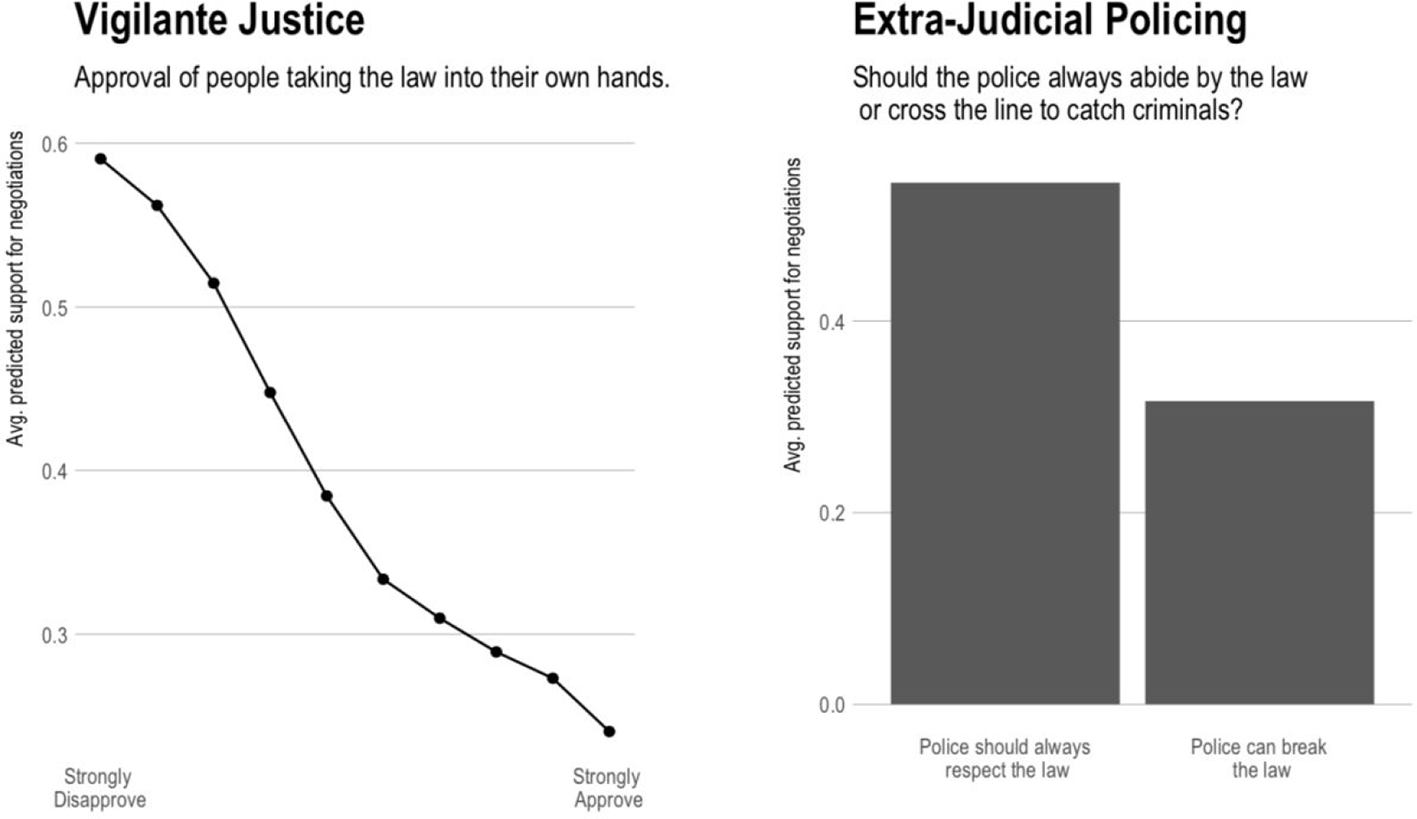
Partial dependence plots of variables bearing on respondent values and support for negotiations.
Clearly, citizens who hold punitive social preferences appear least willing to negotiate an end to war. While it is unsurprising that punitive social preferences are related to attitudes towards negotiation, it is important to note that they are unlikely to be tapping into the same underlying construct; punitive social preferences are broader than attitudes towards war and are thought to have evolved in societies in order to maintain pro-social norms (Carlin and Love, 2018).
The findings support accounts of negotiation attitudes that emphasise the role of social preferences for punishment and revenge (Carlin and Love, 2018; Stein, 2015). Across a wide variety of contexts and policy domains, people who believe social transgressions should be met with punishment have been found to be resistant to diplomatic solutions to conflict, even in the face of substantial costs (Halperin and Bar-Tal, 2011; Hetherington and Suhay, 2011; Kertzer and Brutger, 2016; Stein, 2015). This is likely because such people see participation in an armed group as an inherent violation of social norms, and believe these transgressions should be met with negative sanctions, not negotiations.
Evaluations of the State
Next, we find that variables bearing on citizens’ evaluation of the state, the president, and various other institutions are consistently strong predictors in the model. Items bearing on trust of local government and political parties, approval of the president, and the extent to which people expect the courts to be effective are strong predictors of negotiation preferences, with associated mean decrease in accuracy from permutation between 10 per cent and 15 per cent.
A major concern here is the extent to which citizens’ evaluations of the state map onto partisan attachments. This is particular worrying in regard to negotiation attitudes, given that ex-President Alvaro Uribe would become stridently opposed to negotiating with the FARC during the peace process, while President Juan Manuel Santos became its chief architect. To address these concerns, we split the sample by who was in office at the time of the survey and re-fit the model.
As expected, the relationship between citizens’ evaluation of the president and negotiation preferences is highly dependent on who is in power at that particular time (Figure 4): those with a high opinion of Uribe (Santos) tend to oppose (favour) negotiating with the FARC at higher rates than those with a low opinion of Uribe (Santos). Clearly, negotiation preferences are deeply entwined with evaluations of these two key political elites. We do not find the same pattern, however, with respect to broader institutional trust: across both subsamples, the relationship between institutional trust and the propensity for supporting negotiations is largely similar (Figure 5). This suggests citizens’ evaluations of state institutions are not entirely wrapped up in electoral politics but rather exert their own effect on negotiation preferences. In this case, we find that those with low (high) trust in the state and its institutions tend to support negotiation at much lower (higher) rates than their counterparts. 15
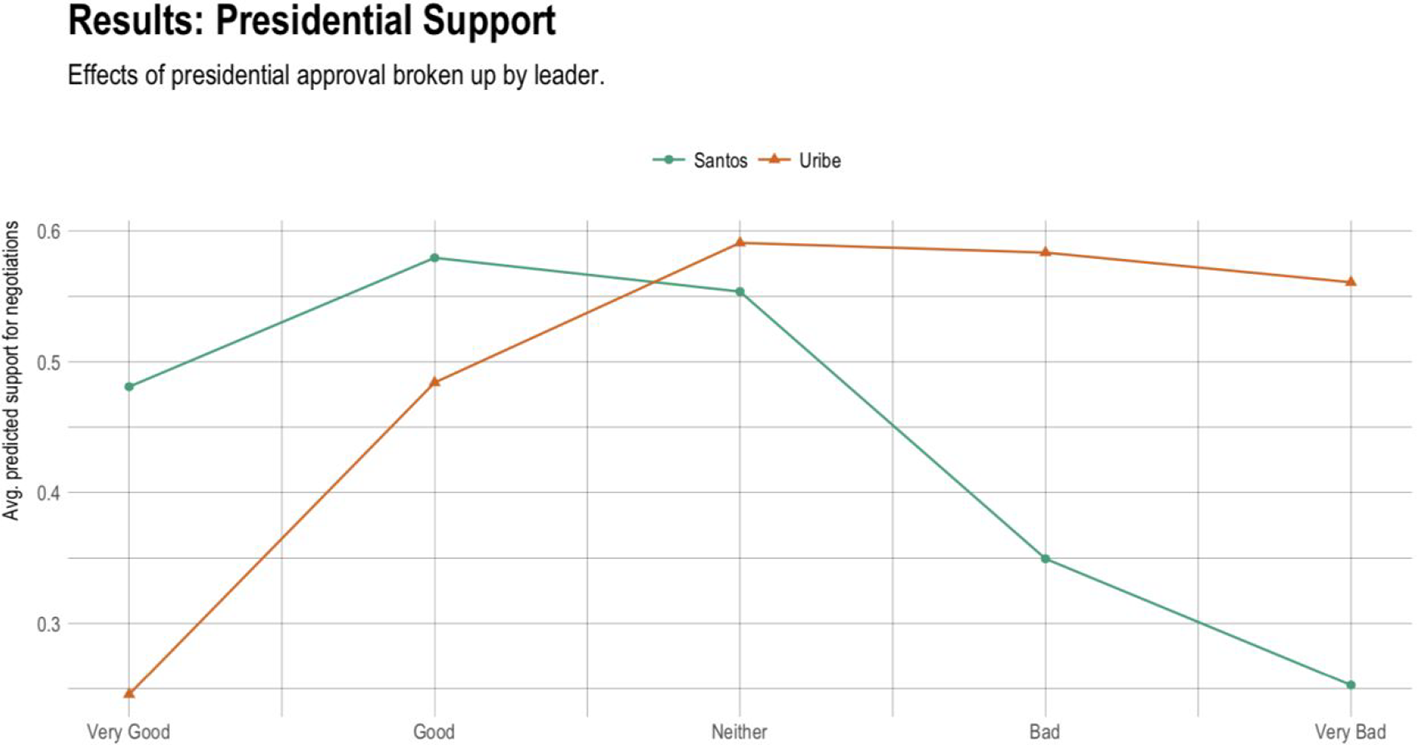
Partial dependence plot of presidential approval, subset by time in office of each leader in the sample.
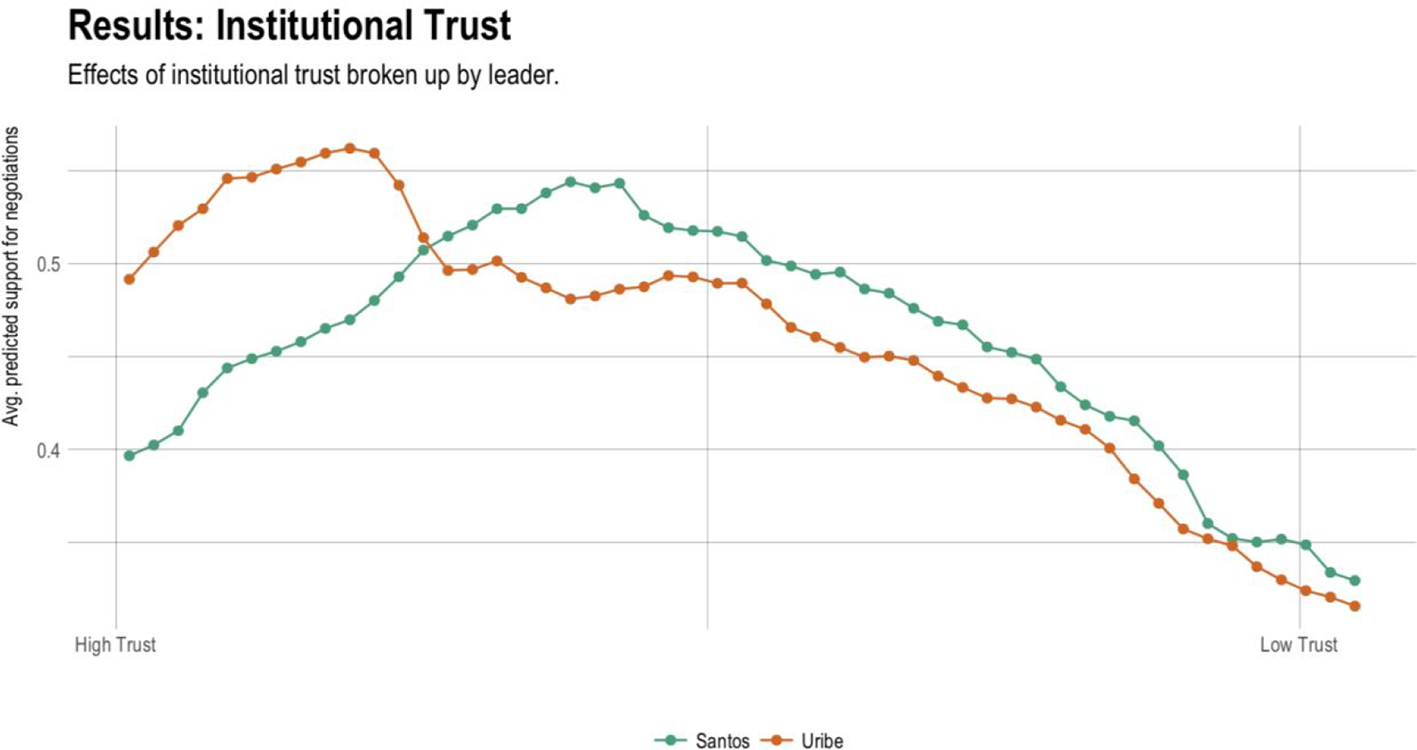
Partial dependence plot of trust in institutions and support for negotiations, subset by time in office of each leader in the sample.
That citizens’ willingness to endorse negotiated peace depends on their evaluations of the state, a key actor in the bargaining process (Walter, 2002), is an important but understudied aspect of wartime public opinion. Successfully negotiating and then implementing a peace agreement is a challenging process that would tax even high-capacity states; it is a particularly challenging process for states plagued with low capacity and territorial reach (García Sánchez, 2014; Nilsson, 2012). The findings point to citizens being weary of negotiations when they view the state as ineffectual.
Conflict Exposure and Perceptions
Finally, we consider the importance of variables bearing on conflict exposure. We distinguish between victimisation – variables capturing harm or loss experienced as a result of the conflict – and conflict proximity – physical proximity to locales prone to armed combat. We find strong support for proximity (25 per cent decrease in classification accuracy) as a predictor of attitudes. In contrast, victimisation experiences – such as whether the respondent or those close to them were harmed, forced to leave, etc., in response to the conflict – seem to offer very little predictive power, with none breaking 10 per cent in permutation importance. Unsurprisingly, we find that attitudes towards the FARC are also a significant predictor of negotiation preferences. 16
The partial dependence plots for these variables are depicted in Figure 6. People who live in high-conflict zones are predicted to support the negotiation at higher rates than their counterparts and the difference in magnitude is substantial. Conversely, direct victimisation experiences are very weak predictors of conflict negotiation and the difference between victimised and non-victimised civilians is small. Finally, trust in the FARC is a relatively important predictor of negotiation preferences, and the relationship appears curvilinear. Those with low or high trust in the FARC are predicted to oppose negotiations, while respondents with moderate levels of trust are more likely to support them.
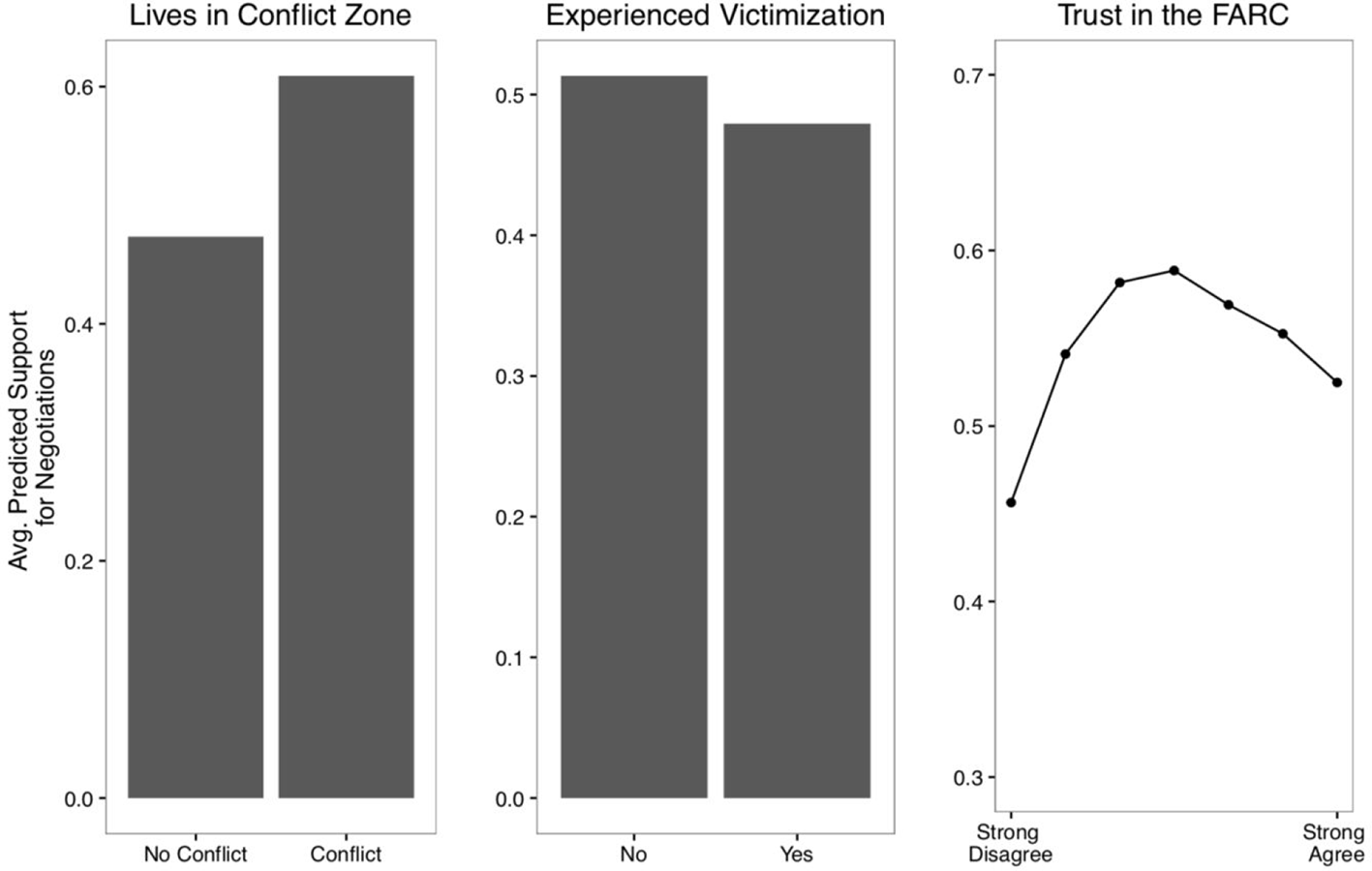
. Partial dependence plots for conflict-experience variables and support for negotiations.
These patterns point to an important distinction between experiencing violence directly and living “in the shadow” of violence (i.e. a conflict zone). Facing the potential of experiencing violence in the future, should the bargaining process fail, is a reality that those living in conflict zones face more directly than those living elsewhere, regardless of victimisation status. As a result, citizens in conflict zones may be more willing to endorse negotiations as a means of risk reduction, even as victimisation serves to harden citizens against conflict (Bakke et al., 2009). Finally, the relationship between FARC support and negotiation attitudes points to a logic of strong partisans on both sides of the war (ardent opponents and loyal supporters of the FARC) being unsatisfied with negotiated settlement (Kalyvas, 2006; Wood, 2003). 17
Conclusion
The study demonstrates that there are varied and distinct processes driving conflict negotiation preferences among civilians. Importantly, the results also support (and contradict) extant lines of research on the causes of public intransigence to negotiations and point to avenues for future research. First, the exploratory analysis supports a growing body of research that suggests that “pre-political” social preferences, predispositions, or values are strong predictors of preferences bearing on national and domestic security (Carlin and Love, 2018; Hetherington and Suhay, 2011; Kertzer and Rathbun, 2015). Second, the results appear to contradict studies that emphasise the importance of victimisation as a barrier to peace-building (Hirsch-Hoefler et al., 2014), and instead support work indicating that proximity to ongoing conflict is a key determinant of who supports negotiations (Tellez, 2018). However, in looking at support for FARC involvement in politics, the paper by Garcia and Plata, in this special issue, find no consistent difference among citizens living inside and outside of areas of historical FARC control. In some respects this is puzzling, as citizens in these areas are likely to anticipate renewed conflict should the process to reintegrate the FARC fail, and thus the results seem to run counter to the idea that proximity to conflict increases support for peace. These results should ultimately renew scholarly interest in understanding how, exactly, the geography of conflict shapes citizen preferences. An empirical puzzle is how to tease apart the probability of conflict resurgence from patterns of territorial control. Finally, while little research has considered how the ability of states to implement complex peace agreements affects public buy-in for peace, the analysis clearly points to evaluations of state efficacy as key motivators of support for peace.
Of course, the results presented here cannot be interpreted causally and, while the analysis suggests certain variables are strong predictors of negotiation preferences, the precise mechanisms linking the predictors to the outcome must be explored in future research. With respect to “pre-political” social preferences, research suggests people who have strong preferences for punitive responses to norm violations experience threat more acutely than others (Hetherington and Suhay, 2011); this threat in turn motivates the desire for harsh responses. Future work that traces, or experimentally manipulates, the sense of threat respondents feel from armed combatants would help elucidate this process.
The relationship between individual belief in state efficacy and conflict negotiation attitudes is likely more complicated. We interpret the relationship between low trust in state institutions and support for negotiated settlement as resulting from an implicit evaluation of the state’s ability to successfully negotiate and implement an agreement (Prendergast et al., 2002). However, it is also possible that citizens with low trust in the state simply have a “pessimistic” perspective of society. Future work must directly measure how civilians think about the state’s ability to negotiate peace. The study also points to opportunities for experimentally manipulating respondents’ belief in the efficacy of the state – for example, by priming respondents with stories of state success (or failure) in implementing policy, before asking about negotiation preferences.
Finally, the study points to the need for disaggregating conflict exposure, as different kinds of contexts or experiences can produce different effects on attitudes. We expect the mechanism linking proximity to conflict and heightened support for negotiations to be an evaluation of personal risk exposure in the face of continued armed combat, in line with the conclusions found in Beber et al. (2014). Research that measures respondent evaluation of risk directly, or experimentally primes participants with information on the costs of war, would go a long way to clarifying this relationship. Moreover, it would be interesting to explore whether civilians outside of conflict zones can be pushed to support negotiations if primed with information about the potential costs others might bear if war continues.
Footnotes
Appendix 1
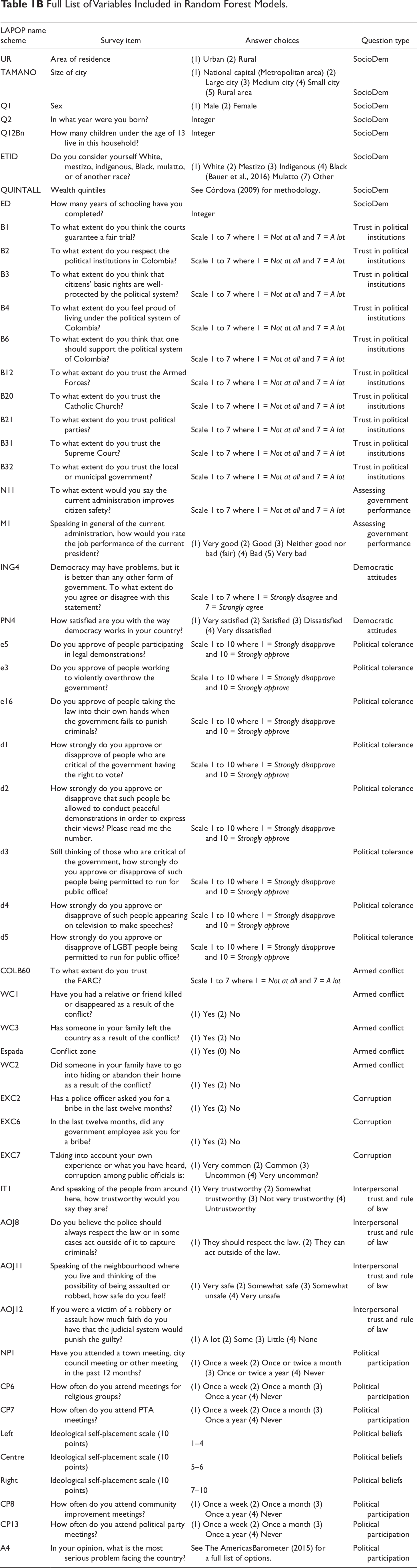
Full List of Variables Included in Random Forest Models.
| LAPOP name scheme | Survey item | Answer choices | Question type |
|---|---|---|---|
| UR | Area of residence | (1) Urban (2) Rural | SocioDem |
| TAMANO | Size of city | (1) National capital (Metropolitan area) (2) Large city (3) Medium city (4) Small city (5) Rural area | SocioDem |
| Q1 | Sex | (1) Male (2) Female | SocioDem |
| Q2 | In what year were you born? | Integer | SocioDem |
| Q12Bn | How many children under the age of 13 live in this household? | Integer | SocioDem |
| ETID | Do you consider yourself White, mestizo, indigenous, Black, mulatto, or of another race? Arjona, 2016Bauer et al., 2016 | (Arjona, 20161) White (2) Mestizo (3) Indigenous (4) Black (Bauer et al., 2016) Mulatto (7) Other | SocioDem |
| QUINTALL | Wealth quintiles | See Córdova (2009) for methodology. | SocioDem |
| ED | How many years of schooling have you completed? | Integer | SocioDem |
| B1 | To what extent do you think the courts guarantee a fair trial? | Scale 1 to 7 where 1 = Not at all and 7 = A lot | Trust in political institutions |
| B2 | To what extent do you respect the political institutions in Colombia? | Scale 1 to 7 where 1 = Not at all and 7 = A lot | Trust in political institutions |
| B3 | To what extent do you think that citizens’ basic rights are well-protected by the political system? | Scale 1 to 7 where 1 = Not at all and 7 = A lot | Trust in political institutions |
| B4 | To what extent do you feel proud of living under the political system of Colombia? | Scale 1 to 7 where 1 = Not at all and 7 = A lot | Trust in political institutions |
| B6 | To what extent do you think that one should support the political system of Colombia? | Scale 1 to 7 where 1 = Not at all and 7 = A lot | Trust in political institutions |
| B12 | To what extent do you trust the Armed Forces? | Scale 1 to 7 where 1 = Not at all and 7 = A lot | Trust in political institutions |
| B20 | To what extent do you trust the Catholic Church? | Scale 1 to 7 where 1 = Not at all and 7 = A lot | Trust in political institutions |
| B21 | To what extent do you trust political parties? | Scale 1 to 7 where 1 = Not at all and 7 = A lot | Trust in political institutions |
| B31 | To what extent do you trust the Supreme Court? | Scale 1 to 7 where 1 = Not at all and 7 = A lot | Trust in political institutions |
| B32 | To what extent do you trust the local or municipal government? | Scale 1 to 7 where 1 = Not at all and 7 = A lot | Trust in political institutions |
| N11 | To what extent would you say the current administration improves citizen safety? | Scale 1 to 7 where 1 = Not at all and 7 = A lot | Assessing government performance |
| M1 | Speaking in general of the current administration, how would you rate the job performance of the current president? Arjona, 2016Bauer et al., 2016 | (Arjona, 20161) Very good (2) Good (3) Neither good nor bad (fair) (4) Bad (Bauer et al., 2016) (5) Very bad | Assessing government performance |
| ING4 | Democracy may have problems, but it is better than any other form of government. To what extent do you agree or disagree with this statement? | Scale 1 to 7 where 1 = Strongly disagree and 7 = Strongly agree | Democratic attitudes |
| PN4 | How satisfied are you with the way democracy works in your country?Arjona, 2016 | (Arjona, 20161) Very satisfied (2) Satisfied (3) Dissatisfied (4) Very dissatisfied | Democratic attitudes |
| e5 | Do you approve of people participating in legal demonstrations? | Scale 1 to 10 where 1 = Strongly disapprove and 10 = Strongly approve | Political tolerance |
| e3 | Do you approve of people working to violently overthrow the government? | Scale 1 to 10 where 1 = Strongly disapprove and 10 = Strongly approve | Political tolerance |
| e16 | Do you approve of people taking the law into their own hands when the government fails to punish criminals? | Scale 1 to 10 where 1 = Strongly disapprove and 10 = Strongly approve | Political tolerance |
| d1 | How strongly do you approve or disapprove of people who are critical of the government having the right to vote? | Scale 1 to 10 where 1 = Strongly disapprove and 10 = Strongly approve | Political tolerance |
| d2 | How strongly do you approve or disapprove that such people be allowed to conduct peaceful demonstrations in order to express their views? Please read me the number. | Scale 1 to 10 where 1 = Strongly disapprove and 10 = Strongly approve | Political tolerance |
| d3 | Still thinking of those who are critical of the government, how strongly do you approve or disapprove of such people being permitted to run for public office? | Scale 1 to 10 where 1 = Strongly disapprove and 10 = Strongly approve | Political tolerance |
| d4 | How strongly do you approve or disapprove of such people appearing on television to make speeches? | Scale 1 to 10 where 1 = Strongly disapprove and 10 = Strongly approve | Political tolerance |
| d5 | How strongly do you approve or disapprove of LGBT people being permitted to run for public office? | Scale 1 to 10 where 1 = Strongly disapprove and 10 = Strongly approve | Political tolerance |
| COLB60 | To what extent do you trust the FARC? | Scale 1 to 7 where 1 = Not at all and 7 = A lot | Armed conflict |
| WC1 | Have you had a relative or friend killed or disappeared as a result of the conflict? | (1) Yes (2) No | Armed conflict |
| WC3 | Has someone in your family left the country as a result of the conflict? | (1) Yes (2) No | Armed conflict |
| Espada | Conflict zone | (1) Yes (0) No | Armed conflict |
| WC2 | Did someone in your family have to go into hiding or abandon their home as a result of the conflict? | (1) Yes (2) No | Armed conflict |
| EXC2 | Has a police officer asked you for a bribe in the last twelve months? | (1) Yes (2) No | Corruption |
| EXC6 | In the last twelve months, did any government employee ask you for a bribe? | (1) Yes (2) No | Corruption |
| EXC7 | Taking into account your own experience or what you have heard, corruption among public officials is:Arjona, 2016 | (Arjona, 20161) Very common (2) Common (3) Uncommon (4) Very uncommon? | Corruption |
| IT1 | And speaking of the people from around here, how trustworthy would you say they are?Arjona, 2016 | (Arjona, 20161) Very trustworthy (2) Somewhat trustworthy (3) Not very trustworthy (4) Untrustworthy | Interpersonal trust and rule of law |
| AOJ8 | Do you believe the police should always respect the law or in some cases act outside of it to capture criminals?Arjona, 2016 | (Arjona, 20161) They should respect the law. (2) They can act outside of the law. | Interpersonal trust and rule of law |
| AOJ11 | Speaking of the neighbourhood where you live and thinking of the possibility of being assaulted or robbed, how safe do you feel?Arjona, 2016 | (Arjona, 20161) Very safe (2) Somewhat safe (3) Somewhat unsafe (4) Very unsafe | Interpersonal trust and rule of law |
| AOJ12 | If you were a victim of a robbery or assault how much faith do you have that the judicial system would punish the guilty?Arjona, 2016 | (Arjona, 20161) A lot (2) Some (3) Little (4) None | Interpersonal trust and rule of law |
| NP1 | Have you attended a town meeting, city council meeting or other meeting in the past 12 months? | (1) Once a week (2) Once or twice a month (3) Once or twice a year (4) Never | Political participation |
| CP6 | How often do you attend meetings for religious groups? | (1) Once a week (2) Once a month (3) Once a year (4) Never | Political participation |
| CP7 | How often do you attend PTA meetings? | (1) Once a week (2) Once a month (3) Once a year (4) Never | Political participation |
| Left | Ideological self-placement scale (10 points) | 1–4 | Political beliefs |
| Centre | Ideological self-placement scale (10 points) | 5–6 | Political beliefs |
| Right | Ideological self-placement scale (10 points) | 7–10 | Political beliefs |
| CP8 | How often do you attend community improvement meetings? | (1) Once a week (2) Once a month (3) Once a year (4) Never | Political participation |
| CP13 | How often do you attend political party meetings? | (1) Once a week (2) Once a month (3) Once a year (4) Never | Political participation |
| A4 | In your opinion, what is the most serious problem facing the country? | See The AmericasBarometer (2015) for a full list of options. | Political participation |
Declaration of Conflicting Interests
The author(s) declared no potential conflicts of interest with respect to the research, authorship, and/or publication of this article.
Funding
The author(s) received no financial support for the research, authorship, and/or publication of this article.
Notes
Author Biographies
E-mail:
E-mail: