




Abstract
Political participation of former combatants is a central component of peace agreements. Similarly, people’s acceptance of political parties derived from such agreements is a crucial element towards peace building. Considering the peace deal between the Colombian government and the Revolutionary Armed Forces of Colombia (Fuerzas Armadas Revolucionarias de Colombia, FARC), we ask “What factors shape popular support for the FARC’s political involvement?” We argue that attitudes towards the political integration of the former guerrilla are influenced by conflict experiences and partisan identities. Relying on survey data, our results indicate that conflict experiences and political identities alone are not correlated with attitudes towards the political integration of former insurgents. However, public support for former combatants having a political party is associated with conflict experiences only for those who feel close to parties that took a hawkish stance towards the agreement.
Introduction
After reaching an agreement with the Colombian government in 2016, the Revolutionary Armed Forces of Colombia (Fuerzas Armadas Revolucionarias de Colombia, FARC) transformed into a political party. According to survey data, less than 20 per cent of Colombians supported the transition of the former guerrilla into a political actor (Galvis et al., 2016). Amid such opposing conditions and as the FARC prepared to participate in the 2018 and 2019 elections, it was unclear under what conditions allowing the FARC to have its own political party were admissible among Colombians.
Public opinion is a key factor of settlements’ success and post-conflict stability. Citizens’ opinions about peace agreements and their main components matter because sometimes they are asked to weigh in on these pacts through referendums or elections. But even in cases in which citizens are not asked to vote directly on the agreement, their support still shapes the implementation phase, as they decide whether to cooperate with the terms (Office of the United Nations High Commissioner for Human Rights (OHCHR), 2009). Settlements that lack civilian support are more likely to fail or have poor implementation than those backed by the public (Nilsson, 2012).
Given how critical public opinion is in defining the fate of a peace agreement, we ask “What factors shape popular support for the FARC’s political involvement?” Although past research finds that electoral provisions in peace agreements are an important enforcement mechanism (Matanock, 2017), we know less about under what conditions citizens are likely to support the integration into the political system of a former insurgency. Even if citizens do not vote for them, public support to create such political parties is critical to legitimise their involvement in politics and to incentivise a reciprocal behaviour by complying with peace agreements.
Factors shaping popular attitudes towards peace agreements and the political actors that emerge from them are diverse. Indeed, comparative literature has explored the role of conflict experiences (Nussio et al., 2015; Tellez, 2019; Tellez and Montoya, 2020), political elites (Garbiras-Díaz et al., 2019), territorial control, and political identities (Balcells, 2012). In this article, we propose to understand popular support for the FARC’s political involvement, taking into account the legacies of conflict and democratic governance. The co-existence of political violence and democratic procedures represents a paradox if we consider that democracy is expected to be a mechanism through which competing political forces can settle their differences without resorting to violence (Przeworski, 1999). However, this promise has not materialised in many countries that, despite adopting democratic procedures, continue experiencing political violence. Among these nations, Colombia is probably the case in which such a paradox has been present for the longest time. In fact, for the past six decades, Colombians have lived in tension between democracy and violence. While electoral processes unfolded under relatively open competition, fraud has been generally absent, and winning candidates have been considered legitimate by most citizens (Hartlyn and Valenzuela, 1997), this nation has also suffered prolonged and bloody armed conflict.
We argue that attitudes towards former rebels participating in politics, after signing a peace agreement with the government, are shaped by people’s experiences with both conflict and democracy. Conflict may have an impact through violence victimisation by illegal armed actors. At the same time, living in an electoral democracy may also have an effect on political attitudes about political reintegration of armed actors, as regular electoral competition allows political parties to put forth platforms, both for and against the components of the peace agreement, that resonate with voters in these regions.
Moreover, in a context where violence and democracy co-exist, these two experiences may interact; hence, political parties opposing the political involvement of former rebels would find an echo on this issue only among individuals more apprehensive about the FARC’s incorporation, like those having conflict experiences. From a different perspective, victimised individuals should be less likely to approve the FARC’s involvement in politics only if stances of a party that took a hawkish position regarding the peace agreement helped them have a clear position on the issue.
Based on survey data from a study conducted by Observatorio de la Democracia of Universidad de los Andes in 2017, we find that, on average, being a FARC victim and political identities have no relation with attitudes towards former combatants participating in politics. However, our research suggests that although feeling closer to a party that opposes the 2016 peace agreement is positively associated among non-victims with higher support for the political participation of former combatants, such tendency is neutralised (even reversed) among victims.
This article proceeds as follows. The next section presents our expectations on the factors that shape public attitudes towards the political participation of former combatants. The section thereafter describes our data. Next, the article presents a descriptive analysis on the attitudes of Colombians towards the main components of the peace agreement, followed by our main results. The last section concludes.
How War and Political Experiences Shape Citizens’ Attitudes towards the Political Involvement of Former Rebels
Public support towards the possibility of having former FARC’s militants participating in politics may have different levels of acceptability. At one end, citizens may feel compelled to oppose the FARC’s political involvement to affirm their political autonomy vis-à-vis the FARC’s past control or aggressions. At the other extreme, citizens may agree to the existence of a political party to channel the FARC’s political agenda, regardless of whether citizens agree with their stances. Such a range of attitudes reflects the contradictory outcomes that may result from combining years under democratic competition and the enduring threat of violence by the FARC. The extent to which individuals are willing or not willing to accept the FARC members’ participation in politics should be determined by the impact that violent experiences and democratic competition have on individuals’ attitudes.
Explaining the depth of citizen support for the FARC’s political involvement in Colombia should take into consideration this combination of experiences with both conflict and democratic politics. First, experiences of war may be consequential for citizens’ involvement in politics and their attitudes towards the future political engagement of former combatants. Studies focused on victims’ political involvement have shown that victimised individuals are more likely to be involved in civic life and are more willing to vote than non-victims (Bellows and Miguel, 2009; Gilligan et al., 2014; Krause, 2017). The willingness to participate in the politics of victims of violence has been explained by their increased perception of external efficacy (Krause, 2017), and because conflict victimisation is likely to augment social cohesion among victims who find a coping mechanism in collective activism (Gilligan et al., 2014).
On the other hand, although victimisation increases victims’ cohesiveness, when it comes to attitudes towards the political participation of former rebels, war experiences seem to lead individuals to reject that a former armed actor is allowed to have a political party. Thus, while personal political engagement may be seen as a strategy of personal growth (Blattman, 2009), traumatic experiences reinforce differences with out-group individuals (Bauer et al., 2016) and they also seem to promote feelings of rejection towards individuals associated with past violence (Balcells, 2012; Grossman et al., 2015).
Despite these results, recent research on the Colombian case showed that attitudes towards the peace process are not strongly correlated with conflict experiences (Hazlett and Parente, 2020; Liendo and Braithwaite, 2018), and that there are no differences in attitudes towards transitional justice mechanisms between victims and non-victims (Nussio et al., 2015). These counterintuitive findings may indicate that in a long-term civil conflict, the victims versus non-victims divide may be blurred. It is possible that close co-existence of victims, non-victims, and armed combatants could prevent citizens from developing a clear in-group versus out-group distinction.
Following the argument according to which conflict experiences reinforce differences with out-group individuals, citizens victimised by the FARC should be the least supportive of the FARC’s political party creation. On the contrary, if a long-term civil conflict increases the opportunities of victims and non-victims to interact, which may favour a common representation of issues related with the armed conflict and its actors, it would be harder to define an out-group on the basis of personal experiences with violence. Therefore, in this type of scenario, regardless of victimisation status, people may end up sharing similar attitudes towards armed actors and former combatants. Then, we should not find differences in acceptance of the FARC’s political involvement between victims and non-victims.
Most conflict literature has not gone beyond conflict experiences to explain citizens’ attitudes towards the political actors resulting from peace agreements. However, as we mentioned before, in many countries political competition and elections co-exist with political violence. Therefore, experiencing democratic debate may have an impact on attitudes towards peace and the political involvement of former rebels. Post-conflict settings tend to be characterised by political polarisation around the issue of war settlement and peace. This situation often emerges from fighting factions (Montalvo and Reynal-Querol, 2005) or during the negotiation phase as parties take dovish or hawkish approaches to negotiation (Matanock and García-Sánchez, 2017). In addition, electoral competition facilitates political parties to put forth platforms and messages in favour of or against the different provisions included in a peace agreement that resonate with voters’ concerns. Recent research has demonstrated that citizens’ attitudes towards different components of the peace agreements signed in Colombia and South Sudan are driven by cues from polarising elites (Garbiras-Díaz et al., 2019; Haas and Khadka, 2020).
If that is the case, an in-group versus out-group distinction may also emerge from the political debate that revolves around the peace agreement and its provisions; hence, political allegiances may be correlated with attitudes towards the peace deal and its components. Therefore, followers of those parties that took a hawkish stance towards the agreement should be the least supportive of the FARC’s political party creation. In Colombia, the peace process with the FARC triggered a deep political division within the political establishment (Matanock and García-Sánchez, 2017). Former president Álvaro Uribe leads a coalition of politicians who opposed the peace negotiations and the agreement signed in 2016 with the FARC. In 2013, he founded Centro Democrático (Democratic Center), a party that centred their appeals on the opposition to peace negotiations with the FARC. Particularly, Centro Democrático vehemently opposed the political involvement of the FARC if they were not being held accountable by justice.
So far, we have argued that both conflict and political debate may influence people’s attitudes towards the political integration of former rebels. Yet to what extent do these two dimensions interact? We think that political messages of parties and leaders in favour of or against the different provisions included in a peace agreement may resonate more strongly with fears among victimised individuals than among non-victimised citizens. Views put forth by parties that took a hawkish stance towards the agreement may contribute to amplifying or activating victims’ grievances against the former reels, helping to create a distance between victims and ex-combatants as two distinct groups. In consequence, victims of violence sharing the stances of political parties opposing the peace agreement should be more likely to hold clear positions against the creation of a political party by FARC members.
Based on the previous discussion, we formulated three hypotheses:
Data
We tested the extent to which violence victimisation and the structuring role of political parties that take a hawkish stance on the peace agreement predict individuals’ attitudes on the FARC forming a political party, by relying on a special survey sample carried out between October and December 2017 by Observatorio de la Democracia from Universidad de los Andes in the areas most affected by the armed conflict. Specifically, the sampling frame of this study included the 170 municipalities where the Colombian government determined to implement development projects defined in the agreement signed between the government and the FARC. 1 This sample of 1391 individuals, eighteen and older, covers four regions, each of which had a particular experience with the FARC’s presence and violence; it also includes a lengthy questionnaire dealing particularly with citizens’ attitudes and perceptions of the peace agreement with the FARC. 2
A sample of conflict-affected regions allows us to test our hypotheses in regions in which both conflict and democratic debate co-existed for decades. Dwellers of regions traditionally affected by conflict report significantly higher levels of violence victimisation, compared to the average population. According to data from Observatorio de la Democracia, the national average of conflict victimisation is 40.8 per cent in the 2018 national sample; this average reached 68 per cent in the special sample covering areas historically affected by conflict (Ávila et al., 2018). On the other hand, there is less of a contrast between the democratic experience of Colombians living in conflict and non-conflict-affected regions. Data from a national representative sample show that in 2018, 29 per cent of Colombians were satisfied with democracy, 34 per cent were interested in politics, and 26 per cent identified with a political party. In conflict-affected regions, the percentage satisfied with democracy reached 36 per cent; 25 per cent were interested in politics and 23 per cent identified with a party. This suggests that despite the incidence of violence on electoral results (García-Sánchez, 2016), Colombians from different regions seem to experience democracy in a fairly similar manner. That is, citizens in conflict-affected areas and the average Colombian share cautious attitudes towards the performance of democracy and are distant from politics and political parties.
The design of the 2017 special sample offers another advantage to evaluate the role of experiences with conflict on our dependent variables. The sample is divided into four regions (sample strata), each of which had different experiences with violence, in particular with the presence of the FARC. As shown in Map 1, the regions included in the 2017 study are Bajo Cauca, Pacific Coast, Cordillera Central, and Macarena-Caguán. In each of them, the FARC had an important military presence; its relationship with the local population varied significantly, and so did the level of FARC victimisation. The Macarena-Caguán region was the FARC bastion; there, the guerrilla was militarily powerful, and it developed, over the years, a close control of several communities due to its role in the colonisation process, the coca economy, and building a social order (Jaramillo et al., 1986). In this region, 44.3 per cent reported to be FARC victims. The Cordillera Central was a region in which the FARC had a strategic interest, as it connects the Macarena-Caguán with the Pacific coast. In this area, insurgents exerted a strong military presence, but its social influence was moderate due to active peasant and indigenous organisations. Twenty-five per cent reported being victims of the FARC. The Pacific coast saw the FARC’s presence only in 1985. By the 1990s, this region was the battlefield of several armed groups, including the FARC, attempting to control illegal economies (drugs, mining, arms smuggling). In this zone, the FARC did not develop a close relationship with the communities, because its military power was volatile. The percentage of reported FARC victimisation was 17 per cent. Finally, in the Bajo Cauca zone, the FARC arrived in the 1970s along with other guerrilla groups and never consolidated full control. Then, with the military consolidation of right-wing paramilitaries, the FARC’s presence and its social influence were marginal. Here, 14 per cent reported to be FARC victims. In short, the sample design offers variation in conflict experiences and with varying intensities.
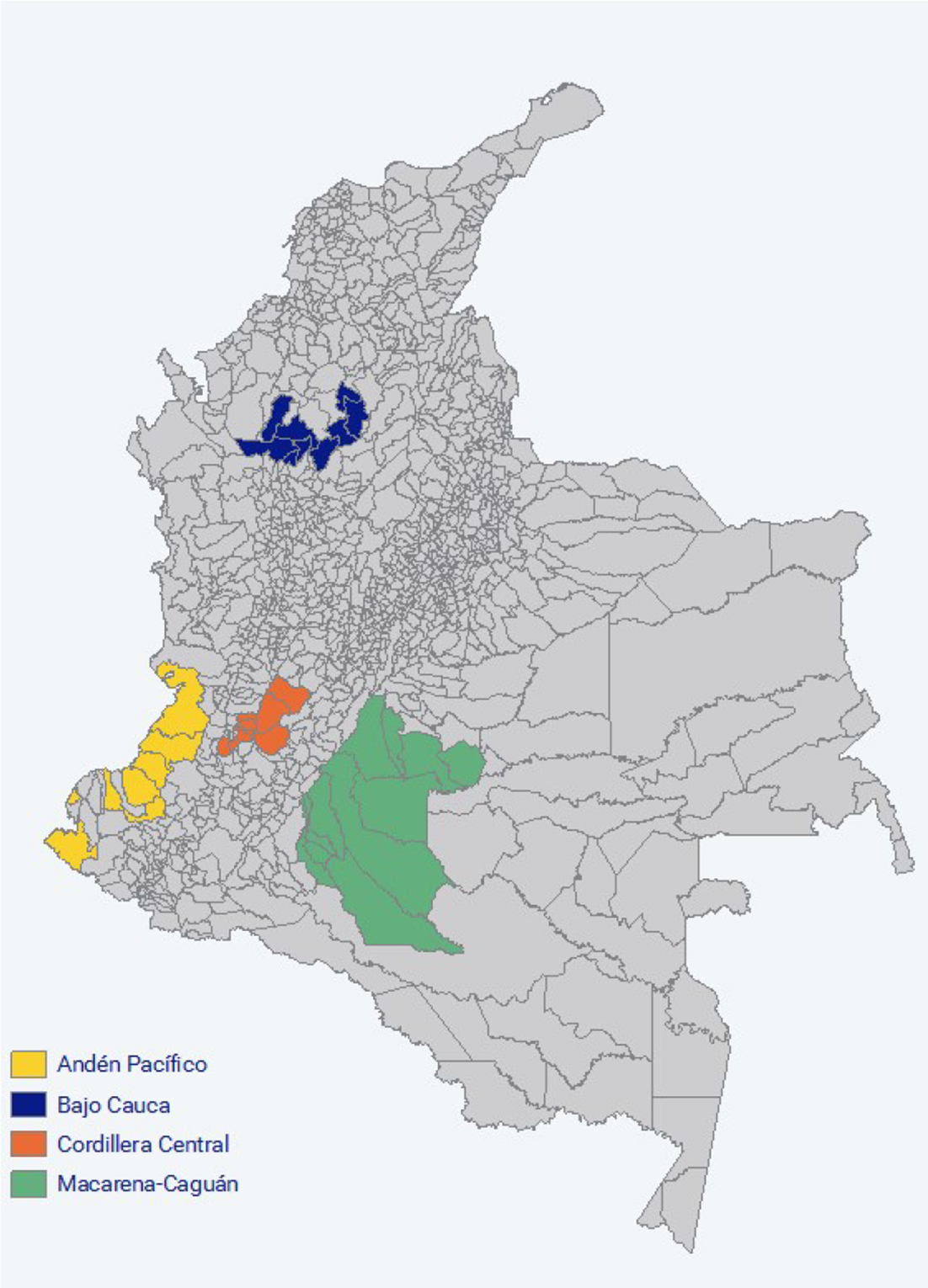
Regions Included in the Observatorio de la Democracia 2017 Sample of Conflict-Affected Regions.
In addition to using survey data, we also rely on insights from various focus groups we conducted in one municipality of each region included in the 2017 sample. In total, we had sixty participants in each of the following municipalities: Buenaventura (Pacific Coast), Santander de Quilichao (Cordillera Central), Puerto Libertador (Bajo Cauca), and San Vicente del Caguán (Macarena-Caguán). In each locality, we divided participants into four groups to have a diverse population and to ensure that individuals would feel comfortable participating. 3 This qualitative methodology is valuable in complementing survey data, as it elicits in-depth information on the topic or relationship at hand (Ward et al., 1991).
Our dependent variable is a measure of support for the FARC’s political participation. Using the 2017 sample, such support was captured using a question asking respondents the extent to which they agree or disagree with former FARC members creating a political party. Answers to this question were given using a 1 to 10 scale, where one indicates strong disapproval and ten indicates strong approval.
Moving to our main independent variables, we measured conflict victimisation taking advantage of additional information collected by our survey. Besides simply recording whether someone in their household was victimised by a series of actions, we asked who was responsible for those events. 4 Using this information, we were able to build a variable that records whether someone was not victimised; whether she or her family was victimised by the FARC, the paramilitaries, other groups; or whether they were victimised by more than one armed group. Using this measure, we achieved two goals. First, we identified which group victimised respondents. This is critical since we theorise that victimised individuals will reject the political involvement of their perpetrators. Second, as we recorded cases with more than one offender, we could identify cases where blame for violence is more diffuse, and consequently, rejection attitudes less clear.
In order to capture different conflict trajectories, we also tested for regional fixed effects. Although regional differences are due to many factors, if we found an association between region and attitudes towards the FARC’s political involvement, we could at least continue to entertain the possibility that diverse conflict experiences play a role.
Political affinities could influence attitudes towards the FARC’s political participation as part of a broader rejection of peace negotiations with the FARC. Therefore, in order to test the effect of political affinity with political parties taking a hawkish stance towards the agreement, we included a measure of closeness to the Centro Democrático, the main political party that opposed the contents of the peace agreements with the FARC. Beyond their possible impact on the population, political affinities may be particularly impactful in shaping opinions of victimised individuals. Particularly, opposing views in the Centro Democrático may deepen the apprehensiveness of victimised individuals feeling close to that party when thinking about the FARC’s political inclusion. In consequence, we also tested for an interactive effect of closeness with the Centro Democrático and being victimised. Finally, we controlled for wealth, 5 years of education, gender, age, urban/rural residence, and respondents’ support for democracy. 6 For reference, Table 1 presents minimum and maximum values, among other descriptive statistics of every variable used in the following analysis.
Descriptive Statistics.
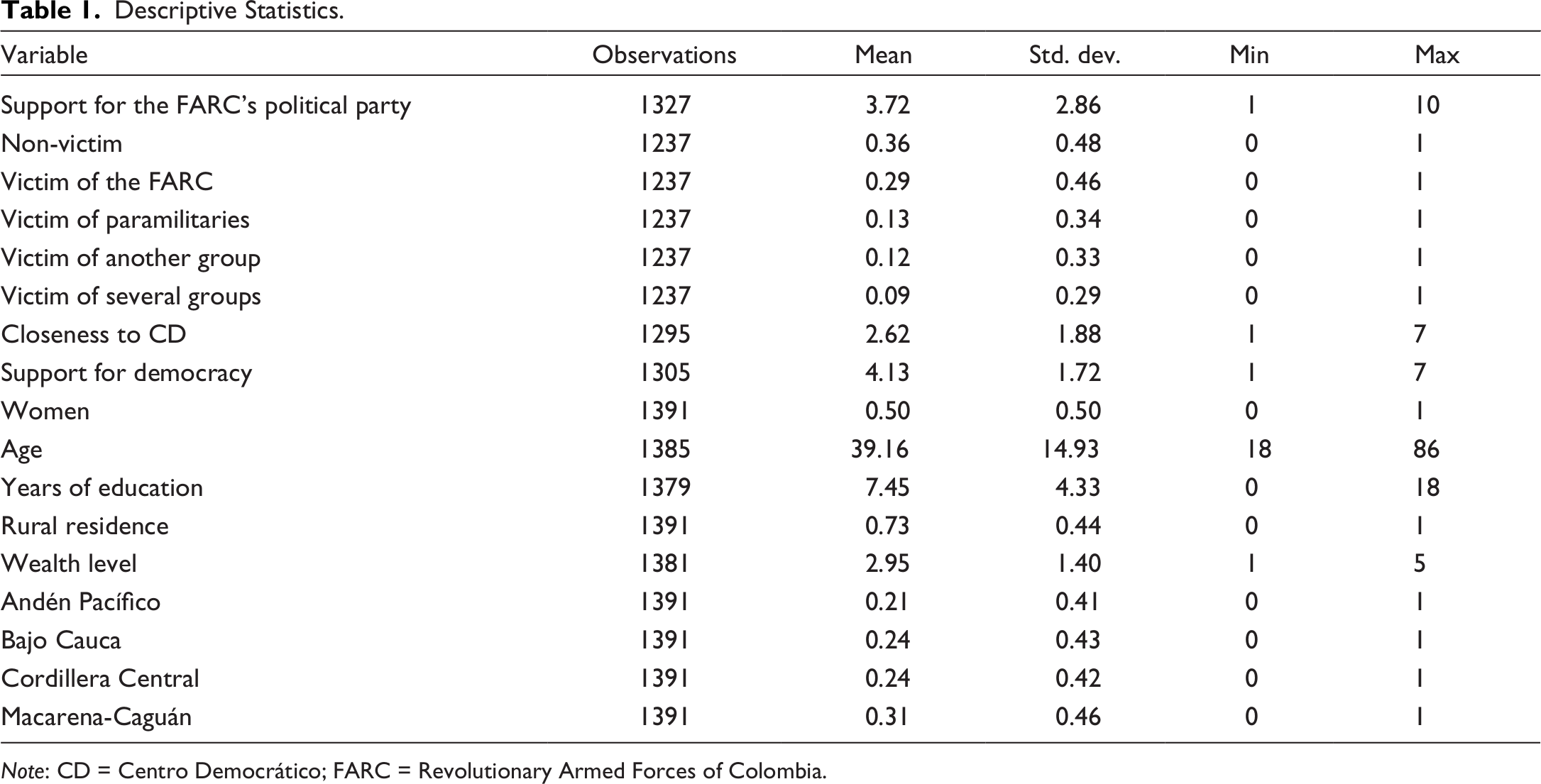
Note: CD = Centro Democrático; FARC = Revolutionary Armed Forces of Colombia.
Attitudes towards Peace Agreements in Conflict-Affected Regions
Before testing our hypothesis, it was important to have a sense of the extent to which citizens supported various components of the peace agreement with the FARC. An analysis of the approval of a peace agreement with the FARC seems to suggest that there is a great divide across partisan lines, geographical regions, and war-time experiences (Dávalos et al., 2018; Tellez, 2019). However, attitudes towards peace are more nuanced, as revealed by the 2017 survey conducted by Observatorio de la Democracia.
Initially, it is important to note that support for negotiating, as the main strategy to end conflict with guerrillas in Colombia, was very high. In 2017, 81.6 per cent of respondents in the areas most affected by the conflict preferred negotiation to using armed force, or a combination of both. Although less prevalent, support for negotiation was also high nationally (69.5 per cent), as recorded by the Americas Barometer 2018 survey in Colombia.
However, support for a negotiated peace does not translate into support for the peace agreement with the FARC. While support reached 53 per cent in conflict regions in 2017, nationally 48 per cent of Colombians supported the agreement (Ávila et al., 2018). This level of support gives some basis to the notion that Colombians are polarised around the idea of reaching an agreement with the FARC. But just as we do not find a similar divide when thinking of negotiating in abstract terms, we observed great heterogeneity in the level of agreement across each of the main components of the peace agreement with the FARC.
Figure 1 presents support levels for 2017 in regions most affected by conflict. The strikingly large variability in support levels across components reflects the complexity of opinions around the peace agreement in these areas. Components that are likely to bring concrete benefits to individuals received greater support than components benefiting former FARC members. Thus, agrarian reform programmes (81.8 per cent), creating peasant reserves (68.6 per cent), and creating electoral districts to represent victims of conflict (67.7 per cent) were supported by most individuals in areas most affected by the armed conflict. On the contrary, securing equal conditions for the FARC’s political party (35.1 per cent) and an amnesty for FARC rank-and-file members (24.7 per cent) are issues that received the least support. Within this range, support for the FARC’s political involvement is at the lower end, with barely 18.4 per cent of individuals agreeing with the creation of the FARC’s political party.
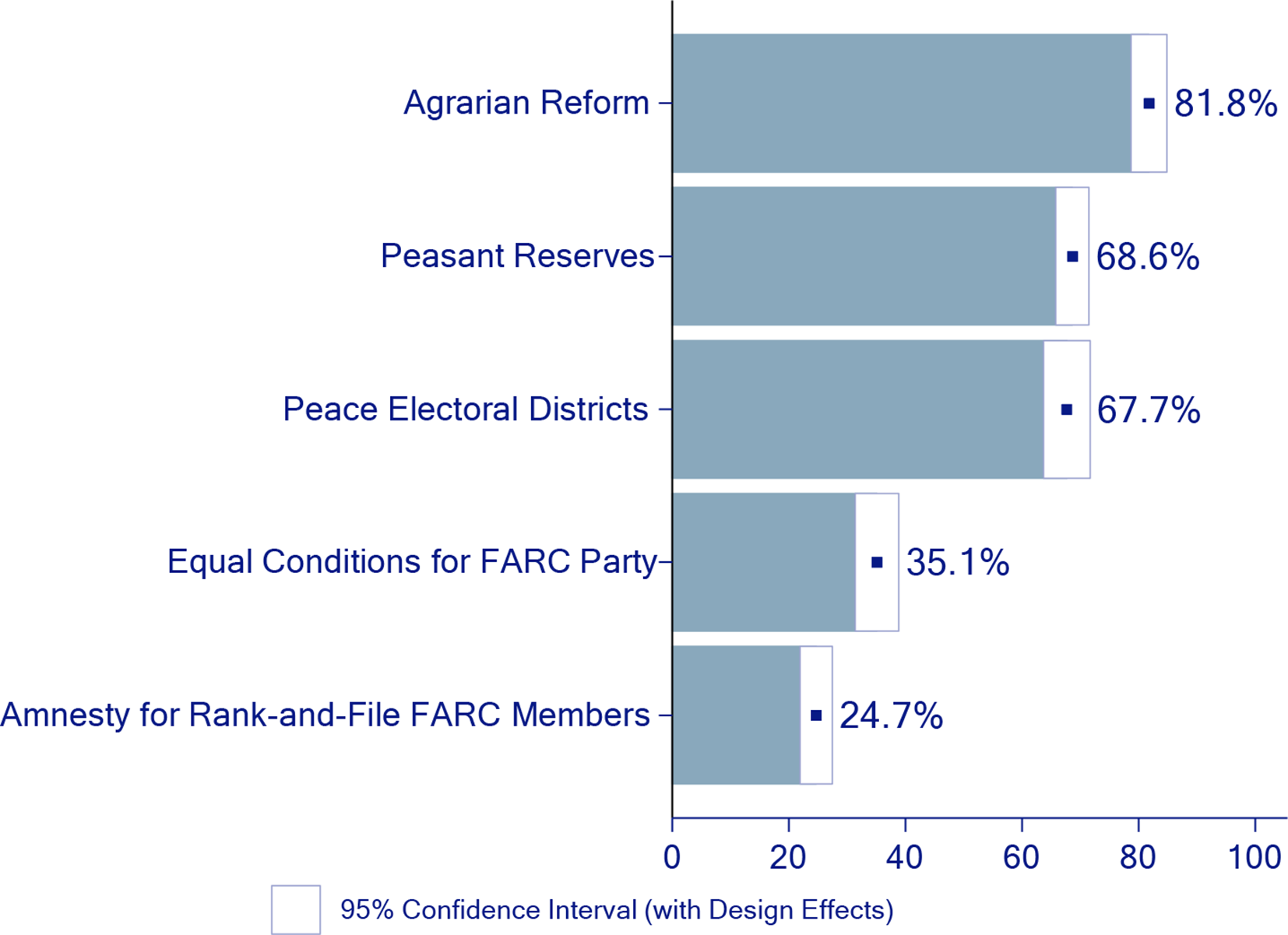
Percentage Approving Each Component of Peace Agreements with the FARC (2017 Sample).
Results from the 2018 Americas Barometer in Colombia describe a similar scenario: 84.6 per cent of Colombians supported the agrarian reform component of the Peace Agreement; 29.1 per cent and 18.9 per cent supported granting equal political conditions for the FARC’s party and the amnesty for FARC members, respectively.
Results
As mentioned above, the 2017 special survey sample by Observatorio de la Democracia allows us to explore the impact of conflict victimisation, political allegiances, and the moderating role of political preferences on the agreement with the FARC’s political involvement in contexts that experienced both armed conflict and democratic governance. Below are results for two regression models. 7 Model 1 predicts support for the creation of a political party by the FARC using the variables described above. Model 2 tests whether political preferences (closeness to an anti-peace party, Centro Democrático) moderate the effect of being victimised on the acceptance of the political participation of the FARC. Both models included fixed effects for regions to capture regional differences in conflict experiences. Table 2 presents association co-efficients for each independent variable and the corresponding standard error.
Regression Results for Support for the FARC’s Electoral Participation.
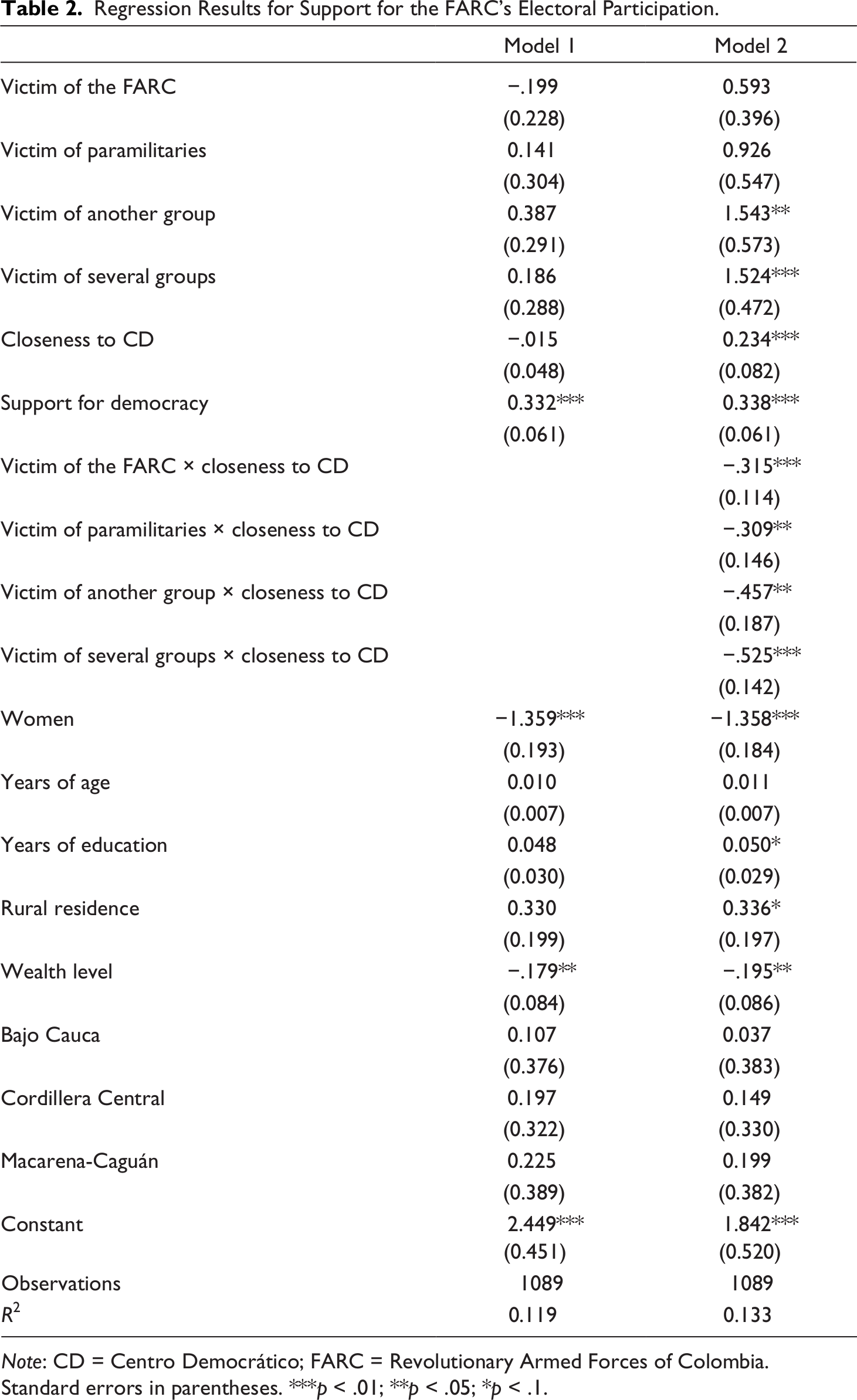
Note: CD = Centro Democrático; FARC = Revolutionary Armed Forces of Colombia. Standard errors in parentheses. ***p < .01; **p < .05; *p < .1.
Our first model reveals that victimised individuals are not more or less approving than non-victims of granting the FARC the possibility of forming a political party. This result holds for victims of the FARC, the paramilitaries, other armed actors, or various armed groups.
Model 1 also shows that citizens’ approval of the FARC having a political party is not different in places in which the FARC victimised more citizens, compared to places where the percentage of victims of this guerrilla was lower. For instance, respondents in the Macarena-Caguán, a region in which four out of every ten respondents declared being FARC victims, compared to those living in the Pacific coast (baseline region), a region in which 16 per cent of respondents declared to be victims of this guerrilla, did not express less support for the former guerrilla having a political party. Thus, citizens do not seem to be more inclined to accept FARC’s political involvement after experiencing different conflict trajectories.
Moving to the role of political allegiances, we find, unlike our expectations, that individuals feeling closer to the Centro Democrático party are not more inclined to oppose the FARC’s political involvement than individuals feeling more distant to this party (Model 1). However, testing whether victimised individuals find organising principles to their concerns regarding the political participation of the FARC within stances of the Centro Democrático, Model 2 includes an interaction between both variables. Results support the idea that identification with the Centro Democrático moderates the impact of being victimised.
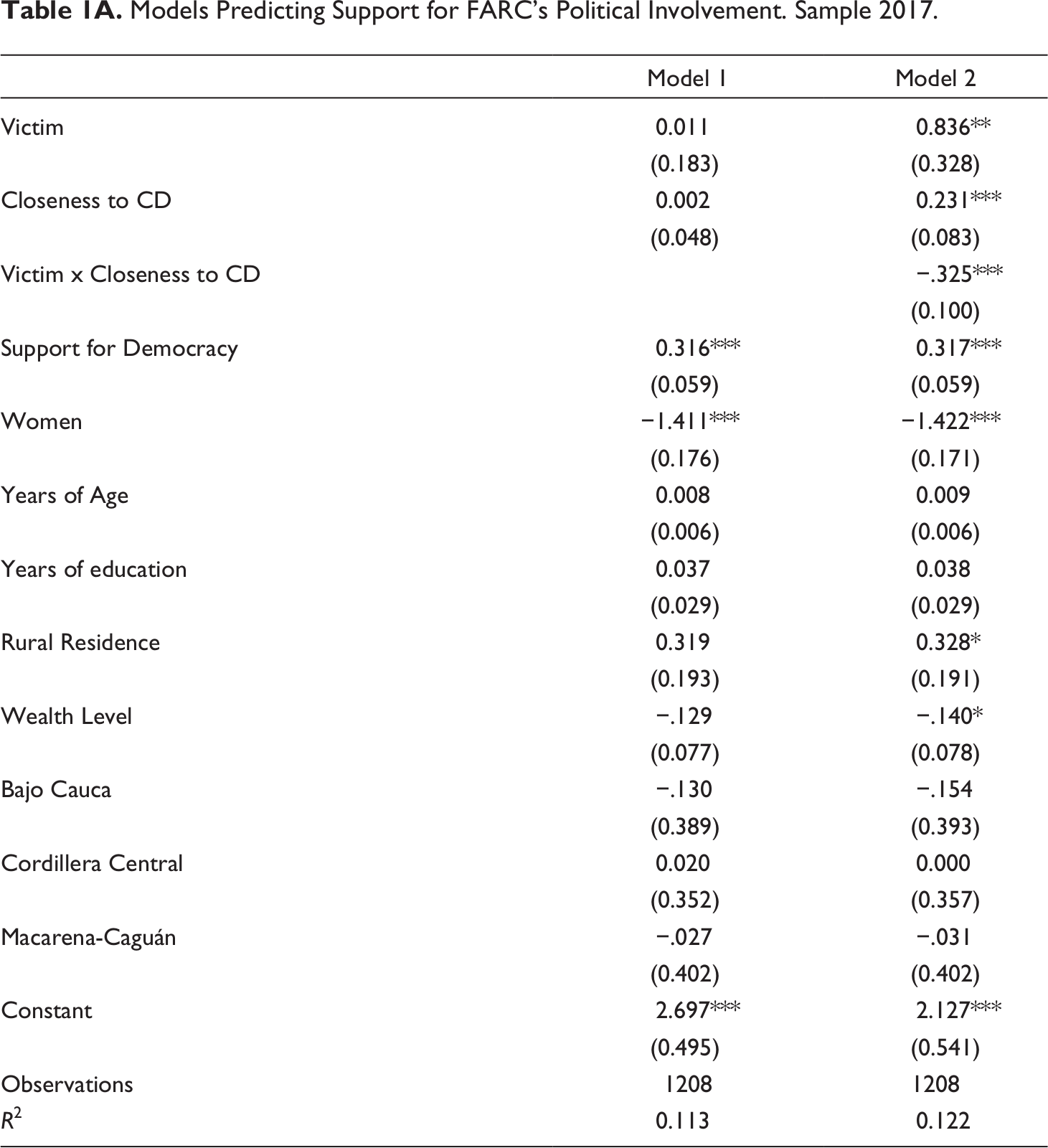
To better appreciate interaction effects, Figures 2 and 3 present the expected support for the FARC’s political involvement for non-victims and victims as feelings of closeness to the Centro Democrático increases, 8 holding every other variable constant. Figure 2 presents results of Model 2 (Table 2), but to get more precise estimates, we replicated the same models aggregating all victims as one group (see Appendix). Figure 3 presents the key results of Model 2 of the aggregated estimation.
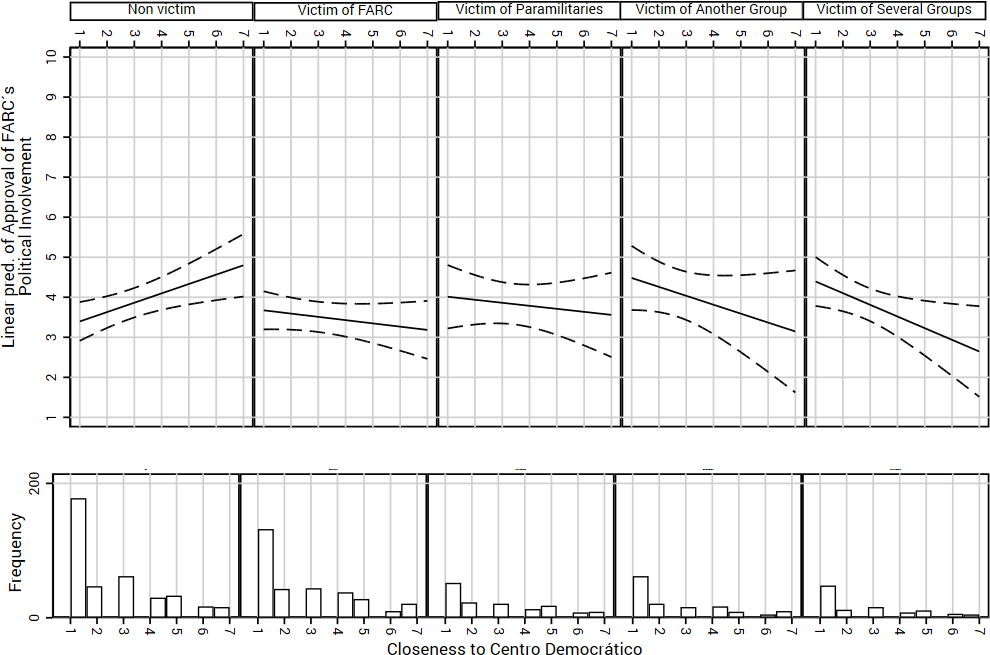
Predicted Approval of the FARC’s Political Involvement Across Victimiser and Closeness to Centro Democrático (2017 Sample). FARC: Revolutionary Armed Forces of Colombia.
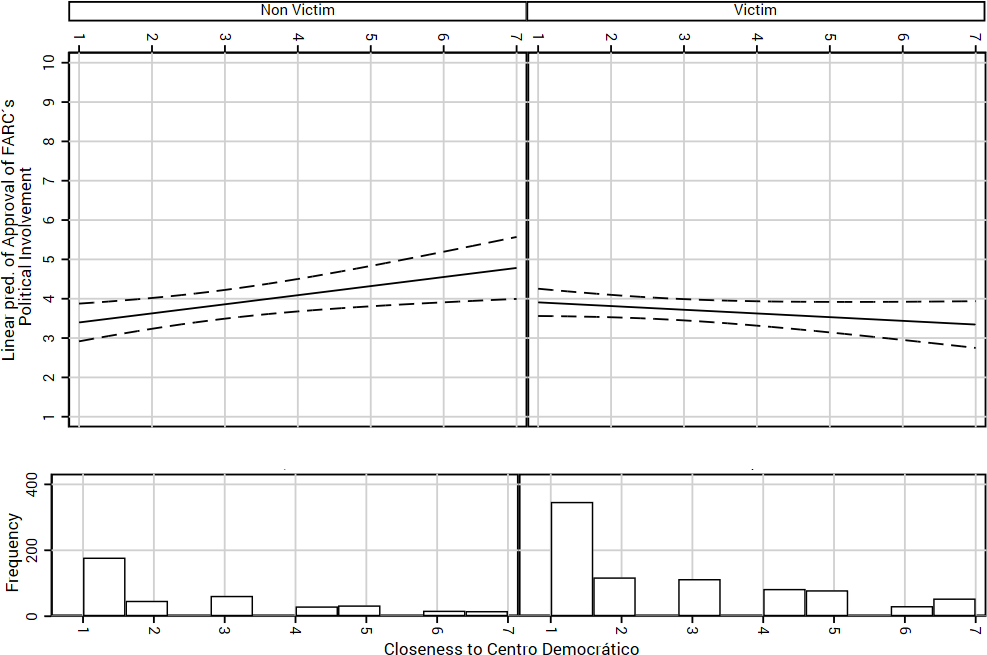
Predicted Approval of the FARC’s Political Involvement Across Non-Victims Versus Victims and Closeness to Centro Democrático (2017 Sample). FARC: Revolutionary Armed Forces of Colombia.
Figure 2 shows that support for the FARC’s political involvement is higher among victims of another group and several groups compared to non-victims among individuals with low expressed closeness to Centro Democrático. The same pattern appears in Figure 3, where victims are more approving than non-victims, among individuals feeling less close to Centro Democrático, on the FARC being allowed to have a political party. This suggests that individuals who are victimised by state institutions or the perils of intense crossfire but do not identify with the Centro Democrático see the FARC’s involvement in politics in a more positive light than non-victims.
Moving to the impact of closeness to the Centro Democrático among non-victims (see the non-victims panels in Figures 2 and 3), feeling closer to the Centro Democrático increases the likelihood of expressing support for the FARC’s political involvement. Here, non-victims feeling close to the Centro Democrático apparently lack motives to feel uneasy with the FARC’s political involvement as we expected among victimised individuals.
In contrast, negative co-efficients for all interaction terms indicate that conflict victimisation, by any armed group, significantly neutralises the influence of feeling closer to the Centro Democrático on accepting the FARC’s political involvement. Such reversal even reaches the point where, among victims of several groups, feeling closer to the Centro Democrático makes them more disapproving of the FARC’s political involvement. A similar reversal is observed in Figure 3. On the one hand, non-victims feeling close to Centro Democrático manifest a higher level of support for the political involvement of the former guerrilla. However, victims feeling close to Centro Democrático stop being supportive of the FARC’s participation in electoral politics. In sum, in areas traditionally affected by conflict, victims seem to be particularly receptive to the political stances of parties opposing the peace agreement. Such political affinity leads victimised individuals to not being more inclined to accept the participation in politics of former combatants, even though individuals identifying with a political party are generally more supportive of democracy and politically tolerant than non-identifiers. 9
The moderating role of closeness with Centro Democrático reflects their ability to resonate concerns of victimised individuals in areas strongly affected by armed conflict. As a way to show that this effect is driven by the particular position of this party, we conducted a series of placebo tests that replicated previous models using measures of closeness with parties that took different positions about the peace agreement (Table 3). Alianza Verde, Cambio Radical, Polo Democrático, Partido Liberal, and Partido de la U all supported, at the time, the peace agreement; Partido Conservador was to some extent divided about the peace agreement, but several of its most prominent leaders sided with Centro Democrático (Rodríguez-Raga, 2017). We found no evidence that any of these political parties also moderated attitudes of victims towards the FARC’s political involvement. If anything, we found that non-victims feeling close to Alianza Verde and Polo Democrático were more welcoming of the FARC’s political involvement. Only feelings of closeness to the Partido Conservador seemed to play a smaller and more limited role moderating the attitudes of victimised individuals. This later outcome seems understandable, given the shared views of Centro Democrático and Partido Conservador.
Regression Results for Support for the FARC’s Electoral Participation with Different Political Affinities.
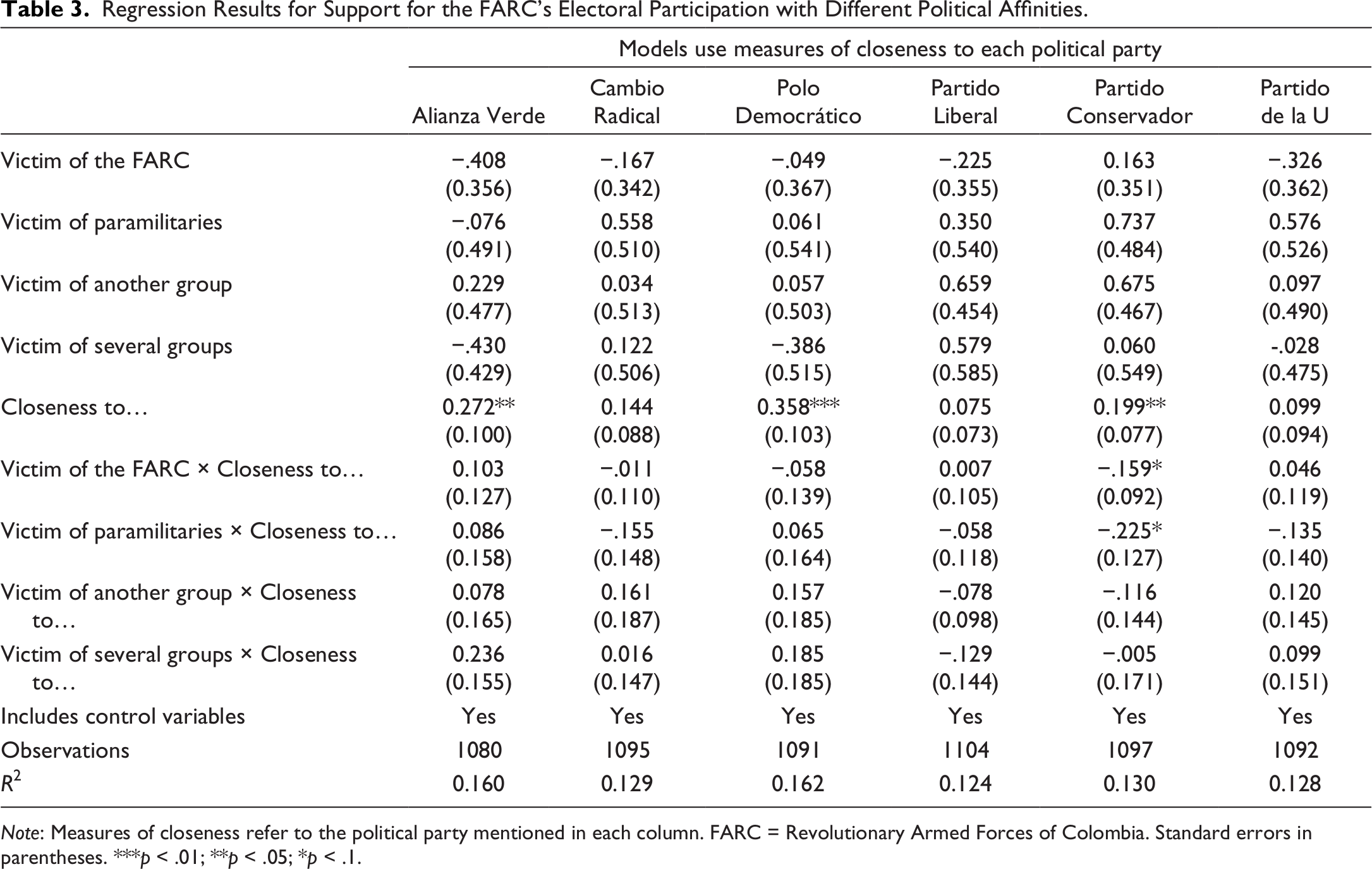
Note: Measures of closeness refer to the political party mentioned in each column. FARC = Revolutionary Armed Forces of Colombia. Standard errors in parentheses. ***p < .01; **p < .05; *p < .1.
Finally, across Model 1 and Model 2, we find that women and wealthier individuals are consistently more strongly opposed to the FARC creating a political party than men and poorer residents of areas strongly affected by the armed conflict. Also, we find that accepting the FARC’s political involvement is significantly associated with support for democracy. Individuals more supportive of democracy are more likely to agree with FARC being allowed to form a political party.
These results highlight that conflict victimisation and political identities play a limited role explaining attitudes towards the FARC’s political involvement. By itself, years experiencing violence do not seem enough to shape preferences about one of the least preferred components of peace agreements with the FARC. Citizens, no matter their victimisation status and/or political preferences, hold many fears around this issue. This pattern is further confirmed through focus group sessions we held in one municipality for each of the regions in the 2017 survey sample.
In general, focus group participants expressed doubts about the participation of FARC candidates in elections. Participants are concerned about the future political behaviour of FARC members and hold their past behaviour against the possibility of supporting their political integration. Politically, participants in San Vicente del Caguán expressed that the FARC would focus on excluding their preferred party from local politics. For that purpose, some perceived that the FARC would look for political alliances that increase their chances of preventing a Centro Democrático victory, even at the cost of holding a secondary position. Others expressed that a FARC mayor, for example, would increase corruption and would protect the interests of their former commanders rather than those of the whole population. Corrupt behaviours would be a continuation of their tendency to lose political principles when at war.
A second set of doubts relate to their past behaviour and FARC members’ lack of interest in adjusting their damaging actions. Thus, focus group participants reiterated that individuals are hurt by years of violence. Added to that, participants do not perceive any regret or interest in forgiveness among FARC members. Under these conditions, the FARC party would only perpetuate their suffering: “we would be masochists", argued one of the participants in the focus groups. FARC members are seen as undeserving of the opportunity to participate in politics.
These and similar arguments are likely shared by citizens across conflict-affected regions, regardless of whether they were victimised. After many years of conflict, the slightest of doubt is enough to oppose the FARC’s political involvement when the stakes are high. Such doubts, although assuaged among non-victimised followers of the Centro Democrático, are made salient to individuals experiencing violence. Political parties’ role of aggregating and ordering preferences appears to be key concerning victimised individuals’ unwillingness to accept the FARC’s incorporation, particularly in conflict-affected regions.
Conclusion
Political participation by former FARC members is a critical component of peace agreements between the Colombian government and the FARC. However, its success is far from guaranteed. Support for FARC members participating in politics is reduced. According to the 2017 special survey sample by the Observatorio de la Democracia, just 18.4 per cent approved FARC members’ forming of a political party.
In this article, we have examined the extent to which living in contexts that combine intense conflict and democratic governance promotes or reduces support for the political involvement of FARC members. Contrary to recent works emphasising the role of victimisation, we found that attitudes related to political participation of former FARC members must be explained beyond conflict exposure. Our research highlighted that victimisation experiences in Colombia play a limited role in several ways. First, aggregate measures of victimisation obscure the fact that direct victimisation by the FARC seems less impactful than falling victim to the crossfire of competing armed groups. This result highlighted the need to distinguish victimisation experiences in armed conflicts involving long and convoluted trajectories such as those in Colombia. Second, given that strong partisan identities are rare, there are limited opportunities for non-victims and victims to develop divergent attitudes towards the political involvement of excombatants. Finally, a condition for the moderating role of political allegiances is that issues at stake are central to the political debate. That was the case with the peace agreement with the FARC, but in contexts where such issues are less contested, individuals are less likely to find, in polarising political elites organising principles to hold contrasting stances around their concerns.
Our results related to victimisation (without a partisan moderator) deserve a reflection as they are at odds with a growing body of research showing a negative relationship between exposure to conflict and attitudes towards the political involvement of the perpetrator of violence. Our contrasting findings may reflect, in part, the nature of the Colombian civil war and its dynamics of victimisation. According to Orozco (2002), unlike regular wars, in which victimisation is a unilateral and vertical process, in prolonged and degraded civil conflicts there is no clear distinction between victims and victimisers; there is a process of horizontal victimisation. This ambiguity is reinforced by the fact that after decades of fighting, none of the factions were able to establish clear territorial control. In this context, Orozco highlights the role of politics in articulating citizens’ representations of conflict. The rise of Álvaro Uribe to power in the early 2000s made the economics of hate cease to be a phenomenon in rural areas most affected by conflict and become the emotional capital of a nation. In sum, the Colombian war is a “space widely inhabited, if not governed, by vindictive hatred and retaliatory rage” (Orozco, 2002: 81). These feelings appear to be widespread beyond partisan lines.
From a different perspective, Nussio et al. (2015), whose research shows that attitudes towards transitional justice mechanisms do not differ between victims and non-victims, offer some answers to this question that deserve to be considered. First, they highlight that given the long-term nature of the Colombian civil conflict, violence has been going on for decades and victims “may eventually overcome their pain, and their traumatic experience may be less determinant of their views and attitudes” (Nussio et al., 2015). In fact, according to the 2016 survey conducted by Observatorio de la Democracia, 40 per cent of Colombians declared being victims of the armed conflict and only 6 per cent of them were victimised in the year prior to the survey. If this is the case, rejection of the political participation of the FARC and their candidates may be concentrated among recently victimised Colombians.
A second possibility has to do with social proximity between victims and non-victims in Colombia. Nussio et al. (2015) argue that this proximity may produce shared frames of social reference in relation to the armed conflict. We believe that product of such proximity, negative attitudes towards the FARC have widespread among Colombians producing a shared distrust towards the FARC. In 2018, only 6 per cent of Colombians trusted this group.
Third, the differences in attitudes towards the political integration of the FARC after the peace agreement may be blurred by social desirability. Previous research indicates that measures of trust in the Colombian military are inflated due to social desirability (Matanock and García-Sánchez, 2017). Something similar may be happening with attitudes towards the political integration of the FARC. Such a bias may explain the convergence in the opinions of victims and non-victims. Survey techniques like the item count technique may be used to produce more accurate measure of attitudes on the political participation of the former guerrilla.
Overall, these possibilities relate to processes blurring differences between victims and non-victims. In the opposite direction, politics seem to be dividing Colombians’ views about the FARC. Garbiras-Díaz et al. (2019) found, in a recent article, that elite divisions are separating opinions about different components of the agreement. Former president Álvaro Uribe and his opposition to the peace agreement have created two political camps in Colombia. Although in each camp, victims and non-victims co-exist, partisan platforms opposing the FARC’s political involvement seem to amplify fears only among victimised individuals. Evidence of the role of this political divide is that in our models, closeness to Centro Democrático moderates the effect of victimisation in areas most affected by conflict. While non-victims feeling closer to the Centro Democrático are more willing to admit the FARC’s party in the political arena, such inclination gets muted (reversed) among victimised individuals.
In sum, our article ultimately highlights that victimised individuals hold different attitudes than non-victims in certain conditions. Thus, the analysis of the Colombian case helps us identify more clearly the scope conditions of theories emphasising victimisation as the key explanatory variable of attitudes about peace agreements and its main components.
Finally, it is important to mention that our results do not rule out that conflict victimisation and political identities may have a role in shaping citizens’ attitudes about components of the peace agreement other than political integration. As mentioned before, the wide majority of Colombians reject this particular issue, and hence it was a hard test for our theory. That may not be the case with other provisions included in the peace agreement (i.e. rural development); therefore, further studies need to explore the determinants of popular support for components of the peace agreement that generate more division among the public.
Footnotes
Appendix
Models Predicting Support for FARC’s Political Involvement. Sample 2017.
| Model 1 | Model 2 | |
|---|---|---|
| Victim | 0.011 | 0.836** |
| (0.183) | (0.328) | |
| Closeness to CD | 0.002 | 0.231*** |
| (0.048) | (0.083) | |
| Victim x Closeness to CD | −.325*** | |
| (0.100) | ||
| Support for Democracy | 0.316*** | 0.317*** |
| (0.059) | (0.059) | |
| Women | −1.411*** | −1.422*** |
| (0.176) | (0.171) | |
| Years of Age | 0.008 | 0.009 |
| (0.006) | (0.006) | |
| Years of education | 0.037 | 0.038 |
| (0.029) | (0.029) | |
| Rural Residence | 0.319 | 0.328* |
| (0.193) | (0.191) | |
| Wealth Level | −.129 | −.140* |
| (0.077) | (0.078) | |
| Bajo Cauca | −.130 | −.154 |
| (0.389) | (0.393) | |
| Cordillera Central | 0.020 | 0.000 |
| (0.352) | (0.357) | |
| Macarena-Caguán | −.027 | −.031 |
| (0.402) | (0.402) | |
| Constant | 2.697*** | 2.127*** |
| (0.495) | (0.541) | |
| Observations | 1208 | 1208 |
| R 2 | 0.113 | 0.122 |
Acknowledgements
We thank Ryan Carlin, Gregory Love, Iván Orozco, Juan Carlos Rodríguez-Raga, Laura Wills, the anonymous reviewers, and the participants to the Colloquium at the Political Science department of Universidad de los Andes and the Workshop "The Peace Agreement Under the Gaze of Public Opinion: Negotiation, Political Participation and Transitional Justice" held at Universidad de los Andes, for their comments on previous versions of this paper. We also thank Carlos Ávila, Adriana Gaviria, Pedro Juan Mejía and Alejandro Socha for their assistance during different phases of this project.
Authors’ note

Declaration of Conflicting Interests
The author(s) declared no potential conflicts of interest with respect to the research, authorship, and/or publication of this article.
Funding
The author(s) received no financial support for the research, authorship, and/or publication of this article.
Notes
Author Biographies
E-mail:
E-mail: