




Abstract
Why did Uruguay become the first country in the world to legalise marijuana in 2013? Based on extensive original research and unprecedented review of secondary sources, the article assesses alternative explanatory accounts through a unique combination of process tracing and counterfactual analysis. By tracing cannabis reform in Uruguay both as it was and was not but could have been in the absence of hypothesised explanatory factors, the article assesses the role of these factors in the causal story. Specifically, the article shows how and why political will and social mobilisation influenced both the reform process and outcome. In doing so, the article cuts through the haze of rival explanations to present the clearest picture of drug policy reform in Uruguay to date.
Keywords
Introduction
Latin America is marred by shockingly high levels of crime, violence, and homicide rates (Bergman, 2018; Duran-Martinez, 2017; Yashar, 2018). Indeed, Latin America is now considered the most violent region in the world (Cruz, 2016). While not all violence is criminal or drug-related, drugs are a key contributor to violence (Bagley and Rosen, 2015; Duran-Martinez, 2017). Yashar (2018) finds that homicidal violence is the result of competition between criminal groups over drug routes in contexts of weak state capacity. Similarly, Bergman (2018) contends that the combination of highly profitable criminal activities and inadequate state capacity explain “high crime equilibria.” Duran-Martinez (2017) argues that state power and competition in drug markets jointly determine the visibility and frequency of drug violence.
If drug violence is the result of confrontations between weak states and powerful criminals fighting each other over lucrative illegal goods, then there are two ways to confront drug violence: either to strengthen the coercive capacities of the state or to the reduce profitability of criminal activities. Strengthening states’ coercive capacities has been the predominant response to drug violence in Latin America (Cruz, 2016). Yet, results have been disappointing (Bagley and Rosen, 2015). At best, waging a war on drugs is not effective because high profits make dissuading criminals from engaging in illegal activities difficult (Bergman, 2018). At worst, state intervention is counterproductive because it extends the cycle of violence. Lessing (2017), for example, shows that antinarcotics policies can be a key driver of cartel–state conflict.
By contrast, regulating drug commercialisation and use to reduce the profitability of illegal activities has been the exception, despite punitive prohibition being increasingly questioned by state and non-state actors alike (Youngers, 2014). Former Latin American presidents have advocated for change as members of the Global Commission on Drugs. Guatemala, Colombia, and Mexico called for an in-depth review of the dominant approach to drug control, which resulted in a special session of the UN General Assembly in 2016. And, limited changes have occurred in Bolivia, Ecuador, and Colombia (Labate et al., 2016). However, only Uruguay has thus far implemented an alternative approach to addressing drug violence by legalising marijuana.
Of course, marijuana legalisation is unlikely to be a panacea, as cannabis hardly accounts for most drug violence in Latin America (Bagley and Rosen, 2015). Nevertheless, it might be a necessary first step to dealing differently and more effectively with drug violence (Duran-Martinez, 2017). Irrespective of its eventual effects, marijuana legalisation represents the beginnings of a weaning off from Latin America’s “addiction to punishment” (Uprimny et al., 2013) and reminder that an alternative approach is possible. As President Mujica stated, “someone has to be the first in Latin America. Someone has to be the first, because we are losing the battle against drugs and criminality in the continent” (El Observador, 2012b).
The article explores why Uruguay became the first country to legally regulate cannabis from seed to smoke in 2013. 1 What explains Uruguay’s surprising and substantial departure from the status quo of drug prohibition regarding cannabis in a region where prohibition has been the norm, vested interests conspire against change, and legalisation remains unpopular with the public? This article advances our understanding of both the process and outcome of Uruguay’s cannabis reform through a combination of process tracing and counterfactual analysis. Plausible “what-if” scenarios enhance the analysis, because ceteris paribus comparisons are unavailable, key evidence is missing, and other strategies to test rivalling hypothesis are not viable.
Specifically, I show how political will and social mobilisation both contributed to the success of cannabis reform in Uruguay. On the one hand, President Mujica played a central role, putting comprehensive cannabis reform on the agenda. Furthermore, his timely intervention ensured the reform bill’s passage. On the other hand, campaigning by reform proponents contributed to both the reform process and outcome. Activists kept the issue on the political agenda and influenced the content of cannabis reform. Overall, the outcome of cannabis reform in Uruguay reflects a compromise between governmental, legislative, and societal pro-reform actors. The article shows not only that both high-politics and grassroots efforts were individually necessary and jointly sufficient, but also how and why each influenced cannabis reform in Uruguay.
In elucidating why Uruguay legalised marijuana, the article makes a three-fold contribution. First, by clarifying the role of both political will and social mobilisation in reform processes, the article contributes to theoretical debates about the determinants of policy change. Second, by identifying the determinants of reform, the article sheds light on whether or not Uruguay is likely to remain an outlier in the region. Third, by building on existing journalistic and scholarly accounts of cannabis reform in Uruguay published in different languages with unique and original evidence based on extensive fieldwork, the article advances knowledge about the most important instance of drug policy reform in Latin America.
The remainder of the article proceeds as follows. The first section reviews extant explanations of cannabis reform in Uruguay. The second section introduces the analytical strategy. The third section establishes a “factual” account of Uruguay’s reform process, so that the fourth section can scrutinise and clarify the relationship between different explanatory factors through counterfactual analysis. The conclusion summarises and discusses the findings.
Extant Explanations
Authors vehemently disagree on why Uruguay legalised marijuana in 2013. Close reading of the extant literature reveals three distinct clusters of arguments. Proponents of the “top-down” thesis argue that marijuana legalisation occurred because of President Mujica’s protagonist role. By contrast, adherents to the “bottom-up” antithesis contend that cannabis activism took centre stage, with Mujica relegated to a minor player. Champions of an interactionist synthesis try to show that both were important, playing different roles at different points in time.
Much of the literature characterises Uruguay’s cannabis regulation as a “top-down” process. Authors highlight that cannabis reforms were initiated by the government and did not elicit public support (Cruz et al., 2016; Gandilhon et al., 2018; Pardo, 2014). In the most sophisticated “top-down” account of cannabis reform in Uruguay to date, Queirolo et al. (2018: 5) argue that “the driving force behind this agenda was José Mujica.” The “top-down” thesis persuasively explains important aspects of Uruguay’s cannabis reform. However, scratching the surface reveals two analytical weaknesses. First, the assessment is made vis-à-vis marijuana legalisation through popular referenda in Colorado and Washington State, not a careful engagement with evidence from Uruguay itself. Second, accounts simply assume that once cannabis reform was proposed, its success followed automatically without engaging with the subsequent twists and turns of the reform process.
In stark contrast, “bottom-up” accounts highlight the role of activism and mobilisation in Uruguay’s cannabis reform process (Lemos, 2014; Levayer, 2017; Montañes, 2014). The strongest proponents of the “bottom-up” are those who study marijuana legalisation in the context of other progressive reforms – same-sex marriage and abortion – occurring around the same time (Arocena and Aguiar, 2017; Gonzalez-Guyer, 2016; Lissidini, 2016). For instance, Rivera-Velez (2016: 148) argues that “Mujica is not the author of these laws,” but rather social movements drove progressive change. In highlighting the contribution of mobilisation, the “bottom-up” antithesis presents an important corrective to the dominant “top-down” thesis. Yet, arguing for the primacy of social movements might go too far. After all, the view that “mobilisation in itself is likely to be influential” (Amenta et al., 2010: 297) has been questioned by scholarship on the policy effects of social mobilisation (Giugni, 2004). Because activity and effect are not the same, it must be clarified how, when, and why, if at all, mobilisation mattered for policy-making.
Rather than seeing Uruguay’s cannabis reform as either exclusively “top-down” or “bottom-up,” several authors embrace causal complexity to argue that both were crucial in different ways at different points in time (Castro, 2014; Lissidini and Pousadela, 2018; Repetto, 2014). In her highly nuanced account, Musto (2018) sheds light on actors’ underlying beliefs and opportunity structures in Uruguay. Among other things, she draws attention to the often-difficult nature of the process: “a discontinuous story, marked by breaks, principled conflicts and sudden shifts” (Musto, 2018). Successful cannabis reform in Uruguay was not a foregone conclusion, but rather “the prevalent feeling throughout the process was that everything was always about to collapse” (ibid: 125). Highlighting the “convergence” (Castro, 2014: 1), “interactions” (Lissidini and Pousadela, 2018: 371), or “combinations” of factors (Levayer, 2017) is an important step in painting at fuller picture. However, there is a danger of simply stating that everything mattered without knowing how exactly. Discerning between causal factors and pinpointing their importance is critical for understanding why Uruguay became the first country in the world to legalise marijuana.
Analytical Strategy
In an interview, a high-level actor intimately involved with the reform process mentioned that “the success of Uruguay’s marijuana legalisation has many fathers.” The article proposes a two-pronged paternity test as the main analytical strategy: process tracing and counterfactual analysis. While process tracing is the go-to qualitative method for the analysis of causal processes, counterfactual analysis allows us to assess alternative explanations through hypothetical “what-if” scenarios (Goertz and Mahoney, 2012). Combining the two allows us to establish the causal weight of different explanatory factors and to distinguish between activities and effects (Betsill and Corell, 2001). Because of missing pieces of evidence and activities occurring concomitantly, exclusively relying on process tracing has encountered difficulties in pinpointing the causal effect of different factors explaining Uruguay’s cannabis reform. 2 Counterfactual analysis is therefore called for to improve the causal account.
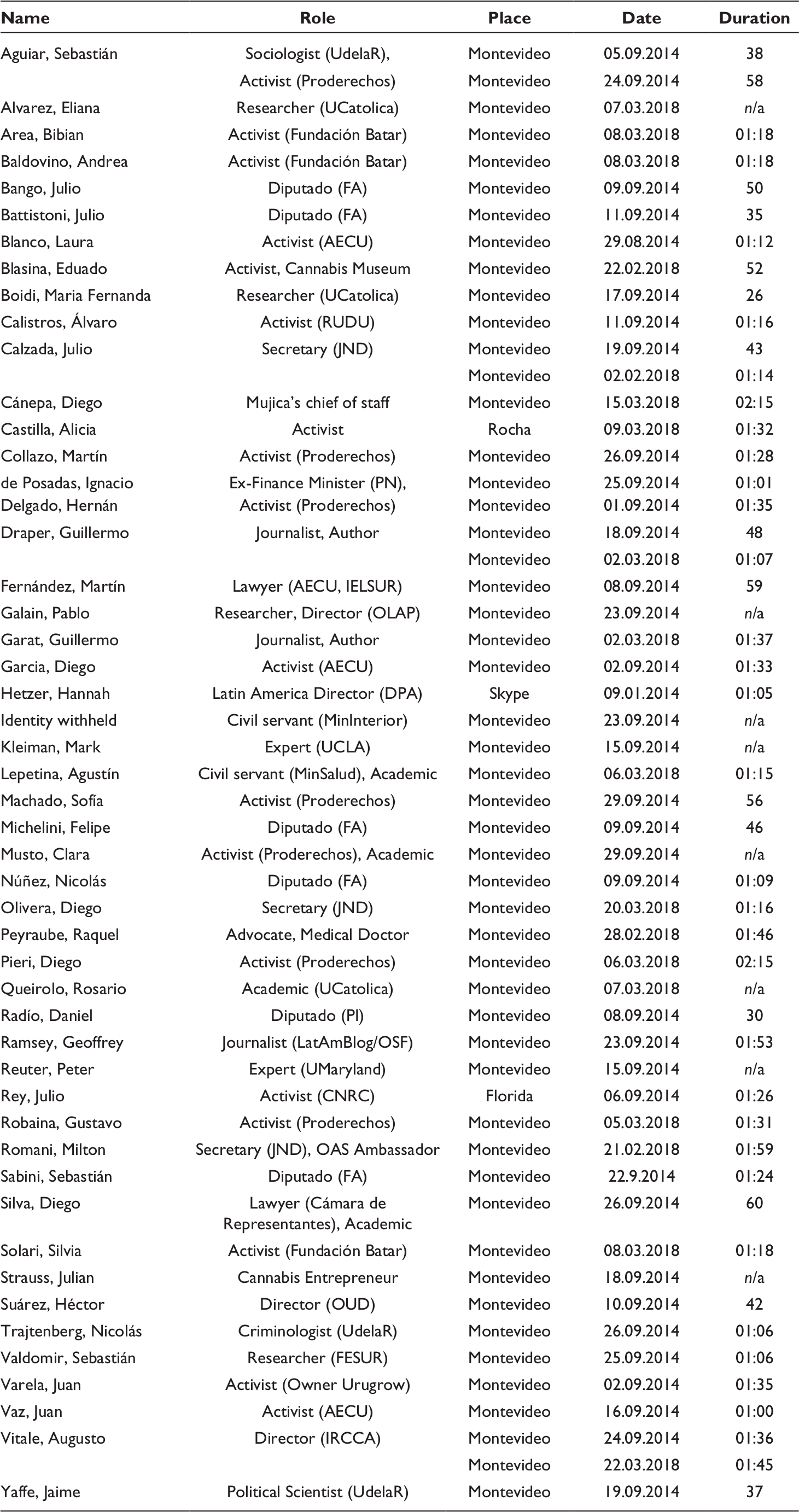
The article’s analysis of the process and outcome of marijuana legalisation in Uruguay is based on a variety of evidence. First and foremost, I draw on fifty-one semistructured interviews with key actors – politicians, activists, and public officials – conducted during fieldwork in Uruguay (August to September 2014 and January to March 2018). 3 Purposefully sampled interviews with those directly involved in decision-making provided the “kind of data that can be critical in uncovering the causal processes and mechanisms that are central to comprehensive causal explanations” (Tansey, 2007: 767). Second, I assemble and assess the substantial secondary literature and primary sources – minutes of meetings, parliamentary debates, and contemporary media reports – to “triangulate” information, and scrutinise Uruguay’s cannabis reform process through process tracing and counterfactual analysis.
In process tracing, instead of “black-boxing” the process by which initial conditions are translated into outcomes, one seeks to identify and examine the intermediate steps to make inferences about how that process took place and whether it generated the outcome of interest (Beach and Pedersen, 2013; Collier, 2011; George and Bennett, 2004). Process tracing can be defined as the “systematic examination of diagnostic evidence selected and analysed in light of research questions and hypothesis posed by the investigator” (Collier, 2011: 823). While no strong causal inference without process tracing has become a mantra for qualitative researchers, it is “no panacea” (Beach and Pedersen, 2013: 2). If “smoking gun” evidence is absent and alternative explanations equally pass “hoop tests,” process tracing can be at a loss when it comes to discerning between the relative weight of alternative explanatory accounts.
In counterfactual analysis, one asks what would have happened if some cause had taken a different value or a causal event never occurred (Fearon, 1991; Lebow, 2000; Tetlock and Belkin, 1996). Counterfactuals are “what-if statements” exploring how these hypothetical changes would have affected outcomes. Counterfactuals are especially vital when analysing single cases, when increasing the number of observations not viable, or when dealing with necessary conditions, as they inherently contain the counterfactual claim that in the absence of X, Y would not have occurred. The counterfactual approach allows to “rerun history of a case under counterfactual assumption in order to decide if a given factor played its hypothesise causal role” (Goertz and Mahoney, 2012: 122). Good counterfactuals are supposed to be as plausible, similar, and consistent with available theories and evidence as possible. 4
To structure and guide process tracing and counterfactual analysis, I break down Uruguay’s reform process into its constituent parts. 5 The underlying idea of separating the policy process into distinct phases is that every policy process has a beginning, middle, and end (Jann and Wegrich, 2006). One way of denoting the stages is as “agenda setting” and “agenda maintenance,” with the former describing the process of gaining attention, and the latter covering what happens after the policy reached agenda status. Agenda-setting is a key step in policy-making (Peters, 2015). Yet, making it onto the political agenda is not enough: issues must not only be “recognised” but interest in them “maintained” (Nelson, 1986). Combining the periodisation of the reform process with the actors responsible for advancing it yields the following causal graph (Figure 1).
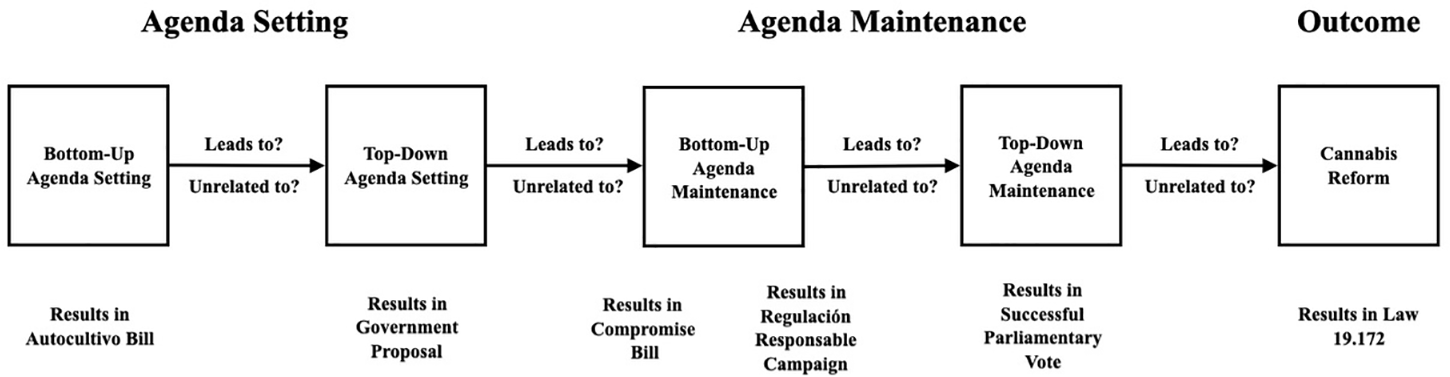
Stylised Causal Graph of Uruguay’s Cannabis Reform Process.
Regarding Uruguay’s marijuana legalisation, there is relatively little controversy about a series of “factuals,” which I discuss in greater detail in the next section. What is more controversial are the connections between different causal steps and the relative explanatory weight of distinct factors. To assess the causal efficacy of explanatory factors, I analyse four “minimum-rewrite” counterfactuals implicit in existing hypotheses about cannabis reform in Uruguay, and scrutinise causal process observations unearthed by closely tracing the reform process both as it factually was and as counterfactually could have been without the presence of a certain explanatory factor. In sum, I explore why and how different causal steps influenced the process and outcome of Uruguay’s marijuana legalisation by analysing counterfactually what would have happened to the causal chain in the absence of one link.
Cannabis Reform in Uruguay
The following section describes the “factuals” of Uruguay’s cannabis reform process. Description of “the facts” is not only important for its own sake, but also to set up the subsequent counterfactual analysis, which must be grounded in the empirics to meet the “minimum re-write” criteria. Uruguay’s cannabis reform process can be summarised in one graph that reports the number of news items per week published by Uruguay’s leading newspaper El País mentioning marijuana legalisation (Figure 2).
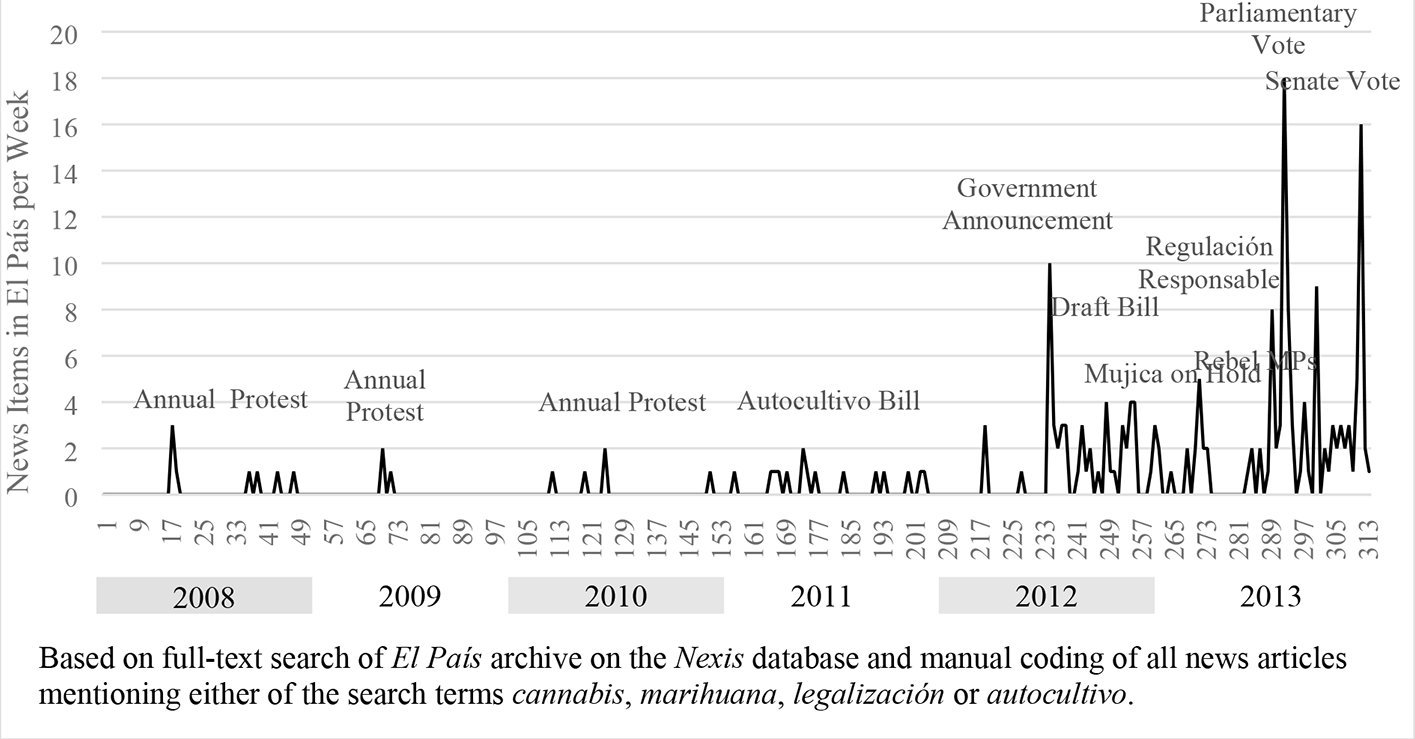
Cannabis Reform in the News (2008–2013).
Vocal cannabis activism in Uruguay existed for years before reforms occurred in 2013 (Aguiar and Muñoz, 2007; Garat, 2012; Lemos, 2014). In fact, “long before Uruguayan president Mujica even started talking about it, the cannabis legalisation movement was born in Montevideo’s streets” (Musto, 2018). Several organisations engaged in mobilisation for cannabis legalisation. They raised the public profile of cannabis reform, and in response to activists’ demands, certain lawmakers presented a limited cannabis reform proposal to allow self-cultivation at home, or autocultivo. 6
However, for several years, the political effects of cannabis activism were limited. The topic was simply not a political priority (Garat, 2012: 170). As then-Secretary of the Junta Nacional de Drogas (JND), Milton Romani, explained, “marijuana was not on the government’s agenda.” He considered the time not ripe for cannabis reform and “any attempt of legalisation doomed to fail” (Interview, 21 February 2018). Within parliament, calls for cannabis legalisation received little support, and only a handful of politicians were considered as allies by cannabis activists (Filardo et al., 2012: 152). Activists were well aware of the lack of support. As one activist remarked in 2007, “the government has 16 more urgent priorities… this is not on the agenda” (Aguiar and Muñoz, 2007; 19). In this context, “asking for marijuana legalisation was a utopia, something that would never happen,” as activist Juan Vaz remembers (Castro, 2014: 13).
After the 2010 election, a group of young legislators from across the political spectrum began working on a cannabis reform bill (Garat, 2012). In March 2011, Sebastián Sabini, Nicolás Núñez (Frente Amplio), Fernando Amado (Partido Colorado), and Daniel Radío (Partido Independiente) proposed a bill that would have allowed the home cultivation of eight plants and established cannabis social clubs (Sabini et al., 2011). The bill addressed activists’ policy asks, and was the result of “dialogue and co-operation between cannabis activists and MPs” (Sebastián Aguiar, interview, 24 September 2014). MPs like Sabini and Núñez were close to activists and had personal experiences with cannabis (Sebastián Sabini and Nicolás Núñez, Interviews, 22 and 9 September 2014). This reform bill represented the culmination of years of activism and reflected the “principal demands of the social movement” (Aguiar and Musto, 2015: 301). This activist-led cannabis reform bill was the most tangible result of bottom-up agenda-setting. But, the autocultivo bill never became law.
On 20 June 2012, the Uruguayan Minister of Defence, Eleuterio Fernández Huidobro, dropped a bombshell. He revealed that Uruguay planned to legally regulate the national cannabis market. The executive, hitherto absent from the cannabis reform process, proposed to “legalise and control marijuana” (Gabinete de Seguridad, 2012: 11). Cannabis reform was only one among fifteen measures of the Estrategia por la vida y convivencia (hereafter Strategy). Overall, the Strategy was not “soft on drugs,” including tougher sentences for selling pasta base (cocaine base paste) and increased policing (Castro, 2014). The goal of the new “differentiated policy” was to separate “soft” from “hard” drugs, thereby reducing the exposure of users to the black market, undercutting the profits of criminal organisations and refocusing law enforcement resources on drugs perceived as more dangerous (Galain, 2018).
Once the dust of the announcement had settled, it became clear that there was much that was unclear and uncertain about cannabis regulation. The proposal was neither well-thought-out nor represented the final word on the issue. From a meeting in which the government presented its initiative most participants emerged “with more questions than answers” (Müller and Draper, 2017: 130). Nicolás Núñez remembers that he “left with so many doubts as to whether this would actually happen because there was so much ignorance” (Interview, 9 September 2014). Sebastián Aguiar recounts “so much bullshit” being said that he had the impression this was not a serious proposal (Interview, 5 September 2014).
A seeming lack of commitment put reform in doubt. In July, the President’s chief of staff, Alberto Breccia, declared that “we are working on this but don’t know when or if we will definitively submit [a project to Parliament]” (El Observador, 2012c). In August, President Mujica seemed to walk back on the initiative: “We are proposing a debate so that from this debate can come better ideas than those we have right now” (CNN, 2012). Even more problematic was that the proposal did not count on public support. In July 2012, a survey found that 66 per cent of Uruguayans were against legalisation and only 24 per cent in favour (CIFRA, 2012). In response, President Mujica cast further doubts on the initiative’s prospects, stating: “If 60 % of the country do not back us, this is toast” (El Observador, 2012a).
Nevertheless, on 8 August 2012, the executive sent its cannabis reform bill to parliament (Proyecto de Ley, 2012). The bill consisted of just one article: the state would legally regulate the production, distribution, and sale of cannabis. By presenting a bill with one vague article, the Mujica administration obligated others to come up with a workable cannabis reform bill (Silva, 2016: 321). The JND Secretary, Julio Calzada, was tasked with coming up with a regulatory framework. Augusto Vitale, who was working on the bill, remembers that “Calzada told me: ‘Look, we have to start figuring out the details. We have to gather information’” (Interview, 22 March 2018). This meant looking around for already existing models of regulation. As Calzada explained: “We were not about to reinvent the wheel” (Interview, 19 September 2014). Regulating cannabis also meant talking to cannabis activists. As Vitale put it, “the only way you can have direct engagement with those you are about to regulate, is to talk to them. They were the ones who knew” (Interview, 22 March 2018). The result was close consultations between pro-reform actors inside and outside the government. As Sebastián Sabini, the legislator in charge of the cannabis bill, recalls:
“There was a lot of dialogue. We worked together on this from the first moment, maybe not always in agreement on everything, but knowing that we shared the same goal” (Interview, 22 September 2014).
After months of deliberations and negotiations behind the scenes by a group of parliamentarians, state officials, and activists, a first draft of cannabis reform was presented on 15 November (Sabini et al., 2012). Instead of one article, the new draft bill contained thirty-six. According to Calzada, the “basis” on which him, Sabini, and Bango drafted the new bill was Sabini’s autocultivo bill (Interview, 19 February 2018). Sebastián Aguiar recounts how “working together… we came up with a mix between the bill that included home cultivation and cannabis clubs and the idea that the state would sell [marijuana]” (Interview, 24 September 2014). Cannabis reform would therefore entail an amalgamation of state-controlled cannabis retail sales, home cultivation, and cannabis social clubs. Diego Silva, the legal advisor who drafted much of the bill’s text, described his task as follows:
They told me: ‘Diego, there has to be a bill.’ So, what do I do? First, I take the Articulo Unico, then the autocultivo bill that we had written in 2010, and then I add a regulatory agency to ensure state control. (Interview, 26 September 2014)
In late 2012, cannabis reform appeared on track, until Mujica put cannabis reform on hold. On 18 December 2012, Mujica announced: “The decision is not ready, that’s why I put a stop to it” (El País, 2012). His principal reason was the continued lack of support. Mujica reminded his party that they should not override popular will: “Don’t vote for a law just because it has a majority in Parliament. The majority has to be in the streets.”
Pro-reform actors realised that something needed to be done to rescue the reform project. The campaign Regulación Responsable was created with the goal of giving the initiative a “legitimate face” (Sebastián Aguiar, interview, 5 September 2014), steer the public debate, and demonstrate that there was societal support for reform. To sell cannabis reform to a sceptical public cannabis reform was repackaged and reframed. As Collazo describes it, “we applied marketing techniques to a just cause” (Interview, 26 September 2014). Experimenting with messaging, pro-reform actors found out what worked and what did not (Sebastián Aguiar, Interview, 24 September 2014). The name Regulación Responsable was strategically chosen because it became clear that the public was more open to “regulation” than “legalisation” (Castro, 2014: 36; Garat, 2015: 82; Musto, 2018). Regulation was a more neutral term. As Diego Pieri, an activist from Proderechos remembers:
This semantic battle was strategic. Regulation was a good way to show [the difference] of the Uruguayan model. The word legalisation implied this idea of debauchery [libertinaje], associated with all kinds of excess. (Garat, 2015: 83)
Activists recognised that “the possibility of success of this new message requires new messengers” (Lemos, 2014). “We had to clean up the stereotype that people have of those smoking marijuana, someone with dreads and red eyes” (Hernán Delgado, Interview, 1 September 2014). Further, they refrained from using any of the typical symbols of cannabis activism, such as the colour green or the cannabis leaf, opting instead for the white and blue of the Uruguayan flag. Finally, the arguments in favour were condensed to a “message triangle” to improve its coherence and effect (Hetzer and Walsh, 2014). Regulación Responsable focused on three talking points: strengthening public safety by separating marijuana from more dangerous drugs, improving public health, and, resolving the contradiction that consumption, but not acquisition, was legal. Regulación Responsible endeavoured to legitimacy and popularity of cannabis reform by changing the image, arguments, and faces associated with marijuana legalisation.
While others were highly active and engaged in the reform process, trying to increase public support for cannabis reform and drafting a reform bill that represented a compromise that could command a majority of votes in parliament, the President for the most part took a back seat: “Mujica did not intervene, he limited himself to supervise” (Müller and Draper, 2017: 220). Sabini remembers that Mujica did not meet with him until the bill had been finalised (Interview, 22 September 2014). Milton Romani recalls that “Mujica never spoke much about the issue” (Interview, 2 February 2018). This was not untypical for Mujica, whose governing style was to “provide space, supervise little and let others do” (Israel, 2014: 25).
Despite continued misgivings and the failure to win over public opinion, Mujica gave his blessing. Not only was he willing to compromise on including home cultivation, disliked for not ensuring enough state control, but Mujica and his advisors concluded that public rejection would not produce an electoral blowback (Diego Cánepa, Interview, 15 March 2018). Mujica was ready to assume the risks that passing an unpopular reform might entail: “The people will understand or not, but we have to move forward and pay the costs that you have to pay” (Müller and Draper, 2017: 190).
Irrespective of Mujica’s support, more difficulties loomed on the horizon. Within the Frente Amplio (FA), there was dissent and rejection of the bill. Because of its razor-thin majority in the lower house, the FA needed all its legislators on board. Yet, two FA MPs, Doreen Ibarra and Darío Pérez, vehemently opposed cannabis reform (Müller and Draper, 2017). Several attempts were made to assuage their concerns (Garat, 2015). Sabini remembers that these informal discussions were “arduous, and I often had to bite my tongue not to create more problems” (Interview, 22 September 2014).
On 31 July, Doreen Ibarra and even Darío Pérez cast their vote in favour of cannabis regulation. Ibarra made clear that he only voted for this “inopportune” and “wrong” project because the FA was forcing him to do so. Pérez, with tears in his eyes and a trembling voice, proclaimed that he would bow to the FA’s decision to pass the law. In his speech, he left no doubt about his views: “Marijuana is shit [bosta].” With these two crucial votes, the bill passed with exactly fifty votes. Considering the FA’s secure Senate majority, the most important obstacle had been overcome. Marijuana legalisation became reality in December 2013.
The resulting Law 19.172 allows legal access through retail sales, cannabis social clubs, or home cultivation (Ley 19.172, 2013). By exempting those registered with the government from criminal sanctions (which continue to apply to other substances and non-regulated conducts, Galain, 2018), Uruguayans are able to either legally grow up to six plants at home, become members of cannabis social clubs, or buy up to 40 g of cannabis per month in pharmacies (Silva, 2016). This new legislation made history: Uruguay became the first country in the world to legally regulate cannabis.
Counterfactual Analysis of Cannabis Reform in Uruguay
The following section analyses plausible counterfactuals to better understand both the process and outcome of cannabis reform in Uruguay. Exploring what was not, allow us to better understand what was. To find answers to the still-open questions about Uruguay’s cannabis reform and discern between explanatory factors hypothesised as important, each is investigated in turn. To assess what would have occurred if any factor had been absent, four “minimum-rewrite” counterfactuals are constructed to clarify the causal weights of and relationships between “bottom-up” and “top-down” agenda-setting and maintenance.
Counterfactual 1: No Top-Down Agenda-Setting
That the government’s announcement represented a dramatic shift for cannabis reform in Uruguay is out of the question (Aguiar and Musto, 2015; Musto, 2018; Repetto, 2014). Its prior “absenteeism” (Castro, 2014: 29) vanished from one day to another. Instead, a powerful actor entered the policy arena. Suddenly everyone was talking about marijuana legalisation. This “irruption” was abrupt, unforeseen, and consequential, expanding the realm of the possible (Aguiar and Musto, 2015; Musto, 2018; Queirolo et al., 2018).
What if the Mujica administration had not presented its cannabis legalisation proposal? Would Uruguay have legalised cannabis as result of “bottom-up” mobilisation? And, if so, what would the potential outcome of cannabis reform have looked like? Several authors entertain the notion that more limited cannabis reform would have occurred in Uruguay without the government’s intervention. For instance, Castro (2014:29) argues that Sabini’s bill “had legislative support” and “was about to be approved.”
Reports at the time suggest that Sabini was optimistic about his autocultivo bill’s prospects (El Espectador, 2011). As one of the bill’s sponsors, Nicolas Núñez, put it: “The bill was well-advanced. From a legislative perspective, it was written, signed and approved by the Frente Amplio’s parliamentary group…The only thing missing was voting on it” (Interview, 9 September 2014). Another legislator working on the bill, Daniel Radío from the Partido Independiente, remembers: “everything was ready to go” (Interview, 8 September 2014). Yet, Julio Calzada points out that “the topic was not on the table and the political circumstances were not in place to advance it… It had been worked on, but much was still missing… if it had come just from the Legislature it would have probably not been voted on” (Interview, 19 February 2018).
There is reason to believe that cannabis reform was not only not on the government’s agenda, but also did not have the President’s support. Reportedly, Mujica mocked the importance of the autocultivo bill: “Look what an interesting discussion about having six or eight plants at home… I have to fight for the trains, employment, the man on the street” (Tulbovitz and Danza, 2015: 224). When the Secretary of the JND, Milton Romani, wrote an internal memo proposing cannabis reform at the beginning of Mujica’s presidential term, the President just ignored his report: “He never mentioned it, never asked for a meeting” (Interview, 21 February 2018). Without the Executive’s support and engagement, it seems unlikely that cannabis reform would have succeeded. As Garat (2015: 61) points out, “political will was lacking for something to happen….” Indeed, studies have found that legislative proposals originating from the Legislature have a substantially lower chance of becoming law than initiatives that are presented by the Executive (Chasquetti, 2016).
While it is unlikely that the activist-sponsored cannabis bill would have advanced by itself, it is certain that cannabis reform would have been less ambitious. Had the executive not come out in support of reform, the best-case scenario would have been the passage of a more limited autocultivo bill. The Executive’s involvement “completely changed the terms of what was debated in Parliament” (Sebastián Sabini, Interview, 22 September 2014). Up until then, only home cultivation and cannabis clubs were contemplated. Neither activists nor legislators dreamed of trying to legalise retail sales. As Juan Vaz put it, “all we wanted was home cultivation” (Interview, 16 September 2014). Thus, “top-down” agenda setting substantially changed the dynamic, scope, and prospects of drug policy reform. As Sabini contends, “a decision of this magnitude could not have come from Parliament… it had to be a policy that came from the President” (Interview, 22 September 2014).
Counterfactual 2: No Bottom-Up Agenda-Setting
This, however, does not mean that bottom-up agenda-setting was inconsequential. Several authors consider that cannabis activists successfully installed the topic on the agenda (Aguiar and Musto, 2015; Lemos, 2014; Rivera-Velez, 2016). Similarly, actors directly involved deem early demand from below to have been important. For example, Julio Calzada estimates that “the cannabis movement managed to put the topic on the agenda” (Interview, 19 September 2014). Julio Bango argued that cannabis activists had a “strong impact on placing the topic on the agenda” (Interview, 9 September 2014). And, Juan Vaz claimed that the cannabis movement “prepared the ground” (Interview, 16 September 2014).
What if there had been no previous cannabis legalisation efforts? Would the Mujica administration have presented its cannabis regulation proposal regardless? And if so, would cannabis reform have resulted in the same outcome? Some have intimated that the government’s proposal was presented because of bottom-up agenda setting. For example, Nicolás Núñez believes that “[The Executive] saw that our bill’s approval was imminent and they came out with a more statist proposal” (Interview, 9 September 2014). While it is certainly true that actors in the Executive were aware of the reform proposal and rejected home cultivation (Müller and Draper, 2017: 198), there is no evidence that this motivated them to take action. All attempts to find a “smoking gun” have failed: nobody has been able to establish a direct causal link between Sabini’s cannabis bill and the Executive proposing cannabis reform (Musto, 2018).
Existing evidence suggests that the stunning proposal of cannabis legalisation was the result of discussions among the highest echelons of government, the Gabinete de Seguridad (Security Cabinet). Convened in March 2012, the Security Cabinet drafted the Strategy in secrecy and isolation (Garat, 2015: 44). While there remain “myths” about who convinced whom (Diego Cánepa, Interview, 15 March 2018), Fernández Huidobro has been identified as the driving force behind cannabis regulation in these closed-door meetings. According to Mujica himself, “the idea of legalising marijuana came from Huidobro” (La Republica, 2017).
Huidobro proposed a state monopoly of legal cannabis as a solution to the perceived escalation of drug violence and insecurity (Müller and Draper, 2017: 109). The underlying idea was to separate drug markets, take away the proceeds of drug traffickers, and focus on other drugs. Cannabis reform was perceived as a means-to-an-end to resolve the problem of drug-related violence. For Mujica, “the grave problem is narco-trafficking, not marijuana” and this was a “measure against drug trafficking” (CNN, 2012).
This means that Mujica and his government did not suddenly “become ‘pro-drug’” (Castro, 2014: 31). Despite proposing cannabis regulation, the Strategy also contained harsher penalties for other drugs, particularly pasta base perceived as driving drug-related violence (Galain, 2018). Thus, change did not extend to all substances and Mujica was initially partial of compulsory drug treatment (Müller and Draper, 2017). Neither Mujica nor Fernández Huidobro bought into the argument that cannabis reform was a matter of personal liberties (Ruchansky, 2015). In fact, Mujica is annoyed that people see him as the one that “legalised” marijuana in Uruguay:
Smoke as you want? Bullshit [Fumo libre, las pelotas]! This has nothing to do with liberties; for me it’s a security problem, against narco-trafficking. I have explained this over and over again, but people only hear what they want to hear. (Müller and Draper, 2017: 275)
Even though no direct line between initial “bottom-up” and “top-down” agenda setting can be drawn, and the government initiated the reform process for its own reasons, previous bottom-up agenda-setting could still be important if it were to influence the content of the approved cannabis reform bill. Indeed, this was the case. Law 19.172 represents a combination of the activist-sponsored autocultivo bill and the government’s bill. A comparison of Sabini’s autocultivo bill, the Executive’s articulo unico, and Law 19.172 reveals that this law represents a “synthesis” (Aguiar and Musto, 2015; Lissidini and Pousadela, 2018; Silva, 2016). What, then, would cannabis reform have looked like, if there had not been a preceding reform project?
In Fernández Huidobro and Mujica’s original vision, the state would assume a monopoly of the production and supply of cannabis, with absurdly strict controls (Müller and Draper, 2017: 112). The government initially rejected autocultivo, and Mujica opposed it till the last moment (ibd:221). In his memo for the Security Cabinet, Fernández Huidobro called home cultivation “uncontrollable and dangerous” as people might sell or export what they grow at home (ibid: 113). After all, for the Mujica administration cannabis reform was about asserting state control and striking a blow against the criminal drug market, not respect for personal liberties.
Although home cultivation was initially excluded, this was not the final word on the issue. Sabini and others within the government were successful in pushing for the inclusion of this central demand of cannabis activists. As Martín Collazo put it: “We had meetings with Calzada and Sabini. We told them that home cultivation had to be in [the law], because the Executive could not pass a law that denies its existence and continues to penalise cultivators” (Repetto, 2014: 18). As Calzada remembers, “Mujica preferred that there would not be any home cultivation. But in the end, we convinced him otherwise” (Interview, 19 February 2018).
As in any compromise, nobody got everything they wanted. As Julio Calzada remembers, “everyone had to give up on something” (Interview, 19 February 2018). There were tough pills to swallow for both sides: cannabis activists had to accept user registration, and the Executive had to countenance cannabis social clubs and home cultivation. Compromise was never easy or free from conflict, among actors with distinct motivations (Musto, 2018). There were countless differences in priorities, principles, and proposals, and endless debates. As Julio Bango remembers, “every single paragraph of the bill was a topic of endless discussions” (Garat, 2015: 69).
In the end, pragmatism prevailed; in Romani’s words: “Everyone realised that if the choice was between all or nothing, nobody would end up winning” (Interview, 21 February 2018). Most cannabis activists agreed that “a law is better than no law” (Rivera-Velez, 2016: 137). Legislators, such as Sabini, similarly considered that “having something is better than nothing” (Interview, 22 September 2014). And, even the government relented on some of its demands, with Mujica conceding that “neither us nor them have all the truth” (Müller and Draper, 2017: 221). Through negotiation and compromise, the “cannabic [sic] movements were able to re-introduce legal cultivation and cannabis clubs” (Castro, 2014: 36). Without prior mobilisation and continued campaigning, Uruguay’s cannabis reform would have looked very different.
Counterfactual 3: No Bottom-Up Agenda Maintenance
What if there had not been a well-orchestrated pro-reform campaign in the form of Regulación Responsable? Would cannabis reform have succeeded anyways? This is what Calzada seems to imply, stating “from the moment the President told us he had taken the decision and he would make the announcement [to propose cannabis reform]…I was convinced this would happen” (Odriozola, 2015). Yet such post hoc rationalising betrays the uncertainty that characterised the reform process. Musto, witnessing the reform process first-hand, describes “the prevalent feeling throughout the process was that everything was always about to collapse” (2018:125). The successful conclusion of the reform process was no foregone conclusion.
There were several moments in which cannabis reform seemed doomed, for instance, in late 2012 when Mujica put the reform process on hold. Pro-reform activists took notice of the possibility of the reform process derailing. As Hernán Delgado put it: “As an organisation, we saw this as a clear threat; if this did not change, everything could fail” (Interview, 1 September 2014). This was a call to action. Martín Collazo remembers activists’ reasoning: “When Mujia says this, we realised that we had to do a campaign, a real effort. We knew we had to do this now, otherwise everything could go to shit [se va al carajo]” (Interview, 26 September 2014). Thus, at least in part, Regulación Responsable was set up in response to Mujica’s call for increasing public support for the bill as a condition for reform.
Despite a sophisticated campaign, public support changed little. By July 2013, opinion polls showed that 63 per cent of respondents still opposed cannabis regulation (CIFRA, 2013). Nevertheless, pro-reform activists claim that Regulación Responsable was a success. According to Hannah Hetzer, they managed to increase public support by 8 per cent in half a year (Interview, 9 January 2015). This shift highlighted that people could change their minds over time: “The most important thing that we had to show was that support was increasing” (Martín Collazo, Interview, 26 September 2014). Although they failed to generate majoritarian support, Hetzer argues that the campaign was indispensable:
It provided the political cover to vote for the bill… For legislators going ahead with this without having any campaign was a little off-putting. It is much easier to vote for something if you see that there is a massive well-run campaign and support behind it. (Interview, 9 January 2015)
Similarly, Collazo argues that campaigning meant that “legislators did not feel alone when the time came to cast their vote” (Interview, 26 September 2014). Aguiar considers that “it was key for everything to happen as it did. If there had not been this support, the government might have not gone through with it” (Interview, 5 September 2014). Several policymakers agree with this assessment. Núñez stated that “any time the societal support for the initiative was questioned, there were people on the streets expressing their support” (Interview, 9 September 2014). Sabini echoed this, stating that activists’ campaigning demonstrated that “this was not an initiative based on nothing but rather had strong support” (Interview, 22 September 2014). For Calzada, cannabis reform would not have been possible without the efforts of societal actors (Interview, 19 September 2014). Milton Romani deems activists’ interventions important because “they filled spaces, lobbied and generated debates… I believe they saved the bill” (Interview, 21 February 2018).
Several authors argue that civil society campaigning provided crucial agenda-maintenance (Lissidini and Pousadela, 2018; Repetto, 2014; Rivera-Velez, 2016). While distinguishing activity from effect can be difficult even for those directly involved, key actors thought that and acted as if mobilisation was crucial to the success of cannabis reform at the time. In fact, they believed, rightly or wrongly, that without cannabis activists, few, if any, would support and defend the unpopular cannabis reform. Sabini remembers lobbying for the inclusion of home cultivation to secure the support of activists (Musto, 2018):
I explained to them that strategically we could not afford to be against the social movement and cannabis activism by leaving personal cultivation out, because they would be the only ones supporting a cannabis legalisation proposal.
Similarly, Julio Calzada perceived that
for the law to be successful, we needed a social movement on the streets. In truth, for lots of people the only thing that mattered was autocultivo. If we were to keep home cultivation out of the bill, we would end up without anyone [supporting this]. That is what we told Pepe (Interview, 19 February 2018).
Thus, regardless of the actual impact that Regulación Responsible had on public opinion, there was agreement that it was vital for the government to count on the support of activists to ensure the reform initiative’s viability, especially in the context of public rejection. To secure activists’ support, pro-reform actors were even willing to make concessions, such as home cultivation in the eventual bill.
Counterfactual 4: No Top-Down Agenda Maintenance
What if Mujica had completely withdrawn his support of the cannabis reform bill? Would cannabis reform have still occurred? On some level, it goes without saying that without Mujica’s support, cannabis reform would not have come to fruition. As President, he could have vetoed any law. A congressional over-ride of a presidential veto would have required an unattainable two-thirds majority (Chasquetti, 2016). His signing-off on the reform was a sine qua non for its successful conclusion. Beyond this obvious, proximate role, Mujica intervened at a crucial point to secure the decisive fiftieth vote in Parliament. Had he not done so, it seems unlikely that cannabis reform would have had the necessary parliamentary votes to pass in August 2013.
Although some posit that the passage of the bill was a forgone conclusion (Faubion, 2013: 395), the political discussion within the FA evidences “substantial difficulties to obtain the necessary votes to approve the bill in the Camara de Representantes” (Silva, 2016: 253). Two rebel legislators, Darío Pérez and Doreen Ibarra, opposed marijuana legalisation until the last moment, when Mujica personally intervened to persuade the last hold-out, Darío Pérez to support marijuana legalisation. Diego Cánepa, Mujica’s chief of staff, argues that Mujica persuaded Pérez to vote for the bill: “Getting Darío on board, was Pepe’s doing, in a late-night meeting” (Müller and Draper, 2017: 208). Only the morning after his face-to-face with Mujica – the day of the vote – did Pérez reveal that he would vote for the bill.
It might be argued that Darío Pérez would have voted for the bill anyways. Several actors have argued that Pérez was using his opposition only to advance his political ambitions and raise his profile (Müller and Draper, 2017). Yet, it is difficult to fathom how committing to “fight as hard as possible” to derail the bill (Busqueda, 2013), to then cave in, represents a sound political move. Furthermore, Pérez’s opposition seems genuine: designating himself a “conscientious objector,” this was not just a matter of policy but principles (Cadimar, 2013). Despite repeated persuasion efforts, he remained opposed. Héctor Suárez, working for the JND’s Observatorio de Drogas, remembers that “Darío was impossible to convince” (Müller and Draper, 2017: 205).
Getting Pérez’s vote was crucial because it is unlikely that the FA would have had the necessary votes without it. Despite several opposition MPs – Daniel Radío, Fernando Amado, and Aníbal Gloodtofsky – supporting cannabis reform in principle, they abstained for party-political reasons (Garat, 2015). At the end of the day, the cannabis reform bill depended on all of the FA’s votes in parliament and Mujica played a crucial role in securing the decisive one. At a critical moment, the president stepped in to make sure that the process he had so surprisingly initiated the previous year would conclude before the end of his term. Yet, for most of the time, he just got out of the way – and sometimes in the way – of cannabis reform, while others struggled to keep it on the agenda. As Sabini, who led the legislative process, recalls:
He gave us a lot of space to do our parliamentary work… and that permitted that the law was approved. If the Executive had simply imposed something, maybe today we would not be talking about why the law was passed. (Interview, 22 September 2014)
Conclusion
The preceding discussion shows that Uruguay’s cannabis reform defies parsimonious “top-down” or “bottom-up” explanations. However, instead of simply noting the complexity of Uruguay’s cannabis reform process, and adding to an ever-growing list of explanatory factors, the article engages with, and assesses the contributions of, different hypothesised causes to the outcome of interest. To establish the weight of and relationships between different explanatory factors, I made a series of analytical moves. By combining the literature’s distinction between “top-down” and “bottom-up” factors and breaking down the reform process into “agenda-setting” and “agenda-maintenance” stages, the article carefully traces Uruguay’s cannabis reform process both as it was and as it could have been. The resulting four “minimum rewrite” counterfactuals allow us to rerun history as if one of the factors hypothesised to explain the reform process had not been present. Despite its limitations, this approach reveals a lot about both the process and outcome of cannabis reform in Uruguay.
President Mujica was indeed crucial for both the initiation and conclusion of cannabis reform in Uruguay. Without top-down agenda-setting, comprehensive cannabis reform would not have been an option. Available evidence of the decision-making process suggests that the Executive independently came to support marijuana legalisation as a solution to the perceived crisis of drug-related violence. Despite being mostly absent from day-to-day agenda-maintenance, without Mujica’s timely intervention, twisting the arms of rebel legislators who threatened to withhold their support for marijuana legalisation, the reform process would have hit a wall.
Social mobilisation was key for the continuation and content of cannabis reform in Uruguay. Without cannabis activists’ prior agenda-setting, there would have been no autocultivo or cannabis social clubs in the final bill. Through negotiations and lobbying, activists and their allies managed to substantially change the content of cannabis reform. While Regulación Responsable was ultimately unsuccessful in changing public opinion, key decision makers thought and acted as if bottom-up agenda-maintenance was vital. The perception was that marijuana legalisation was doomed to fail without activists actively campaigning for reform. By identifying the perceived importance of social mobilisation and the bargaining power it afforded the activists, the article establishes why social mobilisation had an effect.
In sum, both political will and social mobilisation were necessary for the initiation, continuation and successful conclusion of cannabis reform in Uruguay, and, perhaps fittingly, jointly sufficient. This collective construction is reflected nowhere more clearly than in the content of the resulting legislation: Law 19.172 represents a synthesis of governmental and activist proposals. If either had gotten their way, both the reform process and outcome would have looked very different.
Although limited to one substance rather than a substantial rethinking of how to deal with all substances, Uruguay’s marijuana legalisation represents a decisive departure from status quo drug prohibition. While further research is required to evaluate the implementation and consequences of cannabis reform in Uruguay, 7 understanding why Uruguay legalised marijuana allows us to better appreciate whether it is likely to become a trendsetter or remain an outlier in Latin America. The collective construction of drug policy reform in Uruguay, characterised by compromises and occasional conflicts, suggests that novel responses to the perennial question of how best to deal with drug violence are possible, if not easy. Through a combination of political courage, collaboration and cognizance that doing the same thing over and over again expecting different results might not be the sanest approach, Uruguay became the someone that first legalised marijuana.
Footnotes
Appendix 1 – List of Interviews
| Name | Role | Place | Date | Duration |
|---|---|---|---|---|
| Aguiar, Sebastián | Sociologist (UdelaR), | Montevideo | 05.09.2014 | 38 |
| Activist (Proderechos) | Montevideo | 24.09.2014 | 58 | |
| Alvarez, Eliana | Researcher (UCatolica) | Montevideo | 07.03.2018 | n/a |
| Area, Bibian | Activist (Fundación Batar) | Montevideo | 08.03.2018 | 01:18 |
| Baldovino, Andrea | Activist (Fundación Batar) | Montevideo | 08.03.2018 | 01:18 |
| Bango, Julio | Diputado (FA) | Montevideo | 09.09.2014 | 50 |
| Battistoni, Julio | Diputado (FA) | Montevideo | 11.09.2014 | 35 |
| Blanco, Laura | Activist (AECU) | Montevideo | 29.08.2014 | 01:12 |
| Blasina, Eduado | Activist, Cannabis Museum | Montevideo | 22.02.2018 | 52 |
| Boidi, Maria Fernanda | Researcher (UCatolica) | Montevideo | 17.09.2014 | 26 |
| Calistros, Álvaro | Activist (RUDU) | Montevideo | 11.09.2014 | 01:16 |
| Calzada, Julio | Secretary (JND) | Montevideo | 19.09.2014 | 43 |
| Montevideo | 02.02.2018 | 01:14 | ||
| Cánepa, Diego | Mujica’s chief of staff | Montevideo | 15.03.2018 | 02:15 |
| Castilla, Alicia | Activist | Rocha | 09.03.2018 | 01:32 |
| Collazo, Martín | Activist (Proderechos) | Montevideo | 26.09.2014 | 01:28 |
| de Posadas, Ignacio | Ex-Finance Minister (PN), | Montevideo | 25.09.2014 | 01:01 |
| Delgado, Hernán | Activist (Proderechos) | Montevideo | 01.09.2014 | 01:35 |
| Draper, Guillermo | Journalist, Author | Montevideo | 18.09.2014 | 48 |
| Montevideo | 02.03.2018 | 01:07 | ||
| Fernández, Martín | Lawyer (AECU, IELSUR) | Montevideo | 08.09.2014 | 59 |
| Galain, Pablo | Researcher, Director (OLAP) | Montevideo | 23.09.2014 | n/a |
| Garat, Guillermo | Journalist, Author | Montevideo | 02.03.2018 | 01:37 |
| Garcia, Diego | Activist (AECU) | Montevideo | 02.09.2014 | 01:33 |
| Hetzer, Hannah | Latin America Director (DPA) | Skype | 09.01.2014 | 01:05 |
| Identity withheld | Civil servant (MinInterior) | Montevideo | 23.09.2014 | n/a |
| Kleiman, Mark | Expert (UCLA) | Montevideo | 15.09.2014 | n/a |
| Lepetina, Agustín | Civil servant (MinSalud), Academic | Montevideo | 06.03.2018 | 01:15 |
| Machado, Sofía | Activist (Proderechos) | Montevideo | 29.09.2014 | 56 |
| Michelini, Felipe | Diputado (FA) | Montevideo | 09.09.2014 | 46 |
| Musto, Clara | Activist (Proderechos), Academic | Montevideo | 29.09.2014 | n/a |
| Núñez, Nicolás | Diputado (FA) | Montevideo | 09.09.2014 | 01:09 |
| Olivera, Diego | Secretary (JND) | Montevideo | 20.03.2018 | 01:16 |
| Peyraube, Raquel | Advocate, Medical Doctor | Montevideo | 28.02.2018 | 01:46 |
| Pieri, Diego | Activist (Proderechos) | Montevideo | 06.03.2018 | 02:15 |
| Queirolo, Rosario | Academic (UCatolica) | Montevideo | 07.03.2018 | n/a |
| Radío, Daniel | Diputado (PI) | Montevideo | 08.09.2014 | 30 |
| Ramsey, Geoffrey | Journalist (LatAmBlog/OSF) | Montevideo | 23.09.2014 | 01:53 |
| Reuter, Peter | Expert (UMaryland) | Montevideo | 15.09.2014 | n/a |
| Rey, Julio | Activist (CNRC) | Florida | 06.09.2014 | 01:26 |
| Robaina, Gustavo | Activist (Proderechos) | Montevideo | 05.03.2018 | 01:31 |
| Romani, Milton | Secretary (JND), OAS Ambassador | Montevideo | 21.02.2018 | 01:59 |
| Sabini, Sebastián | Diputado (FA) | Montevideo | 22.9.2014 | 01:24 |
| Silva, Diego | Lawyer (Cámara de Representantes), Academic | Montevideo | 26.09.2014 | 60 |
| Solari, Silvia | Activist (Fundación Batar) | Montevideo | 08.03.2018 | 01:18 |
| Strauss, Julian | Cannabis Entrepreneur | Montevideo | 18.09.2014 | n/a |
| Suárez, Héctor | Director (OUD) | Montevideo | 10.09.2014 | 42 |
| Trajtenberg, Nicolás | Criminologist (UdelaR) | Montevideo | 26.09.2014 | 01:06 |
| Valdomir, Sebastián | Researcher (FESUR) | Montevideo | 25.09.2014 | 01:06 |
| Varela, Juan | Activist (Owner Urugrow) | Montevideo | 02.09.2014 | 01:35 |
| Vaz, Juan | Activist (AECU) | Montevideo | 16.09.2014 | 01:00 |
| Vitale, Augusto | Director (IRCCA) | Montevideo | 24.09.2014 | 01:36 |
| Montevideo | 22.03.2018 | 01:45 | ||
| Yaffe, Jaime | Political Scientist (UdelaR) | Montevideo | 19.09.2014 | 37 |
Declaration of Conflicting Interests
The author(s) declared no potential conflicts of interest with respect to the research, authorship, and/or publication of this article.
Funding
The author(s) received no financial support for the research, authorship, and/or publication of this article.

Notes
Author Biography
E-mail: