



Abstract
Much has been written about rebuilding conflict-affected societies, but its implementation in urban contexts needs further examination. In urban studies, some scholars have highlighted the relationship between urban dynamics and the conditions for peace and conflict. Meanwhile, critical peace scholars have emphasised the value of everyday practices for peacebuilding. This study situates the conventional peacebuilding components of security, reconciliation, and development within Marawi City's people, places, and practices to advance an integrated framework for analysing urban peacebuilding. The data for analysis draws on focus group discussions around the issues of security (e.g., clearance of unexploded ordnances), reconciliation (particularly the return of displaced persons), and development (i.e., the resumption of livelihoods). Results show that identity, spatiality, and relationality are entangled in post-conflict cities like Marawi, posing complex and unique challenges to peacebuilding efforts. Therefore, sustaining peace in post-conflict cities needs careful consideration of the urban characteristics of the people, places, and practices that influence peacebuilding.
Introduction
The nature of conflicts is changing, as well as the spaces where they take place (Cockayne et al., 2017). Cities are the new battlefields of a rapidly urbanising world, and urban dwellers are now at the frontlines of urbanised armed conflicts. Civil wars have replaced inter-state armed conflicts, and armed insurgencies have moved outside remote jungles and rural villages. Although urban warfare is not a new phenomenon, recent conflicts have taken on an urban face—from gang violence to terrorist attacks in both developed and developing societies (Graham, 2008). The increasing urban population also brings the consequences of conflict closer to people's doorsteps. High urban density dispenses more means for those who inflict conflict, making their impact more widespread and their “enemies” less identifiable. Cities are particularly strategic sites to obscure the delineation between the internal from the external and the combatants from the civilians (Graham, 2008). With more civilians caught in the crossfires, urban conflicts have affected more innocent lives than traditional wars in ways that are not always visible. Therefore, cities under siege need a unique set of rebuilding tools relevant to their urban context, including the people, places, and practices that make them.
Several studies have pointed out the need to urbanise conflict resolution and peacebuilding, given the urbanising nature of conflicts. In peace and conflict studies, the spatial lens has been applied to understand the symbolic, political, and social capacities of sites and places for peace and conflict (Björkdahl and Buckley-Zistel, 2016). This research strand is aligned with critical peace studies that highlight the relational aspect of peacebuilding by situating the interaction of groups or communities in sites and places, such as cities. In urban studies, peace and conflict considerations have been integrated into urban planning and policy. This strand acknowledges that urban spaces can either facilitate divisions and conflict or improve relations and public order (Bollens, 1999). In both strands, local dynamics is the mechanism that drives the relationship between urban spaces and peace/conflict conditions. These two strands are combined into the study of urban peacebuilding. Urban peacebuilding deals with the social, economic, and political factors that make or break peace in urban environments. As cities are “places where social and political life takes place, knowledge is created and ideas shared” (Björkdahl, 2013: 212), they can provide more contextualised and dynamic insights into the conditions of peace and conflict. However, most cases examined under the lens of urban peacebuilding have been on inter-ethnic relations in cities that have experienced wars or protracted conflicts, such as Belfast in Northern Ireland, Mostar in Bosnia and Herzegovina, and Nicosia in Cyprus (e.g., Bollens, 1999; Charlesworth, 2006; Forde, 2016). Insights from recent cases with non-ethnic-related issues can deepen our understanding of a myriad of urban factors that influence peacebuilding.
This study contributes to the literature on urban peacebuilding using the case of Marawi City in the Philippines by situating the peacebuilding components of peace, justice and reconciliation, and economic development within people, places, and practices in the urban environment. In 2017, Marawi witnessed a 5-month battle between Islamic State (IS)-inspired militant groups and the Philippine military, resulting in the longest urban warfare in the country since World War II. What is now known as the “Battle of Marawi” or the “Marawi Siege” claimed the lives of 920 militants, including the leaders of the groups, 165 soldiers, and 47 civilians, although these numbers are likely incomplete (Amnesty International, 2017). It also forcibly displaced 360,000 people from the city and neighbouring municipalities (Amnesty International, 2017). The government has launched an inter-agency reconstruction effort, but the ruins of residential houses, commercial buildings, and places of worship have become fixtures of the new urbanscape of Marawi (Simangan and Yusoph, 2023). Despite significant progress in rehabilitation, especially in infrastructural projects, many residents have questioned the delays in victim assistance and the slow pace of the process (Galang, 2021). The case of Marawi offers insights into how post-conflict peacebuilding can effectively operate in urban environments. How does the urbanscape of Marawi influence its reconstruction and peacebuilding? Specifically, what is the role of people, places, and practices in building or impeding security, justice and reconciliation, and economic development in post-siege Marawi?
An integrated analytical framework on urban peacebuilding, explained in the following section, elucidates the uniquely urban challenges to post-conflict peacebuilding in Marawi. Through a thematic analysis of focus group discussions (FGDs) with community members directly affected by the siege, this study shows that peace encompasses a spectrum of security needs: the absence of war or conflicts, economic opportunities, and a return to normalcy. Intersecting these peace aspirations with ongoing issues relevant to security, justice and reconciliation, and economic development reveals three peacebuilding considerations that speak to the urban characteristics of Marawi. First, people's sense of identity is closely linked to the spatial and relational dimensions of security. Second, people's aspirations can be translated into these spaces, making them malleable, which means they are possibly governable based on the requirements of conflict-affected cities. Third, urban spaces can magnify everyday practices that are either peace-promoting or conflict-inciting.
The following section frames the concepts relevant to the study of urban peacebuilding and sets the conceptual parameters for the data collection and analysis. It is followed by a section describing the urban characteristics of the Marawi Siege and summarising the results of the FGDs. These results are then discussed using an integrated framework of urban peacebuilding as an analytical lens. This paper then closes with how these observations in Marawi can help develop the theorisation and implementation of peacebuilding in other urban contexts.
Situating the Urban in Post-Conflict Peacebuilding
Violence is expressed differently in urban settings, where riots and terrorist attacks are more likely than in rural settings, and distributed unevenly, with specific locations or neighbourhoods being more prone to violence than others (Elfversson et al., 2019). In a conceptual scoping of urban peacebuilding, Björkdahl (2013) considers the urban as both spatial (city) and social (city life). Social dynamics reveal the inherent contradictions of the urban as a space where interactions could be either peace-enhancing or conflict-generating. This contradiction is more apparent in cities with embedded socio-political boundaries along ethnic groups, which Björkdahl (2013) calls ethnoscape, as opposed to peacescape, which is characterised by tolerance and diversity towards sustainable urban peace. The concept of peacescape adds an urban dimension to the concept of everyday peace, which is informed by the social, routinised, and mundane practices of individuals and groups in societies that have experienced or are experiencing widespread conflict and violence (Firchow, 2018; Mac Ginty, 2021). Moreover, to understand where everyday peace is socialised, routinised, and practised, it is necessary to examine the spaces where socialisation, routines, and practices happen. As such, recent works on urban peacebuilding highlight the constructive potential of cityscapes despite their destructive realities (Elfversson et al., 2023). Urban peace can thrive through creativity, accommodation, and fragmentation, paving the way for coexistence despite diverging perspectives of peace (Gusic, 2022). It is based on “connectedness, proximity, and trust between individuals, different segments of society, and divided urban spaces, as opposed to other approaches that emphasise separation, distance, and enmity associated with securitised, zero-tolerance, or counter-terror policies” (Wennmann, 2021: 256). Amid violent crimes, everyday peace practices exist and become everyday forms of resilience and coexistence (Mantilla, 2023).
I contribute to the above studies by conceptualising urban peacebuilding through the constitutive elements of the city—people, places, and practices—in juxtaposition with critical components in post-conflict peacebuilding—security, (justice and) reconciliation, and (economic) development. These components are traditionally considered the most immediate tasks for peacebuilders after a conflict (International Commission on Intervention and State Sovereignty, 2001). These tasks, however, do not clarify the importance of the urban contexts in which they operate. Urban conflict requires peacebuilding relevant to urban people (i.e., the urbanities or the urban population), places (or public spaces where urbanities interact), and practices (or social norms and cultural practices). This study substantiates the theoretical grounding of urban peacebuilding by anchoring it on specific peacebuilding tasks or components of security, justice, and development (Figure 1). While all these components are relevant to urban people, places, and practices in various ways, 1 the literature on urban peacebuilding and the prevailing issues in post-siege Marawi associate people with security, places with reconciliation, and practices with development more evidently. In linking these urban elements and peacebuilding components contextually, this study also hopes to contribute to updating the broader scholarship and practice of post-conflict peacebuilding in time of rapid urbanisation, situating it within the specific requirements of post-conflict cities in which they will likely and more often operate.
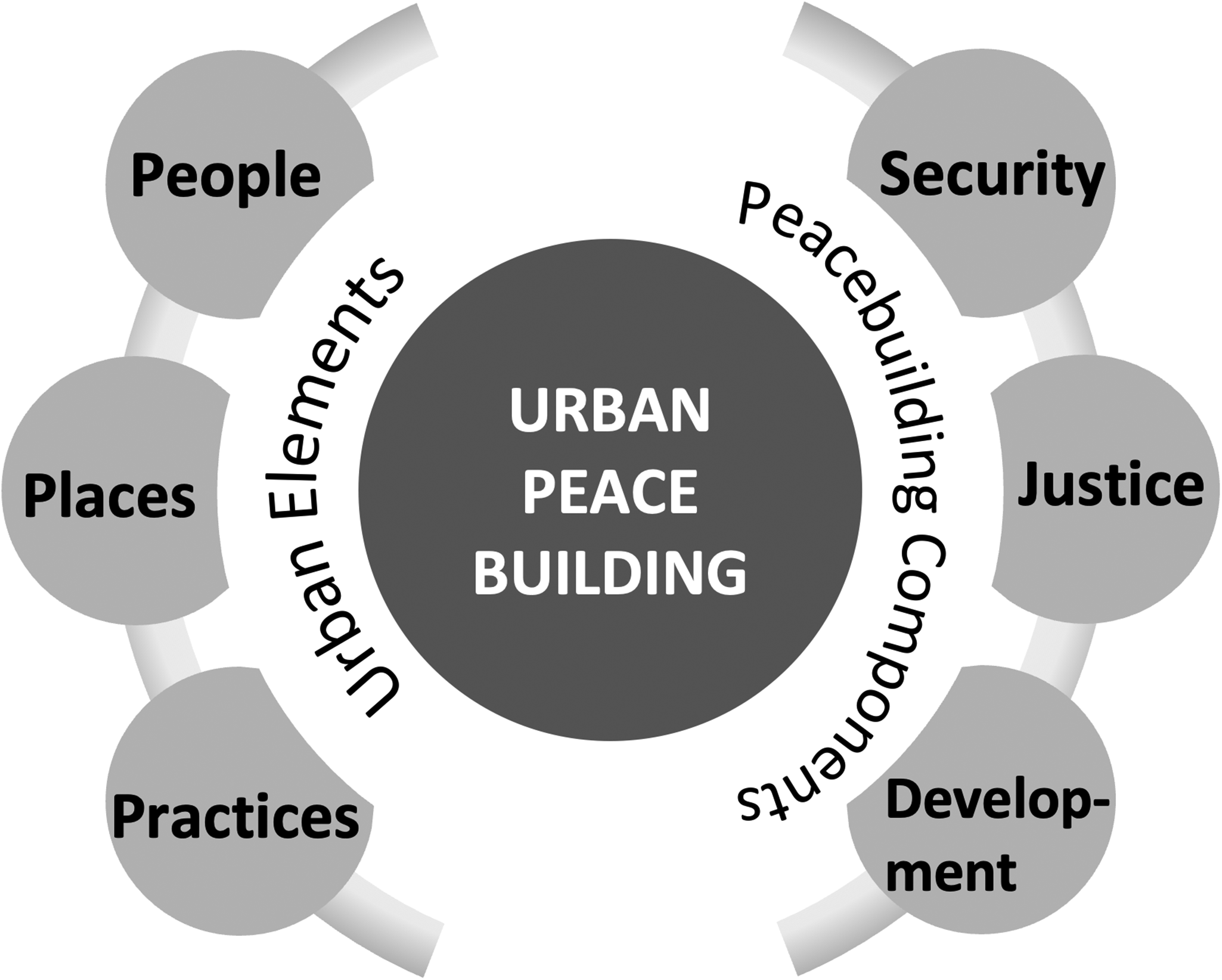
An Integrated Conceptual Framework on Urban Peacebuilding.
People and Their Security
It is imperative for sustaining peace in post-conflict cities to integrate urban planners primarily concerned with urban configurations and peacebuilders who promote peaceful behaviour (Wennmann, 2019). Critical peace scholars reminded us that societies hosting peace interventions are not tabula rasa. Local actors have the agency to contextualise, negotiate, resist, or even reject international norms, practices, and institutions (Björkdahl and Höglund, 2013). Their agency and practices inform building and sustaining peace or inciting new forms of conflict and violence. After all, the local is political and heterogenous (Bräuchler and Naucke, 2017). The heterogeneity and density of the local population make post-war cities vulnerable to violent clashes, competing control over key urban areas, civilian exposure to crossfires, and illicit activities (Elfversson et al., 2019). War-torn cities become breeding grounds for “actors who use violence and repression to challenge or reinforce the prevailing distribution of power and political, economic, and social control” (Elfversson et al., 2023: 323). Therefore, security threats are more pronounced in post-war cities.
Security, in addition to reconciliation and development, is a set of tasks that requires immediate attention in a post-conflict society (International Commission on Intervention and State Sovereignty, 2001). After armed conflict and widespread violence, retaliatory attacks, political violence, the regrouping of rebel groups, and threats from explosive remnants of war, for example, are likely to occur. Without security, the other aspects of peacebuilding would not be possible or at least disorderly and ineffective. Therefore, a sense of security is mandatory for the immediate delivery of services and the resumption of daily life. While security is a broad concept covering conditions ranging from military security to human security and environmental security, it is narrowly construed in this study as the security of the people from physical harm to their life, property, and livelihood. More specifically and more relevant to the context of Marawi, this study focuses on the clearance of unexploded ordnances (UXOs). The intense firefights between the militants and military forces and the air bombardment that eventually put an end to the war left UXOs across the city, making it unsafe for post-war reconstruction efforts.
Places of Reconciliation
Agency can also be expressed through the physical spaces, which in turn can facilitate either peace or conflict (Björkdahl and Kappler, 2017). Applying a spatial lens to people's interactions adds an important dimension to our understanding of peace and conflict dynamics. Spaces have different but overlapping functions. They can be perceived as a social representation or lived as integral to everyday life (Lefebvre, 1991). A space can become a place for grounding the everyday, where materialities, experiences, and narratives all intersect (Selimovic, 2019). With these functions, space is neither static nor homogenous; it is always under social (re)construction and (re)interpretations (Massey, 2005). A physical space can transform into a social place where peace or violence happens. According to Björkdahl and Buckley-Zistel (2016), the use of violence has a spatial dimension; and like spaces, violence, as a product of human activities, also has borders and boundaries. In other words, the characteristics of a space could influence the characteristics of violence.
How public places are designed can influence the psychology and behaviour of people and, by extension, their interactions, which can either impede or facilitate reconciliation. In post-conflict contexts, reconciliation can be achieved through transitional justice, defined as “the full range of processes and mechanisms associated with a society's attempt to come to terms with a legacy of large-scale past abuses, in order to ensure accountability, serve justice, and achieve reconciliation” (United Nations, 2004: para. 8). Justice can be pursued through judicial processes that often entail institutional reforms and retributive justice or non-judicial processes that usually consist of restorative forms of justice, such as truth-telling and customary or traditional forms of social reparation. Contrary to retributive justice, restorative justice aims to rehabilitate perpetrators and address victims’ needs. A history of injustice and human rights violations could create a culture of social division and out-group animosity. This risk is high when victims feel marginalised from the peacebuilding process. For this reason, the analysis in this study centres on the assistance offered to displaced persons (IDPs) since the Marawi Siege. As of July 2022, approximately 16,749 displaced families are yet to return (UN Office for the Coordination of Humanitarian Affairs, 2022).
Practices Towards Development
Urban spaces are embedded in the city's social fabric and vice versa. Spaces can be socially constructed through everyday practices, peaceful or not. These practices draw on multiple traditions, including the politics, identities, and emotions of the people (Bădescu, 2022). In Bădescu's (2022) conceptualisation of syncretic place-making, the built environment plays a role in combining these multiple traditions toward everyday practices that foster peace and coexistence. As Björkdahl and Buckley-Zistel (2022: 538) put it, “The everyday becomes synonymous with the space where peace is practised.” On the other hand, the materiality of spaces can impede or encourage peace, as mentioned in the previous section. For instance, extortion practices have become common in urban areas where criminal groups and gangs take advantage of the governance vacuum left by the conflict (Reitano and Shaw, 2019). Due to its close link to governance issues, extortion and other illicit activities in the cities must be understood not just as an issue of criminality but also of political economy (Reitano and Shaw, 2019). In terms of economic development, the urban must also be understood not just through political configurations shaping people's interactions but also through the actual market boundaries where economic activities are performed (Meyer, 2018).
War and widespread violence can devastate the economy, disrupting the sources of people's income and livelihoods. Economic mandates are core to many post-conflict peacebuilding processes, as economic insecurity could be a source of discontent and disenfranchisement, making people vulnerable to the recruitment of rebel groups or inclined to practice violence. Relatedly, unequal distribution of economic opportunities could also ignite interpersonal or communal violence, hindering the promotion of peace (Richmond, 2014). For these reasons, the resumption of economic activities is crucial for achieving a sense of normalcy in post-conflict societies and meeting the post-conflict needs of the population. I focused on local livelihoods, as Marawi was a bustling trade capital in Mindanao until the siege. The IDPs’ desire to return could be attributed not just to their attachments to the place where they are from and the cultural identity they developed in those places but also to the memories of profit-making in those places (Collado, 2020). Despite the influx of foreign assistance and the establishment of a dedicated government inter-agency task force (Task Force Bangon Marawi) to lead the rehabilitation, recovery, and reconstruction, the slow process has stalled the economic activities in the city, undermining peacebuilding efforts.
Research Design
The Marawi Siege
On 23 May 2017, militant groups waved the IS flag and took hold of the city of Marawi on the southern island of Mindanao in the Philippines. Five or six militant groups, reportedly affiliated with IS, including the Maute group and Abu Sayyaf group, exchanged fire with battalions of the Armed Forces of the Philippines (AFP). Then Philippine President Rodrigo Roa Duterte immediately declared Martial Law on the whole island of Mindanao. The AFP carried out airstrikes, leaving the once-thriving city in ruins. Mindanao is familiar ground to Islamic separatist groups attempting to establish an independent Islamic state or “caliphate” in the Philippines. The most prominent of those is the Abu Sayyaf Group, which has conducted several terrorist attacks and bombings on the island and the nation's capital, Manila. In September 2016, the Maute group killed 14 and injured 70 civilians using an improvised explosive device (IED) in Davao City, also in Mindanao and Duterte's hometown (NDRRMC, 2016). Despite the familiarity of the threat that engulfed Marawi, the military forces proved unprepared and ill-equipped for an organised urban terrorist attack of such scale. The Chief of Staff of the Armed Forces of the Philippines (AFP) admitted that the militants’ urban tactics came as a surprise for military troops, who are “used to fighting in the mountains and areas away from population centres” (The Inquirer, 2017).
The Marawi siege lasted months as the military re-calibrated its strategy for the urban environment. Clearing the buildings of IEDs was a slow and dangerous process. The difficulty of penetrating the militants’ stronghold pushed the government to resort to artillery shelling and airstrikes, justified on the grounds that the militants kept changing their hiding places. Aerial bombardment, conducted almost daily, eventually destroyed the IS groups and the city. According to Amnesty International (2017), hundreds to thousands of civilians who were unable to escape or fearful of the militants capturing or killing them remained trapped in the city and experienced prolonged periods of food and water shortages. According to the Philippine Commission on Human Rights, the airstrikes contributed to the further displacement of the population, killed innocent civilians and government troops, and encouraged militants to ransack abandoned houses (Gamil, 2017). What was left of the militant groups escaped to a district near Lanao Lake, where they sourced food, fuel, weapons, and workforce (The Inquirer, 2017).
In the aftermath of the siege, the international community quickly pledged support for Marawi's rehabilitation. The Philippine government received assistance from foreign governments, including Australia, Canada, China, Germany, Korea, India, Thailand, and Singapore, as well as international organisations, such as the ASEAN Coordinating Center for Humanitarian Assistance on Management European Union, the Asian Development Bank, the World Bank and the United Nations Development Programme (Mendez, 2017). 2 Crucial to the urban context of Marawi was funding for the restoration of basic social services, such as water and health facilities, the reconstruction of public infrastructure, such as housing and roads, and livelihoods and education programmes. Local non-governmental organisations (NGOs) also contributed to rehabilitation efforts. However, in a highly securitised space such as Marawi, and especially when Martial Law was in effect, the delivery of humanitarian assistance rests on effective civil–military coordination (Hall and Deinla, 2021). A study conducted by Hall and Deinla (2021) revealed that many NGOs viewed their coordination with local government units as more significant in performing their functions than with the military, and some of them, especially rights-based NGOs, criticised the imposition of Martial Law and the associated human rights and power abuses. Meanwhile, the military became more sceptical of local NGOs’ political motivations and doubtful of the effectiveness of their humanitarian services (Hall and Deinla, 2021). While this relationship did not hinder some humanitarian NGOs from working outside the main battle area (Hall and Deinla, 2021), it reduced the prospects of the military's role in peacebuilding and partnership with civil society.
Almost seven years later, there are still reservations about whether the IS presence in Marawi has been eliminated. Duterte extended the Martial Law twice until the end of 2019 to address reports of the militants regrouping. Although the operations of what was left of the siege have been scaled down, IS-affiliated attacks, including bombings of public places, indicate the enduring IS threat (Banlaoi, 2018). It was alleged that the government fell short of implementing a coherent and transparent policy framework to prevent another “Marawi” in the Philippines (Banlaoi, 2018). Amid the plebiscite that decided the ratification of the Bangsamoro Organic Law and the scope of the Bangsamoro Autonomous Region, government authorities confirmed that suicide bombers took the lives of 22 civilians and injured at least 100 in a cathedral in Jolo, the capital of the Sulu province in Mindanao in January 2019. Three days later, an unidentified person threw a grenade into a mosque in Zamboanga City, also in Mindanao, killing two and injuring four civilians. Most recently, the IS claimed responsibility for the December 2023 bombing of a gymnasium within the premises of the Mindanao State University-Marawi campus, where a Catholic mass was being held, killing four and injuring seventy-two. These attacks indicate the persistence of urban conflict in Mindanao. Meanwhile, local communities have demonstrated unity and resilience amid these experiences (Eviota-Rivera et al., 2023; Tejero et al., 2020). These characteristics and incidents make Marawi an urban space where conflict lurks, yet peace thrives.
Data Collection
This study analyses data from FGDs with community members directly affected by the siege. Two FGDs with fifteen participants each were facilitated in June 2021 in partnership with a local youth organisation in Marawi. Such a partnership is aligned with efforts towards capacity-building for the younger generation of peacebuilders (Ragandang, 2020). The discussions were divided into three segments, each dealing with questions about security, reconciliation, and development. For security, they were asked about their sense of safety and security in Marawi, their awareness of the UXOs, and their recommendations for improving the security situation in Marawi. For reconciliation, the questions focused on the return of IDPs, specifically their awareness of the challenges faced by IDPs and their recommendations for addressing such challenges. For development, the participants discussed how the conflict has affected their livelihoods, the government's plan to resume economic activities, and their aspirations for economic security.
The selection of FGD participants ensured that social groups based on gender, age, and sector were fairly represented. Twelve males and eighteen females between the ages of twenty and forty-five participated in the discussions. A research ethics clearance was obtained, and participant information sheets and consent forms were provided to the FGD participants.
The FGDs were conducted in the local language, transcribed, and translated to English for analysis. The transcriptions were coded based on security, justice, and development, and the prominent themes were analysed in relation to the people, places, and practices that make up Marawi. The following section presents these themes.
Results and Analysis
Security From UXOs
It was broadly recognised during the discussion that the security situation in Marawi needs urgent improvement. One participant saw the need for increased visibility of police, and another participant observed that there were enough police officers, but the police only showed up when they submitted documents or processed their clearances. For example, two police officers were assigned to accompany the returning residents, but they left their posts after 3 months. When they left, some residents lost their properties and livestock to theft. There were also allegations that the police were involved in crimes, such as female abductions, which eroded public trust in authority. As such, some of the female participants said they felt safer if the security personnel were also Maranaos or Muslims whom they could trust. According to the participants, the local government was made aware of this security issue. They recommended the local government to conduct more patrolling and monitoring of public places in the city, as well as information campaigns about drills and emergency responses to conflicts.
Despite safety assurances, most participants in the FGDs felt unsafe returning to the most affected area of Marawi. They expressed the necessity of clearing unexploded ordnances for their safe return. One participant said: “It is important for the authority to declare that all bombs have exploded. It will not give us peace of mind when we return without ensuring that our place is clear of all bombs. It may even create more problems if bombs will just explode.” When I visited Marawi in March 2019, ground zero was still closed to the public due to the incomplete clearing of UXOs. While much of ground zero has been cleared of UXOs and other debris, army engineers were still detonating UXOs that have been previously recovered as of June 2023 (Umel, 2023).
Related to their return is the difficulty in locating where their houses were before the siege. They were also worried about hearsay that the Maute group would attack their city again. For these reasons, one participant reminded the group that the issue of safety applies not only to the most affected area but to the whole of Marawi because those displaced continue to face security issues at their temporary shelters. The participant explained:
When we speak of “Marawi City”, we should not think of ground zero alone. If we say physical safety in Marawi, it involves the safety of everyone who lives within Marawi City. I guess letting people feel safe is the first important thing to do. By “people”, it should not only include those who lived in ground zero. It should also include all of those displaced, those who have returned recently, and those who lived in the vicinity within and outside Marawi. It is important to feel safe before we return to ground zero. You cannot say you are safe even in places outside ground zero. Many have disappeared.
The discussion with communities reveals that the sense of physical security is also tied to issues related to their return. “More than the question of whether it is safe to return to Marawi, my main concern is whether our land is still there,” commented one participant. These sentiments depict the land as a space where physical security from UXOs and security of property ownership intersect.
Justice for the Displaced
The IDPs who participated in the FGDs described their living conditions in the refugee camps as below satisfactory. Due to the shortage of shelters, several families had to cram into shelters meant for one family. Some camps do not have running water and drinking water. Rurug Agus, for example, one of the evacuation camps, is far from the centre of Marawi. Transportation costs add a further financial burden to the IDPs, along with the shortage of medical supplies and employment opportunities. As such, they clamoured to return but were also worried about sources of basic needs and livelihoods upon their return. According to their contracts with the local government, IDPs can also stay in temporary shelters for a maximum of five years. With the expiration of their contracts, many of those who do not own land or cannot provide official documentation of land ownership in Marawi face uncertainty about their return. For these reasons, the IDPs in the FGDs defined peace as their ability to return to their lands/homes.
For the participants, peace and justice are related to land rights. Land ownership is a primary issue among residents who lost their properties to the siege. Many of the IDPs encountered difficulties when claiming their property because even though they owned the house, many of the lands were inherited and did not have land titles. “How can we return if they already built a barangay hall on our land? Where is justice there?” asked one participant. They wished the government had informed the rightful owners of the land before putting up any structure in the city.
Many participants also expressed disappointment over the unequal distribution of relief and services, which they attributed to patron–client relations that have permeated many aspects of Philippine politics and society (Teehankee, 2012), including Marawi. Government officials favoured their relatives over helping those in most need during relief distribution. “They prioritise those who own a Fortuner!” exclaimed one participant. Meanwhile, there were claims that those with disagreements with local officials did not receive assistance. This practice of clientelism was also evident in land ownership issues. One participant, for example, said that they were told to relocate to a certain area only to find out that it was already occupied exclusively by the relatives of those in government positions. Another participant explained that corruption and clientelism in public offices undermine peace because powerholders want to remain in power for as long as they want, even through violence, such as rido, 3 and at the cost of peace.
Renters face the consequences of both political clientelism and land ownership issues. In addition to being unable to receive assistance because of the “one house, one relief” rule by the local government, their ward leader, who does not know them personally, tended to exclude them from the list of eligible relief recipients. According to a renter who participated in the discussion, the local leaders prioritised registered voters who could support them during elections. Relatedly, excessive paper documentation delayed timely assistance, especially for renters who do not own properties in Marawi. While the participants collectively recognised the need for further assistance to everyone affected by the siege, there was also a suggestion to prioritise the needs of “real Marawinians.” Such a suggestion contradicted the concerns raised by renters and is telling of how the spaces in Marawi could host potential conflicts arising from unresolved land issues, exacerbated by the “us-vs-them” mentality. The people's return will depend on the equal and just distribution of these lands and the livelihood opportunities that come with them.
Livelihoods and Economic Development
In addition to security concerns, political clientelism complicates the returnees’ livelihood opportunities. The war destroyed small businesses in Marawi, stripping the ordinary people of their sources of income. Although the need for capital to restart their livelihood and revitalise economic activities in Marawi was evident during the discussion, they also recognised the unsustainability of relief dependence. As one participant described, the politicians and leaders only know how to provide food instead of providing stable sources of income. Hence, the participants also linked justice to their livelihoods. “In our effort to give justice and make things fair, it is becoming unfair,” said one participant. For instance, while the government's cash payments for livelihood assistance benefitted poorer families, those who were better off used the livelihood assistance for indulgences rather than basic needs. Therefore, some participants acknowledged that issues of inequity regarding government assistance were not solely the responsibility of those distributing the assistance. Another participant echoed this plea: “The question is how to improve the people's livelihood. The answer is there in that sentence: people. We need to ask and reflect on ourselves. Sometimes, when donor agencies give us money, some of us use it to buy a new cellphone. Do you think that helps you augment your income? No. So for me, it is really important to improve our lifestyle.” Hence, the participants suggested that livelihood programmes be coupled with training for the recipients to sustain their economic activities. More robust monitoring and assessment of government assistance outcomes were also recommended to re-align the purpose of the assistance with the needs and concerns of the people.
Several participants cautioned about the potential consequences of economic insecurity. For example, those who did not receive livelihood assistance may resort to crimes in order to feed their families. A stable income will disincentivise people from committing such crimes. As such, they defined peace as the ability to afford basic needs and the absence of poverty. According to one of the participants, “There is peace when the IDPs are afforded jobs, provided with a permanent shelter, and are given what is due to them; and if the datus (chieftains) and the Bangsamoro government is firm in their authority so that the siege will not happen again.”
The participants collectively understood the implications of armed or violent conflicts for their livelihoods. Before the siege, rido had already disrupted business operations and sources of livelihood in Marawi. The ongoing practice of rido continues to undermine economic stability in post-siege Marawi. Correspondingly, the resumption of their livelihoods and other economic opportunities depends on their sense of security and safety and their return to and ownership of the land. These perspectives illuminate how varying (and sometimes contradicting) experiences and narratives occupy the same physical materialities of urban spaces.
Challenges and Prospects for Urban Peacebuilding in Post-Siege Marawi
Locating the people, places, and practices in rebuilding security, promoting justice, and revitalising the economy elucidated three aspects of urban peacebuilding in post-siege Marawi. First, it reveals how identity is attached to the sense of security among the participants. Some participants implied the idea of “us-vs-them” (i.e., Maranao Muslims versus non-Maranaos or non-Muslims). For instance, a participant expressed a preference for security personnel who are also Muslims. Another participant asserted that peace would settle in Marawi only if Shariah law were enforced strictly. Furthermore, regarding residential lands, one participant claimed that most disputes happen due to renters claiming ownership of the land even though they are not from Marawi: “For me, it was the arrival of those who are not like us that destroyed our peace. In the past, we were all Maranaos, and we were peaceful. When they came, that was the time when peace was destroyed.”
Second, people's aspirations are translated to the spaces where peace or conflict occurs. The precarious conditions of IDPs in temporary shelters demand attention to spaces outside ground zero, where new sources of conflict may take root. Spaces where economic discontent and the sense of injustice over land dispossession are expressed could become conducive for recruitment into radical and violent groups. 4 As such, urban peacebuilding is tied not just to urban spaces, but also to the places where people have been relocated. Relatedly, the IDPs in the FGDs expressed fear of being suspected as terrorists whenever they move from the camps to the urban centre. They carry these security concerns as they move through the city. Urban peacebuilding, therefore, must take into account not only the meanings and experiences of people in the spaces they occupy but also the impermanency of these spaces. Peacebuilding must adapt to the transformation of these spaces in response to people's movement and evolving requirements.
Third, the challenges to rebuilding Marawi confirm the significance of everyday practices to both peace formation and conflict perpetuation. While the participants attributed some of the sources of conflict in Marawi to “external actors,” they also recognised that some of their local norms do not contribute to peacebuilding. One of those is the preservation of Maranao pride, sometimes translated into the practice of rido, which can escalate minor conflicts to widespread armed violence (Trajano, 2020). This culture of kinship-based politics, together with Bangsamoro's complex political struggle, further complicates the security challenges in Marawi and the broader region (Andaya, 2021). On the other hand, some of these norms and practices can also contribute to peace, according to the participants. The participants mentioned self-discipline, patience, receptiveness, and the spirit of volunteerism as some of Maranao qualities that contribute to the conditions of peace in Marawi. Notwithstanding the violent manifestations of rido, many participants expressed faith in the culture of peace in Marawi. Inter-religious dialogues were common before the siege; during the siege, there were accounts of people protecting and sacrificing their lives for each other, regardless of religion (Eviota-Rivera et al., 2023). Furthermore, in terms of economic development, the nationally led reconstruction process must recognise and support the well-known entrepreneurial spirit of Maranaos, which could contribute to economic security and revive Marawi's identity as Mindanao's commercial hub (Candelaria and Katayanagi, 2023). These are the peaceful practices among the people within the places of Marawi that must be supported. However, the FGD participants’ general frustration over the process withheld further elaborations on these peace-promoting characteristics and practices. These findings confirm that urban elements can facilitate or hinder peacebuilding, contingent upon their careful consideration or incorporation during the planning and implementation of post-conflict reconstruction efforts.
Conclusion and Policy Implications
How does Marawi's urban environment influence its post-siege reconstruction and peacebuilding? I answered this question by situating security, justice, and reconciliation within Marawi's people, places, and practices. In doing so, this study contributes to a more comprehensive understanding of peacebuilding by integrating conventional peacebuilding components and urban characteristics. This analytical approach to the case of Marawi shows how identity, spatiality, and relationality influence peacebuilding efforts. Considering both spatial (in this case, urban) and relational (expressed in everyday practices) dimensions in the everyday lives of ordinary people is salient to the study and practice of peacebuilding. Relatedly, the peace and security requirements of conflict-affected communities inform the use of spaces in facilitating peace or conflict. While materialities, experiences, and narratives all give meaning to a space, meanings can also shape how a space is materialiased, experienced, and narrated.
Urban spaces can facilitate everyday practices that can hinder or promote peace. Understanding how these spaces were built and used over time can guide in reconstructing a post-conflict city. On the one hand, such an understanding would minimise the possibility of inheriting its history of violence and injustice into the newly (re)built spaces and infrastructure. Spaces are malleable and, therefore, open to change according to the meanings and (re)interpretations people attach to them (Danielsson, 2020). For this reason, it is necessary for peacebuilding efforts to consider how people have experienced, are experiencing, and will experience places of post-conflict reconstruction. Post-conflict reconstruction efforts must be cognisant of the norms and practices that could be channelled to these spaces, either for staging armed violence and embodying social division or for opening dialogue for justice and reconciliation.
The Battle of Marawi, unlike other urban warfare in failed or fragile states, happened within a country with effective government and political legitimacy. It also shows the growing influence of IS in the Southeast Asian region, threatening peace and security in the Philippines and its neighbouring countries. The peace process in Mindanao has been slow for decades, and the newly established Bangsamoro region will be vulnerable to social tensions, such as urban conflicts, risking the breakdown of the peace agreement. The success or failure of rebuilding Marawi is tied to the overall peace process in the Bangsamoro region (Abuza and Lischin, 2020; Cook, 2018). Therefore, it is a crucial goal to ensure that another Battle of Marawi will not happen in the Philippines.
Overall, the discussion with conflict-affected communities demonstrates that the people broadly construe peace as physical security, the right to return, and stable livelihoods. Ignoring these aspirations would lend the “peace” in post-siege Marawi as irrelevant to the needs of the community, fragile to security risks, and deemed successful only by the national authorities. While the scope of this study does not include a review of relevant policies, the results and analysis could inform several practical recommendations applicable not only to Marawi but also to other post-conflict cities. Across these recommendations, an enhanced partnership between urban planners and peacebuilders is essential. First, temporary shelters or refugee camps must carefully consider the heterogeneity of the affected population. Violence could extend to spaces beyond where conflict initially erupted due to competing identities or other unresolved conflicts. These security risks could be heightened by the shortage of basic services, especially within communities with a history of violence, such as rido among Maranaos.
Second, facilitating the return of IDPs is not just about ensuring their physical safety but also enforcing their legal rights. In my most recent visit to Marawi in December 2022, ground zero was already open to the public, with key buildings reconstructed, but most residential sites remain in rubble. Army engineers announced in January 2023 that Marawi is 99% safe with the progress made in clearing UXOs (Umel, 2023). However, despite these assurances, Marawi's urbanscape will remain populated with empty lots and buildings rather than people unless property rights are resolved. As some of the participants in the FGDs commented, Marawi could not be considered peaceful because of the ongoing conflicts over property; therefore, peace necessitates proper management of land issues. Their suggestion of letting the new Bangsamoro Autonomous Region in Muslim Mindanao (BARMM) government lead the management rather than the central government indicates their desire for a more locally contextualised and locally owned post-conflict reconstruction process.
Third, economic assistance, whether through foreign or national agencies, must consider the city's political economy. Both illicit and informal forms of economic activities are not uncommon in cities, more so in conflict-affected ones. As such, it is important to assess how livelihood programmes, whether complementing or suppressing the informal economy, could influence the economic security of their beneficiaries in the long run. Without proper needs assessment, economic assistance packages may also be exploited for illicit activities. Relatedly, it is also important to consider where economic activities take place. In Marawi, the delineation of urban spaces into separate zones for commercial, residential, agricultural, institutional, and other purposes, as part of the rehabilitation process, neglects the mixed use of these spaces prior to the siege, further contributing to dispossession and discontent (Fernandez, 2021).
By acknowledging the link between armed conflict and urban safety, specifically in Mindanao, the Philippines committed to the principles of the New Urban Agenda and plans to improve the provision of basic services to IDPs and create public spaces and other built environments that promote not only liveability but also facilitate social interaction and inclusion (UN-Habitat, 2016a). This commitment echoes the United Nations' call for urban planners to develop infrastructure that encourages and supports patterns of peaceful coexistence (UN-Habitat, 2016b). The aftermath of Marawi is a litmus test for this commitment. Marawi's post-siege reconstruction is still ongoing, and further research is needed to account for the evolving requirements and aspirations of the conflict-affected communities and the progress of the inter-agency task force that leads the reconstruction and rehabilitation of Marawi. A holistic approach to post-conflict reconstruction necessitates an interdisciplinary lens and multi-level partnerships. Facilitating this collaboration will ultimately draw on the people, places, and practices that make up the city of Marawi.
Footnotes
Declaration of Conflicting Interests
The author declared no potential conflicts of interest with respect to the research, authorship, and/or publication of this article.
Funding
The author disclosed receipt of the following financial support for the research, authorship, and/or publication of this article: This work was supported by the Japan Society for the Promotion of Science (grant number 21K13157).