




Abstract
The capacity of citizens to see political corruption where it exists and to link such perceptions to evaluations of public officials constitutes an important test of political accountability. Although past research has established that perceived corruption influences political judgments, much less is known regarding the critical prefatory matter of who sees corruption. This article develops a multifaceted theoretical framework regarding the possible bases of perceived corruption. Experiential factors – personal experience and vicarious experience with bribery – mark the starting point for our account. We then incorporate psychological dispositions that may colour judgments about corruption and that may strengthen or weaken the links between experiences and perceptions. Expectations derived from this framework are tested in a series of multi-level models, with data from over 30,000 survey respondents from 17 nations and 84 regions in the Americas.
Political corruption, often defined as the misuse of public office for private gain (Treisman, 2007), abounds in many nations, bringing repercussions for the quality of economic performance and democratic governance. 1 Corruption scandals have engulfed several Latin American nations in recent times. In 2014, Brazil became the epicentre of a massive fraud scheme in the state-owned oil company, Petrobas. 2 The Petrobas scandal has yield hundreds of indictments of businesspersons, congressional representatives, and politicians from Brazil’s main political parties on accusations of corruption, money laundering, and other financial crimes. This scandal has tainted three former Brazilian presidents: Lula Da Silva, Dilma Russeff, and Michel Temer. Brazil is also the centre of another scandal of global proportion, the Odebrecht scandal, a web of bribes potentially engulfing politicians and presidents of several Latin American nations. 3 The imprisonment of former President Ollanta Humala in Peru and the eventual resignation of Presidents Otto Pérez-Molina of Guatemala and Pedro Pablo Kuczynski of Peru are only a few recent casualties of corruption scandals.
Although political corruption is not an extraordinary occurrence in Latin America, 4 the scope and reach of recent corruption scandals revives the need to comprehend more accurately how citizens cope with political corruption. If fighting corruption is to bear fruit, learning how citizens see corruption, and the factors that account for their perceptions, should contribute to the critical tasks of fostering accountability and good governance in the region.
Many early studies of political corruption utilised aggregate data to identify corruption’s causes and consequences. Scholars next explored the impact of mass-level experience with, and perception of, corruption (e.g. Anderson and Tverdova, 2003; Bohn, 2012; Canache and Allison, 2005; Rose-Ackerman, 1999; Seligson, 2002, 2006; Zechmeister and Zizumbo-Colunga, 2010; c.f. Manzetti and Wilson, 2007). Only recently has attention been directed to the bases of citizens’ perceptions. This is an important matter. Ideally, if public officials are engaged in malfeasance, citizens will see it and downgrade their views of those officials. We might rue corruption-induced declines in trust and support, but perhaps we should celebrate critical reactions to corruption, because these responses signal political accountability in action.
It follows that an inquiry into the antecedents of corruption perceptions should gauge whether citizens’ perceptions of corruption are grounded in reality and should identify any forces leading to such perceptions. Such a study would speak to several of the issues most central to improving our understanding of how citizens engage the political world.
Our analytical framework builds on recent work on the individual-level correlates of perceptions of corruption and on the link between the experience and the perception of political corruption (Bohn, 2012; Canache and Allison, 2005; Charron, 2016; Olken, 2009; Rosas and Manzetti, 2015; Seligson, 2002, 2006). The framework includes three components: (1) people’s personal experiences with bribery, and the possible impact of those experiences on perceptions of corruption; (2) vicarious experiences with bribery, as represented by the prevalence of bribery within the individual’s regional context, and the possibility that those vicarious experiences also influence perceptions of corruption; and (3) the two-part impact of people’s personality traits in (a) directly predisposing individuals to express more or less critical views of public officials and (b) strengthening or weakening the connections between bribery experiences – both personal and vicarious – and perceived corruption. We test this framework with the 2010 AmericasBarometer survey data, 5 which allows us to measure personal and vicarious bribery experiences and perceptions of political corruption, along with personality traits. Further, these data are available for over 30,000 respondents, from 84 regions in 17 nations in the Americas.
Experience, Dispositions, and Corruption
In a world of perfect civic competence, citizens would monitor the performance of public officials, detect corrupt practices, and re-evaluate officials in the light of that information. However, because corruption activities are illegal and corrupt officials work hard to hide their behaviour, it is difficult for citizens to gather accurate information about the pervasiveness of these practices (Olken, 2006). Apart from news of major corruption scandals, how do ordinary citizens form their views about political corruption? Moreover, does tangible experience shape perceptions of corruption? To unpack the bases of views of corruption, we begin at a general level with an explication of the building blocks of political perception.
Connecting Bribery Experiences and Corruption Perception
Empirical reality arguably is an important factor in any inquiry into human perception. Research in psychology shows that experience plays a central role in how individuals perceive their environments (Kates, 1976). Research on perceptions of environmental hazards – including climate change, air pollution, natural disasters, and human-made hazardous events (e.g. Kates, 1976; Keller et al., 2006; Whitmarsh, 2008) – establishes that people’s perceived likelihood of risk increases if they have personally experienced or been exposed to the risk situation. The explanation is that people use their “experience” as a heuristic in their assessments of their environment and behavioural responses.
The experiential world offers a useful starting point to understand how ordinary citizens perceive corruption. What is the reality of corruption that common citizens experience? A major difficulty in answering this is that citizens vary in their understanding of corruption, 6 as well as in how permissible such behaviours are considered to be. 7 This creates hurdles for the study of perceptions of corruption in a cross-national framework. It follows that a precise and focused measure of experiential corruption is a critical step in asserting the cross-cultural validity of our study. Thus, we adopt what Bohn (2012: 70) calls a minimalist definition and define corruption as involving “corrupt acts stemming from the interaction between individuals and the state.”
Treisman (2007: 211) makes a strong case for the bribery-corruption link: “The quintessential corrupt transaction envisioned is the gift of a bribe by a private citizen to a public official in return for some service that the official should either provide for free or not provide at all.” Thus, to capture the interaction between ordinary citizens and public officials’ involvement in corrupt acts, we use data on whether people have been asked to pay bribes as our experiential measure of corruption. We acknowledge that there is no certainty that bribery fully captures the behaviours citizens designate as corrupt. 8 Yet, we believe that exposure to government officials asking for bribes in exchange for public services puts citizens in a situation of vulnerability – that is, it creates a sense of threat if the demand is not satisfied – that should affect how citizens assess political corruption. Thus, our expectation is of some impact of citizens’ experiences with bribes: such experiences should influence how citizens perceive corruption in government. How much of a link there is, and for which people and in which circumstances, will need to be pinpointed. Personal bribery experience is the first component of the three-part framework outlined above.
Vicarious bribery experience is the second component of our theoretical framework. In addition to personal experience with bribery, people may rely on others’ experiences when forming assessments of corruption. This influence is likely to arise from corruption-relevant information pertaining to environments in which individuals are located. Thus, we develop an approach that captures socially mediated experience with corruption at the subnational level.
Clarification of terms is in order. First, by “subnational,” we mean any geographic unit smaller than that of the nation. Examples include regions, states, districts, counties, municipalities, neighbourhoods, and so on. Our core claim is that analytical focus at the subnational level will improve our understanding of the bases of corruption perceptions, and especially of how vicarious experiences contribute to views of corruption. Nothing in our theoretical account privileges a specific subnational level; instead, we argue simply that, as a general matter, a subnational focus will be insightful. But second, our operationalisation in this study is at the regional level. Hence, we must provide a three-part justification for: (1) why it is necessary to study individuals embedded within geographic contexts – that is, to employ a multi-level framework – at all rather than studying either aggregate opinion or individual-level opinion that omits attention to context; (2) why movement to geographic units smaller than the nation is needed; and (3) why a regional focus, in particular, is appropriate.
Regarding the first of these points, our multi-level approach differs from those of studies that make use of national-level data, such as the Corruption Perceptions Index (CPI) reported by Transparency International, which is formed by aggregating survey responses from business leaders and other elites. Research using such data has generated considerable debate. 9 First, as encapsulated in classic analyses of the ecological fallacy, perception occurs at the individual level, making it unclear how to interpret results from collective-level analyses. Such studies can identify the correlates of aggregate opinion, but make little progress in uncovering causal mechanisms and pinpointing causal order. After all, as Schelling (1978) so effectively explained, countless individual-level processes could account for the same aggregate-level outcome. Second, it is risky to assume that these data capture the reality of corruption within a nation. The data are still perceptual, making them prone to the same biases in impression-formation as all perceptual markers. 10 Third, as with most aggregate-level analyses, this research may reveal insights about the big picture, but a great deal of nuance, particularly with respect to the role of citizens, is lost. For instance, a strong correlation between a nation’s economic development and its CPI score leaves us no further ahead in the effort to understand the nature and significance of mass opinion about corruption.
To be clear, aggregate-level studies offer a useful starting point by helping to frame the context for analysis and by mapping basic cross-national patterns. Our point is not that there is no role for such studies, but rather that aggregate-level analyses alone cannot provide a full account of the basis of perceptions of corruption. Our strategy is to develop an explanation focused on the views of individual citizens, incorporating individual-level and contextual-level predictors shaping a person’s experience with corruption. Thus, we introduce a multi-level research design. 11
Although definitive identification of process may not be possible in multi-level research design, 12 we develop an approach that brings improvement over extant work. We incorporate context in a manner that is closer in two key ways to perceptions of political corruption. We do so, first, by modelling context at the subnational level, and second, by including contextual information not just about standard predictors such as economic factors but also about a matter that speaks more directly to corruption – subnational experiences with bribery.
This brings us to the second point, the value of a subnational rather than an exclusively national focus. Several rationales suggest that the subnational context will be more important for corruption perceptions than the national context. For one, tangible experiences with misconduct by public officials most often take place in person during encounters within the municipality, district, or region. Our experiential variable draws on items that probe whether the person has received a bribe request from the police and government employees in the past twelve months. These encounters, which may be with employees of the municipal government or with employees of the national government who happen to work in a person’s local area, mostly occur at the subnational level. Further, information transmitted via social communication and the news media primarily focuses on the behaviours of local representatives and officials, in addition to national leaders. Lastly, a considerable amount of variation exists within nations. Our two median countries in terms of the range of regional experiences with bribery are Colombia and Panama. In Colombia, regional averages on our bribery measure vary from 6 per cent to 11 per cent. In Panama, the range is 1 per cent to 8 per cent. The potential significance of this subnational variation would be lost if we only accounted for effects at the national level.
A subnational focus is one step in reducing the gap between explanatory variables and corruption perceptions. Another step is to add contextual variables not only for economic factors but also for experiences with bribery. This is a key change relative to most work on the antecedents of perceptions of corruption, but one that follows logically from studies of mass opinion in other domains. 13 As we have noted, previous studies have used exposure to bribe requests as a predictor of corruption perceptions. Our models include such a measure, but also the level of bribery experience within the respondent’s region. This means that we will examine not just individuals’ own experiences but also the collective experiences of others.
Even where people can bring personal experience to bear on a judgment, the experiences of others tend to be influential. The most voluminous research on this point examines economic voting. Starting with Kinder and Kiewiet (1979), countless scholars have shown that sociotropic judgments, assessments of the economy at the collective level, typically outperform pocketbook judgments as predictors of phenomena such as presidential approval. These effects usually are identified at the national level, but subnational perceptions also matter (Mondak et al., 1996; Reeves and Gimpel, 2011). Consistent with our framework, an important aspect of the economic voting literature considers biases, partly emanating from contextual forces, in people’s subjective assessments of the economy (e.g. Duch and Stevenson, 2011). Outside of the realm of economic voting, scholars have demonstrated that personal (Tyler, 1990) and vicarious (Mondak et al. 2017b; Peffley and Hurwitz, 2010) experiences affect people’s perceptions of the justice system. 14
We see a subnational focus as valuable, but why at the regional level? In our data, each nation has between two and nine regions. The regions are delineated by the Latin American Public Opinion Project (LAPOP) surveys, and thus this designation is not of our construction. That said, we see it as appropriate for present purposes. The designation of regions is informed by in-country experts in each nation, meaning they are not artificial constructs, and they would be sensible to all or most respondents. In Argentina, for instance, there are six regions: Buenos Aires (city and province), Centro, Northeast, Northwest, Cuyo, and Patagonia. Costa Rica includes three regions: San Jose, the remainder of the Central Valley and the remainder of the nation. A benefit of using larger geographic units is that we can represent the climate of the context with data on over fifty respondents even for the least-populated areas; we expand on this point below when describing our data and measures. Additionally, use of a subnational measure that is broader than the neighbourhood or municipality helps ensure that we capture bribery experiences that transpire when people venture to nearby larger cities to attend to such matters as court appearances and the seeking of permits.
Our key contextual measure is the proportion of respondents in the region who have been asked to pay bribes in the past year. We have no expectation that respondents will be familiar with regional bribery rates. Instead, we expect the contextual frequency of bribery to affect social communication (Huckfeldt and Sprague, 1995). If a respondent lives in a region where bribery is common (rare), there is a high (low) likelihood that he or she will speak with people who have received bribe requests.
Our measures of both personal and vicarious experiences rely on data concerning bribery. Hence, we must discuss some concerns – in addition to possible variation in definitions of corruption – surrounding the validity of our conceptualisation and measurement of experiential corruption. First, we recognise, as Mishler and Rose (2008) note, that any effort to empirically connect bribery experiences to corruption perceptions faces the limits of human memory. Our items ask whether respondents have been asked to pay bribes within the past year. If respondents fail to recall bribery situations, or are uncertain as to whether those incidents occurred in the past year, the resulting data will be somewhat imprecise.
Second, focus on experiential corruption as a source of perceptions of corruption does not preclude or discount the role of information sources such as mass media. 15 Dissemination and interpretation of corruption scandals by the media is undoubtedly a significant factor in raising public awareness about this issue; this flow of information in turn shapes the empirical reality individuals confront (Canache and Allison, 2005; Giglioli, 1996). Our goal in this study is to examine how every-day life experiences with potentially corrupt behaviour affect citizens’ overall assessment of political corruption, but we recognise and acknowledge that national-level events such as those discussed in this article’s introduction also will be consequential, especially when made salient by national news media.
Third, experience, personal or vicarious, is not the only driver of corruption perceptions. Individuals in similar circumstances may differ in how they form and express perceptions. The measure of corruption perception we use asks survey respondents how common corruption is among public officials. Suppose, it is widely known that 30 per cent of officials in a country have been caught taking bribes. People who were shocked by this information may label corruption as very common. Conversely, for respondents who previously were convinced that all officials are corrupt, evidence that only 30 per cent take bribes might be modestly good news, leading to the conclusion that corruption is uncommon. The point is that variation in perceptions may remain when citizens draw on common information to form evaluative judgments.
Extant research highlights multiple forces driving heterogeneity of perceptions of corruption, including socio-economic and partisan bias factors (Bohn, 2012; Manzetti and Rosas, 2015; Zechmeister and Zizumbo-Colunga, 2013), political trust (Bohn, 2012; Morris and Klesner, 2010), and system-level perceptions of corruption (Canache and Allison, 2005). We contribute to this literature in the third part of our framework, where we posit that variation in corruption perceptions may be at least partly systematic, with origins in predictable psychological foundations.
Connecting Personality and Corruption Perception
Attention to the possibility that people’s personality traits influence corruption perceptions constitutes the third and final component of our theoretical framework. Effects of psychological forces on corruption perceptions may follow at least two paths. First, some psychological tendencies may make people generally more positive or negative in their views. When answering survey questions, the cynic and the malcontent will tend to express disapproval, opposition, and dislike. Such individuals likely will perceive that corruption among public officials is very common. Second, some dispositions may strengthen or weaken the impact of experiential factors on people’s perceptions. The two paths outlined here imply that psychological influences may produce direct effects on perceptions of corruption and may yield effects in interaction with experiential variables.
At question is whether individuals’ personality traits, or enduring psychological tendencies, predispose them to perceive corruption more or less critically. For many predictors of perceptions of corruption, endogeneity is problematic. For example, does trust lead a person to evaluate public officials positively, and thus answer that corruption levels are low, or does the perceived absence of corruption encourage greater trust? Do low levels of efficacy and interest breed cynicism, resulting in high levels of perceived corruption, or does rampant corruption spark disinterest and feelings of inefficaciousness? 16 In contrast with such variables, personality traits are much less susceptible to concerns over causal direction. We model corruption perceptions partly as a function of the Big Five personality trait dimensions: openness to experience, conscientiousness, extraversion, agreeableness, and emotional stability. 17 It is rather unlikely that people’s basic psychological profiles would change because they perceived public officials to be high or low in corruption, particularly since personality traits, including the Big Five dimensions, are highly heritable and very stable over time. 18 Hence, if relationships are found between the Big Five and perceived corruption, it would be reasonable to infer that those effects signal the influence of the former on the latter.
We envision direct effects for three of the Big Five traits on perceptions of corruption. 19 The first trait we examine is conscientiousness. Individuals high in conscientiousness tend to be sticklers for propriety, often to the point of being judgmental. Further, this trait is characterised in part by achievement striving (Costa and McCrae, 1995; John et al., 2008), a facet that is associated with high aspiration levels (Costa and McCrae, 1995). Bernardin et al. (2000) suspected that these characteristics might diminish the tendency of people high in conscientiousness to provide glowing assessments of others and found that students with high levels of this trait provided less positive ratings of fellow group members in a human resource management course. This suggests that conscientiousness may prompt scepticism about the actions of public officials and lead to the perception that corruption is widespread.
We expect people high in agreeableness to be less likely to see corruption as common. Trust and generosity are facets of agreeableness (John et al., 2008); thus, individuals high in this trait will tend hold positive default views of public officials. Consistent with this logic, Mondak et al. (2017a) find that agreeableness is positively related to trust in political institutions. The strong relationship between political trust and corruption perceptions (Konold, 2007) suggests that some of the same forces that influence institutional confidence also may affect opinions about malfeasance. We anticipate agreeableness to be one of these factors.
Emotional stability is the third personality trait that may have a direct relationship with corruption perceptions. Individuals high in this trait tend to be calm and relaxed (Costa and McRae, 1995), whereas individuals low in this trait tend to worry and complain (John et al., 2008). In the political realm, these citizens may fret over, and think the worst of, public officials. 20 Thus, we expect that high scores on emotional stability will correspond with less critical perceptions of political corruption.
Applications of the Big Five in the study of political behaviour emphasise that personality effects often emerge in combination with situational forces via what are known as Trait × Situation interactions. Here, the chief situational factor is personal and vicarious experience with bribery. We expect Trait × Situation interactions for three of the Big Five dimensions. First, people high in openness to experience are both attentive and responsive to information. This is certainly the case for political information, as high levels of openness are associated with more frequent political discussion and greater political interest, attention to politics and political knowledge (Mondak, 2010). Therefore, we expect individuals high in openness to be more likely to learn about the prevalence of bribery in their environment and to respond to personal and vicarious information by appropriately assessing the general level of corruption among public officials. Second, extraverts are highly attuned to their social environment. In the political domain, extraverts are more likely to engage in political discussion (Hibbing et al., 2011; Mondak, 2010) and are more likely to follow the news (Mondak, 2010), presumably because they want to be active participants in political conversations with their friends and acquaintances. This suggests that extraverts should be more likely to see and respond to contextual signals about corruption than introverts. Third, high levels of agreeableness correspond with prosocial behaviour (Carlo et al., 2005) and a sense of community (Lounsbury et al., 2003). Thus, violations of the public trust should be the most jarring and should elicit the strongest adverse reactions, among the highly agreeable.
Data and Method
Data are drawn from the 2010 AmericasBarometer surveys. These surveys, sponsored by the LAPOP, were administered in the spring of 2010 to citizens in 84 regions in 17 nations throughout Latin America. 21 The items included in the present analyses were asked of just over 30,000 respondents. 22 We use the 2010 AmericasBarometer surveys rather than more recent renditions because only the 2010 surveys included personality measures that we added.
Perceptions of corruption are measured with an item that asks, “taking into account your own experience or what you have heard, corruption among public officials is very common, common, uncommon, or very uncommon?” Three aspects of this question require attention. First, the wording does not specify what type of public officials the respondent is to assess. That is, it is left to the individual to interpret which officials to include as part of the judgment regarding the pervasiveness of corruption. 23 Respondents are free to include in their judgments any mix of high-level, low-level, national, and municipal officials. Second, the item primes respondents to consider personal and vicarious experiences. The impact of experiential predictors on corruption perceptions is central to our theoretical framework. By calling attention to experiences, the survey item arguably creates a best-case circumstance for assessment of experiential hypotheses. This will be important to keep in mind when interpreting results from multivariate analyses. Third, respondents were asked about personal experiences with bribery in a series of questions immediately prior to the item regarding perceptions of corruption. This placement further primes respondents to contemplate their own experiences when answering the perception item. 24
Our experiential measures draw on data from items regarding whether respondents have been asked to pay bribes in the past year. 25 As with the dependent variable, the bribery independent variable does not specify any single level or location of actor. The first item we use asks whether a police officer had solicited them for a bribe in the past twelve months, and the second inquires about bribe requests from any government employee. 26 Our interest is in whether the respondent has been asked to pay a bribe to any public official. Thus, in theory, the second item should be sufficient. If the respondent had to pay a bribe to a police officer, the respondent should have answered yes when asked the item regarding “any government employee.” However, over 2,000 respondents answered “yes” to the police item while answering “no” to the generic question. Presumably, this occurred because some respondents did not think of police officers as being government employees or at least not the employees referenced in the question. To account for this, personal bribery experience is coded 1 if the respondent answered yes to either of the bribery items and 0 if otherwise. 27
In addition to the effect of personal bribery encounters, we also expect that vicarious experiences will influence corruption perceptions. To test this hypothesis, we represent regional bribery as the proportion of respondents in a region with scores of 1 on the personal bribery scale. Use of this measure is premised on the assumption that as the regional bribery rate rises, so too should the likelihood that a resident of the region will hear from relatives, friends, and acquaintances about instances in which they were asked to pay bribes – and, of course, that this additional information will shape the person’s perception of corruption.
Respondents are identified as residing in 84 regions across the 17 nations. The number of regions within a nation depends on historical and political divisions. The smallest number of regions is two, in Uruguay, versus a high of nine in Bolivia. On average, there are 358 respondents per region. Four regions have fewer than 100 respondents, with a low of 54 in one of Colombia’s six regions. Two regions in Ecuador and one in Chile have more than 1,000 respondents. 28
Our thesis holds that personal and collective experiences will influence perceptions, but also that a full understanding of experiential effects requires attention to psychological mechanisms. We measure personality with a ten-item battery that includes two questions for each dimension of the Big Five. 29 Respondents were asked to indicate the extent to which they agreed or disagreed with each question. A value of 1 means “strongly disagree” and a value of 7 means “strongly agree.” The phrases used to represent each trait are: open to new experiences and intellectual, uncreative and unimaginative (openness to experience); dependable and self-disciplined, disorganised and careless (conscientiousness); sociable and active, quiet and shy (extraversion); critical and quarrelsome, generous and warm (agreeableness); and anxious and easily upset, and calm and emotionally stable (emotional stability). For each trait, data from the two items are combined, and then the final trait scale is recoded to range from 0 (lowest observed value) to 1 (highest observed value).
In addition to the key variables described thus far, models also will include individual-level and regional-level controls. The individual-level controls include a measure of political preferences 30 to tap partisan biases in information processing and standard socio-demographic variables, age, education, sex, and wealth. 31,32 The regional-level controls are the regional averages for education and wealth. We include these to capture the possibility that, independent of regional bribery rates, respondents in contexts with higher socio-economic status will be less likely to perceive widespread corruption. 33
To explore the hypothesised experiential and psychological effects, analyses proceed in several stages. We will begin with descriptive information on corruption perceptions and the two experiential predictors. Subsequently, corruption perceptions will be examined in three multivariate models. The first includes only the control variables and experiential measures. To begin testing our psychological account, the second model adds the personality variables. Lastly, the third model tests for several interactions between the experiential and psychological predictors. Because models include predictors at both the individual and regional levels, a multi-level modelling strategy is employed. With perceptions of corruption measured using a four-category ordinal scale, we estimate a series of multi-level ordinal regression models. 34
Identifying the Determinants of Perceived Corruption
Respondents on the 2010 AmericasBarometer perceived corruption to be widespread. Of the 28,325 who answered the corruption question, 12,458 or 44 per cent replied that corruption among public officials is very common, and another 33.6 per cent indicated that corruption is common. Thus, fewer than 25 per cent believed that corruption is uncommon or very uncommon. Further, a majority of respondents in every country answered that corruption is common or very common. Figure 1 displays the cross-national distributions. From left to right, the segments in each bar show the percentages of respondents within the nation who answered that corruption is very uncommon, uncommon, common, and very common. The countries are listed in inverse order of response that corruption is very common. Even in Uruguay and Chile, the nations with the lowest levels of perceived corruption, substantial portions of respondents indicated that corruption is very common: 21.2 per cent in Uruguay and 31.4 per cent in Chile. At the other extreme, a staggering 56.2 per cent of respondents in the Dominican Republic saw corruption as very common. Not surprisingly, perceptions varied more widely across regions. For instance, the highest regional mark for perceiving that corruption is very common, 69.0 per cent, is found in the Cuyo region of central-west Argentina. Conversely, the lowest level is 16.3 per cent, in a region that includes Nicaragua’s North and South Caribbean areas.
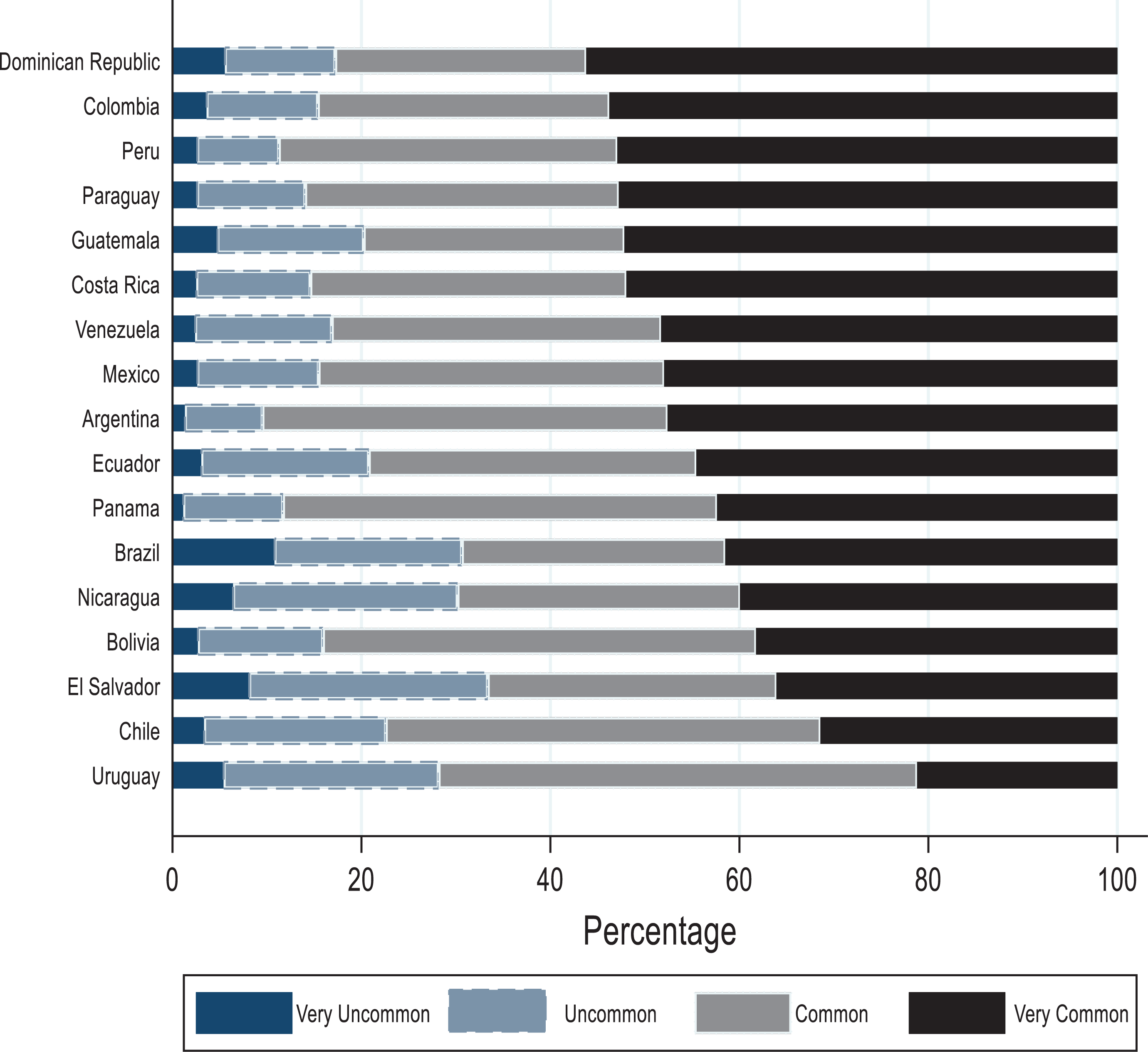
Distribution of Perceived Corruption.
In our three-part analytical strategy, recall that the first component is personal bribery experience. Although most respondents see corruption as widespread, it appears that these views rarely result from personal experience with bribery. Over 75 per cent view corruption as common or very common, yet only 16.3 per cent indicated that they had been asked to pay a bribe to a police officer or other government official in the past year. The correlation between bribery experiences and corruption perceptions is .08, suggesting that personal experience alone offers only the barest account of who sees corruption.
The second component of our framework holds that vicarious experiences may shape perceptions of corruption. If 16.3 per cent of individuals have been asked to pay bribes, then, on average, a person with five acquaintances has a 59 per cent chance of knowing at least one person with a bribery experience (1 − .8375 = .59). The likelihood of vicarious exposure to bribery rises to .83 if the individual has ten acquaintances. Intuitively, bad experiences should trump good ones as determinants of perceived corruption. For instance, if a person’s friend had to pay a bribe to a police officer, the impact of that experience seemingly would not be muted just because the person has other friends with no bribery encounters. Thus, a little bit of exposure to malfeasance may go a long way toward fostering the perception that corruption is pervasive.
Recall that we represent a person’s potential for exposure to information about the bribery experiences of others via the regional bribery rate. This rate varies from a low of .01 in central Panama to a high of .33 in central Mexico. In regions where bribery is common, residents should be more likely to have heard about the experiences of others and, as a result, to perceive corruption as pervasive. Consistent with this logic, the regional bribery measure is significantly correlated with individual-level perceptions. However, as with personal experiences, the correlation is modest in magnitude (r = .10). 35 Individual and collective experiences with bribery influence corruption perceptions, but they are not the only factors.
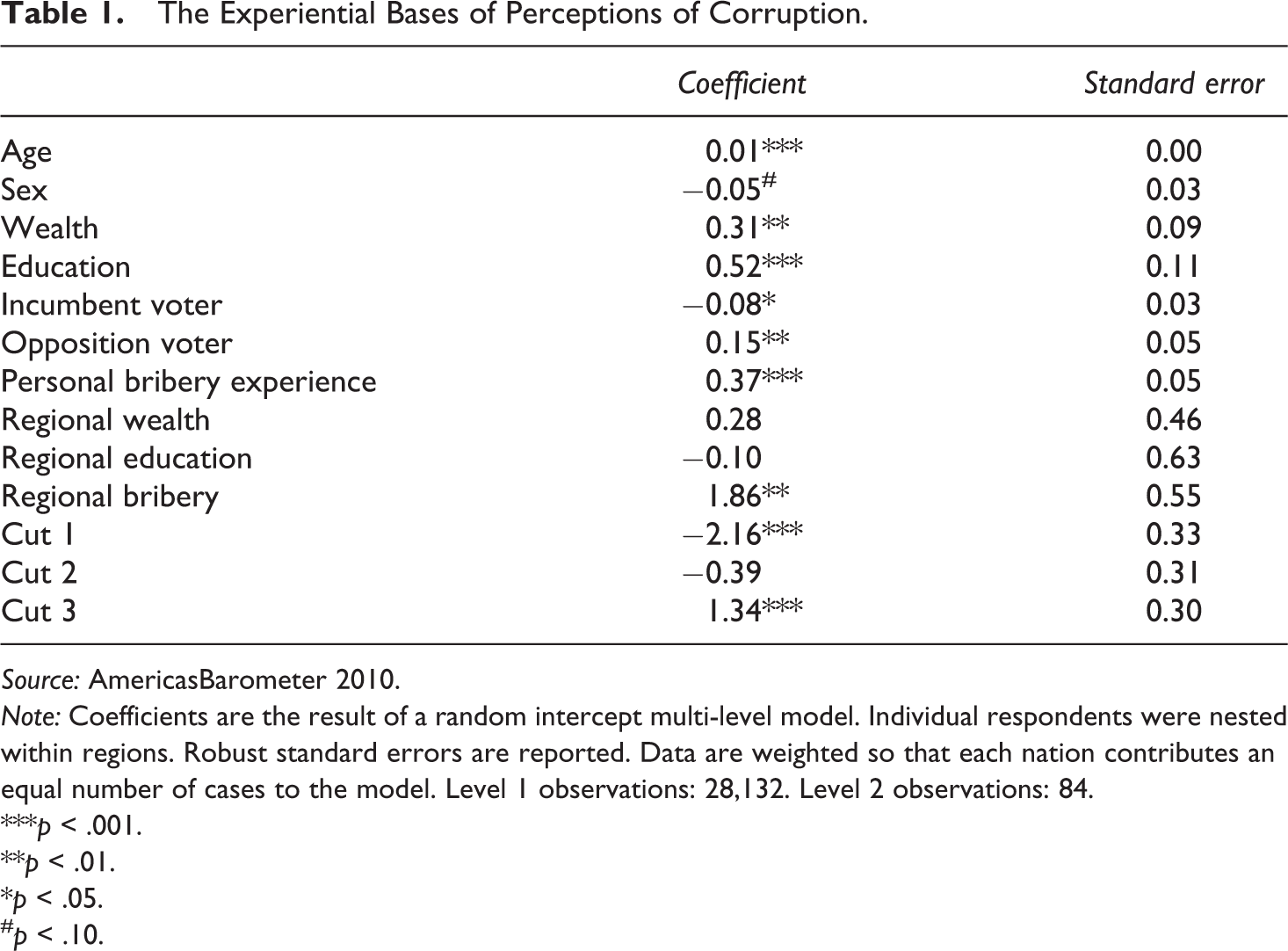
As we move toward multivariate analyses, we begin to account for the third component of our framework, a multi-level perspective that includes attention to subnational influences on individual-level corruption perceptions. To examine the joint effects of the two experiential variables, we begin with a model that includes only these measures and our control variables. Results are shown in Table 1. As expected, we see that personal experience with bribery and regional bribery levels both emerge as significant predictors of corruption perceptions. Substantively, with all other variables held constant at mean values, the predicted probability that a respondent sees corruption as very common rises from .44 to .52 as a result of personal bribery experience. A shift from .42 to .48 occurs as the regional bribery rate increases from one standard deviation below the mean (.05) to one standard deviation above the mean (.20), 36 and the predicted probability rises from .40 to .54 when the regional bribery rate increases from the minimum to maximum observed values. Among the control variables, the coefficients for individual-level wealth and education are positive, suggesting that a person’s own socio-economic well-being prompts a higher likelihood of seeing corruption as widespread. The significant effects for incumbent voter and opposition voter reveal that political preferences colour respondents’ views about the prevalence of corruption. The predicted probability of seeing corruption as very common is .48 for opposition voters and .44 for individuals who sided with the winner in the most recent national election. Turning to the regional-level controls, we find that the educational and income regional measures do not reach statistical significance.
The Experiential Bases of Perceptions of Corruption.
Source: AmericasBarometer 2010.
Note: Coefficients are the result of a random intercept multi-level model. Individual respondents were nested within regions. Robust standard errors are reported. Data are weighted so that each nation contributes an equal number of cases to the model. Level 1 observations: 28,132. Level 2 observations: 84.
***p < .001.
**p < .01.
*p < .05.
# p < .10.
Results thus far comport with expectations in that the personal and collective bribery measures both produce significant effects. What is somewhat surprising is that the effects of the bribery variables are only modest in size. The placement and wording of the corruption item primed respondents to draw on bribery experiences when forming judgments about levels of corruption, but the observed effects are less than overwhelming. Clearly, experience alone yields an incomplete explanation of who perceives corruption. This highlights the possibility that psychological influences – the final element of our framework – also matter, both in directly shaping corruption perceptions and in moderating experiential effects. It is also likely, of course, that factors outside of our framework – such as large national scandals – affect perceptions.
Measures of the Big Five personality trait dimensions are added to test whether corruption perceptions are influenced by people’s basic psychological dispositions. Two models are needed to test our hypotheses regarding psychological influences. The first adds the new variables as direct effects, whereas the second also includes a series of interactions between personality traits and our two experiential measures.
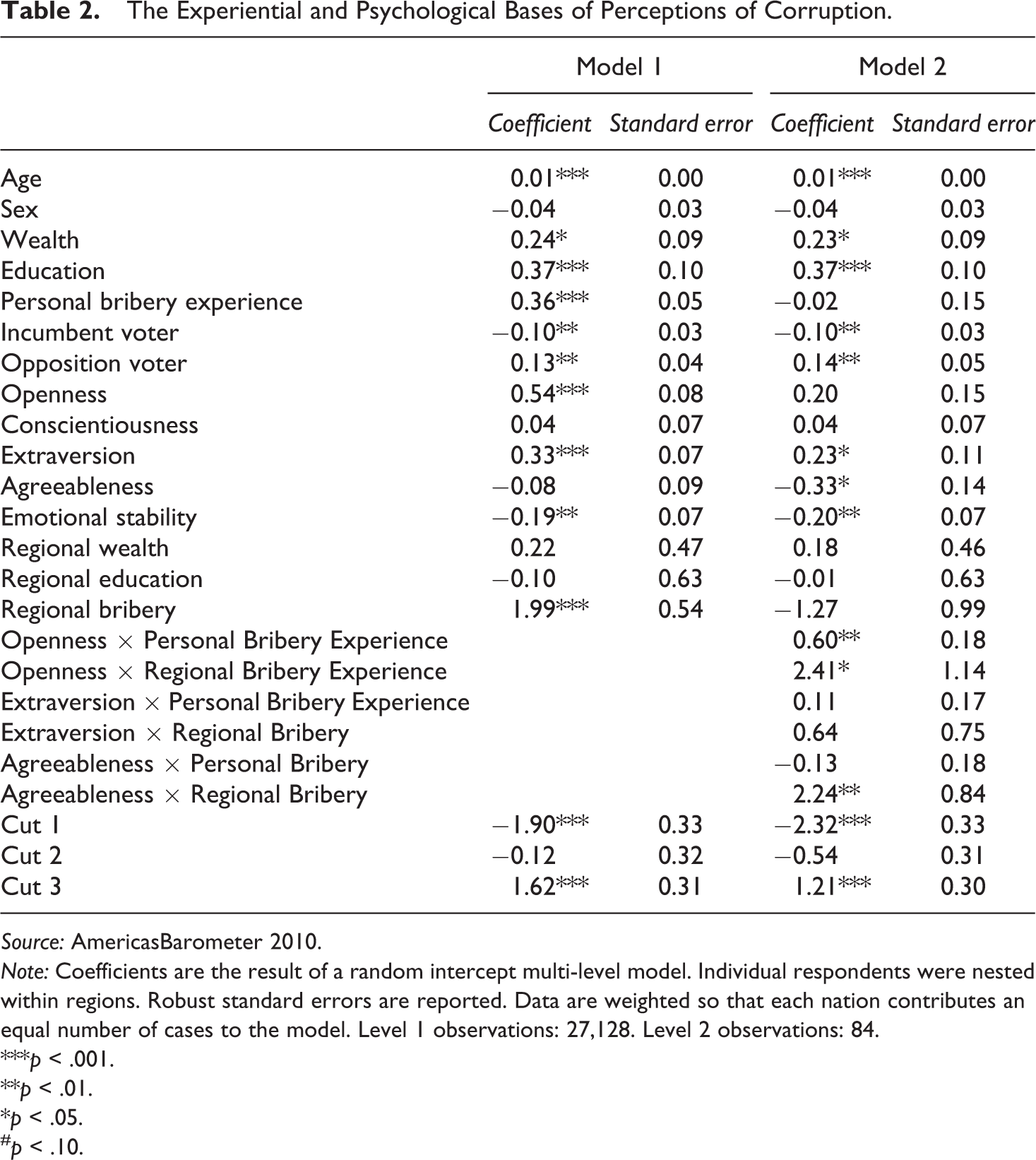
Results for these models are reported in Table 2. The first model brings inconsistent support for our hypotheses. We anticipated that perceived corruption would peak among individuals high in conscientiousness, low in agreeableness, and low in emotional stability. Only the emotional stability trait exerts even a modestly significant effect on perception of corruption. As seen in Table 2, additional significant coefficients emerge for openness to experience and extraversion; for each, high values correspond with a greater likelihood of perceiving corruption.
The Experiential and Psychological Bases of Perceptions of Corruption.
Source: AmericasBarometer 2010.
Note: Coefficients are the result of a random intercept multi-level model. Individual respondents were nested within regions. Robust standard errors are reported. Data are weighted so that each nation contributes an equal number of cases to the model. Level 1 observations: 27,128. Level 2 observations: 84.
***p < .001.
**p < .01.
*p < .05.
# p < .10.
Substantively, as emotional stability drops from one standard deviation above the mean to one standard deviation below, the predicted probability of seeing corruption as very common slightly decreases (from .46 to .44), suggesting that individuals low in emotional stability are marginally predisposed to perceived high levels of corruption. An increase in extraversion also affects the chances of seeing corruption as very common; the predicted probability rises from .43 to .47 as extraversion moves from one standard deviation below the mean to one standard deviation above. In contrast to the modest effects of these personality traits, the effect for openness is larger. As openness rises from one standard deviation below the mean to one standard deviation above the mean, the predicted probability of seeing corruption as very common increases from .42 to .48, and as openness shifts from its lowest to highest observed values, the predicted probability increases from .37 to .50. The direct effects for openness and extraversion were not foreseen. Instead, we hypothesised that individuals high in openness and extraversion would draw on experiential variables when gauging the scope of corruption. These and our other interactive hypotheses are tested in the second model in Table 2.
Three of the hypothesised conditional effects are consistent with expectations. In Table 2, we see that the interaction coefficients for openness with each of the experiential variables are statistically significant, as well as the interaction coefficient for agreeableness and regional corruption. Figure 2 displays the results for openness. In the first panel, we see having been asked to pay a bribe produces almost no effect on the corruption perceptions of individuals low in openness versus a relatively sharp effect for individuals high in openness. Similarly, in the second panel, we see that the regional bribery rate exerts a somewhat stronger effect on the perceptions of respondents who are high in openness. This is a prototypical trait–situation interaction in that corruption perceptions peak only when the situational (bribery in the region) and dispositional (openness to experience) factors both are at their highest levels. A very similar pattern is seen for agreeableness: moving from a low bribery region to a high bribery region 37 produces a change of two percentage points in the likelihood that respondents low in agreeableness will see corruption as very common versus a change of five percentage points among individuals high in agreeableness. 38
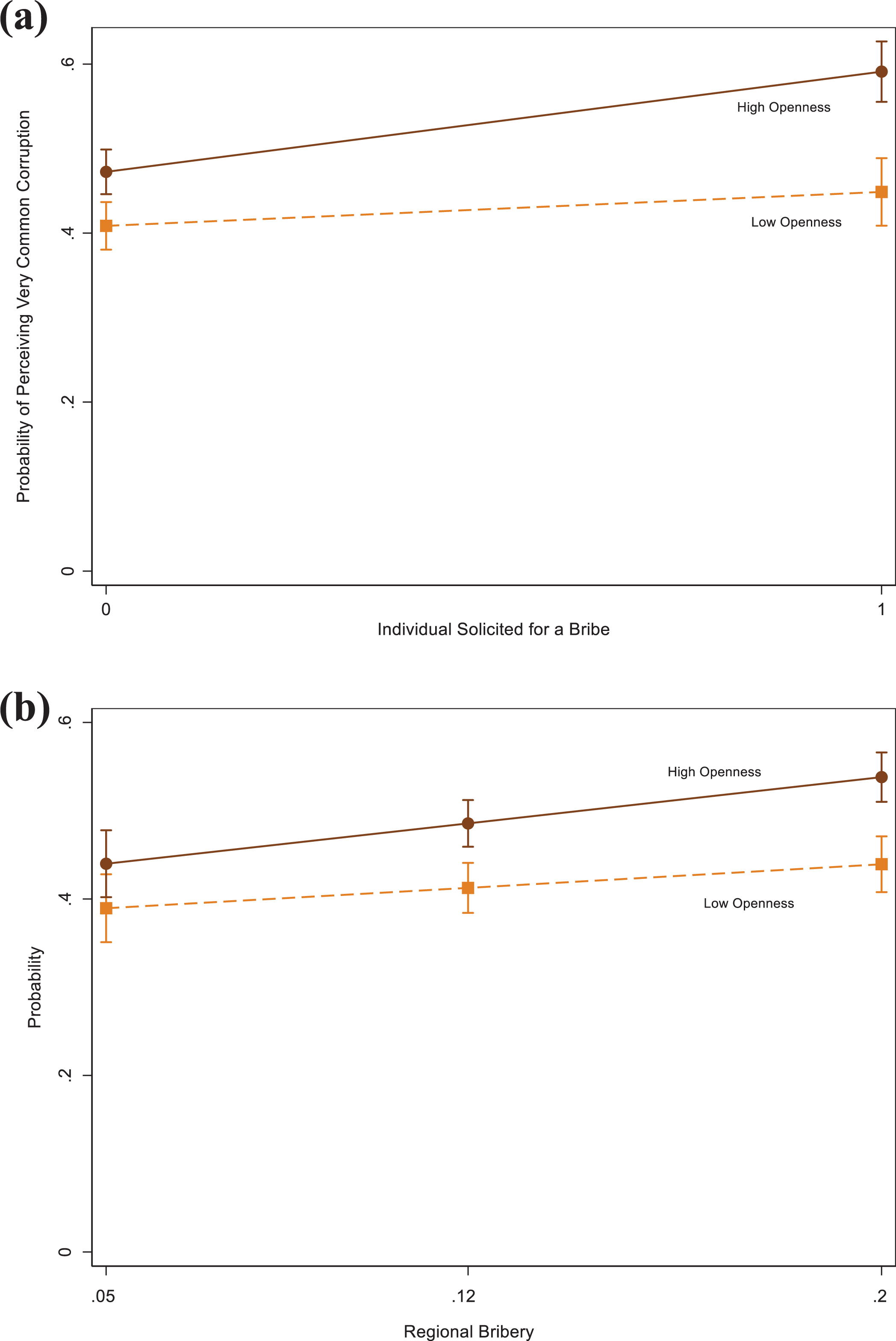
The Moderating Effects of Openness to Experience on the Experiential Bases of Perceptions of Corruption. (a) Personal Bribery Experience and (b) Regional Bribery.
Together, the results for openness and agreeableness cast the regional experiential variable in a new light. Contextual information about bribery is important, but the magnitude of the effect of that information hinges partly on the perceiver’s core dispositions. The broader lesson is that the bases of corruption perceptions are complex and multifaceted. First, personal experience with bribery matters, but vicarious experience matters as well. Second, corruption perceptions vary as a function of both direct and conditional influences of personality traits.
Conclusions
Political accountability exists when citizens encounter evidence of policy successes and failures and accurately assign credit and blame for what they have observed. Corruption among public officials is problematic for democratic governance both because the means of open and fair decision-making are compromised and because suboptimal policy can result. Consequently, perceiving corruption where it is present and drawing on that perception when assessing public officials constitute vital acts of citizenship. The second half of this two-step process continues to receive careful scholarly attention, and numerous studies have shown that corruption perceptions darken citizens’ evaluations of public officials. In contrast, systematic, psychologically realistic study of who sees corruption has been less prevalent. Absent such inquiry, the quality of accountability in this area remains unclear. After all, a link between citizens’ perceptions of corruption and their judgments of public officials would be of no systemic value and may well even be counterproductive for democratic governance, if the origins of these evaluations were entirely idiosyncratic and unrelated to political reality. The framework we have devised in this study places citizens’ experiences with public malfeasance front and centre, but also acknowledges that the individual’s social context can be consequential, and that psychological processes can shape the perception of corruption.
Bribery is widely recognised as being a chief indicator of corruption. Hence, one seeming anomaly in the literature is that so many people view political corruption to be widespread while so few people have been asked to pay bribes. At first glance, this disconnect may appear problematic. If people’s personal encounters with public officials generate no evidence of corruption, why do so many people perceive corruption to be prevalent? The present study’s first key finding offers at least a partial solution to this puzzle. Drawing on research regarding the effects of collective experiences on individuals’ political judgments, we posited that collective encounters with bribery, not just a person’s own experiences, matter for corruption perceptions. Results demonstrated that collective experience equals or exceeds personal experience as a determinant of perceived corruption. This makes good sense. People apparently recognise that their own experiences may be isolated and idiosyncratic. However, if bribery is known to be common within the region, this speaks more definitively to the scope of corruption. More importantly, the impact of the contextual variable helps to explain why corruption is seen as common even among individuals who have not encountered it personally. In many regions, the typical person need have only a handful of acquaintances to know at least one person who has been asked to pay a bribe. Vicarious experiences serve to multiply the reach of each person’s encounter with bribery.
Although we have reported clear evidence that personal and collective experiences with bribery influence citizens’ perceptions, the joint substantive impact of our two experiential measures is only modest. Part of the reason undoubtedly is that how people define corruption varies greatly. One task for future research will be to identify more precisely what citizens think corruption entails, and what actions in addition to bribery signal that public officials are corrupt. Another factor is the occurrence of major national corruption scandals that do not involve bribery, but that are salient and well-known to many citizens.
A second rationale for why experiential factors offer only a limited account of perceived corruption highlights the psychological bases of human perception. Evidence of distinct psychological influences was reported here. Although our expectations regarding direct effects of the Big Five traits of conscientiousness, agreeableness, and emotional stability were not supported, openness to experience and agreeableness were shown to moderate the impact of experiential factors on perceptions of corruption. That is, the link between bribery experiences and corruption perceptions is not constant across individuals. Instead, systematic heterogeneity exists, with that link experiencing a marginal strengthening or weakening as a function of core personality traits.
The framework presented here is broad, incorporating multiple factors thought to combine to influence who perceives corruption. Likewise, the empirical tests we have reported are multifaceted and have drawn on data from multiple nations and regions in Latin America. Nonetheless, this article’s contributions are best seen as a step toward further systematic and theoretically well-grounded inquiry in this area. With additional attention to both the experiential and psychological bases of perceived corruption, the potential exists for dramatic progress in understanding both how corruption is understood by citizens and how well those citizens succeed in demanding accountability for political misconduct.
The core results for our experiential variables show accountability in action. The findings establish that when citizens themselves are exposed to bribery solicitations, and when they reside in areas in which such solicitations are common, they react critically. Although we see ground for optimism in that dynamic, we would be remiss to close without comment on the bigger picture. Survey respondents from throughout Latin America see political corruption as pervasive. All available indicators suggest that those perceptions are well-grounded. Accountability is to be welcomed, but accountability also has its limits. If an election means nothing more than the trading of one corrupt party for another, meaningful democracy will be undermined, and citizen cynicism and disaffection will grow.
Footnotes
Declaration of Conflicting Interests
The author(s) declared no potential conflicts of interest with respect to the research, authorship, and/or publication of this article.
Funding
The author(s) disclosed receipt of the following financial support for the research, authorship and/or publication of this article: This study was supported by a grant from the National Science Foundation (Award 0962153, to Canache and Mondak).
Notes
Appendix 1
Descriptive Statistics.
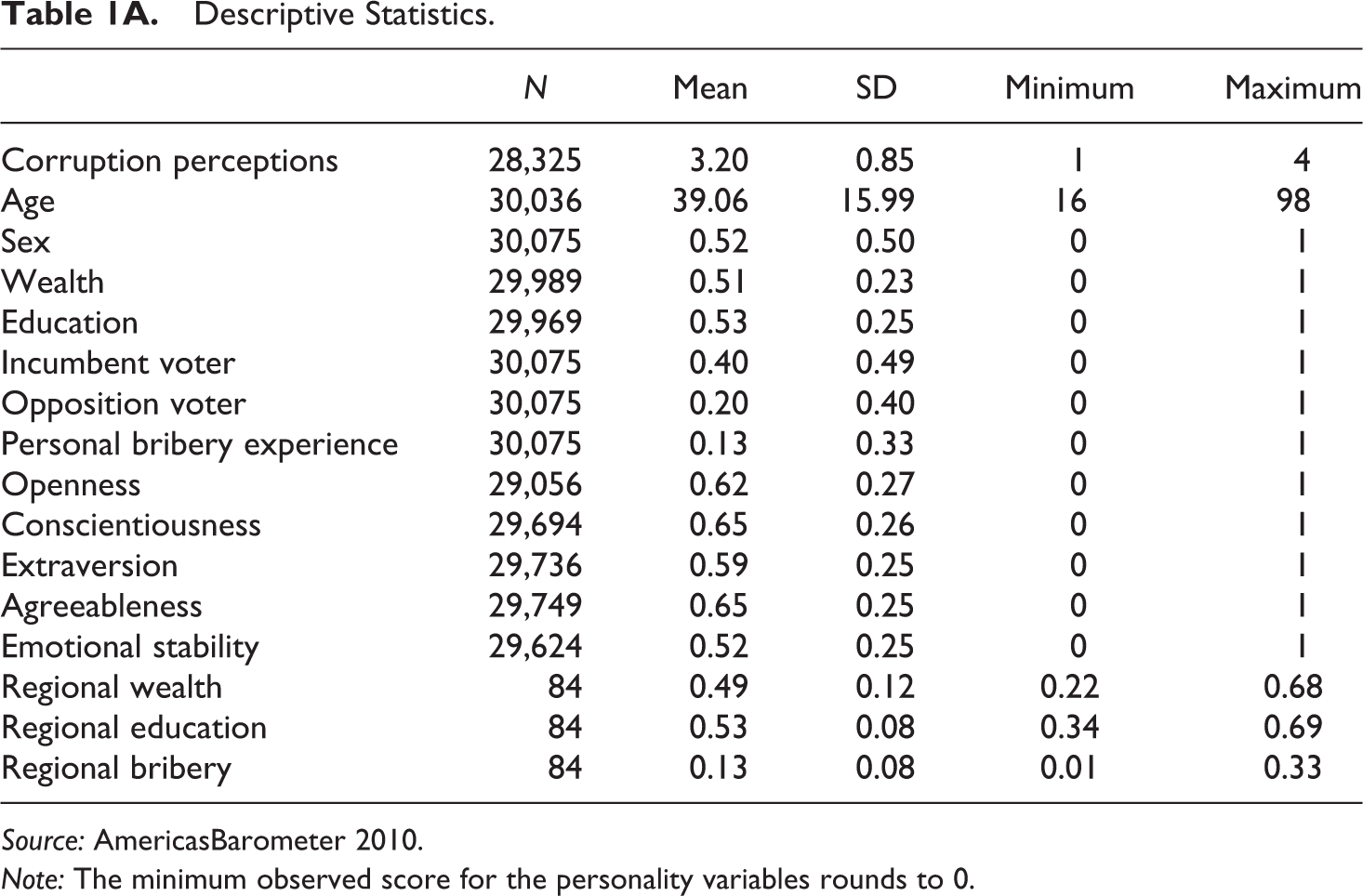
| N | Mean | SD | Minimum | Maximum | |
|---|---|---|---|---|---|
| Corruption perceptions | 28,325 | 3.20 | 0.85 | 1 | 4 |
| Age | 30,036 | 39.06 | 15.99 | 16 | 98 |
| Sex | 30,075 | 0.52 | 0.50 | 0 | 1 |
| Wealth | 29,989 | 0.51 | 0.23 | 0 | 1 |
| Education | 29,969 | 0.53 | 0.25 | 0 | 1 |
| Incumbent voter | 30,075 | 0.40 | 0.49 | 0 | 1 |
| Opposition voter | 30,075 | 0.20 | 0.40 | 0 | 1 |
| Personal bribery experience | 30,075 | 0.13 | 0.33 | 0 | 1 |
| Openness | 29,056 | 0.62 | 0.27 | 0 | 1 |
| Conscientiousness | 29,694 | 0.65 | 0.26 | 0 | 1 |
| Extraversion | 29,736 | 0.59 | 0.25 | 0 | 1 |
| Agreeableness | 29,749 | 0.65 | 0.25 | 0 | 1 |
| Emotional stability | 29,624 | 0.52 | 0.25 | 0 | 1 |
| Regional wealth | 84 | 0.49 | 0.12 | 0.22 | 0.68 |
| Regional education | 84 | 0.53 | 0.08 | 0.34 | 0.69 |
| Regional bribery | 84 | 0.13 | 0.08 | 0.01 | 0.33 |
Source: AmericasBarometer 2010.
Note: The minimum observed score for the personality variables rounds to 0.