




Abstract
The 1990s witnessed the spread of anti-corruption scandals in Latin American countries as well as a decade in which international transparency standards were developed. These two processes were closely related but they followed different local and global political dynamics. Transparency policies were perceived everywhere as a good response to the growing of corruption scandals. But, at the end of the day, the effectiveness of these policies was far from optimal. This article discusses the link between these two main aspects of the corruption as a public problem in Argentina. It reconstructs the dynamics of corruption scandals and state responses in Argentina during the 1990s, and asks how effective and efficient those responses were given the type of accusations and corruption cases exposed to the public through scandals. The hypothesis is that scandals, on the one hand, and public policy responses, on the other, refer to different aspects of the same problem and that the latter have failed to deal effectively with the demands and claims expressed through the scandals.
Introduction
Since the 1990s, corruption scandals became a recurrent phenomenon of the political life. This can be verified in many Latin American countries as well as in European ones. Throughout the decade, countries such as Italy, France, Spain, and Portugal – just to mention the most important examples – were shaken by scandals that had a strong impact on political life. In Latin America, corruption scandals became a trait feature of democratic politics to the extent that some administrations throughout this period have remained strongly tied to corruption allegations (Adut, 2008; Bågenholm, 2013; Blechinger, 1999; Costas-Pérez et al., 2012; Garrard and Newell, 2006; Shore, 2003; Thompson, 2013). A first wave of high-profile scandals begun with blunt allegations against Presidents Carlos Andres Perez in Venezuela, Fernando Collor in Brazil, Carlos Menem in Argentina, and Alberto Fujimori in Peru, among others (Blake and Morris, 2009). More recently, a second wave of accusations have also reached most major Latin American political leaders – including presidents and former presidents of Brazil, Chile, Argentina, Mexico, Ecuador, and Guatemala, to name the most important ones. To end with large-scale anti-corruption demonstrations flourishing around the globe (Della Porta, 2017).
Corruption scandals have generally had great impact and significant political consequences in most countries, yet not necessarily in institutional terms. For instance, judicial responses to corruption scandals and allegations were usually insufficient and late (OCDAP et al., 2012). However, ever since the 1990s corruption has become a specific issue of public policy. Both in terms of legislation and the development of programmes and public agencies, states reacted to the growing concern on the matter as well as to citizenship’s growing dissatisfaction. Anti-corruption reforms were initiated in many countries in the last two decades showing a few successes (Persson et al., 2013: 450).
This article discusses the synchrony and compatibility – at least in this early period and for the case of Argentina – between these two aspects of the corruption as a public problem. It reconstructs the dynamics of corruption scandals and state responses in Argentina during the 1990s, and wonders about how effective and efficient those responses were given the type of accusations and corruption cases exposed to the public through scandals. The hypothesis is that scandals, on the one hand, and public policy responses, on the other, refer to different aspects of the problem and that the latter have failed to deal effectively with the demands and claims expressed through the scandals.
The first section assesses the dynamics of the early wave of corruption scandals in Argentina (1990–2001) and discusses the main features of a series of cases surveyed in the press. Then, the article focuses on the legislation and state-driven institutional innovations of the time. It reviews the bills that were discussed in Congress and focuses with more detail on the creation of the Oficina Anticorrupción (Anti-Corruption Office [OA]) in the late 1990s. The last section compares the approaches of the corruption issue that lie behind scandals and public policies, in order to assess the degree of decoupling between the two ways of addressing the problem.
The Growth of Corruption Scandals in Argentina during the 1990s
The 1990s is often mentioned by analyst as a key moment of emergence of corruption scandals around the world (Mattina et al., 2018). That’s the case for Argentina that has witnessed a significant wave of corruption scandals during that period. In fact, the wave marked a significant change in the political landscape of the country. Since the 1990s, corruption is almost constantly present in public debate about national politics. This section focuses on scandals of that period offering a systematic analysis based on a data set built using national press as a main source.
In our analysis we use a classical of the term scandal referring to “[…] actions or events involving certain kinds of transgressions which become known to others and are sufficiently serious to elicit a public response” (Thompson, 2013: 23). This means that the scandal involves a particular form of mobilisation of moral indignation and the act of making a complaint before an audience. With this framework, a survey of all corruption scandals reported by the national press – from early 1990 to late 2001 1 – was undertaken. The sources were the three main national newspapers: Clarín, La Nación, and Página/12. Operationally, “scandals” were those events that had some continuity over time beyond the mere complaint, and led to disputes where some kind of legal evidence was involved (e.g. the judicial investigation, provision of evidence, documents, etc.). A total of 136 scandals were recorded during the period in order to assess its characteristics and observe some of their features: type of complainant, type of accused, scandal reason, and coverage of the consequences, among others.
Corruption occupied a growing place in the press throughout the decade only taking into account cover pages featuring the scandals under scrutiny (Figure 1). The relevance of the corruption scandals is a key trait of the decade especially considering that there was a change of the political coalition in office in 1999. 2
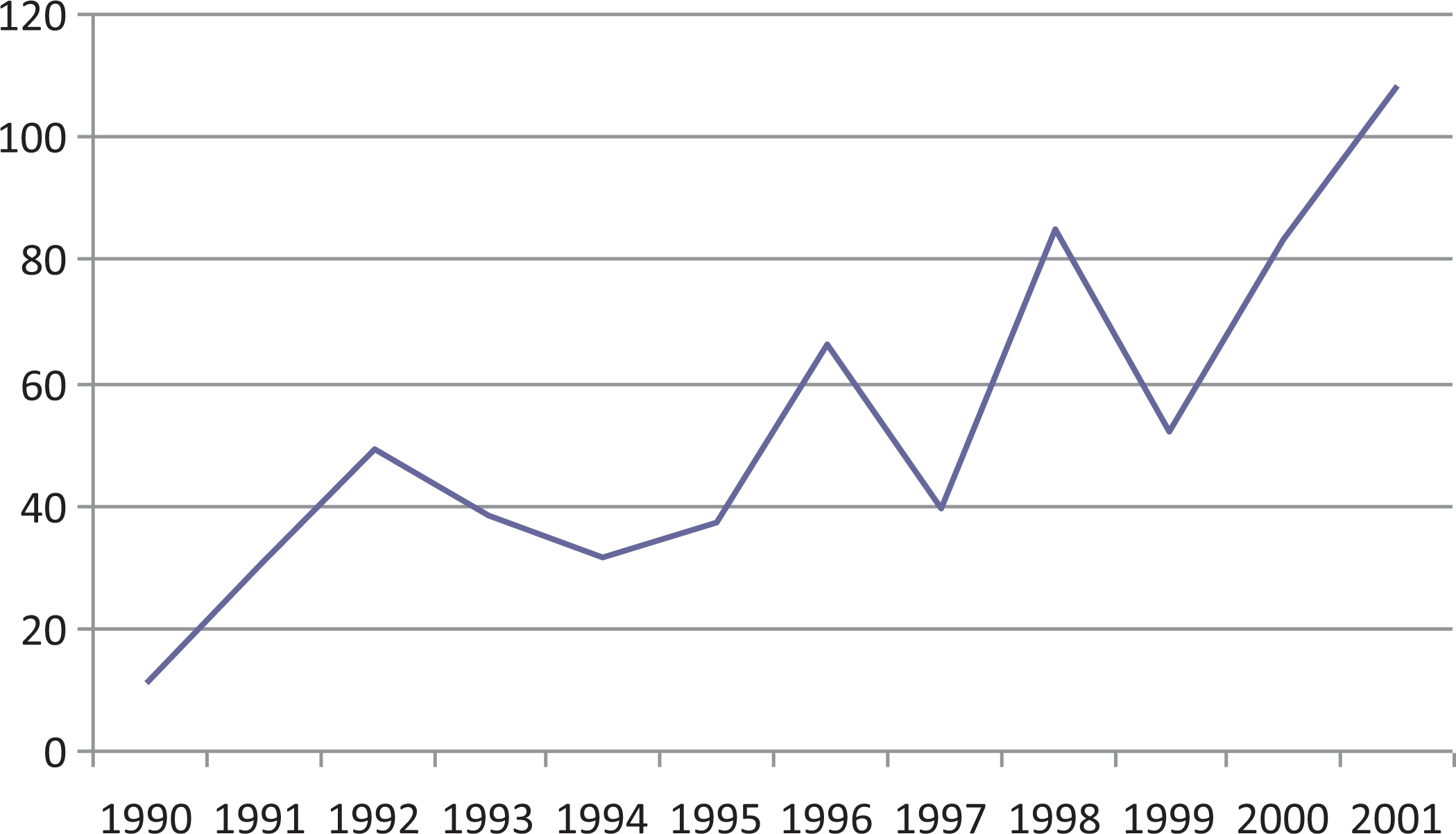
Number of Newspaper Covers Referring to Corruption Scandals (1990–2001).
Scandals during the decade show different type of narratives and plots. They changed over time and reveal different aspects of public concern about this issue. Predominantly the development of a citizens' critic point of view towards politics and politicians. In this sense, it is risky to provide a general analysis of political scandals during the decade. But for the purpose of this text we move in that direction trying not to over decontextualise the data but focusing only in some general features of the scandals.
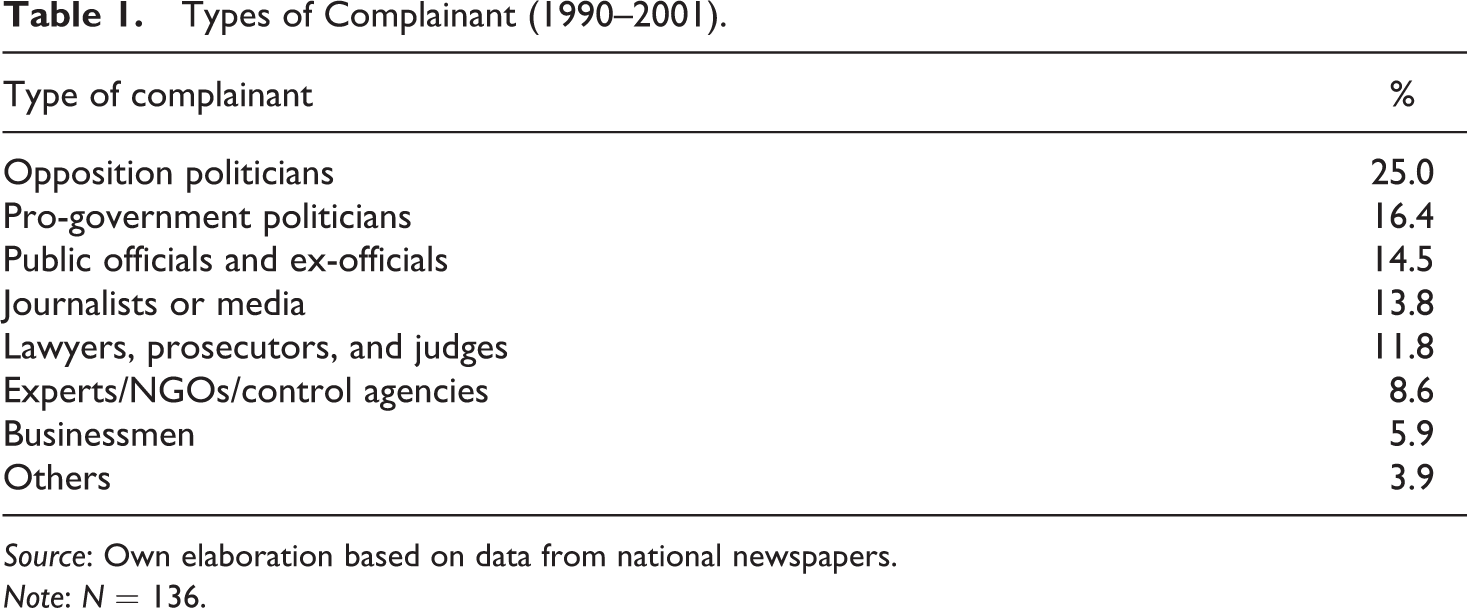
Scandals are triggered by complaints and establish the different types of complainants are relevant for the understanding of political dynamics in which scandals are embedded (Mattina et al., 2018). Table 1 shows the distribution of complainants throughout the period.
Types of Complainant (1990–2001).
Source: Own elaboration based on data from national newspapers.
Note: N = 136.
A review of the different types of complainants shows a significant heterogeneity. Contrary to what might be expected, journalists were not the major complainants in corruption scandals but rather political players (41.4 per cent). Interestingly enough, the proportion of those who were in the opposition at the time is only slightly higher (25 per cent) than the proportion of those who were part of the ruling majority (16.4 per cent). If we add to that the 14.5 per cent of complainants who were officials or former officials, it is clear that one-third of the complainants in 1990s scandals belonged or was linked to the government coalition. In this sense, corruption allegations seem to have become, over the decade, a resource and an instrument of political struggle, in a broad sense. Whereas opposition politicians denouncing a corrupt administration represent a classic image of political struggle, here it can be noted that criticism also operated as a key element of dispute within the administration or ruling coalition itself (Balán, 2011). The progressively hybrid nature of government coalitions brings important elements for the understanding of this phenomena (Calvo, 2013). Hence, research journalism – usually viewed as a condition of possibility for the triggering of political scandals – does not seem to occupy such a central place in this stage. Of course the work of journalism does not disappear when journalists themselves don’t become complainants since it is their work what is tighter linked to production than with research as a whole. It has to be noted that while many of the most emblematic and high-impact scandals were promoted by journalists, this was not the rule for the majority of the cases.
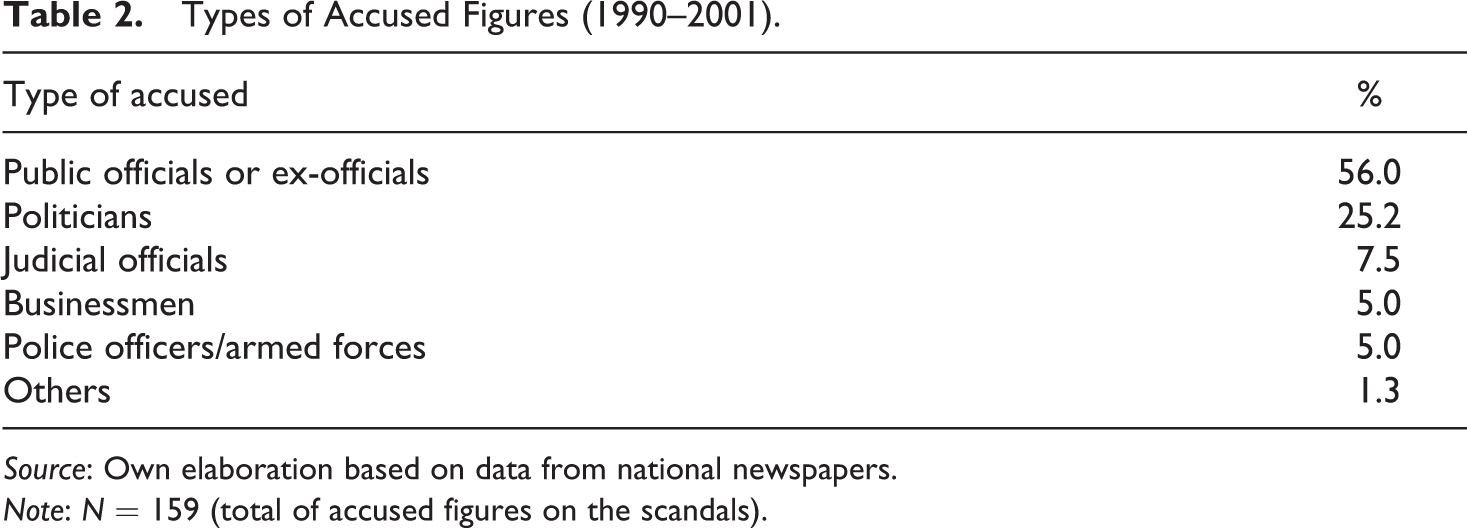
Considering the types of accused figures, it is possible to note that although the global picture is slightly diversified, public servants amount a clear majority (Table 2). Moreover, corruption accusations focused almost exclusively on those who were part of the world of politics and therefore, in some sense, were restricted to only one of the parties involved in corrupt exchanges (Granovetter, 2007).
Types of Accused Figures (1990–2001).
Source: Own elaboration based on data from national newspapers.
Note: N = 159 (total of accused figures on the scandals).
The overwhelming majority of complaints (56 per cent) referred to public officials, which is consistent with the iconic main characters of the biggest scandals (Swiftgate, weapon trafficking to Ecuador and Croatia, the Yoma Case, bribes in the Senate, etc.). As just noted, most of the accused had direct ties with the political activity (83 per cent). It can also be noted a strong trend towards focusing on the person of the accused. This personalisation has a lot to do with the meaning of scandals themselves because they put on trial, above all, the moral status of the accused. Although the narratives that explain or justify acts of corruption tend to appeal to more complex and collective dimensions – such as hyper or systemic corruption, lack of controls, and Argentine culture – scandals were mainly about the behaviour of certain characters, whose moral integrity was under question.
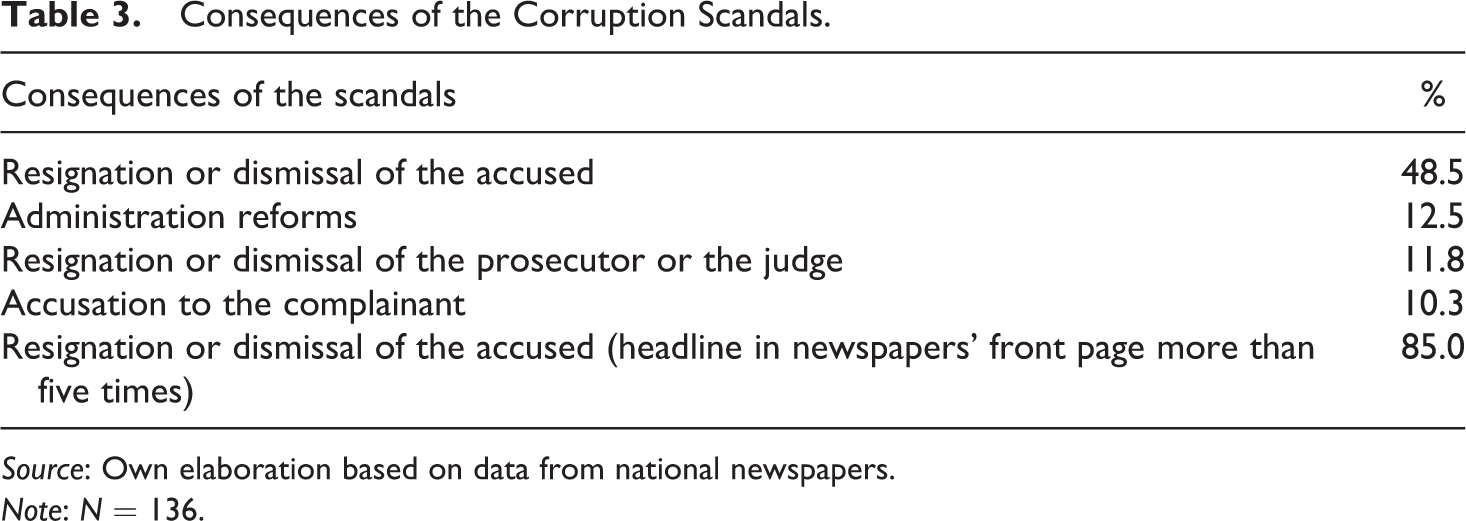
What were the consequences of these scandals? Drawing upon available information, it can be noted that the coverage of scandals tended award a very important place to the judicial treatment of the cases. However, at the same time, as the thread of judicial treatment dilutes over time, scandals lost centrality and interest without reaching significant results. Most of the cases (87 per cent) include information about the first steps of the judicial process. However, very few scandals are still matter of public opinion concern when resolution of trials occurs. 3 In that sense, it is important to consider what is the main output of the scandals. Table 3 summarises the main consequences that put to an end the analysed scandals
Consequences of the Corruption Scandals.
Source: Own elaboration based on data from national newspapers.
Note: N = 136.
Types of Anti-Corruption Bill Drafts (1989–2001).
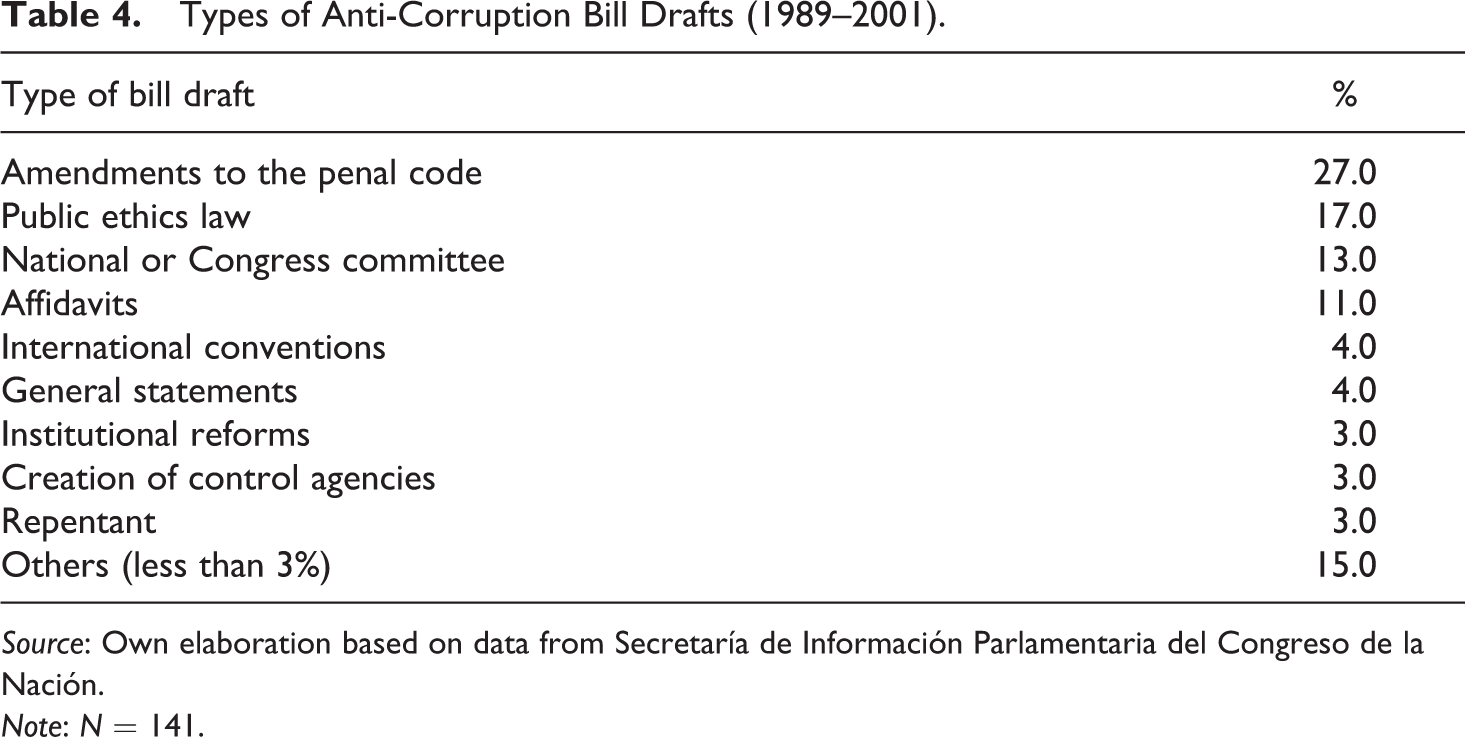
Source: Own elaboration based on data from Secretaría de Información Parlamentaria del Congreso de la Nación.
Note: N = 141.
Scandals had one main kind of impact: the resignation or dismissal of public officials. Therefore, punishment should be considered an essential element in corruption scandals, 48.5 per cent of the surveyed scandals led to resignation or dismissal of the accused. If only the most important scandals were to be pondered – those which became headline in newspapers’ front pages more than five times – the figure rises to 85 per cent. In that sense, scandals can be primarily understood as a mechanism for the removal of public officials, although the contexts in which these dismissals took place were very diverse.
Considering the complaints and the consequences that resulted from the scandals, the centre of the scene is occupied by the acts of corruption and the individuals who perpetrate them. Corrupt exchanges tend to blur and institutional and organisational contexts are often neglected. This first wave of corruption scandals shows that scandals arose as a recurrent element of political struggle to definitely become a key weapon to challenge political class. Professional figures such as journalists or lawyers reinforced their public image vis-à-vis the political class, but corruption scandals also acted (somewhat paradoxically) as a resource of political struggle. In the latter sense, it should be noted that internal struggles in governmental coalitions played a key role in the production and development of corruption scandals during this period. Thus, the most emblematic and significant scandals happened to be those which, on the one hand, showed a difference between the kind of complainant and the kind of accused and, on the other, succeeded in terms of the main consequence they could lead to: the dismissal of the person indicted.
Origins and Main Aspects of Anti-Corruption Policies
The other significant and related aspect of this story is no doubt the development of anti-corruption or transparency measures as a new domain in public policies. This process has to do with global as well as with local dynamics (Krastev, 2004; Pereyra, 2013). We are going to focus here exclusively on local dynamics hopefully contributing that way to the better understanding of the impact and consequences of this new measure.
During the 1990s the deployment of anti-corruption measures was linked to the growing presence of scandals involving administration officials from 1991 onwards. Complaints against the Menem administration itself elicited official responses. In a first stage, they involved parliamentary action and were primarily oriented to the criminal prosecution of corruption acts. Over the decade, however, transparency policies were developed progressively linked to international anti-corruption standards. The Peronist governing coalition’s defeat in 1999 allowed the new anti-corruption paradigm to start producing reforms in the realm of the executive branch. The winning coalition (Alianza) had turned the corruption issue into one of its main campaign slogans, integrating into its ranks a number of experts and activists who had built anti-corruption networks in the country (Guerzovich and De Michele, 2010; Pereyra, 2013). Thus, the debate in the legislative arena gave way to institutional innovations that closed a cycle of complaints and policymaking that ended with the 2001 crisis. In what follows we first analyse legislative anti-corruption production during the decade and then the most significant institutional reforms.
A first important finding is that after the end of the last military dictatorship in 1983, and until 1989, no bill related to the anti-corruption issues had been filed in Congress. By contrast, 141 bills were presented in the following decade (1989–2001). Between 1983 and 1989, the concept of “corruption” was not absent in legislative vocabulary – at least seventeen legislative statements referred to the topic – but it seems elaborating legislation in this realm was not an urgent matter. Since 1989, this concern grew significantly and, in addition to the above-mentioned bills, a total of 471 draft resolutions, statements, and communications were prepared vis-à-vis this issue. 4
Between 1989 and 2001, a total of 141 bills were submitted regarding the issue of corruption (see Table 4). The number of submitted bills grew irregularly since the early 1990s, featuring scaling peaks in 1991–1992 (thirty-two drafts) and 1996–1997 (forty drafts). Since 1991, at least seven bills were presented every year in one of the two chambers. This shows that throughout the decade there were sustained efforts to produce legislation on anti-corruption issues.
Regarding the characteristics of these bills, a wide heterogeneity of themes and approaches can be found (we developed a typology covering twenty-one different varieties of drafts). Yet, despite this dispersion, some types are clearly dominant over the others: amendments to the penal code (27 per cent), public ethics laws (17 per cent), national or Congress committees (13 per cent), affidavits systems (11 per cent).
In terms of legislative output, punitive approaches on corruption prevailed throughout the decade. On a regular basis, new bills sought to increase penalties for crimes against public administration and jurists came up with new categories and definitions in an attempt to fully capture those crimes.
However, only 3.5 per cent of all projects under analysis were completely enacted, while 12.8 per cent were addressed and discussed giving way to other draft-laws and norms. The vast majority of these legislative projects were not sanctioned at all. These numbers heighten the idea of Congress as a low-intensity normative production body at that time. 5
The Menem administration laid down specific anti-corruption measures regularly from the moment it took office, most of which sought heavier penalties for corruption offences (i.e. illicit enrichment, influence peddling, subornation) or aimed at introducing new legal definitions to describe them better. The first of those anti-corruption legislative projects, that endorsed what was being put forward through presidential discourses, was presented in March 1990. 6 This law-draft stirred debate among opposition legislators, who responded by presenting an alternative project focusing on public officials’ financial disclosures rather than on the penalties themselves. The bill drafted by the members of the party in office posed tougher penalties for defamation, libel, and slander, which in a way was a response to the first accusations that, as shown above, had already begun to gain Media attention. Parlamentary debates during the decade recurrently focus on penalties for corrupt acts. 7
Something similar happened with the bills that sought to establish a Regime, Statute, or Code for public officials. These initiatives came to be known as “Public Ethic Bills.” In 1997, Menem administration created the National Office of Public Ethics (Decree 152/97). The Executive Power drafted and enacted the Code of Public Ethics provided for in the decrees of 1997. Decree 41/99 enacted the Code of Ethics drawn up on the basis of a set of general principles governing the activity of public officials. Towards the end of the Menem administration, discussions about public ethics and corruption also led to legislative approval of two other important initiatives: on the one hand, in September 1999, the Framework Law on the Regulation of National Public Employment (25.164) and, in November, the Law on Ethics in the Exercise of Public Function (25.188). Together, all of these regulations meant settling the debates that began in 1997 with the discussion of the Code of Ethics and modified the Basic Legal System of Public Function established in 1980 (Law 22.140). However, as an official report argues, the outcome of this process was a very complex and even contradictory regulatory framework for public employment (Alegre, 2001: 4).
Throughout this period, especially towards the end of the Menem administration, the ties between corruption and state reform led the ruling party to insist over and over about the need of completing a full re-engineering of state administration through the transformation of operation standards, labour reform, and the disciplining of public officials.
After the government change, new institutional reforms were conceived and enacted. The 25.233 Act gave way in 1999 to the creation of the OA. It should be borne that the Alianza coalition, who won the elections that year, built its campaign precisely on the idea of fighting “Menem administration” corruption.
Compared to its predecessor, the Public Ethics Office, the OA was conceived as a broader agency with enhanced and executive powers. Run by an Administrative Control Prosecutor, the OA structure was based on two bodies: the Department of Investigations (Dirección de Investigaciones), whose main function was to supervise that agents comply with their duties, make a proper use of state resources when investigating cases and eventually bring them to the Justice; and the Transparency Policy Planning Department (Dirección de Planificación de Políticas de Transparencia), in charge of elaborating comprehensive anti-corruption policies for the public sector.
The office began operations with forty employees, twenty per department. Its employee profile stood out counter to traditional civil servant stereotypes. These were higher educated young professionals with job and technical skills who drifted apart from the traditional bureaucratic model as well as the long-established partisanship and ideological conviction that had defined these jobs. However, the OA was created as part of the executive branch lacking autonomy and financial autarchy As a result, agency policies were basically established by the new government and were oriented mostly towards an investigation of the previous administration crimes.
In that context, the Office began its work investigating corruption cases. By the end of 2000, the Office had received 1,076 cases, most of them against officials who had worked under the previous administration. Many of these cases had an important impact and after a lengthy judicial debate, the Office succeeded in obtaining courts’ recognition to be part of the prosecution. Even when the OA bolstered research processes, judicial results were actually quite minor; besides, as soon as the Office sought to move forward in the investigation of Alianza government officials, it began to endure important political questioning. By 2003, the OA had filed a total of 667 cases, and 127 officials and former public officials had been investigated for the alleged crimes, out of which 71 were indicted. However, only one case had reached trial and the accused had been acquitted (“Annual Anti-Corruption Office Balance,” en Diario Clarín, 20 February 2003).
The OA was then conceived to pursue former government officials and politicians. But, on the other hand, was also seen as a place to develop new control policies focusing on the functioning of public administration. In that regard, the OA creation responded to a line of action based on the efforts of anti-corruption and transparency experts. Thus, legal-punitive visions that fundamentally focus on an ex post control of administrative acts yield their ground before more administrative and management-oriented perspectives, guided by a systemic and predominantly preventive view. A transparency agenda was then developed but the OA was unable to translate that agenda into institutional reform. Even when the OA had succeeded in reinforcing a system of affidavits with compliance figures close to 95 per cent, most of the policy reform agenda was partially enacted and not in a sustainable way after the 2001 crisis. 8
The investigation branch of the OA suffered a significant weakening process during the Alianza administration. With no investigation activity related to the administration in office, the development of new corruption scandals severely affected the reputation of the agency. In 2000, the Alianza administration suffered its most terrible crisis because of a bribery scandal in the Senate. The scandal led to the resignation of Vice President and produced a Cabinet change, promoting President de la Rúa’s brother to the position of Minister of Justice, in a move that triggered uncertainty and demands among the OA members. Without a doubt, this episode has imprinted one of the Office’s biggest constraints, and it’s an explanation for the low profile and performance in the years to come. The complementary trait of this low investigation profile of the OA was the production of a weak regulatory frame oriented towards day-to-day activities of the public administration. A regulatory frame that is, in principle, far away from anti-corruption demands is expressed throughout the scandals.
Conclusions: Can Transparency Policies Be Compatible with Anti-Corruption Demands?
This text presents the results of research data that allow to ponder how anti-corruption claims rose and multiplied in Argentina during the 1990s. Corruption scandals became an important feature of the country’s political life. Consubstantially, policy responses begun to be articulated to address the issue. Thus, it gave way to an important legislative production, as well as the creation and transformation of specific public agencies. The emergence and consolidation of a new anti-corruption paradigm, synthesised in the formula “transparency policies,” was one of the most important traits of the period. This paradigm shows an interesting synchrony between the production of standards at an international level and the domestic consolidation of political actors capable of implementing those reforms locally.
Throughout this entire process, it is possible to see an important disconnection between the logics of scandals and that of public policies. Scandals, as shown above, tend to focus on individual liability for corruption and to place the judicial treatment of cases and the moral degradation of those involved at the centre of the scene. The functioning of corrupt exchanges or the problem of collision between public interest and private interest also tends to fade behind that sort of emphasis on the participation of public officials or professional politicians. Private sector participation on corrupt exchanges tend to be overestimated. Organisational cultures and mechanisms that result in bribery practices are not considered as part of the problem (Pohlmann et al., 2016: 95). Hence, the ties between politicians and politics and other social actors appear as splintered, weighting over their heads the responsibilities for the causes and consequences of the issue of corruption.
The state response to the proliferation of corruption scandals was initially tied to that demand for a criminal treatment of these cases. During the 1990s most projects sought to increase or codify penalties for crimes against the public administration and this growth coincides with the highest points of the discussion of the problem in public opinion. However, it could also be observed that this initial response also gave rise to the structuring of an agenda on transparency policies meant to deal with the issue. This agenda mainly focused on the functioning of public administration and pondered corruption in a systemic and integral way, as well as in a more day-to-day fashion tied to the formal and informal rules that govern civil service and operate on the political activity. With strong arguments, this agenda starts at the assumption that it is not the individual cases, nor the most resonant ones that allow us to understand the forms of collusion between public and private interest in the State and Politics operations. Yet, this is the way through which transparency policy agenda gradually loses its connection with those individual and resonant cases that are fuelled by corruption scandals. As mentioned by other analysis, instruments to curb corruption tend to become ineffective since there will be no actors that have an incentive to enforce them (Persson et al., 2013: 450–451). In our case, this was particularly true regarding the investigative facet of the OA. Created in 1999, after the government change, the OA was rapidly confronted to the task of reacting to the own government corruption scandal. The lack of autonomy was then a key feature that produced the low profile and retrospective-oriented performance of the agency.
These circumstances took shape during the 1990s on the brink of the first wave of corruption scandals in the region. Today, we are witnessing a second wave of scandals whose scope and physiognomy continue to progress and expand. Thus it is under this context and considering this scenario it is relevant to ask how an agenda of reforms and transparency policies can be retaken and updated.
Footnotes
Declaration of Conflicting Interests
The author(s) declared no potential conflicts of interest with respect to the research, authorship, and/or publication of this article.
Funding
The author(s) disclosed receipt of the following financial support for the research, authorship and/or publication of this article: The author received financial support for the ALBAN Programme from European Commission.