



Abstract
What factors led to the surprise defeat of the Colombian peace referendum? Initial analyses suggested a link between support for peace and the experience of violence, but economic conditions and political support for incumbent parties also affect electoral outcomes. We use Bayesian hierarchical models to test links between referendum result and previous violence victimization, economic conditions, and support for Centro Democrático (the main party opposed to the peace agreement). There was less support for peace in the Andean region than in other regions, and departments with lower support had higher unemployment and growth in GDP. Support for the opposition was the dominant covariate of decreasing support for the peace accords, while previous violence victimization increased the proportion of votes for peace. In light of these results, regional variation in baseline support for the agreements – a complex variable governed by partisan engagement but also influenced by structural economic factors – will be critical during implementation of the newly revised accords.
Introduction
Implications of the 2016 Colombian Referendum
Throughout 2016, talk of post-conflict became common throughout Colombia. After four years of peace talks, the government and the FARC (Fuerzas Armadas Revolucionarias de Colombia) agreed to end their conflict that had started in 1964. On 2 October 2016, Colombian voters went to the polls for a referendum on a peace deal negotiated by the FARC and President Juan Manuel Santos. Despite projections of a “yes” vote on the referendum, a slim majority (50.2 percent) rejected the peace deal with the FARC. The “No” campaign was led by former president Alvaro Uribe and his Centro Democrático party, who criticized the deal for being too lenient on the FARC, being too financially generous to demobilized rebels, and providing guarantees of representation in Congress through 2022. Why did the “no” side win? Was it a reflection of President Santos’ low approval rate? Does it portend growing support for the main opposition party, led by former President Uribe? Does it undermine prospects for peace in Colombia? So far, descriptive analyses or media-based speculation have dominated the answers to these urgent questions. At least two theoretical approaches are relevant to this case; one studies the inclusion or exclusion of civil society in the peace process, and another focuses on referendum results. While the civil society and peace process literature sets positive expectations for the referendum results, the referendum literature is guarded, at best.
Peace Talks, Civil Society and Legitimacy
There is a large literature debating the efficacy of the inclusion of civil society in peace negotiations. Despite the increased complications that can arise from additional parties in peace negotiations, scholars such as Aall (2007), Belloni (2001), Orjuela (2003), and Paffenholz (2010) have argued for the inclusion of civil society in peace processes. The advantages of this approach to negotiations are not limited to the agreements among parties. Instead, cross-national analyses find that inclusion boosts the perceived legitimacy of the peace process leading to more durable peace (Nilsson 2012; Wanis-St. John 2008; Zanker 2014). However, the specific mechanisms translating inclusion to legitimacy remain unclear. For example, there was no increased support for the peace agreement among university students in Cyprus in an experimental study analyzing the inclusion of civil society (Kanol 2015). Nevertheless, inclusion takes many forms, and the specifics of civil society inclusion matter
(Paffenholz 2014). This is why Paffenholz (2014) encouraged scholars to focus on particular characteristics, as she has identified nine models of civil society inclusion.
The 2016 Colombian case can be considered unusual. Although the peace negotiations were initially held between the Colombian government and the FARC, midway through the talks, the United Nations and Universidad Nacional de Colombia convened five national forums to obtain civil society input to be presented to the negotiators in Havana. Moreover, certain victim groups, including women, indigenous and Afro Colombian representatives, were invited to contribute. In an attempt to maintain support of the armed forces, respected retired military officers also participated. The last point of the agreement called for a democratic mechanism that was initially designed as a referendum. The referendum organization did have broad participation, with 1842 committees registered with the National Election Council (1676 in favor and 166 against; see Gomez-Suarez 2017). Overall, there was substantial civil society participation, and attention to victims in particular, which is generally expected to increase support for a peace process.
Referenda
Referenda are relatively uncommon and results may be driven by the salient policy issues, but also by support for the incumbent or opposition, and in response to economic performance. For example, a weak economy and the power of Euroskeptic parties played a role in the French rejection of the European constitution (Jerome and Vaillant 2005), but support for the president also minimized the loss among center-right parties (Brouard and Tiber) 2006). In the case of the 1992 Danish EU referendum, as in Colombia, the intention to put the issue before a popular vote was seen as more democratic, but the risk of placing a major foreign policy issue (in Denmark) or a major domestic policy issue (in the Colombian case) before ordinary voters lies in the public's lack of interest and information (Siune and Svensson 1993). Hence, referenda have been cited as both ways to strengthen democracy and accountability (Barczak 2001), or to outmaneuver opposition forces through decrees and popular referenda (Breuer 2009). In Latin America, referenda tend to be related to institutional reform (Altman 2014).
The Colombian referendum was initiated by Colombian President Juan Manuel Santos to legitimize the peace treaty and isolate the agreements from subsequent political debates, and was therefore a proactive referendum (Breuer 2009). Further, the decision to hold a referendum is framed by a general decline in support for Colombian political parties (Holmes and Gutiérrez De Piñeres 2012). The referendum was an attempt to legitimate both the president and his agenda and was not just a means to obtain a popular vote on a specific decision (Breuer 2007). Although Santos had won re-election in the second round with almost 51 percent of the vote in 2014, the closeness of the results meant that Santos had to look for support among other parties to create a governing coalition. His rival, Óscar Iván Zuluaga, of Uribe's Centro Democrático party, had received 45 percent of the vote in the second round.
Power is fragmented in the both the House and in Senate. The Senate has 102 members, but there is no majority party. Instead, major parties include the Partido de la U party, which has 21 seats, followed by the Centro Democrático with 20, the Partido Conservador (18), the Partido liberal (17), the Partido Cambio Radical (nine), and the Partido Alianza Verde, the Polo Democrático Alternativo, and the Partido Opción Ciudadana, all of which have five seats. The House contains 166 members and is similarly divided. The Partido liberal holds 39 seats, the Partido de la U has 37 seats, the Partido Conservador 27, the Centro Democrático 19, and the Partido Cambio Radical 16. The Partido Alianza Verde and the Partido Opción Ciudadana each have six seats. Numerous other small parties had some representation (Polo Democrático Altemativo and El Mira had three each, in addition to others, see El Tiempo 2014).
Prior to the referendum, there were early warning signs for support of the peace process. Santos’ declining popularity had a negative impact on support for the peace process. Based on public opinion polls in 2014 and 2015, Carlin, McCoy, and Subotic (2016) found that trust in President Santos was one of the largest indicators of support for the peace process. As Santos’ popularity waned, this linkage was going to drag down support for the peace process. Moreover, previous polls (e.g., Montoya 2014; Rodríguez 2012) documented general support for a peace process, but little support for the FARC participating as a political party and a lingering skepticism about FARC's true motivation of peace. At the time of the referendum in October 2016, Santos’ approval had fallen to a low of 29 percent. His 2014 rival, Zuluaga, had an approval rating of 34 percent, and former President Uribe, who took a hard line against the FARC and was a strident opponent of peace talks, was most popular with a 52 percent approval rating. Uribe and his Centro Democrático led the effort for the “no” vote in the referendum.
Of course, economic performance factors also have a major impact in elections (Lewis-Beck 2008), including referenda. In the case of the 1988 Chilean election, economic performance in terms of income, unemployment, and inflation influenced the referendum on Pinochet (Panzer and Paredes 1991). According to Gallup, by late fall 2016, the Colombian public was increasingly frustrated with corruption, poor economic performance, unemployment, and inflation (Gallup 2016a), creating a negative context for the referendum.
Historically, security has also been a major concern in Colombia. However, for the first time since May 2011, security was not consistently one of the top two concerns of Colombians in the six months leading up to the referendum (Gallup 2016b). Security concerns have been noted as important performance issues in explaining electoral outcomes elsewhere (Arce 2003; Gassebner, Jong-A-Pin, and Mierau 2008; Holmes and Gutiérrez De Piñeres 2012; Kelly 2003). However, this referendum raised hopes of ending a conflict with FARC that had plagued Colombia since 1964.
Based on the referendum literature, a number of factors favored the “no” side. First, there is a “status quo bias”, also known as LeDuc's Law, in which voters tend to support the status quo at the ballot box, despite possibly expressing support for change earlier in polls (LeDuc 2003). Indecision and uncertainty translate into support for the status quo, in this case, continued conflict in Colombia and a rejection of the peace process. Second, uncertainty about outcomes favors the default (Bowler and Donovan 1998), in this case the “no” vote. Third, thanks to repeated referenda in the state of California, it is possible to analyze how campaign spending affects results (Bowler 2015). Campaign spending to support the “no” side can be more powerful than the “yes” – strong enough to play a veto role but not strong enough to generate a legislative solution (Bowler 2015). Finally, a similar asymmetry favoring “no” votes emerges in campaigning and messaging (Vreese 2006), as it is more difficult to defend a yes vote and easy to attack it. In a partisan setting, political parties generally have a hard time sending consistent messages despite a dichotomous yes/no choice (Vreese 2006). These dynamics, which bias strongly toward “no” votes, are more powerful in countries where voters have relatively little experience with referenda, and Colombia had not held a referendum since its constitutional referendum in 2003. Partisan education and messaging become critical, but large, centrist parties have the most difficulty maintaining coherent support for referenda (Vreese 2006). In short, the referendum literature provided a more pessimistic assessment for the Colombian referendum.
The outcome surprised both the poll-based predictions and the government that called for it. Here, we analyze the outcome of the referendum to evaluate the relationship between the vote and a series of potential covariates, including economic, electoral, and conflict-related variables. To adequately model data collected at a larger geographic scale, we use a hierarchical approach, enabling sampling of unemployment, economic growth, and inflation. The results highlight the importance of controlling for economic trends when accounting for electoral outcomes.
Materials and Methods
Data
A series of socioeconomic variables have been generally found to predict election outcomes. These variables include: support for the opposition in previous elections, gross domestic product (GDP) growth, and rates of unemployment and inflation. As the goal of this study is to identify and measure the relationship between exposure to violence and the referendum on the peace agreement, we included two variables to capture this association: the cumulative number of victims (2001–2010), and the cumulative arrivals of displaced persons for the 1984–2016 period (the modal year of arrival is 2000). These last two variables were divided by the 2005 census population to produce per-capita indicators (Brouard and Tiberj 2006; DANE 2008), and the resulting ratio was log10-transformed. Our final sample consists of 860 municipalities in Colombia as of 2016. In a simple linear model, the highest variance inflation factor (VIF) is 1.51, suggesting that multicollinearity is not an issue (Kennedy 2008). 2 Table 1 summarizes the response and predictor variables, along with their geographic scales and original sources.
Variables, Geographic Scale, and Data Sources Used in the Model
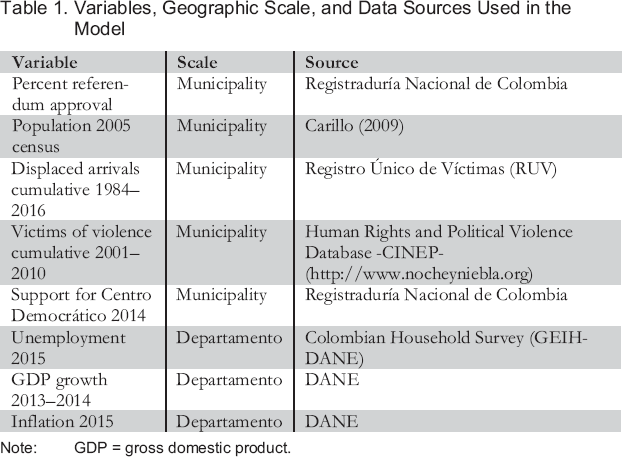
Variables, Geographic Scale, and Data Sources Used in the Model
Note: GDP = gross domestic product.
As part of the exploratory stage, we calculated a correlation matrix for all the variables included in the analysis. We also ran a simple regression model and performed a variance inflation factor (VIF) to detect any possible issue of an excess of linear correlation among explanatory variables. In general, no single correlation between a pair of independent variables is particularly high. In addition, the highest VIF is 1.51, which suggest that there is no problem of excess of correlation (the standard sing of multicollinearity is a VIF greater than 10).
While referendum outcome and violence data were available by municipalities, data on GDP and unemployment and inflation rates were available only at the aggregate department scale (that is, each department contains many municipalities). Therefore, we used a hierarchical Bayesian approach to model approval for the peace treaty (percentage) as a function of the predictor variables. In particular:

in which i designates each municipality and j each department, y is the percentage approval for the treaty at the municipal scale modeled as a normally-distributed variable with precision given as a function of its standard deviation σ y , α j specifies different intercepts for departments, and separate coefficients β capture the effect of each predictor. In turn, α j is normally distributed, and centered on mua with standard deviation given by σ a and determined by:

in which the intercept of each department is a normally-distributed variable with precision given as a function of its standard deviation σ a , and determined by variables observed at the department level. We compared a model including all predictors with one that excluded inflation and found that the simplest model lacked both inflation and the arrival of displaced persons as explanatory variables.
To estimate measures of variance explained at both hierarchical levels – observations y and departments a – we calculated errors at each of these levels of inference and estimated the variance explained and level of pooling in each case (Gelman and Pardoe 2006). Bayesian models were run in R2jags (Su and Yajima 2012) on the R v3.1.4 (R Development Core Team 2005) platform and were implemented in JAGS (Plummer 2003). Each model ran four chains of 5000 generations each. Posterior estimates were obtained after discarding the first half of all chains as burn-in, and thinning chains every other sample. To assess convergence, we used the Gelman-Rubin diagnostic (< 1.05) and effective sample size for all parameters ≥1000. The Gelman-Rubin diagnostic, or potential scale reduction factor (Gelman and Rubin 1992), approaches 1.00 as chains converge on the same estimates for a given parameter by comparing within-chain variance to the between-chain variance. The best model was selected by maximizing the variance explained for both observations y and departments a.
Results
The model with all predictors had the highest proportion of variance explained (Table 2). This model fitted different intercepts for each department summarized in Table 3. These department-specific intercepts indicate baseline support for the peace agreement before accounting for all predictors, with the lowest estimates for Quindio with a mean of 76 (95 percent HPD = 70–82), and the highest estimates for Chocó with a mean of 106 (95 percent HPD = 102–110). Two predictor variables, displaced arrivals and inflation, had coefficients with high probability densities including 0, consistent with or without detectable effect. All other predictors contributed to explaining the variance in the response, with the indicator of victims of violence strongly increasing support for the peace agreement, and support for the Centro Democrático party in the previous presidential elections strongly decreasing support for the peace accords (Figure 2). At the department scale, unemployment and GDP growth both decreased support for the accords, although not as strongly as the municipality-level factors (Figure 3).
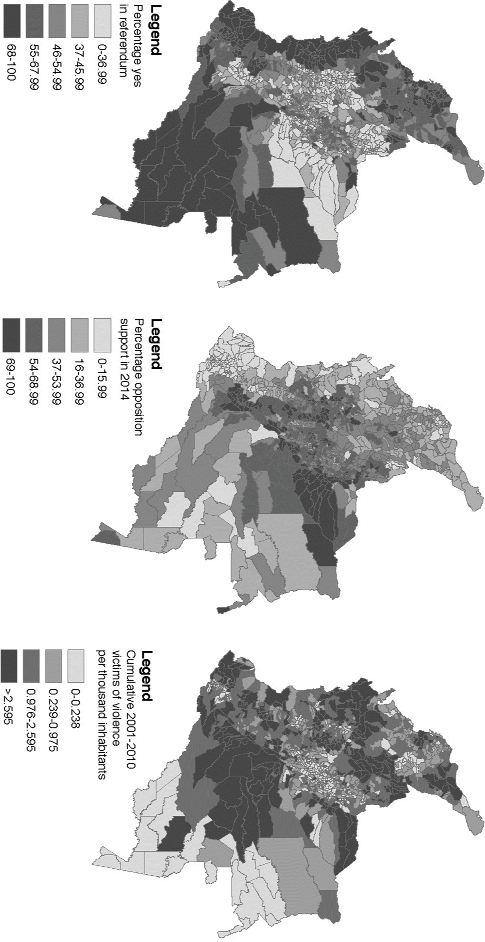
Variation across Municipalities
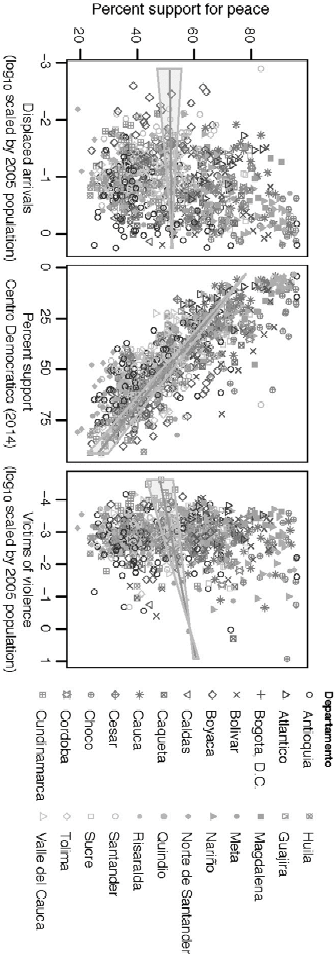
Municipality-Level Factors
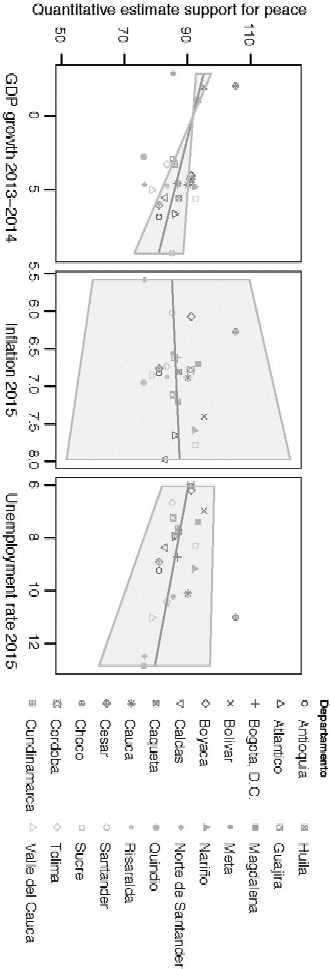
Department-Level Factors
Models Considered
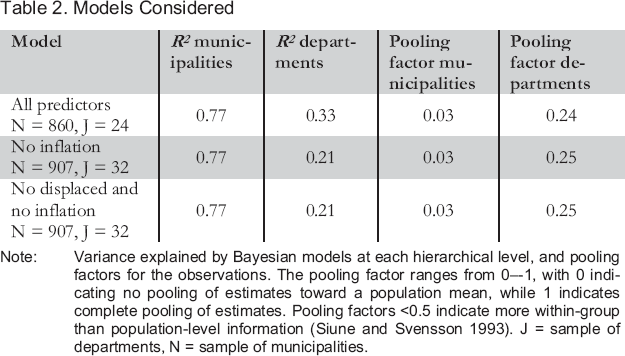
Note: Variance explained by Bayesian models at each hierarchical level, and pooling factors for the observations. The pooling factor ranges from 0–1, with 0 indicating no pooling of estimates toward a population mean, while 1 indicates complete pooling of estimates. Pooling factors <0.5 indicate more within-group than population-level information (Siune and Svensson 1993). J = sample of departments, N = sample of municipalities.
Intercepts for Each Department
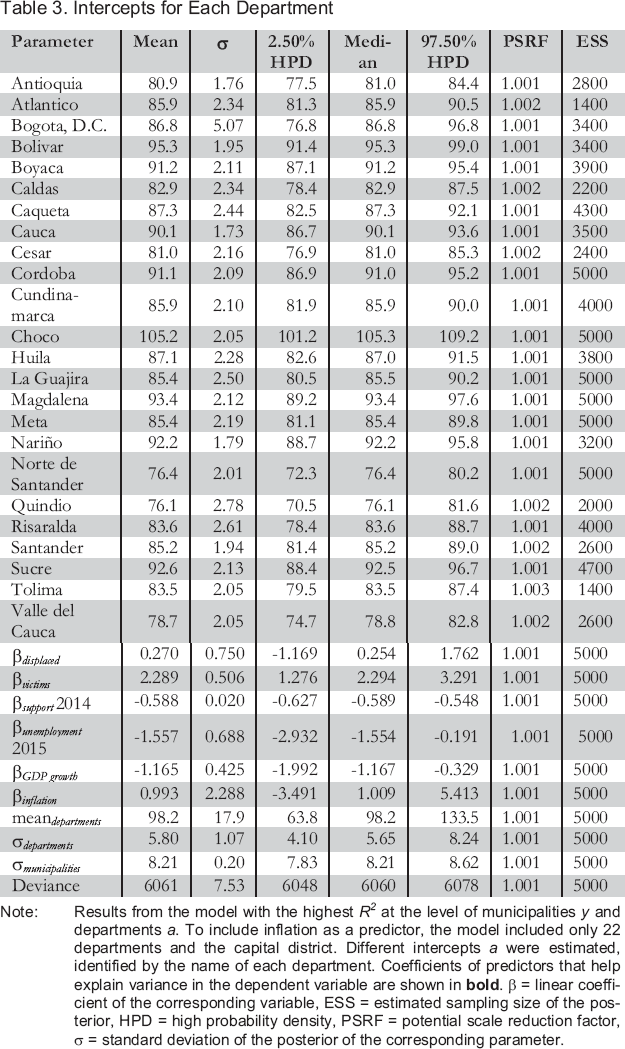
Note: Results from the model with the highest R2 at the level of municipalities y and departments a. To include inflation as a predictor, the model included only 22 departments and the capital district. Different intercepts a were estimated, identified by the name of each department. Coefficients of predictors that help explain variance in the dependent variable are shown in bold. β = linear coefficient of the corresponding variable, ESS = estimated sampling size of the posterior, HPD = high probability density, PSRF = potential scale reduction factor, σ = standard deviation of the posterior of the corresponding parameter.
Our analyses evaluated the effects on support for the initial peace accords of both conventional electoral factors (such as support for the incumbent party, unemployment, economic growth and inflation) and violence-related variables relevant to inclusion models (such as victims of violence and displacement). The results reveal: (1) important regional differences in baseline support for the accords, (2) the importance of economic performance in determining referendum outcomes, (3) the critical role of support for former president Álvaro Uribe's Centro Democrático party in explaining votes against the accords, and (4) the tendency for municipalities with proportionally more victims of violence to vote for the peace accords. While the last two have been highlighted before (e.g., Álvarez-Vanegas, Garzón, and Bernal 2016), these effects had not been estimated in a formal model or analyzed together with variables explaining electoral behavior. We examine each of these key findings, along with the implications for implementation of the revised peace accords.
Regional Variation
First, the estimates of department-specific intercepts in the main model (Table 3) reveal regional differences in baseline support for the peace accords (that is, not associated with municipal predictors, but influenced by the department-level factors). This variation tends to reflect differences between an Andean core of municipalities with low support the peace accords, and higher support in the periphery, with some exceptions (Figure 1a). Densely populated Andean departments such as Quindio and Risaralda had low intercepts, as did Norte de Santander (northeast) and Valle del Cauca (southwest), reflecting results from their more densely populated Andean municipalities. Additionally, the results support a critical role for the Caribbean region: Bolivar, Magdalena, Sucre and Cordoba, all in the Caribbean region, show some of the highest intercepts in the model, and only one Caribbean department, Cesar, showed low support for the accords (Table 3). Since the region as a whole tended to disproportionately vote for the accords, low voter turnout caused by heavy rains and flooding from Tropical Storm Matthew ultimately contributed to rejection of the accords on the aggregate. The regional divide, along with the contrast in voting patterns between Andean and non-Andean municipalities within departments (Figure 1), suggest implementing the accords will require location-specific policies to persuade voters in more densely populated municipalities of the benefits of the renewed peace accords.
Covariates of Referendum Results by Department
While previous analyses of the Colombian referendum have highlighted subnational variation and the effect of measures of violence on the vote, none have included standard economic factors relevant to electoral studies. Despite low power from the small sample of departments included in the model, we found negative effects of both unemployment and GDP growth on support for the accords (Figure 3). As expected based on previous work showing unemployment decreases incumbent support, higher unemployment rates translated into lower support for the peace accords, contributing to low intercepts in departments such as Quindio and Norte de Santander. In contrast, the Caribbean region also experienced relatively low unemployment, helping explain higher overall intercepts (Table 3). More puzzling is the negative effect of GDP growth on support for the accords, as growth generally results in support for the incumbent government (Holmes and Gutiérrez De Piñeres 2012). This effect is driven, at least in part, by declining GDP in departments such as Bolivar and Chocó, and stronger growth in Antioquia and Cesar. It may also reflect the varying resource basis of the different regions, with Bolivar being more heavily reliant on oil refining during a period of low global prices, and Antioquia reflecting both the gold mining boom and industrial growth of a more diversified local economy.
Covariates of Referendum Results by Municipality
Support for the incumbent party is an important control variable in most electoral studies. However, in order to understand the rejection of the referendum, we look to support for the party strongly associated with a rejection of the peace plan. The cmcial role of support for former president Álvaro Uribe's Centro Democrático party as an opposition force has been noted before (Álvarez-Vanegas, Garzón, and Bernal 2016), but the extent of this effect relative to other factors has not. As shown in our model, support for Centro Democrático is a strong predictor of the “no”-voting pattern in the referendum (Table 3). This raises the question of how the opposition, or the government for that matter, mobilized voters around a single referendum question. In contrast with the 1990 referendum on forming a new constitutional assembly, which was issued alongside parliamentary elections (Álvarez-Vanegas, Garzón, and Bernal 2016; Fox, Gallón-Giraldo, and Stetson 2010), the 2016 peace referendum was a stand-alone single-issue vote. While the government spent considerable resources publicizing the referendum and the benefits of the peace accords, how the opposition mobilized is less well understood. In fact, pre-referendum survey polls systematically overestimated the pro-accords vote (in August 2016, 57 percent reported preferring dialogue and peace talks to a military solution according to Gallup 2016a), contributing to the difficulty in explaining voter mobilization by the opposition. Nevertheless, our results show the widespread mobilization of opposition voters had a strong and consequential effect on the vote.
In the lead-up to the referendum, Centro Democrático representatives led opposition to the peace accords, with vocal support from former president and then-senator Alvaro Uribe. The formal rationale for opposing the accords centered on the transitional justice process for both Colombian military implicated in crimes and FARC combatants. Centro Democrático argued that the transitional justice process would be biased against the military and lenient towards the FARC combatants.
Another broadly publicized line of opposition centered on transitional economic support for ex-combatants. As part of the peace accords, FARC ex-combatants were to receive 90 percent of the minimum wage for up to 24 months, provided they were not otherwise employed. Two other single-time payments, the first as a one-time stipend following the unemployment period, and the second in support of small business, were also contemplated. Released in August, these terms prompted outrage that was aired vocally through social media and in the comment sections of articles reporting the news (COLPRENSA 2016). With unemployment over 6 percent (Figure 3), a vast population of underemployed and informally employed workers, and no unemployment insurance, commenters were indignant about the system to reward excombatants who were portrayed by the opposition as no different from criminals or bandits. Partially reflecting concerns surrounding the stipend program, our analyses show that greater unemployment resulted in lower support for the accords (Figure 3).
However, the informal arguments against the peace extended well beyond the actual text of the accords. Headed by Uribe, opposition to the accords coalesced into a loose civil coalition animated by different political aims. These included the rejection by both conservative Catholics and evangelical Christians of the principles of equal gender rights presented in the accords. To mobilize this voter base, Centro Democrático called for congressional hearings based on a social media campaign that falsely equated a never-released leaflet on gender diversity aimed at schoolchildren with photography stills from online pomography.
In the hearings, Centro Democrático representatives and allies questioned the openly gay Minister of Education Gina Parody, time and again conflating online pornography with the unpublished leaflet. Concurrently, and led by clergy and some educators, thousands of parents marched in August against what was described as “homosexual colonization of the classrooms”. This placed Parody, and by extension the sitting executive and the peace accords, on the defensive. In the run-up to the referendum the leaflet was presented as one example of “gender ideology” to be imposed if the accords were ratified, and Parody resigned two days after the referendum (Educatión 2016). Uribe and his Centro Democrático successfully shifted attention from the potential benefits of the peace, energizing their voter base despite overwhelming mainstream support for peace. First, Centro Democratico and its allies managed to connect the peace accords to socially sensitive issues, such as gender equality and gay rights, and defined the discussion of transitional economic measures as rewards for FARC's past crimes (instead of incentives to forego armed insurrection). On the defensive, the government focused on defending the educational campaign, without addressing the link to the gender and gay rights provisions in the accords. Similarly, the provisional stipends were first denied by official sources, then minimized, but not defended on their merits for bringing about peace (Alsema 2016).
In a series of now-familiar moves, the opposition successfully deployed social media to promote linkages between the accords and sensitive social issues by identifying terms with overwhelmingly negative, and often visceral connotations. These included: “Castro-chavismo”, aligning peace with the regimes of Cuba and Venezuela; “peace without impunity”, suggesting openness to accords while labeling the provisional justice clauses of the accords as impunity; “Santos’ surrender of Colombia to the FARC”, highlighting negotiation as a manifestation of weakness instead of the product of credible military gains by the government; “No + Santos”, directly identifying the accords with the sitting government and not the culmination of a national process; “Civil Resistance”, casting the “no” vote as resistance and not the persistence of the status quo; and “Gender Ideology”, equating the idealistic gender rights clauses of the peace to an assault on traditional family roles (Gomez-Suarez 2016, 2017). These terms were amplified from Uribe's favored medium of Twitter, as well as through community groups on Facebook that were responsible, for example, for disseminating the false leaflets. In fact, Colombia News reported a significant amount of disinformation, with the “no” proponents carrying out a particularly effective social media campaign (Alsema 2016). In a close parallel with electoral surprises such as the Brexit vote and the US 2016 presidential elections, the Colombian government's approach relied on public service announcements and standard media outlets, as well as polling surveys that missed growing mobilization of the “no” vote through social media. Juan C. Vélez, the CEO of the “no” campaign, outlined the winning strategy as a combination of social media virality and mobilizing anger so that people “go out and be pissed off when they vote” (La República 2016). In line with the bias in spending found in electoral studies (Vreese 2006), and as Vélez boasted only a few days after the referendum, the winning operation turned out to be inexpensive despite being backed by powerful corporate donors (La República 2016).
Finally, and as expected under inclusion models, municipalities with more per-capita victims of conflict tended to vote for peace. Although the pattern was identified early on (Álvarez-Vanegas, Garzón, and Bernal 2016), suggesting the experience of violence motivated support for peace, here we show that this correlation persists after controlling for other relevant factors (Figure 2). Municipalities with high proportions of victims tend to be peripheral to the Andean core, and the maps reveal complementarity between high victimization rates and both rejection of the peace accords and support for the opposition party (Figure 1). Abstention rates in peripheral municipalities were higher than in other regions, leading to the suggestion that higher voter turnout in those regions would have changed the outcome (Álvarez-Vanegas, Garzón, and Bernal 2016). As voters are concentrated in Andean municipalities, overcoming their numerical advantage would require higher peripheral turnout relative to the Andean core. Municipalities that receive higher numbers of displaced people contrast with those with higher victimization rates (Figure 2). Although the strain on services and infrastructure from displaced arrivals is expected to result in opposition to the government (Carillo 2009), no such influence is apparent with these data.
Conclusions
We analyzed the Colombian referendum on peace with FARC in light of two broad theories: one based on inclusion in peace negotiations highlighting civil society participation and, in this case, exposure to political violence; and another based on electoral and referendum results. Although we find support for the inclusion model, as a greater representation of victims of violence translated into support for the accords, electoral and referendum-related factors provided the better guide to the results. As expected based on electoral studies, support for the opposition party was a critical factor in the outcome, with more important quantitative influence than either the experience of victimization or economic drivers of dissatisfaction such as the unemployment rate. We hypothesize that the opposition was able to mobilize its voter base through effective use of social media, connecting the peace accords to socially divisive discussions on gender difference and recasting financial incentives for peace as unjust rewards. Important regional differences, with higher relative support for the peace in most Caribbean departments, imply the heavy rains and flooding from Tropical Storm Matthew, which suppressed turnout in the region, may have had a decisive effect on the referendum result. After controlling for both regional differences and other variables, the per capita rate of victimization was a positive covariate of support for the accords, likely reflecting greater motivation to seek peace. Finally, the Colombian case provides additional support in the referendum literature for the power of the status quo, especially in the context of uncertainty created by an animated opposition and in a country without recent referendum experience.
Although there will not be another referendum on the peace process with the FARC, support for the process can increase, especially with alterations to the details of the implementation, benefits to the demobilized, and punishments for FARC crimes. In the Danish case, a 1992 rejection of the Maastricht Treaty was followed by acceptance in 1993, driven by changing perceptions of the costs and benefits of integration among a small group of swing voters (Siune and Svensson 1993). Eventually, a revised accord was unanimously passed in the Colombian case, by 75 to 0. Uribe's Centro Democráico boycotted the vote. In fact, after the defeat, the Colombian peace process polled stronger than three months before rebounding to 73 percent, up from 57 percent in August (Álvarez-Vanegas, Garzón, and Bernal 2016; Gallup 2016a).