



Abstract
One of the most significant recent changes in Brazilian politics is the inroads made by the Workers’ Party (Partido dos Trabalhadores, PT) and other leftist parties into state and municipal governments in the country's most conservative region, the Northeast. An important strand of literature argues that this is due to a transformative strategy anchored in institutional growth, which is based on opening local party directorates. In contrast, this analysis shows that the PT has made gains in the region by segmenting its strategy – that is, by focusing on two well-established political practices. First, the PT has leveraged executive office at higher levels of government (e.g., federal and state) in order to advance at lower levels (e.g., state and municipal). Second, it has constructed pragmatic alliances with opportunistic parties, thus revealing how the migration of opportunist politicians into allied parties allowed entrenched elites to remain in power. This suggests that the Left's subnational advances are less transformative than they seem and could potentially harm democratic consolidation.
Introduction
After over a decade of sustained electoral hegemony, the tables turned rather quickly for Brazil's Workers’ Party (Partido dos Trabalhadores, PT). 1 Following the election of Luiz Inácio Lula da Silva as president in 2002, the PT experienced a long electoral boom culminating in the election of Dilma Rousseff as Lula's successor despite her lack of electoral experience. The PT also expanded subnationally in the less economically developed and historically conservative Northeast, the region where it had been weakest. Despite its early victories being tied to its historical base in the South and Southeast, the PT's later successes through Lula (2006) and Rousseff (2010 and 2014) relied heavily on northeastern voters (Hunter and Power 2007; Soares and Teron 2008; Alves and Hunter 2017). PT downticket candidates in the Northeast also saw improved results, with the party's shares of federal deputies and state legislators growing from 6.6 percent to 16.6 percent and from 6.2 percent to 12.3 percent, respectively, during the period 1998–2010. 2 Notably, the PT also secured executive positions, such as its first ever governors and an increasing share of mayors (10.2 percent in 2012 versus 1.2 percent in 2000). However, after narrowly winning reelection in 2014, President Rousseff was impeached by a legislature led by former coalition allies from the Brazilian Democratic Movement Party (Partido do Movimento Democrático Brasileiro, PMDB) and the Centrão (“big center”), an agglomeration of centrist and rightist parties. 3 Following Rousseff's impeachment, the PT had 60 percent fewer mayors elected in the 2016 municipal elections than in the 2012 polls. The party also contested 35 percent fewer municipal elections as many incumbent mayors had abandoned ship. Although such opportunistic behavior is commonplace in Brazil (Desposato 2006; Novaes 2018), the scholarly consensus was that the PT was uniquely built to prevent this. So how did the wheels come off so abruptly?
Thanks go to Frances Hagopian, Peter Johannessen, Eduardo Moncada, Timothy Power, Celina Souza, Kurt Weyland, and three anonymous reviewers. Extra special thanks to Wendy Hunter. An earlier version of this paper was presented at the 2017 LASA Annual Congress. I am grateful to Queens College and a PSC-CUNY research grant for financial support.
Unless otherwise referenced, the electoral statistics presented are the result of the author's calculations based on data from the online repository of the Brazilian electoral authority (Tribunal Superior Eleitoral, TSE), online: <www.tse.jus.br>.
The PMDB recently reverted its acronym to MDB, as part of a broader process of rebranding that saw many dropping the term Party (Partido) from their official name. I adopt the convention of using the official name during the time period being referenced.
To better understand the PT's rise and apparent rapid decline, I examine the methods it employed to expand subnationally. It is well established that the party's early successes stemmed from its iconoclastic approach to politicking (Keck 1992), particularly its emphasis on programmatic leftist positions, tight party discipline, and the rejection of pragmatic alliances. The PT grew by building a strong brand with loyal support in southern Brazil, which it did by advocating good governance and an innovative agenda of social programs and inclusive participation – known as the “PT way of governing” (Bittar 1992). Lula's election, however, followed significant adaptations (e.g., softening of ideology and using professionalized campaigns) that aimed to increase the PT's electoral viability beyond its original base (Amaral 2003; Samuels 2004; Hunter 2010; Singer 2012; Ribeiro 2014). But the greatest change in the PT's growth strategy came after it took national office and then began to expand into the Northeast Region by leveraging the prerogatives and resources of executive office at the national level to build pragmatic alliances. These new allies were increasingly heterogeneous and thus raised the costs of maintaining the president's (and governors’) coalition (Bertholini and Pereira 2017), which ultimately cost the PT its transformational project.
This argument has been at least partially challenged by a strand of literature that ties the PT's northeastern expansion to a return to its distinctive process of local-level party-building (Samuels and Zucco 2014; Van Dyck 2014; Van Dyck and Montero 2015). In this account the PT national leadership allocated windfall resources for party organization in rural areas where conservative elites were strongest. Support from loyal partisans – supposedly formed by these new local directorates – led to the defeat of entrenched northeastern elites. The implication is that the PT did more than just win elections; it also transformed the very nature of politics in the region. In contrast, we argue that the PT did not utilize a transformational approach but rather merely substituted actors at the top of political structures, which remained mostly unchanged. In short, the PT appropriated and co-opted preexisting elites and won in the Northeast by learning how to play by the de facto rules of everyday politics in Brazil.
Programmatic parties, which are based on a coherent set of ideological and policy precepts, face a specific dilemma as they seek to grow (Przeworski and Sprague 1986; Strøm 1990; Kitschelt 1994; Müller and Strøm 1999): Should they continue to coherently emphasize their central ideas or relax them to prioritize winning office? If they choose the latter (as the PT did), they are likely to need to adapt how they reach out to voters – Kitschelt (2000) calls this “party–voter linkages.” 4 In large federal systems with significant socioeconomic differences, such as Brazil, linkage strategies are further constrained by varying regional needs, expectations, and informal political practices (Helmke and Levitsky 2004; Behrend and Whitehead 2016). Therefore, parties must segment strategies by adopting different linkages across groups and regions (Kitschelt 2000; Luna 2014). The PT won elections in the Northeast by successfully and pragmatically segmenting its strategies. However, in facing the significant and resilient informal practices of northeastern politics, the party made choices that saw it normalize itself and diminish its transformative project.
Kitschelt's typology includes charismatic, clientelistic, and programmatic linkages (Kitschelt 2000: 855).
Parties require some degree of pragmatism in order to go from being the ideological fringe to the substantive opposition; that is even more so the case when they become incumbents, regardless of whether they are primarily policy- or office-seeking parties. Nevertheless, the extent and forms of the PT's normalization have important implications. When we consider that the PT succeeded by playing the northeastern “politics as usual” game of executive alignment and directing resources to opportunistic allies (both of which are effective strategies for delivering electoral victories when in control of resources but not for building lasting allegiances), it is unsurprising that the PT has suffered since losing the presidency. Not only does this approach affect the party and its distinctive brand (Lupu 2013), it also potentially delegitimizes the leftist platform across Latin America, thus opening up leftist political and socioeconomic inclusive policies to challenge and retrenchment (Dunning and Novaes forthcoming). Further, in embracing the strategies (if not quite the policy positions) of political opportunists, the PT might have reversed the institutionalization trend of posttransition Brazilian democracy, exhausting coalitional presidentialism and dealigning the party system like leftists who adopted neoliberal reforms did earlier across Latin America (Roberts 2014).
This study focuses on the nine states in Brazil's Northeast in order to challenge the notion that the PT expanded by building resilient partisan linkages. Subnational analysis is an established strategy to examine the validity of national-level theories on subnational phenomena (Giraudy, Moncada and Snyder Forthcoming). Competing research (Samuels and Zucco 2014; Van Dyck 2014; Van Dyck and Montero 2015) uses the Northeast as a “hard test” of partisanship-based explanations due its history of machine politics and political competition dominated by conservative elites (Ames 2001) and its socioeconomic profile, which would make the PT's urban-based mobilizational strategy difficult (Montero 2012). By analyzing political trends in the northeastern states within regional and federal contexts, we can downplay the role of partisanship in recent electoral shifts and stress the importance of regionally specific informal political practices. This article highlights the importance of analyzing state-level politics to understand the role of traditional subnational elites in national and subnational political outcomes, especially in Brazil (Hagopian 1996; Souza 1997; Abrúcio 1998; Samuels 2003). Knowledge about northeastern politics is also relevant in and of itself: the region's 53 million residents account for 28 percent of Brazilians, which would also make it Latin America's third most populous country. The region's considerably sized electorate delivered victories to the last few presidents, while its large congressional delegation has been able to appoint its politicians to prominent brokerage positions in Brasília, as recent corruption scandals illustrate.
Part one of this article describes everyday politics in Brazil's Northeast and establishes the expectations of conduct for a party hoping to win office there. Part two introduces recent studies that emphasize the salience of the novel organizational strategy – namely, the establishment of local directories designed to create PT partisans – behind the PT's growth. Part three underscores the broader political dynamics in which this PT strategy unfolded, highlighting two conventional methods that the PT has adopted: leveraging the benefits of executive office downward (from the president to governors to mayors) and forging electoral and governing alliances with opportunistic nonleftist parties. Inflating the governing coalition by accepting and even welcoming party-switching ensured the PT had the electoral support of mayors of small financially dependent municipalities across the region, which is one of the prime benefits of incumbency. Part four concludes by drawing attention to a catch in the PT's growth strategy: a party can only remain dominant to the extent that it governs. Once a political group loses the executive and can no longer distribute resources, its opportunistic network disintegrates as members defect in search of new patrons. Indeed, under the new patronage of the PT, incumbent politics remained alive in northeastern Brazil.
Politics in Brazil and the Northeast
Brazil is a presidential democracy with a three-tiered federal system consisting of 26 states, a federal district, and 5,570 municipalities. Voters elect chief executives (president, governors, and mayors) and legislators (senators and federal deputies, state deputies, and city councilors) at each tier. Presidents, governors, and mayors of municipalities with populations greater than 200,000 are chosen in majoritarian elections; a run-off is held if no candidate achieves a majority. Mayors in the 97 percent of municipalities below this population threshold are elected through the plurality rule. Legislators are elected through open-list proportional representation with states and municipalities serving as districts. Federal and state representatives are voted for in general elections every four years, as are municipal representatives in midterm elections.
Brazil has a weakly institutionalized, highly fragmented multiparty system, which partly results from the concatenation of a presidential system, electoral rules, the prominent position of subnational elites in national-level party decision-making, and lax barriers to party-switching (Mainwaring 1999; Desposato 2006; Carneiro and Almeida 2008; Samuels and Shugart 2010). 5 Most political parties are ideologically diffuse, fragmented, and somewhat disarticulated across territorial levels. It is common for national-level allies to compete at the subnational level and for state-level and especially local-level candidates to break party lines and side with national-level opponents. 6
The judiciary branch attempted to curtail party-switching in 2007 by determining that elected positions belong to the party rather than the individual, but the decision was revoked for executives in 2015 (Novaes 2018).
Historically, the PT was the exception, but that is no longer the case. The party entered 178 alliances with the PMDB in the 2016 municipal elections despite the PMDB being the protagonist in Rousseff's impeachment (Folha de São Paulo 2016a).
Despite systemic conditions that complicate coordination, the fates of a party's executive and legislative candidates are interdependent within and across levels of government. Without strong parties to contain them, politicians respond first and foremost to the availability of public resources, such as discretionary transfers and political appointments within the bureaucracy. The presidency is the cornerstone of this structure. The federal executive is powerful due to its ability to shape policy and is resource-rich compared to its subnational units. In Brazil the president has an outsize influence – that is, the president has strong legislative powers, has final say over budgetary disbursements, and makes a comparatively large number of appointments that permeate the bureaucracy, culminating in national ministerships (Figueiredo and Limongi 2000; Cheibub, Figueiredo and Limongi 2009).
The national executive must coordinate a delicate, intricate system of political interests to ensure legislative support. Presidents in multiparty democracies typically borrow strategies from parliamentary systems when distributing cabinet posts as trade chips in order to build congressional majorities – something the literature dubs “coalitional presidentialism” (Abranches 1998; Chaisty, Cheeseman, and Power 2018). Depending on macroeconomic conditions and compositional factors (e.g., proportionality and ideological heterogeneity), coalitional maintenance costs can be quite high, thus impacting cabinet size, ministry expenditure levels, and the availability of pork for legislators (Bertholini and Pereira 2017). In federal systems, where representatives are linked to subnational constituencies, cabinet distribution must also weigh up territorial considerations, thus linking national and local politics.
Subnational executives are also key players in Brazil's highly decentralized federal system. State governors are influential actors within state politics due to their control of sizeable resources and because they face fewer restrictions on distributional choices and weaker institutional checks and balances (Souza 1997; Abrúcio 1998; Samuels 2003; Carneiro and Almeida 2008). Although their freedoms have been significantly curtailed by constitutional reforms limiting spending, governors still possess relatively large budgets compared to most of their municipal counterparts. Added to their visibility and organizational backing, governors are active figures in campaigns within their states, influencing sub-national elections on behalf of their parties and allies (Ferreira and Bugarin 2007; Dantas 2009). Controlling governorships is valuable to national executives and nongoverning parties seeking to remain nationally relevant (Borges, Alballa, and Burtnik 2017). State executives can leverage their influence over state legislators and their vote-getting networks to secure concessions from presidents, such as ministerial appointments for their lieutenants and resources for discretionary spending. They exploit these links to strengthen their hold on their states, exerting what Gibson (2013) calls “boundary control.” As a result, a party's ability to expand in a state is made significantly easier by winning the governorship.
Mayors are also important actors in Brazil's multilevel system. Brazilian municipalities, one of the few in the world recognized as independent members of the union, received significant responsibilities following redemocratization, including the power to draft social policy (notably on primary health and basic education), the freedom to determine property and sales taxes, and substantial leeway in deciding how to target spending. Continued interaction and local knowledge allow mayors to develop steady relationships with voters, making them powerful brokers who can control access to local voters for their parties, coalitions, or even the highest bidder (Avelino, Biderman, and Baroni 2012; Novaes 2018). Collectively, mayors are essential for the consolidation of political power in a state and are therefore an important part of state elites’ and national elites’ electoral calculus.
Politically independent but generally strapped for cash, mayors are typically the most pragmatic actors in Brazilian politics. Most municipalities are reliant on mandated federal transfers for the majority of their revenue (Afonso and Araujo 2000) and voluntary transfers, such as legislative budgetary amendments and partnerships with federal ministries (convênios), to fund new programs (Arretche 2009). 7 Securing these resources requires municipal representatives to apply for federal and state programs and to pursue one-on-one meetings with decision-makers within ministries to expedite those requests. State and federal legislators traverse and connect the levels of government by directing their allotted budgetary amendments to their constituencies, finding additional funding opportunities for municipalities at higher levels, and coaxing favors from governors and presidents in exchange for amassing electoral support from mayors in their regions and legislative support in assemblies. Consequently, mayors, especially those in smaller and economically stagnant municipalities, are reliant on and responsive to the group currently holding power and resources.
On average, municipalities raise only 6 percent of total tax revenue in Brazil (RF/CETAD 2013). This ranks Brazil's municipalities 15th out of a sample of 19 federal systems (Afonso and Araújo 2000).
As a result of these structures and needs, there are significant incentives and pressures to strategically channel public resources to affect subnational elections. Incumbents therefore direct partnerships and investments to benefit copartisans and allies at the expense of their competitors (Ferreira and Bugarin 2007; Brollo and Nannicini 2012; Johannessen 2016). Politicians commonly make these claims during election years, either by touting copartisan upper-ballot candidates or by praising the benefits of alliances (Alves and Hunter 2017). 8
Political channeling of resources transcends the Brazilian context. Studies highlight similar behavior in other federal systems in Latin America (Gervasoni 2010; Lema and Streb 2013; Flamand and Moscovitch 2014; González 2016), India (Arulampalam et al. 2009) and consolidated democracies such as the US and Spain (e.g., Grossman 1994; Solé-Ollé and Sorribas-Navarro 2008).
Everyday politics in Brazil – especially in regions that rely on the transfer of resources, such as the Northeast – is characterized by the tendency of groups to have successive electoral victories, working their way down from the federal level to the state level and then to the local level (“leveraging”). This pattern suggests that party leaders make use of the institutional, financial, and political resources at their disposal and of the visibility enjoyed by higher levels of government to reward and expand their networks. It is also typified by parties entering into ideologically diverse, pragmatic alliances with centrist or nonprogrammatic parties, which in Brazil have been referred to as “professional support parties” (Power 2000). These parties’ main reason for being is to exchange legislative support in return for pork. This practice is reproduced at the state level, where parties informally cluster around incumbents and form incongruous political constellations with little else in common but the joint desire for the spoils of power. In Brazil this tendency to flock to the party that controls resources has been called situacionismo (Hagopian 1996: 181) or governismo (Leal 1976; Abrúcio 1998). Leveraging precedes and subsidizes alliance-making – particularly the opportunistic type – but is conceptually distinct. Leveraging national office could conceivably be deployed as part of a medium-term transformational strategy if it expands not only the party's electoral success but also jump-starts party-building by coherently strengthening the party's program and subsidizing programmatic alliances. But when it is used to buy the allegiance (and voter networks) of opportunistic regional and local elites, it replicates and maintains everyday forms of politics and typically results in rapid shifts in subnational voting patterns following a change of power at higher levels of government.
Historically, northeastern elites became entrenched by expertly controlling the boundary between national and state politics (table 1). Despite local variation, these states all had local groups who used their local power bases to become politically relevant nationally, bartered their support for national-level resources, and then leveraged these resources to secure greater control of state and local politics, thus becoming central nodes for a variety of pragmatic local allies. Antônio Carlos Magalhães cemented his group's dominant position in Bahia between 1991 and 2006. Former president José Sarney (1985–1989) exploited his time in office to secure similar control of his home state of Maranhão (Power n.d.), where his group elected five consecutive governors – one with 81 percent of the vote – while controlling 55–78 percent of mayors. Long spells of dominance also occurred in Ceará, Paraíba, and Sergipe. 9
Not all state elites managed to serve as sole conduits to federal resources. In these states (Alagoas, Piauí, Rio Grande do Norte) a few elites competed in a polarized fashion, which Borges (2007: 121) calls “oligarchic factionalism.”
Dominant Political Groups in Brazil's Northeast, 1982–2010
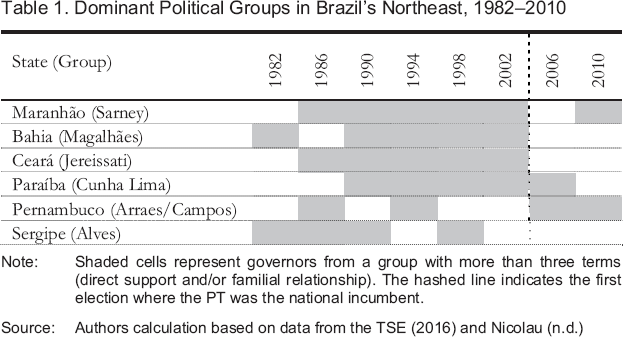
The apparent invincibility of northeastern political machines was only partially based on entrenched support. Their survival hinged first and foremost on their ability to continue to serve as guarantors of federal resources. The elites in four northeastern states perfected this formula in the 1990s and were able to enhance their standing in their home states by bulking up the support coalitions for Presidents José Sarney (1985–1989), Fernando Collor (1990–1992), Itamar Franco (1992–1994), and Fernando Henrique Cardoso (1995–2002). The PT's maiden presidential victory in 2002 temporarily upset this system, as the first Lula administration changed spending priorities and political appointees within the federal bureaucracy, thus shifting the flow of resources and leaving machines dry. Suddenly, governors used to distributing a healthy flow of federal resources could no longer deliver funds to cash-hungry municipalities or claim credit for federal programs. Mayors and legislators began to look for new patrons. As a result, Lula's reelection campaign established the PT and its allies as the dominant force in northeastern politics, winning the governorship of old bailiwicks of the Right such as Bahia and Sergipe and backing winners in many other states. But how transformational was this turn of events?
Transforming Northeastern Politics?
Gubernatorial victories by the PT's Wellington Dias in Piauí (2002), Jaques Wagner in Bahia (2006), and Marcelo Deda in Sergipe in (2006) brought optimism to many analysts and scholars. Trying to make sense of this unprecedented shift, some studies argue that the PT's victories were made possible because vertical competition introduced by federal social programs had weakened the clientelist networks that monopolized access to public goods in order to control voters (Hunter and Power 2007; Fenwick 2009; Borges 2011; Sugiyama and Hunter 2013; Souza 2015). They reason that rules-based social programs were resistant to local capture and could therefore replace typical linkage strategies used in the region. Many hoped, if not anticipated, that the displacement of local machines by new incumbents who practiced a unique (for Brazil) style of partisanship would solidify programmatic, competitive politics in the region. One strand was especially optimistic about these prospects, calling leftist victories a “historic transformation” (Van Dyck and Montero 2015: 118).
These studies build on a long-established literature on the history of the PT, which emphasizes how electoral success flowed from programmatic linkages developed by a strongly organized party with deep roots in organized civil society (Meneguello 1989; Keck 1992; Amaral 2011; Samuels and Zucco 2015). Samuels and Zucco argue that the PT's northeastern success resulted from a center-led growth project that focused on opening new local party offices (diretórios municipais) to generate party identification and electoral support. Furthermore, they contend that these local directorates created a robust programmatic identity with the PT, which surpassed the initial personal or charismatic connection to Lula (Samuels and Zucco 2015: 134).
In this vein, Van Dyck and Montero (2015: 117) argue that the PT succeeded in the Northeast not by mobilizing urban voters as it had done in southern Brazil but by creating new constituencies in smaller, rural, “conservative-dominated localities” where it previously did not have a presence. These local party directorates converted nonmobilized poor into new PT partisans. In their account this yielded notable payoffs for PT candidates in municipalities where the party opened new directorates: legislative candidates saw an increase of between 2.1 and 4.3 percent in vote share (Van Dyck and Montero 2015: 132); mayoral candidates, 2.9 percent; and governors, 1.3 percent (Van Dyck 2014: 17).
There are important reasons to question the extent to which party-building drove the PT's electoral success in the Northeast. First, despite being statistically significant, the magnitude of these findings is small. A 2–4 percent increase in vote share might change the electoral fate of a legislator, but it is unlikely to affect most executive races. Though the vast majority of Brazilian municipalities elect mayors based on the plurality rule, only a small share (15 percent) of mayoral races fell within 3 percent between 1996 and 2012. 10 More importantly, municipal outcomes were embedded within broader windfall support for the PT's presidential and gubernatorial candidates: Lula had 67 percent of the northeastern first-round vote in 2006, while Rousseff amassed 61.6 percent in 2010 and 59.7 percent in 2016. Governors Dias, Wagner, and Deda won first-round majorities with a minimum margin of 7 percent and secured reelection with an average 30 percent cushion. Even though local party offices unquestionably helped to generate some degree of PT partisanship in the Northeast, party-building cannot account for the sizeable electoral shifts there.
The median margin for all mayoral races in Brazil between 1996 and 2012 is 11.3 percent (Klašnja and Titiunik 2017: 137). The data for northeastern races do not diverge significantly.
This account also contradicts the PT's national-level normalization during that time (Amaral 2003, 2010; Samuels 2004; Hunter 2007, 2010; Singer 2012). Studies show that the softening of the PT's ideological positions – for example, its embracing of market reforms and macroeconomic stability, its decision to hire marketers to lead professionalized campaigns, and especially its openness to electoral alliances with nonleftist parties – preceded Lula's presidency. The PT made further concessions to pragmatism and governability when it incorporated the catchall PMDB into Lula's cabinet in the aftermath of the mensalão congressional bribery scandal in 2005 (Goldfrank and Wampler 2006; Hunter 2007). As Rousseff's 2016 impeachment reiterated, the PMDB is an unreliable, splintered amalgamation of regional elites concerned primarily with access to federal resources and controlling their home bases. While it has not had a viable presidential contender since redemocratization, its large legislative bloc makes it a critical source of support in Brazil's fragmented legislature. Acquiescing to the PMDB by offering ever-larger roles in the cabinet was a turning point for the PT in terms of embracing the logic of coalitional presidentialism. Its subsequent incorporation of a series of smaller nonideological parties on the Right and its orchestration of the Social Democratic Party (Partido Social Democrático, PSD) – a new support party made up of opposition defectors – further exemplify how the PT became increasingly permissive in its alliance choices over time.
The need to ensure electoral and legislative support for Lula therefore provided the PT with the final push to embrace standard political practices in Brazil. This had implications at the national level in terms of good governance but also bled into subnational decision-making. Wagner, the future PT governor of Bahia, led President Lula's Ministry of Institutional Relations during this time and advocated strongly for broader alliances in Brasília and at the state level. The incorporation of existing elites onto PT tickets in states like Bahia and the pragmatic abandonment of PT candidacies in most others were direct effects of this approach. In contrast to 2002, when the PT boosted Lula's local visibility by fielding a gubernatorial candidate in every state, it scaled back candidacies in 2006 to three states, choosing instead to back three winners from the leftist Brazilian Socialist Party (Partido Socialista Brasileiro, PSB), and helped to swing a second-round election in Maranhão by backing the Democratic Labor Party's (Partido Democrático Trabalhista, PDT) Jackson Lago. As the next section will show, the choice to back front-runners in the states in exchange for support in Brasília would escalate over time, culminating in the PT declaring support for many entrenched elites it once fought to displace.
One should therefore question why a party making ever more concessions to win elections and ensure governability would solely pursue a costly and painstaking mobilizational strategy to advance into a region dominated by those same useful allies. Fortunately, there are relatively easy ways to tell which approach is closer to the truth. For one, the timing of victories can reveal important information. If party-building is behind the PT's newfound dominance, we would expect consistent and relatively gradual growth in electoral returns. Punctuated and volatile growth such as a dramatic surge or drop in the number of PT elected officials should not follow a gubernatorial win or loss in that state. We would also expect that this new partisan support would be somewhat evenly spread across the ballot. Municipalities that voted heavily for the PT up the ticket should also be supporting mayoral candidates from the PT or at least from its historic programmatic allies. Finally, for the transformation to be truly historic, the PT and its allies should be displacing incumbents rather than absorbing them.
As the next section shows, this is not what happened. The PT's growth in the Northeast was abrupt. The party expanded rapidly once it held the presidency, especially in states where it also won the governorship. Growing partisanship cannot fully explain this spike, as PT membership still represents less than 1 percent of the region's electorate despite almost doubling between 2002 and 2015. 11 Furthermore, voters did not reward the PT in isolation; they continued to elect entrenched elites at the local and even at the state levels. This does not necessarily indicate that they split their support; rather, it highlights that the PT's success is the result of a deliberate strategy to expand locally by tapping the political networks of entrenched elites in the center and on the right, either directly or through alliances. By choosing to incorporate rather than replace these elites, the PT was able to feed and benefit from existing networks of clientelistic linkages to local voters.
Tribunal Superior Eleitoral 2016. There was a relative partisan build-up in the two states that elected a PT governor in 2006 (Bahia and Sergipe), where PT membership grew from 0.5 percent of the electorate in 2004 to 0.7 percent in 2006 compared to states that did not elect one (steady at 0.5 percent). Partisanship levels fell across the board between contests but grew again before the 2014 election; states that elected a PT governor (Bahia, Ceará, and Piauí) again had a greater number of PT members than those who did not (1.1 percent versus 0.8 percent of the electorate). Surveys from the Brazilian Electoral Panel Study (Ames et al. 2013) found greater evidence of partisan support, as 24 percent of northeastern voters indicated a preference for the PT compared to 20 percent in states outside the region.
Substitution, Not Transformation
The evidence supports a narrative of overwhelming continuity in northeastern politics under the PT. Although some party-building has no doubt taken place, the PT's sustained surge had more to do with its ability to leverage its prominent position atop the federal government at the state and local levels and use federal resources to recruit a large number of local elites to join their state-level support coalitions.
Leveraging Executive Offices for Subnational Gain
Allegiance to the president has been a fundamental feature of politics in the Northeast since redemocratization (figure 1). The 1982 gubernatorial elections, the first direct elections in Brazil's democratic transition, were split 12 to 10 between the incumbent promilitary party and the opposition PMDB. All nine northeastern states sided with the incumbents. Four years later, the region abandoned the promilitary party and embraced President Sarney's PMDB and his initially successful economic stabilization plan. And while they did not vote for President Collor's personalist-vehicle party in 1990, eight of the region's nine governors provided him with congressional support once in office. Throughout the 1990s, states in the Northeast continued to be polarized between the PMDB and the conservative PFL, 12 even though both parties provided the core of President Cardoso's (of the Brazilian Social Democracy Party [Partido da Social Democracia Brasileira, PSDB]) congressional coalition. During this time, it was commonplace for northeastern elites to take prominent positions within the federal government and the Congress leadership.
The Liberal Front Party (Partido da Frente Liberal, PFL) splintered from the official support party of the military regime and was renamed Democrats (DEM) in 2007 (Power n.d.).
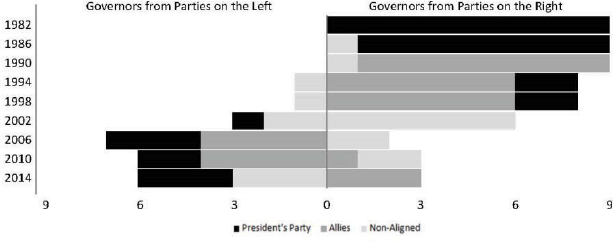
Alignment between Governors and Presidents in the Northeast, 1982–2014
Northeastern bosses like Sarney and Magalhães used their ability to channel federal resources to municipalities either directly or through state governments to ensure compliance from politicians within the state. As a result, Magalhães's PFL controlled an average of 57 percent of Bahia's representatives in the national and state legislatures between 1990 and 2005 (Alves 2015:127). This allowed him to attract a large number of local politicians and their constituencies into his sphere of influence, which boosted his reach to over 70 percent of Bahia's legislators and mayors in the late 1990s. Figure 2 illustrates the extent of governismo across the Northeast during the second Cardoso administration. Note that while Cardoso himself was popular, his party never enjoyed a similar standing across the region. Even at his height, the PSDB only had two northeastern governors elected and 16 percent of mayors, while Cardoso's main allies controlled six states and 53 percent of municipalities. 13 This discrepancy in subnational electoral success indicates that local machines provided significant support to the president. The PFL and the PMDB continued to polarize state-level disputes in most northeastern states during this period, complicating the electoral–governance strategic balance for the president. Cardoso therefore eschewed challenging his allies’ strongholds, at times abandoning the state-level PSDB to side with their opponents.
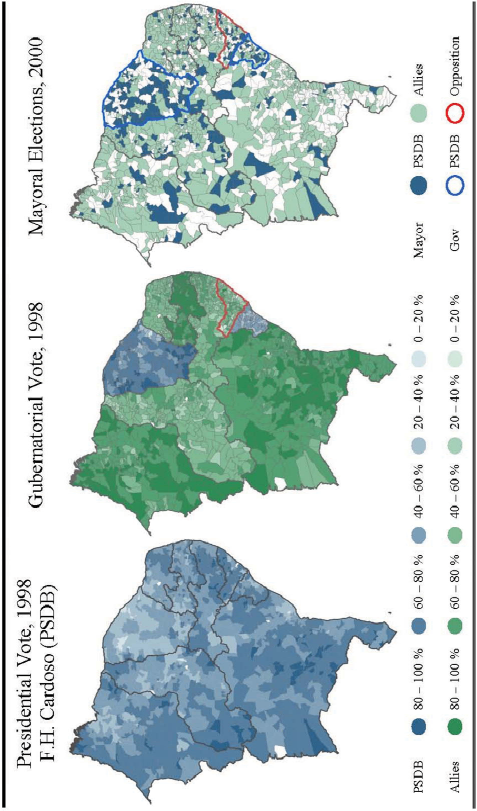
Cardoso's Coalition Executive Dominance in the Northeast by Municipality, 1998 Elections
Municipal figures include the Progressive Party (PP).
Figure 1 demonstrates that Lula's 2002 election represents a clear discontinuity with the northeastern alignment equilibrium. While Lula performed strongly in the Northeast, the presidential election required a second round to determine the winner. Since it was unclear to local elites and voters who the new federal patron would be, only one of the nine governors was elected on Lula's coattails. Disgruntled by a history of failed challenges in the states, northeastern PT leaders knew they needed to use their party's presidency to break through. Therefore, Lula appointed many of them to visible positions within his first cabinet. Within the bureaucracy, PT appointees dislodged existing resource routes and gave left-led municipalities access to federal programs (Alves 2015). Meanwhile, programmatic social policies circumvented governors in order to reach poor beneficiaries throughout the region, further loosening the grip of local clientelistic networks (Borges 2007; Fenwick 2009; Zucco 2013, Souza 2015). PT bureaucrats also channeled pork to their existing allies through federal voluntary transfers (Johannessen 2016).
As a result, in the 2006 general elections voters and elites were able to resume the regional practice of choosing the president over partisan allegiance. In that election the PT saw its sole incumbent governor (Dias in Piauí) reelected, added two more (Wagner in Bahia and Deda in Sergipe), and backed two first-round winners in Ceará and Rio Grande do Norte. The party also helped turn the tide in two other races (Maranhão and Pernambuco) by declaring its support for leftist candidates who trailed in the first round. Lula was the driving force of the 2006 elections in the Northeast, collecting 66.8 percent of the first-round vote, compared to 48.6 percent nationally. He outdid first-time winners Wagner and Deda (53 percent each) and Dias (62 percent). Furthermore, Lula won outright in 95 percent of the region's municipalities, compared to just 45 percent in 2002.
Campaigns throughout the Northeast featured him prominently – either in person or with his face inserted behind local candidates’ banners and fliers – with allies proudly touting themselves as “Lula's candidate.” Lula's influence proved significant enough to defeat the region's two foremost machines, displacing an incumbent PFL governor in Bahia in the first round and using his 75.5 percent support in Maranhão to fuel a come-from-behind second-round upset of the Sarney clan. The timing and downward push of these results clearly indicate a leveraging dynamic.
President Lula's popularity notwithstanding, his ability to anoint his presidential successor was facilitated by the Northeast's willingness to line up behind incumbents. Despite having no history of running for office, Rousseff garnered 61.6 percent of the first-round vote there, three times the amount of her second-round opponent and 15 points better than her national vote. To ensure her victory, Lula featured significantly in the 2010 campaign, while sitting PT governors Wagner, Dias, and Deda led charges in their states. Since then, gubernatorial contests have continued to reveal the prominence of alignment over partisanship. While the following section will discuss the alliance-making strategy at length, it is important to note a qualitative difference in the PT's electoral approach in 2010, when it incorporated the PMDB onto the presidential ticket (with Michel Temer as Rousseff's vice president) and deferred from fielding candidates in the majority of northeastern states. The PT easily reelected both of its eligible incumbent governors and backed five other winners. As a result, the electoral map in 2010 (figure 3) looks uncannily similar to that of 1998 (figure 2), save for the party labels: the president had an outsize presence in the election, but the penetration of the president's party decreases as the level of analysis shifts downward. Nevertheless, states and municipalities side with candidates that are aligned with the current president, implying a symbiotic relationship between access and support. The number of aligned governors grew in 2014 despite Rousseff being involved in a closely contested, albeit successful, presidential election. Under Rousseff the PT again won the Northeast handily, seeing three PT governors elected and backing virtually all other winners in the region. 14
Although three nonaligned candidates were elected governor in 2014, the PT backed two of them in the runoff round.
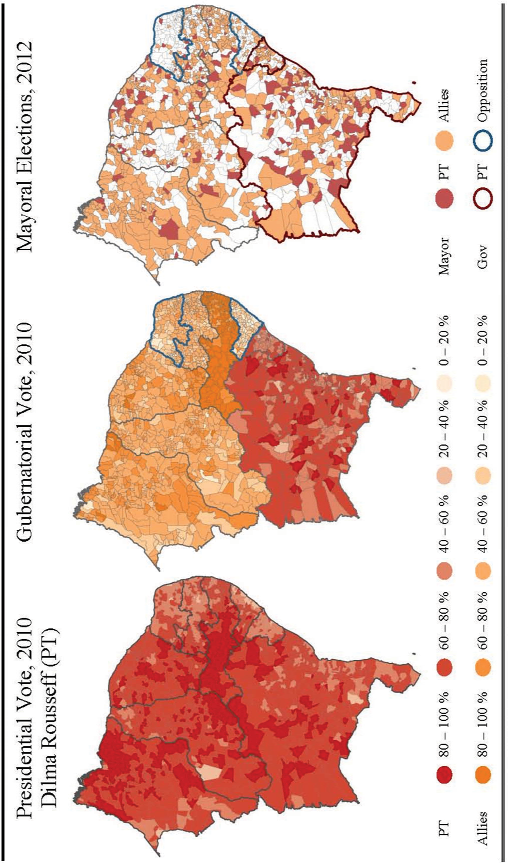
Growing PT Dominance in Executive Vote in the Northeast by Municipality, 2010
The final step in executive alignment is the repositioning of mayors. Municipal elections have been held as midterm elections between general elections since 1996, reflecting the current state of both presidential and gubernatorial power. The line in figure 4 illustrates the effect of the presidency on the PT's achievements in mayoral elections in the region. The PT accounted for only 1.2 percent of northeastern mayors as late as the 2000 election despite being competitive at the national level since 1989. Lula's rise to the presidency preceded a steady period of expansion of PT municipal governments, which started with the tripling of PT mayors in the 2004 elections. But the politics of governors weathers presidential impact. The PT's advances into local governments occurred at a much faster rate in the states where it also controlled the governorship, which peaked at one in five. This likely represents both supply and demand logic. Controlling both federal and state executives allows incumbent parties to more easily distribute resources to allies. It also likely denotes strategic actions on the part of mayors lining up to bend the knee. The punctuated increase in the number of PT mayors in states with PT governors has less to do with party-building, which is a protracted process, and likely more to do with the electoral benefits of leveraging executive positions at higher levels of government. The dramatic drop in PT mayors across the board in 2016 – in the immediate aftermath of Rousseff's impeachment – further indicates that voters and mayors pivot in response to changes in Brasília and the state capitals.
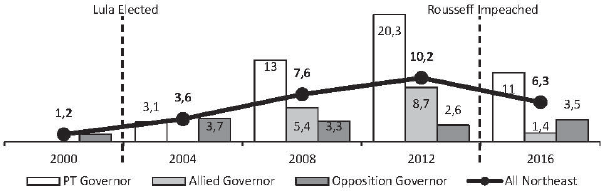
PT's Share of Mayors by Relationship to Governor in the Northeast, 2000–2016
Expanding Coalitions
Stitching together broad, pragmatic alliances is the other essential component of electoral and governing success in Brazil. Historically, north-eastern elites mastered the ability to build coalitions that eschewed ideology in order to stay on top. PT candidates did not substitute them at the state level until they chose to emulate this behavior (Hunter 2010; Ribeiro 2014), becoming increasingly adept at it as payoffs from their first concessions came in.
Decisions to enter alliances of convenience took different forms depending on the local patterns of competition and access to national-level support. Where opposition elites were splintered, the PT took a leadership role and co-opted them in order to jointly displace the dominant group (e.g., Bahia, Piauí, and Sergipe). In most other cases, where amenable elites had significant power bases that could be useful at the national level, the PT deferred, choosing to serve as the junior member locally. Some of these instances led to ideologically consistent alliances, such as the multiple times it teamed up with the center-left PSB. But this strategy eventually led to dramatic about-faces, such as embracing the Sarney clan in Maranhão to the detriment of other leftist candidates. In these instances, the PT refueled the ailing networks of former opponents, reinvigorating their political prominence in return for support.
Ruling elites in the Northeast were keen coalition-builders. The average governor's electoral coalition between 1998 and 2014 contained eight parties, with even larger governing coalitions enabling leaders to enlist local support. Although national-level positions were typically held by members of the governor's party or a key ally, coalition partners played a larger role in the composition of state legislatures and especially in municipal governments. The average northeastern governor's party accounted for 29 percent of mayors in 2002, while allies accounted for 35 percent. In extreme cases, alliance partners controlled up to 60 percent of municipalities. Figures 2 and 3 also hint at the territorial logic of alliance-making, as they spread fairly evenly throughout the states. This suggests that state-level elites selectively compensated local politicians who could serve as brokers across the territory.
Historically, the PT played the role of ideologically consistent opposition by refusing to join nonleftist electoral coalitions. 15 As late as the 1998 elections – when Cardoso won reelection by defeating Lula – the party still emphasized ideological coherence when building alliances. Seven out of the PT's nine gubernatorial coalitions in that election consisted only of leftist parties. Ideological consistency brought about steady defeats in the region, where it lost eight out of nine contests. Following the party's national-level decision to soften its stance for the 2002 elections, the PT showed a greater willingness to allow smaller parties to join their state-level coalitions. In fact, its only successful candidate – Dias in Piauí – led an alliance composed of seven parties from across the political spectrum. The PT leadership has loosened the belt significantly since, with the party's average coalition size growing from around 5 parties in 2002 to 11 parties in 2014. Concurrently, the PT's average municipal coalition size grew from less than two in 2000 to over five in 2012 (Dunning and Novaes forthcoming).
There are a few exceptions where opposition groups united in order to challenge local machines, but the PT was not the key player in any of them.
Scholars have noted that the incorporation of the catchall PMDB into the Lula's cabinet marked a turning point for the party nationally (e.g., Hunter 2007). This move also greatly subsidized the PT's subnational expansion. Local PMDB elites played a pivotal role in the PT's gubernatorial beachhead victory in Piauí, where two-term governor Francisco “Mão Santa” Souza campaigned for Dias in interior municipalities where the PT did not have an organizational presence (Sandes-Freitas 2016). Likewise, Wagner's 2006 victory in Bahia followed a pact in which the PMDB's leader, Geddel Vieira Lima, traded his own candidacy for the right to name the vice governor on the PT ticket and a position in Lula's cabinet. Wagner's broad coalition allowed him to polarize the election between the PT and the incumbent PFL governor Paulo Souto, pitting Lula's popularity against the governor's identification with Cardoso's PSDB. While the PMDB also played a smaller role in Deda's victories in Sergipe, the alliance's most flagrant union occurred in Maranhão, when the PT formally backed Roseana Sarney's reelection bid in 2010. As part of the national deal between her father – former president José Sarney – and President Lula, Roseana Sarney campaigned with Lula in 2006 despite being a PFL candidate and then switched to the PMDB in 2010 in order to formalize their alliance. Despite substantive protests from party founders in that state – including a nationally covered hunger strike in Congress – the PT National Committee overruled the local chapter and allowed a joint PMDB–PT Sarney candidacy. Alexandre Padilha, then Lula's minister of institutional relations, justified the decision, saying that “Roseana opens up our reach and fully embraces Dilma's candidacy. It is an important platform of 2 to 2.5 million votes” ( Globo.com 2010).
In return for their support, the PMDB and other allies were able to negotiate cabinet positions in PT administrations in Brasília and in various states. Of note was the top job in the Ministry of National Integration, a small but relevant office for northeastern states due to its control over water infrastructure, drought relief, and regional development programs, among others. Northeastern appointees ran this ministry for all but the last year of PT administrations, starting with Ceará's Ciro Gomes and followed by Bahia's Geddel Vieira Lima, appointees by Pernambuco's Eduardo Campos, and once again Gomes during Rousseff's tenure. The PMDB in the Northeast continued to benefit from the allocation of positions in federal ministries. For instance, Sarney appointees held the position of minister of mines and energy for 10 of the PT's 13 years in the presidency despite his first pick having to resign in 2007 amidst corruption allegations (Folha de São Paulo 2007). Those who joined the alliance at later stages also benefited from state and national cabinet positions.
Moreover, allied parties such as the PMDB earned immediate electoral dividends in subsequent municipal elections. While the number of PT mayors increased from 1 percent in 2000 to 10 percent in 2012 during the PT's time in power, this share remained well below those of its main regional allies, which accounted for 36 percent of mayors in 2008 and 45 percent in 2012 (table 2). Before joining the PT, the PMDB had been experiencing a steady decline in their share of mayors, losing one-quarter of the municipalities they controlled in the 2004 polls. This loss was promptly recovered at the 2008 municipal election following its alliance with the PT. The PMDB's resurgence was evidenced by a 143 percent increase in mayoral victories in the four states in which it had joined the PT in electoral coalitions, though it continued to lose ground in other states. It is unlikely that this rapid and concentrated reversal in fortune exemplifies changes in partisan preferences; rather, it fits within the broader trend that local voters favor mayors in federal and state governing coalitions. In addition, it also shows that local politicians and voters were not attached to the PT itself, as the proponents of the party-building thesis would lead us to believe. Even though the PT ran more candidates at the local level than ever before, the electorate continued to support preexisting local elites, albeit now under the PT's tutelage. A telling statistic is that while the number of mayors in PT-associated parties expanded greatly at the 2012 elections, their local-level success clustered in those states where they held alliances with the PT. Only 48 percent of the mayors belonging to the four parties in state-level alliances with the PT in 2004 resided in those states where alliances were forged. By 2012, the PT had 19 different state-level allies, but 64 percent of allied mayors were housed in the states where they were tied to the PT. This implies a codependent relationship in which the PT attached itself to local frontrunners to boost its standing in the states, and local elites could only be successful by tapping into the PT's nationally controlled resources.
Share of Mayors and Party-Switching Mayors by Alliance in the Northeast, 2000–2012
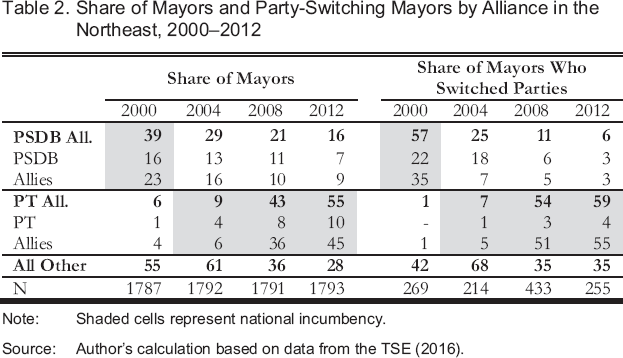
Note: Shaded cells represent national incumbency.
Source: Author's calculation based on data from the TSE (2016).
Furthermore, a close analysis of the mayors bulking up the PT's alliances in the Northeast reveals that party-switching is not the privilege of major state-level elites like the Sarneys and Gomeses. While a portion of the alliance gains are due to parties joining the coalition, a significant part comes from local elites switching parties to avoid the unsavory role of local opposition. On average, about 16 percent of mayors elected in the Northeast have previously held the same position under a different party. This pattern of party-switching correlates with national- and state-level incumbency. Following Cardoso's reelection in 1998, 57 percent of mayors who switched parties joined the PSDB and state-level allies. As we have seen, the 2004 municipal election occurred during an atypical period in which most governors were not aligned with the PT president – hence the majority of opportunist mayors switching to nonaligned parties. By 2008, the PT had become the preeminent force in the nation and, through alliances, in most states. Opportunist local elites therefore jumped on the PT alliance bandwagon. The PT's strong organization typically served as a barrier to entry to the party, which explains the relatively large migration to PT allies. Party-switchers therefore accounted for a substantive portion of the PT alliance's gains in 2008 (11 percent of the PT's mayors and over 35 percent of the alliance's). 16 Interestingly, 73 percent of party-switching mayors changed loyalties while running for reelection in 2008, revealing a clear attempt to maximize the benefits of incumbency at the federal, state, and local levels. In the extreme case of Bahia 70 percent of the newly elected mayors in the alliance had been members of the Magalhães coalition.
This evidence is corroborated by Dunning and Novaes (forthcoming), who show that 30 percent of PT mayoral candidates in 2008 had previously been in other parties.
The bottom line is that by looking at the PT's electoral growth outside of its regional context, we risk overestimating the degree of change that has occurred. Voters rewarded allied parties in far greater numbers, and many of those electoral gains were actually the same candidates winning under new labels. This means that the PT did not vanquish old elites but merely allowed opportunists to continue to line up behind incumbents in order to go on with business as usual.
Conclusion
Leftist government has lost its shine across Latin America, as rightist politicians have taken advantage of political and economic crises to reclaim power through the ballot box or congressional maneuvering. The PT is an example of a party that has experienced the apparent phenomenon of inevitable rise and quick decline. The hope that the PT and other pink-tide governments would focus on social justice seems to have come to fruition based on human development indicators and the Right's initial refusal to directly abandon redistributive policies where it reclaimed power (Niedzwiecki and Pribble 2017). However, the expectation that these parties would deepen democracy by using programmatic competition and governance to change political practices has not been entirely met. Rather, the PT's experiences in Brasília and in the northeastern states show that even an internally coherent and mobilized party that wishes to spread in unequal settings must adapt its linkage strategies in order to succeed. In the PT's case this meant learning to leverage executive power at higher levels of government to spread into lower levels. The need for national-level support – heightened by corruption scandals – along with the lack of partisan networks of their own meant that the PT had to loosen the standards on which it based alliances. The PT's segmented strategy paid rapid dividends, with the party needing only one full electoral cycle to force a realignment of northeastern governors and the politicians in their cadres. But this method led to a tenuous rather than a deeply rooted hold on power, 17 allowing opportunists to raise the costs of coalition maintenance until presidentialism became less about building programmatic coalitions to govern and more about joint co-optation.
Dunning and Novaes (forthcoming) reach a similar set of conclusions.
What lessons can be learned from this account? First, while tempting, using the presidency to fuel subnational expansion is likely to have little more than a fleeting impact. In the aftermath of Rousseff's impeachment, the PT lost over half of the municipalities it controlled. However, given the nature of incumbent politics, governors can play a significant role in counteracting this trend. For instance, the decrease in PT mayors was significantly lower in the Northeast because the PT's three northeastern governors were able to limit the impact of Rousseff's demise in their states by having tied down opportunistic parties with resources and cabinet positions. Conversely, the majority of municipal losses came in states where the PT had allied governors, who are quicker to turn when the enticements that attracted them run dry. This illustrates how opportunist allies respond not to message but to access.
The PT's foray into the Northeast also speaks to the impacts of party adaption to the party system more broadly. As Roberts (2014) shows, leftist parties that adopt rightist policy preferences in order to win or survive in office uproot existing voter linkages, unmoor historical parties, and, ultimately, dealign party systems and electoral competition. In Roberts’ account the PT channeled a popular backlash to neoliberal reforms and, in doing so, contributed to programmatic alignment and party system institutionalization in Brazil. However, the PT's move toward the center and acceptance of some precepts of the Washington Consensus might have belatedly introduced the seeds of dealignment in Brazilian politics, as evidenced by the severe contraction of the PFL/DEM and, to a lesser extent, the PSDB. In its subsequent adoption of conservative electoral methods the PT might have revealed a secondary potential source of party system dealignment, hindering not only its distinctive brand and potentially undercutting its redistributive legacy but also ultimately discrediting the Left more broadly. The resulting crisis of representation fed a wave of social protests and opened the door to populist and outsider forces (Weyland, Madrid, and Hunter 2010), such as Jair Bolsonaro and João Doria. In response to a question about corruption in the PT, Jaques Wagner once said that those who have never tried molasses inevitably get messy when they do. 18 By indulging in the benefits and practices of the Brazilian political system, the PT might have broken the two main structures that, though flawed, have kept Brazil relatively stable since redemocratization: the party system and coalitional presidentialism.
“Quem nunca comeu melado, quando come, se lambuza.” (Folha 2016b).
The paradox, therefore, is that subnational expansion in unequal settings requires linkage segmentation, but the act of segmenting can paint a party into a corner. By making increasingly pragmatic choices in the Northeast, the PT abandoned its transformational project, at times creating new entrenched elites or sponsoring the deep-rooted machines they once fiercely contested. Today, the PT's power base is more concentrated in the Northeast than ever before, especially in those states where it holds the governorship. But as rightist parties’ recent history shows, this power base is highly dependent on who controls the federal spigot. It is too soon to know for certain whether the PT has transformed the typical elite–voter linkages in the Northeast or whether the region will return to its previous status quo and banish the PT. It is certainly plausible that the PT's apparent demise is itself evidence that northeastern voters have broken the pattern and will now punish politics as usual under all banners. If the argument presented here is correct, the PT's losses will be significant, irrespective of President Temer's abysmal approval ratings. As hard as it was to envision at the time of writing this paper, if Temer's position is strengthened in 2018, old elites with federal contacts will reassert themselves, the PT will lose states, and its municipal showing will thus decline even further. 19 But if the national situation remains unclear, the power of incumbency will allow PT governors to influence subnational elites to hold on. Lula's popularity in the Northeast – as exemplified by his recent trek through the region – might provide the PT with enough support to reclaim the presidency; however, his position as the PT's sole viable candidate directly confronts the claim that voting in the Northeast is based on stable, programmatic partisan linkages rather than charismatic or clientelistic ones.
In line with this argument the local press recently speculated that Bahia's Governor Rui Costa (PT) cut a deal to influence the 2 August 2017 vote on whether to authorize corruption investigations against President Temer by temporarily releasing two of his cabinet members so that they could resume seats in the national chamber to abstain from the vote, favoring the president. This ultimately did not occur, but the underlying logic was that Temer's demise would bring the DEM's Rodrigo Maia to the presidency, therefore aligning the party of the would-be president and Costa's main political opponent, the mayor of Salvador (ACM Neto, also DEM) (A Tarde 2017).