



Abstract
This research note uses two case studies of Argentine provinces to develop a typology of clientelistic brokers. I identify a dirigente-type broker, who acts as an advocate of voters, and a puntero-type broker, who acts as a delegate of the patron. The clear differences between these two broker types point to greater diversity among clientelistic practices (such as monitoring and enforcing clientelistic exchanges) than is commonly acknowledged. I provide original evidence from 34 open-ended interviews with local- and provincial-level elected officials that accounts for patron–broker dynamics in small, poor, and peripheral Argentine communities.
Introduction
Although the literature provides evidence of the diversity among clientelistic brokers, no systematic classification or typology of brokers has been developed. In this article I explore the patron–broker relationship in two Argentine provinces and argue that differences in patron–broker relationships can help us identify different types of brokers. I describe two types of brokers. The first, dirigente-type brokers, mediate between patrons and clients and seek to garner political support and votes in exchange for benefits for their community. The second, puntero-type brokers, may also be imbedded in their communities but only act as delegates of patrons. Their legitimacy only relates to their role as gatekeepers of the patron's benefits. Dirigente-type brokers have more autonomy from patrons and authority with voters than puntero-type brokers.
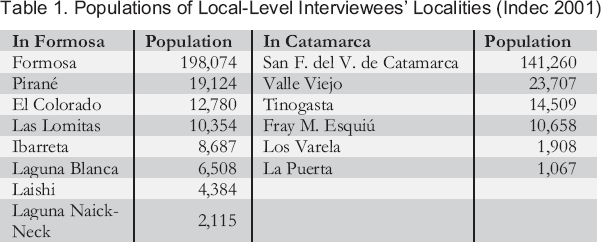
Currently, the literature fails to persuasively and systematically differentiate between brokers and, barring a few exceptions (e.g., Stokes et al. 2013), ignores clientelism in small peripheral districts in Argentina, where it perhaps has the greatest impact. This article looks to address these two gaps in the literature. In small and medium-sized communities enforcement, monitoring, and the reward or punishment of clients thrive (see Medina and Stokes 2007). 1 Compared to other studies, my study focuses on a larger number of smaller towns (n=14) (see Table 1), which better reflect the dynamics of clientelism that occur in Argentine 2 and Latin American localities and the large diversity of patron–broker relationships.
Populations of Local-Level Interviewees’ Localities (Indec 2001)
On enforcement, also see Stokes (2005) and Calvo and Murillo (2004); on “vote buying,” Stokes (2005) and Brusco, Nazareno, and Stokes (2004); on “turnout buying,” Nichter (2008).
There are 3,248 localities in Argentina, but only 64 have more than 50,000 inhabitants (see INDEC 2001). Szwarcberg (2012) does not deal with small localities (out of seven sampled cities, only one has just over 20,000 inhabitants; the rest range from 80,000 to 1.3 million; see Ministerio del Interior, online: http://mininterior.gov.ar/inicio/index.php (8 May 2017)) or with poor districts (her two provincial cases – Córdoba and Buenos Aires – ranked fourth and seventh in the 1996 Human Development Index out of 24 provinces in the country).
I conduct a “structured focused comparison” in order to make inferences about typical brokers in two case studies (see Brady and Collier 2004). I then formulate a set of standardized, general questions that reflect the theoretical framework and research objectives (see George and Bennett 2005: 67) and enable me to evaluate how autonomous brokers are from patrons. The observations come from 34 in-depth interviews with local- and provincial-level Argentine politicians.
Clientelism
The literature indicates that poverty is a strong predictor of the existence of clientelistic relationships between patrons (usually politicians) and clients (usually voters) (see Brusco, Nazareno, and Stokes 2004; Calvo and Murillo 2004; Kitschelt and Wilkinson 2007; Magaloni, Diaz-Cayeros, and Estevez 2007). In this type of contract patrons give clients particularistic benefits (e.g., money, food, and favors) in exchange for electoral support (Auyero 2000: 57; Trotta 2003: 174). This exchange is usually enabled by brokers who (i) give patrons information about a district's constituents, (ii) grant patrons access to voters in the district, and (iii) deliver benefits to clients who, in turn, are expected to support patrons (e.g., Auyero 1997: 36; Stokes et al 2013: 75). Brokers may be party workers or even local community leaders who also engage in other activities, such as running soup kitchens or sports clubs. A clientelistic exchange is complete when clients receive the benefit and the patron receives the support (i.e., a vote).
Clientelism is an asymmetric but mutually beneficial relationship where deference and loyalty toward the authority is common (Neufeld and Campanini 1996; Roniger 1997; Trotta 2003: 145). Yet types of clientelism can differ according to the nature of the patron–client bond. Small-town personalized clientelism is characterized by a bond of loyalty and respect between actors that takes time to develop. It corresponds to a modern version of oligarchic patronage, which typified nineteenth-century northern rural Argentina, for example (Falleti and Sislian 1997; also, Lazar 2004; Roniger 1997; Sabato and Lettieri 2003). Clientelism can also occur between more anonymous electoral machines and clients in an electorally competitive setting (Eisenstadt and Roniger 1981; Lemarchand 1981). Both types of clientelism require that parties use different practices and resources in the clientelistic exchange (see Auyero, Lapegna, and Page Poma 2009: 24). Hence, it is reasonable to differentiate between types of broker relationships.
Limitations of the Literature
In the study of clientelism limitations regarding the selection of cases and the methods used can lead to partial or biased evaluations of clientelistic brokers. The literature on clientelism tends to measure the concept indirectly (see Kitschelt 2000) and is mostly restricted to case studies and qualitative or quantitative methods focusing on the demand side of the equation (the clients). This is because of the difficulty in accessing elected officials, who conceal clientelistic practices (e.g., Brusco, Nazareno, and Stokes 2004; Szwarcberg 2010: 11; Stokes 2005; Valdez 2004; Kitschelt and Wilkinson 2007). Stokes (2005) and Calvo and Murillo (2013) observed voters and clients in order to examine political parties and clientelistic machines (see also Wantchekon 2003). Other studies use restrictive assumptions (e.g., Calvo and Murillo 2004) to overcome the ecological inference problem of dealing with aggregate data (e.g., Magaloni, Diaz-Cayeros, and Estevez 2007). Some also use game theory, which simplifies and minimizes the role of brokers (e.g., Stokes 2005).
Studies of clientelism in Argentina that use supply side (patron) data are either limited to large urban areas or relatively developed districts (e.g., Auyero 1997, 2000, 2001; Neufeld and Campanini 1996; Trotta 2003; Szwarcberg 2002, 2012, 2013a, 2013b; Álvarez-Rivadulla 2012; see footnote 2). The specific roles of brokers may not necessarily be replicated in small towns and could thus lead to a partial conception and a disaggregated analysis of brokers. There are no major studies of Argentina's poorest and smallest localities that avoid relying on surveys (unfortunately, Brusco, Nazareno, and Stokes's (2004) list of sampled cases is not provided). Medina and Stokes (2007) reference Álvarez (1999) in their single peripheral-locality anthropological case study, while Weitz-Shapiro (2012), Stokes et al. (2013), and Szwarcberg (2013a) all use surveys with municipal bureaucrats, brokers, and councilpeople. Szwarcberg's (2002, 2010, and 2012) studies are notable exceptions to the lack of small- and medium-N studies (see also Urquiza 2005).
Stokes et al. (2013) do provide insights into what I label puntero-type brokers. However, they overlook the significant role that dirigente-type brokers play due to their use of a formal structured questionnaire, 3 their assumption that the respondents are “party brokers” (i.e., puntero-type brokers) (e.g., Stokes et al. 2013: 75, 81), their choice of cases, and their choice of method to select survey respondents (e.g., conceiving of brokers as both “city councilors” and “nonelected activists” working for councilpeople who have done “territorial work in neighborhoods” (Stokes et al. 2013: 98)). Szwarcberg (2012: 88) is even more restrictive, defining brokers as “local elected officials” (my emphasis). Also, Stokes et al.'s (2013: 76) assumptions of (i) “electorally (in)efficient targeting” by patrons and brokers and (ii) “patrons’ vote maximization goals” preclude the possibility that, for example, small town mayors’ legitimacy goes beyond the sheer number of votes they receive (e.g., see Lazar 2004; Álvarez-Rivadulla 2012). A more thorough differentiation between brokers is needed – one that takes into account brokers’ agency in complex and, at times, entrenched relationships and not only recognizes patrons’ agency trade-offs (Álvarez-Rivadulla 2012: 92). Both Auyero (1997) and Trotta (2003) refer to the “balance of power” between patron and broker, but they do not – perhaps due to their choice of cases (large metropolitan areas) – explicitly and sufficiently consider the possibility of brokers whose social legitimacy in the community goes deeper than their capacity to mediate with patrons. 4
The authors’ survey questions, which often required brokers to put themselves in hypothetical situations, ran the risk of forcing interviewees into abstract scenarios and leading them to make judgments that may please the survey conductor but do not reflect their own experiences. In my experience the formalities of “academics with their questionnaires” often intimidate these agents of clientelism, making respondents behave in a strategic way in order to “stay out of trouble,” “please the interviewer,” etc., which obstructs a proper observation of attitudes, expressions, etc.
The fields of sociology, psychology, and anthropology have contributed illuminating research on the topic of brokers (e.g., Roniger 1997; Auyero 1997, 2001; Lomnitz 1988; Neufeld and Campanini 1996; Trotta 2003; Álvarez-Rivadulla 2012; also Urquiza 2005).
Case Selection, Method, and Data
The present work is a descriptive inference and follows the “method of structured, focused comparison” to observe one side of the patron– broker relationship (George and Bennett 2005, chapter 11; Goertz 2006, chapter 3). The goal is to identify subtypes of brokers rather than developing a comprehensive typological theory that links independent and dependent variables in a causal relationship (George and Bennett 2005: 233).
Field research was conducted in the Argentine provinces of Formosa and Catamarca in 2006. Comparatively speaking, both are poor provinces. Catamarca, however, is electorally competitive, while Formosa has one dominant party (see Appendix).
Interviews with Elected Officials
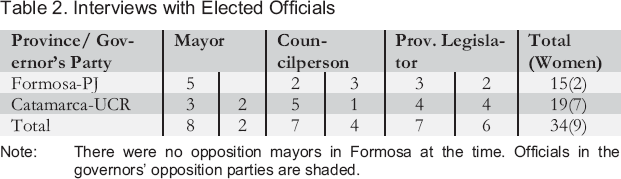
Note: There were no opposition mayors in Formosa at the time. Officials in the governors’ opposition parties are shaded.
I used open-ended questions to trace meanings and causal relationships in specific contexts. I found that politicians, in nonelection years, do not self-censor when discussing somebody else's role (that of brokers) and are less inhibited than brokers (who are likely less powerful than and fear reprisals from patrons) when giving actual examples of behaviors instead of answers to hypothetical scenarios (see footnote 3). Additionally, patrons were often brokers earlier in their careers (see Szwarcberg 2012), thus making these personal accounts at least as relevant as, and possibly more reliable and insightful than, interviews from current brokers.
Next, I illustrate the cases which were used to infer the brokers’ subtypes. 5
I considered it appropriate to preserve the officials’ quotations in the original Spanish language and their English translation appear in footnotes.
Catamarca's Dirigente-Type Brokers
Catamarca's parties do count on punteros (such as those found in Formosa) in the larger cities, where people have access to more resources and hence are more autonomous from parties’ particularistic benefits. Catamarca's illustration below, though, corresponds to dirigentes acting as brokers, which I did not find in Formosa.
The dirigentes are, as one official put it, “intermediadores sociales” (social intermediaries) or social brokers. The routine face-to-face interaction with voters forces a commitment from the dirigente to deliver on promises. Hence, dirigentes need to be bold when dealing with officials of any party, regardless of their personal party preference.
People have strong loyalties to local dirigentes, who may demonstrate caudillo-type attitudes and behavior but are not seen as part of the political machine. According to Deputy Brandán (Brandán is a Peronist in the UCR led Frente Cívico y Social (FCyS) governing coalition),
El interior es más pobre pero es más caudillesco la manera de hacer política, y la gente responde a ciertos dirigentes. Y digamos, por más que le lleves lo que le lleves, esa gente es fiel a cierto dirigente. 6
In English: “The interior is poorer but the way of doing politics is also more caudillo-style, and people answer to certain dirigentes. And no matter what you bring them, those people will be loyal to certain dirigentes.”
Dirigentes come to Catamarca's provincial capital for a couple of days at a time to start advocating people's needs, for example, in the Ministry of Education, in the provincial legislature, and with respect to health insurance for the elderly. When talking about the relevance of dirigentes, the mayor of San Fernando del Valle de Catamarca, Ricardo Guzmán (Unión Cívica Radical, UCR) claims that,
Hay dirigentes de primer y segundo nivel [que] abren las puertas del intendente y del gobernador, tienen un diálogo mano a mano […] su afiliación partidaria es secundaria a su rol de […] representante de los intereses colectivos de su comunidad […]. Generalmente adhieren a la persona [patrón] que le da respuesta […]. Yo le diría que el famoso puerta-a-puerta solo es posible cuando tiene el apoyo de dirigentes territoriales con prestigio, si no es imposible. 7
In English: “There are dirigentes of first and second order [who] open the mayor's and governor's doors, they have one-on-one dialogue […] their party affiliation is secondary to their role as […] representatives of the collective interests of the community […]. Generally, they support the person [patron] who gives them solutions […]. I would say that the famous door-to-door canvassing is only possible when you have the support of the prestigious territorial dirigentes, otherwise it is impossible.”
Senator Albarracín (Partido Justicialista, PJ) told me about his interaction with dirigentes in rural areas, how he prepared for the election, and how the broker was the must-see person to get to people. According to Albarracín,
Usted tiene que subir [al cerro], hablar con el dirigente, y el dirigente es conocedor de todo, y si está con el tiempo necesario […] hace reuniones [con la gente]. 8
In English: “You have to go up [into the mountains], talk to the dirigente, he is the one who knows everything, and if you have the time […] you make meetings [with the people].”
Deputy Brandán made it clear that the local dirigente is key to getting people to vote, saying that,
Por más que tengas una flota de remises, si no tenés al dirigente. La gente si no lo ve al dirigente en el auto, en la combi, la gente la deja pasar a la combi y se viene a votar a pié o en el colectivo. 9
In English: “Even if you have a fleet of rental cars, if you do not have the dirigente, if people do not see the dirigente in the car, the van, they will let the van go, and come to vote by foot or take the bus.”
Electoral competitiveness reflects the relative resourcefulness of alternative political parties in a district and may hence give dirigente-type brokers multiple sources of benefits that help their communities. Dirigentes that are not helped by their local mayors may turn to the provincial senators or deputies in their counties. As Guzmán said, “adhieren a la persona que le da respuesta.” 10 Hence, it might be more difficult for a mayor to have complete control of the local dirigentes. Councilman Millán (UCR, Catamarca) claims that “Son líderes barriales. […] Lamentablemente muchas veces sucede” – thus effectively recognizing that brokers change to patrons who give them more resources. 11 There may be other factors that affect the patron–broker bond, such as multiple layers of elected officials (local-, provincial-, and national-level executive and legislative officials), overlapping districts, and different electoral systems within the same territory. Accordingly, and understandably, people are loyal to their familiar local dirigente.
In English: “They support the person who gives them solutions to their problems.”
In English: “They are neighborhood leaders. […] Unfortunately, it happens many times.”
Formosa's Brokers
Mayors with Little Mediation from Brokers
I found no significant evidence of dirigente-type brokers in Formosa; in fact, brokers only act as patron's delegates there. This may be due to (i) the province having one of the least developed civil societies in the country (see appendix), (ii) the incumbent Peronist PJ having a monopoly on resources, and (iii) small communities in the province having close patron–client bonds.
In Formosa mayors routinely personally interact with voters and people regularly bring requests to their mayors’ brokers or the mayors themselves. However, the act of giving is a mechanism that reinforces personalism, loyalty, and legitimacy in small towns. People know the mayors in these towns (many since childhood) and would not want to talk to somebody who does not have the power to help them – for example, in terms of securing food, employment, money for medicine, or subsidies directly administered by the mayor. Mayors receive people in their offices, listen to their concerns, and then reach into their pockets “to help their neighbors.” Mayors make sure that each individual recipient knows that they are not doing a simple favor (“budgets are tight,” “the need is great everywhere”). Thus each beneficiary leaves with a problem solved and the knowledge that he or she now owes “the good mayor that helped me.” According to Mayor Meza (PJ, Las Lomitas),
Hoy hubo tres casos urgentes que tenían que viajar a Formosa [al hospital]. Yo tenía que darle una solución, un subsidio que ellos rinden después. Cuando vuelvan, le compramos los medicamentos. 12
In English: “Today I had three urgent cases of people needing to travel to Formosa [to the hospital]. I had to give them a solution, a subsidy they will later give back. When they come back to town, we'll get them the medications.”
People's personal relationships with officials, besides cultivating a cult of personality, nurture links of clientelism between constituents and the electoral machines of mayors. Personal relationships create bonds of loyalty and even deference and trust; however, they also generate fear and distrust of outsiders. Some people even come to see their mayors as parental figures who advise them on matters – for example, on who to vote for president. As Mayor Meza points out:
A los candidatos no los conocen. Por ejemplo, Kirchner […]. Acá estaba arraigado Menem, era Dios. Pero dije que a lo último no hizo buena gestión, y defendíamos a Kirchner. 13
In English: “People don't know the candidates. For example, Kirchner […]. Here Menem was deep-rooted, he was God. But I said that in the end he had a bad administration, and we supported Kirchner.”
Brokers Are Delegates of the Mayor
Se va el puntero, se camina el barrio completo, visitó casas, viene a la sede, y te dice, al candidato, “mirá acá en la casa de Pérez tenés que ir sí o sí vos. En la casa de Gómez, puede ir el puntero, otro.” Si va el candidato es porque quizá hay alguna antigua deuda, no cumplió, etc., o porque quieren hablar personalmente. Hay gente que no quiere hacer compromiso con el dirigente [i.e., neighborhood captain], sino el candidato. (Mayor Fernández, PJ, Laguna Naick-Neck) 14
In English: “The puntero goes, walks the whole neighborhood, visits houses, returns here and tells the candidate, ‘Look, here at Pérez's you have to go no matter what. At Gómez's the puntero can go, someone else.’ If the candidate goes it is because, perhaps, there was an old debt, unfulfilled promise, etc., or because they want to talk personally. There are people who do not want to make deals with the neighborhood captain, but with the candidate.”
The key to campaigning is to count on punteros in different neighborhoods (in big cities there may be a puntero per city block) and relevant rural areas. Punteros operate in the communities they come from – they know the people. This knowledge of the base means candidates know what to say and where. Based on Fernández's quote above, we can infer that punteros provide valuable information not only during campaigns but also during a mayor's tenure. Punteros do not always have the confidence of the people, as they are seen as candidates’ political delegates with no decision-making power. Brokers carry out the mayoral business of clientelism, solving people's particularistic demands if they can. Ultimately, mayors know that their legitimacy depends on the satisfaction of those multiple (often small) particularistic requests and hence try to keep their local political and electoral machines well oiled.
Al entregar mercadería […]. Si es campaña, yo no salgo [como sí sale cuando no hay campaña], para eso tenés tu gente. […] Dicen vengo en nombre del intendente. Podés igualar en la cantidad de cosas y la diferencia es en el que te crean a vos. (Mayor Meza) 15
In English: “When giving out food […]. If it is during campaigning, I do not go [as he does when not campaigning], that is why you have your people. […] They say ‘I come in the name of the mayor.’ You can match the amount of things given, the difference is that they believe in you.”
There is an element of trust and loyalty that is difficult for candidates to achieve. It takes time to demonstrate that they care for their respective communities. Mayors would rather pay off potential defectors from the clientelistic bargain than tarnish their image as magnanimous benefactors to the community. 16
This argument contradicts commonly held statistical inferences or assumptions that resources “devote[d] to people who are unlikely to turn out or unlikely to support them are resources wasted” (Rosenstone and Hansen 1993: 163; also Stokes 2005). However, in a context in which a party (the PJ in this case) receives well over 70 percent of the votes, my evidence may undermine the argument that benefits are distributed to those “weakly predisposed in their favor” (e.g., Stokes 2003) and instead support a perspective in which votes are not the only reason for the exchange (e.g., Lazar 2004).
Finally, in Formosa punteros do not usually have much choice of patrons. In small towns punteros are usually tied to the city government, receiving stable pay in a public employment job. Councilman Victor Colusso (PJ, Formosa) explains that
Trabajo en la campaña; bueno, todos cobran o tenés que darle algo. No es voluntario; Un cargo, un puesto. […] pero si va a pegar panfletos le tenés que dar los puchos [cigarrillos], pero también, si vos llegaste también le tenés que dar un puesto de trabajo. Porque también es un trabajo [el ayudar en la campaña al candidato]. 17
In English: “Work during the campaign; well, everyone earns money, or you have to give them something. They are not volunteers [my emphasis]; a job, a post. […] but if he goes to put up flyers you have to give them cigarettes, but also, if you make it [win the elected position] you have to get him a job. Because it is also a job [working for the candidate's campaign].”
Framework and Context: Two Scenarios for Two Types of Brokers
To better account for the types of brokers I explore here, I synthesized stylized descriptions of two scenarios. These scenarios are contextual descriptions of the two provincial cases and serve as a framework from which sets of “general questions” (to qualify brokers) can be inferred.
These scenarios suggest causal factors (theory-relevant variables) and consequences associated with a certain type of broker, which could be the focus of future research.
In machine clientelism – which operates during the last few days of campaigns and is fueled by electoral competitiveness – voters are more anonymous to party operatives and, hence, can cast votes more autonomously. The value of loyalty and/or feelings of reciprocity that clients have toward patrons is drastically reduced, and monitoring clients may be of greater relevance than it would be in less competitive districts (on reciprocity and loyalty, see, e.g., Lawson and Green 2014; Lomnitz 1988: 7, 47; Auyero 1997, 2000: 73).
What role and what characteristics do clientelistic brokers have in these two different, if not polar, settings? How do brokers fit into these scenarios?
Set of General Questions (and the Answers)
To operationalize patron–broker relationships and the role of brokers, I identify attributes around the issue of broker autonomy from the patron. Following George and Bennett's (2005: 71) “method of structured, focused comparison,” I formulate a “set of standardized, general questions to ask of each case” or province. I did not ask the questions below during the 34 interviews. Instead, I examine the “body of material in order to infer the ‘answers’” (George and Bennett's (2005: 87):
Do brokers have a monopoly on access to clients? (exclusivity of access vis-à-vis patrons)
Do brokers act as delegates of patrons or as agents of clients? In other words, are brokers subordinate to patrons, or do patrons negotiate brokers’ support? (E.g., who has the power to determine the times, the places where, the manner in which benefits are delivered to clients and the types of benefits that are delivered?)
Are brokers self-sufficient or dependent on a patron to deliver benefits to clients?
How important is the broker–client relationship for clientelistic tactics (i.e., organization of people, communication of events, delivery of messages and benefits)?
Are brokers known and trusted by the clients/community?
How important are patron–client personalized tactics to campaigns (e.g., candidates visiting people face-to-face in homes or small groups)? Do officials rely on face-to-face campaign activities to win votes?
Can patrons reach clients effectively without the aid of brokers?
Characterization of Catamarca's and Formosa's Brokers
Clientelistic Broker's Subtypes
The above-discussed examples of dirigente and puntero brokers I found in Catamarca and Formosa allowed me to synthesize and typify the secondary-level dimensions of broker subtypes on the issues of broker autonomy and broker legitimacy (researchers will have to operationalize them according to data availability). This work, however, is not exhaustive regarding the number of subtype dimensions (see Goertz 2006: chapter 3) or the number of broker subtypes (i.e., truncated property space). The following questions can be used to synthesize the subtypes:
Are these “party” brokers? (i.e., elected officials (e.g., Stokes et al. 2013) or those paid by the party or in public employment (e.g., Auyero 1997; Trotta 2003))
Do the brokers have a “social” role/job in their communities that is independent of their role as brokers? (if yes, see, e.g., Herzer 2004)
Do they broker solutions for one or many patrons? (see, e.g., Álvarez-Rivadulla 2012)
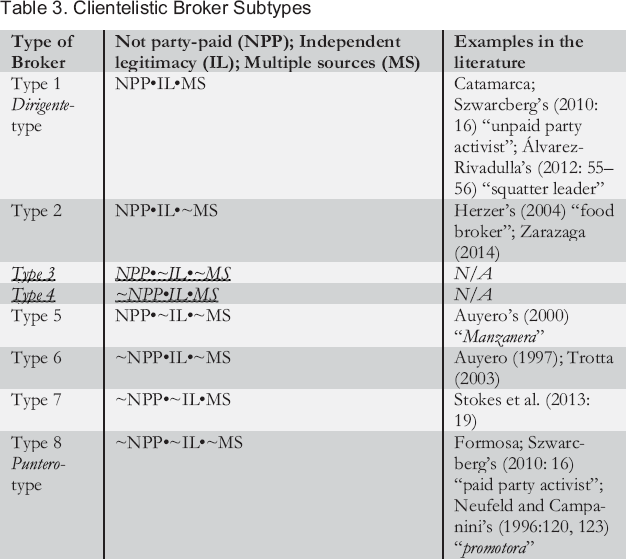
A clientelistic broker who does not work for a specific party AND plays an important role in the community that is independent of his or her brokerage role AND does not rely on a single patron to find solutions would qualify as a dirigente-type broker (type 1 in table 3); if the exact opposite is the case, the broker in question would qualify as a puntero-type broker (type 8) (for more on “logical AND” (•) and negation (~), see, e.g., Ragin 2000). In the classical approach the concepts’ secondary dimensions are necessary conditions. As with any ideal type, the extension of the concept is presumably zero.
However, real cases approximate types. The different combinations that result from compliance with the secondary-level dimensions could reflect different dynamics of the clientelistic relationships, which remain unnoticed in the literature. I anticipate that types 3 and 4 are not relevant, since we would not expect such cases to exist. This leaves six “socially possible” types that may plausibly be identified and studied. Table 3 illustrates a preliminary evaluation of types of broker that can be inferred from the literature.
Clientelistic Broker Subtypes
Conclusion
There is ample evidence in the literature of the diversity of clientelistic brokers’ relationships with patrons and clients, their roles in the clientelistic exchange, and their styles of communication and monitoring clients. It therefore seems relevant to begin a systematic evaluation of such diversity with the aim of furthering our understanding of clientelism and democracy. 18 If brokers are clients’ agents instead of patrons’ delegates, how ephemeral (or solid) is the clientelistic bond? How persuasive or coercive are mechanisms designed to monitor clients? Does the type of broker affect the politician's credit claiming (and legitimacy) among voters/clients?
Lazar (2004) argues that dismissing clientelistic politics simply as dysfunctional oversimplifies clients’ experience with democracy and citizenship.
The broker classification presented here requires that the intensity of the secondary-level dimensions of the broker concept be contained by the primary-level dimensions. Consequently, the concept of clientelistic brokers, who may or may not be hired by a party, is more appropriate than the literature's narrower concept of “party broker.”
Footnotes
Appendix
Possible causal factors of the relevance of clientelism in the studied provinces are represented here by the Effective Strength of Opposition Parties (ESOP) 19 (gubernatorial elections for the period 1987–2003) and the Human Development Index (1996) (see table 4). I expect the study's inferences to be valid for small, poor (even rural) localities where clientelism is relevant to campaigns (e.g., Brusco, Nazareno, and Stokes 2005: 271).
I show elsewhere how Laakso and Taagepera's (1979) Effective Number of Competing Parties (ENCP) is an inappropriate proxy for competitiveness and how the Effective Strength of Opposition Parties (ESOP) index is more appropriate (Lisoni 2012). The ESOP accounts for the problems of coordination and the use of resources (economy of scale) faced by several smaller opposition parties vis-à-vis fewer and larger opposition parties. ENCP = (1/Σvi 2 ); ESOP = Σvo 2 /Σvi 2 ; where vo is the vote share of each of the nonincumbent party and vi is the vote share of each of all parties. The ESOP index ranges from 1 (when the nonincumbent parties win all votes) to 0 (when the nonincumbent parties win no votes.)
Table 4 compares the two studied cases and two other cases selected to provide contrast on socioeconomic and quality-of-life indicators (see also Lisoni 2012). To further qualify the “capacity” of citizens in our cases, see the study by GADIS (2004) on the development of civil society in Argentina. Our cases ranked as follows (out of 24 districts): Capital Federal 2, Santa Cruz 9, Catamarca 16, and Formosa 20 – revealing Formosa to be among the least developed.
Provincial-level electoral competitiveness is arguably more relevant than national- and local-level competitiveness for understanding clientelistic machines. For example, De Luca, Jones, and Tula (2002: 416, 452) show that understanding the centrality of governors is key to understanding candidate nominations in Argentina. Jones et al. (2002) do the same with regard to members of Congress (see also Eaton 2002). Argentina is a federal country and governors have a strong hold on power due to financial and political resources being centralized (Gibson 2005; Gervasoni 2011, 2010a, 2010b; Giraudy 2010), which is to the detriment of city (financial) autonomies. My measure of competitiveness averages the ESOP index value for each gubernatorial election in the period 1987–2003.