




Abstract
Building upon recent studies of the electoral effects of social policy and President Lula da Silva's coattails in the 2006 Brazilian elections, this article explains the performance of leftist and conservative candidates in elections for governor during that cycle in the Northeast region. The study assesses three systemic factors: the conditional cash transfer program, Bolsa Família, economic growth, and Lula's coattails on support for right-wing incumbents and left-wing oppositions in the states of Bahia, Maranhão, and Ceará. Based on the analysis of an original municipal-level dataset and a survey of partisan elites, the findings underscore the importance of urban-based party building strategies across the three states and patterns of elite alliances specific to each state. Alliances made in the capitals coupled with divided conservative establishments, facilitated leftist victories in the examined states. At the same time, variations in alliance patterns and leftist party development across the three states reveal that conservative clientele networks remain vibrant bases of right-wing support, especially in the interior, and despite either social policy or Lula's coattails.
Introduction
The 2006 Brazilian elections were a watershed in the political development of some of the poorest states in the country. These states were crucial in President Inácio Lula da Silva's reelection that year, but they also proved important to leftist parties. These parties won gubernatorial races and expanded seat shares in state assemblies in the poorest states of the North and Northeast, even as their performance suffered in the developed South and Southeast. Most unexpected was the rise of leftist governors in the three largest states of the Northeast, the most conservative region. In Bahia, Ceará, and Maranhão, leftist candidates overcame political machines accustomed to securing their power through the routine buying of votes on behalf of conservative political barons. Leftist success in these three states in particular signaled for many observers that systemic causes were at work and that Brazilian politics would never be the same. First, Lula's own coattails figured prominently in the initial, journalistic explanations. Second, some scholars pointed to economic growth and social policy, both of which intensified consumption and expanded employment, raising living standards in the years prior to the 2006 vote (Hunter and Power 2007). More economically and socially secure voters in the Northeast thus “rewarded Lula” and like-minded reformist and mostly leftist forces at the state level for their advocacy of good governance. At the same time, improved household income freed voters in the Northeast of their erstwhile dependence on the material support provided by clientelist machines, especially in the interior of the poor states.
As hopeful as these arguments sound and as remarkable as these leftist victories were in the Northeast, the proposed systemic causes fail to provide a sufficient explanation for these shifts and they overclaim the depth and sustainability of these changes. Lula's coattails proved more important in some states than in others where the presidential candidate did not consistently support his own Workers’ Party (PT) candidates or allied parties. Leftist candidates did better in areas experiencing more economic growth, but the effects were not consistent across states. And though social policy, particularly poverty alleviation, had a robust effect on Lula's share of the vote in the region as a whole (Zucco 2008), the effects of federal social programs on gubernatorial races were dispersed and even helpful to conservatives who retained the support of the poor interior municipalities most consistently.
Contrary to the systemic explanations, leftist victories in the largest Northeastern states were the result of localized strategies of party-building and state-level elite alliance-formation. Neither of these factors, however, overturned more fundamentally the clientelist networks that can bring conservatives back. In recent years, leftist parties were able to establish toeholds in the more urban municipalities and it was through grassroots efforts that these organizations were able to expand their vote shares for governor. The study demonstrates that the leftist surge was spatially localized in urban capitals and environs. 1 Conservatives suffered their most acute losses in these areas in 2006 but they retained advantages in the poorer interior municipalities where clientelist networks remained robust. Shifts in elite alliances were independent of party-building efforts. Right-wing establishments in all three states were divided at the outset of the 2006 electoral cycle, affording leftists an opening, and in the case of Ceará, the qualified backing of elements of the old machine. Yet where conservatives regrouped following the vote and leftist alliances did not hold, the right was able to stage a comeback, as conservatives did in Maranhão through the courts. With a largely unaltered electoral game board, leftist candidates and their parties still face an uphill climb to secure for themselves competitive positions in the politics of these states. The chief lesson of the 2006 gubernatorial vote in these states is that the left must dominate urban centers and preserve coherent alliances in the face of persistent conservative domination of interior bailiwicks if they hope to gain and retain control of governorships in the Northeast.
I thank Javier Corrales, Ed Gibson, Wendy Hunter, Tim Power, and two anonymous reviewers for their helpful comments on earlier drafts and presentations of this research. I am especially grateful to Wei-Hsin Fu for her generous help with the spatial analysis.
The study proceeds with an evaluation of the systemic explanations and contrasts them to the main argument of this study that localized patterns of party-building and state-level elite alliances provide better explanations for the vote shares of leftists and conservatives in Bahia, Ceará, and Maranhão. The subsequent section analyzes the available arguments in the context of the three-state comparison. The study employs quantitative analysis drawing from ordinary least squares (OLS) regression and geographically weighted regression using geographic information systems (GIS). Taking insights from the quantitative and spatial analyses, the subsequent section examines each case using qualitative data based on interviews of presidents and organizers of the largest parties in the three states.
Systemic Change or Contingent Effects?
The states of the Brazilian Northeastern region have long represented the archetypal politics of parentela, machine politics, and oligarchical rule. Traditional elites whose power was based on control of large landholdings and commerce dominated these states long before Brazil's transition to democracy in 1985. These landed families and local strongmen, known as os coronéis (the colonels), ruled over peasants who depended upon these figures for their livelihoods (Vilaça and Albuquerque 1988). Rapid industrialization and modernization during the twentieth century failed to fundamentally change these inequalities. Instead, traditional elites modernized their formulas of political domination by building pervasive networks of clientelist exchange (Hagopian 1996; Desposato 2001). 2 These networks obviated the creation of conservative parties from a grassroots level. Rather, right-wing parties emerged and proliferated during the post-1985 democracy, the New Republic, as vehicles for competing groups of conservatives to gain national resources to consolidate control over their subnational bailiwicks (Power 2000).
Political clientelism is defined as the distribution of resources by politicians in exchange for support (cf., Gay 1990; Auyero 2000; Mainwaring 1999: 177-178).
The capacity of conservatives in the Northeast to garner the vote of the poor and un(der)educated, who form a majority of the electorate in the region, gave the right remarkable staying power in gubernatorial offices and secured their dominance in state assemblies throughout the 1980s and 1990s. Traditional elites’ control of the state apparatus allowed the right to direct patronage to allies and material rewards to clients. Unequal land tenure, the concentration of capital in public companies, and commercial agricultural concerns with strong ties to the traditional elite reinforced the hegemony of conservatives, making the Northeast fallow soil for leftist organization.
These trends seemed to be upended most stunningly in the 2006 elections when subnational political machines lost control of governorships in a number of Northeastern states, but particularly in the three largest states of Bahia, Ceará, and Maranhão. 3 This loss of control over the state apparatus fundamentally threatened conservative rule by undermining the political machines’ access to patronage and the powerful gubernatorial offices that shape the careers of federal deputies and mayors (Samuels 2003; Mainwaring 1999: 193-194). As such, some observers declared the end of the era of conservative rule (e.g., Borges 2007).
Other notable acquisitions for the left were made in Piauí, Pernambuco, Rio Grande do Norte, and in Sergipe. PT governors were elected for the first time in Sergipe and Pará, a Northern state bordering the Northeastern region.
The depth and sustainability of these shifts depend on how systemic their causes are. Soon after the vote, three interrelated and systemic explanations emerged to account for the puzzle of the leftist surge. At their core, the three explanations hold that the underlying clientelist networks that sustained traditional elites in power in the Northeast eroded badly before the 2006 vote, opening the way for leftist challengers to reverse the hegemony of the right. A central logic of these perspectives is that economic and social improvements in the lives of poor voters devalued the material rewards provided by local bosses. Thus more materially autonomous voters sought to reward the incumbent president, Lula, and like-minded reformers at the state level.
The first explanation involves the economy. After several lackluster years of low growth and a financial crisis in 1999, Brazil began to recover and to take full advantage of a strong upsurge in international (especially Chinese) demand for natural resource manufactures and agricultural commodities. The resulting commodity boom affected even the poor states of Brazil, as commercial agriculture grew with the expanded demand for commodity exports. The growth of both agriculture and industry produced externalities for the service sector, where most Brazilians are employed. Drawing from numerous official studies of export growth, rising wages, the rapid expansion of consumption, and the decline of inequality, Carraro et al. (2007) find that such factors coincided with the vote for Lula. Improved living standards and higher levels of economic autonomy undermine the poor's dependence on the material rewards of clientelism, so it is conceivable that what freed these voters to support Lula in such unmatched numbers in 2006 also helped like-minded opposition candidates on the left.
A second, related, systemic explanation is Lula's own coattails. Plagued by anti-corruption investigations for vote-buying in the National Congress and looking the other way at his own party's problems with local kickback schemes (caixa dois), Lula faced eroding support in his erstwhile base among the industrialized states of the Southeast and South as he campaigned for reelection. Yet a combination of his symbolic importance to the poor as the first working-class Brazilian president and his popular economic and social policies in the Northeast, secured for him an unprecedented electoral following in the redoubts of conservative rule. His victory was assured over his challenger, former São Paulo governor Geraldo Alckmin, only because the poor plumped for him in record numbers, and mostly in the backward states of the North and Northeast (Zucco 2008; Hunter and Power 2007). 4 Lula's popularity was especially evident in the Northeast where he enjoyed almost 80 percent support among those polled before the contest (Hunter and Power 2007: 5). Though Lula's popularity did not help PT candidates for Congress overall, his reelection victory coincided with the leftist surge at the state level in the Northeast.
Evidence for this is the inverse relationship between Lula's share of the vote and the Human Development Index (HDI) per state. Notably, the PT's share of the vote remained positively correlated with HDI, indicating that the candidate and his party developed different demographic bases, at least nationally.
Lula's personal popularity hinged on the effect that his economic and social policies had on the poorest Brazilians. This, more than any factor, has received the widest support among scholars arguing for a systemic and a lasting effect on the electorate. Primary consideration has gone to Lula's landmark social program, Bolsa Família (the Family Grant, BF). As a conditional cash transfer program, BF provides a monthly stipend of up to 60 USD (120 BRL) to households as long as parents keep children in school, give them regular medical care, and maintain the required immunization schedule. Several studies show that voters supported Lula most strongly in those places that had the highest percentage of families receiving BF monies (Hunter and Power 2007; Nicolau and Peixoto 2007; Zucco 2008). On the subnational level, Borges (2007: 129-130) provides state-level correlative evidence showing that the density of Bolsa families is significantly associated with the change in the vote share given to the PT and allied leftist parties in gubernatorial and state assembly contests between 2002 and 2006. Focusing on Bahia's 417 municipalities, Souza (2009) presents evidence that BF predicts the distribution of the vote in 2006 better than the social funds managed by the state government.
The BF factor encapsulates the main rationale for systemic explanations by explaining how the conditional cash transfer program devalued conservative, gubernatorial clientelism through its procedural characteristics, especially 1) its universal criteria for distribution based on federal guidelines and 2) its municipal implementation through a federal registry without the direct input of governors. The first quality (universality) obviates the need for the poor to turn to local clientele networks since they are no longer prodded to do so by necessity. Nor are they compelled by fear since beneficiaries know that their benefits cannot be taken away as long as they remain qualified to receive them (Zucco 2008: 45; Hunter and Power 2007: 18). The second quality (municipalization), along with the first, represents a shift of resources from the governors, creating a competing flow of capital to the poor that undercuts the ability of state-level political bosses to monopolize social policy outputs (Fenwick 2009; Souza 2009: 4; Borges 2007: 127-128, 2008). Key to this is the idea that the municipalization of program funding allows mayors and city councilors to credit-claim without depending on the largesse of governors. Meanwhile, the latter are denied the right to claim credit for resources that they did not broker (Fenwick 2009: 114).
BF is a threat to conservative rule particularly in the poor states because of the way that it disrupts the traditional distribution of support within each state. Spatial patterns of voting in the poor regions in Brazil typically place opposition forces (usually center-left or leftist) in the more urban and developed areas of each state with the hundreds of interior towns, known in public discourse as the grotões, often voting for the gubernatorial incumbent (usually conservative). This tendency is based on the logic that the more dependent a municipality is on gubernatorial largesse, the more likely that mayor and city council will organize (buy) voters for the incumbent. 5 Since the grotões have simple subsistence economies, they remain highly dependent on the public sector. Conditional cash transfers undermine the clientele network by providing funds to local economies free of gubernatorial influence. This cuts out the governors’ ability to credit-claim in the grotões, without which incumbent right-wing governors cannot hold onto power (Ames 2001: 100).
A parallel reasoning is provided by Desposato (2001): local politicians and voters in poor municipalities prefer individual private goods in return for support while politicians and voters in more developed areas prefer public goods. Also see Magaloni, Diaz-Cayeros, and Estévez (2007).
There are, however, several weak premises in the rationales for the systemic effects of federal economic and social policies. First, there is nothing inherent in the federalization of social policy and municipalization of its implementation that prevents governors from preserving extant clientele networks. The need to hedge against the electoral risks of having voters migrate to rival candidates creates an ongoing incentive for gubernatorial incumbents to use clientelist material incentives to garner mayoral and voter support (Magaloni, Diaz-Cayeros, and Estévez 2007). It is plausible that voters and mayors will maximize their income by taking federal support and the governor's patronage. Second, incumbent governors and mayors, including conservatives, can credit-claim the positive economic and social effects of federal policies because voters do not always have a clear cognitive baseline to help them understand which level of government is responsible or who is allied to whom. The low average education of voters in the Northeast makes these citizens especially susceptible to intentional confusion. Because partisanship is weak in the Brazilian electorate, voters do not have the advantage of a party-based rubric for voting down-ticket. Based on an original survey of BF recipients in Recife, Pernambuco, Figueiredo and Hidalgo (2009) find that beneficiaries of the program have positive attitudes toward Lula, who they link to BF, but there is no other effect regarding attitudes toward the President's co-partisans or toward the PT in general. They also find that voters are responsive to campaign messages that invoke BF, regardless of the party making the pitch (Figueiredo and Hidalgo 2009: 18-20). This indeterminacy allows incumbent governors, even those not affiliated with the President's party, to position themselves opportunistically.
A more fundamental flaw in the systemic explanations is that they do not indicate why the erosion of clientelist networks would result in a victory for leftists at the subnational level. I argue in this study that understanding that part of the story requires a comparative analysis of patterns of party-building and state-level elite alliance-formation. The first part of the argument recognizes that while traditional elites have historically relied on access to patronage and the use of pervasive clientelist networks in the poor states, leftists tend to build their organizations through grassroots campaigning. This is a vestige of the way that leftists struggled to organize during the long period of bureaucratic-authoritarian rule (1964-1985) and it remains a fundamental difference between conservatives and the left in Brazil (Power 1996). In the Northeastern states, where conservative politicians have tended to dominate their bailiwicks to the exclusion of viable anti-machine candidates for such a long time, and particularly in the interior, it is primarily in the larger and more economically diversified cities where leftists can gain a toehold.
Consequently, the spatial patterns of leftist organization differ from those of conservatives. Whereas we can expect conservative dominance throughout the grotões, the interior of the poorest states, leftist candidates are more likely to focus on urban areas and environs. This is true for several reasons. First, most of the grassroots organizations (e.g., unions, nongovernmental organizations, consumer groups, etc.) that are likely to form ties with leftist parties are located in these areas. Second, short, average distances allow party offices to remain in face-to-face contact with supporters and to engage in constituency service. While this is not as much of a challenge to conservatives whose clientele networks are well-established and decentralized, leftist parties pursue mobilizational strategies that require repeated upkeep and a more extensive organizational network. Since the larger and more economically diversified cities and surrounding areas have greater shares of the state population, they tend to be more competitive (Ames 2001: 99-100). This means that a clustering of left-oriented activity and support in urban areas takes advantage of several factors that can lead to an anti-machine victory.
The second part of the argument recognizes that state elections in Brazil have their own dynamics involving different configurations of party alliances, candidates, and campaign strategies. Urban localization is a necessary condition for left opposition victories, but may be insufficient in the face of conservative dominance of the interior. Since leftist parties in the Northeast were historically a minority and small organizations, they had to learn to shape alliances to support viable gubernatorial candidacies. The urban clustering of leftist toeholds in Northeastern states puts a premium on their ties with other, like-minded parties given that any significant break in the leftist formation, either due to intra- or inter-party divisions, can fragment the urban vote, handing the governorship to conservatives who retain dominion over their regional bailiwicks. The coherence of the conservative machine is another factor. Where right-wing incumbent governors failed to hold together the support of the machine and the elite divided, leftist parties were afforded an opportunity to expand their support. These patterns explain differences across the three states regarding the cause and sustainability of leftist victories in the 2006 gubernatorial contest.
Statistical and Spatial Analysis
This study focuses on three cases in the Northeast that share the baseline attributes of conservative rule: Bahia, Ceará, and Maranhão. These are three of the five states that Borges (2007) classifies as “dominant machine”; in other words, they are among the least competitive subnational polities. 6 Two of the selected three states have been dominated by the largest party of former, pro-military conservatives, the Partido da Frente Liberal (PFL – Maranhão and Bahia), a condition that satisfies a more restrictive, partisan definition of conservative rule. None of the three has developed an organized leftist opposition until recently. These states are also at similar levels of socio-economic development as measured by the United Nation's Human Development Index (HDI) 7 and urbanization rates and they are the most populous states in the Northeast (Borges 2008).
The other two are Paraíba and Goiás.
The HDI is an index scaled 0 to 1 based on a composite of three indicators of well-being: life expectancy, per capita income, and educational attainment.
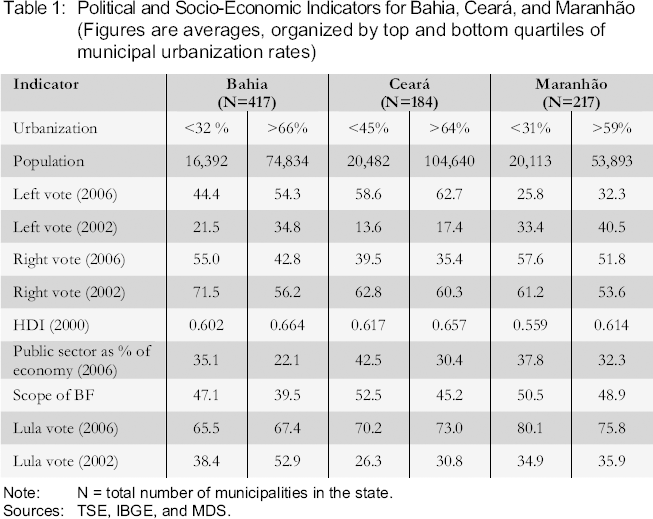
Table 1 profiles the main political and socio-economic indicators of municipalities in the three-state cohort. The selected municipalities are pooled based on the top and bottom quartile ranges of urbanization in each state. Those in the bottom quartile are typically grotões, while those in the top quartile represent the cohort of more developed municipalities. The three states share socio-economic attributes in that the more urbanized municipalities have higher HDI scores and have a lower dependence on the public sector. As expected, the scope of BF coverage is greater in the grotões across the three states. 8 Turning to the political indicators, all three states had conservative (incumbent) administrations that won in 2002. Support for the incumbents in each case (Paulo Souto of the PFL in Bahia, Lúcio Alcântara of the Partido da Social Democracia Brasileira – PSDB in Ceará, and José Reinaldo Tavares of the PFL in Maranhão) reflected the traditional bias of voters in these states to support the incumbent, a tendency known as governismo, by large margins. Notably, this support was larger in the grotões than in the more urban areas. Again, this is consistent with the relative dependence on public sector spending and what we expect from clientelistic, dominant machine cases.
Political and Socio-Economic Indicators for Bahia, Ceará, and Maranhão (Figures are averages, organized by top and bottom quartiles of municipal urbanization rates)
Note: N = total number of municipalities in the state.
Sources: TSE, IBGE, and MDS.
BF scope is measured here as the percentage of families per municipality receiving Bolsa Família.
The numbers for the 2006 vote indicate a rupture in the traditional tendency. Leftist opponents in Bahia (Jacques Wagner of the PT) and Ceará (Cid Gomes of the Partido Socialista Brasileiro – PSB) won in the first round on the basis of sizable swings in average vote shares in both the more and less urban areas. In Maranhão, the representative of the incumbent machine, Roseanna Sarney (PFL), and the opposition leader, Jackson Lago (Partido Democrático Trabalhista – PDT), went to a second round in which Lago was victorious with a slight margin of 3.6 percent of the vote. Notably, the difference in average vote shares between 2002 and 2006 for leftist oppositions were either larger (Bahia) or about the same (Ceará) between the more urbanized municipalities and the grotões (Maranhão is the exception). And the conservatives lost larger mean percentages in the less urbanized municipalities in Bahia and Maranhão and about the same in Ceará. Below, I test whether these are just artifacts of the grouping of cases in this table or a statistically significant effect.
The data in Table 1 reveal other differences across the three states. The performance of the opposition in Bahia and Ceará is largely consistent with Lula's average share of the vote per municipality, but Maranhão stands out as an obvious exception. This state also deviates from the others in the degree to which BF relates to the electoral performance of the incumbent versus the opposition. The program's influence in Bahia and Ceará seems much more consistent with the expectations of scholars who see BF as undercutting conservatives and lifting the political fortunes of their left-of-center opponents. But there are other differences among these states that should qualify these expectations. The weight of public sector spending is larger in Ceará and Maranhão than it is in Bahia, giving the left more of an advantage in the latter in 2006. Discretionary spending is strongly associated with political support for the conservative incumbent in Northeastern states (Souza 2009; Power 1996: 72), a pattern that is replicated in the table for the 2002 vote and for the right in Maranhão in both contests. That leaves Ceará as a puzzle since larger proportions of potential clientelist spending were not enough to keep the incumbent in power. This case suggests that more pervasive BF coverage may overcome these otherwise pro-conservative effects.
Further evaluation of the cases, however, reveals that straightforward explanations based on the pooled data in Table 1 are not where analysis should end. For example, the Ceará case represents something very different from the experience of Bahia. In 2006, the incumbent machine divided on its support for the sitting governor, Lúcio Alcântara, with the most powerful boss within the PSDB, ex-governor Tasso Jeressaiti, endorsing the eventual winner, Cid Gomes. Mayors, who typically switch parties to the one(s) affiliated to the governor to garner gubernatorial resources (Lacerda 1991; Ames 1995), gravitated to Gomes as the designated dauphin of Jeressaiti and the brother of a former PSDB governor of the state, Ciro Gomes. This shifted much municipal spending in Gomes’ favor. By contrast, the opposition in Bahia fought against a much more unified and entrenched incumbent regime. In this case, the close affiliation of the eventual winner, Jacques Wagner of the PT, with the Lula government, may well have made federal social policy a weighty factor in breaking the choke hold conservatives had maintained on the state since 1990. Alternatively, the Lula factor could have played a much bigger role in Bahia, obviating the effect of BF. In Maranhão, Lula's margins and BF's scope were large, but the President actively campaigned on behalf of Sarney despite the fact that his own PT was in alliance with Lago's PDT. Though Lago still won in the second round, his position was weak vis-à-vis the conservative establishment. Lago's subsequent judicial removal from office (cassação) for alleged electoral corruption ended his government not three years into his term in favor of Sarney. Though leftist oppositions won in all three states, the causes and sustainability of these shifts were affected by these differences in state alliance patterns.
The present study first assesses systemic predictors of the incumbent and leftist anti-incumbent share of the gubernatorial vote in 2006 against a proxy for localization effects (urbanization) and controls for socio-economic development (municipal HDI) and previous electoral support in the municipality. 9 The dependent variable is the percentage of the vote per municipality. 10 In all cases, this involves candidates of right-wing (PFL) or center-right (PSDB) incumbents versus leftist (PT/PSB/PDT) oppositions in alliance with like-minded parties. Urbanization rates represent the percentage of the population that lives in urban areas as defined by the Instituto Brasileiro de Geografia e Estatística (IBGE). 11 Economic growth is measured as the growth rate of the municipal economy between 2004 and 2006. The scope of BF coverage per municipality is a percentage of the local population calculated from Ministry of Social Development data for household recipients and actual family size per municipality as determined by the IBGE. Recent studies of BF coverage use the number of households receiving BF as a percent of the total number of households per municipality (e.g., Zucco 2008, 2009; Borges 2007) or a transformed term measuring BF recipients as a percentage of the total municipal population. 12 I tested these alternative operationalizations and did not see different results from those reported here. The models include (but do not show for the sake of conserving space) state dummies to account for omitted variable bias produced by state-specific attributes. Removal of the dummies produces less efficient models but not different overall results.
Several unreported specifications controlled for party of the mayor, yet the results were not different from those shown here.
All electoral data were taken from the official Tribunal Superior Eleitoral (TSE) figures.
In the censuses of 1991 and 2000, IBGE defined an “urban situation” in its Manuais de Delimitação de Setores as the physical space between a perimeter and an urban center as measured by census officials at the time of a municipal survey. Urban populations are those inhabitants of that physical space and they may be compared to those in “rural situations” located outside the urban perimeter.
Either operationalization encounters the problem that not everyone in a household is of voting age. Yet, despite that fact, it is also likely that non-voters can influence voters living in the same household or in neighboring households. This assumption is consistent with research findings on the importance of social relationships in voter decision-making (Baker, Ames, and Rennó 2006). So the proportion of the population receiving BF monies should approximate the number of BF voters directly as well as indirectly. The term used in this study correlates (R>.90) strongly with Zucco's (2008) operationalization.
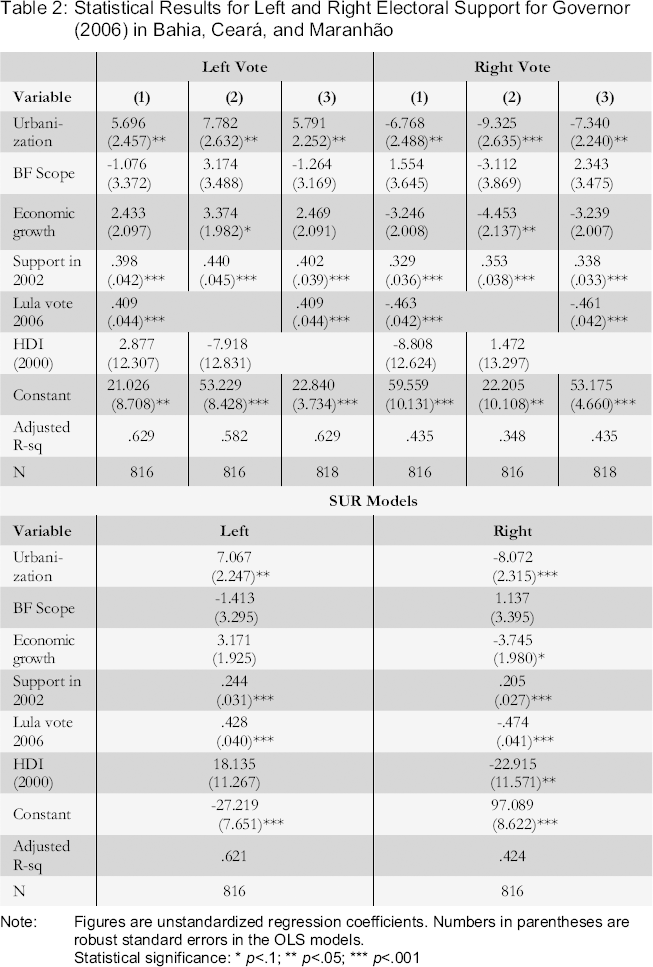
Table 2 reports the OLS results for the opposition and conservative incumbent vote in the 2006 gubernatorial elections in Bahia, Ceará, and Maranhão. Three specifications are run for each dependent variable with Lula's vote share in 2006 dropped in the second model and the HDI dropped in the third. Since these two factors are known to interact strongly with BF coverage in national studies, these models test whether the presence of the predictors mutes the effects of social policy. 13 To evaluate whether the error terms across specifications regressing the left and right vote are correlated, the table includes the results for seemingly unrelated regressions (SUR) of the unified models. SUR analysis uses generalized least squares to estimate more efficient models than are possible using OLS when different dependent variables are tested from the same data.
Statistical Results for Left and Right Electoral Support for Governor (2006) in Bahia, Ceará, and Maranhão
Note: Figures are unstandardized regression coefficients. Numbers in parentheses are robust standard errors in the OLS models.
Statistical significance:
p<.1
p<.05
p<.001
Breusch-Pagan tests for heteroskedasticity indicated the need for a correction, so the OLS models employ robust standard errors. Post-estimation diagnostics for multicollinearity revealed that the parameter estimates were within acceptable tolerance intervals.
The results demonstrate that urban localization and Lula's coattails are the most consistent predictors of the gubernatorial results in the three states in 2006. The latter proves a weightier factor since a move from the 10th percentile to the 90th on Lula's municipal share of the vote while holding all other predictors at their mean produces a −12 percentage point change in the rightist incumbent's share and a +10.6 percentage point change in the leftist opposition's share. Urbanization has a less powerful, but still appreciable, effect. Moving from the lowest decile to the highest in urban population rates produces a shift of 3 percentage points in favor of the left and a decline of 4 percentage points in the right's share of the gubernatorial vote.
Are Lula's coattails working with both economic growth and BF to help down-ticket leftists? Economic growth becomes significant for the left and right only when the coattails effect is removed. While it is significant at the .05 level for the right, it is significant only at the .1 level for the left. Economic change may lift leftists and depress support for the right, though it does not appear to do so independent of successful credit-claiming by the president and perhaps subnational oppositions who wish to identify with him. The overall results for BF fail to affirm the program's systemic effects on gubernatorial elections in the three states. That does not mean that BF has no effect since local indicators of spatial association analyzed below reveal that BF does have an impact, though not in the manner systemic arguments expect. 14
Specifications interacting BF and economic growth were also run without different results.
The SUR models that correct for contemporaneous cross-equation error correlation show results that are virtually the same as those of the OLS models with the exception that growth is no longer significant for the left and significant at only the .1 level for the right. HDI becomes significant for the right with the most likely substantive interpretation being that this confirms what the urbanization term shows in that leftist challengers gather more of their support from the more developed and more competitive municipalities while conservative bailiwicks tend to be less developed.
The differential performance of the urbanization term for left and right underscores Barry Ames’ core insight in his The Deadlock of Democracy (2001) that electoral politics in Brazil is a “fight for space.” For Ames, municipalities have patterns of domination and competition that must be understood on two dimensions: 1) “vertical penetration” (domination) and 2) “horizontal coverage” (contiguity). Domination refers to a given candidate's share of the vote per municipality weighted by the percentage of the candidate's total vote the municipality represents. 15 Horizontal coverage refers to the clustering of support for a candidate across neighboring (contiguous) municipalities. This is substantively important because space is related to the costs of organization. Those costs are lower for conservative incumbents in the Northeast who can rely on extant decentralized clientele networks that have been in place for a long time. Consequently, these politicians tend to dominate their bailiwicks, especially in the grotões where managing clientele networks is facilitated by smaller and more dispersed populations and erstwhile systems of vote-declaration in return for material rewards post-election (cf Nichter 2009). By contrast, leftist oppositions must build their parties at the grassroots level and mostly in urban areas where organizational allies such as unions and consumer groups are located and where the costs of continued mobilization are lower due to shorter distances. In the Northeast, leftists cannot capture the governorship without maximizing both domination and horizontal coverage of urban areas and their environs, while conservatives can if they split the urban vote and retain domination over their bailiwicks.
Domination (Di) = Vix where i is the candidate's share of all votes cast per municipality x and then weighted by Tix (percentage of the candidate's total vote municipality x contributes). Notably, Ames (2001: 74, 100-101) finds that patterns of domination are more discernable over time in the Northeast than in other regions.
Confirming these insights in the cases of the three largest states of the Northeast requires moving beyond OLS analysis to understand the geography of politics through spatial analysis. The first step is to generate state-level overviews of spatial patterns of what Ames (2001) calls “horizontal coverage.” Do votes cluster spatially for left and right across the three states in recognizable patterns? Moving beyond univariate analysis, we can ask if clusters of votes form in statistically significant patterns along with the distribution of the other variables of importance – Lula's share of the vote, BF coverage, economic growth, and HDI. Spatial analysis doesn't just provide insight into the political dynamics at the state level, it also allows us to better understand through local indicators of spatial association (LISA) municipal-level and cluster-specific interactions that may not be statistically significant at a more aggregate level but are at a local level. In these ways, spatial analysis and geographically weighted regression unveil dimensions of political and socio-economic phenomena that are left as obscured “dark matter” by OLS regression of pooled data.
Fortunately, geographic information systems (GIS) offers a convenient statistic to evaluate patterns of clustering and dispersion over defined study areas (e.g., states) and LISA analysis gives us further insight into localized patterns within these study areas (e.g., municipalities). Both rely on the calculation of the Moran's Index (or Moran's I). This statistic is a measure of spatial autocorrelation that ranges from −1 (complete dispersion) to 1 (complete clustering) for phenomena that can be mapped onto spatial units (“polygons”) whereby each polygon has a range of contiguous neighbors with either similar or different cross-products on a given variable. Positive and high Moran's indices indicate clusters of neighbors with similar values while negative and low indices represent high dispersion. Both possibilities can be statistically significant if sufficiently above or below zero to reject the null hypothesis of a random spatial pattern. 16
For more on Moran's I, see Mitchell (2005).
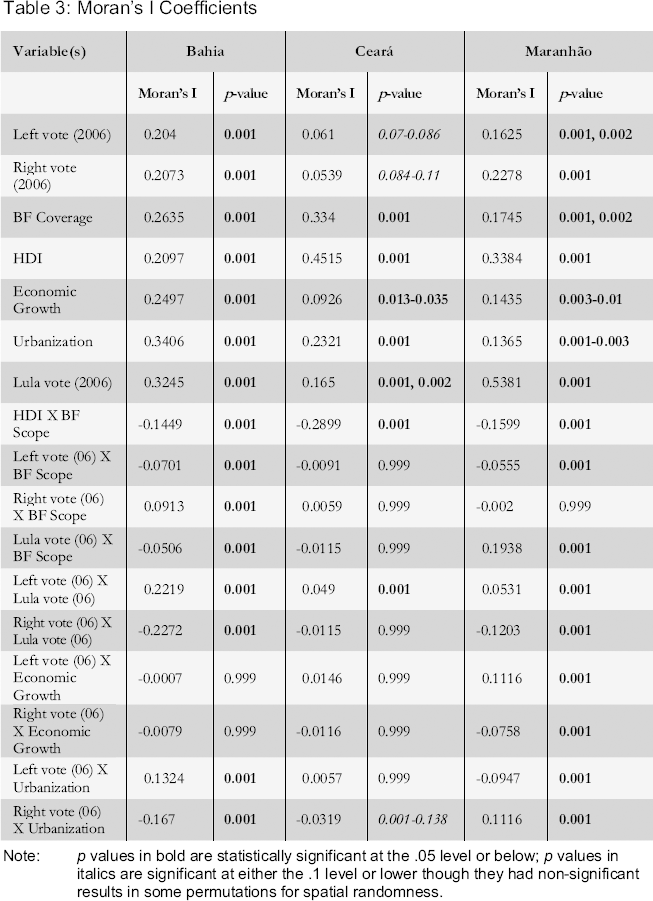
Table 3 shows the Moran's I for univariate and pairwise associations of interest. Each p-value is determined after running 999 permutations of spatial randomness. The results for the univariate mappings indicate that all of the phenomena of interest in this study have spatial patterns that indicate clustering. Only Ceará is exceptional in that the left and right shares of the vote for governor show some spatial indeterminacy, a finding that will be explored further below. Regarding the bivariate associations, the results provide additional insights into the BF variable as it disperses with the left vote in Bahia and Maranhão, and surprisingly, with the vote for Lula in Bahia. Where it clusters it does so for the conservatives in Bahia and for Lula only in Maranhão, where the incumbent President supported the right-wing candidate and not his own party's alliance partner, the PDT. Economic growth is also spatially inconsistent as it clusters with the left vote and disperses with the conservative vote only in Maranhão. Neither BF scope nor growth have discernable spatial patterns in Ceará. Lula's coattails cluster, as we would expect, with the left across all three states and disperses with the right share of the vote (Ceará is indeterminate). Finally, urbanization shows differential clustering with the left vote and dispersion with the right in Bahia, but the opposite is the case in Maranhão, where the left vote does not show the same urban-centered pattern. No statistically significant pattern is present in Ceará.
Moran's I Coefficients
Note: p values in bold are statistically significant at the .05 level or below; p values in italics are significant at either the .1 level or lower though they had non-significant results in some permutations for spatial randomness.
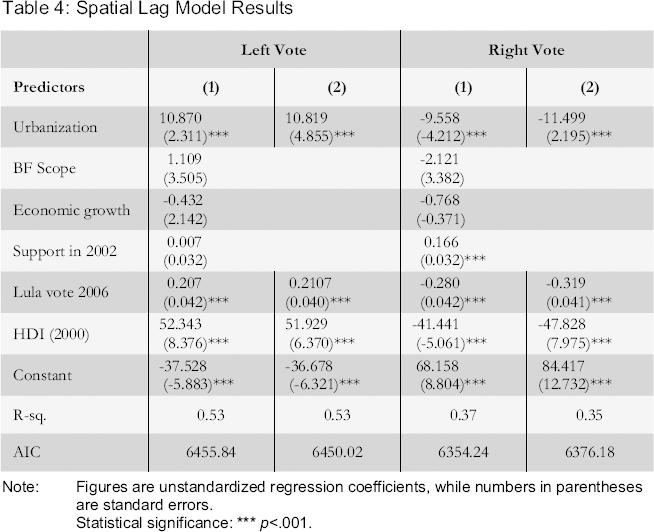
The results of the Moran's I analysis suggest that there are spatial variations in the data that matter to the organization of the vote for the left and for the incumbent machines. Spatial lag modeling, also known as spatial autoregression, can assess whether these dimensions alter appreciably the parameter estimates in the OLS analysis. With this approach, the average of the left and right vote in a given municipality's contiguous neighbors becomes a term on the right side of the regression equation. In other words, the models give a direct estimate of the influence of the predictors in neighboring municipalities on vote shares in each unit. Table 4 presents the results for the most efficient models compared to the OLS baseline. 17 The results confirm the insights of the Moran's I analyses that localization strategies and Lula's coattails cluster meaningfully across the three states. This is true even if significant socio-economic effects as measured by HDI are controlled. Once again, there is no effect from BF or from economic growth. What the results do not explain is why Ceará evinces different patterns in the Moran's I table and why localization functions differently in Maranhão. As I argue below, these two states had alliance patterns that shaped the left's opportunity structures differently. State-by-state analysis will show that these distinctions mattered in assessing both the causes and the sustainability of leftist victories.
Spatial Lag Model Results
Note: Figures are unstandardized regression coefficients, while numbers in parentheses are standard errors.
Statistical significance:
p<.001.
The tests involved generating multiple models and visually comparing the mappings of the residuals and their standard deviations between OLS and the spatial lag models. The residuals maps for the three states are available upon request.
Besides differences in horizontal coverage, the states show some distinctions on the spatial distribution of vertical penetration. Drawing on Ames’ (2001) concept of spatial domination, I analyzed the three states for the dimension of vertical penetration. Mapping dominance scores for the left and the right vote in all three states, Figures 1 and 2 show the spatial distributions for the 2002 and 2006 votes, respectively. The results can be easily “eye-balled” with the darkest coastal spots representing the most populated urban centers. The results for 2002 show a sharp division between leftist urban toeholds versus conservative grotões. The pattern holds when compared to the dominance score maps in 2006, though several notable differences appear. In Bahia, the left's urban toehold deepens and expands around Salvador and down the coast. The conservatives lose support around the capital and depend for more of their vote shares on the interior bailiwicks. In Maranhão, Lago's share of the vote depends more on urban areas in 2006 than in 2002, but there is a substantial strengthening of conservatives’ dominance over the grotões. The leftist thus faced a conservative opposition that was divided at the elite level but more entrenched in its regional bailiwicks, a position of strength that the sarneyistas could use to later challenge Lago's victory in the courts. By contrast, the results for Gomes in Ceará show spatial patterns similar to those for the PSDB candidate in 2002, a pervasive interior distribution completely out of character with the nature of the 2002 PT candidate's performance, which reflects the more typical urban and coastal localization strategy. These patterns for Ceará suggest that state-level alliances mattered in that case in generating a more extensive victory for the left that did not upend the political machine but built upon it. Mayors once and always in the service of Tasso Jeressaiti shifted their support to his candidate, Gomes. Finally, Bahia represents a more classic conflict between conservative incumbents and leftist opponents supported by Lula who used an urban political mobilization strategy to ride to a more sustainable victory.
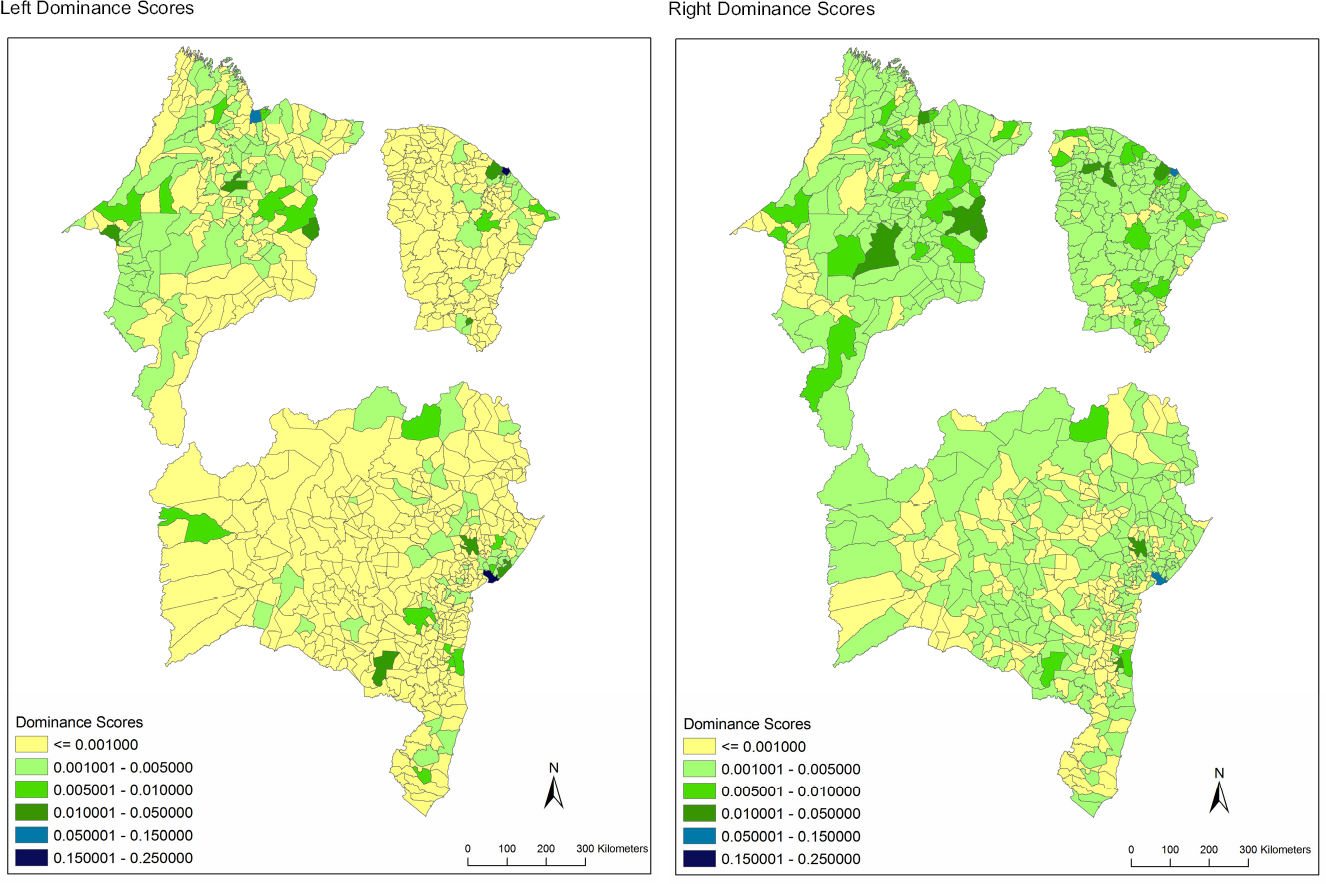
Dominance Scores (2002) in Bahia, Ceará, and Maranhão Left Dominance Scores
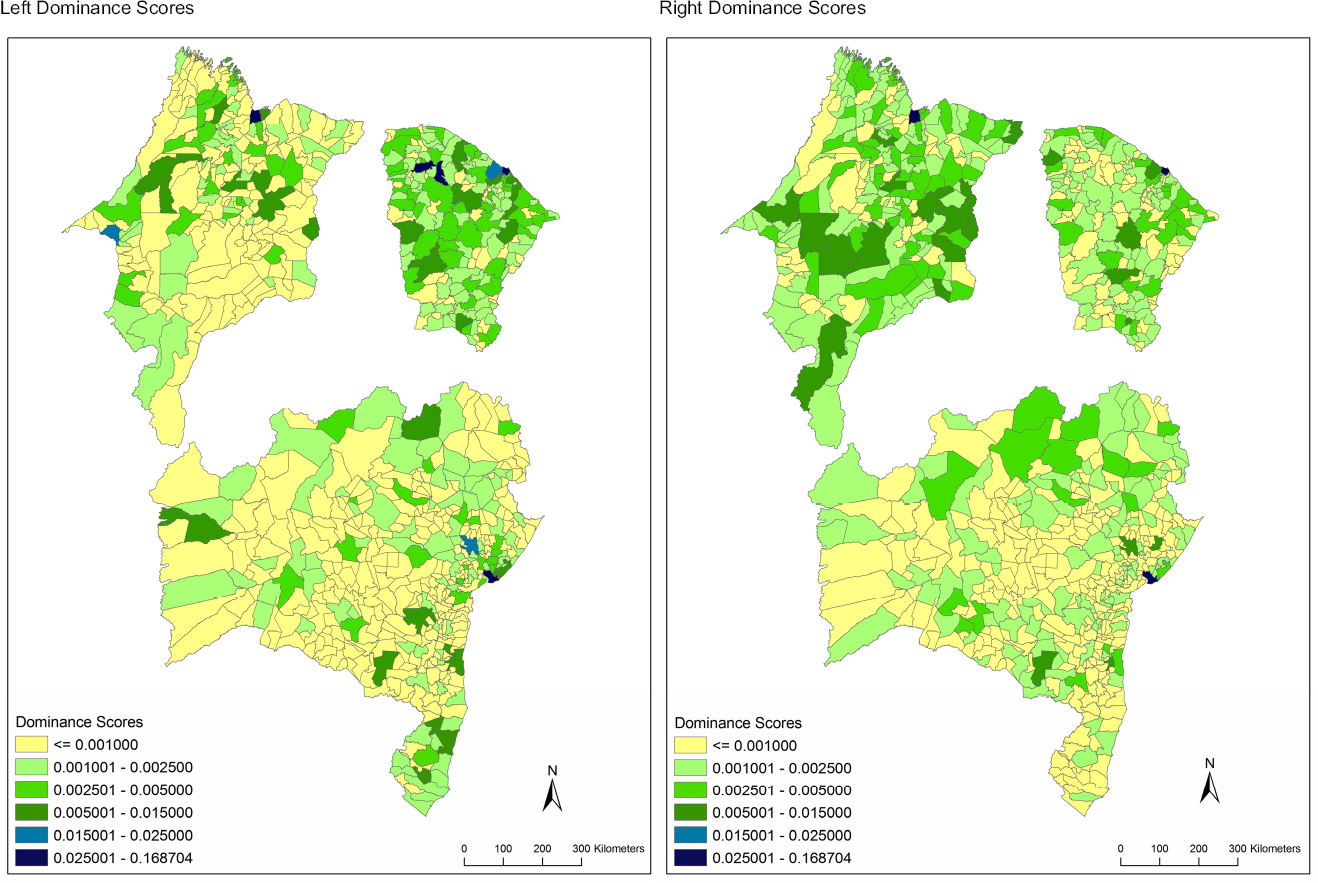
Dominance Scores (2006) in Bahia, Ceará, and Maranhão Left Dominance Scores
Localized Patterns within the Three State Cases
The statistical and spatial analyses underscore that the three states producing leftist victors for governor in 2006 differed in ways that require an understanding of elite alliance patterns and the relative cohesion of the conservative establishment and the leftist opposition on the eve of the vote. In this section, I examine briefly the parameters of these factors in each state. I illustrate how variations in the spatial distribution of vote clusters within each state reflect not only urban-based patterns of party-building and mobilization for the left but larger bargains involving the positioning of incumbent machines against their opponents. For each state, I generate a local indicators of spatial association (LISA) mapping. Results from interviews with party leaders supplement the analytical narratives, especially with regards to campaign strategies.
Bahia: Conservative “Exhaustion” and Localized Opposition
In no other state of the Northeast were conservatives more pervasively dominant than in Bahia. This state was long the fiefdom of Antônio Carlos Magalhães, who had served the state as governor under the military regime and during the New Republic; conservatives could thus rely on a highly decentralized system of clientelism financed by direct lines to federal coffers through Magalhães’ ties to national elites. The carlista network dominated Bahia by electing governors between 1982 and 2002, mostly on the PFL legenda, with the exception of the 1986-1990 period in which the centrist opposition led by Waldir Pires of the Partido do Movimento Democrático Brasileiro (PMDB) took the governorship (Dantas Neto 2006). The power of the carlistas only began to erode with the sudden death of Magalhães’ son and assumed successor, Luís Eduardo, who died of cardiac arrest in 1998, and Magalhães’ own death in 2002. Fissures within the carlista political group during the early years of this century weakened the machine's control and produced tensions within the PFL (Souza 2009: 25-26). Notably, Governor Paulo Souto (2002-2006) remained within the party even as others formerly loyal to Magalhães bolted to the catch-all PMDB. 18
I thank Paulo Fábio Dantas for his insights on this history.
The carlistas thus approached the 2006 gubernatorial election with an incumbent in the governorship, Souto, but without the ties to the federal government that the PFL and the state enjoyed when their patron was alive. Allied conservative parties began to abandon their ties to the carlista group, which came to be based more exclusively on the PFL. As the conservative establishment looked more “exhausted” (desgastado), the opposition led by the PT was more organized and genuine than any that Bahia had seen, and with stronger ties to the national presidency after Lula's election in 2002 than any opposition enjoyed in the state's history. The Workers’ Party (PT) and allies in the Partido Comunista do Brasil (PCdoB) and the Socialist Party (PSB) had mobilized in the years preceding the vote mostly in the municipalities around Salvador, the capital and the Southern coast, where allied civil societal organizations were most active. 19
Leftist party leaders told me that their committees could not venture for more than short, periodic visits to interior municipalities, favoring instead the mobilizational assets they had in Salvador and the coast.
Given these dynamics, the distribution of the left vote for Jacques Wagner's candidacy had the dominance and horizontal coverage expected from an opposition relying primarily on urban mobilization. This can be shown using bivariate LISA. Bivariate LISA analysis calculates the crossproduct of the standardized value of the first variable at a municipal location i with that of the average for another variable in contiguous neighbors. Localized correlations are either statistically different from conditions of spatial randomness or they are not. Cluster maps show the location of the cores of clusters having either high-high or low-low relationships among cross-products. Where values are inverse (high-low and low-high), clusters are designated as spatial outliers that are the converse of the linear relationship. 20
These designations (and the patterns on the maps) are reversed when the original bivariate relationship is known to be inverse. In these cases, high-high and low-low clusters are spatial outliers. On the specifics of cluster mapping in GeoDa, the software with which the spatial data analyses were conducted, see Anselin, Syabri and Kho (2004).
Figure 3 illustrates the spatial bivariate LISA for the left and right vote in Bahia with urbanization. The left vote concentrates around Salvador and the southern coast while the right vote clusters more in interior municipalities and is an uneven, spatial outlier around the capital. Again, this is what we would expect if the left mobilizes primarily in urban environs. The spatial finding for urbanization contrasts notably with the role of BF in the state and that is especially telling given the fundamentals in this case which should favor the BF factor. It should be remembered that the PT's candidate, Jacques Wagner, was closely tied to the President, having served him as an advisor in the Planalto during the difficult months of the corruption scandals of 2005, and was connected strongly to Lula's social agenda. 21 High voter identifiability of BF with the challenger was more likely in this case, and Souto and the PFL as outsiders to the Lula franchise could hardly claim BF for themselves. Yet as Figure 4 shows, support for the right clusters positively with BF coverage (Moran's I = 0.0913, p<.001) and precisely where conservatives maintain higher levels of dominance in the grotões.
Author interview with special adviser to Governor Wagner, Jones Carvalho, Ouvidor Geral do Estado, Salvador, June 18, 2009.
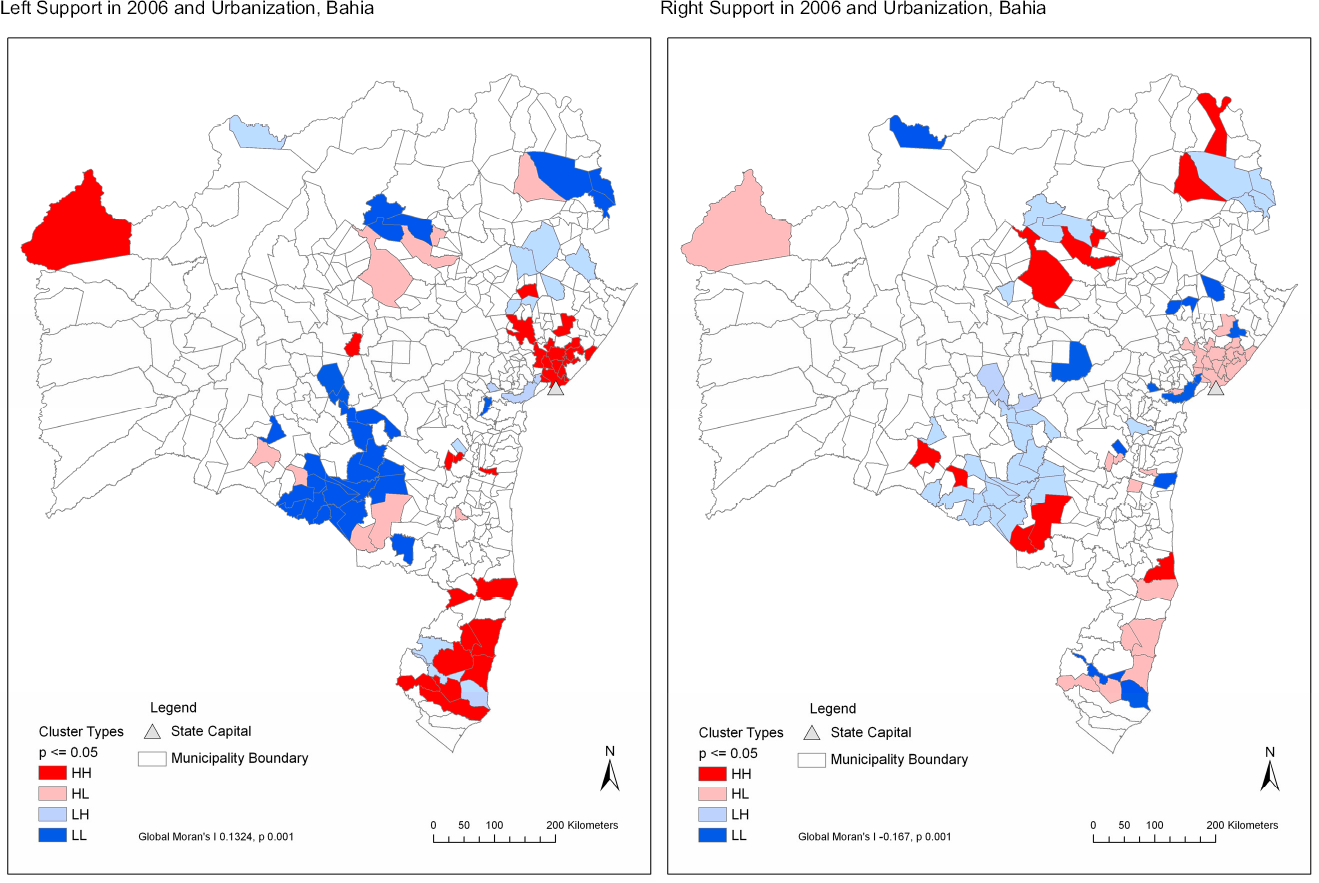
Political Support in 2006 and Urbanization in Bahia
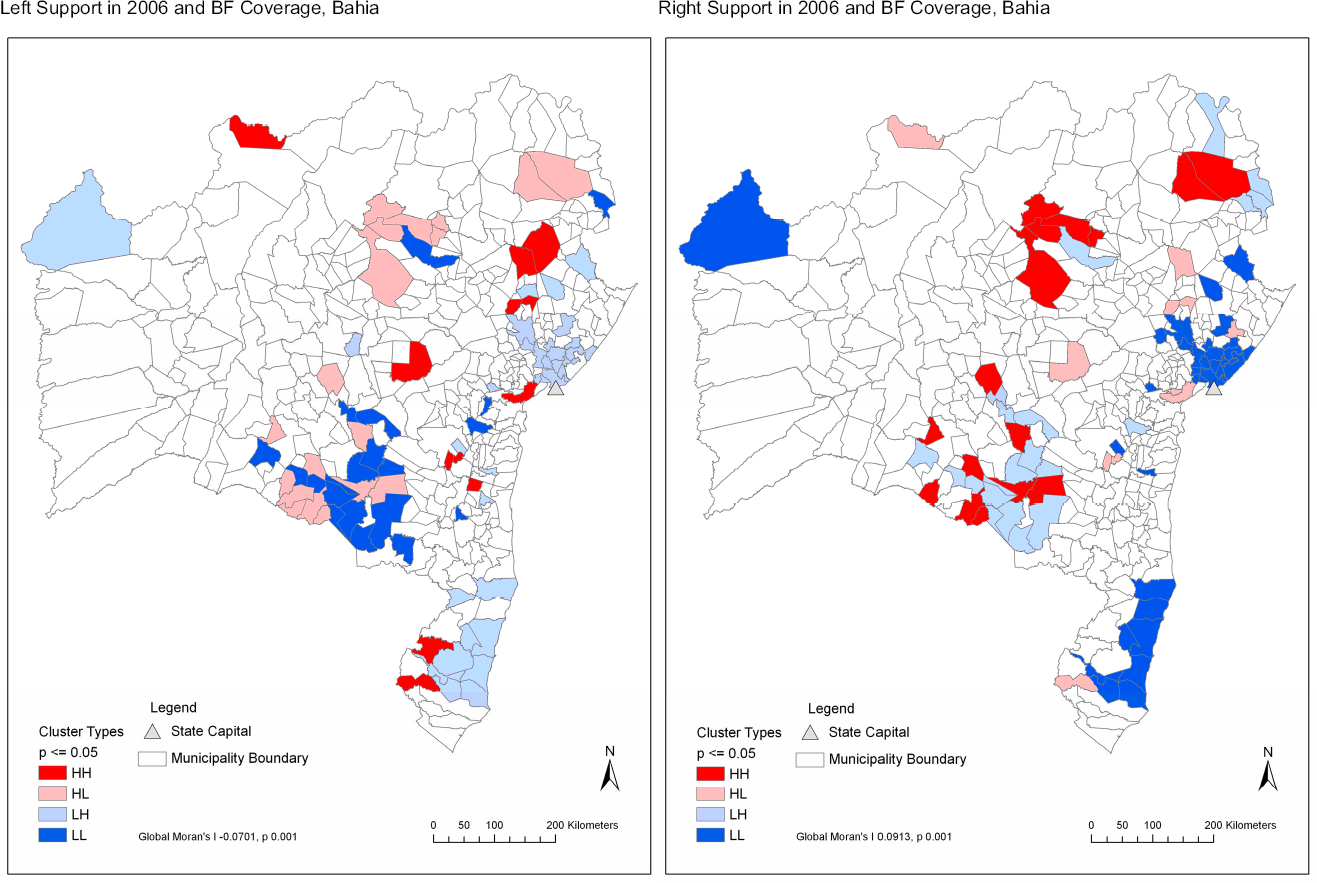
Political Support in 2006 and BF Coverage in Bahia
Ceará: Elite Breakups and Brokered Opposition
Unlike Bahia and Maranhão, the political machine in Ceará was constructed by self-avowed progressive business people who had removed the oligarchic triumvirate of former army colonels who had ruled the state up to the beginning of the New Republic. Then, Tasso Jereissati, the young head of the Industrial Center of Ceará (Centro Industrial do Ceará – CIC), the chief business association, parlayed the support of the state's business sector to gain the governorship in 1986. 22 Once in office, Jereissati took to party-building by breaking off from the PMDB to form the state's Party of Brazilian Social Democracy (PSDB) in 1989 to replace the old oligarchical system with one run by the so-called tucanos (named after the avian symbol of the PSDB). The tassistas (the faction most loyal to Jereissati) dedicated themselves to a comprehensive project of transforming Ceará through good fiscal management, civil service reform, infrastructural investments, and social policy (Moraes 2006; Tendler 1997; Bonfim 1999, 2002).
This is the subject of several extended monographs, notably Bonfim (1999) and Lemenhe (1994). See also Abu-El-Haj (2002).
The tucanos built a largely anti-competitive system that co-opted rivals and closed off patronage resources from residual opposition (Borges 2008: 244; Bonfim 2002: 49-52). The degree to which the tucanos successfully centralized power is somewhat contested, since several studies show that Jereissati also succeeded in decentralizing policy-making in education, microeconomic policy, and health care to municipal government (Tendler 1997; Borges 2008). Still, not even the carlistas were able to capture and hold power as the tucanos did in Ceará, retaining the governorship from 1986 to 2006 with Jereissati winning three times and electing his dauphin, Ciro Gomes, in 1990. Such success was based on the creation of a pervasive system of buying mayors and voters (Moraes 2006: 300). 23 These practices intensified during the early years of the new century as prominent figures within the PSDB argued for a renovation of the party through a more politically progressive agenda. 24 This was fundamentally a reaction to the pressures created by Lula's presidency and the realized potential that the PT's candidate in 2002, José Airton, showed in taking the governorship from the PSDB's candidate, Lúcio Alcântara. The PSDB fell short of the first-round win by .2 percent of the vote, forcing the first run-off election in Ceará during the New Republic, which Alcântara won only by a hair.
The continued dominance of the PSDB's vote-buying machine, even in the 2006 contest, was confirmed by multiple respondents from conservative, center-right, and leftist organizations (author interviews with presidents and general secretaries of PMDB, PDT, PP, and PCdoB, Fortaleza, June 22-27, 2009).
Author interview with Carlos Matos Lima, PSDB state president, Fortaleza, June 25, 2009.
Having been in power so long and understanding that more progressive forces threatened the PSDB's dominance, Jereissati reasoned that a renewed commitment to Alcântara in 2006 would weaken the tucanos’ hold. So the tassistas shifted their support outside the party and signaled through Jereissati himself that the machine would embrace a second candidate, Cid Gomes of the socialist party PSB, allied as it was to the PT and the communists of the PCdoB. This stratagem proved useful in reuniting the tassistas and enabling them to keep control of the state apparatus, including interior municipalities and state agencies. But it was also an extension of an erstwhile tactic of co-opting the opposition.
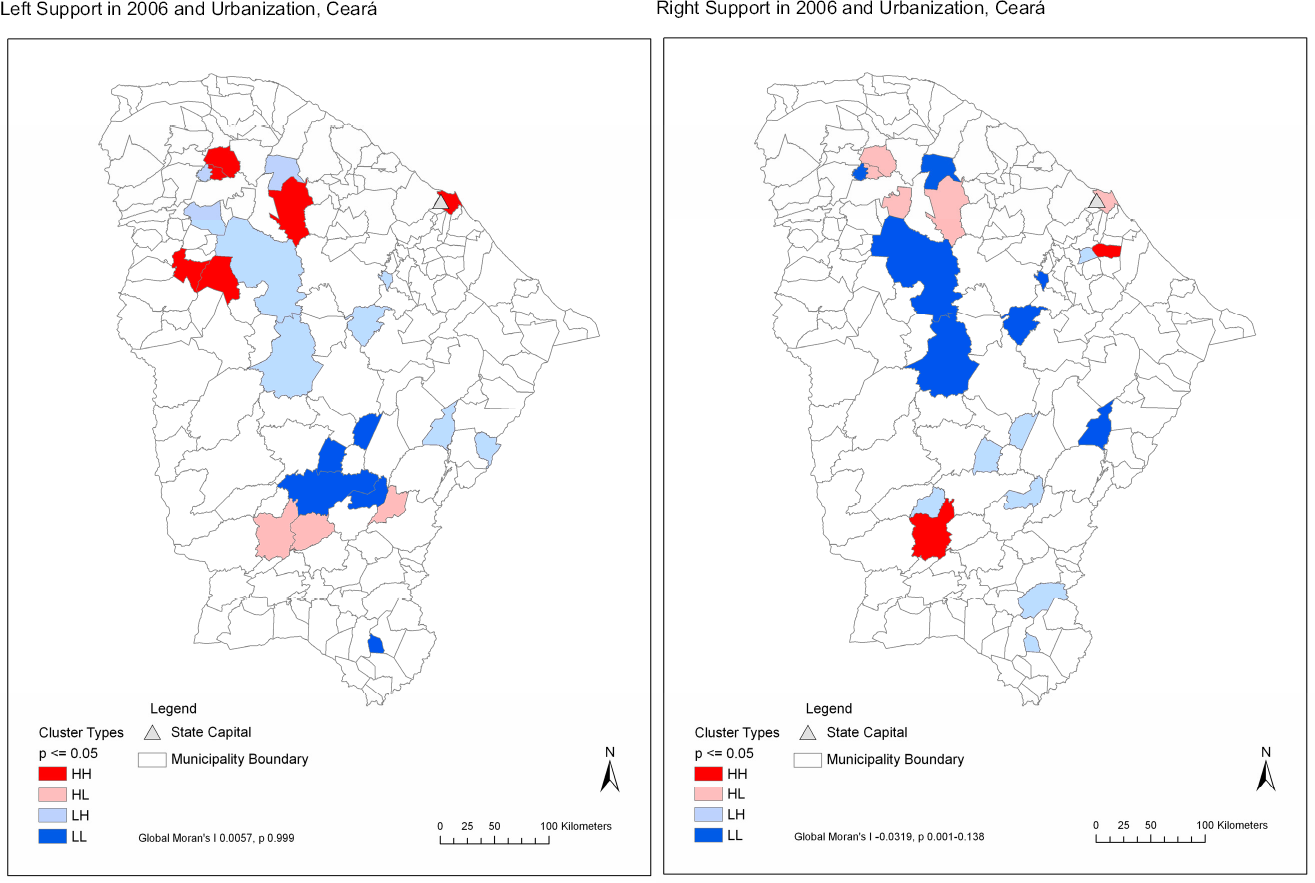
The results of Ceará's brokered opposition victory are evident in the spatial analysis. As shown in Figure 2, Gomes’ dominance scores are the most spatially distributed of the leftist opposition in all three states, but arguably his was the least organizationally developed opposition. As a former mayor of Fortaleza, neither Gomes’ PSB nor Airton's PT mobilized supporters in the interior bailiwicks where the tucano clientele network remained strong. Figure 5 demonstrates the LISA analysis of the left vote with urbanization. While the global Moran's I is insignificant, the localized clusters in Fortaleza and a few municipalities in the western part of the state, areas of high dominance, are significant. By contrast, localized clusters in the interior are “low-low.” Though the urban-based pattern is expected for the left, the map shows that urban mobilization alone was insufficient to produce a leftist victory given few clusters in these areas. Without the support of the tassistas and their considerable assets throughout the state and especially in the grotões, Gomes would have shown little independent capacity to challenge the tucanos or gain state office.
Maranhão: A “Transition” Interrupted
Of all 27 Brazilian states, Maranhão is conceivably the one with the most oligarchical politics. The state was ruled by a single political group organized around the person of Federal Senator Victorino Freire from 1945 until 1965 and then the election of José Sarney to the governorship initiated a new political machine that extended through the 1990s as Sarney's own daughter, Roseanna, would claim the governorship in 1994 and then again in 1998. She would be followed by a long-time loyalist of her father, José Reinaldo Carneiro Tavares in 2002. 25
For the history of the maranhense oligarchy, see Cabral da Costa (2006) and Reis (2007).
Political Support in 2006 and Urbanization in Ceará
Opposition in Maranhão was always weak due to the dominance of the Sarney machine. However, it was particularly stunted by factionalism in which different groups routinely sided with the establishment in return for material rewards. 26 Even the PT maranhense was split between a faction allied to José Sarney, Lula's own Articulação, which depended on the political baron to shepherd the government's legislation through the National Senate, and a more “authentic” opposition known as the PT de Aço (PT of Steel), which was the more successful faction in electing candidates to municipal office and controlling the state party (Borges, Arleth Santos 2008). The PT's position as an opposition force was undermined substantially when Lula, most visibly between the first and second rounds of the gubernatorial vote in 2006, traveled to Maranhão to campaign actively on behalf of Roseanna Sarney. 27
Author interviews with general secretaries of the PP, PCdoB, Partido Popular Socialista - PPS, and PMDB, São Luís, June 30-July 2, 2009.
Lula's choice to back the incumbent in this case is confirmation of Giraudy's finding that presidents often face strong incentives to support subnational authoritarians to prop up their own positions nationally. See Giraudy (2010 in this issue).
In this context, the opposition that challenged Roseanna's bid to return to the governorship in 2006 was one that had all of the elements of a “transitional opposition.” It was supported by elements of the old order, namely the sitting governor, Tavares, who had split from the Sarneys over a personal feud involving his wife and the ex-governor, and had signaled his support for Lago of the PDT. Lago as the most recognizable anti-Sarney figure, was seen by the leftist opposition as an acceptable titular challenger, but neither he nor his party were recognized as offering a programmatic alternative to the sarneyistas. 28 Evidence for both tendencies was the fact that after winning narrowly, a larger than expected proportion of mayors switched to the PDT, a sign that a mixture of the old vote-buying and governista system was still in operation. 29 Yet unlike the situation in Ceará where the more powerful machine faction backed the leftist, the more influential side in Maranhão, the sarneyistas, remained opposed. These aspects of Lago's illfated victory invariably weakened his leadership as he was unable to garner enough political support to defend himself against the Sarney machine when it used judicial channels to challenge the legitimacy of the 2006 vote. 30
This was the view of two major leftist parties in his coalition. Author interview with general secretary of the PCdoB, São Luís, July 3, 2009; author interview with Paulo Matos, president of the PPS, São Luís, July 1, 2009.
Author interview with Remi Ribeiro Oliveira, president pro-tem of the PMDB, São Luís, June 30, 2009.
My thanks to Arleth Borges, Wagner Cabral, and Ilse Gomes for their overviews of the 2006 vote as a case of non-change in Maranhão.
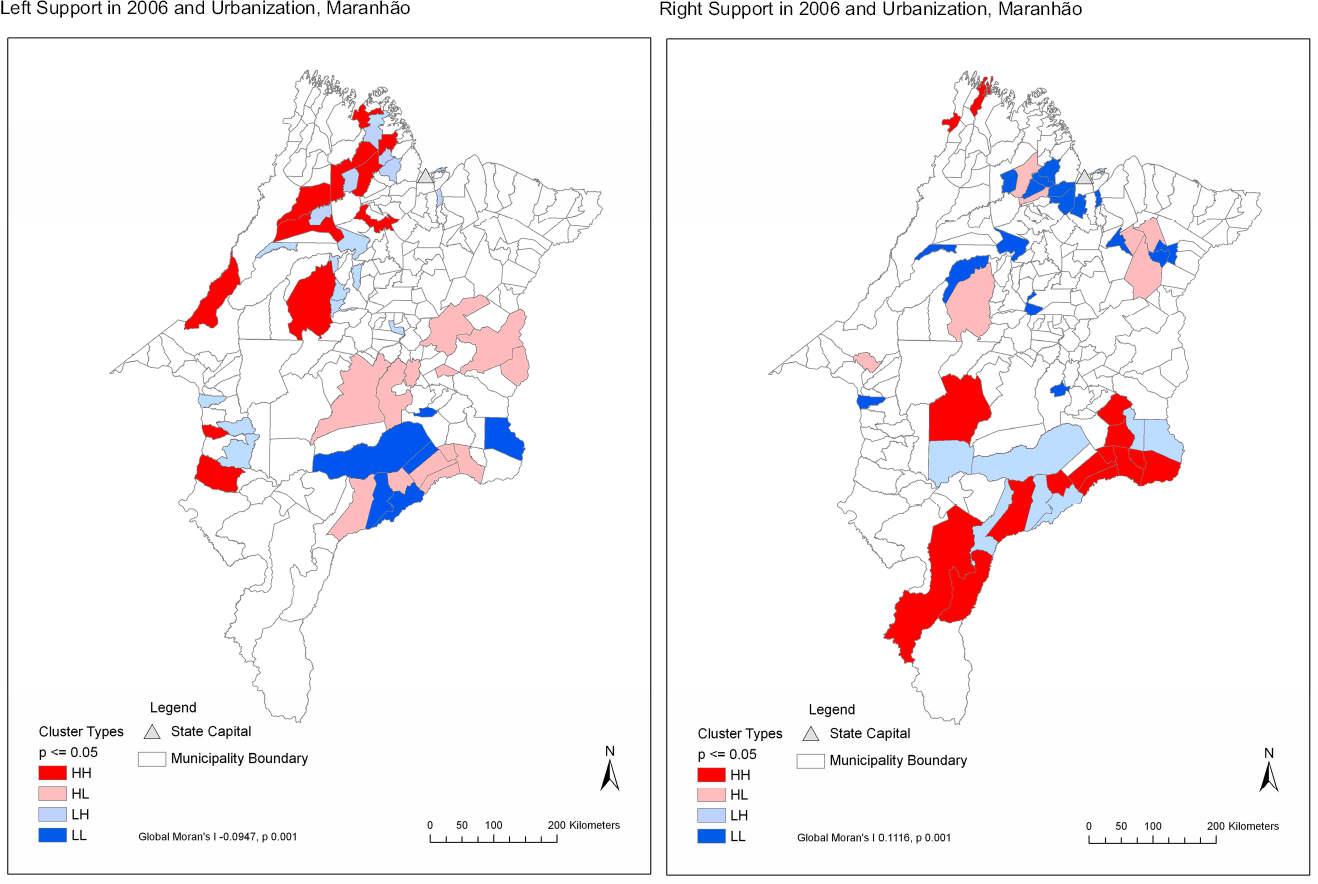
In the end, the vote reflected the strong support for Sarney in the grotões and the ongoing strength of clientele networks throughout Maranhão. Once again, the spatial analysis bears this out as a comparison of Figures 1 and 2 shows that conservatives remained dominant throughout the interior. The LISA analysis in Figure 6 shows urban versus interior patterns that are locally significant but the global Moran's I is signed negative for the left and positive for the right. In this case, urban mobilization for the left produced neither sufficient dominance nor horizontal coverage to weaken the erstwhile patterns of conservative rule over the state.
Political Support in 2006 and Urbanization in Maranhão
Conclusions
As much as the 2006 gubernatorial vote in the Northeast region appeared to be a watershed reflecting the reversal of the oligarchy's grip on power and the systemic effects of pro-leftist national factors such as Lula's coattails, economic growth produced by the commodity boom, and most importantly, BF, the results of this study highlight several fundamental continuities in these states. First, conservatives retained their control of the grotões in each case. Contrary to arguments concerning the effects of BF on undermining clientele networks, conservatives showed that the system of vote-buying and material rewards remains the key source of support for conservatives in these states. Second, leftist oppositions continue to rely on party-building in urban areas. These patterns of mobilization were crucial in Bahia for securing a victory against an entrenched conservative oligarchy, but they proved insufficient in the other two states without more divided rightist machines.
Regarding the causes and the sustainability of the electoral surge by leftists in 2006, the study demonstrates that patterns of political dominance and horizontal coverage vary across states and within them. These factors are, as Ames (2001) argues, central to the “fight for space” that drives Brazilian politics. Accordingly, the study finds that leftists can win in the Northeast where they claim both dominance in urban areas and sufficient horizontal coverage in areas adjacent to these centers. These are necessary conditions if conservatives remain dominant in their interior bailiwicks and remain largely undivided. The Bahian case illustrates this possibility. Splits in either the conservative or the leftist camps can shift alliances and attendant resources in ways that can alter the electoral game board. Breaks in conservative machines can lead to a brokered leftist win as in Ceará or a conservative claw-back of power against a more divided left as in Maranhão. Elite alliance factors thus provide some clues as to the future sustainability of leftist success in the Northeast. Dependence on the strongest faction of the incumbent machine as in the case of Ceará or securing victory with a divided urban base and against an entrenched conservative establishment as in Maranhão may produce only Pyrrhic victories for leftists. Conservative comebacks in these cases are more likely.
Partisan localization and campaign strategies will become more determinate as leftist organizations develop further in the old redoubts of conservative rule. Systemic factors such as presidential coattails may continue to be important, but Lula's own effects will no longer be a factor. Of the three states, Bahia's leftist opposition is the only one to have consolidated a strategy independent of this effect. Armed with the incumbent's advantage, Jacques Wagner and his allies may be able to take on conservatives in their interior bailiwicks in future elections. Their experience may prove instructive for leftist oppositions in other states dominated by conservative machines.