




Abstract
When dictators seize power, they face a choice about how to deal with the pre-existing political parties. Some simply repress all parties, some ally themselves with one of the traditional parties and use it to help organize their rule, and others repress pre-existing parties but create a new party to support themselves. This study examines how these decisions affect the subsequent development of party systems after redemocratization. Looking at the experience of Latin America, a region that has experienced its share of dictatorships, we show that dictators who allied with traditional parties or repressed existing ones have contributed to very stable party systems. By contrast, dictators who repressed the old parties but created a new one destabilized their countries’ party systems for some time after the return of democracy.
Introduction
Compared to party systems in the United States and Northern Europe, Latin American party systems exhibit remarkable variation, both across the region and within individual countries over time. As Mainwaring and Scully (1995) observed more than two decades ago, though some Latin American party systems are stable and very long-lived, others are highly fluid systems in which parties regularly form and disintegrate between elections.
Scholars have proposed a number of factors to explain these dynamics, including unique historical and structural conditions dating back to the early 20th century (Kitschelt et al. 2010), the pervasiveness of presidentialism throughout the region (Samuels and Shugart 2010), and the nature of government responses to indigenous populations (Madrid 2005). 1 More recently, economic struggles and institutional changes have transformed many of the region's party systems (Morgan 2011). Market reforms of the 1980s and 1990s stabilized party systems in some instances, but caused unrest and electoral unpredictability in others (Roberts 2015). In some places, such as in Argentina in 2003, politicians attempted to change their party's “brand” or message, weakening voter loyalties to traditional parties (Lupu 2014). Corruption scandals and other failures of representation dismantled a few party systems too, with Venezuela being a particularly well documented case (Seawright 2012).
See Roberts (2013) for a review of the literature on party system change and stability in Latin America.
The present study complements this body of work and considers an additional factor that has shaped Latin America's party systems: the experience of dictatorship. We examine the effect of authoritarian interludes – specifically, dictators’ choices about dealing with the parties they encounter when they seize power – on the evolution of party systems after the return of democracy. We begin by noting that different dictatorships treat pre-existing parties differently. Some outlaw all party activity, while others ban old parties but create an official party to support the regime and mobilize voters in rigged elections, usually against a tame opposition. Some even ally themselves with a pre-existing traditional party and coopt it for use as the official party.
We show that where authoritarian rulers outlaw and repress parties, even for many years, those parties emerge at redemocratization as though from a freezer, with little having changed. Where dictators ally with a pre-existing party, that party tends to attract those individuals with a vocation for politics or the desire to receive benefits from the dictatorial government, which causes the party to increase in size. However, where the dictatorship has outlawed old parties but created one or more new ones, the new parties attract those people who wish to have a role in politics or government and the old traditional parties lose the support of all but their most committed adherents. Such party systems tend to fragment in post-transition elections. These artificially created official parties, to which opportunists flocked during the dictatorship, tend to split into more ideologically cohesive smaller ones. In short, we find that dictators who pursue either repression or alliance with traditional parties actually contribute to party system stability, while dictators who create new parties destabilize party systems during the first years after democratization.
The remainder of this paper proceeds as follows. We begin with a sketch of contemporary Latin American party system trends. We then develop a theory about how dictators’ use of parties in their strategies of control and cooptation will affect both the activity of political elites and the voting behavior of ordinary citizens. Finally, we show evidence that this theory is consistent with real-world political behavior, even when we take into account the potential endogeneity of dictators’ choices about how to respond to pre-existing parties. Although we focus on the Latin American experience, we also believe that a careful assessment of current democracies would show that the Latin American experience is not unusual, and that parties in many newer democracies are more like those in Latin America than those theorized in much political science literature on parties.
Latin Americanists who have written about parties have emphasized the challenge that volatile, fluid, personalistic, uninstitutionalized parties pose to democracy (Mainwaring 1999). In the present paper, we show how the policies of dictators have contributed to the creation of such parties. However, we also show that other dictatorial strategies have helped to create the remarkable stability of some Latin American party systems. We raise the question of whether a party system can be too stable. Can the persistence of a party system unchanged since the nineteenth century limit citizens’ ability to find representation in the political system?
Contemporary Latin American Party Systems
To give context to our examination of how the experience of dictatorship altered Latin American party systems, we first offer a portrait of recent party system trends in the region. Table 1 shows electoral volatility, an indicator of party system instability, in contemporary Latin American countries. 2 Consistent with the observation that many Latin American party systems are unstable (Roberts and Wibbels 1999), average volatility is 25 percent; this figure is more than twice that of Western Europe, where it has hovered in the vicinity of 10 percent every decade since the end of World War II (Dassonneville and Hooghe 2011: 18). The range of Latin American volatility is also very wide, as Carreras (2102: 138) and Hawkins (2003: 17) have pointed out. Two countries have average volatility below 10 percent, and four have average volatility above 40 percent.
Recent Electoral Volatility in Latin America
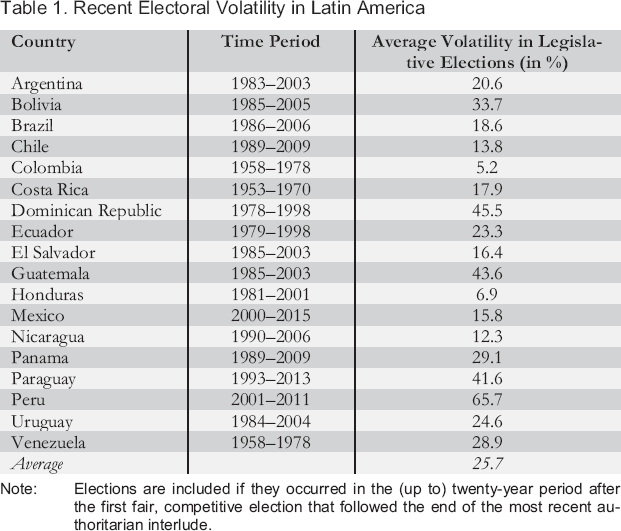
Note: Elections are included if they occurred in the (up to) twenty-year period after the first fair, competitive election that followed the end of the most recent authoritarian interlude.
This is measured using the Pedersen Index, which is usually used in studies of European volatility. The Pedersen index sums the interparty swing between elections and divides it by two (since otherwise each swing vote would be counted once for the party losing it and once for the party gaining it). Where parties split, we sum the resulting parties in the first election after the split in order to calculate volatility from before to after the split. Where parties merge, we sum the parties before the merger in order to calculate volatility from before to after the merger. We took great care to identify splits, mergers, and name changes so as not to inflate volatility scores.
Recent research suggests that various experiments with market reforms in the 1980s and 1990s in Latin America help to explain the abovementioned trends (Roberts 2013). Where conservative leaders implemented reforms, for example, the party system stabilized, while the opposite occurred where populist leaders pushed for them instead. Although political contexts during economic liberalization likely influenced subsequent patterns of party system stability, we argue that varying experiences with dictatorship also matter. As Table 2 illustrates, market reforms occurred in some instances under autocratic rule and/or at the time of democratization, but they did not come in the majority of Latin American countries until some years after the most recent democratic transition. In other words, many democratizations predated economic liberalization. 3 Therefore, it is possible that differences in the autocratic experiences of Latin American countries also help to explain these party system trends; this is the subject to which we now turn.
Democratization and Liberalization in Latin America
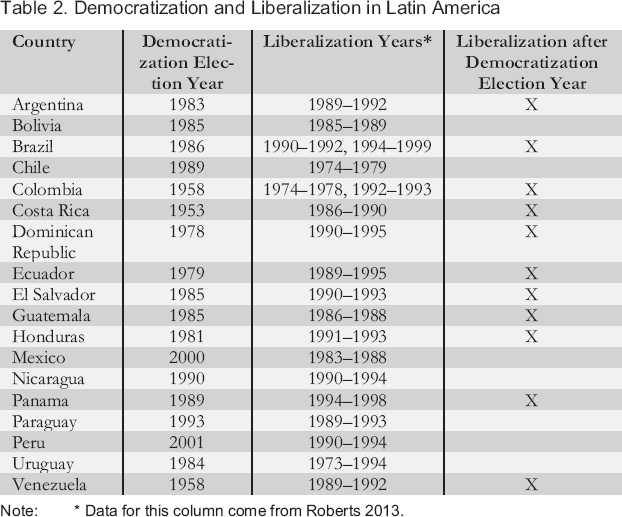
Note:
Data for this column come from Roberts 2013.
We also estimated our key empirical models of traditional party vote share and average volatility scores taking into account different liberalization experiences and (as we report later) our results are robust to their inclusion.
The Effects of Dictatorship on the Stability of Party Systems
All Latin American countries have had at least some experience with dictatorial government since World War II. Some of these interludes have disrupted party systems, but others seem to have reinforced them. Parties’ survival of authoritarian interludes depends in part on decisions made by dictators, as we show below. Dictators have adopted a range of strategies to deal with the parties of the previous regime. Some dictators have simply repressed all parties and governed without party mediation. Others have repressed existing parties but created an official party to support their government (and possibly a tame opposition party as well). Yet others have coopted an existing established party, while repressing or disadvantaging other parties.
These decisions by dictators then determine the costs and advantages associated with the choices that party activists face during dictatorships, as they decide whether to continue their activism in their old party, join a new dictatorship-sanctioned party, form a new party (if allowed), or withdraw from politics. Party activists’ choices, in turn, influence the attitudes and behavior of voters because activists’ choices, along with any constraints imposed by the dictator, determine what party options citizens have when they are allowed to vote. If, for example, those activists who previously led democratic parties desert them in order to join the dictator's support party, old parties may fail to appear on the ballot even when allowed to run because plausible candidates have decided not to campaign under old party labels. In this situation, even if voters’ attitudes toward pre-authoritarian parties have not changed, their choices have.
When the authoritarian government simply outlaws parties, the parties go underground. They continue to exist, although in much reduced fashion, even in jail or exile. The parties lose contact with casual adherents and are prevented from attracting new supporters, but committed activists maintain clandestine networks. If unions or other well-organized groups remain incompletely suppressed or co-opted, then former party activists find opportunities within those groups to continue their vocation for politics and build limited networks of support. Unions played a key role in the survival of parties in several South American countries during late twentieth-century military rule. When those dictatorships allowed the reemergence of parties as they prepared to relinquish power, old parties rose, phoenix-like, from the ashes of repression. These party systems emerged little changed by the authoritarian interlude. Ironically, then, suppression fosters survival. 4
Even when the military insisted on outlawing one of the old parties as a condition for returning to the barracks, as the Argentine military did in the 1950s when they outlawed the Peronists, the outlawed party survived undiminished, sometimes winning the first election in which it was eventually allowed to run.
Where dictators have allied with one of the traditional parties (as in Colombia 1949–1953, Honduras, Paraguay, and Nicaragua under the Somozas), that party tends to be reinforced by its alliance with the dictator. When allied with a traditional party, dictators make use of party officials to staff government offices and use party symbols to appeal to voters. Anyone who wants a government job, a favor, or an uncomplicated life joins the ruling party. As a result, traditional parties also tend to be reinforced by their years as authoritarian ruling parties.
Dictatorships that repress all parties or ally with one of the traditional ones prevent the rise of new parties, which tends to preserve the old party system unless the dictatorship creates new parties. Paraguayan, Nicaraguan, and Honduran dictators who allied with traditional parties tolerated some opposition from the excluded traditional party during certain periods of time, but they outlawed other parties until the run-up to the first free election. The lack of new parties and leaders to bring new ideas into public discourse or to promise novel policies meant that citizen loyalties to the traditional parties remained largely unchallenged through transitional elections. 5 New parties often had little time to build their organizations or develop a reputation among voters between the legalization of new parties and the first democratic elections. This meant that they faced a severe competitive disadvantage in the first elections.
We emphasize voters’ attachments to parties here and elsewhere, in line with recent research emphasizing the key role this attachment plays in explaining party system changes (Lupu 2014).
When authoritarian governments do create new ruling parties and hold regular unfair elections – even if competition is limited and those elected have little real say in government – they create incentives for those with a vocation for politics to expend their energy, either in the regime-sponsored party or in the tame opposition. Many politicians from the overthrown democracy will join the new ruling party if they are allowed to. They will compete with others allowed to compete, make alliances with others allowed into the political game, and enjoy the benefits that playing ball with the dictatorship makes available to them and their constituents. When democracy returns, some of the politicians who supported the regime party will remain loyal to that party and try to use the party's organization and resources to secure their own future political careers. Recent research on the surprising popularity of many authoritarian successor parties illustrates that this is not a foolish choice (Loxton 2015). Others will defect to the regime-created opposition and try to continue their political careers under its umbrella. Some will form new parties, but few will revert to their old pre-authoritarian parties. After a period during which those with a vocation for politics have made careers in the new system, the old parties are empty shells with few resources or activists who can be mobilized on behalf of candidates.
Below, we sketch brief examples of each strategy to provide context for our argument.
Paraguay: Alliance with a Traditional Party
Before the onset of dictatorship in 1954, two political parties – the Liberals and the Colorados – had dominated Paraguayan politics since the late nineteenth century. Although the political system was unstable, often violent and usually undemocratic, the Liberals and the Colorados structured competition for many years. Party organizations extended down to the village level, and citizens showed their loyalty by volunteering for partisan armed forces and voting when ordered by the party to do so (Lewis 1980: 20–75). When General Alfredo Stroessner came to power via a military coup, the Colorados and the military had already established a close relationship; most army officers were already party members (Riquelme 1992). Stroessner took advantage of the close ties between the party and the military to forge an alliance between the party, the state, the army, and domestic business elites. He outlawed other parties during the first years of his rule, but continued to hold elections. 6 By allying with a party that had already established deep roots in society, Stroessner was able to secure support for his regime at an early stage. In order to maintain widespread grassroots support, the party was divided territorially into seccionales, which became the main mechanism for dispersing patronage. All state employees and military officers had to be Colorados. 7 The party dominated all aspects of life; the only means for advancing a political, military, or public service career was through party membership.
This ban on parties was lifted in 1962, beginning an era of limited multi-party elections.
See The Stroessner Regime, US Library of Congress Country Study, http://countrystudies.us/paraguay/55.htm (26 January 2016).
The Liberals remained the opposition party, both covertly when other parties were banned and openly when party activity was legalized in 1962. Liberal activists who did not join the Colorado Party during the dictatorship maintained ties to the Liberal party or a faction of it. When the first free and fair elections were held in 1993 – nearly forty years after Stroessner seized power – traditional parties received 90 percent of the legislative vote. The pre-authoritarian party system re-emerged virtually unchanged.
Venezuela: Repression of Parties
During the years immediately preceding the 1948–1958 dictatorship in Venezuela, Acción Democrática (AD) dominated the political scene. The main opposition party to AD was the Comité de Organización Política Electoral Independiente (COPEI), although other parties also participated in elections during the short-lived democratic government from 1945 to 1948. AD's three-year reign ended in 1948, however, when Colonel Marcos Pérez Jiménez and other junior officers launched a military coup. Colonel Pérez Jiménez banned AD and outlawed political opposition. 8 Despite repression, party activity persisted underground and in exile and political activists continued to work behind the scenes to advance their goals.
See The Transition to Democratic Rule, US Library of Congress Country Study, http://countrystudies.us/venezuela/6.htm (26 January 2016).
When the Pérez Jiménez regime fell in 1958, the party system that had existed before the dictatorship re-emerged. In the 1958 elections, traditional parties received over 95 percent of the legislative vote.
Dominican Republic: Creation of a Party
Rafael Trujillo seized power in the Dominican Republic in 1930 and created the Partido Dominicano (PD) soon thereafter. Most other political parties were banned during Trujillo's rule, although he legalized them briefly from time to time. Trujillo used the PD as a vehicle for maintaining control. The party was the source of state jobs and provided a mass base to a regime that had not originally received support from the traditional elite (Crassweller 1966). Ties to the party became the key means by which individuals with political aspirations could further their ambitions. Party elites established patronage networks across the country, helping to turn the party into a mass-based tool for mobilizing support for Trujillo. The more influence they had within the party, the more prestige they wielded elsewhere (Walker 1970). For the masses, alignment with PD secured employment, protection, and other favors.
Although the PD evolved into a strong party machine, the party died along with Trujillo in 1961. A handful of parties subsequently organized to contest elections in 1962, including the Partido Revolucionario Dominicano (PRD), which Juan Bosch and other exiled opposition leaders had formed in 1939 (Hartlyn 1998: 74). The PRD won a majority of the votes in the 1962 race, the first elections it had ever competed in. Traditional parties that predated Trujillo, by contrast, only received about 30 percent of the vote.
In conclusion, when dictators ally with a traditional party or repress parties altogether, activists tend to maintain their loyalties to traditional parties. Consequently, the post-dictatorship party system will look quite similar to the one that predated the regime. However, when dictators opt to create a new party, activist party loyalties tend to realign, fundamentally altering the party system that emerges after democratization.
Implications of the Argument
Since we cannot systematically observe activists’ behavior in multiple countries, we draw implications from our argument in order to test it. It is possible to summarize the hypothesized effect of dictators’ choices on party activists, and hence voters, in a simple model. From the model, we can then derive some expectations about the expected effect of dictators’ choices on subsequent party systems. We start by making several simplified but plausible assumptions:
Party activists are motivated primarily either by political beliefs or by a desire to have access to patronage and other kinds of government benefits (to keep the model simple, motivations do not change during the dictatorship).
Party activists influence voters, either through campaigning or by affecting which parties appear on the ballot.
When party activists go underground or into exile and are thus unable to campaign, voter loyalty to those parties gradually decays.
The assumption that some party activists are motivated by beliefs and others by the desire for access to government largess implies that party activists motivated by beliefs would be expected to remain loyal to their old parties, regardless of what blandishments the dictator offers. However, those motivated by a desire for benefits would be likely to join the dictator's party, if one exists. Table 3 summarizes the expected responses of different kinds of activists to dictators’ party choices in this simplified world.
Party Activists’ Reactions to Dictator's Party Strategy
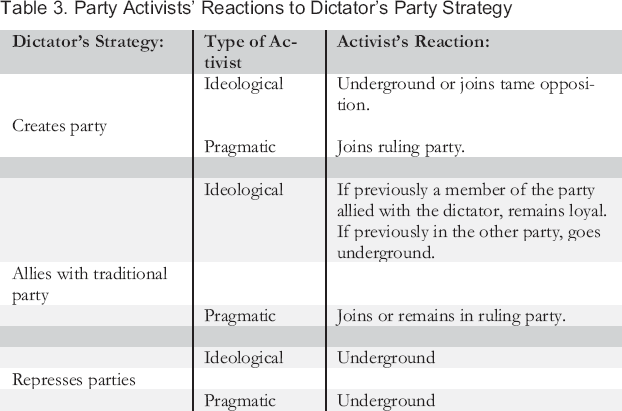
If we were to assume that votes depended on the campaigning and other strategies of activists, that all activists were approximately equally effective, and that nothing else affected the vote, then the argument would imply that we could predict the vote for pre-authoritarian parties in transitional elections. We can test the argument because votes are observable. Although these are implausible assumptions, we use them for illustrative purposes only and make them temporarily for the sake of demonstrating the pattern that we expect the argument to yield. In the statistical analysis, we control for the other factors expected to affect the vote.
Given the assumptions above and our expectations about activists’ behavior, we anticipate that:
When the dictator creates a new party,
Expected Vote for Pre-Authoritarian Parties = dΣq j p jI
Where q j = proportion of total voters who usually voted for party j before the dictatorship
p jI = proportion of ideological activists in party j
d = the loyalty rate for voters over the entire period of time the dictatorship existed, 1<d<0, assumed to be the same for all parties during a particular dictatorship. 1 -d is the loyalty decay rate.
When the dictator has allied with a traditional party,
Expected Vote for Pre-Authoritarian Parties = q d [p dI + (1-p dI )] + (1- q d )[p eI d + (1-p eI )] = q d + (1- q d )[p eI d + (1-p eI )]
Where qd = the proportion of voters who before the dictatorship usually voted for the traditional party with which the dictator later allied
p dI = the proportion of ideological activists in the party allied with the dictator, and (1-p dI ) is the proportion of non-ideologues or pragmatists
p eI = the proportion of ideological activists in the excluded party, and (1-p eI ) is the proportion of pragmatists
We assume that the pragmatists in the excluded party join the dictator's party, and therefore their party loyalty does not decay.
When the dictator represses all parties,
Expected Vote for Pre-Authoritarian Parties = 1d
(The total pool of activists in all traditional parties, deflated by the decay rate)
By setting the proportion of ideologues in the parties, the rate of decay for loyalty in citizens, and the strength of the pre-existing party that the dictator allies with at some arbitrary but plausible numbers, we can achieve a rough sense of what we should expect to see when we look at the data. If the proportion of ideologues (pjI) = 0.5 in every party; the loyalty rate (d) = 0.7; and, in cases in which the dictator allies with a party, that party's pre-authoritarian support (qd) = 0.5 of the total, then the expected vote for pre-existing parties should conform roughly to the pattern below.
When a dictator creates a party,
Vote for pre-existing parties = p jI d = 0.5(0.7) = 0.35
When a dictator represses parties,
Vote for pre-existing parties = 1d = 1(0.7) = 0.7
When a dictator allies with a party,
Vote for pre-existing parties = q d + (1 - q d ) [p eI d + (1-p eI )] = 0.5 + 0.5(0.35 + 0.5) = 0.925
The proportions used here are arbitrary, and the other factors that affect elections have not been taken into account; however, this exercise creates ordinal expectations about how dictators’ party strategies should be expected to affect the vote for pre-existing parties in the transitional election. That is, old parties would receive fewer votes when dictators had created new parties. They would get the most votes when the dictator had allied with a pre-existing party, and repressing parties would lead to an intermediate outcome. We test these expectations below by examining the first democratic elections after authoritarian interludes.
Of course, voters’ decisions are affected by many factors other than activists’ behavior. For example, they could be affected by the economic performance of the outgoing dictator, especially when the dictator is allied with a party. Outcomes could also be affected by changes in the rules about who can vote. In countries in which illiterates were enfranchised prior to the first post-authoritarian election, we might expect that new voters would be less loyal to old parties than those who had voted in the past. In order to test the argument, these and other factors that might influence the vote have to be controlled for.
Data and Measurement
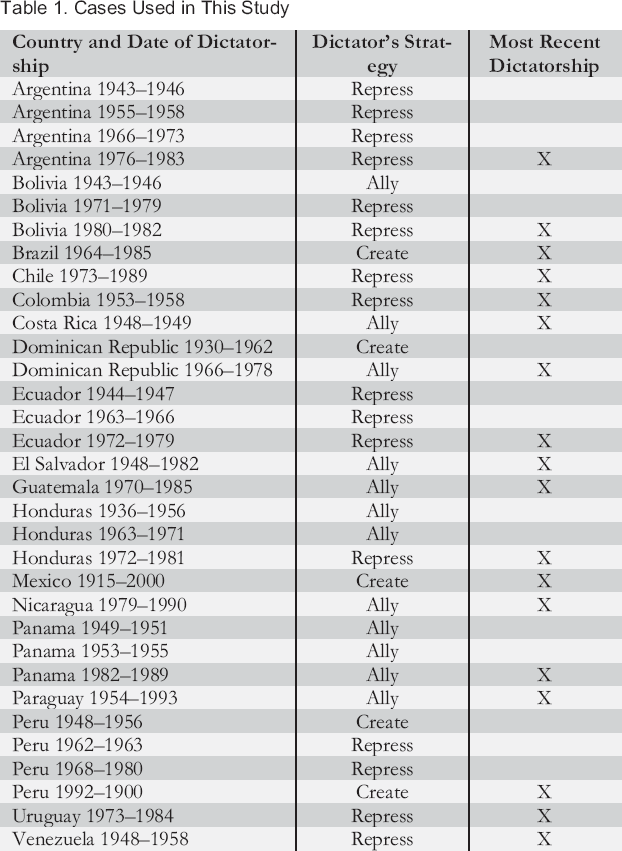
To test the implication that old parties should survive less well after dictatorships in which new parties were created, we need to examine the universe of redemocratizations. The cases included are redemocratizations in countries that experienced dictatorship followed by competitive elections and had sufficient prior experience with elections to have developed parties before the authoritarian interlude. The pre-authoritarian experience does not need to have been free and fair since party loyalties often develop in political systems with very limited participation, constrained competition, or fraud. 9 There were 49 dictatorships in Spanish-and Portuguese-speaking America between 1946 and 2010 (authoritarian regime data come from Geddes, Wright, and Frantz 2014). Of those, 33 ended in redemocratization rather than replacement by a new dictatorship. These comprise the universe of cases used in the analyses of transitional elections (listed in the Appendix). Only 23 of these cases experienced at least two post-authoritarian competitive elections – a prerequisite to be used in the analysis of longer-term electoral volatility. These numbers are further reduced if data are missing for some of the control variables.
Cases are included if they had held at least one legislative election prior to the dictatorship, though it does not need to have been immediately before it; and at least one competitive election after the dictatorship. Dictatorships followed by other dictatorships were excluded. Competitive periods in which a major party was prevented from participating (as in Argentina 1958–1966 and El Salvador 1984–1994) are coded as democratic, although the results we show below are not sensitive to this coding decision.
Each dictatorship is coded according to whether it repressed parties, allied with one of the pre-existing parties, or repressed old parties but created one (or more) new one for support. Some of these countries had strong, stable party systems before authoritarian interludes, and others did not. Parties were classified as “pre-existing” if they had existed for more than two years prior to the authoritarian seizure of power. In most cases, the pre-existing parties had endured since the nineteenth century.
The first outcome examined is the percentage of the vote received by pre-authoritarian parties in the transitional legislative election. Despite our best efforts to count votes for renamed pre-authoritarian parties or offshoots from them as votes for pre-authoritarian parties, we have probably missed some. We found that the average vote for pre-authoritarian parties in the first competitive election is 36.2 percent when dictators create a party, 85.1 percent when dictators ally with a traditional party, and 82.2 percent when dictators repress parties. This implies that party creation during a dictatorship damages prospects for traditional parties the most in transitional elections, and that allying with a preexisting party damages them the least. While the difference in votes for traditional parties between dictators who allied with a pre-existing party and those who repressed parties is not great, there were bans on one of the traditional parties in the competitive elections following the regime transition in a handful of countries where dictators implemented the latter strategy. These restrictions reduced the vote share of traditional parties in those instances, as we show below. Note that these average results are not greatly different from those generated above using arbitrary but plausible numbers.
To test the argument more seriously, we used a statistical analysis in which other factors could potentially be controlled for. In the statistical analysis, we used dummy variables for the dictator's strategy. The omitted category is party creation.
Some political systems have permissive electoral rules that make it easy for new parties to compete, while others create high barriers to the entry of new parties. We would expect that low barriers to entry for new parties would reduce the vote for traditional parties. Much prior research has shown that proportional representation, large district magnitude, the absence of thresholds, easy party registration rules, non-concurrent elections, and elected subnational governments tend to make it easier for new parties to get a start and for small parties to survive (Shugart and Carey 1992; Jones 1995). In contrast, low district magnitude, concurrent elections, high thresholds for representation in the legislature, appointed subnational officials, party registration rules that require many signatures from multiple regions, and allowing multiple lists to run under single party labels tend to make it difficult for new parties gain a foothold in the system or for small parties to survive. In an ideal world, we would have included all these institutional features in the data analysis; however, since there are so many institutions and so few cases, we used a summary indicator instead. Earlier research shows that these institutions have a substantial effect on the number of parties that can survive in political systems, so we used the effective number of parties (ENPV), measured just prior to the onset of dictatorship, as an indicator of the aggregated effect of all these institutions on barriers to the success of new parties. 10
We estimate this statistic using the number of parties competing in the pre-seizure election in two cases (Paraguay 1954–1993 and Peru 1948–1956). In each of these cases, available electoral results indicate the number of parties competing, but not their vote share.
In some instances, the last democratic election was quite a few years before the dictatorship under examination because another dictatorship preceded it. In such cases, party loyalties would have had to survive through two or more successive dictatorships. It seems reasonable to believe that party loyalties would decay more as time passes without competitive electoral activity (Hamann and Sgouraki-Kinsey 1999). To test the argument about the decay of loyalties while activists are underground or in exile, we included a measure of the number of years between the democratic transition election and the most recent competitive election prior.
In a few cases, authoritarian governments have insisted on excluding some parties as a condition for stepping down, as noted above. Because outlawing a traditional party is likely to reduce the vote share for traditional parties, we included a dummy for it.
Some countries have a long history of electoral volatility, which could affect how much change occurs in the party system between pre-authoritarian and post-authoritarian elections. To test that possibility, we tried controlling for average electoral volatility prior to the authoritarian interlude. While our central results held, we have not included prior volatility in the results shown because it never approached statistical significance and caused a loss of cases since it could not be calculated for cases with very short prior electoral histories.
We expected that parties that had existed for many decades prior to the authoritarian intervention would be more likely to survive the intervention without loss of support, whereas voters would be unlikely to have developed strong loyalties to parties that had competed in only one or two elections. As a measure of pre-authoritarian party strength, our analysis included a measure of how many competitive elections had occurred prior to the dictatorship.
In several countries, illiterates and/or women had been granted suffrage in the period just prior to the authoritarian seizure of power or during the dictatorship. Citizens who had not participated in pre-authoritarian elections might lack traditional party loyalties, so we might expect that pre-authoritarian parties would receive fewer votes in countries in which many new voters entered the system (Kellam 2013). To control for this, we included a dummy variable if suffrage was extended at any point from the decade prior to the start of the dictatorship to the democratic transition election year.
We expected the economy to affect these elections, as they affect other elections. A standard retrospective voting argument would lead to the expectation that parties linked to the dictatorship would receive fewer votes if the economy was performing badly prior to the first competitive election. To test this possibility, we included growth in the analysis. Since we might have expected that the effect of retrospective voting would be different in those countries in which the dictator had allied with a traditional party compared to those where he did not, we also included an interaction term for growth and the alliance strategy in one model.
As mentioned earlier, many Latin American countries pursued extensive and painful market reforms in the 1980s and 1990s, near the time during which roughly one-third of the dictatorships in our sample democratized. Therefore, controlling for economic growth is also important because it enables us to take into account arguments that economic conditions (in response to market reforms) triggered party system instability. 11
See Benton (2001) for an in-depth examination of this relationship. To ensure that our results were not driven by different experiences with economic liberalization, we ran two robustness checks using data featured in Roberts (2013), which list the years in which Latin American countries pursued reforms and whether the reforms were aligning, dealigning, or neutral for their respective party systems. First, we ran Model 1 in Table 4, including a dummy variable that captured whether the country pursued reforms prior to or during the transitional election year. Second, we ran this same model including three separate dummy variables capturing the type of reform (aligning, dealigning, or neutral). We did the same for Model 5 in Table 6, using dummy variables to capture whether the country pursued reforms prior to or at any point during the period for which we estimate volatility scores. Our key results (which can be obtained upon request) do not change in any instance.
The Effect of Dictators’ Party Strategies on the Survival of Traditional Parties
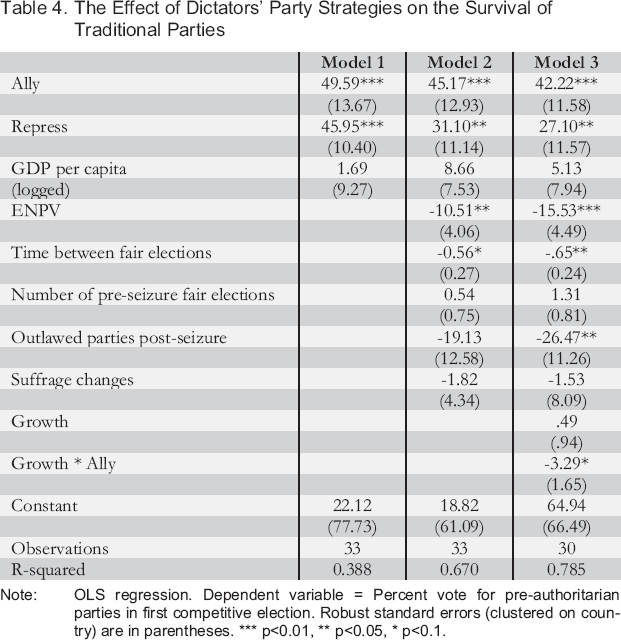
Note: OLS regression. Dependent variable = Percent vote for pre-authoritarian parties in first competitive election. Robust standard errors (clustered on country) are in parentheses.
p<0.01,
p<0.05,
p<0.1.
Endogeneity of Dictator's Choice of Party Strategy
Note: IV-2SLS estimation. Robust standard errors (clustered on country) are in parentheses.
p<0.01,
p<0.05,
* p<0.1.
The Effect of Party Creation by Dictators on Average Volatility
Note: OLS regression. Dependent variable = Average volatility in the (up to) twenty years following the democratic transition. Robust standard errors (clustered on country) are in parentheses. *** p<0.01,
p<0.05,
* p<0.1.
Finally, we included level of development (logged) in the year prior to the first competitive election to control for the possibility that poorer countries may have weaker parties, as Molina (2001) suggested. Where voters have lower levels of education, it might be harder for parties to reach them with their messages and thus harder to develop strong party loyalties. However, some research on Western Europe has suggested the opposite: that the uninformed may use party cues to decide how to vote, while those with more information pay less attention to party cues (Dalton, McAllister, and Wattenberg 2000). 12 In all of our tests we use OLS regression and robust standard errors (clustered on country).
Economic data come from the Penn World Tables (Feenstra, Inklaar, and Timmer 2013).
Results
The data analysis provides support for the argument that traditional parties tend to be damaged when dictators create new parties. Our results are presented in Table 4. In Model 3, the dictator's strategy of allying with a pre-existing party is associated with 42.2 percent more votes being cast for traditional parties (all other things being equal) than would have been the case if the dictator had created a new party to support the dictatorship. If the dictatorship repressed all parties, traditional parties would receive 27.1 percent more votes than if a dictatorial support party had been created. These are very large proportions of votes and they are statistically significant in all models we have tried.
The effect of economic performance on voting in transitional elections is complicated. If the economy was doing well as the transition occurred, we might expect more votes for dictator-created parties if voters gave the incumbent party credit for the good economy, as they would in a democracy. The same logic would lead to the expectation of fewer votes for traditional parties in the countries in which dictatorial parties had been created. This relationship would be reversed for cases in which the dictator allies with a traditional party. In those cases, the incumbent is itself a traditional party. The economy might have no effect on the vote for traditional parties where those parties had been repressed.
Our results run counter to these expectations. The coefficient for growth is positive, meaning that growth may increase the vote for traditional parties that the dictator had repressed, although this result is not statistically significant at conventional levels. The coefficient for the interaction between growth and alliance with a traditional party is negative, indicating that good economic performance reduces the vote for traditional parties when the dictator is allied with one of those parties. We suspect that these results indicate that voters believe that dictators choose economic policies in consultation with economists or private sector allies, and that the parties allied with dictators have little influence on these policies.
The effective number of parties (ENPV), which is the proxy for the effect of political institutions on barriers to the entry of new parties into the system, has the expected effect. As institutional barriers decline, it becomes easier for new parties to gain a foothold in the party system, and traditional parties do less well. In Model 3, each additional “effective” party allowed into the system is associated with approximately 15 percent fewer votes for traditional parties.
The amount of time between the last competitive election and the democratic transition election also affects the vote for traditional parties, as would be expected if citizens’ loyalties decay over time. The strength of pre-authoritarian parties prior to the seizure also affects how they fare afterwards, although this effect is not statistically significant at conventional levels. The greater the number of fair elections held before the dictatorship, the higher the percentage of the vote traditional parties received later. In addition, outlawing a party during the transition decreases the vote for traditional parties by approximately 26 percent. Finally, although we expected that changes in suffrage would decrease the vote for traditional parties later on, the coefficient of this variable, while negative, is never statistically significant. It is, of course, very difficult to achieve statistical significance when the number of cases is so small.
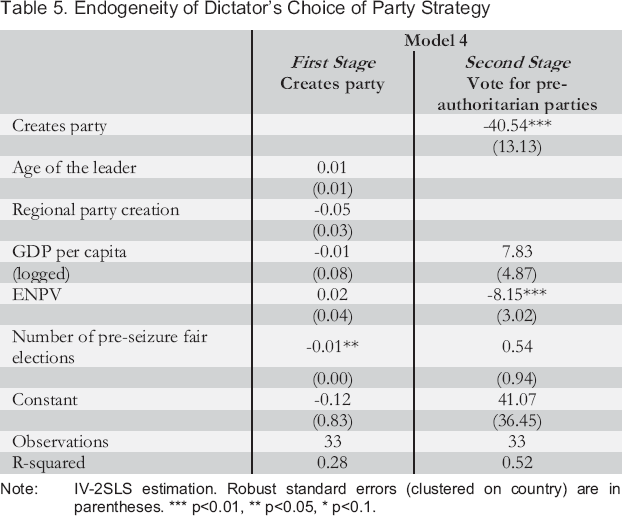
Readers might wonder whether the relationship between a dictator's party strategy and the vote for traditional parties is endogenous; that is, whether it is caused by dictators choosing their party strategies in response to the strength of pre-existing parties. In particular, it is possible that the strategy most damaging to party system stability – the creation of a dictatorial support party – is more likely to occur where party loyalties are very weak.
To test for this possibility, we used an instrumental variables (IV) approach. The basic idea is to estimate the endogenous variable (party creation), using at least one exogenous variable that is correlated with the endogenous variable but not with the dependent variable (vote for pre-authoritarian parties) (Angrist and Krueger 2001; Angrist and Pischke 2009; Sovey and Green 2011). For the IV analysis here, we used the Instrumental Variables Two-Stage Least Squares method (IV-2SLS), which is typically the preferred method, even in cases in which the endogenous variable is dichotomous (Angrist and Krueger 2001; Wooldridge 2002).
A critical component of IV estimation is the selection of good instruments (Sovey and Green 2011). Whether an instrument is “good” depends on whether it is ‘theoretically’ plausible that the instrument affects the endogenous variable and has no direct effect on the outcome. We use two instruments to predict party creation: the age of the first leader of the dictatorship and regional party creation. Older leaders should be more likely to create parties because they are more likely to have established political networks that they can tap into to form a new party organization. At the same time, we can think of little reason why traditional parties would fare worse following authoritarian interludes led by older leaders as opposed to younger ones.
The second instrument we use is regional party creation, which is the number of dictatorships in power in Latin America that created a party while in office (lagged one year, excluding the regime in question). The use of this instrument follows the approach of Bernhard et al. (2015), who argued that institutional choices are often the product of diffusion. Dictators get ideas from other dictators and tend to adopt institutions that seem to work well for their neighbors. Where a higher proportion of other Latin American dictatorships have opted to create a party, others should follow suit. At the same time, we can think of little reason why party creation in neighboring dictatorships would influence the vote share of traditional parties following democratization, except through its effect on the dictatorial elite's decision to create a party.
In IV estimation, each control variable included in the second-stage equation must also be included in the first-stage equation (which must also include at least one instrument that is excluded from the second-stage equation). To predict party creation (the first-stage equation), we include the two instruments (age and regional party creation), along with the set of control variables that we use to predict traditional vote share (in the second-stage equation). Because the first-stage equation estimates the likelihood that a particular strategy will be pursued by dictators at the time of seizure (or shortly after it), it makes little sense to include control variables that capture features of the political environment long after it. Therefore, we use all of the control variables included in Model 3 above, except the dummy for outlawing parties, the number of years between competitive elections, suffrage changes, and the growth variables (which measure attributes of the political environment after the seizure of power). However, we note that the results we present are robust to the exclusion of regimes that outlawed parties from the sample, as well as to the inclusion of a measure of economic growth just prior to the seizure. The final point to note is that, for the IV model, we measured the level of development in the year of the most recent election prior to the dictatorship (to avoid the aforementioned temporal issues).
Beyond the selection of “good” instruments, it is also important that the instruments are “strong” or relevant predictors of the endogenous variable (Sovey and Green 2011). For instruments to be considered “strong,” the partial R 2 should be greater than 0.10 (Shea 1997; Staiger and Stock 1997; Sovey and Green 2011). In our model, the partial R 2 is 0.20, which suggests that the instruments we have selected are adequate predictors of party creation. The Sargan test of the exclusion restriction (p = 0.29) also indicates that our chosen instruments are valid.
Table 5 shows the results of the IV-2SLS model, with robust standard errors (clustered on country). The effect of party creation on traditional vote share is negative, large, and statistically significant. The vote share for pre-authoritarian parties in transitional elections after dictatorships that created new parties is about 40 percent less than in elections after dictatorships that repressed parties or allied with pre-existing ones. These results indicate that a dictator's strategy toward parties has consequences for the party system that emerges afterwards, even after taking into account the endogeneity of dictators’ choices.
To sum up this section, dictators have weakened traditional parties in the instances in which they have created support parties and held regular election campaigns organized around these new parties during the dictatorship. However, most Latin American authoritarian regimes have repressed all parties. These authoritarian interludes, along with those in which dictators ally themselves with traditional parties, actually prolong the lives of pre-existing parties and stabilize their influence in politics. They prevent the entry into the political system of new competitors until the run-up to the transition election. In effect, they freeze the old party system for whatever number of years they endure, erecting the strongest of all barriers to the entry of new parties.
Longer-Term Consequences
The effects of dictators’ choices on parties would be unimportant if older parties disappeared and were replaced by stable new ones in the countries in which dictators created parties, but that can take quite a while to happen. In the meantime, a chaotic party system can contribute to difficulties in governance and voters’ inability to hold politicians accountable.
The artificial parties created by dictators tend to have more enduring effects because they are opportunistic coalitions, which means that they tend to fragment after redemocratization. Dictatorial support parties begin as pragmatic alliances of those who seek a political career or government largesse. They usually lean in an ideological direction but lack a fully developed ideology and programmatic coherence. Both the dictator's support party and opposition parties that are legal during authoritarian rule tend to fragment after redemocratization, simply because they were group marriages of convenience in the first place. The dictator's party is the party of the “ins,” and the opposition is the party of the “outs.” Some of the post-authoritarian splits in these parties are caused by ideological disagreements or interest differences, and such splits lead to more coherent smaller parties that may develop loyal followings among voters and become stable. However, other splits are caused by personal conflicts over nominations and can lead to a multiplication of personalistic and sometimes short-lived parties. This process can result in a very chaotic party system – not forever, but for significant periods of time.
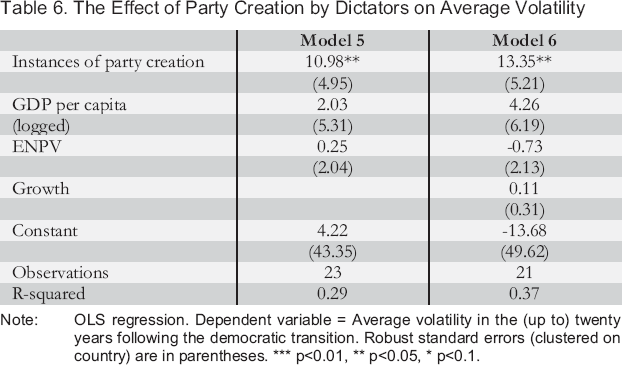
Table 6 shows the relationship between party creation during dictatorship and average volatility during the twenty years (or as much time as has elapsed if twenty years has not) since the most recent transition. 13 In some countries, more than one dictatorship created a party; therefore, the independent variable here is the number of instances in which a dictatorship created a party. Each dictatorship's decision to create an official support party increases average volatility by more than 10 percent. This is true even when the most recent authoritarian government did not create the party. In Bolivia, for example, a dictatorial support party was created in the mid-1960s during the dictatorship of René Barrientos. Dictators before Barrientos tended to ally with a pre-existing party and those afterward repressed parties. Thus, party creation seems to have long-lasting consequences. Also, in those countries in which two dictatorships created official support parties, such as Peru, 14 party creation is associated with an increase in volatility of than 20 percent compared to what it would have been if the regime had pursued a different strategy. 15
The level of development in the models in this table is measured in the year prior to the democratic transition.
We do not consider name changes or what seem to be resuscitations of the same party (as happened in El Salvador, for example) as separate party creations. In contrast, in Peru the first dictatorial support party was created by General Manuel Odria who ruled from 1948–1956, and the second completely different one by President Alberto Fujimori, who ruled from 1990–2000.
We also compute a basic difference in means test comparing the volatility scores among countries in which a dictatorship created a party at some point in time and those in which this did not occur. The difference in means between these two groups is statistically different from zero, consistent with our expectations.
To summarize this section, the creation of support parties by dictators leads to medium-term increases in party instability as new parties jostle for permanent places in the new democratic political system and voters take time to figure out what the parties stand for and which ones have a chance to achieve a place in government.
Although most authoritarian interventions reinforce party systems, those that create parties often destroy the pre-existing party system. This upheaval would have no long-term significance if the new post-authoritarian parties settled quickly into stable and representative systems. In most Latin American countries, however, the parties created by dictators have not proved to be as resilient as ex-communist parties in other parts of the world (Loxton 2015). Instead, they have tended to split or fragment after transitions, leading to a period of partisan disorganization.
Conclusion
In this paper, we discussed the effects that decisions by dictators about how to treat the parties they overthrow have on the party systems that emerge after democratization. We showed that traditional parties have survived best where long-lived dictatorships have allied with them and prevented new competitors from entering the political system for many decades. In other words, these dictators have erected very high and crude barriers to the entry of new parties into the political system. In such situations, traditional parties have faced less competition from new parties making different promises and appealing to different interest groups than they would have in stable democracies. Even twenty years after transitions, many of these traditional parties maintain a degree of advantage.
We further showed that authoritarian regimes that repress or outlaw parties freeze the pre-existing party system so that when competition is again allowed, the old parties usually emerge from repression little changed and able to command substantial loyalty from voters. Few new parties enter the first fair elections, and those that do fare poorly because most voters remain loyal to the old parties. These dictatorships also prevent the entry of new parties into the system until shortly before transitional elections.
Since most Latin American dictatorships repress parties, dictatorship reduces party volatility, on average. Yet, a number of dictatorships have opted to outlaw pre-existing parties and create new ones to support their governments, and to allow those who participate in these new parties to partake of the usual fruits of holding office. This has a strong destabilizing effect on pre-existing party systems. Many politicians from the ousted democracy find places for themselves in the new system, as will people who grow up under the dictatorship. When the regime begins to fail, those who have participated in the support party will either stick with it and try to use the material and organizational resources it provides to fuel their future democratic political careers, or they will defect to the previously tame opposition. Very few will return to their old parties, and those parties are usually unable to make a comeback.
However, where the dictatorship has disabled the old democratic parties by attracting most of those interested in political roles into dictatorial support parties, many politicians will be tempted to form new parties to compete in the first few democratic elections because voters are unanchored by deep loyalty to the old parties. The fittest of these new parties will survive. Democratic periods following such dictatorships tend to be characterized by high initial periods of party and voter volatility, as parties are born, split, and die and voters try to figure out which new party stands for what. The transitions following other kinds of dictatorship are usually more orderly. The old parties emerge from the deep freeze, most voters feel a nostalgic fondness for them even if not intense party loyalty, and most new entrants are deterred, at least for some time.
So we are left at the end with an apparent paradox. Party longevity, which we intuitively think must contribute to stable democracy, 16 is caused by barriers of whatever kind, even dictatorial, to the entry of new parties into the political system. Yet, such barriers limit competition and reduce the choices available to citizens.
This is a widely believed intuition, although a study by Cheibub (2002) raises doubt about its empirical accuracy.
While observers of Latin American politics have expressed concerns about the effects of party system instability on governability and democratic stability, we suggest that extreme party stability might also reduce the quality of democracy. Extreme party stability, based on high barriers to the entry of new parties, means that voters have few choices. New parties almost never get a foothold in these political systems, regardless of how dissatisfied voters are with the performance in office of existing parties.
Thus, authoritarian intervention has hindered the functioning of subsequent representative government for at least a couple of decades following their demise, in two different ways. In the countries in which dictators created new parties, these newly created parties have tended to fragment, contributing to party system chaos and difficulty for voters to figure out which parties and candidates stand for what, and therefore which ones could best represent their interests. Authoritarian interventions have also hindered representative government where they repressed all parties or allied with one traditional pre-authoritarian party. This is because, in such cases, they froze party options available to voters, thereby excluding parties that might have arisen to represent the interests of non-elite citizens. Although the dominance of these old parties has begun to deteriorate in the affected countries, most of these countries had quite limited competition for the first ten years after democratization.
Both of these strategies chosen by dictators can, for unrelated reasons, undermine the representativeness of new democracies. As we think about the results of democratization in Latin America, early observers worried about consolidation, but consolidation and democratic stability have not turned out to be problematic. Instead, the problem is whether elected governments are responsive to voters. Dictators’ influence on party system development is one of the reasons for the weakness in the link between citizens and their elected representatives.
Footnotes
Appendix
Cases Used in This Study
| Country and Date of Dictatorship | Dictator's Strategy | Most Recent Dictatorship |
|---|---|---|
| Argentina 1943–1946 | Repress | |
| Argentina 1955–1958 | Repress | |
| Argentina 1966–1973 | Repress | |
| Argentina 1976–1983 | Repress | X |
| Bolivia 1943–1946 | Ally | |
| Bolivia 1971–1979 | Repress | |
| Bolivia 1980–1982 | Repress | X |
| Brazil 1964–1985 | Create | X |
| Chile 1973–1989 | Repress | X |
| Colombia 1953–1958 | Repress | X |
| Costa Rica 1948–1949 | Ally | X |
| Dominican Republic 1930–1962 | Create | |
| Dominican Republic 1966–1978 | Ally | X |
| Ecuador 1944–1947 | Repress | |
| Ecuador 1963–1966 | Repress | |
| Ecuador 1972–1979 | Repress | X |
| El Salvador 1948–1982 | Ally | X |
| Guatemala 1970–1985 | Ally | X |
| Honduras 1936–1956 | Ally | |
| Honduras 1963–1971 | Ally | |
| Honduras 1972–1981 | Repress | X |
| Mexico 1915–2000 | Create | X |
| Nicaragua 1979–1990 | Ally | X |
| Panama 1949–1951 | Ally | |
| Panama 1953–1955 | Ally | |
| Panama 1982–1989 | Ally | X |
| Paraguay 1954–1993 | Ally | X |
| Peru 1948–1956 | Create | |
| Peru 1962–1963 | Repress | |
| Peru 1968–1980 | Repress | |
| Peru 1992–1900 | Create | X |
| Uruguay 1973–1984 | Repress | X |
| Venezuela 1948–1958 | Repress | X |