



Abstract
Legislative experience, one of the various indicators of both congressional institutionalization and political elites’ renewal, has been mostly measured by either turnover or reelection. However, in regions such as Latin America, with more volatile and less institutionalized party systems, where most careers are not stable and ambitions are not mostly static, turnover and reelection may not be accurate measures of legislative experience. This paper aims to fill this gap by assessing parliamentary experience in Latin America by means of a more accurate indicator: legislative amateurism. Using a novel dataset comprising eighteen national single or lower-chamber legislatures over almost three decades, we find that legislative amateurism is a consequence of party system institutionalization, electoral volatility, and newly implemented gender quotas. Overall, our findings suggest that weak political parties and certain electoral rules may become fertile ground for amateur legislatorś landing in Congress.
Introduction
Among many other problems of Peruvian politics (e.g. weak political parties, executive-legislative conflict, recurring presidential impeachments), having politicians clung to power is hardly one. Still, despite the country having one of the highest presidential turnover rates in the region, in 2018 an overwhelming 85 per cent of Peruvians voted for a constitutional reform that banned legislative reelection. A cross-partisan campaign echoed the popular wisdom that single-term legislators would be less tempted to bribery given that they would not have enough time to establish their corrupt business.
Compared with any other region in the world, Latin America has one of the highest rates of parliamentary circulation. Between 1993 and 2019, more than 65 per cent of national legislators was a first-time member of Congress, while in a similar period, the figure was 51.5 in Central and Eastern Europe; 32.3 in Western Europe 1 ; and only 15 in the US. 2 Yet, newcomers and political outsiders are often seen as a remedy for whatever does not work in politics. The Peruvian example mentioned above illustrates the extent to which Latin American voters are willing to choose candidates with no experience over career politicians. Even if abundant literature stresses the negative effects of unprofessional Congresses (e.g. political instability, institutional weakness, short-termism, low-quality legislative work), it is a recurrent issue in the region every time a country heads for the polls.
Members of Congress’ (MPs) legislative experience is far more important than it seems since it has several political and social implications. Along with other features (e.g. specialization of the committee system, membership pay, staffing, or the number of days in session per year), membership stability is one of the cornerstones of congressional institutionalization, with determining consequences for policymaking and legislative work in general (Carey et al., 2000; Palanza et al., 2016; Polsby, 1968; Squire, 1992). Moreover, its centrality transcends institutions as it is a highly appropriate sensor that records the porosity of politics by measuring elites’ circulation, and thus capturing the pulse of democracies (Gouglas et al., 2018; Pedersen, 2000).
This paper is the first attempt to measure parliamentary experience in Latin America through an original and more accurate indicator: legislative amateurism (i.e. the lack of prior experience in the national parliament). Amateurism is a much more precise tool than turnover or reelection and it is especially appropriate for studying the region since, given the less institutionalized career structures and non-static ambitions of Latin American legislators, newcomers in a legislature may be former MPs (who have held their seats two or more terms before) and thus perfect insiders to parliament. Following Putnam's (1976) original metaphor of turnover as a “seismograph” that registers changes in politics, amateurism can measure legislative experience and thus become a key indicator, among others, of both congressional institutionalization and political elites’ renewal.
To study the drivers of legislative amateurism in Latin America, we have analyzed eighteen national single or lower-chamber legislatures’ amateurism rates over almost a three-decade period. Overall, our results suggest that legislative amateurism is mainly a consequence of weak party systems (i.e. lowly institutionalized and electorally volatile) and electoral rules (gender quotas). These findings help bridging the gap between scholarship on legislatures and party systems, pushing forward the existing knowledge on Latin American parliaments.
This article contributes to the existing literature in, at least, four ways. First, it introduces legislative amateurism as an innovative dependent variable to analyze legislative experience, in contrast with extant research that focuses on turnover (Gouglas et al., 2018; Matland and Studlar, 2004) or reelection (Altman and Chasquetti, 2005; Saiegh, 2010). Second, it tests its determinants relying on a multivariate model that accounts both for party system and institutional rules. Third, it compares eighteen Latin American countries, providing a comprehensive outlook of nearly all of the region over the last three decades. Finally, it helps refining the assessment of two major topics: congressional institutionalization and political elites’ circulation.
The present article is structured as follows. First, it addresses the social and political implications of different levels of legislative amateurism. Second, it defines the dependent variable. Third, it describes the heterogeneity of legislative amateurism in Latin America. Fourth, it reviews the literature on the subject and formulate the hypothesis. The fifth section delves into the data sources and the methods. The sixth analyzes the results. Finally, the article concludes by discussing the main findings and their implications and limitations for the study of legislative amateurism.
Implications for Congressional Institutionalization and Political Elites’ Renewal
Latin American legislatures tend to be reactive rather than active (Cox and Morgenstern, 2001). Instead of the US-House-model proactive stance conventional wisdom expects from parliaments (e.g. proposing and passing their own legislation), legislatures in the region play an important role blocking legislation or shaping policy outcomes by pressuring the president and negotiating with him (Morgenstern, 2002). Additionally, they do have some policy making capacities and, more importantly, political control functions that can be decisive in times of crisis when president mandates are in question (Llanos and Nolte, 2006). In other words, Latin American Congresses are key political actors in their countries.
At the same time, there is a strong consensus among scholars on the fact that high levels of legislative experience are associated with more professionalized parliaments. On the one hand, highly professionalized congresses offer a more appealing environment for career-oriented legislators (e.g. more stable careers, actual chances of influence in policy making or the relevance of the body in the national arena) and, thus, foster reelection seeking incentives (Palanza et al., 2016; Spiller and Tommasi, 2007). On the other hand, higher levels of legislative experience (i.e. MPs with longer parliamentary careers) help to build a more professionalized chamber and, thus, contribute to improving the quality of democracy in several ways (Cunow et al., 2012; Gouglas et al., 2018; Matland and Studlar, 2004).
First, higher levels of experience bolster incentives for legislators to strengthen the institution they are devoted to. Experienced legislators contribute to building Congresses with stronger powers for controlling and negotiating with the executive (Shair-Rosenfield and Stoyan, 2017). This is particularly important in presidential countries such as those in Latin America, where the executive holds most of the initiative. Besides, if they expect to remain in congress for many years, it will more likely be in their interest to shape an institution they can benefit from (Dal Bo and Rossi, 2011). Second, longer careers help legislators acquire lawmaking skills to produce better policy. Spending more time in Congress helps them obtain the necessary know-how to legislate more efficiently, raising parliament's productivity (Miquel and Snyder, 2006). Additionally, more stable legislative careers contribute to intra-party stability since they make candidate selection more foreseeable and cooperative (Altman, 2004).
Conversely, scholarship suggests that a lower legislative experience (i.e. shorter parliamentary careers in a given legislature) makes a less professionalized legislature with negative effects on both legislative work and the quality of democracy. To begin with, when legislators face the probability of not being able to pursue a political career, they have less incentives to invest time and effort in parliamentary work (Dal Bo and Rossi, 2011). Legislative positions tend to lose their distinctiveness, becoming places to bide time in between more desirable executive posts. 3 Second, the lack of legislative experience has a negative impact on the quality of legislative work since congressmen are often unfamiliar with the chamber's rules, undermining parliament's capacities. Third, if legislators’ careers are at stake in every election, they will probably fight with their opponents ruthlessly to get a nomination and, consequently, damage party bonds (Altman, 2004). Volatile legislative careers may weaken parties by increasing intra-party instability. Finally, high turnover rates may also be detrimental for policy outcomes since they spawn instability and short-termism (Gouglas et al., 2018). The prospect of a brief career could be conducive to shorter horizons making legislators unwilling or unable to invest in long-term policies such as those related to economy, education, or health, among others (Uppal and Glazer, 2015).
In this vein, the advantages of having more professionalized legislators are almost unanimously agreed upon and supported by evidence, even if there is no certainty about how much should be set as a benchmark. 4 However, a small body of research points in the opposite direction, arguing that excessively long careers can be harmful to democracy. The expectation here is that a certain degree of renewal is important to avoid congressmeńs stagnation, favoring the circulation both within -from one position to another- and between -the political, the economic, the intellectual, etc.- political elites. In fact, some degree of turnover would be desirable to offer opportunities to new groups, thus increasing accountability and fighting corruption (Golosov, 2018). Furthermore, in a context where politics is more and more discredited, bringing new members on board could strengthen the legitimacy of political institutions (Matland and Studlar, 2004).
In a nutshell, although the effects of Congress’ legislative experience both on legislative professionalization and on elites’ circulation have been widely studied, there is no unanimity regarding its normative consequences. Longer parliamentary careers seem to be positive for parliament but, a priori, negative for the renewal of elites and vice versa.
From Turnover and Reelection to Amateurism
Both turnover and reelection are widely spread concepts in the field of legislative studies. They are simple and straightforward indicators of careers stability that can be easily related to electoral rules, party systems, and voters’ preferences among other dimensions. Moreover, data for calculating these variables is usually public and easy to access, even when estimating the proportion of reelection seekers that fail to be nominated remains one of the most important methodological challenges of working with these variables (Gherghina, 2015). Legislative turnover, for instance, assesses the number of legislators that leave parliament right after the end of their term (Gouglas and Maddens, 2019). That is, the incumbents that are not immediately re-elected, regardless of whether these exits are voluntary -if the legislator does not want to run for a new term- or involuntary -when they fail to be nominated by their party or are defeated in the general election- (Matland and Studlar, 2004). On the other hand, legislative reelection is its exact opposite, i.e. the rate of legislators that win the same seat immediately after the end of their term (Cunow et al., 2012). Once again, this figure may be calculated taking into consideration all incumbents or only those who sought to be reelected and were successful in being nominated (Altman and Chasquetti, 2005).
Nevertheless, in Latin American countries, with less institutionalized and more volatile party systems, reelection and turnover may not be useful to assess either institutionalization or elites’ renewal properly. When careers are not necessarily stable and legislators’ ambitions are not mainly static (see Botero, 2011; Samuels, 2003), newly elected legislators may have held their seats two or more terms before. Thus, in many cases, low re-election or high turnover may not be indicating membership instability (that is, lower congressional institutionalization) or fast political elites’ renewal. Instead, it could only be a consequence of the circulation of career politicians among different positions and the role of Congress being an “in-between” job before and after other positions. 5
For all these reasons, we posit that legislative amateurism is a more accurate dependent variable and sets a higher standard to measure core dimensions of both institutionalization and political elites’ renewal. We define legislative amateurism as the lack of prior experience in the national parliament. Based on the seminal definition of political amateurs formulated by Canon (1990) as those with no previous political experience, we focus on members of Congress that are elected for their position for the very first time, regardless of whether they have a record in any other elective or non-elective office. In line with other works that use this concept, we stay away from negative connotations. Unlike professionals, amateurs are simply those who lack experience (see Carreras, 2012; Pow, 2018).
Table 1 compares the figures of the three different indicators for four Latin American cases, showing amateurism as a subset of turnover. For instance, if we take the 1998–2002 Ecuadorian National Congress that was elected in May 1998, its reelection rate was 18.3 per cent and its turnover rate accounts for 81.7 per cent. That is, less than one over five incumbents from the previous legislature were reelected for another consecutive term. However, the rate of legislative amateurism is 63.6 per cent. If we subtract amateurism from newcomers (81.7 per cent that was elected without being immediately reelected), the result is that 18.1 per cent of the total was elected having occupied a seat in congress before. Thus, only 63.6 per cent was elected for the very first time. This is precisely the population we are targeting in the present work.
Legislative Reelection, Turnover and Amateurism Compared [%].
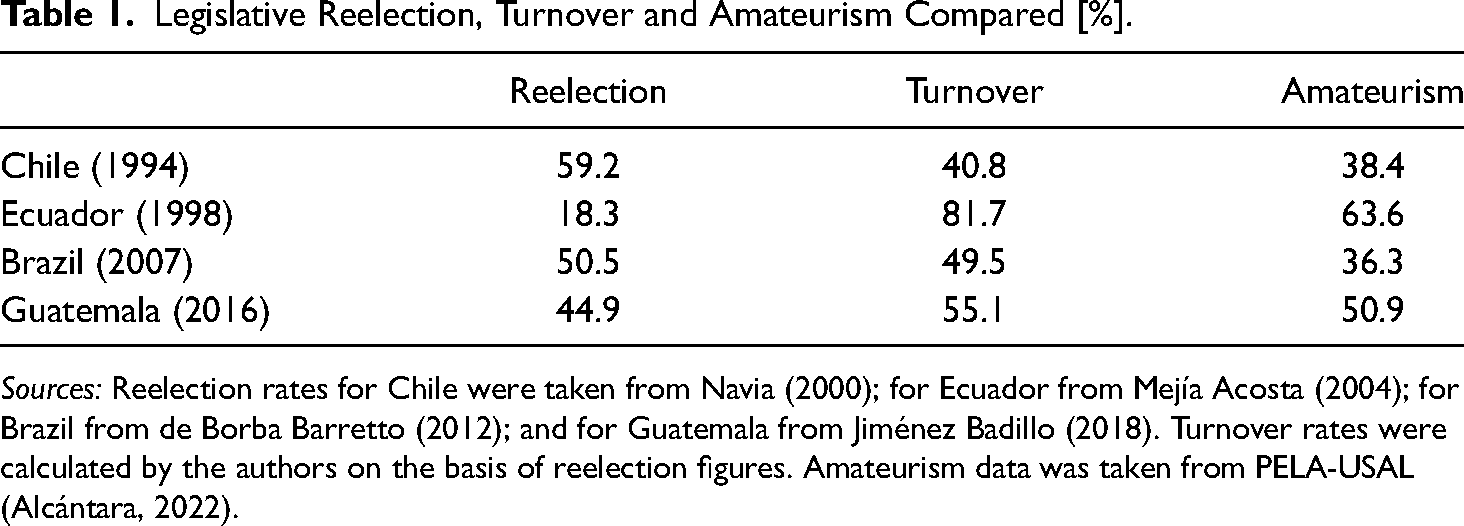
Sources: Reelection rates for Chile were taken from Navia (2000); for Ecuador from Mejía Acosta (2004); for Brazil from de Borba Barretto (2012); and for Guatemala from Jiménez Badillo (2018). Turnover rates were calculated by the authors on the basis of reelection figures. Amateurism data was taken from PELA-USAL (Alcántara, 2022).
Regional Trends in Legislative Amateurism
The average rate of legislative amateurism in Latin America between 1993 and 2019 is 65.8 per cent. In other words, around two thirds of the legislators won their seats without having previous experience in Congress during this period. Table 2 shows below there is some cross-national variation in the region. The countries with lower levels of amateurism are Chile, El Salvador, Brazil and Uruguay, while those with the higher levels are Costa Rica, Bolivia, Paraguay and Mexico.
Legislative Amateurism in Latin America [%].
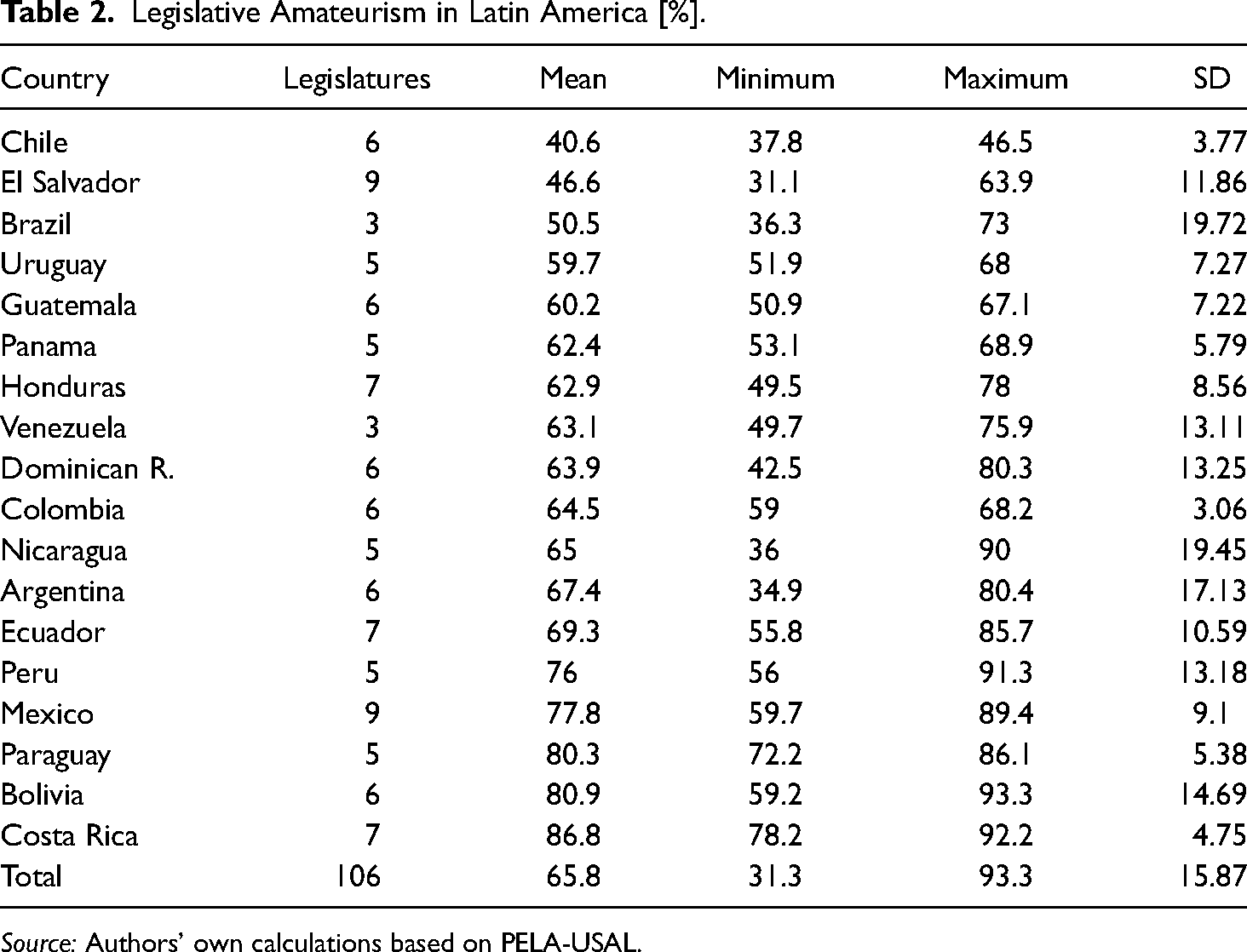
Source: Authors’ own calculations based on PELA-USAL.
The wide divergence of each country's standard deviations unveils the remarkable heterogeneity among them. Both at the top and at the bottom of the ranking there are cases with sharply changing rates of amateurism from one election to another. For instance, Brazil doubles its rate between the 2006 and the 2010 election, rising from 36.3 to 73 per cent. In contrast, Colombia's amateurism only increases from 59 to 68.2 per cent considering its lowest and highest values.
Figure 1 shows the variation of amateurism over time, suggesting there is no clear pattern in the region. While some countries reduced their levels of amateurism (e.g. Nicaragua, El Salvador, Dominican Republic), others increased them (e.g. Bolivia, Peru, Venezuela) during the same period. Besides, countries such as Costa Rica, Colombia, and Chile show quite stable levels of amateurism, in contrast with others like Honduras and Mexico, that seem rather volatile.
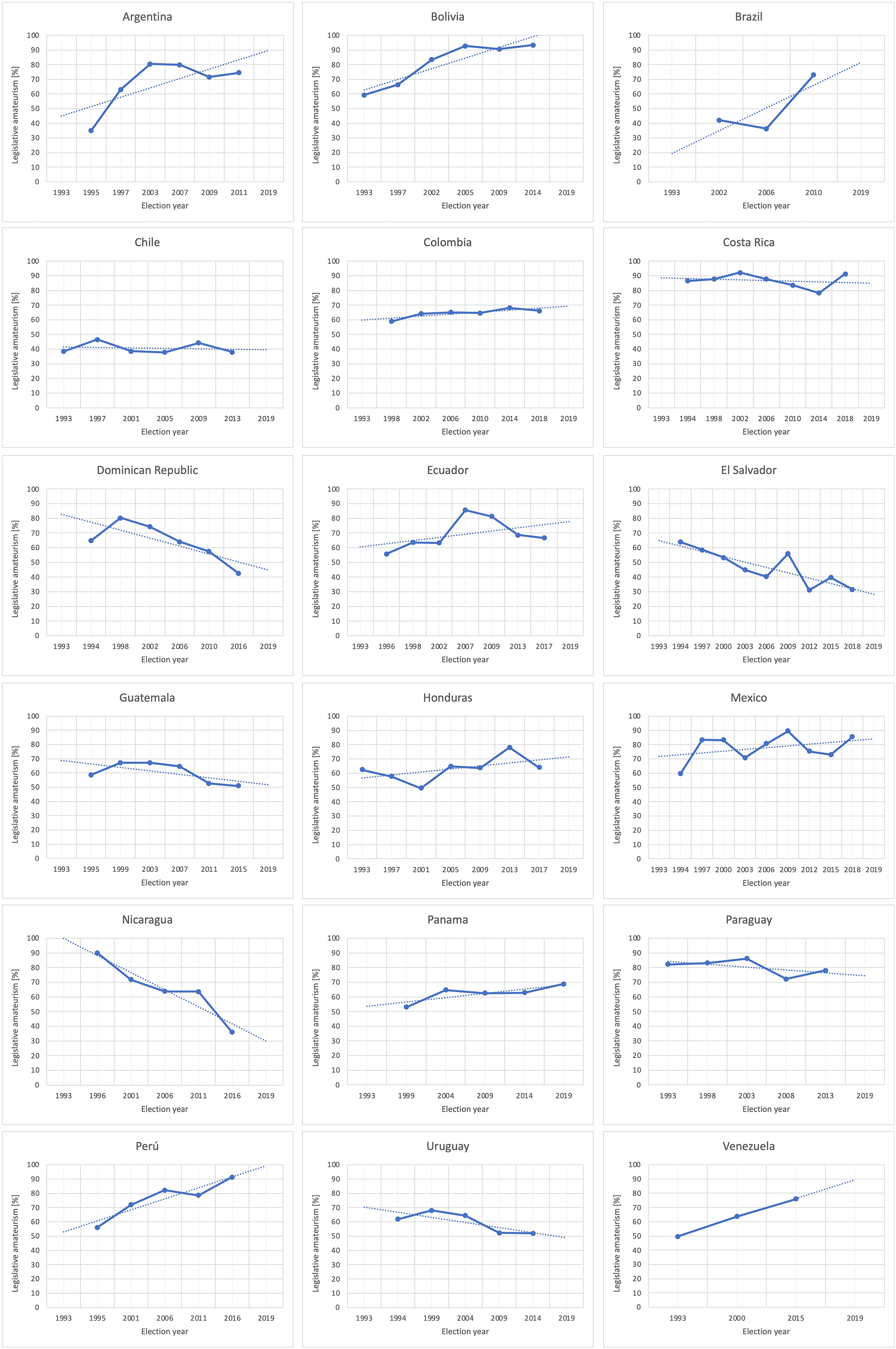
Legislative Amateurism in Latin America, 1993–2019.
Delving into country specific trends, several of these important within-country differences over time can be related to specific political landmarks. Following Putnam's metaphor (1976), Figure 1 records parliamentary elites’ changes as a seismographer would do. For instance, the Bolivian and Ecuadorian party system collapses in the mid-2000s left visible marks. The 2005 Bolivian watershed election led Evo Morales to the presidency reaching a crisis point in terms of social mobilizations against the political elites. Thus, the increase in amateurism expresses the long and lasting turmoil the country faced during the preceding years and the rise of the MAS (Movement for Socialism) among other left parties. After 2005, amateurism stabilized in Bolivia. Ecuador shows a very similar path, yet even more blatantly. The 2006 elections catapulted Rafael Correa to the executive triggering a constitutional reform that shook the very bases of Ecuadorian politics. Legislative amateurism reached a peak that year and then lowered as politics went back to a new normal.
Figure 1 also captures Argentina's bipartisan system decline in the late nineties and its breakdown in 2001–2002. The fragmentation of the Radical Party and, to a lesser extent, of Peronism seem to be correlated with a sharp increase in amateurism that reaches its pinnacle in the early 2000s with steadily high values. The Dominican Republic and Nicaragua both show a pattern of institutionalization after a regime change that reinstituted free and fair elections in 1996 and 1990, respectively. 6 El Salvador follows roughly the same trend, except for the 2009 election that replaced ARENA (National Republican Alliance) with the FMLN (Farabundo Martí National Liberation Front) as the ruling party, introducing an important number of amateurs in congress. In contrast, Peru and Venezuela have continuously climbed towards more and more legislative amateurism as their political systems sunk into recurrent crises. The former keeps falling into a spiral of government instability, weak parties, presidential impeachments, and a low regime legitimacy; while the latter experienced the collapse of its party system and moved to a competitive authoritarian regime (Levitsky and Way, 2010). Finally, many countries show relatively stable rates of amateurism, either at high (e.g. Costa Rica and Paraguay) or at low levels (e.g. Chile and Uruguay).
Theory and Hypotheses
To explain the determinants of amateurism, we draw a multivariate model from the extant literature on legislative reelection and turnover, as shown above in Figure 2. This model echoes Siavelis and Morgenstern (2008) analysis of candidate recruitment and selection in Latin America, which points out that institutions, party-level factors and context are determining to explain them. Overall, legislative amateurism is the result of two major factors. The first is the stability of a given party system. How sound are political parties? Have they been able to build solid and deeply rooted organizations? The second are the institutional rules, which are the set of constitutional and electoral rules that establish the legal requirements to become a candidate. Who can run for Congress? What are the statutory requirements to be nominated for and then be elected member of Congress? Are legislative elections to be held together with presidential elections? All these mechanisms occur in a specific political system from which we will consider countries’ territorial organization and their type of electoral system.
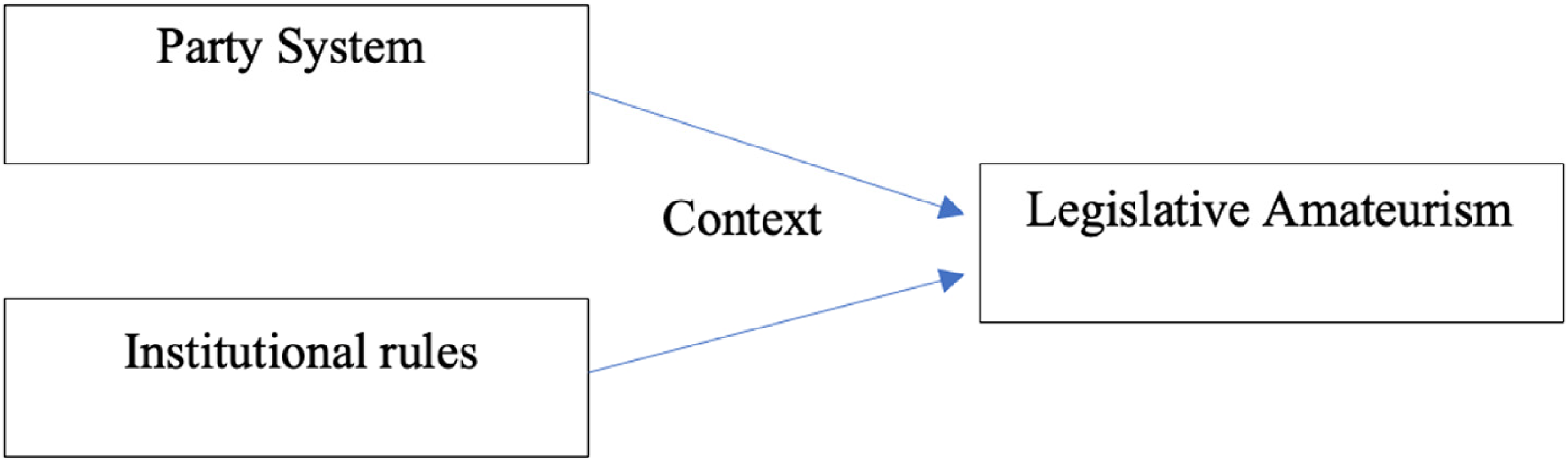
Factors Explaining Legislative Amateurism.
Party System
A party system is considered to be institutionalized when “a stable set of parties interacts regularly in stable ways” (Mainwaring, 2018: 4). In such a case, the expectations and behaviors of all players are shaped in predictable manners. When party competition is stable, parties are solidly and strongly entrenched in society, and tend to become more legitimate actors (Mainwaring and Scully, 1995). Deeply rooted parties are more cohesive, have stronger bonds with their constituencies, and are more embedded in civil society.
Although some concerns have been raised against the utility of this concept regarding Latin American countries (Luna, 2014), like the fact that many systems such as the Chilean and the Brazilian have parties that are at the same time up-rooted and quite stable 7 (Luna and Altman, 2011), party system institutionalization succeed in connecting system stability and party rootedness (Mainwaring et al., 2018).
Latin American party systems have been strikingly diverse in their patterns of institutionalization since the nineties. Mainwaring (2018: 8) identifies five pathways: 1. those with a persistent institutionalization such as Uruguay, Chile and, up to a certain extent, Honduras; 2. those in a process of increasing institutionalization like Brazil, Mexico, El Salvador, and Panama; 3. countries that have suffered a deep erosion of their party systems like Argentina, Colombia and, in some way, Costa Rica; 4. collapsed systems such as Ecuador, Bolivia, and Venezuela; and 5. persistently low institutionalized systems like Guatemala, Peru, and Paraguay.
On the one hand, in more institutionalized party systems, party blocs’ sizes in legislatures tend to be steadier (i.e. electoral volatility is lower), increasing MPs’ chances of getting reelected. Furthermore, if political parties are also more institutionalized, recruitment mechanisms will be more stable and thus career patterns more predictable. Hence, we expect:
Electoral volatility -i.e. the change in voters’ preferences, expressed by the shift in the number of seats each party wins from one legislature to the next (Roberts and Wibbels, 1999)- is considered to be a central indicator measuring the stability in parties’ vote shares (Carreras and Acácio, 2019; Mainwaring, 2018: 5). In Latin America, there is a remarkable heterogeneity in its countries’ level of electoral volatility, including extreme cases such as Honduras, with a national volatility average for legislative elections of just 14.5 per cent between 1993 and 2016; and Peru, with 78.3 per cent during the same years. The region as a whole has the second-highest electoral volatility in the world, only behind Eastern Europe (Carreras and Acácio, 2019). Electoral volatility has remained high in spite of the fact that democracies in the continent have aged and consolidated almost everywhere.
To measure electoral volatility, scholarship has distinguished between party replacement, on the one hand, and stable party volatility, on the other (Cohen et al., 2018; Mainwaring et al., 2017). The former is the change of voters’ preferences from established to new parties (i.e. extra-system or Type A volatility). The latter is the swing of votes among already existing parties (i.e. intra-system or Type B volatility). Thus, total volatility is the result of the addition of Type A plus Type B volatility. While some scholars found that most of Latin American volatility is Type A (see Carreras and Acácio, 2019; Cohen et al., 2018), others suggest that Type B is higher (e.g. Mainwaring and Su, 2021).
In both cases, low volatility is associated with stable and impermeable party systems, while high volatility is connected with weak institutions and recurring crises (Lago and Torcal, 2020). Thus, when votes change considerably between parties from one election to the next, MPs’ chances of being reelected tend to decrease. Whether votes swing among old parties or switch to new ones, it is more likely that a higher share of the legislature will be replaced (Altman and Chasquetti, 2005; Gouglas et al., 2018; Matland and Studlar, 2004). Therefore, we expect that an increase in any of them will result in more legislators without previous experience in Congress.
Institutional Rules
The institutional framework within which elections are held is a powerful driver of political recruitment and candidate selection processes shaping, ultimately, the legislature that is about to be elected (Norris, 1997). We focus on two key indicators that are part of the structure of political opportunities (Schlesinger, 1966): gender quotas and the concurrence of legislative and executive elections.
Electoral gender quotas seek to increase the number of women candidates for Congress through explicitly articulated rules (Krook, 2014). While some are “soft” and only set a more or less ambiguous series of targets and recommendations (Krook, 2009), others explicitly regulate different dimensions such as the size of the quota, the placement of women candidates on the list and sanctions in case of noncompliance (Dahlerup et al., 2013).
Gender quotas for legislative candidates are widely spread among Latin American countries, making many of them the forefathers of legal reforms that aimed to promote women's representation in Congress (Caminotti, 2016). Unlike many European countries, where the minimum number of female candidates is voluntarily decided by each party (Matland and Studlar, 1996), most Latin American quotas are mandatory. Since the early nineties, when Argentina passed the first gender quota law, every country in the region -except for Guatemala- enacted laws that forced parties to nominate women candidates in winnable positions to a certain extent. Globally, gender quotas in Latin America have strong policy designs and have gradually incremented their requisites setting the standard higher and higher over the years (Gatto, 2017). The basis of this legislation is that congresswomen have been and still are a clear minority regarding their male counterparts. As a result, if we randomly select any given woman in politics, the chances of her having legislative experience are lower than those of a man. Thus, setting a mandatory minimum of female candidates improves descriptive representation and, consequently, increases their experience (Htun and Jones, 2002). Where quotas are in place, party leaders are forced to select candidates that they would not have otherwise chosen if these regulations were not in place. When gender quotas have been in place for more than one election, amateurism is less likely to increase because women candidates have had the chance of getting some experience in Congress. Conversely, when gender quotas are newly implemented, we expect legislative amateurism to be higher.
Scholarship suggests that the level of amateurism can be affected when legislative and executive elections are concurrent. In several Latin American countries, voters cast their votes for presidential and legislative candidates together. That is the case of Uruguay and Guatemala, which have always held concurrent elections. While countries such as Mexico and Argentina do it once every two elections, others like El Salvador have never held concurrent elections.
A well-known effect of simultaneity is that it concentrates the votes on parties with relatively strong presidential candidates, reducing the chances of small and new parties to be voted (Carey and Shugart, 1995; Mainwaring and Shugart, 1997). On the contrary, when legislative and executive elections are not concurrent, the number of relevant parties increases. We assume that novel parties are more likely to have candidates with no prior experience and, at the same time, voters may be more prone to support them compared with the concurrent elections’ scenario (Carreras, 2012). Therefore, we can expect simultaneous elections to be associated with lower levels of amateurism. Thus, we expect:
Research Design
Data and Sources
To test our hypotheses, we employ an original dataset gathering information from different sources. First and foremost, the Parliamentary Elites of Latin America database of the University of Salamanca (PELA-USAL) (Alcántara, 2022), which has been collecting data on the opinions, attitudes and political careers of the members of national single or lower-house legislatures from 18 Latin American countries since 1993. PELA-USAL gathers data using face-to-face interviews in each country's legislative chamber and the final sample is representative of party composition of parliament. Our dependent variable is the rate of legislative amateurism of each individual legislature. To measure legislative amateurism, we calculated the proportion of representatives in each legislature who answered that they had become congressmen for the very first time, using all available waves included in PELA-USAL. 8 We were able to retrieve data for a total of 106 legislatures in 18 countries between 1993 and 2019. 9
Although some concerns have been raised against the reliability of these data (e.g. as sampling problems and a high number of missing values), PELA-USAL database offers original information that has proven to be particularly useful to test theories using a comparative approach for a variety of democratic contexts (Arnold, 2012; Carey, 2009; Kitschelt et al., 2010; Singer, 2021). Moreover, the variable we include shows clear methodological advantages. First, the question of whether the deputy has or has not been elected for the first time is asked in the exact same way in all surveys. Second, there are no reasons to expect this question to be answered in a self-serving or norm-following way, as other similar political opinions may. Third, the overall missing values are only 3.37 per cent and are distributed quite evenly among the surveys. Finally, as a robustness check, we analyzed each dataset separately, weighting the results according to each parties’ seat share in the legislature. Since our unit of analysis is not the political party but the parliament, smaller parties’ limited sample sizes PELA-USAL database relies on do not pose a significant problem.
The independent variables were collected from different sources, using the year elections were held as a reference (e.g. Uruguayan 2000–2005 House's composition was the result of the 1999 elections).
For party institutionalization, we rely on V-Dem's Party Institutionalization index (Coppedge et al., 2021), which measures the degree to which party systems are rooted in each country. It comprises five dimensions: the number of stable national parties, how many of them are present at the local level, what kind of linkages they hold to their constituents, whether their manifestos are public and distinct from one another, and their cohesion when voting in Congress (Bizzarro Neto et al., 2017).
To measure electoral volatility, we distinguished between intra and extra-system volatility, based on the Latin American Presidential and Legislative Elections database (LAPALE) (Cohen et al., 2018). This original dataset has been gathering information about electoral volatility from all presidential and legislative elections since the democratic transitions in the 1970s and 1980s. We chose LAPALE over other volatility datasets, such as the Latin American Electoral Volatility Dataset (LAEVD) (Mainwaring and Su, 2021), because the former is a more sensitive instrument to capture changes in party systems. LAEVD relies on a highly demanding standard to classify parties and, thus, only considers a party to be new if it is actually a completely novel organization with no previous existence (that is, it considers a party to be the same even if it has changed its name from one election to the next). In contrast, when a party changes its name, it is automatically considered a new party in LAPALE. The difference between these two criteria relies on their sensitivity: one of them tends to overestimate volatility, while the other risks undervaluing it. We consider LAPALE both a more sensitive instrument and a better choice to assess electoral volatility since it does not only reflect votes shifting to brand new parties but the fact that recently created parties together with old parties that changed their brand are obtaining more votes. When parties’ brands blur and they cannot or do not want to keep the same name there is some kind of institutionalization deficit (Lupu, 2016). Information on gender quotas was taken from Caminotti (2016). We coded their implementation in each legislature as a dummy variable 10 (one for cases where quotas were required for the first time and zero when quotas were already in place the previous election or there were no quotas at all). We collected data on legislative-executive national elections concurrence from countries’ electoral authorities.
In our models, we control for three additional variables: term limits, countries’ territorial structure (i.e. whether they have federal systems or not) and the type of electoral system for legislative elections in place. First, when term limits are mandatory and legislators are not allowed to run for successive periods, parliamentary careers tend to be reduced to their minimum or become intermittent. In Latin America, most countries allow the immediate reelection of their national legislators with only two exceptions: Mexico until 2021 and Costa Rica since 1949. Data on term limits comes from the Observatorio de Reformas Políticas en América Latina (1978–2021). We coded the imposition of term limits in each legislature as a dummy variable (one for cases where reelection is forbidden).
Second, federal countries offer bigger political markets than unitary ones (Borchert, 2011). States, provinces or departments with a certain degree of autonomy have elected governments and legislatures. That is to say, an array of cabinet and ministerial positions and seats in parliaments -which may be even bicameral- where to be appointed or elected to, respectively. To account for a possible effect of federalism, we included a dummy variable indicating whether the parliament was in a federal or unitary country (one for federal countries).
Third, we control for the electoral rules, taking into account closed-list and open-list proportional systems as well as mixed systems that combine features from both the proportional and the plurality systems in different manners. Scholarship suggests that systems where voters cast their ballots for one specific runner make it more difficult for party leaders to deselect incumbents and thus they are more likely to have higher reelection rates (Matland and Studlar, 2004). To control for a possible effect of the electoral system, we added a dummy variable where plurality and open-lists systems (i.e. those where there is a chance for voters to choose a particular candidate) are coded as one and the rest (uniquely proportional) as zero. As with other variables, we considered the cases where there have been changes from one election to another due to electoral reforms. Table A2 in the Appendix describes the summary statistics for all variables.
Methods
To test the influence of our main predictors of interest on legislative amateurism, we employ hierarchical mixed models (Beck and Katz, 2007). We use a time-series cross-sectional (TSCS) approach, distinguishing between occasions as level one and countries as level two. To account for the clustering of observations within countries, and considering we introduce both time-variant (e.g. volatility) and time-invariant (e.g. gender quotas) covariates, we fit a two-level random intercepts model in which measurement occasions are nested within countries (Beck, 2007). We consider this model appropriate for our analysis, given our particular interest in both fixed and slowly changing or historically determined variables (see Bell and Jones, 2015 for a discussion). 11 To facilitate interpretation, we standardized all continuous variables before running our models —all continuous variables have a mean of zero and a standard deviation of 1. We estimate our models using restricted maximum likelihood (RML) since it offers more reliable estimates in nested models when the country-level N is small (Schmidt-Catran et al., 2019). We also include year dummies to reduce the possibility of obtaining spurious correlations due to simultaneous time trends in both our outcome and predictor variables (Fairbrother, 2014). As a robustness check, in supplementary materials we report additional models including robust standard errors clustered by country (Table A4, Supplementary Materials). Given that party system institutionalization and volatility are negatively correlated (−0.42), we introduce these variables in separate models to avoid collinearity issues. Table A3 in the Supplementary Materials reports the bivariate correlations of all covariates included in the analysis.
Results
Table 3 below presents the results of the hierarchical mixed models. Both models include the hypothesis outlined in the theoretical framework; the difference between them is that model 1 includes the Party System Institutionalization index but not electoral volatility and vice versa. In both models the intraclass correlation coefficient indicates that over 90 per cent of the variation is due to differences between legislatures, and over 40 per cent due to differences between countries. Both models show satisfactory R2 values, accounting for between 66 and 80 per cent of the total variance in amateurism (see Table A4, Supplementary Materials). While both factors -institutional rules and party system- show robust determinants, some covariates have a stronger influence than others.
Determinants of Legislative Amateurism in Latin America.
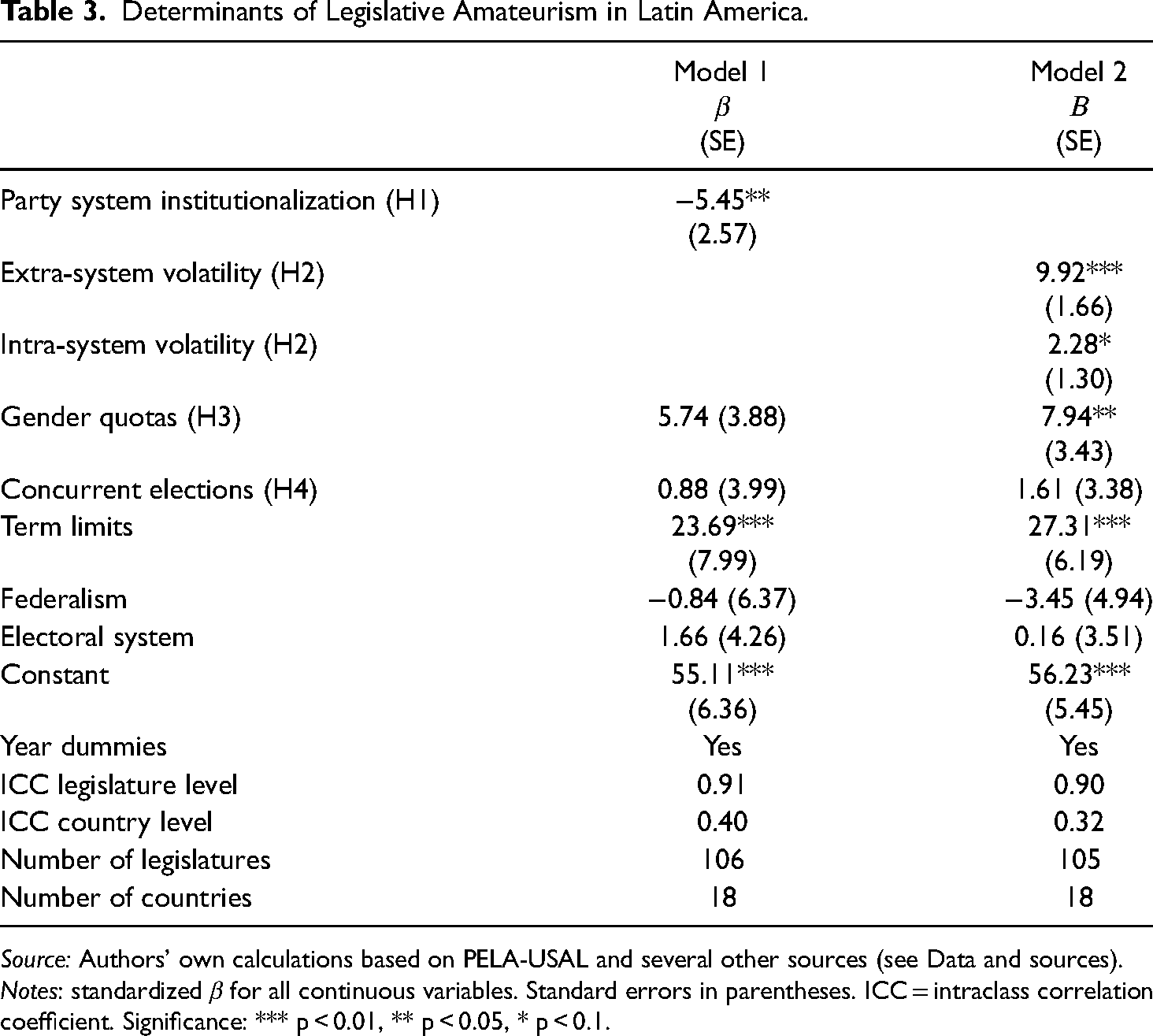
Source: Authors’ own calculations based on PELA-USAL and several other sources (see Data and sources).
Notes: standardized β for all continuous variables. Standard errors in parentheses. ICC = intraclass correlation coefficient. Significance: *** p < 0.01, ** p < 0.05, * p < 0.1.
Both models suggest that amateurism is affected by the characteristics of the party system. As hypothesized in Hypothesis 1, model I shows that party institutionalization is negatively and significantly associated with legislative amateurism. Keeping the other variables constant, an increase of one standard deviation in the level of party system institutionalization results in a decrease of 5.45 per cent in legislative amateurism. In contrast, as expected of Hypothesis 2, model II indicates that both extra and intra-system electoral volatility have a positive effect on legislative amateurism, yet this effect is stronger on the former. While an increase of one standard deviation in extra-system volatility results in an increase of 9.92 per cent in legislative amateurism (99% CI), it results in an increase of 2.28 per cent in legislative amateurism for intra-system volatility (90% CI). These results are similar in the additional robustness checks reported in the Appendix (Model 2, Table A4).
When they are enacted for the first time, gender quotas increase amateurism in almost 8 per cent. In line with Hypothesis 3, model II indicates that newly implemented gender quotas (i.e. rules stating a minimum number of women candidates to be placed on the lists) increase legislative amateurism. These results still hold in the robust standard errors models reported in the Appendix (Table A4, Supplementary Materials). Conversely, rejecting Hypothesis 4, both models suggest that the concurrence of legislative-executive elections has no effect on legislative amateurism.
Moreover, our models include additional controls that could affect legislative amateurism levels. Both models suggest that term limits are a strong determinant of the dependent variable. When immediate reelection is prohibited, the rate of legislative amateurism is, on average, between 23 and 27 per cent higher. This indicates that the overall experience of the house decreases when legislators cannot run for a second consecutive term. On the contrary, we do not find either federalism or the electoral system to have any clear influence on the number of inexperienced legislators. Finally, we cannot totally discard the influence of other institutional or even contextual aspects that may be related to amateurism through other factors.
Discussion and Conclusions
This comparative cross-national study has assessed the drivers of parliamentary experience in Latin America relying on a more accurate indicator (legislative amateurism), using a novel dataset of eighteen national legislatures between 1993 and 2019. The first and most consequential conclusion to be drawn from this study is that party systems are key to explain legislative amateurism levels. More institutionalized party systems are less likely to have parliaments with high levels of legislative amateurism. This finding goes beyond the dominant theoretical consensus that suggests that parliaments with higher levels of institutionalization should have lower turnover rates (e.g. Matland and Studlar, 2004). Our analysis provides, for the first time, empirical evidence of a positive effect of the institutionalization of the party system as a whole over legislators’ level of experience in Congress. Moreover, in line with the scholarship on turnover and reelection (e.g. Altman and Chasquetti, 2005; Gouglas et al., 2018; Matland and Studlar, 2004), our results support the view that parliaments with greater electoral volatility tend to have higher levels of amateurism.
When votes swing from old to new parties, and presumably new politicians that are entering the competition run with them, the effect is noticeably stronger than when voter's preferences move between already existing parties. While most research has focused on the relationship between institutionalization or electoral volatility and legislative turnover or reelection, we push forward this knowledge by providing evidence that suggests that weak parties and the shift of votes among any kind of parties generate a breeding ground for inexperienced politicians landing in Congress.
While it is true that each body has its own norms and set of formal and informal rules -thus making experience in each specific chamber an incomparable asset-, having some prior experience, particularly as a state or provincial legislator, is something that should be considered in further analyses. Political experience as a whole (regardless the branch, level or office) should also have an impact on legislators’ performance, given that it is unjustified to assume a former governor or a local representative will have as little experience as a complete outsider running for the first time (Lucardi et al., 2022). Hence, although it was not possible for this study to identify the percentage of each legislature which had previous subnational legislative experience, future research should consider this in order to accomplish a more accurate assessment of both congressional institutionalization and political elites’ circulation.
A second conclusion of our study is that some institutional rules that regulate the candidate selection process can have a clear influence over legislative amateurism and, thus, an impact on both congressional professionalization and political elites’ renewal. Our results suggest that, on certain occasions, gender quotas can increase legislative amateurism. We find that parliaments that introduce gender quotas for the very first time tend to have higher levels of legislative amateurism. To put it in other words, even if gender quotas increase the diversity of backgrounds of legislators and include historically marginalized groups into government decision making bodies, they can be to some degree costly in terms of legislative experience, since there is a tradeoff between equalizing the representation of men and women in parliament and the overall experience in the houses. However, future research should address whether this effect holds when quotas are in place for more than one election or if their influence tends to become attenuated over time once female legislators experience increases.
We haven’t found concurrent legislative-executive elections to have any clear effect on legislative amateurism. We believe the most plausible explanation for this is due to the fact that, in a context of relatively high electoral volatility, parties with strong presidential nominees (those supposed to receive more votes for their legislative candidates) are not necessarily the older and most established ones, so they may have a considerable number of amateurs on their lists.
Finally, our models show that term limits lower congressional professionalization and accelerate political elites’ circulation. This was an expected outcome, yet our study provides a more nuanced assessment of the true magnitude of this effect given the novel nature of the dependent variable that measures experience taking into account positions held two or more terms before.
This work opens new questions and paves the way for further research. First, future studies should analyze the consequences of amateurism on legislative work and policymaking in Latin American parliaments. How and to what extent do amateurism levels shape policy and other political outcomes? Second, party-level analysis would shed light on countries’ heterogeneity. Third, future research should also consider subnational legislative experience in order to set different degrees of amateurism and better understand how political experience as a whole affects legislative amateurism. In this vein, case-studies could be particularly useful to provide a deeper understanding of the importance of different country-specific factors and to assess the generalizability of our results. Comparative transregional research among other developing areas in the world may contribute to a better understanding of congressional professionalization and political elites’ circulation in the Global South.
Supplemental Material
sj-docx-1-pla-10.1177_1866802X231212571 - Supplemental material for Assessing Congressional Institutionalization and Political Elites’ Renewal in Latin America Through Legislative Amateurism
Supplemental material, sj-docx-1-pla-10.1177_1866802X231212571 for Assessing Congressional Institutionalization and Political Elites’ Renewal in Latin America Through Legislative Amateurism by Gabriel Levita and Cristian Márquez Romo in Journal of Politics in Latin America
Footnotes
Acknowledgements
The authors would like to thank Mercedes García Montero, Steven Levitsky, Fernando Bizzarro, Iván Llamazares Valduvieco, and Paula Clerici for their valuable comments and suggestions. Adam Wolsky and Scott Mainwaring generously helped us with the electoral volatility data. Previous versions of this paper were presented at the Political Science and Public Administration Area at the Universidad de Salamanca, the Latin American Working Group at the MIT Department of Political Science, the GEL session at the ALACIP conference, and the “Elite and Class” workshop at the University of Kassel.
Declaration of Conflicting Interests
The author(s) declared no potential conflicts of interest with respect to the research, authorship, and/or publication of this article.
Funding
The authors received no financial support for the research, authorship, and/or publication of this article.

Supplemental Material
Supplemental material for this article is available online.
Notes
Author Biographies
References
Supplementary Material
Please find the following supplemental material available below.
For Open Access articles published under a Creative Commons License, all supplemental material carries the same license as the article it is associated with.
For non-Open Access articles published, all supplemental material carries a non-exclusive license, and permission requests for re-use of supplemental material or any part of supplemental material shall be sent directly to the copyright owner as specified in the copyright notice associated with the article.
