




Abstract
When do presidents delegate policy-making authority to their foreign ministries? And is foreign policy unique in this respect? We posit that six international, national, and personal factors determine the opportunity and motivation of presidents to delegate, and then analyse the cases of Argentina, Brazil, and Mexico in 1946–2015. By applying fuzzy-set qualitative comparative analysis, we find that four combinations of factors are sufficient paths to delegation: (1) international stability and elite consensus on foreign policy; (2) international stability, right-wing president, and low diplomatic professionalisation; (3) international stability, right-wing president, and low presidential expertise on foreign policy; or (4) absence of authoritarianism combined with elite consensus on foreign policy and right-wing president. Our study of foreign ministries reinforces some of the main findings of the scholarly literature on other ministries, thus challenging the view of foreign policy-making as different from domestic policy areas.
Keywords
Motivation and Puzzle
Why do chief executives delegate authority to professional bureaucrats instead of politicians, private-sector technocrats, interest-group representatives, or cronies? This is a key question to understand policy-making in presidential regimes, given that presidents, as opposed to prime ministers, hold individual rather than collective responsibility for government. 1 It is no wonder that there has been a growing comparative literature on the issue, with a strong focus on economic and social ministries in Latin America (Camerlo and Pérez-Liñán, 2015; Centeno and Silva, 1998; Dargent, 2014; Kaplan, 2017). Yet despite this growing literature, there is a dearth of comparative research on delegation to professional diplomats. This is puzzling, because professional diplomats rank among Latin America’s best-trained bureaucrats and are pivotal for the formulation and implementation of effective foreign policies. International relations scholars, for their part, tend to eschew the development of cross-country operational indicators and focus on single cases instead (Belém Lopes, 2013; Bosoer, 2005; Cason and Power, 2009; Castro, 2009; Dalbosco, 2014). With few exceptions (such as Figueroa and Schiavon, 2014), comparative research on the relations between political leaders and professional diplomats in Latin America lies in limbo. The most we can say is that presidential ideology is the primary determinant of foreign policy change (Merke et al., 2020). But then, knowing whether presidents conduct foreign policy themselves or delegate it becomes crucial, as presidential ideology can get diluted, distorted, or even challenged in the delegation process.
Why was Brazilian president Fernando Henrique Cardoso (1995–2002) mockingly nicknamed Viajando (“Travelling”) Henrique Cardoso? (Pinheiro Machado, 2018: 466). Why has Mexican president Andrés Manuel López Obrador (2019–) been titled “a president who does not travel”? (Carretto, 2019). The comparative literature lacks a systematic explanation of the factors behind such contrasting approaches, respectively presidentialisation and delegation, to foreign policy-making.
Recently, Amorim Neto and Malamud (2019) conceptualised and measured the policy-making capacity of Latin American foreign ministries with an empirical focus on Argentina, Brazil, and Mexico in 1946–2015. Foreign ministries with high policy-making capacity are capable of insulating themselves from the policy preferences of other government agencies. In so doing, they are able to advance and implement their preferences while retaining internal and external legitimacy. Three features build up a foreign ministry’s policy-making capacity: the professionalisation of the diplomatic corps, ample institutional attributions, and extensive presidential delegation. The first is a necessary condition, while the second and third features are substitutable: a foreign ministry can have its policy-making capacity heightened either by institutional attributions or by presidential delegation. In this manuscript, we endeavour to explain the latter.
The article proceeds as follows. The next section reviews both the literature on delegation to technocrats/bureaucrats and the literature on foreign policy-making to pin down the state of the art and in search of hypotheses. We posit that international, national, and personal factors determine the opportunity and motives of presidents to delegate power to their foreign ministries. The third section describes our methods, indicators, and data. In the fourth section, we use Ragin’s fuzzy-set qualitative comparative analysis to identify the combinations of conditions conducive to presidential delegation; in addition, we identify the conditions that lead to non-delegation. We discuss the findings and provide robustness checks in the fifth section. The sixth section concludes.
State of the Art and Explanatory Factors
Research on technocrats in Latin America tends to focus on contemporary examples. However, the technocratic phenomenon has roots that go back to the late nineteenth and early twentieth centuries. After a prolonged period of post-colonial frustration with the failure to accomplish rapid change, politicians in late nineteenth-century Latin America turned to science for solutions. The technocrats of this period, of which the Mexican cientificos became the most renowned, were expected to fulfil these new hopes and aspirations (Baud, 1998). This positivist mindset was expressed in the Brazilian national motto, Ordem e Progresso, which has been stamped on its flag since 1889, and in Argentina’s Paz y Administración campaign of President Julio Roca (1880–1886).
Traditional Latin American populism was not dismissive of technocrats but put them firmly under the rein of the political leader. This hierarchic or complementary rather than adversarial relationship is consistent with the most recent research. Bickerton and Invernizzi Accetti (2017) assert that both populism and technocracy are similar in their “opposition to two key features of party democracy: political mediation and procedural legitimacy.” Lee and Schuler (2020: 531) further contend that autocrats “do not fear technical competence; they fear political competence.” Therefore, they “promote ministers with technical competence but punish the politically competent.” Although autocracy is not the same as populism, we consider them as functional equivalents in terms of the relationship between the political leadership and the bureaucratic/technocratic echelons of the administration.
After multiple decades of bureaucratic authoritarianism (in Argentina and Brazil) or autocratic rule (in Mexico), neoliberalism established a foothold in the 1990s. Neoliberalism, with a technocratic flair not dissimilar to that of bureaucratic authoritarianism, occurred in a more heterogeneous fashion across the region, however. In Argentina and Brazil, the neoliberal turn took place under neopopulist presidents Carlos Menem and Fernando Collor. In Mexico, it evolved under traditional Institutional Revolutionary Party (PRI) rule. In the three cases, strong presidents alternated with weaker ones, and the relationship between them and their national bureaucracies displayed great variation.
With regard to foreign policy-making, we want to understand the factors that led some presidents to lean on technocratic government and others to accentuate political (presidential) discretion. In other words, this is an analysis of professional diplomacy versus presidential diplomacy. Complementing recent findings on technocratic and partisan appointments in presidential cabinets (Camerlo and Pérez-Liñán, 2015), our research goes beyond minister retention to unveil the logic behind presidential direct intervention in policy-making.
Six Explanatory Factors
We posit that six factors are connected to a president’s decision to delegate power to the foreign ministry. These factors are spread over three dimensions: international, national, and personal. Cason and Power have already applied this threefold categorisation to the study of Brazil’s foreign ministry, and we intend to supplement their analysis and extend it to assess our other two cases (Cason and Power, 2009).
The international factor concerns the presence of systemic stability. In relatively stable times, presidents have incentives to delegate foreign policy management and focus instead on domestic issues. In contrast, during systemic crises such as the end of a world war, a global financial meltdown, or a sharp decline of a superpower, presidents may find both a motive and opportunity to intervene more directly in foreign affairs.
The first domestic factor is political and concerns the presence of an elite consensus on foreign policy – or the absence or politicisation thereof. When such a consensus is present, presidents have incentives to delegate policy-making authority to professional diplomats; when the consensus breaks or never develops, more presidential foreign activism is to be expected. The rationale underlying this factor is identical to the logic of central bank autonomy: when political and economic elites converge on the goal of keeping inflation low and stable, they grant autonomy to a central bank staffed with high-quality economists (Cukierman, 2008).
The second domestic factor is institutional and concerns the nature of the political regime. The presence of democratic institutions generates incentives for chief executives not to delegate to the foreign ministry because democratic presidents are under pressure to consider the views of voters, interest groups, and political parties. That is to say, democracy’s accountability mechanisms compel presidents to consider preferences other than those of professional bureaucrats. In contrast, non-democratic presidents are freer to delegate authority to the foreign ministry.
The third domestic factor is ideological and concerns the programmatic orientation of the government. Right-wing parties and leaders have the motivation to rely on technocratic management, and therefore to delegate authority to professionalised foreign ministries (Kaplan, 2017; Kiely, 2017). Moreover, given the frequent elitist bias of the diplomatic career, there is an elective affinity between diplomats and right-wing politicians because the latter tend to be more closely associated with elites. Conversely, leftist presidents have the motivation to advocate policy change and frown upon such bias and, thus, to display a hands-on approach to professional diplomacy.
The last domestic factor is bureaucratic and regards the degree of professionalisation of the foreign ministry. As mentioned above, the classical problem of public agencies becoming independent from their political masters increases when bureaucrats are professionalised. In the words of Weber (1946: 232), “The ‘political master’ finds himself in the position of the ‘dilettante’ who stands opposite the ‘expert,’ facing the trained official who stands within the management of administration.” Professional bureaucrats claim a monopoly on their technical expertise, form deeply entrenched preferences over policy, establish clear-cut boundaries between their bureau and the outside world, and develop an “esprit de corps” that is jealous of any hint of encroachment by outsiders. These are the drawbacks of a strong public organisation – from a chief executive’s point of view, particularly from a democratic one. While strong bureaucracies are desirable because they are an instrument of effective governance, their drawbacks generate a control problem. Conversely, when a public bureaucracy is organisationally weak, it is relatively easy for the chief executive to penetrate or marginalise it. Therefore, the presence of a professional foreign ministry motivates presidents not to delegate authority to it.
Finally, the personal factor is psychological and concerns presidential personality. Broadly speaking, a weak personality can be associated with delegation, while a strong personality is connected to presidential activism in foreign policy. Psychological factors are multi-dimensional and very difficult to measure. Here we rely on part of Preston’s theorisation to develop one hypothesis regarding presidential personality. Preston’s study found that three individual characteristics – need for power, complexity, and prior policy experience – played a critical role in shaping presidential leadership styles in the United States (Preston, 2001). However, here we analyse only prior policy experience because it bears directly on presidents’ motivation to delegate authority to the foreign ministry, is relatively easy to observe, and therefore is relatively straightforward to operationalise on the basis of a president’s career before he or she was sworn in.
Prior policy experience of leaders has a significant impact upon presidential style, the nature of advisory group interactions, and how forcefully leaders assert their own position on policy issues (Alcántara, 2012, 2017; Araya, 2015; Preston, 2001). Experience provides leaders with a sense of what actions will be effective or ineffective in specific policy situations, as well as which cues from the environment should be attended to and which are irrelevant. Leaders with a high degree of policy experience insist upon personal involvement or control over policy-making (Preston, 2001: 11–12). Therefore, a less experienced president has incentives to rely on experts for conducting foreign policy (Saunders, 2017). Conversely, a president with considerable experience in international affairs and for whom foreign policy is a salient issue has the motivation to take charge personally (Allison and Zelikow, 1999; Saunders, 2017).
Cases, Methods, Measures, and Data
Following Amorim Neto and Malamud (2019), our case selection is based on three facts. First, Latin America features the world’s strongest presidentialist tradition. Second, our chosen cases are the largest powers in the region, which confers greater impact to their foreign policy-making process. Third, the three cases exhibit wide variation in presidential delegation to the foreign ministry. This variation allows us to expect that our results may travel well to other presidentialist countries.
As our objective is to identify the causes of a consequence, not the consequences of a cause, the appropriate methodology is the comparative-historical method (Mahoney, 2010). Moreover, as our purpose is to pin down combinations of conditions conducive to presidential delegation to foreign ministries – and given the nature of our evidence, measures, and size of our sample – it is advisable to use Ragin’s fuzzy-set qualitative comparative analysis (henceforth, fsQCA [Ragin, 2008]). Deploying fsQCA allows us to illuminate what Ragin calls “explicit connections” rather than the mean effects of a set of variables, as would be the case were we to conduct a multi-variate regression analysis. Hocking (1999: 14) claims that “generalisations about foreign ministries, their role and significance are fraught with danger.” Precisely because we agree on this statement, a configurational analysis is a suitable instrument, as it aims at only “contingent generalisations” (George and Bennett, 2005: 31–32). Last but not least, as recently argued by Goertz (2017), QCA is particularly useful for testing “constraint theories” such as the one developed here.
Calibrating Presidential Delegation
Following Amorim Neto and Malamud (2019), we consider three indicators of our dependent variable, presidential delegation to foreign ministries. The first indicator regards direct intervention in foreign affairs, which is measured through a proxy: international travel. Presidents who embark on more foreign trips, and remain longer abroad, are considered to delegate less authority on foreign policy than presidents who tend to stay home (Cason and Power, 2009). 2 This delegation may be more or less implicit. Intentionally or not, diplomatically inactive presidents are more likely to empower the foreign ministry than active ones.
The second indicator is the maintenance of a stable ambassadorial elite composed mostly of career diplomats. Given that the appointment of ambassadors is a presidential attribution, the decision to fill a country’s key diplomatic posts with professional diplomats is a signal of a presidential delegation that strengthens the foreign ministry policy-making capacity.
The third indicator is the appointment of foreign ministers with an autonomous political basis. Amorim Neto and Malamud (2019) highlight that ordinary bills of law are a less necessary tool for foreign policy than for other policy areas. This implies that the conversion of presidents’ preferences into foreign policy will depend more on executive control over the bureaucratic apparatus than on legislative majorities. 3 Presidents for whom foreign policy is a salient issue will prefer the selection of experts or bureaucratic operators acquainted with the diplomatic apparatus. The more a president wants to control foreign policy, the less he or she will be willing to delegate authority to the diplomatic corps. Hence, the chief executive will be less inclined to appoint a foreign minister with independent political support, such as, for example, a party leader. This kind of president is even likely to appoint a diplomat to head the foreign ministry. Diplomats offer him or her the double benefit of being politically weak, therefore controllable, and knowing the inner working of the bureaucracy.
Amorim Neto and Malamud (2019) hypothesise that the three indicators that capture the level of delegation are substitutable, namely: (1) (low) diplomatic activism by presidents, (2) the stability and the professional makeup of the ambassadorial elite, and (3) the appointment criteria of foreign ministers. For every presidential term, they allocate 0, 0.5, or 1 point for each dimension in which delegation proceeds. When a country meets a given condition in a given year, it is coded as 1; when a country meets that condition partially, it is coded as 0.5, and 0 otherwise. Since the three indicators can be cumulative, each presidential term can receive the following scores: 0, 0.5, 1, 1.5, 2, 2.5, and 3.
We calibrated the scores for the purpose of conducting fsQCA. Therefore, when the score of a presidential mandate is 3 (maximum delegation), it was coded as 1; when it is 2.5, it was coded as 0.83; when it is 2, it was coded as 0.66; when it is 1.5, it was coded as 0.5; when it is 1, it was coded as 0.33; when it is 0.5, it was coded as 0.17; when it is 0, it was coded as 0.
A note on Brazil’s Juscelino Kubitschek (1956–1961) is illustrative of how Amorim Neto and Malamud’s measures of delegation correspond to presidents’ behaviour in foreign policy. Kubitschek’s score on our calibration of delegation is 0.66. He travelled little and appointed foreign ministers with an autonomous power basis (both features implying delegation), but rotated his ambassadorial elite frequently and selected relatively many non-professional ambassadors (implying relegation). This means that he was more or less in the set of delegation. Does this summary evaluation match his behaviour in foreign policy? Kubitschek is known for personally engaging in one important foreign policy initiative, the Pan American Operation (OPA), in 1958. He did not agree with the foreign ministry on how to deal with Washington: while the president wanted a multi-lateral approach, the foreign ministry preferred a bilateral one. Thus, the president created an inter-ministerial committee and set out to bring the Latin American countries together so as to negotiate US foreign aid. “In June, Foreign Minister Macedo Soares resigned, not because he opposed OPA, but because he had been excluded from its planning” (Weiss, 1993). Here is a clear example of a president withdrawing delegation, although in other regards he let the foreign ministry run diplomatic affairs according to its preferences.
We now turn to the calibration of the six explanatory factors or conditions.
Stability of the International System
Our independent international factor, systemic stability, is the only one that remains unchanged through all national cases. It is calibrated in the simplest manner, that is, as a dummy. We have identified four periods of systemic change, meaning either that the system polarity was altered or that major economic turmoil conferred extraordinary activism to lesser powers. Every one of these periods, with an assigned score of 0, includes a starting year plus the four that followed. We have defined all other years as stable and assigned them a score of 1. The first period of change is 1946–1950, when the Cold War order set in and crystallised. The second period is 1973–1977, when the first oil crisis disrupted the international economy and put an end to the thirty glorious years in the West. The third period is 1989–1993, encompassing the fall of the Berlin Wall and the dissolution of the Soviet Union. Finally, the 2001–2005 period marks the peak and end of the US unipolar moment, after 9/11 and its aftermath, including the rise of China, which signalled the advent of an increasingly multi-polar order.
The remaining explanatory factors are located at the domestic and individual levels.
Elite Consensus on Foreign Policy
The category of elite consensus involves two separate questions: who is included in the elite (the actors), and what is agreed or disagreed upon (the substance). We understand the foreign policy elite as representing parties’ principal leaders, the top brass of the armed forces, and the most prominent members of the diplomatic corps, whose views are commonly intertwined with academic paradigms. As to substance, the crucial Latin American issues concern national development strategies, trade policies, and relations with the United States. Development strategies have generally alternated between a resource-based export model and an import-substituting industrialisation model. Accordingly, trade policies have varied between free trade and protectionism. Finally, the political dimension of foreign policies has oscillated between US-friendly and “anti-American” approaches. Because this compound variable is multi-dimensional, it is advisable to adopt a fine-grained calibration rather than a dichotomy. Based on an extensive literature review and expert consultation, we operationalised it in a trichotomous manner.
If there is a consensus on the political dimension and on the development/trade dimension of a president’s foreign policy, the score is 1. If there is consensus only on the political dimension or only on the development/trade dimension, the score is 0.6. This value is more appropriate than 0.5 because the latter indicates maximum indifference, which is not the case as far as consensus is concerned (Schneider and Wagemann, 2012). 4 If there is no consensus on either dimension, the score is 0.
Political Regime
We adopt a minimalist definition of democracy as a regime in which rulers are elected through relatively free and fair (though not necessarily direct) elections, and calibrate this factor as a dichotomous variable: 1 for periods of authoritarianism or non-democracy; 0 for democratic presidents. Our coding of Latin American political regimes coincides with that of Mainwaring and Pérez-Liñán (2001).
Professionalisation of the Foreign Ministry
If under a given president, diplomatic recruitment and promotion has not been professionalised, this president’s term receives the score of 0. Note that professionalisation began in 1963 in Argentina, 1946 in Brazil, and 1967 in Mexico (Amorim Neto and Malamud, 2019), dates to which we assign a membership score of 0.6. 5 That is, for the year when professionalisation started for each country, they received a membership score greater than 0.5, as they are now more in than out of the professionalisation condition. From then on, the degree of professionalisation evolves 0.1 every five years, as successive cohorts of diplomats are recruited and promoted according to meritocratic criteria. Twenty years after the professionalisation of the diplomatic service – that is, once professionalisation is mature – presidential terms are assigned a score of 1.
Presidential Ideology
The ideology of a president is that of their party, and party ideology is initially based on the categories and operationalisation proposed by Coppedge (1997), further revised and updated with resort to case experts as reported in Amorim Neto and Malamud (2015). As for calibration, this factor is a fuzzy-set: 1 for rightist presidents; 0.75 for centre-rightists; 0.5 for centrists; 0.25 centre-leftists; 0 for leftists.
Presidential Expertise
On the basis of presidential biographies, we have first established a scale of expertise ranging from 1 to 5. Presidents who had been ministers of foreign affairs or were acknowledged specialists in international affairs were coded as 5; presidents who had been ambassadors, heads of a ministry related to foreign affairs (such as defence or foreign trade), attachés, representatives of an international organisation, or had some type of substantial international experience were coded as 4; presidents whose careers had had some kind of systematic contact with foreign affairs (e.g. a legislator who had been a member of the foreign affairs committee) were coded as 3; presidents whose careers had not provided them with any systematic contact with foreign affairs, but who had travelled abroad for political or business affairs, or had participated in international political missions were coded as 2; all others were coded as 1. Re-elected presidents were automatically upgraded to the maximum score. As for calibration, we proceeded as follows: 5 was converted to 1; 4 to 0.75; 3 to 0.5; 2 to 0.25; and 1 to 0. Unlike the elite consensus variable, here it is relevant to retain the score of 0.5, as the presidents who are at the so-called cross-over point can go either way in terms of delegation.
The scores for systemic stability and professionalisation of the foreign ministry have been identified above, so we now discuss the four other factors for each country.
Argentina
Full elite consensus on foreign policy has not existed in Argentina since 1946, when Perón came to power and redrew the political system in two camps that have lasted until today. The only exception was the coalition government that, after the 2001 economic and political meltdown, led Duhalde to head a caretaker administration tantamount to a national salvation government (2002–2003). A partial consensus was reached in the 1963–1974 period, when a tacit agreement sunk in on non-alignment, import substitution, and soft contestation of existing international organisations (Russell and Tokatlian, 2006). Dissent was prevalent during the rest of the time due to two stable dichotomies: one facing the pro-US military administrations versus the more pro-autonomy civilian opposition, the other reflecting the all-out adversarial relationship between Peronists and Radicals (Malamud, 2011; Saraiva and Tedesco, 2001).
As to the political regime, democracy was interrupted during 20 years out of 70: in 1955–1958, 1966–1973, and 1976–1983. During the three non-democratic periods, all of which followed military coups, the presidents were military officers of the army branch. The two last periods are commonly catalogued as bureaucratic authoritarianism, which makes technocratic delegation more likely.
Regarding ideology, we needed to depart from Coppedge (1997) classification mainly because Peronism, or Partido Justicialista, evades traditional labels and is catalogued as “other.” Based on expert consultation, we classified all military presidents as rightists, Peronist presidents as spanning between centre-left and centre-right, and civilian non-Peronist presidents as spanning between centre-left and centre.
Presidential expertise in Argentina has had the most variegated sources. Three presidents had previously been military attachés (Perón, Aramburu, and Levingston), and one had been an ambassador (Lanusse). Perón, Menem, and Fernández came to power with different backgrounds, but all were highly experienced when they were re-elected. Martínez and Fernández enjoyed an early exposure to foreign policy as they were married to former presidents. Some traditional politicians such as Frondizi or Alfonsín lacked institutional experience abroad but had either had an intellectual contact with foreign affairs or built international connections; others were total rookies. Consecutive presidential re-election, allowed by the 1994 constitutional reform, paved the way for experienced presidents to remain longer in office. 6
Brazil
Although diplomats and commentators alike tend to depict Brazilian foreign policy as largely consensual and consistent over time, neither harmony nor continuity should be taken for granted. Indeed, during Brazil’s first democratic experiment (1946–1964), consensus was rather partial until 1959, chiefly due to the controversy on the position to be adopted vis-à-vis the United States (Lima, 1994). Only under the consecutive terms of Geisel, Figueiredo, and Sarney (1974–1990) did a consensual foreign policy develop, but it was interrupted by the unexpected victory of Collor in 1989 and never fully restored (Cason and Power, 2009). 7
With regard to the political regime, Brazil was a democracy between 1946 and 1964, and then again since 1985.
Under the 1946–1964 democratic regimes, all Brazilian presidents were centre-right, except Vargas and Goulart, both considered centre-left. All military presidents are classified as right. After 1985, Sarney, Franco, and Cardoso are classified as centre, Collor as rightist, and Lula and Rousseff, centre-left.
Most Brazilian presidents had had some expertise on foreign affairs prior to entering office, the only exceptions being Kubitschek, Quadros, Collor, and Rousseff. Presidents in their second term (Vargas, Cardoso, Lula, and Rousseff) were obviously connoisseurs, while most military presidents had previously held posts linked to foreign affairs, whether ministers of war, military attachés, or chiefs of the intelligence services. Consecutive presidential re-election, allowed since 1997, paved the way for experienced presidents to remain longer in office. 8
Mexico
In Mexico, an elite consensus on foreign policy was the norm until 1982. By then, technocrats and politicians within the ruling PRI broke up over the transition from import substitution industrialisation to an export-based model. The conservative party PAN was closer to the former group, while left-leaning PRD was closer to the latter. Since 2000, some consensus on foreign economic policy was restored, but disagreements emerged on the political dimensions, mainly democracy and human rights. 9
The Mexican political regime is considered to have been non-democratic until 1994, when elections were held for the first time under the supervision of the Federal Electoral Institute. Created in 1990, this agency guaranteed transparency and therefore conferred legitimacy to the electoral process, paving the way for the democratisation of the political system (Ai Camp, 2011a).
As for the ideology of presidents, and following expert advice, Alemán Valdés, Díaz Ordaz, de la Madrid, Salinas de Gortari, Fox, and Calderón were classified as centre-right; Ruiz Cortines, López Portillo, Zedillo, and Peña Nieto were considered centrists; and López Mateos and Echeverría were classified as centre-left.
The first two Mexican presidents after 1946 lacked any relevant foreign experience, but several of the following were more knowledgeable. López Mateos had lived in exile and led a diplomatic mission to Europe; Díaz Ordaz had been a member of the foreign affairs committee in Congress; Echeverría had studied abroad and written a thesis on the Society of Nations; López Portillo was a lawyer who had also studied abroad; both de la Madrid and Salinas de Gortari had studied at Harvard and attended a number of international conferences; and Zedillo had been a professor at Yale. National Action Party (PAN) presidents Fox and Calderón had also studied at Harvard, although the former later developed a career as an international businessman. The last president in our sample, Peña Nieto, had no particular expertise before wearing the presidential sash. 10
Fuzzy-Set Qualitative Comparative Analysis
For our necessity and sufficiency assessment, we first verified the measures of consistency and then coverage of the set of conditions. The data were computed with the aid of the fs/QCA 3.0 software developed by Ragin and Davey (2017).
With fuzzy sets, “the consistency of a necessary condition is given by the degree to which each case’s membership in X (the condition) is equal to or greater than their membership in Y (the outcome)” (Schneider and Wagemann, 2012: 141). As for coverage, it assesses the relevance of the necessary condition – the degree to which instances of the condition are paired with instances of the outcome (Ragin, 2008). Relevance is related to whether the condition is a trivial or important necessary condition.
According to Legewie, “when testing conditions for their necessity, remember that the threshold for consistency should be high (>.9) and its coverage should not be too low (>.5)” (Legewie, 2013: 19). As for the analysis of sufficiency, we rely on fs/QCA software’s algorithm to organise the raw fuzzy-data matrix in a truth table. The truth table analysis yields 64 logically possible combinations (2k = 64, where k represents the number of causal conditions, here six).
Table 1 displays the fuzzy-set scores for all our factors, countries, and presidential terms (the detailed period of each presidential term is displayed in Appendix 1).
Fuzzy-Set Scores for Delegation and Causal Conditions.
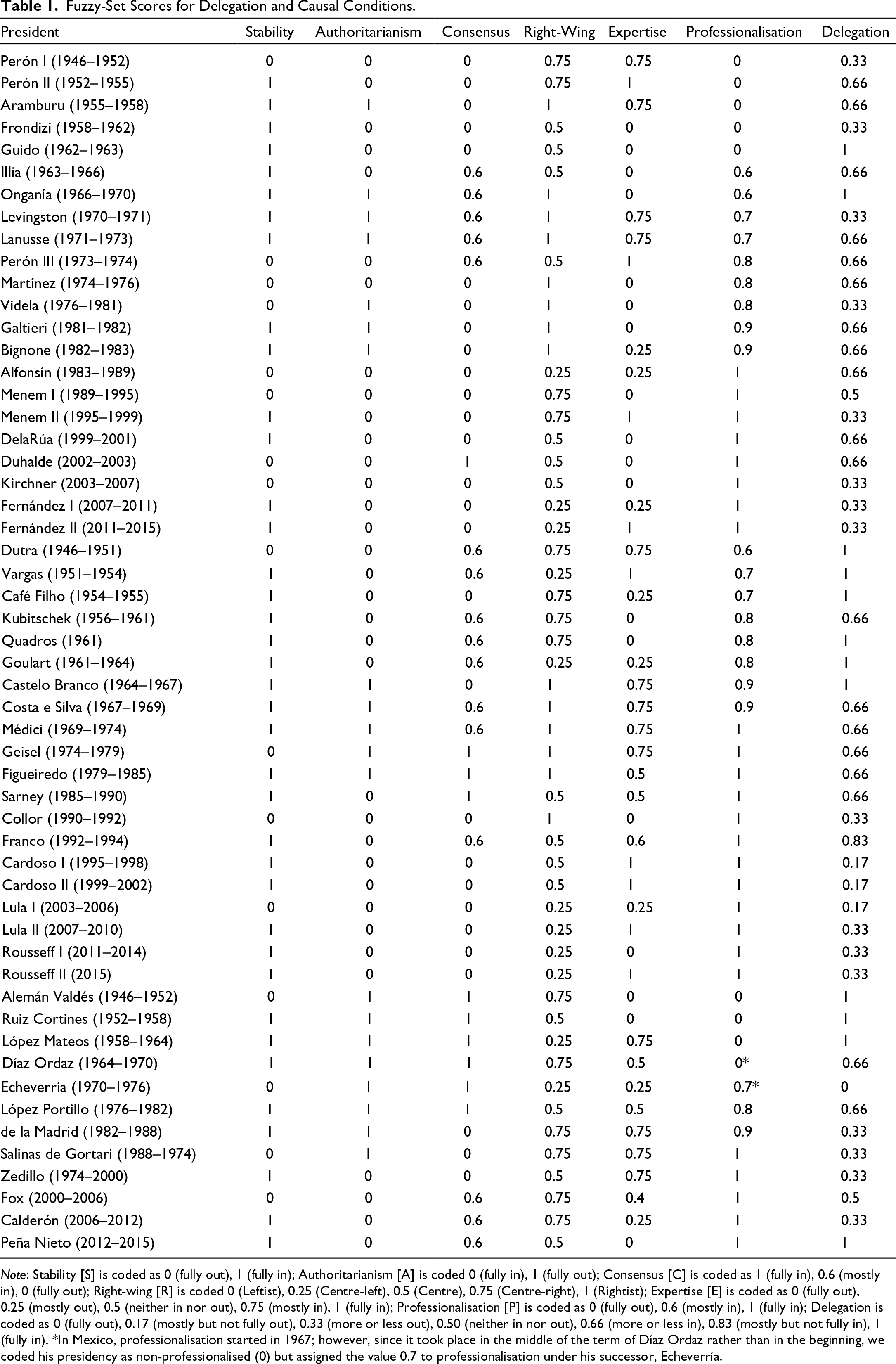
Note: Stability [S] is coded as 0 (fully out), 1 (fully in); Authoritarianism [A] is coded 0 (fully in), 1 (fully out); Consensus [C] is coded as 1 (fully in), 0.6 (mostly in), 0 (fully out); Right-wing [R] is coded 0 (Leftist), 0.25 (Centre-left), 0.5 (Centre), 0.75 (Centre-right), 1 (Rightist); Expertise [E] is coded as 0 (fully out), 0.25 (mostly out), 0.5 (neither in nor out), 0.75 (mostly in), 1 (fully in); Professionalisation [P] is coded as 0 (fully out), 0.6 (mostly in), 1 (fully in); Delegation is coded as 0 (fully out), 0.17 (mostly but not fully out), 0.33 (more or less out), 0.50 (neither in nor out), 0.66 (more or less in), 0.83 (mostly but not fully in), 1 (fully in). *In Mexico, professionalisation started in 1967; however, since it took place in the middle of the term of Díaz Ordaz rather than in the beginning, we coded his presidency as non-professionalised (0) but assigned the value 0.7 to professionalisation under his successor, Echeverría.
Fuzzy-Set Tests
Results from the necessary assessment show that no factor by itself is a strong necessary condition according to the 0.9 threshold. However, when testing combined sets, the combination of stability or right-wing appeared as the strongest necessary condition. Then, the strongest necessary arrangements were the combination of international stability and high diplomatic professionalisation; and no authoritarianism and right-wing president. Both conjunctions are combined by the logical operator “or” as well.
Proceeding to the analysis of sufficient conditions, we defined the parameters of frequency and consistency for the logical minimisation of the truth table. Ragin (2010) suggests that “when the total number of cases in an analysis is relatively small, the frequency threshold should be 1 or 2.” We adopted a minimum of 1 due to the low frequency per row. The truth table after the removal of the rows with no empirical cases is displayed in Table 2A in Appendix 2.
According to Schneider and Wagemann (2012: 101), “a truth table row should be considered a sufficient conjunction for the outcome if each case’s membership in this row is smaller than or equal to its membership in the outcome.” In fuzzy sets, this can be seen by the “raw consistency” measure, which assesses the “degree to which membership in that corner of the vector space is a consistent subset of membership in the outcome” (Ragin, 2010).
Our sample comprises all presidencies from Argentina, Mexico, and Brazil in 1946–2015, with a total of fifty-four presidents. To define which combinations could be considered a subset of the outcome for the logical minimisation process, we analysed the distribution of the thirty-seven cases (seventeen cases could not be matched to a solution) over the twenty-four combinations, as seen in Appendix 2. Considering the distribution, the selected consistency cut-off was 0.90. Finally, moving to the logical minimisation process, the algorithm Quine-McCluskey generates a “complex solution” and a “parsimonious solution.” They can be seen as a continuum where, at the complex solution end, no counterfactuals are allowed. At the opposite end, where the parsimonious solution lies, both easy and difficult counterfactuals are allowed. As a result, a smaller number of causal conditions are favoured (Ragin, 2008).
However, as recommended by Ragin, when using the fs/QCA software, one can choose the intermediate solution by selecting simplifying assumptions based on the theorised relationship between the conditions and the outcome (Ragin, 2008). This implies that for each condition one can set whether its presence or absence should be linked to the outcome. This prevents or allows the presence of counterfactuals in the minimisation process (Ragin, 2008: 174). Thus, we set that all six aforementioned conditions contribute to the outcome, as hypothesized” To: “Thus, we set that four conditions (elite consensus, international stability, authoritarianism, and right-wing president) contribute to the outcome when present and two when absent (diplomatic professionalization, and presidential expertise), as hypothesised. Let us thus focus on the intermediate solution.
As seen in Table 2, the intermediate solution yields four substitutable sufficient conjunctions for delegation: (1) international stability and elite consensus; (2) international stability, right-wing president, and low diplomatic professionalisation; (3) international stability, right-wing president, and low presidential expertise; (4) absence of authoritarianism combined with elite consensus and right-wing president.
Results from the Necessity and Sufficiency Assessments for Delegation.
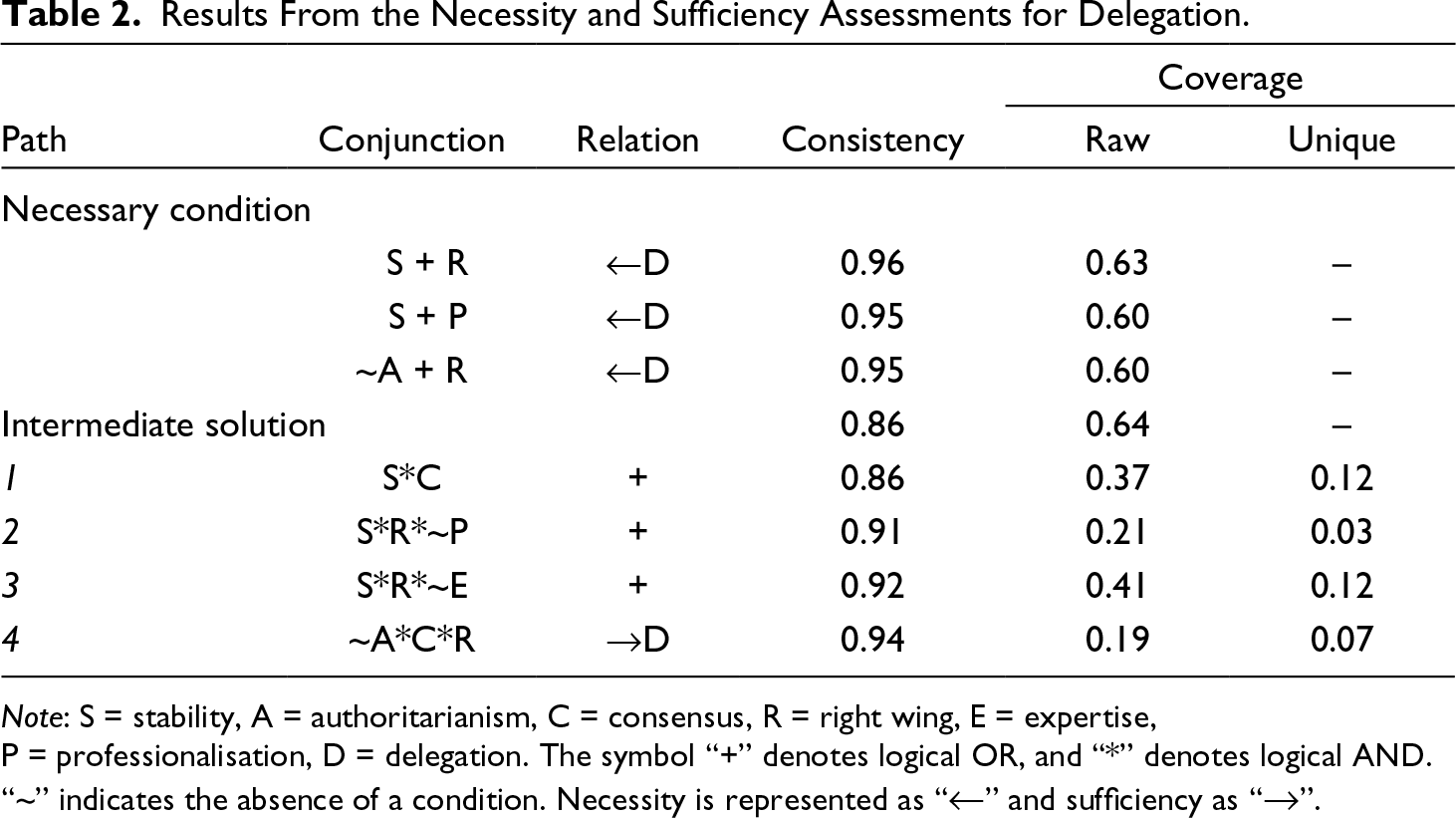
Note: S = stability, A = authoritarianism, C = consensus, R = right wing, E = expertise, P = professionalisation, D = delegation. The symbol “+” denotes logical OR, and “*” denotes logical AND. “~” indicates the absence of a condition. Necessity is represented as “←” and sufficiency as “→”.
This solution’s consistency is 0.86, with a coverage of 0.64. While this indicates a good fit in terms of consistency, in terms of coverage, that is, empirical relevance, it falls short, according to the 0.75 minimum suggested by Legewie (2013). Paths 1, 2, and 3 corroborate five of our six factors, while path 4 goes against one of our hypotheses because democracy (or absence of authoritarianism) appears as one of the factors conducive to delegation.
In addition, international stability and right-wing president appear in three of the four conjunctions generated by the intermediate solution. Consensus appears in two. Low presidential expertise and low diplomatic professionalisation are present in one. Authoritarianism is not found in any of the four conjunctions. Therefore, the first five factors (international stability, elite consensus, right-wing president, low expertise, and low professionalisation) seem to be the conditions connected to presidential delegation to the foreign ministry, and in varying permutations. Authoritarianism is our weakest factor.
In order to provide empirical support for the solution, it is useful to identify the cases that hold a membership of greater than 0.5 in the conjunctions yielded in the truth table analysis. Thus, Table 3 shows the presidencies that help explain the outcome (delegation) per path of the intermediate solution, as well as the deviant cases – those that can be considered members of a path but do not present the outcome.
Presidential Terms Explained by Each Sufficient Path for Delegation.
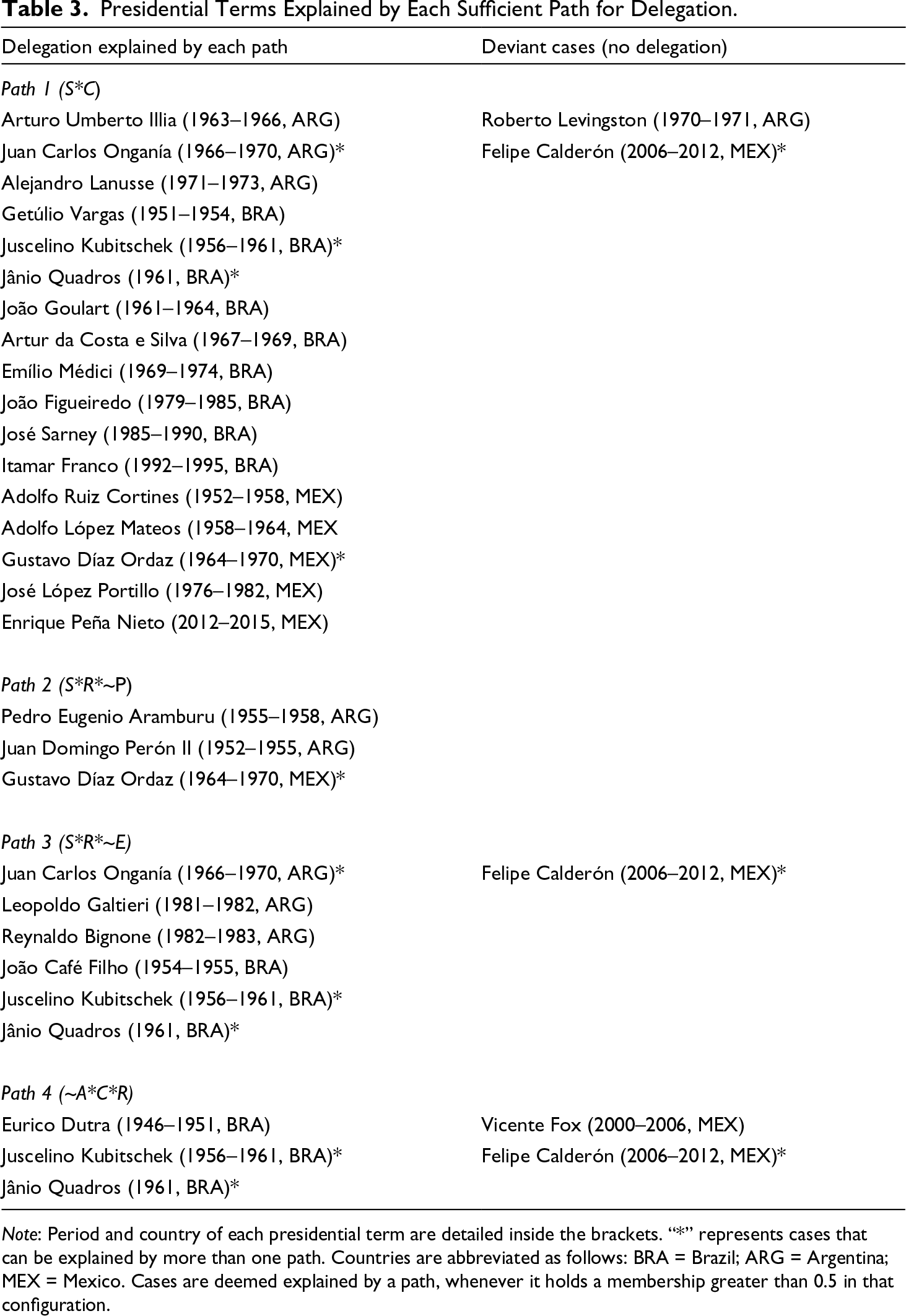
Note: Period and country of each presidential term are detailed inside the brackets. “*” represents cases that can be explained by more than one path. Countries are abbreviated as follows: BRA = Brazil; ARG = Argentina; MEX = Mexico. Cases are deemed explained by a path, whenever it holds a membership greater than 0.5 in that configuration.
Non-Delegation to Foreign Ministries
Let us now consider the negative result, non-delegation. We test which conditions are connected to non-delegation, that is, presidential diplomacy. Appendix 3 displays the resulting truth table. Table 4 presents the results from the sufficiency and necessity analysis. Table 5 shows the distribution of cases in the paths yielded by the intermediate solution.
Results from the Necessity and Sufficiency Assessments for Non-Delegation.
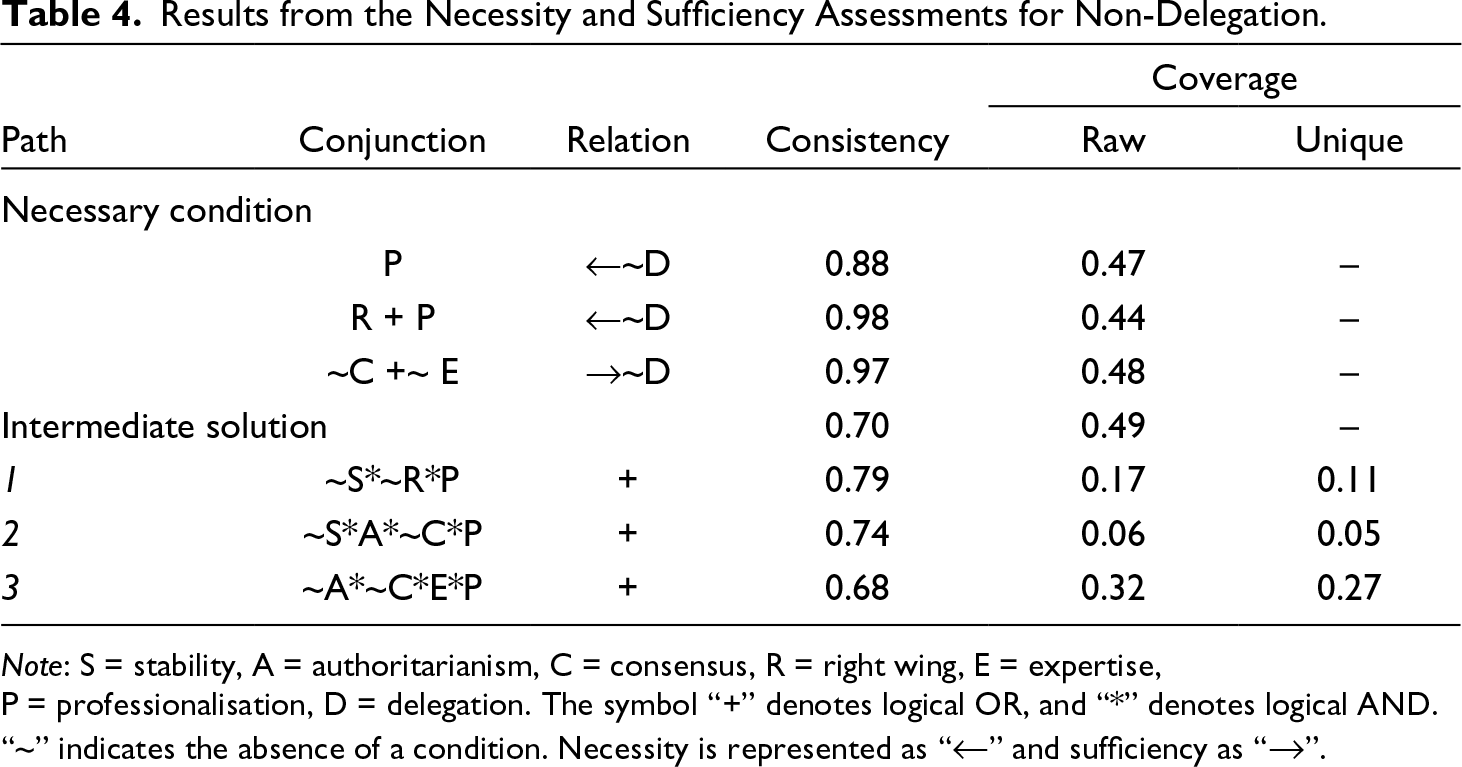
Note: S = stability, A = authoritarianism, C = Consensus, R = right wing, E = expertise, P = professionalisation, D = delegation. The symbol “+” denotes logical OR, and “*” denotes logical AND. “~” indicates the absence of a condition. Necessity is represented as “←” and sufficiency as “→”.
Terms Explained by Each Sufficient Path for Non-Delegation.
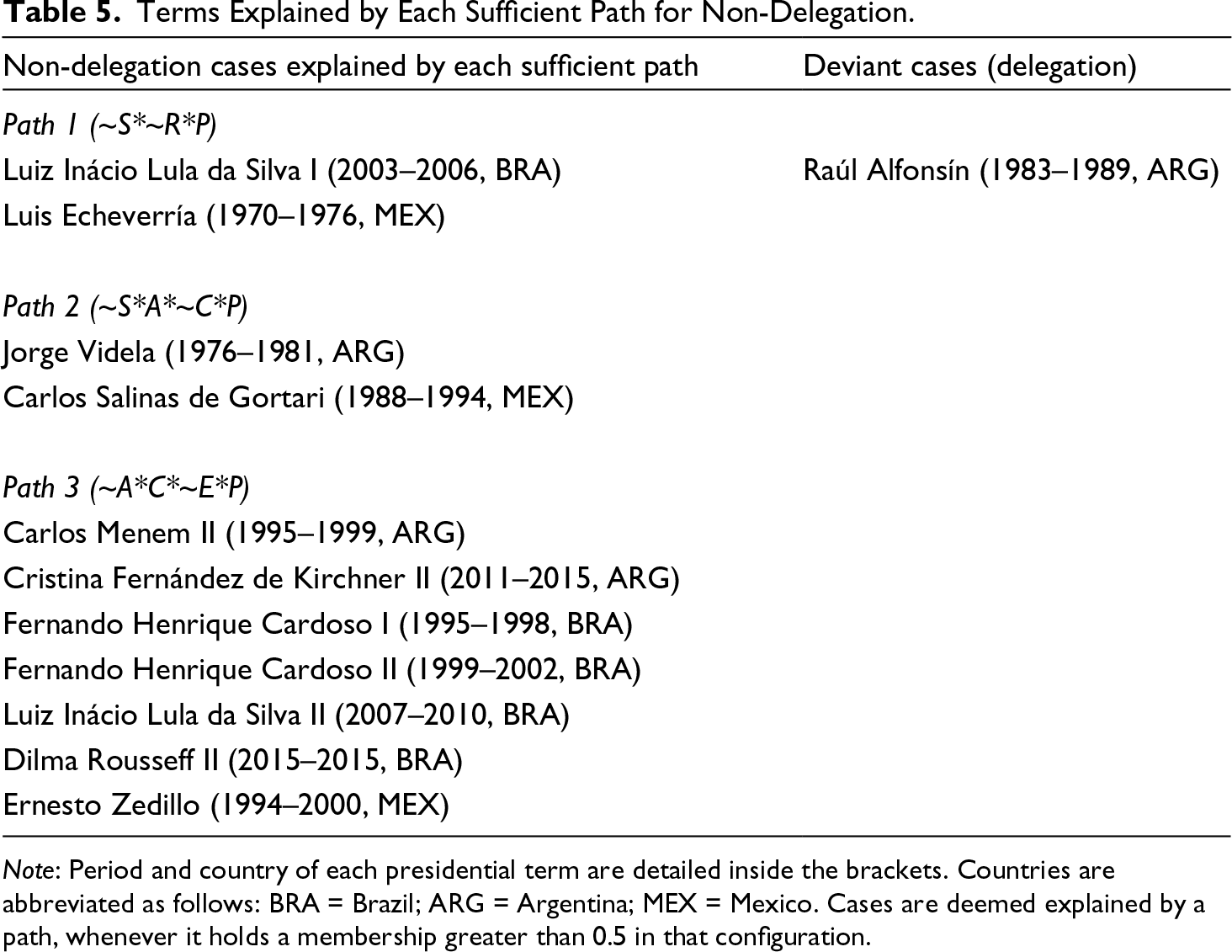
Note: Period and country of each presidential term are detailed inside the brackets. Countries are abbreviated as follows: BRA = Brazil; ARG = Argentina; MEX = Mexico. Cases are deemed explained by a path, whenever it holds a membership greater than 0.5 in that configuration.
Necessary Conditions
Regarding individual causal conditions, professionalisation was deemed almost necessary to non-delegation (consistency score = .88, coverage = .47). The coverage score shows that it is just a little under the minimum threshold of 0.5. Thus, it is just about a non-trivial condition. This suggests that professionalisation is an important condition for non-delegation. A non-trivial condition suggests that the link between it and the cases is strong, and whenever the outcome is present, the necessity condition is present too. As for a trivial condition, the factor occurs so frequently in all the instances under study that its presence does not indicate much.
Right-wing president or diplomatic professionalisation received the highest consistency score (0.98). Then, with a consistency score of 0.97, followed the combinations of no elite consensus or non-presidential expertise, no elite consensus or diplomatic professionalisation, right-wing president or absence of authoritarianism, no elite consensus or right-wing president. Among these necessary conditions, the least trivial of the combinations (coverage = .48) is no elite consensus and low presidential expertise.
Sufficient Conditions
Diplomatic professionalisation appears in three paths. Absence of international stability and absence of elite consensus appear in two paths. Authoritarianism, absence of authoritarianism, non-right-wing president, and expertise appear only in one path each. The intermediate solution showed a lower consistency score and coverage, which also reflects on the low number of observations covered by the solution. Moreover, only two paths (1 and 3) fully match the hypotheses – that is, conditions with the opposite signs to the ones leading to delegation. These combinations are absence of international stability, no right-wing president and diplomatic professionalisation (~S*~R*P), and absence of authoritarianism, low elite consensus, and high presidential expertise and diplomatic professionalisation (~A*~C*E*P). This is precisely what is expected in fsQCA due to the assumption of asymmetric causation: the same conditions that lead to the occurrence of the outcome cannot be immediately transported to the negation set of the outcome (Ragin, 2008).
Discussion and Findings
As expected in configurational analysis, we found equifinality: many roads led to presidential delegation to foreign ministries in Argentina, Brazil, and Mexico in 1946–2015. Various configurations of international stability, low diplomatic professionalisation, elite consensus, right-wing presidents, and low presidential expertise on foreign affairs were found sufficient for delegation. These five factors are INUS conditions, that is, an insufficient but necessary part of a condition that is itself unnecessary but sufficient for the result (Mahoney et al., 2009).
Specifically, there are four alternative paths to delegation: (1) international stability and elite consensus; (2) international stability, right-wing president, and low diplomatic professionalisation; (3) international stability, right-wing president, and low presidential expertise; and (4) absence of authoritarianism combined with elite consensus and right-wing president. Surprisingly, only one of these combinations contradicted the hypothesised conditions: absence of authoritarianism (instead of presence) combined with elite consensus and right-wing incumbent. These results suggest that contextual conditions matter, as is the case of right-wing democratic presidents when there is elite consensus. These were the cases of Brazil’s Dutra (1946–1951), Kubitschek (1956–1961), and Quadros (1961).
As for professionalisation, it was deemed almost necessary to non-delegation by itself. This is a most relevant finding, one that corroborates the Weberian hypothesis that it is precisely the strongest bureaucracies that create control problems for their political masters, paving the way for the latter to tame the foreign ministry. 11
With regard to non-delegation, the six hypothesised conditions were present in the solution terms as INUS conditions: diplomatic professionalisation, absence of elite consensus, absence of international stability, presidential expertise, absence of authoritarianism, and absence of right-wing president. Only one path showed a factor with the opposite sign as hypothesised for delegation: absence of authoritarianism in path 4. However, it makes intuitive sense that democratic regimes might as well lead to delegation whenever accompanied by facilitating conditions (elite consensus and right-wing presidents).
Findings
Our findings on presidential expertise, absence of elite consensus, and absence of international stability as conditions of non-delegation corroborate to a large extent the work of Cason and Power (2009) on the causes of the “rollback” of Brazil’s foreign ministry in the 1990s and 2000s. As mentioned, the authors highlighted precisely personal, domestic, and international factors underlying the gradual erosion of this once powerful bureaucracy.
How do our findings converse with some key works on presidential appointment strategies and patterns of bureaucratic recruitment in Latin America?
First, international stability proved to be an important and frequent condition of delegation in both sufficient and necessary solutions (when combined with other conditions). This dovetails with Geddes’s findings that Latin American presidential appointments are conditional on chief executives’ political survival strategies (Geddes, 1994). To put it in other words, when Latin American presidents face political crises, they have incentives to politicise their bureaucratic appointments (Merke et al., 2020). Symmetrically, in periods of international stability, it becomes less costly for presidents to delegate to diplomats than in periods of international upheaval.
Our findings on the of role international stability in presidential delegation to foreign ministries also converge with those of Kaplan (2017). He shows that incumbents’ delegation preferences over economic agencies are conditional on external shocks (economic crises). Likewise, as argued by Dargent (2014), competition for the policy-making arena increases with international turmoil, rendering delegation to social and economic experts less likely due to what he calls an “unbalanced constellation of stakeholders.” We have shown that there is a similar dynamic at work with regard to diplomats.
Presidents’ low expertise on foreign affairs also converges with Dargent’s (2014) findings on the asymmetry of information between experts and politicians. Such asymmetry strengthens the propensity of politicians to delegate policy-making authority to technocrats. Dargent (2014: 42) also shows that elite consensus by itself does not lead to the autonomy of the technocracy, but can help to “enhance technical autonomy and raise the likelihood of technical continuity.” Likewise, our fsQCA shows that elite consensus is found to be a sufficient element for delegation to experts only when accompanied by other factors such as international stability and right-wing presidents.
Finally, right-wing presidents, when combined with other conditions, were found to be a sufficient solution and a necessary factor for delegation to the foreign ministry. In other words, the link between the condition and the outcome is so strong that a rightist president not only facilitates delegation (sufficient), but is needed in order to have delegation (necessity).
This finding converges with those of Schneider (1998) and Ai Camp (1998) on the association between the rise of technocracy and neoliberalism in Latin America. Our findings on presidential ideology also converge with those of Kaplan’s (2017) on Latin American economic agencies: the profile of those appointed to head the latter differs according to government ideology.
Our findings also add a twist to Merke et al. (2020) claim that presidential ideology is the single most relevant factor behind foreign policy change in Latin America: apparently, this is more so when presidents are leftists, as they tend to lean less than right-wing leaders on status quo-biased bureaucracies.
Robustness Checks
Møller and Skaaning (2019) recommend that, similarly to other methodologies, robustness checks should be conducted in QCA studies to further prove the results.
First, Marx and Dusa (2010) advocate that for a desirable ratio of conditions to cases, for large sample sizes, a 0.2 is the maximum recommended. This study’s conditions to cases ratio is 0.11 (6/54), thus passing the test.
Second, Braumoeller (2017) and Veri (2017) argue that QCA results might be contaminated by ambiguous cases. Thus, we checked whether solutions were being explained by deviant cases. As seen in Tables 3 and 5, this does not seem to be the case.
Third, Grauvogel and von Soest (2014) argue that one can compare the different solutions to distinguish core conditions. As seen in Table 2 and in tests not reported here, the resulting paths to delegation share commonalities like stability, which is also present in most of paths of the parsimonious and complex solution. Also, the parsimonious solution shares the same number of solutions and two sets of equal paths (international stability and elite consensus; international stability, right-wing president, and low presidential expertise). The other paths differ only due to the presence of the right-wing INUS condition in path 2 and path 4 in the intermediate solution.
Similar to Mello (2014) and Grauvogel and Von Soest (2014), another possible robustness check is to make changes in the sample and see how they affect the results. This was done by re-running the sufficient and necessary tests for delegation without the Mexican presidents. Mexico was removed because, unlike Argentina and Brazil, all its presidents concluded their constitutional terms, it did not have a military regime, it did not go through the pink wave in the twenty-first century, and it is located in North America.
Paths 2, 3, and 4 are the same in both tests, as seen in Table 2 and in tests not reported here. This is important especially because paths 2 and 3 are in line with the expected hypotheses. Path 1 differs from the one in Table 2 only due to an extra condition (no authoritarianism) and, apart from that, the new sample yielded a fifth path (S*A*R). Necessary conditions performed similarly in the new sample. The yielded consistency scores were also higher than 0.9, indicating that an extra country (Mexico) does not significantly affect the results.
As a final robustness check, we used an alternative measure of delegation based on the proposition that the more a president changes the foreign minister, the less authority he or she delegates to the foreign ministry. We estimated the maximum time – as a proportion of the president’s term – that the longest lasting foreign minister held the office during each presidency. This is a simpler measure than the one developed by Amorim Neto and Malamud (2019). However, it captures a dimension – foreign minister turnover – that was absent in their indicators. The sufficiency analysis was conducted in the same manner (i.e. the minimum consistency score was set at 0.9, and the same factors were used) as the initial one. As a result, seven causal conjunctions were generated, two of which were similar to the original analysis: (1) the combination of stability and consensus, and (2) consensus and right-wing. In the latter conjunction, the non-authoritarian INUS factor is not present as in the original analysis. It is noteworthy that stability, consensus, and right-wing also appear with the same expected (positive) sign as in the original analysis, and thus remain INUS conditions. However, the new findings cast doubts on the role of authoritarianism and expertise, as these factors appear with both signs in the alternative analysis. Also, professionalism now appears with a positive sign (instead of a negative) as an INUS condition. Only three out of seven items now fully corroborate our hypotheses (instead of three out of four). As for the necessity tests, all INUS conditions were confirmed. Our new delegation measure corroborates the original finding that professionalisation is a necessary factor for non-delegation, even if at a lower threshold (consistency = .76 and coverage = .20). Hence, considering that fsQCA models are very sensitive to changes in measures, and that a large part of our results still holds when using a completely different proxy for delegation, our original findings remain relevant.
Conclusion
This article offers the first systematic assessment of factors connected to presidential delegation to foreign ministries, a phenomenon that has been described by country experts but never explained in depth or tested in a comparative fashion.
We contend that there is no reason to exclude foreign ministries from the comparative literature on presidential appointment strategies and patterns of bureaucratic recruitment in Latin America. The study of diplomats essentially reinforces this literature’s findings on economic and other ministries (Camerlo and Martínez-Gallardo (2017); Camerlo and Pérez-Liñán, 2015; Dargent, 2014; Kaplan, 2017), and therefore provides support to the claim that foreign policy should be studied as a dimension of public policy – and not as a special domain where cross-party consensus prevails, as used to be taught in the most prestigious of Latin American diplomatic academies.
Overall, our main proposition – that presidential delegation to foreign ministries depends on motivation and opportunity – seems to hold water for Latin America’s three largest powers, particularly in the four decades following the end of World War II. While systemic opportunities (international stability) were similar for Argentina, Brazil, and Mexico, motives to delegate – including elite consensus on foreign policy, diplomatic professionalisation, presidential ideology, and presidential expertise on foreign affairs – varied cross-nationally and over time. As for the negative outcome (i.e. non-delegation), professionalisation was deemed almost necessary to non-delegation by itself. The combinations of right-wing president or diplomatic professionalisation and the absence of elite consensus or low presidential expertise came out as weak necessary conditions. Furthermore, the absence of international stability, no-right-wing presidents, the absence of elite consensus, and presidential expertise and diplomatic professionalisation were found to be INUS conditions of non-delegation. In other words, while there is more than one path to delegation, the aforementioned conditions seem to foster presidential delegation to foreign ministries whenever present. Since they are INUS conditions, they are not enough by themselves for presidents to delegate to the foreign ministries, but they become so whenever combined with other factors.
The relevance of these conditions was highly intuitive in light of the literature on presidential appointments and patterns of bureaucratic recruitment in the region (Amorim Neto and Malamud, 2019; Dalbosco, 2014; Faria and Casarões, 2013; Figueroa and Schiavon, 2014), but the impact of different configurations could not be told beforehand. We found some apparently obvious combinations, but also several unexpected ones, that foster or hinder delegation.
The analysis identified four causal paths conducive to delegation, and three conducive to non-delegation. Together, they account for thirty-eight cases (combining the sufficient analysis for delegation and non-delegation) out of our total sample of fifty-four, as illustrated by Table 3 and Table 5 . In each set, one path stood out. With regard to delegation, path 1 (international stability and elite consensus) explains nineteen cases out of twenty-six, most of them clustered in the 1950–1990 period. We call it “the golden age of professional diplomacy.” With regard to non-delegation, path 3 (non-authoritarianism and non-consensus, plus expertise and mature professionalisation) explains seven cases out of twelve, all of them clustered after 1994. We call it “the rise of presidential diplomacy.” Both groups include presidents of our three national cases. This means that the transition from professional diplomacy to presidential diplomacy depends on context rather than country. One could say that, with regard to foreign policy-making in the largest Latin American powers, history trumps geography.
Footnotes
Appendix 1
Argentina
Perón I (1946–1952); Perón II (1952–1955); Aramburu (1955–1958); Frondizi (1958–1962); Guido (1962–1963); Illia (1963–1966); Onganía (1966–1970); Levingston (1970–1971); Lanusse (1971–1973); Perón III (1973–1974); Martínez (1974–1976); Videla (1976–1981); Galtieri (1981–1982); Bignone (1982–1983); Alfonsín (1983–1989); Menem I (1989–1995); Menem II (1995–1999); De la Rúa (1999–1901); Duhalde (2001–2003); Kirchner (2003–2007); Fernández I (2007–2011); Fernández II (2011–2015).
Brazil
Dutra (1946–1951); Vargas (1951–1954); Café Filho (1954–1955); Kubitschek (1956–1961); Quadros (1961); Goulart (1961–1964); Castelo Branco (1964–1967); Costa e Silva (1967–1969); Médici (1969–1974); Geisel (1974–1979); Figueiredo (1979–1985); Sarney (1985–1990); Collor (1990–1992); Franco (1992–1994); Cardoso I (1995–1999); Cardoso II (1999–1903); Lula I (2003–1907); Lula II (2007–2011); Rousseff I (2011–2015); Rousseff II (2015).
Mexico
Alemán Valdés (1946–1952); Ruiz Cortines (1952–1958); López Mateos (1958–1964); Díaz Ordaz (1964–1970); Echeverría (1979–1976); López Portillo (1976–1982); de la Madrid (1982–1988); Salinas de Gortari (1988–1994); Zedillo (1994–2000); Fox (2000–2006); Calderón (2006–2012); Peña Nieto (2012–2015).
Appendix 2
Note: S = stability, A = authoritarianism, C = consensus, R = right wing, E = expertise, P = professionalisation, and D = delegation. Delegation refers to whether the cases of the combination or row are above the consistency cut-off, that is, they are set as a subset of the outcome (No = 0; Yes = 1).
Appendix 3
Note: S = stability, A = authoritarianism, C = consensus, R = right wing, E = expertise and P = professionalisation, ~D = non-delegation. Non-delegation refers to whether the cases of the combination or row are above the consistency cut-off, that is, they are set as a subset of the outcome (No = 0; Yes = 1).
Acknowledgements
The authors thank the superb research assistance provided by Pedro Accorsi, Camila Farias, and Sebastián Ronderos. We are grateful to Igor Acacio, Ignacio Arana Araya, Mariana Borges da Silva, Marcelo Camerlo, Ana Covarrubias, Júlio César Cossio Rodriguez, Feliciano de Sá Guimarães, Gregory Michener, Guadalupe González, Antonio Ortiz-Mena, Luis Schenoni, Jorge Schiavon, and Consuelo Thiers for data, comments, and wisdom. The authors also thank two anonymous reviewers for their very useful critiques and suggestions. Amorim Neto acknowledges the support of Brazil’s National Research Council (CNPq).
Declaration of Conflicting Interests
The author(s) declared no potential conflicts of interest with respect to the research, authorship, and/or publication of this article.
Funding
The author(s) disclosed receipt of the following financial support for the research, authorship, and/or publication of this article: Malamud acknowledges the support of Portugal’s Fundação para a Ciência e a Tecnologia (Project UID/SOC/50013/2013).

Notes
Author Biographies
E-mail:
E-mail: