



Abstract
This paper analyzes the dynamics of vetoes and veto overrides in the context of a multiparty legislature using an original dataset from the period 1983–2007 in Argentina. We argue that the President can use an “item” or “partial” veto to selectively delete articles, while keeping enough distributive goods in the bill to break up the coalition responsible for its passage, thereby eliminating support for an override. Our research reveals that total vetoes – which affect all legislators equally – are more likely to be overridden than partial vetoes. Contradicting the received wisdom that in multiparty legislatures override attempts are more likely under a divided government, we find that override attempts are more likely in plurality governments. We use case analyses to illustrate the main arguments developed in this paper.
Introduction
In October 2001, two months before President Fernando de la Rúa resigned as President in the midst of public unrest, the Argentine Congress enacted Law 25500 modifying a previously approved budget law that allowed each Senator and Representative to grant 50 pensions (pensiones graciables) per year with no restrictions regarding the recipients. The very simple bill stated that each legislator, regardless of political party affiliation, would be entitled to allot 50 pensions annually for the next ten years. This type of benefit had been instituted for individuals who served the country in extraordinary circumstances. But over time, legislators’ use of the pensiones graciables had become highly arbitrary. Arguing that such pensions were used in a clientelistic manner, the President vetoed the whole law. However, one month later, legislators in both chambers unanimously overrode the presidential veto.
Some ten years earlier, in December 1991, under President Carlos Menem, the Argentine Congress had passed a bill (Law 24057) supporting non-profit organizations that studied and facilitated citizens’ use of urban space, rural land, housing, and transportation. But the President used an item veto 1 to remove the articles establishing the organizations’ right to take action on issues neglected by the federal government, receive preferential treatment for loans and subsidies, and work for the federal government as consultants about decisions related to those issues. The bill vaguely stated that the federal government would “promote” the creation of such organizations, without providing any specifics as to how that would be done. Indeed, the President's partial veto was substantively a total veto, although legally it was not: since Congress did not override his veto the rest of the bill became law. We believe that the reasons why the President chose a full veto in one case and a partial veto in another affect the likelihood of congressional overrides. 2
We alternately and equivalently refer to “item vetoes” and “partial vetoes”. The former term derives from US politics, whereas the latter is more commonly used in comparative politics, especially in Latin America. See Alemán and Schwartz (2006) for more variations in terminology.
Acknowledgements: Previous versions of this paper were presented at meeting of the American Political Science Association 2011, and at the Primer Encuentro Internacional GEL ALACIP – Legislativos en América Latina: Mirada Crítica y Agendas Pendientes, October 2011, Belo Horizonte, Brasil. We thank Jose Cheibub, Christian Grose, Mariana Llanos, Andrés Mejía Acosta and Erica Moreno for extensive comments on previous versions of this paper. We also thank Ernesto Calvo, Daniel Chasquetti, Constanza Figueroa-Schibber, Eric Magar, and Juan Moraes for exchanging data and ideas. Bárbara Castillo, Nicolás Díaz, Felipe Monestier, Gina Reynolds, Cristóbal Sandoval, Jamie Scalera, Esteban Torre, and Giancarlo Visconti provided valuable research assistance at different stages of this project. Valeria Palanza gratefully acknowledges funding provided by FONDECYT #11100174 and by Iniciativa Científica Milenio Proyect NS100014, Min. de Economía, Fomento y Turismo de Chile. Gisela Sin acknowledges the generous support of the Research board, University of Illinois.
Why did Congress override the President in the first example and not the second? What conditions push legislators to attempt to override presidential vetoes? We focus here on the dynamics of veto overrides and how they are related to total and line-item vetoes. If presidential vetoes are rare events, as Cameron suggested (2000), then successful congressional overrides are even rarer. These events afford insight into the bargaining that takes place between the executive and legislative branches during the legislative process. We adopt a comparative perspective, considering variations in political environments along with override arrangements that are unlike those that have already been analyzed. As Alemán and Schwartz (2006) showed, veto prerogatives vary considerably across separation-of-powers systems in Latin America. We draw on empirical evidence from Argentina not only to understand the nature of veto bargaining in a specific case, but also to stimulate further theorizing about the implications of attempts at overrides and their success.
Argentina's government is composed of an executive with a four-year mandate and a bicameral legislature with staggered elections. Representatives of the House are elected through proportional representation in closed party lists with five to 35 seats – which results in a multiparty distribution of seats in Congress. Each province elects three Senators through direct elections, with seats allocated by the two-thirds rule: the party with the most votes wins two seats, and the party with the second largest amount of votes wins the third. 3
Prior to the constitutional reform of 1994, each provincial legislature elected two Senators per district.
As in other Latin American countries, the Argentine President enjoys ample legislative prerogatives. Perhaps most importantly, the President is entrusted with decree authority – the constitutional prerogative to enact legislation through non-statutory means. Other presidential prerogatives include the exclusive authority to make propositions in key areas such as the budget. In Argentina, the President's traditional veto power includes the authority to veto parts of approved legislation – while the remaining content is enacted. Overrides of presidential vetoes require the approval of two-thirds of both congressional chambers, and are made by roll call (Schinelli 1996: 413).
Despite the Argentine President's considerable prerogatives and high status as party leader, as well as the strong party discipline in Congress, vetoes do occur and sometimes they are overridden. Key to the functioning of this system is the difference between total and item vetoes.
This paper shows that Congress is more likely to override total vetoes than partial vetoes because the line-item veto prerogative can undo the coalitions in each chamber that initially supported a bill. We claim that by using the line-item veto, Presidents are not just able to eliminate items far removed from their own predilections, but also keep the right number of particularistic goods in a bill so that the right number of legislators will prefer to not override. 4
In particular, the president needs to leave at least one-third of the membership of one chamber with no incentives to override the presidential veto under a two-thirds override requirement.
We also contradict previous findings about veto enactment, finding that divided governments – in various forms – contribute to successful overrides. 5 Successful overrides are more likely when the President's party enjoys only a simple plurality in Congress. When the governing party (the plurality party) does not have a majority in at least one of the chambers it uses overrides as an instrument to gain credibility in its commitments with other parties. This is because the party in power knows it will need other parties’ support to reach a majority in the future: overriding presidential vetoes helps the governing party maintain credibility within its working coalition. For issues that are of great importance to the “extra” legislators, the plurality party in Congress is better off by overriding the presidential veto.
We follow Calvo's (2011) use of two categories of divided government, which we explain in section 3.
We analyze an original dataset that contains every law enacted in Argentina from December 1983 until December 2007 and present the quantitative results. We also present four case studies that support the identified causal mechanism: Partial vetoes serve to break up coalitions by differentiating particularistic goods.
In the next section we introduce the literature. In section 3 we explain our decisions regarding the variables of analysis, and present the patterns that emerge from the Argentine setting. In section 4 we test a few preliminary hypotheses and reach descriptive conclusions. Section 5 presents four case studies that support our argument. Section 6 concludes.
Strategic approaches to studying vetoes that were developed with the United States case in mind have produced a substantial understanding of the role of vetoes in separation-of-powers systems. However, most of these contributions are meaningless when tested in other institutional contexts. Here we review the contributions and some of the complexities that become evident in a comparative analysis of the effects of vetoes.
Early models that were used to interpret vetoes assumed complete information (Romer and Rosenthal 1978) and predicted that vetoes (and overrides) would never occur in equilibrium. Later theoretical models relaxed the complete information assumption by introducing uncertainty about which kinds of bills the President would accept or reject. Those models found that vetoes occur when the preferences of Congress and the President diverge enough to make Congress uncertain about what the President will find acceptable.
Cameron's (2000) model of sequential veto bargaining, in which Congress updates its beliefs about the President's preferences after the first veto bargaining episode, emphasized veto chains and the policy concessions they bring about. Cameron finds that a President may veto a bill despite preferring it to the status quo in order to build a reputation that can extract concessions from Congress in a second iteration of the process.
Studying the United States, Matthews (1989) focused on the effect of veto threats, arguing that Presidents use them to reveal information about their preferences. He found that a President might threaten a veto to obtain a larger concession from Congress despite being ready to accept Congress's ideal point. Groseclose and McCarty (2000) developed a “blame game” that includes an electorate that is uncertain about the President's preferences. With the electorate watching, Congress may present the President with a bill that will have to be vetoed, so as to reveal the President's true preferences. Groseclose and McCarty's found that vetoes tend to reduce the President's popularity. McCarty (1997) examined the effects of presidential honeymoons, arguing that Presidents have strong incentives to veto bills during the first months of their term in order to make a reputation for being extreme. Anticipating this possibility, Congress passes bills closer to the President's ideal point during the “honeymoon” period, which reduces Congress's willingness to be accommodating to the President throughout their term (Ibid.). We are greatly indebted to these scholarly contributions.
However, the many institutional variations beyond the well-known US setting complicate the analysis, since predictions based on the United States can provide little guidance. Among the comparativists, Shugart and Carey (1992), Carey and Shugart (1998), and Mainwaring and Shugart (1997) have pointed out the relevance of the veto prerogative, especially the leverage it gives presidents. In the 1990s, Carey and Shugart generally determined the research agenda on aspects of the institutional life of new democracies, but students of separation-of-powers systems did not address vetoes.
The most extensive analysis of the veto prerogative in different settings may be that of Alemán and Schwartz (2006), which made a comparative analysis of veto prerogatives. In their words, presidential veto powers are “richer, more varied, and more regionally distinctive than hitherto appreciated”. They classified the patterns observed in 18 Latin American countries into four game forms and noted important details. Several of their game forms represent systems with presidential line-item or item-reduction vetoes that expand presidential prerogatives by allowing the President to revise congressional drafts. This is the case in 15 Latin American countries: Argentina, Bolivia, Brazil, Chile, Colombia, Costa Rica, Ecuador, El Salvador, Mexico, Nicaragua, Panama, Paraguay, Peru, Uruguay, and Venezuela. 6 Tsebelis and Alemán (2005) claimed that item vetoes and the possibility of making amendatory observations allow presidents to choose the final form of any bill, a considerable enhancement of executive power.
A fundamental difference among these 15 countries is that while in Argentina, Brazil, Ecuador, and Uruguay presidential revisions of bills using the item veto need not undergo a send-back vote in Congress, in the other countries it is required.
Recent work by Indridason (2011), who also emphasized the line-item veto, united important issues in legislative politics in order to assess common expectations about vetoes. He advanced a model of veto bargaining over public-goods- and pork-barrel-spending that includes incentives that can be used for credit claiming. Indridason's theoretical findings – (a) item vetoes reduce pork-barrel spending and (b) gains made by reducing pork can be offset by greater incentives to attach riders to legislative proposals – provide theoretical guidance but also call for empirical testing.
A related literature has focused on the incidence of vetoes in specific Latin American countries: Uruguay (Buquet, Chasquetti, and Moraes 1998; Magar and Moraes 2003, 2011), Argentina (Figueroa Schibber 2005; Magar 2001; Mustapic and Ferretti 1995), Chile (Magar 2001; Sandoval 2012), and Brazil (Hidalgo 2010). These valuable works show how the veto prerogative is used in different institutional settings, and the conditions that favor vetoes. On average, Presidents make four vetoes per year in Chile, approximately four-and-a-half in Uruguay, thirteen in Brazil, and fourteen in Argentina. All these studies focus on the partisan affinities of the President and Congress and the levels of significance of laws as explanatory variables. They can be used to make important comparisons and provide a wealth of hypotheses that we attempt to address.
Our interest in multiparty presidential systems led us to focus on the Argentine case using a dataset that includes all the bills passed by Congress and all the presidential vetoes in 24 years. This is why we are particularly interested in earlier work on the country's legislative process. The most notable literature on the Argentine legislative process has focused on legislator preferences (Alemán et al. 2009; Calvo 2011; Jones and Hwang 2005), and how Congress's internal organization affects lawmaking (Jones et al. 2002; Calvo 2011). We draw on these studies to examine vetoes, which they surprisingly ignored. The empirical work of Figueroa-Schibber (2005) focused on how an institutional innovation such as partial overrides contributes to successful bargaining between Congress and the President. She analyzed overrides during Menem's presidency and found that the number of overrides was inversely related to the President's strength: the stronger the President, the fewer the overrides. Molinelli's (1985) studied veto overrides in Argentina between 1862 and 1985, and Mustapic and Ferretti (1995) focused on the period immediately after Argentina became a democracy. This paper incorporates our understanding of inter-branch interactions in terms of the actors’ strategic interactions.
In the 24 years between the return to democracy in December 1983 and the end of Nestor Kirchner's presidential term in December 2007, the Argentine Congress enacted 3,258 laws: 362 were vetoed by the President, and Congress overrode 42 of those vetoes.
What explains these figures? Under what conditions does Congress attempt to override vetoes, and under what conditions does it prevail?
Argentina presents an interesting puzzle because of its President's many legislative prerogatives. The President initiates legislation – in fact, certain types of legislation can only be proposed by the President. This rule ensures that a substantial portion of all proposals will represent presidential preferences. But what is the role of vetoes when the President can also enact highly significant legislation by decree? 7
Between 1983 and 2007, Argentine Presidents issued 694 decrees (DNU), which equal congressional statutes although legislators are excluded from the process.
The institutional layout and the nature of interactions during the legislative process in Argentina lead to expectations that the executive and legislative branches would have reached agreement on a bill passing through Congress to permit its approval in relative proximity to presidential preferences – because otherwise, the President would have legislated by decree. But this is not the case. Palanza (2009) put forth a new argument that Argentine Presidents legislate via Congress when they know that legislators will not accept a presidential decree. 8 In other words, Presidents only choose to legislate through Congress when Congress would view an executive decree as countering its interests and be sure to seek reversal.
There are many reasons why a decree might be unacceptable, from constitutional limitations to pressure imposed by constituents and interest groups.
This paper develops that intuition: we expect confrontations between the branches during the legislative process, and see vetoes and overrides as indicators of such tension. The Argentine President's prerogative to issue item vetoes as well as total vetoes provides an interesting case for analysis. Furthermore, Congress can override parts of vetoes – one article and not another, and also parts of overridden articles. We examine these interactions more closely below.
In this section we present our variables of analysis and a set of descriptive hypotheses that are in line with the literature on vetoes and veto bargaining. This section is organized into three parts, each of which deals with an independent variable.
But first we present our dependent variable, congressional overrides. We operationalize overrides in two instances: (1) attempts to override vetoes and (2) the success of attempted overrides. In the case of override attempts, we seek to discover the conditions under which legislators try to override presidential vetoes without considering their possible success. We believe that there are systematic differences between the vetoed laws that legislators try to override and vetoed laws that remain unchallenged (the majority). In this case, we use a dichotomous variable that takes the value of 1 when there is an override attempt. We also seek to understand the conditions that favor successful override attempts, that is, what enables the undoing of presidential decisions. This, too, is a dichotomous variable, where 1 represents a successful override.
Of the 3,258 bills proposed during the 24-year period, only 362 were vetoed. We observe these 362 cases to evaluate the conditions that prefigure override attempts. Because the likelihood of successful overrides is conditional on the number of override attempts, the number of observations is 62.
Identifying – and Classifying – the Bills
We built a dataset of all the bills that became law between the return to democracy in 1983 and the end of Néstor Kirchner's presidency in 2007, and identified all the bills that were vetoed. We also coded each veto as a “total veto” or an “item veto”, generating an indicator variable, Item Veto that takes the value 0 when a veto is total and 1 when it is partial.
In many presidential systems, including Argentina's (and unlike that of the United States), presidents can propose bills without having to go through a legislator. One of our independent variables distinguishes a bill's originator: Presidential Proposal is a dichotomous variable that takes the value 1 when the bill was proposed by the President and 0 when Congress proposed it. We expect Congress to be inclined to override vetoes of laws proposed by its members.
Partisan Support in Congress
Our identification of divided and unified governments acknowledges the distinct characteristics of a divided government in multiparty legislatures, following Calvo's (2011) three categories. The first, Unified Government, includes the periods in which the President's party has more than 50 percent of the seats in the House and the Senate. The second category, Plurality Government, identifies the periods in which the President's party is the largest party in the House and/or the Senate, and falls short of a majority in the other chamber. 9 The third category, Divided Congress, identifies whether or not the same party controls a plurality (or majority) of seats in both chambers. These variables seek to represent the distance between Congress and the President, as well as inter-chamber affinity. The literature on vetoes and overrides suggests that more overrides are to be expected when the gap between the President and Congress is greatest, that is, under a divided government.
The party may have a plurality in both chambers, or a plurality in one chamber and a majority in the other. There were pluralities in the periods 1989–1995, 1997– 1999, 2001–2003, and 2005–2007.
Earlier studies argued that the “honeymoons” at the beginning of a new administration should produce a smaller probability of vetoes and therefore, of veto overrides (e.g., McCarty 1997). To assess these hypotheses we created a dichotomous variable, Honeymoon, which takes the value 1 during the initial three months of a President's term, the period usually viewed as the honeymoon phase.
Scoring legislative significance is a complicated and difficult task. Mayhew's (1991) outstanding effort, further developed by others such as Cameron (2000) and Clinton and Lapinski (2006), makes use of sophisticated analyses and publications that unfortunately are not available for Latin America. Students of Latin American legislative politics who have to score legislative significance are aware of many limitations. Without independent sources that systematically analyze and assess the impact of new legislation, Mayhew's admirable work cannot be applied to Argentina (nor, we dare say, to most Latin American countries). Monestier (2010) reviewed the multiplicity of criteria used in recent studies to establish the levels of significance of legislation where Mayhew's criterion cannot be applied, suggesting that much could be gained with a unifying criterion that enables comparisons. Ricci (2010) also took up this debate, pointing out that classifying legislative content through an approach that assesses levels of significance is better than the alternatives, but is no small challenge.
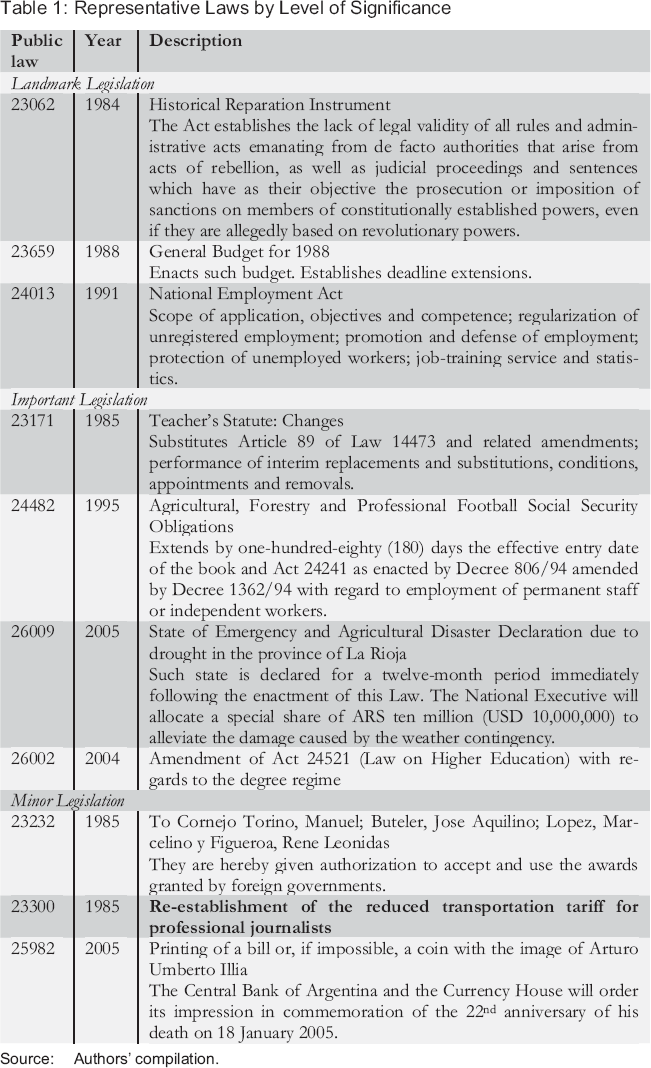
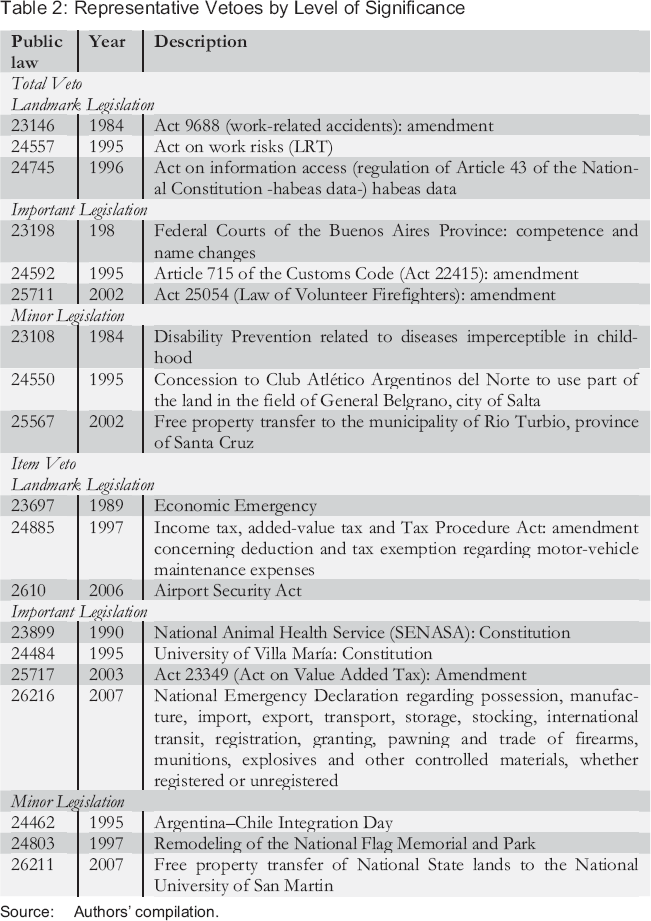
Despite the difficulty, we agree with Cameron (2000) that “legislative significance is hard to define but easy to recognize”. In this paper we expand on Molinelli et al. (1999) by continuing to use three levels of significance. This classification is conceptually very similar to Mayhew's (1991), although as explained above, it is not possible to directly apply Mayhew's criterion to this context. Molinelli et al. (1999) introduced three levels of categorization: (1) landmark legislation, (2) important legislation, and (3) minor legislation. 10 We use their criterion in exactly the same way, applying it to all laws enacted through December 2007. 11 We describe each category below. Table 1 shows examples of the laws included in each category, and Table 2 illustrates the vetoes in each category.
Representative Laws by Level of Significance
Representative Laws by Level of Significance
Source: Authors’ compilation.
Representative Vetoes by Level of Significance
Source: Authors’ compilation.
We acknowledge the possible gains from a more nuanced classification of four categories, such as that used by Cameron (2000), who splits the intermediate category into two distinct ones. Due to several limitations we use Molinelli et al.'s (1999) three categories here.
Three researchers independently classified each law passed between 1998 and 2007 using Molinelli et al.'s criterion for the period 1983–1998. To ensure inter-coder reliability for the two periods, a representative random sample of laws was drawn from the 1983–1997 period, with the coder who had not participated in that exercise coding those cases. We then checked for correlation levels between the earlier coding and that done by the new coder, and discussed each non-matching case to ensure uniformity of the criterion among the three coders and between the two coding processes.
Level 1 – Landmark legislation: This category only includes major pieces of legislation that establish or profoundly reform areas that broadly affect the nation, and only extensive and profound reforms to these laws enter this category (narrow reforms are placed in the next category). Given the scope and extension of their consequences, a few treaties also belong in this category, as do all budgetary laws (see table 1 for more examples).
Level 2 – Important legislation: This category includes legislation with varying degrees of importance that does not produce the broad effects characteristic of landmark legislation. It includes legislation that reforms some aspects of landmark legislation as well as legislation that regulates important issues but is limited in scope. Table 1 provides examples.
Level 3 – Minor legislation: This category includes pieces of legislation that are mostly symbolic or establish issues of importance to a very small group of individuals and have only minor consequences for the larger population. Laws that create monuments, transfer buildings between jurisdictions, stipulate the locations of international organizations, and permit citizens to accept honors are typical examples of laws in this category.
In our forthcoming work, Palanza and Sin (2014), we find that landmark legislation is more likely to be vetoed by a partial, as opposed to a total, veto. We expect that legislative significance will positively impact the likelihood of override attempts, since the significance of a bill should motivate legislators to undo presidential vetoes. Since most landmark legislation vetoes are partial, we expect override attempts of significant legislation to be marginally successful, mostly due to the legislators’ ability to rebuild a coalition.
In this section we present the patterns revealed by our large-N statistical analysis, and use case analyses to illustrate aspects of our argument and proposed causal mechanism. Before making sense of overrides, however, we first summarize the conditions under which vetoes occur, that we develop in Palanza and Sin (2014).
The Initial Probability of a Veto
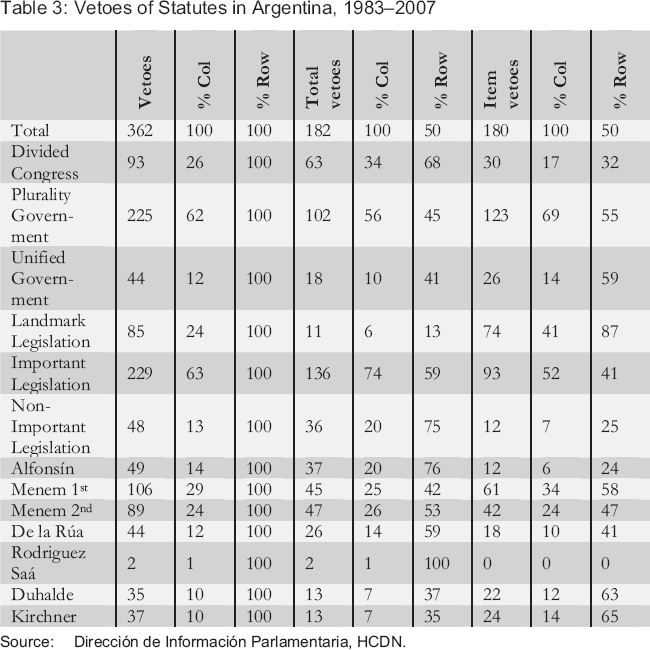
Table 3 shows that of all the statutes passed in Argentina between 1983 and 2007, only 362, or 11 percent, were vetoed. Yet the number of bills vetoed as a percentage of bills enacted during the period seems large when compared with figures for the United States, where between 1945 and 1992 a total of 17,428 bills were enacted and just 434 (2.3 percent) were vetoed (Cameron 2000).
Vetoes of Statutes in Argentina, 1983–2007
Vetoes of Statutes in Argentina, 1983–2007
Source: Dirección de Información Parlamentaria, HCDN.
Our forthcoming study (Palanza and Sin 2014) shows that the level of significance of a piece of legislation and whether a bill originates in Congress or the Presidency strongly influence the likelihood of a presidential veto. For landmark legislation, the likelihood of vetoes rises considerably. Furthermore, when the President's party has just a plurality of seats (as opposed to a majority) in Congress, and when it concerns landmark legislation, the President is consistently more likely to veto. We also found that Presidents are much less likely to veto their own bills. This suggests that bargaining over legislation is not limited to partisan dynamics, but has an important institutional component: the likelihood of vetoes is affected by which institutional actor proposes the bill.
In that paper we point out (Palanza and Sin 2014) that when the President's party has only a plurality the likelihood of vetoes increases. Plurality is the sole variable to capture the distance in preferences between Congress and the President that consistently yields statistically significant results. These results contradict a long-held belief that when the President holds less than a plurality of seats in at least one chamber, a divided Congress (a divided government in bipartisan settings) positively affects the likelihood of vetoes.
Distinguishing between item and total vetoes reveals a much more complex situation. Among the effects we analyze (Palanza and Sin 2014), one that stands out is the likelihood that a piece of legislation introduced by the President will receive an item, as opposed to a total, veto. We find that if the President introduces legislation that is vetoed, it will always receive an item veto instead of a total veto. With respect to the three partisan configurations of government, the probability of total vetoes is almost equal in each circumstance. Our analysis reveals that although the differences between the three scenarios for item vetoes are more noticeable, they are still small. These results are in line with our findings about the probabilities of vetoes in general. The variables that intend to capture the distance between President and Congress do not have strong effect when predicting the probabilities of total and item vetoes.
Another of our important findings (Palanza and Sin 2014) is related to the effect of different levels of legislative significance. The likelihood of line-item vetoes compared with total vetoes increases significantly for landmark legislation. Argentine Presidents veto items of landmark legislation that are far removed from their preferences. We conjecture that they do this because these items – probably part of the agreement reached among party factions in Congress to enable the bill's passage – are no longer needed to support the bill. 12 Indeed, the fact that landmark legislation proposed by a President has a higher probability of suffering item vetoes shows that these bills are more likely to be amended during the legislation process (requiring the President to return to the chamber and veto). This suggests that there are higher levels of inter-branch disagreement with regard to landmark legislation.
While we do not present evidence here to support this conjecture, and agree that it could be argued that such logic weakens the government's future credibility, we suspect that veto overrides supported by presidential party members are made to counter losses in credibility. We develop this point below.
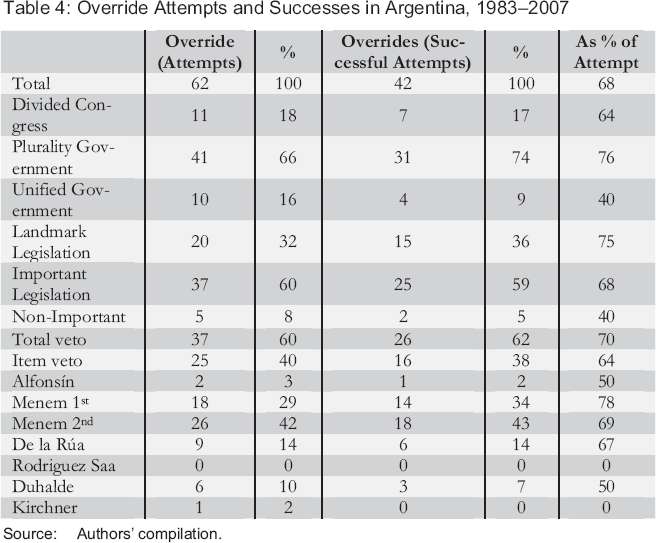
We know from the literature that if vetoes are rare, overrides are even rarer. In Argentina, during the 24-year period studied there were only 62 override attempts (see table 4). This implies that in 17 percent of the cases Congress took steps to sustain legislation that it had initially passed. During this period, 42 overrides were successful: 11.6 percent of all vetoes were successfully overridden, and 68 percent of all veto-override attempts succeeded. (During the 1945–1992 period in the United States that Cameron analyzed, 50 percent of all vetoes faced override attempts. Argentina's 17 percent seems meager in comparison.)
Override Attempts and Successes in Argentina, 1983–2007
Override Attempts and Successes in Argentina, 1983–2007
Source: Authors’ compilation.
We claim that this difference results from the existence of line-item vetoes – because they break up the coalition that supported the bill. The Argentine Congress attempted to override about 20 percent of all the bills that had been vetoed in full, and succeeded most of the time: 14 percent of the bills challenged by total vetoes were successfully overridden. However, there were many fewer override attempts for bills that were item-vetoed: Congress tried to override only 14 percent of the executive decisions regarding item vetoes. 13 Furthermore, in only 9 percent of partially vetoed bills did Congress successfully override at least a portion of the President's vetoed items.
Because it may be inappropriate to use asymptotic analysis, we also conducted Fisher's exact test to analyze the association between two events. Fisher's exact test can precisely calculate the significance of the deviation from a null hypothesis, making it unnecessary to rely on an approximation that only becomes exact in the limit as the sample size grows to infinity. The drawback of this test is that it only tells us whether two events are related, not how they are related. The p-value of Fisher's exact test for the independent variable, total and item veto, is .06 when the treatment variable is a dichotomous variable where 1 means that the override attempt received a total veto.
It is striking that of 362 vetoes, 320 were not overridden. However, this does not imply that all 320 bills died. 14 In fact, all the partially vetoed laws that were not overridden were enacted following the partial vetoes. This example shows why total and item vetoes are such important characteristics of Argentina's institutional setting, and provides many lessons with lots of implications. Of the 320 laws that were vetoed and not overridden, only 49 percent (157 bills) had faced total vetoes. The remaining 163 proposals, having received vetoes affecting only parts of the text, were enacted into law without further ado.
We acknowledge that Congress does not just attempt to override vetoes, and that evidence suggests that veto chains occur in Argentina. Table 2 includes two examples of total vetoes that arguably are part of a chain (although they were passed under different presidents, which according to Cameron (2000) would preclude that possibility): Laws 23146 (on accidents at the workplace), and 24557 (on risks at the workplace). Here, however, we limit our analysis to the unique possibility of death of a bill absent overrides.
Partial vetoes further complicate things: With the prerogative to veto portions of laws, the President may choose to veto every article of relevance, leaving just a few insignificant items in the statute. Partial vetoes vary tremendously in terms of the size of the deletions (for instance, Law 24057, which we discussed in the introduction). A law that is stripped of most of its content ceases to fulfill its purpose: why take this route instead of making a total veto? We believe that it is because the few items left in the statute are perks intended to deter a number of legislators from helping to override the veto – a lesson in how item vetoes can break up enacting coalitions. In systems like that of the United States where the President can only impose total vetoes, an override will be supported by the majority that initially passed the bill, with support from other legislators needed depending on the extent of initial support. In the United States, 50 percent of the vetoes get the two-thirds support required.
If we were to assume that the Argentine President does not dismantle the enacting coalition by issuing partial vetoes, we should expect the same number of override attempts for total and line-item vetoes (given an equal number of total and line-item vetoes). But this is not the case: figure 1 shows that the probability of attempts to override fully vetoed bills is more than double the attempts to override partially vetoed bills.
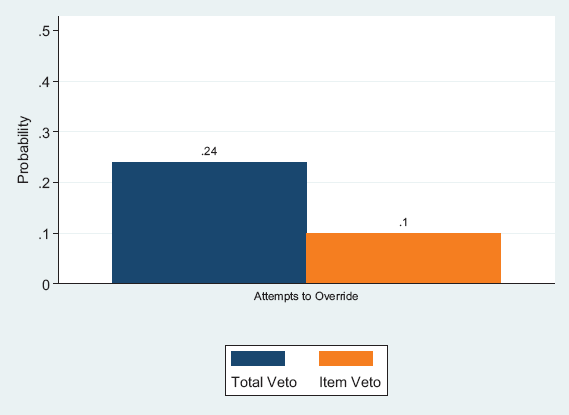
Predicted Probability of Override Attempts across Veto Types
This suggests that when Argentine Presidents partially veto a bill, they pick and choose articles in order to destroy the coalition that initially supported the bill.
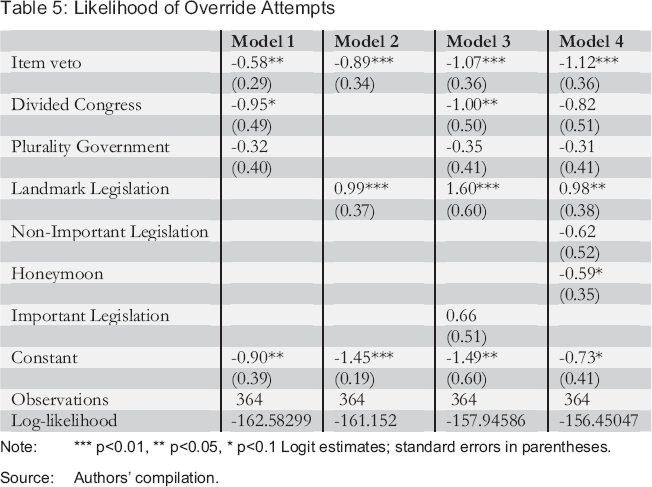
What affects the likelihood that Congress will attempt to override a presidential veto? Logit results in table 5 confirm most of Cameron's (2000) findings: (a) the level of legislative significance affects those odds, with Congress more likely to attempt to override vetoes of landmark legislation, and (b) partisan effects are present. When the President's party holds less than a plurality in the lower chamber, the likelihood of override attempts decreases – although less congressional support for the President would be expected to make override attempts more, not less, likely.
Likelihood of Override Attempts
Note:
p≤0.01
p≤0.05
p≤0.1 Logit estimates; standard errors in parentheses.
Source: Authors’ compilation.
A novel finding that is linked to Argentina's particular institutional setting comes from the distinction between total and item vetoes. Table 5 shows that across the specifications, item vetoes consistently suffer fewer override attempts by Congress than total vetoes. 15 Figure 1 illustrates the magnitude of this effect: changing from an item to a total veto more than doubles the odds of an override attempt. This is because the enacting coalition is broken through partial vetoes (figure 1).
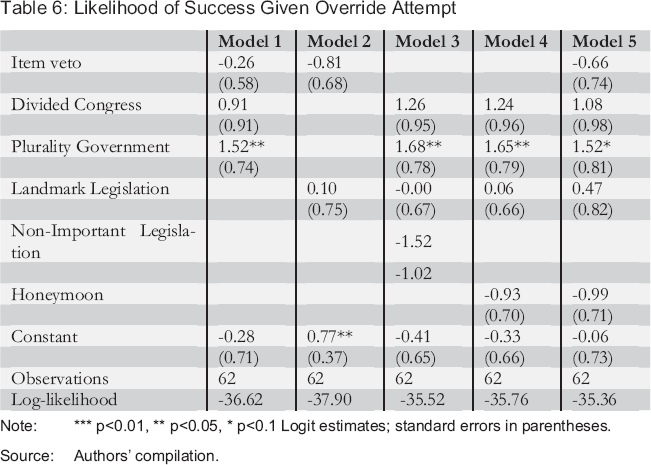
Tables 5 and 6 include four and five specifications, respectively. We ran a large number of regressions controlling for the effect of different variables, but report only those that provided consistent results across the specifications. Variables that systematically yielded results that were not statistically significant and did not affect other results in the specification, such as Presidential Proposal, were not included in specifications for this paper. Adding the variable to the specification in model 4 does not meaningfully improve the fit – it decreases the log-likelihood of the regression by 0.048.
Likelihood of Success Given Override Attempt
Note:
p≤0.01
p≤0.05
p≤0.1 Logit estimates; standard errors in parentheses.
Source: Authors’ compilation.
The odds of an override attempt are 2.6 times greater when facing landmark, as opposed to non-landmark, legislation (figure 2 shows predicted probabilities). An analysis using types of vetoes and levels of significance indicates that override attempts are most likely to affect landmark legislation – especially if the President has totally vetoed it (see figure 3).
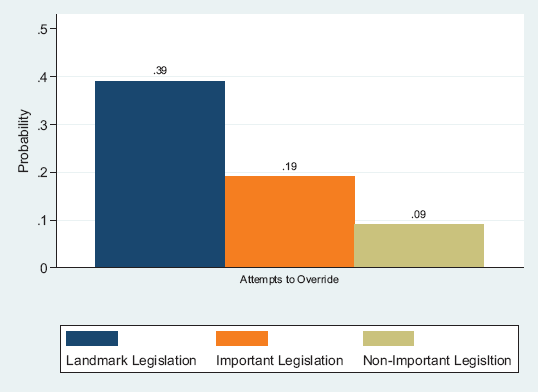
Predicted Probability of Override Attempts across Levels of Significance
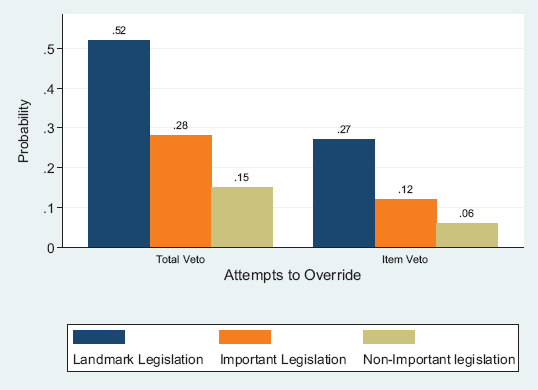
Predicted Probability of Override Attempts by Veto Types and Levels of Significance
Are the determinants of override attempts related to those of success? We have already noted the high success rate of attempts (.68). Do any specific political scenarios or characteristics of legislation provide greater insight about when to expect successful overrides? Table 6 provides analysis results regarding this question.
We find that across specifications plurality is the only significant effect on the likelihood of success: override attempts are more likely to succeed when the President's party in Congress holds a plurality (no more and no less).
We conjecture that if legislation, especially that introduced under a plurality government, results from a compromise among different groups to reach a majority, successful overrides might be one way for the plurality party leadership to show its level of commitment to the groups that helped reach a majority.
The high likelihood of override success reflects a Congress that can coordinate and avoid attempts that are deemed to fail. Most importantly, these results suggest that Congress might also act by re-passing vetoed legislation, a subject beyond the scope of this article.
Figure 4 shows that plurality has the greatest effect on the likelihood of overrides: 72 percent. This effect is not just large, but it is also the sole statistically significant effect on the likelihood of success. In environments where the governing party needs the support of legislators from other parties to reach a majority, overrides show commitment and credibility. So to shore up those legislators’ future support, the governing party provides enough legislators to reach the required two-thirds. The case of the Budget Law for 1998 (below) is an example of this situation, in which overriding vetoes of articles that affected coalition members helped the governing party attain a majority.
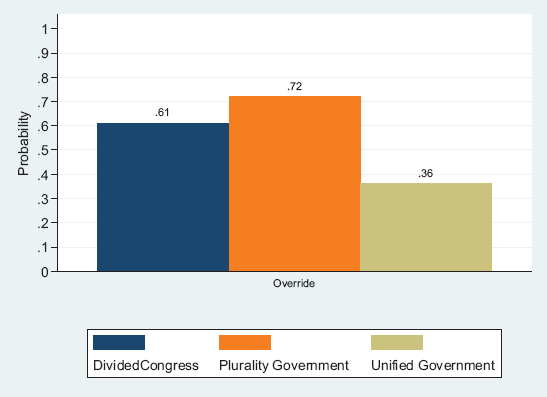
Predicted Probability of Overrides across Partisan Scenarios
The presidential veto enables dynamics that alter the nature of the negotiations between the President and Congress. By deleting certain articles in a bill, the President is able to break up the enacting coalition that was probably put together by adding selective incentives. We suspect that if item vetoes did not serve to break up an enacting coalition, thus making overrides harder to achieve, the attempts to override total and item vetoes would be equally distributed. They are not. Although the number of total and partial vetoes is roughly equal (182 and 180, respectively), there were more override attempts for fully vetoed bills. We present four cases to illustrate our argument.
Coalition Cohesion around Broad Benefits
The first two examples illustrate how some vetoes do not alter the enacting coalition because they affect issues that are evenly spread throughout society. No legislators who first supported a bill would change their positions just because it was vetoed. But if something does cause a set of legislators to change their preferences regarding a bill, the likelihood of override attempts will increase.
Case 1: Law 24305, National Program to Eradicate Foot-and-Mouth Disease
In late 1994, Congress approved an important measure aimed at eradicating foot-and-mouth disease, which repeatedly hindered the commercialization and exportation of Argentine cattle. The law charged the federal agency for animal health with implementing a plan to stop the spread of the disease through control measures such as quarantining infected animals, and most importantly, instituting a national vaccination plan. To this end, the law exempted the import, manufacture, and marketing of vaccines, as well as the actual vaccination work, from all taxes. This was the most important part of the law since it was mainly the high price of vaccines that prevented the eradication of the disease. When, in January 1995, the President item-vetoed the tax relief that affected the enacting coalition equally Congress was able to override the presidential decision.
Case 2: Law 25019, National Program for Wind and Solar Energy
In September 1998, seeking to create financial incentives to promote investment in alternative sources of energy, Congress enacted a law that promoted wind farms by exempting them from taxes for the first 15 years. However, the President item-vetoed tax benefits, which were a fundamental part of the bill. It was highly unlikely that wind farms would be able to prosper initially without tax breaks. The President argued that the tax cuts would negatively impact on both the federal government income and the energy market. But because the law was very specific and the veto did not affect selective groups of legislators, it was unanimously overridden in the Senate and got a super-majority in the House.
Coalition Splits around Selective Benefits
Selective incentives, which reward one set of legislators without affecting (or punishing) other legislators, can break up enacting coalitions. The next two cases illustrate how legislators react to presidential line-item vetoes by attempting to override items that have broad impact and not trying to override vetoes of articles that provide selective incentives.
Case 3: Law 24191, General Budget for 1993
President Menem presented his budget proposal to Congress in September 1992. After passing through the lower chamber's Budget Committee, it reached the floor in December, where a few amendments were made. The President then vetoed four of those amendments: (i) Article 21, which granted funds from the Ministerio de Desarrollo Social (Ministry of Social Development) to the Ministerio de Obras Públicas, Salud, y Economía (Ministry of Public Works, Health and Economics). The funds were for five social programs, and Congress specified that a Bicameral Congressional Committee would oversee the use of those funds; (ii) Article 26, which established payments of ARS 5 million to people whose lands were to be expropriated for the construction of a highway along the northern access to Buenos Aires; (iii) Article 39, which granted ARS 14 million to citizen-security projects with resources from the Fondo de Desarrollo Regional (Regional Development Fund); and (iv) Article 41, which established that the budget for both congressional chambers would be distributed in proportion to their respective number of seats. The Senate passed the House version later that month, and on 30 December 1992, the President vetoed all four articles.
Congress might have chosen to do nothing, or to override the veto either entirely or in part. In March 1993, the House attempted to override the vetoed articles. It succeeded with Articles 21 and 41 (which affect benefits that are evenly spread amongst legislators or their constituencies), but failed with Articles 26 (which in one case benefited a small group of citizens in Buenos Aires) and 39 (which drew resources away from specific regions). We find that the successful override of the first pair of articles shows how specific changes introduced through partial vetoes can break up the enacting coalition: while the required two-thirds did unite to override the vetoes of the two articles that equally affected all legislators, they remained divided regarding the two articles that provided selective incentives. It is possible that these two articles enable the very tight initial approval of the bill. 16
The coalition that supported these articles during the bill's initial passage included 133 legislators or exactly 51 percent of the members needed. In Argentina veto overrides require the support of two-thirds of the legislators. During the attempts to override Articles 26 and 39 (those with targeted benefits), 71 of the original 133 legislators changed positions: 66 voted to sustain the vetoes and 5 abstained (effectively increasing the total number of voters and destroying the coalition needed for the override). When voting to override Articles 21 and 41 (those granting universal benefits), only one of the original legislators in favor changed position so the override was almost unanimously passed with 141 of 142 votes.
Case 4: Law 24938, General Budget for 1998
This bill's approval shows that Congress can more easily garner support for overrides when vetoes affect measures that benefit a large number of legislators. In the 1998 budget law, the President vetoed: (i) a salary increase for elementary and high school teachers, (ii) the creation of a new government agency to support the development of small and medium-sized companies, (iii) funds for a children's burn hospital, (iv) funds for the recovery of the Atuel and Diamante River basins, (v) subsidies for a transportation system in Patagonia, (vi) funds for the National Institute for Water and the Environment, (vii) the extension of subsidies received by three provinces (Fondo de Reparación Histórica) and the addition of eight more provinces to receive such funds (the original recipients were Catamarca, San Juan and San Luis, and the new ones were Santiago del Estero, Salta, Jujuy, Tucumán, Chaco, Misiones, Mendoza, and Córdoba), and (viii) funds to recover and refill digging sites in Greater Buenos Aires, as well as for the Merchant Marine Academy.
Of all the measures vetoed by the President, Congress only insisted on the one that extended and expanded subsidies for eleven provinces. A month after the first override, Congress also overrode the veto concerning funds to recover digging sites in Buenos Aires and for the Marine Merchant Academy. While the second override is harder to interpret and might have been part of a backroom deal (especially because it occurred later), the first shows that the only article that legislators were able to override was the one in which benefits were widely spread.
This paper analyzes the dynamics of vetoes and veto overrides in the context of a multiparty legislature. In particular, it distinguishes between total and item vetoes, suggesting that the latter complicate the legislative bargaining process and fundamentally change the strategic game.
We argue that item vetoes mainly allow the President to break up the enacting coalition and make overrides more difficult. The President does this by strategically deleting specific articles from a piece of legislation (the remainder of which is enacted). The deleted articles, which typically feature benefits that were only added to the bill to broaden its support, cannot gather enough legislators for an override coalition. This is why total vetoes, which affect all legislators equally, are more likely to be overridden than partial vetoes.
The quantitative analysis reveals that the Argentine Congress mostly does not attempt to override presidential vetoes, especially when they are partial vetoes. Yet when Congress does decide to override a veto, its odds of succeeding are high, with total and partial vetoes evenly distributed.
Our statistical analysis reveals that item vetoes decrease the likelihood of override attempts, a result that is stable across all specifications. We also find that override attempts are common when vetoes affect landmark legislation. While landmark legislation strongly predicts the likelihood of override attempts, it does not predict their success. If a highly significant law suffers a full presidential veto, the probability of an override attempt is high. This effect is strong across the categories of divided governments, which leads to our third set of interesting findings.
We know that most override attempts succeed, but not what affects their success. Contradicting the common view that override attempts will be more likely in a divided Congress, we have shown that the likelihood of override attempts is significant under plurality governments. In fact, the single most important predictor of successful overrides is a plurality government: When the president's party lacks a majority in at least one of the chambers, but remains the largest force, the probability of a successful override increases.
We claim that governing party leaders would rather confront the President on some issues, thereby ensuring a degree of credibility before fellow legislators from other parties, than to become so completely aligned with the President as to jeopardize their chances of creating future coalitions. This risk is greatest under plurality governments, because although the President's party is the largest in Congress, it still needs a few more legislators to gain a majority. Given the multiparty nature of the Argentine legislature, in divided Congresses the non-governing parties also find it hard to put together a majority: in most cases, the President's party confronts a fragmented legislature in which no single party is close to having the majority.
In a divided Congress, when the President's party does not control at least one chamber, overrides fail because it is so difficult to deliver a majority in both chambers. Overrides are impossible without support from the presidential party. This suggests that vetoes and overrides indicate coordination (as opposed to confrontation) between the executive and legislative branches, an idea we intend to explore in future research.