



Abstract
Research on the impact of participatory institutions in Latin America has not yet examined how they work in authoritarian settings. National autocrats in Mexico implemented participatory reforms during that country's national electoral authoritarian regime. Building on research on political decentralization in authoritarian regimes, I argue that participatory institutions can be used to channel citizen demands and to incorporate citizens into authoritarian systems, thereby strengthening authoritarian rule. However, following research on democratic participatory governance, I also argue that participatory institutions will work better in this regard when designed from the bottom up rather than from the top down. Statistical analysis of patterns of municipal-level electoral authoritarian support in Mexico shows that bottom-up-designed participatory institutions implemented during electoral authoritarian rule strengthened local political control to a greater extent than top-down-designed political systems. The study supports research revealing the anti-democratic effects of participatory institutions in democratic Latin American nations.
Introduction
The third wave of democratization in Latin America in the 1980s left behind a series of democratically elected governments whose legitimacy was widely questioned in the 1990s. In response, political elites promoted decentralizing reforms to bring policy-making closer to citizens through the transfer of policy authority, fiscal resources, and political rights to lower levels of government (O'Neill 2005). To this end, many decentralizing reforms included institutional innovations to promote “participatory governance” (Eaton 2004b; Hiskey and Seligson 2003; McNulty 2011; Van Cott 2008; Wampler 2008). Participatory governance constitutes institutional mechanisms that allow citizens – especially marginalized ones – to participate in the formation, selection, design, implementation, and oversight of local governments and policy programs. When used to incorporate marginalized groups, participatory institutions are sometimes coupled with the recognition of indigenous rights and customary laws (Van Cott 2008). Participatory institutions based on local customs are often referred to as “multicultural institutions.”
Research 1 on participatory institutions in Latin America has examined whether and how these measures improve the quality of democratic governance (for example, see Eaton 2004b; Hiskey and Seligson 2003; McNulty 2011; Van Cott 2008; Wampler 2008). Scholars have shown that when participatory institutions are designed from the top down, improvements in citizen participation in local politics and policy-making tend to be limited (Eaton 2004a, b; Hiskey and Seligson 2003; Van Cott 2008; Wampler 2008). While participatory institutions certainly raise the capacity for citizens to participate in local politics and policy-making, the rigidity inherent in a shared set of institutions that are implemented universally from the top down limits their positive effect. In contrast, when localities are allowed to design participatory institutions from the bottom up, improvements in citizen participation in local politics and policy-making tend to be greater (Eaton 2004a, b; McNulty 2011; Van Cott 2008; Wampler 2008). Bottom-up-designed participatory institutions enable public officials to tailor the institutions to their communities’ social, political and economic realities, enhancing the capacity for citizens to participate in local policy-making and thus the positive impact of these institutions on democratic governance.
Acknowledgements: I am grateful to Francisco Cantú and Ernesto Calvo for suggesting and providing the R code for the ecological regression analysis. I thank Scott Desposato and Amy Liu for comments on earlier versions of this study. All errors are my own.
Participatory governance is usually depicted as a means of addressing the limitations of representative democracy (Barber 1984; Wampler 2008), where higher-level elected officials, appointed bureaucrats, policy experts, and political elites make policy decisions. It may therefore come as a surprise to find that Mexico's long-surviving electoral authoritarian regime also undertook participatory reforms. Mexico's national electoral authoritarian rulers began to decentralize policy-making in the 1980s and implemented electoral reforms to allow opposition parties greater capacity to compete for and win municipal, state, and national offices along the way (Grindle 2000, 2007; Rodríguez 1997; Selee 2006, 2011). What is less well known is that Mexico's authoritarian rulers included constitutional reforms as a part of their politically decentralizing measures to allow the adoption of participatory institutions as well.
Specifically, national constitutional reforms in 1983 allowed municipalities to create bottom-up-designed municipal development planning councils, although few were actually set up (Fox 2007; Selee 2006). Constitutional reforms in 1992 recognized the nation's multicultural heritage, opening the door for state measures to recognize local participatory practices operating informally in many peasant and indigenous communities (Anaya Muñoz 2005; Fox 2007; López Bárcenas 2010; Sierra 1995). Sixteen out of Mexico's 31 states undertook constitutional reforms in the early to mid-1990s to recognize their multicultural heritages, with one (Guerrero) doing so as early as 1987 (López Bárcenas 2010). 2 However, most of these states did not match constitutional reforms with secondary legislation, instead only allowing municipal and sub-municipal (hamlet) authorities to use participatory institutions informally (Anaya Muñoz 2005, 2006; de León Pasquel 2001; Fox 1996, 2007; López Bárcenas 2010).
Another three states adopted constitutional reforms after the nation's democratic transition in 2000 (López Bárcenas 2010).
In contrast, authorities in the indigenous southern states of Chiapas and Oaxaca, as well as in the non-indigenous central states of Tlaxcala, Morelos, and Puebla, formally codified local participatory institutions into law. Given research on the differential effects of bottom-up- and top-down-designed participatory institutions in Latin America's democratic systems, we might wonder whether this same distinction was present in Mexico's electoral authoritarian states and whether it produced differential political effects for electoral authoritarian control. By joining research on the impact of participatory governance in democratic systems with insights about political decentralization in national authoritarian regimes, I argue that the degree to which participatory institutions benefit electoral authoritarian regimes depends on whether these institutions are designed from the bottom up or from the top down. Specifically, participatory institutions will deliver greater benefits to authoritarian rulers when they are individually tailored to local economic, social, and political conditions from the bottom up than when they are universally designed and implemented from the top down.
I test this argument using data from the state of Oaxaca. Unlike in Chiapas, Morelos, Puebla, and Tlaxcala, which only authorized participatory institutions at the sub-municipal hamlet or lower community level, autocrats in the state of Oaxaca granted participatory rights directly to many – but not all – of its municipal authorities, making it easier to measure and compare the effect of these bottom-up-designed institutions to top-down-designed ones on authoritarian rule. In September 1995, authorities in the state of Oaxaca granted 412 out of their total 570 municipalities the right to create bottom-up-designed participatory institutions for selecting municipal governments and making policy decisions, referring to these municipalities as “Usos y Costumbres” or “Uses and Customs” (UyC) systems. The state's remaining 158 municipalities were granted a common set of rules for selecting municipal governments that were universally designed from the top down; these are referred to as “Partidos Políticos” or “Political Parties” (PP) systems. Conveniently for the purposes of this study, UyC municipal leaders could tailor these institutions to local conditions, but PP municipal leaders could not. Although PP municipalities enjoyed newly decentralized political rights – making it possible for parties to compete for and win municipal offices in elections determined locally by citizens rather than centrally by autocrats – these institutional arrangements were determined from the top down and could not be tailored to local political dynamics.
Statistical analysis of the effect of Oaxaca's bottom-up-designed UyC institutions compared to its top-down-designed PP ones shows that UyC systems gave municipal leaders greater political control in their localities. In undertaking this study, I hope to shed light on how participatory institutions can be used by both authoritarian and democratic incumbents to strengthen their hold on power. Studies of participatory institutions in Venezuela and multicultural institutions in Bolivia show that they have been used by national incumbents to increase local policy and political participation among their supporters, something that has facilitated the rise of increasingly autocratic local and national rule (for example, see Hawkins 2010; Hiskey and Seligson 2003; Schilling-Vacaflor 2011; Smilde and Hellinger 2011; Tockman and Cameron 2014; Van Cott 2008). In-depth study of Oaxaca's bottom-up-designed participatory institutions in this study supports these findings by showing how electoral authoritarian leaders can use participatory institutions for the purpose of managing local political participation on behalf of authoritarian regimes as well.
Political Decentralization and Participatory Governance in Authoritarian Regimes
Participatory institutions are designed to deepen political decentralization that is often undertaken to improve democratic governance in representative democratic systems (Barber 1984). Political decentralization refers to institutional arrangements that allow the election of representatives to lower levels of government authorized to determine and respond to local policy needs. However, most decentralized systems rely on representative institutions whereby citizens elect officials who then determine, implement, and oversee local policy programs. Participatory governance, in contrast, refers to a variety of additional institutional mechanisms that enable citizens to express their political and policy preferences – such as through public town hall meetings – during the selection of local public officials and during the selection, design, implementation, and oversight of local policy programs (Barber 1984).
Although scholars of Latin American politics usually envision political decentralization and especially participatory institutions as a means of improving the quality of representative democratic governance (see, for example, McNulty 2011; O'Neill 2005; Wampler 2007), other scholars of politics in non-Latin-American nations suggest that their benefits need not be limited to democratic systems. National authoritarian rulers often undertake political decentralization and implement participatory institutions to strengthen their hold on power. For example, scholars examining authoritarian regimes beyond Latin America have noted that political and policy decentralization can improve authoritarian governance in much the same way as it does in nationally democratic systems (e.g., Jin, Qian, and Weingast 2005; Landry 2008; Montinola, Qian, and Weingast 1996; Qian and Weingast 1996; Uchimura and Jütting 2007; Zhuravskaya 2000). The decentralization of local bureaucratic appointments and the use of local elections to select local regime officials improves national authoritarian feedback on and oversight over local regime officials (Gilley 2008; Hu 2005; Jiang 2007; Kelliher 1997; Kennedy 2009; Landry 2008; Landry, Davis, and Wang 2010; Dong 2010; Manion 2009, 2014; O'Brian and Li 2000; O'Brien and Han 2009; Oi and Rozelle 2000; Shi 1999; Truex 2014; Wang 1997). Scholars of Mexico – the empirical point of focus in this study – have noted something similar about the expected benefits of political decentralization during its electoral authoritarian regime (e.g., Cornelius 1999; Grindle 2000; Hernández Rodríguez 2008; Selee 2011).
Just as in nationally democratic systems, national authoritarian political decentralization often includes the adoption of institutions for participatory governance. Authoritarian participatory governance is similar to its democratic counterpart in that it seeks to create mechanisms for citizens to participate in the formation, selection, design, implementation, and oversight of local policy programs. However, proponents of democratic participatory governance seek to maximize participation in policy processes in order to produce maximal policy contestation and thus policy choices that better reflect citizens’ needs and demands (Wampler 2007). Proponents of authoritarian participatory governance, in contrast, seek to maximize local governmental transparency and oversight and local administrative capacity and policy efficiency (Collins and Chan 2009; He 2011; Jayasuriya and Rodan 2007; O'Brian and Li 2006; Truex 2014). Therefore, authoritarian participatory institutions are designed to generate sufficient citizen participation for providing information on local policy preferences and feedback on local governmental policy performance, so that autocrats can improve policy efficiency and raise citizens’ satisfaction with their rule, thereby strengthening authoritarian regimes (Collins and Chan 2009; He 2011; Jayasuriya and Rodan 2007; O'Brian and Li 2006; Truex 2014). By creating vehicles for citizen participation, autocrats hope to incorporate citizens into local policy administration as well, thereby also co-opting them into authoritarian projects and strengthening authoritarian regimes (Collins and Chan 2009; He 2011; Jayasuriya and Rodan 2007; O'Brian and Li 2006; Truex 2014).
However, studies of national authoritarian decentralization and participatory institutions have found that these measures sometimes stimulate political liberalization. Because political decentralization and participatory governance raise citizen participation in local policy debates, they can create opportunities for citizens to express divergent views from those of regime officials, triggering criticism of authoritarian rule and weakening national regimes (Grindle 2007; He 2011; Ko and Zhi 2013; Oi and Rozelle 2000; Pei 1995; Shi 1999; Uchimura and Jütting 2007; Zhuravskaya 2000). Rising citizen capacity to demonstrate regime opposition can empower citizens over local regime officials, subverting authoritarian systems and raising the chance of democratic transition (He 2011; Pei 1995; Shi 1999). Some scholars of Mexico's national electoral authoritarian regime have noted that its decentralizing reforms sometimes worked to facilitate the rise of opposition groups, contributing to the nation's democratic transition (Grindle 2000, 2007; Ochoa-Reza 2004; Rodríguez 1998; Selee 2011).
Conflicting findings about the benefits of political decentralization and participatory democracy for national authoritarian regimes have led scholars to examine the underlying political, social, and economic contexts in which these reforms occur (see, for example, research by Blanchard and Shleifer 2001; Grindle 2007; Ko and Zhi 2013; O'Brian and Li 2000; Oi and Rozelle 2000; Selee 2011; Uchimura and Jütting 2007; Zhuravskaya 2000). However, two factors remain understudied. First, unlike scholars of national democratic systems (e.g., Eaton 2004a, b; Hiskey and Seligson 2003; Van Cott 2008; Wampler 2008), scholars of national authoritarian regimes have not yet examined whether the bottom-up or top-down design of decentralizing political or participatory institutions might affect the strength of their benefits to these regimes. Second, unlike scholars of national democratic systems (e.g., Van Cott 2008; Wampler 2007, 2008), scholars of national authoritarian regimes have only just begun to examine whether the placement of decentralized participatory institutions in pro-regime or anti-regime hands might matter for the direction of their impact on authoritarian regime support (e.g., Grindle 2000, 2007; Selee 2011). It may be the case that the design of decentralized political and participatory institutions and their placement in pro-regime or anti-regime hands work together to explain the divergent findings about the impact of political decentralization on national authoritarian rule noted above.
I argue that the design of authoritarian participatory institutions interacts with their political placement to determine the strength and direction of their impact on national authoritarian rule. When participatory institutions are designed from the bottom up and placed in pro-regime hands, local pro-regime officials can tailor these institutions to the peculiarities of local dynamics and use them to channel citizen participation, demands, and activities to maximize citizen integration into – or, at least, compliance with – the regime, thereby generating the greatest gains for authoritarian rule. Even though top-down-designed participatory institutions in pro-regime hands can help local leaders deliver support to authoritarian rulers, they will be less successful in this regard as local officials are unable to tailor them to local dynamics. Table 1 summarizes the relative expected effects of bottom-up- and top-down-designed participatory institutions in pro-regime hands on authoritarian regime support.
Relative Regime Support under Different Participatory Institutional Designs
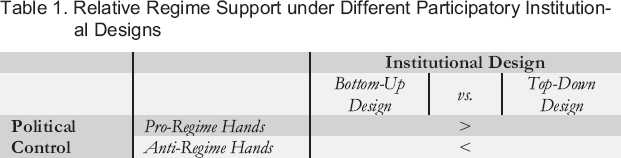
In contrast, when participatory institutions are designed from the bottom up and placed in anti-regime hands, anti-regime officials can tailor these institutions to the peculiarities of local dynamics in ways to maximize opposition to authoritarian rule. Local anti-regime officials should use bottom-up-designed participatory institutions for the same purposes as pro-regime ones; that is: to channel citizen participation, demands, and activities to maximize citizen integration into – or, at least, compliance with – opposition rule, thereby generating the greatest gains for opposition control. Even though participatory institutions designed from the top down in anti-regime hands will also undermine support for the authoritarian regime, the effect of these institutions will not be as strong due to the generic nature of the institutions that anti-regime leaders must use. Table 1 summarizes the relative expected effects that bottom-up-and top-down-designed participatory institutions in anti-regime hands will have on authoritarian regime losses.
Political Decentralization and Participatory Governance in Electoral Authoritarian Oaxaca, Mexico
I examine the impact that bottom-up- and top-down-designed participatory institutions in pro- and anti-regime hands have on authoritarian rule using data from the state of Oaxaca, Mexico. Mexico is known for its longtime national electoral authoritarian regime run by the Institutional Revolutionary Party (PRI), which engineered overwhelming support in federal, state, and municipal elections until 2000. 3 To maintain their hold on power, PRI autocrats used non-autonomous national- and state-level electoral institutes to manipulate electoral processes in their favor. However, rising political discontent led national autocrats to undertake top-down-designed political decentralization in the 1980s and 1990s, in order to bring politics and policy closer to citizens (Grindle 2000, 2007; Rodríguez 1997; Selee 2006, 2011). Revised national electoral rules lowered the barriers to entry to opposition parties, while the legitimacy of electoral processes was improved through the creation and regulation of the independent Federal Electoral Institute (IFE) between 1990 and 1994. National autocrats required state autocrats to do the same, as part of decentralizing reforms.
Some date the transition to 1997 when the PRI lost control over the chamber of deputies.
However, national autocrats also undertook constitutional reforms in 1983 and 1992 to allow state governments to adopt bottom-up-designed participatory institutions as a part of their politically decentralizing reforms. Although most states chose not to take this additional step, a few did formalize participatory rules into law. In 1984, PRI autocrats in the state of Puebla authorized sub-municipal hamlet-level governments to select local authorities via plebiscite. In 1992, PRI autocrats in the Morelos authorized some sub-municipal hamlet governments to select authorities using participatory rules. In 1995, PRI autocrats in Oaxaca authorized some municipalities to create participatory institutions to select municipal governments. In 1998, PRI autocrats in Tlaxcala allowed some sub-municipal hamlet governments to use participatory institutions to select their authorities. In 1999, state leaders in Chiapas allowed indigenous communities to select local leaders using local customary laws.
I test the argument using data from Oaxaca. There are three reasons why Oaxaca is a good case for study. First, electoral data capturing the level of regime support – as well as crucial control variables – are available at the municipal level, in contrast to the less well-defined sub-municipal hamlet or community levels that would be required to examine participatory institutions in the other states listed above. Second, the assignment of bottom-up participatory institutions across the state's 570 municipalities is well documented between 1997 and 2012, the years under study here. Between 1995 and 1996, state authorities in Oaxaca identified 412 (rising to 418 in 1997; falling to 417 in 2012) municipalities that would be authorized to create participatory institutions – calling them “Usos y Costumbres” or “Uses and Customs” (UyC) systems – and 158 (falling to 152 in 1997; rising to 153 in 2012) municipalities that would be required to use top-down-designed representative democratic systems – calling them “Partidos Políticos” or “Political Parties” (PP) systems.
Third, the difference between Oaxaca's bottom-up-designed UyC systems and its top-down-designed PP systems is well established. Oaxaca's UyC and PP municipalities must follow the national constitution and select a mayor, a local municipal council (aldermen), and a community representative (síndico, a type of ombudsman). However, incumbent UyC officials are allowed to design their own participatory mechanisms for selecting governments and making policy decisions entirely from the bottom-up, leading to considerable variation across UyC municipalities. Oaxaca's UyC systems select officials during a municipal town-hall meeting known as an Asamblea General Comunal or General Community Assembly (AGC). The AGC is run by a supervisory board (Mesa de Debates) comprised of incumbent municipal officials and sometimes elders’ councils. However, each municipal board determines its rules for selecting candidates for municipal offices and the mechanism for selecting between them. It can restrict the voting pool by sex, age, marital status, birth and/or residency requirements, and satisfactory participation in local unpaid community service (tequio). It can restrict the candidate pool for municipal offices according to these same criteria, and by satisfactory fulfillment of unpaid community administrative positions (cargos). Each municipal board also chooses its voting mechanism for selecting municipal officials, and can use a range of mechanisms from secret ballots to publicly cast votes (the most common). Municipal boards also decide whether sub-municipal hamlets will share municipal officials with the municipal seat or whether they will be allowed to design their own UyC rules to select their own leaders to report to municipal officials.
Incumbent PP municipal officials must oversee the selection of municipal governments via the ballot box using a common set of state electoral rules that respect universal political rights and secret ballots; that is, liberal representative democratic institutions. The formal assignment of PP systems in 1995–1996 allowed top-down political decentralization compared to prior years, given that it occurred just after state electoral reforms (1990–1994), creating a newly independent electoral institute. Improved electoral integrity allowed opposition parties to freely compete for and win municipal elections in PP systems for the first time. Thus, Oaxaca's top-down-designed PP systems enjoyed a type of top-down political decentralization, although it was not as extensive as that enjoyed in bottom-up-designed UyC systems. State authorities reserved the right to authorize the use of UyC systems at the sub-municipal hamlet level in PP municipalities (Fox 2007), as well as the right to overturn municipal or sub-municipal processes.
Oaxaca's state electoral reforms represented an important break from the past, when state autocrats centrally managed municipal political processes across the state. State autocrats determined party candidate slates in municipalities facing internal PRI divisions or anti-regime forces (Anaya Muñoz 2006; Martínez Vásquez and Díaz Montes 2001; Recondo 2007, 2008), with election outcomes engineered using the state electoral apparatus. State autocrats allowed local strongmen to construct party slates in places deemed free from internal PRI divisions and anti-regime forces, with local strongmen registering PRI slates as having received 100 percent support without holding formal elections (Anaya Muñoz 2006; Martínez Vásquez and Díaz Montes 2001; Recondo 2007, 2008). In the early 1990s, however, rising anti-PRI support amidst the armed insurgency in neighboring Chiapas encouraged Oaxaca's state officials to change their approach to managing elections (Anaya Muñoz 2005, 2006; Eisenstadt 2011; Recondo 2007) and to decentralize electoral outcomes throughout the state, selecting 412 municipalities in 1995–1996 for highly decentralized bottom-up-designed participatory rule and 158 for top-down-designed PP systems.
Several scholars have argued that the formal assignment of UyC systems ensured the survival of local strongmen and thus local PRI rule in these places (Bailón Corres 1999; Bartra 1999; Benton 2012; Fox 2007; Recondo 2007). The fact that the PRI ruled Oaxaca until 2010, despite national democratization in 2000, suggests that UyC reforms may have contributed to state PRI survival. However, anecdotal evidence also suggests that local citizens were able to use UyC institutions to undermine local strongmen and thus local PRI domination as well (see Eisenstadt 2011 for a summary of this research). To explain these contradictory findings, I explain how bottom-up-designed UyC institutions delivered different effects on regime support depending on whether they were placed in pro- or anti-regime hands. In so doing, this study diverges from Benton (2012), who did not distinguish between how the placement of UyC and PP systems in pro- and anti-PRI hands might lead to differential effects on PRI support. I argue that the bottom-up or top-down design of authoritarian institutions interacts with the placement of these institutions in pro-regime or anti-regime hands to determine the strength and direction of their impact on authoritarian rule.
This argument means we should observe two things. First, we should observe greater PRI support, greater winning margins, and greater abstention in bottom-up-designed UyC compared to top-down-designed PP systems among municipalities in PRI hands. As local PRI officials are given the decentralized political tools with which to channel citizens’ demands on behalf of the regime, they should be better able to manage PRI regime support, and through this the party's capacity to win elections. However, because authoritarian participatory institutions are designed to gauge and channel citizen demands, autocrats should use them to dampen political participation that could turn against the regime, with bottom-up-designed UyC institutions more effectively achieving this goal (abstention) than top-down-designed PP systems. These expectations are summarized in Table 2.
The Relative Political Impact of UyC and PP Institutions in Oaxaca, Mexico
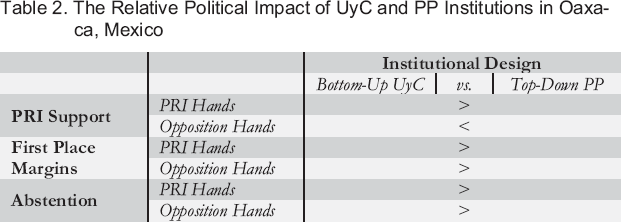
Second, it means we should observe greater opposition support, greater winning margins, and greater abstention in bottom-up-designed UyC than in top-down-designed PP municipalities among municipalities in opposition hands. As local opposition leaders are given the decentralized political tools through which to channel citizens’ demands away from the regime, they should be better able to manage opposition support and participation for and against them, increasing their capacity to wrest control away from authoritarian rulers. However, because participatory institutions in authoritarian regimes are designed to gauge and channel citizen demands, opposition leaders should use them to dampen political participation that threatens to undo their anti-regime gains, with bottom-up-designed institutions like UyC systems more effective in this regard than top-down-designed systems like PP ones. These expectations are summarized in Table 2.
In building this argument, I diverge from research on Oaxaca's UyC systems in two ways. Scholars have noted that PRI autocrats assigned UyC systems among their localities, while opposition leaders were allowed to determine whether to assign UyC systems among places under their control (Anaya Muñoz 2006; Benton 2016; Recondo 2007, 2008). Given the divergent political interests of pro-regime and anti-regime officials, UyC systems should have been used to different political ends in pro- and anti-regime hands. However, as noted, no one has yet made this distinction. Studies examining the impact of UyC systems on political behavior in Oaxaca do not distinguish between how these systems worked in PRI and opposition hands (e.g., Benton 2012; Hiskey and Goodman 2011).
Studies of Oaxaca's UyC systems also usually attribute differences in political behavior in these systems compared to PP ones to general, overarching differences between them. For example, Benton (2012) highlighted how the exclusion of political parties in UyC systems (beginning in 1997) allowed UyC leaders to manage the direction of community debate and prevent partisan intrusion in local political affairs. Others might argue that it is the use of the AGC town hall meeting that distinguishes between UyC and PP systems. In contrast, my argument emphasizes how it is the capacity of UyC system leaders to design their institutions from the bottom up that facilitates their capacity to manage the direction of community debate and prevent partisan intrusion in their affairs, thereby separating them from PP systems in this way. In other words, it is the endogenous nature of UyC systems, which varies considerably across locality, that enables local UyC leaders to manage citizen demands more easily than their counterparts in PP systems.
Statistical Analysis and Results
I use ordinary least squares (OLS) regression to compare the effect of bottom-up-designed UyC with that of top-down-designed PP institutions in pro-regime and anti-regime hands in Oaxaca's electoral authoritarian regime. To this end, I analyze municipal-level election results for state deputies after the 1995 UyC reform, specifically the share of PRI support, first-place party margins, and abstention in 1998, 2001, 2004, 2007, and 2010. 4 Gubernatorial elections were coterminous with state deputy elections in 1998, 2004, and 2010. I examine state elections because municipal election results were not recorded by party in UyC systems from 1997 onward. Although UyC systems apply to municipal political processes, they have been shown to affect voting behavior in higher-level (federal) elections (e.g., Benton 2012; Hiskey and Goodman 2011). This is not surprising given that scholars have shown that local electoral rules (e.g., Jones 1997) and political practices (e.g., Chandra 2004) affect political behavior at higher levels in both democratic and authoritarian systems.
Data from IEEPCO.
The principal explanatory variables are the presence of UyC or PP institutions in the municipality, whether these systems were placed in PRI or opposition hands at the time of UyC adoption, and an interaction between the two. The UyC municipality variable is a dummy variable coded 1 if the municipality was assigned a UyC system and 0 if the municipality was assigned a PP system during the initial 1995–1996 assignment period (and a couple of changes in 1997, when seven municipalities were reassigned UyC institutions and one reassigned PP institutions). A dummy variable records whether the municipalities were in PRI (1) or opposition (0) hands at the time of UyC and PP assignment between 1995 and 1997. State autocrats used the 1995 state elections to determine whether the municipality was in PRI hands when making the original UyC and PP assignment decisions (Anaya Muñoz 2006).
I include a series of variables to account for the endogenous nature of UyC and PP assignment. Quantitative analysis of the impact of political, social, and demographic variables on UyC assignment shows that UyC placement was prioritized in socially stable places with strong but declining PRI support (Benton 2016). In addition to whether the municipality was under PRI control, I include the change in PRI support between 1992 and 1995, as well as dummy variables noting the presence of social conflict after state and municipal elections. 5 Although research shows that political and social concerns were crucial for UyC assignment, other social and demographic factors may have mattered, such as the share of population that is indigenous and its concentration 6 in a single group, the share of population that is catholic, the share of the population living in rural areas and on communal lands, poverty rates, migration rates, and municipal population size (Benton 2016). 7 Many of these variables have also been shown to affect PRI support and abstention rates (Klesner and Lawson 2001). Finally, I include the effective number of parties and the trend in PRI support, as these also matter for voting outcomes. A test for collinearity among all independent variables shows that the mean Variation Inflation Index (VIF) was 1.53 (with none of the variables’ VIF above 1.46).
Todd Eisenstadt kindly shared post-election conflict data.
I use the Herfindahl-Hirschman Index of market concentration, ranging from 0 (no indigenous group members) to 1 (unified indigenous group).
Data from INEGI and CONAPO.
The results for the OLS models examining the impact of institutional design and political control on regime support, winning margins, and abstention rates are found in Tables 3, 4, and 5, respectively. To ease hypothesis testing, I also present the predicted values associated with the linear combinations of the UyC municipality dummy, the PRI control dummy, and their interaction term in Table 6. As shown in that table, winning margins were consistently higher in UyC compared to PP systems in PRI-run municipalities across the years, in line with expectations. In PRI-run municipalities, for example, winning parties enjoyed 32 percent greater support on average than runner-up parties in UyC systems compared to a lower 21 percent greater support in PP systems in 1998. Abstention was 54 percent on average in PRI-run UyC systems, compared to 46 percent in PRI-run PP systems in 1998 as well. These patterns persisted over time, showing that PRI-affiliated municipal leaders in bottom-up-designed UyC systems enjoyed a significantly greater capacity to channel political support – through their management of political rights and public ballots – compared to their colleagues who relied on top-down-designed PP systems.
UyC Municipal Institutions, PRI Municipal Control, and PRI Support in Oaxaca
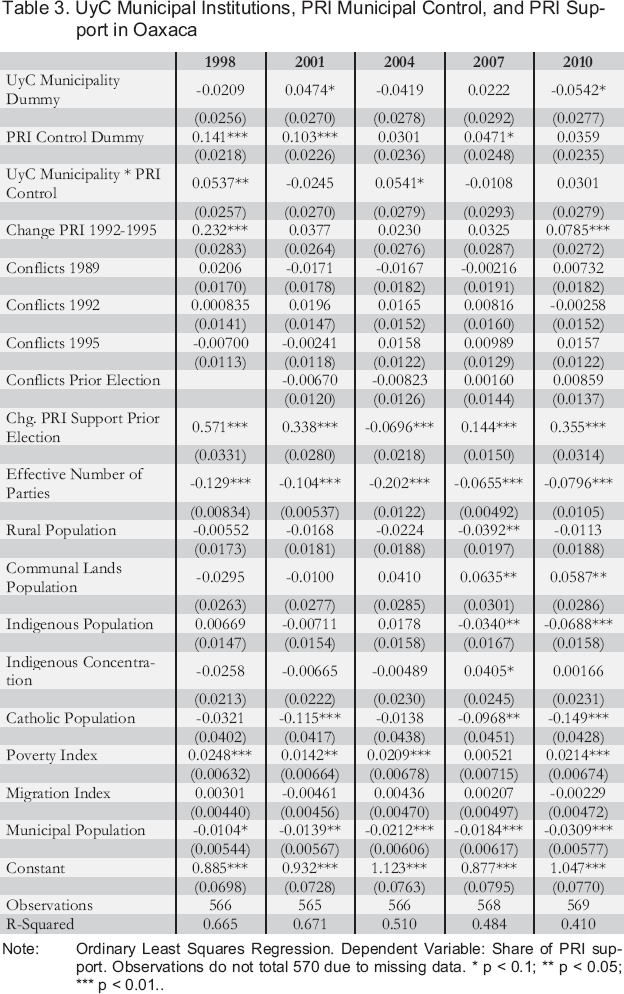
Note: Ordinary Least Squares Regression. Dependent Variable: Share of PRI support. Observations do not total 570 due to missing data.
p < 0.1;
p < 0.05;
p < 0.01.
UyC Municipal Institutions, PRI Municipal Control, and First Place Margins in Oaxaca
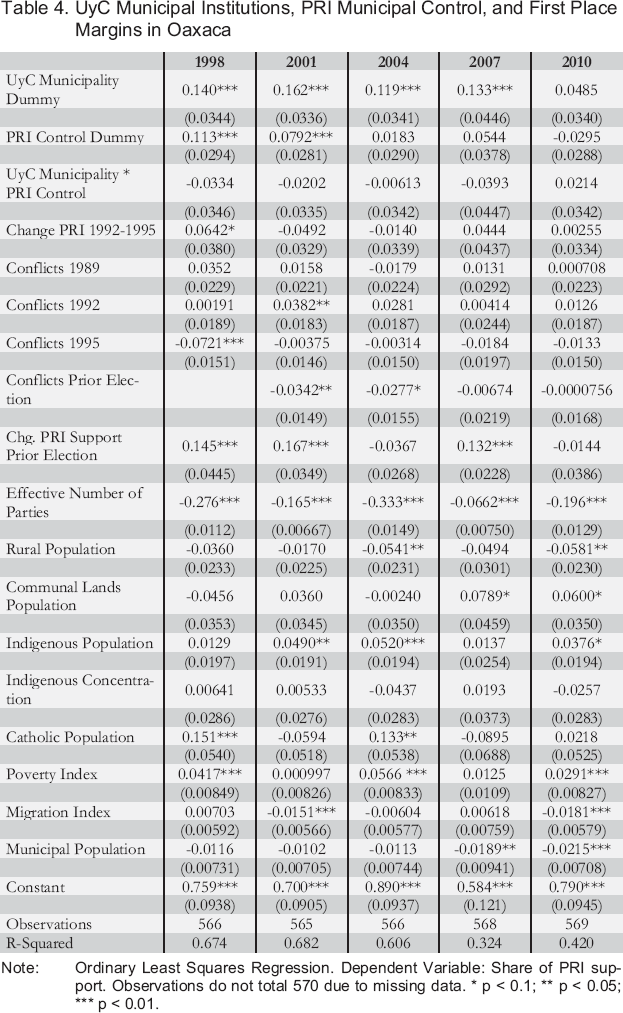
Note: Ordinary Least Squares Regression. Dependent Variable: Share of PRI support. Observations do not total 570 due to missing data.
p < 0.1;
p < 0.05;
p < 0.01.
UyC Municipal Institutions, PRI Municipal Control, and Abstention in Oaxaca
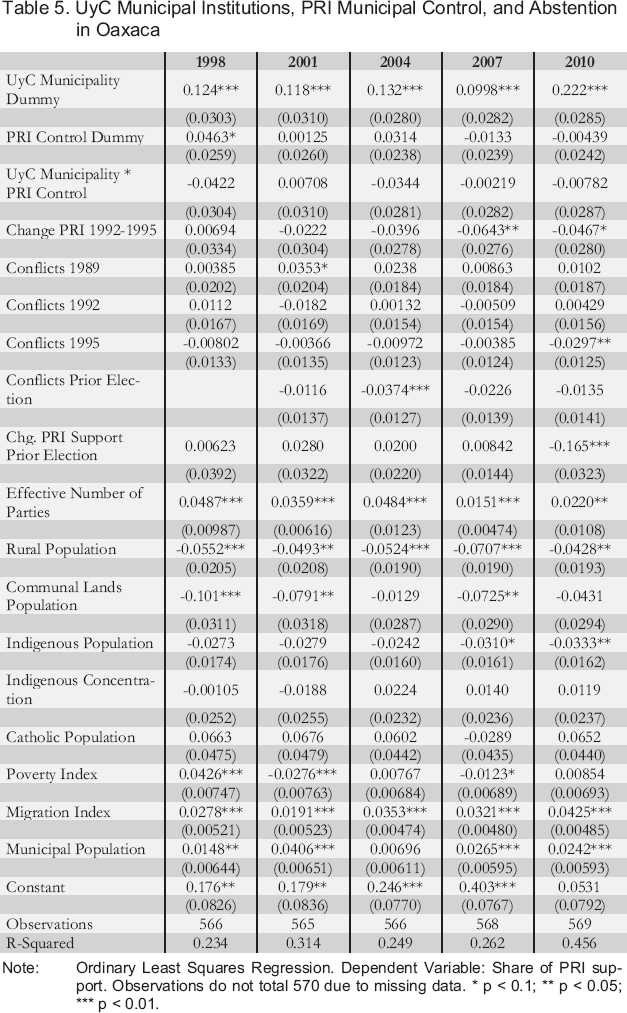
Note: Ordinary Least Squares Regression. Dependent Variable: Share of PRI support. Observations do not total 570 due to missing data.
p < 0.1;
p < 0.05;
p < 0.01.
Predicted PRI Support, Winning Margins, and Abstention in Oaxaca, Mexico
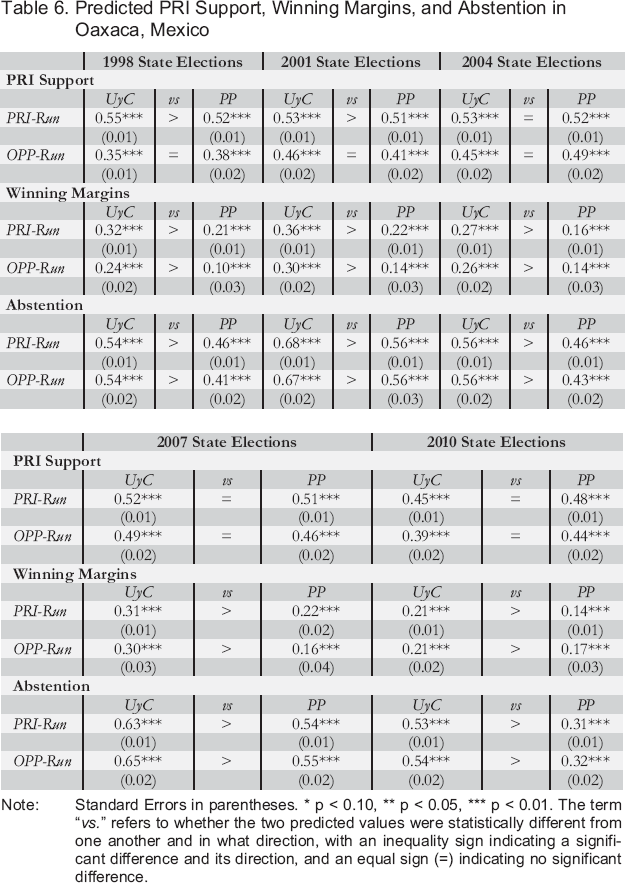
Note: Standard Errors in parentheses.
* p < 0.10,
** p < 0.05,
p < 0.01.
The term “vs.” refers to whether the two predicted values were statistically different from one another and in what direction, with an inequality sign indicating a significant difference and its direction, and an equal sign (=) indicating no significant difference.
Table 6 shows that PRI-run UyC municipalities delivered 3 percent greater PRI support on average compared to opposition-run places in 1998 (55 percent PRI support compared to 52 percent PRI support) and 2 percent greater PRI support on average in 2001 (53 percent compared to 51 percent); this is in line with expectations that UyC institutions placed in pro-PRI hands would deliver greater support for the PRI. However, this additional support is small, while PRI-run UyC municipalities did not continue to deliver it over time. In view of the consistently much larger winning margins in PRI-run UyC municipalities compared to PP ones, these results reveal two things. First, many, if not most, leaders of PRI-run UyC municipalities used their control over UyC institutions to favor the state PRI regime initially after UyC reform. However, many UyC leaders switched political allegiances, lowering the level of PRI support in PRI-run UyC municipalities relative to first-place margins. This is not surprising; municipal leaders in UyC systems often show no partisan preference (Bailón Corres 1999; Bartra 1999; Recondo 2007), with seemingly pro-PRI incumbents using UyC institutions to channel support to opposition groups and seemingly anti-PRI leaders using UyC institutions to channel support to the PRI. Even if municipal leaders used bottom-up-designed UyC systems to strengthen their political control, varying but declining PRI loyalty would result in initially small and later insignificant differences in PRI-support over time.
Among opposition-run municipalities, winning margins and abstention rates were consistently higher in UyC than in PP municipalities across the years as well, in line with expectations. In 1998, for example, winning parties in opposition-run UyC municipalities enjoyed 24 percent greater support on average than runner-up parties; this is in contrast to winning parties in opposition-run PP systems, which only enjoyed 10 percent greater support. Abstention rates averaged 54 percent in opposition-run UyC systems compared to 51 percent in opposition-run PP systems in 1998 as well. Regardless of whether in PRI or opposition hands, bottom-up-designed UyC systems gave municipal leaders the capacity to channel citizen support to a greater degree than their counterparts in PP systems, as argued.
However, opposition-led UyC municipalities did not generally use their control over bottom-up-designed UyC institutions to engineer support away from the state PRI regime; this was in contrast to expectations. The level of PRI support in opposition-run UyC systems was not statistically different from that in PP municipalities in any year under examination. Although contrary to expectations, the finding that opposition UyC municipal leaders delivered high margins – manipulating political participation in this regard – demonstrates their greater level of political control compared to opposition PP leaders, even if they did not always use this control against the PRI. This is not surprising, given that UyC leaders often showed no particular partisan preference.
Addressing Alternative Interpretations
Despite providing evidence in favor of the argument, the above results are consistent with another interpretation. It could be the case that the institutions comprising Oaxaca's UyC systems, especially the AGC town meeting, are a mechanism for generating consensus rather for manipulating support. Once consensus is reached, citizens on the “losing” side may refrain from voting, which would produce the observed differences in winning margins and abstention rates in UyC compared to PP systems noted. To strengthen the conclusion that bottom-up-designed UyC systems facilitated political control, I analyze the “flow of votes” between parties between elections using ecological regression (Lau, Moore, and Kellermann 2007; Rosen et al. 2001). 8
Ecological regression analysis addresses problems of aggregation bias and correlated errors within and across systems of equations.
In a clean election, in which voters cast ballots according to their political preferences, the “flow of votes” between parties from one election to the next should make sense, with no particular party receiving unexplainable transfers of support (Cantú 2013; Myagkov, Ordeshook, and Shakin 2009). In contrast, if Oaxaca's UyC systems increase the capacity of municipal leaders to manage citizen support to a greater ex- tent than their counterparts in PP systems, the flow of votes between parties should occur in ways that are consistent with this logic. Specifically, if bottom-up-designed UyC institutions improve the capacity of municipal leaders to engineer support, we should see signs that municipal UyC leaders are better at preventing defections and at forcing those unwilling to comply with their orders into the ranks of abstainers. If bottom-up-designed UyC rules do not give municipal leaders greater capacity to engineer political support compared to leaders in PP systems, we should not observe such differences and the flow of votes between parties should be similar across UyC and PP systems.
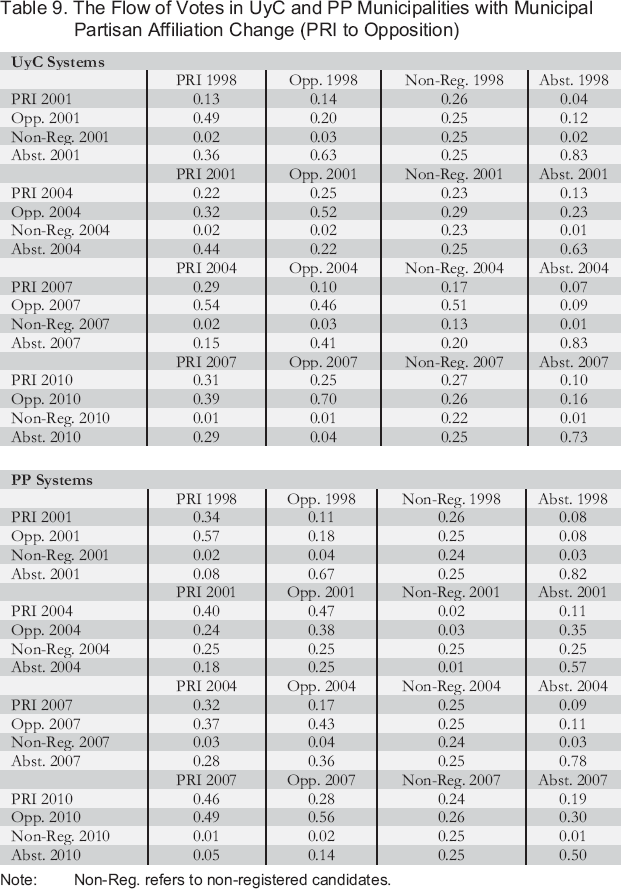
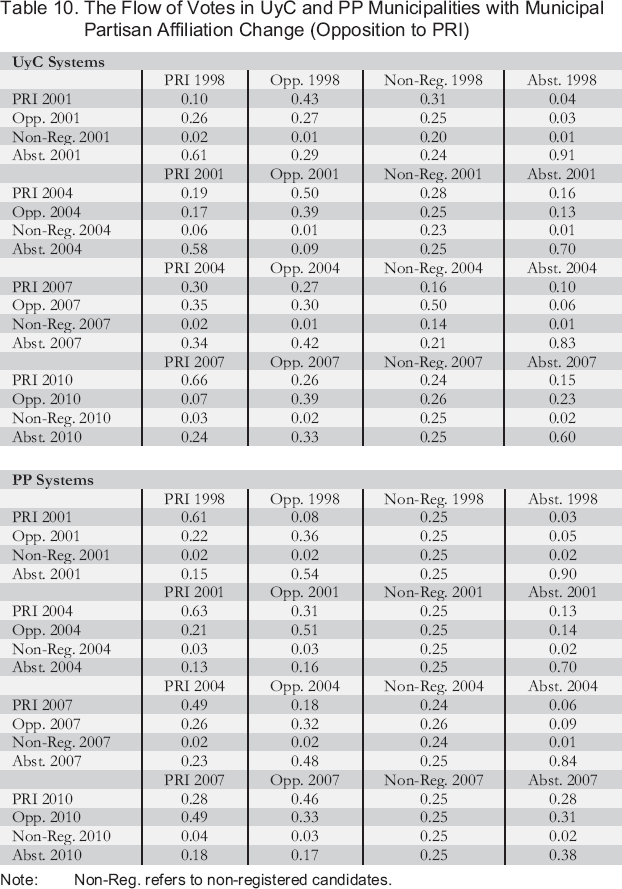
To examine the flow of votes, I separate Oaxaca's municipalities into four groups: those under PRI rule at the time of UyC adoption that stayed in PRI hands between elections (Table 7); those under opposition-rule at the time of UyC adoption that remained in opposition hands (Table 8); those under PRI rule at the time of UyC adoption that shifted to the opposition (Table 9); and those under opposition rule at the time of UyC adoption that shifted to the PRI (Table 10). Table 7 presents the results for the municipalities that remained under PRI rule between elections. If bottom-up-designed UyC systems facilitated greater political control compared to PP systems, then the flow of votes to the opposition (defections against UyC municipal leader commands) should be considerably lower among UyC than among PP systems and the flow of votes from the PRI to abstainers should be considerably greater among UyC than among PP systems. This was the case across the years. Between 1998 and 2001 the flow of votes from opposition parties to abstainers was a greater 59 percent in UyC compared to 57 percent in PP systems, while the flow of votes from the PRI to the opposition (against municipal leaders’ wishes) was a lower 16 percent in UyC systems compared to 21 percent in PP ones. This pattern was repeated in subsequent years.
The Flow of Votes in UyC and PP Municipalities with Municipal PRI Party Continuity between Elections (PRI to PRI)
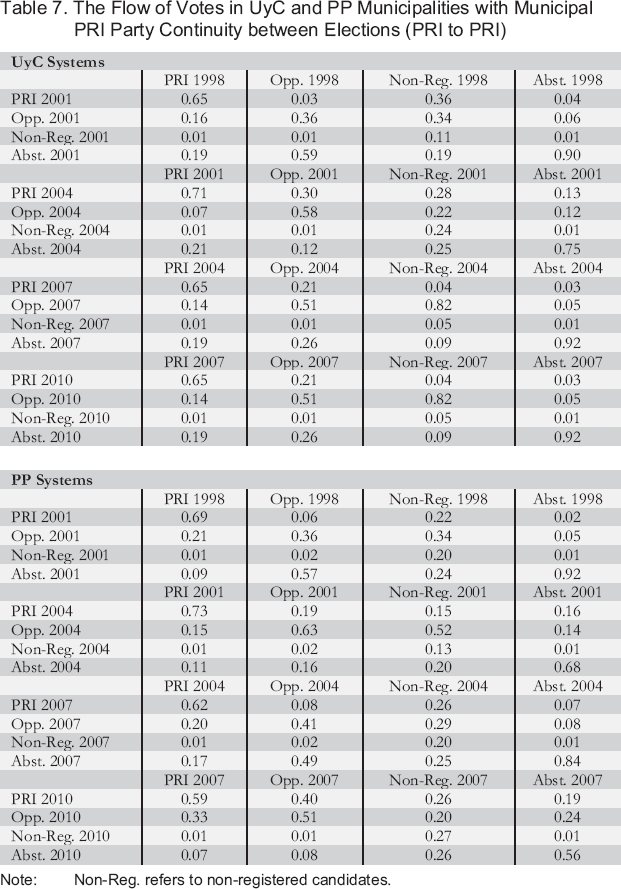
Note: Non-Reg. refers to non-registered candidates.
The Flow of Votes in UyC and PP Municipalities with Municipal Opposition Party Continuity between Elections (Opposition to Opposition)
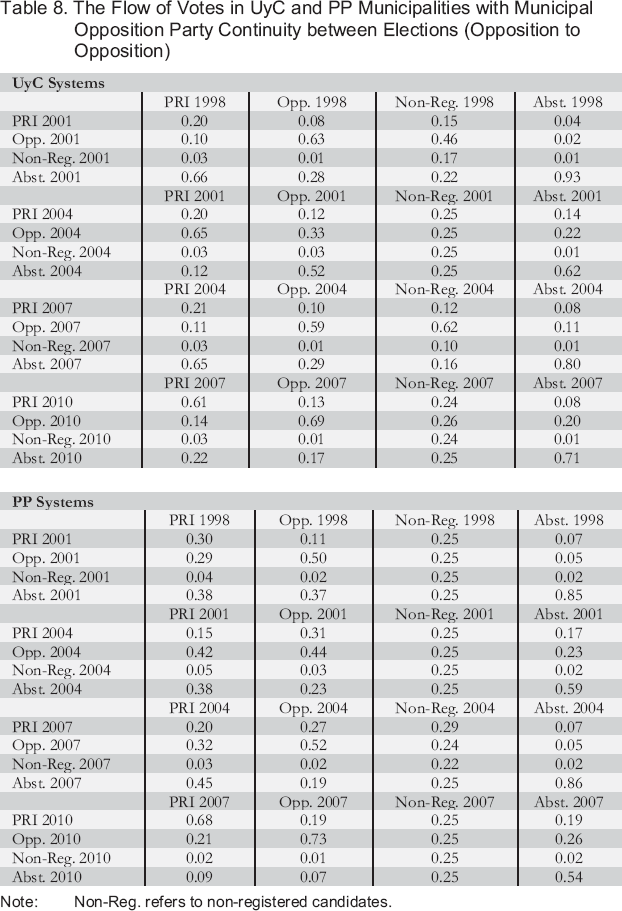
Note: Non-Reg. refers to non-registered candidates.
The Flow of Votes in UyC and PP Municipalities with Municipal Partisan Affiliation Change (PRI to Opposition)
Note: Non-Reg. refers to non-registered candidates.
The Flow of Votes in UyC and PP Municipalities with Municipal Partisan Affiliation Change (Opposition to PRI)
Note: Non-Reg. refers to non-registered candidates.
Table 8 presents results for those municipalities that remained under opposition control between elections. If bottom-up-designed UyC systems facilitated greater political control compared to PP systems, then the flow of votes from the opposition to the PRI should be considerably lower among UyC than among PP systems and the flow of votes from the opposition to abstainers should be considerably greater among UyC than among PP systems. As expected, this tended to be the case. Table 9 shows results for municipalities that shifted partisan control from the PRI to the opposition between elections. If bottom-up-designed UyC systems facilitated greater political control compared to PP systems, then the flow of votes from the PRI to the PRI should be considerably lower among UyC compared to PP systems and/or the flow of votes from the PRI to abstainers should be considerably greater in UyC compared to PP systems. This was also generally the case. Table 10 shows results for municipalities that shifted partisan control from the opposition to the PRI between elections. If bottom-up-designed UyC systems facilitated greater political control compared to PP systems, then the flow of votes from the opposition to the opposition should be considerably lower among UyC compared to PP systems and the flow of votes from the opposition to abstainers should be considerably greater in UyC compared to PP systems. Again, this tended to be the case.
Conclusion
The original aim of this study was to examine the impact of participatory institutions on authoritarian rule. Joining research on democratic and authoritarian political decentralization and participatory institutions, I have argued that when authoritarian participatory institutions are designed from the bottom up and placed in pro-regime hands, pro-regime officials can better tailor these institutions in ways to favor authoritarian rule than they can when these institutions are designed from the top down. When participatory institutions are designed from the bottom up but placed in anti-regime hands, anti-regime officials can better tailor these institutions to the peculiarities of local political dynamics and use them to undermine national authoritarian rule better than they can when these institutions are designed and given to them from the top down.
Statistical analysis of municipal level voting behavior in Mexico's electoral authoritarian state of Oaxaca, whose leaders implemented participatory reforms during the last decade of national electoral authoritarian rule, provides evidence in support of the argument. Pro-regime leaders in municipalities enjoying bottom-up-designed participatory institutions delivered greater support to the state electoral authoritarian regime than pro-PRI leaders in municipalities with top-down-designed institutional arrangements, but only in the initial years after the UyC reforms. Pro-PRI leaders with bottom-up-designed participatory institutions increasingly varied in their allegiance to the state electoral authoritarian regime, but they retained political control over their localities and went on to deliver high winning margins to the parties they favored in subsequent years. Municipal leaders in opposition localities with bottom-up-designed participatory institutions did much the same, although they showed no initial or lasting preference against the regime and vacillated between opposition parties and the regime earlier.
In showing that participatory institutions can be used by pro-regime and anti-regime leaders to engineer political control for the political groups they favor, this study supports recent empirical findings about the way that these institutions work in the hands of incumbent leaders that are concerned with remaining in power. In Bolivia, Evo Morales implemented participatory institutional reforms after his election in the mid-2000s and placed them at the center of the 2009 Constitution. In Venezuela, Hugo Chávez campaigned on and then formalized a series of participatory institutions in his 1999 Constitution. Despite these leaders’ claims that participatory measures were designed to raise political inclusion, scholars have found evidence that they favored the participation of incumbent supporters and the exclusion of opponents, allowing local level authoritarian practices on behalf of national leaders (Hawkins 2010; Hiskey and Seligson 2003; Schilling-Vacaflor 2011; Smilde and Hellinger 2011; Tockman and Cameron 2014; Van Cott 2008).