



Abstract
During each electoral period, the strategic interaction between voters and political elites determines the number of viable candidates in a district. In this paper, we implement a hierarchical seemingly unrelated regression model to explain electoral coordination at the district level in Uruguay as a function of district magnitude, previous electoral outcomes and electoral regime. Elections in this country are particularly useful to test for institutional effects on the coordination process due to the large variations in district magnitude, to the simultaneity of presidential and legislative races held under different rules, and to the reforms implemented during the period under consideration. We find that district magnitude and electoral history heuristics have substantial effects on the number of competing and voted-for parties and lists. Our modeling approach uncovers important interaction-effects between the demand and supply side of the political market that were often overlooked in previous research.
Introduction
Elections pose a substantive coordination problem for voters and political elites. To avoid wasting their vote on hopeless candidates, voters may choose to support candidates or parties that, despite not ranking first in their preference ordering, have higher prospects of securing legislative representation or cabinet posts than their favorite electoral options (Cox 1997; Palfrey 1989). Similarly, political elites tend to concentrate endorsements and resources on those candidates who are expected to fare better (Boix 1999; Osborne and Slivinski 1996). The incentives for strategic behavior channeled through the electoral system encourage the coordination between voters striving to cast a “useful” vote and politicians trying to maximize their chances of success and constrain the number of viable contestants in a race. In this sense, “electoral coordination” can be broadly defined as the process by which “groups of voters and politicians coordinate their electoral actions in order to win more legislative seats or executive portfolios” (Cox 2000: 49).
Strategic coordination affects the number and characteristics – e.g., platforms, ideological positions – of the parties competing in an election, the representation of voter preferences and political interests, and the policymaking patterns of the elected authorities. In view of its significance, the political science literature has devoted considerable efforts to understanding how the coordination process is mediated by alternative institutional designs, with particular emphasis on the role of electoral rules and, in the case of legislative races, of district magnitude (Cox 1997; Duverger 1954; Lijphart 1994; Ordeshook and Shvetsova 1994; Taagepera and Shugart 1989). Distinct combinations of district magnitude and electoral rules determine the rates at which votes can be converted into seats and condition the extent to which the articulation of citizens’ vote choice and politicians’ entry and exit decisions reduce the competition to only a subset of viable candidates (Amorim Neto and Cox 1997; Cox 1997; Duverger 1954; Leys 1959; Ordeshook and Shvetsova 1994; Sartori 1968). 1
Acknowledgments: We are grateful to Rafael Piñeiro, who kindly provided us data corresponding to Uruguayan elections taking place between 1942 and 2004. We also thank Professors R. Michael Alvarez, D. Roderick Kiewiet and Jean-Laurent Rosenthal for their helpful comments.
Although the interplay between the demand and the supply side of the political market is central to the coordination game, few – if any – empirical studies have carefully examined the interdependence between the two sides. The vast majority of the applied work in this area has concentrated exclusively on either strategic voting or strategic entry decisions (Blais and Carty 1991; Indridason 2008). Even authors underscoring the fundamental correspondence between the strategic behavior of voters and political elites – most notably Cox (1997) and, more recently, Gschwend (2007) and Lago (2008), among others – have generally focused on the determinants of tactical voting first and only explored its implications for political competition at a later stage. We adopt a different approach in this paper, investigating the concurrent impact of electoral rules and district magnitude on the strategic behavior of voters and political elites and their dynamic interactions. Specifically, we develop a hierarchical seemingly unrelated regression (SUR) model (Chib and Greenberg 1995) to jointly analyze the evolution of the number of competing and voted-for parties and lists in thirteen concomitant presidential and legislative elections held in Uruguay between 1946 and 2009.
Uruguay, one of Latin America's most stable and consolidated democracies (Cason 2002; Morgenstern 2001), provides an especially interesting case study to assess the impact of institutional factors on strategic coordination. The large disparities in district magnitude and the electoral reforms implemented in the country in the last 60 years – which affected the rules used for presidential races while leaving those regulating the distribution of legislative seats virtually unchanged – allow a systematic evaluation of agents’ responses to changes in key features of the electoral regime over time. In addition, the close link between presidential and legislative elections, together with Uruguay's highly factionalized party structure and the incentives for within-party competition prevailing in house races, requires us to take a multi-level perspective to the study of strategic coordination, including not only parties and voters but also factions as units of analysis to account for the “contamination” between the national and sub-national political arenas (Lago and Montero 2009). Using data on electoral results by constituency from a single, relatively homogeneous polity enables us to test for these institutional effects at the district level while attenuating the confounding influence of other relevant variables – such socio-demographic characteristics, political culture, issue dimensions and their salience – that may obscure cross-national comparisons.
Our results indicate that there is a strong relationship between characteristics of the electoral structure and strategic coordination by voters and political elites. For instance, we find that district magnitude has a positive and statistically significant impact on the number of launched parties and lists, and to a lesser extent on the number of voted-for lists. We also find that there are considerable interaction effects between the supply- and demand-side of the electoral game, and that there is high inertia in the behavior of voters and political elites across elections. These findings have relevant implications in view of the frequency and scope of the institutional transformations introduced in virtually every Latin American democracy in the last decades (Remmer 2008). The instability and variation of electoral rules throughout the region has spurred an overriding interest in the consequences of electoral engineering on political stability, partisan competition and party systems (Benton 2005; Remmer 2008). A few authors have also delved into the issue of tactical voting in Latin America (Wantchekon 1999; Benton 2005). Still, with rare exceptions (Cox 1997; Cox and Shugart 1996), electoral coordination has received relatively little academic attention in Latin America – at least in the English language – compared to industrialized democracies (Blais and Carty 1991, Blais and Gschwend 2010; Gschwend 2009). To the best of our knowledge, no work has in fact attempted to simultaneously gauge the repercussions of electoral engineering on voters’ and elites’ strategic behavior and their correlation. Our analysis of the Uruguayan case constitutes an initial step in this direction.
The remainder of the paper is organized as follows. In the next two sections, we briefly review the literature on electoral coordination and summarize the main characteristics of Uruguay's electoral institutions and party system for the purposes or our study. We then present the hypotheses to be tested in the empirical part of the paper and describe our model specification and estimation method. Lastly, we discuss the main results of our analysis and proceed to the conclusion. Additional descriptive statistics and estimation results are reported in the Appendix and in the Supplementary Materials accompanying this paper (see Online Appendix available as this article's supplementary material at <www.jpla.org>).
The Effect of Institutions on Strategic Coordination: Electoral Rules and District Magnitude
The motivation behind much of the empirical and theoretical work on electoral coordination can be traced back to Duverger's (1954) seminal contribution. In a nutshell, the main thrust of his argument is that the number of “serious” – i.e., viable – parties in a polity is essentially determined by the mechanism stipulated in the electoral system to translate votes into seats as well as by the strategic response of voters and political elites to such mechanism. From the voters’ perspective, the primary implication of the “psychological effect” postulated by Duverger (1954) is that supporters of weak or marginal parties would rather support other candidates with higher chances of winning than waste their vote on their preferred option. Likewise, political elites – opinion leaders, donors, party officials, prominent political figures – tend to concentrate their resources – money, endorsements, campaign appearances, etc. – on candidates with better electoral outlooks while abandoning others (Cox 1997). The interaction between short-term instrumentally rational voters and elites attempting to affect election results limits the actual or voted-for count of competitors, eventually reducing the competition to a handful of viable contenders in any given race.
Although Duverger stressed the importance of the “mechanical” and “psychological” effects in single-member plurality elections at the national and local level, ensuing research recognized that voters and political elites face some incentives for strategic behavior in virtually any electoral system, and that these incentives are especially marked at the district level (Cox 1997; Kiewiet 2011; Leys 1959). Consequently, scholars turned to the analysis of electoral coordination in district races held under diverse electoral rules. Subsequent extensions of the “Duvergerian model” retained the basic idea that strategic coordination takes place both among the electorate and political elites. As summarized in the “M+1 rule” (Cox 1997: 99; Cox and Shugart 1996), when voters and candidates in plurality, PR or majority systems care primarily about the results of the election at hand, the number of candidates entering a race, in a district of magnitude M, tends to be no more than M+1. If, however, political elites fail to restrict the number of contestants, voters still tend to concentrate their support on at most M+1 of them. Therefore, the outcome of the coordination process is driven by the mutually dependent actions of voters and elites (Blais and Carty 1991; Cox 1997). Nevertheless, most authors embraced a “one-sided” methodological stance in their applied work, focusing either on strategic voting or on candidates’ strategic entry, exit and coalition formation (Blais and Carty 1991; Indridason 2008).
On the one hand, the literature on tactical voting sought to quantify the impact of various combinations of electoral rules and district magnitude on strategic party desertion, treating the number of parties as an explanatory variable sometimes and as a consequence of voters’ choices other times (Blais and Gschwend 2010; Gschwend 2007). Students of comparative electoral system have generally concluded that strategic voting is less prevalent in proportional representation (PR) or, more generally, in less disproportional systems, while it is most prevalent in single-member plurality regimes. The primary justification for this result is that, in order to avoid “wasting” their vote and concentrate their support on viable candidates, constituents in single-member plurality elections only need to identify the top two candidates in their district (Blais and Gschwend 2010; Kiewiet 2011). In contrast, incentives for strategic party defection are less compelling under proportional representation, since even marginal parties may have a chance to gain seats (Gschwend 2007). Moreover, since the number of available electoral options is typically larger in PR than in plurality systems, voters might have much more trouble discriminating between hopeless and viable candidates (Cox and Shugart 1996). Therefore, even when acknowledging that strategic voting is possible in PR systems, political scientists have consistently asserted that it tends to fade out as the district magnitude increases because it is too difficult for citizens to figure out which parties are marginal and which ones are likely to succeed (Cox 1997; Leys 1959; Sartori 1968).
Recent findings, however, cast some doubts on the “conventional wisdom” about the impact of electoral institutions on strategic voting. In their studies on Portugal and Spain, Gschwend (2007) and Lago (2008) show that tactical voting can be observed even in PR systems with large district magnitudes when citizens use simple heuristics – such as previous election results – to ascertain the viability of the competing parties. Thus, although empirical evidence does clearly indicate that the number of seats awarded per district is negatively correlated with voters’ propensity to desert their preferred electoral option (Gschwend 2009), strategic voting does not seem to automatically disappear when “the district magnitude gets above five” (Cox 1997: 122). Analogously, other authors have suggested that the influence of the (dis)proportionality of the electoral regime on strategic party defection might have been overstated, and that differences between plurality, runoff and proportional representation in this regard may actually be negligible (Abramson et al. 2010; Blais and Gschwend 2010). In other words, the link between electoral system and voter behavior seems to be much less straightforward than had been previously assumed (Blais and Gschwend 2010).
On the other hand, academics have also concerned themselves with the reactions of political elites to the incentives created by the electoral law (Blais and Carty 1991; Cox 1997; Gunther 1989). The mechanical effects embedded in specific combinations of electoral formula and district magnitude encourage office-seeking politicians to form, maintain or disband political parties, launch or withdraw candidacies in certain districts and form coalitions in some others. An impressive wealth of scholarly work inspecting the repercussions of diverse electoral systems on the characteristics of partisan competition and party systems has accumulated over the years. These studies reveal that the electoral supply tends to increase with the proportionality of the system and that PR prompts a larger number of candidates and parties than plurality, although the outcome of elites’ coordination depends on factors such as the interaction of district magnitude and electoral formula, the interface between PR and plurality rules in mixed-member systems, and the degree of political and economic centralization (Blais and Carty 1991; Benoit 2001; Lago and Montero 2009). More generally, they have underlined that the partisan effects of electoral laws are not direct or deterministic, but critically influenced by strategic considerations of political elites, which are generally contingent on their expectations about voters’ actions (Gunther 1989).
Despite this extensive body of research, there is virtually no evidence regarding the strength of the interrelation between the strategic behavior of voters and political elites and how it is mediated by electoral institutions. The fact that the two strands of the literature – one concentrated on voters, the other on politicians – remained largely dissociated in empirical work has undoubtedly contributed to this state of affairs. In this sense, the failure of most studies to simultaneously integrate the demand and the supply side of the political market has limited the possibility of an in-depth analysis of the relationship between the electoral decisions of the two sides. Besides understating the predominance of elite-voter interactions, this could actually lead to erroneous substantive conclusions (Thum 1997) regarding the impact of electoral rules and district magnitude, hindering our understanding of the coordination process. The methodology implemented in this paper to analyze the behavior of voters, parties and lists in Uruguay allows overcoming these shortcomings.
Electoral Institutions and Party Structure in Uruguay
There are several reasons why Uruguay provides an interesting opportunity to assess the influence district magnitude and electoral rules on voters’ and elites’ behavior and interactions.
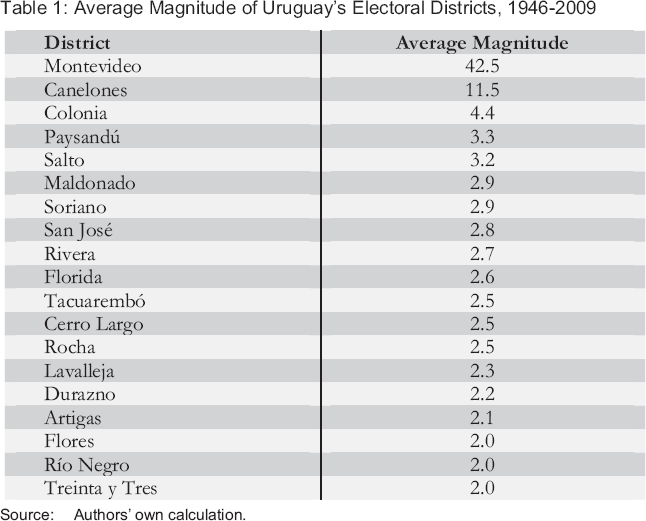
First, as shown in Table 1, which reports the average number of seats awarded in each of Uruguay's 19 electoral districts between 1946 and 2009, district magnitude varies widely across the country. 2 Average magnitudes range from 43 and 11 in the two largest districts, Montevideo and Canelones, respectively, to 2 to 4.5 in the remaining 17 constituencies. These differences are comparable to those observed in some of the European democracies with the highest district magnitude variation. For instance, the number of seats per district fluctuates between 1 and 35 in Spain, while in Portugal it ranges from 3 to 58 (Gschwend 2007; Lago 2008). As noted by Gschwend (2007), such large variations imply that standard arguments emphasizing the influence of district magnitude on voters’ strategic behavior – developed in principle for the purpose of comparing the frequency of tactical voting across electoral systems with varying degrees of proportionality – should also apply to a country like Uruguay.
Average Magnitude of Uruguay's Electoral Districts, 1946-2009
Source: Authors’ own calculation.
No extensive redistricting process took place during this period.
As noted by Benoit (2001), the impact of district magnitude on agents’ behavior is conditioned and modulated by the type electoral formula used. In this sense, the characteristics and evolution of Uruguay's electoral system during the period under study also allow us to appraise the interrelated effect of district magnitude and electoral formula on the tactical behavior of candidates and parties. Elections for the executive and the legislative branches are held concomitantly and are connected by means of a “block vote” (Buquet and Chasquetti 2008): citizens can only choose presidential candidates and lists of senators and representatives running under the same party label. The indissoluble link between presidential and legislative races mitigates the influence of several confounding factors – e.g., “policy-balancing” voting, disengagement between “nationalized” presidential contests and “localized” legislative choices, distinction between midterm and general election-years (Blais and Gschwend 2010; Gschwend 2007) – that prevail in other institutional settings and facilitates the simultaneous analysis of elite-voter interactions across elections. At the same time, the different rules used for executive and legislative offices present agents with additional coordination dilemmas due to the tight relationship between the national and subnational electoral arenas (Lago and Montero 2009).
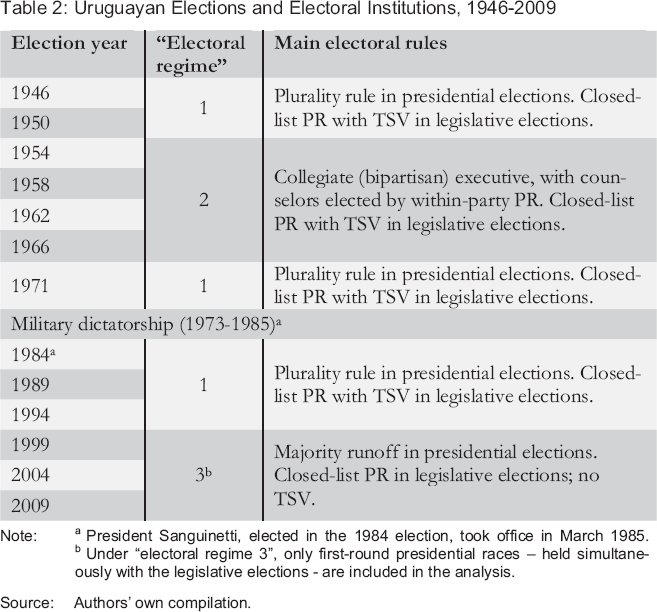
As mentioned in the Introduction, the country's presidential election rules underwent some important modifications in the last 60 years, while those regulating legislative races remained essentially unchanged during most of this period. A thorough description of Uruguay's complex electoral system is beyond the scope of this paper. 3 Given our purposes, however, its main features and transformations can be summarized in three basic “electoral regimes”. Under what we denominate “electoral regime 1”, employed before 1954 and then again between 1971 and 1994, presidents were elected by plurality. Each of the parties in the executive race was allowed to nominate multiple candidates, who competed against each other as well as against the other parties’ nominees. Votes for same-party candidates were pooled together, and the winner was the most-voted-for candidate within the plurality party. Under “electoral regime 2”, inaugurated in the 1954 elections, the country adopted a nine member collegiate executive, with the first and second most voted-for parties occupying 6 and 3 seats in the National Council of Government, respectively. Parties could still nominate various executive candidates, and counselors within each of the two largest parties were elected by proportional representation. This second “regime” was only in force until 1966, and the country switched back to plurality after the 1967 constitutional reform. Finally, the system currently in place – “electoral regime 3” – was introduced in the constitutional reform of 1997, which established a majority runoff rule and forced each party to present a single presidential candidate selected in mandatory open primary elections.
The interested reader should consult Buquet and Chasquetti (2008), Moraes (2008), Morgenstern (2001) and the references therein for details.
Under the three “electoral regimes” considered, a closed-list proportional representation system has been used to elect 30 senators in a single national district and 99 representatives in the 19 districts identified in Table 1 above. The allocation of legislative seats by D'Hondt formula is determined in two fundamental steps. First, seats in the Senate and the House of Representatives are distributed proportionally across parties, taking the whole country as a single constituency. In a second stage, seats are apportioned within each of the parties. The national constituency still remains for the Senate, but house seats are distributed between the party's lists across the 19 electoral districts in proportion to the number of votes in each one. The only meaningful shift in this procedure during the period considered was instituted by the 1997 reform, which prohibited co-partisan house lists to pool votes by forming electoral alliances (sublemas). Until then, under “electoral regimes” 1 and 2, seats in the house were first allocated across parties, then among within-party alliances, and finally between lists within each sublema. This mechanism, sometimes referred to as “triple simultaneous vote” (TSV), was abandoned under “electoral regime 3”. Table 2 outlines the defining characteristics of the three “regimes” and indicates their correspondence with each of the 13 elections held between 1946 and 2009.
Uruguayan Elections and Electoral Institutions, 1946-2009
Note:
President Sanguinetti, elected in the 1984 election, took office in March 1985.
Under “electoral regime 3”, only first-round presidential races – held simultaneously with the legislative elections - are included in the analysis.
Source: Authors’ own compilation.
This peculiar institutional design has also entailed profound consequences for political organizations. Specifically, as noted before, one of the byproducts of the Uruguayan electoral code has been an extremely fragmented internal party structure. 4 The country's party system, one of the most consolidated and competitive in Latin America (Cason 2002), is dominated by three major actors: the Blanco and Colorado parties on the center-right, and the Frente Amplio (currently Encuentro Progresista – Frente Amplio – Nueva Mayoría) on the left. These are the only three parties to have won presidential elections in Uruguay's history and the ones that have occupied nearly all the legislative seats in the last 40 years. 5 The center-left Partido Independiente, founded in 2004, is the only other political organization that has achieved parliamentary representation in the last two national elections. A myriad of minor parties – some of them emerging and disappearing between election years – usually participate in executive and legislative races as well, although generally with relatively modest success.
Again, a more detailed account of the characteristics and history of the Uruguayan party system can be found in Buquet and Chasquetti (2008), Moraes (2008) and Morgenstern (2001).
All the senators and 97 of out 99 representatives in the 47th Legislature (2010-2015) belong to one of these three parties.
Because Uruguayan electoral laws have historically encouraged within-party competition by allowing multiple co-partisan candidates for various national and local offices, strongly organized autonomous factions with their own electoral incentives and goals have developed and coexisted inside each of the parties – especially within the three major contenders (Buquet and Chasquetti 2008; Morgenstern 2001). The role of within-party factions is particularly important in elections for the House of Representatives, since different house lists in each district have to compete not only against other parties’ lists, but also against their co-partisan rivals for the seats captured by the party. Because their votes are summed to determine the between-party contest, same-party lists have a common interest in obtaining the largest collective vote-share. At the same time, though, they are also encouraged to cultivate a “factional vote” and to try to differentiate themselves from each other (Moraes 2008). As a result, voters in Montevideo could choose between 45 house lists from 5 different political parties in the 2009 election, and even in Treinta y Tres, one of the smallest districts of the country (see Table 2), 23 lists fielded candidates for the House of Representatives. In consequence, not only the number of competing and voted-for parties, but also the corresponding number of lists, must be considered for understanding and characterizing the electoral coordination problem in Uruguay. In this sense, while much research in this area (e.g., Blais and Carty 1991; Gschwend 2007, 2009; Lago and Montero 2009) has treated the party as the unit of analysis, the Uruguayan case illustrates the prominence of internal party dynamics and the need for a “multi-level” approximation to the coordination problem in settings in which multiple agents within the parties face conflicting electoral incentives.
Finally, the rather stable and homogeneous nature of the Uruguayan society (Calderón and Chong 2007) means that ethnic, linguistic, religious and social cleavages are not key determinants of the number of available and voted-for parties and lists. Therefore, we can use district-level data to analyze the impact of electoral rules and district magnitude on voters and political elites while minimizing the influence of socio-demographic heterogeneity (Cox 1997).
Hypotheses
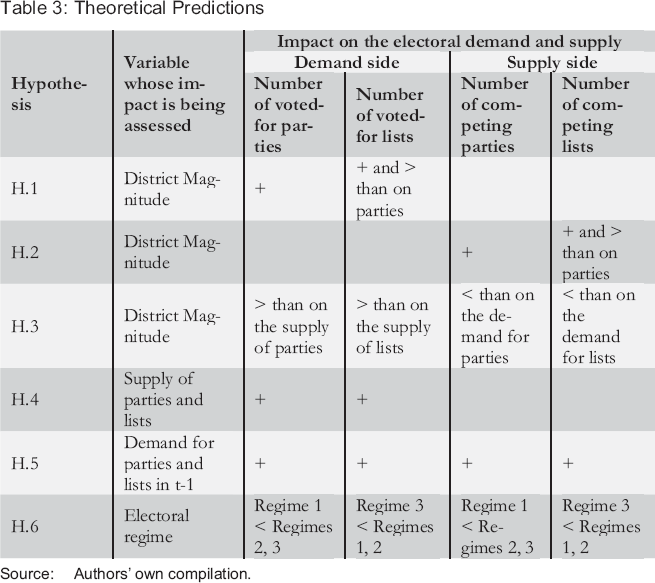
Drawing on the literature on electoral coordination, and in light of the characteristics of the Uruguayan electoral system discussed in the preceding section, we formulate six hypotheses to be tested in the empirical section of the paper. The first three hypotheses refer to the influence of district magnitude on the number of competing and voted-for parties and lists. The fourth and fifth hypotheses center on the interaction between the electoral supply and demand, and the last one concerns the impact of changes in electoral rules.
Empirical evidence consistently supports the claim that the smaller the district magnitude (M), the smaller the number of viable parties and the stronger the incentives for strategic party desertion (Blais and Gschwend 2010; Gschwend 2009). Hence, it is reasonable to expect that, other things constant, the number of voted-for parties in Uruguay increases as the number of seats awarded per district rises. Furthermore, given the high degree of within-party fragmentation induced by Uruguayan electoral laws (Morgenstern 2001), if a party performs better as M grows because voters are less concerned about the possibility of wasting their vote, several lists could become viable competitors for the additional seats captured by this party. Thus, our first hypothesis (H.1) is that district magnitude has a positive impact on the number of voted-for parties, and an even greater positive impact on the number of voted-for lists.
District magnitude should also affect the “supply side” of the electoral market – that is, the number of electoral options available to voters. If prospective political contenders are mainly concerned about winning a seat, they should be more likely to enter an election the better their chances of success in the district. Because political elites are presumably aware of the fact that larger districts lower the threshold required for any party to gain seats (Cox 1997; Gunther 1989), we expect the number of contestants to increase with M. In the case of Uruguay, then, our second hypothesis (H.2) is that the supply of both parties and lists is an increasing function of the district magnitude. In fact, we expect the supply of lists to be actually more responsive to district size than the supply of parties. As noted before, co-partisan lists in Uruguay compete for the seats captured by the party in each constituency. District magnitudes in Montevideo and Canelones averaged 42 and 11 between 1942 and 2009 (Table 1). Thus, with three major parties obtaining the bulk of the popular vote, a considerable number of lists within each party could aspire to gain a seat in these districts. At the other extreme, the average value of M in 14 of the remaining 17 districts was lower than 3 during this period. Hence, within-party factions would essentially compete for 1 seat, which should clearly reduce the incentives for party elites to launch lists in these districts (Benoit 2001; Moraes 2008).
Moreover, according to our third hypothesis (H.3), the effect of district magnitude on the supply of parties and lists should be stronger than on the demand side. As illustrated by Lago (2008), political elites are likely to be more attentive to the incentives for strategic coordination created by the district magnitude than voters. Thus, at the pre-entry stage of the electoral game (Cox 2007), parties should launch fewer candidacies as M decreases (Benoit 2001). In contrast, even in small districts some expressive voters may not respond to the “wasted vote argument,” and in very large districts some voters might still be willing to cast strategic votes (Gschwend 2007). Together, these two factors should render the behavior of voters less sensitive to M than that of the elites, and should tend to weaken the association between district magnitude and the number of voted-for parties and lists for a given electoral supply.
We also expect the number of available and voted-for parties and list to influence each other after accounting for the effect of district magnitude. On the one hand, the greater the number of electoral alternatives, the more likely voters will be to find an option “good enough” to support (Blais and Gschwend 2010). Also, a larger electoral supply would impose more stringent informational requirements on voters (Katz et al. 2011), making it harder for them to distinguish between trailing and leading candidates and rendering strategic party- and list-desertion more unlikely (Cox 1997: 78-79). In this sense, the effect of a larger electoral supply holding M fixed would be somewhat similar to the impact of an increase in district magnitude in the standard Duvergerian or electoral coordination theories (Cox 1997; Cox and Shugart 1996). Clearly, the electoral supply in a district should be closely related to the number of legislative seats at stake, although considerable differences may subsist conditional on M. For instance, in the 2009 Uruguayan election, the total number of lists voters could choose from in Flores (21) was one-third lower than in Río Negro (28), although both districts have the same magnitude (see Table 2). Therefore, our fourth hypothesis (H.4) states that, other things being equal, we expect the number of voted-for parties and lists in a district is an increasing function of the number of available parties and lists, respectively.
At the same time, the number of competing parties and lists should be positively correlated with the expected number of voted-for parties and lists. As highlighted by Gschwend (2007) and Lago (2008), citizens can use past election results to form their expectations about the viability of the parties competing in a district. Simply put, the better parties fared in previous elections, the better voters anticipate them to perform in the next race. Extending this assertion to the Uruguayan setting, and in view of the linked electoral fortunes of parties and lists imposed by the country's unique institutional design, we conjecture that previous results at both the party- and listlevel should affect the number of voted-for parties and lists in a district. Further, we claim that political elites also rely on this kind of electoral history heuristics. That is, politicians’ decisions about whether or not to run in a district should also be influenced by their electoral outlook – i.e., their projected vote-share vis-à-vis the other contestants – which will be, at least to some extent, based on past election results. The empirical implication of this line of reasoning is that the demand and supply of parties and lists in an election should be positively related to the number of voted-for parties and lists in the previous election. This is our fifth hypothesis (H.5).
Finally, we also expect the electoral reforms implemented in Uruguay during the period under study to have affected the number of available and voted-for parties and lists after accounting for the aforementioned variables. Even though district magnitudes above two typically imply that multiple parties are viable in legislative races, the combination of straight-party voting and plurality rule for presidential elections under “electoral regime 1” should have fostered the consolidation of a two-party system. In contrast, the switch to a majority runoff system under “electoral regime 3” ought to have attenuated this trend, leading to an increase in the upper-bound number of viable parties – from 2 to 3 (Cox 1997: chapter 6). The rules for integrating the collegiate executive under “electoral regime 2” should work in a similar direction, increasing the number of parties compared to “electoral regime 1”. The number of lists, on the other hand, should be markedly lower under “electoral regime 3” than under the other two regimes. As mentioned in the previous section, the only major regulatory change in legislative elections under the period considered was introduced by the 1997 constitutional reform, namely, the elimination of the “triple simultaneous vote”. Under electoral regimes 1 and 2, house lists could pool votes by forming within-party electoral alliances. Hence, even weak lists could conceivably hope to achieve legislative representation by “borrowing strength” from other lists in their sublema. This was no longer the case under “electoral regime 3”. Under the latter system, voters and political elites should eventually realize that some lists – especially in small magnitude districts – do not have any real chance of success. To sum up, then, our sixth hypothesis (H.6) can be formulated as follows: the number of parties is larger under electoral regimes 2 and 3 than under “electoral regime 1”, while the number of lists is smallest under “electoral regime 3”.
Because of the positive relationship between the number of available and voted-for parties postulated in H.4 and H.5, we expect hypothesis H.6 to hold for both the demand and the supply side of the electoral market. However, we do not have clear a priori intuitions about the relative impact of the different electoral rules on each side. Political actors have to become acquainted with the reforms and need to learn how best to play the game defined by the new institutions. Parties might have to fine-tune their campaign messages and redefine their political strategies. Voters may need to update their expectations and alter their decision-making “model”. Since electoral institutions are largely endogenous to the party system (Boix 1999), and because politically inattentive citizens are typically unable to anticipate the potential consequences of reforms (Lagos 2008), political elites should presumably “move first”. Voters’ response to possible supply shifts, though, could in turn have profound implications for the parties’ electoral fortunes and for the characteristics and evolution of the party system (Gschwend 2007). Such dynamic adjustment process might require a substantial amount of time and lots of political learning before a new equilibrium is reached (Benoit 2001; Cox 1997), so formulating precise theoretical predictions about the comparative effect of the reforms under consideration on the number of available and voted-for parties/lists is far for straightforward. This is ultimately an empirical issue about which previous research – having generally failed to account for the interconnection of elites’ and voters’ strategic decision – offers little guidance.
To conclude this section, Table 3 below summarizes the six hypotheses to be tested in the empirical part of the paper.
Theoretical Predictions
Source: Authors’ own compilation.
Methodology
To assess the validity of the theoretical predictions formulated above, we implement a hierarchical seemingly unrelated regression (SUR) model (Chib and Greenberg 1995) using district-level data from the 13 elections held in Uruguay between 1946 and 2009. Our specification allows the number of competing and voted-for parties and list to be influenced by different factors and to exhibit varying degrees of volatility across districts and races while accommodating potential correlation between the electoral demand and supply. Thus, this empirical approach is particularly well suited to test our hypotheses – especially H.4 and H.5 – and, more generally, to better account for the interdependence between the behavior of voters and political elites that is crucial for the outcome of the coordination process (Blais and Carty 1991; Cox 1997; Indridason 2008).
The dependent variables in our model are: the number of parties (P) presenting candidates in each district and election; the number of lists (L) available to voters in each district and election; the effective number of parties (ENP); and the effective number of lists (ENL).
6
The first two variables represent the supply side of the electoral market. The last two aim at capturing the demand side – i.e., the number of voted-for parties and lists – and are measured as
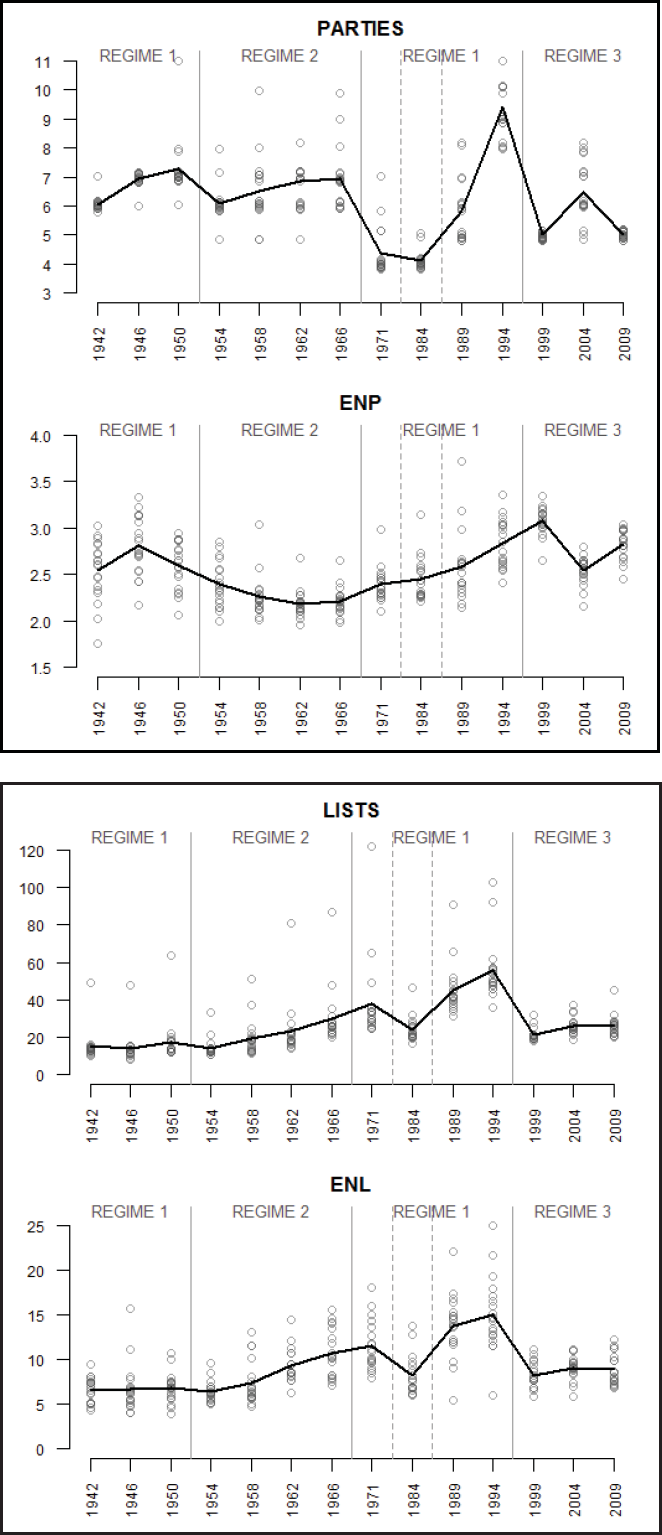
Total Number of Available and Voted-for Parties and Lists between 1942 and 2009
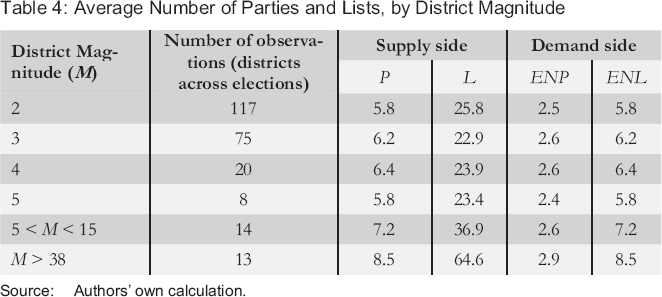
Average Number of Parties and Lists, by District Magnitude
Source: Authors’ own calculation.
The number of lists is approximated by the number of “voting-sheets” supplied by parties in each election and district. Voting-sheets are paper ballots including combinations of same-party candidacies for a variety of elective offices. Each representatives’ list may be supplied in a single or multiple voting-sheets – where in each voting-sheet the list is paired with different same-party candidates running for other elective offices. Thus, the number of ballot sheets is always greater than or equal to the number of representatives’ lists.
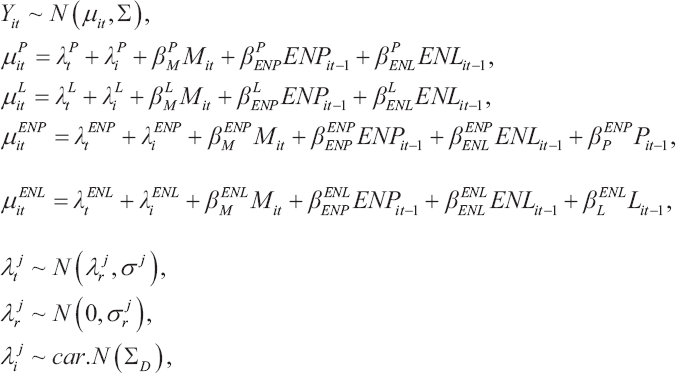
For each district i and election t, our vector of dependent variables can be represented as Yit = (Pit, ENPit, Lit, ENLit). We allow for contemporaneous correlation between the four dependent variables by specifying a multivariate normal distribution for Yit, with variance-covariance matrix Σ and mean
In accordance with hypotheses H.1–H.5, the components of the mean vector
Because electoral rules apply to all districts in the country in a given set of elections (see Table 2), it is necessary to account for the hierarchical structure of the data. Failing to do so would violate the assumption of independent and identically distributed errors, potentially leading to negatively biased standard errors and erroneous substantive conclusions drawn from “spuriously significant” statistical effects (Antweiler 2001; Maas and Hox 2004). In order to avoid these problems, we use a multi-level specification (Gelman et al. 2004) with random effects by district and election-year. The election-effects are modeled as a function of the “electoral regime”, as well as of idiosyncratic or temporal factors that may induce changes in the average values of the dependent variables beyond those related to the electoral reforms. The district-random effects, in turn, capture possible time-constant heterogeneity between constituencies while simultaneously accommodating potential correlation in electoral demand and supply between neighboring geographical units. Prior work finds strong evidence of geographical clustering of citizens’ political preferences as well as strategic voting behavior (Fieldhouse, Shryane, and Pickles 2007).
Further, as seen in Figure A.1 in the Appendix, Uruguay's largest districts are all concentrated in the south and the west, closer to the Montevideo, while the smallest constituencies are situated in the center part of the country. It is possible that districts located within the same economic or geographic region, or closer to the capital of the country, engage in cross-district coordination (Cox 1999). To accommodate potential correlation of in the outcomes of electoral coordination across districts, we use a CAR-Normal distribution (Thomas et al. 2004) for the district random intercepts. 7
Following the suggestion of one of the reviewers, we also estimated an alternative model in which district effects were modeled as a function of the distance of each constituency from Montevideo. The results of this alternative model are reported in the Supplementary Materials.
The model specification can thus be written as:
where
While hypothesis H.4 refers to the effect of Pt and Lt on ENPt and ENLt, we also control for the lagged values Pt-1 and Lt-1 in the equations for
Estimation was performed by Markov chain Monte Carlo (MCMC) simulations (Gelman et al. 2004). Three parallel chains were run for 50,000 iterations, keeping every 10th iteration to reduce autocorrelation and discarding the draws from first-half of each chain as “burn-in”. Convergence was assessed based on Gelman and Rubin's diagnostic (Best, Cowles, and Vines 1996; Gelman and Rubin 1992). Samples from the second half of each chain were pooled and used to summarize the posterior distributions of the model parameters. 9
The model was fit using WinBugs 1.4 (Lunn et al. 2000). The code is available from the authors upon request.
Results
Figure 2 reports the estimated marginal effect on the number of competing and voted-for parties and lists of a change in district magnitude and in the electoral supply and demand in the previous race. 10
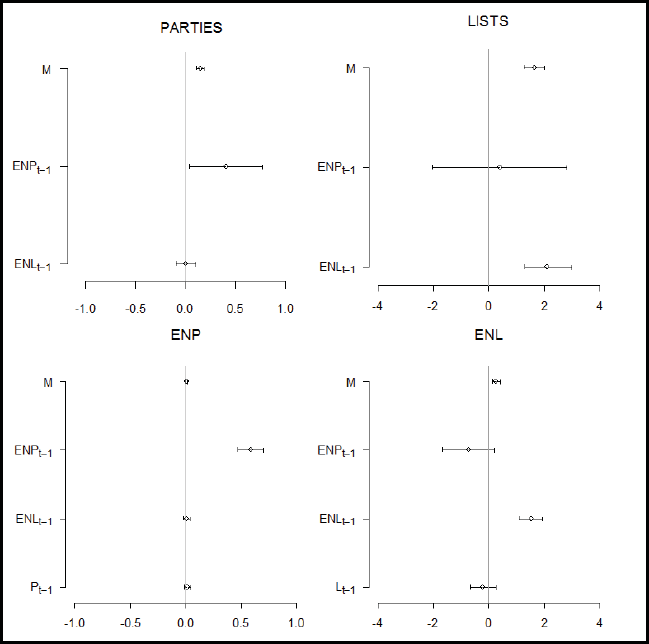
Marginal Effect of M, Pt-1, Lt-1, ENPt-1 and ENLt-1 on the Number of Competing and Voted-for Parties and Lists
The (log-transformed) parameter estimates of the SUR model used to calculate these marginal effects are reported in the Supplementary Materials.
Regarding the impact of district magnitude (M), and in line with our first hypothesis (H.1), a one-unit increment in M raises the effective number of lists in the constituency by 0.27 units on average. A larger M is also associated with a slight increase on the number of vote-getting parties, although the effect in this case is indistinguishable from 0 at the 0.1 level. The influence of district magnitude on the supply of parties and lists, on the other hand, is more conclusive. For each additional seat awarded in the district in any given race, the number of parties and lists fielding candidates in the constituency increase by 0.15 and 1.68, respectively. These estimates are significant at the usual confidence levels, providing apparent support for our second hypothesis (H.2).
Also consistent with our expectations, the number of competing and voted-for lists is more elastic to changes in the district magnitude than the corresponding number of parties. That is, as outlined by Piñeiro (2004), the effect of district magnitude on electoral coordination in Uruguay is exerted at the sub-party, rather than at the party level. Political elites respond to variations in M by essentially adjusting the number of house lists they present in each constituency. In large districts, where parties – especially Blancos, Colorados and the Frente Amplio – expect to gain a considerable number of seats, competition between co-partisan factions drives the number of lists up. In contrast, in smaller constituencies, where the competition takes place fundamentally between parties, political elites still field partisan candidates but avoid wasting resources and restrict internal competition by limiting the number of lists voters can choose from. Unlike previous work on Uruguayan elections (e.g., Piñeiro 2004), however, our analysis underscores that the predominant role of within-party factions in lower house races is not exclusively explained by the decisions of political elites at the “pre-entry” stage of the coordination game. Citizens too, in turn, respond to M by further concentrating their votes among fewer lists in smaller districts without necessarily deserting the parties due to tactical considerations.
In order to illustrate the relationship between district magnitude and the number of competing and voted-for parties in greater detail, we simulated the effect of a unit increase in M on the four dependent variables for each of the different average constituency sizes observed in Uruguay. The results of this counter-factual exercise, summarized in Figure 3 below, clearly indicate that the impact of district magnitude is contingent on the baseline value of M. While the marginal effect of M in smaller constituencies is strongly and significantly related to an increase in L, ENL and P, it is usually negligible in Montevideo.
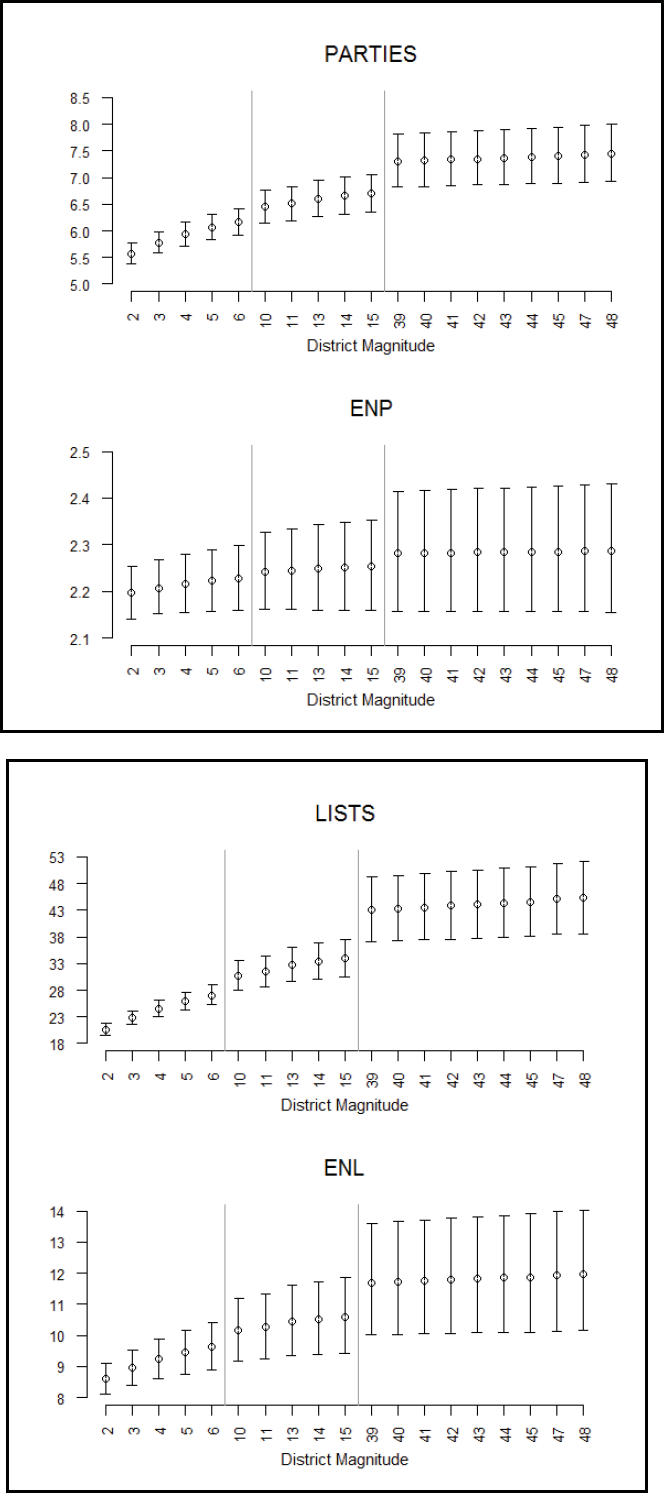
Effect of an Increase in M on the Number of Parties and Lists, by District Magnitude
In addition, the estimates reported in Figures 2 and 3 also confirm that the effect of district magnitude on the supply side of the electoral market is greater than on the demand side, as stated in hypothesis H.3. For instance, as noted above, the response of supply of lists to a given change in M is more than 5 times higher than the response of the demand. Furthermore, a comparison of the graphs in the upper and lower panels of Figure 3 also suggests that party elites in Uruguay seem to be much more attentive than voters to the incentives for strategic coordination generated by variations in M. Differences in the predicted values of P and L between very low and very large districts are apparent in the figure. In contrast, the estimates regarding the number of vote-getting parties and lists are less clear-cut, with less variation and more overlapping in the predicted values of ENL and ENP across magnitudes. This finding is in accordance with Lago (2008), who showed that voters do not typically know the precise number of seats at stake in their district and are thus more likely to rely on alternative heuristics – such as previous election outcomes – in their decision-making process.
This conclusion is reinforced by examining the effect of the electoral supply and demand in the previous race. As seen in Figure 2, there is strong positive association between the effective number of parties and lists at time t-1 and t. Holding other variables constant, a one-unit increase in ENPt-1 augments the number of voted-for parties by 0.60 in the following election, while the marginal impact of ENLt-1 on the number of vote-getting lists in the next race is 1.51. These results can be interpreted as indicating that voters use “electoral history heuristics” to form their expectations about the number of viable parties and lists in a district race. Moreover, the number of voted-for parties and lists in the previous race is also significantly correlated with the subsequent electoral supply: other things equal, a marginal increase in ENP t-1 and ENL t-1 raise the number of parties and lists competing in t by 0.38 and 1.98, respectively. In other words, as expected according to hypothesis H.5, politicians also use information from previous elections as heuristic aids to decide whether or not to run in a district.
In contrast, our fourth hypothesis (H.4), that holds that the number of voted-for parties and lists is an increasing function of the electoral supply, finds little support in the data. As seen in Table A.1 in the Appendix, which reports point estimates and 90% credible intervals for the elements of the variance-covariance matrix of the four dependent variables, all but one of the pairwise correlations between the variables capturing the electoral supply (P and L) and those representing the demand (ENP, ENL) are statistically insignificant at the 0.1 level. Figure 2 shows that previous electoral supply fails to systematically affect the number of vote-getting parties and lists as well. In some sense, this negative finding actually lends more credence to the recent contributions of Gschwend (2007) and Lago (2008). As discussed before, the political science literature has traditionally claimed that the information requirements for tactical voting are quite stringent (Cox 1997; Leys 1959; Sartori 1968), and that the increase in district magnitude or the proliferation of electoral options, can overwhelm voters to the point of hindering their strategic calculations. Evidence from Portugal, Spain and now Uruguay challenges – or at least attenuates – this contention, suggesting that voters can in fact resort to simple cues like previous election outcomes in order to try to distinguish between hopeless and viable candidates.
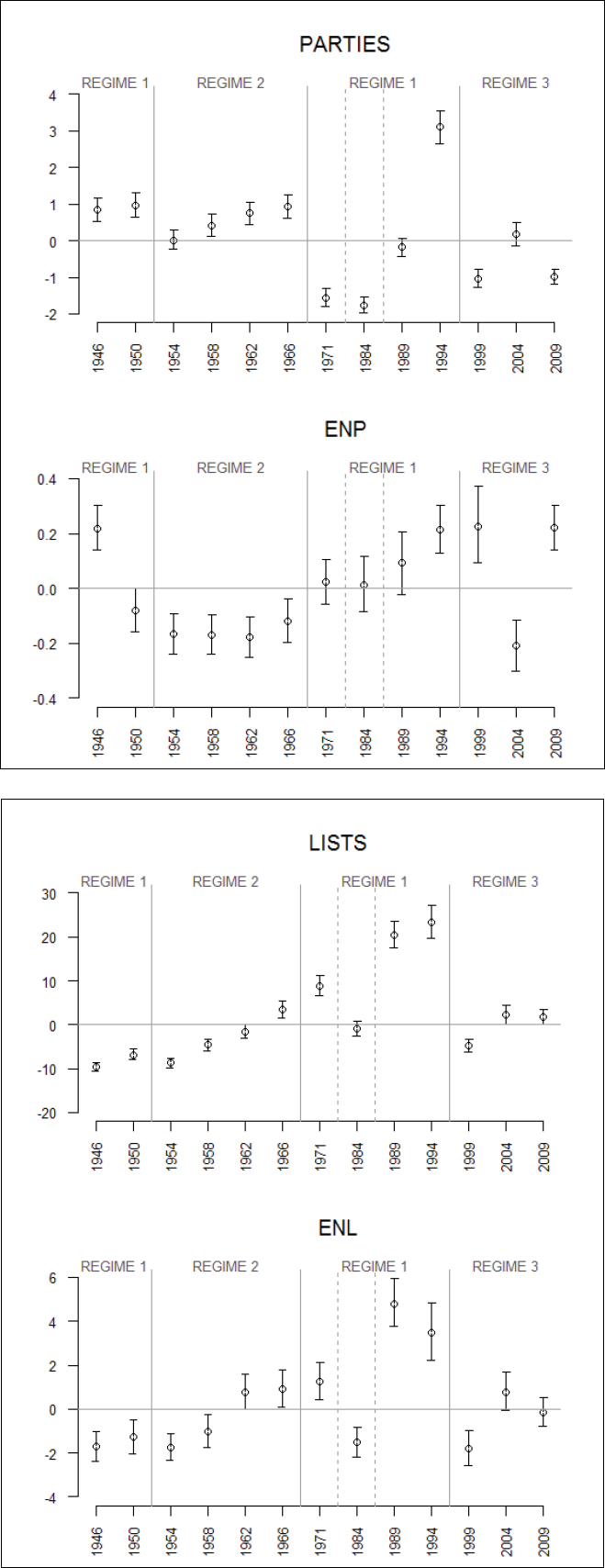
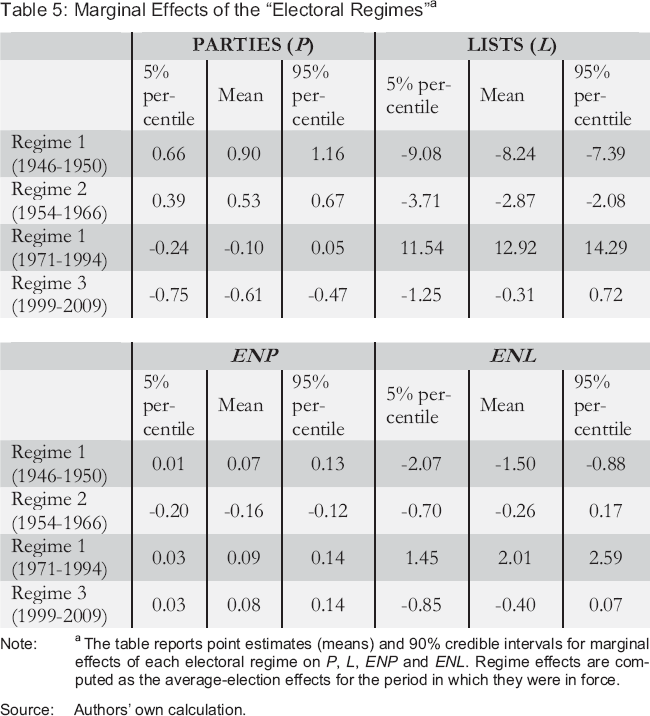
Turning to the analysis of the three “electoral regimes” identified in Uruguay between 1946 and 2009, Table 5 summarizes the estimated impact of each regime on the number of available and voted-for parties and lists, compared against the average predicted values for the whole period under study. The estimates for “regime 1” are presented discriminating between the two periods in which it was used, 1946-1950 and 1971-1994. Figure 4 complements this information, presenting election-specific effects capturing the influence of additional contextual factors that may have influenced the evolution of the dependent variables beyond the electoral reforms.
Election-Year Marginal Effects
Marginal Effects of the “Electoral Regimes” a
Note:
The table reports point estimates (means) and 90% credible intervals for marginal effects of each electoral regime on P, L, ENP and ENL. Regime effects are computed as the average-election effects for the period in which they were in force.
Source: Authors’ own calculation.
In line with our expectations, the number of parties running for office under “electoral regime 2”, in force between 1954 and 1966, was 0.53 than the average over the whole period. However, P was not significantly higher than in the 1946-1950 elections, held under “electoral regime 1”. Moreover, the effective number of parties under “regime 2” was actually lower than the 1946-2009 average. Also contrary to our theoretical predictions, P was lowest under “electoral regime 3”. The results for lists are quite inconclusive as well. As stated in our sixth hypothesis (H.6), the elimination of the “triple simultaneous vote” (TSV) after the 1997 reform tended to reduce the number of available and voted-for lists under “electoral regime 3” vis-à-vis the previous 2 regimes. However, this effect is not significant at the usual confidence levels. Overall, then, we find no consistent support for hypothesis H.6.
It is important to mention that the reinstatement of “regime 1” in 1971 took place simultaneously with the emergence of a new major party – the Frente Amplio – exhibiting a relatively large degree of within-party fractionalization. This might partially explain the above-average levels of supplied and voted-for parties and lists observed under “regime 1” between 1971 and 1994 (Table 5). Also, it is worth noting that, even though the removal of the TSV did not lead to a significant reduction in the supply and demand for lists, it coincided with a clear reversal in the trend towards greater within-party fractionalization observed during the previous electoral regime. Thus, it seems that the prohibition for same-party lists to pool votes for the house elections did, to some extent, reduce the incentives for launching and supporting a large number of lists. Of course, this sudden drop in the number of competing and vote-getting lists need not only be explained by the new electoral regime, but also by the attainment of a new long-term electoral equilibrium once the Frente Amplio became a more consolidated party.
A closer look at Figure 4 also uncovers some interesting patterns regarding voters’ and elites’ reactions to the electoral reforms implemented during the period considered. The trends followed by the number of competing and voted-for lists shows roughly similar behaviors of voters and elites throughout the period considered. This is not only true before 1997, when the rules for legislative races remained constant, but also after the change introduced by the Constitutional reform. In contrast, P and ENP exhibit strikingly different tendencies in most of the election-years. Part of this divergence may be explained by the fact that, as discussed before, adapting to new electoral laws can take a relatively long time (Cox 1997; Gschwend 2007). Still, the fact that agents adjusted quite rapidly to changes in legislative rules but not in the presidential formula marks an interesting contrast. As stressed by Lago and Montero (2009), when elections for different elective bodies are simultaneously held under distinctive electoral systems, the strategic dilemmas faced by the political actors become particularly complex. There is virtually no research, however, on the impact of transformations in electoral laws on concurrent presidential and parliamentary races, how they influence the strategic calculations of voters and political elites, and whether these changes impact primarily at the executive or legislative level. Future work on this issue might help explain some of puzzling patterns regarding the evolution of the number of competing and voted-for parties observed in the figure.
Finally, as a robustness check, and following a reviewer's suggestion, we fit an alternative model with district-specific intercepts modeled as a function of the distance from Montevideo (see footnote 6). The main substantive conclusions of this specification, which are presented in the Supplementary Materials accompanying this paper (see Online Appendix available as this article's supplementary material at <www.jpla.org>), are essentially identical to those reported here. In particular, while this alternative specification indicates that the number of voted-for lists in each district is also negatively influenced by the distance from Montevideo, the results regarding hypotheses H.1–H.6 remain unchanged, reinforcing the validity of our findings.
Conclusion
Understanding the nature of electoral coordination is important because it potentially affects the representativeness of the elected government, the responsiveness and stability of the political system and, ultimately, the policy-making process and its outcomes. Coordination takes place both at the voter and the elite level: the mechanism defined by the electoral system to translate votes into seats creates incentives for citizens seeking to avoid “wasting their vote” and for political elites trying to maximize their chances of success to concentrate their support and resources on a few viable candidates. The result of the process, namely, the number of vote-getting contestants in a given race, will be thus determined by the mutually dependent decisions of voters and political elites. The strategic dilemmas faced by the agents become further complicated when they participate in a variety of races held under different electoral laws, as is typically – though not exclusively – the case in mixed-member systems or in multi-level democracies. The empirical approach implemented in this paper explicitly addresses these issues, simultaneously analyzing the impact of electoral rules and district magnitude on the number of competing and voted-for parties and house lists in Uruguay between 1946 and 2009.
Our results suggest that there is indeed a close relationship between relevant features of Uruguay's electoral structure and the outcomes of the coordination process. Consistent with previous research (Amorim Neto and Cox 1997; Benoit 2001; Blais and Carty 1991; Ordeshook and Shvetsova 1994), we found that district magnitude has a positive and significant effect on the number of competing and voted-for parties and lists. Given the peculiar characteristics of the Uruguayan electoral and party systems, the impact of district magnitude is larger at the within-party than at the party level. Also, it is considerably larger on the supply than on the demand side of the electoral market, indicating that political elites in Uruguay are more responsive to the incentives for strategic coordination induced by variations in district magnitude. This does not mean, as previous work suggested, that because Uruguay's intricate electoral laws impose strict information requirement on voters, strategic coordination can only take place among political elites (Piñeiro 2004: 37). Not only do voters take into account the influence of district magnitude in their electoral calculations, but in addition they also rely heavily on electoral history heuristics to discriminate between hopeless and viable candidates. In fact, our estimates reinforce previous findings by Gschwend (2007) and Lago (2008) in the sense that, when faced with complex decision environments, citizens use simple cues to avoid wasting their vote. Moreover, our evidence shows that politicians rely on previous election results as well in order to decide whether or not to run in a district.
Regarding the impact of electoral regimes, we did not find support for the hypothesis that the collegiate executive or introduction of a majority runoff system gave way to a larger number of competing and voted-for parties. Similarly, although the elimination of the possibility for same-party lists to pool votes for house races after 1997 seems to be associated with a decrease in the number of launched and vote-getting lists, this correlation is not significant at the usual confidence levels. Nonetheless, while previous studies concluded that the Uruguayan party system was on a path of increasing fractionalization (González 1991; Piñeiro 2004), our estimates clearly indicate that this tendency was reversed after the 1997 electoral reform. This suggests the removal of the “triple simultaneous vote” might in fact have contributed stop the expansion of within-party fragmentation observed between 1954 and 1994.
Turning to the limitations of our study, it is important to recall that correlation does not imply causation. A more careful causal analysis would require controlling for other factors that might also affect elite and voter behavior, such as demographic characteristics of the population, socio-economic conditions and other election-specific forces. Even though we compared contiguous elections and geographically close districts from a single, relatively homogeneous country, it would be obviously unrealistic to assume that all these relevant factors remained constant during the 58-year period under consideration. Nonetheless, we are confident that our approach improves upon previous cross-country studies that fail to control for differences other than aggregate-level institutional features and coarse measures of socio-demographic heterogeneity such as the number of ethnic groups.
A promising avenue for future research would be to replicate our analysis using individual-level data – ideally, obtained from a panel survey design clustered on the electoral district level – and extend it to other Latin American democracies. This would allow assessing the robustness of the main results reported here and enable a more precise account of agents’ electoral incentives and behavior. Obviously, since political surveys in most countries of the region generally cover only a handful of elections – typically those held after the return of democracy in 1980s and 1990s (Mattes 2007) – this kind of study would require sacrificing the broader historical perspective adopted in this paper. Hopefully, complementary research on micro-foundations and macro-outcomes will contribute to advance our knowledge about the impact of institutions on electoral coordination in Latin America.
Footnotes
Appendix
Online Appendix available as this article's supplementary material at <www.jpla.org>.