



Abstract
This article analyzes the continued popular support for Lula and Dilma in the face of multiple corruption allegations throughout their respective presidencies. What explains their ability to survive corruption? And what are the implications of this – at first sight – lack of electoral punishment for Brazilian democracy? In searching for answers to these questions, this article looks at four mechanisms that help explain the continued popularity of politicians amid allegations of corruption: the use of clientelism as payoffs, informational failures, the relevance of other issues, and rouba mas faz. By analyzing Lula's and Dilma's terms in office and their inopportune links to corruption, this article argues that the shifting strategies used to deal with corruption allegations effectively shifted the reputational costs of corruption away from individual political leaders and toward the Workers’ Party and the political system as a whole. This finding emphasizes the mid- to long-term consequences of corruption scandals on political parties and democratic institutions, while also shedding light on the paradoxical relationship between corruption as a voting valence issue and continuing electoral support for politicians allegedly involved in corruption.
Introduction
On 2 October 1992, inside the Palácio do Planalto, Fernando Collor de Melo signed the letter from the Brazilian Congress stating that he was required to step down as president in order to face impeachment. Just as Collor was leaving through the back door, the Partido dos Trabalhadores (PT) – the Workers Party – was cementing its image as the antithesis of the Collor administration (Hunter 2010: 61–62). In fact, few events had a greater impact on convincing the public that the PT and its leader, Luiz Inácio Lula da Silva, were tough on corruption (L. Figueiredo 2006).
Thirteen years and six months later, on 5 April 2006, one can only imagine Lula's relief when the final report of the special joint congressional committee spared him from any direct responsibility in the Mensalão scandal. Despite the committee naming eighteen deputies who received Mensalão payments, Lula survived and won re-election in 2006; but this and other corruption scandals severely tarnished the PTs previously squeaky-clean reputation. In October 2012, the court reached a verdict in the Mensalão trial, finding 35 of the 37 people charged (including Lula's former top aide, José Dirceu) guilty of corruption.
Dilma Rouseff, the petista who succeeded Lula as president in 2010, has seen a number of corruption scandals come to light under her presidency, but has so far managed to maintain her positive image by showing a tough stance on the issue. Nevertheless, corruption remains prominent and continues to affect public opinion in Brazil, as is further demonstrated by the wave of protests of mid-2013, which were partially based on claims of corruption.
This paper looks at the governments of Lula and Dilma and their inopportune links to corruption. In doing so, it specifically builds on existing literature that looks at the electoral effects of corruption in order to explain how Lula was able to sustain popular support and remain a success story despite multiple allegations of wrongdoing. Furthermore, this article analyzes and assesses the changes the Dilma administration has advanced in terms of dealing with corruption post-Lula. The analysis highlights how the political party ended up carrying the burden of negative reputational costs while individual leaders emerged somewhat unscathed from potentially damaging corruption allegations. This conclusion is somewhat counterintuitive, as corruption scandals are generally characterized as being more impactful on individual politician's careers than on political parties’ reputations (Entman 2012; Thompson 2000; Welch and Hibbing 1997).
Lula's and Dilma's continued success despite corruption, aside from presenting a compelling conundrum, may be a sign of problems with the adequacy of Brazilian democracy, particularly in terms of accountability (Ferejohn 1986). When the electorate fails to punish malfeasance, it undermines the quality and efficiency of democratic vertical accountability as a useful mechanism for control over politicians (Przeworski, Stokes, and Manin 1999). According to Warren (2004), the continued tenure of politicians tainted with investigations and scandals may undermine the principles of representative democracy, and eventually affect people's trust in democratic institutions (Anderson and Tverdova 2003). Given this concern, which researchers have raised regarding the corruption scandals during PT-led governments over the past decade (Filgueiras 2009), this paper also seeks to provide insights into the consequences for the quality of Brazilian democratic institutions of continued popular support amidst corruption.
This paper is arranged as follows: the first section provides a theoretical framework to explain various links between corruption and popular support for allegedly corrupt politicians and political parties. The second section analyzes Lula's two terms in office, looking first at how the PT rose to power by compromising its longstanding commitment against corruption, and later exploring the mechanisms that allowed Lula to maintain a successful image despite allegations of corruption The third section shifts the analysis to Dilma's first few years in office, looking at new ways used to address corruption in order to ensure popular support in the post-Lula era. The fourth and final section concludes by looking at how Lula's and Dilma's success in managing sticky corruption issues did not extend to the PT. In particular, this finding emphasizes the mid-to-long-term consequences of corruption scandals on political parties and democratic institutions, while playing down the reputational costs for individual political leaders. In light of the mid-2013 protests in Brazil, it seems that while charismatic politicians remain widely popular, certain political parties and the credibility of the overall political system are both paying a price for the prevalence of corruption. The conclusion also explores theoretical insights the Brazilian case provides into understanding the paradoxical relationship between corruption as a voting valence issue on the one hand, and the continuing electoral support and perceived success of politicians allegedly involved in corruption on the other.
Corruption and Popular Support
All else being equal, people prefer non-corrupt politicians to corrupt ones. In this sense, corruption is a valence issue in terms of voting behavior. 1 Yet corrupt politicians win elections and gain re-election. Examples abound: Berlusconi in Italy (Newell 2010), Olmert in Israel (Sharkansky 2006), Menem in Argentina (Balán 2011), Zuma in South Africa (Bassett and Clarke 2008), Asif Ali Zardari in Pakistan (Goodson 2008; Synnott 2009), among many others. The relationship between corruption and sustained popular support is surprising given corruption's negative connotations, and it poses important questions when analyzing and evaluating Lula's and Dilma's success over the last decade. How and why did Lula and Dilma survive multiple allegations of wrongdoing during their administrations? Existing literature attempts to explain the election and re-election of allegedly corrupt politicians in four ways: the use of clientelism as payoffs; informational failures; the relevance of other issues; and the claim of rouba mas faz (steals but get things done). As becomes clear later in this article, I do not consider these arguments to be alternative explanations, but rather they provide complementing dynamics that result in shifting the costs of corruption onto political parties rather than individual politicians.
On valence issues and corruption, see Chong et al. (2011) and Peters and Welch (1980), among others.
The clientelism as payoff argument proposes that governments establish a patron-client relationship with lower-income sectors of the population (Hutchcroft 1997). In light of this link, governments and political parties provide mostly private benefits in exchange for political support. Recipients interpret their receipt of particular goods, such as food, money, jobs, or social programs, as a payoff to look the other way when it comes to allegations of corruption. Following this logic, Chang and Kerr (2009) analyze and provide evidence of how members of patronage networks more frequently turn a blind eye to corruption than those who do not benefit from clientelistic networks. Wantchekon (2003) pushes this argument further by showing evidence that regional and incumbent candidates benefit most from clientelism. Others have pointed out that partisans are less likely than non-partisans to perceive and punish corruption among politicians and public officers from their party, which suggests that clientelistic practices may deter punishment for corruption (Anduiza, Galego, and Muñoz 2013; Dimock and Jacobson 1995).
Scholars also point to informational failures as a reason why corrupt politicians sustain popular support. This argument posits two different mechanisms. Firstly, the lack of transparency that is the norm in many countries makes it difficult to be aware of ongoing corruption in government (Rose-Ackerman 1996). In this way, lack of clarity serves corrupt politicians, since they sustain public support despite their corrupt activities (Manzetti 2000). Secondly, informational asymmetries among voters may help to explain why some are more sensitive to corruption accusations than others (Klasnja 2011). According to this idea, informed voters are more likely to punish corruption than uninformed voters, and this exacerbates the problem of voters’ limited knowledge, a point supported by evidence presented by Ferraz and Finan (2008). As a consequence of both these mechanisms, corrupt politicians retain support by banking on existing informational failures and asymmetries. Yet, information seems to be a necessary but insufficient condition for citizens to punish corrupt politicians (Chong et al. 2011).
Some authors have argued that politicians tainted by corruption retain support by emphasizing other issues (Rundquist, Strom, and Peters 1977). Seen in this way, corruption is only one dimension of a multidimensional voting space, and electorally successful corrupt politicians and parties bring other issues to the fore, so that voters support them despite corruption, and not because of it. Rundquist, Strom, and Peters (1977) show that voters may prefer corrupt politicians who share their ideology to cleaner politicians who do not. In addition to ideological reasons, despite hints of corruption, voters may choose candidates based on identity, religious, or kinship preferences (Chang and Kerr 2009). In the specific case of Brazil and the Mensalão scandal, Rennó (2011) shows that other issues overshadowed corruption to secure the re-election of Lula in 2006. To sum up, according to these arguments, voters make a rational trade-off by valuing issues other than corruption, and therefore fail to punish corrupt politicians.
A final and related argument is that voters tend to support corrupt politicians who overcome an otherwise inefficient system. In other words, voters reward politicians who ‘steal but get things done’ (rouba mas faz) in a system they consider ineffective. 2 Cynicism would drive this approach – the general perception that all politicians are corrupt leads some people to vote for those that at least “do something” while in office (Rivero and Fernández-Vázquez 2010). In this way, politicians build a reputation as efficient public managers while accumulating private wealth through corruption. Winters and Weitz-Shapiro (2013) explore this hypothesis through a survey experiment in Brazil, and conclude that respondents do not behave in accordance to the rouba mas faz argument. Instead, they find that voters react to information on political misconduct by punishing corrupt politicians, a result that is at odds with previous findings from public opinion studies in Brazil (Almeida 2006; M. Figueiredo 2004). Pereira, Melo, and Figueiredo (2009) make a finer distinction by suggesting that voters follow the rouba mas faz reasoning, but only to an extent. Voters only punish corrupt politicians if they receive information about wrongdoing immediately before an election. At other times, they make light of claims of corruption, and voters may choose to follow a rouba mas faz logic.
For a review on the origins of rouba mas faz, see Cotta (2008).
The following section explores how these claims connect to Lula's continued success under the shadow of allegations of corruption. While these four factors help explain Lula's resilience, it is also interesting to note that the most damaging corruption allegations of the period – namely the Mensalão scandal – were actually connected to the PT's strategies in managing the government coalition. In this sense, these strategies, which helped Lula survive prominent corruption scandals, may have contributed to a shift in the negative consequences towards the PT.
The fight against corruption was one of Lula's main strengths in the 1990s, but soon after he took office in 2003, corruption became perhaps one of the main concerns about the PT government. The fact that campaigning on an anti-corruption platform makes a party or politician more vulnerable to allegations of corruption makes this shift more significant (Vidlakova 2011). Understanding Lula, and the PT's, difficult relationship with corruption requires an analysis of his initial election campaign, and the compromises he had to make in order to take office. It also requires an examination of the major corruption scandals during Lula's terms in office, showing how coalition management issues help explain some of the main revelations during this period.
The Ascent of the PT: Links between Corruption and Popular Support
Only nine years after its creation in the context of a disintegrating military regime, the PT came very close to winning the presidency in 1989. Its decidedly leftist ideology and its connections to unions scared the economic elite, and ultimately gave Collor de Melo the presidency. As stated before, Collor's ungraceful departure from office bolstered the PT's ethical image within a political sphere defined by corruption. Lula seized on this positive image, even stating multiple times that if the PT were to win the presidency, corruption would be drastically reduced and generate a 10 percent surplus in the government budget (L. Figueiredo 2006: 79). At least in part as a result of this reputation, the PT slowly improved its electoral performance in state and congressional elections in the following years. 3 The PT increased its number of representatives in the lower chamber from 35 to 58 in only a couple of elections. The number of PT senators increased from one to four between 1990 and 1994.
For a thorough analysis of the PT progression and adaptation, see Hunter (2010).
However, voters did not seem to trust the PT and Lula enough to elect him as president in the 1990s. Lula lost the 1994 and 1998 elections to the centrist coalition headed by Fernando Henrique Cardoso and the Partido da Social Democracia Brasileira (PSDB). These electoral defeats redefined the PT and, under José Dirceu's direction, moderated its ideological inclinations (Goldfrank and Wampler 2008; Hunter 2010). By the 2002 presidential election, the PT had changed quite significantly. Lula and Dirceu led the PT to become a national and electorally integrated party with a renewed political strategy (L. Figueiredo 2006: 80). After presenting electoral coaligações 4 in 1989, 1994, and 1998 that included only traditional leftist parties that lacked solid and ample electoral bases, in 2002 the PT led an electoral coaligação that was far more ideologically heterogeneous. This coaligação included center-right to right wing parties such as the Partido Liberal (PL) and the Partido Trabalhista Brasileiro (PTB) – the latter in the runoff election. In fact, the heterogeneity of the government coalizão after winning the 2002 election would only increase with the inclusion of other parties such as the pragmatic Partido do Movimento Democrático Brasileiro (PMDB) and the center-right wing Partido Progresista Brasileiro (PPB/PP).
Coaligação refers to an electoral coalition put together in preparation for an election, while coalizão refers to a governing coalition once in office (Figueiredo Cheibub 2007).
These alliances helped the PT win the presidency, and then ensured enough support in Congress to move the government agenda forward. However, the PT could not depict some key members of the alliance (particularly the PL and the PTB) as having a strong history of anti-corruption. Moreover, a number of municipal PT administrations – particularly in the state of São Paulo – were already showing signs of corruption in the management of public transportation and garbage collection (L. Figueiredo 2006; Goldfrank and Wampler 2008; Hunter 2010). Despite some discoveries by the Ministerio Público and some exposés in the media, the PT still maintained a sufficiently good reputation for clean government that it could cope with some sticky issues at the municipal level. The PT had clearly departed from its principled position in the anti-corruption camp, becoming more flexible with its political strategy by accepting partners with opposing ideological stances and questionable reputations in terms of corruption. To give just one example, the alliance with the PPB brought former mayor of São Paulo, Paulo Maluf to the government coalition; Maluf had previously been accused of multiple corruption schemes and money laundering.
Winning the support of political parties that represented starkly different ideological stances proved costly for the PT. On the one hand, the program of government had to accommodate a wider range of interests, which threatened to dilute key aspects of the party platform. 5 On the other hand, it transpired that building the electoral coaligação and the government coalizão proved to be costly in a more explicit way. According to journalistic sources (L. Figueiredo 2006) based on allegations by political actors, the PT made monetary promises to the PL and the PTB in order to build the alliance. 6 Moreover, prior unsuccessful presidential campaigns led the PT leadership to consider professional management, an essential requirement for political campaigns. Lula insisted on hiring Maluf's former campaign manager, Duda Mendonça. The advertising and political strategist officially closed the deal with the PT in exchange for 10.4 million BRL (Brazilian reais) (over 3 million USD), although a number of reports and Mendonça himself put that number at 25 million BRL (8 million USD), the difference allegedly being paid through caixa dois (Brígido 2012; Uol 2005). As a result, according to these sources, the PT moved into the Palácio do Planalto owing at least 55 million BRL (17 million USD). Evidence shows that campaign donations continued to impose constraints on the PT throughout Lula's administration (Boas, Hidalgo, and Richardson 2011).
This aspect goes beyond the scope of this paper, but has been addressed by prior research (Samuels 2004).
I have argued elsewhere that allegations such as these are usually politically motivated. See Balán (2011).
The PT's reputation for ethics did not hasten its ascension to power. Voters prioritized other issues in 1994 and 1998. Paradoxically, the PT coalitions and administrations at the municipal level had to compromise PT's anticorruption image to secure Lula's election. Similarly at the 2006, 2010, and 2014 elections, voters did not decisively punish incumbents for corruption. The results of these elections support the view that issues other than corruption significantly affect electability. As Rennó (2011) aptly demonstrates, corruption perceptions forced Lula to a runoff election in 2006 when otherwise he would have won in the first round. Yet, he was still re-elected, and then was succeeded by another petista who was recently re-elected; so the electoral consequences of a tarnished image were not enough to drive them out of office. As Rennó (2011), Pereira, Rennó, and Samuels (2011), and Hunter and Power (2007) point out, corruption does have an impact on Brazilian voters. Yet, this impact does not seem to determine election outcomes.
Since the transition to democracy, corruption scandals have been ubiquitous in the Brazilian political sphere. Lula's presidency was far from an exception; he entered office in the shadow of corruption scandals (Correios, Bingos), the Mensalão scandal took central stage in his first term, and additional scandals (Sanguessugas, Dossier) followed his re-election. As analyzed in the preceding section, most of these scandals emerged because of the compromises made in Lula's path to winning the presidency and in the composition of the government coalition (Pereira, Power, and Raile 2008).
In fact, the origins of the Mensalão can be traced back to Lula's first months in office. After winning the presidential election in October 2002, and before taking office, Lula put together his cabinet. He had to confirm his campaign commitment to moderation, key to appeasing financial market interests, while awarding seats to the different factions within the PT (the Campo Majoritario and the more leftist factions) and other coalition parties in order to ensure a majority in Congress. The PT was the lower chamber's largest party with 91 members, and its many electoral partners brought that number up to 219. Yet, a legislative majority would require securing the support of another 38 members. Lula and his top aides decided to increase the size of the cabinet from 21 to 36, which provided more seats to distribute but also watered down the overall importance of each position. In assigning these posts, Lula included new partners, such as the PMDB, but did so without following an unwritten proportionality rule calling for a constant ratio between the number of cabinet seats and the number of congressional seats granted to a particular party. According to Raile, Pereira, and Power (2011), Lula's cabinet was more disproportional than any other since 1988. Lula granted most cabinet posts to his own party in order to appease different factions within the PT, which made it difficult to sustain support from the rest of his government coalition (Goldfrank and Wampler 2008). As Hunter and Power (2005) point out, no president in Brazil takes office without a coaligação behind him or her. And it can be added, no president is able to govern without a coalizão either, and this requires significant bargaining (Fleischer 2012). The Lula government consequently had to secure the loyalty of coalition members by means other than cabinet appointments, thus creating the need for side-payments that generated the Mensalão scandal (Raile, Pereira, and Power 2011).
The congressmen who received bribes through the Mensalão generally came from three clientelistic parties that were ideologically distant from the PT – the PTB, the PL, and the PP. As Pereira, Power, and Raile (2008) explain, securing the loyalty of these parties would require one of the following three strategies: either giving them control over certain state resources, whether through cabinet posts or lower rank positions; adjusting the PT policy agenda to conform to the needs of these parties, which given the highly opportunistic nature of these parties would be unlikely, and arguably impossible; or paying them for their support. The PT chose a dangerous combination of the first and third options. The PTB received side-payments and control of Correios, the state-owned postal service. Roberto Jefferson, leader of the PTB, revealed information about the side-payments he and other deputies of coalition parties received in the wake of the Correios scandal and the PT's attempts to make his own party the scapegoat (Fleischer 2012). The allegations provided details about the payments, and Marcos Valério's role as the distributor. Jefferson implicated many of the leading figures of the PT in his accusations, including José Dirceu, José Genoino, and others (Sola 2008), although he spared Lula.
According to Marcos Valério, the PT spent 136 million BRL a year (over 40 million USD) securing congressional support (Folha 2012). However, the exact amount spent through the Mensalão scheme is still uncertain and a matter of contention. Despite this uncertainty, evidence shows that the PT made payments by way of caixa 2, an off-the-record and unofficial slush fund, which allegedly contained money obtained from kickbacks from large state contracts (Fleischer 2012). As a result of the scheme's magnitude, the previously untarnished image of Lula and the PT, and a certain animosity from mainstream media towards the government (Fleischer 2012; A. Pereira 2012), the scandal generated massive public attention. The PT and Lula's image suffered, and many important figures were forced to resign their posts. A number of Comissões Parlamentares de Inquérito (CPI) – Parliamentary Commissions of Inquiry – were launched, investigating the initial Correios scheme as well as the Mensalão itself. To the shock of the public and political insiders, a number of other corruption scandals emerged (Folha 2005; Veja online 2005). The PT's defense was far from compelling: Soares, the PT treasurer, admitted to the CPI that payments existed, while claiming they were contributions to campaign finances (Goldfrank and Wampler 2008). Lula initially said that no stone would be left unturned in pursuing the truth (Fleischer 2012), but later dismissed the charges as business as usual, saying his party was only doing what others had done (Sola 2008).
As Goldfrank and Wampler argue, early on it had seemed that “Brazil had transformed the PT more than the PT had transformed Brazil” (Goldfrank and Wampler 2008: 266), and the reputation of the PT and Lula both suffered from these corruption scandals. The PT lost a number of important figures, and Lula was even reported to be questioning whether to run for the 2006 presidential election (Traumann and Ulhôa 2005). Some analysts declared Lula's government finished, and called for impeachment (Costa and Cunha 2005; Dimenstein 2005). After the scandals, polls showed for the first time since 2002 that Lula was unlikely to be re-elected, trailing José Serra by almost 10 percentage points in opinion polls. 7 Similarly, polls showed approval ratings for the government falling by 15 percentage points after the scandal, going all the way down to 31 percent. Months later, with Lula already running for re-election, the PT was further hit by other corruption scandals, such as Sanguessugas – which involved the diversion of public funds originally destined to purchase ambulances – and the Dossier-gate – in which members of Lula's re-election campaign team were accused of attempting to purchase evidence on a political rival's involvement in the Sanguessugas scheme (Goldfrank and Wampler 2008). By early 2006, Brazil's electorate considered the PT, once perceived as the cleanest party in the Brazilian political sphere, to be the most corrupt (Goldfrank and Wampler 2008).
Based on information available at ≤http://media.folha.uol.com.br/datafolha/2013/05/02/aval_pres_15122005.pdf≥ (25 November 2014).
Yet the president survived, and many would say ‘thrived’, under these circumstances. One reason for this is that the same schemes that generated corruption scandals also allowed Lula to get his policies approved by Congress. Extending the set of tools to ensure support in Congress through side-payments allowed Lula to pass his policy agenda. Despite his difficulties in managing the government coalition, Lula continued Cardoso's successful policies, and promoted changes that proved to be fruitful.
This ability to pass legislation proved useful in advancing key policies that helped Lula win the 2006 presidential election by focusing on other issues that took precedence over corruption. The expansion of Bolsa Família, the Brazilian conditional cash transfer program (CCT), from 8.5 to 11.5 million families, together with a 13 percent increase in the minimum wage and poor Brazilians being granted greater access to loans, won Lula the economic vote (Sola 2008). An international context far more favorable than the one Cardoso had faced during his time in office helped shift the media and voter's attention away from corruption allegations (Hunter and Power 2007). This context lends support to the idea first advanced by Rundquist, Strom, and Peters (1977) that issues other than corruption may ensure continuing support for politicians accused of wrongdoings. While the PT was punished by a poor showing in congressional elections, a positive economic outlook and Lula's ability to serve his changing constituency, secured his re-election. His popularity soared during his second term, reflecting the fact that the electorate's assessment of presidential performance is based on the importance of issues other than corruption. Despite the global financial crisis of 2008, Brazil maintained its economic growth, while poverty numbers continued to decline (Fleischer 2012).
This focus on other issues links to the second argument presented above; namely that clientelism can become a payoff for popular support (Chang and Kerr 2009). Indeed, Lula's frugal spending during his first two years in office allowed him to increase spending in the run up to the election. This ability to spend, together with a social policy designed to target the poorest families, resulted in remarkable achievements in terms of poverty reduction. The correlation between social spending, in the form of Bolsa Família, and the vote share for Lula at the state level compared with that in 2002, provides support for the clientelism-as-payoff argument (Hunter and Power 2007). The poor significantly improved their situation during Lula's first term, and rewarded him for this improvement (Shikida et al. 2009). Forty-seven percent of the electorate had a family income below the amount two full-time minimum wage jobs would provide, and this segment of the population voted for Lula in larger numbers than any other segment (Hunter and Power 2007: 20). Social spending continued during Lula's second term in office, producing remarkable results in terms of poverty reduction. 8 Dilma rode Lula's coattails and won the presidency in 2010, thanks to Lula's generally positive image, particularly among lower income voters.
Bohn (2011) disagrees with the idea that social programs generated support for Lula, yet her evidence is questioned by Zucco and Power (forthcoming).
The support from lower income voters for Lula represented a shift in the traditional electoral base of the PT (Hunter and Power 2007; Soares and Terron 2008; Zucco 2008). The urban middle classes originally comprised PT's electoral base, particularly in the most developed and industrialized southern states of São Paulo and Rio Grande do Sul (Goldfrank and Wampler 2008). Until the 2006 election, neither Lula nor the PT polled strongly in the less developed regions of the country in the north and northeast. Targeted social spending, and in particular Bolsa Família, helped change this trend. In fact, the ten states where Lula received the highest percentage of the vote in the 2006 presidential election had the highest percentage of families targeted by CCTs (Goldfrank and Wampler 2008). Recipients of Bolsa Família also had less exposure to news about corruption than Lula's previous urban middle class political base (Ferraz and Finan 2008), a finding that supports another of the arguments presented above regarding informational failures and asymmetries (Klasnja 2011). People exposed to more information about corruption will likely care more about it, and vote accordingly (dos Santos 2008). Hence, the shift in support for Lula, aside from providing good examples of social spending as payoff and the importance of other issues, also highlights the importance of informational failures and asymmetries in explaining continued popular support despite corruption.
The combination of these arguments lends support to an overall view of Lula as an effective and charismatic politician working under less than ideal conditions. This view represents a variation of the rouba mas faz view, although in this case Lula's political party, the PT, took most of the blame for the first part (rouba, or steals) and Lula benefitted most from the latter part (faz, or does). In fact, a cursory view of Lula's and the PT's separate approval ratings and positive/negative images, shows that while corruption scandals damaged them both and economic achievements helped them both, Lula suffered fewer losses than the PT and experienced greater gains. Support for Lula did not necessarily extend to support for the PT (Goldfrank and Wampler 2008; Hunter and Power 2007). Lula always enjoyed wider popular support than the PT, but the disparity increased in the 2006 election. While Lula won the presidential race by a wide margin, the PT lost seats in both chambers and the PMDB surpassed it as the largest congressional minority in the lower house (Hunter 2010). As stated by Hunter and Power (2007), this electoral outcome was particularly poor when compared with historical standards. Both Sarney and Cardoso increased their congressional delegations when they held office.
Allegations of corruption stuck to the PT more than they did to Lula. PT figures had to resign their posts and face investigation, and the party's candidates for congressional, state, and municipal elections lost votes due to the PT's tarnished image (de Figueiredo, Hidalgo, and Kasahara 2011). Lula's wide appeal and charisma protected him, whereas the PT's more ideological and narrower voting base made it more vulnerable (Samuels 2006).
While corruption left his party vulnerable to electoral punishment, another factor protected Lula. Personal experience with corruption reduces the probability of an incumbent being re-elected, but perceived corruption does not (Deegan-Krause, Klasnja, and Tucker 2011). Consequently, pocket-book corruption voting is much more prevalent than sociotropic corruption voting. Because most of the corruption scandals that emerged close to Lula were high-politics, grand-corruption schemes, voters only had mediated perceptions of these schemes. Meanwhile, many of the PT's corruption scandals at the local and municipal levels took place, by definition, closer to the voters, some of whom personally experienced these corruption schemes (Brollo and Nannicini 2012; Ferraz and Finan 2008). Therefore, the different impacts of pocket-book and sociotropic corruption voting also helps explain the apparent paradox of Lula's success at the national level and the PT's struggles at the local level.
Given Lula's popularity during his second term, he might have been able to change the rules and run for a third consecutive term in office. However, Lula himself clearly stated that he had no intention to change the constitution and attempt a second re-election (French and Fortes 2012: 14). Without an obvious candidate to succeed him, Lula decided to nominate Dilma as the PT candidate for the 2010 presidential election. Dilma had served as his chief of staff since the departure of José Dirceu in 2005. Dilma was far from being a true PT insider, as she had only joined the party in 2001 (Montuori Fernandes 2012) and had never before run for political office. As such, she was at the time considered an electorally unknown commodity. In fact, initial polls showed Dilma lagging behind José Serra, the São Paulo governor and likely opposition candidate for the PSDB (Fleischer 2012: 2). Dilma's image was described as being associated with “strong managerial skills and an imposing, at times abrasive, style” (de Souza 2011: 86), and she seemed to lack Lula's charisma and popular appeal to the lower classes.
However, as the 2010 presidential elections approached, Dilma narrowed the gap that separated her from Serra. Voters found the PSDB candidate unappealing, and he ran a poor campaign that focused on fiscal austerity, judging Cardoso too unpopular to mention and Lula too popular to criticize (de Souza 2011). Meanwhile, Dilma ran an energetic campaign and had Lula's staunch support. In fact, Lula unambiguously threw all his political capital behind Dilma, and his 80 percent approval ratings proved key in helping her win the presidency. For most of the campaign, Dilma made the election about the economy. Yet, close to the election both sides traded corruption allegations. Serra attempted to benefit from the involvement of Erenice Guerra, Dilma's aide, in an influence-peddling scheme (Mendes 2011; Peixoto and Rennó 2011). Dilma's campaign team responded by airing irregularities in subway construction contracts in São Paulo. It was a third candidate, Marina Silva (former Lula environment minister and a long time PT member until 2009, running for the Partido Verde, Brazil's Green Party), who benefitted the most from these counter-accusations by unexpectedly gaining almost 20 percent of the vote in the first round (Souza de Amorim 2011). Despite not being able to win outright in the first round, Dilma defeated Serra convincingly in the runoff, receiving more than 12 million more votes (12 percent) than the PSDB candidate.
Dilma's electoral victory marked the historic inception of Brazil's first female president. Yet the celebrations did not last long, and as soon as she took office, she faced a number of challenges. Dilma had to navigate a complicated equilibrium to capitalize on Lula's political appeal, while avoiding being perceived as merely a façade for Lula's third term. The notion that Lula continued to govern from the shadows threatened Dilma's legitimacy, and limited her political clout. Meanwhile, she had to manage a complex and ideologically heterogeneous government coalition without the clear support of her own party. Many inside the PT still perceived Dilma as an outsider. At the same time, corruption allegations had severely tarnished the PT's image, and a close alignment with the party would be costly for Dilma. Lastly, in contrast to the vast experience of Lula, she had to manage this complex scenario with little personal political capital, and remained a mostly unknown quantity to many voters.
Dilma's room to maneuver was also severely constrained. Given the success of Lula's policies, many of them simply had to be kept in place, narrowing the possibilities for Dilma to differentiate herself from her popular predecessor. As Zucco (2013) argues, while social spending, and in particular Bolsa Família, had helped both Lula win re-election in 2006 and Dilma win in 2010, the political gains from these measures were likely to fall away. When policies become rights, maintaining them confers no political benefit. Perhaps paradoxically, her chosen strategy involved fighting corruption, which was what had been Lula and the PT's Achilles heel. Dilma imposed a zero tolerance policy for corruption in her cabinet, and allowed the Mensalão trial to move forward in order to build her own positive image, and to distance herself from Lula.
Dilma's Faxina
Dilma compensated for any weakness in her position when taking office by retaining some of Lula's cabinet members, and by giving posts to officials who had played key roles in her campaign (de Souza 2011). These figures included António Palocci, former finance minister under Lula, who was widely considered a competent economic manager and a shrewd political negotiator. Palocci had left the Lula administration amidst a scandal, but Lula backed him and he became Dilma's chief of staff and one of the most influential officials in the government during her first months in office (C. Pereira 2011). However, in June of 2011, only six months after Dilma took office, new corruption allegations forced Palocci to resign.
Dilma decided not to shift the distribution of seats in the cabinet to replace Palocci; instead she appointed Gleisi Hoffman, a lesser known member of the PT (C. Pereira 2011). When Dilma had to fire 17 officials from the Ministry of Transport, including the minister, Alfredo Nascimento of the Partido da República (PR) (Marques 2011), for charging a five percent bribe on every Ministry of Transport contract, she replaced Nascimento with another member of the PR, Paulo Sérgio Passos. Just two months later, she replaced the Minister of Agriculture, Wagner Rossi (PMDB), because of corruption charges (Muello 2011). Afraid of disrupting the relationship with an important coalition partner, Dilma replaced Rossi with another PMDB figure, Mendes Ribeiro Filho (Rosa 2010). Dilma's first year in office would bring to the fore scandals in tourism, sport, and labor that prompted further cabinet changes. In all, Dilma removed seven cabinet members in the space of 15 months, in what came to be known as her faxina (housecleaning).
Dilma's zero tolerance policy when it came to corruption in the cabinet differed from the approaches taken by both Lula and Cardoso to similar allegations during their presidencies (Fleischer 2012). In fact, throughout the eight years of his presidency, Lula only dismissed four cabinet members because of corruption allegations (see Table 1). 9
Cabinet Changes due to Corruption Allegations under Lula and Dilma
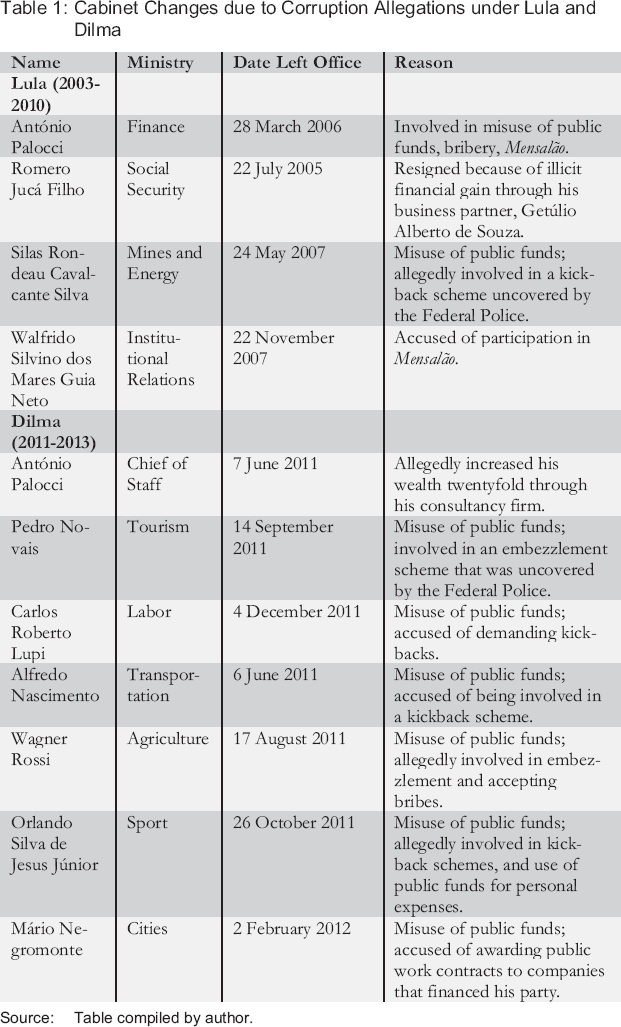
Cabinet Changes due to Corruption Allegations under Lula and Dilma
Source: Table compiled by author.
Out of 45 cabinet members that were replaced during this time. Based on research compiled by the author. For cabinet changes, see online: ≤www.biblioteca.presidencia.gov.br/ex-presidentes≥ (25 November 2014).
Dilma's quick and decisive responses to corruption allegations helped reshape her image as an efficient and clean politician, and by the end of 2011, she was reaching approval ratings of 60 percent, a 15 percent improvement on her initial ratings in a year marked by corruption scandals. Once again, her strategy effectively shifted the costs of the continuing corruption allegations away from herself and towards the PT and the other parties in her coalition. Moreover, her high approval rating after one year in office was almost 20 percentage points higher than Lula's ratings had been after one year in office. 10 From the end of 2011 until the protests in 2013, Dilma's image improved steadily, which made her the front-runner for the 2014 presidential election. According to A. Pereira (2012), much of this newly gained political capital was due to her anti-corruption stance, which contrasted with people's expectations as well as with prior common practices. Although Dilma's popularity took important hits since 2013, she was re-elected to a second term in October 2014 after closely defeating Aécio Neves from the PSDB in the runoff election.
Information is available through Datafolha, online: ≤www.datafolha.com.br≥ (5 November 2014).
In late 2012, a poll by CNI/Ibope showed two seemingly contradictory trends in public opinion: while Dilma remained widely popular, with more than 60 percent approval ratings, the piece of news that people most associated with the Dilma administration was the Mensalão trial (Bramati 2012). Two basic premises explain this apparent paradox. On the one hand, Brazil's ex post accountability deficit meant that people were not used to seeing judicial processes involving powerful political figures advance, uncover misdeeds, and reach strict sentences (Taylor and Buranelli 2007). Therefore, despite its negative connotations, most voters viewed the Mensalão trial as good news.
On the other hand, thanks to her firm stance and zero tolerance on corruption during her first year in office, voters perceived Dilma, whether true or not, as a guarantor of the integrity of the trial. Amidst allegations that Lula approached five members of the Supremo Tribunal Federal (STF) – the Brazilian Supreme Court – to exert pressure and influence the outcome of the Mensalão trial (Seligman 2012), Dilma kept her distance and did not intervene. In fact, the image of an independent court investigating the party in power further helped solidify Dilma's anti-corruption image.
The Mensalão trial became a sign that, despite being less than perfect, the Brazilian judicial system had come a long way in the past few decades. As Michener and Pereira (2013) point out, a comparison with the 1990s proceedings relating to impeached ex-president Fernando Collor de Melo, shows great strides in terms of informational asymmetries, inter-agency coordination, and avoidance of political intervention. Moreover, the trial helped establish a growing perception that wrongdoings were becoming more visible, and that they would be prosecuted and eventually punished. Dilma's faxina, and her successful support for the comprehensive Freedom of Information Law passed in 2011, also signaled this positive trend. At least until 2013, Dilma made the issue of corruption work to her advantage, whereas it had threatened the PT's hold on power throughout Lula's administration. Yet, just as Lula got credit for social spending while the PT did not, Dilma seemed to get all the credit for fighting corruption, while the PT and the rest of the political system took the blame for continuing corruption in the country.
Conclusion
The PT has gone from having an image of integrity in the 1990s to taking much of the blame for the corruption scandals during Lula's and Dilma's terms in office. Lula was able to maintain his popular appeal despite the allegations of corruption surrounding him. The emphasis on other more positive issues, the use of clientelism as payoff, a shift in his constituency towards portions of the population less likely to be conscious of corruption allegations, and an overall image of rouba mas faz, all help explain this outcome. The implementation and expansion of Bolsa Família made Lula widely popular. Meanwhile, as he reaped the political benefits of these policies, the PT took the fall for the corruption scandals. Dilma maintained Lula's successful programs, but added an emphasis on fighting corruption. These measures distinguished her from her predecessor, and increased her popularity despite the many corruption allegations during her first years in office. Her strategy effectively shifted the reputational costs of corruption towards the PT and other coalition parties, and accordingly the electorate continues to blame the PT for the seemingly unending stream of corruption allegations, as seen again in the late 2014 elections. The mid-2013 protests showed a growing disenchantment with the corruption of the political system. While the protesters did not specifically target individual politicians, they signaled a growing sense of discontent with what the public sees as endemic corruption.
As a result, the PT is in the paradoxical position of having had two highly successful presidential periods under Lula, and potentially two more under Dilma, without being able to expand its own linkage with the voters. While Lula and Dilma are widely popular, voters perceive the PT as the most corrupt political party within a system full of corrupt political parties (Lima 2012). Whereas Dilma, despite a downturn in the public's perception of her during 2013 and 2014, was able to win reelection, and Lula remains a popular and viable candidate, the future of the PT is unclear. While Lula managed to survive corruption allegations and Dilma at least initially found a way to leverage them in her favor, the PT seems to be paying the biggest price for corruption.
A broader question concerns how corruption survival, sustained popular support amidst corruption allegations, and corruption-based protests, will affect the quality of Brazilian democracy. Some scholars argue that electoral insensitivity to corruption implies significant shortcomings, particularly in terms of democratic accountability (Przeworski, Stokes, and Manin 1999). While the Brazilian case shows that corruption has a limited effect on the outcome of an election, particularly at the national level, the 2013 protests show that non-electoral mechanisms can bring corruption to the forefront. Moreover, the fact that issues other than corruption dominate the electoral process may not necessarily imply a negative outcome. In fact, as Caparrós (2011) argues, if corruption becomes the main concern, then there is a danger of falling into honestismo, which he defines as a state of affairs in which policy positions and ideological stances do not matter, opening the door for questionable policies as long as a semblance of integrity and honesty is maintained.
The Brazilian case suggests that concerns regarding the continued electoral support for politicians and parties linked to corruption scandals should be considered within the broader political context. Corruption seems to be a valence issue, but this does not imply that it is the major concern for voters. This conclusion, in itself, does not necessarily point to democratic shortcomings. Growing attention to corruption and the mid-2013 protests may help reduce corruption in the future, as they may help convey politicians the sense that corruption can become a barrier to election. The Brazilian case shows that corruption allegations and protests may both have limited consequences for individual politicians; nevertheless, corruption seems to undermine the credibility of the overall system, which may be the most important negative consequence for democracy.