



Abstract
A wave of leftist governments has swept Latin America in recent years, attracting a great deal of scholarly attention. Yet a number of new conservative parties have attained considerable electoral success, as well. This paper argues that a conservative party can succeed electorally and consolidate organizationally when it is supported by two strong groups in society: the business community and the neoliberal technocrats. To assess the argument, I explore the successful trajectory of the rightist Alianza Republicana Nacionalista (ARENA) in El Salvador. I then evaluate the generalizability of the argument by comparing ARENA's trajectory with another conservative party in the region, Unión Demócrata Independiente (UDI) in Chile. In addition to proposing a new theory for conservative party success in Latin America, the paper calls for the revival of socioeconomic explanations in political science.
Introduction
The so-called pink tide sweeping across Latin America has attracted scholarly attention for years. Yet, despite all the excitement about the left's resurgence in the region, many conservative parties are alive and well. In fact, a number of the parties that have been founded in the region during the past few decades and that have managed to consolidate themselves organizationally and attained considerable electoral success are on the right side of the spectrum. This paper explores the successful trajectory of the conservative party “Alianza Republicana Nacionalista” (ARENA) in El Salvador. 1 To explain ARENA's success, three hypotheses arising from different theoretical approaches are examined. While institutional and cultural variables fail to provide a satisfactory explanation, an argument based on socioeconomic structures can account for the consolidation and performance of ARENA.
This article originated as a Master's thesis titled “On the Right Track? Business, Economic Experts, and Conservative Party Building in Latin America: The Case of El Salvador” (The University of Texas at Austin, 2009). I would like to thank the following people for their helpful comments: Álvaro Artiga González, Sandra Botero, Eduardo Dargent, Henry Dietz, Sébastien Dubé, Laura Gamboa, Kenneth Greene, Raúl Madrid, Randy Uang, and two anonymous reviewers from the Journal of Politics in Latin America. I would like to extend special thanks to Kurt Weyland for his constructive commentary. Any remaining errors are solely mine. The field work was supported by a Lozano Long Summer Field Research Grant from The University of Texas at Austin.
The paper speaks to a broader theoretical debate in the field of political science. Some authors have criticized mainstream political science for its atomistic nature (Weyland 2002: 66). Others have argued that the emphasis on institutions elides structural and societal dynamics (Kurtz 2004: 27-28). Both views address an overall trend in comparative politics. The regime changes of the 1980s shifted the main focus of the discipline to newly democratic institutions. The ensuing market reforms in Latin America and Eastern Europe called for the study of individual leaders and their actions. Consequently, structuralist explanations became marginalized.
The paradigm shift from society to institutions is clearly discernible in the study of political parties. The third wave of democratization drew attention to electoral institutions and their effects on party systems (e.g., Shugart and Carey 1992; Mainwaring and Shugart 1997). At the same time, topics such as the transformation of social and political actors, relationships between citizens and states, and citizens’ representation in the electoral arena remained understudied (Roberts forthcoming). While some recent Latin Americanist scholarship uses a socioeconomic approach to study the left (Seawright 2006; Roberts forthcoming), many research topics have been left untouched. This paper shows that the success of conservative parties is one of the questions that can be best addressed through a structuralist framework.
Before proceeding to the possible explanations for ARENA's success, three clarifications are needed. First, I define the term “conservative” programmatically along the classic left-right continuum. The definition can be somewhat problematic, since ideological positions change over time and vary across countries. However, it remains the most applicable in comparative politics. The competing definition focuses on “core constituencies” of parties: a party is defined “conservative” if its core constituencies come from the highest socioeconomic classes of society (Gibson 1996). I argue that the comparative measurement of “core constituencies” is at least equally difficult and problematic as defining party programs. As the following sections of the article will show, core constituencies form a crucial part of my explanation for conservative party success. Regardless of the role they play in the explanation, however, I do not consider the concept of core constituencies a useful definitional tool.
Second, the argument is confined to conservative parties. While many important variables influence electoral results of both rightist and leftist parties, the structural conditions of any given society force conservative parties to employ different strategies. This is because various traditionally rightist programs can be expected to appeal to a very small part of the electorate. The starting point for a conservative party building is therefore very different from that of the left, especially in a highly unequal society.
Third, the dependent variable of the study, party consolidation, includes electoral and organizational aspects. When defining electoral consolidation, I follow Middlebrook (2000): in order to be considered electorally consolidated, a conservative party has to have received at least 20-30 percent of the congressional or presidential vote in more than two successive, free and fair national elections (Middlebrook 2000: 4). When it comes to organizational consolidation, I follow loosely Mainwaring and Scully (1995) in their definition of consolidated party systems: I will consider a party consolidated when it has stable roots in society and is well organized with reasonably stable rules.
Ever since O'Donnell's and Schmitter's seminal work on democratization (1986), students of Latin America have agreed on the importance of the organized right in democratic politics. The political right represents traditionally the interests of two influential groups: the military, the group that commands legitimate use of force in the country, and business sectors, the actors with the most economic power. Together these groups have more capacity to bring down the government than any other segment in society (Power 2000: 6-8). Since rightist political parties channel the interests of the most powerful societal sectors, they have an important role to play in the consolidation of democracy. Unfortunately, recent research on Latin America has overlooked research topics that concern the electoral right. This work aims to fill in the gap.
The paper proceeds as follows. The first section discusses alternative explanations for recent conservative party successes in Latin America and presents the main argument. The rival explanations will be examined through a comparison of two fairly “different systems” (Przeworski and Teune 1970): El Salvador and Chile. While El Salvador and Chile have many contextual differences – in terms of their electoral institutions and political and economic history, for example – both countries share a similar outcome – a strong, new right-wing party. By juxtaposing El Salvador's ARENA with Chile's “Unión Demócrata Independiente” (UDI), one of the most successful right-wing parties in the region, we can discard factors that do not contribute to conservative party success. The second section provides empirical evidence by examining the trajectory of ARENA. The last section concludes.
Building Successful Conservative Parties: A Theoretical Approach
The recent electoral success of Latin American leftists has received considerable attention among scholars (e.g., Petras 1999; Castañeda 2006). At the same time, academia has overlooked the rise of strong new conservative parties in certain countries. In the following, I present three plausible explanations for the success of new political parties of the right. The first arises from the institutionalist and the second from the culturalist school in the social sciences. After assessing their validity, I offer a third explanation based on socioeconomic structures.
Institutionalism
The institutional approach emphasizes the impact of formal rules on political behavior. Rules create incentives and impose constraints on actors, influence their selection of strategies and, consequently, shape political outcomes. These political outcomes can vary from the number of political parties to the level of coherence in parties and to the campaign strategies of candidates (Ames 2001; Coppedge 1997). Some of the most studied institutions include electoral systems, such as proportional representation (Sartori 1986; Norris 2004) and large district magnitude (Lijphart 1986; Taagepera and Shugart 1989; Coppedge 1997).
El Salvador and Chile have both an electoral system based on proportional representation, a system commonly considered to benefit new political parties (for an overview, see Van Cott 2005: 23-32). However, the Salvadoran and Chilean systems also vary significantly. First, the number of candidates elected from one district, the district magnitude, is notably higher in El Salvador. Since the seats are allocated to the candidates according to the proportion of votes their party receives, a higher district magnitude leads to more proportional outcomes. The average district magnitude in El Salvador is 5.6, whereas in Chile it is 2.0 (Payne, Zovattoo, and Diaz Mercedes 2002: 89). Following Taagepera and Shugart (1989: 114), the Salvadoran system provides relatively proportional outcomes, while the system of Chile does not. In other words, Salvadoran voters have more incentives to vote for new parties than Chilean voters have.
Second, the systems have very different mechanisms of translating votes to seats. The Salvadoran system gives considerable advantage to the third largest party. El Salvador uses a system of remainders, known as the Hare quota, to ensure better proportionality. This results in substantial over-representation of a third largest party, to the detriment of the largest and the second largest party (for more, see Carey 2003). The system encourages new parties, since politicians know that their party can win representation even if it receives a relatively small percentage of votes. The Chilean electoral system leads to very different results. Chile uses a unique binominal system that over-represents the second largest party and completely excludes the third party. More specifically, the binominal system has the following implications for small parties: the number of parties that enter the parliament is reduced; small parties do not have the means to make electoral pacts; and the electoral competition remains between two major alliances instead of a plurality of parties (Nohlen 1998: 318-319). To put it simply, the Chilean system gives very few incentives to form a new political party.
An examination of the institutional differences between El Salvador and Chile shows that electoral institutions cannot explain the recent conservative party successes. The Salvadoran system provides opportunities for smaller parties. In Chile, on the contrary, the electoral system favors the two largest political forces at the expense of smaller parties. Since significantly different electoral systems have led to similar outcomes, the reasons for ARENA's success must lie elsewhere.
Culturalism
Cultural explanations highlight the causal significance of common and shared views of the world in society (Lichbach 1997). Culturalism assumes that these world views are reflected in politics: citizens manifest their values and beliefs through their actions in the political arena. When it comes to the study of political parties, the culturalist approach has been mostly used to examine the effect of attitudes on voting behavior (for a seminal work, see Campbell et. al. 1960). A number of scholars have studied the recent success of leftist parties in Latin America by analyzing the ideological positions of voters. They have argued that the rise of the left can be explained partially by a leftist ideological shift of Latin Americans (Morales 2008; Seligson 2008). In a similar vein, the stronger conservative positions individuals hold in a country, the better rightist parties should perform. 2
My discussion on culturalism focuses on subjectivist culturalism. As Lichbach notes, subjectivist culturalism employs individual level survey data and can thus come close to rational choice framework (Lichbach 2003: 73). Subjectivist culturalism is often challenged by intersubjective culturalists who argue that the aggregation of individual level survey responses to macro-level is problematic (Lichbach 2003: 73).
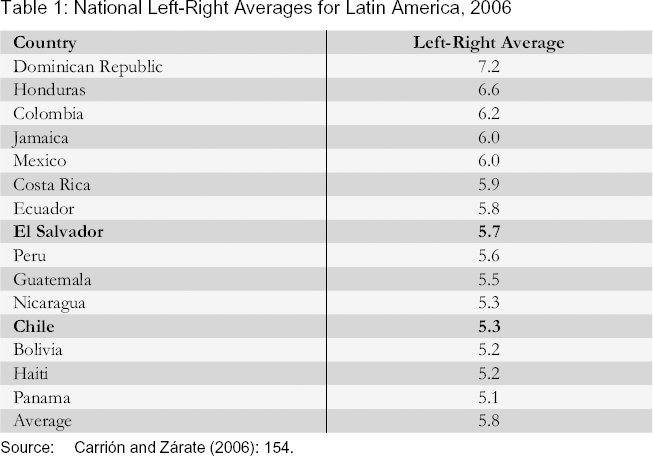
An examination of the national ideological positions of voters in Latin America disproves the culturalist argument based on voter's ideological self-identification. Table 1 lists the ideological left-right averages of citizens in 15 Latin American countries in 2006. The averages are calculated by asking voters to place themselves along a left-right continuum, from 1-left to 10-right. Studies show that people perceive 5 as neutral, even though the midpoint on the scale is 5.5. (Seligson 2008).
National Left-Right Averages for Latin America, 2006
Source: Carrión and Zárate (2006): 154.
As Table 1 shows, the averages of the national ideology scales in El Salvador and Chile are slightly more to the left than the average of Latin America. This means that Salvadoran and Chilean voters cannot be expected to be more supportive of conservative parties than any average Latin American is. Yet both countries did witness good electoral performance of right-wing parties at the time.
A snapshot of the left-right averages of voters in 2006 shows that the success of conservative parties in some Latin American countries cannot be explained through the self-identification of voters. ARENA and UDI have emerged and succeeded in countries that are slightly more leftist in ideological orientation than the average of the region. This is because contrary to culturalist expectations, people do not manifest their individual ideological positions automatically through the vote. Rather, values operate together with incentives and constraints. Moreover, the translation of individual values into political action requires various steps. For instance, political parties have to activate, mobilize, and organize voters. Culturalism overlooks these intervening factors, and these factors might well be crucial for a new party.
Socioeconomic Structuralism
The structural school in the social sciences emphasizes political, social, and economic relationships between groups and classes in society. Structuralism is impersonal and nonsubjective – it focuses on patterns of relationships among groups instead of individuals (Skocpol 1979: 18). This paper draws from structuralism and argues that politics has a socioeconomic base. I do not consider class conflict to be the only major source of change, as a strict Marxist approach does, but I acknowledge the implications that the distribution of the means of production has for politics. The approach I apply here could be thus best described as “socioeconomic structuralism.”
Some historians have studied nineteenth- and twentieth-century El Salvador from a socioeconomic point of view (Lindo-Fuentes 1990; Menjívar 1980; Paige 1997). However, the contemporary political and economic relationships in the country remain understudied. I argue that the reasons for ARENA's success can be found in those relationships. Specifically, there are two closely related groups in society that play a crucial role in conservative party politics: the business community and the neoliberal technocrats.
Latin American business associations have been characterized as weak, fragmented, and dependent on the state (Cardoso 1971; Schmitter 1971, Haggard and Kaufman 1995), although some stronger organizations have been formed during times of economic crisis (Schneider 2004). 3 Nevertheless, Durand and Silva (1998) show that from the 1970s and especially from the 1990s onwards, business associations have come to play more important roles in national politics in the region. Durand and Silva emphasize the role of encompassing business associations, arguing that they have increasingly set the agenda for public policies. Moreover, after a certain policy is chosen, business organizations have taken actively part in further policy design. Even when encompassing associations have not been involved in policy crafting, the private sector has participated in policy formulation (Durand and Silva 1998: 18-23).
Empirical work on business-government relations remains problematically diffuse. As Haggard, Maxfield, and Schneider (1997: 36) note, this is partly because of the confusion about conceptualization of business. In my analysis, I will follow Durand and Silva (1998) in examining business as associations. However, I will also pay attention to individuals and informal networks between them.
Despite the active role that business plays in politics, the business community avoids open party affiliations. The entrepreneurs’ aversion to partisan politics has pragmatic roots: businesspeople need to ensure that the government protects their interests. Since the party in opposition today might be in government tomorrow, businesspeople have to maintain working relations with all parties: only this way can entrepreneurs secure that the next government will not attack their livelihood (Roberts 2002: 25; Schneider 2004: 53). In the case of Latin America, business has had also institutional disincentives. As Schneider notes, Latin American business associations were many times legally prohibited from participating in party politics (Schneider 2004: 53).
This paper argues that the conventional wisdom about the pragmatism of business needs to be revised. Under certain conditions, businesspeople decide to step into partisan politics. When this happens, a party that is backed by business increases its likelihood to consolidate organizationally and succeed electorally. The conditions for the politicization of business will be discussed after the introduction of the second societal group relevant for conservative party building.
The other group that has played a more significant role in Latin American politics since the beginning of the 1960s is the technocratic community. 4 Collier has defined technocrats as
The terms “technocrat,” “técnico,” “economic expert,” “expert,” and “economist” are used here interchangeably.
individuals with high levels of specialized academic training which serves as a principal criterion on the basis of which they are selected to occupy key decision making or advisory roles in large complex organizations – both public and private (Collier 1979: 403).
Starting from the 1990s, these policy experts, often with a shared neoliberal world view, have gained increasing control over political and technical institutions in various Latin American countries (Centeno and Silva 1998).
The gained influence of business and neoliberal technocrats in Latin America has had more direct implications in party politics than previous research has shown. In fact, these two groups are crucial for a new conservative party: if business and economic experts decide to support an emerging rightist party, the party is likely to succeed. The support from business associations and from the wider business community contributes to the party's success in various ways. First, businesspeople help the party financially so that it gains a resource advantage over its competitors. Second, businesspeople that choose to run for public offices often have time due to a flexible work schedule and a significant amount of money to allocate for their campaigns. Economic experts, on the other hand, help the party more indirectly. Técnicos, with their broader take on politics, shape the party program into one that is appealing for the wider electorate. They also offer the party crucial help in terms of campaign methods and research on the electorate.
The support from business sectors and technocrats is a necessary condition for conservative party success. However, as argued above, business usually refrains from partisan politics. The pragmatism of business is challenged if entrepreneurs face a leftist threat with credible redistributive claims. In other words, the existence of a threatening leftist group with potential political leverage is a necessary condition for the politicization of the business class.
Bellin (2000) offers a similar type of argument in the case of democratization. She argues that the level of threat is one of the main factors explaining the variation in class support for democratization. The capitalists and the labor sector choose to either promote or oppose democracy depending on the conditions under which they operate. For the capitalists, fear is one of the main factors. The greater the level of inequality in a society, the greater the fear: as Bellin writes, the mass inclusion and empowerment that democracy promises “threatens to undermine the basic interests of many capitalists” (2000: 181).
Various scholars have considered fear to have political consequences. For example, O'Donnell argued in his work on the bureaucratic authoritarian state that the fear of mobilizing popular sectors unified the dominant classes (O'Donnell 1975: 68; O'Donnell 1978; for criticism, see Remmer and Merkx 1982). Durand and Silva conform in the case of encompassing business associations. They argue that a severe threat to business and landowning sectors – created either by mass movements or the state – was the key factor in the emergence and development of business associations in Latin America (1998: 5-10).
While a number of scholars have identified threat as the key in politically activating the dominant classes, the argument has not been widely extended to party politics. I argue that business elites’ fear of the left can lead the influential sectors to join or form parties. The next section will illustrate the argument: the Salvadoran business elite, afraid of attacks from below and above, united to support ARENA. A move that proved crucial for the party.
Business, Economic Experts, and Conservative Parties: The Case of ARENA
This section examines whether the empirical evidence from the case of ARENA confirms the importance of businesspeople and economic experts for conservative party success. If the hypothesis is correct, we should observe a strong presence of businesspeople and economic experts in ARENA. Moreover, the role of businesspeople and técnicos in the party has to be decisive. The significance of entrepreneurs can be evaluated through a) party finances and b) the social composition of candidates and party officials. We should find that a) the party receives a considerable amount of money from private enterprises and that b) a significant proportion of party leaders and candidates for electoral office are businesspeople. The importance of economic experts for the party can be examined by looking at a) the changes of party image and platforms throughout the party's trajectory and b) the type of research the party conducts and the type of training party members or candidates receive.
As argued in the previous section, the presence of supportive businesspeople and técnicos is a necessary but not a sufficient condition for a conservative party to succeed. Many variables that affect electoral performance of parties concern the electorate. It is thus important to note that some characteristics of the Salvadoran electorate might make it more attuned to the appeals of ARENA. Most importantly, the collective memory of Salvadorans has been dramatically shaped by a long civil war (1980-1992), in which about 75.000 people died. Past political campaigns suggest that ARENA has used war experiences and memories in gaining electoral success. In the first elections after the peace accords in 1994, for example, the party attacked the left with anonymous television advertisements showing war scenes and horrifying stories of “terrorists” (Vickers and Spence 1994: 8). By suggesting that voting for the left would threaten the peace process, ARENA gained votes from peasants who were expected to vote against it (Wantchekon 1999).
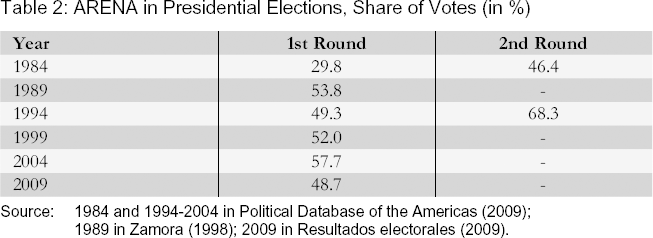
Before advancing to the hypothesis, I briefly evaluate the electoral and organizational consolidation of ARENA. The vote percentages the party has received in the presidential and parliamentary elections, Table 2 and Table 3, clearly mark its electoral success. The party held the presidency for four consecutive terms between 1989 and 2009. 5 In the Legislative Assembly, it has been the key player since 1988. ARENA's electoral consolidation is undisputed.
ARENA in Presidential Elections, Share of Votes (in %)
Source: 1984 and 1994-2004 in Political Database of the Americas (2009); 1989 in Zamora (1998); 2009 in Resultados electorales (2009).
ARENA in Legislative Elections, Share of Votes (in %) and Number of Seats Won
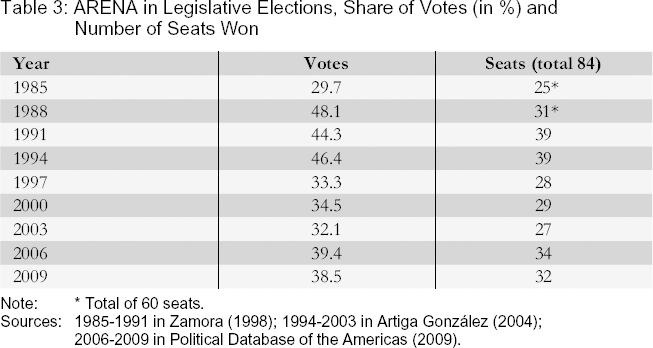
Total of 60 seats.
Sources: 1985-1991 in Zamora (1998); 1994-2003 in Artiga González (2004); 2006-2009 in Political Database of the Americas (2009).
The victory of the FMLN's Mauricio Funes in 2009 was predicted by the majority of polls (e.g., IUDOP 2008a, 2008b, 2008c, 2009).
The party has succeeded organizationally, as well. ARENA ranks especially high in terms of the stability of its rules and structure. The party structure has had only few minor changes during the whole party trajectory. 6 Average militants have very limited opportunities to participate in decision-making and the party has been known for a more vertical and autocratic party structure than any other Salvadoran party (Artiga González 2004; Zamora 1998: 68). The party structure and the strict enforcement of the rules have kept the party extremely disciplined during its whole trajectory (Barahona 2008).
Interview with Ricardo Valdivieso, July 4, 2008.
ARENA is well-rooted in society. It has eight sectors: youth, women, workers, businesspeople, farmers and ranchers, farm workers, professionals, and Salvadorans abroad. It has also filiales de iniciación (branches of initiation) to be organized in “industrial, agricultural, commercial, cultural, or any other type of centers” of society in order to promote the party (ARENA statutes, chapter 10). While official data on members are hard to attain, many of my interviews indicated that the sectors and the filiales de iniciación root the party deep in society. For example, in San Vicente, a departmental capital of about 53.000 inhabitants, the party has branches of initiation at least in the hospital, in the post office, and in the sugar factory. 7 Overall, the party has about 220-250 offices open all year in the 262 municipalities of the country. 8 The estimated number of party affiliates is 500.000. 9
Interview with Julio Cesar Matales, July 19, 2008.
Interview with Miguel Tomás López, July 20, 2008.
Interview with Miguel Tomás López, July 20, 2008. While this number was confirmed by various people, it is likely to be lower in reality. In 2003, a member of the Consejo Ejecutivo Nacional (COENA) estimated that ARENA has 140.000 affiliates (Artiga González 2004: 183).
The exceptional electoral results and deep roots in society together with a clear party structure and discipline prove that ARENA meets the criteria of party consolidation. The question is, whether business and economic experts have helped the party to reach this level of success.
The Role of Business in ARENA
The party identity of ARENA has always been defined in great part by businesspeople. Former army officer Roberto D'Aubuisson founded the party in 1981 with a small group of people that consisted mainly of businesspeople, professionals, and students. 10 The party had two clear goals: to fight the communistic threat posed by the revolutionary coalition “Frente Farabundo Martí para la Liberación Nacional” (FMLN) and to stop the redistributive economic reforms of the military government. These firm goals and the charismatic leadership of D'Aubuisson helped ARENA to form a strong and coherent party identity (Artiga González 2001). Since the main goals are in the domain of political economy, it is reasonable to assume that the formation of ARENA's identity relied greatly on the ideas and the expertise of businesspeople. Zamora's study of the socioeconomic characteristic of the party founders corroborates this point. Zamora has found that the share of entrepreneurs is higher in ARENA than in any other party in El Salvador (1998: 48-50). Gloria Salguero Gross, one of ARENA's founders, provides evidence for the importance of business factors in a newspaper interview:
D'Aubuisson is held responsible for leading death squads that assassinated Archbishop Óscar Romero in March 1980 (see Boutros-Ghali 1993). Connections between ARENA as a party and death squads are not well documented. One interviewee responded, “ARENA, as a party, was never violent. What did happen is that some of the people taking part in violent activities were also sympathizers of ARENA. This is, that I know of, the only connection. As a party, ARENA was not in that” (Interview with Rodrigo Samayoa Rivas, January 7, 2009). Rather than focusing on the undoubtedly ultra-rightist positions or actions of various ARENA members during the armed conflict, this paper will pay attention to the role of businesspeople and economic experts. In doing so, I do not attempt to deny the connections between some party members and death squads. Instead, I emphasize other characteristics that are relevant to explain this party's success.
Q: So ARENA was born, for a great part, because of the agrarian reform?
A: Yes.
Q: And not just because of the fight against communism?
A: No, no, nooo. We emerged because of the agrarian reform. There was also a movement that emerged because of communism and that had a big impact on the party. It was a strong fight in 1980 and 1981 (Murcia, Arauz, and Baires Quezada 2008, translation by the author).
Businesspeople have remained prominent in ARENA ever since the party's foundation. Out of the four ARENA presidents, three, Alfredo Cristiani (1989-1994), Armando Calderón Sol (1994-1999), and Antonio Saca (2004-2009), were prominent businessmen. At the legislative level, an examination of the Legislative Assembly from 2006 to 2009 offers an indication of the socioeconomic composition of the party today: 26 percent of the ARENA deputies self-identified as “businessman” or “businesswoman” (see Diputados de Alianza Republicana Nacionalista). The presence of businesspeople is equally high at the municipal level: according to the biographies of ARENA's mayoral candidates for the term from 2009 to 2012, 40 percent owned a private enterprise. 11 The high percentages prove that the business sectors remain powerful in the party. 12
Biographies of only 96 candidates were posted online. Of those, 38 candidates mentioned that he or she owned a company (see Candidatos).
It is important to note that different business factions have never been completely unified in supporting ARENA. Indeed, various sectors have been competing in the party ever since its foundation. While these divisions have not been documented, it is widely held that agricultural and coffee sectors yielded more power during the early years of the party, whereas later more modern sectors of economy gained more leverage.
The Importance of Business in ARENA
There are at least two possible advantages that ARENA might have because of the socioeconomic characteristics of its members. First, I examine what kind of effect entrepreneurs have had on ARENA's finances. Second, I analyze the role that businesspeople play in party life. The examination shows that ARENA draws significant financial support from the business community. The socioeconomic composition of ARENA's candidates and the way they are depicted in campaigns present another advantage for the party. I conclude that the presence of business has been one of the main factors in ARENA's success.
The information on party finances is very limited in El Salvador, due to lacking legislation. Given the active participation of businesspeople in ARENA, it is reasonable to assume that a significant amount of the party's finances come from the business sectors. The highest socioeconomic class supports ARENA about twice as much as the upper and lower middle classes (Artiga González 2004: 190) and they are likely to contribute more to party finances. Indeed, Zamora has concluded that ARENA's main source of funding is contributions from private business (1998: 80).
An examination of campaign expenditures in the last elections shows that ARENA enjoys clear advantage in terms of its financial resources. During the last campaign period, ARENA spent 10,388.249 USD on media advertisements while the FMLN spent only 3,005.475 USD (Mejía 2009). The financial advantage of ARENA is significant: it was able to use three times more resources than its main opponent. To be clear, the past campaign was no exception. In 1994, for instance, ARENA used over 52 percent of the total sum invested by all parties in electoral advertising (Obach 1994: 245).
The significant difference in the media campaigns suggests that ARENA has a clear advantage over its main opponent. While the lack of oversight over party finances makes contributions from drug trafficking and foreign actors possible, this type of funding cannot be connected to only one party. The reason for the difference in funding between ARENA and the FMLN can be thus assumed to lie in ARENA's ability to attract many more business donors than its competitor does. This way, ARENA's financial advantage has helped it reach its notable electoral victories.
The role of the business community is not confined to campaign contributions. In addition to their financial help, entrepreneurs offer the party their skills. Educated and successful businesspeople-turned-into-candidates provide an opportunity for shaping the party image. The electoral campaign of 2009 illustrates how ARENA uses the professional experience of its business candidates. The vice-presidential candidate of the party was Arturo Zablah, the owner of one of the biggest furniture producers in Central America. ARENA purposefully used Zablah's business image in the campaign. The framing is apparent in an advertisement aired on television in November 2008. Zablah says,
(…) I know how work is created. Not a single sensible and serious investor would invest in the country upon the invitation of candidate Funes and Salvador Sánchez Cerén [presidential and vice-presidential candidates of the FMLN]. (…) I would like to ask my friends and colleagues among businesspeople, who of you would leave your company in the hands of Mauricio Funes or Salvador Sánchez Cerén? And leading a country is something much more complex. 13
Translation by the author.
It is interesting how strongly ARENA uses the business image of Zablah when convincing voters. Zablah explains his entrepreneurial experience at length in the advertisement, suggesting that people should vote for him because of his business skills. This shows how comfortably Zablah sides with entrepreneurs. While electorates in other countries can see politicians with strong business connections as elitist, ARENA has managed to turn candidates’ entrepreneurial background into an advantage.
Businesspeople running for public office can also finance their campaigns and their work allows them flexibility during the campaign season. As a party, ARENA is aware of these advantages. The party supports its mayoral candidates with a monthly allowance during the campaign period but it also expects the candidates to fund parts of their campaign themselves. 14 For example, the candidate for Mayor of the departmental capital Santa Ana estimated in July 2008 that the money he received covered 40 percent of his campaign. The remaining part he raised and paid himself. 15 When it comes to the amount of time devoted to campaigning, ARENA expects its candidates to work full-time while receiving the monthly campaign payment. The candidates appear to come close this standard: a party activist in San Vicente, a departmental capital, estimated that the candidate was dedicating 70-80 percent of his time to the campaign in July 2008. 16 Given that ARENA is the party with the largest financial resources in the country, it is likely to have an advantage over its competitors when it comes to funding its candidates.
Interview with Miguel Tomás López, July 20, 2008.
Interview with Luis Alfredo Lemus, July 17, 2008.
Interview with Julio Cesar Matales, July 19, 2008.
This section has shown that ARENA has benefited from the strong presence of business at least in two important ways. First, the party receives more funds from business owners than any other party in the country. Second, the businesspeople-turned-into-candidates bear an advantage over their competitors thanks to their business image, private funds, and flexibility of work schedule. The evidence suggests that the great number of businesspeople among ARENA's candidates and members translates into clear political advantages. The next section examines whether this is the case with economic experts, as well.
The Presence of Técnicos in ARENA
The first generation of técnicos started to develop in El Salvador in 1983, when less politicized businesspeople founded a neoliberal think tank “Fundación Salvadoreña para el Desarrollo Económico y Social” (FUSADES). Officially, FUSADES was created as a non-partisan research organization that aimed to strengthen the Salvadoran private sector and national development. In practice, it turned into a haven of soft-line businesspeople: the less politicized industrialists, manufacturers, investors, and small and medium business owners who were not welcomed in the more politicized business associations at the time, took control of the institute. The FUSADES economists and policy experts, with degrees from the United States, Chile, Costa Rica, and El Salvador, trained these soft-liners with technical and substantive knowledge (Johnson 1993: 223-252).
Over the course of the 1980s, FUSADES gained more influence among the business community. Both hard-liners and soft-liners started to internalize FUSADES's neoliberal message about privatization and deregulation. In addition to technical analyses, reports, and seminars, FUSADES launched various training programs for many business associations (Johnson 1998: 134), connecting FUSADES closely to them. Several leaders of the most important business associations in the country served in FUSADES committees or commissions in the late 1980s (Johnson 1998: 134-135). These connections linked FUSADES indirectly to ARENA. Moreover, there were direct connections between the think tank and the party: out of the ten FUSADES leaders between 1984 and 1990, seven are known to have either held offices in ARENA or to be sympathizers of the party. 17
Interview with Rodrigo Samayoa Rivas, January 1, 2009.
The links between FUSADES and ARENA seem to have been the strongest around the election of President Alfredo Cristiani 1989. Cristiani took various officials from the think tank to the government, to the extent that his economic team was called the “FUSADES boys” (Johnson 1998: 136). The economic and social platforms of ARENA campaigns in 1989 and 1990 were almost identical to the proposals of FUSADES (Johnson 1998: 257). After the term of Cristiani, the connections between FUSADES and ARENA started to fade and there have been few observable similarities in the policy proposals of the two ever since. 18
I thank an anonymous reviewer for pointing out that the important role of FUSADES calls for an institutional account of the relationship between the Salvadoran private sector and politics. While the scope of this paper does not allow a more detailed analysis on the topic, Johnson (1993) offers an excellent analysis.
The Importance of Técnicos in ARENA
The presence of economic experts has been decisive for the success of ARENA at least in two ways. First, they have led the party to moderate its policy programs and public image. This way, the party has avoided the risk of being shaped too strongly by businesspeople with narrow economic interests. Second, técnicos have guided the more practical side of policy-making: they have offered the party valuable research capabilities, helping it to build high quality research practices and training programs. This allows ARENA to build attractive campaigns and craft popular policies that appeal to the wide electorate. 19
The relationship between experts and businesspeople is potentially conflictual, given the somewhat different goals the groups have. In the case of ARENA, different factions have managed to reach a necessary level of unity.
The rise of economic experts in El Salvador is clearly visible in the trajectory of ARENA. The party was divided between hard-liners and soft-liners towards the late 1980s. The first group opposed negotiating with the guerrilla group FMLN, whereas the latter preferred to replace the anticommunist ideology with pragmatism. The last offensive of the FMLN in November 1989 brought the hard-liners of the party temporarily back to power but, soon thereafter, the pragmatic approach prevailed. The notable change from anticommunist ideology to electoral pragmatism occurred when Alfredo Cristiani took over the party leadership in 1985 (González 2003: 1193; Albiac 1999: 852-853). The anticommunist hymn was played less in public, businessman Cristiani gave ARENA a new public face, the party's rhetoric was moderated, and its political positions became less strident and more technical (Zamora 1998: 57). At the same time, the business-government relations changed when business gained access to political decision-making. The entrepreneurs welcomed the change warmly and, as a consequence, many members from the country's main business association “Asociación Nacional de Empresa Privada” (National Association of Private Business – ANEP) joined ARENA. Calderón Sol's presidential term brought conflicts between the ANEP and the government but ANEP's técnicos still had direct influence on governmental policy-making (Rodríguez 2005).
The influence of técnicos was not only that of professionalization of politics – they also participated in the party's every-day decision-making on a very practical level. The party realized its lack of systematic research centers on the course of the 1990s. Today, it has three distinctive institutes that conduct technical research. The strategic center of the party, “ARENA Estratégica”, founded in 2003, and another investigative center, “Centro de Estudios Políticos Dr. José Antonio Rodríguez Porth” (CEP), founded in 2001, exemplify how the party uses its technical capacities. The former plans party strategies, studies the electorate, conducts surveys, maintains the membership list, and offers electoral training. CEP conducts research, trains politicians, and proposes policy solutions. The influence of técnicos is evident in the themes of CEP's seminars, called “Municipal Finances,” “Formulation of Municipal Projects,” and “Social Projects,” for example. 20
Interview with Manuel Vásquez Mendoza, July 16, 2008.
Modern research methods are a fundamental part of party life. With the help of “ARENA Estratégica,” the party polls the performance of candidates and the popularity of possible candidates. The party also investigates thoroughly what type of proposals voters are looking for. 21 This indicates a high level of professionalism in the party as well as trust on technocratic knowledge and skills. To put it simply, the expertise of técnicos allows the party to translate the economic resources obtained from politicized entrepreneurs into votes.
Interview with Miguel Tomás López, July 20, 2008.
Conclusion
New political parties come and go in Latin America. High electoral volatility, low levels of party identification, and widespread lack of trust in politicians signal weakness in the linkages between parties and society. In spite of these unfavorable conditions for party foundation, conservative parties like ARENA in El Salvador have managed to consolidate well. While scholars have paid a significant amount of attention to the rise of the left in the region, the success of conservative parties has gone virtually unnoticed.
As shown in the theoretical section, arguments derived from institutional and cultural frameworks do not offer satisfactory explanations for the consolidation of right-wing parties. This paper has argued that the reasons for the right's success lie in socioeconomic structures. Specifically, there are two powerful groups in society that can provide crucial support for an emerging conservative party: business and technocratic communities. The endorsement of the business class leads to an increase in party finances. Moreover, if an entrepreneur chooses to run for office, he or she can have many advantages in the race, through his or her experience in leadership positions, personal funds, and the flexibility of his or her work.
Técnicos, academically trained policy experts, contribute to the development of the overall party program. Without them, a conservative party runs the risk of turning into an elitist interest group. After all, businesspeople with substantial financial resources are likely to expect the party to follow their personal demands. Técnicos have a broader view of politics. Since technocrats are more interested in the overall development of the country, they shape the party program to appeal to the wider electorate. In addition to this broad policy formulation, economic experts help elaborate the electoral strategies of the party. This way, the party can translate its economic advantage into a political advantage.
The business class is willing to support a political party only if it is pushed into politics. When the business community faces a real threat of losing its economic privileges, it is likely to enter the political arena. In other words, a militant leftist threat is a necessary condition for activating the business community politically. In the case of El Salvador, the revolutionary threat in the late 1970s brought the business sectors together and pushed it to support ARENA.
The argument is applicable to other parties in Latin America, as well. While the scope of this paper does not allow for a close examination of other parties, a few examples confirm the argument. The trajectory of the Chilean UDI, one of the most electorally and organizationally successful parties in the region (e.g., Joignant and Navia 2007; Albán 2006), underlines the importance of businesspeople for conservative party building. The party has received strong technocratic support (Picazo 2001: 332) and thus has managed to form a stable and well-functioning organization. At the same time, however, the Chilean business community has been divided between two different rightist parties (Barrett 2000; Pollack 1999). The lack of unified business support has hindered UDI's electoral success. Another illustrative although less studied case is the “Partido Liberal Constitucionalista” (PLC) in Nicaragua. PLC has managed to reach a high level of electoral success with the help of somewhat coherent business sectors. At the same time, however, the party has lacked the backing of técnicos and it has been unable to consolidate its organization. 22
Peru under Alberto Fujimori (1990-2000) illustrates how the lack of a political leftist threat can reduce the likelihood of business involvement in party politics. In the early 1990s, Fujimori gained wide support among the business class by laying out a systematic plan to defeat guerrilla groups and by bringing order back to Peru's disastrous economy through draconian “shock” policies (Durand 1997: 171-175). In other words, the security threat posed by the guerrilla was not enough to mobilize the business class in party politics. The relationship between the Colombian business and president Álvaro Uribe seems to have similarities with the Peruvian experience (for Uribe's support among the business class, see Rettberg 2003). A positive case for the argument is Mexico's “Partido Acción Nacional” (PAN). One of the three important groups that participated in PAN's foundation consisted of entrepreneurs and landholders who had either been affected by Cárdenas's redistributive policies or who feared them (Mizrahi 2003: 21; Mabry 1973: 35-36). As Mabry writes, the party's leader was able to bring together a group of people unified by their common purpose of destroying the “socialist” policies (1973: 31). Decades later, the 1982 bank nationalization politicized the business sector and boosted a movement of different business actors and organizations within PAN, known as “neo-panismo” (Arriola 1994: 47-48).
The argument speaks to an on-going theoretical debate in political science. Contemporary research tends to emphasize institutions and, consequently, to neglect the study of broader societal interests. Formal institutions have been in the forefront of the research agenda in comparative politics ever since the third wave of democratization (e.g., Shugart and Carey 1992; Mainwaring and Shugart 1997). While the contributions of this line of research have been significant, the focus on national-level institutions has obfuscated other important research agendas. The excessive emphasis on institutions has, for example, overshadowed important social foundations of politics (Kurtz 2004: 27).
Another overall trend in comparative politics today emphasizes individual actors. The trend was initially started by the rational choice school which, with its focus on micro-foundations, argued that political change derives from the rational calculations of individuals (e.g, Bates 1981; Ames 2001). The rational choice school has been challenged by scholars who argue that utility-based micro-foundations rest on false premises. Unlike rational choice assumes, human cognition limits our decision-making, sometimes even in the most stable situations (Jones 1999). This school of thought, known as bounded rationality, argues that cognitive psychology provides more accurate micro-foundations for the study of decision-making in political science, as it can better account for the origins of actors’ preferences. Bounded rationality has led to some insightful accounts in the study of politics (Weyland 2006; Jones and Baumgartner 2005). However, as its rival paradigm rational choice, it is centered on studying individual actors and their choices and preferences. While it includes contexts in the analysis better than rational choice does, it still assumes that the moving force behind political change is human action.
This paper has advocated for the revival of the structuralist approach. Socioeconomic structuralism stands on the opposite side in the agency-structure debate from rational choice and bounded rationality. For structuralists, specific structures matter more than individuals embedded in them. Since the institutional and agent-centered approaches rarely look at relationships and interactions between societal groups, contemporary research has largely neglected this type of topics. Structuralism is especially suitable for such broader, societal questions. The comeback of the approach could broaden the research agenda and fill in many gaps in contemporary scholarship.
The building of a conservative political party in a new democracy offers an example of a research question that can be best addressed through socioeconomic structuralism. Any political party requires the involvement of various sectors of the society. The experience of ARENA illustrates the point: the party has consolidated itself because of a fruitful alliance between politicians, businesspeople, and técnicos. Neither institutional nor agent-centered approaches can tap into the power relations between these groups.
Political representation of powerful societal sectors is crucial for the stability of democracy. The political right represents traditionally two influential groups: the military and business sectors. Since the first one controls the legitimate use of force and the second the greatest accumulation of economic power, together they have the greatest capacity in society to bring down the government. Guaranteeing their political representation contributes to the overall regime stability.
Interestingly, these powerful societal groups have had mixed success in gaining representation in Latin America. The reasons for this variation remain unexplored in contemporary Latin American studies. This paper suggests that socioeconomic structuralism provides a framework that opens the door for the future study of influential societal sectors in the politics of new democracies.
List of Interviews
Lemus, Luis Alfredo, ARENA candidate for Mayor of Santa Ana for the term 2009-2012, businessperson, Santa Ana, July 12, 2008.
Matales, Julio Cesar, director of ARENA's youth sector in San Vicente department, San Vicente, July 19, 2008.
Samayoa Rivas, Rodrigo, Governor of San Salvador, ARENA candidate for the Legislative Assembly for the term 2009-2012, businessperson, San Salvador, January 7, 2009.
Tomás López, Miguel, member of the Consejo Ejecutivo Nacional (COENA) in 2003-2008, businessperson, San Salvador, July 20, 2008.
Valdivieso, Ricardo, director of the “Instituto de Formación Política Mayor Roberto D'Aubuisson”, one of the founders of ARENA, businessperson, San Salvador, July 4, 2008.
Vásquez Mendoza, Manuel, executive director of the “Centro de Estudios Políticos Dr. José Antonio Rodríguez Porth” (CEP), San Salvador, July 16, 2008.