




Abstract
In many Latin American countries the executive branch manipulates the composition of the Supreme Court, and judicial independence has remained elusive. Because high courts can exercise judicial review and influence lower courts, incoming presidents often force the resignation of adversarial justices or “pack” the courts with friends. One indicator of this problem has been the high turnover among members of the high courts. In this paper we offer systematic evidence to compare this problem across countries and to place this issue in historical perspective. Our analysis covers 11 Latin American countries (Argentina, Brazil, Chile, Colombia, Costa Rica, El Salvador, Guatemala, Honduras, Mexico, Panama, and Uruguay) between 1904 and 2006. We model the entrance of new justices to the Supreme Court as a function of “natural” (legal and biological) factors, political conditions empowering the president to reshuffle the Court, and institutional incentives promoting executive encroachment on the judiciary.
Introduction
In recent years, judicial politics has become a salient topic among students of Latin American political institutions. 1 Research on judicial independence and executive-court relations has gained a prominent place among more traditional topics such as the study of political parties, electoral systems, legislative policymaking, and executive-legislative relations. Concern with this subject came with the realization that judicial institutions are critical to protect individual rights, promote horizontal accountability, secure the enforcement of policies and regulations, and resolve disputes among key political actors. In the context of democratization inaugurated in the late 1970s, the judiciary has gained increasing leverage in the politics of most Latin American countries.
Revised paper presented at the symposium on “New Frontiers on Institutional Research in Latin America,” organized by the GIGA Institute of Latin American Studies (Hamburg, May 5-6, 2008). This project was funded by the Center for Latin American Studies, the University Center for International Studies, and the Central Development Research Fund at the University of Pittsburgh. Sebastián Linares, Kurt Weyland, Bruce Wilson, and Laurence Whitehead offered valuable comments. We are indebted to Erin Rodriguez and Alicia Mathó for their research assistance. Ronald Alfaro Redondo, Andre Burton, Elizabeth Buncher, Gabriela Contreras, Carlos Guevara Mann, Lenina Meza, Alfredo Narvaez, Gabriel Negretto, Sebastián Ocampo Valencia, Patricia Salvador Berrío, Kenzie Swift, Jorge Vargas Cullell, Evelyn Villareal, and Laura Wills Otero helped us identify sources and collect data for this project.
Because of this reason, questions about executive-court relations have become critical. In what countries are judges more independent from the executive branch? How can we measure the president's ability to manipulate the composition of the Supreme Court? In this paper we offer systematic evidence to answer those questions comparatively, and place the problem in proper historical perspective. Our analysis covers 11 Latin American countries (Argentina, Brazil, Chile, Colombia, Costa Rica, El Salvador, Guatemala, Honduras, Mexico, Panama, and Uruguay) during more than 100 years (1904-2006).
In the next section we review the emerging literature on judicial politics in Latin America, emphasizing the separation-of-powers perspective. As with many other areas in the study of Latin American institutions, studies of executive-court relations initially borrowed theoretical insights from the literature on American politics, but those insights proved insufficient and theories had to be extended in order to yield more general hypotheses. We illustrate this challenge with the study of supreme court vacancies: some of the assumptions that are fully justified in the study of the U.S. Supreme Court – for instance, that justices will decide the best time to leave the bench voluntarily – need to be relaxed for theories to travel well across countries. In the third section of this paper we argue that presidents have incentives to nominate new justices as soon as they come into office, and that they often do so by encouraging justices to retire or by expanding the number of seats in the Court.
Section four provides a comparative and historical overview of judicial turnover in 11 Latin American countries. Using the U.S. Supreme Court as a benchmark, we show that Latin American courts have been quite volatile, although significant variation exists across countries. In some countries, more justices have been appointed in a single year than the total number of members in the Court (indicating that the Supreme Court was reshuffled more than once in 12 months), while in other countries the relative rate of turnover has been similar to that of the United States.
In sections five through eight we develop a statistical model of judicial appointments in Latin America. Our dependent variable is the number of new justices entering the Supreme Court in any given country-year. We employ a fixed-effects count model to test the impact of legal and biological factors (Section 5), political conditions such as the nature of the political regime and changes in the executive branch (Section 6), and institutional incentives for presidential encroachment (Section 7) on the stability of the judiciary. In section eight we extend those models to address two fundamental questions: During which historical periods, and in which countries, have Latin American presidents exercised more leverage on the composition of the Supreme Court?
The conclusions emphasize that presidents have had an important influence in determining the stability of Supreme Court justices in office. This paper corroborates early findings about the relevance of executive politics for the judiciary (Verner 1984). Courts have been manipulated by presidents according to their partisan interests, and democracies do not have a better record than dictatorships in this regard. This paradox reflects the high judicialization of democratic politics in the region (Sieder et al. 2005; Domingo 2004).
For many years, the study of Latin American judicial institutions was mostly relegated to legal scholarship. Early analyses from a comparative politics perspective, such as Joel Verner's, noted that that “Latin American supreme courts are politically dependent and dominated by the political environments within they are embedded…”(Verner 1984, 468). 2 Between the mid-1980s and the mid-1990s, however, institutional analyses focused mostly on the transition from authoritarianism, the perils of presidential constitutions, the development of political parties, and the operation of legislatures. But, as Verner complained, little attention was given to the independence of supreme courts in the developing areas (1984: 463).
Based on secondary sources and data from the Fitzgibbon-Johnson index for 1945-1975, Verner developed a typology of judicial independence involving six types: (1) Independent-Activist (Costa Rica); (2) Attenuated-Activist (Chile and Uruguay); (3) Stable-Reactive (Mexico); (4) Reactive-Compliant (Argentina, Brazil, Colombia, and Venezuela); (5) Minimalist (Bolivia, Ecuador, El Salvador, Guatemala, Honduras, Panama, and Peru); and (6) Personalist (Cuba, Dominican Republic, Haiti, Nicaragua, and Paraguay). Our analysis in this paper tends to confirm some of those clusters.
In recent years, by contrast, there has been a growing interest in studying judicial independence in developing countries (Russell and O'Brien 2001; Malleson and Russell 2006). Most of the Latin American literature is country-specific, but comparative studies are becoming more common in the region (Scribner 2004; Navia and Ríos Figueroa 2005). The Supreme Courts in Argentina, Brazil, Chile, and Mexico are the most studied in the region, whereas the Central American ones remain highly understudied (Kapiszewski and Taylor 2006).
One of the most prominent research areas within this field is the study of strategic decision-making by judges from a separation-of-powers perspective (Magaloni and Sanchez 2006; Helmke 2005; Scribner 2004; Iaryczower et al. 2002; Rios-Figueroa 2007; Leoni and Ramos 2006; Chavez 2004; Pérez-Liñán et al. 2006). 3 This line of research suggests that strategic justices will respect the preferences of the executive branch when presidents are powerful and will challenge the executive's interpretation of the law when presidents are weak. Voting against the preferences of a powerful president will make justices vulnerable because the president and the ruling party in Congress may initiate an impeachment process and remove the hostile judges from the Court. In addition, presidents may mobilize partisan majorities in Congress to secure the appointment of friendly justices, particularly early during their terms. Because of those reasons, the literature assumes that Supreme Court justices will be less likely to defy presidents who control large congressional majorities, unless the end of the administration is in sight. Even though the existing literature does not analyze the justices’ decision to retire or the ways in which they leave office, those assumptions about presidential leverage serve to explain the rulings of Supreme Court members. The main limitation of these works is that those assumptions are usually not tested.
For an more detailed and extensive list of works about judicial politics on the region, please refer to (Kapiszewski and Taylor 2006).
American scholars have analyzed the factors that explain changes in the composition of the U.S. Supreme Court. In the American case, the president will nominate a new justice when someone steps off the bench voluntarily; thus the main research objective of American scholars has been to determine the factors predicting when a vacancy will occur. 4 The U.S. literature on judicial vacancies involves qualitative studies that are mainly chronological and biographic accounts of the justices that served in the Court (Atkinson 1999; Ward 2003) and quantitative analyses of the factors that affect the departure of justices. The second type of analysis provides a theoretical framework to think systematically about the causes of judicial instability, as those studies have identified political and non-political factors that affect judicial tenure (Spriggs and Wahlbeck 1995; Hagle 1993; Squire 1988; Barrow and Zuk 1990; Nixon and Haskin 2000; King 1987; Hall 2001; Epstein and Segal 2005; Zorn and Van Winkle 2000). 5
At this point it is important to underline that in nascent democracies vacancies not only occur because a justice steps off the bench but also because presidents increase the number of sitting justices. Due to the natural evolution of the U.S. Supreme Court, the American literature does not take into account this type of vacancies.
Even though some of these works account for vacancies in the Supreme Court and others only in the lower federal courts, all these studies use the same hypotheses to explain retirements in the judiciary. The only exception is the literature on state supreme courts since in this case scholars place special attention to the role of judicial elections and institutional variables in understanding the retirements of state supreme court justices (Hall 2001).
The analysis of non-political factors (often treated as control variables) suggests that justices retire from the bench for personal reasons: age, salary and retirement benefits, caseload, and job satisfaction. The other set of explanations is related to the political conditions that may encourage justices to step off. For instance, the literature has argued that a justice is more likely to retire when he or she identifies with the political party in control of the White House and the Senate, because in such cases the president will nominate (and the Senate will confirm) a candidate with the same political preferences (Zorn and Van Winkle 2000). Strategic justices will therefore time their retirements to transfer their seats to other like-minded colleagues (Zorn and Van Winkle 2000; Spriggs and Wahlbeck 1995). Along the same line of reasoning, the literature has argued that justices will not retire during the last years of the presidential term if the president belongs to the opposite political party (a strategy of “wait-and-see”), but they will be more likely to retire early during the term, especially the second presidential term, since they may not want to wait too long (Spriggs and Wahlbeck 1995; Hagle 1993; Zorn and Van Winkle 2000).
In sum, those theories reveal that judicial turnover may be explained by the interaction between the ideological preferences of the justices and the ideological preferences of the president (and his or her party in Congress). But the main assumption underlying those explanations is that justices will determine when a vacancy will occur. As Ward has pointed out, “what is significant about departures [in the U.S. Supreme Court] is the power of the justices themselves to influence who their successor will be by the timing of that departure…” (2003, 6). Epstein and Segal noted that, by contrast, “ideology and partisanship have not figured prominently in most judicial removals in the United States…” (2005, 32).
Even though research on vacancies in the U.S. Supreme Court provides interesting hypotheses that may partly account for the stability of Latin American justices, the underlying assumption is questionable for most countries in the region. The literature on Latin American courts discussed above suggests that it is often the president, rather than the justices themselves, who determines when vacancies will occur. For example, in Argentina, presidents were able to alter the number of members in the Supreme Court four times (in 1960, 1966, 1990, and 2006) 6 while in Mexico presidents have manipulated the number of sitting justices three times since 1917 (in 1928, 1934, and 1994). 7
Laws 15.271 (February 3, 1960), 16.895 (July 5, 1966), 23.744 (April 11, 1990), and 26.186 (December 18, 2006).
Court packing is not unique to Latin America (Nelson 1988). In Australia, for instance, the court-packing strategy developed in a particular way since the executive managed to get rid of troublesome judges by reorganizing the courts and not reappointing all judges (Williams 2001).
In this paper, we argue that presidents want to maximize their political influence on the Supreme Court, both in order to control judicial review and to exercise indirect leverage over lower courts. Presidents prefer to deal with justices nominated by them over justices nominated by previous administrations, and with justices nominated by their own party over justices nominated by the opposition. And they prefer to craft a loyal Court earlier rather than later in their terms so that they can exercise leverage on the judiciary during the whole period in office.
Vacancies in the Court represent the best opportunity to shape the preferences of the judiciary. Depending on the institutional setup, presidents may nominate candidates that are approved by the legislature (as in Argentina, Brazil, Mexico, and Panama), they may instruct their parties in Congress to appoint like-minded judges (as in Costa Rica, El Salvador, Guatemala, Honduras, and Uruguay), or they may appoint new justices from a list of candidates presented by the Supreme Court itself (as in Chile). In extreme cases (such as the aftermath of a military coup), presidents may even appoint Court members unilaterally. Only in rare instances (e.g., Colombia after 1991) is the Court able to recruit new justices without the explicit intervention of the executive branch or the president's party in Congress. 8
Presidents may also negotiate “quotas” of justices with opposition parties in Congress, in order to achieve the majorities needed to appoint some party loyalists to the bench.
The executive can craft a supportive Court not only by nominating friendly justices for open vacancies, as the American literature has long recognized, but more interestingly by influencing when a vacancy will occur. In order to create vacancies in the Court, presidents may offer incentives for justices to retire or they may negotiate with Congress an expansion of the number of seats in the Court (i.e., they may “pack” the Court). 9 In authoritarian contexts, presidents may have considerable leeway to pursue both strategies. Our comparative analysis thus relaxes the standard assumption in the American politics literature; we allow for the fact that justices not always step off the bench voluntarily, but rather as a result of a presidential manipulations and pressures.
The “incentives” offered by the executive branch in order to promote judicial retirements may be positive or negative, selective or indiscriminate. Presidents may offer special retirement packages, set up a mandatory retirement age, negotiate side-payments for salient justices (e.g., government posts for family members), or threat justices with impeachment, among other things. Although the literature on judicial politics in Latin America has emphasized the impeachment threat, little is known about the actual instruments employed by presidents to induce judicial retirements.
Because of this reason, we claim that judicial turnover is often the result of political realignments in the executive branch. Historically, government replacements in Latin America have been the result of free and fair elections as well as of military coups; they have brought changes in the ruling party as well as partisan continuismo. Such institutional differences may (and do) affect the capacity of incoming presidents to restructure the Court. But we hypothesize that, to the extent that presidents are willing and able to nominate new justices, it is likely that they will do so early during their administrations, when their political leverage is stronger and the time horizons for the administration are longer.
Although we cannot observe the political maneuvering leading to the opening of vacancies in supreme courts, we can infer the leverage exercised by presidential administrations by looking at the historical record. In the next section we present a descriptive analysis of the stability of supreme courts in the region over the past century. In sections five through eight we model the frequency of supreme court appointments as a function of changes in the executive branch plus an extensive battery of controls. In some countries, the arrival of a new administration in power has usually meant the appointment of new judges, while in other countries the Court has been isolated from executive cycles.
Our dataset is composed by 1,127 observations, corresponding to the Supreme Court in 11 Latin American countries (Argentina, Brazil, Chile, Colombia, Costa Rica, El Salvador, Guatemala, Honduras, Mexico, Panama, and Uruguay) between 1904 and 2006. 10 Our dependent variable in this study reflects the number of new justices entering the Court in any given year (units of analysis are country-years). 11
Information for Uruguay is only available after 1906. Three additional observations (Mexico in 1915-1916 and Guatemala in 1985) were treated as missing because the Supreme Court was not operational. Including the United States, the N=1,230.
We collected data from multiple historical sources (Supremo Tribunal Federal do Brasil 2008; Corte Suprema de Justicia de la Nación 2005b, 2005a; Rodrigues 1991a, 1991b, 2002; Alonso Godoy et al. 2003; Scribner 2004; Bercholc 2004; Molinelli et al. 1999; Aguilar Avilés 2000; Sáenz Carbonell and Masís Pinto 2006; Órgano Judicial de la República de Panamá 2003; Supreme Court of the United States 2008; Corte Suprema de Justicia de la Nación 2001). For Colombia, Guatemala, Honduras, and Uruguay we relied on primary sources found in local archives.
Figure 1 displays the number of justices appointed to the Supreme Court per year. The United States is included in the figure for comparative purposes. The number of appointments in any given year is partly explained by the size of the Court in each country – we show the total number of justices for reference – but it is also an important indicator of judicial stability. In a few countries – El Salvador being the most dramatic example – the number of appointments has in some years surpassed the total number of members, indicating that the Court was reshuffled more than once within 12 months. The figure shows that the opportunity for incumbent administrations to nominate and appoint loyal judges has varied considerably from country to country during the past century. Based on the average turnover rate, in the term of four years the average president would have expected to nominate more than two thirds of the Supreme Court members in El Salvador, Colombia, Guatemala, and Honduras, but less than half of them in Mexico, Chile, Costa Rica, Brazil, and the United States.
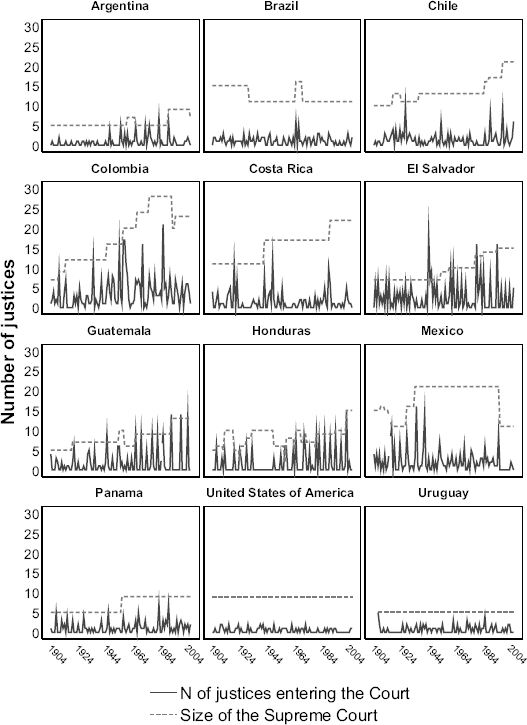
New Justices Entering the Supreme Court, by Country and Year
Figure 1 also suggests that patterns of judicial independence have occasionally varied at critical junctures. For example, the Argentine Supreme Court became more volatile after the impeachment of four members in 1947, and the Mexican Supreme Court became more stable in the 1940s during the administration of Miguel Alemán. To facilitate the comparison, in Table 1 we have normalized the number of incoming justices dividing it by the size of the Court. Table 1 compares the average proportion of freshmen justices expected to enter the Court in a typical year during three historical periods corresponding to the “waves” (and ensuing counter-waves) of democratization in the region: 1904-1944, 1945-1977, and 1978-2006 (Huntington 1991; Hagopian and Mainwaring 2005). Early during the twentieth century, Argentina had the most established Court among the countries in the sample, only surpassed by the United States. During the second historical period, Argentina had one of the most unstable courts, after El Salvador and Colombia. Conversely, Mexico's represented the fourth most volatile court (after El Salvador, Colombia, and Guatemala) in the early twentieth century, but it was among the most stable ones (only surpassed by Costa Rica and the United States) during the second period. The Courts of El Salvador, Honduras, and Guatemala are among the most unstable ones in the region for this whole period; whereas; on average Brazil's is the most stable Court in the sample (an average of .09). Although the values displayed in Table 1 are partly shaped by the size of the Court (the denominator), values above .20 generally indicate periods of judicial turmoil, while values below .20 tend to indicate periods of relative judicial stability. 12
Expected Proportion of Incoming Justices to the Supreme Court (per Year)
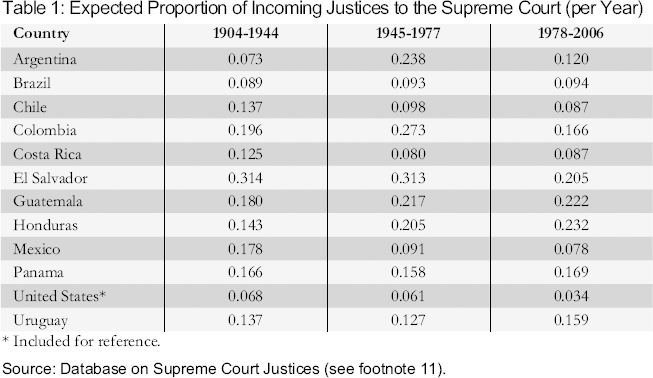
Included for reference.
Source: Database on Supreme Court Justices (see footnote 11).
Some data points in Figure 1 and Table 1 may be slightly inflated because historical sources often fail to distinguish between the appointment of principal and alternate justices. Whenever possible, we only counted the appointment of primary justices to avoid documenting excessive turnover. However, sources for the early twentieth century are often silent about the status of appointees (as well as about when alternates became principals). For Brazil, Guatemala, Mexico, and Panama, we have detected years in which the number of justices reported as serving in the Court is slightly greater than the known size of the Court. Assessing this problem is sometimes compounded by the fact that the constitution did not fix the number of members of the Court, leaving this decision to the discretion of Congress. In such cases, we simply report the known number of new appointments. It is very unlikely that alternate justices were replaced massively while principals stayed in office.
How can we explain this considerable variance in judicial turnover across countries as well as within countries over time? In this paper we follow the existing literature and model the filling of judicial vacancies using a count model (King 1987; Hagle 1993). By contrast with case studies of the U.S. Supreme Court, our sample contains considerable panel heterogeneity, as suggested by Figure 1. We employ a negative binomial estimator with unconditional fixed effects and robust standard errors to model the expected number of appointments to the Court in any given country-year (Long 1997, Chapter 8; Allison and Waterman 2002). 13
The dependent variable presents overdispersion, the property by which the variance of the count (6.95) exceeds the mean (1.59). In cases like this, a Negative Binomial regression is preferred to Poisson regression (Long 1997). Another advantage of the negative binomial estimator is that it relaxes the assumption that the probability of an event occurring at one point in time is constant and independent of all previous events (King 1998).
In Table 2 we present the statistical model of judicial turnover for 11 Latin American countries from 1904 to 2006. The predictors seek to capture a few “natural” legal and biological conditions that may explain the frequency of judicial appointments. The first variable captures the total number of justices in the Court, an important measure to calibrate the need for new appointments across cases. 14 The second predictor measures the number of years that the median justice had served in the Court by the time prior to the observation. Unfortunately very few historical sources provide enough biographical data to compute the age of all justices, so we use the number of years on the bench as a proxy for retirement age. Because count models are non-linear (linear estimates are exponentiated to obtain predicted counts), we transformed the two variables to reflect the functional form suggested by the theory. Following King (1987), we took the natural logarithm of the total number of justices in the Court to model a linear relationship between the size of the Court and the frequency of appointments. By contrast, we took the base 10 logarithm for the tenure of the median justice in order to account for any non-linear effect of age on judicial vacancies. It is possible that in countries with high judicial turnover, a justice who has served in the Court for ten years will be more likely to retire than a justice who has been just appointed by the current president; but in countries with low judicial turnover, a justice who has been in office for 30 years may have a similar propensity to retire to one who has been in office for 21 years. 15 We expect both variables to have a positive impact on the number of judicial appointments.
A Basic Model of Judicial Tenure
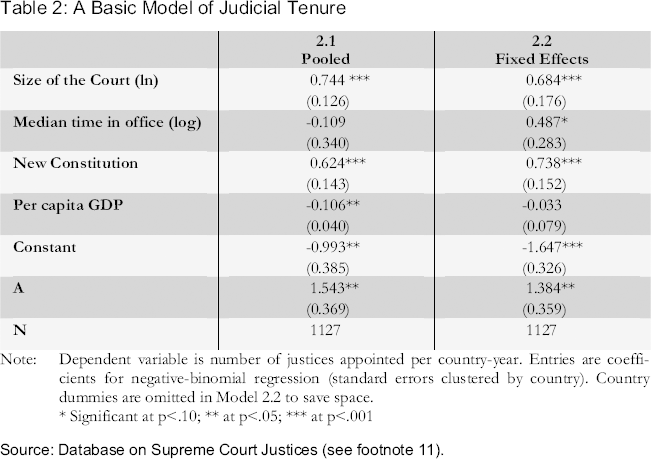
Note: Dependent variable is number of justices appointed per country-year. Entries are coefficients for negative-binomial regression (standard errors clustered by country). Country dummies are omitted in Model 2.2 to save space.
Significant at p<.10
at p<.05
at p<.001
Source: Database on Supreme Court Justices (see footnote 11).
The size of the Court constitutes an important control variable in cross-sectional terms because countries with larger judicial bodies will naturally need to fill more vacancies. However, presidents may expand the size of the Court as a way of packing it, and thus longitudinal changes in this variable will not always indicate a “neutral” reason for appointments. A similar case can be made for constitutional reforms, another independent variable that we treat as an institutionally neutral reason for new appointments. Our estimates of politicization are thus rather conservative.
Although we prefer the transformed variables for theoretical reasons, the inclusion of untransformed variables in the models (as well as the use of the mean duration in office instead of the median) did not change the overall results.
A third, dichotomous indicator measures the adoption of a new constitution over the past 24 months. Constitutional reforms often expand the number of members in a supreme court or establish specialized chambers; therefore we expect to find an increase in the number of judicial appointments in the aftermath of many constitutional reforms. The fourth independent variable is an estimate of per capita GDP in the country. 16 This measure is intended to capture the level of modernization, which presumably produces both greater life expectancy and institutional stability (Przeworski et al. 2000). Both mechanisms should reduce judicial turnover. 17
GDP estimates for most Latin American countries in the early twentieth century are not easy to obtain. We used income data from Maddison (2003) and OxLAD, plus information from Banks (2004) on imports and exports to estimate yearly growth rates. Using those growth rates, we projected income figures from the World Development Indicators retrospectively for the period 1904-1960 (World Bank 2007).
In studies of economic development, judicial independence is sometimes used as an independent variable, which hints a potential problem of endogeneity. A negative relation between development and turnover could mean that modernization leads to a more independent and stable judiciary, or that a stable and independent judiciary facilitates economic development (Cameron 2002). We cannot address this controversy in this paper, but this issue underscores the need to include fixed effects in the models.
Model 2.1 shows a negative binomial model with no fixed effects (i.e., no country dummies). The results indicate that a larger number of justices is appointed when there are more seats to be filled and in the aftermath of a constitutional change. The coefficient for the tenure variable, on the other hand, is insignificant, which could indicate that age retirement has not been a critical reason for judicial turnover in Latin America, or that our proxy is not particularly accurate. Finally, per capita income has the expected negative and significant effect. The value of the dispersion parameter α is greater than zero, indicating that the conditional variance of the count outcome is greater than its expected value (and therefore the negative binomial estimator is preferable to a standard Poisson model).
There are good reasons to believe that unobserved country characteristics induce panel heterogeneity in our sample: countries vary in their legal traditions, constitutional designs (including the procedures to nominate justices and the length of their terms), and rules regarding retirement (mandatory age, benefits, and other incentives). Therefore in model 2.2, as well as in the remaining models in this paper, we include individual country dummies to capture fixed effects (Argentina serves as the reference category). 18 The results of this model are similar to the ones in 2.1, but the tenure variable is marginally significant at the .1 level, and per capita GDP presents an insignificant effect. This suggests that differences in income may mask more general differences across countries.
Other reasons for the inclusion of fixed effects are cross-national differences in the quality of historical sources (as explained previously, some sources fail to discriminate consistently between principal and alternate judges) and the potential endogeneity of the predictor measuring the length of tenure in office if we do not account for average turnover in the past. Following Allison and Waterman, we employed actual country dummies in the analysis, but alternative models using the fixed effects option with xtnbreg in Stata generated similar findings (Allison and Waterman 2002).
Substantive interpretation of the coefficients in Table 2 is not straightforward because count models are non-linear. The marginal impact on the dependent variable of a unit-increase in any predictor depends on the expected value of the count given the behavior of all other independent variables. For simplicity in the presentation, we report substantive effects as relative percentages, using the formula (exp(β)–1)*100. According to the second model, a constitutional reform increases the frequency of judicial appointments in 109 percent. That is, if the expected number of appointments in a typical year was only one justice, the expected number of new appointments in the aftermath of a constitutional reform would be, ceteris paribus, 2.09, or effectively twice as many.
What is the capacity of an incoming executive (either a democratically elected president or a military junta) to shape the Supreme Court? To what extent are new administrations able to nominate and appoint friendly justices? This is the key question driving our paper. In order to measure presidential power in this realm, we employ a dummy variable which acquires a value of one in the first two years of a new administration, and zero after-wards. 19 A positive coefficient would indicate that new justices are more likely to enter the Court in the aftermath of a government change.
The use of two years, rather than just one, to code the dummy is driven by the fact that new administrations may come to power at the end of a calendar year, pushing the appointment of new justices to the next year.
Presidential discretion to shape the Court, however, is expected to vary with the nature of the political regime. In model 3.1, we controlled for this factor using three dummy variables for authoritarian, oligarchic, and semi-democratic regimes (the reference category is democratic rule). 20 The model suggests that a change in administration generally boosted the number of judicial appointments by 84 percent, but authoritarian governments were able to appoint in addition 19 percent more justices. Other types of regimes are virtually indistinguishable from democracies in their management of judicial appointments.
We used Smith's classification of historical regimes (Smith 2005). Smith defined regimes as democratic when political competition was free and fair, as semi-democratic when competition was free but not fair, as oligarchic when competition was fair but not free, and as authoritarian when it was neither.
Given those results, it is possible that the significant coefficient for new administrations is reflecting the effect of certain authoritarian governments coming to power. Military coups often suspend the Constitution, dissolve Congress, and reshuffle courts unilaterally. In order to distinguish the impact of civilian and military presidents, we included a second indicator that reflects the advent of new military rulers. 21 Model 3.2 shows that, on average, the inauguration of a military government may accelerate judicial turnover by 105 percent. This effect accounts for the negative influence of authoritarianism observed in the previous model (this variable is now insignificant) but not for the advantage of civilian administrations, which still appoint 71 percent more justices during their first 24 months in office. This result presents an interesting question for the literature on democratization, because it shows that the establishment of a democratic regime is not sufficient to guarantee a more stable and independent judiciary. In Table 3, the impact of constitutional reforms remains significant and similar in magnitude to the effect observed in model 2.2.
Political Factors: Regimes and Government Changes
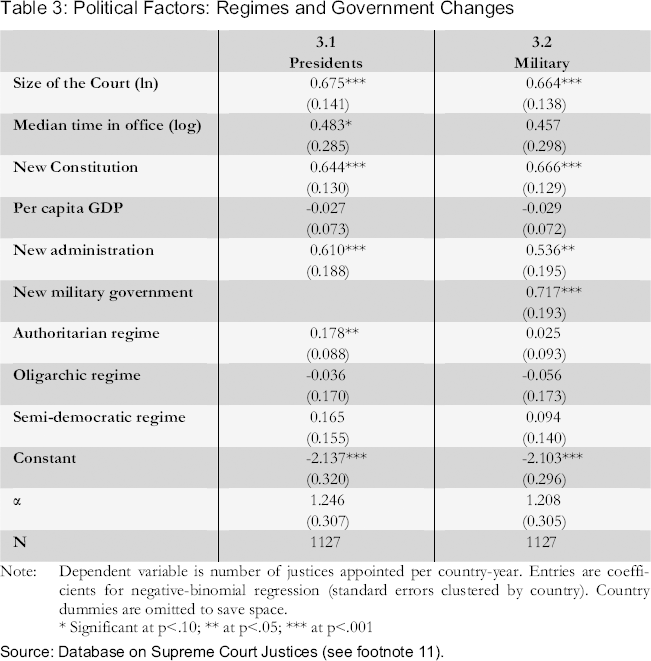
Note: Dependent variable is number of justices appointed per country-year. Entries are coefficients for negative-binomial regression (standard errors clustered by country). Country dummies are omitted to save space.
Significant at p<.10
at p<.05
at p<.001
Source: Database on Supreme Court Justices (see footnote 11).
This is a subset of the new administrations: of 552 changes of government, 46 were coded as military. Instances in which former military officers took office as “civilian” party leaders were not counted as military governments.
The fact that incoming presidents have some leverage to nominate new justices does not automatically mean that they will always want to do it. Under what conditions are presidents more interested in reshuffling the Court? In this section we explore three hypotheses. First, presidents may be less interested in altering the composition of the Supreme Court when judicial review is exercised by a different body. We include a dummy variable indicating whether a distinct constitutional tribunal operates in the country. In those cases, control of the Supreme Court will still provide important benefits (among them influence over lower courts deciding on cases of corruption and on civil cases involving the president's cronies) but the political value of the Court as a veto player will decline.
Second, presidents may be reluctant to stir the Court when they have to negotiate the appointments with the opposition. Unfortunately, data on the composition of Congress is hardly available for some Latin American countries in the early twentieth century, but we were able to measure: (a) whether a legislature operated in the country (because our sample includes multiple types of regimes, about 10 percent of the country-years lacked a legislature), and (b) whether the legislature was elected by proportional representation (51 percent of the cases in the sample). Presumably, a more fragmented Congress could discourage presidential encroachment on the judiciary (Chavez 2003).
Third, presidents may be less interested in appointing new justices when party loyalists already control the Court. As explained above, we assume that presidents prefer to deal with justices nominated by them rather than with justices nominated by other presidents; and that they prefer justices nominated by other presidents of their own party rather than justices nominated by the opposition. We include two variables, capturing the proportion of justices nominated by the same president and the proportion of justices nominated by governments of the same party, measured for the year prior to the observation.
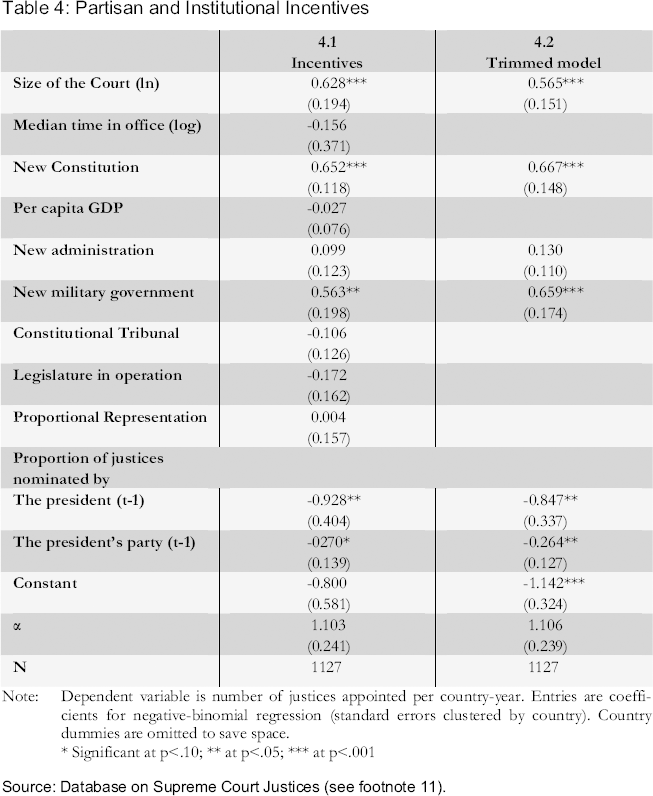
Model 4.1 shows the results of the analysis. The coefficients for the dummies indicating the presence of a constitutional tribunal and a legislative body have the expected direction but fail to achieve statistical significance. By contrast, partisan incentives emerge as a strong predictor of judicial appointments. The number of appointments declines significantly when the president or the party already control a considerable proportion of seats in the Court. In this model, the advent of a military government still produces changes in the Court, but the inauguration of a civilian administration is not relevant for judicial turnover in the absence of partisan incentives.
Model 4.2 is a trimmed equation eliminating predictors with insignificant effects in most tables. To illustrate the substantive effect of partisan incentives consider that, if a hypothetical president had the ability to nominate five new justices to the Court in any given year, the president would only nominate 3.8 candidates if the Court was already controlled by his or her party, and would nominate only one justice if the Court was controlled by his or her own nominees.
Partisan and Institutional Incentives
Partisan and Institutional Incentives
Note: Dependent variable is number of justices appointed per country-year. Entries are coefficients for negative-binomial regression (standard errors clustered by country). Country dummies are omitted to save space.
Significant at p<.10
at p<.05
at p<.001
Source: Database on Supreme Court Justices (see footnote 11).
We have shown that, in several Latin American countries during more than one century, political factors seemed to explain the appointment of new members to the Supreme Court. The number of appointments was significantly greater in the aftermath of constitutional reforms, when military leaders took office, and when civilian presidents faced courts controlled by opposition parties.
Are those political effects consistent across countries and over time? Table 1 suggested that structural breaks may be present in the series for some countries. Our first question in this section is whether judicial politics generally changed with each historical “wave” of democratization. During the first period reflected by Table 1, between the independence of Panama and the end of World War II, few nations could be considered fully democratic. But politics varied considerably across countries: some governments were controlled by powerful individuals such as Maximiliano Hernández Martínez in El Salvador (1931-1944), Manuel Estrada Cabrera (1898-1920) and Jorge Ubico (1931-1944) in Guatemala, Tiburcio Carías in Honduras (1933-1949), and Porfirio Díaz in Mexico (1884-1911); others were controlled by strong elites united under a hegemonic party, such as those in Argentina, Brazil, and Mexico after the Revolution; and few others were controlled by competitive (but still elitist) parties, such as those in Chile and Uruguay (Lewis 2005; Dahl 1971; Smith 2005).
The second period, between the end of World War II and 1977, began with a short wave of democratization (illustrated by the Arévalo and Arbenz administrations in Guatemala during 1944-1954), followed by a series of breakdowns, a new and longer wave of democratization in the late 1950s (represented by the fall of the Rojas Pinilla dictatorship in Colombia in 1957), and a lasting counter-wave (indicated in our sample by the military dictatorships in Argentina, Brazil, Chile, El Salvador, Guatemala, Honduras, Panama, and Uruguay in the 1960s and the 1970s). The third period, after 1978, corresponds to the so-called “third wave” of democratization, a period in which all countries in the sample became democracies or semi-democracies (Mainwaring et al. 2007).
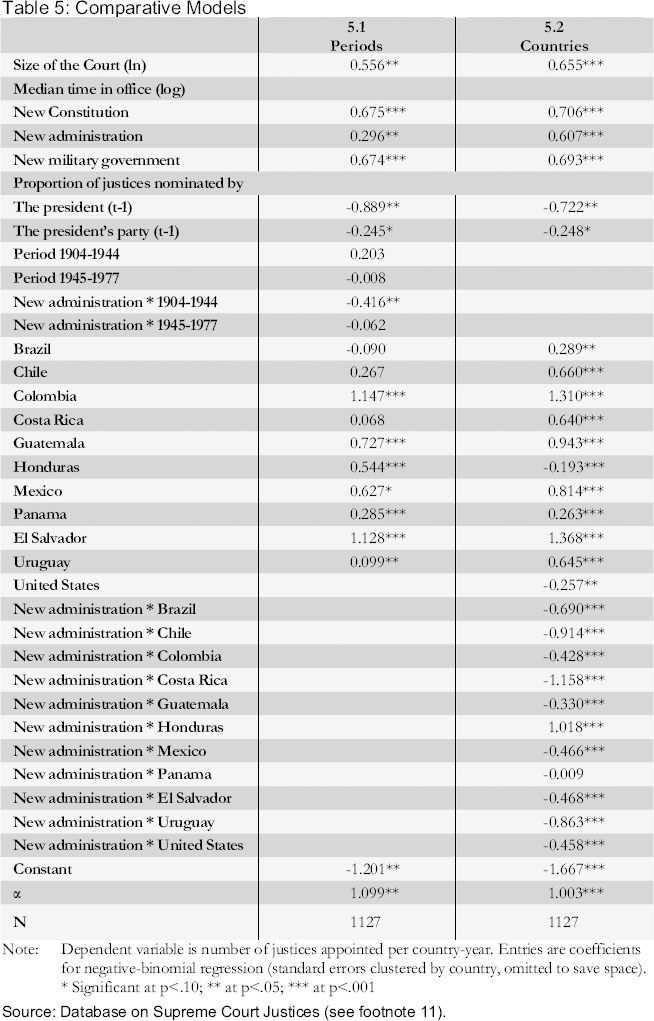
Given the evolution of democracy in the region, we expected presidents to be more inclined to reshuffle courts during the first two historical periods. However, Table 5 suggests a different conclusion. Model 5.1 includes two dummy variables (one for 1904-1944 and another for 1945-1977) and two interaction terms between them and the new administration dummy. Therefore the reference category in this model is the most recent period (1978-2006) and the baseline coefficient for new administrations reflects the variable's impact during the current period.
Comparative Models
Comparative Models
Note: Dependent variable is number of justices appointed per country-year. Entries are coefficients for negative-binomial regression (standard errors clustered by country, omitted to save space).
Significant at p<.10
at p<.05
at p<.001
Source: Database on Supreme Court Justices (see footnote 11).
The results indicate that executive realignments had milder political consequences for the Supreme Court during the early twentieth century than later. The analysis of conditional coefficients shows that, between 1904 and 1944, the effect of new administrations on the appointment of new justices was virtually indistinguishable from zero; between 1945 and 1977, every government change increased the appointment of justices by 26 percent (significant at the .05 level), and between 1978 and 2006, new administrations increased the number of appointments by 34 percent (significant at the .01 level). Because of the relevance of institutional veto players and the judicialization of politics, the advent of democracy may have accelerated the race to control courts, rather than reducing it (Tsebelis 2002, Chapter 10).
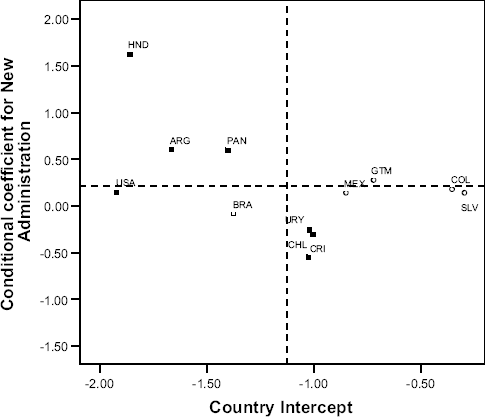
In order to facilitate the interpretation of the results, Figure 2 plots the 12 countries, showing their intercepts and the conditional effect of a government change according to model 5.2. The horizontal axis reflects the country intercepts (the constant in 5.2 plus the estimate for the country dummy), a measure for the expected turnover in the Court after all other factors have been controlled for. The vertical axis reflects the conditional coefficients for the New Administration variable (the baseline coefficient in 5.2 plus the estimates for the interaction terms), an indicator of the impact of presidential interference in each country. The vertical dimension thus indicates to what extent the historical levels of judicial turnover depicted in Figure 1 and Table 1 resulted from realignments in the executive branch; while the horizontal dimension compares the remaining degree of judicial turnover in each country after all general explanations included in the models are accounted for.
Country Intercepts and Conditional Coefficients in Model 5.2
The quadrants in the figure denote four historical types of institutional environments for the Supreme Court. Cases in the upper-left quadrant represent situations in which supreme court turnover is relatively low in “normal” years, but increases significantly in the aftermath of government changes. Honduras presents an extreme example of this pattern, indicating that the very high turnover observed in Figure 1 may be fully explained by executive politics. Argentina and Panama constitute significant but less dramatic examples of this historical problem. Note that the quantitative model cannot reveal which strategies were used by incoming presidents to induce supreme court vacancies in each context. Therefore, and in spite of the similar outcomes, a detailed historical analysis of the cases in this cluster could unveil different sub-types of executive-court relations.
The lower-left quadrant captures instances of high judicial stability in which judicial turnover does not significantly change during the first months of a new administration. Only Brazil belongs in this category. Closer to the previous group, the United States has a positive and statistically significant conditional coefficient for the new administration variable. This finding tends to confirm the hypothesis about strategic retirements in the U.S. Supreme Court, but while in the United States strategic retirements are mostly driven by the calculations of individual justices, in Latin America they have often been induced by the executive branch (Zorn and Van Winkle 2000; Spriggs and Wahlbeck 1995; Hagle 1993).
The upper-right quadrant represents situations in which judicial turnover tends to be high, irrespective of the electoral cycles. In countries such as Colombia, El Salvador, Guatemala, and Mexico new justices have been appointed at any point during the life cycle of the administrations. The cases cluster at the lower boundary of the quadrant. Non-significant values for the conditional coefficient indicate that the appointment of new Court members has not typically increased during the first 24 months of presidencies. However, non-significant values for the country intercepts tend to indicate that judicial stability is generally low. To understand this result, consider that country intercepts reflect expected judicial turnover in the hypothetical case when all predictors are zero, including the variable reflecting the size of the Court. Negative values thus indicate that the frequency of appointments would naturally drop if the size of the Court was drastically reduced to just one member (i.e., ln(1)=0), while intercepts close to zero indicate that there is a constant level of judicial turnover in the country that cannot be explained by the predictors in the model (neither the size of the Court nor any others). Mexico, Colombia, El Salvador, and Guatemala illustrate this pattern of sustained turnover. As with the first type, careful historical analysis may reveal important differences within this cluster.
Finally, the lower-right quadrant represents cases of judicial independence in which supreme court stability tends to be high, and more markedly so during the first months of a new administration. In Costa Rica, the appointment of new justices has historically declined by 42 percent in the first two years after a president takes office. In Chile, new governments have typically appointed 26 percent less judges, while in Uruguay the reduction has been of 23 percent (Verner 1984: 479-484).
The expansion of democratic regimes in Latin America during the 1980s fostered a growing interest in the comparative analysis of political institutions. Initially, scholars focused on the study of executive-legislative relations, political parties, electoral systems, and legislative behavior. In recent years, as scholars became more concerned with the protection of citizen rights and the rule of law, the study of judicial institutions attracted their attention. Unfortunately, our knowledge of judicial politics in Latin America still remains quite limited. Region-wide assessments of judicial institutions are scarce, and comparative historical perspectives are often hindered by the lack of reliable sources.
In this paper we offered one of the first systematic long-term comparative analyses of supreme courts in the region. The data for 11 countries suggested that there have been considerable historical differences in the degree of judicial turnover experienced by high courts in Latin America. The Supreme Courts in Honduras, Guatemala, and El Salvador were reshuffled frequently during the last hundred years, while the Courts in Brazil, Costa Rica, and Chile have been at least as stable as the U.S. Supreme Court. Some judicial systems have seen considerable transformations during the course of the twentieth century, with Argentina moving towards a more volatile Supreme Court and Mexico moving towards a more stable one.
Following a separation-of-powers approach, we modeled the frequency of supreme court appointments as a function of changes in the executive branch plus a battery of controls. Our results indicate that the arrival of new administrations to power has consistently resulted in the appointment of new justices. This effect is more pronounced for the first months of military governments, but change in civilian administrations has also triggered supreme court reshuffles.
Our findings reinforce Verner's (1984) early conclusions about the role of executives and provide more precise evidence about the specific circumstances under which executive politics matters for judicial stability. Partisan alignments help explain judicial turnover, indicating that supreme court nominations are a key political resource for presidents to extend partisan loyalty within the judiciary.
We have shown that democratic regimes do not produce greater levels of judicial stability than authoritarian regimes. Authoritarian rulers may prevent the Supreme Court from dealing with sensitive issues, thwarting any form of judicial activism. Unable to do so, democratically elected presidents sometimes seek to manipulate the composition of the Court in order to secure friendly justices (Larkins 1998). This conclusion is reinforced by the fact that civilian presidents in Latin America have become increasingly aggressive in their attempts to influence judicial appointments. On average, the arrival of a new civilian administration in office has had a more profound impact for the composition of the Supreme Court in the last three decades (that is, after the wave of democratization) than at any other point during the twentieth century. This process denotes the increasing judicialization of politics in the region (Domingo 2004; Sieder et al. 2005).
Constitutional designs may in part explain the capacity and the incentives of presidents in different countries to induce judicial retirements. We have not probed this issue systematically in this paper because of the limited availability of long-term comparative data on constitutional rules dealing with the judiciary, but we are working to explore this topic more carefully in the future. 22
To the extent that constitutional rules tend to be relatively stable conditions, the fixed effect models may have captured their effects. But the key questions are what institutions matter and in which ways.
Our findings suggest that, just as in the U.S. case, supreme court vacancies and appointments are influenced by political considerations. But Latin American countries differ from the American case in that presidents, rather than justices, have influenced the timing of judicial retirements and nominations. Presidents have employed multiple strategies to induce judicial retirements, but such strategies remain for the most part unknown. One of the key tasks ahead is to develop a comparative research program to determine how presidents, in very different historical and institutional settings, have been able to manipulate the partisan composition of high courts.