




Abstract
Latin America contains roughly half of the world's countries that use compulsory voting, but this electoral institution has received only limited attention from researchers. This article examines the determinants of voter turnout in the world's largest electorate subject to mandatory voting, that of Brazil. In analyzing data from six national legislative elections held in Brazil between 1986 and 2006, the study finds that the impact of compulsory laws varies across social and economic groups. From a methodological perspective, the article argues that “compulsoriness” of mandatory voting legislation can be modeled by taking into account both exemptions to the law and the relevance of potential sanctions against non-voters. The issue of enforcement must be considered if we are to develop comprehensive models of electoral participation under conditions of compulsory voting.
The simple presence or absence of mandatory voting laws in a constitution is far too simplistic. It is more constructive to analyze compulsory voting as a spectrum ranging from a symbolic, but basically impotent, law to a government which systematically follows up on each non-voting citizen and implements sanctions against them.
Maria Gratschew, International IDEA 1
See the International IDEA website at <http://www.idea.int/vt/compulsory_voting.cfm>.
Although political science has built up an impressive literature on electoral participation, it is striking how little we know about compulsory voting in comparative perspective. As Sarah Birch (2009) has noted, this imbalance is rather curious: comparatively uncommon electoral institutions such as the single transferable vote (STV) have garnered significant attention from comparativists, yet mandatory voting – which occurs more frequently among contemporary democracies – languishes in relative obscurity.
If this shortcoming is to be redressed, the burden must fall heavily on Latin Americanists. Latin America contains approximately half of the countries in the world that currently make voting an obligation under the law. If we take the typical universe of 18 countries that have been analyzed exhaustively in the Third Wave of democratization (Brazil plus the Spanish-speaking republics, minus Cuba), we note that 15 of these countries have some form of compulsory voting legislation (henceforth CVL) in place. Only Colombia, Nicaragua, and Venezuela do not. Given that in the latter two countries, entrenched CVL was abolished by left-leaning governments in 1987 and 1999, respectively, 2 Colombia is the only Latin American country with a longstanding historical tradition of voluntary voting. However, the literature on CVL in Latin America remains sparse and, in some countries, practically nonexistent.
CVL existed in Nicaragua during the Somoza dynasty, but was excluded from the 1987 constitution, which was written by an assembly dominated by the Sandinistas. As for Venezuela, there is some confusion over when CVL was formally abandoned. Fines for non-voting were dropped in 1993, but CVL was not definitively abolished until the Chávez-inspired constitution of 1999.
In this article, I aim to increase our understanding of mandatory voting – and more broadly, electoral participation – in Latin America by examining the case of Brazil. Brazil has used some form of CVL in all of its electoral processes since 1934, and currently contains the world's largest electorate subject to mandatory voting. Since 1988 voting has been compulsory for all voters, except illiterates, between the ages of 18 and 70 (it remains voluntary for 16- and 17-year-olds and for senior citizens). I examine the determinants of voter participation in 27 Brazilian states in the six democratically held parliamentary elections since 1986 in order to ask two relevant questions about CVL. First, does CVL tend to homogenize turnout across subnational units, or do conventional cross-sectional differences persist, best explained by traditional predictors of turnout? Second, even while holding national CVL constant, is it possible to capture variance in susceptibility of voter categories to the inducements of mandatory voting? Addressing the first question at a subnational level helps us move beyond what has become somewhat of a stalled debate at the cross-national level. Addressing the second question would address International IDEA's admonition quoted above by generating new findings on a notoriously tricky issue – enforcement of CVL – and potentially offering some insights on how mandatory voting might best be administered. 3 In exploring the case of Brazil, the central objective of the paper is to improve our understanding of how “compulsory” CVL really is, and how mandatory voting interacts with traditional predictors of voter turnout.
Compulsory voting and mandatory voting, which I will use interchangeably in this essay, are both misnomers. As Arend Lijphart pointed out in his 1996 presidential address to the American Political Science Association, existing laws do not compel citizens to “vote,” but rather to appear at the polls. A more accurate descriptor for CVL would be “compulsory turnout” (Lijphart 1997). Presumably because CVL draws citizens to the polls who would might have stayed at home in a voluntary voting system, it is associated with higher rates of blank and spoiled ballots (Power and Garand 2007).
Before proceeding, it is worth noting what this article will not do. I will not endeavor to explain the origins of CVL in Brazil or elsewhere (e.g. Helmke and Meguid 2007), nor enter into debates over the normative desirability of mandatory voting (e.g. Lijphart 1997, Hill 2002), nor attempt to assess the distributive consequences of CVL from a political economy perspective (e.g. Chong and Oliveira 2006). Although important, these are not questions to which a subnational research design on a single CVL country can meaningfully contribute. However, such a design can potentially advance the debate by controlling for historical and cultural effects and isolating more carefully some of the institutional, political, and sociodemographic variables that may affect how mandatory voting plays out in practice. Moreover, the issue of enforcement – which can only be addressed indirectly, even under the best of circumstances – may prove easier to investigate when we hold the socio-legal environment reasonably constant.
Compulsory Voting: Methodological Puzzles
Why does the literature on Latin American politics give scarce attention to mandatory voting? One reason, mentioned above, is that CVL has never occupied much space in the broader comparative literature on electoral behavior. 4 To the extent that it has been addressed at all, it has figured mostly in studies of the few advanced industrial democracies that have used it extensively (Australia, Belgium, Italy, etc.), or it has been used as a control variable in cross-national studies of turnout. A second reason is that many studies of Latin American voting continue to be single-country case studies, in which electoral rules are held constant, or in which the dependent variable is partisan choice rather than appearance at the polls. Understandably, the weighty electoral choices connected to democratization and structural adjustment over the past two decades have been viewed as more worthy of study than the issue of raw turnout.
Birch (2009) commendably provides the first comparative book-length study of the topic in English.
A third reason for sparse attention is the daunting lack of information on the degree to which CVL is actually enforced in various countries. Although in recent years there have been some efforts at compiling cross-national information on both the existence and application of sanctions against non-voters (e.g. International IDEA 1997; Payne et al. 2003: chapter 2; Norris 2004: 168-170), the available data (especially on the issue of application) remain relatively rudimentary and impressionistic. Without better data on enforcement, cross-national research designs cannot adequately conceptualize CVL as something that admits of degrees; it is almost always operationalized as a dummy variable in statistical analyses. For what it is worth, these analyses have invariably shown that CVL – when measured crudely as a dichotomous variable – really “works” to boost turnout, both in advanced democracies (Powell 1986; Jackman 1987; Hirczy 1994; Franklin 1996, 1999, 2004) and in Latin America (Pérez-Liñán 2001; Fornos et al. 2004). In the best available overview of the comparative literature on voter turnout, André Blais summarizes the current state of knowledge:
“‘Compulsory voting increases turnout’ can be construed as a well-established proposition… In summary, we know that compulsory voting increases turnout and that its impact depends on its enforcement. But we do not know how strict that enforcement must be in order to work. We know nothing about the public's awareness and perceptions of the law and its implementation. And there are no comparative analyses of the determinants of turnout with and without compulsory voting. This is an unfortunate state of affairs” (Blais 2006: 113).
This pessimistic assessment seems accurate, and our ability to change it seems somewhat limited in the medium term. However, there are some ways in which creative research designs can make some headway on the issue of CVL. One approach is to compile individual-level data, combine them with well-established variables from aggregate cross-national studies, and then use multi-level models to compare how similarly situated individuals behave in different national-electoral contexts with and without CVL (Franklin 2004). Another approach is to use survey research in CVL systems to simulate how individuals might behave (more precisely, how they report they would behave) if voting were made voluntary (Elkins 2000). Still another method is to use time series with intervention in cases that have changed their electoral rules regarding mandatory participation; this was the method used in an early study by Irwin (1974) on the Netherlands, where CVL was abolished in 1970. Finally, another intriguing research strategy is to “scale down” (Snyder 2001), using the subnational comparative method to investigate intra-national differences in voting behavior in cases where institutions vary cross-sectionally across electoral districts. Such an approach was used in Hirczy's elegant (1994) quasi-experimental design, in which he compared turnout rates of Austrian provinces with and without CVL.
The subnational comparative method holds out a great deal of promise, because it allows the researcher to hold constant many of the elusive cultural and historical variables that can confound cross-national research. Controlling for political culture seems particularly important in the case of CVL. For example, Norris finds that CVL boosts electoral participation only in the advanced industrial democracies, but not in the “new” democracies of the Third Wave. She speculates that
“it may be that the impact of mandatory laws depends primarily upon broader social norms about the desirability of obeying the law and those in authority, which may prove stronger in established democratic states in Western Europe than in many Latin American cultures” (Norris 2004: 170).
A subnational research design on a new democracy would not completely neutralize Norris’ concerns, because it could conceivably be the case that the relevant culture-bearing units are regions rather than the national polity – this is a frequent theme of research on political participation in cases such as the United States (Elazar 1966; Sharkansky 1969) or Italy (Putnam, Leonardi, and Nanetti 1993) – but it would provide an indirect test of her hypothesis. If we find, for example, that the impact of mandatory voting laws across Brazilian states varies considerably, and/or if we find that such variation can be linked to institutional or social-structural factors specific to the subnational units, then we would have to qualify any culturalist explanation along the lines that Norris proposes.
“Scaling down” to a subnational study permits us to address issues of intranational variation in mandatory voting. One of the key normative arguments in favor of CVL is that it should reduce inequality (Lijphart 1997). Although this argument has been made chiefly at the levels of individuals and of social classes, it can easily be extended to regional inequalities. To give a simple example, the wealthiest U.S. state (Connecticut) has a per capita income roughly twice that of the poorest state (Mississippi), and over the past two decades voter turnout in Connecticut has been, on average, about 15 percentage points higher than that of Mississippi. 5 It is reasonable to expect – as does Lijphart – that the introduction of CVL in the U.S. could reduce this differential, improving political equality in the face of enduring socioeconomic inequality. In Brazil, regional inequalities are even more severe and more politically salient (Soares 1967): in the most recent election year of 2006, the per capita GDP of the richest electoral unit (the Federal District of Brasília) was more than nine times higher than that of the poorest (the state of Piauí). If CVL in Brazil is indeed working to narrow inequalities, then we should see relatively small differences in turnout across states, and the traditional predictors of turnout used in ecological studies with aggregate data (e.g. socioeconomic, institutional, and political variables) should have less of an impact.
Data were drawn from the United States Election Project at George Mason University, online: <elections.gmu.edu>.
So CVL should work to homogenize voter turnout across electoral districts in Brazil. But how can we control for possible variation in the enforcement of the law? At first glance, a subnational research design may not seem to offer us much progress toward conceptualizing and operationalizing the difficult issue of enforcement – after all, CVL is a national constant and applies to all states in Brazil, so one might argue that enforcement should simply be “assumed out” of a study like this one. Although enforcement poses difficult methodological issues that force us to choose among various suboptimal strategies, I see two ways in which we can attempt to improve upon extant models. One is by attempting to measure the effectiveness of the judicial institutions that are charged with enforcing mandatory voting. While this is extremely difficult in cross-national research due to various confounding factors (varying legal sanctions, different enforcement institutions, and inadequate measures of their effectiveness), within Brazil the enforcement institutions are identically configured across states, and there are some limited data on their efficiency and throughput.
A second way to capture enforcement is to assume that not all voters are equally susceptible to the inducements of mandatory voting laws, and to try to model variation in the obrigatoriedade (compulsoriness) of voting across social groups. The rationale is as follows. Laws do not apply equally to everyone in practice, and some can usually evade their consequences. For example, a U.S. law requires all males to register with the Selective Service System (a roster intended for possible military conscription) within 30 days of their 18th birthday. Evasion is a felony punishable by up to five years in prison and a 250,000 USD fine, but prosecutions are rare. On the other hand, no adult male can obtain federal student loans, job training, or government jobs without proof of registration, so it behooves most young men to comply. But there are certainly cases of men who will never enter into any of these interactions with the federal government, and for them, failing to comply with the law is unlikely to cause them much difficulty in life. It is therefore unsurprising that we find a nontrivial amount of evasion: across the U.S., about one in five young men fail to register with the SSS by the age of 20. There is also considerable cross-sectional variance in compliance, ranging from 95 percent in New Hampshire to 73 percent in Hawaii (SSS 2000). This example suggests two things: an action that is ostensibly compulsory in fact varies in “compulsoriness” across different social groups, and moreover it should be possible to model that variance based on certain reasonable assumptions about what drives the compulsoriness – i.e., what kinds of individuals are more or less susceptible to the inducements and rewards embodied in the law.
In the case of Brazilian CVL, variation in obrigatoriedade was first hypothesized by Marcus Figueiredo (1991: 197-201). He observed that while CVL imposes some obligation on all voters (small fines are written into the law), the obligation falls most heavily on those voters for whom interaction with the state is unavoidable: public employees. Because proof of voter participation is a condition of public employment, failing to vote is not an option for these workers. His regression analysis showed that the percentage of voters who are funcionários públicos was indeed a positive and significant predictor of turnout. 6 I propose to extend this logic to include all voters who are in the formal economy, defined as those having a signed work card (carteira assinada). Less than half of the Brazilian labor force falls into this category. 7 Following Figueiredo's argument, status as a formal-sector worker locks these voters into a lifelong series of transactions with the central state (benefits, pensions, severance pay, etc.), which in turn raises the effective penalties for non-voting enormously.
This was a very preliminary test. The hypothesis was tested in a snapshot model, using the 22 states that voted in the 1963 plebiscite on the restoration of presidentialism, and the only other independent variable was an indicator of electoral competitiveness in the state. To my knowledge, Figueiredo's original hypothesis has not been developed further in the literature on Brazilian voting.
Comparing the Brazilian states in 2006, the penetration of carteira assinada ranged from 21 percent in Piauí to 47 percent in the Federal District, with a mean of 35 percent. Even taking only Brazil's six largest metropolitan areas, formality among employed persons passed 50 percent for the first time only in early 2008 (IBGE press release, “Emprego com carteira assinada é recorde,” March 2008). These figures include military personnel and public employees.
I further propose to introduce additional controls for the two age-defined segments of the electorate for whom voting is voluntary (16- and 17-year-old voters, plus voters 70 and older), and for illiterates. By estimating the size of the voluntary electorate which lives inside a mandatory voting system, these controls should capture variation in “compulsoriness.” Finally, as noted above, I will also attempt to control for the effectiveness of the relevant subnational enforcement institution (the Tribunal Regional Eleitoral, or TRE). In these three ways I aim to achieve a more nuanced operationalization of CVL in Brazil, thus allowing us to test more fully specified models of electoral participation.
Compulsory Voting in Brazil: Background and Context
The dependent variable in the analyses reported below is turnout as a percentage of the registered electorate in contests for the Câmara de Deputados, the lower house of the federal legislature. The registered electorate is defined by the Tribunal Superior Eleitoral (TSE), the national electoral court and the supreme authority in electoral management. Each of the 27 states also has a provincial electoral management court known as the Tribunal Regional Eleitoral (TRE), responsible for administering the election in each state and for the enforcement of mandatory voting.
As noted earlier, voting is compulsory for all literate citizens between the ages of 18 and 69; it is voluntary for illiterates and for those aged 16-17 and 70 and over. This means that citizens in the compulsory category must seek out the electoral justice and apply for a título eleitoral (voter registration card), but citizens in the voluntary category are not required to register. However, if those in the voluntary category choose to enter the registered electorate, they must vote regularly in order to maintain their título up to date, as discussed below.
Establishment of a citizen's age is very straightforward, but what to make of the legal exemption for illiterates? We have virtually no data or research on the impact of CVL upon illiterates in Brazil (Nicolau 2002). However, there are several reasons why the exemption for illiterates is often viewed as innocuous in Brazil. One is that illiterates were denied suffrage until 1985, so one might expect a surge of participation after the democratic transition. 8 Another reason is the elusive definition of what actually constitutes literacy. When voters register, their educational level is entirely self-reported, and the TSE states publicly that it makes no effort to check the veracity of the information. The possibility of self-reporting, and the absence of any verification, presumably reduces any social deterrent to coming forward to register. Table 1 reports the self-declared educational attainment of Brazilian voters in 2008, showing that 6 percent reported being illiterate when they registered. Another 16 percent (more than 20 million voters) said they could read and write but also declared that they lacked any formal schooling. It seems reasonable to assume that many in this second category are also functionally illiterate.
Male illiterates could vote for most of the Empire (1822-1889) subject to wealth and property requirements, but illiterates lost the suffrage with the constitution of 1891. All Brazilian constitutions have barred illiterates from becoming candidates for public office.
Self-Reported Educational Attainment of the Registered Brazilian Electorate as of March 2008
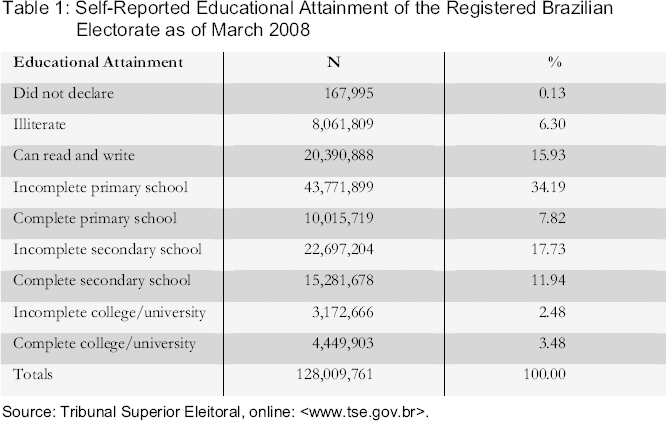
Source: Tribunal Superior Eleitoral, online: <www.tse.gov.br>.
The social stigma attached to illiteracy should be expected to raise the psychological cost of not having a título eleitoral like the vast majority of the adult population. When faced with the choice between registering to vote or undergoing a potentially embarrassing interaction with state authorities sometime in the future, an illiterate citizen may well decide that registering is the lower-cost alternative. Once the person is registered, the calculus is similar: either keep voting or risk the loss of the título. There is of course a third alternative that is available to illiterates (or to anyone else, for that matter): neither register to vote nor interact with the state. We have no good individual-level information about how illiterate citizens actually decide these issues, so all of our inferences must be made imperfectly via aggregate data. The 2006 national household survey estimated that 10.4 percent of adult Brazilians (15 and older) are illiterate; the 2008 electoral register shows that 6.3 percent of registered voters (16 and older, thus not directly comparable) are self-declared illiterates. 9 Given the strong possibility of underreporting of illiteracy in voter registration figures, it is quite possible that literate and illiterate Brazilians choose to register at broadly similar rates. 10
Data from the 2006 wave of the Pesquisa Nacional de Amostra por Domicílios (PNAD), online: <www.ibge.gov.br>.
Indeed, the electorate as a share of the population now stands at an all-time high in Brazil. In March 2008, the electorate stood at 128 million and the population count at 186.5 million (from the online IBGE popclock), meaning that registered voters as a percentage of the population are now an impressive 68.6 percent. This compares to 62 percent in 1995, 41 percent in 1975, 24 percent in 1955, and only 16 percent in 1945 (Power and Roberts 2000).
As discussed above, a citizen will calculate the utility of registration by estimating whether he or she will need to transact with the authorities in the future in order to obtain desirable benefits. Therefore, although there are good reasons to believe that the CVL exemption for illiterates is effectively innocuous, this hypothesis must be assessed in conjunction with other environmental variables such as the size of the formal sector (e.g. the penetration of carteiras assinadas). For instance, there is no reason to assume that illiterate residents of poorer states will make the same kinds of choices as illiterates in the more socioeconomically developed states. The latter are more likely to be acted upon by the formal economy and by state institutions of more advanced capacity.
Once registered, citizens must vote in order to maintain their título eleitoral. A citizen who fails to vote has 60 days to appear before a TRE judge and provide a valid explanation for failing to do so. This normally requires written documentation, such as a doctor's note for illness, or travel documents that prove absence from the electoral district. An employer's memo will not suffice, because private-sector workers are not exempt from CVL, and managers must make arrangements for their workers to vote; however, certain government employees and military personnel can seek exemption under a loophole for essential workers. If the electoral judge rejects the petition (justificação) of the non-voter, he or she can apply a fine defined by law. 11 In 2006, the value of this fine normally ranged from 1.06 BRL to 3.51 BRL: the dollar equivalent at the time of the election was 0.50 USD to 1.65 USD. Based on unusual circumstances and taking into account the offender's ability to pay, the TRE judge could theoretically multiply this fine by ten, but the maximum value would still be only around 16 USD.
The presentation of such excuses to the authorities is known by the slang term justificar o voto (to justify one's vote), when it has precisely the opposite meaning – to justify the act of non-voting.
Even for low-income voters, these fines are not excessive. However, the value of the fine is less important than the long list of non-monetary penalties for defying CVL. Citizens who do not vote or who fail to justificar in three consecutive elections 12 can expect to have their voter registration card cancelled (cancelamento do título eleitoral). Those without an up-to-date título eleitoral are prohibited from taking civil service examinations, from holding any form of government employment, or (if already employed by the public sector) from receiving any government paychecks from the second month after the missed election. They cannot enroll or renew registration at public schools or universities, or in fact any educational institution accredited by the federal government; they cannot obtain an identity card or passport; they cannot obtain credit at any state-owned bank or do business with any state or parastatal enterprise; and they are barred from any activity which would require proof of military service or of payment of income tax. While not all Brazilians engage in all of these transactions, the vast majority require an identity card, which is needed for everything from cashing checks to boarding interstate buses. Therefore, despite the low monetary value of fines, there are a number of persuasive reasons why ordinary citizens will want to keep their título eleitoral up to date.
A two-round election counts as two separate elections. Runoffs are used for the presidency, for governorships, and for mayors of cities with more than 200,000 voters.
Exemptions and enforcement, therefore, are two key factors in understanding compulsory voting, but we know very little about how they work. In the next section, I attempt to operationalize some of these contextual variables and merge them with traditional predictors of voter turnout.
Data, Variables, and Empirical Testing
In the absence of individual-level data on mandatory voting behavior in Brazil, we are forced to use aggregate data. Brazil has 27 electoral districts: 26 states plus the Federal District (Brasília). I collected data on electoral turnout in these states in all six elections to the federal Chamber of Deputies (the lower house of Congress) under democracy, from 1986 through 2006. This yielded a total of 161 state-year observations. 13 Because certain independent variables are lagged in the analyses below, I drew on some data from the 1982 congressional elections as well. 14 Although the transitional 1982 contests were held in the twilight of military rule, they were generally competitive and inclusive, and so it is justifiable to build lagged measures on those elections. 15
The total should be 162, but in 1986 the state of Tocantins was still a part of Goiás. It became independent in 1988 and voted in federal elections for the first time in 1990. Also, prior to 1990 the remote and lightly populated states of Amapá and Roraima were federal territories. Although as territories they did not elect their own governors, they did elect federal deputies in the same way as states, the exception being that they were limited to four seats each (half of the minimum district magnitude for states). For simplicity I refer to the territories and to the Federal District as states throughout.
Lagging independent variables causes the exclusion of three cases in regression analysis: the Federal District in 1986 (it first voted in 1986) and Tocantins in 1986 and 1990 (the state was created only in 1988).
The 1982 elections were the first multiparty parliamentary elections held in Brazil since 1962. Only the two small Communist parties were proscribed, but their candidates ran generally unhindered under other party labels, and the then-radical Partido dos Trabalhadores (PT) was fully able to participate. The elections generated enormous interest because they coincided with the first direct elections for governor since 1965. This signified the advent of subnational democratization, which preceded national democratization in Brazil (Samuels and Abrucio 2000).
The hypothesis regarding regional inequalities discussed earlier – i.e., CVL works to homogenize turnout across electoral districts – can be assessed visually. Figure 1 presents the mean turnout rates for the 27 states over the six electoral cycles under democracy. As can be seen, there is significant variation in turnout, ranging from a mean of 74.6 percent in the northeastern state of Maranhão to an average of 89.2 percent in the southern state of Rio Grande do Sul. What is more, these patterns are relatively consistent across cycles: the low performers and the high performers are usually the same states at each election.
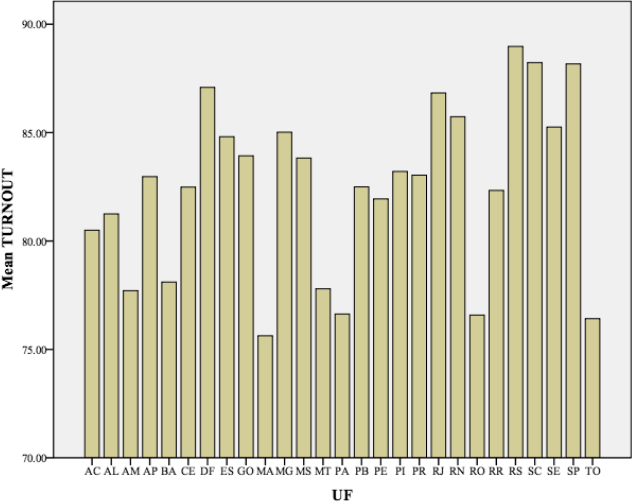
Mean Turnout for Chamber of Deputies, Brazilian States, 1986-2006
For the 27 states under democracy, the mean turnout is 81.8 percent, with a standard deviation of 4.35 and a range of 14.6 percentage points. Are the range and standard deviation high or low? A comparison can be made with the United States, which uses voluntary voting. I drew several different random samples of 27 U.S. states (to match the Brazilian sample size) and ran tests of the turnout rates for the highest office in all elections from 1980 to 2006. 16 The results were broadly similar each time: a mean of about 50 percent, a standard deviation slightly above 6, and a range slightly above 20 percentage points. Compared to the United States, Brazilian states have vastly higher voter turnout – the best-performing U.S. state, Minnesota, is 10 points below the worst-performing Brazilian state, Maranhão – but the measures of dispersion are only slightly lower. Although one cannot draw firm conclusions from a simple comparison such as this, the exercise suggests that CVL elevates turnout (which has been confirmed in numerous cross-national studies) but does not necessarily erase enduring differences across electoral units, at least in Brazil. In fact, a glance at Figure 2, which correlates mean turnout with a measure of state per capita income, suggests a rather predictable pattern established in countless other studies of electoral behavior around the world. Simply knowing the wealth of the states allows us to predict over 40 percent of the variance in electoral participation, even under conditions of mandatory voting.
Data were drawn from the United States Election Project at George Mason University, online: <elections.gmu.edu>.
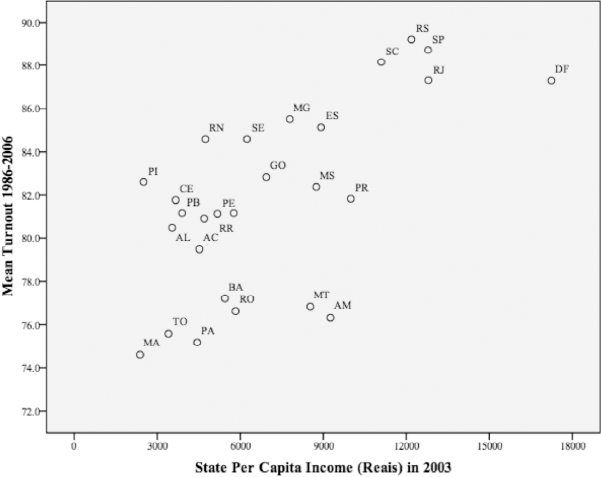
Mean Turnout by Per Capita Income, Brazilian States, 1986-2006
Although the above exercise is superficial, Figures 1 and 2 suggest rather strongly that there is a significant amount of cross-unit variance remaining to be explained. The question is how much of that variance can be explained by traditional predictors of electoral participation, such as wealth and political institutions, and how much of it can be explained by variation in the effective “compulsoriness” of voting.
With regard to wealth, there is a wide consensus in the comparative literature that socioeconomic modernization is associated with higher political participation both at the individual and aggregate levels (Almond and Powell 1963; Wolfinger and Rosenstone 1980; Filer, Kenny, and Morton 1993; Rosenstone and Hansen 1993; Norris 2004), so in the models below I include a measure of state GDP per capita. 17 This variable, intended as a baseline control, is expressed in constant reais of the year 2000. I now proceed to two other clusters of variables, one capturing the political-institutional environment of each state and the other capturing obrigatoriedade.
This study does not include measures of economic performance in the models, because such measures are not available at the subnational level. I rejected macro-level controls on growth or inflation as too blunt, not only because they would become constants in each of the six electoral cycles, but also because it is not clear what would be the appropriate time frame to measure these variables.
Institutional accounts of electoral participation date to the seminal articles of Powell (1986) and Jackman (1987). This approach was recently reviewed in the excellent review essay by Blais (2006), and has already been applied in studies of Latin American voter turnout (Pérez-Liñán 2001; Fornos Power, and Garand 2004), so I will not go into great detail here. One key variable from this approach is electoral disproportionality, which punishes minor parties. Supporters of these parties will thus have less of an incentive to appear at the polls, and therefore disproportionality should depress electoral participation. Here I use the Gallagher index of disproportionality, also known as the least squares index (Gallagher 1991). This measure is highly sensitive to the presence of small parties (Taagepera and Grofman 2003), which makes it appropriate for the permissive Brazilian system with its high average district magnitude (Mainwaring 1991). Another important variable here is party fragmentation: Jackman (1987) argued that multipartism should be inversely related to voter turnout. Voters in fragmented party systems will be less efficacious because they perceive that their votes are not perfectly translated into the formation of governments. A related argument pertains to information costs: a saturated political market with many parties may confuse and alienate potential voters (Power and Roberts 1995; Kostadinova 2003). This expectation is especially relevant in new democracies where party systems have not yet become institutionalized and labels are still unfamiliar, which was the case in Brazil during the first several electoral cycles examined here (Mainwaring 1999). I measure multipartism using Laakso and Taagepera's (1979) effective number of electoral parties (ENEP). I lag both disproportionality and ENEP by one election (see Appendix for further information on variables and data).
Powell (1987) and others have argued that the electoral formula itself is a good predictor of turnout, because it affects the likelihood that political parties will attempt to “get out the vote.” For example, single-member district plurality (SMDP) electoral rules do not provide parties with incentives to run candidates everywhere, meaning that some districts are simply written off”. Proportional representation (PR) systems overcome this disincentive and are associated with higher turnout (Blais and Dobrzynska 1998). In addition to having high district magnitudes across the states (ranging from a minimum of eight to a maximum of 70 seats), Brazil's open-list PR system permits parties to run more legislative candidates than there are seats available, and to increase this total even further when they form interparty alliances (Mainwaring 1991). The number of candidates is important because it is generally individual politicians rather than parties that conduct the business of campaigns (Mainwaring 1999, Ames 2001). To capture this process of political mobilization, I include a measure of the number of candidates for federal deputy per registered voter. This indicator captures the cross-sectional variation in district magnitude (smaller states are overrepresented in Congress) as well as the somewhat unpredictable ceiling on candidacies, which in turn is contingent upon the number of participating parties and the number and breadth of the alliances that they choose to form. Because of the element of randomness owed to coalition formation, the ratio of candidates to voters varies immensely: in 2006 there were 2.8 candidates per 100,000 voters in Bahia, while in Roraima the equivalent figure was 36.
I also include a measure of enlargement of the electorate relative to the previous election. Under certain conditions, rapid expansions of the franchise have been shown to depress participation, especially when the electorate is being enlarged nonrandomly via the inclusion of citizens who are less likely to vote (Franklin 2004). A commonly cited example is the lowering of the voting age: Blais and Dobrzynska (1998) show that in cross-national perspective, a reduction in the voting age by one year will drive down turnout by two points, ceteris paribus. Since the expansion of the electorate in Brazil over the past two decades has been driven in large part by extending the franchise to socioeconomically disadvantaged persons (illiterates) and by reducing the voting age to 16, it is reasonable to expect that the velocity of this process is inversely related to turnout. This hypothesis gains plausibility when we take into account Brazil's underinstitutionalized party system: parties with weak roots in society should find it especially difficult to mobilize a rapidly expanding market of voters.
Turning to the question of uneven “compulsoriness” of mandatory voting, I include five variables. The first is the state illiteracy rate, which is imperfect because it measures illiteracy among the adult population (15 and older) rather than among registered voters. Literacy data for registered voters were not available for the early election cycles; however, aggregate state-level illiteracy is an excellent proxy. The second and third variables are the percentages of registered voters who are young (16- and 17-year-olds) and old (70 and above), respectively. 18 Rather than combine them into a single category of “age-voluntary voters,” I maintain them as separate variables, because there are good reasons to suspect that these two groups might behave differently (as they clearly do in the industrial democracies). In Brazil, persons over 70 are very likely to have voted before, whereas those under 18 have certainly never done so. I expect these three variables to be negatively related to turnout. The fourth variable is the size of the formal-sector labor force, measured as the percentage of the employed population which holds a carteira assinada (a signed work card, linking the individual to the state via labor legislation and benefit schemes). I expect labor formality to be a positive predictor of electoral participation.
The “young voters” variable is scored as zero for all states in 1986, when the voting age was still 18; it was not reduced to 16 until the new Constitution of 1988.
The fifth compulsoriness variable is a proxy for the effectiveness of CVL enforcement. This is operationalized as the disposition rate (also known as the clearance rate) of the local Tribunal Regional Eleitoral, or TRE. The disposition rate is a simple concept: resolved cases as a percentage of all cases brought in a given year. If this figure is below 100, the electoral court is building up a backlog; if the figure rises above 100, the docket is being cleared rapidly. Because data were available for most states only from 1989 to 2002, and also because of the considerable annual fluctuation in the disposition rates, I opted to calculate a single score for each state TRE (the mean of all clearance rates, 1989-2002). As a constant for each state, this is the only variable included here which does not vary in time; although the best available proxy, this operationalization of enforcement is clearly suboptimal. However, it is reasonable to believe that the state electoral courts should, over time, acquire distinct reputations for efficiency or inefficiency. This reputation should have some marginal effect on the calculus of voters, because it will shape the probability of facing an undesirable outcome such as a fine or the cancellation of the título eleitoral by an electoral judge. An apt analogy would be the differential parking behaviors observed in two hypothetical cities, one in which scofflaws acquire numerous parking tickets with no follow-up by the authorities, and the other in which violators have their wheels clamped on the second offense. In Brazil, the reputation of the local electoral justice should be positively related to compliance with mandatory voting.
The above discussion directs toward a model of electoral participation in Brazil which is influenced by the comparative literature but which also reflects the local CVL context. In its stylized form, the model is:
Voter turnout = (Traditional predictors) + (CVL exemptions) + (CVL enforcement) + (error term)
Regression Analysis
I now regress voter turnout on the ten variables discussed above. I estimate two equations, one for turnout patterns and one for turnout dynamics. In the first model of Table 2 (patterns), several interesting findings emerge. Lagged party fragmentation behaves in the way predicted by Jackman (1987): other things being equal, an increase of 1.0 in the effective number of electoral parties drives down turnout by slightly less than one percentage point. Aspects of the electoral system also behave according to established institutionalist models: disproportionality is negatively associated with turnout, and candidate saturation (intended to embody the potential for campaign-driven mobilization) has a positive effect.
Alternative Models of Electoral Turnout for the Chamber of Deputies, Brazilian States, 1986-2006
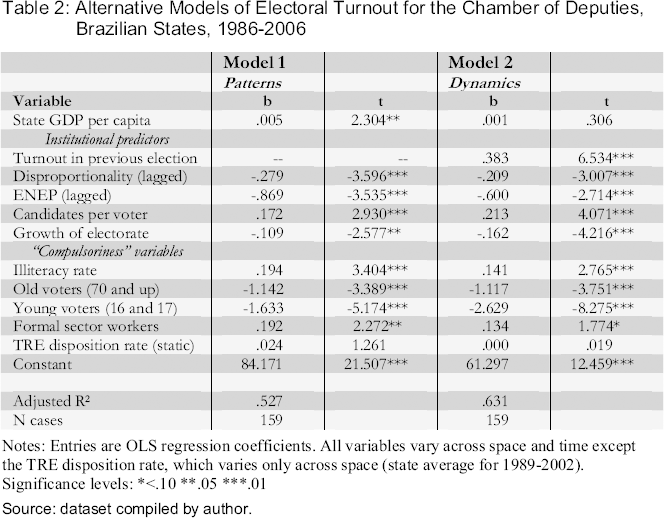
Notes: Entries are OLS regression coefficients. All variables vary across space and time except the TRE disposition rate, which varies only across space (state average for 1989-2002).
Significance levels:
<.10
.05
.01
Source: dataset compiled by author.
What is intriguing here is that four of the five of the “compulsoriness” measures are significant, and all have the expected polarity save one. Registration by under-18s (“young voters” in the table) has a strong depressing effect on turnout; the negative impact of over-70s (“old voters”) is smaller, but is also highly significant. In 2006, young voters as a share of the electorate ranged from 0.85 percent in Rio de Janeiro to 3.62 percent in the frontier state of Amapá, with a mean of 2.29 percent; old voters ranged from 2.59 percent in Amapá to 8.01 percent in Rio (which has far and away the oldest population), with a mean of 5.40 percent. These findings suggest that the voluntary nature of voting for certain age groups has a nontrivial and negative effect on aggregate turnout. The surprise here is the performance of the illiteracy variable, which although significant, has the wrong sign. Net of all the demographic, political, and institutional variables in the model, illiteracy has a positive effect on turnout.
In terms of the non-age related variables which are hypothesized to stimulate compliance with CVL, both have the expected signs in Model 1, but only one is significant. The mean TRE disposition rate does not reach statistical significance in the model, but the share of the electorate in the formal sector is positively linked to electoral participation. For every one percentage-point increase in the labor-sector formality of a given state-year case, voter turnout can be expected to rise about a fifth of a point, net of per capita income.
Model 2 adds the lagged term of electoral participation to the equation. Given the cross-state differences represented visually in Figure 1, the lagged dependent variable offers something of a control on “state political culture” – it helps us predict turnout at time t taking into account what we already know about the state's electoral mobilization at time t-1. The lag of voter turnout has a large and positive effect, increasing the overall goodness of fit of the model, and pointing to significant inertia in electoral participation. It also creates an explicitly dynamic model which provides a useful contrast to Model 1. The substantive findings of the two models are virtually identical, with one exception. In Model 2, the control for GDP per capita loses statistical significance. This is perhaps to be expected given that this is now a dynamic model and the wealth measure varies captures mostly differences across space: GDP per capita changes only slowly and relatively uniformly across time.
Discussion and Conclusions
The analyses presented above are very preliminary, and also exploratory in nature. Yet exploration is exactly what we need to do if we are to improve upon existing empirical studies of compulsory voting. This article has investigated both partial exemptions from CVL as well as the critical issue of its enforcement. As Blais (2006) pointed out, we know very little about how enforcement of mandatory voting works. Having individual-level data on Latin American electoral behavior would be useful, but even so there are always obvious problems with using self-reported data on voting habits. (One might imagine that such data quality problems are compounded in societies where abstention is illegal.) In the absence of individual-level data, the next best thing is to turn to aggregate data in an effort to assess the plausibility of certain hypotheses about compulsory voting. Thus the tests in this article should be understood mainly as establishing the principle of varying “compulsoriness” in certain CVL systems, and as proposing a few key variables for further study.
The models specified here aimed to test “compulsoriness” variables in the presence of certain standard predictors of voter turnout. 19 One conventional predictor, state per capita income – the most commonly used measure of socioeconomic modernization – was significant only in the cross-sectional model, but lost significance in the dynamic model.
One shortcoming of this study is its inability to include temporal variables, in order to test the argument that turnout declines over time in new democracies (Kostadinova 2003; Kostadinova and Power 2007). Time presents serious difficulties in this dataset. It is highly correlated with variables such as party fragmentation and concurrent elections for president, causing multicollinearity in certain models; a dummy variable for the election of 1986 (in which the voting also elected a constitutional convention) is perfectly collinear with the reduction of the voting age, and so on.
The most surprising variable was illiteracy, which turned out to be positive and significant in both equations. There are several possible reasons for this unexpected finding. One hypothesis could be that clientelism – an oft-cited property of the Brazilian political system (Geddes and Ribeiro Neto 1999; Bezerra 1999), and one which is assumed to flourish in the presence of dependent citizens – provides the missing link between illiteracy and electoral mobilization. Another hypothesis is that the exemption from CVL for illiterates is not simply innocuous, but may in fact serve the opposite purpose, inducing disadvantaged citizens to vote at higher rates in order to obtain a key token of citizenship: the valid título eleitoral. Yet a third possibility is after we control for a number of other factors, the marginal abstention in the models is actually being driven by more socioeconomically privileged voters. Middle- and upper-class Brazilians are far more likely to travel on election day, to accumulate other legally valid excuses for not voting, and to have the skill levels necessary to navigate the electoral justice system and push the justificação process forward to a favorable conclusion. More research is necessary to test all of these hypotheses.
The variable capturing the disposition rate of the local electoral court system is positive in both regression models, but is not statistically significant. Although the TRE score captures the state capacity of subnational units, it is unlikely that this is an artifact of socioeconomic modernization, since I also controlled for per capita income, labor market formality, and illiteracy. In fact, the bivariate correlation between the TRE measure (average for 1989-2002) and state GDP per capita (in 2003) is only .39, suggesting that there are both underperformers and overperformers among the subnational electoral courts. As noted above, the use of a static measure here is imperfect, but – thanks to the growing availability of judicial behavior data in Brazil – it will almost certainly be possible to improve on this measure in the future. The main point here is simply to demonstrate the theoretical and methodological plausibility of controlling for the capacity of enforcement institutions in the future study of CVL, and the approach adopted here could be replicated in other contexts where enforcement data are available.
Labor sector formality led to intriguing results in the analyses presented here. The higher the percentage of workers in the formal labor force, the greater is the probability that these citizens will need to transact with the state. In turn, the greater the aggregate need for voters to transact with the state, the greater the overall compliance with CVL. This proposition is theoretically sound and finds some promising support in the empirical models presented here.
The overall message of this empirical exercise is that it is indeed possible to measure variation in the “compulsoriness” of compulsory voting. Brazil is an interesting case in this regard. It provides some legal exemptions to mandatory voting, such that there are at least ten million Brazilians (a number larger than the total electorates of several Latin American countries) who are essentially “voluntary voters” living inside a “compulsory voting” system. It also has a well-defined list of penalties for noncompliance with CVL, and a highly institutionalized court system for dealing with violations of the law. By making certain reasonable assumptions about who is likely to comply with the law and why, and by devising some crude measures of the enforcement mechanisms, it is possible to document some variation in the effective “compulsoriness” of voting. This is an approach that can and should be attempted in the approximately 30 other countries which use mandatory voting, half of which are in Latin America.
Footnotes
Appendix: Variables and Sources
Turnout: Turnout (percent of registered voters) in elections to the Chamber of Deputies. Sources: Jairo Nicolau, Dados Eleitorais do Brasil (DEB), online: <http://jaironicolau.iuperj.br>, and Tribunal Superior Eleitoral (TSE) data for 2006.
State GDP per capita: State gross domestic product per capita, expressed in constant reais of the year 2000. For 2006, the value used is for the year 2005. Source: Ipeadata, online: <www.ipeadata.gov.br>.
Disproportionality: Electoral disproportionality is measured using the Gallagher (1991) or least squares index. For 1986, the lagged value is from 1982. Sources: calculated from DEB site.
ENEP: Effective number of electoral parties, calculated using the Laakso-Taagepera (1979) formula, and based on state-level contests for the Chamber of Deputies. Sources: calculated from DEB site and from TSE data for 2006.
Candidates per Voter: Registered candidates for federal deputy per 100,000 voters, calculated from TSE data.
Growth of Electorate: Percentage growth in the state electorate relative to the previous election. Sources: calculated from DEB site and from TSE data for 2006.
Illiteracy: Percentage of state residents over 15 years old who are unable to read and write. Source: Ipeadata.
Young Voters: Percentage of registered voters who are 16 or 17 years old. For 1986, all cases are scored as zero because these age groups were not awarded the suffrage until 1988. Since then, voting has been voluntary for these groups. Sources: demographic data drawn from Perfil do Eleitorado Brasileiro (TSE 1989) and TSE website.
Old Voters: Percentage of registered voters who are 70 or older. Sources: demographic data drawn from Perfil do Eleitorado Brasileiro (TSE 1989) and TSE website.
Formal Sector Workers: Persons with a signed work card (carteira assinada) as a percentage of the registered electorate in the state. This was derived from two different IPEA time series. First, I took the number of employed persons (população ocupada) from IPEA, 1982-2002. Then, I took the percentage of the employed persons with a signed work card (a separate time series, 1982-2002) and multiplied the two variables together to obtain the raw number of persons with signed work cards. I then divided this by the registered electorate to generate the percentage used here. Since there were no data past 2002, the 2006 value is carried forward from 2002. Sources: Ipeadata and TSE.
TRE Disposition Rate: The judicial efficiency score for the Tribunal Regional Eleitoral of the state. For each year from 1989 through 2002, I calculated resolved cases as a percentage of total cases brought before the TRE. I then took the mean of the 14 yearly scores for the 1989-2002 period and assigned a single score to the state: there is no variance over time. Source: Banco Nacional de Dados do Poder Judiciário, online: <http://www.stf.gov.br/bndpj>.