




Abstract
Though Chile is often lauded for its successful democratic transition and high quality democracy, there are increasing levels of citizen dissatisfaction with the functioning of democracy. This article asks whether this dissatisfaction is due to the lack of congruence between political elites and the mass public with respect to their orientations on political and economic issues. It provides tentative support for the proposition that there is growing consensus between elites and the mass public with respect to the most important issues. Rather than a lack of congruence between elites and the mass public, the paper suggests that the more likely source of citizen dissatisfaction is an emerging partidocracia (or a polity characterized by political party domination) which hampers the full functioning of democracy in terms of legitimacy, accountability and alternation of power. Because this domination has been produced by the interaction of an entrenched legislative election system and model of post-authoritarian partisan politics, it will be difficult to eliminate.
Introduction
Chile is lauded for its successful democratic transition and the high quality of its democracy. 1 However, Chile's status as an iconic political model in Latin America belies a growing frustration with the functioning of democracy among the Chilean mass public. Only 15 percent of Chileans think democracy functions well or very well (CEP et al. 2008). Further, after almost two decades of democracy, only 45 percent think democracy is the best regime in all cases and the number who think so has actually decreased. Indeed, the percentage of Chileans who agree that in some circumstances an authoritarian regime is acceptable (18 percent) or that it really does not matter whether a regime is authoritarian or democratic (29 percent) exceeds the 45 percent who think that democracy is always preferable (CEP et. al 2008). 2 Even in relative Latin American terms, though Chile is praised by academics and analysts as a high quality democracy, on several key indicators of mass public opinion other countries rank higher, and some of Chile's indicators are disturbing. Only 36 percent of Chileans report being satisfied or very satisfied with democracy. This places Chile in the eighth position among the 18 countries included in the Latinobarómetro survey. The citizens of the other poster children for democracy usually grouped along with Chile, Uruguay and Costa Rica, reported much higher rates of satisfaction with democracy at 66 percent and 47 percent respectively. In addition, systemic support for democracy as a regime dropped by 10 percent (from 56 to 46 percent) between 2006 and 2007, placing Chile among the countries with the lowest support for democracy as a system, along with Brazil (43 percent), Paraguay (33 percent), Honduras (38 percent), El Salvador (38 percent), and Guatemala (32 percent) (Corporación Latinobarómetro 2007). On these measures Costa Rica and Uruguay scored 83 and 75 percent, respectively. More worrying for the future, while 95 percent of Chileans over 55 years of age are registered to vote, only 22 percent of the 18- to 24-year-olds are, suggesting a deep generational divide that does not bode well for a potential growth in support for democracy (CEP et al. 2008).
Research for this paper was undertaken while I was a visiting researcher in the Area de Ciencia Política of the University of Salamanca. I am grateful for the institutional support provided by it, and in particular, the personal help and support of Manuel Alcántara, Flavia Freidenberg and Agustín Ferraro.
Though difficult to say definitively, it is unlikely that this division is simply the old authoritarian/democratic cleavage often seen in Chile after the transition (see Moreno 1999). First, there has been a general downward trend in support for democracy since the onset of the transition, suggesting that alienation is not only the norm among those on the traditional authoritarian right. Second, the percentage of those dissatisfied with democracy now far exceeds the percentage of those who identified themselves as part of the traditional right, suggesting that even those traditionally on the “democratic” side of the regime cleavage are also dissatisfied. Finally, the widespread abandonment of their formerly strong party attachments suggests that Chileans across the spectrum are dissatisfied with the current party dominated model of politics.
This data, along with increasing social mobilization and large scale protests during Socialist President Michele Bachelet's administration have led some analysts to tie political dissatisfaction to political parties that have “lost touch” with the public. Yet, several studies have shown that there is congruence in elite-mass opinion in Chile and parties are very well institutionalized; making them theoretically capable of effective representation. If this is the case, why do Chilean politicians and the Chilean public refer to a “crisis of representation” in the country? This puzzle leaves us with three possibilities. The first is, of course, that those measuring elite-mass congruence have somehow got it wrong, and that Chilean political elites have views different from those of the voting public. The second is that elite-mass congruence does not matter for the performance of democratic regimes. The final possibility is that despite agreement on policy, somehow elites are failing Chileans when it comes to other aspects of democracy.
This paper argues that when it comes to the crisis of representation in Chile, the most accurate characterization of the elite-mass equation is the third. The thesis of this paper is that the growing dissatisfaction with the functioning of Chilean democracy is not rooted in incongruity between elite and mass opinion. Rather, this study confirms there is elite-mass congruence on the most important topics facing Chile and Chilean society. However, while there is broad agreement on the content of politics between elites and the mass public, there is dissatisfaction with democratic processes and outcomes. In focusing on a single indicator or representational quality (commonality of elite and mass opinion), studies of elite-mass congruence do not measure success in realizing the full range of elements that are central to the success of democracies, including legitimacy, accountability, alternation of power, and a guarantee that citizen preferences actually make a difference. This paper argues that the interaction of the electoral system and the structure of post-authoritarian competition has led to the emergence of a partidocracia (a pattern of party dominated politics) that causes Chile to fail on these other counts. In essence, Chile's highly institutionalized parties have been both the source of the stability of the democratic transition and the root of dissatisfaction with contemporary democratic politics. For very good reasons elites continue to act within a political model that guaranteed a successful political transition. But, it is also a model which, in terms of longer term government performance, limits accountability, undermines legitimacy, and prevents party alternation within congressional districts. Only with significant reforms and transformation of this model will the long-term performance of a high quality democracy in Chile be successful. However, because this emerging form of partidocracia is in many ways tied to institutional variables, and the legislative electoral system in particular, it may be quite difficult to transform, with potentially very negative long-term consequences for Chilean democracy.
This paper proceeds as follows: The first section discusses the relative importance of elite-mass congruence to democracy and explores studies of elite-mass congruence in Latin America, referencing the most systematic study to date undertaken by Luna and Zechmeister (2005). The second section uses data from the Chilean Centro de Estudios Públicos (CEP) and the University of Salamanca Database of Parliamentary Elites (or PELA) to provide a more impressionistic, but perhaps more complete confirmation of the existence of elite-mass congruence in Chile based on general orientations toward the fundamentals of politics, as well as particular issue areas. The third section explores the roots of dissatisfaction with Chilean democracy despite the existence of elite-mass consensus, focusing on how the legislative electoral system and the pattern of post-authoritarian politics have interacted to put more and more power in the hands of political parties, undermining the full functioning of democracy. The conclusion investigates comparative parallels and discusses the challenges faced in devising a new form of post-transition politics.
Elite-Mass Congruence and the Quality of Democracy
Representative democracy by definition entails a mechanism to channel public will into policy through a smaller number of elected representatives. According to this idea, the policy preferences of legislators ideally should reflect those of the electorate. 3 This is not to suggest that the highest quality democracy would necessarily be the one where there was minimal distance between the policy preferences of electors and politicians. Indeed, Pitkin's (1967) classic work establishes the multidimensionality of representation. An argument can even be made that depending on how one wishes to measure democracy it might be preferable that there is a wide gap between the preferences of the governed and the governing. Politicians may tap into populist tendencies in voters to promote policies that are damaging to democracy for the longer term, or advocate harmful policies that respond to the will of a fleeting majority caught up in the passions of the political moment.
The purpose of this paper is not to enter into a debate concerning the distinction between mandate and trustee models of democracy. Rather its focus is primarily on the tradition of representative democracy which posits that the will of the elected should generally parallel the will of the electors.
Still, there is reason to believe that a model of “mandate representation” (where congruence exists between the policy preferences of the population and politicians) is more likely to facilitate the positive functioning of democracy (Kitschelt 1999). “Mandate representation” may contribute to other dimensions of democracy like responsiveness and accountability by creating the citizen-politician links that allow these processes to take place. What is more, such congruent relationships may better ensure the ability of subordinated classes to pursue their interests and achieve distributive outcomes that are beneficial to them and that reinforce democracy (Rueschemeyer, Huber, and Stephens 1992). With respect to new democracies, “[t]here is strong reason to believe that the level of representation affects citizens’ support for a system and therefore contributes to its durability” (Luna and Zechmeister 2005: 392). For all of these reasons, elite-mass congruence is significant to democracy. However, as this paper will ultimately demonstrate, “mandate representation” guarantees neither the quality of democracy nor a high level of satisfaction with it. 4
See Powell (2004) for a useful review of the literature on political representation.
Luna and Zechmeister (2005) provide one of the few analyses of elitemass congruence for Latin America by combining indicators from elite and mass surveys to measure the extent to which such a parallel between the elected and electors exists. They offer a quantified measure of the extent to which political parties represent the preferences of voters based on 11 questions that are broadly parallel and posed to elites and voters in nine Latin American countries. In addition to ranking countries based on the level of mass-elite congruence, they also find that representation is correlated positively with high levels of party institutionalization and high levels of socioeconomic development. It would come as no surprise to those accustomed to Chile's portrayal as one of the poster children for democracy in Latin America that the country ranks as the most representative democracy among the cases covered in the study.
Further, Luna and Zechmeister find high correlations between party institutionalization and representation. They propose that this is the case because, “[i]n systems in which parties have had time to develop clear and consistent track records, citizens and elites are more likely to link to each other on the bases of programmatic criteria” (2005: 409). While Luna and Zechmeister's findings are interesting, there are some problems with them in terms of measuring the full extent of elite-mass congruence. First, and as they acknowledge, their measures only provide a snapshot of elite-mass congruence at a given moment, and do not account for the possibility of change over time. Second, though their study measures elite-mass congruence in 11 areas, the measure is necessarily based on a narrow set of questions. So it is possible that the extent of elite-mass congruence could be muted or elevated based on the questions selected.
Ideally, a rigorous and comprehensive study of elite-mass congruence would involve asking elites and voters identical questions at identical historical junctures, and at several moments in time. Nonetheless, it is impossible to find uniform political opinion survey data that question a broad range of the citizenry and elites asking the same range of questions in the same way. Therefore, in pushing this analysis further for Chile, rather than present an analysis that is very tight methodologically, but risks inaccuracy by measuring a very narrow range of agreement while missing a whole range of disagreement, here I present a more impressionistic (and admittedly in some ways methodologically problematic) analysis of elite-mass comparisons on a wider range of issues. Rather than challenging Luna and Zechmeister's findings or framework, this paper seeks to build upon it for a particular case and explore the extent of elite-mass congruence in the country over time. The findings are impressionistic and suggestive and are intended to provide insight into the extent of elite-mass congruence in Chile given the very limited data available. Obviously a complete answer to the question of elite-mass congruence will require more rigorous testing.
Though questionnaires worded exactly the same way for elites and public opinion do not exist, there are broad parallels between the public opinion surveys carried out by the Centro de Estudios Públicos and the elite interviews carried out for members of Congress by the team at the University of Salamanca. 5 This study is based primarily on comparisons of these data sets.
The N for each of the elite surveys (out of a total Chamber of 120 members) was 93 for the 1994-1998 period, 89 for the 1998-2002 period, and 88 for the 2002-2006 period, closely weighted to party identification. For details on all of the surveys, see the questionnaires and fichas técnicas at http://americo.usal.es/oir/elites/bases_de_datos.htm. Public opinion data is based on averages undertaken by the author of a series of public opinion studies undertaken by the Centro de Estudios Públicos for periods that correspond to the legislative period in question. Seven, seven, and eight waves of national public opinion surveys were undertaken for each of the periods in question, asking respondents to rank the top three most serious problems facing the country. The data presented here are averages of each survey undertaken for the periods in question. For the complete data as well as the total N and survey design see: http://www.cepchile.cl/bannerscep/bdatos_encuestas_cep/base_datos.php.
Elite-Mass Congruence in Chile: A More Complete (but Impressionistic) Look
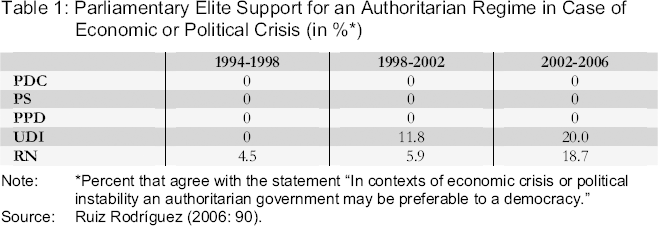
On what fundamental issues can we find congruence in elite and mass opinion in Chile? Given the violence and severity of the military regime, and the recognized toll it took on Chilean society, one would expect widespread rejection of authoritarian politics. In addition, given the country's iconic status as a model democracy in the region, and frequent news and scholarly allusions to the quality of Chilean democracy, one might think that support for a democratic regime would be increasing at the elite and the popular level. Actually, the data suggest that the reverse is true. The Salamanca data show that the percentage of Deputies who agreed with the statement that an authoritarian regime may be preferable in “situations of political and economic crisis” grew across the three legislative sessions (1994-1998, 1998-2002, 2002-2006) from 1.0 percent, to 6.7 percent, and to 9.0 percent. It is among parties of the right that we find such an increase, as Table 1 shows. Similarly, the percentage of Chileans who agreed with the statement that an authoritarian regime “might be preferable to a democratic regime in certain circumstances” increased from 12.6 percent to 18 percent from 2006 to 2008 (once again, survey data that corresponds to the same time period is difficult to come by). 6 At the most basic level of the governing regime, there is consensus and general congruence, with generalized acceptance of democracy, but a moderately growing small percentage of both the population and elites acknowledges that at times an authoritarian regime may be preferable.
Parliamentary Elite Support for an Authoritarian Regime in Case of Economic or Political Crisis (in % * )
Note:
Percent that agree with the statement “In contexts of economic crisis or political instability an authoritarian government may be preferable to a democracy.”
Source: Ruiz Rodríguez (2006: 90).
See Latin American Public Opinion Project, online: http://www.vanderbilt.edu/lapop/ and CEP et al. (2008).
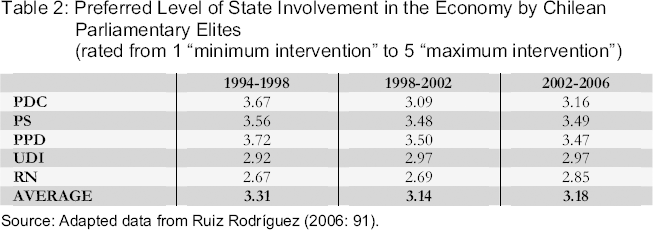
Another essential question, of course, concerns the role of the state. Chile is notorious for its early adoption of a neoliberal model, and is lauded as a successful exemplar of capitalist development. While the actual extent of the free market model is subject to dispute and beyond the scope of this analysis, among elites and the public there is a shared consensus that Chile should be an economy with a strong market orientation. With the rejection of the Washington Consensus and neoliberalism across much of the continent, one might think that at the elite and the mass level there would be increasing support for a greater role for the state in the economy. In addition, the fact that Chile had two governments headed by the more centrist Christian Democratic Party, followed by two Socialist governments might suggest a trend toward a larger role for the state. At the elite level such a supposition is not borne out. Table 2 shows that there was a moderate move towards decreased support for state intervention in the economy across three legislative sessions. Indeed, it is interesting to note a counterintuitive evolution in the orientation of the elites, with legislators of the Independent Democratic Union (UDI) (the party usually most closely associated with the neoliberal oriented authoritarian government) actually moving slightly toward a greater preference for state intervention in the economy, and Socialist Party (PS) legislators trending towards a preference for less intervention.
Preferred Level of State Involvement in the Economy by Chilean Parliamentary Elites (rated from 1 “minimum intervention” to 5 “maximum intervention”)
Source: Adapted data from Ruiz Rodríguez (2006: 91).
How does the public feel about the role of the state in the economy? There is less data, and certainly none that measures orientations toward the role of the state in the same way. A 2008 survey asked the question in a slightly different way, but it broadly parallels the 1 to 5 scale cited above in Table 2 for elites. When asked to place themselves on a scale from 1 to 5 (with 1 being “businesses should be private” and 5 being “business should be owned by the state”) Chileans average 2.96, perhaps suggesting that the Chilean public wants a smaller state than Chilean elites. 7 It might appear then that Chileans are closer to the parties of the right in their estimation of the role the state should play. However, caution is in order. First, the question asked of elites was much less expansive, referring to “intervention” rather than ownership. Second, the public opinion survey data are revealing in another way. When asked to rank the orientation of different coalitions with respect to their position on the preferred role of the state, the Chilean mass public suggested that all coalitions (even the governing coalition and the coalition of the far left, “Juntos Podemos Más”) had a greater preference for privately controlled business than it did on average (see Figure 1).
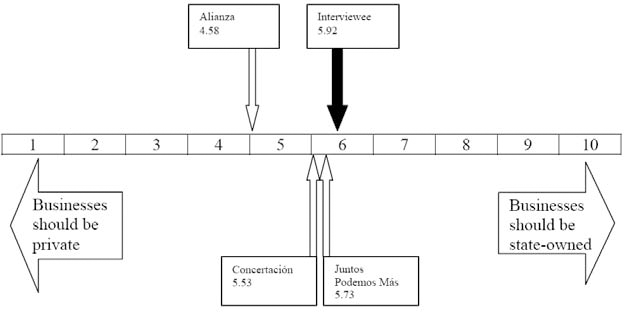
Chilean Public Opinion Concerning the Role of the State in Business, and Perceived Position of Major Coalitions, 2008.
This was adjusted from a 10 point scale in the original survey reporting.
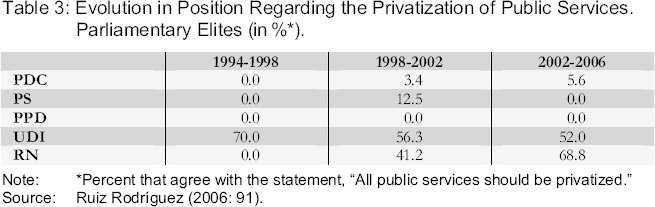
With respect to the state's role in social provision, there appears widespread support for market solutions to public problems among deputies, though as Table 3 shows such support is still concentrated among parties of the right. Still, for the 2002-2006 legislative period a full 29 percent of deputies agreed with the statement that “all public services should be privatized” up from 24 percent and 21 percent in the 1994-1998 and 1998-2002 legislative periods, respectively.
Evolution in Position Regarding the Privatization of Public Services. Parliamentary Elites (in % * ).
Note:
Percent that agree with the statement, “All public services should be privatized.”
Source: Ruiz Rodríguez (2006: 91).
On a 5 point scale similar to that used above, with 1 being “responsibility for economic sustenance rests with the state” and 5 being “responsibility for economic sustenance rests with individuals” Chileans placed themselves on average at 3.37. Once again it is interesting that members of the Chilean public on average perceive that every coalition (and even the Alianza on the right) sees the state as more important to economic sustenance than they do (CEP et al. 2008). Survey data also suggest that Chileans generally agree on a limited role for the state in other ways. In a series of four surveys undertaken between 1995 and 2001, 8 when asked to choose the top three most important determinants of personal success from a list of 14 categories, Chileans chose “educational level” (39.7 percent), “individual initiative” (23.7 percent) and pitutos – or personal contacts (19.5 percent) – as their top three on average across surveys. Economic help from the state was only named by 5.3 percent of the population, trailing “luck” (7.2 percent), and significantly trailing “faith in God” (12.4 percent) (CEP et al. 2008).
More recent surveys did not ask this question.
Does this mean that the Pinochet government has stripped Chileans of their attachment to the state, and that they are even more statist than their representatives? The answer is clearly, no, and may have something to do with how surveys are constructed. Responses to other questions suggest that Chileans still want their state to be involved in the economy. For example over 70 percent of Chileans polled in 2000 either “agreed” or “very much agreed” with the statement “it is the responsibility of government to reduce the differences in income between high income and low income people.” In addition, despite the widespread privatization of the health and educational sectors, when asked in 2006 which should be the three most important initiatives to which government resources should be devoted, health care was named by 92 percent and education by 80 percent of those surveyed. In addition, Chileans “agreed” or “very much agreed” with the following statements in the following proportions, when asked about measures the government should take with regard to the economy (CEP 2006):
“finance new projects which create jobs” (88.0 percent)
“support industries to develop new products and technologies” (72.8 percent)
“support industries experiencing problems in order to protect jobs” (81.8 percent)
“reduce the length of the work day to create more jobs” (60.9 percent)
Therefore, it appears that Chilean elites and the Chilean public share broadly similar views on the fundamental questions or at the very least do not differ in a marked or striking way. All favor democracy, but a small portion of both elites and the public acknowledges that in some instances an authoritarian regime might be preferable. In addition, there is broad support for a market economy, though most Chileans, among the elite and public, generally agree that the state should play some role in social provision and has a responsibility for addressing inequality.
While there appears general consensus on the basics, perhaps the potential source of dissatisfaction with democracy is disagreement when it comes to more specific policy areas? CEP surveys and the University of Salamanca survey of parliamentary elites provide enough data to analyze similarities and differences with respect to elite-mass congruence in specific issue areas. Despite broad parallels between the questions asked on the two sets of surveys there are a few problems. First, the questions are worded differently for elite questionnaires and for the public opinion survey questions. While elites were asked to rate the importance of a series of issues by their degree of importance, the public was asked to choose the three most important issues facing the country. The second important difference is that certain choices were missing from either the elite or public opinion survey. Most significantly “poverty” was not included in the Salamanca questionnaires and for two of the three waves of questionnaires “health care” was left out. These are obviously serious problems preventing any definitive conclusion concerning elite-mass congruence in specific issue areas. What insights do these admittedly impressionistic comparisons provide, then?
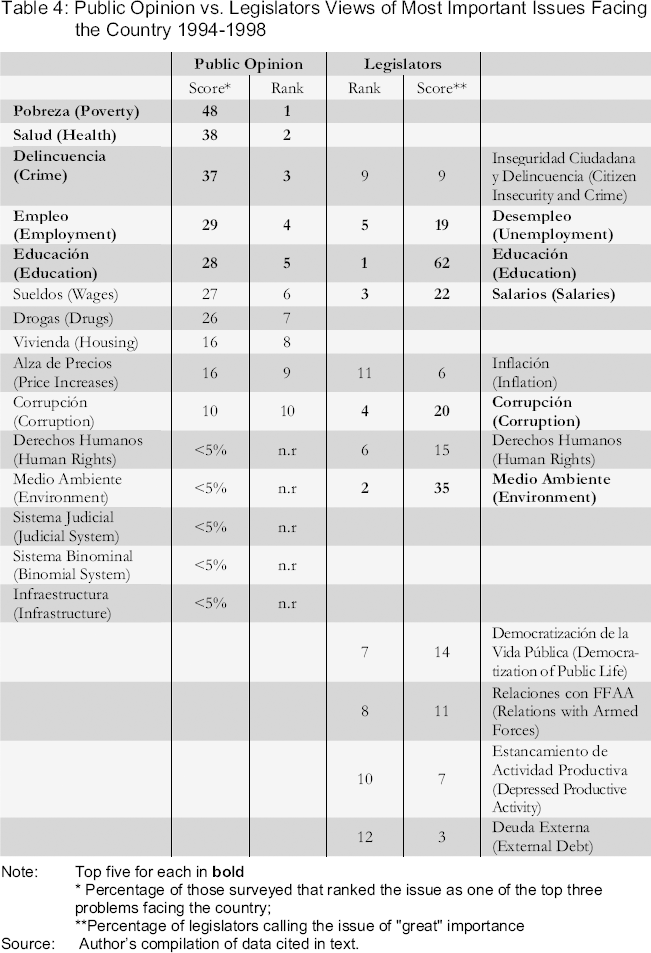
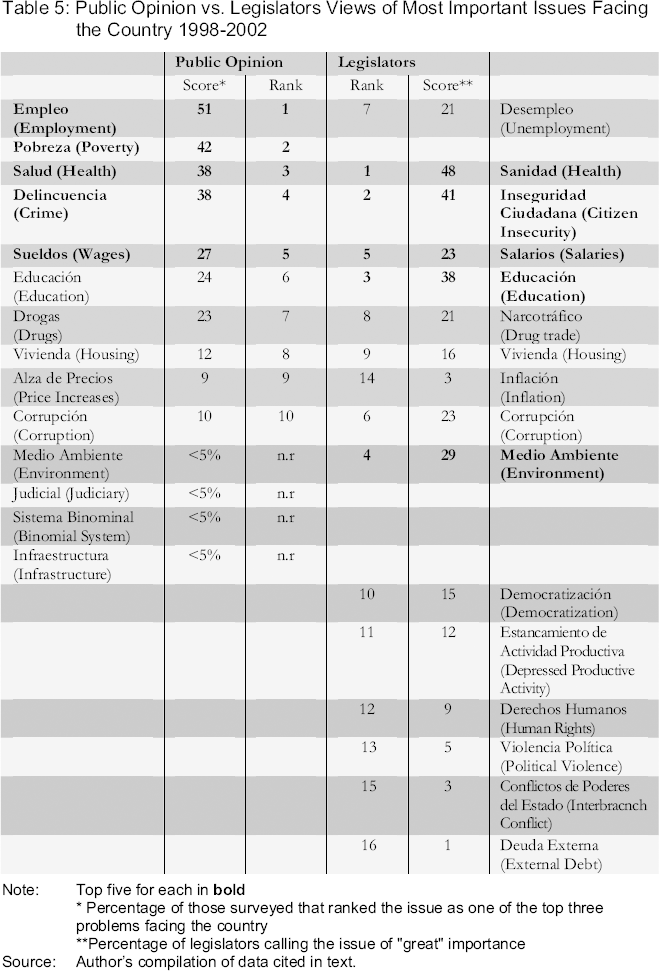
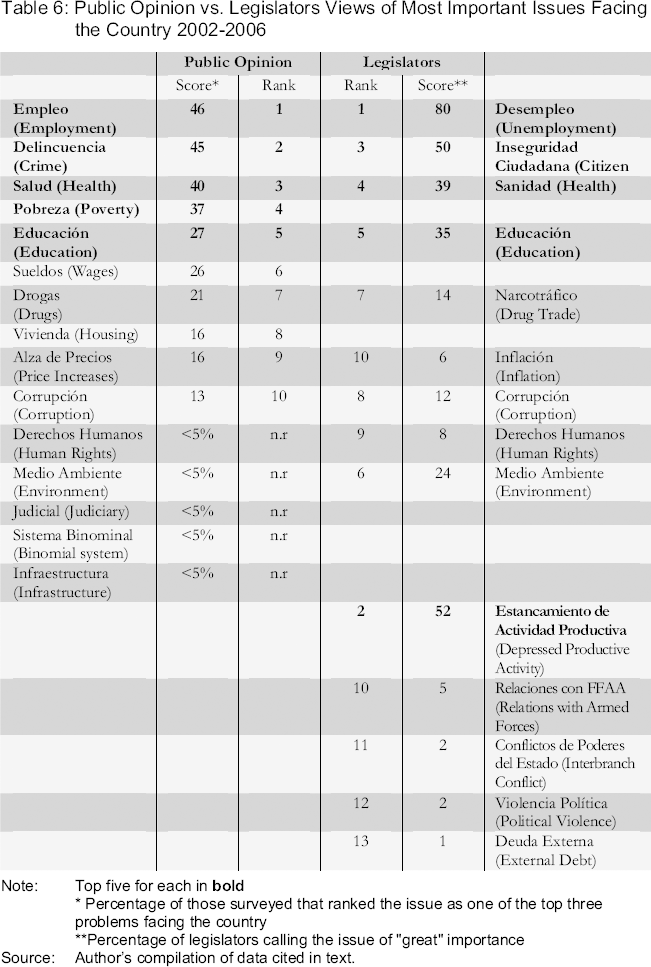
Tables 4, 5, and 6 summarize the results of these comparisons. Equivalent issues are paired together, and the original Spanish language responses used in the surveys and elite questionnaires are presented in the tables so the reader can compare the wording of questions. For public opinion survey data the tables present averages from seven waves of public opinion surveys undertaken by CEP during two congressional sessions (1994-1998 and 1998-2002), and eight waves during the 2002-2006 legislative session, for a total of 15 waves of public opinion survey data. The survey of parliamentary elites represents a single wave of interviews undertaken towards the middle of each legislative session with a large, party representative sample of members of parliament. 9 The tables present the hard numbers from each of the scoring schema and the ranking of each issue for the general public in public opinion survey data and then for parliamentary elites. It is important to note that these numbers are not comparable given the different scales used for each (the hard numbers are included to give the reader an idea of the relative distance between rankings in each set of results).
Public Opinion vs. Legislators Views of Most Important Issues Facing the Country 1994-1998
Note: Top five for each in
Percentage of those surveyed that ranked the issue as one of the top three problems facing the country;
Percentage of legislators calling the issue of “great” importance
Source: Author's compilation of data cited in text.
Public Opinion vs. Legislators Views of Most Important Issues Facing the Country 1998-2002
Note: Top five for each in
Percentage of those surveyed that ranked the issue as one of the top three problems facing the country
Percentage of legislators calling the issue of “great” importance
Source: Author's compilation of data cited in text.
Public Opinion vs. Legislators Views of Most Important Issues Facing the Country 2002-2006
Note: Top five for each in
Percentage of those surveyed that ranked the issue as one of the top three problems facing the country
Percentage of legislators calling the issue of “great” importance
Source: Author's compilation of data cited in text.
See note 5 for a description of the elite interviews and questionnaire.
Table 4 suggests that for the 1994-1998 period there is minimal congruence in the ranking of importance of particular issues. Legislators and the public only hold two of their most important five issues in common. This is due largely, however, to problems with the data. The public ranked “poverty” and “health,” respectively, as the first and second most important problems facing the country, and these categories were not included in this wave of the Salamanca questionnaires for parliamentary elites. In addition there is a very far outlier (that carries through all three sets of comparisons, with respect to “the environment” as an important issue). “The environment” scored second in importance among parliamentary elites, but was identified by less than 5 percent of the Chilean population as one of the three most important issues facing the country. Also notable for the 1994-1998 period is that elites appeared more concerned about “corruption,” ranking it number four, than the citizenry who ranked it as the tenth most important problem. In addition, though the public is consistently concerned with “crime and safety” (delincuencia), elites perceive it as much less serious a problem. In later surveys elites will perceive it as a growing problem, as it consistently ranked among one of the top four concerns for the citizenry across all surveys included in this analysis.
The 1998-2002 comparisons presented in Table 5 demonstrate more commonality in the ranking of concerns for elites and the Chilean public, with three of the top five issues for each group overlapping. Once again, the absence of “poverty” as an option for elites is part of the problem, and the inclusion of “health” (sanidad) provided for an additional element of overlap given that Chileans consistently identify “health care” as one of the top three problems facing the country during the last decade. Elites once again, identified “the environment” as a much more pressing problem than the general public, and seemed much less concerned about “unemployment”, which was rated as the most pressing concern of the public during this period.
Table 6 shows that the 2002-2006 period demonstrates the highest degree of congruence between the citizenry and parliamentary elites in terms of issue concerns, with an overlap in four of the five cited areas, and roughly the same rank order for each of the problems. Once again, it is the absence of “poverty” as a choice for parliamentary elites that prevents what could have been almost absolute congruence in the ranking of the top five issues for the 2002-2006 period; had “poverty” been included, it likely would have ranked in the top five concerns. This assertion is based on another question included in the Salamanca questionnaires. The 2002-2006 wave of interviews introduced a new question asking legislators to identify what they see as the issue that could “represent a significant threat or risk to democracy.” By far legislators identified “poverty and marginalization” as the element representing the greatest potential threat from a list of ten issues (much higher than “relations between the armed forces and civilians”), with 30 percent of legislators ranking “poverty” as a “high” potential threat and 68 percent calling it “high” or “significant.”
Therefore, and once again from an admittedly impressionistic interpretation, there is not a huge gap in what the public and what elites consider to be the most important issues facing the country. Indeed, the data presented here suggest that over the course of the consolidation of Chilean democracy elite and mass opinion have become more congruent.
Another suggestive indicator of congruence has to do with perceptions about political parties. There is no fundamental disconnect between the mass and elites with respect to the ideological placement of parties. Figure 2 shows public placement of political parties on a left/right space. Using the same scale elites ranked parties in the following order from left to right:
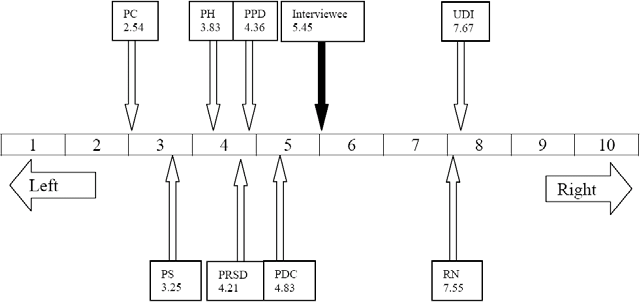
Ideological Self-Placement and Placement of Political Parties by the Chilean Electorate, 2008.
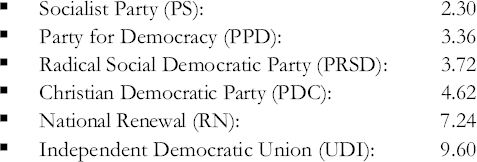
The order of ranking on the left-right scale is identical, with the exception that the PRSD was placed slightly farther to the left than the PPD by the public. Members of parliament, on the other hand, tended to place the major parties at the outside edges of the ideological spectrum (the UDI on the right and the PS on the left) in a more extreme position than the public. Indeed, parliamentary elites placed the UDI to the extreme right and the PS farther left than the Communist Party when compared to the placement of the Chilean public. This is latter finding is not insignificant and will be analyzed later with respect to the growing importance of party identification among elites and the shrinking importance among the electorate. 10
The Communist Party (PC) and the Humanist Party (PH) were not included in the parliamentary elite survey.
Hence, on the essential issues and with respect to particular issue areas, an impressionistic analysis suggests relatively strong indicators of elite-mass congruence at best, and at the very least, few areas where elites and masses fundamentally disagree.
Agreement on Issues and Dissatisfaction with the Process
If elites and the citizenry generally agree on the fundamentals and policy issues, what then is the source of Chilean's dissatisfaction with democracy? Survey and elite data also provide some insights for answering this question. In particular, rather than a fundamental disconnect between the governed and the governing as the root of dissatisfaction with democracy, there are strong indications that Chileans are dissatisfied with the process rather than the content. That is to say, rather than fundamentally disagreeing, Chileans may be dissatisfied with patterns of participation, how representative functions are undertaken, and issues of accountability and legitimacy. This paper argues that Chile's much lauded institutionalized party system is a double-edged sword that underwrote a successful democratic transition, but at the same time is at the root of public dissatisfaction with democracy. In essence the legislative election system and pattern of transitional politics increasingly has concentrated power in the hands of political parties and party elites, contributing to the formation of a model that verges on a partidocracia. This paper draws on Coppedge's definition of partidocracia as a situation where “political parties monopolize the electoral process, dominate the legislative process, and penetrate politically relevant organizations to a degree that violates the spirit of democracy” (1994: 2). While contemporary Chilean politics can certainly be described as a partidocracia in terms of the first two variables identified by Coppedge, social organizations in Chile are nowhere near as penetrated by political parties as they were in Venezuela during the period of Coppedge's study. Nonetheless, with respect to party control over candidate nominations and the choices offered to voters, as well as the role of Congress in the policy process – also elements of partidocracia as identified by Coppedge – the role of parties in Chile fits Coppedge's description. Furthermore, other aspects of party domination, particularly related to the policy process that grew from the democratic transition, provide Chilean parties additional power in ways not considered by Coppedge given their lack of relevance to the Venezuelan case.
To fully understand this argument it is necessary to put the role of Chilean parties in historical perspective. The literature on the historical development of political parties makes two central points. First, before the Pinochet government, parties were recognized as the central actors in the political system, with high levels of institutionalization and importance and very high levels of citizen identification and social penetration – to such an extent that they were referred to as the “backbone” of the Chilean political system. 11 The second major feature of the system was its high level of party fractionalization and wide ideological spectrum. As Valenzuela (1996) notes, only Finland and the French Fourth Republic exceeded Chile's level of party system fractionalization.
For a discussion of this reality see Garretón (1983, 1987: 64). On the historical evolution of the party system see Scully (1992) especially Chapter 5.
With the return to democracy, and despite the Pinochet's government efforts to transform it, the party system forcibly re-emerged with the same general physiognomy, and indeed the same leaders, following 17 years of authoritarianism (Siavelis 1997; Scully and Valenzuela 1997). By all accounts this was a party-led and party-centered democratic transition. At the outset of the democratic transition 17 political parties (five of which could be considered major parties: the PS, PPD, PRSD, and the PDC) joined to form the center-left Concertación coalition to face off against the Alianza on the right (made up of two major parties, the UDI and the RN). Parties realized that the only way to win the post-authoritarian elections (especially in light of the majoritarian legislative electoral system bequeathed by Pinochet) was to join together in a negotiated transition characterized by power sharing between major parties. Political parties constructed a series of elite-negotiated formal and informal institutions aimed at power sharing and securing the democratic transition (Siavelis 2006).
First, the Concertación coalition, which has governed Chile since the return to democracy, is based on an elaborate form of party power sharing. The details of this bargain include careful division of ministerial portfolios among its constituent parties. This arrangement, referred to somewhat derisively as the cuoteo (quota) leaves the impression among the Chilean public that ministerial positions are not awarded based on the talents or experience of would-be ministers, but rather on the exigencies of party politics.
Secondly, the policy making process has been dominated by elites, and given the weakness of Congress, mostly by executive branch elites. The post-transitional political model involved a series of deals between party elites within the Concertación and between the Concertación and potential veto players on the right. In terms of the Concertación's relationships with veto players on the right, the bargain included a tacit agreement that the President should negotiate with powerful economic actors and leaders on the right to arrive at consensus solutions for the most controversial legislation. This model, dubbed democracia de los acuerdos (democracy by agreement), was used in reforming the tax code, expanding social welfare and anti-corruption legislation, and in the comprehensive constitutional reforms of 2005. These major policy deals involved very little popular or congressional involvement (Silva 1992; Boylen 1996).
Thirdly, the election system bequeathed by the Pinochet government limits the impact of voters on the outcome of elections. The legislative election system, known as the binomial system, establishes two-seat districts for elections to Congress, for which each coalition can present two candidates. The details of the electoral system have been analyzed in depth elsewhere and need not be recounted here (Siavelis 2002; Navia 2005). However, in terms of the representative capacity of the election system, its most significant feature is that the highest polling coalition in a district can only win both seats if it more than doubles the vote total of the second-place list; otherwise, each list wins one seat. So within the context of Chile's post-authoritarian pattern of two-coalition competition, a coalition must poll 66 percent of the vote to win both seats, but can usually win one seat with only 33 percent. Because both major alliances almost invariably poll between 33 percent and 66 percent in each district, the outcome of elections is a foregone conclusion: except in a few cases one member of the Concertación and one member of the Alianza are likely to win in each district. Accountability is central to democracy. The current coalitional configuration combined with the properties of the binominal system does not provide voters the opportunity to hold their representatives accountable. Indeed, as Navia (2005) notes, because of the thresholds of the system a candidate who loses support in a district could conceivably go from a level of 60 percent support to 35 percent without losing the congressional seat.
The binomial system also makes it almost impossible to defeat incumbents. Barring incompetence or extreme indiscipline, Chilean parties consider incumbents to have a right of re-nomination (Siavelis 2002). The election system in the context of two coalitions strongly limits the ability to unseat an incumbent. Rarely will one list contain two candidates from the same party, providing incumbents the luxury of not facing intra-party competition at least in the electoral arena. More importantly, if a voter seeks to unseat an incumbent there are two potential strategies. The voter can either completely abandon his or her ideological convictions and vote for an opposition list, or cast a likely more ideologically sincere vote for the list partner of the incumbent. But, because votes are pooled in determining seat distributions, a vote for one candidate on a list is in many respects a vote for both. Therefore by voting for an incumbent's list partner, a voter may actually be contributing support to the very incumbent the voter aims to defeat! 12
For an elaboration see Navia (2005).
While the candidate selection process has the potential to allow for more citizen input into choosing representatives, the dynamics of the electoral system have also prevented any significant democratization of the candidate selection process. Because the binomial system only provides two seats to each coalition, and the Concertación is composed of five major parties, the number of candidacies that each party in each coalition receives is subject to arduous negotiations before the elections. Parties offer evidence of their performance in previous elections, their standing in polls, and what they can potentially contribute to the coalition as bargaining chips. However, the pairing on individual lists is also crucial. Parties seek to place their candidate on the same list either with an extremely weak candidate (who they can handily beat), or an extremely strong candidate (who can carry the list to an unlikely two seat victory). This complexity, and the political horse-trading involved in placing candidacies on individual lists leaves candidate selection completely in the hands of party elites, and works at cross purposes with any efforts to democratize the legislative candidate selection process, which has been dominated by party elites since the return to democracy. 13
On legislative candidate selection in Chile see Siavelis (2002); Navia (2008).
At the elite level the party system seems remarkably like that of the pre-authoritarian period, and numerous studies attest to the extent of continuity. However, while parties have been the “backbone” for structuring elite politics and the democratic transition, the nature of society-party relations is very different than in the pre-authoritarian period. This fundamentally different nature of party society relations has been less recognized and less analyzed, even though it likely lies at the root of Chileans’ dissatisfaction with the state of democracy in their country.
As noted, Chile was notorious for its wide ideological spectrum, high levels of party fractionalization, and high levels of party identification. Survey data from the post-authoritarian period demonstrate deep and fundamental changes to this pattern. Perhaps most remarkable, while Chile was often noted as the most politicized country in Latin America, recent data from the Latinobarómetro survey ranked Chile as the least politicized among the 18 countries surveyed based on a question regarding the ideological self-identification of those polled. Of those surveyed 29 percent either said they would or could not place themselves along a right-left spectrum in ideological terms (Corporación Latinobarómetro 2007: 74). Data from the Centro de Estudios Públicos confirm this trend, with 34 percent of the Chilean public attesting to not sympathize with any ideological position, and 3 percent saying they did not know (CEP et al. 2008). Among those who do place themselves, the data suggest that Chileans have become remarkably centrist. On a scale of 1 to 10, with 10 being the farthest right and 1 being the farthest left, the average ranking was 5.45 suggesting that Chileans identify themselves, on average, as slightly right of center. What is, indeed, striking is that 30 percent of those surveyed placed themselves exactly at the center at 5, with none of the other deciles on the ten point scale exceeding 7 percent (CEP et al. 2008).
With respect to identification with particular parties, the nature of citizen party connections has also been transformed. When surveys began immediately following the return to democracy in 1990, 62.5 percent of the Chilean public attested to identifying with a political party. By 1992, the number of Chileans self-identifying with political parties increased to 87 percent. From there this percentage has registered gradual declines, to the point that in 2008 only 43 percent of Chileans said they identified with a particular political party, and none of the parties registered a level of adherence above 10 percent. 14
These numbers are based on an analysis of every political opinion survey undertaken by the Centro de Estudios Públicos between 1990 and 2008 where this question was asked. A total of 37 surveys were consulted which can be found at http://www.cepchile.cl/dms/lang_1/home.html.
This low level of party identification is certainly a function of the low esteem in which Chileans hold political parties. When asked their opinion of a series of 16 institutions, Chileans ranked political parties dead last. Only 6 percent expressed “some or much” confidence in political parties, trailing far behind the military (57 percent), the government (30 percent), newspapers (28 percent), and unions (26 percent). The Courts and Congress which ranked fourteenth and fifteenth had “some or much” confidence of 18 percent and 16 percent of the population, respectively.
Certainly support for political parties is relatively low across Latin America. In terms of comparative referents among the 18 countries included in the Latinobarómetro survey Chile ranks ninth with respect to the citizenry expressing the least confidence in political parties (Corporación Latinobarómetro 2007: 94). While regionally not at the bottom with respect to the evaluation of parties, this position is remarkable given the strong historical connections between society and parties, and scholarly work that lauds the quality and institutionalization of Chile's parties.
Clearly, the importance of ideology has decreased in Chile, and the traditional role of parties as the main representational interlocutors for society has been transformed. Nonetheless, at the elite level, ideology remains very important and parties – and in particular party elites – remain the most important political actors in Chile. Several sets of data with respect to voting behavior and answers to elite surveys underscore this reality.
While the importance of ideology and party differentiation has decreased at the mass level, at the elite level they have actually intensified since the return to democracy. While certainly the ideological scope even at the elite level has narrowed in light of transformations wrought by the end of the Cold War and the fall of communism, ideological differentiation among parties within this narrower spectrum has increased. Through analysis of a series of questions drawn from the three waves of the Salamanca survey of parliamentary elites, Ruiz Rodríguez (2006) found that while in terms of actual policy program elites seemed to be moving closer together, tests of ideological positioning showed that self professed ideological distinctions between parties have actually become sharper since the return to democracy. In addition, as noted above with reference to Figure 2 and the accompanying discussion, members of parliament make much sharper distinctions than the citizenry when it comes to the perceived ideological space between parties. Alcántara (2008) also finds that among countries included in the three waves of PELA interviews, Chile is the country where ideology most sharply differentiates legislators’ perceptions of the severity of different sets of problems. For example, self identified leftist legislators are more likely than those on the right to consider economic problems the most important, while those on the right see political problems as much more serious.
With respect to the importance of parties, a cursory view of the self-reported data of legislators would suggest that the concerns of citizens and constituency reign supreme. For the two waves of surveys for which data were collected from legislators, 83.1 percent (1998-2002) and 73.3 percent (2002-2006) contended that deputies should always vote in the interests of their constituents rather than voting in the interest of their parties or base their decision on the material at hand. Further, 100 percent (1998-2002) and 88.6 percent (2002-2006) contended that “securing resources for my district” is “important” or “very important.” However, both of these sets of data probably reflect what deputies perceive to be the “correct” response. First, levels of party discipline in the Chilean legislature were (until very recently) quite high suggesting a good deal of party voting (Carey 2002). Secondly, Chile's constitution sharply proscribes the ability of deputies to secure pork or material resources for their districts.
In reality, political parties, and in particular party elites, still retain a good deal of control. From the most basic perspective, parties are recognized as important actors by members of parliament. When deputies were asked whether the structures of their parties “were continuous” or “merely mobilized for elections” over the three waves of questionnaires deputies pointed to the continuing structural importance of their parties by wide margins: 94.7 percent (1994-1998), 88.8 percent (1998-2002), and 85.2 percent (2002-2006). As already noted, party elites exercise almost complete control over the legislative candidate selection process, and in the few cases where primaries are undertaken party elites have overridden the decisions of popular contests to satisfy other deals related to coalition maintenance (Siavelis 2002). With respect to the power and influence of party elites in particular, Chile is the only country of the 15 included in the PELA study where party leaders are ranked as most important ahead of voters and party militants in terms of whose opinions deputies take into account when making decisions (Marenghi and Garcia 2008). With respect to internal party democracy, legislators perceive it as quite low, albeit growing, when measured in terms of the power and influence of party militants. During the three legislative periods dealt with here, 16 percent of deputies termed levels of party democracy as “high” or “very high” during the first (1994-1998), 31 percent during the second (1998-2002), and 44.4 percent during the third (2002-2006). Overall, among the 15 countries included in the PELA study, Chile ranked third from the bottom in terms of perceived internal party democracy, only behind Argentina and the Dominican Republic (Ruiz Rodríguez 2008).
Public opinion survey data suggest that citizens perceive and object to this elite dominance, lack of turnover, and the elite lock on power. When asked whether members of Congress are concerned about the problems of average people, only 14 percent of the population answered in the affirmative (CEP 2007). When asked to name the two principal defects of political parties, the top three responses were “they are not transparent” (36 percent), “they are always the same … there is no turnover” (33 percent) and “they pass out government position among themselves” (31 percent). While it is impossible to directly tie demands for electoral reform to these responses, it is notable that when asked about reforms to the binomial system, 46 percent said “it should be changed completely”, 42 percent said “it should be maintained”, and 12 percent did not know or did not answer (CEP 2007).
Conclusion: Elite-Mass Congruence, Partidocracia and the Transitional Desfase
The extent of elite-mass congruence in Chile is one reason that scholars tend to categorize Chile as a successful democracy. Studies of elite-mass congruence are prefaced on the long-held notion that where the preferences of elites are parallel to those of the citizenry democracy will be efficacious and valued by the public. Nonetheless, democracy entails more than just agreement on orientations and issues. It also entails legitimacy, accountability, alternation of power, and a sense that participation in elections makes a difference. While this study has confirmed, albeit in an impressionistic way, that there are high levels of agreement between a certain set of elites and the mass public, on other counts this analysis suggests difficulty in fulfilling these other requisites of democracy. This study argues that many of these are tied to a desfase (gap) between elites and the governed with respect to the process rather than the content of politics. Elites continue to accept and operate under the transitional model for democracy, while citizens demand a new model that performs better on measures of accountability, legitimacy, and influence on policy outcomes. This is not to suggest that this growing dissatisfaction is somehow a harbinger of a potential return to military politics, but rather that Chile is not immune from the widespread dissatisfaction with the quality of the functioning of democracy that plagues much of Latin America, despite its status as an iconic democracy in the region.
Chile's highly institutionalized parties are also credited with underwriting the success of the democratic transition and the stability of Chilean democracy. However, like with elite-mass congruence, we must say more about the role of institutionalized parties to get at the root of the fault-lines of Chilean democracy. While party institutionalization has provided presidents workable legislative majorities, strong parties, and powerful party leadership, party elites dominate decision-making and candidate selection, with little citizen input. Party elites exercise strong control over legislative behavior. Party elites in concert with the President bypass Congress to work out legislative deals with major social actors and veto players before they are presented to Congress. Finally, at the system level, the dynamic interaction of coalition politics and the electoral system have provided Chile's two major coalitions an effective lock on power, where citizen preference mean little and each major coalition is provided an effective assurance of one of the two seats in each electoral district.
In this sense, it is not simply the essential nature of parties which is at the root of this apparent crisis of representation, but rather the interplay between the electoral and the party system. Elites understand many of the difficulties underscored here and are not irrationally tied to operating under the transitional model; they just lack alternatives given the nature of the legislative election system. Because no party can achieve a majority, the only way parties can be assured legislative seats under the binomial system is to ally with another party. However, the elaborate negotiations necessary to strike such agreements (see Siavelis 2002) mean that decision making power on policy and candidacies are forced into the hands of party elites, reinforcing public perceptions that politics is simply a game of negotiation and horse-trading among the powerful. Further, while this was a beneficial and stability generating model at the outset of the transition, it no longer is. Nonetheless, the election system remains a powerful impediment to reforming this model of politics.
As noted, the findings here are impressionistic, and there are potentially other explanations for the dissatisfaction with democracy we find in Chile. One might argue that contemporary dissatisfaction merely rests with the current government or with the economy. Nonetheless, Michelle Bachelet's ratings as a president are extraordinarily high, principally because of the relatively successful economic management of her government, and in particular, the leadership exercised by her Finance Minister Andrés Velasco. Recent political events in Chile provide support for other aspects of the argument set out here as well. The bursting on the scene of an independent presidential candidate challenging the status quo, Marco Enríquez-Ominami, perhaps reflects some of the dissatisfaction with “politics as usual” and a demand for a more inclusive and less elitist and party dominated form of politics. With respect to the election system as the element underwriting the continuation of the model of transitional politics, we can also find some confirmation in the latest developments, the most dramatic of which was the decision of the parties of the Concertación to split and present separate tickets for the municipal elections of 2008. The reason they could do so was because municipal elections employ a proportional election system rather than the binomial system. While the split reflects the underlying divisions within the Concertación, it also underscores that it is largely the binomial system that forces the governing coalition to remain together and dooms it to continue to rely on a model of negotiating candidacies and policies in order to strike the necessary pre-election alliances.
In writing on pre-Chávez Venezuela, a country previously touted as a “model democracy” and island of stability in Latin America in the 1970s, Coppedge contended that “The institutions that make Venezuela a stable polity also tarnish the quality of its democracy” (1994: 2). Coppedge noted that Venezuela's highly institutionalized parties had come to completely dominate the political system in the form of a “partyarchy” or partidocracia. In a very similar way, the institutions and political dynamic which made Chile's transition to democracy a success have also tarnished its quality. Many of these institutions are tied to a developing partidocracia. The success of the Concertación coalition was based on a complex power sharing arrangement; one which increasingly brings charges of elite domination and politics by quota. The sharing of electoral spoils guaranteed peace between Chile's parties, but could only be undertaken through elite selection of candidates. The binomial system provided incentives for coalition formation among Chile's major parties and provided a stable pattern of two coalition competition, but it gave the two coalitions an effective lock on power. It is difficult to unseat incumbents, and each coalition is likely to win a seat in every electoral district.
This is not to say that party institutionalization is a bad thing. Just as Coppedge noted the different forms of institutionalization and partisan power, Chile's parties can play the vital role in democracy that they played in the past. In their study of Uruguay, Buquet and Chasquetti (2004) refer to the partidocracia de consensos, noting the extraordinary strength of Uruguay's parties. However, the crucial difference is that Uruguayan parties demonstrate many of the same prerogatives as Chilean parties, but unlike the situation in Chile, they enjoy extraordinarily high levels of cohesive support among the mass public.
This conclusion does not suggest that a Chávez-type politician waits in the political wings to assume power in Chile with the advent of a crisis. Still, long-term deficiencies in Chile's democratic performance have the potential to at the very least move Chile from a moderate form of democracy with a balanced social-market orientation towards more populist forms of representation. In terms of gaining the type of adhesion characteristic of Uruguayan parties, Chilean parties must recoup some of the support and levels of identification they enjoyed in the past. A good place to start would be a significant reform of the electoral system. Though all four post-authoritarian Presidents have presented electoral reforms to Congress, none has succeeded, as much because of the entrenched interests of the Concertación as the unwillingness of the opposition. Short term political incentives militate against reform. Yet, the introduction of some form of moderate, small magnitude proportional representation would provide greater competition and accountability. In addition, new forms of connection between the citizenry and parties, more real power for legislators in the legislative process, and enhanced levels of internal party democracy are also a fundamental part of much needed and new model of post-transitional politics.