



Abstract
Purpose:
Soccer is a popular sport among children and adolescents that exposes to a high risk of injury. Several prevention programs, including the FIFA 11+ Kids program have been developed to decrease this injury rate. The aim of the study was to investigate the knowledge and use of the FIFA 11+ Kids program among soccer coaches of skeletally immature soccer players in a Swiss canton and analyze difficulties of implementing such a prevention program.
Materials & methods:
First, an online survey was sent to all soccer coaches involved in Swiss training programs for male players from 7 to 13 years of age. Coaches were identified through existing Swiss coaching networks. A total of 237 coaches completed the survey. Second, the FIFA 11+ Kids program was implemented in three soccer teams (players from 7 to 13 years of age) during 6 months in the same canton. Utilization of FIFA 11+ Kids program and compliance of coaches were recorded by the research staff.
Results:
Around 84% of the included coaches in the survey were certified. Of those, 59% had been taught injury prevention during their course(s). Only 14% of the included coaches knew one of the FIFA programs (11, 11+, 11+ Kids), of those, about one-third (10 out of 237) used the FIFA 11+ Kids program. After 6 months, none of the soccer coaches applied the entire FIFA 11+ Kids program twice a week. One coach had completely abandoned the program. The main reasons for their disapproval were the time and surveillance needed and the players’ lack of motivation. They stated, however, that the exercises were good if used occasionally.
Conclusion:
Injury prevention should be integrated in every soccer coach education courses. An adaptation of the FIFA 11+ Kids program should be considered, especially for the youngest players.
Keywords
Introduction
Soccer is one of the most popular sports in the world with, according to FIFA (Fédération Internationale de Football Association), 265 million players worldwide. It is the most played sport among children and adolescents under 18 years. 1
Sports activities improve health, although some sports, such as soccer, carry a risk of injury. Injuries may lead to inactivity, decreased long-term quality of life, and are finally often the reason to quit a sport. 2 Soccer accounts for 228,000 injuries per year in the United States alone and results in a worldwide cost of over $30 billion. 3
Soccer is a contact sport with frequent changes of direction, often played at maximum intensity, which poses a risk of injury. The number of injuries is highest in adolescents. 4 After initiation of peak height velocity in young adolescents, there is a decrease in core stability and impairment of neuromuscular control, resulting in an increased risk of injury.5,6 It is therefore essential to include injury prevention in training programs from an early age. 7
Most injuries (60%) are situated in the lower limbs, most commonly the knees and ankles. The majority are contusions followed by ligament and muscle injuries. Fractures and dislocations are rarer.8–10
One of the most perceived risk factors for injury in children is lack of physical fitness. 11 Important factors for prevention are physical conditioning and physical maturity.8,12
F-MARC (FIFA Medical Assessment and Research Center) launched the FIFA 11+ Kids program in 2017: a warm-up prevention program for children ages 7–13 developed from the “FIFA 11+” program.1,13–16 It is a complete program covering coordination, balance, leg muscles strengthening, core training, and fall exercises.
In 2014, a large study on the effectiveness of this program was conducted in Switzerland. About 78 soccer teams with players aged 7–13 years were included. It concluded that by using this program once a week, a 48% reduction of the overall injury rate was measured. The reduction in the rate of lower limb injuries was at 55% and the reduction in severe injuries was 74%. There may be a further increase in these rates if the program is performed twice a week. It is therefore recommended that it be performed at least once a week, if possible twice. 17
In Switzerland, there are several coach educations courses available for those interested in coaching youth soccer players. None of these courses teach the FIFA 11+ Kids program. However, they do briefly mention some prevention concepts.18–20
The purpose of this study was to investigate the prevalence of coaches knowing about prevention programs—in particular the FIFA 11+ Kids program—and how many use one among the coaches training players aged 7–13 years in the Swiss canton of Vaud. In addition, the challenges of implementing a prevention program would be analyzed.
Materials and methods
Online coaching survey
Experimental approach to the problem
This study is a cross-sectional descriptive survey of soccer coaches of skeletally immature soccer players. The web-based survey consisted of 30 total questions (with conditionals questions) and was divided into four sections (Coach Demographic, Coach educations, Prevention Programs, and FIFA Prevention). The “Prevention Programs” section included closed and open questions to allow coaches to describe their approach to developing and promoting injuries prevention programs during training sessions. The “FIFA prevention” section included specific questions to understand the awareness levels about FIFA 11+ Injury Prevention Programs. The survey was designed to be as concise as possible to maximize the information in a minimum of time and to obtain more than 40% of respondents.
Subjects
Subjects ranged in age from 15 to 70 years of age. Inclusion criteria required that potential participants were (1) active soccer coaches involved in Swiss training programs for skeletally immature soccer players and (2) at least 14 years of age. Coaches were identified by existing Swiss coaching networks and were sent an electronic link to complete the survey. All selected soccer coaches work in soccer teams from three different categories (D, E, and F, players 7–13 years old) in the Canton of Vaud, Switzerland. A total of 582 coaches were contacted to complete the survey.
Practical implementation of “FIFA 11+ kids”
A practical implementation of the FIFA 11+ Kids program was carried out with three soccer teams from three different categories (D, E, and F). To assess the challenges of implementing the prevention program, the program was implemented only with teams whose coaches were not familiar with or did not use the program. Subsequently, the challenges could be analyzed to identify improvements to the implementation of the program. Part of the research staff met with the three coaches in June 2021 and provided them with the FIFA 11+ Kids manuals and posters. The coaches were asked to perform the program twice a week. In August 2021, a training session was held to explain and demonstrate the program to the children. During this 1-h session, the coaches and the author detailed the objectives of the program to the children. After receiving an explanation of the exercises in the first level of the program, the players performed the exercises. After 8 weeks, the author returned to a practice session to observe the teams implement the program and asked the players for feedback on the FIFA 11+ Kids program. At the end of the practice, the coaches shared their feelings about the program. Coaches were called 6 months after the initial implementation of the program (in April 2022) to find out if they had continued to apply to the program.
Results
Online coaching survey
Participant characteristics
Of the 583 e-mails sent, 237 complete responses were obtained (40% of respondents). The mean age of the 237 respondents was 39 years (male/female), and the mean coaching experience was 9 years. Actually 38% of coaches train in category D, 48% in category E, and 18% in category F (for a total of 104% because some of the coaches train many teams).
A large majority of coaches attended at least one soccer coaching education course (84%, 199 coaches), and 89% of those who did not, said they would like to attend one in the future. Injury prevention was taught in only 59% of the courses taken by coaches (118/199). The vast majority found the training in injury prevention to be useful (97%), interesting (96%), of sufficient quality (76%), adequate in quantity (71%), and applicable (88%).
FIFA 11+ familiarity and implementation
The results indicated that only 33 coaches of the 237 (14%) reported being familiar with at least one of the three FIFA Injury Prevention Programs (11, 11+, 11+ Kids). Of those coaches familiar with the FIFA programs, only 14 of them knew the programs through soccer coaching courses. Moreover, only 16 coaches (6.75%) regularly scheduled implementation and adherence to a FIFA injury prevention program: 10 of 16 coaches used FIFA 11+ Kids program.
Satisfaction analysis of the three FIFA’s programs (11, 11+, and 11+ Kids) was based on these 16 respondents. Coaches used the program on average 1.6 time per week, and all were satisfied or very satisfied with the program. The effect of the programs on the players was also assessed: 15 coaches (94%) felt that the players were ready to practice at the end of the program. About 14 (88%) answered “yes” at the statement “players are doing the exercises correctly” and 13 (81%) for “players are progressing in the different levels,” the other coaches answered “uncertain.” The two statements that received the least “yes” were “players are motivated” with 11 positive responses (69%) and “players enjoy the program” with 10 (62%). Player’s motivation and enjoyment were the two most uncertain items (Figure 1).
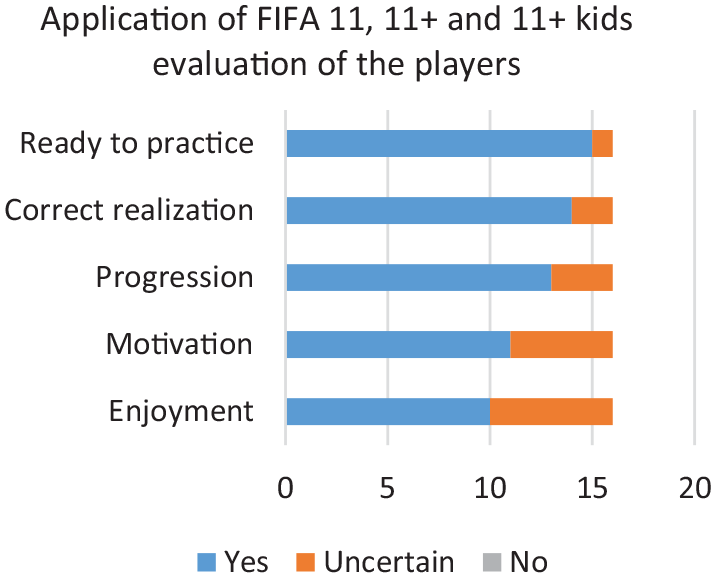
Evaluation of the players from the 16 trainers that apply one of the FIFA’s programs (11, 11+, 11+ kids). Responses to five affirmations with “yes,” “uncertain,” or “no.”
The strengths of this program were “it is a good warm-up” (11 vote, 69%), “it improves players’ physical abilities” (9 votes, 69%), “it reduces injuries” (9 votes, 56%), and “it is easy to complete” (6 votes, 38%; Figure 2). Slightly more than half of the coaches who delivered the program mentioned “injury reduction” as a strength, which was the goal of the program. The same was true for the secondary objective, which was the “improvement of players’ physical abilities.”
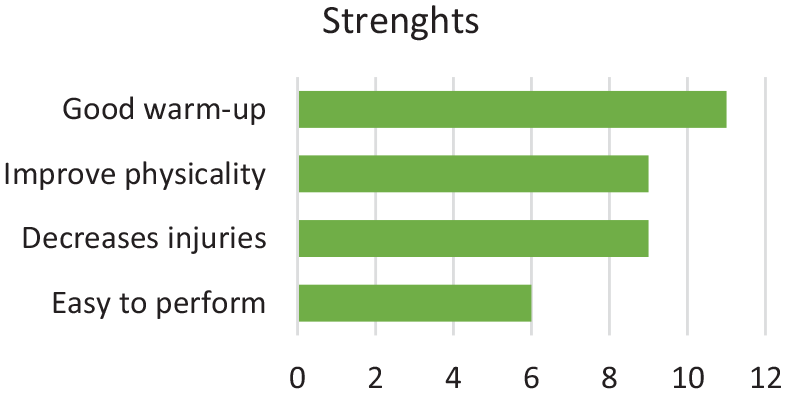
Strengths of FIFA’s programs (11, 11+, 11+ kids) according to the 16 coaches who apply it.
The weaknesses identified were: “more staff (coaches) is needed to correct players” (8 votes, 50%), “it is not fun enough for kids” (7 votes, 44%), “lack of soccer ball” (6 votes, 38%), “not soccer specific enough” (5 votes, 31%), “too repetitive” (2 votes, 13%), and “too long” (1 vote, 6%; Figure 3).
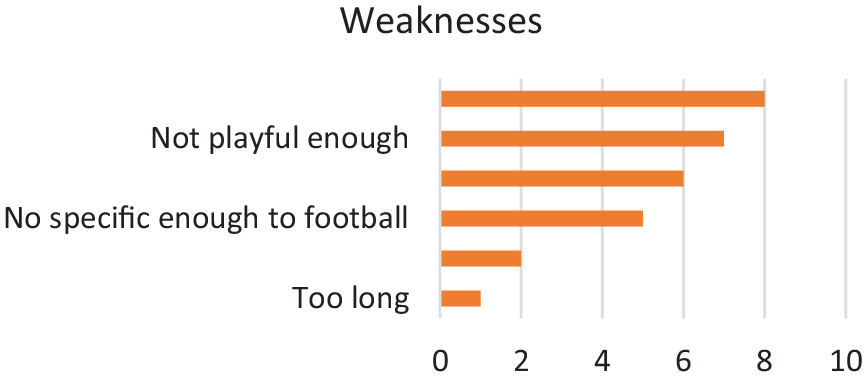
Weaknesses of FIFA’s programs (11, 11+, 11+ kids) according to the 16 coaches who apply it.
Coaches were highly motivated to learn and apply the FIFA 11+ Kids program. About 93% responded positively to the question “Would you be interested in receiving the FIFA 11+ Kids manual?” and 92% answered “yes” to the question, “Would you agree to try applying the FIFA 11+ Kids program with your team?”
Practical implementation of FIFA 11+ Kids program: results
Compliance
Compliance was not the same among the three coaches. Team D coach (players 11–13 years old) applied it scrupulously twice a week. Team E coach (players 9–11 years old) partially enforced it (3–4 exercises per practice), once or twice a week. And the coach of the team F (players aged 7–9) did not apply it at all and said that “with children of this age it is too complicated” so he did not answer the following questions. Therefore, the following analysis was based only on the two remaining coaches.
Program satisfaction and strengths
Both coaches shared mixed feedback. The coach of the older players was the most satisfied with the program and also proposed the implementation of the program to the other two coaches. Both coaches found that the children were ready to practice after the program but one added that “at this age they are always ready to play.” They found that the FIFA 11+ Kids program was great before a physical training; it trained essential skills such as muscle strengthening and balance. They thought that the manual was well done. They explained that having different level of play was motivating for the kids and that the players who struggled the most improved a lot.
Weaknesses
Coaches felt the program was too long; team E had never managed to do the program in 20 min or less. Players were not motivated, “at this age they just want to play with a ball” and “The 11+ Kids needed a lot of space.” It was also hard to supervise and correct all the children; “there should be at least two coaches.” Furthermore, “Players’ levels were different, which is difficult to manage.” There was “not enough soccer balls and soccer-related situations,” and “the players are not ready to play a game after this warm-up.”
Willingness to continue with the program
Coach D stated “yes but, not twice a week, maybe once or before physical practices.” Coach E stated: “not in that state,” he wanted to keep some of the exercises and incorporate them into his own warm-ups or trainings. This also reflected the way he had been implementing the program throughout the 8 weeks, the whole FIFA 11+ Kids was taking him “too much time.”
Six months later
Team D coach still used the program before physical trainings (2–3 times per month) and sometimes used one or two exercises in other warm-ups. Team E coach continued to use the program as a panel of exercises available for practice, so the kids had more fun.
Comment from the players
The children did not like the FIFA 11+ Kids program, they found it “too long and repetitive.” They expressed that they did not want to continue doing it before each practice, but they did not seem reluctant to do it once a week.
Discussion
Motivation
Almost 98% of coaches had taken a soccer coaching course or said they would take one in the future. The enthusiasm for these courses is certainly financial since clubs are paid when a coach is qualified, but it opens a door for all coaches to be trained in injury prevention. But the main problem is that only 59% of coaches have received injury prevention training in trainers’ courses. This lack of leadership in injury prevention by national and regional associations has been highlighted in numerous studies. 21 Furthermore, most coaches who received injury prevention education during coaching courses found it useful (97%), interesting (96%), of sufficient quality (76%), of sufficient quantity (71%), and applicable (88%). These results are very encouraging as to the enthusiasm of the coaches to receive this type of training. The motivation to discover the “FIFA 11+ kids” program was also high; more than 90% wanted to receive the program manual and were motivated to try to apply it.
Regarding the practical application, the coaches were initially motivated to apply the “FIFA 11+ kids” program, but 6 months later, none of the coaches were still using it as recommended. The players never showed much motivation for the program.
Challenges
The FIFA 11+ Kids program was, despite its effectiveness proven by numerous studies,22,23 unknown to most coaches (86%) of the program’s target categories (7–13 years old) in the canton of Vaud and was not taught during coaches’ lessons. Investigating this topic, some information is found: the program is not mentioned at all on the F-MARC website (only the “FIFA 11+” is displayed) and the webpage of the “11+ Kids” manual has been removed.1,24 In addition, Mario Bizzini (physiotherapist formerly working for F-MARC) mentions that: “the program remained without promotion for political and financial reasons.” The F-MARC study testing the effectiveness of the program was conducted in the German part of Switzerland.13,17,25 In a future study, it would be interesting to examine soccer coaches’ awareness of the program and what strategies were used to implement it.
Possible improvements
The lack of involvement and focus on injury prevention by the National Soccer Federation is a critical issue in Switzerland. All coaching courses should teach injury prevention, and it would be even better if this part of the course was given by someone who plays soccer or is aware of the reality of Swiss amateur soccer. FIFA organizes medical training courses every year during competitions and provides free access to an online lesson to obtain the FIFA Diploma in Football Medicine. 26 This FIFA training could be interesting for physicians or physiotherapist who want to teach injury prevention. The involvement of professional soccer personalities as ambassadors for the program could also help to raise awareness of the FIFA 11+ Kids program and increase motivation among young players. 27
A second possible improvement is the content of the program. Consideration should be given to developing the program in a games format and include more ball or soccer-related situations. The manual could also offer shortened versions of the program adapted to different situations, such as games. In the “FIFA 11” manual, it is proposed that only 3 of the 10 exercises be used before games. 28 This kind of proposal would be beneficial for FIFA 11+ Kids program. Another idea would be use half of the program at the beginning of training and the other half at the end. This could increase the children’s concentration.
The FIFA 11+ Kids program targets children the ages of 7 and 13. This age range could be reduced. It was difficult for younger children to complete the program in 20 min and focus on the exercises. 29 One option could be to have another program for younger players, such as under 10 years old. The program could be shorter, less complex, and more fun for these younger players.
Finally, the coaches wondered if the players could do the program on their own before the training sessions, to avoid losing training time. The FIFA 11+ Kids program is not designed in this way, but it should be evaluated whether it could be modifies in this way.
Strengths and limitations of the study
Strengths
For the survey, 40% of the respondents represent the target population. For the practical application, the age categories corresponding to FIFA 11+ Kids program were represented. There is no link between this study and the “FIFA 11+ kids.”
Limitations
Despite the large number of survey respondents, the results are biased by the fact that coaches interested in injury prevention are more likely to respond. Also, the group of our participants who have taken a soccer coaching course may be higher than the actual average in our area.
In terms of practical application, it is not possible to draw any real conclusions with only three teams and coaches. Rather, this application should be viewed as one of many illustrations. Moreover, the program instruction was not optimal. It was not carried out by someone with soccer experience and took place in only two appointments and a few hours.
Conclusion
There is a lack of awareness of the FIFA 11+ Kids program as well as of any other prevention program among soccer coaches in the Swiss canton of Vaud. This is mainly due to the lack of information from higher authorities like FIFA or the Swiss Football Association. Injury prevention should be integrated into all training courses for soccer coaches. Moreover, in order to increase awareness of the program and to motivate young players, it might be useful to have professional soccer players as ambassadors of the program.
Several coaches seemed interested in trying the FIFA 11+ Kids program, but in practice, it was difficult for coaches and players to complete the full program twice a week. To optimize prevention, an adaptation of the program should be considered especially for the younger players.
Future studies should attempt to obtain a global representation of the impact of FIFA 11+ Kids in European soccer teams according to coach educational level, soccer team levels, and children age. To succeed this kind of studies, the involvement of the FIFA would be helpful.
Footnotes
Author contributions
Méline Franchina: Study design, data acquisition, data analysis
Marco Turati: Critical revision
Stéphane Tercier: Critical Revision
Barbara Kwiatkowski: Study design, data analysis, critical revision
Compliance with ethical standards
No research on humans was conducted, hence no Institutional Review Board/Ethics Committee approval nor informed consent needed.
Declaration of conflicting interests
The author(s) declared no potential conflicts of interest with respect to the research, authorship, and/or publication of this article.
Funding
The author(s) received no financial support for the research, authorship, and/or publication of this article.
