




Abstract
The textile materials functionalized with nanostructures have proven to be useful for many applications, such as antimicrobial, ultraviolet (UV) light protection, and self-cleaning substrates. The objective of this research is to synthesize and characterize zinc oxide (ZnO) nanoparticles (NPs) for the applications of UV absorbers and antibacterial activities. ZnO NPs were synthesized at different temperatures and reaction media of water (S-1) and 1,2-ethanediol (S-2) using precipitation and in situ methods on the surface of cotton fabric. The average crystalline size of the ZnO NPs estimated from the Debye Scherrer formula was found to be 32 and 26 nm for S-1 and S-2, respectively. The morphology of ZnO NPs characterized by scanning electron microscope revealed that agglomerated nanostructures were homogeneously formed on the fabric surface for S-1 and S-2; on the other hand, bundle-/flower-like particles having different sizes were observed for synthesis using an in situ method. The UV protection ability of ZnO NPs coated on textiles was investigated using UV-Vis spectroscopy by measuring the UV protection factor (UPF) in the range of 280–400 nm. Higher values of UPF were obtained for ZnO NPs prepared using an in situ method. The UPF value obtained by this method was found to be 320, which demonstrates its excellent ability to block UV radiation. The antibacterial activities of ZnO NPs synthesized by the two methods possess very good bacteriostatic activity against Staphylococcus aureus and Escherichia coli bacteria demonstrated by the zone of inhibition.
Introduction
The applications of nanotechnology in the textile industry have been increasing rapidly. 1 –3 Recently, several nanomaterials, such as copper, gold, silver, aluminum, titanium dioxide, and zinc oxide (ZnO), are frequently used in textiles as coating or embedding agents. 4 –7 This is mainly due to the fact that conventional methods used to impart different properties to fabrics often do not lead to permanent effects and will lose their function after laundering or wearing. Fabrics treated by nanoparticles (NPs) have high durability as compared to conventional materials. Large surface area to volume ratio of NPs has high surface energy ensuring better affinity for fabrics and leads to an increase in durability of the textile functions. 4 Cotton fabrics treated with bulk-ZnO or nano-ZnO show different physical and mechanical properties. Unlike bulk ZnO air permeability of the fabric is improved when the coating process is carried with ZnO NPs. 1–2 It is also reported that the applications of ZnO on cotton increase the mechanical strength of fabric as compared to the untreated one. Probably, the treated fabric is stiffer and this results in a higher maximum force and lower elasticity. 1 Several kinds of literature also described the biosafety, biocompatibility, and electrical, optical, chemical, and biological properties of ZnO, and other NPs. 5 –7
The textile materials functionalized with these nanostructures have been proven to be used for many other applications, such as antimicrobial activity, ultraviolet (UV) light protection, and self-cleaning substrates. 5 –11 Several interesting and progressive works were developed in the field of textile finishes for the construction of bifunctional or multifunctional fabric using various nanostructured materials. The finished fabric can offer multiple innovative characteristics, which broaden the application areas of the final product.
Similarly, several types of NPs have received great attention for the potential of antimicrobial effects. Among them, ZnO NPs have been found highly preferable. ZnO NPs have some more advantages, compared to silver NPs, due to lower cost and white appearance. Moreover, the antimicrobial activity of ZnO NPs is light-independent, in contrast to TiO2 NPs, where light irradiation is required for achieving good antibacterial activities. 9 –11 Due to their antimicrobial properties, ZnO NPs have been extensively used in fabric finishing because they are considered as a viable solution for fighting a broad spectrum of bacteria and fungi. The high-specific surface area of this material provides a great opportunity for a reaction with microorganisms. Different factors play an essential role in the interactions between NPs and microorganisms. These factors include the shape, size, type, and concentration of NPs, the intrinsic properties of the bacterial strain, among others. 11 –13 Several studies were aimed at the production of ZnO NPs for antimicrobial activities and UV light protection properties on different textiles. However, the synthesis of ZnO NPs of different shapes and sizes (due to reaction medium) for the applications of UV light protection and antibacterial activities is not investigated in detail. So, in the present study, ZnO NPs were synthesized using precipitation method in different reaction medium (water, 1,2-ethanediol) and in situ method on cotton fabrics using Zn (NO3)2.6H2O and other reagents to get different size and morphology of ZnO NPs to evaluate the UV light blocking ability and antibacterial activities.
Materials and methods
Chemicals and instruments
Zinc chloride (ZnCl2, NeoLab, Mumbai, Maharashtra, India), 1,2-ethanediol, 2-propanol, sodium chloride, zinc nitrate (Zn(NO3)2.6H2O) (Himedia, Gujarat, India), ammonium chloride (NH4Cl), urea, ammonia solution, distilled water, and ethanol were used in the synthesis of ZnO NPs without any modification. Cotton fabrics were purchased from Alameda Textile Factory (Ethiopia) and local market (Adama, Ethiopia). The fabrics are washed, rinsed, and dried before coating and in situ synthesis.
To measure the absorbance spectra of treated and untreated fabrics, double-beam UV-Vis near-infrared spectroscopy (Perkin Elmer, Ueberlingen, Germany) with the wavelength range of 170–3200 nm was used. Scanning electron microscope (FEI, INSPET F50, Germany) was used to study the surface morphology of the samples and X-ray diffractometer (XRD-7000, Shimadzu Co., Japan) to investigate the XRD pattern of ZnO by generating copper Kα radiation (=1.54056 Å), operating at a voltage of 40 kV and applied current of 30 mA at room temperature. It is used to determine the crystalline phase of the synthesized NPs. Intensities were measured at room temperature at an angle range. All the diffraction peaks are well indexed to the hexagonal ZnO wurtzite structure (JCPDS card no. 36-1451). The average nanocrystalline size was estimated from the Debye Scherrer formula using equation (1) 14

where λ, θ, β, and D, are X-ray wavelength, Bragg’s diffraction angle, full-width at half-maximum of the peak, and average grain size of the crystalline particle, respectively.
Synthesis methods
ZnO NP (S-1) was synthesized by precipitation method according to the procedures reported elsewhere. 15 ZnCl2 (5.5 g) was dissolved in 200 mL deionized water in beaker and vigorously stirred by magnetic stirrer at 90°C, and then, 16 mL of 5 M NaOH aqueous solution was added dropwise to the ZnCl2 solution with a gentle stirring over a period of 10 min at 90°C. After the reaction is complete, the solution was allowed to settle and the supernatant solution was removed and the remaining suspension was washed five times with distilled water. The particles were peptized with 2-propanol at room temperature to disrupt microagglomerates. 16 The synthesized particles were collected by centrifugation at 4000 r min−1 for 10 min. Finally, the prepared particles were treated thermally in the oven for 5 h at 250°C, which leads to the formation of ZnO NPs. Similarly, the second synthesis (S-2) method also followed the same procedure as the above but carried out in a different solvent (1,2-ethanediol) and temperature of 150°C. For the application of NPs on cotton fabrics (10 × 10 cm2), the cotton sample was immersed into the dispersion of ZnO NPs (synthesized using (S-1 and S-2)) in 2-propanol (5% wt%/wt%) under gentle magnetic stirring. The wet cotton fabric was first squeezed to remove the excess dispersion and dried in an oven at 130°C for 15 min under atmospheric pressure (dry heat). To evaluate the NP adhesion to the cotton fabrics, the treated fabrics were washed two times.
The in situ method of synthesized ZnO NPs on cotton fabrics was performed according to the developed procedure mentioned elsewhere. 17 First, the fabric was washed in warm water using a nonionic detergent to ensure the removal of residual chemicals. The washed fabric was rinsed with warm water and dried in an oven at 75°C for 60 min. It was then transferred into 100 mL of 0.005 M of Zn(NO3)2.6H2O. After 15 min, 0.02 mol NH4Cl, 0.01 M urea, and 5 mL ammonia solution were added to the reaction vessel. The system was rapidly heated (10°C min−1) to 90°C and kept for 60 min under magnetic stirring (300 r min−1). After the reaction is completed, the fabric was rinsed several times using distilled water, and finally, it was kept in the oven at 150°C for 10 min to ensure particles’ adhesion to the fibers’ surface.
UV light protection measurement
The UV light responses of the treated and untreated cotton fabrics were studied using a UV-Vis spectroscopy. The effectiveness in shielding UV radiation was evaluated by measuring the UV absorption and transmission. The transmission data were used to calculate the ultraviolet protection factor (UPF) and the percent of UV transmission, according to equations (2) and (3). 18 The UPF is the ratio of the average effective irradiance calculated for skin to the average UV irradiance calculated for skin protected by the test fabric. It was calculated using mean percentage transmission in the UV-A region (315–400 nm) and mean percentage transmission in the UV-B region (280–315 nm)


where E(λ) is the relative erythermal spectral effectiveness, S(λ) is the solar spectral irradiance in W m−2 nm−1 and T(λ) is the spectral transmission specimen obtained from UV spectrometric experiments. E(λ) and S(λ) were obtained from the National Oceanic and Atmospheric Administration database.
Antibacterial activity test
The antibacterial activity of the ZnO NPs synthesized by (S-1) and (S-2) is applied on gram-positive (Staphylococcus aureus) and gram-negative (Escherichia coli) bacteria with identification codes (ATCC 25922) and (ATCC25923), respectively, using agar disc diffusion method. 19 Microbial strains were grown aerobically in nutrient broth for 24 h at 37°C until the turbidity of bacterial suspensions was achieved to 1.3 × 10⁸ CFU mL−1 (0.5 McFarland Standard). Sterile standard filter paper discs (6 mm in diameter) were impregnated with sterile aqueous suspensions of ZnO NPs at 126, 252, 504, and 1280 µg mL−1 prepared in dimethyl sulfoxide and placed onto the inoculated plates using sterile forceps. The standard antibiotic drug ciprofloxacin was used as positive control. The plates were incubated at 37°C for 24 h. All measurements were performed in triplicate. Finally, the zone of inhibition formed around the discs was measured in millimeters (mm) and recorded.
Similarly, the antibacterial activity of the in situ synthesized ZnO NPs on cotton fabrics applied against both gram-negative (E. coli) and gram-positive bacteria (S. aureus) using agar diffusion method. The cotton fabrics with 20 mm diameter were uniformly pressed on the agar and incubated for 24 h at 37°C. After incubation, the antibacterial effect of the fabrics was investigated by evaluating zones of inhibition formed around the discs measured in millimeters (mm) and recorded.
Results and discussion
XRD analysis
Figure 1(a) and (b) shows the XRD pattern of ZnO NPs synthesized using water (S-1) and 1,2-ethanediol (CH2OHCH2OH) (S-2) solvent, respectively. All diffraction peaks are in a good agreement with wurtzite structure (hexagonal phase, space group P63mc) with lattice parameters a = b = 3.249 Å and c = 5.206 Å, as reported in JCPDS card no. 36-1451. The nine characteristic peaks appeared at 31.802, 34.468, 36.306, 47.600, 56.592, 62.951, 66.411, 67.91, and 69.152 correspond to (100), (002), (101), (102), (110), (103), (200), (112), and (201) of crystal planes. The samples (101) peak is the most intense peak that shows the plane is a preferred growth plane. 20 The average crystallite size of the ZnO NPs calculated using Debye Scherer formula equation (1) was 32 and 26 nm for S-1 and S-2, respectively.

XRD patterns of ZnO NPs synthesized using (a) precipitation method in water reaction medium and (b) precipitation method in 1,2-ethanediol reaction medium, respectively. XRD: X-ray diffraction; ZnO: zinc oxide; NP: nanoparticle.
SEM analysis
Figure 2(a) shows the SEM images of uncoated cotton fabrics, whereas Figure 2(b) to (e) shows the SEM images of cotton fabrics treated by ZnO NPs synthesized using S-1, S-2, and in situ methods, respectively. The SEM image analysis confirmed uniform and dense depositions of ZnO NPs available on the surface of cotton fabric. The morphology of ZnO NPs revealed that nanostructures were homogeneously formed on the fabric’ surface for S-1 and S-2 with some agglomerated NPs (Figure 2(b) and (c)). The morphology of ZnO NPs synthesized using these methods has spherical shape, on the other hand, ZnO NPs synthesized using in situ method have bundle-/flower-like shape structures. Bundle-like particles are composed of few rods adhered together with different forms, whereas the flower-like particles consist of many single rods aligned in a radial way from the center. 21 The particle size and shape play a primary role in determining their adhesion to the fibers. 1,2 Larger particle sizes and agglomerates of NPs can easily be removed from the fiber surface, while smaller particle will penetrate deeper and adhere strongly into the fiber matrix.

The SEM image of (a) uncoated cotton textiles, (b) cotton textiles coated with ZnO NPs synthesized using precipitation in water medium, (c) cotton textiles coated with ZnO NPs synthesized using precipitation in 1,2-ethanediol medium, and (d, e) cotton textiles coated by ZnO NPs synthesized using an in situ method. SEM: scanning electron microscopy; ZnO: zinc oxide; NP: nanoparticle.
UV light protection of cotton textiles
The solar UV radiation is composed of UV-A (400–315 nm), UV-B (315–290 nm), and UV-C (290–200 nm). UV transmittance through fabric is the decisive factor in determining the UPF of the cotton fabrics. The incorporation of ZnO NPS on the cotton fabrics increases the absorption of UV light, as shown in the UV absorption spectra of untreated and treated fabrics of cotton textiles in Figure 3(a) to (f). The untreated cotton fabrics have low UV radiation absorbance (Figure 3(a) and (d)), as compared to the cotton treated with ZnO NPs (Figure 3(b), (c), and (f)). The application of nanosized ZnO NPs on the cotton fabric increases the absorption of UV light over the entire investigated spectrum, as compared to untreated samples. Our results indicated that higher UV absorbance was obtained when ZnO NPs applied on cotton samples by the in situ method, as compared to others, as shown in Figure 3(c) and (e). This implies the dependence of UV light protection on the shape of NPs and precursor chemicals. It has been previously reported that the shape of ZnO NPs synthesized from ZnCl2 precursor has a rod shape and a maximum peak of absorbance in the UV-B regions, as compared to others. 22 Recent reports demonstrated that the shapes of NP greatly affected the multifunctional properties of textile fabrics especially those coated with ZnO NPs. Nanorod ZnO NPs have more antibacterial properties against pathogenic bacteria and UV protection index compared to the hexagonal ZnO NPs. 8,11 Our study results also indicated that the UV absorbance ability of cotton factory products is higher than the local product, as shown in Figure 3(b) and (c) versus Figure 3(e) and (f). This difference may be due to the structure of fabric and initial treatment of fabrics with additive chemicals. 23

The UV-Vis absorption spectra of (a) uncoated cotton textiles (factory product), (b) cotton textiles (factory product) coated with ZnO NPs synthesized using precipitation in 1,2-ethanediol medium, (c) cotton textiles (factory product) coated by ZnO NPs synthesized using in situ method, (d) uncoated cotton textiles (local product), (e) cotton textiles (local product) coated by ZnO NPs synthesized using in situ, and (f) cotton textiles (local product) coated with ZnO NPs synthesized using precipitation in water medium. ZnO: zinc oxide; NP: nanoparticle; UV: ultraviolet.
UPF and percentage of UV transmission for UV-A and UV-B ranges were calculated using equation (2) and presented in Table 1. Higher UPF value means the ability to protect UV radiation. The highest UPF 320 was obtained on fabric cotton synthesized using an in situ method on factory products. Similarly, the UPF factor obtained for the local product was 44.6 using the same method. On the other hand, small amounts of UPF were obtained for untreated cotton. The UPF obtained in this research is by far much higher than the result previously reported by other coworkers. 1,2 The fabric with a UPF of >40 is considered to provide excellent protection against UV radiation and considered as totally safe sunblocks. The UPF value <15 indicates no protection against transmittance of UV radiation through fabric. 23 –25 The UV radiation transmitted ability of the ZnO NP-coated cotton has also been very small as compared to the untreated cotton, as given in Table 1. The factory product of fiber cotton has also less UV light transmission, as compared to the local cotton, which may be due to the difference in their fabric structure and initial treatment of fabrics with additive chemicals. 23 Furthermore, the effects of washing fabrics on UPF were evaluated by washing the fabrics two times and the results demonstrated that washing has no effects on the UPF and UV transmission ability. The observation is consistent with the results of previous works reported elsewhere. 21
UPF and percentage of UV transmission of factory cotton and local cotton fabrics coated by ZnO NPs.

UPF: ultraviolet protection factor; UV: ultraviolet; ZnO: zinc oxide; NP: nanoparticle.
Antibacterial activity of the ZnO nanoparticles
Figure 4(a) to (d) shows the antibacterial activity of ZnO NPs synthesized using S-1 and in situ methods on E. coli and S. aureus bacteria, respectively. The antibacterial activity showed that ZnO NP synthesized using the in situ method (Figure 4(c) and (d)) has exhibited strong antibacterial activity against gram-positive (S. aureus) and gram-negative (E. coli) bacteria, as compared to the S-1 method (Figure 4(a) and (b)). This may be due to the difference in the shape and size of ZnO NPs applied on the cotton fabrics. 11,13,26 It was clearly described on the article recently published by Mohameda et al. 11 and Kasahun et al. 13 that NP shapes greatly affected the multifunctional properties of textile fabrics coated with ZnO NPs. Nanorod NPs showed enhanced antibacterial properties against pathogenic bacteria and UV-protection index compared to the hexagonal ZnO NPs. Similarly, ZnO NPs of smaller sizes can easily penetrate into bacterial membranes due to their large interfacial area, thus enhancing their antibacterial efficiency. A large number of studies investigated on the considerable impact of particle size on the antibacterial activity, and the researchers found that controlling ZnO NPs size was crucial to achieve the best bactericidal response, and ZnO NPs with a smaller size (higher specific surface areas) showed highest antibacterial activity. 26
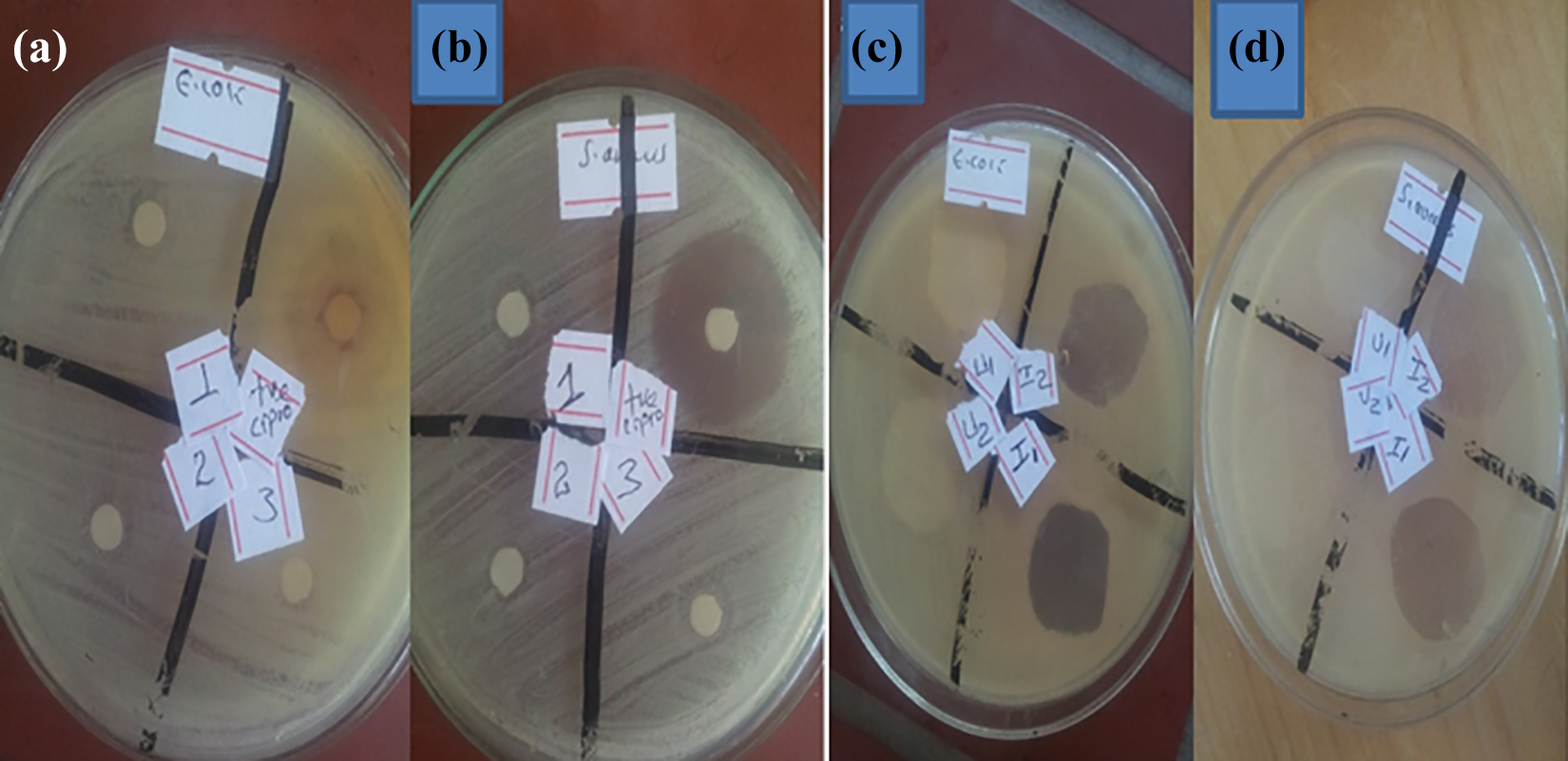
The antibacterial activities of ZnO NPs with different concentrations applied on E. coli and S. aureus synthesized using (a, b) precipitation method in water medium and (c, d) in situ method are shown. The number 1, 2, 3 and U1, U2, and U3 show the concentrations of ZnO NPs and their corresponding zone of inhibition for ZnO NPs synthesized using precipitation method in water medium and in situ method, respectively. ZnO: zinc oxide; NP: nanoparticle.
It was also observed that ZnO NPs have better antibacterial activity on gram-positive (S. aureus) than the gram-negative (E.coli) bacteria. We found that the antibacterial activity is dependent on the concentration of ZnO NPs, as shown in Figure 5. Generally, the growth of the inhibition zone of E. coli and S. aureus has been increased as the concentration of ZnO NPs increased, as shown on the discs also. The mechanisms of ZnO NPs for antimicrobials are due to disruption of cell membranes of bacteria and fungus probably by the production of reactive oxygen species, such as superoxide anion, hydroxyl radicals, and hydroxyl ion. 27,28

The antibacterial activities applied against S. aureus and E. coli at different concentrations and their corresponding zone of inhibition/mm (a) ZnO NPs synthesized using precipitation method in water medium and (b) the standard antibiotic drug ciprofloxacin. ZnO: zinc oxide; NP: nanoparticle.
Conclusions
In this study, ZnO NPs were synthesized using three different methods and applied for UV light protection and antibacterial activities. ZnO NPs synthesized by precipitation method through homogeneous phase reaction using ZnCl2 as a precursor with sodium hydroxide at high temperature in water and 1,2-ethanediol at 90°C and 150°C, respectively. The other method was in situ synthesized of ZnO NPs on the surface of cotton textiles via a simple wet chemical route. The morphology of ZnO NPs characterized by SEM on cotton fiber shows bundle or flower shape for ZnO synthesized using the in situ method and spherical for those synthesized using S-1 and S-2 methods. The UV protection ability of ZnO NPs coated on textiles was investigated by measuring the UPF in the range of 280–400 nm. Higher value of UPF was obtained when ZnO NPs prepared using in situ method. The antibacterial activities of ZnO synthesized by the two methods possess very good bacteriostatic activity against S. aureus and E. coli bacteria, as demonstrated by the zone of inhibition.
Footnotes
Acknowledgments
The authors would like to acknowledge Adama Science and Technology University and the Ministry of Innovation and Technology of Ethiopia for financial support. Addis Ababa Science and Technology University for SEM characterizations and Addis Ababa University, Department Physics for allowing us to use UV-Vis spectroscopy
Declaration of conflicting interests
The author(s) declared no potential conflicts of interest with respect to the research, authorship, and/or publication of this article.
Funding
The author(s) received no financial support for the research, authorship, and/or publication of this article.
