




Abstract
Lean Management builds the basis for efficient production systems for many industrial companies. However, lots of potentials of Lean Management have been lifted and information and communication technologies in the context of digitalization and cyber-physical production systems (CPPS) offer new possibilities to enhance the performance of companies. Even though surveys indicate that companies recognize these potentials, especially small and medium-sized companies still face challenges in selection and implementation of suitable solutions. Thus, the research project GaProSys 4.0 aims at supporting companies with a systematic approach to combine existing structures of Lean Management with potentials of digitalization in development of a new set of methods to enhance production systems. This paper presents the approach of the research project to develop a structured set of methods and provides an example to illustrate the potentials.
Keywords
Introduction
In the past, the implementation of efficient and goal-oriented processes was achieved through the introduction of Lean Management. In the meantime, Lean Management principles, as well as methods, have already become an industry standard, e.g. VDI 2870, 1,2 and are established in almost all industries, 3,4 The importance of Lean Production Systems (LPS) for companies does not depend on company size and structure. After the transition to the operating phase, however, Lean Management with a high degree of maturity can only be optimized by implementing a small-step continuous improvement process (CIP), since the organizational framework conditions have already been implemented. In addition, further increasing market requirements in terms of flexibility and mass customization increase the complexity of value streams as well as shortens the response time for decisions. Thus, extended approaches are required. In order to meet these requirements and realize further economic potential, the Industry 4.0 approach is currently being pursued and researched. 5
The term Industry 4.0 is associated with numerous development perspectives and a wide range of definitions has been developed. Generally speaking, the term refers to the convergence of real and virtual production in all sectors. 6 This paper bases on the following definition: Industry 4.0 is a real-time capable, intelligent, horizontal and vertical networking of people, machines and objects through information and communication technologies (ICT). 7 Research into Industry 4.0 approaches is currently carried out predominantly in technology-intensive large-scale enterprises and by research institutes. 8
The implementation of Industry 4.0 generally promises great potentials in all areas of the production system. However, due to the complexity of the topic and the lack of available resources as well as strategic capacity to act, current surveys show that small and medium-sized enterprises (SMEs) in particular face major challenges in the selection and implementation of corresponding Industry 4.0 solutions, 9,10 In addition, CPPS can rarely be introduced on a “greenfield site” and thus existing company as well as Lean Management structures must be considered. 11 This means that companies must be supported in the goal-oriented selection and implementation of existing organizational and process structures.
In the context of the research project GaProSys 4.0 an integrated approach combining Lean Management and Industry 4.0 is developed. Two main potentials of this approach have been identified. On the one hand, the existing Lean Management concepts can be inmproved through development of new technologies and digitalization of existing oncepts. 12 On the other hand, Lean Management, with its lean and efficient process design, forms the basis for successful implementation of Industry 4.0 in all branches of industry. 13
So far, research projects have either focused on certain technologies or Lean Management, resulting in use-cases, e.g., 14,15 A systematic approach to combine Lean Management and Industry 4.0 in new methods and a standardized description has not been developed yet.
Categorization of lean methods and Industry 4.0
In order to develop new methods, synergies between existing Lean Management and Industry 4.0 must be identified. The basis for the derivation of synergies is the categorization of Lean Management and Industry 4.0. In the following approaches for both topics, as well as the most feasible approach in the context of this research project, are presented.
Lean Management
In the past, companies have introduced Lean Management to reduce waste in their production processes. 1 Hereby Lean Production Systems (LPS) represent a promising approach to define and implement Lean Management in companies effectively. The LPS is a combined form of Lean Management, Taylorism and innovative working models and has been established as an industry standard, 2,16
The structure of the LPS, which enables the systematic operationalization of strategic goals, is shown in Figure 1. It illustrates how the strategic target of “quality improvement” can be cascaded in a purposeful manner. First, the sub-target “sustained process mastery in manufacturing” can be derived from the strategic target. The achievement of this sub-target is determined by certain enterprise processes that have to be identified. In this example, the sub-target is significantly influenced by the manufacturing and assembly processes. In order to enhance process improvement, the LPS provides eight principles on operating level. Each principle contains several methods that aim at a mutual goal, which is formulated by the name of the principle.

Structure of Lean Production Systems.
The principles are as follows: avoidance of wSaste, CIP, standardization, zero defects principle, flow principle, pull principle, employee orientation, management by objectives and visual management. 1 The LPS provides 35 methods, which are classified according to the principles.
For the example described, the methods and tools of the zero defects principle can be used. In particular the methods Jidoka and statistical process control appear to be useful.
Industry 4.0
Approaches to structure the Industry 4.0 are as diverse as the definitions. Previous studies have focused in particular on the presentation of functions, areas of application and future and technology fields, 17 –21 The characterization of Industry 4.0 approaches according to application areas, 18 such as manufacturing or warehousing, is unsuitable for comparison with LPS methods because these do not address specific Industry 4.0 characteristics. Similarly future fields, 19 such as ICT or innovative production systems, or technology fields, 20 such as embedded systems or cloud computing, are not detailed enough to be able to derive a link between LPS methods and Industry 4.0. If Industry 4.0 is structured on the detailed level of concrete technologies, however, the solutions are too diverse and specific. An analysis based on such a structuring is also inappropriate as notransferable conclusions can be drawn. Instead, a classification of Industry 4.0 on the level of functions has been chosen in the scope of the research project, 21,18 On the one hand, these functions are sufficiently universal to describe all aspects and facets of Industry 4.0, on the other hand they offer concrete starting points for the combination with LPS methods. In this way, LPS methods can be supported or improved with individual functions.

Industry 4.0 functions, cf. 17
According to existing approaches 10 functions were derived to characterize Industry 4.0 use cases, 17 which are visualized in Figure 2. These were validated via workshops and semi-structured interviews with more than 30 experts (CEOs, production-, lean- and digitalization managers) with regard to their suitability for comparison with LPS methods. For this purpose, LPS methods were selected and compared with Industry 4.0 functions so that initial synergies could be analyzed.
Derivation of synergies
Based on an inductive-empirical approach, synergies between LPS methods and Industry 4.0 functions were evaluated and documented. Therefore, 358 different industrial use cases from the platform Industry 4.0 22 were analyzed regarding the interaction LPS methods according to 2 and Industry 4.0 functions according to. 17 A combination between LPS method and Industry 4.0 function that is not described in the use cases is shown as “no potential.” If a combination is described by one or more use cases, a potential is assumed. The level of the potential is proportional to the number of use cases describing the corresponding combination. The result is documented in a synergy matrix, see Figure 3. This matrix enables companies to derive Industry 4.0 functions suitable to enhance an already implemented LPS method. The matrix is also an integral part of further discussions and the scientific approach to developing integrated methods.
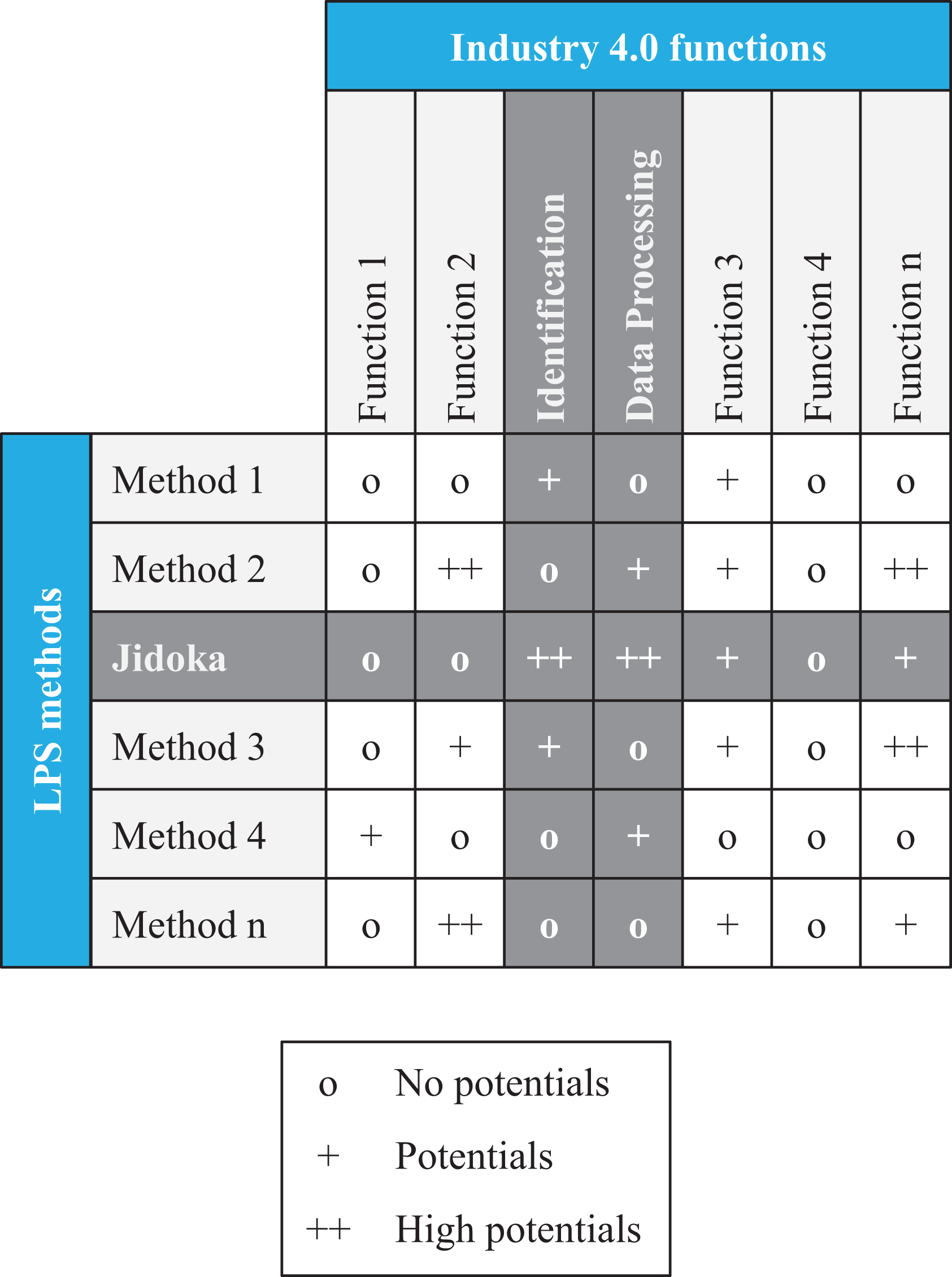
Synergies between LPS methods and Industry 4.0 functions.
The results show two possible outcomes. In the case of given synergies, the positive combination of LPS methods and Industry 4.0 functions has been considered and used in different companies. In this instance, the next steps include their description in a universally valid way. On the contrary, no detected synergies do not automatically imply that a possible combination of an LPS method and an Industry 4.0 function cannot enhance the company´s effectiveness. It can only be concluded that a practical use case for a particular combination has not been discovered yet. Therefore, further research will analytically investigate whether there are synergies for this combination of LPS methods and Industry 4.0 functions.
The existing results indicate, that the Industry 4.0 functions identification and data processing offer high potentials and synergies for the LPS method Jidoka method. However, this is only one example of many that was identified by the conducted analysis. The extension of this LPS method to include the Industry 4.0 functions is described in more detail below.
Standard description of new methods
Based on the identified synergy potentials, new GaProSys 4.0 methods were developed and documented within the framework of the research project. One example is provided in the next chapter.
Despite differences in content, a uniform and clearly structured form of description was chosen for the documentation of the methods. This approach has already been used successfully in the description of LPS methods in the VDI guideline 2870 1 and is considered supportive in implementation of methods by practical users. For the development of a standardized template for GaProSys 4.0 methods, the template from the VDI guideline 2870 1 was extended considering the additional requirements for the description. Additional requirements are for example stating the Industry 4.0 functions included in this method as well as the explanation of these within a use case description.
Initially, the need for extension of the basic template was identified within the framework of literature-based research. In particular, the need for description of aspects related to digitalization (e.g. possible digitalization solutions for implementation of the method) was defined. Subsequently, the identified requirements for extension were verified in already mentioned workshops and semi-structured interviews. Also the template was extended together with the experts. Particularly, new description categories were added to facilitate cost-benefit considerations. An exemplary expression of the template is shown in Table 1.
Standardized description of Jidoka 4.0.

For the most part, the methods are described by free texts (e.g. categories “abstract” or “effect in business processes”) and partly supplemented by standardized evaluation elements. For example, the target contribution, expenditure/ costs and the implementation period are described by predefined valuation elements. The target contribution is rated with a point system (•, ••, •••) which indicates the effects from weak (•) to strong (•••). Other categories are rated by the expressions low, medium and high. On the one hand, this ensures better comparability between the methods and, on the other hand, enables the evaluation of the methods in the sense of an approximate range of values. For example, the valuation of acquisition costs by a concrete sum (measured in €) is not considered reasonable, since company-specific framework conditions have a high influence on the valuation. Nevertheless, it is possible to give a spectrum for an approximate estimation of the investment expenditure.
Example of Jidoka 4.0
LPS-method: Jidoka
The Japanese term Jidoka refers to “intelligent automation” or “autonomous automation.” The target of this method is to create small, independently running control cycles that monitor the manufacturing process in order to detect defects at their source and avoid the dissemination of defective products (mistake propagation). 1
The Jidoka method uses sensors or mechanical principles to enable autonomous correction of the process. A deviation of the process output regarding the required quality requirements (defect) is detected by the sensors and leads to an automatic stop. The automatic stop of the process in case of a defect allows the employee to operate or monitor several machines simultaneously. Stopping the process creates pressure to act, which should help to eliminate the cause and create a faultless process. 1
Initially, the concept was applied to a weaving chair that mechanically monitored each single threat. As soon as a threat broke, the weaving machine stopped and the worker could fix the weaving process. Thus, production of defective parts was prevented. However, the tearing of threats could not be prevented. Results were downtime of machinery and correctional processes for the workers. Thus, detection of material or process abnormalities before defects occur would improve the process even more.
New potentials through Industry 4.0
As explained in the previous section, the classical Jidoka approach allows to identify process errors immediately after their occurrence and to initiate appropriate measures. However, the increasing dissemination of ICT in the context of Industry 4.0 holds considerable potential for a predictive approach to quality improvement in manufacturing processes. 23 In particular, potential errors can be predicted before occurrence and the possible impact on product and process quality can be assessed. 24 Thus, quality deviations can be anticipated and prevented. 25
A major enabling factor for predictive process monitoring is the increasing availability of affordable measuring devices and capacity of data storage hardware. This enables companies to generate massive data repositories which contain implicit knowledge about production processes. By the use of powerful hardware the recorded data can be evaluated in real time. At an early stage conclusions can be drawn about the course of the manufacturing process and the quality of the final product using methods of Machine Learning in the context of Data Analytics, which adresses the recognition of patterns in structured as well as unstructured data in order to extract previously unknown knowledge and hidden laws from data. 26 The gained knowledge enables the development of data-based prediction models as the basis for computer-aided prediction of future events and effects. Thus, data analytics can contribute to an increase in efficiency and product quality, especially in the industrial and manufacturing sector. 27
The prediction of errors in production processes can be realized by different types of data analytics methods. These can be divided into unsupervised and supervised learning.
By the use of unsupervised learning methods, unknown patterns and structures can be recognized within and solely on the basis of process data. It is not necessary to know the historical data of a target variable. Thus, unsupervised methods can be used even if the measurement of a target variable is not possible due to technological or economic reasons. 28 One possible objective when using unsupervised learning methods in the context of quality monitoring is anomaly detection to detect abnormal process patterns that may lead to deviations in product quality.
In contrast to unsupervised learning, the use of supervised methods requires knowledge about historical measurements of the target variable. 29 On the foundation of this database, an assignment function which describes the relationship between input data and target variable can be formulated. In the context of quality monitoring, such functions can be used for an error evaluation based on measured process variables. In addition to identifying the presence of an error, supervised methods also allow a differentiation of varying error patterns.
The prediction of product quality using unsupervised and supervised learning methods builds the methodological basis of Jidoka 4.0. The development of this method originates from an application of supervised machine learning for predictive quality control in electronics manufacturing developed and described in further detail by Deuse et al. 30 In this use case, the objective was to predict the quality of the final product of a production line for surface-mounted devices. The important measure of quality of the final product was the right position of the soldered parts, which previously was determined by an X-ray inspection system at the end of the manufacturing process. To predict this measure of quality Gradient Boosted Trees (GBT) have been used as they performed better than other supervised learning methods such as Naive Bayes, Decision Trees, and Support Vector Machines (SVM) in this use case. Thus GBT were trained on the basis of historical measurements of process quality parameters such as sensor data and data from visual inspections recorded at different points along the entire production line as well as the corresponding measurements for the quality of the final product. On the one hand, this approach led to a relief of the X-ray inspection system for monitoring the quality of the final product as the algorithm was able to predict the output of it (position of soldered parts within or out of specification). On the other hand, possible defects could be predicted and countermeasures initiated at an early stage of the production sequence.
The approach of predictive quality control with the aid of data analytics pursued in this use case builds the basis of the method Jidoka 4.0.
The approach was abstracted, set in context with other GaProSys 4.0-methods and major findings were embedded in this research project. With the standardized description it is provided to a broad public in form of the Jidoka 4.0 method.
Jidoka 4.0
The standardized description for Jidoka 4.0 is presented in Table 1.
The method presented in this paper, Jidoka 4.0, is an example for a set of methods developed within the research project. An overview of the full method set as well as a selection system for companies will be published subsequently. The main purpose of the development of a structured set of methods is the illustration of Industry 4.0 potentials in the context of Lean Management as well as providing new methods to industrial companies. The methods are described in a general way, providing companies with approaches instead of specific technical solutions. Hence, the methods can be adapted by companies of different industries, but also have to be specified to match the company-specific conditions and needs. Assessing existing lean methods and improving them via the connection with Industry 4.0 functions guided by the method set provided represents the first step in digitalization. Within this process companies shall be enabled to extend this approach to further lean methods and departments. However, the initial discussion of implementation and evaluation of new technologies is seen as crucial for commencing the digitalization of industrial companies. Thus, the method set is designed to offer potentials for digitalization and reducing existing barriers.
Conclusion
Lean methods that have been established in the industry over the last decades have not become obsolete with recent developments in the Industry 4.0. However, they can be enhanced by emerging technologies, as shown on the example of Jidoka 4.0. Thus, existing lean methods need to be assessed whether synergies with Industry 4.0, respectively regarding Industry 4.0 functions can be derived. On the one hand, this allows the improvement of existing lean methods. On the other hand, approaches for the implementation of Industry 4.0 are derived and can reduce existing barriers.
This paper presents the approach of the research project GaProSys 4.0 to combine lean methods with Industry 4.0 functions. With Jidoka 4.0 an exemplary method is presented in form of a standardized description. In parts the initial method has been altered, with focus on predictive failure detection based on process parameters instead of stopping a process after a failure has occurred. Thus, the initial approach is maintained, but the technological evolution allows an improvement of the method. Especially data collection, storage and analysis via affordable sensors, data bases and analysis software are the enabler of this method. Thus, allowing to react faster on process deviations and in advance of the occurrence of errors and defect parts.
The implication for other lean methods has still to be analyzed. The research project will continue with the assessment and additionally develop a selection guide to assist companies in assessment and selection of suitable approaches depending on company structures.
Footnotes
Declaration of conflicting interests
The author(s) declared no potential conflicts of interest with respect to the research, authorship, and/or publication of this article.
Funding
The author(s) disclosed receipt of the following financial support for the research, authorship, and/or publication of this article: The research project GaProSys 4.0 (19840 N) of the Research Association for Transport Business Economics and Logistics (GVB) e.V. is supported by the German Federal Ministry for Economic Affairs and Energy (BMWi) on the basis of a decision by the German Bundestag.
