




Abstract
This study aims to investigate whether the graduates’ core competencies are fairly sufficient to get employed and also aims to understand the impact of these employable skill (ES) on work performance (WP). Toward this, a theoretical framework was developed by considering delivery-related competencies (DRCs), interpersonal competencies (IPCs), and strategic competencies (SCs) as independent variables and ESs and WP as predictable variables. The survey was conducted across private companies in Saudi through a questionnaire that received 235 completed responses. A qualitative approach by conducting few interviews were also considered to gain possible value added comments from the respondents. An exploratory factor analysis) using varimax rotation was conducted to evaluate the impact of competencies on ESs and its further effect on WP. The results demonstrated that, though the DRCs and IPCs have low positive significant effect on the overall ESs, the SCs were not able to significantly predict the recent graduates’ ESs. It is also evident that the overall ESs are not significantly predicting the WP. The indirect effect of independent variables on WP through the mediation of ESs were also assessed using AMOS software. The results revealed that ESs have a significant partial mediating effect only between delivery competencies, IPCs, and WP but not with SCs. The findings also provide a deep insight to the national recruiters to consider the competency-based management. The study is limited to understand the fresh graduates’ competencies, so the results cannot be generalized to experienced graduates. Further, few important recommendations were also proposed to the higher education establishments to strengthen their efforts and finely groom their future graduates according to the global labor market. The study also sheds numerous directions to potential new graduates for enhancing their present skills and to become competent in the job market.
Introduction
Vigorous changes in global economy are triggering Saudi’s private sector organizations to confront lot of challenges at a fast pace both in the domestic and in the global markets. Recently, the Saudi nation is intensifying efforts to enhance the core competencies of the indigenous workforce by deploying its recently graduated citizens and accomplish its Saudi Nationalization Scheme. This scheme is the newest policy of Saudi Arabia that was strictly implemented recently by the Ministry of Labor, demanding all Saudi organizations to fill their personnel with Saudi nationals by replacing foreigners up to a certain level, and companies failing to comply this policy would not obtain government contracts and visa services. Since 2013, there had been a severe and consistent repatriate process taking place in the country as most of the expatriates decided to leave the country due to loss of jobs and being unpleasantly affected by unstable ministerial resolutions that were announced very often. However, there are many ongoing debates in the nation as this policy may have adverse impact on various key public sectors. Many research studies stated that there is a controversy about the work productivity among Saudi workers and foreign employees, where most of the Saudis at all job levels prefer to work in an administration or managerial job with good salary and less working hours. While the competency being the cohesive backbone for the employee’s work performance (WP), and a manifesto in bringing a brand to the employer, retrospective literature reviews also stated the recent Saudi Nationalization Scheme has created a heavy competition among the literate Saudi citizens and became a challenge for organizations to improve their recruitment strategies in hiring the best candidate. 1 This statement is also fortified by many employers’ negative perception that most of the Saudi employees prefer public sector jobs because of higher compensation package, job security, less working hours, and they are reluctant to work in private sector because of their cultural and behavioral propensity toward the work inherent in the society. 2,3 As the employee’s WP is one of the critical factors for any organization’s development, previous studies relevant to the context of Saudi recruitment also suggested that employers need to contemplate competency model as one of the primary criterion during employee selection to move toward a sustainable corporate growth. Hence, a structured or behavioral interview that is commonly known as competency-based recruitment is an imperative initiation to reinforce the organizations with a clear vision for the future. However, referring to the literature, it is not admissible to reach a decision without investigating the current core competencies possessed by the fresher; because of the controversy, there are few Saudi fresh graduates who possess high end competency and perform extremely satisfactory work and business results. Most of the past researchers acknowledged the most important competencies essential for new graduates from various areas of educational background. Mavuso, 4 considered how the competency model shaped the Saudi university students and its implementation method in the institution. However, the author clearly recommended to further examine their graduate’s core competencies at different workplace when employed. While most of the past research studies conducted and considered various established competency models in determining the selection and recruitment outcomes, few other prioritized the graduates’ competencies from academic and industrial viewpoint and many other identified the top competencies essential for engineering, nursing, and other domains and seldom emphasized to understand the skill analysis of recent university graduates at workplace nor psychometrically tested the competencies in the Saudi context.
As stated by Al-Rawaf and Simmons, 5 the first school for girls in Saudi Arabia at university level was started in only one university at Riyadh during 1960 but with very limited students. So the concept of higher education was not so new in the nation. Also, unlike other countries, the Saudi students in public universities were paid stipends for joining higher education and this is just to motivate them toward pursuing higher studies. The literature suggests that the graduates’ competencies play a critical role in developing the organizations and nation as well. It is recognized that there exists a paucity in understanding the fresh graduates’ competencies and to what extent they are eligible to be employed. Therefore, this study aims to emphasize on basic skills possessed by fresh graduates required at the entry-level jobs by developing and investigating a core competency model to understand their employable skills (ESs) and examine its influence on WP to prevent organizations from taking any hasty decision or making any wrong assessment by hiring an inappropriate candidate for a job. Hence after the introduction, relevant literature review is presented followed by theoretical framework and hypotheses formulation. In the subsequent section, the data collection and analysis followed by key findings and interpretation of the study are presented. Also deep insight for academicians and fresh graduates in fine-tuning their potentials and recommendations for organizations on how to develop and leverage their workforce competencies to have an added advantage with a higher potential in the global opportunities are provided.
Literature review
Previously, researchers demonstrated that a corporation is formed by different strategic business units, and these business units used to operate autonomously to avoid the risk of losing its corporate image. Over a period of time, they realized people, process, and resources are not substantially significant in delivering the corporate business strategy. Apparently, a drastic change in the overall concept of business management had led the organization to work as a group by considering the core competencies. Consequently, many core competency models were developed based on the contemporary requirements. However, all the competency models were based on behavior, skills, knowledge, attitude, and intention components. The below two sections provide a deep insight in understanding the core competencies and the ES sets possessed by the fresh graduates and its pragmatic influence on their WP.
Core competencies
Grus 6 described the core competencies as integrative tasks that are necessary to perform a job and those competencies are recognized as a person’s capability and qualification in terms of his or her education and expertise which finds him or her suitable for a job. These core competencies that are intangible yet extreme key assets to an organization were apparently found to be distressed in the Saudi recruitment process due to an aggressive implementation of nationalizing the jobs. As every organization operates uniquely toward its vision and mission, similarly, there exists a unique core competency necessary for every job. Nevertheless, many studies revealed the radical six-core competencies namely communication, technological, leadership, teamwork, critical thinking, problem-solving, and professional development, which are referred to be the functional skills. 7,8 As argued by many researchers, every job demands different skill sets that suits the organization goals. These skills are broadly divided into soft and hard competency. Soft skills are understood to be the personal characteristics of an employee in terms of societal, proficiency, or conceptual. 4,9,10 Mohamed et al. 11 identified and prioritized 50 competencies for Saudi engineering graduates and categorized them into four main types namely knowledge and understanding, personal and professional skills, and interpersonal and practicing skills. Among all the identified fundamental knowledge in the field of study, problem-solving skills, teamwork, and functional skills were given the highest weightage by the industrial experts and suggested the graduates must inculcate soft skills like motivation, analytical skills, time and resource management, decision-making, and leadership skills. Al-Neam et al., 12 while exploring the gaps between the knowledge gained and the ability to apply that knowledge in a specific task, analyzed the competencies before and after the training period undergone by the King Fahd Central Hospital nursing graduates and argued there were noticeable differences in knowledge and skills but not greatly on attitudes.
Schutte et al. 13 developed and empirically validated a human resource (HR) professional competency model consisting of 12 measures under 3 constructs, namely executive conduct and authority, service inclination and business implementation, and expertise. The authors further added that supervision and trustworthiness, problem mitigation, and professional mutual connections are vigorously necessary at work; to be a successful leader, talent management, analytics, and measurement are the principal elements for implementation and service delivery; and lastly, strategic involvement, corporate knowledge, and technology are the most significant items for business intelligence. Despite these skills, the Organization for Economic Co-operation and Development (OECD) 14 summarized 15 personnel competencies into three main categories. The employee’s dealing resources, analytical skills, accomplishment focus, drafting skills, flexible thinking, teamwork, and leadership falls under the first category of delivery-related competencies (DRCs) for achieving results; secondly, client emphasis, diplomatic thoughtfulness, influencing, negotiating, and organizational knowledge falls under the second category of interpersonal competencies (IPCs) for building relationships at work. However, improving talent, organizational arrangement, future networking, and thinking fall under the third category of strategic competencies (SCs) for planning the future developments. However, the study demonstrates all these competencies as key indicators for different jobs varying from low level to high level which considers assistants, secretaries, clerks, cashiers, operators, corporate management and administrators, officers, sales and logistics executives, documentalists, HR advisers, IT/policy analyst, managers, and directors from different specialties. Recently, the Saudi Ministry of Labor in 2016 has reserved multiple job categories that suits best for its citizens to promote the nationalization employment campaign where all of them fall under the abovementioned job titles. Hunthausen 15 also examined the US airline recruitment and selection system based on multidimensional and contextual job performance and predictor’s task and quoted that the supervisor soft skills’ assessments were related to communication, negotiation, quantitative skills, analytical and decision-making ability, problem-solving, leadership and teamwork and strategic perspectives. Additionally, Bandow 16 studied on newly hired IT professionals in the United States and demonstrated that technical skills, communication, teamwork, commitment, and problem resolution are the key ESs, but the study did not attempt to present any empirical examination between competencies and employee WP.
Ozcelik and Ferman 17 discussed the value-based approach which reviewed their employees work in terms of moral and cultural dimensions. The study proposed to use the constructs and measures of OECD 14 in conjunction with Schutte, 13 which were also referred in many studies of competency models. In the recent years, many reputed universities in Saudi Arabia like King Faisal University guides their undergraduate students to develop key core competencies such as communication, critical thinking, assessment, and technical skills during their academic study which helps them to plan, design, and evaluate their work when employed. On the other hand, many business case studies explained that becoming cost-effective by reducing training costs, improving work productivity, reducing employee turnover, providing high-quality service, and managing cultural competent in them are observed to be the expected ESs. 18 In today’s world, any organization predominantly focuses on three main aspects to be successful in the global market. Based on the earlier discussion on literature, most of these competencies are broadly cascading under OECD’s major three competency categories; therefore, the study is proposed to align the identified relative skills under delivery competencies, IPCs, and SCs as discussed below.
Delivery competencies are how the individuals can transfer the knowledge and experience into a successful measurable WP and result. Operational ability, which is also referred as task alignment, is principally mental and cognitive in nature involving flexible thinking and problem-solving that are required to perform the job but are subjected to change according to the context and functional roles. 19 Analytical thinking is that which an employee need to involve in identifying complex situations and essentially able to differentiate critical situations and irrelevant information that are not easily apparent. 20 Critical thinking is characterized to possess the ability to effectively get adapted at various situations or individuals. The OECD 14 expressed that the executives at all level must be able to recognize the importance of different point of view and doing things differently with an optimistic attitude even when things are uncertain and altered. Draganidis and Mentzas 21 assert that the sales professionals may possess sales planning skills, an approach of working in teams, understanding the industry ideas, and planned thinking. The next is managerial or leadership competencies, previous researchers quoted few examples such as strategic thinking and visionary leadership are associated with the organization and employee in driving them toward organization’s goals and employee’s development.
IPCs are soft and very fundamental in nature and mostly associated with emotional intelligence and personnel attitude for managing the human relations. Such skills are also commonly seen in augmenting the hard skills and are necessary for an amicable working environment. 9,10 However, it also includes all kinds of communication skills like drafting, thoughtfulness in negotiating. OECD 14 recommended that, at any job level, the employee must retain within them an active and desirable influencing ability with a sound organizational knowledge to track difficult issues and conveying in a constructive manner.
SCs not only are required for everyday requirements but also need to foresee what proficiency may determine the future success. 22 Spencer and Spencer 23 studied strategic alignment and influences as a part of soft skills, and these SCs will have employee initiative and influence on others in building up the interrelations. Martinelli 24 suggested some key stages to be considered while introducing a new business model, managing skills which may be used in future, amid board members namely business spirit, risk taking, communicating well at all levels, new coalitions, sense of promoting innovation, and creativity.
Employable skills
ESs are those that are identical with core competency, generic skills, proficiency, interpersonal, or transferable skills and are referred as the abilities, knowledge, and personal values that an individual can possess with him or her to gain employment and eventually help them to succeed and progress professionally. The US Department of Labor 8 has developed competency model and emphasized on identifying the various ESs and filled the skill gaps that exist in the preparation of graduates and expectations of employers at the workplace. This model constitutes five competencies, namely resources allocation; involvement in developing a team environment; securing information and evaluation; distinguishing social, business, and technological systems; deploying and coping up with the technological changes. However, apart from these, the essential skills include basic skills (communication and simple mathematics), thinking skills (decision making and problem solving), and personal traits (honesty, accountability, self-esteem). Harvey 25 asserted that graduates must demonstrate realistic proficiency to get welcomed for many flourishing competitive positions in the job market.
Work performance
Motowidlo et al., 26 defined WP as “the total expected value to the organization of the discrete behavioral episodes that an individual carries out over a standard period of time.” The underlying feature for any employee is competency which will lead them to deliver a successful WP. Kolibáčová 27 studied the association among employee expertise and production and proposed an employee’s performance rate can ameliorate from 7% to 12.5% comparatively with the other, who is impotent at work by one unit. He further suggested that this positive association between competency and performance makes sense for the organizations to invest money and time on the competent employees to enhance their performance. The 360° opinion of competency is a combination of implicit, clear, collective and discrete knowledge, ability, and skills that lead to an efficient, effective, and exceptional performance. This study primarily emphasizes on individual competencies. Several research studies 21,28,29 found that there exists a robust association between individual and professional competencies. Conversely, few studies mentioned because of complexity in evaluating the competencies that there exists many ambigious and skepticism about the correlation between performance and competencies. Numerous research studies recognized the competencies can significantly predict the employees performance and provide an opportunity to explore new career prospects. Ryan et al 28 spotlight a rational efficacy of competencies in speculating the performance of an employee.
Theoretical framework and hypotheses formulation
The above retrospective literature review of various components signifies in developing the model (Figure 1) and attempts to examine the influence of three independent constructs (DRCs, IPCs, and SCs) on recent university graduate’s ESs and further verfies whether those skills can significantly predict their WP which are vital for the organization development. The study considers the competencies that are very basic and vital of new graduates that are referred in many previous studies and grouped them into constructs as presented in OECD. 14 From the above proposed framework and the exploration of theories, the study postulates the following four hypotheses and aims to predict the direct influence on ESs and further its impact on WP.

Framework of graduate’s core competencies model.
Formulation of research hypotheses
According to the developed theoretical framework, the study also formulates the below three hypotheses to understand the mediating effect of ESs between the three independent variables and WP respectively.
Research methodology
Survey instrument
In this section, the development of survey instrument, data collection procedure, and statistical analysis are presented. The survey instrument consists of questions that are relevant to graduates’ individual competencies, ESs, and their WP. The independent constructs and their respective items were adopted from the OECD 14 competency framework. The items for DRCs include analytical thinking, achievement focus, drafting skills, flexible thinking, managing resources, leadership and teamwork and for IPCs, client focus, influencing and negotiation, and organizational knowledge were considered. As the SCs link the planning for the future, organizational alignment, strategic networking, and thinking were considered. The dependent variables ESs and WP with the measurement items were identified from the literature and developed suitably to measure the overall competencies of graduates. The survey instrument was developed by discussing with a panel of industrial experts using a five-point Likert-type scale with measurement items related to the above constructs: 1 = strongly disagree, 2 = disagree, 3 = neutral, 4 = agree, and 5 = strongly agree.
Data collection
While the small and medium-sized enterprises in Saudi Arabia contribute to majority of the nation’s economy and also in employment creation, it is assumed the high possibility of placement of any fresh university graduate could be either in small-sized or in medium-sized organization. With this viewpoint, the study implemented both qualitative and quantitative methods for information inputs. The former is accomplished by survey instrument and the latter by conducting very few telephonic interviews to get the strong opinion from HR department and respective department heads of various firms in Riyadh province. Initially, the survey questionnaires were distributed among 800 respondents with only 260 returned responses, resulting in 32.5% response rate. Of the 260, only 235 were found to be useful. The follow-up calls were made to the respondents to enquire about the status on filling the distributed questionnaire. Some of them said they do not have time to look into the questionnaire, rather would prefer to answer on phone quickly. This approach attracted the researcher to gain broad information about fresh university graduates’ competencies. The profile of responding firms is presented in Table 1.
Profile of responding firms.

Source: SPSS Analysis of primary data.
Data analysis and results
The study analyzes the data in two stages. Firstly, the exploratory factor analysis (EFA) using principal component analysis (PCA) method under varimax rotation was conducted to determine the underlying dimensions of various competencies. Secondly, SPSS (version 21.0) software application was used as a statistical tool to analyze the data and test the formulated research hypotheses.
Exploratory factor analysis
An EFA under PCA with varimax rotation was conducted with 22 measurement items to reduce the data and extract the dimensions of the constructs. As shown in Table 2, the EFA resulted in five factors with eigenvalues greater than 1, and all items were loaded respectively under these five constructs. A significant Bartlett’s test of sphericity (p < 0.001) and Kaiser–Meyer–Olkin value with 0.825 also confirmed the factorability conditions. Depending on the item loadings, the factors include DRC (6 items, IPC (5 items, and SC (4 items as predictors, and Cronbach’s α coefficients are 0.874, 0.921, and 0.866, respectively, and each item-total correlation was greater than 0.3. Further, the factor scores were calculated from the results of factor analysis, and these variables were used in multiple regression analysis.
Rotated component matrix.

Source: SPSS analysis of primary data.
DRC: delivery-related competency; IPC: interpersonal competency; WP: work performance; SC: strategic competency; ES: employable skill.
The reliability test determines the extent to which a summated scale measurement instrument yields consistent results on repeated trails. Although the summated scales are usually an association of interrelated items, which meant to measure underlying constructs, it is important to know whether the same set of items elicits the same responses when the same questions were posed. Cronbach’s α coefficient is one way to test the reliability of measurement scales and must be greater than or equal to 0.7 to be in a tolerable range 30 and the corrected item-total correlation above 0.3. 31 Also, validity test is predominantly concerned with determining whether the scale measures the underlying construct adequately or not. The dependent variables of Y1, ES—3 items and Y2, WP—4 items with Cronbach’s α coefficients 0.856 and 0.924, respectively, whose corrected item-total correlation were also larger than 0.3.
Hypothesis testing
Multiple regression analysis method was used to test the developed hypotheses. The dependent variable (Y1—ESs) is derived as:
Dependent variable = f (multiple independent variables) which can be expressed as

Hence, employable skills = 8.466 + 0.094 X1 + 0.596 X2 + 0.084 X3 + ε.
From Table 3, analysis depicts that the value of determinant of coefficient is 0.583, which indicates the three independent variables (DRCs, IPCs, and SCs) together explains 60.3% of variance in ESs. The F value 99.503 is statistically significant, indicating all the independent variables have an overall influence on ESs.
Model summary of employable skills.a

DRC: delivery-related competency; IPC: interpersonal competency; SC: strategic competency; ES: employable skill.
a Predictor: (Constant), DRCs, IPCs, SCs; dependent variable: ESs.
However, observing the standardized β coefficients in Table 4, interpersonal skills have got significant affect (0.596, t value <0.001) and DRCs and SCs found to have insignificant positive affect with values 0.094 and 0.084, respectively, demonstrating that the recent graduates do not have essential skills to be employed but are only good at maintaining good relations with other in the workplace.
Coefficients—model summary of employable skills.a

VIF: variance inflation factor; ES: employable skill.
a Dependent variable: ESs.
The variance inflation factor (VIF), which is a popular technique for measuring multicollinearity among variables, must be less than 10. 32 Also, the model here shows no collinearity problem with the tolerance value above 0.1. Therefore, the research hypotheses H1 and H2 are accepted, while H3 is rejected as the data do not support them. Similarly, to test the hypothesis H4, the WP (Y2) is predicted by investigating the impact of ESs on it

Hence, ESs = 11.693 + 0.278X1 + ε
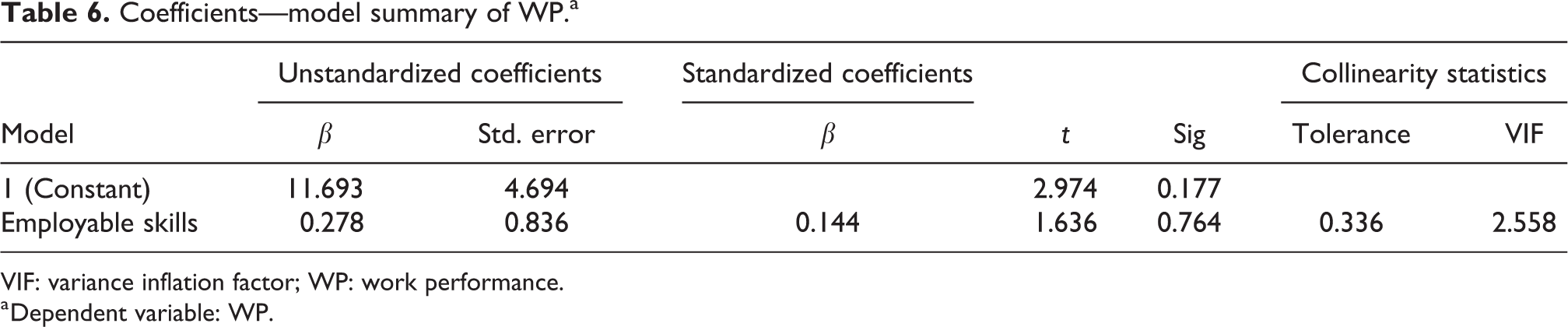
Table 5 confirms only 25.7% of variance is explained in WP by ESs with insignificant F value (16.350), and it verifies that the WP is not predictable by its independent variable. The standardized β coefficients in Table 6 also reveal that there is no significant relation between them. Subsequently, H4 is also rejected and not supported by the data.
Model summary of WP.a

ES: employable skill; WP: work performance.
a Predictor: (Constant), ESs; dependent variable: WP.
Coefficients—model summary of WP.a
VIF: variance inflation factor; WP: work performance.
a Dependent variable: WP.
For understanding the mediating effect between three independent variable and WP, AMOS software (version 21) was used to calculate the indirect effects. AMOS is a visual program for structural equation modeling and can perform the computations for structural models very easily with multiple items in a construct. For calculating the indirect effects, first it is necessary to confirm whether there is any significant direct effect between the variables. This direct effect before entering the mediator in the model is presented in Table 7. The statistical values explain that there is a significant positive relation between delivery-related and WP with β value 0.495 at p = 0.021 and β value 0.612 at p = 0.015 between IPCs and WP. The β value 0.138 at p = 0.063 shows that there is no positive significant relation between SCs and WP, indicating the rejection of H7.
Variables entered the model before mediator (ESs).

Source: Analysis using AMOS.
CR: critical ratio; DRC: delivery-related competency; IPC: interpersonal competency; WP: work performance; SC: strategic competency; ES: employable skill.
After confirming the significant direct effect, mediating effect of ESs were calculated as shown in Table 8. The β value between DRCs, IPCs and WP was found to be reduced to 0.372 at p = 0.035 and 0.0481 at p = 0.037, respectively, while the indirect effect between ESs and WP with DRC and IPC constructs are 0.123 at p = 0.042 and 0.131 at p = 0.041, respectively. This confirms that ESs have a partial mediating effect on DRCs and IPCs and no effect on SCs. Hence, the hypotheses H5 and H6 were supported by the study.
Variables entered the model after mediator (ESs).

Source: Analysis using AMOS.
CR: critical ratio; DRC: delivery-related competency; IPC: interpersonal competency; WP: work performance; SC: strategic competency; ES: employable skill.
Findings and interpretation
This study was conducted to empirically explore whether the overall ESs of the fresh Saudi university graduates influence their WP. The study demonstrates that the graduates have got very poor competencies, which are not sufficient for the employment in the Saudi labor market. The results demonstrate that 66% of the graduates possess poor analytical skills, lack technical skills in few areas, and the majority of them are with low critical thinking and less involvement to customer perceived value. Sixty percent of medium-sized product-based companies stated that the graduates must possess appropriate technical skills in their job field, especially the fresh engineers, nurses at medical laboratories in handling the tools and machines at work. In an interview with private organizations, few employers expressed their views on graduate’s strategic skill, stating they neither have an appropriate knowledge of the organization nor aspire for future developments and quality improvements. This statement is also consistent with many other research findings, such as Sami, 33 where 77.8% of employers expressed their uncertainty on the Saudi university graduates’ ESs and Casner-Lotto and Barrington 7 reported that the employers expressed their dissatisfaction about the unmet performance expectations for entry-level jobs. In this study, few other interviewees reported the employers do not expect reliable skills, time bound and productive results, and target-oriented task from these entry-level employees, rather would anticipate commitment and devotion in work, fulfilling the work schedules, affinity toward teamwork, self-confidence, ability to handle uncertain situations, work under pressure, willing to learn, improve negotiation, and leadership qualities. This opinion is also consistent with views of Adnan and Mikhail 34 and Knight and Yorke, 35 who discussed that even the most pioneering countries do face such problems. Some of the employers agreed only 40% of graduates are good in English and computer knowledge with adequate qualification, the rest do not have good communication and analytical skills in addressing the customer’s queries, although these are the minimum skills a student need to acquire during their graduation programs. Alternatively, numerous training programs are being conducted by the organization to enhance their skills and abilities, which are again time-consuming and incur additional cost to the companies. The study also recognized new entry-level employees maintain poor professional behavior and attitude, high expectations of salary, absenteeism, low working hours, and changing jobs very frequently. Statistical analysis shows the graduates are not up to the expected level in problem-solving, critical thinking, technical aspects, and managing the resources. On the other hand, they do not possess significant long-term competencies that are related to strategic networking, quality and development, and sustainable decision-making. From this, it is very clear that the outcomes of university education systems are not aligned with the needs of Saudi labor market. Agreeing with this statement ubiquitously in the country, and inferences from the literature, the present government is funding many potential students with scholarship schemes to pursue their study in Western countries, expecting these graduates would eventually return to the home country and contribute in the development of the nation. The study also suggests academicians to constantly update curriculum of various graduate programs and contribute in preparing the graduates suitable for local and global labor markets.
Since it is very commonly perceived that just the theoretical knowledge does not enrich the graduate’s skills, higher education system can mandate to put the classroom theory into a dynamic and tangible activity or emphasize on scientific applications and deploying interdisciplinary approaches. Also, it is suggested that the graduates can gain the relevant work knowledge through an appropriate cooperative or vocational education programs, as these initiatives can vigorously support in bridging the gap between the set of available competencies and that are required by the employers. While failing to develop such skills will dramatically ruin the graduates’ long-term career growth and leads to forfeit with promotion prospects and may face underemployment problem.
Conclusion
The study concludes DRCs and IPCs have a positive effect on ESs, while SC does not predict the ESs of graduates. Further these ESs do not significantly influence WP. However, the ESs have a mediating effect between DRCs, IPCs, and WP. The findings of this study are also consistent with many recent past studies as clear from the literature. From the above findings, the potential graduates may also learn how to enrich their efforts for a job search and knock down their weaknesses. The study infers that outgoing graduate students must also develop self-learning, self-efficacy, and self-evaluation skills in them for their future work-related personality development as university education does not inculcate those skills in them. Further, if the firms are receptive toward core competency-based recruitment, the process can elicit into an effective employment system and helps the organizations to gain competitive edge in the global market. Therefore, the recruiters may strictly consider a holistic assessment-based interviews, where they focus primarily on personality, cognitive, and core competency perspectives right from entry level through the strategic and executive levels. Based on the respondents’ opinion during interviews and the results of the study, it is understood that the Saudi graduates have not developed necessary competencies in them to be eligible for employment. However, the companies welcome the graduates just to comply with the Saudization scheme and gain government benefits in terms of renewals, contracts, and visa issuance. Apparently, most companies are misusing the Saudization policy to help themselves exist in the business by hiring more Saudi citizens irrespective of their competencies. The accumulated retrospective literature provides evidence, if the strict integration of competency model in HR functions takes place, it will enhance individual performance and organization as well in the long-term. Similarly, further researchers can address numerous ongoing debates on graduates’ competencies which are not limited to universities accreditations, university and industry collaboration, new academic programs development and approvals, augmentation of academic culture, and so on. Therefore, aggressive recruitment process of the nationalities for complying the Saudi Nationalization Scheme may be futile at this point of time till organizations find potential graduated personnel.
Footnotes
Declaration of Conflicting Interests
The author(s) declared no potential conflicts of interest with respect to the research, authorship, and/or publication of this article.
Funding
The author(s) received no financial support for the research, authorship, and/or publication of this article.
