




Abstract
Employability is a key concern for many stakeholders, students, graduates, universities, organisations, and national decision-making bodies. Due to its ability to influence the paths towards success, the methods and factors affecting the development of employability have gained increased attention from these agents. This study aims to investigate how socio-emotional competencies and socio-economic factors are related to the employability of female graduates. Data were collected from 102 graduates at the Tathleeth Faculty of Arts and Science at the University of Bisha in the Kingdom of Saudi Arabia (KSA). Using structure modelling techniques, our findings indicate that socio-economic factors have an impact on the unemployed, whereas socio-emotional competencies impact the employed. Employability skills are shown to have an impact both on the unemployed and on socio-economic factors. Furthermore, the moderation effect of socio-emotional competencies and socio-economic factors on the relation between employability skills and employment is unsupported. Consequently, we conclude that the study’s results suggest the necessity of developing a theory of employability which investigates the conditions under which employability skills impact the employability of graduates. To this end, contextual factors must be identified so as to form the cornerstones of an adequate theory.
Introduction
Employability is defined differently by scholars depending on whether they adopt the perspective 1 of governmental institutions, 2 society, educational institutions, 3 businesses organisations, 4 or personal perspectives. 3 Different metrics are used to measure employability. 5 Thus, research on employability has produced contrasting results. 1 In all cases, however, the concept has been mobilised to define the abilities and competencies of a successful employee or that which leads to employment. 6
On the basis of different theories, several models of employability have been developed to map the route to employment and to success in a job. 2,3,7,8 These models show how an individual can gain employment thanks to certain capabilities, and have attracted the attention of different parties. Decision-makers at the national level seek to reduce unemployment in order to reform the economy. Universities strive to build strategies that allow for their graduates to successfully navigate the labour market. Graduates aim to acquire the necessary skills with which to secure employment and advance in their careers. Organisations aspire to select graduates suited to their job requirements. Models of employability discuss the paths towards developing employability through the identification of the factors impacting it, and (more specifically) the individual skills needed for the graduate to find employment and how to measure them. Many studies indicate that some graduates are unable to gain employment despite the high learning outcomes of their courses – which have been specially designed by universities on the basis of research aimed at accommodating the labour market. 5 Therefore, certain scholars seek to determine which factors influence the relationship between employability skills (the individual competencies acquired during university studies) and employment status. Some of these factors relate to the personality of the graduates and are thus not necessarily gained during the course of graduate studies; others are linked to gender and the culture in which the university is immersed. 9 Few studies have described how the different components of employability models, such as employability skills and the factors affecting their relation with employment status, are connected and interact. Identifying these relationships would enable one to determine the conditions under which employability skills could improve a graduate’s access to employment. This constitutes the boundaries for an effective employability theory, as suggested by Dacre et al., 8 which can empower national decision-makers to adopt education strategies suited to certain regions in order to raise the employment rate. Organisations may thus design requirements and training programmes adapted to new forms of employment. Furthermore, undergraduates may be enabled to evaluate their own skills so as to facilitate their path towards employment.
The Kingdom of Saudi Arabia (KSA) is keen to decrease the unemployment rate and has paid particular attention to the issue in its 2030 Vision. Despite efforts in this direction, female graduates have been presented with insufficient chances to gain employment, thereby fuelling competition between them. Consequently, it is important for female graduates to engage in self-promotion in their careers and understand why some are hired earlier or choose self-employment. On the other hand, KSA culture, like that of most Middle Eastern countries, influences women’s employment. However, few studies have examined women’s employability. 10 Hence, there is a need to investigate how personal characteristics, such as emotional competencies, socio-economic factors, and employability skills impact employability. This study addresses employability from an individual perspective, in keeping with Rothwell and Arnold 11 and Vargas et al., 12 both of which refer to the graduate’s ability to gain or maintain employment. In this approach, employment status serves as the indicator of a graduate’s ability, as discussed by Harvey. 7 The present study focuses on how personal and socio-economic factors affect the relationships between employability skills as one of the learning outcomes, and employability itself in one of the female branches of the University of Bisha. The latter, one of the newest universities in the KSA, may benefit from an evaluation of their graduates’ employability as part of quality studies by answering the following questions: do employability skills influence the employment status of female graduates? do socio-emotional competencies and cultural factors affect this relation? do the perceptions of the socio-emotional competencies of graduates and cultural factors change with the improvement of employability skills? To date, these points have been unexamined within Bisha University’s quality studies. Answering these questions will help establish the conditions under which employability skills affect the employability of graduates.
To examine the impact of emotional competencies and socio-economic factors, we design a model which represents how employability skills relate to socio-economic factors and emotional competencies, how these factors interact to influence the relationships between employability skills and employment, as well as how they relate to employment. Thus, we make theoretical contributions to the development of the employability of female graduates – which can be beneficial to numerous parties. They may indeed enable decision-makers at the national level to design strategies to offer learning opportunities that consider female personal characteristics and regional particularities. They may also help Bisha University design effective programmes. For graduates and students, the results of the study may illuminate the path to future success.
The remainder of the study is organised as follows. The second section discusses the models developed to represent the relationships between employability skills, employment status, socio-economic factors, and emotional competencies. Hypotheses are formulated on the basis of a review of the existing literature. The third section presents the methodology used to gather and analyse the data. The final section discusses the main results of the study, their implications, and limitations.
Literature review and hypotheses
Employability skills, emotional competencies and employment
Employability has been defined using different perspectives: a competency-based approach considers the ways in which employability develops over time 6 ; the theory of planned behaviour explains how individuals make decisions related to employment 13 ; integrated approaches 6 ; human capital theory 14 proposes that education and training improve the skills necessary for workers to achieve economic gains. Though these approaches are connected, they demonstrate the existence of numerous determinants, with the result that no clear meaning 6 or agreement has emerged regarding the dimensions of employability. 1 This may be attributed to the diversity of disciplines and perspectives represented by the authors. 6
In higher education research, employability skills (as one dimension of employability) are defined as the transferable skills 6 needed by an individual to make themselves ‘employable’. 5 Different dimensions are used to measure employability skills depending on the perspectives of the scholars. Ramisetty and Desai 5 used the following scale to develop valid instruments for measuring employability skills: vision, intellectual and technical skills, personal qualities, professional advancement, and communications. Their study found no difference between males and females in gaining employability skills. In the Chinese context, Chen 15 used the following dimensions of employability skills to investigate the relationships between social networks, social network learning, and graduate employability: professional self-identity, learning ability, teamwork skills, career planning ability, and social adaptability. In Kuwait, Al-Mutairi et al. 16 explored the importance of four primary groups of employability skills to the employer: soft skills, graduates’ knowledge; personal abilities; and teamworking.
The employability skills and qualities that companies seek when selecting new employees are one of the learning outcomes.
17
Higher education, however, does not guarantee the ability to secure employment, but rather serves to enhance employment chances
18
as qualifications enhance professional opportunities.
19
Similarly, Ahmad et al.
20
pointed to employability as a status of graduates (employed or not), demonstrated that graduates compete in the job market by leveraging the skills they acquired at university. This also proves that the skills of graduates are in line with the requirements of job industries.
6,7
In the same context, Römgens et al.
6
and Harvey
7
concur with Ahmad et al.
20
in distinguishing between employability skills and employment potential due to the existence of external factors. Thus, graduates may either satisfy the employability requirements, fail to do so, or only partially satisfy them.
1
Although it has received much attention in the literature, the concept of employability needs to be further explored.
19
Several models have been used to reflect the process of employability. For example, the index of employability is concerned with the time necessary for graduates to find work. The simplistic model of employability (the magic bullet model) investigates employability from a student perspective. According to this model, students gain employability skills, thereby leading to employment during the course of study.
7
Consequently, this study states the following hypotheses:
Mayer and Salovey,
21
pioneers in the study of emotional competencies, identified emotional intelligence as the ability to adjust, express, understand, and use emotions.
22
Many scholars have investigated how emotional competencies influence employability. Khan’s
23
study demonstrated the influence of both emotional intelligence and intelligence quotient on the performance of graduates, which from the perspective of the workplace was defined as the ability to gain future employment. The results indicated that both factors can impact student performance. In the same context, Sharon and Grinberg
24
found a positive relationship between the level of emotional intelligence and success in nursing studies. Many studies indicate the importance of emotional competencies for graduates to enrol in jobs, such as Jameson et al.
25
In a meta-analysis, MacCann et al.
26
found that the impact of emotional intelligence on student performance was of a greater importance in the humanities than in the sciences. Since the level of emotional competencies positively impacts both employability skills and employment status, this asserts the possibility of its abilities to change the strength of the relationships between employability skills and employability status when its level is high. As such, social-emotional competence can be termed as a moderated variable as described by Hair,
27
that is, the variable that can change the strength of the relation or its direction between two variables. Few studies have demonstrated the moderated impact of emotional competence on the relationships between employability skill and employment status. However, Aziz and Pangil
28
showed the existence of a moderating role of emotional intelligence on the relationship between perceived soft skills and the employability of Malaysian business graduates. Moreover, Qureshi
9
studied the moderating effect of emotional intelligence in the relationship between human resource practices and employee performance. Mishra et al.
29
established that certain emotional skill parameters impacted placement among the students of various Indian universities. In their study, employability was understood as a guarantee of employment while students in their last semester received job offers from companies. However, no consistently reliable conclusion has been drawn to date as to how emotional intelligence moderates the role of employability skills in the employability (employment) of KSA graduates. Hence, we formulated the following hypotheses:
Some scholars have considered socio-emotional competencies to be one driver of employability due to their importance within industries that place employees in direct contact with customers. Additionally, they have been described as one of the factors of success in the workplace as they enable the person who possesses them to build and develop relationships with others.
8
Similarly, Hoerger and Chapman
30
demonstrated the importance of emotional competencies for good management and recommended adding this competency to undergraduate-level curricula. Accordingly, we propose the following hypotheses:
As socio-emotional competencies can be improved through learning and training at the undergraduate level, they may therefore be included in curricula.
8
These competencies are essential to creating a productive network with different parties, such as customers, suppliers and stockholders, and with the employees themselves. As such, they may have an impact on the success of businesses. Additionally, employees with higher socio-emotional competencies can add value to their organisation by contributing to its good reputation.
31
We therefore introduce the following hypothesis:
Employability skills, socio-economic factors and employment
From a management perspective, socio-economic factors focus on how economics and different cultures impact the performance of people or organisations. 32 This approach is also found in employability studies as part of management science.
Organisations tend to select personnel on the basis of their academic achievement. Recruitment can thus be influenced by socio-economic inequity when certain universities are distinguished during the selection of graduates for particular positions. Consequently, the process producing the qualifications and the competencies is marketable in itself. This is an indication of the impact of socio-economic conditions on employability, as discussed by Mishra et al.
29
Similarly, Harry et al.
19
found – at a rural university in South Africa – that poor socio-economic status influences employability. The results of Sparrow and Wu,
33
on the other hand, indicate that national cultural values are a metric of work outcomes. This was confirmed by Pfau-Effinger,
34
who stated that cultural values influence both women’s decisions and economic considerations. Therefore, a relation exists between women’s orientations towards family and their behaviour towards high incomes. In a study in India, Joy
18
explored a different perspective on how social and cultural factors impact employment. He concluded that many factors related to a student’s social culture affect their employability skills. These include the family environment, the ranking of the educational institution they attended, and their socio-economic and demographic status (notably the parents’ professions and level of education). The results of his study showed differences between male and female students. Hence, he argued for the necessity of this issue being remedied through government policies. In the KSA, Al-Asfour et al.
35
revealed a significant number of prominent societal, organisational, structural, and attitudinal barriers to the advancement of Saudi women in paid employment. Lack of mobility, the salience of gender stereotypes, gender discrimination in the workplace, limited opportunities for growth, development and career advancement, excessive workload caused by a lack of family-work balance, and gender-based challenges (i.e., pregnancy) are among these barriers. Thus, we state the following hypotheses:
Based on the previous discussions, we can conclude that socio-economic factors impact employee status. However, whether socio-economic factors impact employability skills are a question that still needs to be addressed. A study in Ghana focused on how the entrepreneurial intention is configured using a sample of higher school students. The results found a positive relationship between entrepreneurial environment, which is reflective of how cultural and socio-economic factors impact the availability and knowledge of entrepreneurship in a certain region. 36 In the USA, Terriquez et al. 37 focused on the barriers faced by immigrant students. They found that the obstacles to leaving education included certain issues related to their economic situation. Moreover, in the KSA, due to parental control, and the segregation of men and women in education, some hindrances have occurred which may impact the acquirement of desired skills. For instance, when studying through a knowledge management system in e-learning classes, there were found to be greater difficulties in how females communicated with their male teachers and colleagues. 38,39 In the same context, female students in the KSA received lower marks, compared to male students, in discussions during a master’s programme due to their segregation in class, as well as socio-cultural beliefs and norms. 40 Accordingly, the impact of socio-economics on employability skills differs from country to country – as do the factors behind the impact. Based on this discussion, socio-economic factors affect both employability skills and employment status.
The impact of different employability skills affects employment status in a number of different ways. Indeed, these differences also vary from country to country. The perspective of employers supports this argument. In a study in Nigeria by Yetunde, 41 the vital skills necessary for a graduate employee are good communication, analytical and investigative abilities, entrepreneurship and managerial skills, teamwork, computer literacy, and Nigerian language fluency. However, there is a large unemployment rate among graduates. The author reflects that the reason behind this is government policy towards employment, in that education policy is poorly linked to the universities and the labour market. In Bahrain, where the labour market contains many multinational companies, Thomas et al. 42 found that English and Arabic language competency, and soft skills are the main requisites for maintaining employment.
The literature review has indicated that socio-economic factors that may positively change the strength of the relationships between employability skill and employment status do so as long as they play a supportive role. As such, they can be treated as a moderated variable, as suggested by Hair,
27
despite a few studies having suggested the moderation impact on the socio-economic factors – a rare example is the work of Bussemakers et al.,
43
who found that socio-economic factors are sufficient conditions for educated women to gain employment. Studying how socio-economic factors impact employability leads to formulating theories on the influence of culture and political situations on educated women’s employment. The results of these studies can be used by policymakers and educational institutions to build effective strategies for the promotion of women’s employment. Accordingly, we propose the following hypotheses:
According to human capital theory, higher education can change the perception of graduates in decision-making processes and promotes their access to national- and family-level decisions. Policymakers focus on improving the education of women as it alters their perceptions of many cultural issues, such as family, health, violence, war, work – including the level of involvement and appropriate behaviour in working environments, and the economic impact of labour.
44
Accordingly, education empowers women to engage with numerous cultural and economic issues, and to participate in decision-making processes. The involvement of educated Indian women in self-help groups (as described by Ghosh et al.)
45
is one of example of this. Similarly, Seeberg
46
found that, in China, educated women are more capable of participating in social work and bringing economic benefits to their families. Educated women thus cause social change in their communities. In the KSA, higher education for women leads to cultural changes, such as the expansion of women’s role in family decision-making, the increase in the number of girls attending school or working, and growth in the proportion of women in decision-making bodies at the national level.
47
Therefore, the skills that graduates obtain during their studies can influence their perceptions of social culture, relations with others, and economic issues. To the best of our knowledge, the relationships between employability skills and graduate perception of socio-economic factors have not been addressed in the KSA context. Therefore, we formulate the following hypothesis:
The abovementioned discussions shed some light on how employability skills can affect the perceptions of socio-economic factors and social competencies, and impact the employment of graduates. Additionally, socio-economic factors and social competencies are moderating factors in the relationships between employability skills and the employment of graduates.
Methodology
Conceptual model
The conceptual model (represented in Figure 1) is based on the hypotheses illustrated in the previous section which demonstrated the relationships between the variables. The solid lines indicate a direct relation between the variables while the dotted lines show the moderating effect. There are four variables that link the seven main hypotheses. The dimensions of employability skills are represented as having a direct effect on three dimensions of employment status (employed H1a, unemployed H1b, self-employed H1c). Socio-economic factors have moderated relationships between employability skills and the three dimensions of employment status (employed H2a, unemployed H2b, self-employed H2c). The dimensions of socio-emotional competencies factors have a direct effect on three dimensions of employment status (employed H3a, unemployed H3b, self-employed H3c). Employability skills have a direct impact on the dimensions of socio-emotional competencies (H4). The dimensions of socio-economic factors have a direct effect on three dimensions of employment status (employed H5a, unemployed H5b, self-employed H5c).

Conceptual model.
The dimensions of socio-emotional competencies have a moderated effect on the relationships between employability skills and three dimensions of employment status (employed H6a, unemployed H6b, self-employed H6c). The dimensions of employability skills have a direct effect on socio-economic factors representing hypothesis H7.
Data collection
The questionnaire was created in a Google Form, which contained 62 questions that required approximately 15 minutes to respond to, and was then sent through WhatsApp to the potential participants in December 2019. We conducted the study in the Faculty of Science and Art in Tathleeth at the University of Bisha’s female branch. The latter comprises only 5 departments for a total of 410 graduates, according to faculty records at the time of the study. To distribute the questionnaire, we searched for graduate WhatsApp groups, as it is traditional in the college for each class in each department to operate its own WhatsApp group. The members of these groups are either employed by the university or are completing their higher education there. Some are still connected with their professor via WhatsApp or telephone, thus we used different techniques to reach them so as to ask them to volunteer in sending the questionnaire to the groups or the graduates outside the group. The questionnaire was circulated to cover different departments using stratified sampling techniques. The respondent rate is seen in Table 1.
Respondent rate.

After a month of 350 questionnaires that were distributed only 102 were collected. Table 2 displays the respondent characteristics. This study used partial least square approach of the structural equation modelling that has the ability to deal with small sample size. Thus, the sample of our study could be considered sufficient following the Hair’ 27 rule that indicates sample size should be equal or 10 times larger than the number of paths.
Characteristics of the respondent.

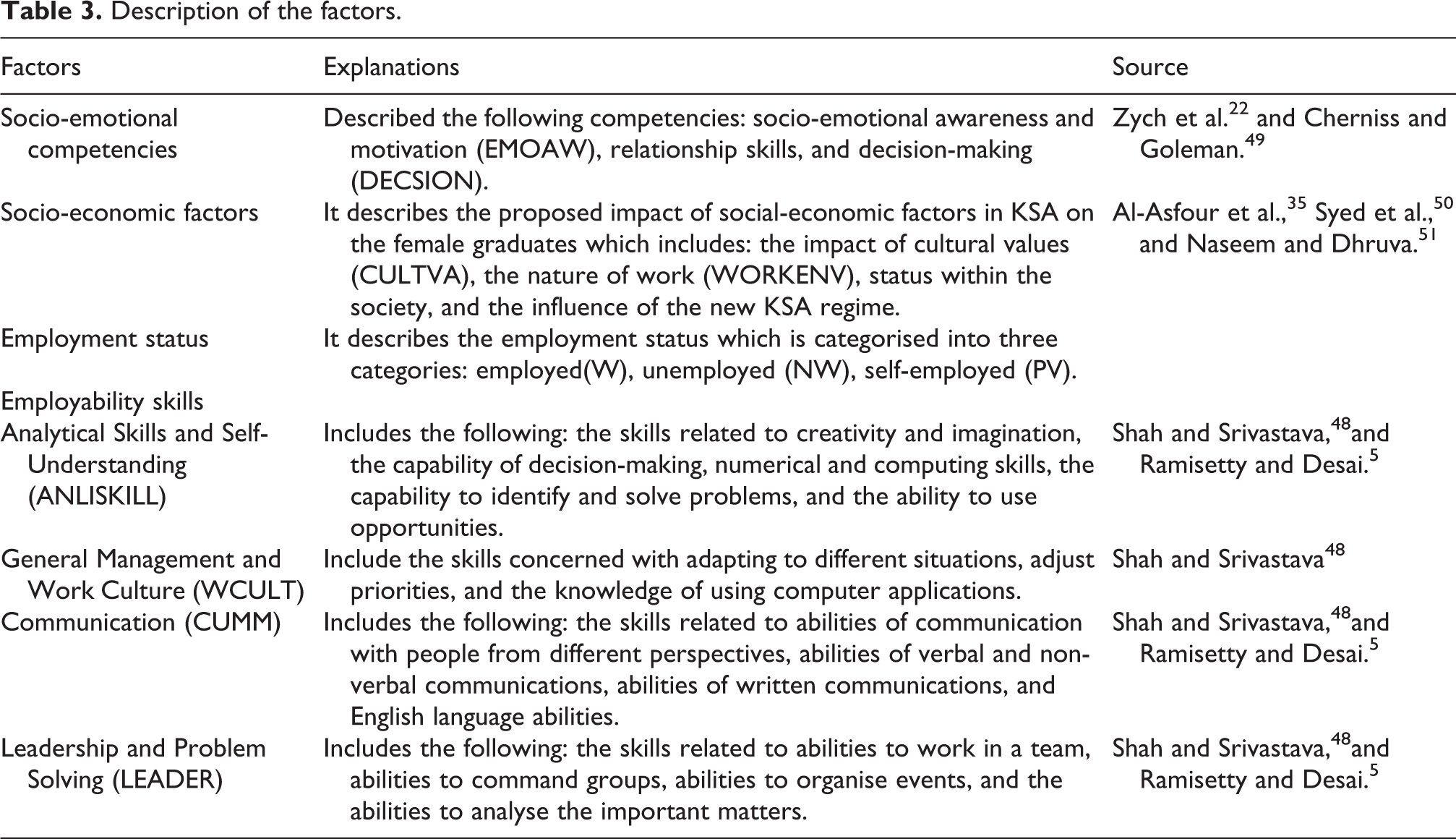
All items in the research model are adapted from previous studies so as to accurately reflect the culture of KSA women. Table 3 describes the questionnaire items. 18 items were used to measure graduate employment status, which is categorised into employed, unemployed, and self-employed. Employability skills (learning outcomes) constituted 14 items, which are defined as the skills developed by the graduate during her studies. They were divided into analytical skills and self-understanding, communication, and general management and work culture – an adaptation from Shah and Srivastava, 48 and Ramisetty and Desai. 5 Socio-emotional competence is a collection of skills to adjust, express, understand, and use emotion as acquired by the graduate to achieve employability. In this study, they were measured through nine items, including socio-emotional awareness and motivation, relationship skills, and decision-making (adapted from Zych et al. 22 and Cherniss and Goleman). 49 Socio-economic factors were designed to reflect the changes in attitudes towards women in KSA culture. Through the use of 18 items, these reflected the impact of cultural values, the nature of work, status within society, and the influence of the new KSA regime following Al-Asfour et al., 35 Syed et al., 50 and Naseem and Dhruva. 51
Description of the factors.
Data analysis
The analysis, conducted through the partial least squares structural equation modelling approach (PLS-SEM), was used to analysed the data and test the hypotheses. This statistical approach has the ability to manage complex models, such as those which contain moderation analysis and multiple relations. Moreover, it can be useful in exploratory studies at the theory development stage. 27 We used the two-stage process to analyse the research model, as recommended by Anderson and Gerbing, 52 so as to determine validity and reliability, and test the hypotheses. We used the latest SmartPLS 3 software to conduct the analysis.
Following Chin, 53 any item with a factor loading below 0.4 should be removed in order to increase validity, while the removal of the constructs of outer loading between 0.4 and 0.7 is decided through its effects on internal consistency and reliability. 27
Reliability was tested though composite reliability (CR) and Cronbach’s α coefficient. The CR value should be acceptable if it’s higher than 0.7. 27 While Cronbach’s a coefficient considers above 0.9 is excellent and 0.5 is unacceptable. 54
The validity is assessed by convergent and discriminate validity, the former is assessed through Average Variances Extracted (AVE), which should be greater than 0.5. The reliability and convergent validity results are shown in Table 4.
Reliability.

Table 4 shows the results after we deleted 4 factors from unemployment and 13 items from the socio-economic factor, all of which had factor loadings of below 0.4. The value of Cronbach α is ranged between (1–0.754) which is acceptable results. The value of CR is above 0.7, thereby indicating the reliability of all the constructs is acceptable.
Table 4 shows only the AEV value of one dimension (Employed) is below 0.5 (0.478) that can be rounded (0.5). This result could be considered acceptable if the value CR is above 0.70 taking into consideration the results of confirmatory factor analysis. 55 However, the CR value for this dimension is 0.85. Thus, in combining these findings with confirmatory factors in Table 4, we can consider the model to be valid.
Discriminant validity is tested to ensure all constructs are different from one another. According to Hair, 27 discriminate validity can be assessed through cross-loading which indicates outer loading exceed cross-loading. Table 5 shows the factor loading and cross-loading.
Cross-loading.

Table 5 findings confirm convergent validity of outer loading variables is higher than cross-loading.
The availability of moderated variables in our model required two steps to test the hypotheses, as suggested by Hair 27 The first tested the direct relationship between the variables, while the second involved conducting the indirect affect test to show how the moderated variable impacted the predicted variables.
To test the direct relationship between the variables in the study, we assessed the structural model through investigating whether the path coefficient of the relation between the variable was significant or not. Due to the nature of PLS-SEM not countering the specific distribution proposition, we proposed to use bootstrapping techniques with standard error to detect the significance (if any) of the relationship – one of the methods of random resampling with replacement that estimates the sample distribution parameter. We took a large number of sub-sample from the original sample with replacements so as to provide bootstrap standard error, which we then used to predict the significant value of the path coefficients in terms of p or t value. 27 The significance of the path coefficients (β) of our hypotheses was determined by calculating the p-value, which was determined through bootstrap in (PLS-SEM) with a sub-sample of 5,000, as recommended by Hair. 27 The results are shown in Table 6.
Hypotheses testing.

Note: *p < 0.10, **p < 0.05, ***p < 0.01.
Table 6 shows that only four hypotheses are supported: socio-emotional competencies have an impact on employment (β = 0.473; p = 0.057); socio-economic factors have an impact on unemployment (β = 0.305; p = 0.004); employability skills have an impact on socio-emotional competencies (β = 0.868; p = 0.000); and employability skills have an impact on unemployment (β = −0.322; p = 0.092). The remaining hypotheses are unsupported: socio-emotional competencies have no impact on self-employment (β = 0.094; p = 0.66); socio-emotional competencies have no impact on unemployment (β = 0.304; p = 0.143); socio-economic factors have no impact on employment (β = 0.120; p = 0.478); socio-economic factors have no impact on self-employment (β = 0.193; p = 0.127); employability skills have no impact on employment (β = −0.299; p = 0.242); employability skills have no impact on self-employment (β = 0.276; p = 0.149); and employability skills have no impact on socio-economic factors (β = −0.049; p = 0.733).
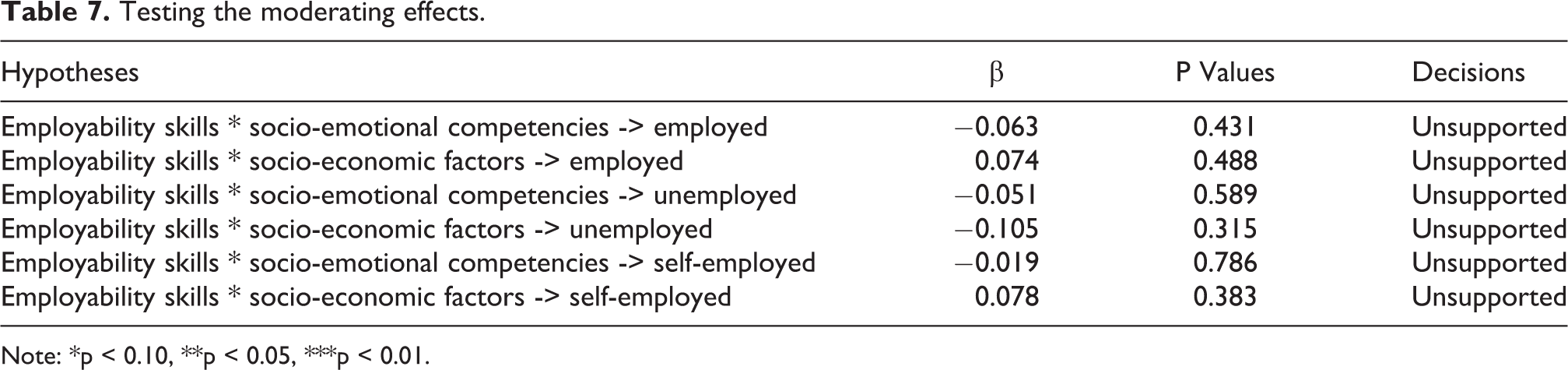
To investigate whether the moderator factors (socio-economic or socio-emotional competencies) impact the relationship between employability skill and employment status, we conducted the second step – the indirect effect. This involved creating an interaction term, which is the product term of the indicator of the predictor variable (employability skill) and moderator (either socio-economic or socio-emotional competencies). We then tested the significance of the relationship between the product term and employment status through conducting bootstrapping error techniques. 27 The results of the indirect effect are shown in Table 7.
Testing the moderating effects.
Note: *p < 0.10, **p < 0.05, ***p < 0.01.
Table 7 indicates that the moderating effects of socio-emotional competencies on the relationships between employability skills and the three dimensions of employment – employed (β = −0.063; p = 0.431), unemployed (β = −0.051; p = 0.589), and self-employed (β = −0.019; p = 0.786) – is unsupported. Likewise, the moderating effects of socio-economic factors on the relationships between employability skills and the three dimensions of employment – employed (β = 0.074; p = 0.488), unemployed (β = −0.105; p = 0.315), and self-employed (β = 0.078; p = 0.383) – is unsupported.
Discussion
Personal factors, such as socio-emotional competencies, enable graduates to adapt to different working and learning environments. 56 Additionally, these competencies can be used by organisations as indicators when testing the suitability of candidates for a particular position. 32 Socio-economic factors influence the employment opportunities of some graduates regardless of their skills, which may in turn impact the country’s economy and gross domestic product (GDP). Consequently, the issue has garnered international attention from the world’s policymakers. In the KSA, policymakers place a greater emphasis on lowering the unemployment rate in the context of the 2030 Vision. Therefore, this paper sought to explore the relationships between such personal factors as socio-emotional competencies, socio-economic factors, employability skills, and employment status.
The results demonstrate that socio-emotional competencies are not moderators in the relationship between employability skills and employment. This in turn suggests that socio-emotional competencies are insufficient conditions for female graduates to find employment, attempt self-employment, or remain unemployed. Thus, though they are valued by employers in many industries, socio-emotional competencies are not sufficient conditions in the employment of female graduates. This finding contradicts previous studies, such as Aziz and Pangil’s. 28
The results also show that employability skills impact socio-emotional competencies, confirming previous studies – most notably that of Jackson. 57 Accordingly, the employability skills that graduates develop during their studies help them build socio-emotional competencies. On the other hand, graduates with higher socio-emotional competencies are generally employed, as there are significant relationships between socio-emotional competencies and employment. In contrast, the results indicate that unemployed and self-employed graduates are largely unaffected by socio-emotional competencies. This contradicts the results of Sanchez-Ruiz et al., 58 who found that self-employed graduates are affected by these competencies. This implies that the University of Bisha may have emphasised socio-emotional competences in its curriculum in order to enable graduates to find formal employment, while neglecting those with an interest in self-employment.
Additionally, the present study found that the moderating effects of socio-economic factors have no significant impact on the relationships between employability skills and employment. This may be attributable to the characteristics of countries with conservative gender norms (as is the case for the majority of Middle Eastern countries) and the degree of employment availability. These elements may indeed inhibit the effect of socio-economic factors for highly educated women demonstrated by Bussemakers et al. 43
In contradiction with our fourth hypothesis, we found no significant relationships between employability skills and socio-economic factors, indicating that the employability skills gained by graduates throughout university do not influence their perceptions of socio-economic factors. Conversely, Seeberg 46 and Al-Asfour et al. 35 provided an alternate view in the contribution of education on empowering female involvement in many aspects, such as decision-making in a family or national context.
The results further showed no significant relationships between socio-economic factors and the two dimensions of employment (employment and self-employment), and a significant relationship with the unemployment dimensions. This is somewhat unsurprising as our sample contained a high rate of unemployed (approximately 70%). This confirms previous research by Harry et al., 19 which found that socio-economic factors affect employability, and is also supported by certain studies in the KSA context, such as Syed et al. 50 The inclusion of a women empowerment policy in the 2030 Vision 42 by the KSA regime may account for this. This notion is in keeping with Bussemakers et al., 43 who found that educated women have more of a chance on the employment market in countries where the government supports women’s employment. Therefore, greater efforts are needed by the government to empower women.
On the other hand, the results demonstrated the existence of a negative relationship between employability skills and unemployment, revealing that poor employability skills are related to the high rate of unemployment. Some graduates do not acquire the employability skills introduced by the university. Thus, it is crucial to educate undergraduates as to the importance of employability skills.
Conclusion
Numerous theoretical and practical applications can be taken from this study. Universities can use the results to help graduates secure employment by organising training programmes to improve employability skills and evaluate the curricula in order to align them with the labour market
In general, the findings should enable policymakers at national and university levels to develop suitable programmes leading to the creation of employment opportunities for women. Other countries that face problems in the employment of female graduates, such as other middle east and some eastern countries can apply the research model to evaluate their problems and then apply suitable strategies to solve their problems.
The results of this study support the idea of developing a theory of employability which investigates the conditions under which employability skills affect the employability of graduates. Such an endeavour would require defining the contextual factors that form the foundation of any approved theory, as suggested by Andersson et al. 59
To this end, it is necessary to apply the research model to different universities in different cultures. Our study also contributes to the theory of planned behaviour in demonstrating the effect of certain programmes or competencies on such behaviours as developing a self-employment project, as discussed by Sanchez-Ruiz et al. 58
Despite its theoretical-empirical implications, this study is not without its limitations. First, it focuses on a single branch of the University of Bisha. Accordingly, the findings cannot be generalised to other branches or universities given that environmental factors may vary during data collection. Second, the data were collected at a certain point in time and it could well be that the respondents’ opinions may change.
Another issue may affect the generalisations of the study related to data collections procedure and the distributions of different disciplines in our sample. The sample comprised a high percentage of management graduates (about 40% from the sample) that are aware of the issues related to employability due to their academic background. Thus, the respondents of management graduate could be more oriented towards some answers in their response. 1,11 Taking this beside the fact that the graduates differ in the year of graduation in our sample which may affect their perceptions of employability issues. 1 Thus, the time factor may change the perceptions of graduates. All of this may affect the validity of the study in another context, in addition the other factors may affect graduated perceptions of employability issues such as reputations of university and country culture. 11
Longitudinal studies should be conducted to overcome this limitation. Finally, the small sample size affects the generalisability of the results. Therefore, we recommend increasing the sample size when repeating this study.
Future studies should focus on other factors that enhance female graduate employability, such as age (as suggested by Cebulla and Wilkinson), 60 demographics, and satisfaction with graduate study. We could also attempt to examine determinants of entrepreneurial intentions 61 and how the transfer of knowledge from academia to business could stand to be improved. 62 The impact of these factors could be applied across different academic disciplines so as to gain insights into the perception of graduates. Additionally, studies should focus on the skills and characteristics that must be cultivated in order for graduates to develop self-employment strategies. Moreover, research should strive to shed light on how these factors impact the employability of female graduates from different universities and countries. This suggests the need to conduct this study in different countries at different points of time.
Footnotes
Declaration of conflicting interests
The author(s) declared no potential conflicts of interest with respect to the research, authorship, and/or publication of this article.
Funding
The author(s) received no financial support for the research, authorship, and/or publication of this article.
