




Abstract
It is well-established that toddlers make sense of things when they talk with their educators. While previous research has explored how educators’ talk shapes young children’s learning, less in known about how toddlers participate in conversations with educators and what learning opportunities their participation affords. In this study, we video-recorded and qualitatively examined naturalistic conversations between 12 two-year-old toddlers and their educators. Attending to both toddlers and educators, we first coded each conversation for its communicative purpose and language features, which allowed us to identify eight types of toddler-educator conversations. We then examined the conversations with a focus on who exercised ‘conversational leadership’, that is who influenced the topic and communication purpose (determined by intent and language features) in each conversation. We found that in three conversation types conversational leadership belonged to toddlers, in another three to educators, and in the remaining two to both. We also examined the potential of each option of conversational leadership distribution to provide toddlers with learning opportunities to either demonstrate their knowledge or create new knowledge. Our findings support a broader understanding of toddlers’ agency in shaping their own learning. The findings can inform and help to validate educators’ efforts to enrich their conversations with toddlers as an effective learning-promoting pedagogy.
Introduction
Contemporary models of early childhood education recognise that children, including the youngest, are active communicators and co-constructors of their own learning and curriculum (Berthelsen, 2009; Hedges & Cullen, 2012; Siraj & Asani, 2015). Indeed, research (for example, Salamon, 2011) shows that educators acknowledge that young children are no longer perceived as listeners getting ready to learn, but as thinkers and conversational partners. In practice, however, interactions between educators and toddlers are naturally asymmetrical, as it is educators who usually set the direction of these conversations by asking questions or giving instructions by virtue of being adults and more knowledgeable partners (Geekie & Raban, 1994; Os, 2019; Ødegaard, 2006; Rowe & Snow, 2020; White, 2016). White (2016) also argues that educators’ language choices are key to ‘shap[ing] the nature of engagement, and by association, learning itself’ (p. 8).
Adopting the contemporary image of children as engaged learners driven by their own interests raises awareness of the tension between educators’ focus on leading conversations to transmit knowledge as part of intentional teaching, on the one hand, and responsiveness to children’ initiations, on the other. Educators’ critical self-reflection often revolves around this tension. As a result, educators strive to provide meaningful and engaging experiences to reconcile their responsibility for transmitting knowledge with creating opportunities for children to actively build on their own knowledge (Kultti & Pramling, 2015). For toddlers, one such experience with potential for learning is talk with their educators. As recent research has demonstrated, very young children’s conversations with their educators may promote learning through joint engagement in reasoning (Hu et al., 2019), mental-state talk (Degotardi & Han, 2022), decontextualised talk (Brand et al., 2024), and exchanging and considering different perspectives and ideas (Degotardi et al., 2018; Kultti & Pramling, 2015).
The significance of conversations with caregivers for children’s cognitive development can be explained with reference to Halliday (2004 [1993]) and Vygotsky (1978). Halliday’s (2004 [1993]) language-based theory of learning posits that through participation in linguistic interactions children not only learn language and learn about language, but also learn through language. Vygotsky’s (1978) broader socio-cultural theory of learning also explains that children learn in interactions with more knowledgeable others. Taken together, the theories of Vygotsky and Halliday highlight the value of every child-adult conversation as an opportunity for advancing children’s learning (Painter, 2001), and invite us to examine how particular types of toddler-educator talk afford toddlers “different opportunities to share and extend their knowledge” (Degotardi & Han, 2022, p. 101).
Conversations between young children and their educators have been acknowledged and researched as effective learning-promoting activities (for example, Girolametto et al., 2000; Hu et al., 2019; Kultti & Pramling, 2015). Previous studies offer valuable insights into the learning value of talk between young children and educators with the objective to empower educators to successfully co-deploy intentional teaching, thus the focus of these studies has been on educators’ roles in educator-child talk. Little is known, however, about whether and how young children’s participation in conversations advance their learning. To address this gap and advance current knowledge about the potential of these conversations to promote learning, in the present study we examined the contributions of both toddlers and educators.
Studies revealing the value of toddlers’ conversational contributions
While most existing studies focus on educators’ participation in conversations with young children, a small number of studies have considered whether and how educators encourage young children to contribute to these conversations, and very few have examined this with a focus on infants and toddlers (see Houen et al. (2022) for a systematic review). Durden and Dangel (2008), for example, investigated the language choices and functions in conversations between one educator and 13 toddlers and another educator and 17 preschoolers in an early childhood centre. The study found that the educator used mostly statements when talking with the preschoolers, while with toddlers they used a combination of statements and closed questions to test toddlers’ knowledge (How many eggs are there?). Around 90% of the conversations in this study were educator-led and most served a managerial or didactic purpose. Conversations that functioned to encourage children to convey and discuss ideas were observed least frequently in both age groups.
Focusing on whether and how educators’ talk creates opportunities for toddlers to contribute to conversations, Emilson and Folkesson (2006) collected 24 hours of video footage of educators in toddlers’ rooms in three centres. They closely analysed one episode of the children drawing a bus and another of making a playdough snail, which included both educator-directed conversations and conversations oriented towards encouraging toddlers’ contributions. The analysis revealed that some educator-directed conversations restricted toddlers’ contributions to mostly just acknowledging that they understood the task. In contrast, in other conversations, the educators demonstrated verbal and emotional responsiveness, which served to encourage toddlers’ contributions.
Also underscoring the value of educator responsiveness, Kultti and Pramling (2015) argued that young children benefit when ‘the teacher becomes a participant in activities with children, entering into their sensemaking … where participants learn from and with each other’ (p. 115). Their recommendations were supported through a qualitative analysis of one conversation involving a group of six toddlers (1–3 years old) and their educator during mealtime. The participants talked about the taste, smell and colour of sliced limes and lemons served to flavour water in a jug. The toddlers not only expressed familiar ideas but also co-constructed new ideas as the educator used questions and labelling to expand and extend the topic. The educator’s sensitivity to the toddlers’ contributions created a genuine co-construction of meaning, rather than a unidirectional ‘transmission of information from teacher to children’ (p. 115). The study concluded that educators should guide conversations to encourage multidirectional contributions.
One way educators demonstrate responsiveness to and encourage children’s conversational contributions is by talking about topics that extend children’s interests and knowledge. This is evident in Os’ (2019) investigation into how educators engaged toddlers in conversations during mealtime. Part of a larger project, in which the interactional skills of 168 educators talking with children of up to four years of age were assessed against a purpose-built scale, this study examined the talk of six educators who received a high score and six with a low score. Os’s (2019) qualitative analysis of eight-minute-long video recordings of each educator interacting with toddlers during mealtime revealed that while some conversations functioned to regulate toddlers’ behaviour, others involved topics that were inspired by shared experiences or events outside the centre. These topic-developing conversations were used more prevalently by the educators with high interaction scores, who were also found to be more responsive to and intentional in eliciting conversational contributions from the toddlers.
Moving beyond a focus on individual conversations, Hu et al. (2019) explored educators’ use of commands and directive statements aimed at regulating behaviour. The authors analysed conversations captured during three-hour video recordings of 56 educators talking with under-two-year-old infants during their normal daily activities in an early childhood centre. Adopting an elaborated view of directive language, the authors coded each command both as (i) direct (when realised by an imperative as in ‘Take your shoes off’) or indirect (when realised by a declarative or interrogative as in ‘Could you take your shoes off?’), and as (ii) non-suggestive with the impetus assigned to the infant (‘You have to take your shoes off first’) or suggestive, which attributed shared responsibility (‘Let’s take your shoes off first’) (p. 193). Although the study did not examine infants’ contributions, the authors proposed that even educator talk aimed at regulating behaviour has potential, through indirect and suggestive commands, to communicate the opportunity for toddlers to negotiate and add their own input into the conversation. This study thus highlights the value of attending closely not only to the purpose and topic but also to language features of educators’ talk with children.
Combined, these studies of educator-child talk highlight that educators’ participation can vary and elicit largely three types of responses from children: responses (typically non-verbal) to educators’ commands or their behaviour-regulating utterances, answers to ‘test’ questions, and responses that support the exchange of ideas and development of topics. In this study, we contribute to this line of research by examining the contributions of both toddlers and educators to toddler-educator conversations, and paying attention to the purpose, topic and language features of these conversations in order to understand what we term ‘conversational leadership’ and its role in promoting learning.
Conversational leadership
We propose the term conversational leadership to reflect (i) our understanding that both toddlers and educators contribute to and co-construct meaning in toddler-educator interactions, and (ii) our study’s aim to examine the nuances of the dynamics of toddler-educator conversations, which we regard to be more complex than educators just directing a conversation or responding to children’s communication attempts.
Our concept of conversational leadership draws on studies by Blum-Kulka (1994) on child-adult talk in home settings and by Escandell-Vidal (2016) on adult-adult talk, where participation in conversation involves negotiation of topic choice, topic change, and topic closure. Our focus on conversational leadership is motivated by studies that show that even very young children are capable of such negotiation. For example, even before they produce their first words, infants can demonstrate interest in the interaction through vocalisations and facial expressions, and by the time they produce their first words they can sustain turn-taking in extended talk with adults (Snow, 1977). By the age of three many toddlers are adept at maintaining and changing topics (Blum-Kulka, 1994).
In previous research, the power of the conversation participants to suggest a topic, change a topic, and end a topic was described using terms such as ‘topic control’ (Blum-Kulka, 1994) and ‘child-oriented responses’ (Girolametto & Weitzman, 2002). The term ‘topic control’ reflects the idea that in a conversation one participant, usually the adult, takes control to set the direction of the conversation. The term ‘child-oriented responses’, on the other hand, reflects the idea that one participant, usually the child, needs to be granted this power. While this study does not adopt Blum-Kulka’s (1994) term ‘topical control’, it is informed by her identification of ‘markers’ or language features (e.g. questions, statements, etc.) that allow us to recognise who exercises or takes over leadership by suggesting, changing and ending topics in a conversation.
This study
The present study explored toddler-educator conversations with a focus on how toddlers and their educators exercised or shared conversational leadership and the value of conversational leaderships for toddlers’ learning. First, we analysed the observed conversations in terms of communication purposes or intent and language features, proposing eight types of talk. Second, we examined conversational leadership in these conversations. The findings allowed us to conclude whether and how toddlers shape their learning by contributing to conversations that vary in their communication purpose and conversational leadership.
The research questions were as follows: How is conversational leadership distributed in toddler-educator conversations with various communicative purposes? Do toddler-educator conversations with various communicative purposes and various conversational leadership distribution provide toddlers with learning opportunities to either demonstrate their knowledge or create new knowledge?
Method
Participants
Four early childhood centres, awarded Exceeding (the highest) National Quality Standard (Australian Children’s Education and Care Quality Authority, 2024), in Sydney participated in the research. In each centre, we selected three toddlers, between 30 and 36 months of age – 12 toddlers in total (5 girls and 7 boys) – who had been attending their centre three or more days per week for at least one year, had established positive relationships with their educators, and were known to frequently engage in extended conversations with their educators in English. The observational data of 60 hours of video recordings (5 hours per child) permitted an in-depth qualitative analysis of conversations. Adult participants were the 12 educators (9 female and 3 male) working in the four toddlers’ rooms and holding various qualifications: university degree (Early Childhood Teacher), a vocational diploma and a certificate.
The first author, an experienced early childhood teacher, video-recorded focus children for two and a half hours each, as they went about their normal day in the classroom. Recordings were organised both before and after nap time during free play, organised activities and caregiving experiences, except toileting or clothes change. Prior to recording, the first author met with all the participants, including children, and talked to them about the aims of the recording, the purpose of the study and asked them to interact as they would on any normal day. Recording would occur only when all the participants expressed readiness for this.
The considerations for research involving young children were strictly followed during recruitment and data collection. All families in the centre were informed about the study and their option to opt-out from participation at any time. All educators and focus toddlers’ parents signed consent forms. Approval was granted by the authors’ University Human Research Ethics Committee.
Data preparation and coding
After transcribing toddler-educator conversations verbatim, we identified and selected conversations for analysis. We marked the end of each conversation when one of the participants moved away from the conversation or initiated a more than two-turn conversation with another child or adult. Further, we selected conversations with at least three turns on the basis that only these conversations could demonstrate topic development because ‘next turns are congruent with the understandings, expectations and projections that were established in the previous turn’ (Heritage, 2015, p. 89). The third step was to exclude conversations that served ‘instrumental’ purposes such as behaviour regulation, which tend to elicit toddlers’ compliance rather than conversational contributions.
Following the recommendations by Leech and Onwuegbuzie (2011) and Peshkin (2000), we used the technique of constant comparison analysis. We compared the recorded conversations in terms of their communication purpose until no further intents and patterns of language features could be found. This process resulted in identifying eight kinds of toddler-educator conversations:’, ‘description’, ‘comparison’, ‘grouping’, ‘inquiry’, ‘rebuttal’, ‘reasoning’ and ‘story’ (see Brand et al., 2024 for more detail). Each type of conversation was then analysed in terms of conversational leadership by taking into account how the toddlers and educators participated in these conversations, particularly whether they proposed, changed and ended topics. This was determined by observing their language choices such as questions, direct addresses, closing statements, summarising statements and contradictions. The focus language choices were selected following the study about child-adult conversational dynamics by Blum-Kulka (1994).
The final step involved mapping the relationships between the communication purpose, conversational leadership and learning opportunities in each type of conversation. We recognised that educator-toddler interactions offer toddlers two main learning opportunities – to demonstrate their existing knowledge or to create new knowledge. To illustrate, demonstrating existing knowledge can be achieved through formal categorisation or labelling, for example: ‘Educator: What colour is the cupcake?//Toddler: Pink.’ The creation of new knowledge can be achieved by offering explanations and engaging in problem solving, for example, ‘Educator: What do you think? … Let’s size our shoes together. Let’s see.//Toddler: My ones are bigger. My boots are bigger.’
Findings
Conversational leadership in toddler-educator conversations.

Conversational power dynamics in toddler-educator conversations.
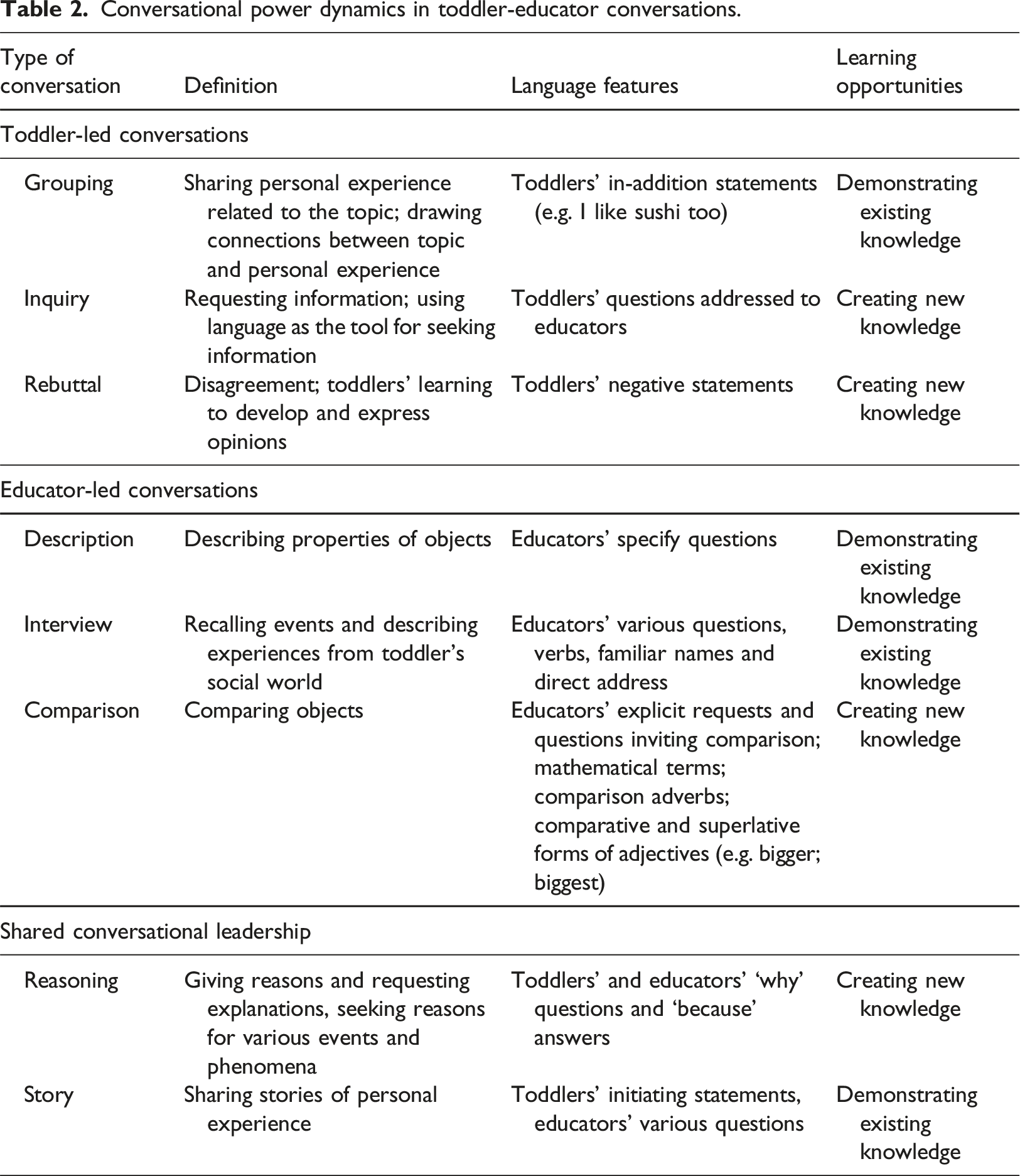
In this section, we report on how conversational leadership is distributed in various types of toddler-educator conversations and consider the implications this has for toddlers’ learning. We start with the toddler-led conversations, followed by educator-led types, and lastly, the conversations in which toddlers and educators shared conversational leadership.
Toddler-led conversations
Toddlers proposed, changed and ended topics in three types of conversations – grouping, inquiry and rebuttal – which offered them opportunities to demonstrate their existing knowledge and create new knowledge.
Grouping
The communication purpose of ‘grouping’ conversations was to show what else toddlers knew about the topic by using in-addition statements. The toddlers volunteered this information with no prompts form the educators. Consider, for example, Eva’s in-addition statement ‘I also east sushi’ in the conversation below. During a group-time discussion on Mother’s Day, the educator and the toddlers talk about what children do with their mothers. Eva: I go to eat fish and chips. Educator: Ok. Eva: I also eat sushi.
In ‘grouping’, toddlers took the initiative to perform what Blum-Kulka (1994) calls ‘topical elaborations’ (p. 12), that is ‘the subtle way speakers accomplish shifts in topical perspectives’ (p. 12), demonstrated in the example below. Max and the educator discuss Max’s visit to the zoo. Educator: Did you see the ducks at the park? Max: And a mummy and a baby. Educator: You saw lots of them. [...] Max: I saw one swimming. I now see the seal show. Educator: The seal show? That was at the zoo on the weekend, wasn’t it? Max: Yes. Did you see the shark show? Educator: The shark show? I am not sure there is a shark show. I think I might get frightened of the shark show. Did you see the dolphins as well?
Blum-Kulka (1994) argued that sometimes children’s topical elaborations may be unsuccessful as adults can perform a ‘backshift to a previous topic … a reintroduction of an earlier topic after one or more others have intervened’ (p. 13). We did not observe backshifts in ‘grouping’ talk, which is another evidence that ‘grouping’ talk was led by the toddlers. The educators adopted the role of a tuned-in conversational partner who followed toddlers’ lead, appreciating their aptitude for drawing connections between things or their ‘relational mindset’ (Vendetti et al., 2014). ‘Grouping’ conversations were defined as offering toddlers opportunities to demonstrate their knowledge of what objects and events belonged to the same ‘group’.
Inquiry
The purpose of ‘inquiry’ conversations was to request information. The conversations of this type were also led by toddlers, who proposed and changed topics by asking questions as in this example. Leo is asking his educator about an unfamiliar adult present in the room. Leo: Is she your friend? Educator: She is my friend. Her name is Nina. Do you like Sharon [educator]? Yes? Leo: Yes. Educator: Then you’ll like Nina too. She is nice. She is a really nice friend.
Painter (2001) argued that young children’s questions indicate their ability to use language ‘not only to represent the world but to act in it’ (p. 322). So, ‘inquiry’ talk provided toddlers with opportunities to successfully seek information to address their knowledge gaps, and therefore create new knowledge.
Rebuttal
In ‘rebuttal’ conversations, toddlers expressed their disagreement with their educators by using negative statements. For example, Anna is watching the educator writing someone’s name. Educator: Me-la-ny J. (writing and commenting) Anna: This is not Melany J. That’s Meimei. Educator: Yeah, Meimei is her nickname. Like we call you Dot. Meimei is her nickname. But her name is Melany J. Anna: No, not Melany J. Educator: It is. Like your name is Anna.
In these conversations, the educators chose to allow toddlers to express disagreement or rebuttal, verbalise their own opinions, create new perspectives and possibly also new knowledge.
Educator-led conversions
The educators proposed, changed and ended topics in three types of conversation – interview, description and comparison. The first two types of conversation offered toddlers opportunities to demonstrate their existing knowledge, while the third supported them to build new knowledge.
Interview
The purpose of ‘interview’ conversations was to support toddlers to recall events of their social world. Like interviewers, the educators asked various questions, and used these questions to propose and shift topics. For example: In the sandpit, Owen played like he was cooking with toy pots and twigs. Educator: Hey Owen, who is in the big school in your family? Owen: Emma. Educator: Emma is at big school, isn’t she? Does Emma go to Oliver’s school? Owen: No. Educator: No. Owen: Mrs Smith. Educator: Ha? Owen: Mrs Smith. Educator: Mrs Smith? Have you met Mrs Smith before? She is not very… Owen: She is not very. Educator: Not very friendly. All right. And when you go home, what do you do with Emma? Owen: Ah. Educator: When Emma gets home from the big school. Owen: Ah! Chocolate! Educator: Chocolate? Chocolate, yes, I thought so. Something food related.
The educators intentionally encouraged the toddlers to share information about past events in interview-like conversations providing the toddlers with opportunities to demonstrate their knowledge about these events.
Description
‘Description’ conversations revolved around describing objects. The educators encouraged toddlers to name the properties of objects such as their shapes, sizes, colour, smell, quantity or location. For example: Anna and the educator are handling pieces of playdough. Educator: What colour is the cupcake? Anna: Pink and yellow. Educator: Ok.
In rare instances, such as in the example below, ‘description’ conversations were initiated by toddlers, but the educators took over quickly and shifted topics by asking questions or ended topics with closing statements. Elias and the educator are reading a book. They look at the illustration showing biscuits. Elias: What’s that? Educator: Those are… You tell me. Elias: I have cookies. It’s delicious. I ate it. Educator: You like those cookies, darling? We can make cookies one day.
Often, in ‘description’ conversations, educators were observed to use their conversational power as a teaching opportunity by correcting toddlers’ answers. For example: The educator and Sam are talking outside. Sam is holding a dinosaur toy. Educator: Sam, come and show me your dinosaur. How many legs has a dinosaur got? Show me his legs. Sam: Three. Educator: Three? No. So, these are the feet. One, two, three, four. And what’s the dinosaurs do?
In ‘description’, the educators tended to position themselves as the more knowledgeable partners requesting toddlers to label parts and qualities of various objects and demonstrate what they already knew about these objects.
Comparison
In ‘comparison’ conversations, toddlers were encouraged to evaluate objects by directly comparing them. For example, The educator encouraged Owen to compare the shoes of Owen, another child and the educator. Educator: What do you think Owen, my feet are bigger or Emma’s feet are bigger? Owen: Your ones are bigger. Educator: Yes, I think you are right. Well done. Can I try? Can you sit down and try? Let’s size our shoes together. Let’s see… Look, my shoes! Owen: My ones are bigger. My boots are bigger. Educator: Your boots are bigger! Are Emma’s shoes bigger? Owen: Mine are bigger.
The educators always initiated and maintained the topic of these conversations encouraging the toddlers to solve cognitively challenging problems. Therefore, in educator-led ‘comparison’ the toddlers had opportunities to create new knowledge (e.g. of mathematical notions of quantity and size).
Shared conversational leadership
In the two types of toddler-educator conversations, reasoning and story, both toddlers and educators proposed, changed and ended topics. While reasoning conversations provided opportunities for toddlers to create new knowledge, story conversations allowed them to demonstrate their existing knowledge.
Reasoning
The communication purpose of ‘reasoning’ talk was to provide or request explanations and justifications of one’s own actions or the actions of others. Reasoning was prompted by ‘why’ questions, which tended to receive ‘because’ statements in response. Both toddlers and educators offered their explanations, and asked questions. In the two examples below, Owen’s educator initiated and concluded the topic. In the next example, Kathy initiated the topic and asked her educator why-equations. Owen and the educator are looking at the fishpond. Educator: (pointing at the fish in the pond) One, two, three and four. Yeah! What are they doing in there? Owen: They are swimming. Educator: Should we take them out? Owen: No. Educator: Why? Owen: Because they die. Educator: Because they die. Yeah. They need to be in the water. Well done. Kathy and her educator are talking in the home corner. Kathy: What are you doing? Educator: I am tiding up the messy food. Kathy: Why? Educator: Because it is a big mess. When I am in my own kitchen, I don’t have food all over the floor and all over the table, oh dear.
Reasoning conversations are challenging for young children as they require them to build new knowledge by establishing new relations between concepts and restructuring the system of ‘knowledge that they already have in a new way’ (Goswami, 1992, p. 143).
Story
The communication purpose of ‘story’ conversations was to co-construct toddlers’ stories about what happened in their social world. In our study, the toddlers initiated these conversations, while the educators supported these communication attempts in order to progress from initially limited to more coherent understanding of the story. In the example below, Max and his educator collaboratively co-constructed Max’s story. Max is talking with his educator at lunch. Max: I am going on a Jetstar airplane. Educator: Tell me again. Max: A Jetstar. Educator: A Jetstar airplane? Was it orange? Max: Ah? No, it was white. Educator: You went on a white Jetstar Airplane? Where did you go? Max: Nana and Grand’s house. Educator: Hang on, chew first… Finished? Where did you go? Max: I am going to Nana and Grand’s house. Educator: You went to Nanny and Grand’s house. Where do they live? Max: They live at Christmas. Educator: They live at Christmas? Max: Hm. Educator: Hm. I think I remember where you went. Did you go to Coffs Harbour? That’s where they live, isn’t it? Max: I am going to the airport. Educator: Sydney airport? Max: Yeah.
While the toddlers initiated ‘story’ conversations, educators supported such talk by asking questions and making decisions about when to change and end the topics. In other words, conversational leadership was enacted by both toddlers and educators. In ‘story’, the toddlers had opportunities to share the details of the social events that they had experienced, and thus to demonstrate their knowledge about these events.
Discussion
This study explored both educators’ and toddlers’ participation in toddler-educator conversations through the notion of conversational leadership with a focus on whether and how the toddlers learn through these conversations. In previous studies toddlers’ contributions have received very limited and mostly indirect attention. Young children’s contributions have been construed as learning outcomes of two teaching strategies: educators intentionally encouraging toddlers to participate in conversations (Girolametto & Weitzman, 2002; Kultti & Pramling, 2015; Ødegaard, 2006) or stepping back and allowing room for toddlers’ participation (Berthelsen, 2009; Burr & Degotardi, 2021; Rogoff et al., 1998). More generally, these strategies can be formulated as transmitting information or responding to toddlers.
A key outcome of this study is its capacity to foster appreciation of the complex nature of conversational participation of both toddlers and educators. First, the study revealed that toddlers can influence the flow of the conversation by proposing, changing and ending its topics. The three types of toddler-led conversations identified in this study, ‘grouping’, ‘rebuttal’ and ‘enquiry’, involved toddlers’ proposing, changing and ending topics without educators’ encouragement, but instead with what White (2016) formulates as educators’ acceptance of ‘diversity and difference (even resistance)’ (p. 168). This finding provides evidence to the idea proposed by Hedges and Cullen (2012) that young children can demonstrate ‘self-motivated’ participation in conversations with educators.
Second, this study found that toddler-educator conversations could be led by toddlers, by educators, or by both. This finding echoes Hedges and Cullen’s (2005) argument that learning-oriented conversations with young children require educators to consider the conversations content (topic), the role of both participants (co-constructing knowledge) and current principles of pedagogy (children’s agency in their own learning). This finding invites reconsideration of the well-documented educators’ strategies of either transmitting information or responding to toddlers, and appreciation of the complex nature of conversational participation.
Third, in this study we found that each option of conversational leadership distribution afforded the toddlers valuable opportunities to either demonstrate their existing knowledge or create new knowledge. Thus, educators’ support of all conversations including those led by toddlers is meaningful for toddlers’ learning. It is well-established that educators should acknowledge both learning opportunities as essential for toddlers’ cognitive growth. Creating new knowledge extends children’s thinking (De Rivera et al., 2005; Durden & Dangel, 2008; van Kleeck, 2014), while demonstrating existing knowledge in conversation with educators is an effective developmentally sensitive way for very young children to make their learning visible (Nelson, 2005; Papic, 2015; Snow, 2014). Nelson (2005) explains: ‘Sharing concepts and categories through language sharpens their edges at the same time that it may illuminate previously unrecognized relations to other concepts’ (p. 19).
Implications
The presented study offers a broader perspective on the toddler’s and educators’ participation in conversations. Knowing how their own as well as toddlers’ contributions shape the learning potential of toddler-educator talk will enable educators to validate their support for these conversations as a learning-promoting strategy. Awareness of the complex learning-oriented conversational dynamics of toddler-educator conversations and seeing the contributions of both educators and toddlers as valuable for learning can increase educators’ capacity to reconcile and effectively co-deploy intentional teaching and responsiveness in the process of joint meaning making, rather than feeling the necessity to choose one principle over the other.
Exploring learning opportunities afforded by toddler-educator conversations that differ in the distribution of conversational leadership is an important step towards addressing the need for guidance on effective learning-oriented strategies that are relevant to toddlers (Sumsion, 2017). Unlike children in preschool and school age, toddlers’ learning is promoted through opportunities to both demonstrate their knowledge and create new knowledge. Informed, intentional and developmentally sensitive support of toddlers’ talk is especially important considering the existing pressure to deliver mandatory ‘school readiness’ programs, which are increasingly suppressing more play-based and child-centred curricula (Rouse & Nicholas, 2024), where educators may adopt an excessive amount of teacher-led talk (Hansen, 2018; van Kleeck, 2014).
Directions for future research
Future studies with larger toddler sample sizes are needed to investigate how characteristics such as age, language development and social-linguistic background may contribute to variation in conversations with recent research demonstrating that infants’ contributions to their language environment is related to a number of individual characteristics (Zheng et al., 2023). Similarly, as previous research has shown that the characteristics of educators’ talk and interactions are often associated with their qualification level (e.g., Degotardi et al., 2018; Hu et al., 2019), future studies are needed to examine whether this relationship extends to the qualities of conversational leadership. Furthermore, the scope of the current study did not include quantitative analysis of the recorded data. Future research is needed to evidence how frequently toddlers produce specific types of talk across all recorded conversations. Future research may also investigate conversational leadership and learning opportunities in instrumental talk, which was not included in the present study, because evidence is starting to emerge that some types of instrumental talk may encourage very young children’s participation in conversations and foster learning in early childhood centres (Hu, Degotardi, Torr & Han, 2019).
Conclusion
By attending to both educators’ and toddlers’ contributions to conversations across normal daily activities in early childhood centres, this study has enhanced our understanding of how young children are agentic in the ways that they learn through language interactions. Children not only build knowledge about various topics, but also learn about the dynamics of conversations and exercise agency in negotiating how conversations unfold. Children demonstrated their desire and capacity to follow their educators’ lead, to share the leadership with the educators and to lead conversations on their own by initiating the topic, shifting it, and ending conversations. By relating different distributions of conversational leadership to the communicative purpose, language features and learning opportunities of toddler-educator talk, we hope that our study can inform educators’ efforts to foster children’s participation in and learning through various types of conversations.
Footnotes
Declaration of conflicting interests
The author(s) declared no potential conflicts of interest with respect to the research, authorship, and/or publication of this article.
Funding
The author(s) received no financial support for the research, authorship, and/or publication of this article.
