




Abstract
This qualitative ethnographic research explores baby talk (BT) and ontology of infancy in a small, rural Indo-Fijian community via semistructured interviews with mothers about their children’s language learning, mothers’ narratives about their photographs of their young children engaged in everyday language, and audio- and video-recordings of naturalistic communication with and around 11 young children in their home environments. Analyses draw on Bourdieu’s notion of habitus, Ochs and Schieffelin’s child-centred and situation-centred categorisations, and de León’s approach to understanding language socialisation in multiparty participation frameworks. The findings describe: i) features of local BT, ii) local beliefs about babies, language acquisition and BT, iii) how local speakers’ communications with babies fit Ochs and Schieffelin’s categories, and iv) how young children draw on their elders’ BT to continue their community’s ways of interacting with and thinking about babies. The conclusion provides implications for pedagogy in early childhood education and care settings.
Keywords
Introduction
The field of language socialisation holds that all communities ‘have expectations for how their children should speak, behave, and comport themselves’ (Paugh, 2012, p. 150). Young children learn their specific communities’ ways of doing, talking and thinking, by observing and actively participating in language-imbued routines and interactions, because messages and models in mature speakers’ repeated contextualised language practices explicitly and implicitly communicate culture (Ochs & Schieffelin, 2008, 2012; Schieffelin, 1990). Mature community members’ ways of involving young children in interactions and routines are guided by local beliefs (ontologies) about infancy and childhood (Solomon, 2012).
In some, but not all, communities, mature speakers directly address babies and young children using altered forms of their usual language. Such talk has been labelled ‘baby talk’ (BT) (Ferguson, 1964; Solomon, 2012), ‘motherese’ (Saint-Georges et al., 2013), ‘parentese speech’ (Ramírez-Esparza et al., 2014, p. 880), ‘infant-directed speech’ (Werker et al., 2007), ‘child-directed speech’ (Omidkhoda et al., 2023) and ‘Child-Directed Communication’ (Ochs et al., 2005). This article employs ‘BT’ because it focuses on talk directed to babies.
Characteristics of BT can include higher and more varied vocal pitch, a slower rate of speech with longer pauses, elongated syllables and other special pronunciations, short, grammatically simplified sentences, repetitive, limited and special vocabulary (often diminutives), frequent questions, gestures and body movements, and exaggerated facial expressions (Broesch & Bryant, 2015; Durkin et al., 1982; Gogate et al., 2015; O’Neill et al., 2005; Solomon, 2012, p. 126). Language acquisition theorists’ (e.g., Cooper & Aslin, 1990; Werker et al., 2007) shared ontology of infancy includes belief that babies prefer BT to adult-directed speech and that specific characteristics of BT support their language acquisition.
A speech ‘register’ comprises a recognisable collection of linguistic features that accompany specific cultural practices within a speech community (Duranti, 2011, p. 42). As a speech register directed to babies, BT involves speakers adjusting their speech to accommodate their beliefs about the baby’s cognitive and linguistic preferences and capabilities (Brown & Gaskins, 2014; Duranti, 2011; Ochs et al., 2005; Solomon, 2012). Silverstein (2004, p. 640) theorised that speech registers structure and authorise speakers’ and addressees’ identities, ontological characteristics, social positions and statuses via an ‘enregistering’ process. Hence, deployment of BT both authorises and constructs ‘ontologies of personhood, child development and communicative competence’ (Solomon, 2012, p. 122), including belief that babies require, and should receive, special language forms to accommodate their cognitive and linguistic preferences and immaturities (Ochs et al., 2005).
Baby talk involves ‘proto-conversational exchanges’ in which the mature speaker ‘assumes the roles of both speaker and addressee’, interprets the baby’s vocal, facial and bodily actions as meaningful conversational contributions, and uses these interpretations to produce conversational responses (Solomon, 2012, p. 123). Baby talk has been noted across the world, including within industrialised (e.g., Broesch & Bryant, 2015) and Indigenous communities (e.g., Bouchard, 2013; Bundgaard-Nielsen et al., 2023; Ferguson, 1964; Luykx, 2003; Sapir, 1929; Shohet, 2013; Watson-Gegeo & Gegeo, 1986). Proto-conversational BT, however, is culturally distinct rather than universal (e.g., Ochs, 1982; Ochs & Schieffelin, 1994; Schieffelin, 1990; Watson-Gegeo & Gegeo, 1986), indicating that it is not required for language acquisition, and is a learned rather than innate linguistic behaviour. Mature speakers’ proto-conversational BT: i) reveals their assumptions that babies are capable of acting intentionally, contingently and reciprocally, ii) positions babies as worthy interactional partners, and iii) structures and is structured by community beliefs about babies’ and speakers’ statuses, capacities, intentions and cognitive processes (Brown & Gaskins, 2014; Ochs et al., 2005; Ochs & Schieffelin, 1994; Solomon, 2012).
Ochs and Schieffelin compared white middle-class American, Western Samoan and Kaluli ‘developmental stories’ (1994, p. 470), categorising these communities ‘as predominantly orienting young children to adapt to social situations (situation-centered) or predominantly modifying social situations to adapt to young children (child-centered)’ (2017, p. 6). The latter category was exemplified by the white middle-class American mothers, who typically made ‘child-centered’ communicative accommodations by using BT in dyadic adult–child communications (1994, pp. 498–499). The former ‘Adapt child to situation’ category (1994, p. 499) was exemplified by Kaluli and Western Samoan speakers, who typically engaged in highly situation-centred communication in multiparty contexts, did not use BT, oriented or directed children to focus on and fit in with the current situation and other people, and positioned children as overhearers and observers of routine social activities (1994, 2017).
Research-based knowledge about young children’s language acquisition and socialisation remains effectively biased towards Western middle-class world views and practices, because research is still predominantly conducted in Western middle-class contexts and focuses on dyadic language practices between mothers and their children (Avineri et al., 2015). Without knowledge of colonised, ‘non-dominant’ (Gutierrez & Arzubiaga, 2012, p. 209) communities’ ontologies, epistemologies, life-worlds and practices, any organisations and policies interested in supporting children’s learning necessarily draw on Western middle-class ontologies of infancy and child-rearing models. This situation constitutes ‘a pivotal barrier to access and participation in early education’ (Sydneham, 2019, p. 22), increases the risk of ethnocentric, symbolically violent ‘intervention[s]’ that contravene ‘ethic codes of respect and beneficence’ (Morelli et al., 2018, p. 5), and disrupts children’s learning and cultural connections (Rigney, 2023). Aotearoa/New Zealand’s and Australia’s early childhood curriculum frameworks (Australian Government Department of Education, 2022; New Zealand Ministry of Education, 2017) and Fiji’s draft early childhood curriculum framework (Ministry of Education, National Heritage, Culture and Arts, 2008) recognise the importance of family/community values and ways of doing for children’s development. Early childhood professionals must therefore develop awareness of conflicting practices’ values and beliefs, challenge Anglocentric perspectives, and ‘acknowledge silenced or marginalised ways of learning’ (McLeod et al., 2022, p. 158).
To date, research has not documented mature Indo-Fijian speakers’ beliefs about babies as linguistic beings or whether Indo-Fijian speakers engage in proto-conversational BT, take a child-centered approach or expect babies to adapt to the situation. Furthermore, despite more than half a century of research interest in BT, studies have not explored how speech communities’ habitual deployment of BT is continued intergenerationally – that is, how children’s socialisation to the production of BT in their interactions with babies happens. This article seeks to rectify these knowledge gaps by exploring: i) whether speakers routinely engage in BT in ‘Dovubaravi’ (pseudonym), ii) locally shared ontology of infancy, and variation in beliefs about babies, and iii) how Dovubaravi children come to habitually use BT to interact with babies and thereby recreate Dovubaravi’s shared ontology of infancy.
Method
I obtained ethics clearances from X University’s Human Research Ethics Committee (HREC ID0000033780), and Fiji’s Ministry of Education, Heritage and Arts. My privileged position as an Australian academic researching in a politically and economically vulnerable postcolonial community required frequent reflection on my power in relation to research processes and participants. I explained that participation would provide no material benefits, took a deeply respectful, relational approach, sought adult participants’ guidance about data collection and interpretations, invited their perspectives as the study proceeded, and reiterated their rights to disallow my access (Smith, 2021).
Participants were the 11 Indo-Fijian children aged under 36 months living in Dovubaravi at the study’s commencement, their mothers and extended family members, and some Indo-Fijian neighbours. Participant recruitment, data collection, translations and analyses were only possible through the ongoing support of three local community mentors, namely Master, a retired schoolteacher, Rukmani, the President of Dovubaravi temple’s women’s committee, and Manju, Rukmani’s youngest sister.
Caregivers gave written consent for inclusion of participating children. Recognition of children’s agency as participants necessitated my careful attention to children’s ongoing consent (Danby, 2017). Young children’s ‘actions’ (p. 5), such as smiling or pouting at me, conveyed assent or otherwise at the time. Older children were asked for assent and advised they could dissent from observation at any time. Upon indications of dissent, I discontinued observation and then (re)established the child’s assent or left.
The data, collected across two years, included audio-recordings of semi-structured interviews with the 11 young children’s mothers about their children’s language learning, mothers’ photographs of their young children engaged in everyday life and their narratives about these photographs, audio- and video-recordings of speakers’ naturalistic communication with and around young children, and my journalled notes about incidental conversations and observations, discussions with adult participants about meanings and validity of collected data, and my reflections on the research processes.
The transcription convention is:
Speech in Fiji-Hindi
[English gloss of Fiji-Hindi speech] ‘Speech in English’ “Speech attributed by the speaker in Fiji-Hindi or English” (Information about non-verbal action)
(Information about features of the speech/vocalisation)
Analyses drew on observations and mothers’ accounts to ascertain the presence, features and interactional contexts of BT in Dovubaravi, and to understand a) how BT instantiated local ‘social norms and ethnotheories’ (Burdelski & Cook, 2012, p. 175), and b) Dovubaravi children’s language socialisation to BT, that is, how they were becoming disposed to deploy BT. I used NVivo software to retrieve of chunks of data pertaining to BT from the assorted data collection methods to bring to analyses. I then examined this data to find both shared patterns and variations in participants’ talk, actions and contexts.
Analyses were also informed by i) Bourdieu’s theory about the formation of ‘habitus’, or culturally established yet agentively created ‘dispositions’ for thinking, doing and talking (1990b, p. 53), ii) language socialisation theory that children’s habitus is formed through participations in language-imbued routines and interactions (Ochs & Schieffelin, 2012; Schieffelin, 1990), iii) recognition of the roles of ‘multiparty participation frameworks … in culturally diverse language socialisation ecologies’ (de León & García-Sánchez, 2021, p. 421) and iv) de León’s (2012) approach to mapping language socialisation through multiparty participations.
Findings
Dovubaravi
‘Dovubaravi’ comprises descendants of indentured peoples who migrated from the Indian subcontinent to Fiji in the late 19th and early 20th centuries. Houses are generally grouped within extended family ‘compounds’. Multiparty interactions are typical because family members usually move quite freely between these houses. All the young children in the study had at least four related children living within their family’s compound.
Baby talk in Dovubaravi
All 11 mothers expressed belief that children learn to talk by being directly addressed as babies, as exemplified below by three responses to my question: ‘In your thinking, what helps children learn to talk in Dovubaravi?’: Ashni: ‘Here in Fiji, we Indians, we mostly talk to our babies. They learn from us, how we speak.’ Kantha: ‘From the time they were born we started talking to them.’ Radha: Doolar se palla. [I have been bringing her up with baby-talk-in-loving-caregiving.] ‘That’s how they learn to talk. Even before they get their names I say: “Baby baby”.’
Here Ashni stated that ‘we’, like other ‘Indians’ in Fiji, address babies directly, with Kantha indicating this practice starts at birth. In translating Radha’s response, Manju explained that doolar is a special, altered kind of talk directed to babies, often within caregiving routines, and an affectionate term akin to ‘darling’. Dovubaravi’s interrelated meanings of doolar, drawn from multiple participants’ practices and explanations, are modelled in Figure 1. Model depicting doolar’s interrelated meanings.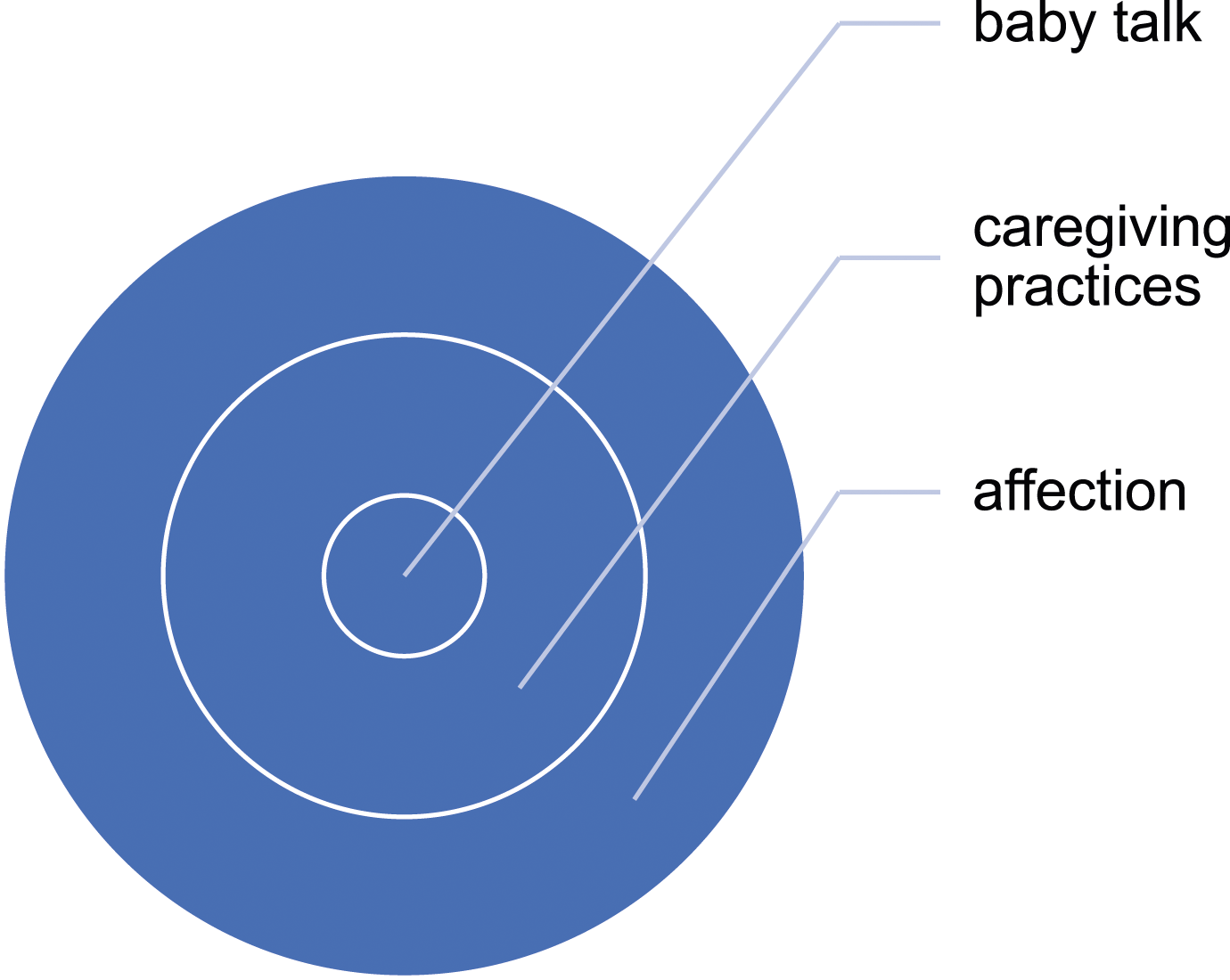
In the extract below a mother explained how doolar talk supports babies’ language acquisition: Me: ‘If a new mother, a woman with her first baby, asked you, “What should we do so my child can learn to talk?”, what would you tell her?’ Shobna: ‘Just keep on talking to her. ( Me: ‘So when you say “communication”, can you just explain a bit more? Shobna: ‘Just saying “Hello baby” (higher than normal pitch), “How are you baby?” (higher than normal pitch), just like that. Because when we say like that, the baby can do something; nah? They will just do the sounding in their baby way. Keep doing that.’
Here, Shobna’s examples of talk to babies were pitched higher than her other speech to me, as if babies need talk with ‘invitational intonation contours’ (Watson-Gegeo & Gegeo, 1986, p. 25). She also alluded to belief that babies learn to talk via their agentic responses to caregivers’ provision of high-pitched doolar talk (‘Because when we say like that, the baby can do something, nah? They will just do the sounding in their baby way.’).
Belief that children learn to talk through engagement in proto-conversational BT is so established in Dovubaravi that one child’s father voiced puzzlement about my focus on young children’s language learning. Observations clearly demonstrated that proto-conversational BT is routinely practised by neighbours, fathers, grandparents, older siblings and other family members in Dovubaravi, beginning soon after babies are born. Doolar talk frequently occurs in multi-aged, multiparty contexts within Dovubaravi’s multi-occupancy homes and compounds. This presence of BT in Dovubaravi’s multiparty contexts contrasts with both middle-class Anglo-America where BT typically occurred within dyadic caregiver–child interactions, and Western Samoa where BT did not occur, and multiparty interactions were the norm (Ochs & Schieffelin, 1994). To illustrate BT in a typical multiparty context in Dovubaravi, and at the same time elucidate doolar’s implications about Dovubaravi’s ontology of infancy, I now draw on a scenario in which Rukmani, a senior woman in the community, sits holding a five-day-old baby so they are face-to-face, and talks to her – in the presence of the new mother and several other family members. Rukmani: (looking into the baby’s eyes, smiling, nodding once, opening mouth wide to enunciate) Kaunchi dekta? [What are you looking at?] (high pitch, intonation rising to end of utterance) Baby: (looks fixedly at Rukmani’s face) Rukmani: (looking into the baby’s eyes, smiling, nodding once, opening mouth wide to enunciate) Kuch dekawe? [Can you see something?] (high pitch, intonation rising to end of utterance) Baby: (looks fixedly at Rukmani’s face) Rukmani: (looking into the baby’s eyes, smiling, nodding once, opening mouth wide to enunciate) Kaunchi dekawe? [What can you see?] (high pitch, intonation rising to end of utterance) Baby: (closes eyes) Rukmani: (turns away from baby)
Rukmani’s talk to the newborn baby included features of BT, specifically high and varied vocal pitch, short sentences, limited vocabulary, frequent questions, body movements and exaggerated facial expressions. She asked, ‘What are you looking at? Can you see something? What can you see?’, as if considering the baby an active, perceiving being. After the baby shut her eyes, Rukmani stopped talking to the baby and turned towards the camera, as if the baby, as ‘co-author’ (Ochs et al., 2005, p. 553) in this communication, had conveyed a desire to end it. Rukmani’s positioning of the baby, her three questions and her disengagement when the baby closed her eyes seem to instantiate and authorise ideas expressed by Shobna and other adults in their conversations with me, namely that babies are conversational partners, legitimately addressed by doolar talk, and agentic, perceiving beings who capably communicate their preferences.
All Dovubaravi speakers addressed babies using repetitions, higher than normal pitch, smiling and eye contact if believing i) that babies’ elders should accommodate to babies, rather than expect babies to accommodate to elders’ usual speech, ii) that babies are linguistically and cognitively immature interlocutors, and iii) that babies prefer, or attend more readily, these specific features of talk. Speakers varied however in their provision of short question formats, exaggerated vowel sounds, head movements and mouth opening, object labelling, babble, percussive sounds and immature pronunciations, even when addressing the same child (aged seven months). This variation suggests that individual speakers varied somewhat in their beliefs about which features of BT the baby preferred.
Doolar talk’s high pitch, repetitions, smiling and eye contact seem to bid for babies’ social interaction. As such, doolar talk potentially a) enregisters Dovubaravi babies’ identities as primarily social beings, b) amplifies their communicative capacities, and c) structures Dovubaravi babies’ beliefs about themselves as conversational partners. Furthermore, I observed that women visitors, when first meeting newborns, usually talked to and jiggled them and even pinched their cheeks until they made eye contact, as if trying to induce interactional responses and expecting, indeed requiring, babies to be socially attentive from the start. This ‘culturally configured’ (Solomon, 2012, p. 127) projection may shape Dovubaravi babies’ futures as socially and communicatively engaged community members and prime their language socialisation to other local practices and ideologies.
Learning talk via doolar-imbued care routines
The mothers indicated belief that doolar talk within everyday care routines helps young children learn talk’s meanings. Here Radha explained: ‘What we say to the children, the children will understand. The more we talk, the more they learn. Never mind they don’t understand what we talk. Our language to small baby like this. By talking, talking. When we change them, feed them, make up their milk, we talk about what we are doing. We just talk to them. They can only hear, but they don’t understand. When they grow up, grow up, they can understand. We every time talk to them.’
My observations and caregivers’ reports indicate that caregivers’ doolar talk during routines includes formulaic questions and statements about babies’ wellbeing, needs, desires and satiety, and what they have done or will do. The illustrative extract below is drawn from a video of Arush’s (seven months) daily massage by his grandmother. In Dovubaravi, baby massages include vigorous deep-tissue strokes along the limbs, inducing some complaints from babies. Grandmother: Thel lagai de. [I’m putting on the oil.] (fairly slow, clear voice; prosody very moderate). Arush: Grandmother: (massaging Arush’s arms quite strongly) Arush: (kicking his legs) Grandmother: Ach cha. Nai nai. Nair oh babba. [It’s OK. No no. Don’t cry baby.] (fairly slow; prosody very moderate). Wah. Wah. [There. There.] Arush: Grandmother: (turns Arush onto his stomach) Arush: (crying stops, wriggles away a bit) Grandmother: (gathers Arush back) Eh, girjaiga. [Hey, watch out you’ll fall off.] Badamasi karta hai? [Are you being naughty?] (stretching Arush’s limbs) Aise, aise, aise. [Like this, like this, like this.] (fairly slow; prosody very moderate). Kallase lagai diya. [I’ve finished applying.] (stands Arush up to look towards me) Dekko. Dekko. [Look. Look.]
Here, Arush’s grandmother apparently seeks to soothe and distract him from his discomfort via slow cadence and repetitions in her talk. Her procedural talk (‘I’m putting on the oil …. I’ve finished applying.’) matches seven-month-old Arush’s now predictable routine.
Young Dovubaravi children seem to gradually construct meanings from participations in care routines accompanied by caregivers’ repeated, lexically limited and contextually relevant doolar talk, and eventually start to produce this talk themselves. To illustrate, in relation to her photo of Sanvi (23 months) and her grandfather getting ready for their afternoon nap, Radha talks about Sanvi’s spoken requests: Radha: ‘She was saying to her tata [grandfather]: “Give me the pillow. I want to lie down.” She say: “Amma, sisi banaido. Humme ninde awe.” [“Mumma, make up a bottle. I’m going to sleep.”] “Give me a bottle”.’
Sanvi’s requests employed some of the same phrases Radha repeatedly uses in Sanvi’s nap routine, although Radha translated some phrases for my benefit. It seems that Sanvi now creates her own sentences using this ‘formulaic language’ – lexical chunks repeatedly used in routines (Burdelski & Cook, 2012, p. 173). Reoccurring ‘patterns of linguistic and other behaviors’ (Moore, 2012, p. 211) seem to have afforded Sanvi’s linguistic assimilation and memorisation of this ‘culturally constructed’ (Paugh, 2012, p. 151) nap routine. This indicates that language acquisition and socialisation to cultural practices are ‘interdependent developmental processes’ (Ochs & Schieffelin, 2012, p. 8) and ‘the centrality of repetition to language, learning, and the (re)production of culture and social organization’ (Moore, 2012, p. 209) in Dovubaravi.
Intergenerational learning to produce doolar talk
Rukmani’s doolar talk to the newborn baby seemed to demonstrate a ‘feel for the game’ (Bourdieu, 1990a, p. 80) or ‘habitus … a set of historically rooted, socially organized dispositions … to interpret and creatively engage in the flow’ of a social practice (Ochs et al., 2005, p. 547). The new mother and others present smiled and expressed no surprise, as if recognising Rukmani’s BT as a situationally relevant social act ‘using communicative resources in conventionally expected ways to achieve certain outcomes’ (Ochs & Schieffelin, 2017, p. 5). I next posit two ways that such shared disposition for producing doolar talk in Dovubaravi is intergenerationally acquired during early childhood; namely (re)creating doolar talk in doll play, and (re)creating doolar talk from observations of it within the multi-aged, multiparty interactions that characterise children’s everyday lives in their family compounds.
(Re)creating doolar talk in doll play
By the end of their second year, Dovubaravi boys’ and girls’ doll play deploys the words, phrases, affectionate gestures (e.g., kissing) and actions (e.g., feeding) repeatedly deployed by their caregivers during care routines. This was exemplified when Renuka (a mother) and I talked about her photo of Saakshi (24 months) kissing a doll, which Renuka had referred to as a ‘baby’. Me: ‘Does she talk to the baby?’ Renuka: ‘Ya.’ Me: ‘What does she say?’ Renuka: Kaise? Manta dood-dooh piye? [How are you? Do you want to drink milky-milk?]
Saakshi included the affectionate action and the baby word (dood-dooh) that Renuka had provided in her doolar (affectionate, BT-imbued care routines), as if agentively fitting her embodied knowledge about doolar actions, affect and talk from her own social experiences into her doll play. In this way, doolar as a holistic package of affectionate baby care and linguistic practices may become part of each child’s habitus.
(Re)creating doolar talk from observations of it in multi-aged, multiparty contexts
Whilst Rukmani positioned the newborn baby’s body so that they were dyadically engaged, other attendees positioned themselves as onlookers. If ‘meanings of language … both reflect and construct the social “context”’ (Moore & Burdelski, 2020, p. 3; see also Ochs, 1990; Ochs & Schieffelin, 2017), Rukmani not only (re)produced doolar talk and instantiated a set of beliefs about babies, but also afforded onlookers’ opportunities to (re)view doolar talk and (re)construct notions of doolar talk as a legitimate linguistic register with its ontological implications about babies as perceiving and agentively communicative beings. Figure 2 maps this posited process as a ‘situated activity’ (de León, 2012, p. 96) within a multi-aged, multiparty participation framework. Multi-aged, multiparty participation in Rukmani’s doolar with the newborn baby. Key: solid line: Rukmani’s doolar directed to newborn; dotted line: newborn baby’s attention to Rukmani’s doolar; dashed line: onlookers’ gaze and listening directed towards Rukmani’s doolar and the newborn baby’s attention to it.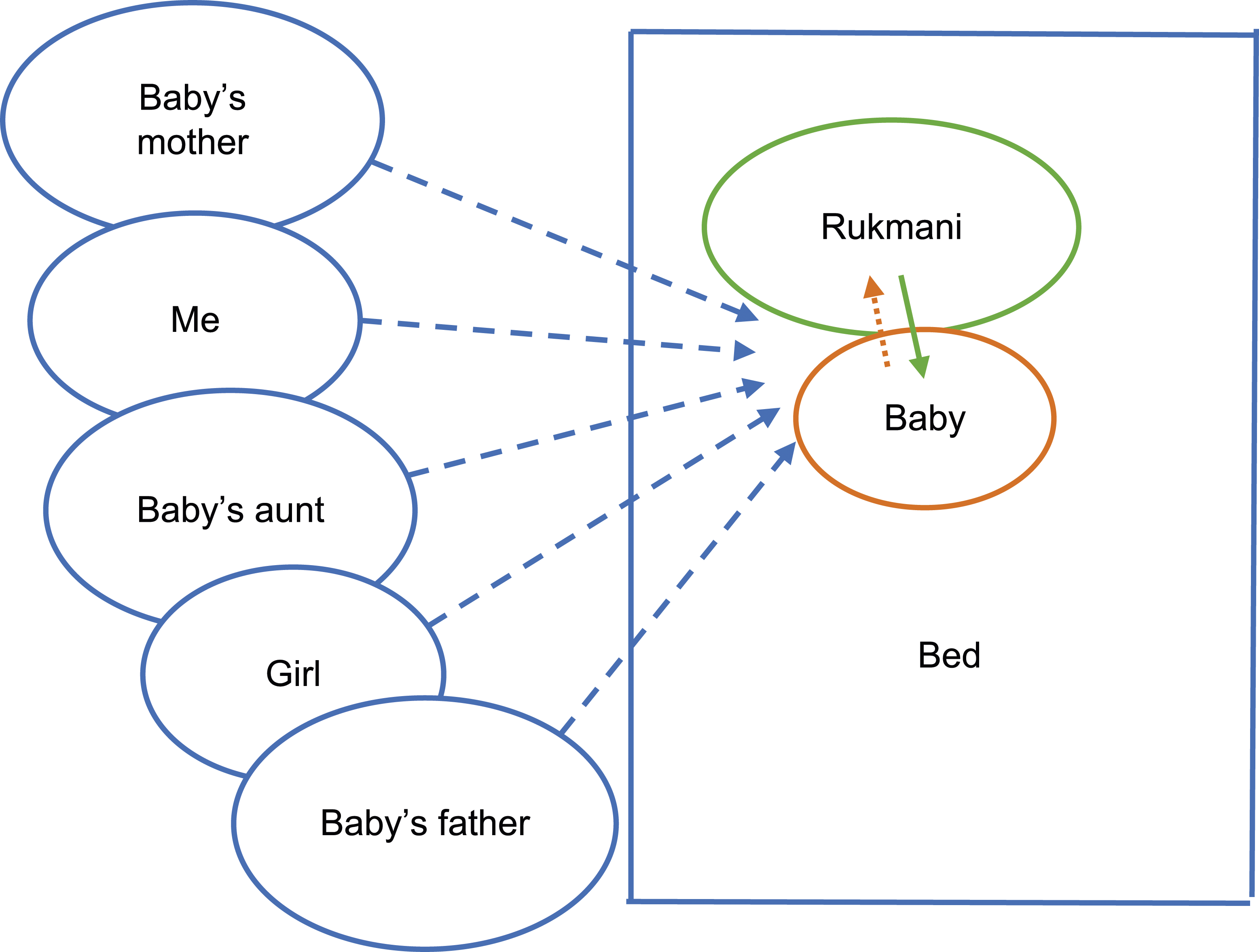
Dovubaravi children frequently observe doolar talk in the kinds of multi-aged, multiparty interactions illustrated by Figure 2. In the following extract Arav (5 years), stands in the middle of the room, interacting with Arush (seven months) who, seated on Manju’s lap, faces him. (See Figure 3). Arav: (bends down and moves his face close to Arush’s) Arush. Arush. (soft but audible voice, elongating both the ‘Ah’ sound at the start of Arush’s name and the ‘sh’ sound at the end) Arush: (looks at Arav’s face) Arav: (straightens up and holds out his fist, in which a toy is partially hidden, towards Arush) Arush. Arush. (soft but audible voice, elongating the ‘sh’ sound at the end of Arush’s name) Korjo. Korjo. [Find. Find.] Arush: (waves arms) Within a typical multi-aged, multiparty, familial context, Arav interacts with Arush (depicted by the filled shape) seated on Manju’s lap.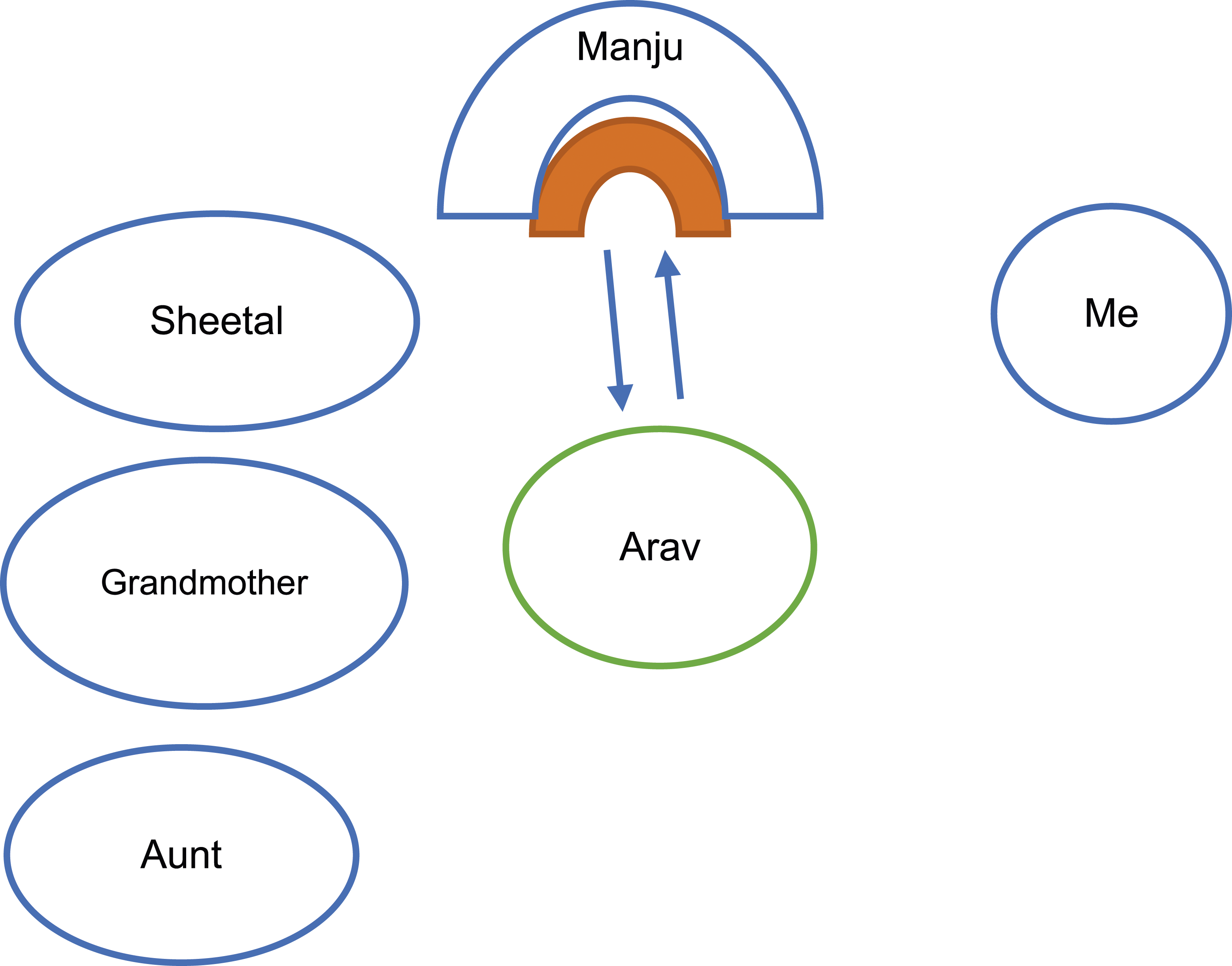
Here, Arav speaks to his baby cousin, adding elongated sounds, word repetitions, and bodily actions – all common features of doolar talk in Dovubaravi. Arush waves his arms, as if responding. Arav’s doolar talk indicates he has developed a socially organised disposition to engage in his community’s habitual deployment of a BT speech register to draw responses from babies.
Arav now seems to know what every Dovubaravi adult knows – that babies are meaningfully addressed using doolar talk and positively respond to it. I suggest that Arav acquired these beliefs about babies and became disposed to deploy the doolar register in his interactions with Arush, by drawing on his frequent observations of family members engaging Arush in doolar talk within their shared household. Arav’s third-party learning of doolar talk through participation as an overhearer and watcher within a multi-aged, multiparty framework is modelled in Figure 4. Model for Arav’s third-party learning of doolar talk.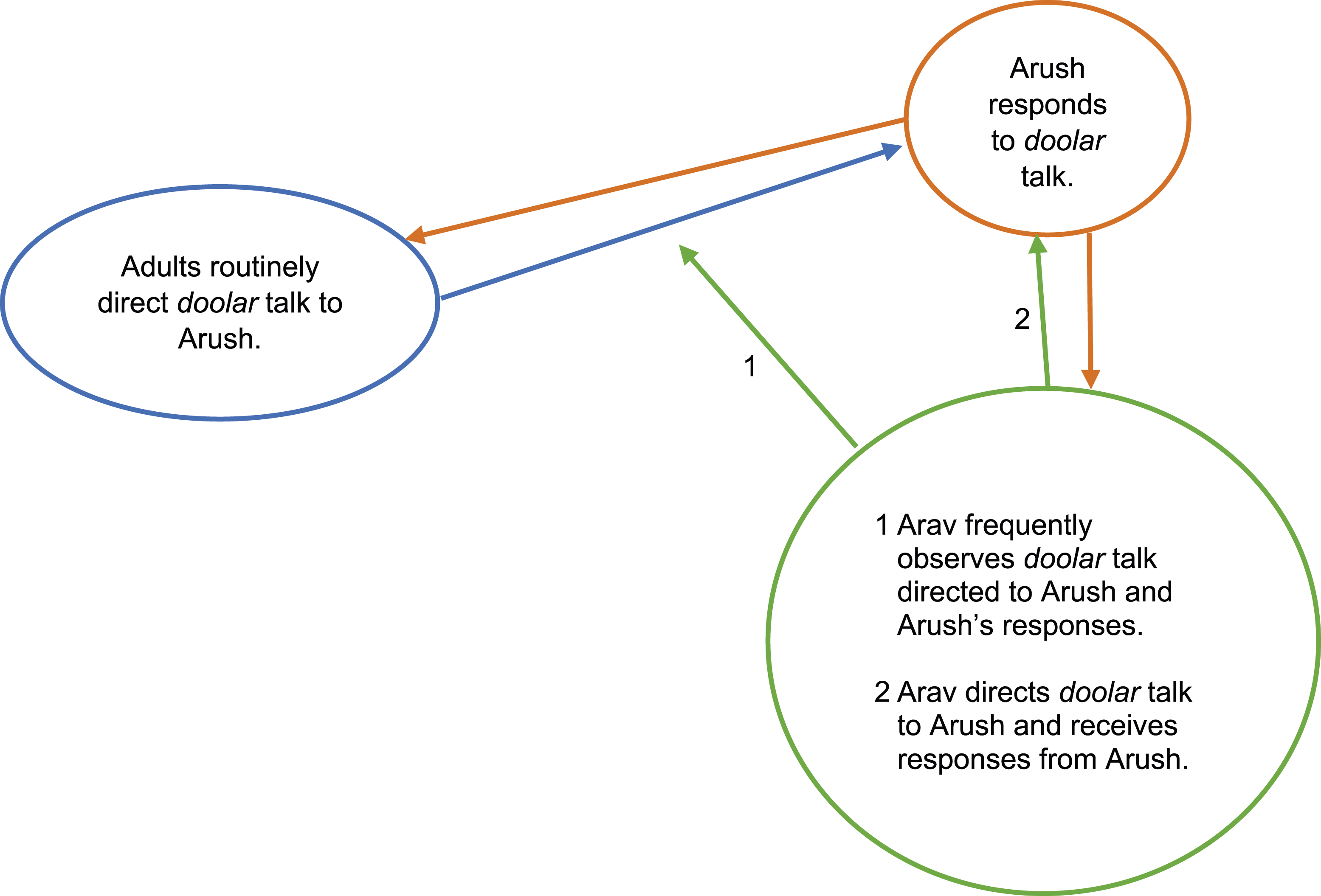
In summary, both doll play and third-party learning by overhearing doolar talk in multi-aged, ‘multiparty interactional arrangements’ (de León, 2012, p. 81) may account for intergenerational deployment of doolar talk to babies and continuation of Dovubaravi’s shared ontology of infancy.
Conclusion
Summary of findings
This article contributes to knowledge about ontologies of infancy, about deployment of baby talk in non-Western contexts, and about young children’s socio-linguistic learning through care routines and multiparty participation frameworks.
The article explained that the Indo-Fijian term doolar refers not only to a set of altered linguistic practices directed to babies (named as baby talk in the West) but encompasses the caregiving routines and affection accompanying such linguistic practices. The findings indicated: i) that Dovubaravi mothers believe doolar supports children’s agentic language acquisition, and ii) that doolar talk instantiates and authorises local beliefs about babies’ ontological status as perceiving, agentic social entities, capable of co-participation in interactions featuring doolar talk.
The findings reiterate the importance of repetitive language-imbued practices for learning talk and culture (e.g., Ochs & Schieffelin, 1994; Painter, 1991; Schieffelin, 1990; Watson-Gegeo & Gegeo, 1986), by explaining how formulaic doolar talk within care routines reveals talk’s meanings to young children and provides children with the vocabulary and grammar needed to eventually speak their ideas.
Whilst middle-class Anglo-American mothers’ BT usually happens in ‘face-to-face dyadic exchanges’ (Ochs et al., 2005, p. 556), doolar talk occurs within Dovubaravi’s typical multiparty interactions. Doolar talk’s prevalence in DDD suggests a ‘child-centered’ orientation, or ‘accommodation’ to babies’ communicative interests (Schieffelin & Ochs, 1986, p. 174). At the same time, Dovubaravi elders’ persistence in engaging babies in social interaction indicates: i) an ‘Adapt child to situation’ orientation to language socialisation (Ochs & Schieffelin, 1994, p. 499), and ii) a focus on supporting babies’ development of other centredness (allocentrism) which is arguably an important capacity for life in extended families, community cohesion and democratic citizenship.
This article proposed two ways that Dovubaravi children generate their own dispositions to (re)produce doolar talk as cultural practice and to (re)instantiate Dovubaravi’s beliefs about infancy: i) by reproducing their own doolar experiences in their doll play, and ii) by participating in multi-aged, multiparty frameworks that feature elders’ doolar talk to babies and babies’ responses to it. In so doing, it helps explain how BT and ontologies of infancy are continued intergenerationally.
The study’s limitations
Whilst some of this article’s findings may be common to other Indo-Fijian communities, they should not be considered representative of all communities in Fiji, where there are multiple ways of living, talking and thinking. Furthermore, the findings cannot fully represent the participants’ ideas, practices and contexts, because data was generated and interpreted in specific interactions and situations within a specific research process in which there were undeniable power differentials between participants and myself as a privileged researcher.
Potential applications in early childhood education and care settings
Early childhood education and care settings (ECECS), with their presence of multiple adults and multi-aged groupings at various points in the day, can have much in common with life in Dovubaravi’s extended family compounds. Early childhood educators could therefore bring some of Dovubaravi’s multiparty pedagogical approaches to their program’s strategies for supporting children’s social learning. They might for example: i) intentionally use BT to express affection towards individual babies to help them develop a sense of belonging, ii) use BT to intentionally encourage babies to orient to others, and iii) direct BT to babies during interactions and care routines in multi-aged, multiparty contexts to intentionally support children’s development of capacities for affectionate talk to, and care of, younger children.
When educators bring marginalised families’ ontologies and epistemologies to pedagogy, they help to sustain familial cultures and promote children’s learning success (Morelli et al., 2018; Paris & Alim, 2017; Rigney, 2023; Sydenham, 2019). Informed early childhood educators know that not all communities engage in BT, and that BT is not required for language acquisition if children inhabit contexts replete with contextualised linguistic interactions (Ochs & Schieffelin, 1994). Early childhood educators might therefore, draw on this study’s methods – particularly familial and professional caregivers’ narratives about their own photos of children’s language learning – to co-explore with families: i) beliefs about how young children learn language, ii) whether, how, and in what contexts professional and familial caregivers engage in BT, iii) whether and how their various contexts afford young children’s observation of, and participation in, rich, varied, contextualised, and culturally-sustaining language iv) whether, when and how dyadic and multiparty interactions and child-centred and situation-centred interactions happen at home and in the ECECS. Such family-educator dialogues support the shared understandings that necessarily underpin culturally sustaining and culturally responsive early childhood education (Harris et al., 2020; Sisson et al., 2024).
Footnotes
Declaration of conflicting interests
The author(s) declared no potential conflicts of interest with respect to the research, authorship, and/or publication of this article.
Funding
The author(s) received no financial support for the research, authorship, and/or publication of this article.
