



Abstract
The quantity and quality of educator-child talk in early childhood education plays a critical role in children’s language development. This study analysed the linguistic aspects of educator-toddler interactions in 24 New Zealand early childhood classrooms, sampling 25 minutes of naturally occurring interaction across five contexts: book-reading, mealtime, play, group, and nappy-change. Both the quantity (e.g., total utterances) and linguistic quality (e.g., lexical diversity, mean length of utterance in morphemes) of educator and child talk were analysed. The quantity and quality of educator-toddler verbal interactions varied across contexts, with book-reading displaying positive features of educators’ language, and nappy-changes showing positive features of children’s language. This information about which contexts naturally promote high-quality verbal interactions will pave the way for oral language interventions in New Zealand and worldwide.
Introduction
Research spanning the past four decades has demonstrated the role of early language experience in predicting children’s later developmental outcomes (Rowe & Snow, 2020). The quantity and quality of adult verbal input builds a strong foundation for children’s cognitive and later literacy development (Dickinson & Porche, 2011). From a sociocultural perspective, children’s development is adaptable at a young age, and grows in collaboration with others (Vygotsky, 1978). The earlier children are exposed to enriched environments that expressly support their language acquisition, the more likely they are to build the fundamental skills that underpin future positive outcomes. Therefore, understanding how adult input in different environments shapes language acquisition in the early years is of great interest to parents, educators, and policymakers. Although most studies have focused on the influence of parental input within the home environment, there has been less emphasis on environments that extend beyond the home (Degotardi, 2021), such as schools, communities, and cultures, all of which offer consistent language input and exposure.
As more women join the workforce, childcare demand has surged, and toddler enrolments in Early Childhood Classrooms (ECCs) have increased. Thus, it is necessary to examine how language is used in ECCs, focusing on the specific contexts of these interactions (Degotardi, 2021). Some contexts, such as shared book-reading, naturally encourage high-quality interactions that enhance children’s learning and development (Rowe & Snow, 2020). A growing body of literature has explored the relations between context and language use in educator-child interactions, with many focusing on book-reading with preschoolers (Noble et al., 2019). Limited evidence exists on the language practices of educators for infants and toddlers under age three in other contexts (Degotardi, 2021). Consequently, understanding the language use of educators and toddlers across different contexts is merited. To address this need, the present study aimed to explore the linguistic aspects of educator-toddler interactions in 24 ECCs, focusing on five specific contexts: book-reading, mealtime, play, group, and nappy-change.
The role of contexts in educator-toddler talk
Book-reading
Research has consistently demonstrated how adult-child interactions vary across contexts, with book-reading particularly effective in fostering high-quality interactions. Shared book-reading occurs when an educator and one or more children share or read a book together (Noble et al., 2019), including approaches like interactive/dialogic reading that encourage children’s participation. These interactions are likely to stimulate the use of higher quality talk, characterised by more sophisticated vocabulary (Barnes & Dickinson, 2017; Dickinson & Porche, 2011) and complex sentence structures (Huttenlocher et al., 2002; Reese et al., 2021).
Research has highlighted the advantageous role of book-reading in facilitating the use of rich language elements compared to other contexts (Dickinson et al., 2014; Gest et al., 2006). Book-reading typically yields child-directed talk with higher lexical and syntactic diversity than play or group time (Dickinson et al., 2014; Gest et al., 2006). This diversity in input often predicts similar diversity in children’s speech (Huttenlocher et al., 2002). Moreover, language and concepts presented in books typically exhibit characteristics of a more academic register (diverse vocabulary and more complex utterances) and a less casual register (shorter and less complex utterances) (Reese et al., 2021). With toddlers, educators may not be aware of the language learning opportunities afforded by reading books. In a naturalistic study, Torr (2019) included 20 infants from 20 different ECCs and observed that nearly half of the toddlers did not engage in any book interactions. Among the toddlers who did participate, educators generally dominated the conversation and determined not only the subjects of discussion but also the timing, which in turn had a significant impact on toddlers’ verbal participation.
Mealtime
A growing number of studies have sought to examine educator-toddler conversations during mealtime in early childhood education (Degotardi, 2021). Mealtime stands apart from other early childhood contexts due to its informal nature, enabling educators to naturally facilitate reciprocal conversations with children (Gest et al., 2006). Shared mealtimes provide opportunities for children to learn culturally appropriate food-sharing practices and engage in vocabulary-rich discussions (Degotardi et al., 2016). This context also offers children greater opportunities to receive high-quality educator language practices, particularly when they are seated with children rather than moving around (Degotardi et al., 2016; Gest et al., 2006).
Play
Play is a diverse context, including indoor and outdoor play with a wide range of materials and including pretend play. Our focus is on children’s indoor free play with an educator present who is sometimes facilitating but not leading the play. In this context, educators can scaffold language development by generating inferential responses (Tompkins et al., 2013), introducing rare vocabulary (Dickinson & Porche, 2011), encouraging responsive (Girolametto & Weitzman, 2002), and multi-turn conversations (Cabell et al., 2015). The importance of play in promoting high-quality interactions is also evident for toddlers (Degotardi, 2010). For instance, Degotardi et al. (2018) found that educators of 57 infants attending different ECCs employed more effective interaction-promoting strategies (e.g., responsiveness, sensitivity) during play than book-reading.
Group
Group time involves intentionally gathering children for shared activities like singing, storytelling, or group discussions, while allowing educators to observe children’s performance (Dickinson et al., 2014; Girolametto & Weitzman, 2002). It can be conducted as whole-class or individual-focused, both relying on educator instructions to support language learning (Connor et al., 2006; Dickinson et al., 2014). Whole-class group, for instance, can foster advanced vocabulary and complex sentence structures by enhancing peer interactions. This context has also demonstrated academic language features, such as a high frequency of sophisticated words and a fast speech rate (Dickinson et al., 2014). Yet individual-focused small-group time has been associated with improvements in preschool children’s alphabet and letter-word skills (Connor et al., 2006). A content analysis of small-group discussions revealed a greater emphasis on skills-focused dialogue compared to whole-class instructions.
Nappy-change
Although scant, there is an emerging body of literature in recent years examining the context of nappy-changes in ECCs. As one of the few one-on-one interactions during the day, nappy-change provides a platform for observing direct feedback and outcomes of educator-child interactions, thus promoting highly responsive care and facilitating child well-being (Laurin et al., 2021). Considering the positive association between responsiveness and language productivity (Girolametto & Weitzman, 2002), nappy-change offers language-rich input tailored to individual children. However, Degotardi (2010) suggests that during a dressing context, educators may primarily focus on addressing toddlers’ physical needs and overlook the quality of verbal input.
The present study
New Zealand’s early childhood education services are guided by a national curriculum Te Whāriki, a holistic, play-based curriculum that recognises children’s active engagement in their own learning, sense of belonging, and communication (Ministry of Education, 2021). Given most research on educator-toddler talk has primarily concentrated on book-reading, there is a need to explore other contexts (Reese et al., 2021). For example, play and group time display interactive language practices (Cabell et al., 2015; Girolametto & Weitzman, 2002), whereas mealtime and nappy-change offer unique language input features (Degotardi, 2010; Degotardi et al., 2016). Although previous studies have often focused solely on educators’ contributions to educator-child talk involving younger toddlers in New Zealand, our research distinguishes itself by considering both educator and toddler contributions. To date, no previous study has compared the distinct linguistic characteristics of naturally occurring educator and child speech across these five contexts in ECCs.
We aimed to analyse the linguistic aspects of naturalistic educator-toddler interactions across five contexts: book-reading, mealtime, play, group, and nappy-change. Participating early childhood centres were randomly selected at baseline from the Kia Tīmata Pai (Best Start) randomised controlled trial, involving over 1400 toddlers and their educators from 138 early childhood centres across New Zealand (Reese et al., 2023). In New Zealand early childhood education classrooms at the time of the observations, the minimum teacher-to-child ratio was 1:5 for toddlers under age two (Ministry of Education, 2021). Researchers sampled 25 minutes of naturally occurring educator-child talk in 24 ECCs from three regions in New Zealand. Video recordings were transcribed and analysed for the quantity and quality of linguistic elements present. Given that this is the first study comparing linguistic features across these five contexts, our hypotheses were descriptive and exploratory. Due to limited past research, our only firm prediction was for book-reading in comparison to other contexts. 1. We predicted that the educator-child language during book-reading would exhibit superior quantity and quality of speech in comparison to mealtime, play, group, and nappy-change. Here, ‘quantity’ is measured by the total number of words, utterances, and conversational turns the children use and are exposed to, whereas ‘quality’ refers to the lexical diversity and syntactic complexity of speech. 2. We predicted that the quantity and quality of educator-child language during nappy-change would differ when compared to book-reading, mealtime, play, and group.
Method
Participants
Characteristics of Children in the Best Start Video Project.
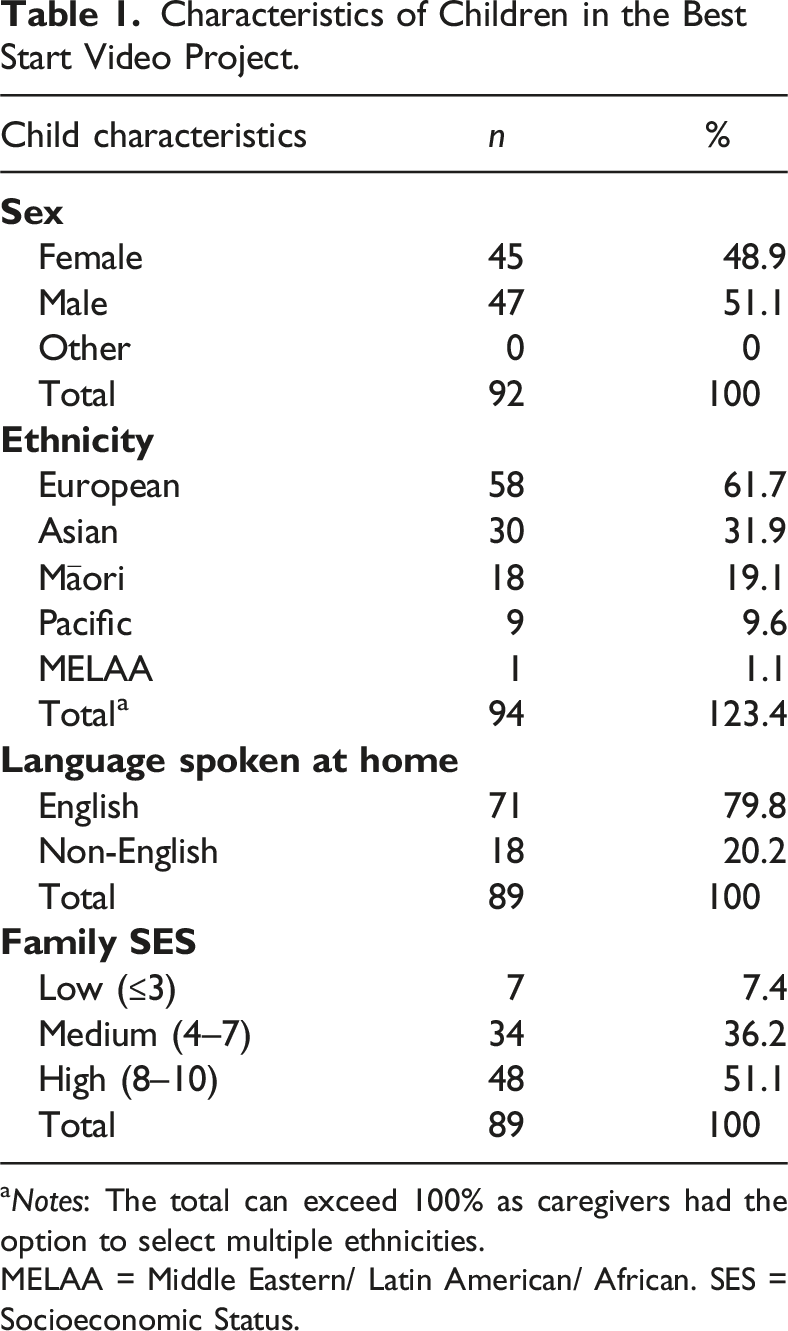
aNotes: The total can exceed 100% as caregivers had the option to select multiple ethnicities.
MELAA = Middle Eastern/ Latin American/ African. SES = Socioeconomic Status.
Characteristics of Educators in the Best Start Video Project.
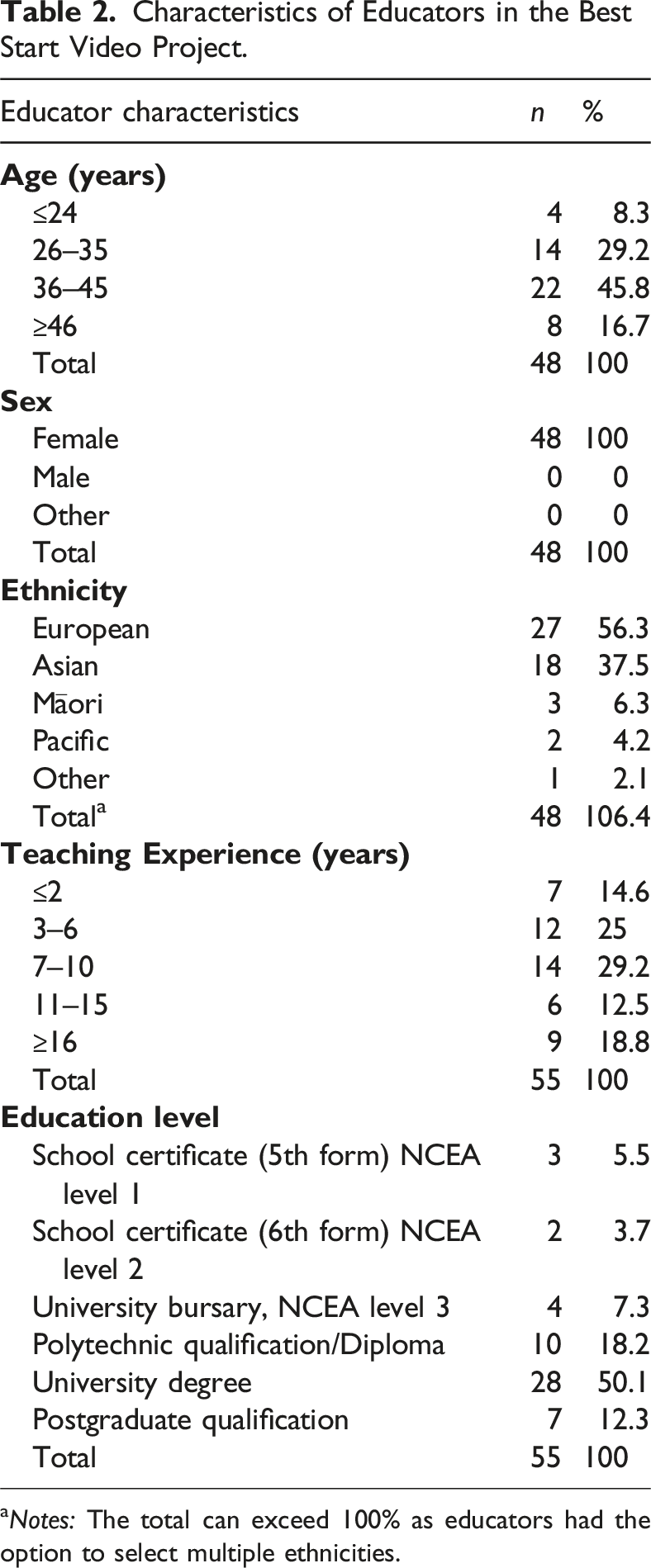
aNotes: The total can exceed 100% as educators had the option to select multiple ethnicities.
Procedure
Before visits
A few weeks before video data collection, centres and parents of participating children were notified about the visit. Parents of non-study children were also asked to consent to having their children filmed. If consent was granted, non-study children were filmed but their data was not coded; if consent was not granted, no video data of those children was collected. In a phone call to centres, we expressed our intention to visit for a maximum of 90 minutes, preferably including mealtime. We did not specifically mention any other contexts because we wanted the interactions to be as naturalistic as possible.
Videotaping
We identified study children with stickers on their clothes or high-visibility vests for later transcription and coding. Educators were instructed to continue with their usual activities during filming. Naturalistic interactions across five contexts (i.e. book-reading, mealtime, play, group, and nappy-change) were recorded by two trained researchers, each using a hand-held camera. For centres where the study children were split between infant (e.g., under two-years-old) and preschool rooms (e.g., over two-years-old), the two PhD student researchers aimed to record 5 minutes of footage for each of the five contexts (book-reading, mealtime, play, group, and nappy-change), totalling 25 minutes of filming per room. Group sizes in each centre varied across different contexts. Educators engaged in book-reading with groups that ranged in size from one to eight children, with a median of four. Educators engaged in play with groups that ranged in size from one to six children, with a median of three. Educators engaged in group time with groups that ranged in size from three to ten children, with a median of five. Educators engaged in mealtime with groups that ranged from three to nine children, with a median of six. Nappy-changes were always conducted on a one-to-one basis.
In nappy-change videos, the researchers obtained verbal agreement from the educators before recording, and only recorded the audio, without any visual footage of children. Group was defined as educator-initiated interactions that included at least two children, but excluded book-reading. Book-reading involved both educator-initiated and child-initiated interactions, ranging from a dyadic experience to interactions in which one educator read to a larger group of children. If a group included book-reading, it was instead classified as book-reading. Play encompassed various types of child-led indoor play such as block, pretend, and motor activities in which an educator was present and sometimes facilitated but did not initiate the interaction. Lastly, mealtime consisted of structured scenarios where children gather around a table to consume food. If there was extra video footage before the meal began, coding did not begin until the first child had been served. Videos that did not fit into any of the five contexts (e.g., clean-up time) were considered ‘other’.
Transcription and coding
All video data were accessed, analysed, and stored securely in compliance with the university’s Human Ethics Committee (reference: H20/116) and the local Research Consultation Committee. Two pairs of PhD student researchers independently categorised videos into each of the five contexts, resolving disagreements through discussion. After categorisation, student researchers completed a comprehensive standardised training for transcription, which included completing two transcripts and passing a reliability test. A trained individual transcribed each transcript, which was then verified by another researcher to ensure accuracy. A random five-minute slice was chosen if the filming per context exceeded 5 minutes, with a preference for footage featuring both a study educator and a study toddler in attendance and with adequate sound quality. Due to the difficulty of identifying off-camera speakers, our focus was only on speakers in the video frame.
To analyse at a micro-level of educator-child verbal interactions, transcriptions were then formatted for Systematic Analysis of Language Transcripts (SALT 20; Miller et al., 2019). SALT, a specialised software designed for detailed analysis of language samples used in educational and clinical settings, provides quantitative measures of linguistic features, including vocabulary diversity, utterance length, and grammatical complexity. Educators’ and children’s speech were parsed into C-units, representing an independent clause and its modifiers, including subordinate clauses. These C-units were then entered as separate lines in SALT, following SALT codes and conventions (Miller et al., 2019). The method allows for the analysis of connected speech by segmenting it into meaningful units. SALT, while powerful for structured language analysis, has limitations with context-dependent educator-infant/toddler talk, including only intelligible, complete verbal utterances. Our analysis thus focused on verbal interactions, with non-verbal interactions analysed separately (Swearingen et al., 2024). This study examined linguistic aspects (e.g., word diversity), while Swearingen et al. (2024) explored function and temporal focus of conversations. When toddlers produced no codable verbal data, we assigned ‘0′ for all measures. Transcripts were marked to indicate the book-reading segments and routinised language (i.e., singing or melodic strings). Routinised language was excluded from the calculation of utterance length. Each SALT-formatted transcript was independently checked by another trained researcher for C-unit segmentations, contractions, conventions, and spelling. For book-reading, we incorporated both the text read aloud and any extratextual conversation into our analysis as we aimed to comprehensively understand all linguistic contributions made by educators.
Analysis plan
To compare the quantity and quality of educator-toddler talk across contexts, we ran a series of Generalised Estimating Equations (GEEs) in SPSS Statistics 29 (Hubbard et al., 2010). GEEs are a type of regression model that extends the general linear model, providing robust population-level estimates of model parameters through estimated marginal means. GEEs are versatile for education research, as they allow for outcome comparisons across diverse groups while accounting for multiple dependencies within the dataset, such as in this case across multiple contexts within centres. GEEs are especially useful for dealing with missing data since they estimate the working correlation matrix using all available pairs of data, allowing for the inclusion of individuals with partial data. This method is valid under the premise that data are missing completely at random (MCAR).
Our dataset for each GEE regression model consisted of nine outcome variables across five contexts for educators and children separately (90 pairwise comparisons). Each case embodied one linguistic outcome for either educators or children, with context as a within-subject factor. We assessed speech quantity by calculating total utterances, total completed words, and mean length of conversational turns. Mean length of conversational turns is an indicator for frequency of speech turns. For speech quality, we measured number of different word types, mean length of utterance (MLU) in morphemes, number of statements and questions, number of Yes/No responses to questions, and responsivity to questions. Responsivity to questions calculates the percentage of responses to questions (see Reese et al., 2021). Linguistic density or rate is calculated as variables per minute by dividing each variable’s total by the video length, except for MLU in morphemes, which is already a proportional measure, calculated by dividing total number of morphemes by total number of utterances.
As previously mentioned, the GEE regression procedure requires the specification of a working correlation matrix. We chose an exchangeable structure, assuming identical matrix’s variance and covariance. To evaluate the primary effect of contexts, we generated a Wald Chi-Square (WT) test statistic from the estimated marginal means, which are essentially predictions of population-level values. Because SPSS does not provide standardised effect sizes for GEE analyses, these estimated marginal means are essentially predictions of population-level values. Therefore, any observed differences between groups during multiple comparisons can be interpreted as unstandardised effect sizes. Given that the contexts comprised five levels, we also conducted pairwise comparisons for a more detailed analysis. Šidák corrections were applied to control for Type I error from multiple comparisons to maintain the overall error rate at 5% and ensure the robustness of our findings. Finally, we assessed whether any missing data in our dataset were problematic. Little’s MCAR tests for children’s variables, χ 2 (df = 16) = 12.39, p = .72, and educators’ variables, χ 2 (df = 16) = 18.33, p = .31 were not significant, suggesting that any missing data were completely at random.
Results
Estimated Marginal Means and Standard Errors of Toddlers’ and Educators’ Language Features in Book-Reading (N = 11), Mealtime (N = 23), Play (N = 20), Nappy-Change (N = 16), and Group (N = 16).
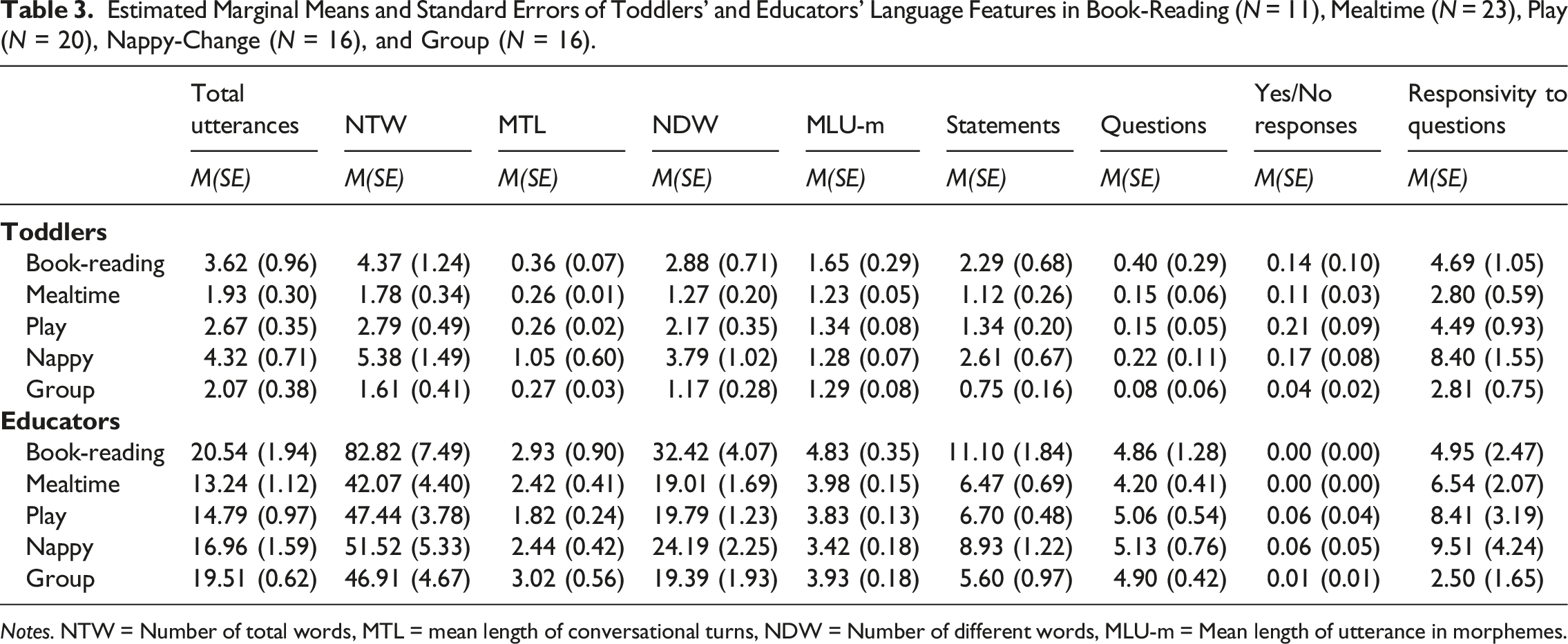
Notes. NTW = Number of total words, MTL = mean length of conversational turns, NDW = Number of different words, MLU-m = Mean length of utterance in morphemes.
Speech quantity
Total utterances
For toddlers, the association between contexts and total utterances was significant, WT = 12.71, p = .01. Across contexts, nappy-change had the highest level of total utterances, WT = 7.00, p < .01. Pairwise comparisons showed that toddlers used more utterances during nappy-change than during mealtime, with a mean difference (MD) of 2.39, 95% CI [0.13 to 4.65], p = .03.
For educators, the association between contexts and total utterances was also significant, WT = 34.62, p < .001. Mealtime (WT = 20.30, p < .001) and play (WT = 18.28, p < .001) had lower levels of total utterances compared to other contexts. Pairwise comparisons showed that educators’ total utterances during book-reading were significantly greater than mealtime (MD = 7.29, 95% CI [2.31 to 12.28], p = .00) and play (MD = 5.75, 95% CI [0.46 to 11.05], p = .02). Similarly, educators’ total utterances during group were significantly greater than mealtime (MD = 6.26, 95% CI [2.37 to 10.15], p = .00) and play (MD = 4.72, 95% CI [1.63 to 7.81], p = .00).
Total completed words (NTW)
There was a significant main effect of context on toddlers’ total completed words, WT = 14.92, p = .01. Although book-reading (WT = 4.06, p = .04.) and nappy-change (WT = 6.00, p = .01) tended to include more completed words, no follow-up pairwise comparisons were significant once the Šidák correction was applied.
There was a significant main effect of context on educators’ total completed words, WT = 32.47, p < .001. Book-reading had more completed words compared to other contexts, WT = 16.72, p < .001. Pairwise comparisons showed that educators’ total completed words during book-reading were significantly greater than mealtime (MD = 40.75, 95% CI [20.32 to 61.19], p = .00); play (MD = 35.38, 95% CI [14.40 to 56.37], p = .00); nappy-change (MD = 31.30, 95% CI [11.30 to 51.30], p = .00); and group (MD = 35.91, 95% CI [11.32 to 60.50], p = .00).
Mean length of conversational turns (MTL)
There was no significant main effect of context on mean length of conversational turns for either toddlers (WT = 5.09, p = .28) or educators (WT = 8.19, p = .09).
Speech quality
Number of different word types (NDW)
There was a significant main effect of context on toddlers’ use of different word types, WT = 19.81, p < .001. Although book (WT = 4.95, p = .03), play (WT = 5.30, p = .02), and nappy-change (WT = 6.18, p = .01) tended to show greater lexical diversity, no pairwise comparisons were significant once the Šidák correction was applied.
There was a significant main effect of context on educators’ use of different word types, WT = 15.73, p = .00. Book-reading had more lexical diversity than other contexts, WT = 9.05, p = .00. Pairwise comparisons showed that educators’ lexical diversity during book-reading was significantly greater than mealtime (MD = 13.40, 95% CI [0.68 to 26.13], p = .03); play (MD = 12.63, 95% CI [0.66 to 24.61], p = .03); and group (MD = 13.03, 95% CI [0.90 to 25.16], p = .03).
MLU-morphemes (MLU-m)
There was no significant main effect of context on MLU in morphemes for toddlers (WT = 5.39, p = .25).
There was a significant main effect of context on educators’ MLU-m, WT = 16.41, p < .01. Book-reading had greater syntactic complexity compared to other contexts, WT = 6.52, p = .01. Pairwise comparisons showed that educators’ syntactic complexity during book-reading was significantly greater than nappy-change (MD = 1.41, 95% CI [0.27 to 2.55], p = .01).
Number of statements and questions
There was no significant main effect of context on the number of questions for either toddlers (WT = 2.92, p = .57) or educators (WT = 3.59, p = .47). Furthermore, there was no significant main effect of context on the number of statements for educators (WT = 6.61, p = .16). However, there was a significant main effect of context on the number of statements for toddlers, WT = 15.12, p = .00. Although book-reading (WT = 4.94, p = .03), play (WT = 5.41, p = .02), and nappy-change (WT = 7.14, p = .01) tended to have higher statements, no pairwise comparisons were significant once the Šidák correction was applied.
Number of Yes/No responses to questions
There was no significant main effect of context on the number of Yes/No responses to questions for either toddlers (WT = 6.62, p = .16) or educators (WT = 4.71, p = .32).
Responsivity to questions
There was a significant main effect of context on toddlers’ responsivity to questions, WT = 14.89, p = .01. Toddlers showed higher responsivity to questions during nappy-change than during other contexts, WT = 12.97, p < .001. Pairwise comparisons showed that toddlers’ responsivity to questions during nappy-change was significantly more than mealtime (MD = 5.60, 95% CI [0.93 to 10.27], p = .01); and group (MD = 5.58, 95% CI [1.24 to 9.93], p = .00).
Discussion
This study examined naturalistic interactions between educators and toddlers by assessing the quantity and quality of speech in five different contexts: book-reading, mealtime, play, group, and nappy-change. We found that children’s quantity and quality of speech was higher during nappy-changes compared to other contexts. Educators’ speech was higher in quantity, lexical diversity, and syntactic complexity during book-reading than other contexts.
Our hypothesis that educators’ language during book-reading would have the highest quantity and quality compared to other contexts was largely, but not completely, supported by our findings. Aligned with past studies, we found that book-reading not only elicits a greater quantity of words, but also higher quality in terms of greater lexical diversity than other contexts (Barnes & Dickinson, 2017; Noble et al., 2019). Because the quantity and quality of input are often related, this finding is not surprising. For instance, educators who use many words also tend to employ a more diverse and rare vocabulary (Barnes & Dickinson, 2017). However, the present study did not differentiate between text language (words directly from books) and extra-textual language (educator’s own words). This could be a potential confounding factor as the role of text language versus extra-textual language on the quantity and quality of words used by educators could vary. Consistent with prior research (e.g., Gest et al., 2006), we found that book-reading exhibited a higher number of total utterances compared to mealtime and play. Notably, a 2020 Ministry of Health policy may have enhanced the quality of mealtime talk by requiring an educator to be seated at the table with the children during mealtimes (Ministry of Health, 2020). In Australia, Degotardi and colleagues suggested that educator presence during meals can improve mealtime interactions (Degotardi et al., 2016). However, the logistics and social etiquette involved in mealtime, including tasks like food preparation, may limit educator-initiated conversations.
A reason why play featured fewer educator verbal contributions than book-reading is that play is largely child-directed in New Zealand’s ECCs, with children often engaged in individual play or interacting with their peers, and educators may use fewer words compared to other contexts. Accordingly, we found that educators exhibited a higher number of total utterances during group than play. Educators may view group as more instructional in nature than play, and therefore speak more during group activities (Dickinson et al., 2014). Our categorisation of group was based on whether the grouping was intentional (group) or not (play), but explicitly excluded group book-reading. When educators intentionally group children for a certain activity, such as drawing while seated at a table, it may encourage both educators and children to engage in more conversation compared to free play when children are not grouped for a purpose (Tompkins et al., 2013).
For speech quality, the current study supported previous research, indicating that educators use a more diverse vocabulary and complex syntax during book-reading as compared to any other context (Barnes & Dickinson, 2017; Dickinson et al., 2014). Book-reading often contains interactive features like responsiveness, shared attention, and discussions centred around a child’s interests (Rowe & Snow, 2020). Engaging in discussions enables children to learn word meanings and comprehend stories more effectively. Yet, we must acknowledge that book-reading in ECCs often occurs in a group context. In such scenarios, the ability to focus on an individual child’s interests may be diluted. Despite this, as children mature, their language development needs to evolve beyond hearing repeated and high-frequency words, and towards exposure to diverse vocabulary and longer sentences (Huttenlocher et al., 2002; Weizman & Snow, 2001). If these conversations do not revolve around content-rich or abstract topics, the diversity of words and complexity of syntax used can be quite limited. Recall that our analyses incorporated both the book text and extratextual talk (Dickinson et al., 2014), potentially enhancing speech quality. Future research should examine differences between book language and educators’ extratextual talk during shared reading.
Because of limited prior research, we did not have firm hypotheses for how nappy-changes would differ from other contexts. We found that children’s speech was higher in quantity and quality during nappy-change than during other contexts. These findings highlighted children’s contribution in educator-toddler interactions, which has not been extensively studied in past research. Children were more vocal during this context compared to mealtime and group, using more utterances, and were more responsive to questions. Nappy-changes are thus a valuable opportunity for promoting children’s linguistic expression. First, the one-on-one, face-to-face interaction during nappy-changes encourages children to talk more, including responding to questions that are directed solely to the child. Exclusive and highly responsive adult-child conversations are vital for language development as they allow children to observe verbal and nonverbal cues, thereby enhancing overall communication skills (Rowe & Snow, 2020). Second, mealtime and group activities often involve more distractions, such as the presence of other children, food, or various stimuli. In contrast, nappy-changes provide a more focused and controlled environment with fewer distractions, allowing children to concentrate more on communication. These findings have important implications for early childhood education practices and policy. The high quality of educator speech during book-reading supports policies encouraging daily reading sessions in ECCs, with guidelines for optimal group sizes and linguistic prompts. Moreover, the higher quantity and quality of toddler speech during nappy-changes suggests these care routines should also be recognised as valuable learning opportunities.
Limitations and future directions
Several limitations need to be addressed. To recall, we stayed at each centre for a maximum of 90 minutes, and only filmed for 25 minutes at each centre, so could have missed contexts that occurred out of this timeframe. Notably, only 11 of the 24 centres included a naturally occurring book-reading in our observations. Future studies could use longer observations to capture all contexts (see Degotardi, 2010).
The generalisability of our findings is limited by possible selection bias in our sample, as our sample primarily comprised middle-class families able to afford childcare, with no government subsidies at the time for toddlers. Although ethnically and linguistically diverse, our participants may not reflect the SES diversity of the New Zealand population. We also acknowledge that our analysis was limited to English conversations, despite some participants being bi/multilingual. Given New Zealand’s multicultural nature (Ministry of Social Development, 2016), future studies might benefit from exploring how language status influences the quality and quantity of educator-toddler interactions. Furthermore, studies could examine the relationships between educators’ and toddlers’ language contributions in terms of both quantity and quality, within and across contexts. Finally, we recognise that the multiple comparisons in this study increased the likelihood of a significant difference occurring by chance. Although a correction was applied, these findings need to be replicated.
In future analyses with this sample, we will track the linguistic features of educator-child verbal interactions over time as a function of an oral language intervention introduced to the educators after baseline, with the aim of enhancing children’s oral language skills. We will evaluate the effects of this intervention on educator-child interactions, considering the linguistic characteristics inherent in different ECC contexts. For example, for nappy-change, it would be interesting to investigate how the complexity of children’s language changes over time. Moreover, findings from the current study indicated that book-reading is predominantly educator-dominated, with less opportunity for children to contribute. We will assess whether the intervention fosters a more interactive approach to book-reading sessions.
Conclusions
An enriched early language environment lays a strong foundation for children’s language development and further learning. The results indicated that book-reading stood out as a context in which educators naturally provide rich linguistic input, and that nappy-changes facilitated high-quality speech from toddlers. Educators can use this information to emphasise the importance of incorporating book-reading sessions into daily contexts to enhance children’s language in ECCs, and to make the most of nappy-changes. These findings also highlight the need for continued support and integration of language-rich activities in early childhood education curricula.
Footnotes
Acknowledgements
Our heartfelt gratitude goes out to the Wright Family Foundation and Methodist Mission Southern for their contributions and investments in this project. The project’s funding was secured by Professor Richie Poulton from the University of Otago. The implementation was led by Jimmy McLauchlan and Julia Errington-Scott from Methodist Mission Southern. The Video Project team, including Tugce Bakir-Demir, Isabelle Swearingen, and Yvonne Mitchell, took charge of organising and gathering the video data, and Stefana Huma, for checking SALT transcriptions. We extend our special thanks to BestStart Education Leaders Clair Edgeler and Natasha Maruariki, members of the Cultural Advisory Group Barbara Backshall, Pip Laufiso, Amanda Clifford, and Waveney Lord, and Science Advisory members Dr. Libby Schaughency, A/Prof Mele Taumoepeau, Professor Karen Salmon, Professor Lou Moses, Professor Dorthe Bleses, and Emeritus Professor David Dickinson for their invaluable advice and generous support. Most of all, we express our deepest appreciation to all the BestStart educators, children, and their families who participated in Kia Tīmata Pai.
Declaration of conflicting interests
The author(s) declared no potential conflicts of interest with respect to the research, authorship, and/or publication of this article.
Funding
The author(s) disclosed receipt of the following financial support for the research, authorship, and/or publication of this article: This work was supported by the Wright Family Foundation.
