






Abstract
This paper critically reviews England’s National Professional Qualification of Early Years Leadership (NPQEYL) and Sweden’s National Principal Training Program (NPTP). The design and implementation of these programs are critiqued considering the process of professional learning, with view of offering recommendations for future policies on professionalisation through leadership professional learning. The study compares the professional development using a simple multiple case study design. Analysis of sources highlight common themes of leadership, curriculum, agency, and professionalism. These are discussed in relation to how such programs may contribute to the early years sector, leading to recommendations to inform future professional learning opportunities.
Introduction
The complexity of leadership in early years is well documented (Douglass, 2019; Male & Ince, 2024; Sakr and O’Sullivan, 2023), alongside a global recognition of contribution that leadership can make to the quality of outcomes across the sector (Sakr et al., 2024). This creates an additional pressure on nationally promoted and propagated qualifications. There are complex relationships and intersectionality between the various stakeholders, from governments, policy makers to the range of professionals within the sector including those developing and leading the qualifications and those that these qualifications are ultimately designed to support by raising the quality of provision and outcomes for children and families (Kay et al., 2021).
Research evidence strongly supports the connection between the level of qualification of professionals and children’s outcomes both in terms of life chances and life choices (Douglass, 2019; Sylva et al., 2010). This link is further supported by research on the importance of skilled and transformational leadership within education and its impact on the quality of provision (Leithwood et al., 2020). The concept of leadership in early years education is potentially more problematic and complex than in other educational sectors due to the variety of provision, roles and responsibilities and complex systems and structures as well as differences in definition. For clarity, in this study the Swedish term principals is utilised in relation to the specific program, although the generic term of leaders is adopted for both contexts within the general narrative.
Sweden is frequently held up as an example of excellence in early years with ministers from England making visits to learn from their systems and practices (Moss, 2022). However, whilst there is much to learn, a deeper analysis of the context is needed to fully understand the comparative dynamics and leverage between England and Sweden (Moss, 2020).
Swedish context
Sweden has a well-established welfare and a high-quality educational system with a good reputation worldwide (Arlestig et al., 2016). However, ‘average 2022 results were down compared to 2018 in mathematics and reading’ (OECD, 2022a,b, n.p). Despite remaining above the overall international average, these results have led to the suggestion that efforts to strengthen and support leaders in exercising pedagogical leadership are likely to be the most important and cost-effective (OECD, 2022a, b) things to focus on in Swedish policy.
Current leader training can be understood as owned by many parties. Ekholm (2015) argues that the government and parliament are quick to make demands and propose changes to the program as soon as the system needs to be improved. Education for Swedish leaders has been negotiated and shaped via these dimensions: politics and profession, national goals, local preconditions, and public and independent schooling (Norberg, 2019).
There has been systematic training of leaders since the mid-1970s. Previous versions of the Swedish National Principal Training Program (NPTP) stressed the more social-psychological aspects, such as personal development (Ekholm, 2015) subsequently higher education credentials developed (Perselli, 2021). Ekholm (2015) concluded that the training of leaders is currently institutionalized and remains subject to debate amongst different actors such as stakeholders, scholars, and politicians (Norberg, 2019). School Commission reports (2015, 2017), indicate a pressing need for systematic training and development of leaders, both in preparatory education and continued skills training. The government policy also recognises the importance of early preparation for the leader, through pre-service preparation training and prioritization of professional development. This is enacted through the Swedish NPTP.
English context
In England the context for professional learning and more specifically the early years sector is complex and the diversity of terminology and qualification with constant change, both confusing and unhelpful (Bubb & Ince, 2023; Nutbrown, 2021). This has been exacerbated by the COVID-19 pandemic highlighting both the importance of early years and the challenges facing the sector (Pascal et al., 2020). Subsequently, there have been several policy initiatives to address aspects of the issues raised. These include the sector being incorporated within the government’s response to teacher retention and recruitment (Nutbrown, 2021). This response, known as “The Golden Thread” (DfE, 2021) sees professional learning as a continuous thread from initial qualification, through early career and into specialist and then leadership progression. As part of this continuum, it has created professional learning opportunities as a response to the early years sector issues. These range from upskilling early years practitioners to National Vocational Qualification (NVQ) level 3 (equivalent to level 4 in Europe and level 3 in the Australian qualification framework), Covid recovery initiatives to the National Professional Qualification in Early Years Leadership (NPQ EYL). This plethora of short-term professional development initiatives for the early years sector has been critiqued as: Decades of policy neglect followed by intense policy activism, with no pause for thought, no time given to democratic deliberation about options, in order to guide the transition from one state to the other (Cameron & Moss, 2020, p.1).
This has implications for early years leaders and their development within a neoliberal ideology. In light of these complexities, this study explores how two leadership programs, one well established from Sweden and one more recently implemented from England, are contributing to the profession. This leads to our research question:
How are the Swedish NPTP and English NPQ EYL programs contributing to the wider professional learning and professionalization of the sector?
This research question is explored against policy and existing literature, as discussed below.
Professional learning and development for educational leaders
This section conceptualises leadership professional learning and development. At the start of the 21st Century there seemed to be a widespread consensus that leaders must possess the necessary skills to enhance teaching (Huber, 2010a, 2010b). However, some countries have invested more extensively in this area than others. While discussions of school leader development are mere rhetoric in some countries, others have taken real actions to provide important development opportunities for leaders (Bush, 2018; Huber, 2010a, 2010b; Woods et al., 2023).
Bush (2018) advocates that an appropriate approach to leaders’ induction is to consider it as a six-phase ongoing process: Succession planning, leadership preparation, recruitment and selection, induction, mentoring, and in-service development with in-service development as a career-long process. This builds upon Pashiardis and Brauckmann (2009) who reinforce the relevance of establishing training provisions in relation to different stages of leadership and career (i.e. new and experienced leaders). Experienced leaders need more instructional and strategic leadership skills, while inexperienced leaders need training on technical issues, such as financial management. As a result, differences related to the leaders’ career stage must also be accounted for in any training. Other important aspects that need to be included concern school improvement practices, strategic planning, human resources and financial management.
Lazenby et al. (2020) identified four key aspects central to Leaders’ professional development: (a) Taking greater responsibility for sourcing their professional development; (b) Knowing what effective professional development would look like for them; (c) Believing participation in professional development extends beyond their employing authority and their immediate jurisdiction and includes access to internationalised professional development opportunities as an essential component in their portfolio of professional learning activities; and (d) Highly valuing networking and interaction with their professional peers, which was seen to provide the most effective, beneficial and relevant form of professional learning (p. 6). These findings offer insights for those developing leadership opportunities in the future.
Key concepts of importance in leadership preparation and development
Scrutiny of literature identified four key concepts: leadership, agency, curriculum design and professional socialisation, as of importance for the purpose this study. These are discussed below.
Leadership
The work of Strehml (2016) sought to create a conceptual framework of leadership by reviewing and synthesising research in the field. It highlights the contextual differences and similarities for leaders across their roles and the challenges involved in early years. Each of the national leadership programs is predicated on a government curriculum that reflects their view of leadership and the role of education in society. Moss (2020) discusses these as the ‘dominant discourses’ and highlights the differences between the ‘unitary system’ in Sweden and England which has a ‘partially integrated system’ for early years. However, despite these differences there are important shared understandings about effective professional development for leadership in early years in nationally promoted programs.
Agency
The status and pay of early years professionals remain unfavourably compared with other professions according to research from OECD and others (Archer & Yates, 2023) although the importance of the work is more widely understood post COVID-19 pandemic (Pascal et al., 2020). This is sometimes attributed to the gendered nature of the work and a lack of understanding of the complexity and responsibility it carries (Male & Ince, 2021). Therefore, it is not surprising that many working in early years report that they chose this sector because they have a passion and commitment to improving outcomes for children (Ince and Kitto, 2020). This aligns with Fullan’s argument that leaders have a moral purpose and act as agents of change developing capacity in themselves and others through an understanding of change, building relationships, making coherence, knowledge creation and sharing (2004).
The terminology involved reflects the multiplicity of roles and responsibilities in early years with a range of terms adopted to discuss this concept including empowerment, agency, resistance, activism according to the theoretical framing of the discussion and focus. A helpful starting point is Siraj’s and Hallet’s view that ‘influential leaders empower others and develop leaders’ agency to improve organisations and develop their leadership practice’ (2014, p. 86). The role of the leader is further embedded in agency being enhanced by control over resources and this links to how one looks at policy development and the ways in which implementation of initiatives is enhanced by leadership agency (Whittington, 2015). Effective change interventions must take both structure and practice into consideration. This resonates with the implementation of both the Swedish and English leadership initiatives which require leaders to develop themselves and influence others by promoting agency within the ethos and culture of their setting.
Curriculum design
Lazenby et al.’s (2020) findings provide a helpful starting point for those developing leadership professional development opportunities. In both the Swedish and English contexts, the actual curriculum content is prescribed by the respective governments. However, the ways in which this is experienced by the participants varies greatly as the delivery of these programs is awarded to more than one provider in each context. The range and types of providers for national leadership programs are discussed by Gibson et al. (2023) and highlight some key differences and issues between England and Sweden and their responses to the same need for leadership professional development. In England, only one university is licensed to offer NPQs as a lead provider with the remainder being charities or business groups. This reflects the development of neoliberalism and its impact on education more widely (Moss, 2020) with a shift away from Higher Education and into a more marketized economy and a privatisation of leadership development programmes. By appointing only universities to offer the leadership program in Sweden there is less diversity of approach as all recognise the importance of professional autonomy and critical reflection. However, both countries are affected by the global neoliberalism of education to differing degrees. For example, Swedish leadership has been transferred from government to governance, leading to more interactive processes with a focus on a variety of measures of performance (Johansson & Svedberg, 2013).
In England, the Education Endowment Fund (EEF) works with the government in supervising these programs and directing curriculum designs towards a “what works” framework. This approach emphasises the impact of staff development activities on children’s outcomes based upon their perceived consensus on features of effective PD (DfE, 2016; EEF, 2021) and a technical and craft approach to education professionals and their leadership. Sims et al. (2021) critique such approaches, arguing for careful consideration in identifying the effectiveness of professional development and learning approaches. However, the design of the UCL led program in England retains the opportunity for leaders to address an issue in their context and using models of change make a difference through their implementation project (UCL, 2022), a form of facilitated action research (Ince & Kitto, 2020). This also aligns with models of adult learning where the relevance of content and its immediate applicability is important (Ball & Poole, 2014). Recognising and utilising previous research on models of effective professional learning (Jones et al., 2023) and leadership (Leithwood et al., 2020) is important because: exposure to and participation in staff development activities may or may not bring about change to individuals’ beliefs, values, attitudes and behaviours. These changes to individuals may or may not lead to changes in the classroom and school practice. And these changes may or may not lead to improvement in pupil outcomes (Bubb & Earley, 2010, p. 3).
Therefore, understanding what makes professional development activities effective is critical but complex. Curriculum design which addresses issues of professionalization, agency and autonomy and application through implementation appears more likely to meet the needs of leaders given that their roles are recognised as complex, multifaceted and liable to high levels of scrutiny and accountability.
Professional socialisation
The status of the early years sector has been discussed in multiple contexts and from different perspectives. Moss (2020) suggests that as a whole and internationally the professionalism of early years leaders and professionals is less recognised. This influences the perceptions of what it means to be a professional in early years and how the characteristics of professionalism may be critiqued.
The process of becoming a leader has been noted to entail a significant transition in both professional and identity domains (Cruz-Gonzalez et al., 2021). Literature emphasises the importance of education, training, and professional experience in consolidating professional socialisation and leader identity (Bush, 2018; Payne & Smith, 2018; Simon et al., 2019). It is argued that professional learning and development for future leaders is fundamental to the development of leadership identity. Furthermore, becoming a leader often involves a departure from a previous professional identity, typically as a teacher (Bøje & Frederiksen, 2019). There are three phases of socialisation that aspiring leaders require, namely: (1) professional socialisation, preparing to become a leader, (2) personal socialisation, which entails a change in identity from teacher to leader, and (3) organisational socialisation, which involves learning to lead in a specific context Bush (2018). Therefore, leadership of early years is complex with a host of aspects, and all are contextually framed.
Case contexts
This section examines the context of the two professional development leadership programs that form the basis for this study, specifically the Swedish NPTP and the English NPQ EYL.
The Swedish model: Leadership preparation programs for leaders
European countries such as Sweden have established professional learning for leadership (Forssten Seiser, 2022), and are frequently held up as exemplars of best practice in early years (Moss, 2020). The NPTP is a mandated requirement for leaders in Sweden in all phases to complete within four years of their appointment as leaders (Norberg, 2019; SNAE, 2019; SNAE, 2020). Seven universities are currently providing the program at the request of the SNAE (2020). This program aligns with a national framework document, ensuring a standardised knowledge base for Swedish leaders (Brauckmann et al., 2020).
The Swedish NPTP is offered for the first time when the participant has a position as a leader, preschool leader, or deputy leader (Brauckmann et al., 2020). In July 2019, the NPTP became mandatory also for early years principals employed after 1 of July 2019. They are supposed to start their training within two years of taking office. While some appointed leaders may have completed voluntary recruitment training or pre-service preparation programs as teachers, others bring experience as teacher leaders, deputy leaders or substitute leaders. Notably, some participants enter the mandatory NPTP without prior leadership training or experience (Ärlestig et al., 2016). The Government’s bill (Proposition 2009/10:27) states that the NPTP is a recognised qualification, including elements at an advanced level to satisfy a strengthened leadership role. The current national program corresponds to 30 higher education credits – equivalent to one semester of full-time studies - and is a 3-year mandatory in-service program. The program encompasses three courses: School Law and Jurisdiction, Governance, Organising and Quality, and School Leadership – Pedagogical Management (Jerdborg, 2022; Ärlestig et al., 2016). The second-cycle courses are the first step toward a master’s degree in educational leadership. The program runs over three years, parallel to working full-time as a leader. The participants are expected to spend 20% of their working time on their studies.
The Swedish National Agency of Education (SNAE) national target document and objectives ensures that the program plays a vital role in the leaders’ ability to lead and aims to contribute to the development of each preschool/school (2019; 2020). After completing the program, leaders should be able to lead change and development processes in schools. The NPTP is designed to enhance the professionalisation of leaders by offering a comprehensive combination of theoretical perspectives and practical examples relevant to local contexts (Brauckmann et al., 2020). The program combines context-independent generic skills and the ability to apply new ideas in real-life situations at their respective preschools and schools. As a result, leaders can apply their leadership knowledge and competencies to customised scenarios that align with the specific context of their preschools/schools.
The English model: The national professional qualifications
Since their inception there have been a variety of NPQ iterations with the most recent versions launched in 2021 as part of the government’s ‘Golden Thread’ policy, to improve recruitment and retention in education (DfE, 2021). The NPQ EYL was launched in 2021 and, in line with the other NPQs, has a required curriculum known as the content framework and this is underpinned by a series of “Learn that… and Learn how to….” statements created by the DfE informed by an advisory panel. The DfE presents it as: The NPQ for Early Years Leadership complements the current suite of National Professional Qualifications aimed at teachers and school leaders by providing training and support for early years practitioners, teachers and leaders, whether they work in
The NPQ EYL must have fidelity to the DFE curriculum content framework statements and consider work life balance with a total of 75 hours of study. Within these parameters, each of the awarded lead providers have created their own approach to delivery, facilitation, and assessment. The program is funded by the DfE if participants meet the eligibility criteria, including those aspiring to leadership roles in early years. The differences between models of delivery between lead providers make direct comparison problematic, however the universal content framework (DfE 2021), means that discussion of curriculum, and comparison with the Swedish model are possible through the design of this study.
Method
The aim is to compare and consider how two leadership programs, the NPTP from Sweden and the NPQ EYL from England are contributing to the professionalisation of early years leaders.
This study adopts a simple multiple case study design of two case studies as ‘literal replications’ (Yin, 2018, p. 59). Case study was adopted as it is a proven approach which can illustrate policy or specific programs (Ridde et al., 2023) and one that creates a strong basis for robust research and international comparative policy analysis (Pal, 2005). Here each case is the current leadership program, allowing for in depth multi-faceted explorations of complex issues in real life (Crowe et al., 2011). The selection of cases for the simple multiple case study design was based on prior knowledge of outcomes and organised within a descriptive framework (Yin, 2018) utilising the four concepts deemed to be of interest from literature and discussed previously (leadership, agency, curriculum, professional socialisation).
Data sources and analysis
The equivalence of documents from each program.
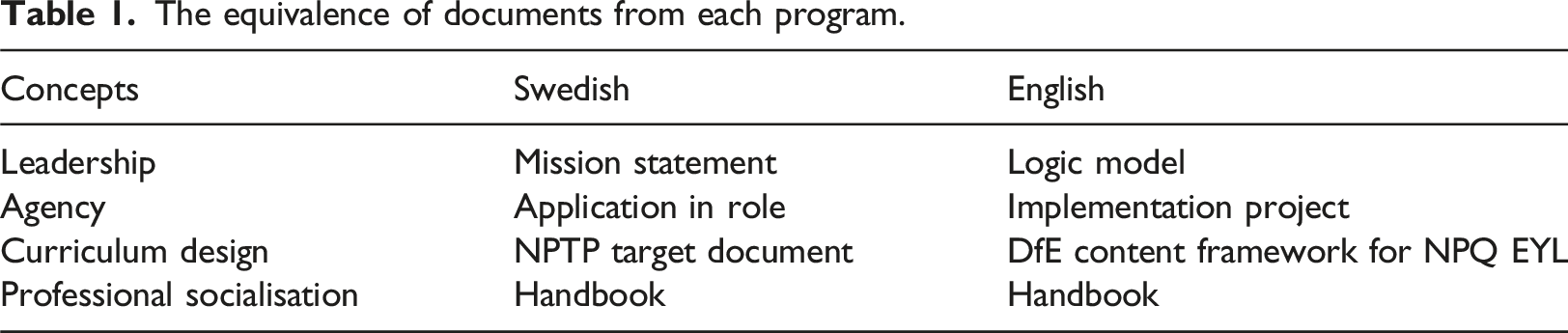
Taken holistically, four key concepts created a synergy between programs reinforcing the decision for a simple multiple case study with cross-case synthesis analysis.
Ethics
Ethical approval was sought and granted from the UCL ethical research committee for the data from England with approval number (
Limitations
A limitation of this study is the lack of generalisability as it is from only two national providers in each country and the design of each respective program does not necessarily represent programs offered by other lead providers in each context. A further limitation was the positionality of the researchers. This was mitigated by a collaborative approach to data analysis and interpretation including the English data being analysed by the Swedish colleague and vice versa, following Cohen et al. (2018) to reduce the risk of bias in interpretation.
Findings
Comparing features of the two leadership programs.
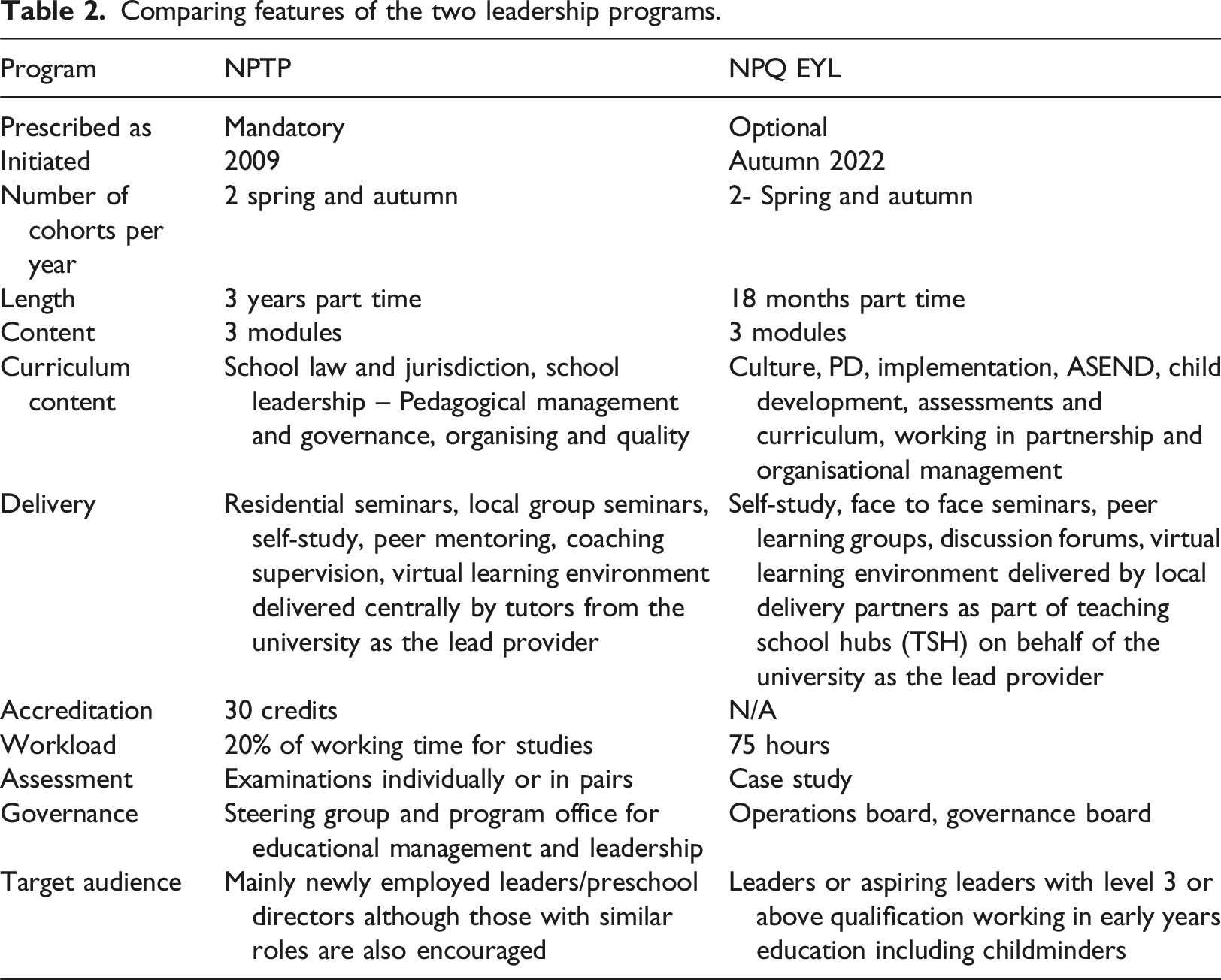
The data was affected by the recency of the NPQ EYL introduction in England compared with the relative longevity of the Swedish NPTP. It was important to recognise that the selected cases have similarities and differences. The main potential ‘contaminating differences’ (Yin, 2018, p. 198) are the difference in length of program and centralised delivery for Sweden versus the localised delivery for England. These are partly explained by the policy and contextual differences between Sweden and England. A key feature emerging from these differences is the quality assurance of participant experience and curricula fidelity from one central delivery mode to localised devolved systems. Mitigating against these features are a range of internal and external quality assurance or continuous improvement cycle actions taken by lead providers and externally imposed reporting and monitoring requirements.
Positive action to provide important professionalisation opportunities for early year’s school leaders is to be welcomed, and has been long established in the Swedish context, with the systematic training program originating from the 1970s. In contrast, the NPQ qualification originates from 1994, with the NPQEYL deployed in 2022. The NPQEYL is framed by inclusivity, in being the first large scale qualification without cost to settings which can be either from the state maintained or private sector, including registered childminders (Sakr et al., 2024). Professionalism is enhanced by the agency and autonomy of educational leaders, which is fostered through a recognised leadership program. Through engagement with the NPQEYL, participants can access high quality learning opportunities and be part of a professional network that works to support each other. However, a diminishing factor is that the NPQEYL has been implemented to enhance an educator’s existing qualifications and is not accompanied by a formal accreditation (PACEY, 2022). Consequently, whilst achieving a NPQEYL qualification may make a candidate more attractive in terms of their leadership knowledge and skills, it does not explicitly support career advancement.
A key feature of the Swedish model of professional ‘training’ is how it is underpinned by a formal university academic education with higher education credentials. This is in stark contradiction to the non-university organisations who are now controlling professional development in England, known as the ’Big Nine’ (Gibbons, 2021). The risk accompanying this move is that the ‘erosion of HE involvement and move to system agents as provider’ is unlikely to deliver educational leaders in early years who are capable of developing the system, but at worst develop leaders who are complicit in the perpetuation of the neo-liberal agenda promoted by government in England (Gibson et al., 2023, p. 166).
The Sweden practice-based approach is interwoven with the work of educational leaders (Jerdborg, 2022). Comparatively, government policy in England has promoted the development of knowledge-based skills approach, and potentially the de-professionalism of teaching and leading (Gibson et al., 2023). Increasingly English policies follow a system leadership approach in the professional development models for leaders (Gibson et al., 2023), which is exemplified by the determinist structure of the NPQEYL framework.
What has emerged in these case studies, are commonalities across the Swedish and English leadership contexts, where a common framework is being developed across countries and influenced by neoliberal ideology with comparative international data (Gibson et al., 2023). In Sweden, leadership training has also been in constant change (Ekholm, 2015; Norberg, 2019, p. 13). Norberg, has argued that the Swedish context has been influenced and manipulated through ‘three dimensions of politics and profession, national goals and local pre-requisites, and public and independent schooling’ (2019, p.13). These policy contradictions exist in both contexts which are framed by a neoliberal focus upon the state, market and goals:
Despite the evident distinctions and divergences in their approaches, both in terms of HEI involvement and national policy, and their different developmental trajectory in the last decades, the rationale for such a modus operandi stems from a common issue – that of the globalized neoliberal drive instigated by performativity and large-scale international assessments (Outhwaite et al., 2023, p. 264).
University led programs, such as the NPTP, must face the challenges of balancing their role as independent critical institutions with preparing leaders as ‘civil servants in a politically steered education system’ (Norberg, 2019, p. 13). This resonates with the NPQ EYL as, despite the differences in providers, in Sweden and England, there is a shared tension inherent in early years leadership. This paradox, arising from an era of performativity, has led to an onus on leaders to demonstrate data driven quality whilst balancing needs of children, a prescribed curriculum and regulatory frameworks against their values and ethos as professionals (Male & Ince, 2021). This creates implications for the development and the professional socialization of early years leaders.
Conclusion
This study examined the enactment of two leadership professional development programs in Sweden and England. In conclusion, we present suggestions on how leaders mediate the social systems against societal influences on organisations within a policy landscape. It is argued that this comparative case study is particularly insightful in the light of recent social and political changes. For example, additional recent challenges have emerged in Sweden such as the needs of refugee students, societal changes, market oriented educational contexts have created the necessity for leaders to develop new competencies. These are not explicitly visible within the curriculum content but are necessary for leaders to be effective. In England, this is exemplified by instability caused by potential changes in government, demographic trends, and a more politicised framing of initiatives. These challenges are not explicitly addressed within the curriculum content and leadership program design. However, they are implicit in the development of professional confidence and agency by early years leaders through the emphasis on leadership enactment. In Sweden this is enacted by the focus on application and professionalization of leadership, and in England through the implementation domain. Both programs recognise the importance of critical thinking and reflection.
Ethical dilemmas exist in both contexts in implementing policy which is underpinned by neoliberal ideology. Moss argues that current educational policy in England is ‘too subject to political diktat, with limited opportunities for genuine consultation with educational leaders on real problems’ (2023, n.p). Moss suggests an alternative paradigm to ‘the educator as a technician’ is to embrace truth, co-construction of practices, multiple knowledge, ‘democratic professionalism’, and welcome diversity and complexity (2010, p. 18). This has implications for curriculum content and programme design. A key recommendation is that leadership programs should take into account ‘local contexts’ and changing circumstances in which early years leaders operate (Gibson et al., 2023, p. 163). This also resonates with the diverse and unique contexts of early years settings in both Sweden and England.
Finally, it is suggested that future research could explore the key influences and challenges of implementing programs which aim to promote social professionalisation of educational leaders from a variety of lenses.
Footnotes
Acknowledgements
Thanks to Sara Bubb (UCL IoE)
Declaration of conflicting interests
The author(s) declared no potential conflicts of interest with respect to the research, authorship, and/or publication of this article.
Funding
The author(s) received no financial support for the research, authorship, and/or publication of this article.
Authorship
Amanda Ince: Conceptualisation, ethics, literature review, methodology, analysis, findings, writing, review and editing; Liz Bullough: Conceptualisation, literature review, analysis, findings, conclusion, writing, review and editing; Susanne Sahlin: Conceptualisation, literature review, analysis, findings, writing, review and editing.
