



Abstract
Schools collect enormous amounts of data, including in children’s first year of formal schooling. Having ‘data’ has sometimes been seen as a panacea, enabling teachers and school systems to quickly get to know children transitioning from preschool to school. However, there are recognised negative effects of datafication, including the “schoolification” of early years education, time impositions on teachers, and the potential for data to create deficit views of children. We present research with teachers and policy officers in a School Authority in Queensland, Australia. Utopia as Method was used to understand the dangers and potentials of data as school staff worked to create systems supporting quality early years teaching. We make a case for disrupting taken-for-granted practices and assumptions about data in favour of listening to teachers’ needs and hopes as they consider how data can best support their teaching of diverse children.
Introduction
The increased collection and use of data, often referred to as the “datafication of education,” (Williamson, 2017) has transformed education systems, including in the early years of schooling (i.e., prep to year 2). In addition to large-scale assessment, digital infrastructures and algorithmic capabilities now allow for data collection and analytics with unprecedented complexity and scope. These systems promise new ways of understanding individual children’s needs, while quickly identifying trends in classrooms, schools and school systems.
There is mounting evidence, however, that data have had negative impacts in the early years, contributing to the “schoolification” of early years pedagogies, in which school-like structures and pedagogies are taken up in early years settings (Bradbury, 2020). Further, datafied systems typically require significant amounts of time and energy of teachers (Spina, 2021), which is highly problematic in a sector characterised by ongoing workforce shortages. Another concern recognises that shifts towards measurement and comparison can lead to deterministic and deficit ways of understanding both children and teachers in early years education (Bradbury, 2021). That is, data and technology in education are seen through both a utopian and dystopian lens (Bayne, 2023).
It is in this context, driven by concern about the dangers of datafication while recognising its enormous potential, that this research project commenced. For this reason, Levitas’ (2013) Utopia as Method was used to explore how one schooling sector in a regional area in the Australian state of Queensland imagined new ways of supporting early years teachers through its approach to data.
This article presents findings from a qualitative research project that examined the collection of data enabled by digital technologies and a database platform used by teachers in the preparatory year of school (known as ‘prep’) in a school authority in Queensland. Prep represents the first year of schooling (prior to year 1), and is compulsory for Queensland children.
The paper, structured around Levitas’ (2013) Utopia as Method, is based on an ethnomethodological approach that involved talking to prep teachers, policy officers and regional support staff about their past and current experiences of working with data in the early years. We asked these participants to imagine what might not yet exist—how could data be used to best support early years teachers as they support children through the transition into schooling. In so doing, we aimed to understand the “everyday utopias” (Cooper, 2014) that already exist, as well as creating space for imagining new possibilities, through a lens of hopefulness.
Datafication in Early Years’ Education
In Australia, schools must have appropriate data platforms to collect and integrate multiple sources of data from all levels of education, including individual, classroom, school, region, state and international (Kerssenset al., 2024). However, a range of deliterious effects have been documented in the literature, resulting from the datafication of education. The collection of large scale data increases workload in schools, consuming significant amounts of teachers’ and leaders’ time (Spina, 2021). Teachers face time-consuming tasks such as data collection, entry and analysis across multiple data platforms (Selwyn, 2021).
Data use concerns in early years classrooms have documented early years teachers’ work in the UK, with Roberts-Holmes and Bradbury (2016) noting that teachers’ work has intensified and is increasingly dominated by data, revolving around accountability demands and performative pressures. In early years education in Australia, data-driven practices, as seen in the UK (Roberts-Holmes & Bradbury, 2016), have intensified these accountability pressures. Relatedly, while engaging with data can prove time-consuming for teachers, does it necessarily provide sufficiently rich evidence to support better outcomes for children and their families?
A second concern relates to how data have reshaped early years pedagogies. Bradbury’s (2020) work demonstrates how the rise of data in the early years led to an increase in formal teaching with a focus on literacy and numeracy. Relatedly, Clark (2022) points out that datafication has contributed to the acceleration of early years pedagogies, such as the need to produce data to indicate that children are “ready” for their next phase (such as the first formal year of school).
There are further concerns about the effects of using data to create comparisons and judgements of individual students, their capabilities and their futures (e.g. Bradbury, 2021; Spina, 2021). Pierlejewski (2024) writes that, for young children, datafication can represent a time when children: realise what they cannot do and in this process start to see themselves as the teacher sees them, in comparison to expectations and norms. This mirror of data produces a new subjectivity in the child: a subjectivity which is part data, part child. (p. 329)
This issue is especially important in the first year of schooling as parents and children alike transition into the school system and begin to see themselves through the lens of school-based language and data.
Finally, digital safety, privacy and surveillance remain a concern for researchers, schools, education departments and authorities as they work to understand and evaluate the risks associated with digital products (Pangrazio & Bunn, 2024). In attempting to minimise some of the workload pressures (Pangrazio, 2024) described above, many schools have turned to digital programs to collect and manage data by using platforms such as Google or Apple Education suites or apps such as Mathletics and Literacy Planet. Many of these programs offer subscription-only products or provide free apps in exchange for data (Rennie et al., 2019). An expansion of Learning Management Systems also means that a range of data, like “engagement” data, is harvested, typically without the consent of children or their families (Zomer, 2024). This use of data in schooling remains highly problematic because it is unclear how children and educators are being digitally surveilled (Smith et al., 2024), how children’s rights are being protected (if they are), and how teachers are using this evidence in their everyday practice (Pangrazio, 2024).
While the effects of data on regional, rural and remote (RRR) early years education and schools are underexplored, there is some evidence of unique tensions related to datafication. The affordances of technology and data in RRR schools points towards the hope that it may provide opportunities for closing persistent gaps in student achievement (White & Downey, 2021). It is doubtful that the situation can be resolved by data and technology alone given that RRR school leaders are likely managing limited resourcing, cultural/linguistic student diversity, shifting performance goalposts, and an unstable teaching workforce (White & Downey, 2021). Yet data collected in schools in RRR contexts are often examined and compared to metropolitan locations, which leads to schools described in terms of what is lacking, rather than what they have (Gouwens & Henderson, 2021). Datafication has further exacerbated deficit views of academic achievement in RRR and low socio-economic contexts, particularly between Indigenous and non-Indigenous students (Anderson et al., 2024), Further, RRR communities often have deep relationships and connections with parents, teachers and students, which can lead to more holistic views of a child (Davies, 2019) that are not necessarily compatible with large-scale standardised data.
Utopia as Method
Levitas’ (2013) Utopia as Method framework incorporates utopia as archaeology, ontology, and architecture. ‘Utopia as archaeology’ (p. 153) involves uncovering the underpinning logics used in political and social systems, to make visible the assumptions that drive current practices, such as how data are collected and used within school systems. This practice requires “piecing together the images of the good society that are embedded in political programmes and social and economic policies” (Levitas, 2013, p. 153). Levitas provides an archaeological account of meritocratic ideals in which competition and individual productivity are highly valued, raising concerns for marginalised or vulnerable children. ‘Utopia as ontology’ complements utopia as archaeology in that it explores how people see themselves in the present. Understanding how people construct the present is important because, as Levitas (2013) suggests, “any discussion of the good society must contain, at least implicitly, a claim for a way of being that is posited as better than our current experience’ (p. 177). Finally, ‘utopia as architecture’ serves as a critique, offering “positive proposals” and inviting writers to imagine alternative ways of being and organizing the world (Levitas, 2013, pp. 197–198). Our analysis examined how those working within a school system, including teachers and school leaders, worked with data, focusing on the interplay between how they saw themselves working with young children and how their views about data shaped their practice.
Study Design and Methodology
The research presented in this paper used a qualitative research design, with ethical approval from the university human research ethics committee (Approval No: 6726) and the Smalltown (pseudonym) School Authority ethics committee. This authority oversees 30 schools across 434,400 square kilometres including remote inland and island communities. The two participating schools in this project (Eucalyptus Primary School and Banksia Primary School) (pseudonyms) are located in different towns, and are classified as ‘outer regional’ (ACARA, 2024), as defined by the Australian Statistical Geography Standard (ASGS) remoteness indicator (Australian Bureau of Statistics, 2023).
Participants and Data Collection
Participants
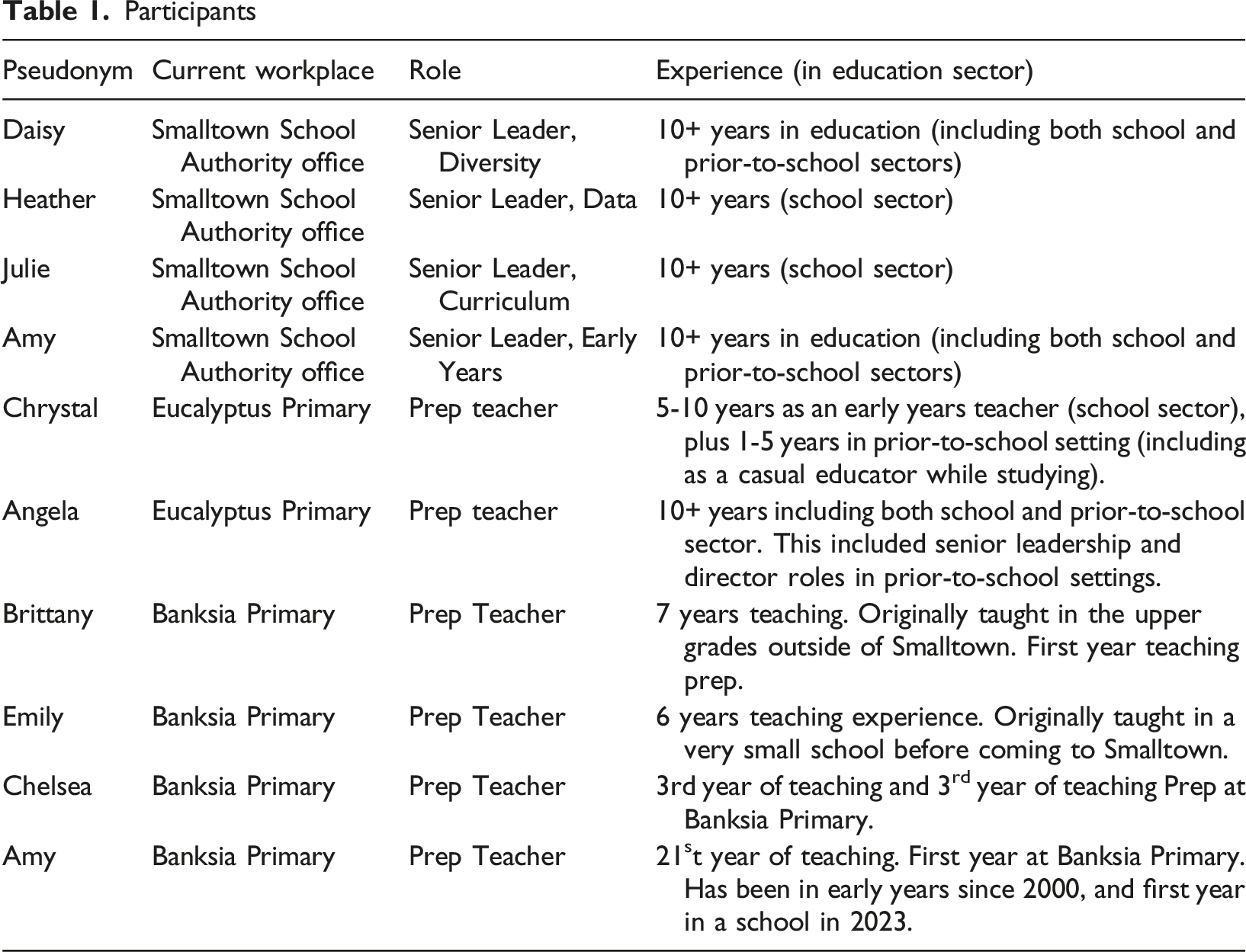
To help with recall, teachers received a document that outlined potential data sources that they might engage with during the school year (See Appendix 1). The document was produced based on the authors’ previous knowledge of assessment programs in schools. The school authority participants were invited to review the document and add additional data that they thought schools might collect. The document was not intended to be an exhaustive list, but rather a prompt to stimulate thinking. Data sources included transition statements from kindergarten, literacy and numeracy monitoring tools, digital teaching and learning apps, large-scale data (such as the Australian Early Development Census), and hearing and vision screening tools. In Queensland, kindergarten programs are offered to children in the year prior to prep, and may be offered on school sites, or in early childhood education and care settings such as long-day care. Approved kindergartens are required to complete a document known as ‘transition statements’ for every child enrolled in their program. These statements represent a summary of learning and development during the kindergarten year, which parents (in collaboration with kindergarten teachers) can elect to share with prep teachers to support their child’s transition to school. The focus groups were approximately 60 minutes long and were conducted at the end of 2023 on site at the two schools and the school authority office. The sessions were audio and video recorded and transcribed verbatim. All identifying information was removed and pseudonyms were used. Participants were asked semi-structured questions to prompt reflections, for example: What is the purpose of the data collected? Where is the data recorded? Who is the data shared with/sent to? How is the data used to support student learning?
Data Analysis
We drew on Braun and Clarke’s (2022) reflexive thematic analysis. The first step was familiarisation with the data, which involved the authors reading and coding the transcripts using a systematic inductive approach. Next, we developed themes by sorting, collating, and collapsing coding into more significant, meaningful themes. Next, we reviewed the themes against the Utopia as Method (Levitas, 2013) framework. At each stage, trustworthiness of analysis was ensured through dialogic reliability, which involved researchers engaging in thematic checks to determine if the themes were a reasonable reflection of participants’ talk.
Findings
Utopia as Archaeology
Teachers’ personal and professional histories shape their views of education (Osgood, 2011), including in RRR contexts. Participants’ experiences of being early years teachers in RRR contexts meant that data were seen primarily as a tool for collaboration and to support pedagogical practice. Smalltown School Authority staff and teachers viewed data not as a tool for judgment but as a resource for fostering collaboration, enhancing relationships, and addressing children’s needs.
Experiences of Working with Data as a Regional Early Years Teacher
A recurring theme found that data had the ability to spark strength-based conversations about education across geographic divides. This strength-based approach contrasts with deficit-focused or accountability driven uses of data, suggesting an alternate logic where data promote collaboration and equity. Catherine, from Smalltown School Authority, described the privilege of being “paid to sit and listen [to teachers] discuss their students as part of annual feedback sessions.” These meetings provided opportunities for each school to discuss student data, and its implications for teaching. The Smalltown School Authority staff viewed their efforts to support geographically isolated teachers as a commitment to equitable access to educational resources. In so doing, they challenged the assumption that isolated schools and students are limited by teacher (in)expertise and lack of educational opportunities. Heather said that, in some small schools with a small number of staff, teachers have limited opportunity to interact with other teachers and colleagues throughout the year. She shared an example of how she helped an early career teacher recognise a student’s exceptional achievement in a small, remote disadvantaged school about data: I said, you know what, that kid got the best result in the whole region and he’s sitting in your room.... [The teacher said] “okay, I understand. I had an inkling that he was clever. Probably didn’t appreciate that.”
Relationships were central to practice. The School Authority staff gave numerous examples of how they had prioritised relationships and rich discussions with teachers because they understood its importance for teachers who were geographically and professionally isolated. Julie, for example, talked about how she used data in her work with teachers: The conversations go beyond the actual test quite often… I’m just thinking of last week, a conversation around the general habits and behaviour and ways of working of a particular child. It’s the conversation. It generates a really rich conversation and that leads to... I do nothing except sit there and ask questions, frankly, but it leads to reflection and then people suggesting themselves other things they might do beyond this to monitor progress, patterns et cetera.
Teachers also valued data as a foundation for meaningful collaboration. Brittany, a first-time prep teacher, had worked only in remote schools, and reflected on the importance of the conversations with the Smalltown School Authority staff who provided guidance and resources for interventions. they [Smalltown School Authority staff] often give us like, uh, ideas and strategies on intervention as well. So different ways that we can take those certain kids and perform interventions and things like that. We had a math consultant come out 1 year as well who had written lots of intervention programmes and things like that that we could use, which was very helpful. Often they analyse the data before meeting with us as well. So a lot of it is us filling in the gaps of, “why do you think this?” or it’s a bit of both.
Brittany reflected on the benefits of collaborative discussions that often included leadership and allied health professionals. She said: it is such a beneficial meeting and having an inclusive education officer to sit and discuss those things with us is so beneficial. And our guidance counsellor jumped into our last one. Yeah... And we had a speech pathologist as well, she comes and offers us support ideas.
Relationships with families and community featured strongly in teachers’ talk, not unusual because regional schools often are strongly connected to living and working in the local community. For example, Chrystal described how she had been involved in a transition to prep day for kindergarten children attending the school the following year. Chrystal’s data collection, used to support her teaching in the new school year, included checklists and observation schedules to take notes about children and to identify possible pedagogic approaches. She said, “so just in a small rural school, you can do that. You have the luxury to do that”. For Chrystal, the “luxury” of time to get to know children and families was at the heart of her practice, which shaped her approach to how she collected and engaged with data. Like others, her talk returned to the value of relationships: I think the most important thing is to know your kids, know your families. But yeah, building those relationships. Because some of those parents I’m really good friends with now, because when you have small rural schools, you build those relationships. So, I think that’s probably the biggest thing.
These practices reflect an alternate logic of data use in education, challenging accountability-driven narratives and emphasising collaboration and relationality. These findings align with Levitas’ (year) utopia as archaeology framework by uncovering the normative assumptions shaping practice to reveal a vision of education grounded in the ideals of support and inclusion.
Utopia as Ontology
Levitas (2013) argues that the value of utopia as ontology is that it enables reflections on what “the good society must contain, at least implicitly, a claim for a way of being that is posited as better than our current experience” (p. 177). In this study, school staff offered perspectives and practices that reflected a vision of education that contrasts with a deficit-oriented view and accountability-driven perspectives associated with datafication (e.g., Bradbury & Roberts-Holmes, 2017). Teachers viewed themselves as educators committed to relational, strengths-based approaches, while Smalltown School Authority staff saw themselves as facilitators of relationships and supporters of teachers. Two key themes emerged: the value of time for conversation and relationships, and the adoption of strengths-based approaches to managing and using data.
Time for Conversation and Relationships
Teachers described themselves as talking openly and frequently about data with each other, with families, and with school leaders and staff at the school authority. Data collected through conversations and site visits supported smooth transitions to school, particularly for children with additional needs. Chelsea, a teacher, described how these processes helped identify and address students’ needs: So, knowing how high his needs were, the school set up lots of site visits that I could do at [early learning centre], different little programs that he was going to. So, once they knew – they knew pretty early that I would have him the following year, so I was visiting quite regularly in Term 4 to get to know him and start adjusting to his needs.
Chelsea described how the school facilitated a tailored, supportive transition process: So they will start, like making a PowerPoint for that child saying like, “this will be your teacher”. They’ll walk into the classroom [with the child and show them around and say] “Your classroom looks like this, your water bottle will go here”.
The co-location of a kindergarten with Banksia Primary facilitated further collaboration.
It was not difficult to arrange for days for kindergarten children to visit the school (which supported transitions to prep) and for conversations between kindergarten and prep teachers. Angela, a prep teacher said: a lot of the information that we get or the most useful information that we get is what we actually get to see for ourselves and having those conversations with, like, we actually got to speak to the kindy teacher. Yeah, we found that the most beneficial. And we’ve been really lucky this year. One of our other teaching partners actually was a kindy teacher last year. So she has been, a wealth of knowledge. So I think, yeah, out of everything, talking to them in person has been the most useful when you can be really honest and yeah, I think has been the most beneficial for us.
While this work did involve an imposition on teachers’ time, Chelsea and other teachers described how taking the time to develop relationships with colleagues, school authority staff, parents and health professionals was central to their role. The documentation of information was seen as important for informing practice whilst enabling teachers to see student growth. Chelsea commented: you don’t often see the growth...until you’ve actually entered the data and gone back and had a look... because you’re constantly behaviour managing or moving through the curriculum...the data shows that they are actually making progress.
Smalltown School Authority staff viewed themselves as facilitators of relationships, using data to prompt conversations of support. They worked to connect teachers with allied health professionals based on needs identified in student data. Daisy said that her “big” work was developing the capacity of teachers, and that she was intimately involved in “breaking open the data around the early years testing” because it was essential in understanding how to best discuss students’ support needs in the transitions to prep. An essential aspect of this work was described as talking to and working alongside teachers: “So we do meet the teachers… and have a conversation with them”. This information supported the provision of curriculum advice, facilitation to access to allied-health professionals and built teachers’ confidence in supporting students. Teachers affirmed the value of these conversations. Chrystal, for instance, said of an early years dataset collected by all prep teachers working within the Smalltown School Authority: Yeah, it is the most beneficial piece of data that we do have…And they talk about our data where our students are, “Who are the ones that we need to be concerned about? Which ones we need to push further?
Chrystal continued to talk about how Smalltown School Authority staff facilitated key stakeholders (e.g., speech pathologists) to attend meetings where there would be feedback shared about data. Chrystal said the nature of the conversations was useful, and she gave examples of how she would interact with others in meetings; for example saying, “‘OK, that’s on the speech language issue. That’s why [this student has] struggled in the speech language section of the test’. I really like that.” She also described how these meetings helped her to have better conversations with parents about their children’s learning and needs.
Strengths-Based Thinking and Moving Beyond Deficit: Using Data to Support Children
Teachers resisted deficit views of children, instead using data to highlight their strengths and needs. Conversations with parents focused on removing stigma around labels and helping families to understand how data could support children’s success. Chrystal said: I know a lot of parents fear labels, and they don’t want their child labelled. But at the end of the day... it’s trying to get the stigma out… It gives us an explanation as to why the child can’t handle loud noises. OK, now we can …help them achieve, and to help them come to school – not just come to school but to do things at school.
The teachers at the two schools involved in the research talked about how they used observations and formative assessment to regularly refine their teaching, and to meet the needs of the diverse children. Chrystal said that formative assessment data was discussed regularly with her colleagues and that “it shows, OK, they don’t have that concept yet. That’s what we need to work on in the next few weeks. And that’s what our next steps are.” Like the teachers, Smalltown School Authority staff looked for ways to improve teaching in Prep. For example, data collected from schools was used by staff to look for areas across the region where the authority could provide better support. Amy reflected that: a lot of children within the region did really poorly on the language questions on the screening tool... What does that mean for us? What support do people need in terms of development of oral language in class? I think there is scope for us to do that.
A final point is that teachers in the early years of schooling described positive, collaborative relationships with parents and families. They reflected on the importance of supporting parents for when children commence formal schooling (in prep). Angela said that “It’s always hard. It’s hard being the first teacher, too”, referring to parents of an only or eldest child who might not have had experience of parenting school aged children. She reflected that, regardless, “It’s really lovely that you can have those conversations on an ongoing basis” and that having data to support these exchanges was an important tool for prep teachers.
The practices described in this study reflect an alternate ontological positioning to that often described in the literature, which is primarily deficit-orientated. Rather, this study found that data serves as a resource and tool for fostering equity, collaboration, and relationality. This vision, in challenging the dominant narrative of data, emphasises its potential to build relationships, support growth, and create inclusive educational environments. Levitas’s utopia as ontology provided a lens for illustrating how a focus on relationships and strengths-based approaches made possible a “good society” grounded in support and inclusion.
Utopia as Architecture
Utopia as architecture provides a framework for understanding how participants imagine the future might be different from the past or present. Both teaching and school authority staff envisioned data systems that empower teachers and support students by fostering collaboration, ensuring teacher agency, and enabling timely interventions. These ideals reflect actionable, positive alternatives to traditional accountability-driven data practices, brought to light through Levitas’s (2013) concept of utopia as architecture. Two key themes emerged: the design of data systems to prioritize teacher agency and collaboration, and the importance of timely, needs-based support.
Data Systems Framed Around Teacher Agency and Collaborative Conversations
Ensuring teachers have time to engage in collaborative conversations with stakeholders was described as essential in the design of data systems. Teachers and school authority staff imagined a future where the purpose of data was to spark conversations, and to generate further shared opportunities for reflection and planning. Unsurprisingly, several teachers at both schools talked about workload and the need to build in “more time” for these essential conversations.
Upon self-reflection, teachers made suggestions including ensuring teacher agency about what data is collected. For example, Chelsea commented that collecting and entering data could be “a little exhausting and time consuming” and reported that the prep teachers had discussed that they were “losing teaching time”. Acknowledging the importance of seeing growth in student learning because of one-on-one assessments (such as reading running records), she suggested that having someone come in and complete the testing would be valuable so she could keep teaching.
In reflecting on workload management, teachers described the importance of being able to give feedback on relevant data in light of the time spent on data collection. Brittany, for instance, talked about the introduction of an online mathematics program being trialled at Banksia Primary, and the challenges of having children complete the expected tasks. She described that “having [children] type the answer themselves or click on certain things” took a significant time to do, which meant that the program was not used frequently. Like her teacher colleagues, she suggested that one way forward would be ensuring teachers have input into what data were collected, and continue to contribute new ideas about what was working and what was not. This approach, she believed, would enable data systems enough flexibility to be “purposeful” and ensure all data collection revolved around the needs of early years’ teachers.
Brittany acknowledged that this approach might mean “upskilling” support staff to ensure they were able to provide teachers with appropriate support. Angela, at Eucalyptus School, expressed a similar view, saying that appropriately skilled support staff were essential in ensuring data collection could be completed in a consistent manner, so that reliable and useful data was generated.
Brittany reflected that being in a somewhat larger regional school (Banksia) had been different to her 7 years of teaching at a remote school, because there was more IT and administrative support at Banksia. This included school wide templates for lesson and curriculum planning, data collection and assessment; minimising teachers’ time spent on creating individual data collection approaches. Brittany went on to express her hope that all teachers would have sufficient support in managing data collection, which would enable teachers to focus their attention on quality pedagogical practice, creating comprehensive datasets that could be shared as children transitioned into higher year levels, and relationship building. A good data system for early years teachers, therefore, would be designed to provide purposeful, reliable information to ease the transition to school could be discussed with stakeholders, including colleagues, support staff, allied-health workers, kindergarten teachers and parents that.
Data Systems that Enable Timely Support
Dialogue about student data contributed to a more nuanced and comprehensive understanding of students’ learning and development needs. Using data to work alongside health professionals and support staff was identified by teachers and the school authority as being essential. Much of this work was already in place across the Smalltown School Authority, and teachers talked about the importance of maintaining these structures. Susan, at Banksia said, “they come in quite regularly actually to help work with me and him as well with the planning side of things and tracking his progress.”
Unfortunately, teaching in a RRR context means that access to allied health services (e.g., hearing and eye tests, speech pathology) could be slow due to long wait lists. Teachers said that they sometimes did not access support due to lack of availability. Teachers in both schools identified a desire for more purposeful data in relation to health and allied health, to trigger support as children transitioned to school. Chrystal, at Eucalyptus Primary, imagined a system where referrals for hearing and vision could be completed before children started school, and this would be valuable because “if we had that before they start, and on record, that might make that process smoother”.
Teachers and the school authority’s visions reflect a fundamental shift in the purpose of data systems, emphasizing collaboration, teacher agency, and timely support. These imaginings, made visible by Levitas’s utopia as architecture, offer a blueprint for reimagining data as a tool for equity and empowerment. By fostering collaboration, addressing systemic barriers, and prioritising the needs of teachers and students, data can support a more inclusive and relational education system.
Discussion and Conclusion
While the dangers of datafication are often highlighted in the literature, it is clear that data use in education is here to stay. This article applied utopian theory and demonstrated “everyday utopias” in existing practices (utopia as ontology) and new possibilities for improving data systems (utopia as architecture). In our work with the Smalltown School Authority and early years teachers, we (unexpectedly) found a group of diverse educators who embraced data collection systems that were used to foster meaningful conversations, enabling them to better understand and support children and families. The educators’ practices reflected a resistance to deficit-driven and accountability-focused uses of data, instead aligning with O’Neill’s (2013) concept of ‘intelligent accountability,’ where parents, students, teachers and other stakeholders collaboratively address students’ needs.
This study uncovered normative assumptions embedded in teaching and school system practices (utopia as archaeology), such as the belief that data should empower rather than control, foster equity and collaboration rather than comparison and competition. The everyday utopias unearthed in this research appeared to be possible because data system at Smalltown was built around the practices of “reciprocal accountability” (Darling-Hammond, 2010, p. 280), where the regional focus was on supporting teachers, rather than monitoring and applying performative pressure on schools. The school authority and teachers alike talked about the importance of working together and using data to prioritise teacher support and appropriate resourcing. By exposing these underlying logics, this research provides evidence that it is possible to rebalance accountability structures to better support early years teachers and students. Participants’ views around future possibilities point towards the importance of building data practices that value relationality, support for teachers and reciprocal accountability.
The teachers and school authority articulated an ontological positioning that emphasised relationality and strengths-based conversations. Teachers saw themselves as collaborators, using conversations about data to build genuine relationships with colleagues, children and families. They saw data as a resource for understanding and meeting all students learning needs. Teachers and the school authority proposed ideals for the implementation of the data system (utopia as architecture) so data could be purposeful for teachers and enable systems to provide timely support for teachers. In turn, they could see opportunities for reducing workload, encouraging teacher agency and ensuring timely access to allied health services.
We are not suggesting that critical concerns should be ignored. Issues such as digital privacy and surveillance remain vitally important, and we concur with Paananen et al.’s (2024) argument that early childhood education research must continue to engage in critical scholarship. As Bayne (2023) describes, “while digital technology has long been one of the tropes through which ‘futures’ are filtered in public discussion of where education is headed, critical research in the field rarely sees it as utopian” (p. 506). We have worked to bridge this gap, by engaging with teachers and staff in a school authority to understand how they engage with datafication, enabled by digital technologies, such as data dashboards, in an educational setting.
In conclusion, our findings highlight the potential of data to create “everyday utopias” (Cooper, 2014), built on strong relationships between teachers and school authorities. Our research shows that it is possible for education authorities and departments to develop data systems that are structured to prioritise genuine conversations to support the needs of teachers and students. For example, data can be used to advocate for enhanced allied health services and support staff in regional areas. To understand the utopian potential of data, continued research about data usage is needed. Mascheroni (2020) argues that more research is needed that acknowledges the lived experiences of those who encounter datafication in their everyday work. Our aim was to contribute to this agenda with productive imaginings about how to better support children and teachers in the early years of schooling. While this is a small study in one regional context, the findings uncovered some possible benefits of data usage, when used in ways that have a strong focus on teacher agency, collaboration and support, rather than accountability. Further research is required to determine whether these findings could be adapted to other similar regions or contexts.
Footnotes
Acknowledgements
This project was supported by the Australian Research Council Centre of Excellence for the Digital Child through project number CE200100022. We would also like to thank Dr Rebecca Ng (University of Wollongong) and Professor Grace Sara (Queensland University of Technology) for their advice and support during the conceptualisation of this project.

Funding
The authors disclosed receipt of the following financial support for the research, authorship, and/or publication of this article: This project was supported by the Australian Research Council Centre of Excellence for the Digital Child through project number CE200100022.
Declaration of Conflicting Interests
The authors declared no potential conflicts of interest with respect to the research, authorship, and/or publication of this article.