




Abstract
National Assessment Program for Numeracy and Literacy (NAPLAN) is the national assessment programme for literacy and numeracy in Australia administered to children in Years 3, 5, 7 and 9 each year. The testing process was introduced in 2008 and is described by the developers as low stakes, however, research has highlighted that this is not the case. This paper examines the perceptions of teachers in the early years of school on the impact NAPLAN has on wellbeing of stakeholders, and the pedagogy and curriculum in early years teachers’ classrooms. Through focus group interviews, the early childhood teachers in 10 independent Western Australian school sites were asked about their experiences of NAPLAN in terms of their wellbeing and that of the children and families with whom they interact. Findings highlight that early years teachers describe that the impact of NAPLAN is felt in the lower years of school by all stakeholders-parents, children and teachers. This study highlights the need for additional research in this area, particularly in diverse settings, to gain evidence of impact that could inform the practice of the NAPLAN testing programme.
Introduction
It has been just over 10 years since the Australian government introduced the National Assessment Program for Numeracy and Literacy (NAPLAN) in 2008. The programme was introduced by the Australian Curriculum, Assessment and Reporting Authority (ACARA) to measure literacy and numeracy skills and knowledge as these skills are seen to provide the critical foundation for other learning. The NAPLAN tests are administered in May of each year and the results of these tests are shared with schools in August/September with the objective of providing opportunities for schools to target improvement in identified areas. Overall school NAPLAN results have been made publicly available via the MySchool website since 2010 and online testing platforms have been trialled for wider implementation in 2019.
Although the national testing process has been the focus of much research, there are few studies that have examined the impact on wellbeing of all stakeholders and even less on the impact on teacher’s pedagogy and curriculum decisions in the early childhood years. This paper reports on an element of a larger study focused on the impact of NAPLAN on stakeholder wellbeing, including that of the children. Specifically, this paper examines the perceptions of early years teachers on the impact of NAPLAN on themselves, the children and families in their classrooms, as well as any perceived impact the testing programme has on their pedagogy and curriculum.
Literature review
The effects of standardised testing have been debated across the globe, with different countries taking alternate viewpoints on whether or not to test, how and when to test and the value placed on the test results (Thompson, 2015). In a review of standardised testing across 10 countries, Salaky (2018) identified that the amount of testing and the stakes of these tests vary greatly. In the United Kingdom for example, there are numerous standardised tests throughout the schooling system that determine levels of achievement for students. This places less pressure on students than the one test model used in Finland and China at the end of the high school experience that has consequences for career choices and further study. The USA is reported to have the highest number of tests with students being tested almost annually to measure against prescribed outcomes (Salaky, 2018).
In Australia, the benefits of the NAPLAN programme have been described as (a) the improvement in education through the use of nationally comparable data to target reforms and (b) accountability of the education system (ACARA, 2016). NAPLAN is administered to all children in Australian schools in Years 3, 5, 7 and 9 in May of each year and include four individual examinations covering skills in reading, writing, spelling, grammar and punctuation, and numeracy. The results of the tests are measured against National benchmarks to provide statistics of whether children are within expected bands and how they compare to other children in their year level as well as across the country. Results are shared with schools, an individual report is sent to parents and school results can be viewed on the MySchool website where the public can compare schools scores.
While the NAPLAN tests are proclaimed by the ACARA to be low-stakes, there has been criticism that the process fosters unhelpful competition amongst schools and has led to the narrowing of the curriculum (Hardy, 2015; Polesel, Rice, & Dulfer, 2014; Thompson & Harbaugh, 2013). In Western Australia, the NAPLAN testing data are described as a key performance indicator of school performance and poor NAPLAN results can result in an external school audit (Department of Education, 2018). Furthermore, failure for students to reach benchmarks in Year 9 NAPLAN facilitate the sitting of another test, the Online Literacy and Numeracy Assessment in Year 10, that effects gaining a Western Australian Certificate of Education (WACE) that signifies the successful completion of high school (SCSA, 2014). Such initiatives make the process high-stakes.
A number of studies into NAPLAN have suggested that there is an overall negative impact on curriculum and wellbeing from the testing. Dulfer, Polesel and Rice, (2012) surveyed over 8000 teachers nationally across primary and secondary contexts and identified that despite ACARA suggesting the need only for familiarisation of the test, 30% of the teachers in NAPLAN years reported practising the test three to four times in the two weeks before implementation. It was identified that this amplifies children’s self doubt and adds to the pressures of an already crowded curriculum. A detailed literature review by Polesel, Dufler and Turnbull (2012) concluded that the publication of school results led to NAPLAN being high-stakes and led to a focus on low-level skills, altering teacher pedagogy and narrowing of the curriculum to areas that are being tested. The narrowing of the curriculum with a focus on some aspects of literacy and numeracy at the expense of other content areas, and teaching that was much more structured to align with the testing processes, was also found in other studies (e.g. Australian Primary Principals Association (APPA) 2013; Ward, 2012).
More specifically to early childhood, Roberts-Holmes and Bradbury (2016) in the UK identified some concerns in terms of specific testing regimes which interpret literacy and numeracy in particular ways that were narrowing teacher’s pedagogy in the early years. The identified increase in formalised learning is described by Little and Cohen Vogel (2016) as a pushdown of accountability by having students perform more academic tasks earlier and educators being pulled up by accountability measures from above for students to be ready to perform well in tests in other grades. The high stakes nature of NAPLAN results have been described as ‘“metapolicy” steering early years pedagogy “from a distance” (Lingard, Martino & Rezai- Rashti cited in Roberts-Holmes and Bradbury, 2016, p. 120). In this way, young students are seen as the “school’s statistical ‘raw materials’ that are mined and exploited for their maximum productivity gains” (Robert-Holmes & Bradbury, 2016, p. 124).
The push-down pressure has been specifically noted in Western Australia where the focus on academic skills and the ‘schoolification’ of the early years (Barblett, Knaus, & Barratt-Pugh, 2016) flows in direct contrast to the implementation of the National Quality Standard (NQS) (ACECQA, 2012) in schools from Kindergarten up to Year 2. Jay and Knaus (2018) found that in the early years (including non-compulsory years levels such as Kindergarten) the “focus on academic skills changes the pedagogical practices and the learning becomes more teacher-directed and instructional” (p. 115). Such teaching does not consider the age-appropriate pedagogies expected in the early years (Department of Education and Training, n.d.) and as outlined in the practices of the Australian Early Years Learning Framework (EYLF) (Department of Education, Employment and Workplace Relations (DEEWR), 2009). A pushed down curriculum and the expectation for students to master materials beyond their capabilities not only was found to increase child stress but also often impacts on classroom practices that impinge on children’s right to play and leisure (Unicef, n.d.).
This paper is drawn from a wider study of NAPLAN and student, staff and parent wellbeing (Rogers, Barblett & Robinson, 2016, 2018). The focus of this paper is on early years teachers’ perceived impact of NAPLAN on the wellbeing of children, families and themselves, and pedagogy and curriculum in the early years of school. In Western Australia school starts for children at 3.5 years of age in a non-compulsory but universally attended Kindergarten class. For this element of the study, the research questions are: What are early years teachers’ perspectives of the effects of NAPLAN on various stakeholders’ wellbeing? How do early years teachers believe that NAPLAN impacts their pedagogy and curriculum?
Theoretical framework
This research adopted a phenomenological approach to describe stakeholders’ views of NAPLAN. Van Manen (1990, p. 177) suggests that the purpose of phenomenology is to describe the universal essence or ‘the very nature of the thing’ or what Kant would describe as the phenomena – in this case the experience of NAPLAN (Payne, 1997). By exploring the narrative of the early years teachers through focus group interviews, the goal was to reach an understanding of the participants point of view (Steinberg & Cannella, 2012) and reveal the meaning that NAPLAN has for these people within what Merleau-Ponty describes as their lived experience (Payne, 1997).
Participants
This study was conducted with funding from Association of Independent Schools of Western Australia. Eighteen metropolitan schools that were members of the Association of Independent Schools of Western Australia (AISWA) were contacted by the research team to request participation in the study approximately two months prior to NAPLAN testing. Ten schools accepted the invitation to take part in focus groups. The 10 participating schools were above the median level (1000) of socio-educational advantage as determined by the ICSEA published on the MySchool website (www.myschool.edu.au). Actual values ranged from 1051 to 1182 with a mean of 1148. In this group eight were large schools catering for students, K to Year 12 and two were primary schools from K to Year 6. Thirty-eight teachers participated in the focus group interviews, mainly from Kindergarten to Year 2 with a small number of early years subject specialists such as Arts or language remediation who taught in multiple year levels across the early years.
Data collection
Focus group interviews
Focus group interviews were conducted with early years teachers as well as some teachers who worked in specialist programmes that serviced multiple classrooms. The semi-structured 45-minute interviews were conducted by a facilitator in the 10 school sites at the end of the school day. The interview questions are included in Table 1, however, the facilitator allowed for teachers to elaborate or pose questions to others in the group.
Focus group questions.
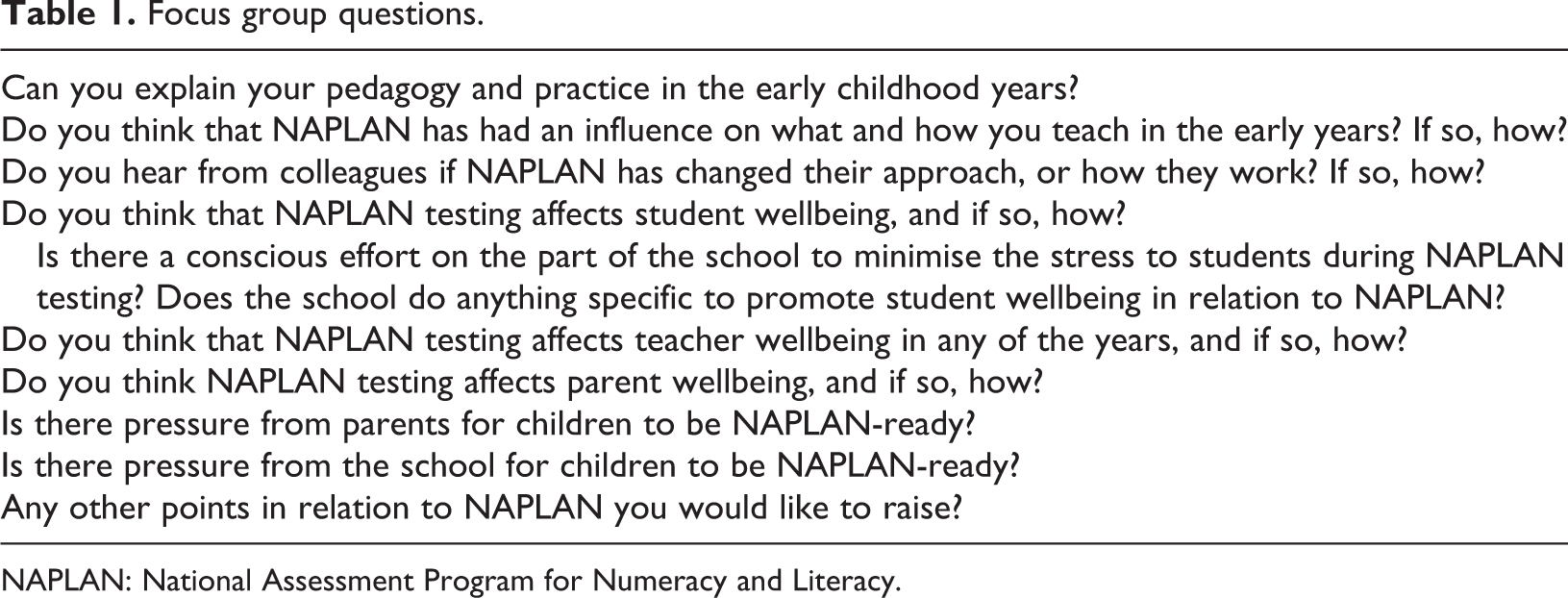
NAPLAN: National Assessment Program for Numeracy and Literacy.
Ethical considerations
Ethical permission was gained from the University Ethics Committee and then the school principal for school staff involvement. All participants were asked and gave informed signed consent prior to being involved in the research. The focus group interviews were audio recorded and transcribed with participant permission.
Analysis
The qualitative data from the focus groups were examined through a process of coding and chunking to assign “units of meaning to the descriptive or inferential information compiled” (Miles and Huberman, 1994, p. 56). The semi-structured nature of the interview meant that the question responses provided the first layer of analysis to identify patterns across the focus groups on the original set of questions (Table 1). The second layer bundled these responses into themes to allow the narrative of the participants lived experiences to be identified. This level of detail or ‘specificity’ allowed the “researchers to scrutinize the data to explicate the conditions that produce the study data or phenomenon” (Denzin & Lincoln, 2011, p. 371). In this case, the point of view of the early years teachers of the impact NAPLAN has on the wellbeing of stakeholders and the pedagogy and curriculum in the early years was sought. Through the grouping of similar responses, patterns were recognised that then allowed the findings from the interviews to be identified and reported.
Findings
In examining the data collected from the focus group interviews with the early years teachers, a number of similarities were identified. The participants across the focus groups reported concerns surrounding the effect of NAPLAN on wellbeing for themselves, the children in their classrooms and their parents. They also identified impacts on the curriculum in their schools (and other schools they had taught in) through the focus on numeracy and literacy-based tasks. To a lesser extent, the groups raised concerns about the MySchool website, the fairness of NAPLAN, and the time of the year the tests are conducted. Each of these is expanded below with quotes from the transcripts to support the inclusion of the theme.
Early years teachers’ perceptions of the impact of NAPLAN on wellbeing
A number of the focus group questions related specifically to the early years teachers’ perspectives of the impact of NAPLAN on wellbeing of stakeholders. The early years teachers reported concerns for themselves, the children in their classrooms and the parents of these children. They also had stories of the impact on other teachers they knew in other schools but these are not included here as the focus was on the lived experience of the teachers in the focus groups.
Teacher wellbeing
Early years teachers’ perceptions throughout all the 10 school sites was that NAPLAN testing did adversely affect teachers’ wellbeing, particularly for those teaching in the NAPLAN years. Some respondents said they felt pressure from their school, while others thought there was little external pressure but they felt a professional responsibility to ensure their students were prepared. Numerous participants also described the want to fulfil their desire for their students to do well. They described placing pressure on themselves especially if students did not do well. This pressure was also found in teachers in between the NAPLAN testing years. Teachers described feeling stressed about being blamed for poor results: ‘I think that, even as the Year 2 teacher, because you’re like, “Oh, I had them last year, it’s probably my fault”’ (School 1).
Nine of the 10 focus groups cited stress and anxiety as manifestations of the pressure they felt in the build up to and during the testing itself. An early year’s teacher said: ‘When I was in Year 3, I did used to get quite stressed about it.’ And ‘It’s just a…it’s a lot of pressure’ (School 8). Another teacher described: When I was in Year 3, and I think there’s a lot of pressure once those results come back. And you have to then contact each parent where the child is under the bar and explain why and how you’re going to actually move that child forward and what strategies you’re going to put in place. But the teachers in Year 3 and 5 do have extra stress levels. (School 2)
As well as pressure from the school and themselves, the teachers in four of the focus groups cited expectations from parents as another factor contributing to this pressure. One teacher reported: I have heard parents having conversations about their friends, whose children go to other schools, and things like, ‘They do NAPLAN practice every Friday, why aren’t we doing that at….?’ (School 3) ‘It did come up for me…around the persuasive writing. Because I had children that were distressed, and so I had emails, and parents coming in going, ‘What happened?’ Or very worried about this, very anxious. (School 4)
Perceived student wellbeing
The majority of participants (8 of the 10 focus groups) felt NAPLAN testing affected all early year students’ wellbeing even if only to a small degree. Across the 10 schools and 38 teacher participants, only four kindergarten teachers, one pre-primary teacher and two Year 1 teachers from two different schools claimed that NAPLAN testing did not impact student wellbeing in the early years in their schools. One teacher said, ‘For us at the lower end, we don’t see it. We’re sort of our own little bubble over here’ (School 10).
For the other teachers, one of the main concerns was that the testing process is not part of the regular curriculum and that this change in routine may cause anxiety in students taking tests. One teacher said: ‘They’re nervous. It’s not the style of teaching that they’re used to on a daily basis. Therefore, a test, and the build up to it, and the prep for it, it makes them anxious’ (School 4). Another teacher spoke of the contrived testing environment as she said: ‘I think the whole testing environment is just not normal…having to sit in silence for 40 minutes, not talk and not move, that’s stressful to any child I think’ (School 3). Some responses also indicated that the stress was not all a result of school practices but that some of the pressure comes from parents or older siblings in the home environment. One teacher described this as she said: And a lot of it doesn’t come from the school, it comes from the parents. You know, they’re talking about the test. We downplay it totally here, but still, some of those kids are very anxious’. (School 7) There’s pressure from home as well, I think, for them to be achieving really well on those sorts of tests. And I know that when I was in Year 3, like the parents would have the practice books as well, and were working through it with them on weekends and evenings after school’. (School 8)
Some of the teachers described the strategies the school put in place to minimise the anxiety of the NAPLAN test. School 2 did yoga with the Year 3s and taught mediation strategies while School 4 made sure staff were available and observing for any concerns in behaviour. Teachers from School 5 also described that school downplayed the tests to help alleviate any concerns. A notion that was common to many of these schools was one communicated to students: ‘It’s one test, on one day, we ask you just to do your best’ (School 5).
Perceived parent wellbeing
Nine of the ten groups of participants felt that parents’ wellbeing was adversely affected by NAPLAN testing. Early years teachers described parents becoming anxious in anticipation of their student’s NAPLAN performance by saying, ‘The parents are high achievers and want their children to do well, and it’s about the prestige of doing really well in NAPLAN’ (School 9). There was general agreement amongst all groups that parents wanted their children to do well. This was exemplified when a teacher said: They all want their kids to do well, they’re very interested in their children’s education. It’s one of their priorities of their life and, you know, they don’t see it as being one test on one day, and the child might, not be feeling 100% that day. (School 8)
Other teachers spoke of parents taking up a self-appointed Education Assistant (EA) role, buying NAPLAN-related texts to help their child, and teaching at home. Indicative of this was the comment in one focus group: I’ve had more and more parents come to me with resources that they buy from [shops], off the shelf, and say, Will this help my child in the NAPLAN test that’s coming up in the following year? So, they’re wanting reassurance that they’re preparing their children at home, as well as teachers are preparing their children. (School 5) Carpark gossip is, oh, ridiculous. Whether…how the kid did, and where their…which dot their kids got their band on, or whatever it is. It…and it’s crazy. It can…turn into a big competition’. (School 6)
The perceived influence of NAPLAN on the early years curriculum and pedagogy
Early years teachers across all schools noted there had been changes in curriculum and the way that they taught over recent years. The majority (nine out of 10 focus groups) felt NAPLAN had influenced the changes; although some within these groups were not sure if it was due to NAPLAN or to the Australian Curriculum pushdown. Most of these teachers were comfortable that they had been able to weather the changes in curriculum and still used early childhood pedagogies such as play-based learning. One teacher said: ‘If our results weren’t good, I’m sure there would be pressure’ (School 6).
Despite feeling that they had maintained early years pedagogies, the teachers reported in some schools an erosion of time spent on child-initiated and play-based activities in favour of more didactic teaching methods and a concentration on literacy and numeracy knowledge and skills. One teacher commented: Yeah, definitely. Last school I was at, they…every morning…the whole school was doing maths and then the whole school (K–Year 6) was doing English. Just so that they could get the kids ready for, like, literacy and numeracy, and doing it for an hour and a half’ (School 6).
Other issues associated with NAPLAN identified by the early years teachers
In addition to the larger issues of wellbeing and curriculum, the focus groups raised additional concerns such as the timing of the tests, the fairness of the test and the MySchool website.
Timing of the tests
The timing of the tests came up in half of the focus groups. Some teachers thought that they came up too early in the year when teachers were still building relationships with their students and the parents. Others questioned whether Year 3 was too young to start NAPLAN testing. One teacher said: ‘Why always at the beginning of the year?’ (School 1) and another ‘at Year 3, I just think it’s so young. For them to do a written piece in 40 minutes is really hard’ (School 2).
Fairness of the tests
In three of the focus groups, the early years teachers spoke about NAPLAN not being a fair test while a further four identified that is was not a reflection of what the student can do. One teacher said, ‘Just that it’s quite concerning that so much emphasis is put on one test at one time, on one day, for one group of kids. I just think it’s completely unfair and inappropriate’ (School 10). Another described her concern for children from minority cultures or who had English as a second language when she said: What about different kids. You get, like, the indigenous children, and what we’re trying to teach them might not be good life skills for them, you know, like, them not being able to do, you know, the maths test. Who cares, really, like, they should be doing other things and getting other skills and, you know, doing more of their culture. (School 2) And lots of children who have a second language. We’ve got a lot of children with second language, and you know what, they’re bright little cookies, but it wouldn’t come through on a test. (School 2) ‘So I don’t think you can use NAPLAN solely as a reflection of the child, and it also doesn’t take into account the creativity, or children have got a great general knowledge and have got so much else to offer. (School 2)
MySchool website
The topic of the MySchool website came up in two of the focus groups as teachers believed that this influenced the way the school positioned itself in relation to ensuring the school maintained a good reputation. The website was mentioned when teachers were asked if there was pressure from the school to be ready for NAPLAN as they were made aware that the school’s results would be public and a reflection they believed of their teaching. One teacher said: ‘I think there is pressure, because it’s reputation, and its public now…its public information and it’s out there on MySchool’ (School 8). Another agreed that it was important given the independent nature of the school: the public versus private thing, and the My School website sometimes is probably looked at by my administrative staff. So the comparison between our results and State school results and what impact that then potentially has on our prospective enrolments, it is quite important to the school’. (School 10)
Discussion
The focus group data indicated that early years teachers were concerned that NAPLAN had an effect on student wellbeing, and in some cases the parents and teachers’ wellbeing. It was suggested that although some of the schools took measures to lessen the stress around NAPLAN, some children, in Year 3 in particular, exhibited tears, anxiety and nervousness. Teachers cited parental pressure for students to do well in NAPLAN manifesting in extra tuition classes for some students not just for the Years 3 and 5 but as early as Kindergarten. The focus on giving “young children an academic edge” has been reported by Bassok, Latham and Rorem (2016, p. 2) who found a number of scholarly accounts of the heightened pressure felt by some parents in the early years of school. It was reported by the teachers that some parents felt the pressure of their children performing well on these tests as they were understandably invested in their child’s education. Others spoke about the social stigma parents may have felt if their students did not perform well as parents compared results.
Teachers reported they felt the pressure of the NAPLAN tests. Most described a self-imposed pressure coming from their accountability for the students and the school to do well, however, for a minority they described this pressure coming from the school and parents. Some spoke of the MySchool website making the school’s results public and the increased impact this had on the school community. The increased rivalry and competition between schools resulting from the publication of results was reported by Thompson (2013) who further indicated that this may increase tension between staff and parents. Some of the teachers in the early years reported being relieved they were not teaching in Year 3 where they believed the pressure to be greater.
While the impact on students wellbeing in NAPLAN years has been reported (Dulfer et al., 2012; Rogers et al., 2016, 2018) this research shows that some teachers are concerned about the trickledown effect on student’s wellbeing in the year levels not associated with NAPLAN. Specifically, in Western Australia, Barblett et al. (2016) and Jay and Knaus (2018) found that early years teachers reported a narrowed curriculum with increased pressure for having students NAPLAN ready starting in the early years. This raises wider social concerns when authors such as Wohlwend (2017) suggest that a disappearance of play and other child-initiated activities becomes a matter of social justice for some children. In such contexts, children are denied an important pathway to increased participation in peer cultures and tapping into their funds of knowledge, family interests and cultural expertise.
Some teachers in the focus groups did not believe that the NAPLAN tests were appropriate for young learners as it did not give a holistic view of the child, or cater for EAL/D students or students with special needs. Goldstein and Flake (2015) emphasise that early childhood experts encourage assessment of the whole child in the areas of social/emotional development, physical capabilities, attitudes towards learning, and early literacy and numeracy skills. They warn that valid and reliable assessment tools are not available for all of these areas. In 2013, the Senate Inquiry into NAPLAN found that the unintended consequences of NAPLAN placed students with culturally diverse backgrounds, disabilities or who had EAL/D at a disadvantage (Commonwealth of Australia, 2014). The committee suggested that consideration be given to sampling schools nationally rather the universal tests currently conducted. In this way, perhaps using NAPLAN Online tests could be tailored to the abilities and progress of the individual student. However, this has not occurred and tailoring the tests as well as these wider issues are additional areas that require further investigation within the contexts of the early years of schooling.
Limitations
The interpretation of these findings is limited to the context of our sample – that of independent schools with above average socio-educational advantage (ICSEA) scores. It must also be noted that focus groups comprise only teachers in these settings, so the results are reported as their perceptions rather than being from all stakeholders in these contexts.
Conclusion and implications
The findings of this study suggest that teachers in the early years of school perceive the impacts from the NAPLAN testing programme on the wellbeing of themselves, the children in their classes and the families. The participants identified concerns around stress levels and anxiety of stakeholders to demonstrate strong educational outcomes leading to changes in the pedagogy in the classroom and a narrowed focus on numeracy and literacy. These indicators present challenges and opportunities for early childhood research as more evidence is required to fully understand the experience of NAPLAN for stakeholders and curriculum across states and territories in urban and rural areas, low/high SES contexts as well as across different school systems.
Even in the independent settings of this research where conscious efforts were made to ‘downplay’ NAPLAN, teachers reported some stress for students their parents and for teachers themselves. This stress was identified particularly in Year 3, but also in year levels not involved in the NAPLAN testing cycle. The findings of wider studies within more diverse contexts that amplifies some of these results would suggest that the impact is greater within these alternate settings and as such needs to be a focus of ongoing reviews in wellbeing as well as early years curriculum and pedagogy. The findings of this study suggest that more investigation is needed of the unintended consequences of NAPLAN in the early years which is imperative in the light of discussions of even earlier standardised testing of young children at school entry. Research in this area would ensure educational policies and guidelines are developed based on evidence of the impact of such practices.
Footnotes
Declaration of conflicting interests
The author(s) declared no potential conflicts of interest with respect to the research, authorship, and/or publication of this article.
Funding
The author(s) disclosed receipt of the following financial support for the research, authorship and/or publication of this article: This research was funded by the Association of Independent Schools of Western Australia as part of a larger project investigating stakeholder wellbeing surrounding NAPLAN.